Bret Corum calls our attention to another Fox News remaking of the map of the world:
Misreporting the news is bad enough — but changing the map? Nations go to war over such things . . .
It appears that, in the Fox News view of the world, Missouri conquered Arkansas, and Alabama and Mississippi either swapped spouses and houses, or are in the middle of some geographic square dance, and the satellite caught them in the middle of a do-si-do into each other’s old territory.
Look on the bright side — so far they only screwed up 8% of the United States with their mapping errors. On the other hand, they named nine states, and made four errors — 55% correct. That’s probably not a passing score even under No Child Left Behind rules.
One gets the sinking feeling that such sloppiness with the facts infects everything Fox does, though.
I wonder what kinds of errors and screw-ups one could find, if one seriously paid attention to what Fox claims.
More:
Why Fox News – yet again – needs a copy editor (apple.copydesk.org) (Charles Apple’s column on news design is always a good read — but this piece lists several, maybe a hundred, other instances of copy editor-less screw-ups on the news and other places. God bless copy editors, and let’s hope these errors were all caused by a lack of one.)
Tip of the old scrub brush to the ever-vigilant, accuracy stickler Bret Corum.
Spread the word; friends don't allow friends to repeat history.
Interior Department photo, America’s Great Outdoors, at Denali National Park and Preserve; photo caption from AGO said, “We’re not sure it’s possible to take a bad photo up there!” Click for larger view.
Update: Interior tweeted another photo later today.
From the U.S. Department of Interior Tweet: This morning we gave you an amazing shot of #Denali. Would you believe this one is from the same place? Whether large or small, beauty in Denali is everywhere you look. #Alaska
Can someone identify the flower?
Spread the word; friends don't allow friends to repeat history.
U.S. flag and Denali on an almost-clear day; Department of Interior photo, August 2012 – public domain
usinterior Tweeted, “Does it get any better than this?”
Denali, also known as Mt. McKinley, is the highest point in North America, 20,320 feet (6,194 m) above sea level. Measured base to peak, it’s the tallest mountain on land on Earth — Everest and other Himilayan peaks rise from a very high plateau. Denali is high enough that it makes its own weather. Finding a day when the mountain is not almost completely obscured by clouds is rare, locals say. Finding an almost-clear view, with blue sky in the background, is a cause for photographer excitement.
You’ll notice straight-line clouds in the sky — condensation trails from passenger jets. I wonder how many flights bend a little to get a better view of the mountain for passengers? Do big airlines even do that anymore?
Nice shot. I could learn to like Instagram with more photos of this quality.
Better, it would be nice to be there, taking these shots.
More, including the controversy over the mountain’s name:
What you see in this photo may depend on where you sit, or stand.
Aerial photo of Port Isaac, Cornwall, from Facebook, August 2012; attributed to Wimp.com
It’s a photo of a town in Cornwall, England: Port Isaac. Lovely photo, showing the verdant hills around the town where grains grow in some abundance (the town’s name means “corn port,” suggesting a thriving grain trade a millennium ago), sheep or other animals graze, and showing the port from which fishermen sail to bring in bounty from the oceans. The picturesque little town is popular among writers and other artists. It’s historic and quaint streets make a popular backdrop for television and film production — the popular BBC series “Doc Martin” films there.
Since some internet “cool stuff” site (Wimp.com? I can’t find it there) picked up the photo, it’s become popular around the internet and on Facebook. Generally the identifiers for the town get stripped away as the ‘net is wont to do. So conjecture pops up in comments:
Roscarrock Hill, Port Isaac The first house on the right is Fern Cottage, made famous as the house of Doc Martin, in the TV series of the same name. (Photo credit: Wikipedia)
Secret town, cut off from the rest of civilization?
Wasn’t that area once forested, and doesn’t the photo show the perils of deforestation for agricultural, or any other purposes? “Many moons ago before humanity it was beautifully covered with pristine forests full of life. It’s now a self-centred disaster brought by humanity…this pic is ugly !”
Isn’t it idyllic, and who wouldn’t want to live there? “This looks like Cornwalls beautiful rocky edge of the world,I just love the area and holiday there most years,maybe one day i will have saved enough to retire there ,it is truly a stunningly wonderful place to be come rain or shine.”
If only there were no people there! “our planet earth is still beautiful you just have to look at it from a distance.”
See how the town is sprawling into the pastures? See the dangers of (small-town) urban sprawl?
London is prettier.
You should see Ireland/Wales/Norway!
Ugly or beautiful — opinions differ depending on what the poster thinks it is, and what the poster thinks s/he knows about the place.
Perhaps its really a shot of Rohrshach, Norway . . .
Details on the film, and how to track down the artists and see more, from Project Yosemite’s Vimeo site:
A collaborative project by Sheldon Neill and Colin Delehanty. What started as an idea turned into an ongoing adventure to timelapse Yosemite in an extreme way.
We were complete strangers before it all started, but after we met on Vimeo our idea came into sight, and then began the challenge to make numerous trips to YNP where we would capture the beautiful landscape it offers for visitors every year.
We invite you to watch our video in hopes you’ll witness Yosemite like never before.
Yosemite HD
This video is a collaboration between Sheldon Neill and Colin Delehanty. All timelapses were shot on the Canon 5D Mark II with a variety of Canon L and Zeiss CP.2 Lenses.
This whole project has been an amazing experience. The two of us became friends through Vimeo and explored a shared interest in timelapsing Yosemite National Park over an extended period of time. We’d like to expand this idea to other locations and would appreciate any suggestions for a future project.
Our hearts go out to the families of Markus Praxmarer who lost his life while climbing Half Dome on September 19th, 2011 and Ranger Ryan Hiller, who was crushed by a tree January 22nd 2012. They will be missed. (A photo of Ranger Ryan Hiller can be found to the right, above the statistics counter)
Generalized geologic map of the Yosemite area. (USGS image) (Photo credit: Wikipedia)
Yosemite National Park is spectacular, and much photographed than other great natural places of beauty. How much does it benefit from being in California, closer to many people with good cameras and great photographic skills, to an extent that more distant, spectacular parks like Glacier N.P., Yellowstone N.P and Big Bend N.P. do not benefit? How does that affect management of the parks? How does that affect how people view their own local adventure areas?
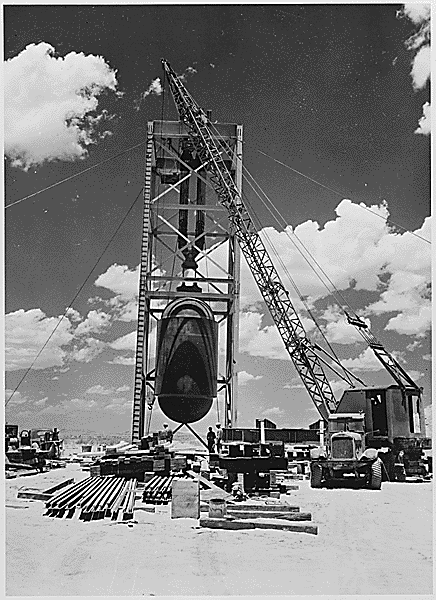
Rare color photograph of the first nuclear test at Trinity site, July 16, 1945. Blurriness is in the original photograph (done when color photography was still fairly new). (Photo credit: Wikipedia)
Spread the word; friends don't allow friends to repeat history.
Little towns in Kansas look like neutron bomb test sites. Especially on a Saturday afternoon, there are no people. Many of the buildings look as though they haven’t been occupied since Dwight Eisenhower was president.
But there’s a cafe in Scott, Kansas, about the intersection of U.S 40 and U.S. 83, that looks like a new business in an old building, the Road Kill Grill. It’s motto:
“Road Kill Grill: For diners with discerning tastes.”
As the astrophysicist Neil deGrasse Tyson put it on the Hayden Planetarium website, “Manhattanhenge may just be a unique urban phenomenon in the world, if not the universe.”
Surely there is a phenomenon almost as cool, somewhere in the American Midwest or Mountain West, perhaps, where the good Presbyterian, Lutheran and Mormon pioneers laid out their cities and entire states with clean Cartesian grids . . . anyone got information to correct Dr. Tyson?
Maybe the question to ask, perhaps from Tyson, is how to calculate when an east-west street in your town might get a “henge” moment.
Sunrise at Delicate Arch, Arches National Park, by Alex Savage
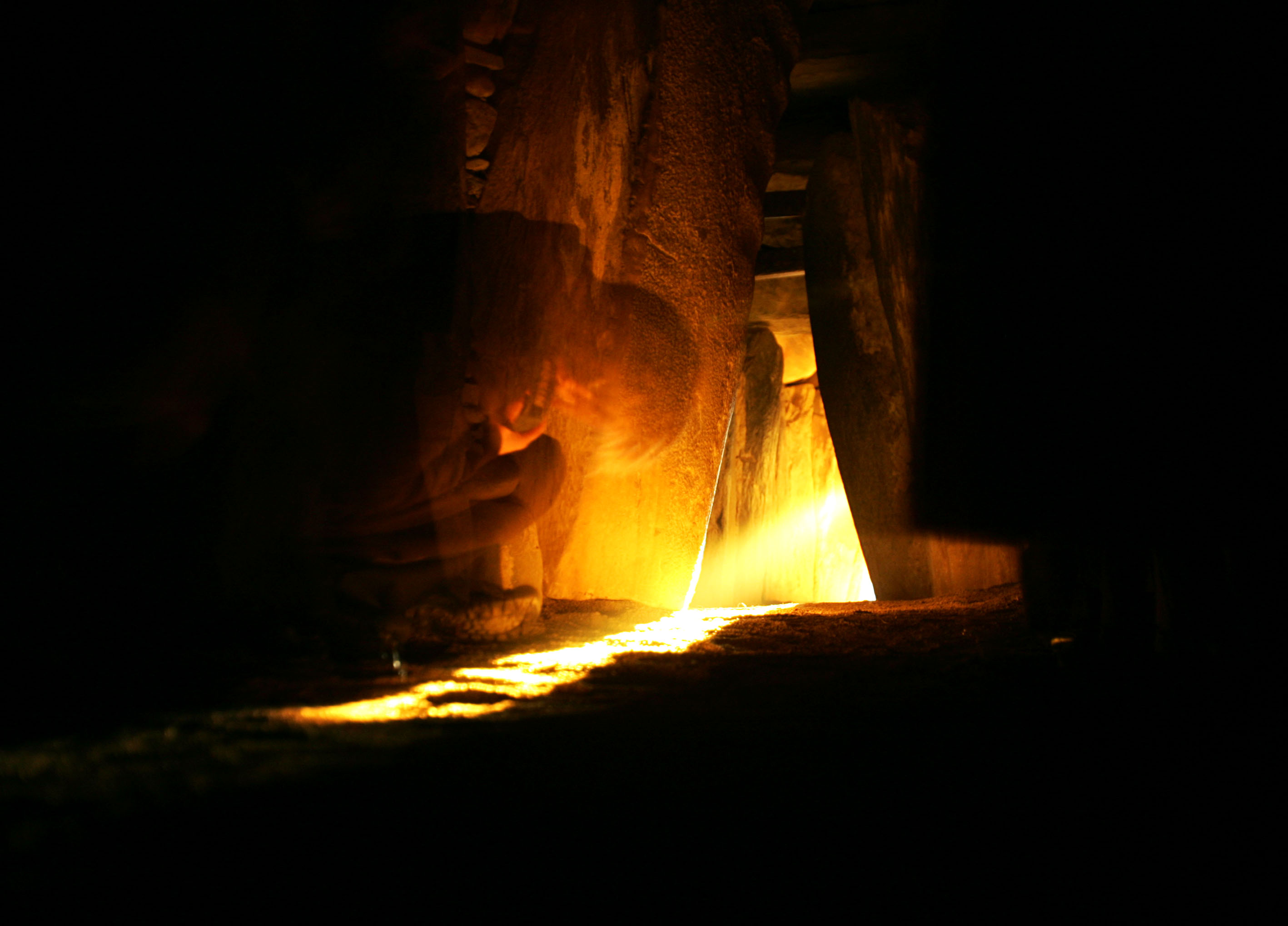
December 20, 2009, solstice sunrise at Newgrange, Ireland – Photograph by Cyril Byrne – courtesy of The Irish Times (Astronomy Picture of the Day, NASA)
For classroom purposes, I wish it didn’t include the names of each location as they go, but surely you can figure out some use for this in geography studies.
Matt hisse’f says:
The cities that didn’t make it into the final cut will be in the outtakes video that we’re putting up soon!
Why does time-lapse photography fascinate me so? It reveals changes over time we too often miss, or don’t stop to appreciate.
Here’s an excerpt from a 1975 film, set to music recently released. Watch closely, you’ll see the shadows of the World Trade Center passing over New York City.
Described at Youtube:
A music video for the gorgeous track “Exercise #3 (Building) by CFCF (Mike Silver). Song is from his upcoming EP titled “Exercises,” which arrives on April 24th via Paper Bag Records.
Footage is from the 1975 short film “Organism,” by Hilary Harris.
Short Wikipedia listing for Hilary Harris; geography and AP human geography teachers may especially appreciate some of Harris’s work, including Highway from 1958, and the 1962 Academy Award Winner Seaward the Great Ships
Perhaps one of the bigest and most listened to advocates of using infographics and data vis in the classroom is Diana Laufinberg, from The Science Leadership Academy. Diana, a History teacher, is a long time user of geographic information systems (GIS). She has recently, however, started helping her students to create their own infographics from complex issues that are part of her course of study and/or part of current events.
I do love the tops of mountains, and I wish I could climb them. Fortunately, there are cameras, people who know how to use them, and people who know how to edit film to tell a story, and put us all in awe.
Plus, living among us are people brave enough and skilled enough to get to the tops of those mountains, people who make the filming possible and worthwhile.
In summer 2010, Lorna Illingworth, Madaleine Sorkin and I spent 25 days in the Cirque of the Unclimbables, Northwest Territories, Canada. Our goal was to free climb the entire 1963 Original Route on the sheer 2000′ Southeast Face of Proboscis, and grants from the American Alpine Club encouraged us to document the adventure. The result: Women at Work (VI 5.12 R).
Geography: Off the Nahanni River, now in the expanded Nahanni National Park, in the Northwest Territories near the border with the Yukon Territory — see maps below.
I continue to like time-lapse photo compilations, and I continue to wonder about how to use them to expand geography teaching. It’s a great circle route, over the Arctic nearing the North Pole. This movie comes from Nate Bolt, who posts his work at Beepshow.
Obviously I’m not the only one who likes it — between the YouTube and Vimeo sites, the movie has more than 4 million viewers.
I shot a photo roughly every two miles between take-off in San Francisco and landing in Paris CDG to make this airplane time lapse. For some reason the Vimeo version of this is more linked to: http://vimeo.com/21822029
Shot with a 5d2, a time-lapse controller, and a 16mm – 35mm, mixed with some iPhone shots. The flight path from SF to Paris goes well over greenland and the arctic circle, where you can see “northern” lights from all sides of the plane, which explains why I could shoot them facing South.
Big thanks to the folks at http://uxlondon.com for inviting me to europe to speak – if it wasn’t for them I wouldn’t have made the trip. The music is a modified template of “Gain” used with permission from DETUNE ltd. denkitribe http://soundcloud.com/denkitribe/gain – I created this arrangement on the Korg iMS20 iPad App, and it’s my first custom score. Edits and pans in After Effects CS5 and iMovie.
The photos during take-off and landing are all computer models and totally rendered because I would never use an electronic device during times when the FAA prohibits them. I did get lucky and have a whole row to myself to setup the tripod and gear.
Thanks to my neighbors for not minding an SLR click every 2 to 30 seconds for 11 hours, and thanks to the whole Air France flight crew for being insanely friendly and allowing me to shoot. Thanks to @ztaylor for showing me the Korg iMS20 iPad App. Thanks to @jayzombie and the #nerdbird on the way to SXSW this year for helping me come up with the idea. Thanks to @somnabulent for the idea of live scoring. Thanks to you for actually reading this far. You are a champion.
Every time I pick up an issue of Boys’ LifeI think how much better students could perform if they just looked that this magazine once a month; you don’t have to be a Scout to subscribe, but why not live the adventures, too?
Will 30-second montages sell more magazines? What more could/should Boys’ Life do on the web?
Here’s an example of the sorts of skills I wish my students had, again from the Boys’ Life YouTube offerings. In “Cache Me If You Can,” these are young Scouts, I’m guessing ages 11 to about 13 from a Troop 6 somewhere in Colorado, out navigating a path through the woods using GPS and hand-held ham radios. I fear most of my 16-18-year-old students would be challenged to do the stuff these younger kids are doing, if they could do it at all.
Of course, while those skills would make them better students more able to understand and use maps and charts, very little of those skills are listed in the Texas Essential Knowledge and Skills. I’m given neither time nor resources to teach them.
More, resources:
A feature at the Boys’ Life site I really like is the “Wayback Machine,” which allows viewing of many issues of the magazine dating back to 1911 — actualy from March 1911 through December 2009. Alas, the features uses Google Books, so viewing at the site is about all you can do — no copying of the great covers by Boy Scouts of America art director Norman Rockwell, no copying of articles with teachable skills for use as illustrations in lessons. This would be a good research site for high school history projects — Scouts in time of war, Scouting and education, map use, youth in exploration, etc.
Spread the word; friends don't allow friends to repeat history.
On Jan. 3, 1959, President Dwight Eisenhower signed a proclamation admitting Alaska to the Union as the 49th state. The New York Times noted that the signing included the unveiling of the new 49-star American flag.
The land that became Alaska came into U.S. possession in 1867, when William Seward, secretary of state under President Andrew Johnson, negotiated a deal to buy the 586,000-square-mile area from Russia for $7.2 million, less than 2 cents per acre. Seward’s decision was ridiculed in the American press, who saw no potential in the vast, inhospitable and sparsely populated area.
For decades after its purchase, Alaska was derided as “Seward’s folly” or “Seward’s icebox.” This opinion changed in 1896 with the discovery of gold in the neighboring Yukon Territory, which spurred tens of thousands of people to head to Alaska in search of gold. The gold rush also brought about a boom in mining, fishing and trapping.
Though the first statehood bill had been presented to Congress in 1916, there was little desire in either Alaska or Washington for Alaskan statehood until after World War II. During the war, the U.S. established multiple military bases to resist Japan’s attacks on Alaska’s Aleutian Islands and prevent a potential invasion of the mainland. The military activity, along with the completion of a major highway from Montana, led to a large population growth.
In 1946, Alaskans voted in favor of statehood in a referendum and Alaskan delegates began to lobby Congress for statehood. After years of debate, Congress voted in June 1958 to admit Alaska.
Eight months after Alaska’s admission, on Aug. 21, 1957 [should be 1959, no?], Hawaii became the 50th state. The 49-star remained in place until the following July 4, when it was replaced by the now-familiar 50-star flag.
49-star flags were produced only until August 1959, so there are few of them around. I love this photo of the unveiling of the flag with President Eisenhower:
“Quartermaster General MG Andrew T. McNamara and President Eisenhower examine new 49 star flag” – image and caption from the Quartermaster Foundation. (Who are the other two people? The guy on the right looks to me a bit like is Pennsylvania’s Sen. Hugh Scott.)
How did the nation survive for 170 years without firm, decisive and conclusive orders on what the flag should look like? Isn’t it a great story that we went so long without law setting the requirements?
Alaska’s flag was designed by 13-year-old Benny Benson
Or, until that account is unsuspended by the forces supporting Donald Trump: Follow @FillmoreWhite, the account of the Millard Fillmore White House Library
We've been soaking in the Bathtub for several months, long enough that some of the links we've used have gone to the Great Internet in the Sky.
If you find a dead link, please leave a comment to that post, and tell us what link has expired.
Thanks!
Retired teacher of law, economics, history, AP government, psychology and science. Former speechwriter, press guy and legislative aide in U.S. Senate. Former Department of Education. Former airline real estate, telecom towers, Big 6 (that old!) consultant. Lab and field research in air pollution control.
My blog, Millard Fillmore's Bathtub, is a continuing experiment to test how to use blogs to improve and speed up learning processes for students, perhaps by making some of the courses actually interesting. It is a blog for teachers, to see if we can use blogs. It is for people interested in social studies and social studies education, to see if we can learn to get it right. It's a blog for science fans, to promote good science and good science policy. It's a blog for people interested in good government and how to achieve it.
BS in Mass Communication, University of Utah
Graduate study in Rhetoric and Speech Communication, University of Arizona
JD from the National Law Center, George Washington University


 Posted by Ed Darrell









 Millard Fillmore's Bathtub