Nobody called for DDT to fight West Nile?

September 28, 2009

Was I too busy to notice?

With the exception of Glenn Beck’s idiot return to 1950s science in an effort to bring back 1950s politics, I didn’t see any major calls for DDT to be brought back to fight West Nile Virus this summer, not even from the Hoover Institute.

DDT is particularly ill-adapted for fighting West Nile Virus.  The mosquitoes that carry it are best fought in the larval stage, before they mature.  DDT is exactly wrong for water applications.

But that didn’t stop people from asking for DDT as a barrier to WNV in the past.  Is some intelligence taking hold now?

Did I miss the editorials?  Maybe it was a better summer than it felt like.

(Still fighting stupidity on bedbugs — taking longer than it should.)

Add to FacebookAdd to NewsvineAdd to DiggAdd to Del.icio.usAdd to StumbleuponAdd to RedditAdd to BlinklistAdd to TwitterAdd to TechnoratiAdd to Furl


Peter Sinclair update: Mars still doesn’t deny Earth’s warming

September 21, 2009

Cleverly avoiding real discussion of greenhouse gases and their effects on Venus, climate change denialists often claim warming to be a solar system-wide event, caused by the Sun — evidenced, they say, by warming on all the other planets in the solar system.

Peter Sinclair’s “Climate Denial Crock of the Week” dealt with the issue several months ago, but he’s redone the piece, with improvements in sound especially.

Spread the word:

Add to FacebookAdd to NewsvineAdd to DiggAdd to Del.icio.usAdd to StumbleuponAdd to RedditAdd to BlinklistAdd to TwitterAdd to TechnoratiAdd to Furl


Climate change denialists cripple American industry

September 16, 2009

Did you see Tom Friedman’s column today?

Is there any way to interpret away his conclusions that the war against green jobs is killing American industry?

Is there any way he could be wrong?  Read it; doesn’t it make you want to fix things?

O.K., so you don’t believe global warming is real. I do, but let’s assume it’s not. Here is what is indisputable: The world is on track to add another 2.5 billion people by 2050, and many will be aspiring to live American-like, high-energy lifestyles. In such a world, renewable energy — where the variable cost of your fuel, sun or wind, is zero — will be in huge demand.

China now understands that. It no longer believes it can pollute its way to prosperity because it would choke to death. That is the most important shift in the world in the last 18 months. China has decided that clean-tech is going to be the next great global industry and is now creating a massive domestic market for solar and wind, which will give it a great export platform.

In October, Applied will be opening the world’s largest solar research center — in Xian, China. Gotta go where the customers are. So, if you like importing oil from Saudi Arabia, you’re going to love importing solar panels from China.


Van Jones: LGF got it right

September 6, 2009

Van Jones’s advantages, added together, summed too closely to the detrimental sum of having him as an advisor in the executive branch, I think.

But Glenn Beck’s unprincipled attack on Jones as a “9/11 truther” brought up issues that were not among the baggage Jones carried. Little Green Footballs explained that Jones’s statement that he didn’t call for an investigation of George Bush seems to be accurate.  LGF has no authors who trend to the liberal side (are there even any Dems there?).

With such a target-rich guy as Jones, why does Beck go with the least credible evidence possible?  When the facts flow your way, why make stuff up?  Beck’s bizarre claims about DDT offer more evidence the guy has just floated around the bend in the reality and ethical river.  More on that later.

Millard Fillmore’s Bathtub said Little Green Footballs was right? Better spread that news!

Add to FacebookAdd to NewsvineAdd to DiggAdd to Del.icio.usAdd to StumbleuponAdd to RedditAdd to BlinklistAdd to TwitterAdd to TechnoratiAdd to Furl


Global cooling? Sure, if only warming weren’t overpowering nature

September 5, 2009

If you do not read Robert Park regularly, you should.  His weekly missive on September 4 succinctly deals with the two big climate change stories of the week, with vim and vigor:

1.  CLIMATE CHANGE: HOTTEST ARCTIC SUMMER IN 2,000 YEARS.
A major study published in today’s Science marks a seminal advance in Sediments from Arctic lakes were used to compile proxy for the last 2000 years.  Arctic summer temperature declined for thousands of years due to a shift in Earth’s orbit.  Although the orbital shift has been going on for 8000 years and will continue, an increase in greenhouse gases produced by the overpowered the cooling trend. The warming has been more rapid since about 1950.  Moreover, thawing permafrost will release methane into the atmosphere, accelerating warming.  The latest study comes just months after scientists at NOAA warned that within the next 30 years Arctic sea ice could vanish completely during the summer; that will further accelerate warming due to decline in reflective ice cover.

2.  CLIMATE SOLUTIONS: IN THE LONG RUN, THERE IS ONLY ONE.
Even as the study on Arctic warming was making its way into print, a group at the controversial Center proposed a quick geo-engineered solution to.  The group is headed by statistician Bjorn Lomborg, a follower of the late Julian Simon, the libertarian economist at the University of Maryland, who believed there are no limits.  Lomborg proposes puffing lots of white clouds into the atmosphere to reflect sunlight.  It would be the perfect job for Lomborg, who has been puffing clouds of obscurantism since he wrote
(Cambridge, 2001).  Presumably we should just keep puffing out bigger white clouds to compensate for the ever growing population.

White clouds of vapor indeed.  Park is a great fog-cutter.

For example, there is this note from his August 28 edition:

3. SCOPES REDUX: LOBBYISTS MAY BE NOSTALGIC FOR DAYTON.
Newspapers around the country have carried the story of the US Chamber of Commerce, the top US lobbying group, calling for the EPA to hold a Scopes- like hearing on the evidence that climate change is man-made. The EPA dismisses such a stunt as a “waste of time,” but that’s the least of its problems. Having lost the contest over scientific peer review of journal articles, the global warming deniers are accused have cooked up a Hollywood stunt.

Global warming deniers are steamed, and may just stew.

More:


More evidence of climate change: Arctic methane hydrates evaporating

August 21, 2009

It’s a pretty picture, but it should strike a bit of fear once you know what it is.

New Scientist explains:

Sonar image of methane plumes rising from methane hydrates on the Arctic Ocean floor; image from National Oceanography Centre, Southampton (Britain)

Sonar image of methane plumes rising from methane hydrates on the Arctic Ocean floor; image from National Oceanography Centre, Southampton (Britain)

It’s been predicted for years, and now it’s happening. Deep in the Arctic Ocean, water warmed by climate change is forcing the release of methane from beneath the sea floor.

Over 250 plumes of gas have been discovered bubbling up from the sea floor to the west of the Svalbard archipelago, which lies north of Norway. The bubbles are mostly methane, which is a greenhouse gas much more powerful than carbon dioxide.

The methane is probably coming from reserves of methane hydrate beneath the sea bed. These hydrates, also known as clathrates, are water ice with methane molecules embedded in them.

The methane plumes were discovered by an expedition aboard the research ship James Clark Ross, led by Graham Westbrook of the University of Birmingham and Tim Minshull of the National Oceanography Centre, Southampton, both in the UK.

Fortunately, the methane is not making it out of the water — yet.  The gases are absorbed before they get to the surface — but that increases ocean acidity.  If, and when, the methane hits the atmosphere, it will contribute to greenhouse warming of the planet.  This could create a runaway heat effect:  Warmer waters cause hydrates to release methane to the atmosphere, which causes the atmosphere to warm more, faster.

Scientists have not dismissed all other possibilities, but methane hydrate melting is the most likely cause:

Cohen cautions that the Arctic methane may not be from hydrate, but could be coming from the methane’s primary source, which might be deep within the Earth.

If that was the case, the warming of the West Spitsbergen current may not be to blame.

He says that the large amounts of methane being released make this unlikely, however: “If the methane is all primary, it would be an unprecedented amount.” So the idea that the hydrates are at least partly to blame is more plausible. “It’s not definitively proven, but it’s certainly reasonable,” he says.


Alaska’s salmon go missing. Why?

August 21, 2009

It’s one of those environmental mysteries that would be fun and intrigueing, were it not so worrisome.

Alaska’s King Salmon disappeared from traditional river runs this year.  Again.

From Reuters:  A sockeye salmon scurries through shallow water in the Adams River while preparing to spawn near Chase, British Columbia northeast of Vancouver October 11, 2006.  REUTERS/Andy Clark

From Reuters: "A sockeye salmon scurries through shallow water in the Adams River while preparing to spawn near Chase, British Columbia northeast of Vancouver October 11, 2006. REUTERS/Andy Clark"

Reasons could be one of many, or several:  Changing ocean currents, pollock fishing accidental catches of salmon, plankton blooms, conditions on the rivers, competition from “ranched” salmon.

Consumers may see only the rise in price and a change in labeling in the supermarket.

Effects on employment and food supply in Alaska are huge, and crippling.

Canada fisheries are affected, too.

Climate change probably plays a role, in any scenario anyone poses:

“It’s quite the shocking drop,” said Stan Proboszcz, fisheries biologist at the Watershed Watch Salmon Society. “No one’s exactly sure what happened to these fish.”

Salmon are born in fresh water before migrating to oceans to feed. They return as adults to the same rivers to spawn.

Several theories have been put forward to try to explain the sockeye’s disappearance:

* Climate change may have reduced food supply for salmon in the ocean.

* The commercial fish farms that the young Fraser River salmon pass en route to the ocean may have infected them with sea lice, a marine parasite.

* The rising temperature of the river may have weakened the fish.

The Canadian government doesn’t know what’s killing the fish, but believes the sockeye are dying off in the ocean, not in fresh water, based on healthy out-migrations, said Jeff Grout, regional resource manager of salmon for the Department of Fisheries and Oceans.

In this case, even a small change in climate can have huge effects on ecosystems and specific populations of animals.  It’s one of those climate change issues that climate change skeptics and denialists prefer not to talk about at all.  If, as they allege, concern over climate change is entirely political, driven by bad information and false claims from over-active environmentalists, these problems should not exist at all.

But the problems do exist.  A fishery that had been stable for 50 years previously, the entire time it was tracked so carefully, suddenly becomes fishless.  Watch those rivers and fisheries.

Tip of the old scrub brush to Pamela Bumsted.

Help save the salmon; tell others:

Add to FacebookAdd to NewsvineAdd to DiggAdd to Del.icio.usAdd to StumbleuponAdd to RedditAdd to BlinklistAdd to TwitterAdd to TechnoratiAdd to Furl


How about another cup of coffee? (Global Warming Conspiracy)

August 18, 2009

Encore post from September 17, 2007 — maybe more appropriate today than ever before.

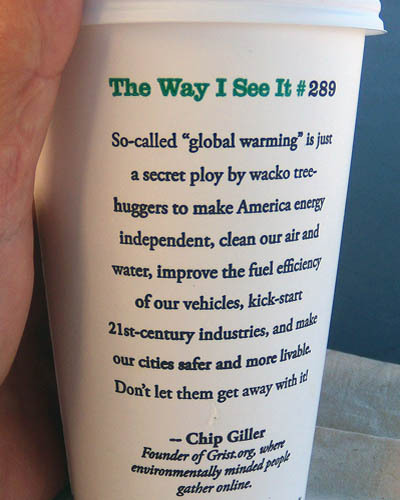
Found this on my coffee cup today:

The Way I See It #289

So-called “global warming” is just

a secret ploy by wacko tree-

huggers to make America energy

independent, clean our air and

water, improve the fuel efficiency

of our vehicles, kick-start

21st-century industries, and make

our cities safer and more livable.

Don’t let them get away with it!

Chip Giller
Founder of Grist.org, where
environmentally-minded people
gather online.

Starbucks Coffee Cup, The Way I See It #289 (global warming)

Look! Someone found the same cup I found!

Add to FacebookAdd to NewsvineAdd to DiggAdd to Del.icio.usAdd to StumbleuponAdd to RedditAdd to BlinklistAdd to TwitterAdd to TechnoratiAdd to Furl

Save


New junk science movie: “Not evil, just wrong”

August 16, 2009

I warned you about it earlierCrank science sites across the internet feature news of another cheap hit on Rachel Carson and science in movie form.

“Not Evil, Just Wrong” is slated for release on October 18. This is the film that tried to intrude on the Rachel Carson film earlier this year, but managed to to get booked only at an elementary school in Seattle, Washington — Rachel Carson Elementary, a green school where the kids showed more sense than the film makers by voting to name the school after the famous scientist-author.

The film is both evil and wrong.

Errors just in the trailer:

  1. Claims that Al Gore said sea levels will rise catastrophically, “in the very near future.”  Not in his movie, not in his writings or speeches.  Not true.  That’s a simple misstatement of what Gore said, and Gore had the science right.
  2. ” . . . [I]t wouldn’t be a bad thing for this Earth to warm up.  In fact, ice is the enemy of life.”  “Bad” in this case is a value judgment — global warming isn’t bad if you’re a weed, a zebra mussel, one of the malaria parasites, a pine bark beetle, any other tropical disease, or a sadist.  But significant warming as climatologists, physicists and others project, would be disastrous to agriculture, major cities in many parts of the world, sea coasts, and most people who don’t live in the Taklamakan or Sahara, and much of the life in the ocean.  Annual weather cycles within long-established ranges, is required for life much as we know it.  “No ice” is also an enemy of life.
  3. “They want to raise our taxes.”  No, that’s pure, uncomposted bovine excrement.
  4. “They want to close our factories.”  That’s more effluent from the anus of male bovines.
  5. The trailer notes the usual claim made by Gore opponents that industry cannot exist if it is clean, that industry requires that we poison the planet.  Were that true, we’d have a need to halt industry now, lest we become like the yeast in the beer vat, or the champagne bottle, manufacturing alcohol until the alcohol kills the yeast.  Our experience with Rivers and Harbors Act of 1899, the Clean Air Acts and the Clean Water Act is that cleaning the environment produces economic growth, not the other way around.  A city choked in pollution dies.  Los Angeles didn’t suffer when the air got cleaner.  Pittsburgh’s clean air became a way to attract new industries to the city, before the steel industry there collapsed.  Cleaning Lake Erie didn’t hurt industry.  The claim made by the film is fatuous, alarmist, and morally corrupt.

    When the human health, human welfare, and environmental effects which could be expressed in dollar terms were added up for the entire 20-year period, the total benefits of Clean Air Act programs were estimated to range from about $6 trillion to about $50 trillion, with a mean estimate of about $22 trillion. These estimated benefits represent the estimated value Americans place on avoiding the dire air quality conditions and dramatic increases in illness and premature death which would have prevailed without the 1970 and 1977 Clean Air Act and its associated state and local programs. By comparison, the actual costs of achieving the pollution reductions observed over the 20 year period were $523 billion, a small fraction of the estimated monetary benefits.

  6. “Some of the environmental activists have not come to accept that the human is also part of the environment.”  Fatuous claim.  Environmentalists note that humans uniquely possess the ability to change climate on a global scale, intentionally, for the good or bad; environmentalists choose to advocate for actions that reduce diseases like malaria, cholera and asthma.  We don’t have to sacrifice a million people a year to malaria, in order to be industrial and productive.  We don’t have to kill 700,000 kids with malaria every year just to keep cars.
  7. “They want to go back to the Dark Ages and the Black Plague.”  No, that would be the film makers.  Environmentalists advocate reducing filth and ignorance both.  Ignorance and lack of ability to read, coupled with religious fanaticism, caused the strife known as “the Dark Ages.”  It’s not environmentalists who advocate an end to cheap public schools.
  8. The trailer shows a kid playing in the surf on a beach.  Of course, without the Clean Water Act and other attempts to keep the oceans clean, such play would be impossible.  That we can play again on American beaches is a tribute to the environmental movement, and reason enough to grant credence to claims of smart people like Al Gore and the scientists whose work he promotes.
  9. “I cannot believe that Al Gore has great regard for people, real people.”  So, this is a film promoting the views of crabby, misanthropic anal orifices who don’t know Al Gore at all?  Shame on them.  And, why should anyone want to see such a film?  If I want to see senseless acts of stupidity, I can rent a film by Quentin Tarantino and get some art with the stupidity.  [Update, November 23, 2009: This may be one of the most egregiously false charges of the film.  Gore, you recall, is the guy who put his political career and presidential ambitions on hold indefinitely when his son was seriously injured in an auto-pedestrian accident; Gore was willing to sacrifice all his political capital in order to get his son healed.  My first dealings directly with Gore came on the Organ Transplant bill.  Gore didn’t need a transplant, didn’t have need for one in his family, and had absolutely nothing to gain from advocacy for the life-saving procedure.  It was opposed by the chairman of his committee, by a majority of members of his own party in both Houses of Congress, by many in the medical establishment, by many in the pharmaceutical industry, and by President Reagan, who didn’t drop his threat to veto the bill until he signed it, as I recall.   Gore is a man of deep, human-centered principles.  Saying “I can’t believe Al Gore has great regard for real people” only demonstrates the vast ignorance and perhaps crippling animus of the speaker.]

That’s a whopper about every 15 seconds in the trailer — the film itself may make heads spin if it comes close to that pace of error.

Where have we seen this before?  Producers of the film claim as “contributors” some of the people they try to lampoon — people like Ed Begley, Jr., and NASA’s James E. Hansen, people who don’t agree in any way with the hysterical claims of the film, and people who, I wager, would be surprised to be listed as “contributors.”

It’s easy to suppose these producers used the same ambush-the-scientist technique used earlier by the producers of the anti-science, anti-Darwin film “Expelled!

Here, see the hysteria, error and alarmism for yourself:

Ann McElhinney is one of the film’s producers.  Her past work includes other films against protecting environment and films for mining companies.  She appears to be affiliated with junk science purveyors at the Competitive Enterprise Institute, an astro-turf organization in Washington, D.C., for whom she flacked earlier this year (video from Desmogblog):

Remember, too, that this film is already known to have gross inaccuracies about Rachel Carson and DDT, stuff that high school kids could get right easily.

Anyone have details on McElhinney and her colleague, Phelim McAlee?

More:

Related posts, at Millard Fillmore’s Bathtub:

Please spread the word:

Add to FacebookAdd to NewsvineAdd to DiggAdd to Del.icio.usAdd to StumbleuponAdd to RedditAdd to BlinklistAdd to TwitterAdd to TechnoratiAdd to Furl


Straight talk: Berenbaum on DDT and malaria

August 12, 2009

Plus, she’ll answer your questions.

But hurry.

One of the world’s great authorities on mosquitoes, May Berenbaum at the University of Illinois Urbana-Champaign, spends this week talking about mosquitoes and malaria, and answering your questions.

Public Radio International runs a feature this week with Dr. Berenbaum answering questions.

(Hey, Beck!  Are you decent this week?)

(Steven Milloy?  Got the guts to ask a real scientist a question?)

You should see these first:

Life Cycle of Malaria, WHO and Campaign to Roll Back Malaria

Life Cycle of Malaria, WHO and Campaign to Roll Back Malaria

You like straight talk – why not share it with others?

Add to FacebookAdd to NewsvineAdd to DiggAdd to Del.icio.usAdd to StumbleuponAdd to RedditAdd to BlinklistAdd to TwitterAdd to TechnoratiAdd to Furl


Global cooling? That would be good news for the forests

August 12, 2009

Climate change denialists (sorry, Mr. Watts – denialism is what it is) frequently argue that since the peak heat year of 1998, the planet has been cooling, and may be in a long-term trend to a much cooler planet.

Has anyone told the beetles?

Has anyone told the pine bark beetles (Dendroctonus ponderosae) that are devastating North American forests?

Colorado conifers affected by pine bark beetles (brown trees are dead) - image from Chad Crawford,  Homebrewed Christianity

Colorado conifers affected by pine bark beetles (brown trees are dead) - image from Chad Crawford, Homebrewed Christianity

I was interested to find this photo and this post at Homebrewed Christianity, by Chad Crawford.

But my trips to the mountains are always simultaneously joyful and mournful. The story I want to tell is about seeing the effects up close of the North American pine beetle outbreak. It’s devastating the Rocky Mountain forests in the U.S. and Canada and growing exponentially each year. The epidemic is occurring because our winters have not been cold enough to stop the beetles from multiplying. Bark beetles are good for the ecosystem, but not in this amount. The fall colors in our evergreen forests are telling us that global warming is no longer something our kids will face; it’s happening now. And it will accelerate if our forests disappear.

Mr. Watts, it’s not me you have to convince.  There are several millions of beetles in Colorado who must be persuaded the climate is not warming — and they’ll be a tough sell, since a colder climate means death to their future generations.

A greater challenge for you, Mr. Watts:  Not one of those beetles reads your blog.  How will you reach them?

Crawford went to Colorado and saw Fr. Thomas Berry.  Maybe we should buy a ticket to Colorado for Watts.


Christian environmental stewardship: Disciples of Christ and the Alverna Covenant

August 5, 2009

I learned something new tonight.  The Disiciples of Christ formally adopted wise environmental stewardship as a denominational goal in 1981.

History of the Alverna Covenant

The Alverna Covenant was written by members of the Task Force on Christian Lifestyle and Ecology of the Christian Church (Disciples of Christ) while meeting at Alverna Retreat Center, a Franciscan retreat in Indianapolis, Ind. The name has added significance. Alverna is named for Mt. Alverna in Italy, the mountain retreat given to Francis of Assisi. Francis is honored for his concern for the care of and relatedness of all creation. The 800th anniversary of Francis’ birth was celebrated in 1981, the year the Alverna Covenant was first introduced at the General Assembly of the Christian Church (Disciples of Christ).

The Alverna Covenant

Whereas:

  • God has created the world with finite resources;
  • God has given to us the stewardship of the earth;
  • God has established order through many natural cycles.

And it is evident that:

  • We are consuming resources at a rate that cannot be maintained;
  • We are interrupting many natural cycles;
  • We are irresponsibly modifying the environment through consumption and pollution;
  • We are populating the earth at a rate that cannot be maintained;

As a member of the human family and a follower of Jesus Christ, I hereby covenant that:

  • I will change my lifestyle to reduce my contribution to pollution;
  • I will support recycling efforts;
  • I will search for sustainable lifestyles;
  • I will work for public policies which lead to a just and sustainable society;
  • I will share these concerns with others and urge them to make this Covenant.
  • What other denominations have statements on wise resource stewardship? What do they say?

    Tip of the old scrub brush to Darrel Manson, who writes at Hollywood Jesus.

    Resources:


    Press release on polar bears the climate change skeptics hope you won’t read

    August 2, 2009

    Why did the self-proclaimed skeptics work so hard to discredit this meeting before it even occurred?  Why have they ignored this press release?

    Take it easy! Calm down, stick to the facts! Polar bear photo by Kathy Crane, NOAA Arctic Research Office

    “Take it easy! Calm down, stick to the facts!” Polar bear photo by Kathy Crane, NOAA Arctic Research Office

    There is no dramatic finding in the release.  After you read it, you’ll probably wonder, too, why climate change skeptics don’t want you to read this press release:

    15th meeting of PBSG in Copenhagen, Denmark 2009

    PRESS RELEASE

    The 15th meeting of the IUCN Polar Bear Specialist Group (PBSG), hosted by the Greenland Institute of Natural Resources, was held at the Greenland Representation in Copenhagen Denmark , June 29-July 3, 2009.  The Polar Bear Specialist Group is composed of researchers and managers representing each of the five circumpolar nations that signed the International Agreement for the Conservation of Polar Bears of 1973.  Since the late 1960s, the members of PBSG have met every 3 to 5 years under the umbrella of the Species Survival Commission of the IUCN (the International Union for the Conservation of Nature and Natural Resources) to review and exchange information, and make recommendations for research and management of polar bears throughout the Arctic.

    The PBSG renewed the conclusion from previous meetings that the greatest challenge to conservation of polar bears is ecological change in the Arctic resulting from climatic warming.  Declines in the extent of the sea ice have accelerated since the last meeting of the group in 2005, with unprecedented sea ice retreats in 2007 and 2008. The PBSG confirmed its earlier conclusion that unabated global warming will ultimately threaten polar bears everywhere.

    The PBSG also recognized that threats to polar bears will occur at different rates and times across their range although warming induced habitat degradation and loss are already negatively affecting polar bears in some parts of their range. Subpopulations of polar bears face different combinations of human threats.  The PBSG recommends that jurisdictions take into account the variation in threats facing polar bears.

    The PBSG noted polar bears suffer health effects from persistent pollutants.  At the same time, climate change appears to be altering the pathways by which such pollutants enter ecosystems. The PBSG encourages international efforts to evaluate interactions between climate change and pollutants.

    The PBSG endorses efforts to develop non-invasive means of population assessment, and continues to encourage jurisdictions to incorporate capture and radio tracking programs into their national monitoring efforts. The members also recognized that aboriginal people are both uniquely positioned to observe wildlife and changes in the environment, and their knowledge is essential for effective management.

    The PBSG recognizes that where habitats are stable, polar bears are a renewable resource, and reaffirmed its support of the right of aboriginal groups to harvest polar bears within sustainable limits.  The PBSG noted that the population of polar bears in Baffin Bay, shared between Greenland and Canada, may simultaneously be suffering from significant habitat change and substantial over harvest, while at the same time interpretations by scientists and local hunters disagree regarding population status.  Similarly, the Chukchi Sea polar bear population which is shared by Russia and the United States is likely declining due to illegal harvest in Russia and one of the highest rates of sea ice loss in the Arctic. Consistent with its past efforts to coordinate research and management among jurisdictions, the PBSG recommended that the polar bear populations in Baffin Bay and the Chukchi Sea be reassessed and that harvests be brought into balance with the current sustainable yield.

    A variety of management changes have occurred since the PBSG last met in 2005.  The PBSG members were particularly pleased that quotas for the harvest of polar bears in Greenland were implemented in January 2006, and that quota reductions have been implemented in some parts of Greenland.  Also since the last meeting, the government of Nunavut reduced the harvest quota in Western Hudson Bay because of the documented population decline.

    The PBSG reevaluated the status of the 19 recognized subpopulations of polar bears distributed over vast and relatively inaccessible areas of the Arctic. Despite the fact that much new information has been made available since the last meeting, knowledge of some populations is still poor.  Reviewing the latest information available the PBSG concluded that 1 of 19 subpopulations is currently increasing, 3 are stable and 8 are declining.  For the remaining 7 subpopulations available data were insufficient to provide an assessment of current trend.  The total number of polar bears is still thought to be between 20,000 and 25,000.  However, the mixed quality of information on the different subpopulations means there is much room for error in establishing that range.  That potential for error, given the ongoing and projected changes in habitats and other potential stressors is cause for concern.  Nonetheless, the PBSG is optimistic that humans can mitigate the effects of global warming and other threats to polar bears, and ensure that they remain a part of the Arctic ecosystem in perpetuity.

    Dr. Erik Born from the Greenland Institute of Natural Resources was elected as the new chairman of the group after Dr. Andrew Derocher from the University of Alberta, who has been serving as chair since 2005.

    Well, there is that proclamation of optimism in the penultimate paragraph, that humans can mitigate threats to bears, including global warming.  Is that why they don’t want you to read it?

    How are the polar bears?  They are in trouble.  The Polar Bear Specialist Group says we should help them out, that we can do things to save the bears.  Why would the “skeptics” not want us to know that?

    Other resources:

    Save


    War on malaria: Wall Street Journal and bloggers side with malaria

    May 24, 2009

    It’s spring.  Each of the past four years, spring has been the time that the anti-Rachel Carson, anti-environmental protection, anti-environmentalist, pro-DDT groups throttle up their campaigns to impugn Carson and environmentalists, and argue that all we need to do is poison Africa to make the world safe from malaria.

    Here’s where Col. Renault joins us from Casablanca to say “Round up the usual suspects.”  It’s spring 2009.  Henry I. Miller of the Hoover Institution could be along any moment to say we need DDT to fight West Nile Virus, though DDT is not the pesticide of choice even among pesticide professionals.

    The Wall Street Journal has become a favorite venue for these poison-the-Earthers as it has left rational policy decisions behind, at least in the editorial and op-ed pages. Steven Milloy’s got a book out slandering environmentalists, Green Hell, and a new blog to promote the book.  No doubt someone will trot out Gordon Edwards’ Lyndon-Larouche-tainted claims against Rachel Carson, though none of them check out.

    Right on cue:  “Malaria, Politics and DDT – The U.N. bows to the anti-insecticide lobby” from the Wall Street Journal! It appeared in the Saturday edition, May 23.

    Sure enough, Green Hell blog picks it up repeating the old canard about how a day without DDT is like a day of genocide. You can’t teach a stupid dog new tricks, you know.  In a post title that drips with calumny, Milloy says “Greens re-boot African genocide.”  They have no case; smears must do the work.

    Let’s dissect the WSJ piece, eh?

    In 2006, after 25 years and 50 million preventable deaths, the World Health Organization reversed course and endorsed widespread use of the insecticide DDT to combat malaria. So much for that. Earlier this month, the U.N. agency quietly reverted to promoting less effective methods for attacking the disease. The result is a victory for politics over public health, and millions of the world’s poor will suffer as a result.

    So much error in so little space!  The error-to-word ratio may be a new land speed record.

    Were there 2 million deaths per year from malaria, we could say malaria killed 50 million people in the last 25 years.  But for many, or most of the past 35 years, the death rate has hovered around 1 million, sometimes lower.  That’s still too high for those of us who think malaria should be beaten, but it’s not 2 million a year.  WSJ exaggerates the death figures — what else do they exaggerate?  If they have a case, why do they need to exaggerate?

    WHO never abandoned DDT for specific usesThere was no policy for WHO to reverse in 2006.  WHO made it clear that they would continue to use DDT where appropriate, and where local governments would allow.  WSJ, new to the business of caring about Africans afflicted by malaria, doesn’t know the history.

    DDT’s effectiveness against malaria-carrying mosquitoes began to wane by 1950.  By the mid-1960s, many populations of mosquitoes had developed resistance and even immunity to DDT.  That was why the World Health Organization (WHO) abandoned its campaign to eradicate malaria.  Overuse of DDT, especially in agriculture, led to rapid evolution of resistance among mosquitoes.  Without a weapon that worked as DDT had worked before resistance, the campaign could not succeed.

    The Journal is simply wrong when it says only less-effective methods are left. DDT’s greatly reduced effectiveness is part of the reason; but research over the past five years, in tests run broadly in several African nations, shows that bednets reduce malaria infections by between 50% and 85%.  That is much more effective than DDT in broadcast spraying.

    One of the things WSJ fails to mention — maybe they don’t know, there is much demonstration of ignorance in the editorial — is that DDT is not used in broadcast spraying to fight malaria.  Such campaigns proved disastrous because they killed off the predators of mosquitoes more effectively than they killed the mosquitoes, and because they often produced harmful results in other ways.  Along some African rivers, the spraying campaigns killed off a lot of fish local people used for food.  The dangers of DDT have been demonstrated in Africa.

    WHO had championed a campaign in the late 1950s and 1960s to eradicate malaria.  The strategy was to use DDT to knock down local mosquito populations for six months or a year, and in that time treat humans infected with the malaria parasites so that, when the mosquitoes came back, there would be no pool of malaria infection among humans from which to draw malaria to spread.

    Alas, the overuse of DDT caused mosquitoes to develop resistance before the malaria-fighters could get into the field in some places and get the health care components of the campaign to work.

    Because of the worldwide resistance to DDT among insects, DDT cannot be counted on as a panacea against malaria in any case.  While it was never the panacea, never the sole tool to beat the disease, its role has been dramatically reduced by the rise of resistance to the chemical.

    The U.N. now plans to advocate for drastic reductions in the use of DDT, which kills or repels the mosquitoes that spread malaria. The aim “is to achieve a 30% cut in the application of DDT worldwide by 2014 and its total phase-out by the early 2020s, if not sooner,” said WHO and the U.N. Environment Program in a statement on May 6.

    Citing a five-year pilot program that reduced malaria cases in Mexico and South America by distributing antimalaria chloroquine pills to uninfected people, U.N. officials are ready to push for a “zero DDT world.” Sounds nice, except for the facts. It’s true that chloroquine has proven effective when used therapeutically, as in Brazil. But it’s also true that scientists have questioned the safety of the drug as an oral prophylactic because it is toxic and has been shown to cause heart problems.

    Where was the Wall Street Journal when these studies were proposed, when they were run, and when they were reported?  WHO and health care agencies in affected countries carefully worked to find non-DDT solutions to malaria.  All programs to fight malaria require good health care systems, to diagnose malaria in victims, accurately as to the form of parasite affecting the victim, and to treat the disease to restore health to the victim and remove that person from the pool of people from whom mosquitoes can draw new malaria to infect others.  The results are in.  The treatment works.  Now comes WSJ to pose questions that have already been answered?  They are too late, and wrong.

    Most malarial deaths occur in sub-Saharan Africa, where chloroquine once worked but started failing in the 1970s as the parasite developed resistance.

    Fascinating.  In discussions with the pro-DDTers, resistance of mosquitoes to DDT is generally denied.  But here the WSJ cites similar resistance by the parasite.  Remember, dear reader, that the DDTers are selective in their use of evidence.

    Even if the drugs were still effective in Africa, they’re expensive and thus impractical for one of the world’s poorest regions. That’s not an argument against chloroquine, bed nets or other interventions. But it is an argument for continuing to make DDT spraying a key part of any effort to eradicate malaria, which kills about a million people — mainly children — every year. Nearly all of this spraying is done indoors, by the way, to block mosquito nesting at night. It is not sprayed willy-nilly in jungle habitat.

    DDT is more expensive than bednets.  DDT is used now only for indoor residual spraying (IRS).  Hut walls are treated with DDT to kill or repel mosquitoes after they have already bitten a victim; this prevents the spread of some parasites, at least in the bodies of the mosquitoes killed.  IRS requires some expensive work, however.  First, analysis of the mosquitoes must be done to be sure DDT is effective; annd second, a professional or highly-trained person must apply the stuff.  DDT applications have to be repeated about every six months.  They cost about $12.00 each time.  IRS may decrease malaria infection by as much as 35% (I’m being liberal).

    In contrast, bednets decrease malaria infection by 50% to 85%.  They cost about $10.00 for the expensive ones, and they last five years.  In tests and in practice in Africa over the past five years, bednets have proven to be a necessary and very effective method to fight malaria.  Bednets work without DDT (there are alternative chemicals available for IRS); DDT can’t work without bednets.

    There is strong opposition to use of DDT even for IRS, in Uganda, for example, where cotton and tobacco farmers have sued to stop the use.  In other areas, local people still fear fish kills.  DDT is controversial because of local opposition to it, not because of any environmental group’s action.

    And the net result is that DDT is not the cheapest nor most effective method to fight malaria.  It is an increasingly expensive, controversial, and decreasingly effective tool.

    But here is the bottom line:  Unless malaria is wiped out in human hosts, there will always be mosquitoes ready to spread the disease from one infected human to a dozen uninfected humans.  The key to eliminating malaria is not killing every mosquito on Earth, as quixotic a goal as that may be; the key is to develop methods of curing humans quickly and well and interrupting the life cycle of the parasite.  Drugs are expensive?  DDT cannot substitute for drugs, regardless how cheap it is.

    WHO is not saying that DDT shouldn’t be used. But by revoking its stamp of approval, it sends a clear message to donors and afflicted countries that it prefers more politically correct interventions, even if they don’t work as well. In recent years, countries like Uganda, Tanzania and Zambia have started or expanded DDT spraying, often with the help of outside aid groups. But these governments are also eager to remain in the U.N.’s good graces, and donors typically are less interested in funding interventions that WHO discourages.

    These campaigns have provided little success against malaria — nothing on the scale of success of bednets.

    Oddly, one of the greatest roadblocks to the use of DDT in Africa since 2000 was the Bush administration, which refused to allow any U.S. dollars for the purchase of DDT or treatment.  There are foggy signs the Bush policies eased in 2008.  But again, it may simply be that the opportunity to use DDT is gone.  It’s time to move on to fight malaria, and quit tilting at the DDT windmill.

    “Sadly, WHO’s about-face has nothing to do with science or health and everything to do with bending to the will of well-placed environmentalists,” says Roger Bate of Africa Fighting Malaria. “Bed net manufacturers and sellers of less-effective insecticides also don’t benefit when DDT is employed and therefore oppose it, often behind the scenes.”

    Roger Bate acts as a shill for malaria over recent years.  Despite the name of his organization, he stands opposed to any effective means of fighting malaria, and he always stands for poisoning Africa.  His claims here are directly contradicted by the results of campaigns run by the Bill and Melinda Gates Foundation, a group which has dedicated its time and an astounding amount of money to beating malaria.  Bill Gates has no axe to grind on the issue — the foundation encourages bednets and medical care, and is relatively silent about DDT.  The Foundation’s work has saved more lives in the past three years than Roger Bate has in more than a decade of promoting DDT.  The Gates Foundation clearly is more credible.

    All other serious experts tend to agree with the Gates Foundation path as well.

    It’s no coincidence that WHO officials were joined by the head of the U.N. Environment Program to announce the new policy. There’s no evidence that spraying DDT in the amounts necessary to kill dangerous mosquitoes imperils crops, animals or human health. But that didn’t stop green groups like the Pesticide Action Network from urging the public to celebrate World Malaria Day last month by telling “the U.S. to protect children and families from malaria without spraying pesticides like DDT inside people’s homes.”

    Pesticide Action Network is probably the only so-called green organization as crazy against DDT as Roger Bate is crazy for DDT.   Ignore what they say.  Pay attention to what’s really going on. (See comments on PAN.)  DDT is dangerous — PAN, for any inaccuracies they may have, are more accurate than the pro-p0ison side.

    The National Academy of Sciences did a serious study of DDT in the late 1970s, and in a publication on the future of such chemicals in 1980, NAS said that while DDT was at one time a near-miracle working chemical, it is more dangerous than its benefits justify, and it needs to be eliminated from use.  The entire world has been working to protect people from dangerous man-made chemicals.  The Persistent Organic Pesticides Treaty of 2001 (POPs) calls for an end to use of dangerous chemicals, and singles out a dozen of the most dangerous. DDT is among the dozen most dangerous.  POPs includes a waiver to allow DDT use for fighting disease, so even it does not ban the stuff.  History shows that DDT decreases in effectiveness, and we discover new dangers from the stuff almost every year.  Since we have effective alternatives, and since DDT use has been hamstrung by litigation in Africa and ineffectiveness in the field, now is a great opportunity to end DDT use with very little harmful effect.

    “We must take a position based on the science and the data,” said WHO’s malaria chief, Arata Kochi, in 2006. “One of the best tools we have against malaria is indoor residual spraying. Of the dozen or so insecticides WHO has approved as safe for house spraying, the most effective is DDT.” Mr. Kochi was right then, even if other WHO officials are now bowing to pressure to pretend otherwise.

    Kochi was right to call for IRS then — and since we now have effective alternatives to DDT to use in IRS, WHO is right again to call for a reduction in DDT use in 2009.  We must take a position based on the science and the data, after all.

    DDT is less effective than alternatives, and more expensive.  DDT is a killer once released in the wild.  DDT is unnecessarily controversial where it might do the most good, and therefore even less effective than it might be.  How can the Wall Street Journal come to any different conclusion, if they’re looking at the economics and science?  Who would have suspected political string-pulling at WSJ?

    Rachel Carson was right.  47 years after Silent Spring is not too soon to eliminate DDT use.

    ___________

    Here’s one indicator of the silly and bizarre exaggerations pro-DDT people tend to use:  This guy claims DDT had eliminated polio. In an otherwise over-the-top claim that Rachel Carson is a mass murderer — a claim that is false in all respects — the author goes even farther, claiming DDT effectiveness as a pharmaceutical against a disease like polio where there is no record for DDT’s ever having been used.

    ____________

    Even more flight from reality: Climate Change Fraud blog, a site that appears to be a haven for anti-science, reprinted the WSJ editorial and added a bogus history introduction.  And another addition to the Wall of Shame:  Black and Right.


    History: May 15, 1963, President’s council vindicates Rachel Carson, warns of pesticide dangers

    May 15, 2009

    President John F. Kennedy’s Science Advisory Council (PSAC) studied Rachel Carson’s best-selling book, Silent Spring, checking it for scientific accuracy.  Kennedy read the book himself, but sought expert advice before doing anything.  Meanwhile, DDT manufacturers bankrolled an extensive public relations campaign claiming DDT was safe, and suggesting Carson was less than a careful writer and scientist.

    On May 15, 1963, PSAC reported:  Carson was right. Pesticides were being misused, even abused, and some pesticides like DDT presented significant threats to the environment.  “The Use of Pesticides” recommended increased government scrutiny of the safety and efficacy of pesticides, and vindicated Carson’s reporting of science findings.

    Library of Congress described the event and its import in America’s Library, “Meet Amazing Americans”:

    The Consequences of Silent Spring

    Reading Carson’s book changed many people’s ideas about the environment and inspired some to take action. People wrote to their representatives in congress and asked them to do something about the misuse of pesticides. When several senators created a committee to research environmental dangers, they asked Carson to speak to them about pesticides. Carson recommended that the government regulate and reduce pesticide use, and that it ban the most toxic pesticides. She said that a citizen of the United States had the right “to be secure in his own home against the intrusion of poisons applied by other persons.”

    President Kennedy understood the importance of Carson’s book. He asked his Science Advisory Committee to research Carson’s claims in Silent Spring. In 1963 the Committee released a report called “The Uses of Pesticides.” It supported Silent Spring. Environmental activists continued to push the government to regulate pesticides. Changes in federal law in 1964 required companies to prove that something did not cause harm before they could sell it. In 1972, activists pushed for and won a ban on DDT, the pesticide that started Carson’s research for Silent Spring. And in 1970 the Environmental Protection Agency (EPA) was created “in response to the growing public demand for cleaner water, air and land.” Who knows what the world would be like today if Rachel Carson had not written Silent Spring?

     
    Some radicals argue that Rachel Carson’s legacy is tarnished, that she was in error about DDT, and somehow that translates into many deaths as a result of malaria, as if DDT worked against malaria parasites themselves.  With such a strong propaganda campaign of disinformation plaguing us today, we do well to pause and remember that Carson’s work was subjected to intense, careful scrutiny by scientists from the start.  Carson’s reporting was accurate, and her legacy of environmental protection and saving lives should be celebrated.

    Teaching Resource: Role play simulation, “Advisory Committee on Pesticides 1963,” (see especially the list of historic and scientific resources available for study and for the simulation, from Douglas Allchin).

    Rachel Carson in the ocean in Florida, 1955 - photo, R. G. Schmidt, USFWS

    Rachel Carson in the ocean in Florida, 1955 – photo, R. G. Schmidt, USFWS

    Updates, January 2013:

    More, from 2013:

    Save