Lincoln and Darwin, born hours apart, February 12, 1809

February 12, 2014

Is it an unprecedented coincidence?  205 years ago today, just minutes apart according to unconfirmed accounts, Abraham Lincoln was born in a rude log cabin on Nolin Creek, in Kentucky, and Charles Darwin was born into a wealthy family at the family home  in Shrewsbury, England.

Gutzon Borglums 1908 bust of Abraham Lincoln in the Crypt of the U.S. Capitol - AOC photo

Gutzon Borglum’s 1908 bust of Abraham Lincoln in the Crypt of the U.S. Capitol – Architect of the Capitol photo

Lincoln would become one of our most endeared presidents, though endearment would come after his assassination.  Lincoln’s bust rides the crest of Mt. Rushmore (next to two slaveholders), with George Washington, the Father of His Country, Thomas Jefferson, the author of the Declaration of Independence, and Theodore Roosevelt, the man who made the modern presidency, and the only man ever to have won both a Congressional Medal of Honor and a Nobel Prize, the only president to have won the Medal of Honor.  In his effort to keep the Union together, Lincoln freed the slaves of the states in rebellion during the civil war, becoming an icon to freedom and human rights for all history.  Upon his death the entire nation mourned; his funeral procession from Washington, D.C., to his tomb in Springfield, Illinois, stopped twelve times along the way for full funeral services.  Lying in state in the Illinois House of Representatives, beneath a two-times lifesize portrait of George Washington, a banner proclaimed, “Washington the Father, Lincoln the Savior.”

Charles Darwin statue, Natural History Museum, London - NHM photo

Charles Darwin statue, Natural History Museum, London – NHM photo

Darwin would become one of the greatest scientists of all time.  He would be credited with discovering the theory of evolution by natural and sexual selection.  His meticulous footnoting and careful observations formed the data for ground-breaking papers in geology (the creation of coral atolls), zoology (barnacles, and the expression of emotions in animals and man), botany (climbing vines and insectivorous plants), ecology (worms and leaf mould), and travel (the voyage of H.M.S. Beagle).  At his death he was honored with a state funeral, attended by the great scientists and statesmen of London in his day.  Hymns were specially written for the occasion.  Darwin is interred in Westminster Abbey near Sir Isaac Newton, England’s other great scientist, who knocked God out of the heavens.

Lincoln would be known as the man who saved the Union of the United States and set the standard for civil and human rights, vindicating the religious beliefs of many and challenging the beliefs of many more.  Darwin’s theory would become one of the greatest ideas of western civilization, changing forever all the sciences, and especially agriculture, animal husbandry, and the rest of biology, while also provoking crises in religious sects.

Lincoln, the politician known for freeing the slaves, also was the first U.S. president to formally consult with scientists, calling on the National Science Foundation (whose creation he oversaw) to advise his administration.  Darwin, the scientist, advocated that his family put the weight of its fortune behind the effort to abolish slavery in the British Empire.  Each held an interest in the other’s disciplines.

Both men were catapulted to fame in 1858. Lincoln’s notoriety came from a series of debates on the nation’s dealing with slavery, in his losing campaign against Stephen A. Douglas to represent Illinois in the U.S. Senate.  On the fame of that campaign, he won the nomination to the presidency of the fledgling Republican Party in 1860.  Darwin was spurred to publicly reveal his ideas about the power of natural and sexual selection as the force behind evolution, in a paper co-authored by Alfred Russel Wallace, presented to the Linnean Society in London on July 1, 1858.   On the strength of that paper, barely noticed at the time, Darwin published his most famous work, On the Origin of Species, in November 1859.

The two men might have got along well, but they never met.

What unusual coincidences.

Go celebrate human rights, good science, and the stories about these men.

A school kid could do much worse than to study the history of these two great men.  In fact, we study them far too little, it seems to me.

Resources:

Charles Darwin:

Abraham Lincoln:

More:

Anybody know what hour of the day either of these men was born?

This is mostly an encore post.

Yes, you may fly your flag today for Lincoln’s birthday; the official holiday, Washington’s Birthday, is next Monday, February 17th — and yes, it’s usually called “President’s Day” by merchants and calendar makers.


1943 War Department film, “Welcome to Britain”

February 8, 2014

Reader and veteran librarian Judy Crook sent a Tweet alerting us to a recent release from the U.S. National Archives, “A Welcome to Britain, 1943.”

It’s a fascinating little film, if 38 minutes is still “little.”

Yes, that’s Burgess Meredith playing the soldier. I haven’t confirmed whether he was actually enlisted, but he often played soldiers or people at war — in 1945, playing war reporter Ernie Pyle, for example. In the 1950s, the House Committee on Unamerican Activities (HUAC) claimed Meredith had consorted too closely with communists, and he was blacklisted for years including a seven-year drought of work.

When this film was made, the Soviet Union was an ally of Britain and the United States.  How times change.

This is a training film made by the War Department (later renamed “Defense Department”), to acquaint U.S. soldiers with what they would confront in Britain.  Why did soldiers need such training?  You can guess, perhaps.   258

Teachers, can you use this film in history class?  Is the discussion on civil rights, about 20 minutes at 25:30 in, instructive in the history of the time?

From the National Archives’s description on YouTube:

Published on Feb 5, 2014

Creator(s): Department of Defense.~. Armed Forces Radio and Television Service. (1954 – ) (Most Recent)

Series : Information and Education Films, compiled 1943 – 1969
Record Group 330: Records of the Office of the Secretary of Defense, 1921 – 2008

Access Restriction(s): Unrestricted
Use Restriction(s): Restricted – Possibly
Note: Some or all of this material may be restricted by copyright or other intellectual property restrictions.

Scope & Content: This film introduced soldiers to Britain and told them what to expect, how to behave and how not to behave in Britain during World War II. It includes footage of military cameramen and black soldiers.

Contact(s): National Archives at College Park – Motion Pictures (RD-DC-M), National Archives at College Park, 8601 Adelphi Road, College Park, MD 20740-6001
Phone: [omitted here]

National Archives Identifier: 7460305
Local Identifier: 330-IEF-7

http://research.archives.gov/descript…

What else hides in the vaults of the Archives?


President Barack Obama’s State of the Union 2014 – full transcript

January 29, 2014

Obama and Washington wait for the State of the Union -  White House caption: President Barack Obama reviews his speech one last time while waiting in a room at the U.S. Capitol prior to delivering the State of the Union address in the House Chamber in Washington, D.C., Jan. 28, 2014. (Official White House Photo by Pete Souza)
Obama and Washington wait for the State of the Union – White House caption: President Barack Obama reviews his speech one last time while waiting in a room at the U.S. Capitol prior to delivering the State of the Union address in the House Chamber in Washington, D.C., Jan. 28, 2014. (Official White House Photo by Pete Souza)

From the Federal News Service, via Washington Post:

Published: January 28

President Obama delivered his 2014 State of the Union address on Jan. 28, 2014, at the U.S. Capitol in Washington. Transcript courtesy of Federal News Service.

PRESIDENT OBAMA: Thank you. (Applause.) Thank you so much. Thank you. Thank you. (Applause.) Thank you so much.

Mr. Speaker, Mr. Vice President, members of Congress, my fellow Americans, today in America, a teacher spent extra time with a student who needed it and did her part to lift America’s graduation rate to its highest levels in more than three decades.

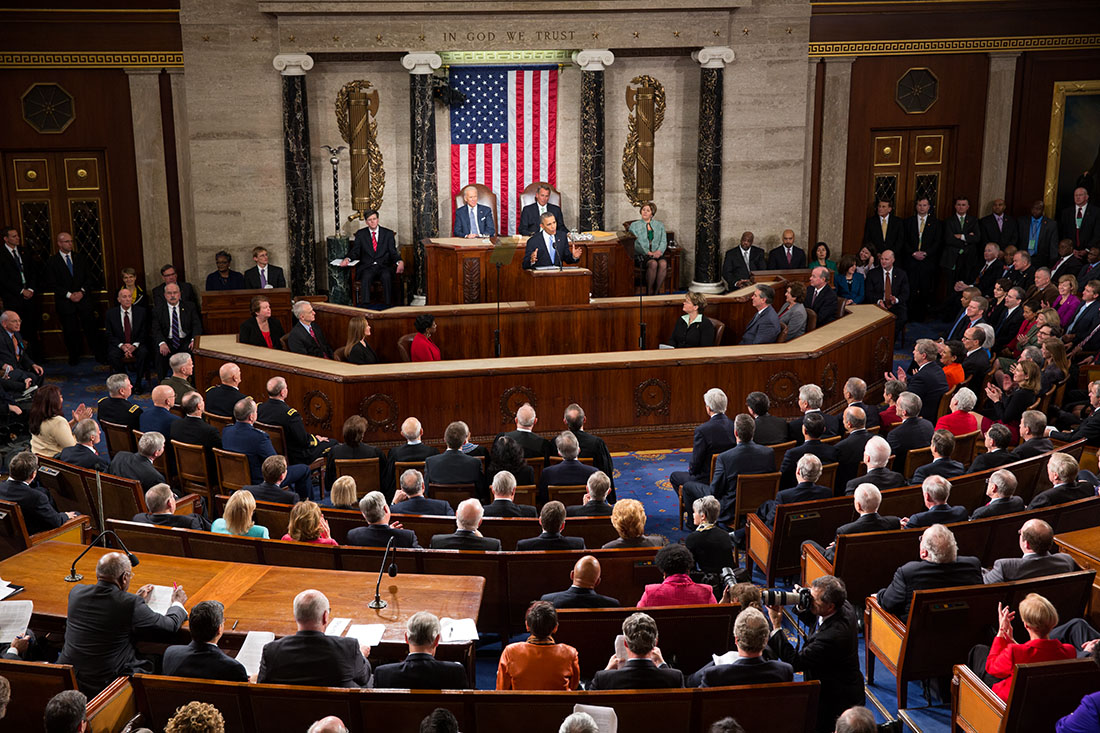
White House caption:  President Barack Obama delivers the State of the Union address in the House Chamber at the U.S. Capitol in Washington, D.C., Jan. 28, 2014. (Official White House Photo by Amanda Lucidon)
White House caption: President Barack Obama delivers the State of the Union address in the House Chamber at the U.S. Capitol in Washington, D.C., Jan. 28, 2014. (Official White House Photo by Amanda Lucidon)

An entrepreneur flipped on the lights in her tech startup and did her part to add to the more than 8 million new jobs our businesses have created over the past four years. (Applause.)

An autoworker fine-tuned some of the best, most fuel-efficient cars in the world and did his part to help America wean itself off foreign oil.

A farmer prepared for the spring after the strongest five-year stretch of farm exports in our history.

A rural doctor gave a young child the first prescription to treat asthma that his mother could afford. (Applause.) A man took the bus home from the graveyard shift, bone-tired but dreaming big dreams for his son. And in tight-knit communities all across America, fathers and mothers will tuck in their kids, put an arm around their spouse, remember fallen comrades and give thanks for being home from a war that after twelve long years is finally coming to an end. (Applause.)

Tonight this chamber speaks with one voice to the people we represent: It is you, our citizens, who make the state of our union strong. (Applause.)

And here are the results of your efforts: the lowest unemployment rate in over five years; a rebounding housing market — (applause) — a manufacturing sector that’s adding jobs for the first time since the 1990s — (applause) — more oil produced — more oil produced at home than we buy from the rest of the world, the first time that’s happened in nearly twenty years — (applause) — our deficits cut by more than half; and for the first time — (applause) — for the first time in over a decade, business leaders around the world have declared that China is no longer the world’s number one place to invest; America is.

(Cheers, applause.) That’s why I believe this can be a breakthrough year for America. After five years of grit and determined effort, the United States is better-positioned for the 21st century than any other nation on Earth.

The question for everyone in this chamber, running through every decision we make this year, is whether we are going to help or hinder this progress. For several years now, this town has been consumed by a rancorous argument over the proper size of the federal government. It’s an important debate — one that dates back to our very founding. But when that debate prevents us from carrying out even the most basic functions of our democracy — when our differences shut down government or threaten the full faith and credit of the United States — then we are not doing right by the American people. (Cheers, applause.)

Now, as president, I’m committed to making Washington work better, and rebuilding the trust of the people who sent us here. And I believe most of you are, too. Last month, thanks to the work of Democrats and Republicans,Congress finally produced a budget that undoes some of last year’s severe cuts to priorities like education. Nobody got everything they wanted, and we can still do more to invest in this country’s future while bringing down our deficit in a balanced way.

But the budget compromise should leave us freer to focus on creating new jobs, not creating new crises.

[Complete Enhanced Video Transcript]

And in the coming months — (applause) — in the coming months, let’s see where else we can make progress together. Let’s make this a year of action. That’s what most Americans want, for all of us in this chamber to focus on their lives, their hopes, their aspirations. And what I believe unites the people of this nation, regardless of race or region or party, young or old, rich or poor, is the simple, profound belief in opportunity for all, the notion that if you work hard and take responsibility, you can get ahead in America. (Applause.)

Now, let’s face it: That belief has suffered some serious blows. Over more than three decades, even before the Great Recession hit, massive shifts in technology and global competition had eliminated a lot of good, middle-class jobs, and weakened the economic foundations that families depend on.

Today, after four years of economic growth, corporate profits and stock prices have rarely been higher, and those at the top have never done better. But average wages have barely budged. Inequality has deepened. Upward mobility has stalled. The cold, hard fact is that even in the midst of recovery, too many Americans are working more than ever just to get by; let alone to get ahead. And too many still aren’t working at all.

So our job is to reverse these trends.

It won’t happen right away, and we won’t agree on everything.

But what I offer tonight is a set of concrete, practical proposals to speed up growth, strengthen the middle class and build new ladders of opportunity into the middle class. Some require congressional action, and I’m eager to work with all of you. But America does not stand still, and neither will I. (Applause.) So wherever and whenever I can take steps without legislation to expand opportunity for more American families, that’s what I’m going to do. (Cheers, applause.)

As usual, our first lady sets a good example. Michelle’s — (applause) — well. (Chuckles.) (Cheers, applause.) Yeah. Michelle’s Let’s Move! partnership with schools, businesses, local leaders has helped bring down childhood obesity rates for the first time in thirty years, and that’s an achievement — (applause) — that will improve lives and reduce health care costs for decades to come. The Joining Forces alliance that Michelle and Jill Biden launched has already encouraged employers to hire or train nearly 400,000 veterans and military spouses. (Applause.)

Taking a page from that playbook, the White House just organized a College Opportunity Summit, where already 150 universities, businesses, nonprofits have made concrete commitments to reduce inequality in access to higher education and to help every hardworking kid go to college and succeed when they get to campus.

And across the country — (applause) — we’re partnering with mayors, governors and state legislatures on issues from homelessness to marriage equality.

The point is, there are millions of Americans outside Washington who are tired of stale political arguments and are moving this country forward. They believe, and I believe, that here in America, our success should depend not on accident of birth but the strength of our work ethic and the scope of our dreams. That’s what drew our forebears here. It’s how the daughter of a factory worker is CEO of America’s largest automaker — (applause) — how the son of a barkeeper is speaker of the House — (cheers, applause) — how the son of a single mom can be president of the greatest nation on Earth. (Cheers, applause.)

Now — (sustained cheers and applause) — opportunity is who we are. And the defining project of our generation must be to restore that promise.

We know where to start. The best measure of opportunity is access to a good job. With the economy picking up speed, companies say they intend to hire more people this year.

And over half of big manufacturers say they’re thinking of insourcing jobs from abroad. (Applause.)

So let’s make that decision easier for more companies. Both Democrats and Republicans have argued that our tax code is riddled with wasteful, complicated loopholes that punish businesses investing here, and reward companies that keep profits abroad. Let’s flip that equation. Let’s work together to close those loopholes, end those incentives to ship jobs overseas, and lower tax rates for businesses that create jobs right here at home. (Cheers, applause.)

Moreover, we can take the money we save from this transition to tax reform to create jobs rebuilding our roads, upgrading our ports, unclogging our commutes — because in today’s global economy, first- class jobs gravitate to first-class infrastructure. We’ll need Congress to protect more than 3 million jobs by finishing transportation and waterways bills this summer. (Cheers, applause.) That can happen.

But — but I’ll act on my own to slash bureaucracy and streamline the permitting process for key projects, so we can get more construction workers on the job as fast as possible. (Applause.)

We also have the chance, right now, to beat other countries in the race for the next wave of high-tech manufacturing jobs. And my administration’s launched two hubs for high-tech manufacturing in Raleigh, North Carolina, and Youngstown, Ohio, where we’ve connected businesses to research universities that can help America lead the world in advanced technologies.

Tonight, I’m announcing we’ll launch six more this year. Bipartisan bills in both houses could double the number of these hubs and the jobs they create. So, get those bills to my desk and put more Americans back to work. (Applause.)

Let’s do more to help the entrepreneurs and small business owners who create most new jobs in America. Over the past five years, my administration has made more loans to small business owners than any other. And when 98 percent of our exporters are small businesses, new trade partnerships with Europe and the Asia-Pacific will help them create even more jobs. We need to work together on tools like bipartisan trade promotion authority to protect our workers, protect our environment and open new markets to new goods stamped “Made in the USA.” (Applause.)

Listen, China and Europe aren’t standing on the sidelines; and neither — neither should we. We know that the nation that goes all-in on innovation today will own the global economy tomorrow. This is an edge America cannot surrender. Federally-funded research helped lead to the ideas and inventions behind Google and smartphones. And that’s why Congress should undo the damage done by last year’s cuts to basic research so we can unleash the next great American discovery. (Cheers, applause.)

There are entire industries to be built based on vaccines that stay ahead of drug-resistant bacteria or paper-thin material that’s stronger than steel. And let’s pass a patent reform bill that allows our businesses to stay focused on innovation, not costly and needless litigation. (Applause.)

Now, one of the biggest factors in bringing more jobs back is our commitment to American energy. The “all the above” energy strategy I announced a few years ago is working, and today America is closer to energy independence than we have been in decades. (Applause.)

One of the reasons why is natural gas. If extracted safely, it’s the bridge fuel that can power our economy with less of the carbon pollution that causes climate change. (Applause.) Businesses plan to invest almost a hundred billion dollars in new factories that use natural gas. I’ll cut red tape to help states get those factories built and put folks to work, and this Congress can help by putting people to work building fueling stations that shift more cars and trucks from foreign oil to American natural gas. (Applause.)

Meanwhile, my administration will keep working with the industry to sustain production and jobs growth while strengthening protection of our air, our water, our communities. And while we’re at it, I’ll use my authority to protect more of our pristine federal lands for future generations. (Applause.)

Now, it’s not just oil and natural gas production that’s booming; we’re becoming a global leader in solar too.

Every four minutes another American home or business goes solar, every panel pounded into place by a worker whose job can’t be outsourced. Let’s continue that progress with a smarter tax policy that stops giving $4 billion a year to fossil fuel industries that don’t need it so we can invest more in fuels of the future that do. (Cheers, applause.)

And even as we’ve increased energy production, we’ve partnered with businesses, builders and local communities to reduce the energy we consume. When we rescued our automakers, for example, we worked with them to set higher fuel efficiency standards for our cars. In the coming months I’ll build on that success by setting new standards for our trucks so we can keep driving down oil imports and what we pay at the pump.

And taken together, our energy policy is creating jobs and leading to a cleaner, safer planet. Over the past eight years the United States has reduced our total carbon pollution more than any other nation on Earth. (Applause.)

But we have to act with more urgency because a changing climate is already harming western communities struggling with drought and coastal cities dealing with floods. That’s why I directed my administration to work with states, utilities and others to set new standards on the amount of carbon pollution our power plants are allowed to dump into the air.

The shift — (applause) — the shift to a cleaner energy economy won’t happen overnight, and it will require some tough choices along the way.

But the debate is settled. Climate change is a fact. (Applause.) And when our children’s children look us in the eye and ask if we did all we could to leave them a safer, more stable world, with new sources of energy, I want us to be able to say yes, we did. (Cheers, applause.)

Finally, if we’re serious about economic growth, it is time to heed the call of business leaders, labor leaders, faith leaders, law enforcement — and fix our broken immigration system. (Cheers, applause.) Republicans and Democrats in the Senate have acted, and I know that members of both parties in the House want to do the same. Independent economists say immigration reform will grow our economy and shrink our deficits by almost $1 trillion in the next two decades. And for good reason: When people come here to fulfill their dreams — to study, invent, contribute to our culture — they make our country a more attractive place for businesses to locate and create jobs for everybody. So let’s get immigration reform done this year. (Cheers, applause.) Let’s get it done. It’s time.

The ideas I’ve outlined so far can speed up growth and create more jobs. But in this rapidly-changing economy, we have to make sure that every American has the skills to fill those jobs.

The good news is, we know how to do it. Two years ago, as the auto industry came roaring back, Andra Rush opened up a manufacturing firm in Detroit. She knew that Ford needed parts for the best-selling truck in America, and she knew how to make those parts. She just needed the workforce. So she dialed up what we call an American Job Center; places where folks can walk in to get the help or training they need to find a new job, or a better job. She was flooded with new workers, and today, Detroit Manufacturing Systems has more than 700 employees. And what Andra and her employees experienced is how it should be for every employer and every job seeker.

So tonight, I’ve asked Vice President Biden to lead an across- the-board reform of America’s training programs to make sure they have one mission: train Americans with the skills employers need, and match them to good jobs that need to be filled right now. (Cheers, applause.) That means more on-the-job training, and more apprenticeships that set a young worker on an upward trajectory for life. It means connecting companies to community colleges that can help design training to fill their specific needs. And if Congress wants to help, you can concentrate funding on proven programs that connect more ready-to-work Americans with ready-to-be-filled jobs.

I’m also convinced we can help Americans return to the workforce faster by reforming unemployment insurance so that it’s more effective in today’s economy. But first, this Congress needs to restore the unemployment insurance you just let expire for 1.6 million people. (Cheers, applause.)

Let me tell you why.

Misty DeMars is a mother of two young boys. She’d been steadily employed since she was a teenager, put herself through college. She’d never collected unemployment benefits, but she’s been paying taxes.

In May, she and her husband used their life savings to buy their first home. A week later, budget cuts claimed the job she loved. Last month, when their unemployment insurance was cut off, she sat down and wrote me a letter, the kind I get every day. “We are the face of the unemployment crisis,” she wrote. “I’m not dependent on the government. Our country depends on people like us who build careers, contribute to society, care about our neighbors. I am confident that in time I will find a job, I will pay my taxes, and we will raise our children in their own home in the community we love. Please give us this chance.”

Congress, give these hardworking, responsible Americans that chance. (Cheers, applause.) Give them that chance. Give them the chance. They need our help right now, but more important, this country needs them in the game. That’s why I’ve been asking CEOs to give more long-term unemployed workers a fair shot at new jobs, a new chance to support their families. And in fact, this week many will come to the White House to make that commitment real.

Tonight I ask every business leader in America to join us and do the same because we are stronger when America fields a full team. (Applause.)

Of course, it’s not enough to train today’s workforce. We also have to prepare tomorrow’s workforce, by guaranteeing every child access to a world-class education. (Applause.)

Estiven Rodriguez couldn’t speak a word of English when he moved to New York City at age 9. But last month, thanks to the support of great teachers and an innovative tutoring program, he led a march of his classmates through a crowd of cheering parents and neighbors from their high school to the post office, where they mailed off their college applications. And this son of a factory worker just found out he’s going to college this fall. (Applause.)

Five years ago we set out to change the odds for all our kids. We worked with lenders to reform student loans, and today more young people are earning college degrees than ever before. Race to the Top, with the help of governors from both parties, has helped states raise expectations and performance. Teachers and principals in schools from Tennessee to Washington, D.C., are making big strides in preparing students with the skills for the new economy — problem solving, critical thinking, science, technology, engineering, math.

Now, some of this change is hard.

It requires everything from more challenging curriculums and more demanding parents to better support for teachers and new ways to measure how well our kids think, not how well they can fill in a bubble on a test. But it is worth it — and it is working.

The problem is we’re still not reaching enough kids, and we’re not reaching them in time, and that has to change.

Research shows that one of the best investments we can make in a child’s life is high-quality early education. (Applause.) Last year, I asked this Congress to help states make high-quality pre-K available to every 4-year-old. And as a parent as well as a president, I repeat that request tonight.

But in the meantime, 30 states have raised pre-k funding on their own. They know we can’t wait. So just as we worked with states to reform our schools, this year we’ll invest in new partnerships with states and communities across the country in a race to the top for our youngest children. And as Congress decides what it’s going to do, I’m going to pull together a coalition of elected officials, business leaders, and philanthropists willing to help more kids access the high-quality pre-K that they need. (Applause.) It is right for America. We need to get this done.

Last year, I also pledged to connect 99 percent of our students to high-speed broadband over the next four years. Tonight I can announce that with the support of the FCC and companies like Apple, Microsoft, Sprint, and Verizon, we’ve got a down payment to start connecting more than 15,000 schools and 20 million students over the next two years, without adding a dime to the deficit. (Cheers, applause.)

We’re working to redesign high schools and partner them with colleges and employers that offer the real-world education and hands-on training that can lead directly to a job and career. We’re shaking up our system of higher education to give parents more information and colleges more incentives to offer better value, so that no middle- class kid is priced out of a college education. We’re offering millions the opportunity to cap their monthly student loan payments to 10 percent of their income, and I want to work with Congress to see how we can help even more Americans who feel trapped by student loan debt. (Applause.)

And I’m reaching out to some of America’s leading foundations and corporations on a new initiative to help more young men of color facing especially tough odds stay on track and reach their full potential.

The bottom line is, Michelle and I want every child to have the same chance this country gave us. But we know our opportunity agenda won’t be complete, and too many young people entering the workforce today will see the American Dream as an empty promise, unless we also do more to make sure our economy honors the dignity of work, and hard work pays off for every single American.

You know, today, women make up about half our workforce, but they still make 77 cents for every dollar a man earns. That is wrong, and in 2014, it’s an embarrassment.

Women deserve equal pay for equal work. (Cheers, applause.)

You know, she deserves to have a baby without sacrificing her job. (Cheers, applause.) A mother deserves a day off to care for a sick child or sick parent without running into hardship. (Applause.) And you know what, a father does too. It is time to do away with workplace policies that belong in a “Mad Men” episode. (Laughter, cheers, applause.) This year let’s all come together, Congress, the White House, businesses from Wall Street to Main Street, to give every woman the opportunity she deserves, because I believe when women succeed, America succeeds. (Cheers, applause.)

Now, women hold a majority of lower-wage jobs, but they’re not the only ones stifled by stagnant wages. Americans understand that some people will earn more money than others, and we don’t resent those who, by virtue of their efforts, achieve incredible success. That’s what America’s all about. But Americans overwhelmingly agree that no one who works full-time should ever have to raise a family in poverty. (Applause.)

In the year since I asked this Congress to raise the minimum wage, five states have passed laws to raise theirs.

Many businesses have done it on their own. Nick Chute is here today with his boss, John Soranno. John’s an owner of Punch Pizza in Minneapolis, and Nick helps make the dough. (Laughter.) Only now he makes more of it. (Laughter.) John just gave his employees a raise to 10 bucks an hour, and that’s a decision that has eased their financial stress and boosted their morale.

Tonight I ask more of America’s business leaders to follow John’s lead. Do what you can to raise your employees’ wages. (Applause.) It’s good for the economy; it’s good for America. (Sustained applause.)

To every mayor, governor, state legislator in America, I say, you don’t have to wait for Congress to act; Americans will support you if you take this on. And as a chief executive, I intend to lead by example. Profitable corporations like Costco see higher wages as the smart way to boost productivity and reduce turnover. We should too. In the coming weeks I will issue an executive order requiring federal contractors to pay their federally-funded employees a fair wage of at least $10.10 an hour because if you cook — (cheers, applause) — our troops’ meals or wash their dishes, you should not have to live in poverty. (Sustained applause.)

Of course, to reach millions more, Congress does need to get on board.

Today the federal minimum wage is worth about twenty percent less than it was when Ronald Reagan first stood here. And Tom Harkin and George Miller have a bill to fix that by lifting the minimum wage to $10.10. It’s easy to remember: 10.10. This will help families. It will give businesses customers with more money to spend. It does not involve any new bureaucratic program. So join the rest of the country. Say yes. Give America a raise. (Cheers, applause.) Give ’em a raise.

There are other steps we can take to help families make ends meet, and few are more effective at reducing inequality and helping families pull themselves up through hard work than the Earned Income Tax Credit. Right now, it helps about half of all parents at some point. Think about that. It helps about half of all parents in America at some point in their lives.

But I agree with Republicans like Senator Rubio that it doesn’t do enough for single workers who don’t have kids. So let’s work together to strengthen the credit, reward work, help more Americans get ahead.

Let’s do more to help Americans save for retirement. Today most workers don’t have a pension. A Social Security check often isn’t enough on its own. And while the stock market has doubled over the last five years, that doesn’t help folks who don’t have 401(k)s. That’s why tomorrow I will direct the Treasury to create a new way for working Americans to start their own retirement savings: MyRA. It’s a — it’s a new savings bond that encourages folks to build a nest egg.

MyRA guarantees a decent return with no risk of losing what you put in. And if this Congress wants to help, work with me to fix an upside-down tax code that gives big tax breaks to help the wealthy save, but does little or nothing for middle-class Americans, offer every American access to an automatic IRA on the job, so they can save at work just like everybody in this chamber can.

And since the most important investment many families make is their home, send me legislation that protects taxpayers from footing the bill for a housing crisis ever again, and keeps the dream of homeownership alive for future generations. (Applause.)

One last point on financial security. For decades, few things exposed hard-working families to economic hardship more than a broken health care system. And in case you haven’t heard, we’re in the process of fixing that. (Scattered laughter, applause.)

Now — a pre-existing condition used to mean that someone like Amanda Shelley, a physician’s assistant and single mom from Arizona, couldn’t get health insurance. But on January 1st, she got covered. (Applause.) On January 3rd, she felt a sharp pain. On January 6th, she had emergency surgery. Just one week earlier, Amanda said, that surgery would’ve meant bankruptcy. That’s what health insurance reform is all about, the peace of mind that if misfortune strikes, you don’t have to lose everything.

Already, because of the Affordable Care Act, more than 3 million Americans under age 26 have gained coverage under their parents’ plans. (Applause.)

More than 9 million Americans have signed up for private health insurance or Medicaid coverage — 9 million. (Applause.)

And here’s another number: zero. Because of this law, no American, none, zero, can ever again be dropped or denied coverage for a pre-existing condition like asthma or back pain or cancer. (Cheers, applause.) No woman can ever be charged more just because she’s a woman. (Cheers, applause.) And we did all this while adding years to Medicare’s finances, keeping Medicare premiums flat and lowering prescription costs for millions of seniors.

Now, I do not expect to convince my Republican friends on the merits of this law. (Laughter.) (Chuckles.) (Laughter.) But I know that the American people are not interested in refighting old battles. So again, if you have specific plans to cut costs, cover more people, increase choice, tell America what you’d do differently. Let’s see if the numbers add up. (Applause.) But let’s not have another 40- something votes to repeal a law that’s already helping millions of Americans like Amanda.

(Cheers, applause.) The first 40 were plenty. We all owe it to the American people to say what we’re for, not just what we’re against.

And if you want to know the real impact this law is having, just talk to Governor Steve Beshear of Kentucky, who’s here tonight. Now, Kentucky’s not the most liberal part of the country. That’s not where I got my highest vote totals. (Laughter.) But he’s like a man possessed when it comes to covering his commonwealth’s families. They’re our neighbors and our friends, he said. They’re people we shop and go to church with — farmers out on the tractor, grocery clerks. They’re people who go to work every morning praying they don’t get sick. No one deserves to live that way.

Steve’s right. That’s why tonight I ask every American who knows someone without health insurance to help them get covered by March 31st. Help them get covered. (Applause.) Moms, get on your kids to sign up. Kids, call your mom and walk her through the application. It’ll give her some peace of mind, and plus, she’ll appreciate hearing from you. (Laughter.)

After all, that — that’s the spirit that has always moved this nation forward.

It’s the spirit of citizenship, the recognition that through hard work and responsibility, we can pursue our individual dreams, but still come together as one American family to make sure the next generation can pursue its dreams as well.

Citizenship means standing up for everyone’s right to vote. (Applause.) Last year, part of the Voting Rights Act was weakened, but conservative Republicans and liberal Democrats are working together to strengthen it. And the bipartisan commission I appointed, chaired by my campaign lawyer and Governor Romney’s campaign lawyer, came together and have offered reforms so that no one has to wait more than a half hour to vote. Let’s support these efforts. It should be the power of our vote, not the size of our bank account, that drives our democracy. (Cheers, applause.)

Citizenship means standing up for the lives that gun violence steals from us each day. I have seen the courage of parents, students, pastors, and police officers all over this country who say “we are not afraid,” and I intend to keep trying, with or without Congress, to help stop more tragedies from visiting innocent Americans in our movie theaters and our shopping malls, or schools like Sandy Hook. (Applause.)

Citizenship demands a sense of common purpose; participation in the hard work of self-government; an obligation to serve to our communities.

And I know this chamber agrees that few Americans give more to their country than our diplomats and the men and women of the United States armed forces. (Extended applause.) Thank you.

Tonight, because of the extraordinary troops and civilians who risk and lay down their lives to keep us free, the United States is more secure. When I took office, nearly 180,000 Americans were serving in Iraq and Afghanistan. Today, all our troops are out of Iraq. More than 60,000 of our troops have already come home from Afghanistan. With Afghan forces now in the lead for their own security, our troops have moved to a support role. Together with our allies, we will complete our mission there by the end of this year, and America’s longest war will finally be over. (Applause.)

After 2014, we will support a unified Afghanistan as it takes responsibility for its own future.

If the Afghan government signs a security agreement that we have negotiated, a small force of Americans could remain in Afghanistan with NATO allies to carry out two narrow missions: training and assisting Afghan forces and counterterrorism operations to pursue any remnants of al-Qaida. For while our relationship with Afghanistan will change, one thing will not: our resolve that terrorists do not launch attacks against our country. (Applause.)

The fact is that danger remains. While we’ve put al-Qaida’s core leadership on a path to defeat, the threat has evolved as al-Qaida affiliates and other extremists take root in different parts of the world. In Yemen, Somalia, Iraq, Mali, we have to keep working with partners to disrupt and disable these networks. In Syria, we’ll support the opposition that rejects the agenda of terrorist networks. Here at home, we’ll keep strengthening our defenses and combat new threats like cyberattacks. And as we reform our defense budget, we have to keep faith with our men and women in uniform and invest in the capabilities they need to succeed in future missions. (Applause.)

We have to remain vigilant.

But I strongly believe our leadership and our security cannot depend on our outstanding military alone. As commander in chief, I have used force when needed to protect the American people, and I will never hesitate to do so as long as I hold this office. But I will not send our troops into harm’s way unless it is truly necessary, nor will I allow our sons and daughters to be mired in open-ended conflicts. We must fight the battles — (applause) — that need to be fought, not those that terrorists prefer from us — large-scale deployments that drain our strength and may ultimately feed extremism.

So even as we actively and aggressively pursue terrorist networks, through more targeted efforts and by building the capacity of our foreign partners, America must move off a permanent war footing. (Applause.) That’s why I’ve imposed prudent limits on the use of drones, for we will not be safer if people abroad believe we strike within their countries without regard for the consequence.

That’s why, working with this Congress, I will reform our surveillance programs because the vital work of our intelligence community depends on public confidence, here and abroad, that privacy of ordinary people is not being violated. (Applause.) And with the Afghan war ending, this needs to be the year Congress lifts the remaining restrictions on detainee transfers and we close the prison at Guantanamo Bay — (applause) — because we counter terrorism not just through intelligence and military action but by remaining true to our constitutional ideals and setting an example for the rest of the world.

You see, in a world of complex threats, our security, our leadership depends on all elements of our power — including strong and principled diplomacy. American diplomacy has rallied more than 50 countries to prevent nuclear materials from falling into the wrong hands, and allowed us to reduce our own reliance on Cold War stockpiles.

American diplomacy, backed by the threat of force, is why Syria’s chemical weapons are being eliminated. (Applause.) And we will continue to work with the international community to usher in the future the Syrian people deserve — a future free of dictatorship, terror and fear.

As we speak, American diplomacy is supporting Israelis and Palestinians as they engage in the difficult but necessary talks to end the conflict there; to achieve dignity and an independent state for Palestinians, and lasting peace and security for the state of Israel — a Jewish state that knows America will always be at their side. (Applause.)

And it is American diplomacy, backed by pressure, that has halted the progress of Iran’s nuclear program — and rolled back parts of that program — for the very first time in a decade. As we gather here tonight, Iran has begun to eliminate its stockpile of higher levels of enriched uranium.

It’s not installing advanced centrifuges. Unprecedented inspections help the world verify every day that Iran is not building a bomb. And with our allies and partners, we’re engaged in negotiations to see if we can peacefully achieve a goal we all share: preventing Iran from obtaining a nuclear weapon. (Applause.)

These negotiations will be difficult; they may not succeed. We are clear-eyed about Iran’s support for terrorist organizations like Hezbollah, which threaten our allies; and we’re clear about the mistrust between our nations, mistrust that cannot be wished away. But these negotiations don’t rely on trust; any long-term deal we agree to must be based on verifiable action that convinces us and the international community that Iran is not building a nuclear bomb. If John F. Kennedy and Ronald Reagan could negotiate with the Soviet Union, then surely a strong and confident America can negotiate with less powerful adversaries today. (Applause.)

The sanctions that we put in place helped make this opportunity possible. But let me be clear: if this Congress sends me a new sanctions bill now that threatens to derail these talks, I will veto it. (Applause.) For the sake of our national security, we must give diplomacy a chance to succeed.

(Applause.) If Iran’s leaders do not seize this opportunity, then I will be the first to call for more sanctions and stand ready to exercise all options to make sure Iran does not build a nuclear weapon. But if Iran’s leaders do seize the chance — and we’ll know soon enough — then Iran could take an important step to rejoin the community of nations, and we will have resolved one of the leading security challenges of our time without the risks of war.

And finally, let’s remember that our leadership is defined not just by our defense against threats but by the enormous opportunities to do good and promote understanding around the globe, to forge greater cooperation, to expand new markets, to free people from fear and want. And no one is better positioned to take advantage of those opportunities than America.

Our alliance with Europe remains the strongest the world has ever known. From Tunisia to Burma, we’re supporting those who are willing to do the hard work of building democracy. In Ukraine, we stand for the principle that all people have the right to express themselves freely and peacefully and to have a say in their country’s future. Across Africa, we’re bringing together businesses and governments to double access to electricity and help end extreme poverty. In the Americas, we’re building new ties of commerce, but we’re also expanding cultural and educational exchanges among young people.

And we will continue to focus on the Asia-Pacific, where we support our allies, shape a future of greater security and prosperity and extend a hand to those devastated by disaster, as we did in the Philippines, when our Marines and civilians rushed to aid those battered by a typhoon, and were greeted with words like, “We will never forget your kindness” and “God bless America.”

We do these things because they help promote our long-term security. And we do them because we believe in the inherent dignity and equality of every human being, regardless of race or religion, creed or sexual orientation. And next week the world will see one expression of that commitment when Team USA marches the red, white and blue into the Olympic stadium and brings home the gold. (Cheers, applause.)

My fellow Americans, no other country in the world does what we do. On every issue, the world turns to us, not simply because of the size of our economy or our military might but because of the ideals we stand for and the burdens we bear to advance them.

No one knows this better than those who serve in uniform. As this time of war draws to a close, a new generation of heroes returns to civilian life. We’ll keep slashing that backlog so our veterans receive the benefits they’ve earned and our wounded warriors receive the health care — including the mental health care — that they need. (Applause.) We’ll keep working to help all our veterans translate their skills and leadership into jobs here at home, and we will all continue to join forces to honor and support our remarkable military families.

Let me tell you about one of those families I’ve come to know.

I first met Cory Remsburg, a proud Army Ranger, at Omaha Beach on the 65th anniversary of D-Day. Along with some of his fellow Rangers, he walked me through the program, the ceremony. He was a strong, impressive young man, had an easy manner. He was sharp as a tack. And we joked around, and took pictures, and I told him to stay in touch.

A few months later, on his 10th deployment, Cory was nearly killed by a massive roadside bomb in Afghanistan. His comrades found him in a canal, face down, underwater, shrapnel in his brain.

For months, he lay in a coma. And the next time I met him, in the hospital, he couldn’t speak; he could barely move. Over the years, he’s endured dozens of surgeries and procedures, hours of grueling rehab every day.

Even now, Cory is still blind in one eye. He still struggles on his left side. But slowly, steadily, with the support of caregivers like his dad Craig, and the community around him, Cory has grown stronger. Day by day, he’s learned to speak again and stand again and walk again, and he’s working toward the day when he can serve his country again.

“My recovery has not been easy,” he says. “Nothing in life that’s worth anything is easy.”

Cory is here tonight. And like the Army he loves, like the America he serves, Sergeant First Class Cory Remsburg never gives up, and he does not quit. (Cheers, applause.) Cory. (Extended cheers and applause.)

My fellow Americans — my fellow Americans, men and women like Cory remind us that America has never come easy. Our freedom, our democracy, has never been easy. Sometimes we stumble; we make mistakes; we get frustrated or discouraged.

But for more than two hundred years, we have put those things aside and placed our collective shoulder to the wheel of progress: to create and build and expand the possibilities of individual achievement; to free other nations from tyranny and fear; to promote justice and fairness and equality under the law, so that the words set to paper by our founders are made real for every citizen.

The America we want for our kids — a rising America where honest work is plentiful and communities are strong; where prosperity is widely shared and opportunity for all lets us go as far as our dreams and toil will take us — none of it is easy. But if we work together; if we summon what is best in us, the way Cory summoned what is best in him, with our feet planted firmly in today but our eyes cast towards tomorrow, I know it’s within our reach.

Believe it.

God bless you, and God bless the United States of America. (Cheers, applause.)


Appreciating and remembering Pete Seeger

January 28, 2014

Interesting morning.  Is there anyone who does not have a Pete Seeger memory?

The Pete Seeger Appreciation page was set up many months ago — in fact founder Jim Capaldi died last December, with his family carrying it on.  A good place to start, maybe.

Classic Pete Seeger photo -- from the 1950s?  This and more at the Pete Seeger Appreciation Page, at PeteSeeger.net

Classic Pete Seeger photo — from the 1950s? This and more at the Pete Seeger Appreciation Page, at PeteSeeger.net

http://twitter.com/jedsundwall/status/428237009241403392

Read his biography, perhaps?

Learn to play the banjo:

This is the one that made me shed tears:

http://twitter.com/Peter_Seeger/status/428243606491918336

What great tributes have you seen to Pete today?  Give us a link in comments, share the good stuff.


Pete Seeger and the Highlander School

January 28, 2014

It’s a stunning photograph, not for its photgrapher’s skills, nor the artistic nature of the taking.  It’s a true snapshot.  Five people on a farm in Kentucky, in black and white.  Probably the photographer used a Kodak camera made just for snapshots.

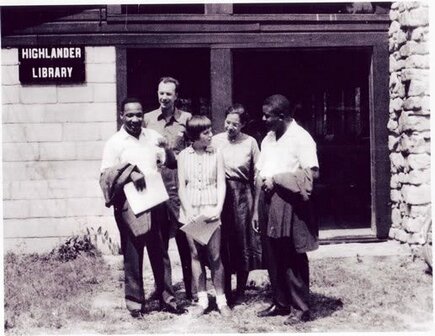
Except, it was 1957.  The farm is the Highlander School.  The five people in the photo include folksinger Pete Seeger, and Rosa Parks, and the Rev. Dr. Martin Luther King, Jr.

Pete Seeger, MLK , and others at Highlander School, 1957

From left, Martin Luther King, Jr., Pete Seeger, Charis Horton, one of the founders of the Highlander School, Rosa Parks, and the Rev. Ralph Abernathy. At a workshop at the Highlander School in Kentucky, circa 1957.

12,346

Who was the photographer?  Perhaps Myles Horton, the director of the school (and Charis’s husband).

In a sort piece filmed at his home in Beacon, New York, for the Highlander’s 75th Anniversary in 2007, Pete described the time and the occasion.

Don’t  you love the cricket singing along with Pete?

More:


Farewell, Pete Seeger

January 28, 2014

Just got the news that Pete Seeger died.  He was 94.

Such a loss for American music, to American music, and to history and art.

New York Times story here.

Pete Seeger at the Beacon Sloop Club in Beacon, N.Y., in 2010. Andrew Sullivan for The New York Times

Pete Seeger at the Beacon Sloop Club in Beacon, N.Y., in 2010. Andrew Sullivan for The New York Times

I love the Andrew Sullivan photo the New York Times used — it reminds me of the best way to hear Pete, in the out-of-doors, near the Hudson, in the summer, with a small audience who could be coerced to sing along.

Pete was an alumnus of Camp Rising Sun (of the L. A. Jonas Foundation) near Rhinebeck, New York, from the very early days.  In 1974, between concerts at large venues with Arlo Guthrie, and on his way back home to Beacon, Pete stopped and spent a day with us at the camp.  He was , as always, wonderfully gracious, other than outward appearances indistinguishable from the 14- and 15-year boys in excitement to be having fun, exploring nature, and then leading us all in songs.

My unfinished master’s thesis was to explore Pete’s use of different rhetorical devices to get his messages across, and make them popular.   (One of my everlasting regrets.)

But despite his down-home-everybody-welcome demeanor, Seeger drove great movements, and pushed the arcs of history in wonderful directions throughout his life.

  • Pete was an anchor for Woody Guthrie in New York, and sometimes a rival.  As Pete told it, everybody loved Woody and always came to a performance to hear Woody sing.  It was often Pete who pushed Woody out front; no mistake that Woody’s famous New Year’s resolutions from 1942 included “Love Pete” among them.
  • Having learned from the Lomaxes at the Library of Congress, Pete recorded history in songs, preserving old tunes, making foreign tunes popular, and re-arranging verses here and there.  Pete revealed, discovered, or pushed the music of a family domestic (“500 Miles”), Cuban revolutionary poets (“Guantanamera”), his engineer sister (“Going to be an Engineer”), and hymn books.
  • Pete taught a song to seminar attendees at the Highlands School in Kentucky, people who went on to do great things with that song.  The song was “We Shall Overcome,” and photos show that those Pete taught to sing included both Rosa Parks and Martin Luther King, Jr.
  • Blacklisted after refusing to give in to the civil liberties assault by the U.S. House Committee on Un-American Activities (HUAC), Pete created a series of records to teach how to play a guitar, a banjo, and a twelve-string.  One of the kids who learned some twelve-string licks included a guy who went on to play strings for the folk group, the Chad Mitchell Trio, and their new tenor, a guy named John Denver.  Roger McGuinn electrified that twelve-string, and leading the Byrds, turned some of Pete’s songs into rock and roll hits — like “Turn, Turn, Turn.”
  • I asked Pete about getting him to Salt Lake City for a concert in the 1970s — he demurred, saying he needed to spend some time locally.  He told a story about showing up at a PTA meeting in Beacon to talk on some issue, and some local guy told Pete that Beacon didn’t need outsiders telling them what to do.  This hurt Pete, since he’d been living in Beacon at that time for more than 30 years, in the house he built by hand.   Pete told me that he realized a world reputation doesn’t count for much if you can’t use it to make things better in your home town.The “local project?” He said he wanted to get an old sloop, and sail the Hudson River signing to get people to clean it up.  At the time, the Hudson was very much a sewer from Albany to New York City.  A short time later the Sloop Clearwater was refitted, and Pete started music festivals up and down the river.  The Hudson, Pete’s local river, runs much cleaner today for his work.
  • I saw Pete and Arlo in concert at Wolf Trap, the performance park near Washington, D.C., a couple of times; and some other venues — but nothing ever beat that open air concert at Rising Sun.
  • Bruce Springsteen did us all a favor with his album of Seeger tunes; I chafed at Ronald Reagan’s choices of performers at his inaugurals, and at many other choices over the years.  I often thought Pete Seeger’s music, and voice, would be a better choice.  Springsteen’s pre-inauguration concert in 2008, from the Lincoln Memorial, had my full attention.  The only thing more perfect, I told Kathryn, would be Pete singing his own tunes from those steps (I heard him tell the stories of King’s and Marian Anderson’s performances there more than once).  Within a few minutes, Springsteen pulled Pete out onstage, and at the age of 90 he led the crowd singing Woody’s “This Land is Your Land.”  A perfect capstone, I thought.

If  you would, pull out your collection of Pete Seeger music today, and give it a spin.  It will raise your spirits, I guarantee.

What wonderful gifts Pete left us!

So long, Pete, one of the best American citizens we’ll ever know.

Maybe we should just say, “So long! It’s Been Good to Know Ya!”

More:


First “official” Boy Scout Troop, January 24, 1908?

January 24, 2014

There are those who argue that the the first Boy Scout Troop was organized on January 24, 1908.

History is not so clear on that point, however.  There may have been earlier troops organized, but records were unclear, or lost.

From Wikipedia:  Front cover of the first part of Scouting for Boys by Robert Baden-Powell, published in January 1908. Illustrations by Baden-Powell himself.

From Wikipedia: Front cover of the first part of Scouting for Boys by Robert Baden-Powell, published in January 1908. Illustrations by Baden-Powell himself.

We do know that the the first installment of the serialized Scouting for Boys was published on January 24, 1908.  By April of that year all installments were published, and we can say that the first Boy Scout handbook had arrived.

Either way, January 24 holds some historical significance for the Scouting movement.

Do a good turn in honor of the day.

Who was really first?  Unfortunately, the records don’t exist to settle that issue.

Scouting, in England, arose from the popular clamor by boys after the 1899 publication of Col. Robert Baden-Powell’s handbook for the scouts he trained for the British Army in southern Africa, Aids to Scouting.  Though not written for a youthful audience, the book became a best seller among boys who wished to emulate the adventures of soldiers and rangers in the British Army.

By 1907, Baden-Powell seriously worked to translate his experience and wisdom in a book aimed at boys.  In the summer of 1907 he gathered a collection of boys to camp, to try out his ideas for outdoor activities for boys.  With aid of the YMCA and other organizations, troops were planned and organized at the end of 1907 and in early 1908; then the program skyrocketed, with 60,000 boy members by the end of 1908.

Which was the “first” troop?

In England, where history and firsts might understandably be taken more seriously for Scouting, a number of groups can make the claims — and it’s almost impossible to choose from among them.  Wikipedia explains the claims of each, without much blood (I’ve left in most of the links and footnote links):

The first Scout Troops were formed in the United Kingdom in 1907, and registered in 1908. There are a number of claimants to be the first troop. However, due to poor record keeping when the Scouting Movement started, The Scout Association does not acknowledge any single troop as being the first. The Scout Association maintains a list of all the Scout Troops who claim to have started in 1908.[1]

The Scout Troops with the strongest claims are listed below:

The 1st Glasgow Scout Group in Scotland holds the earliest known registration certificate, dated 26 January 1908, issued by the Scouting Association. The Group was formed from the Glasgow Battalion of the Army Cadet Corps; its Adjutant was Captain Robert E Young. In June 1907, they formed the ‘Cadets’ Winter Recreation Training Club’. The club was a success from the beginning, as ‘Boss’ Young related: “At first we met at my house, signalled up and down the stairs, tied knots around the banisters and always finished with a good tuck-in.” ‘Boss’ Young met B-P during Autumn 1907 who suggested that the Club could experiment with the ideas contained in ‘Scouting for Boys’. On 16 January 1908, the Club was formally disbanded and the First Glasgow Troop of Boy Scouts was registered with Scout HQ in London.[1][2]

The first Scout Troop to receive a visit from Baden-Powell was the Vaux’s Own Scout Troop in Sunderland. This visit was made on 22 February 1908, so it is assumed by The Scout Association “that it had already been in existence for some days at any rate”.[1] This was also the first Scout Troop listed in the Imperial records. The 1st Crystal Palace Patrol (now known as the 2nd Croydon, 1st Crystal Palace) is documented as being in existence on 28 February 1908. The group is still in existence.[3]

In 2007, 1st Henfield Scout Troop was named as the oldest surviving Scout Troop in the world for the centenary of Scouting. They were the hosts of the only place that the centenary flame stopped in England for the night before reaching its goal of Brownsea Island. However, it is not the oldest Scout Troop, as others were set up before Henfield. It is said that the boys that went to Brownsea Island on the first ever scout trip were from Henfield.[4]

The 1st Birkenhead (YMCA) has a claim to be the oldest Scout Troop as it was founded on 24 January 1908 when B P attended a meeting at the YMCA. Documents at the District Headquarters confirm this fact. Baden-Powell at the 1929 Coming of Age Jamboree in Birkenhead said “Here in Birkenhead that I first mooted the idea of Scouting”.

The 1st Croydon Scout Group (Addiscombe) were founded in the latter months of 1907. The Group was officially registered by Imperial Scout Headquarters on 16 June 1908 and can claim to be one of the earliest Groups.

1st Church Kirk, Church near Accrington Lancashire. Formed 1907. Baden Powell formed a link with Accrington during his opening of the Ambulance Drill Hall in 1904.

There is an entry in Baden-Powell’s diary on 4 February 1908 which mentions a Scout Troop in Nottingham.

1st Alsager, Cheshire were formed before 24 February 1908.

A troop from Hampstead was involved in various events in the first half of 1908.

The 1st City Of Aberdeen Scouts existed in 1908. 1st Arbroath Scout Troop (2nd Angus) dates back to June 1908.[5]

The 1st Norwich “Capt. Bower’s Own” Sea Scouts started in January 1908.[6] The group is one of few which has continuously run for 100 years and, remarkably, had just 4 Group Scout Leaders during that time. To celebrate their centenary year, the group published a book entitled, “It Can Be Done: The Hundred Year History of the 1st Norwich Sea Scout Group.” drawing from their extensive archives.[7]

In Poole, Dorset, there are strong claims from 3 current Scout Groups, that all have separate newspaper articles back to 1908 listing Patrols or Troops practicing Scouting. 1st Parkstone has got a registration number back to February 1908 for a Scout Troop. Hamworthy are listed as having a Boat patrol at the Local Church in November 1908 and Broadstone having an Ambulance Scout at the Gathering on Brownsea Island in December 1908.

Wycliffe Scout Group (Gloucestershire) claims to be the oldest continuously active school-based Scout group in the world (active September 2013). It is listed in the Scout Association database with a registration date of 1 February 1909, although the Group celebrated their centenary in 2008, implying that there had been Scouting activity at the school before the Group was registered.

Who was first?  The question remains, not yet satisfactorily answered for history.

How would you decide the controversy?

Scouts from several nations around a campfire -- photo from the website of the World Scout Organization.

Scouts from several nations around a campfire — photo from EraScouting page [replacing photo from the website of the World Scout Organization]. “Leave this world a little better than you found it” — Lord Baden-Powell, the founder of Scouting. There are over 40 million Scouts in the World Organization of the Scout Movement.

More:


“Penetration however slight”: Remembering a good and noble hoax – the U.S.S. Pueblo, 46 years later

January 22, 2014

January 23 is the anniversary of the North Koreans‘ capture of the spy boat, U.S.S. Pueblo, in 1968 — a beginning of a momentous year for bad events.  The saga of the Pueblo and its crew, including especially Cmdr. Lloyd Bucher, is of special interest to me because it features a series of some of the grandest, best and most humorously American hoaxes ever perpetrated by imprisoned people against their captors and wardens.  This is one of the great Kilroy stories of American history.  It should not be forgotten.  Especially with the role North Korea plays in contemporary angst, the Pueblo episode should not be forgotten. This is an encore post, with new links added.

1968 brought one chunk of bad news after another to Americans. The year seemed to be one long, increasingly bad disaster. In several ways it was the mark of the times between the feel-good, post-war Eisenhower administration and the feel-good-despite-the-Cold-War Reagan administration. 1968 was depressing.

Lloyd M. Bucher

USN Cmdr. Lloyd M. Bucher (Photo credit: Wikipedia)

What was so bad? Vietnam manifested itself as a quagmire. Just when Washington politicians predicted an end in sight, Vietcong militia launched a nationwide attack in South Vietnam on the Vietnamese New Year holiday, Tet, at the end of January. Civil rights gains stalled, and civil rights leaders came out in opposition to the Vietnam war. President Johnson fared poorly in the New Hampshire primary election, and eventually dropped out of the race for the presidency (claiming he needed to devote time to making peace in Vietnam). Labor troubles roiled throughout the U.S., including a nasty strike by garbage collectors in Memphis. It didn’t help to settle the strike that the sanitation workers were almost 100% African American, the leadership of Memphis was almost 100% white, and race relations in the city were not so good as they might have been – the strike attracted the efforts of the Southern Christian Leadership Conference, and Martin Luther King, Jr. – who was assassinated there in early April. In response, riots broke out in 150 American cities.

More below the fold, including the key confession to “penetration.” Read the rest of this entry »


January 21: Odd conjunction of history with Louis XVI and Vladimir I. Lenin

January 21, 2014

This is mostly an encore post.

The Dallas Morning News and the Associated Press inform us that France’s King Louis XVI died on January 21, 1793.  In 1924, Russian revolutionary Vladimir I. Lenin died on January 21.

Portrait of Louis XVI

France’s King Louis XVI died on January 21, 1793.  He is seen here in his most famous portrait, in happier times. Image via Wikipedia

Both died of strokes, but of different kinds of strokes.  Lenin’s was a cerebral stroke; Louis’s was the stroke of the blade of a guillotine.

Painting of Lenin in front of the Smolny Institute, circa 1925,  by Isaak Brodsky - Wikipedia

Lenin died on January 21, 1924.  Painting of Lenin in front of the Smolny Institute, circa 1925, by Isaak Brodsky

Ruminations on the date, and the men:  How much of current history can be understood by studying those two events, and those two men?  How much if we add in George Washington, and Napoleon, other men affected by revolution?

A few years ago I had a sophomore student spell out the importance of people in history.  Israel Pena observed that  Americans got rid of their king through revolution, and ended up with George Washington as leader, and then president.  Washington’s modeling of his life after the Roman patriot Cincinattus led Washington to resign as commander of the Continental Army when the warring was done, instead of declaring himself king, and then later to step down from the presidency after two terms, to promote peaceful retirement of presidents.

The French got rid of their king through revolution in 1789, but in the chaos that followed, they got Napoleon who took over the government after battlefield victories against France’s enemies.  Then Napoleon declared himself emperor, and took off on a reign of conquest and war across Europe.

France’s revolution produced Napoleon; America’s revolution produced Washington, and that has made most of the difference.

Mr. Pena’s commentary compared only those two nations.  What if we add in a third nation and revolution:  Russia?  Russia got rid of its king (czar) through revolution in 1917.  In the chaos that followed it got a government led by Lenin, and upon Lenin’s early death, taken over by Joseph Stalin.

George Washington, by Gilbert Stuart - Wikipedia

George Washington, by Gilbert Stuart – Wikipedia

Is the future of a nation written by the character of the men who run the government?  One might make a good case that the deaths of these men paint most of the picture we really need to have. Louis XVI died at the age of 39, on the guillotine; Vladimir I. Lenin, died at the age of 53, of stroke.  Both still worked to cling to the strings of power; Compare the deaths of Washington and Napoleon. George Washington. died in 1799 at the age of 67, of complications from a strep throat, but in retirement and in his bed at Mount Vernon, Virginia; while Napoleon Bonaparte died at 52, probably from stomach cancer, while he suffered in humiliating exile on the far distant South Atlantic isle of St. Helena, in 1821.

The Emperor Napoleon in His Study at the Tuileries, by Jacques-Louis David, 1812 - Wikipedia

The Emperor Napoleon in His Study at the Tuileries, by Jacques-Louis David, 1812 – Wikipedia

Revolution marked these men. Three of them led revolutions, and the fourth was put out of power by one.  Whose life would you have preferred to follow?  Which of these lives is most meritorious of modeling?

Which one lived the life that put his nation on the more secure footing so that its citizens might live good lives, and die of old age in their beds, rather than at war?

Can one person really push the history of a nation so much?  Or are these four lives simply emblematic of the nations they ruled?

Something to ponder on a January 21.


Letter from Birmingham Jail – Martin Luther King, Jr.

January 20, 2014

If you do nothing else today in commemoration of the life of Martin Luther King, Jr., please read through this missive, his Letter from Birmingham Jail.

King was sentenced to jail for demonstrating for civil rights, in Birmingham.  His aides and organization, the former Montgomery Improvement Association, grown to be the Southern Christian Leadership Conference after the successful Montgomery Bus Boycott in 1956 and 1957, argued that King should not submit himself to be jailed.  It was Easter weekend, after all, and King’s voice from some pulpit would be vital.

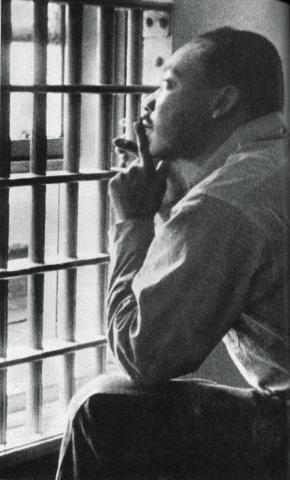
Photograph of Rev. Dr. Martin Luther King, Jr., in the Birmingham City Jail, April 1963.

Photograph of Rev. Dr. Martin Luther King, Jr., in the Birmingham City Jail, April 1963.

But King argued that the essence of non-violent protest is to accept some jail time, from time to time, to further expose the injustice.

The issue boiled over into local newspapers.  A group of Birmingham clergyman wrote a letter, published in a local newspaper, urging King to end the protests altogether, as they were disruptive — evidenced by King’s own jail sentence.

King wrote back.  His answer established the case for civil rights justice, and is regarded by many as one of the greatest explanations of human rights, ever.  This document weighed greatly with the committee that decided the Nobel Peace Prize in 1964.

This text comes from the Bates College 2001 celebration of Martin Luther King, Jr., Day:

*AUTHOR’S NOTE: This response to a published statement by eight fellow clergymen from Alabama (Bishop C. C. J. Carpenter, Bishop Joseph A. Durick, Rabbi Hilton L. Grafman, Bishop Paul Hardin, Bishop Holan B. Harmon, the Reverend George M. Murray. the Reverend Edward V. Ramage and the Reverend Earl Stallings) was composed under somewhat constricting circumstance. Begun on the margins of the newspaper in which the statement appeared while I was in jail, the letter was continued on scraps of writing paper supplied by a friendly Negro trusty, and concluded on a pad my attorneys were eventually permitted to leave me. Although the text remains in substance unaltered, I have indulged in the author’s prerogative of polishing it for publication.

LETTER FROM BIRMINGHAM JAIL
April 16, 1963

MY DEAR FELLOW CLERGYMEN:

While confined here in the Birmingham city jail, I came across your recent statement calling my present activities “unwise and untimely.” Seldom do I pause to answer criticism of my work and ideas. If I sought to answer all the criticisms that cross my desk, my secretaries would have little time for anything other than such correspondence in the course of the day, and I would have no time for constructive work. But since I feel that you are men of genuine good will and that your criticisms are sincerely set forth, I want to try to answer your statements in what I hope will be patient and reasonable terms.

I think I should indicate why I am here In Birmingham, since you have been influenced by the view which argues against “outsiders coming in.” I have the honor of serving as president of the Southern Christian Leadership Conference, an organization operating in every southern state, with headquarters in Atlanta, Georgia. We have some eighty-five affiliated organizations across the South, and one of them is the Alabama Christian Movement for Human Rights. Frequently we share staff, educational and financial resources with our affiliates. Several months ago the affiliate here in Birmingham asked us to be on call to engage in a nonviolent direct-action program if such were deemed necessary. We readily consented, and when the hour came we lived up to our promise. So I, along with several members of my staff, am here because I was invited here I am here because I have organizational ties here.

But more basically, I am in Birmingham because injustice is here. Just as the prophets of the eighth century B.C. left their villages and carried their “thus saith the Lord” far beyond the boundaries of their home towns, and just as the Apostle Paul left his village of Tarsus and carried the gospel of Jesus Christ to the far corners of the Greco-Roman world, so am I compelled to carry the gospel of freedom beyond my own home town. Like Paul, I must constantly respond to the Macedonian call for aid.

Moreover, I am cognizant of the interrelatedness of all communities and states. I cannot sit idly by in Atlanta and not be concerned about what happens in Birmingham. Injustice anywhere is a threat to justice everywhere. We are caught in an inescapable network of mutuality, tied in a single garment of destiny. Whatever affects one directly, affects all indirectly. Never again can we afford to live with the narrow, provincial “outside agitator” idea. Anyone who lives inside the United States can never be considered an outsider anywhere within its bounds.

You deplore the demonstrations taking place in Birmingham. But your statement, I am sorry to say, fails to express a similar concern for the conditions that brought about the demonstrations. I am sure that none of you would want to rest content with the superficial kind of social analysis that deals merely with effects and does not grapple with underlying causes. It is unfortunate that demonstrations are taking place in Birmingham, but it is even more unfortunate that the city’s white power structure left the Negro community with no alternative.

In any nonviolent campaign there are four basic steps: collection of the facts to determine whether injustices exist; negotiation; self-purification; and direct action. We have gone through all of these steps in Birmingham. There can be no gainsaying the fact that racial injustice engulfs this community. Birmingham is probably the most thoroughly segregated city in the United States. Its ugly record of brutality is widely known. Negroes have experienced grossly unjust treatment in the courts. There have been more unsolved bombings of Negro homes and churches in Birmingham than in any other city in the nation. These are the hard, brutal facts of the case. On the basis of these conditions, Negro leaders sought to negotiate with the city fathers. But the latter consistently refused to engage in good-faith negotiation.

Then, last September, came the opportunity to talk with leaders of Birmingham’s economic community. In the course of the negotiations, certain promises were made by the merchants — for example, to remove the stores humiliating racial signs. On the basis of these promises, the Reverend Fred Shuttlesworth and the leaders of the Alabama Christian Movement for Human Rights agreed to a moratorium on all demonstrations. As the weeks and months went by, we realized that we were the victims of a broken promise. A few signs, briefly removed, returned; the others remained.

As in so many past experiences, our hopes had been blasted, and the shadow of deep disappointment settled upon us. We had no alternative except to prepare for direct action, whereby we would present our very bodies as a means of laying our case before the conscience of the local and the national community. Mindful of the difficulties involved, we decided to undertake a process of self-purification. We began a series of workshops on nonviolence, and we repeatedly asked ourselves : “Are you able to accept blows without retaliating?” “Are you able to endure the ordeal of jail?” We decided to schedule our direct-action program for the Easter season, realizing that except for Christmas, this is the main shopping period of the year. Knowing that a strong economic withdrawal program would be the by-product of direct action, we felt that this would be the best time to bring pressure to bear on the merchants for the needed change.

Then it occurred to us that Birmingham’s mayoralty election was coming up in March, and we speedily decided to postpone action until after election day. When we discovered that the Commissioner of Public Safety, Eugene “Bull” Connor, had piled up enough votes to be in the run-off we decided again to postpone action until the day after the run-off so that the demonstrations could not be used to cloud the issues. Like many others, we waited to see Mr. Connor defeated, and to this end we endured postponement after postponement. Having aided in this community need, we felt that our direct-action program could be delayed no longer.

You may well ask: “Why direct action? Why sit-ins, marches and so forth? Isn’t negotiation a better path?” You are quite right in calling, for negotiation. Indeed, this is the very purpose of direct action. Nonviolent direct action seeks to create such a crisis and foster such a tension that a community which has constantly refused to negotiate is forced to confront the issue. It seeks to so dramatize the issue that it can no longer be ignored. My citing the creation of tension as part of the work of the nonviolent-resister may sound rather shocking. But I must confess that I am not afraid of the word “tension.” I have earnestly opposed violent tension, but there is a type of constructive, nonviolent tension which is necessary for growth. Just as Socrates felt that it was necessary to create a tension in the mind so that individuals could rise from the bondage of myths and half-truths to the unfettered realm of creative analysis and objective appraisal, we must we see the need for nonviolent gadflies to create the kind of tension in society that will help men rise from the dark depths of prejudice and racism to the majestic heights of understanding and brotherhood.

The purpose of our direct-action program is to create a situation so crisis-packed that it will inevitably open the door to negotiation. I therefore concur with you in your call for negotiation. Too long has our beloved Southland been bogged down in a tragic effort to live in monologue rather than dialogue.

One of the basic points in your statement is that the action that I and my associates have taken .in Birmingham is untimely. Some have asked: “Why didn’t you give the new city administration time to act?” The only answer that I can give to this query is that the new Birmingham administration must be prodded about as much as the outgoing one, before it will act. We are sadly mistaken if we feel that the election of Albert Boutwell as mayor. will bring the millennium to Birmingham. While Mr. Boutwell is a much more gentle person than Mr. Connor, they are both segregationists, dedicated to maintenance of the status quo. I have hope that Mr. Boutwell will be reasonable enough to see the futility of massive resistance to desegregation. But he will not see this without pressure from devotees of civil rights. My friends, I must say to you that we have not made a single gain civil rights without determined legal and nonviolent pressure. Lamentably, it is an historical fact that privileged groups seldom give up their privileges voluntarily. Individuals may see the moral light and voluntarily give up their unjust posture; but, as Reinhold Niebuhr has reminded us, groups tend to be more immoral than individuals.

We know through painful experience that freedom is never voluntarily given by the oppressor; it must be demanded by the oppressed. Frankly, I have yet to engage in a direct-action campaign that was “well timed” in the view of those who have not suffered unduly from the disease of segregation. For years now I have heard the word “Wait!” It rings in the ear of every Negro with piercing familiarity. This “Wait” has almost always meant “Never.” We must come to see, with one of our distinguished jurists, that “justice too long delayed is justice denied.”

We have waited for more than 340 years for our constitutional and God-given rights. The nations of Asia and Africa are moving with jetlike speed toward gaining political independence, but we stiff creep at horse-and-buggy pace toward gaining a cup of coffee at a lunch counter. Perhaps it is easy for those who have never felt the stinging dark of segregation to say, “Wait.” But when you have seen vicious mobs lynch your mothers and fathers at will and drown your sisters and brothers at whim; when you have seen hate-filled policemen curse, kick and even kill your black brothers and sisters; when you see the vast majority of your twenty million Negro brothers smothering in an airtight cage of poverty in the midst of an affluent society; when you suddenly find your tongue twisted and your speech stammering as you seek to explain to your six-year-old daughter why she can’t go to the public amusement park that has just been advertised on television, and see tears welling up in her eyes when she is told that Funtown is closed to colored children, and see ominous clouds of inferiority beginning to form in her little mental sky, and see her beginning to distort her personality by developing an unconscious bitterness toward white people; when you have to concoct an answer for a five-year-old son who is asking: “Daddy, why do white people treat colored people so mean?”; when you take a cross-country drive and find it necessary to sleep night after night in the uncomfortable corners of your automobile because no motel will accept you; when you are humiliated day in and day out by nagging signs reading “white” and “colored”; when your first name becomes “nigger,” your middle name becomes “boy” (however old you are) and your last name becomes “John,” and your wife and mother are never given the respected title “Mrs.”; when you are harried by day and haunted by night by the fact that you are a Negro, living constantly at tiptoe stance, never quite knowing what to expect next, and are plagued with inner fears and outer resentments; when you go forever fighting a degenerating sense of “nobodiness” then you will understand why we find it difficult to wait. There comes a time when the cup of endurance runs over, and men are no longer willing to be plunged into the abyss of despair. I hope, sirs, you can understand our legitimate and unavoidable impatience.

You express a great deal of anxiety over our willingness to break laws. This is certainly a legitimate concern. Since we so diligently urge people to obey the Supreme Court’s decision of 1954 outlawing segregation in the public schools, at first glance it may seem rather paradoxical for us consciously to break laws. One may want to ask: “How can you advocate breaking some laws and obeying others?” The answer lies in the fact that there are two types of laws: just and unjust. I would be the first to advocate obeying just laws. One has not only a legal but a moral responsibility to obey just laws. Conversely, one has a moral responsibility to disobey unjust laws. I would agree with St. Augustine that “an unjust law is no law at all”

Now, what is the difference between the two? How does one determine whether a law is just or unjust? A just law is a man-made code that squares with the moral law or the law of God. An unjust law is a code that is out of harmony with the moral law. To put it in the terms of St. Thomas Aquinas: An unjust law is a human law that is not rooted in eternal law and natural law. Any law that uplifts human personality is just. Any law that degrades human personality is unjust. All segregation statutes are unjust because segregation distorts the soul and damages the personality. It gives the segregator a false sense of superiority and the segregated a false sense of inferiority. Segregation, to use the terminology of the Jewish philosopher Martin Buber, substitutes an “I-it” relationship for an “I-thou” relationship and ends up relegating persons to the status of things. Hence segregation is not only politically, economically and sociologically unsound, it is morally wrong and awful. Paul Tillich said that sin is separation. Is not segregation an existential expression ‘of man’s tragic separation, his awful estrangement, his terrible sinfulness? Thus it is that I can urge men to obey the 1954 decision of the Supreme Court, for it is morally right; and I can urge them to disobey segregation ordinances, for they are morally wrong.

Let us consider a more concrete example of just and unjust laws. An unjust law is a code that a numerical or power majority group compels a minority group to obey but does not make binding on itself. This is difference made legal. By the same token, a just law is a code that a majority compels a minority to follow and that it is willing to follow itself. This is sameness made legal.

Let me give another explanation. A law is unjust if it is inflicted on a minority that, as a result of being denied the right to vote, had no part in enacting or devising the law. Who can say that the legislature of Alabama which set up that state’s segregation laws was democratically elected? Throughout Alabama all sorts of devious methods are used to prevent Negroes from becoming registered voters, and there are some counties in which, even though Negroes constitute a majority of the population, not a single Negro is registered. Can any law enacted under such circumstances be considered democratically structured?

Sometimes a law is just on its face and unjust in its application. For instance, I have been arrested on a charge of parading without a permit. Now, there is nothing wrong in having an ordinance which requires a permit for a parade. But such an ordinance becomes unjust when it is used to maintain segregation and to deny citizens the First Amendment privilege of peaceful assembly and protest.

I hope you are able to ace the distinction I am trying to point out. In no sense do I advocate evading or defying the law, as would the rabid segregationist. That would lead to anarchy. One who breaks an unjust law must do so openly, lovingly, and with a willingness to accept the penalty. I submit that an individual who breaks a law that conscience tells him is unjust and who willingly accepts the penalty of imprisonment in order to arouse the conscience of the community over its injustice, is in reality expressing the highest respect for law.

Of course, there is nothing new about this kind of civil disobedience. It was evidenced sublimely in the refusal of Shadrach, Meshach and Abednego to obey the laws of Nebuchadnezzar, on the ground that a higher moral law was at stake. It was practiced superbly by the early Christians, who were willing to face hungry lions and the excruciating pain of chopping blocks rather than submit to certain unjust laws of the Roman Empire. To a degree, academic freedom is a reality today because Socrates practiced civil disobedience. In our own nation, the Boston Tea Party represented a massive act of civil disobedience.

We should never forget that everything Adolf Hitler did in Germany was “legal” and everything the Hungarian freedom fighters did in Hungary was “illegal.” It was “illegal” to aid and comfort a Jew in Hitler’s Germany. Even so, I am sure that, had I lived in Germany at the time, I would have aided and comforted my Jewish brothers. If today I lived in a Communist country where certain principles dear to the Christian faith are suppressed, I would openly advocate disobeying that country’s antireligious laws.

I must make two honest confessions to you, my Christian and Jewish brothers. First, I must confess that over the past few years I have been gravely disappointed with the white moderate. I have almost reached the regrettable conclusion that the Negro’s great stumbling block in his stride toward freedom is not the White Citizen’s Counciler or the Ku Klux Klanner, but the white moderate, who is more devoted to “order” than to justice; who prefers a negative peace which is the absence of tension to a positive peace which is the presence of justice; who constantly says: “I agree with you in the goal you seek, but I cannot agree with your methods of direct action”; who paternalistically believes he can set the timetable for another man’s freedom; who lives by a mythical concept of time and who constantly advises the Negro to wait for a “more convenient season.” Shallow understanding from people of good will is more frustrating than absolute misunderstanding from people of ill will. Lukewarm acceptance is much more bewildering than outright rejection.

I had hoped that the white moderate would understand that law and order exist for the purpose of establishing justice and that when they fan in this purpose they become the dangerously structured dams that block the flow of social progress. I had hoped that the white moderate would understand that the present tension in the South is a necessary phase of the transition from an obnoxious negative peace, in which the Negro passively accepted his unjust plight, to a substantive and positive peace, in which all men will respect the dignity and worth of human personality. Actually, we who engage in nonviolent direct action are not the creators of tension. We merely bring to the surface the hidden tension that is already alive. We bring it out in the open, where it can be seen and dealt with. Like a boil that can never be cured so long as it is covered up but must be opened with an its ugliness to the natural medicines of air and light, injustice must be exposed, with all the tension its exposure creates, to the light of human conscience and the air of national opinion before it can be cured.

In your statement you assert that our actions, even though peaceful, must be condemned because they precipitate violence. But is this a logical assertion? Isn’t this like condemning a robbed man because his possession of money precipitated the evil act of robbery? Isn’t this like condemning Socrates because his unswerving commitment to truth and his philosophical inquiries precipitated the act by the misguided populace in which they made him drink hemlock? Isn’t this like condemning Jesus because his unique God-consciousness and never-ceasing devotion to God’s will precipitated the evil act of crucifixion? We must come to see that, as the federal courts have consistently affirmed, it is wrong to urge an individual to cease his efforts to gain his basic constitutional rights because the quest may precipitate violence. Society must protect the robbed and punish the robber.

I had also hoped that the white moderate would reject the myth concerning time in relation to the struggle for freedom. I have just received a letter from a white brother in Texas. He writes: “All Christians know that the colored people will receive equal rights eventually, but it is possible that you are in too great a religious hurry. It has taken Christianity almost two thousand years to accomplish what it has. The teachings of Christ take time to come to earth.” Such an attitude stems from a tragic misconception of time, from the strangely rational notion that there is something in the very flow of time that will inevitably cure all ills. Actually, time itself is neutral; it can be used either destructively or constructively. More and more I feel that the people of ill will have used time much more effectively than have the people of good will. We will have to repent in this generation not merely for the hateful words and actions of the bad people but for the appalling silence of the good people. Human progress never rolls in on wheels of inevitability; it comes through the tireless efforts of men willing to be co-workers with God, and without this ‘hard work, time itself becomes an ally of the forces of social stagnation. We must use time creatively, in the knowledge that the time is always ripe to do right. Now is the time to make real the promise of democracy and transform our pending national elegy into a creative psalm of brotherhood. Now is the time to lift our national policy from the quicksand of racial injustice to the solid rock of human dignity.

You speak of our activity in Birmingham as extreme. At fist I was rather disappointed that fellow clergymen would see my nonviolent efforts as those of an extremist. I began thinking about the fact that stand in the middle of two opposing forces in the Negro community. One is a force of complacency, made up in part of Negroes who, as a result of long years of oppression, are so drained of self-respect and a sense of “somebodiness” that they have adjusted to segregation; and in part of a few middle class Negroes who, because of a degree of academic and economic security and because in some ways they profit by segregation, have become insensitive to the problems of the masses. The other force is one of bitterness and hatred, and it comes perilously close to advocating violence. It is expressed in the various black nationalist groups that are springing up across the nation, the largest and best-known being Elijah Muhammad’s Muslim movement. Nourished by the Negro’s frustration over the continued existence of racial discrimination, this movement is made up of people who have lost faith in America, who have absolutely repudiated Christianity, and who have concluded that the white man is an incorrigible “devil.”

I have tried to stand between these two forces, saying that we need emulate neither the “do-nothingism” of the complacent nor the hatred and despair of the black nationalist. For there is the more excellent way of love and nonviolent protest. I am grateful to God that, through the influence of the Negro church, the way of nonviolence became an integral part of our struggle.

If this philosophy had not emerged, by now many streets of the South would, I am convinced, be flowing with blood. And I am further convinced that if our white brothers dismiss as “rabble-rousers” and “outside agitators” those of us who employ nonviolent direct action, and if they refuse to support our nonviolent efforts, millions of Negroes will, out of frustration and despair, seek solace and security in black-nationalist ideologies a development that would inevitably lead to a frightening racial nightmare.

Oppressed people cannot remain oppressed forever. The yearning for freedom eventually manifests itself, and that is what has happened to the American Negro. Something within has reminded him of his birthright of freedom, and something without has reminded him that it can be gained. Consciously or unconsciously, he has been caught up by the Zeitgeist, and with his black brothers of Africa and his brown and yellow brothers of Asia, South America and the Caribbean, the United States Negro is moving with a sense of great urgency toward the promised land of racial justice. If one recognizes this vital urge that has engulfed the Negro community, one should readily understand why public demonstrations are taking place. The Negro has many pent-up resentments and latent frustrations, and he must release them. So let him march; let him make prayer pilgrimages to the city hall; let him go on freedom rides–and try to understand why he must do so. If his repressed emotions are not released in nonviolent ways, they will seek expression through violence; this is not a threat but a fact of history. So I have not said to my people: “Get rid of your discontent.” Rather, I have tried to say that this normal and healthy discontent can be channeled into the creative outlet of nonviolent direct action. And now this approach is being termed extremist.

But though I was initially disappointed at being categorized as an extremist, as I continued to think about the matter I gradually gained a measure of satisfaction from the label. Was not Jesus an extremist for love: “Love your enemies, bless them that curse you, do good to them that hate you, and pray for them which despitefully use you, and persecute you.” Was not Amos an extremist for justice: “Let justice roll down like waters and righteousness like an ever-flowing stream.” Was not Paul an extremist for the Christian gospel: “I bear in my body the marks of the Lord Jesus.” Was not Martin Luther an extremist: “Here I stand; I cannot do otherwise, so help me God.” And John Bunyan: “I will stay in jail to the end of my days before I make a butchery of my conscience.” And Abraham Lincoln: “This nation cannot survive half slave and half free.” And Thomas Jefferson: “We hold these truths to be self-evident, that all men are created equal …” So the question is not whether we will be extremists, but what kind of extremists we will be. Will we be extremists for hate or for love? Will we be extremists for the preservation of injustice or for the extension of justice? In that dramatic scene on Calvary’s hill three men were crucified. We must never forget that all three were crucified for the same crime—the crime of extremism. Two were extremists for immorality, and thus fell below their environment. The other, Jesus Christ, was an extremist for love, truth and goodness, and thereby rose above his environment. Perhaps the South, the nation and the world are in dire need of creative extremists.

I had hoped that the white moderate would see this need. Perhaps I was too optimistic; perhaps I expected too much. I suppose I should have realized that few members of the oppressor race can understand the deep groans and passionate yearnings of the oppressed race, and still fewer have the vision to see that injustice must be rooted out by strong, persistent and determined action. I am thankful, however, that some of our white brothers in the South have grasped the meaning of this social revolution and committed themselves to it. They are still too few in quantity, but they are big in quality. Some—such as Ralph McGill, Lillian Smith, Harry Golden, James McBride Dabbs, Ann Braden and Sarah Patton Boyle—have written about our struggle in eloquent and prophetic terms. Others have marched with us down nameless streets of the South. They have languished in filthy, roach-infested jails, suffering the abuse and brutality of policemen who view them as “dirty nigger lovers.” Unlike so many of their moderate brothers and sisters, they have recognized the urgency of the moment and sensed the need for powerful “action” antidotes to combat the disease of segregation.

Let me take note of my other major disappointment. I have been so greatly disappointed with the white church and its leadership. Of course, there are some notable exceptions. I am not unmindful of the fact that each of you has taken some significant stands on this issue. I commend you, Reverend Stallings, for your Christian stand on this past Sunday, in welcoming Negroes to your worship service on a non segregated basis. I commend the Catholic leaders of this state for integrating Spring Hill College several years ago.

But despite these notable exceptions, I must honestly reiterate that I have been disappointed with the church. I do not say this as one of those negative .critics who can always find. something wrong with the church. I say this as a minister of the gospel, who loves the church; who was nurtured in its bosom; who has been sustained by its spiritual blessings and who will remain true to it as long as the cord of Rio shall lengthen.

When I was suddenly catapulted into the leadership of the bus protest in Montgomery, Alabama, a few years ago, I felt we would be supported by the white church felt that the white ministers, priests and rabbis of the South would be among our strongest allies. Instead, some have been outright opponents, refusing to understand the freedom movement and misrepresenting its leader era; an too many others have been more cautious than courageous and have remained silent behind the anesthetizing security of stained-glass windows.

In spite of my shattered dreams, I came to Birmingham with the hope that the white religious leadership of this community would see the justice of our cause and, with deep moral concern, would serve as the channel through which our just grievances could reach the power structure. I had hoped that each of you would understand. But again I have been disappointed.

I have heard numerous southern religious leaders admonish their worshipers to comply with a desegregation decision because it is the law, but I have longed to hear white ministers declare: “Follow this decree because integration is morally right and because the Negro is your brother.” In the midst of blatant injustices inflicted upon the Negro, I have watched white churchmen stand on the sideline and mouth pious. irrelevancies and sanctimonious trivialities. In the midst of a mighty struggle to rid our nation of racial and economic injustice, I have heard many ministers say: “Those are social issues, with which the gospel has no real concern.” And I have watched many churches commit themselves to a completely other worldly religion which makes a strange, on Biblical distinction between body and soul, between the sacred and the secular.

I have traveled the length and breadth of Alabama, Mississippi and all the other southern states. On sweltering summer days and crisp autumn mornings I have looked at the South’s beautiful churches with their lofty spires pointing heavenward. I have beheld the impressive outlines of her massive religious-education buildings. Over and over I have found myself asking: “What kind of people worship here? Who is their God? Where were their voices when the lips of Governor Barnett dripped with words of interposition and nullification? Where were they when Governor Wallace gave a clarion call for defiance and hatred? Where were their voices of support when bruised and weary Negro men and women decided to rise from the dark dungeons of complacency to the bright hills of creative protest?”

Yes, these questions are still in my mind. In deep disappointment I have wept over the laxity of the church. But be assured that my tears have been tears of love. There can be no deep disappointment where there is not deep love. Yes, I love the church. How could I do otherwise? l am in the rather unique position of being the son, the grandson and the great-grandson of preachers. Yes, I see the church as the body of Christ. But, oh! How we have blemished and scarred that body through social neglect and through fear of being nonconformists.

There was a time when the church was very powerful in the time when the early Christians rejoiced at being deemed worthy to suffer for what they believed. In those days the church was not merely a thermometer that recorded the ideas and principles of popular opinion; it was a thermostat that transformed the mores of society. Whenever the early Christians entered a town, the people in power became disturbed and immediately sought to convict the Christians for being “disturbers of the peace” and “outside agitators”‘ But the Christians pressed on, in the conviction that they were “a colony of heaven,” called to obey God rather than man. Small in number, they were big in commitment. They were too God intoxicated to be “astronomically intimidated.” By their effort and example they brought an end to such ancient evils as infanticide. and gladiatorial contests.

Things are different now. So often the contemporary church is a weak, ineffectual voice with an uncertain sound. So often it is an archdefender of the status quo. Par from being disturbed by the presence of the church, the power structure of the average community is consoled by the church’s silent and often even vocal sanction of things as they are.

But the judgment of God is upon the church as never before. If today’s church does not recapture the sacrificial spirit of the early church, it vi lose its authenticity, forfeit the loyalty of millions, and be dismissed as an irrelevant social club with no meaning for the twentieth century. Every day I meet young people whose disappointment with the church has turned into outright disgust.

Perhaps I have once again been too optimistic. Is organized religion too inextricably bound to the status quo to save our nation and the world? Perhaps I must turn my faith to the inner spiritual church, the church within the church, as the true ecclesia and the hope of the world. But again I am thankful to God that some noble souls from the ranks of organized religion have broken loose from the paralyzing chains of conformity and joined us as active partners in the struggle for freedom, They have left their secure congregations and walked the streets of Albany, Georgia, with us. They have gone down the highways of the South on tortuous rides for freedom. Yes, they have gone to jai with us. Some have been dismissed from their churches, have lost the support of their bishops and fellow ministers. But they have acted in the faith that right defeated is stronger than evil triumphant. Their witness has been the spiritual salt that has preserved the true meaning of the gospel in these troubled times. They have carved a tunnel of hope through the dark mountain of disappointment.

I hope the church as a whole will meet the challenge of this decisive hour. But even if the church does not come to the aid of justice, I have no despair about the future. I have no fear about the outcome of our struggle in Birmingham, even if our motives are at present misunderstood. We will reach the goal of freedom in Birmingham, ham and all over the nation, because the goal of America k freedom. Abused and scorned though we may be, our destiny is tied up with America’s destiny. Before the pilgrims landed at Plymouth, we were here. Before the pen of Jefferson etched the majestic words of the Declaration of Independence across the pages of history, we were here. For more than two centuries our forebears labored in this country without wages; they made cotton king; they built the homes of their masters while suffering gross injustice and shameful humiliation-and yet out of a bottomless vitality they continued to thrive and develop. If the inexpressible cruelties of slavery could not stop us, the opposition we now face will surely fail. We will win our freedom because the sacred heritage of our nation and the eternal will of God are embodied in our echoing demands.

Before closing I feel impelled to mention one other point in your statement that has troubled me profoundly. You warmly commended the Birmingham police force for keeping “order” and “preventing violence.” I doubt that you would have so warmly commended the police force if you had seen its dogs sinking their teeth into unarmed, nonviolent Negroes. I doubt that you would so quickly commend the policemen if you were to observe their ugly and inhumane treatment of Negroes here in the city jail; if you were to watch them push and curse old Negro women and young Negro girls; if you were to see them slap and kick old Negro men and young boys; if you were to observe them, as they did on two occasions, refuse to give us food because we wanted to sing our grace together. I cannot join you in your praise of the Birmingham police department.

It is true that the police have exercised a degree of discipline in handing the demonstrators. In this sense they have conducted themselves rather “nonviolently” in public. But for what purpose? To preserve the evil system of segregation. Over the past few years I have consistently preached that nonviolence demands that the means we use must be as pure as the ends we seek. I have tried to make clear that it is wrong to use immoral means to attain moral ends. But now I must affirm that it is just as wrong, or perhaps even more so, to use moral means to preserve immoral ends. Perhaps Mr. Connor and his policemen have been rather nonviolent in public, as was Chief Pritchett in Albany, Georgia but they have used the moral means of nonviolence to maintain the immoral end of racial injustice. As T. S. Eliot has said: “The last temptation is the greatest treason: To do the right deed for the wrong reason.”

I wish you had commended the Negro sit-inners and demonstrators of Birmingham for their sublime courage, their willingness to suffer and their amazing discipline in the midst of great provocation. One day the South will recognize its real heroes. There will be the James Merediths, with the noble sense of purpose that enables them to face jeering and hostile mobs, and with the agonizing loneliness that characterizes the life of the pioneer. There will be the old, oppressed, battered Negro women, symbolized in a seventy-two-year-old woman in Montgomery, Alabama, who rose up with a sense of dignity and with her people decided not to ride segregated buses, and who responded with ungrammatical profundity to one who inquired about her weariness: “My feets is tired, but my soul is at rest.” There will be the young high school and college students, the young ministers of the gospel and a host of their elders, courageously and nonviolently sitting in at lunch counters and willingly going to jail for conscience’ sake. One day the South will know that when these disinherited children of God sat down at lunch counters, they were in reality standing up for what is best in the American dream and for the most sacred values in our Judaeo-Christian heritage, thereby bringing our nation back to those great wells of democracy which were dug deep by the founding fathers in their formulation of the Constitution and the Declaration of Independence.

Never before have I written so long a letter. I’m afraid it is much too long to take your precious time. I can assure you that it would have been much shorter if I had been writing from a comfortable desk, but what else can one do when he is alone in a narrow jail cell, other than write long letters, think long thoughts and pray long prayers?

If I have said anything in this letter that overstates the truth and indicates an unreasonable impatience, I beg you to forgive me. If I have said anything that understates the truth and indicates my having a patience that allows me to settle for anything less than brotherhood, I beg God to forgive me.

I hope this letter finds you strong in the faith. I also hope that circumstances will soon make it possible for me to meet each of you, not as an integrationist or a civil rights leader but as a fellow clergyman and a Christian brother. Let us all hope that the dark clouds of racial prejudice will soon pass away and the deep fog of misunderstanding will be lifted from our fear-drenched communities, and in some not too distant tomorrow the radiant stars of love and brotherhood will shine over our great nation with all their scintillating beauty.

Yours for the cause of Peace and Brotherhood,

Martin Luther King, Jr.


Fly your flag for Martin Luther King Day, 2014

January 20, 2014

I don’t really need to remind you to fly your flag today, right?  You’ve already got it waving.

The Martin Luther King, Jr. Memorial in Washington, D.C. Credit: architecture.about.com - See more at: http://saportareport.com/blog/2013/12/statue-of-martin-luther-king-jr-proposed-for-georgias-state-capitol/#sthash.TKrjYCX7.dpuf

The Martin Luther King, Jr. Memorial in Washington, D.C. Credit: architecture.about.com, via Saporta Report

Fly the U.S. flag today for the holiday for the birthday of Martin Luther King, Jr.  The holiday is celebrated on the third Monday in January.

Many Americans will celebrate with a day of service.

More:

2014 Google Doodle for Martin Luther King, Jr., Day

2014 Google Doodle for Martin Luther King, Jr., Day


January 18, 1919: Paris Peace Talks open, ending World War I

January 18, 2014

Coming just after World War I, stuck rather at the beginning of the end of the Progressive Era, the Paris Peace Conference that led to the Treaty of Versailles gets shorted in most history books.

The talks are difficult to explain easily.  And serious dipping of toes into these historical waters turns up the errors of the resulting treaty, including the onerous provisions saddled on Germany, and the oft-portrayed-as-betrayal of the Arabian allies of the Allies, whose lands were carved up with formal borders creating new nations where tribes previously didn’t bother with such formalities.  The treaty’s errors in Europe resulted in World War II, and the treaty’s errors in the Middle East plague the world still.

Woodrow Wilson took his 14 Points to France, won some  of them with the Europeans, but later lost the entire ballgame with the U.S. Senate.  His frantic, public campaign for ratification of the Treaty probably contributed to his stroke, which left him disabled for the remainder of his presidency and the rest of his life.

No wonder people want to forget it.

We’re coming up on the 100th anniversary of World War I, which started with the June 1914 assassination of  Austria’s Crown Prince, Archduke Franz Ferdinand, in Sarajevo, formerly in the Republic of Serbia but at the time under the captive thumb of the Austro-Hungarian Empire.

Maybe we should strive to understand the Paris Peace Conference better, to better understand how we got into those messes, and how we might yet get out of the remaining ones.

The Library of Congress’s Today in History feature carries this very nice, concise write-up:

The Paris Peace Conference

Portions of Territory Proposed to be taken from Germany,
December 31, 1919.
Newspaper Pictorials: World War I Rotogravures, 1913-1919

On January 18, 1919, a few months after the end of World War I, leaders from the Allied nations began a series of discussions that became known as the Paris Peace Conference to settle issues raised by the war and its aftermath. Preceded by a series of armistices in September, October, and November 1918, that ended World War I, the Paris Peace Conference brought together representatives from the victorious nations. Russia had withdrawn from the fighting and was not invited. Because Allied leaders held Germany responsible for the war, German leaders attended only the conclusion of the discussions.

Preliminary meetings between the leaders began on January 12, 1919, after British Prime Minister David Lloyd George arrived in Paris.  Lloyd George, President Woodrow Wilson of the United States, Premier Georges Clemenceau of France, and Premier Vittorio Orlando of Italy emerged as the leaders of the conference and became known as the Big Four. The conference ended approximately one year later when the League of Nations, an international organization adapted from one of President Woodrow Wilson‘s Fourteen Points plan for peace, was organized.

political cartoon showing two men, one gesturing towards the other
The seance that failed,
C. K. Berryman, artist,
circa 1918-19.
Prints & Photographs Online Catalog

group of four men standing outside a building

“Big Four” — Photo by Edward Jackson.
Photo shows “Big Four” world leaders at World War I Peace Conference in Paris, May 27, 1919. From left to right: Prime Minister David Lloyd George, Premier Vittorio Orlando, Premier Georges Clemenceau, and President Woodrow Wilson.
Forms part of: George Grantham Bain Collection (Library of Congress).  Prints & Photographs Online Catalog

political cartoon of a man looking at a large scroll of paper labeled peace treaty
At Last!,
C. K. Berryman,
July 10, 1919.
Prints & Photographs Online Catalog

Wilson’s idealistic Fourteen Points generated heated opposition from Clemenceau and Lloyd George in particular as each disagreed on the details of how to proceed. Eventually, however, the League of Nations was formed in 1919-20 as an alternative to traditional diplomacy. The United States did not join, in part because of opposition and disagreement among a group of powerful U.S. senators led by Foreign Relations Committee Chair Henry Cabot Lodge. The discussions also resulted in the 1919 signing of the Treaty of Versailles with Germany, the Treaty of Saint-Germain with Austria, and the Treaty of Neuilly with Bulgaria.

More:


Everybody comes to Casablanca? First presidential flight, January 14, 1943

January 15, 2014

Humphrey Bogart’s great turn in “Casablanca” got its start from an intended-for Broadway play, “Everybody Comes to Rick’s.

Rick’s Cafe Americain existed only in fiction, an invention of Murray Burnett and his playwright partner Joan Alison.  Casablanca was a rendezvous for people engages in some secret negotiations related to the war, however.

Historian Micheal Beschloss tweeted a photo of President Franklin Roosevelt on the airplane, flying to Casablanca to meet with Britain’s Prime Minister Winston Churchill, on January 14, 1943 — the first time a sitting president had flown in an airplane.  Roosevelt’s cousin Theodore flew in 1910, almost two years after he’d left the presidency.

More details! (Wasn’t that what you said?)

What kind of airplane was it?  Who are those other people? Smithsonian Air & Space Magazine already obliged with some details.  The airplane was a Boeing 314 flying boat, operated by TWA.

Photo from the FDR library, showing President Roosevelt in a happy conversation with the TWA pilot of the Boeing 314, Otis Bryan.

Photo from the FDR library, showing President Roosevelt in a happy conversation with the TWA pilot of the Boeing 314, Otis Bryan.

These photos may have been taken on a second flight Roosevelt took once he got to Africa; here are some more  details from Air & Space:

The Casablanca Conference, held 70 years ago this week [article from 2013], is remembered today for the agreement by Franklin D. Roosevelt and Winston Churchill to demand unconditional surrender from their Axis enemies. But even before the leaders sat down to talk, FDR made history. His trip across the Atlantic, in a Boeing 314 flying boat, was the first time a sitting U.S. president flew on an airplane.

Nobody was more impressed than his pilots. The flights had been planned in secrecy, and when Roosevelt and his entourage showed up at the Pan American airways base in Miami on the morning of January 11, 1943, to board the Dixie Clipper, “[the crew] were very much surprised to learn the identity of our guest,” recalled Pan Am pilot Howard M. Cone, Jr.  Cone, a 34-year-old veteran of transoceanic flights, flew Roosevelt, advisor Harry Hopkins and several military leaders on one Clipper, while another flying boat carried the presidential staff.

Cone said the President was an “excellent passenger” and a “good air sailor” on his 15,000-mile round-trip, displaying an impressive knowledge of geography on a journey that included stops in Trinidad and Brazil. Once in Africa, Roosevelt boarded a TWA C-54 piloted by 35-year-old Captain Otis F. Bryan, who flew him from Bathurst, Gambia to Morocco. The trip back from Casablanca included a flyover of the harbor at Dakar, Senegal, at an altitude of 3,000 feet.

In a War Department press conference following their return to the States, the two airline pilots couldn’t stop effusing about their VIP passenger’s ability to “make you feel perfectly at home. We felt at ease as long as he was,” said Bryan. Roosevelt even joined in the ritual of signing “short snorters” for the crew — dollar bills autographed by all the passengers on a flight.

The President also celebrated his 61st birthday on the way back, dining on caviar, olives, celery, pickles, turkey, dressing, green peas, cake, and champagne. (Captain Cone, reported the New York Times, drank coffee instead.)

It will take more sleuthing to identify all the people in the photos.  71 years ago this week.

More:


How’s that “defund the EPA” working for you now? West Virginia edition

January 10, 2014

Rite-Aid store in Charleston, West Virginia, out of bottled drinking water.

Rite-Aid store in Charleston, West Virginia, out of bottled drinking water. Eyewitness report and photo via Twitter

West Virginia’s water woes might look like a political campaign ad from God to some people.

If you’re watching closely, you may already understand some of the morals of this story.

Last night West Virginia Gov. Earl Ray Tomblin declared an emergency in six counties, telling about 300,000 people to avoid touching their tapwater — no drinking, mixing infant formula, cooking, or bathing; flushing toilets was okay.  NBC reported:

A chemical spill into a West Virginia river has led to a tap water ban for up to 300,000 people, shut down bars and restaurants and led to a run on bottled water in some stores as people looked to stock up.

The federal government joined West Virginia Gov. Earl Ray Tomblin in declaring a disaster as the West Virginia National Guard arranged to dispense bottled drinking water to emergency services agencies in the counties hit by the chemical spill into the Elk River.

Federal authorities are also opening an investigation into the circumstances surrounding the leak and what triggered it, U.S. Attorney Booth Goodwin said Friday.

The advisory was expanded at night to nine counties and includes West Virginia American Water customers in Boone, Cabell, Clay, Jackson, Kanawha, Lincoln, Logan, Putnam and Roane counties.

Several thousand gallons of an industrial chemical had leaked out, into a tributary to the Kanawha River above Charleston, upstream from the city’s culinary water intake.  While the company responsible for the leak, Freedom Industries, assured the governor and other authorities that the spill is not threat to human health, officials took the more cautious path.

This case illustrates troubles we have with food and water supplies, protecting public health, and the rapid proliferation and spread of modern technology and chemical innovation.

  • Why did the company say the spill is no threat?  No research has pinned any particular health effect to the chemical involved. But you, you sneaky, suspicious person, you want to know just what chemical is involved, don’t you?
  • What’s the chemical involved? 4-Methylcyclohexane Methanol (MCHM) spilled out of a tank into the Elk River, which flows into the Kanawha River, from which Charleston gets its water.  Charleston, West Virginia’s capital, is also the state’s largest city.  You’re still suspicious?
  • What are the health effects of the stuff? Now you ask questions for which there are not great answers.  The chemical, with the methylcyclohexane linked to an alcohol molecule, is new enough, and rare enough in industry, that there are not a lot of studies on what it does.  It’s known to irritate skin and mucous membranes; breathing a lot of it can cause pneumonia.  Only rats have been exposed to the stuff enough to know what it does, and only a few rats for only short periods of time and not massive doses. In other words, we don’t know the health effects.
  • What’s the stuff used for? Freedom Industries uses it to wash coal.  Heck, I didn’t even know coal was washed other than a water spray to hold down dust in crushing, loading and unloading the stuff.  [if you missed the link in this post, let call your attention again to the story at WOWK-TV, which is quite thorough in discussing MCHM and its effects.  WOWK-TV is more thorough than the federal regulating agencies.]
  • But wait! If there are no known health effects, why the caution? It’s not that the stuff has been tested and found safe to humans.  MCHM simply hasn’t been tested to see what the health effects are.  The toxic profile for the compound at CDC’s ATDSR does not exist.  NIOSH doesn’t have much  more information on it. The most thorough analysis of what it might do is populated by small studies, or none at all.
  • What do you mean the stuff hasn’t been tested!!!???? Welcome to to Grover Norquist’s “smaller government,” to John Boehner’s and Mitch McConnell’s “reduced regulation,” to Rick Perry’s “states’ rights” world.  Way back in 1962 Rachel Carson warned about the proliferation of newly-devised chemicals being loosed into the environment, when we really had no historical knowledge of what the stuff would do to humans who ran into it, nor to other life forms, nor even inanimate things like rocks, wood and metal.  A decade later, the founders of the Environmental Protection Agency entertained the idea that a federal agency would be responsible for assuring that chemical substances would be tested for safety, both old substances and new.  For a couple of decades Congress supported that mission, until it became clear that there are simply too many new compounds and too great a backlog to test all, thoroughly.That world of making chemists and big companies responsible for their chemical children began to crumble in the Reagan administration, and is mostly abandoned now.  Chemical juveniles may run as delinquent as they would, with EPA and all other agencies essentially powerless to do anything — unless and until tragedy.  Even where EPA, and the Bureau of Alcohol Tobacco and Firearms (ATF) and all branches and twigs of the Department of Homeland Security, designate something as hazardous and deserving of care in handling, a state like Texas will ignore the rules on a substance until an accident blows half of West, Texas, to Hell, Michigan, with loss of life and enormous property destruction.  Afterward, victims get left bereft of aid to rebuild, and wondering who they might look to, to look out for them, to prevent such a horrible occurrence in the future.

So it goes, the nation blundering along from one tragedy, until the next.

Through most of American history, great tragedies produced great reforms.  No longer.  The Great Red State of West Virginia is dependent on federal largesse to get water to drink, at enormous expense and waste of time, talent and money.  Meanwhile, West Virginia’s Members of Congress conspire in Washington, D.C., to strip federal agencies from any power to even worry about what may be poisoning West Virginians.

Gov. Tomblin’s speedy action may seem out of place, not because there is great danger, but because he’s acting to protect public health without a mass of dead bodies in view to justify his actions.  We don’t see that much anymore (Texas Gov. Rick Perry and Attorney General Greg Abbott didn’t cancel appointments to get to West, Texas to even offer sympathy, but instead scheduled weekend jaunts after it was clear the fire was out and there was no danger.  The good people of West did not greet them with a hail of rotten tomatoes, but thanked them for their concern.  Americans are nothing if not polite.)

I was struck with the news last night because I could find no report of just what was the chemical that leaked into the rivers.  This morning we finally learned it was MCHM.  In the depths of some of those stories, we also learn that the leak may have been going on for some time.  Though thousands of gallons of the stuff are missing, the concentrations in the river suggest not much is leaking now . . . the rest leaked earlier, and is already water under the bridge south of Charleston.

What do you think state and federal authorities should do in this case?  What do you think will actually happen?

More:

Update January 12, 2014:  JRehling got it right:

http://twitter.com/JRehling/status/422253679823970304


If you’re not remembered as much as Millard Fillmore . . .

January 10, 2014

The University of Buffalo honored Millard Fillmore today in a graveside ceremony on Thursdaypostponed from Fillmore’s birthday on January 7 due to cold and icy weather.

Is Fillmore forgotten as much as many claim?

Compare to notes on the births of other presidents.

Richard Nixon was born on January 9, 1913 (same year as my mother!)  He’d be 101 today, and still not a crook in his view.

US Senate History tweeted:

Not quite so good as a graveside ceremony.  Funnier picture, perhaps.

But consider Andrew Johnson.  His birthday was a couple of weeks ago, on December 29.

Andrew Johnson, the seventeenth president of the United States, was born in Raleigh, North Carolina, on December 29, 1808. His father’s death when the boy was three left the family in poverty. From age fourteen to age seventeen, young Johnson was apprenticed to a tailor. He then moved with his mother and stepfather to Greeneville, Tennessee, where he established himself as a tailor. Johnson never attended school but taught himself to read and write—he all but memorized the U.S. Constitution—and after his 1827 marriage to Eliza McCardle, a shoemaker’s daughter, acquired a good common education under her tutelage.

A gifted orator, Johnson quickly ascended the political ladder. In 1829, he won his first office, as an alderman. In steady succession he became mayor of Greeneville, a member of the Tennessee state legislature (1835-37, 1839-43), U.S. congressman (1843-53), governor of Tennessee (1853-57), and U.S. senator (1857-62). In Congress, Johnson supported the annexation of Texas and the Mexican-American War, and sponsored a homestead bill that anticipated the 1862 Homestead Act. He also was the only Southern senator who firmly supported the Union and remained in the Senate throughout both the secession crisis and the Civil War. In the spring of 1862, after federal forces captured portions of Tennessee, President Lincoln appointed him military governor of the state, an office he held despite constant danger to his life.

Two years later, influential moderates such as William Seward worked to secure Andrew Johnson, a Democrat, as Lincoln’s running mate on the Republican Party ticket. According to a May 20, 1865, editorial in Harper’s Weekly, Seward had seen in Johnson “that his fellow-Senator, a land-reformer, a stern Union man, a trusted representative of the people of the South as distinguished from the planting aristocracy, was the very kind of leader by whom the political power of the aristocracy was ultimately to be overthrown in its own section.”

After Lincoln’s assassination in April 1865, little more than a month after their inauguration, Johnson assumed the presidency. His administration ran more smoothly in the foreign than the domestic arena: in 1867, Secretary of State Seward purchased Alaska and helped negotiate France’s withdrawal of troops from Mexico.

If nothing else, Johnson is notorious for having been the first president to be impeached (he was acquitted at trial by the Senate; best account probably in John Kennedy’s Profiles in Courage).

Was there much of a peep in popular media on his birthday?

Any note?  I didn’t find it except in a very few of the “Today in History” columns.

Johnson may be forgettable, though — not considered a good president (who could be following Lincoln!).

What about Woodrow Wilson?  His birthday also cropped up a couple of weeks ago, on December 28, the day before Johnson’s.

It is not needful or possible at this time, whilst yet he lives, to say that Wilson is a Washington or another Lincoln, but he is a great American. He is one of the great presidents of American history.

Rabbi Stephen A. Wise in a tribute to Woodrow Wilson.
American Leaders Speak: Recordings from World War I and the 1920 Election, 1918-1920

Anyone notice?  I mean, anyone outside of Staunton, Virginia, his birthplace?  (Well, yeah — see below.)

What is a fair measure of ignominy? If the world forgets the great man’s birthday, is that a sign?

Photo by Michael Bupp, The Carlisle Sentinel:

Photo by Michael Bupp, The Carlisle Sentinel: “For 88 years, there has been a Woodrow Wilson Birthday Association of Cumberland County that organized an annual observance around Dec. 28 to remember Wilson. Pat Stumbaugh is the current treasurer and has been involved in the association since she was a little girl.”

More: