2009 winners of the Rachel Carson “Sense of Wonder” arts contest

October 30, 2009

You can view, and read, the winners of the 2009 Rachel Carson Sense of Wonder contest at the website of the Environmental Protection Agency (EPA).

Bee on a passion vine flower - 2nd place photo, Rachel Carson Sense of Wonder contest, 2009 - by Patricia, age 70, Peggy, age 47, Maggi, age 16 - via EPA

Bee on a passion vine flower – 2nd place photo, Rachel Carson Sense of Wonder contest, 2009 – by Patricia, age 70, Peggy, age 47, Maggi, age 16

Rachel Carson Sense of Wonder 2009 contest winners

EPA’s Aging Initiative, Generations United, the Rachel Carson Council, Inc. and the Dance Exchange, Inc. are pleased to present the winners for the

Rachel Carson Sense of Wonder project logo, EPA

Rachel Carson Sense of Wonder project logo, EPA

third annual intergenerational photo, dance, essay and poetry Sense of Wonder contest. All entries were created by an intergenerational team.

The categories are Photography, Essay, Poetry, Mixed (Photo, Essay and Poetry) and Dance.

Drop over to EPA’s site and look, and read.

2010 contest rules are already up.  You can get the entry form there, too.  Links to the 2008 and 2007 winners and finalists also reside there.

This photo caught me a bit off guard, bringing back wonderful memories.

Gina, age 36, Bill, age 64, Christian, age 1 - 3rd place photo, 2009 Rachel Carson Sense of Wonder art contest - EPA

Bill and Christian explore outdoors, photographed by Gina – Gina, age 36, Bill, age 64, Christian, age 1 – 3rd place photo, 2009 Rachel Carson Sense of Wonder art contest – EPA

Gina, the photographer, described the photo:

My father has been a good role model to me as I grew up with plenty of time outdoors. The red plaid shirt became a sort of symbol, and it was an honor to get a matching shirt myself when I was in college. Now, at just one year old, my son is continuing the tradition of wearing the red and black shirt outdoors. It was fun to photograph the two together in our rural wooded backyard, and helped illustrate that my father can continue to pass along his sense of wonder and love of the outdoors to my son, his first grandchild.

My father, Paul Darrell, wore an old jacket for my entire life — a once-fuzzy buffalo plaid red-and-black woolen jacket.  No one in the family can remember a time he didn’t have it.  The jacket was probably at least 30 years old when I was born.  He wore it when it was bitter cold — one story was that when it was well below zero one wintry morning in Burley, Idaho, it was the only coat he wore to walk to his furniture and appliance store to make sure the pipes hadn’t frozen, a walk of about a mile each way.  It was too cold to start the car.

After he moved to Utah it was his usual gardening and yard-work coat on cold mornings.  I know he took it on a few campouts with my Scout troop, and I’ll wager it went along on camping trips with my older brothers and sister 20 years before that.  I remember my father sitting warm in that jacket on cold mornings around the campfire.

We had a peach tree in the back yard in Pleasant Grove, Utah.  Frosts would come on those mountain slopes when the peaches were just ripened.  I have memories of my father picking peaches in the jacket.  He’d slice the peaches for our breakfast.  No peach has ever been sweeter or more flavorful (but I keep searching).  I remember my father in his buffalo plaid jacket, his arms full of ripe, cold peaches, coming through the kitchen door, and the smile on his face.

The red buffalo plaid coat was so much a symbol of my father that, at his death in 1988, it was one of those objects we nearly fought over.  My niece Tamara ended up with it.

I have one, now.  It’s a good L. L. Bean version, with the wool much thicker than my father’s well-worn version.  After 20 years it still looks new, compared to his.  I suspect it always will.  It could never be warmer than his.

Special tip of the old scrub brush to Dr. Pamela Bumsted.


We become the ephemera of history: ‘Only the privileged few of us get to be fossils’

October 21, 2009

From “Whose father was he?” a four-part essay on tracking down the story of three children whose photograph was discovered on the corpse of a Union soldier killed at the Battle of Gettysburg, in 1863:

Perhaps more than any other artifact, the photograph has engaged our thoughts about time and eternity. I say “perhaps,” because the history of photography spans less than 200 years. How many of us have been “immortalized” in a newspaper, a book or a painting vs. how many of us have appeared in a photograph [32]? The Mayas linked their culture to the movements of celestial objects. The ebb and flow of kingdoms and civilizations in the periodicities of the moon, the sun and the planets. In the glyphs that adorn their temples they recorded coronations, birth, deaths. Likewise, the photograph records part of our history. And expresses some of our ideas about time. The idea that we can make the past present.

The photograph of Amos Humiston’s three children — of Frank, Alice and Fred — allows us to imagine that we have grasped something both unique and universal. It suggests that the experience of this vast, unthinkable war can be reduced to the life and death of one man — by identifying Gettysburg’s “Unknown Soldier” we can reunite a family. That we can be saved from oblivion by an image that reaches and touches people, that communicates something undying and transcendent about each one of us.

And the footnote, number 32:

[32] I had an opportunity to visit the fossil collections at the Museum of the Rockies in Bozeman, Montana. It was part of a dinosaur fossil-hunting trip with Jack Horner, the premier hunter of T-Rex skeletons. Downstairs in the lab, there was a Triceratops skull sitting on a table. I picked it up and inserted my finger into the brain cavity. (I had read all these stories about how small the Triceratops brain had to have been and I wanted to see for myself.) I said to Jack Horner, “To think that someday somebody will do that with my skull.” And he said, “You should be so lucky. It’s only the privileged few of us who get to be fossils.”

See Errol Morris’s whole series, “Whose father was he?” at the New York Times blogs:

  • Whose Father Was He? (Part Five)
  • Whose Father Was He? (Part Four)
  • Whose Father Was He? (Part Three)
  • Whose Father Was He? (Part Two)
  • Whose Father Was He? (Part One)

  • Do not go gently . . . go rockin’!

    August 12, 2009

    Christopher Street, New York City, August 6, 2009.  Photo by Jeff Simmerman

    Christopher Street, New York City, August 6, 2009. Photo by Jeff Simmerman

    Does this guy know about Dylan Thomas?  (Go listen to Thomas read his own poem.) Sir Paul McCartney may want to change the lyric to “when I’m 94.”

    Photo appeared at And I Am Not Lying.

    Tip of the old scrub brush to Mark Frauenfelder, and Dr. Pamela Bumsted.

    Help keep rock ‘n roll alive; share:

    Add to FacebookAdd to NewsvineAdd to DiggAdd to Del.icio.usAdd to StumbleuponAdd to RedditAdd to BlinklistAdd to TwitterAdd to TechnoratiAdd to Furl


    India today, in photos

    August 3, 2009

    Geography teachers, get out your PowerPoints and Keynotes.

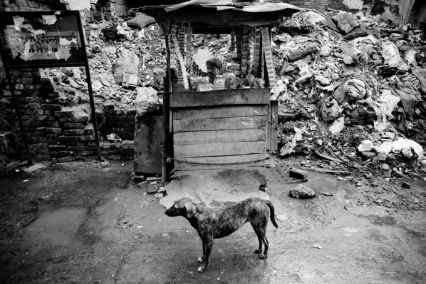
    Photo of life in Delhi, India.  From a collection by Belgian photographer Frederik Buyckx, 2009

    Photo of life in Delhi, India. From a collection by Belgian photographer Frederik Buyckx, 2009

    Thought provoking, occasionally breath-taking photos from a 6:00 a.m. walkaround in Delhi, India; Belgian photographer Frederick Buyckx promises more photos from his recent trip to India and Pakistan, at his blog.

    Please share:

    Add to FacebookAdd to NewsvineAdd to DiggAdd to Del.icio.usAdd to StumbleuponAdd to RedditAdd to BlinklistAdd to TwitterAdd to TechnoratiAdd to Furl


    Fireworks in Washington, D.C.

    July 6, 2009

    President Barack Obama and First Lady Michelle Obama watch the fireworks over the National Mall from the White House on July 4, 2009. (Official White House photo by Pete Souza)

    President Barack Obama and First Lady Michelle Obama watch the fireworks over the National Mall from the White House on July 4, 2009. (Official White House photo by Pete Souza) (White House caption)

    July 4 in Washington was always a lot of fun, and I always found myself without the right film or the right lens, or knowledge about how to make the exposure work.  Several times I tried to get good shots of the fireworks from the Capitol lawn — no success.  Once we walked the Mall and sat under the fireworks going off, near the Lincoln Memorial (Kathryn won’t let me forget that one).  Bad angle for photos, and for viewing.  Once I tried from the Virginia side of the Potomac.  Not a single good shot.

    One of the great joys of electronic photography is getting more of these kinds of shots.

    Still, this photograph shows great skill on Souza’s part — lens selection, exposure, and composition come together just right.

    Some restrictions apply to use of this photograph.  See notes here.


    Party symbol – a photo of the moment

    July 1, 2009

    Al Franken’s in the Senate and Sen. Robert Byrd is out of the hospital.  I was thinking maybe it’s time for some intransigent Republicans to review whether they really want to cross the Democrats.  And then I came across this photo. Somehow, it’s symbolic.

    In any case, it’s a great photo.

    Well, technically its a mule, and not a jackass, but sometimes I worry that Thomas Nast couldnt tell the difference.  Mule at a Georgia petting zoo - Photo by Lona

    Well, technically it's a mule, and not a jackass, but sometimes I worry that Thomas Nast couldn't tell the difference. Mule at a Georgia petting zoo - Photo by Lona


    A rainbow fell on Brooklyn

    June 30, 2009

    Stars on Alabama, a rainbow fell on Brooklyn — somebody ought to write a song about it.

    Rainbow over Brooklyn, June 29, 2009 - photo by JOKelly

    Rainbow over Brooklyn, June 29, 2009 - photo by JOKelly

    Photo by JimmyOKelly.  Go see the stuff Kelly has posted at FLICKR, before he gets famous.  Poetry in photography.  Nice collection of others’ shots, too.


    Snow photos

    December 13, 2008

    Forecast is 70 degrees in Dallas on Sunday.

    Meanwhile, Catherine Sherman has some photos of snow near Kansas City.  Nice stuff. (I don’t have her permission to copy the photo here — go see her blog.)

    I particularly like her photo of the river birch tree.  It appeals to the botanist that still survives within me, plus it gives me hope about the proliferation of electronic cameras and the mass recording of things of interest to science.

    Sherman writes that Kansas is the only state which has no native pines.  Is that accurate?  Does that count include Hawaii?  (What are the native pines of Hawaii?)

    In short, it’s really cool.


    Historic images: Quanah Parker, Last Chief of the Comanches

    June 19, 2008

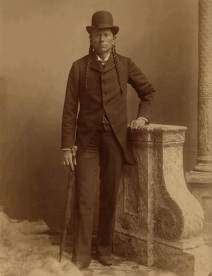
    Quanah Parker, photo by Lanney

    Quanah Parker, a Kwahadi Comanche chief; full-length, standing in front of tent.
    Photographed by Lanney. Public Domain photo.
    National Archives, “Pictures of Indians in the United States”

    Photographs of Native Americans reside among the publicly and internet available materials of the National Archives. Images can be ordered in sets of slides, or as individual prints, though many are available in quality high enough for PowerPoint works and use on classroom materials. Many of the photos are 19th century.

    Quanah Parker stands as one of the larger Native Americans in Texas history. This photo puts a face to a reputation in Texas history textbooks. Texas teachers may want to be certain to get a copy of the photo. His life story includes so many episodes that seem to come out of a Native American version of Idylls of the King that a fiction writer could not include them all, were they not real.

    • Quanah’s mother was part of the famous Parker family that helped settle West Texas in the 1830s. Cynthia Ann Parker was captured in 1836 when Comanches attacked Fort Parker, near present-day Groesbeck, Texas, in Limestone County. (See Fort Parker State Park.) Given a new name, Nadua (found one), she assimilated completely with the Nocona band of Comanches, and eventually married the Comanche warrior Noconie (also known as Peta Nocona). Quanah was their first child, born in 1852.
    • Nadua was captured by a Texas party led by Lawrence Sullivan “Sul” Ross in 1860, in the Battle of Pease River. Noconie, Quanah, and most of the Nocona men were off hunting at the time, and the fact of Nadua’s capture was not realized for some time. Nadua asked to return to the Comanches and her husband, but she was not allowed to do so. When her youngest daughter, who had been captured with her, died of an infection, Nadua stopped eating, and died a few weeks later.
    • Sul Ross was a character in his own right. At the time he participated in the raid that recaptured Cynthia Parker, he was a student at Baylor University (“What do I do on summer breaks? I fight Indians.”) At the outbreak of the Civil War, Ross enlisted in the Confederate Army as a private. Over 135 battles and skirmishes he rose to the rank of Brigadier General, the ninth youngest in the Confederate Army. A successful rancher and businessman back in Texas after the war, he won election as governor in 1887, served two very successful terms (he resolved the Jaybird-Woodpecker War in Fort Bend County, and had to call a special session of the legislature to deal with a budget surplus), refused to run for a third term, and was named president of Texas Agricultural and Mechanical College (Texas A&M) within a few days of stepping down as governor. Ross’s leadership of the college is legendary — students put pennies near a statue of Ross in a traditional plea to pass final exams, among many other traditions. After his death, Texas created Sul Ross State University, in Alpine, Texas, in his honor.
    • Quanah Parker’s father, Noconie, died a short time after his mother’s capture. He left the Nocona band, joined the Destanyuka band under Chief Wild Horse, but eventually founded his own band with warriors from other groups, the Quahadi (“antelope eaters”) (also known as Kwahadi). The Quahadi band grew to be one of the largest and most notorious, always with Quanah leading them. The Quahadis refused to sign the 1867 Medicine Lodge Treaties, and so avoided immediate internment to a reservation. However, dwindling food supplies and increasing opposition forced Quanah to retire to a reservation in 1875, in what is now southwestern Oklahoma. This was the last Comanche band to come to the reservation.
    • Quanah was appointed Chief of all the Comanches.
    • Through investments, Quanah became rich — probably the richest Native American of his time.
    • Quanah hunted with President Theodore Roosevelt.

      Quanah Parker in later life, as a successful businessman. Wikipedia image, public domain

      Quanah Parker in later life, as a successful businessman. Wikipedia image, public domain

    • Rejecting monogamy and Christianity, Quanah founded the Native American Church movement, which regards the use of peyote as a sacrament. Quanah had been given peyote by a Ute medicine man while recovering from wounds he’d suffered in battle with U.S. troops. Among his famous teachings: The White Man goes into his church and talks about Jesus. The Indian goes into his Tipi and talks with Jesus.
    • Photo at right: Quanah Parker in his later life, in his business attire. Photo thought to be in public domain.
    • Bill Neeley wrote of Quanah Parker: “Not only did Quanah pass within the span of a single lifetime from a Stone Age warrior to a statesman in the age of the Industrial Revolution, but he never lost a battle to the white man and he also accepted the challenge and responsibility of leading the whole Comanche tribe on the difficult road toward their new existence.”
    • Quanah Parker died on February 23, 1911. He is buried at Fort Sill Cemetery, Oklahoma, next to his mother and sister.

    Quanah Parker’s epitaph reads:

    Resting Here Until Day Breaks
    And Shadows Fall and Darkness Disappears is
    Quanah Parker Last Chief of the Comanches
    Born 1852
    Died Feb. 23, 1911

    Other Resources:

    Spread Quanah’s story:

    Add to FacebookAdd to NewsvineAdd to DiggAdd to Del.icio.usAdd to StumbleuponAdd to RedditAdd to BlinklistAdd to TwitterAdd to TechnoratiAdd to Furl


    WikiMedia’s appropriate pic of the day

    April 30, 2008

    Well, it woulda been more appropriate in April 25, perhaps — though the species is not a malaria-carrying mosquito.

    Still, you gotta love it, Wikimedia’s Picture of the Day for April 30, 2008:


    Culex spp., larva, near the surface of a body of water.

    This would make a great background for a PowerPoint presentation with just a bit of work, I think. The browns are about the same intensity as the blues and greens. Nice background for a presentation on mosquitoes — outstanding background for slide of a chart on mosquito populations or somesuch.

    Warm up for biology class:  Invert the photo, ask kids to explain what it is.


    Human Liberty Bell: Tribute to photos of Mole & Thomas

    December 12, 2007

    Surely you’ve seen some of these photos; if you’re a photographer, you’ve marveled over the ability of the photographer to get all those people to their proper positions, and you’ve wondered at the sheer creative genius required to set the photos up.

    Like this one, a depiction of the Liberty Bell — composed of 25,000 officers and men at Fort Dix, New Jersey. The photo was taken in 1918.

    Mole & Thomas photo, Human Liberty Bell The Carl Hammer Gallery in Chicago featured an exhibit of these monumental photos in April and May, 2007:
    The outbreak of World War I and its inherent violence engendered a new commitment by the world’s photographers to document every aspect of the fighting, ending an era of In A Patriotic Mole, A Living Photograph, Louis Kaplan, of Southern Illinois University, writes, “The so-called living photographs and living insignia of Arthur Mole [and John Thomas] are photo-literal attempts to recover the old image of national identity at the very moment when the United States entered the Great War in 1917.

    Mole’s [and Thomas’s] photos assert, bolster, and recover the image of American national identity via photographic imaging. Moreover, these military formations serve as rallying points to support U.S. involvement in the war and to ward off any isolationist tendencies. In life during wartime, [their] patriotic images function as “nationalist propaganda” and instantiate photo cultural formations of citizenship for both the participants and the consumers of these group photographs.”

    The monumentality of this project somewhat overshadows the philanthropic magnanimity of the artists themselves.Instead of prospering from the sale of the images produced, the artists donated the entire income derived to the families of the returning soldiers and to this country’s efforts to re-build their lives as a part of the re-entry process.

    Eventually, other photographers, appeared on the scene, a bit later in time than the activity conducted by Mole and Thomas, but all were very clearly inspired by the creativity and monumentality of the duo’s production of the “Living” photograph.

    One of the most notable of those artists was Eugene Omar Goldbeck. He specialized in the large scale group portrait and photographed important people (Albert Einstein), events, and scenes (Babe Ruth’s New York Yankees in his home town, San Antonio) both locally and around the world (Mt. McKinley). Among his military photographs, the Living Insignia projects are of particular significance as to how he is remembered.

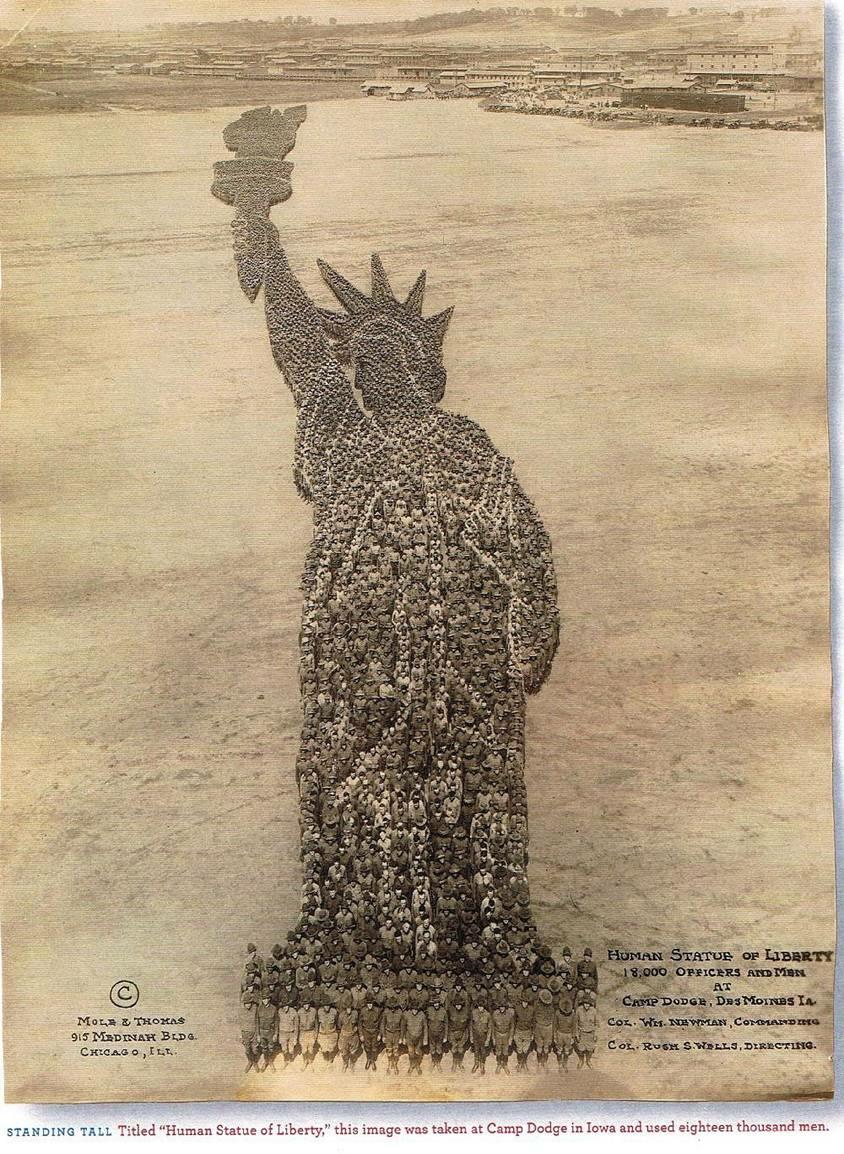
    Using a camera as an artist’s tool, using a literal army as a palette, using a parade ground as a sort of canvas, these photographers made some very interesting pictures. The Human Statue of Liberty, with 18,000 men at Camp Dodge, Iowa?


    statue-of-liberty-human-camp-dodge-from-snopes.jpg

    Most of these pictures were taken prior to 1930. Veterans who posed as part of these photos would be between 80 and 100 years old now. Are there veterans in your town who posed for one of these photos?


    Good photographic copies of some of these pictures are available from galleries. They are discussion starters, that’s for sure.

    Some questions for discussion:

    1. Considering the years of the photos, do you think many of these men saw duty overseas in World War I.
    2. Look at the camps, and do an internet search for influenza outbreaks in that era. Were any of these camps focal points for influenza?
    3. Considering the toll influenza took on these men, about how many out of each photo would have survived the influenza, on average?
    4. Considering the time, assume these men were between the ages of 18 and 25. What was their fate after the Stock Market Crash of 1929? Where were they during World War II?
    5. Do a search: Do these camps still exist? Can you find their locations on a map, whether they exist or not?
    6. Why do the critics say these photos might have been used to build national unity, and to cement national identity and will in time of war?
    7. What is it about making these photos that would build patriotism? Are these photos patriotic now?

    These quirky photos are true snapshots in time. They can be used for warm-ups/bell ringers, or to construct lesson plans around.

    Tip of the old scrub brush to Gil Brassard, a native, patriotic and corporate historian hiding in Baton Rouge, Louisiana.


    Mount Timpanogos

    July 4, 2006

    Among many underappreciated mountain peaks in the U.S. is Mount Timpanogos, in the Wasatch Range of the Rockies. It is northeast of Provo, Utah, and it was due east of my bedroom window for the nine years I lived in Pleasant Grove, Utah, before I headed off to college.

    Here is a site that offers some stunning views of the mountain: http://utahpictures.com/Timpanogos.html [update:  pictures moved to this site:  http://utahpictures.com/Timpanogos.php]. While I often hiked the “backside” of the mountain, I never made it all the way to the top. You can see what I missed.