Sunrise on the Shenandoah Mountains

March 11, 2014

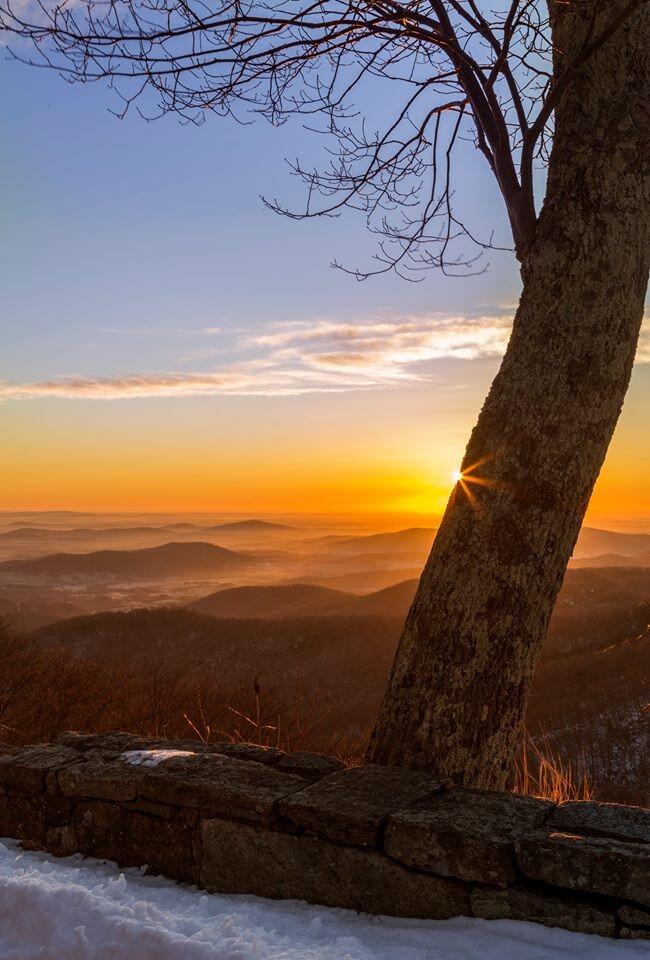
This is a hopeful picture.

US Dept of Interior Tweet:  Beautiful #sunrise over @ShenandoahNPS last weekend. #Virginia #travel #nature pic.twitter.com/T2sEgczGsz

US Dept of Interior Tweet: Beautiful #sunrise over @ShenandoahNPS last weekend. #Virginia #travel #nature pic.twitter.com/T2sEgczGsz

Probably taken along the Blue Ridge Parkway.  At the bottom of the photo, note the stone wall, probably built by the Civilian Conservation Corps during the Franklin Roosevelt administration, and still contributing to America’s beauty and economy 80 years later.

I can imagine driving along, catching a beautiful sunrise, but not being at a point to stop to photograph it.  Driving farther along, the photographer found a safe place to stop, but the sunrise itself was gone by 15 minutes.  With the aid of a young tree, however, the photographer can recapture that moment of the Sun’s peeking over the horizon, without special effects.  Nice thought for the shot.


It’s a desert out there: Salmon Research at Iliamna Lake, Alaska 2013 – Jason Ching film

March 6, 2014

Sitting in a hot trailer out on the northern New Mexico desert, Arizona State’s great soil scientist Tom Brown tipped back his cowboy hat, and asked me if I had been lonely over the previous week.  Classes at BYU started up in August, and our other field workers on the project, with the University of Utah Engineering Experiment Station, for EPA and New Mexico Public Service, had gone back to class.  My classes at the University of Utah didn’t start for a few more weeks — so I was holding down the fort by myself.

Dr. Brown’s expertise in reading air pollution damage on desert plants propelled a good part of the work.  He showed me how to tell the difference between sulfur dioxide damage and nitrogen oxide damage on grasses and other plants, and how to tell  when it was insects.  He had some great stories.  As a Mormon, he was also full of advice on life.

The Shiprock, a plug from an ancient volcano, left after the mountain eroded away. Near Shiprock, New Mexico, on the Navajo Reservation. Wikipedia image by Bowie Snodgrass

The Shiprock, a plug from an ancient volcano, left after the mountain eroded away. Near Shiprock, New Mexico, on the Navajo Reservation. Wikipedia image by Bowie Snodgrass

Between Farmington where our hotel was, and Teec Nos Pos where our most distant (non-wet) sampling site was, radio reception was lousy most of the time.  The Navajo-language AM station in Farmington played some of the best music, and sometimes it could be caught as far west as Shiprock .  Most of the time, driving across Navajoland, I had nothing but my thoughts to accompany me.  Well, thoughts and the all-too-frequent Navajo funeral processions, 50 pickups long on a two-lane highway.

“No, not lonely.  There’s a lot of work, I’ve got good books, and sleep is good,” I told him.

“Enjoy it,” Brown said.  “The best time for any researcher is out in the field.  And when you’re young, and you haven’t seen it all, it’s better.”

Indian rice grass in the sunlight (Oryzopsis hymendoides). Photo from the Intermountain Herbarium, Utah State University Extension Service

Indian rice grass in the sunlight (Oryzopsis hymendoides). Photo from the Intermountain Herbarium, Utah State University Extension Service

Brown spent a couple of days.  Within a couple of weeks I turned everything over to other Ph.Ds to shut down the wet sampling for the winter, and caught a ride back to Provo (closer to where I lived) in a Cessna with a pilot who loved to fly low enough to see the canyons along the way.  Get a map and think of the possibilities, with a landing in Moab; if you don’t drool at the thought of such a trip in the air but not too high, if your heart doesn’t actually beat faster thinking of such a trip, go see your physician for treatment.

By that time I was out of film, alas.

My few summers out in the desert chasing air pollution stay fixed in the surface of my memory.  Indian rice grass still excites me in the afternoon sun (Oryzopsis hymenoides) — one of the more beautiful of grasses, one of the more beautiful and soil-holding desert plants.  When hear the word “volcano,” I think of the Shiprock.  When I read of air pollution damage, I think of all the pinon, aspen, cottonwoods, firs and other trees we gassed; when I see aspen in its full autumn glory, I remember those dozen  or so leaves we caused to turn with SO2 (slight damage turns the leaves colors; greater damage makes them necrotic, a bit of a mirror of autumn).

All of that came back as I watched Jason Ching’s film, “Salmon Research at Iliamna Lake, Alaska 2013,” a simple six-minute compilation of shots taken with modern electronic cameras, including the hardy little GoPros, and with assistance from a DJI Phantom Quadcopter drone.  Wow, what we could have captured with that equipment!

Ching’s description of the film:

This video showcases the scenery of Iliamna Lake and shows some of the 2013 research of the Alaska Salmon Program’s Iliamna Lake research station, one of four main facilities in Southwest Alaska . Established in the 1940’s, the Program’s research has been focused on ecology and fisheries management relating primarily to salmon and the environment in Bristol Bay, Alaska. Check out our program at: fish.washington.edu/research/alaska/

Filmed and edited by Jason Ching
Additional footage provided by Cyril Michel

Song:
“The long & quiet flight of the pelican” by Ending Satellites (endingsatellites.com)

Additonal Information:
Shot on a Canon 5d Mark II, Canon T3i, GoPro Hero 2 and GoPro Hero 3
DJI Phantom Quadcopter

JasonSChing.com

I am very grateful to be a part of such a long standing, and prominent program that allows me to work in the field in such an incredible setting with fantastic folks. This is the second video I created, the first one in 2012, to merely show family and friends back at home what I’ve been up to during the summer. This video was often shot between, or during field sampling events so a special thanks goes out to all those who supported me by continuing to work while I fiddled with camera gear.

Do you really want to get kids more interested in science?  Show them this stuff.  Scientists get the front seats on cool stuff — and they often get paid to do it, though they won’t get rich.

Researching life, and rocks, geography and landscape, and water resources, one may be alone in a desert, or a desert of human communication.  Then one discovers just how beautiful the desert  is, all the time.

More:

  • Yes, I know; Indian rice grass has been renomenclaturedAchnatherum hymenoides (Roemer & J.A. Shultes) Barkworth, or Stipa hymenoides Roemer & J.S. Shultes, or Oryzopsis hymenoides (Roemer & J.S. Shultes) Ricker ex Piper.  It is the State Grass of Utah

North Korea: A hole in the fabric of the 21st century

February 25, 2014

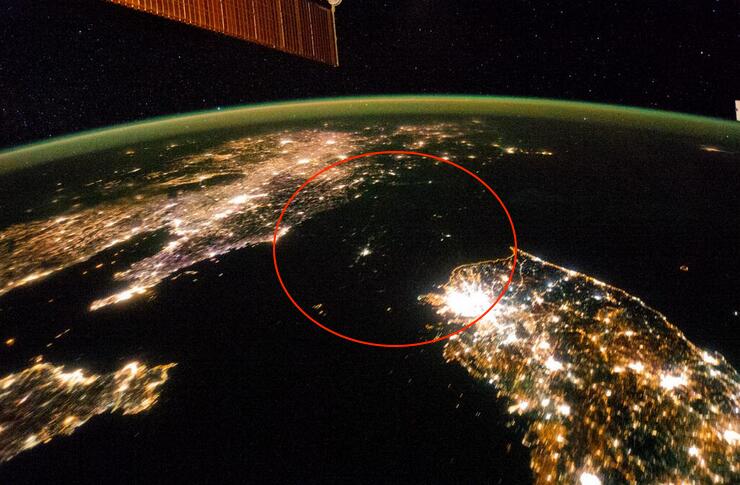
Here’s a photograph of one of the greatest, and longest-running tragedies of our time.

No, that’s not a stretch of water in the red circle.  That’s North Korea, at night, blacked out by a lack of electrical lights.

Tweetpic from the Washington Post: North Korea looks like a sea of misery in this photo from space http://wapo.st/1c1B84q  via @KnowMoreWP pic.twitter.com/nB3g8fa63Q

Tweetpic from the Washington Post: North Korea looks like a sea of misery in this photo from space http://wapo.st/1c1B84q via @KnowMoreWP pic.twitter.com/nB3g8fa63Q

It’s a photo from the International Space Station taken in January.

The KnowMore blog from the Post describes the tragedy, and points to even more disturbing stories:

North Korea appears as nothing more than a shadow in the above photograph, taken at night aboard the International Space Station last month. South Korea’s eastern coastline is indistinguishable from the demilitarized zone along the border with the North, as though the Sea of Japan flowed into the Yellow Sea and Pyongyang were an island in a strait separating South Korea from China.

North Korea’s interior is nearly invisible from orbit at night, just as what happens inside the country on a day-to-day basis is largely invisible to the outside world. U.N. investigators managed to shine a little light into North Korea’s darkest corners last month.  [Click here to get to the U.N. report]

I’ve used similar photos in class.  It’s a powerful exercise.  North Korea is as dark as undeveloped and largely unpopulated areas of the Congo River Basin, the Australian Outback, the Arabian Peninsula’s “Empty Quarter,” and almost as dark as Antarctica.

No doubt stargazing is good in some of those dark spots in North Korea.  This is one case where the absence of light pollution does NOT indicate good planning, but instead an amazing paucity of rational development.


Photography as an instrument of history: Ukraine’s Independence Square

February 21, 2014

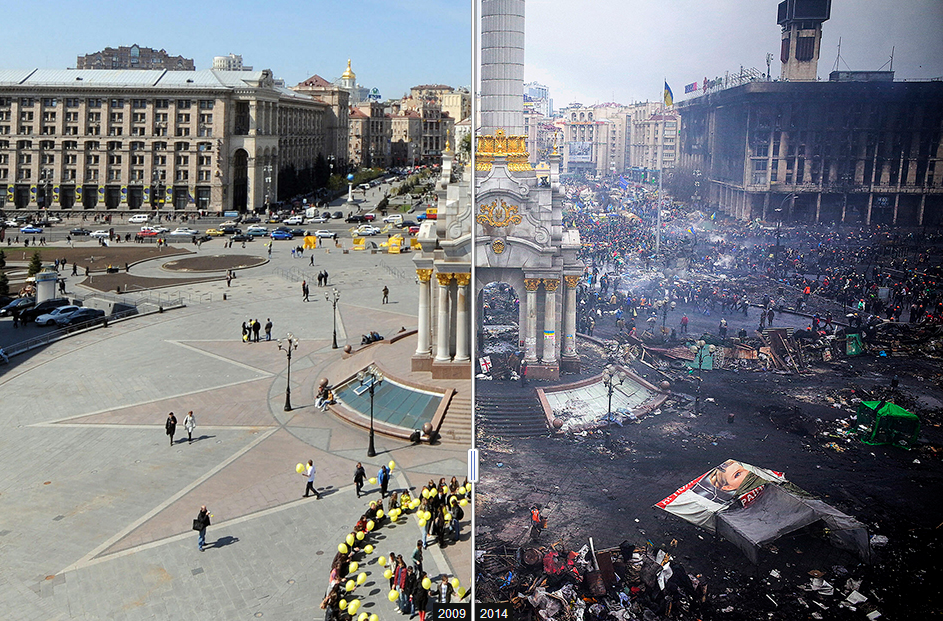
Tweet from the Wall Street Journal shows, in very dramatic form, how photographs can be used to record history and current events, telling a story that words just cannot.

 WSJ Wall Street Journal - #Ukraine's Independence Square: then and now http://on.wsj.com/1d9q7IL  pic.twitter.com/vzqPKj79Cb

WSJ Wall Street Journal – #Ukraine’s Independence Square: then and now http://on.wsj.com/1d9q7IL pic.twitter.com/vzqPKj79Cb

In Ukraine, there’s an enormous difference between 2009 and 2014.  In five years, Kiev is a different city.

Do we attribute the differences to corrupt government, to the assault on democratic institutions, or to the movement to end the corruption and boost democracy?

It’s more impressive that I can show in a link here; at the WSJ site, the two photos are interactive — you can grab the middle line with your mouse and move it to see the damage in 2014.  Check it out.

Are there similar photographic comparisons for Syria, Egypt, Yemen, Venezuela, Brazil, China, Britain, the United States?  If you know of some, or if you have created some, will you share?


When the Moon hits your eye, in Arches NP

February 12, 2014

Photo by Lynn Sessions;

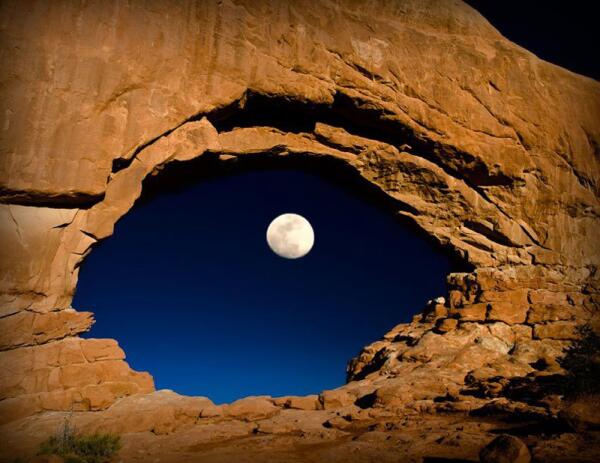
Photo by Lynn Sessions; “THE EYE OF THE #MOON: North Window arch at Arches National Park in #Utah. #NatGeo pic.twitter.com/XwHfdWK5Ft

It’s just a click of the shutter?  Ha!

I’m assuming not a lot of post-photo processing on this. Lynn Sessions had to figure out when the Moon would be in the North Window Arch, calculate exposure, and shoot off enough of them to get a decent shot before the Moon moved.  I suspect the rocks were “painted” with a flashlight during the exposure.

(Haven’t yet found the technical details of the shot. But I did find this about the photographer:
I’m a frustrated amateur photographer who is trying to visit every corner in Utah as well as hike/photograph every canyon in southern Utah. More at http://www.DreamBreeze.com )

Patience, planning, creativity — then just push the button.

More:


Reflections in a window on the wild

January 29, 2014

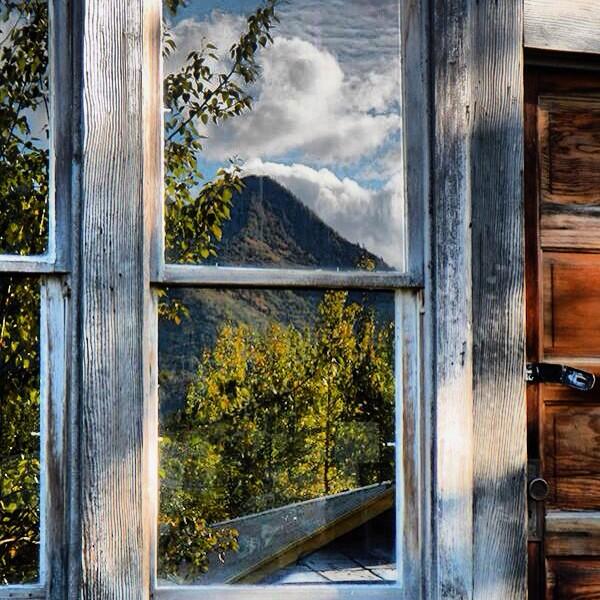
From the U.S. Department of Interior: Really cool reflection photo from America's largest national park: @WrangellStENPS in #Alaska. pic.twitter.com/WHUYkgJNTH

From the U.S. Department of Interior: Really cool reflection photo from America’s largest national park: @WrangellStENPS in #Alaska. pic.twitter.com/WHUYkgJNTH

Wrangell-St. Elias is our largest National Park? At 20,587 square miles, it’s about 80% as large as West Virginia, and larger than nine other states.

Just the facts:

Wrangell–St. Elias National Park and Preserve is a United States national park and national preserve managed by the National Park Service in south central Alaska. The park and preserve was established in 1980 by the Alaska National Interest Lands Conservation Act.[3] This protected area is included in an International Biosphere Reserve and is part of the Kluane/Wrangell-St. Elias/Glacier Bay/Tatshenshini-Alsek UNESCO World Heritage Site. The park and preserve form the largest area managed by the National Park Service in the United States by area with a total of 13,175,799 acres (20,587.19 sq mi; 53,320.57 km2). The park includes a large portion of the Saint Elias Mountains, which include most of the highest peaks in the United States and Canada, yet are within 10 miles (16 km) of tidewater, one of the highest reliefs in the world. Wrangell-St. Elias borders on Canada’s Kluane National Park and Reserve to the east and approaches the U.S. Glacier Bay National Park to the south. The chief distinction between park and preserve lands is that sport hunting is prohibited in the park and permitted in the preserve. In addition, 9,078,675 acres (3,674,009 ha) of the park are designated as the largest single wilderness in the United States.

Wrangell-St. Elias National Monument was initially designated on December 1, 1978 by President Jimmy Carter using the Antiquities Act, pending final legislation to resolve the allotment of public lands in Alaska. Establishment as a national park and preserve followed the passage of the Alaska National Interest Lands Conservation Act in 1980. The park, which is bigger than the nation of Switzerland, has long, extremely cold winters and a short summer season. It supports a variety of large mammals in an environment defined by relative land elevation. Plate tectonics are responsible for the uplift of the mountain ranges that cross the park. The park’s extreme high point is Mount St. Elias at 18,008 feet (5,489 m), the second tallest mountain in both the United States and Canada. The park has been shaped by the competing forces of volcanism and glaciation. Mount Wrangell is an active volcano, one of several volcanoes in the western Wrangell Mountains. In the St. Elias Range Mount Churchill has erupted explosively within the past 2000 years. The park’s glacial features include Malaspina Glacier, the largest piedmont glacier in North America, Hubbard Glacier, the longest tidewater glacier in Alaska, and Nabesna Glacier, the world’s longest valley glacier. The Bagley Icefield covers much of the park’s interior, which includes 60% of the permanently ice-covered terrain in Alaska. At the center of the park, the boomtown of Kennecott exploited one of the world’s richest deposits of copper from 1903 to 1938, exposed by and in part incorporated into Kennicott Glacier. The mine buildings and mills, now abandoned, compose a National Historic Landmark district.

More:


Beautiful Antarctica: Photos, or painting?

January 27, 2014

This one is cropping up all over the internet.

But just try to get a commitment as to its origins.  Photographic, or artist’s image?

I wagered the latter. Note general lack of thick clouds, angle of sunlight, etc.

Beautiful Antarctica from space. Photographic image, or artist's rendering?  Who deserves credit for the image?

Beautiful Antarctica from space. Photographic image, or artist’s rendering? Who deserves credit for the image?

Then, at Twisted Sifter (shout out to Annette Breedlove; and everyone outside my family will be mystified by that reference) I found this, the full image from NASA.  Notice how some selective editing, changing the perspective, makes the image above more fascinating — while stripping out the identifying credits:

Image via Twisted Sifter; NASA image of Antarctica, available at Flickr Commons

Image via Twisted Sifter; NASA image of Antarctica, available at Flickr Commons

Well, that’s a different thing, then.

Twisted Sifter’s explanation of details, excerpt:

Seen above is a view of the Earth on September 21, 2005 with the full Antarctic region visible. The composite image shows the sea ice on September 21, 2005, the date at which the sea ice was at its minimum extent in the northern hemisphere. The colour of the sea ice is derived from the AMSR-E 89 GHz brightness temperature while the extent of the sea ice was determined by the AMSR-E sea ice concentration. Over the continents, the terrain shows the average land cover for September, 2004. The global cloud cover shown was obtained from the original Blue Marble cloud data distributed in 2002. [Source]

Due to the position of Antarctica in relation to our Sun it would not look like this to the naked eye. This is a composite that shows what Antarctica looks like if the entire continent were illuminated.

Click here for the full resolution 8400×8400 pixel TIFF version (63 mb) and click here for the 8400 x 8400 px JPG version.

NASA’s details, from the Flickr file:

NASA on The Commons

Global View of the Arctic and Antarctic on September 21, 2005

Collection: NASA Scientific Visualization Studio Collection

Title: Global View of the Arctic and Antarctic on September 21, 2005

Instrument: Terra/MODIS

Instrument: Aqua/AMSR-E

Description: This image shows a view of the Earth on September 21, 2005 with the full Antarctic region visible.

Abstract: In support of International Polar Year, this matching pair of images showing a global view of the Arctic and Antarctic were generated in poster-size resolution. Both images show the sea ice on September 21, 2005, the date at which the sea ice was at its minimum extent in the northern hemisphere. The color of the sea ice is derived from the AMSR-E 89 GHz brightness temperature while the extent of the sea ice was determined by the AMSR-E sea ice concentration. Over the continents, the terrain shows the average landcover for September, 2004. (See Blue Marble Next Generation) The global cloud cover shown was obtained from the original Blue Marble cloud data distributed in 2002. (See Blue Marble:Clouds) A matching star background is provided for each view. All images include transparency, allowing them to be composited on a background.

Completed: 2007-02-08

Credit: *Please give credit for this visualization to* NASA/Goddard Space Flight Center Scientific Visualization Studio The Blue Marble data is courtesy of Reto Stockli (NASA/GSFC).

Studio: SVS

Animator: Cindy Starr (Lead)

Scientist: Ronald Weaver (University of Colorado)

Data Collected: AMSR-E Sea Ice: 2005-09-21; Blue Marble cloud layer 2002; Blue Marble Next Generation Seasonal Landcover 2004-09

UID: SPD-SCIVS-http://svs .gsfc.nasa.gov/vis/a 000000/a003400/a0034 02/NSIDCimages__SPcl ouds.2158-IMAGE

Original url: svs.gsfc.nasa.gov/vis/a000000/a003400/a003402/index.html

SOURCE: nasaimages.org/luna/servlet/detail/NSVS~3~3~7128~107128

Visit www.nasaimages.org for the most comprehensive compilation of NASA stills, film and video, created in partnership with Internet Archive.

The image, and it’s odyssey and story, are reminders that reality is often better than the made up stuff; and it’s wise to properly attribute stuff you borrow.  Is this just a cool image, or an opportunity for teachers to enrich the classroom and an argument for boosting NASA’s budget?

More:


Joshua Tree National Park at night

January 19, 2014

A long exposure, you can tell by the airplane streaks near the horizon.  Walking that fine photography edge of long enough to get the exposure, but short enough not to distort the stars too much.

Long exposure of a Joshua tree, in Joshua Tree National Park. Photo: Sarah Chah (www.sharetheexperience.org)

Long exposure of a Joshua tree, in Joshua Tree National Park. Photo: Sarah Chah (www.sharetheexperience.org)

Captioned at America’s Great Outdoors Tumblr, by the U.S. Department of Interior:

Viewed from the road, this desert park only hints at its vitality. Closer examination reveals a fascinating variety of plants and animals that make their home in this land shaped by strong winds, unpredictable torrents of rain, and climatic extremes. Dark night skies, a rich cultural history, and surreal geologic features add to the attraction of this place. Come see Joshua Tree National Park for yourself!

Photo: Sarah Chah (www.sharetheexperience.org)


Photograph, or painting of Paris?

January 17, 2014

And from what was this shot, if it’s a photo?

With everyone else,

I love
Paris in the
the springtime!

But I wonder what brain bending goes on in this image.  From Fascinating Pics:

Paris at Sunset, France pic.twitter.com/QnhtkUPKLn - Fascinating Pics

Paris at Sunset, France pic.twitter.com/QnhtkUPKLn Photo by Coolbiere.

What do you think? Painting?  Photo?  Manipulated photo?

Update: J.A. Higginbotham tracked down the original Flickr photo, by a Coolbiere.  Nikon D-800, 70-200 zoom telephoto, at 122mm; claims to have taken it from Mount Parnasse. Luck and preparedness.  Wow.


Insta-Millard, photography and astronomy edition: South DakotaHenge

December 23, 2013

How much image manipulation, if any, was necessary to capture this enormous-looking Moon rising over a South Dakota “road to nowhere,” close to the 2013 Winter Solstice?

From @GlobePics:

From @GlobePics: “Road To Nowhere – Supermoon” – Supermoon rises over this road to nowhere in eastern South Dakota. pic.twitter.com/82AoFgPvWn

Who should get credit for the photo?  (I can’t quite read the name in the lower left corner.)

Buy a print here, from the photographer, Aaron J. Groen.

More:


Who is Tim Pangos?

December 19, 2013

Ha. I am amused at people so anxious to take material from this blog, or complain about something I’ve written, that they can’t be bothered to look around for names of the blog, or author, or otherwise look for proper attribution.

I’ve been called “Tim Panogos” several times, “Tim Pagonos” a few.  I’ve had a few zombies from Santayana’s nightmares insist on calling me Millard.

This is to note that the humor will continue:  Now my photos are credited to “Tim Pangos.”  To be sure, it’s posted by LatinaMom.  Happy to be able to hold on to multicultural appeal.

Here's my photo, as featured at

Here’s my photo, as featured at “Funny Bumperstickers” by Latina Mom. ” Zombies. They’ll get you every time. Image via Tim Pangos.  Photo and original post by Ed Darrell at Millard Fillmore’s Bathtub — use of photos encouraged, with attribution.  This photo from my iPhone, by the way.

For the record, the URL of this blog features the name of that great Utah landmark, Mount Timpanogos.  I do not intentionally use the pseudonyms “Tim Panagos,” “Tim Pangos,” nor any other derivative from the mountain’s moniker.


There’s a Milky Way in Australia?

November 26, 2013

Yes, but it’s upside down, right?

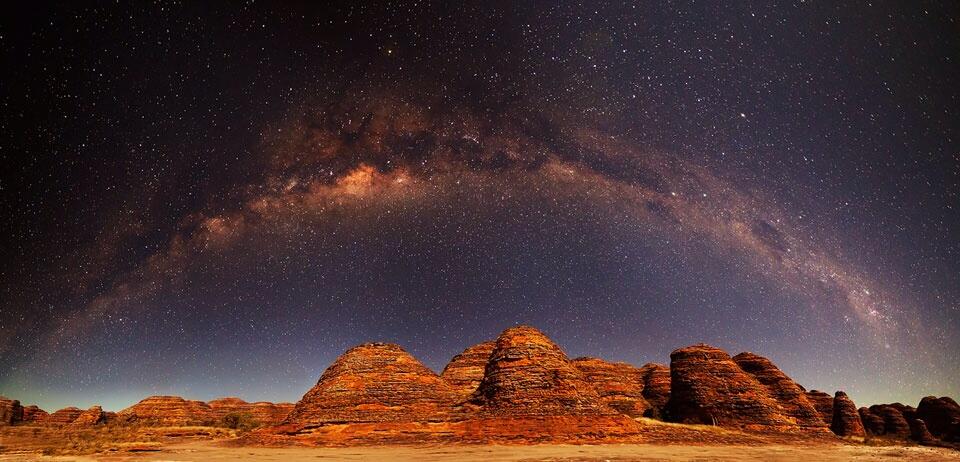
Meredith Frost Tweeted: Great shot of the Milky Way over Western Australia (Photo/Mike Salway) An Astronomy Picture of the DayMeredith Frost Tweeted: Great shot of the Milky Way over Western Australia (Photo/Mike Salway) An Astronomy Picture of the Day

Meredith Frost Tweeted: Great shot of the Milky Way over Western Australia (Photo/Mike Salway) An Astronomy Picture of the Day

Turns out this was the Astronomy Picture of the Day back in September 2012.  NASA said:

Milky Way Over the Bungle Bungles
Image Credit & Copyright: Mike Salway Explanation: Which part of this picture do you find more interesting — the land or the sky? Advocates for the land might cite the beauty of the ancient domes of the Bungle Bungle Range in Western Australia. These picturesque domes appear as huge layered beehives and are made of sandstones and conglomerates deposited over 350 million years ago. Advocates for the sky might laud the beauty of the Milky Way’s central band shown arching from horizon to horizon. The photogenic Milky Way band formed over 10 billion years ago and now includes many well-known nebulae and bright stars. Fortunately, you don’t have to decide and can enjoy both together in this beautiful 8-frame panorama taken from the dark skies of Purnululu National Park about two months ago.

Decide Anyway: Land or Sky

I’d make some remarks about silly names for land formations in Australia — but here we sit with The Grand Tetons, The Gros Ventre, and several dozen “Molly’s Nipples” in our nation.

But really:  Bungle-Bungles?

Ain’t geography grand? Ain’t nature grand? Ain’t NASA doing something right?

More:


NASA’s photo of the day the Earth smiled

November 13, 2013

NASA's caption:  On July 19, 2013, in an event celebrated the world over, NASA's Cassini spacecraft slipped into Saturn's shadow and turned to image the planet, seven of its moons, its inner rings -- and, in the background, our home planet, Earth. Image Credit:  NASA/JPL-Caltech/SSI

NASA’s caption: On July 19, 2013, in an event celebrated the world over, NASA’s Cassini spacecraft slipped into Saturn’s shadow and turned to image the planet, seven of its moons, its inner rings — and, in the background, our home planet, Earth. Image Credit: NASA/JPL-Caltech/SSI

It’s difficult to improve on NASA’s matter-of-fact explanations.

The Day the Earth Smiled

On July 19, 2013, in an event celebrated the world over, NASA’s Cassini spacecraft slipped into Saturn’s shadow and turned to image the planet, seven of its moons, its inner rings — and, in the background, our home planet, Earth.

With the sun’s powerful and potentially damaging rays eclipsed by Saturn itself, Cassini’s onboard cameras were able to take advantage of this unique viewing geometry. They acquired a panoramic mosaic of the Saturn system that allows scientists to see details in the rings and throughout the system as they are backlit by the sun. This mosaic is special as it marks the third time our home planet was imaged from the outer solar system; the second time it was imaged by Cassini from Saturn’s orbit; and the first time ever that inhabitants of Earth were made aware in advance that their photo would be taken from such a great distance.

With both Cassini’s wide-angle and narrow-angle cameras aimed at Saturn, Cassini was able to capture 323 images in just over four hours. This final mosaic uses 141 of those wide-angle images. Images taken using the red, green and blue spectral filters of the wide-angle camera were combined and mosaicked together to create this natural-color view. A brightened version with contrast and color enhanced, a version with just the planets annotated, and an unannotated version are also available.

This image spans about 404,880 miles (651,591 kilometers) across.

The outermost ring shown here is Saturn’s E ring, the core of which is situated about 149,000 miles (240,000  kilometers) from Saturn. The geysers erupting from the south polar terrain of the moon Enceladus supply the fine icy particles that comprise the E ring; diffraction by sunlight gives the ring its blue color. Enceladus (313 miles, or 504 kilometers, across) and the extended plume formed by its jets are visible, embedded in the E ring on the left side of the mosaic.

At the 12 o’clock position and a bit inward from the E ring lies the barely discernible ring created by the tiny, Cassini-discovered moon, Pallene (3 miles, or 4 kilometers, across). (For more on structures like Pallene’s ring, see PIA08328). The next narrow and easily seen ring inward is the G ring. Interior to the G ring, near the 11 o’clock position, one can barely see the more diffuse ring created by the co-orbital moons, Janus (111 miles, or 179 kilometers, across) and Epimetheus (70 miles, or 113 kilometers, across). Farther inward, we see the very bright F ring closely encircling the main rings of Saturn.

Following the outermost E ring counter-clockwise from Enceladus, the moon Tethys (662 miles, or 1,066 kilometers, across) appears as a large yellow orb just outside of the E ring. Tethys is positioned on the illuminated side of Saturn; its icy surface is shining brightly from yellow sunlight reflected by Saturn. Continuing to about the 2 o’clock position is a dark pixel just outside of the G ring; this dark pixel is Saturn’s Death Star moon, Mimas (246 miles, or 396 kilometers, across). Mimas appears, upon close inspection, as a very thin crescent because Cassini is looking mostly at its non-illuminated face.

The moons Prometheus, Pandora, Janus and Epimetheus are also visible in the mosaic near Saturn’s bright narrow F ring. Prometheus (53 miles, or 86 kilometers, across) is visible as a faint black dot just inside the F ring and at the 9 o’clock position. On the opposite side of the rings, just outside the F ring, Pandora (50 miles, or 81 kilometers, across) can be seen as a bright white dot. Pandora and Prometheus are shepherd moons and gravitational interactions between the ring and the moons keep the F ring narrowly confined. At the 11 o’clock position in between the F ring and the G ring, Janus (111 miles, or 179 kilometers, across) appears as a faint black dot. Janus and Prometheus are dark for the same reason Mimas is mostly dark: we are looking at their non-illuminated sides in this mosaic.  Midway between the F ring and the G ring, at about the 8 o’clock position, is a single bright pixel, Epimetheus. Looking more closely at Enceladus, Mimas and Tethys, especially in the brightened version of the mosaic, one can see these moons casting shadows through the E ring like a telephone pole might cast a shadow through a fog.

In the non-brightened version of the mosaic, one can see bright clumps of ring material orbiting within the Encke gap near the outer edge of the main rings and immediately to the lower left of the globe of Saturn. Also, in the dark B ring within the main rings, at the 9 o’clock position, one can see the faint outlines of two spoke features, first sighted by NASA’s Voyager spacecraft in the early 1980s and extensively studied by Cassini.

Finally, in the lower right of the mosaic, in between the bright blue E ring and the faint but defined G ring, is the pale blue dot of our planet, Earth. Look closely and you can see the moon protruding from the Earth’s lower right. (For a higher resolution view of the Earth and moon taken during this campaign, see PIA14949.) Earth’s twin, Venus, appears as a bright white dot in the upper left quadrant of the mosaic, also between the G and E rings.  Mars also appears as a faint red dot embedded in the outer edge of the E ring, above and to the left of Venus.

For ease of visibility, Earth, Venus, Mars, Enceladus, Epimetheus and Pandora were all brightened by a factor of eight and a half relative to Saturn. Tethys was brightened by a factor of four. In total, 809 background stars are visible and were brightened by a factor ranging from six, for the brightest stars, to 16, for the faintest. The faint outer rings (from the G ring to the E ring) were also brightened relative to the already bright main rings by factors ranging from two to eight, with the lower-phase-angle (and therefore fainter) regions of these rings brightened the most. The brightened version of the mosaic was further brightened and contrast-enhanced all over to accommodate print applications and a wide range of computer-screen viewing conditions.

Some ring features — such as full rings traced out by tiny moons — do not appear in this version of the mosaic because they require extreme computer enhancement, which would adversely affect the rest of the mosaic. This version was processed for balance and beauty.

This view looks toward the unlit side of the rings from about 17 degrees below the ring plane. Cassini was approximately 746,000 miles (1.2 million kilometers) from Saturn when the images in this mosaic were taken. Image scale on Saturn is about 45 miles (72 kilometers) per pixel.

This mosaic was made from pictures taken over a span of more than four hours while the planets, moons and stars were all moving relative to Cassini. Thus, due to spacecraft motion, these objects in the locations shown here were not in these specific places over the entire duration of the imaging campaign. Note also that Venus appears far from Earth, as does Mars, because they were on the opposite side of the sun from Earth.

The Cassini-Huygens mission is a cooperative project of NASA, the European Space Agency and the Italian Space Agency. NASA’s Jet Propulsion Laboratory, a division of the California Institute of Technology in Pasadena, manages the mission for NASA’s Science Mission Directorate, Washington, D.C. The Cassini orbiter and its two onboard cameras were designed, developed and assembled at JPL. The imaging operations center is based at the Space Science Institute in Boulder, Colo.

For more information about the Cassini-Huygens mission visit http://www.nasa.gov/cassini and http://saturn.jpl.nasa.gov .

Image credit: NASA/JPL-Caltech/SSI
Bigger image:

Cassini's view looking back from Saturn, on July 19, 2013, the day the Earth smiled. Click for much larger view.  NASA photo and annotations

Cassini’s view looking back from Saturn, on July 19, 2013, the day the Earth smiled. Click for much larger view. NASA photo and annotations

What do you think:  Tax money well spent?

More:


America’s wildlands: Sunset at Malheur NWR, Oregon

November 8, 2013

In Oregon, a scientist’s view from a field research station at Malheur National Wildlife Refuge.

Sunset at Malheur National Wildlife Refuge Field Station, Oregon, May 2012. Great eye and photo by Amanda Holland.

Sunset at Malheur National Wildlife Refuge Field Station, Oregon, May 2012. Great eye and photo by Amanda Holland.

A photo from the actions of President Theodore Roosevelt:

Malheur National Wildlife Refuge was established on August 18, 1908 by President Theodore Roosevelt as the Lake Malheur Bird Reservation. Roosevelt set aside unclaimed lands encompassed by Malheur, Mud and Harney Lakes “as a preserve and breeding ground for native birds.” The newly established “Lake Malheur Bird Reservation” was the 19th of 51 wildlife refuges created by Roosevelt during his tenure as president. At the time, Malheur was the third refuge in Oregon and one of only six refuges west of the Mississippi [six, then].

More:

English: Harney Lake and Malheur Lake in Orego...

NASA has a different viewpoint: Harney Lake and Malheur Lake in Oregon, USA NASA NLT Landsat 7 image. Final image made using NASA World Wind. Via Wikipedia


Something about a campfire, in Arches National Park

November 8, 2013

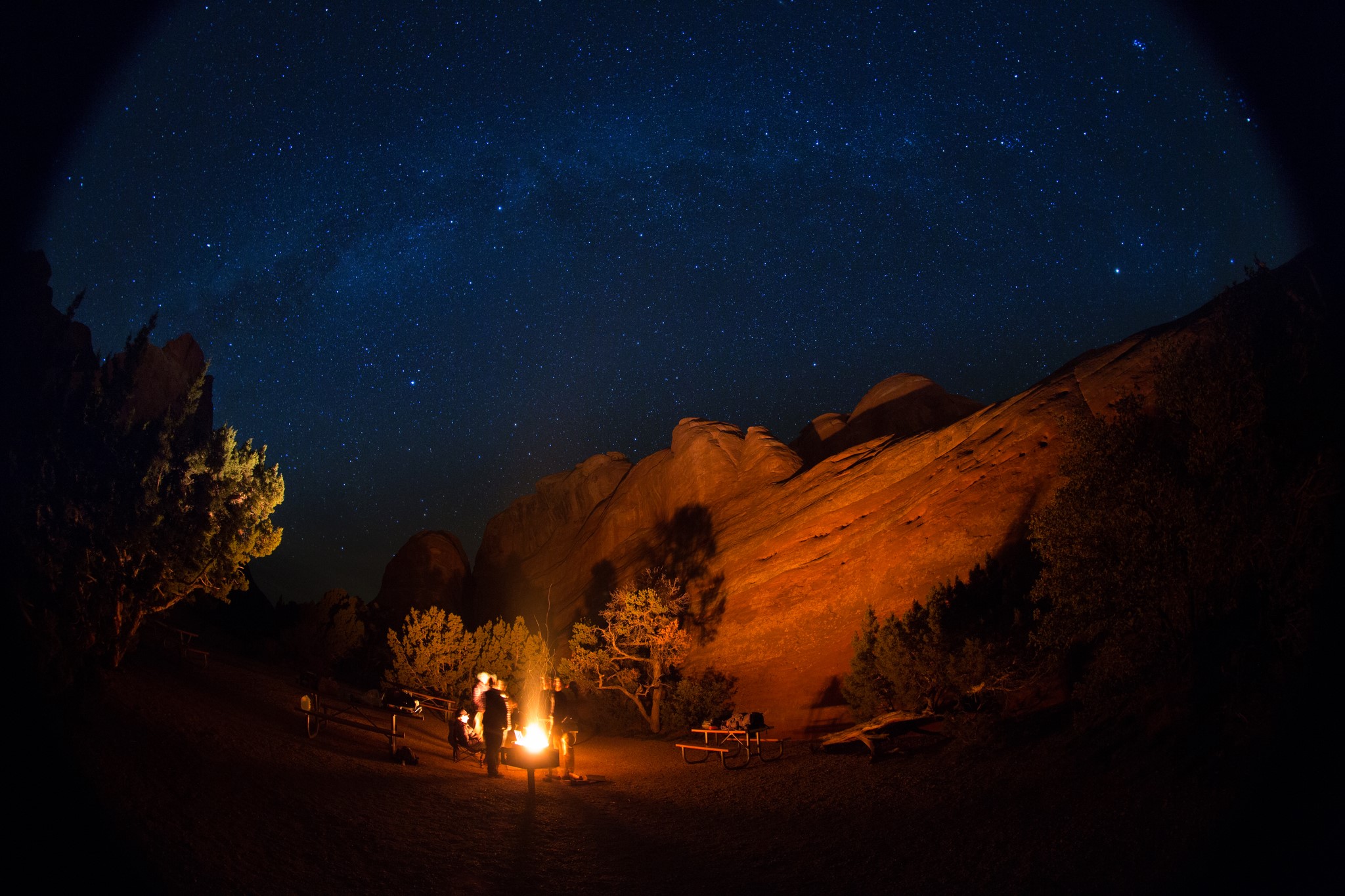
Campfire in Arches National Park, by John Dale, photographer, 2013

Photographer John Dale wrote: “We rolled in to Arches National Park to a beautiful sunset and got to our campsite just as it got dark, but that left us with a clear sky, plenty of stars, and a fire to warm up next to. Here’s a photo from the timelapse I took that night.”

From a photographer named John Dale, via Arches National Park’s Facebook page.

More:

Map of Arches National Park, Utah, United Stat...

Map of Arches National Park, Utah, United States showing predominant features such as arches, peaks, rivers and streams, mines, and roads. (Photo credit: Wikipedia)