Basic science provides critical basis for living, for parenting, and for teaching and learning. Anyone opposed to science instruction should rethink the harms that ever result from ignorance, or even forgetfulness.
Save
Spread the word; friends don't allow friends to repeat history.
NASA photo of Dr. Carl Sagan with a model of the Mars Viking Lander, in Death Valley, California. Or was it taken on Mars? How could we tell, if we lacked sharpened and practiced critical thinking practices?
Are we already too late?
In The Demon-Haunted World in 1995, astronomer and thinker Carl Sagan worried about the directions America was heading, intellectually, and what it could mean for the future. He wrote:
Science is more than a body of knowledge; it is a way of thinking. I have a foreboding of an America in my children’s or grandchildren’s time—when the United States is a service and information economy; when nearly all the key manufacturing industries have slipped away to other countries; when awesome technological powers are in the hands of a very few, and no one representing the public interest can even grasp the issues; when the people have lost the ability to set their own agendas or knowledgeably question those in authority; when, clutching our crystals and nervously consulting our horoscopes, our critical faculties in decline, unable to distinguish between what feels good and what’s true, we slide, almost without noticing, back into superstition and darkness. The dumbing down of America is most evident in the slow decay of substantive content in the enormously influential media, the 30-second sound bites (now down to 10 seconds or less), lowest common denominator programming, credulous presentations on pseudoscience and superstition, but especially a kind of celebration of ignorance.
Sagan had hope. His book’s full title is The Demon-Haunted World: Science as a candle in the dark.
Should we hold that hope today? Elections in 2016 demonstrated that false news does sway the electorate, superstition can overcome knowledge. Worse, too many Americans cannot tell the difference. In a time when millions of Americans profess to work to find “the way,” we confront those same people wandering aimlessly through American culture, apparently with little clue as to how far off the path of reality they are, or any real understanding of what “the way” would even look like. Their compasses operate on faith, not magnetism; their compass needles point whichever way they want them to point, with no fixed power to guide them.
Sagan didn’t write that long ago. A child born in 1995 just voted in her first national election — we hope. Perhaps she didn’t bother to register, and did not vote. What causes our national lack of motivation to even vote, to push our government in the directions we think it should go?
How do we remove the barriers to that motivation? is a more important question.
Was Sagan right? Are we doomed?
We have cause to worry, I think.
58% of Americans eligible to vote, voted in 2016. While that’s near a recent high-water mark, it’s a paltry percentage compared to other democracies in the world. Apathy was highest in key states Donald Trump carried; Hillary Clinton won the popular vote, but trailed President Barack Obama’s 2012 totals by 2 million votes, in those key states. 2016’s election was decided by people who did not vote.
Anti-vaccine movement. Chem-trails fearfuls. Climate change dissenters. Creationists. Moon-landing deniers. Racists. So-called non-racists who oppose immigration completely. Republican senators who imagined a tax cut for the wealthy would help working and poor Americans have better health. DDT advocates. “Libertarians” and so-called conservatives who fear “socialism” of the economics of John Maynard Keynes, one of the foremost capitalism defenders in economics.
Cuts to education. As a barometer, consider Texas, where 25 years ago the state provided 67% of funding for public schools. After decades of cuts, the state provides only 38% of public school funding in the 2017-2019 budget. Lt. Gov. Dan Patrick touts the total as an increase.
Cuts to science. Trump administration proposals slash all science research dramatically, as if we already have cures for cancer and the common cold, and Alzheimer’s disease.
To be sure, we can find pockets of hope. Girl Scouts demonstrate great success with new programs to attract girls to careers in science, with special camps for Science Technology Engineering and Mathematics (STEM). Boy Scouts have their own initiative. But the Texas legislature cut back on math, science and geography requirements for graduation. For every hopeful sign, there’s another sinister sign.
How can we tell civilization, and humanity, gain ground?
Pollsters for the New York Times asked 1,746 Americans to locate North Korea on a map. 36% could do it; many of the guesses are troubling, if not downright shocking. In the map above, from the New York Times, correct answers are marked in red, incorrect in blue.
“Science as a candle in the dark” is a good image.
How can we provide light in the darkness, if we don’t have a candle, and we can’t find matches?
Caption from the Buffalo News: A bald eagle, one of a pair of eagles raising chicks in a nest on Strawberry Island in the Niagara River, fishes in the river, Saturday, March 9, 2013. (Derek Gee/Buffalo News)
Among the greater chunks of powerful evidence for the damage the pesticide DDT did to birds is the dramatic recovery of some species as residual DDT levels drop, after DDT use ended in the U.S.
47 years later, eagles nest in after-recovery record numbers in New York, according to the venerable Buffalo News.
If you haven’t spotted the stark white head of a bald eagle somewhere in the Buffalo Niagara sky, it might be time to get out of the house more often.
Eagles are back in historically high numbers, according to a recent report by the state Department of Environmental Conservation.
The DEC reported a record-high 442 bald eagle breeding territories statewide in 2016, including 58 spots in six Western New York counties, including Erie, Niagara, Wyoming, Chautauqua, Cattaraugus and Allegany counties. That’s up from 38 spots in the region in 2012.
“It’s an astonishing number,” said Jim Landau, a count coordinator from the Hamburg Hawk Watch.
Recovery of bald eagles, and other endangered raptors including osprey, brown pelicans and peregrine falcons, is a great chapter in the book of successes of the Endangered Species Act and the rising conservation consciousness of the 1970s.
Recovery of all four species waited after EPA’s ban on crop use of DDT, until residual DDT levels in adult birds declined to a point the female birds could once again produce competent shells for the eggs they laid. DDT levels in fish and prey also had to drop to levels that would not poison chicks just hatched.
EPA banned DDT from U.S. farms in 1972, designating all DDT made in the country for export, to fight disease. Though DDT use declined world wide as resistance to the pesticide spread rapidly among mosquitoes and flies that were its target, most diseases DDT fought against declined. I estimate about 100 million fewer people died of malaria alone after the DDT ban. Birds were saved, and so were humans.
It’s a day to remember history. Do you remember that day, the first time humans set foot on the Moon?
God knows we could use more Americans to have faith in the good intentions of NASA scientists today; we could use more dreams like those NASA gave us then, too.
Southwest Elementary in Burley, Idaho, existed in a world far, far away from the U.S. space program. We watched rocket launches on black and white televisions — the orbital launches were important enough my father let me stay home from school to watch, but when he dropped me off at school, I was in a tiny band of students who actually made it to school. Potato farmers and the merchants who supported them thought the space program was big, big stuff, worth missing school.
By John Glenn’s flight, a three-orbit extravaganza on February 20, 1962, a television would appear in the main vestibule of the school, or in the auditorium, and we’d all watch. There were very few spitballs. Later that year my family moved to Pleasant Grove, Utah.
Toward the end of the Gemini series, television news networks stopped providing constant coverage. The launch, the splashdown, a space walk or other mission highlight, but the nation didn’t hold its breath so much for every minute of every mission. Barry McGuire would sing about leaving the planet for four days in space (” . . . but when you return, it’s the same old place.”), then six days, but it was just newspaper headlines.
The Apollo 1 fire grabbed the nation’s attention again.Gus Grissom, one of the three who died, was one of the original space titans; death was always a possibility, but the U.S. program had been so lucky. Apollo’s start with tragedy put it back in the headlines.
The space program and its many successes made Americans hopeful, even in that dark decade when the Vietnam War showed the bloody possibilities of the Cold War. That darkest year of 1968 — see the box below — closed nicely with Apollo 8 orbiting the Moon, and the famous Christmas Eve telecast from the three astronauts, Frank Borman, Jim Lovell, and William A. Anders. The space program kept us hopeful.
By early 1969 many of us looked forward to the flight of Apollo 11 scheduled for July — the space flight that promised to put people on the Moon for the first time in history, the realization of centuries-old dreams.
Then I got my assignment for Scouting for the summer. Out of nearly 50 nights under the stars, one of the days would include the day of the space walk. Not only was it difficult to get televisions into Maple Dell Scout Camp, a good signal would be virtually impossible. I went to bed Sunday night knowing the next day I’d miss the chance of a lifetime, to watch the first moon landing and walk.
Just after midnight my sister Annette woke me up. NASA decided to do the first walk on the Moon shortly after touchdown, at an ungodly hour. I’d be unrested to check Scouts in, but I’d have seen history.
Texas Essential Knowledge and Skills (TEKS) lists 11 dates for U.S. history as the touchstones kids need to have: 1609, the founding of Jamestown; 1776, the Declaration of Independence; 1787, the Constitutional Convention; 1803, the Louisiana Purchase; 1861-1865, the American Civil War; 1877, the end of Reconstruction; 1898, the Spanish American War; 1914-1918, World War I; 1929, the Stock Market Crash and beginning of the Great Depression; 1941-1945, World War II; 1957, the launching of Sputnik by the Soviets. Most teachers add the end of the Cold War, 1981; I usually include Apollo 11 — I think that when space exploration is viewed from a century in the future, manned exploration will be counted greater milestone than orbiting a satellite; my only hesitance on making such a judgment is the utter rejection of such manned exploration after Apollo, which will be posed as a great mystery to future high school students, I think.)
* Why 1968 was such a tough year, in roughly chronological order: 1968 produced a series of disasters that would depress the most hopeful of people, including: the Pueblo incident, the B-52 crash in Greenland, the Tet Offensive in Vietnam, the nerve gas leak at the Army’s facility at Dugway, Utah, that killed thousands of sheep, Lyndon Johnson’s pullout from the presidential race with gathering gloom about Vietnam, the Memphis garbage strike, the assassination of Martin Luther King, Jr., riots, the Black Panther shoot-out in Oakland, the Columbia University student takeover, the French student strikes, the tornadoes in Iowa and Arkansas on May 15, the Catonsville 9 vandalism of the Selective Service office, the sinking of the submarine U.S.S. Scorpion with all hands, the shooting of Andy Warhol, the assassination of Robert F. Kennedy, the Buenos Aires soccer riot that killed 74 people, the Glenville shoot-out in Cleveland, the cynicism of the Republicans and the nomination of Richard Nixon and Spiro Agnew, the Warsaw Pact invasion of Czechoslovakia crushing the “Prague Spring” democratic reforms, the Chicago Democratic Convention and the police riot, the brutal election campaign, the Tlatololco massacre of students in Mexico City, Black Power demonstrations by winning U.S. athletes at the Mexico City Olympics, coup d’etat in Panama. Whew!
Richard Feynman, working with the Rogers Commission on the Challenger Shuttle Disaster, demonstrating effects of cold on the vital O-rings, with a glass of ice-water, a C-clamp and an O-ring. Open University film screen capture
Interesting series of films from The Open University, on “unlikely leaders.” The film on Richard Feynman is a good introduction to his work in a few minutes.
Who the hell is “The Open University?” Their website offers a lot of free courses, but no clue about who finances the bunch, or even where it’s physically headquartered. I gather it’s a British group, but find little substantial information beyond that. Website copyright 2014; it’s got a modest track record.
Nice piece on Feynman. But is it a stealth piece to sucker people in? Feynman would be cautious about jumping on the Open University bandwagon. Or is Open University straight up? Enjoy Feynman.
Rachel Carson at Hawk Mountain, Pennsylvania. USFWS photo.
Rachel Carson’s birth anniversary in 2017 was remarkably free from attacks by DDT advocates or other people misinformed about her life and work.
Not that those attacks don’t continue on other days, still, but that the critics did not use the occasion of the anniversary of her birth to gang up on news media.
Some of the nice things said on Twitter:
Today marks Rachel Carson's 110th birthday! Her vital contributions to wildlife conservation continue to inspire and guide so many. pic.twitter.com/JwhtoVvDMf
— U.S. Fish and Wildlife Service (@USFWS) May 27, 2017
"Those who dwell among the beauties & mysteries of the earth are never alone or weary of life." – Rachel Carson, born on this day in 1907.
One of my heros. Happy Birthday Rachel Carson! Thanks for your eloquence, powers of observation, scientific rigor, courage, & persistence https://t.co/fnl1VJ79Ut
“If a child is to keep alive his inborn sense of wonder, he needs the companionship of at least one adult who can share it…" Rachel Carson pic.twitter.com/Yglbx24f8a
— International Education Today (@IntEdToday) May 27, 2017
"Man is a part of nature, and his war against nature is inevitably a war against himself." Rachel Carson. Happy Birthday to you.
Rachel Carson escribió "Primavera silenciosa" denunciando la contaminación industrial y los peligros del uso de los pesticidas (DDT). pic.twitter.com/hFmeYFmqhw
President John F. Kennedy speaking to a special joint session of Congress, on May 25, 1961; in this speech, Kennedy made his famous statement asking the nation to pledge to put a man on the Moon and bring him back safely, in the next ten years.
It was an era when Congress would respond when the President challenged America to be great, and Congress would respond positively.
On May 25, 1961, President Kennedy delivered a special message to Congress, on the challenges facing the U.S. around the world, in continuing to build free market economies, and continuing to advance in science, as means of promoting America’s future. He closed with the words that have become so famous. From the Apollo 11 Channel, excerpts from the speech, via Fox Movietone news:
History from the Apollo 11 Channel:
In an address to a Joint session of the United States Congress, Kennedy announces full presidential support for the goal to “commit…before this decade is out, to landing a man on the Moon and returning him safely to the Earth” and urges Congress to appropriate the necessary funds, eventually consuming the largest financial expenditure of any nation in peacetime.
Though Kennedy had initially been convinced that NASA should attempt a manned mission to Mars, NASA Associate Administrator Robert Seamans spent three days and nights working, ultimately successfully, to convince him otherwise.
“Washington Goes to the Moon”: A two-part radio program produced by WAMU-FM in Washington, D.C. that deals with the political story behind Project Apollo.
Today in 1961: President John F. Kennedy asks the nation to work toward putting a man on the moon by the end of the decade. 🚀 pic.twitter.com/r4Z3YB9KPP
— National Museum of American History (@amhistorymuseum) May 25, 2017
A lot of people like that photo of President Kennedy before Congress!
On This Day. 1961: John F. Kennedy called for the United States to land a man on the moon by the end of the decade (1) pic.twitter.com/dA4wtkOQrF
Today in 1961, Kennedy set the goal to put a man in the moon and being him back. Today in 2017, I touched a moon rock they brought back. pic.twitter.com/WcBdVlOXCY
May 11 is the anniversary of the birth of Richard Feynman (born 1918, died 1988).
Richard Feynman. Borrowed from Luciano’s Tumblr, LikeaPhysicist
Feynman’s birthday falls on Statehood Day for Minnesota. You can fly your flag for both causes, if you wish, Minnesota’s statehood AND Feynman’s birthday. No proclamation will issue from the White House, but you can fly your flag any day.
Why Feynman Day? To celebrate invention, physics, interesting characters, and that essential, American quality of je ne sais quoi.
In addition to his winning the Nobel Prize for Quantum Electrodynamics (QED), Feynman popularized the critique of science and other enterprises with what we now call Cargo Cult science, or education, or whatever, where people follow the dance steps, but without the rhythm and music.
Those two things alone would make him a remarkable man. But, like a product offered for $19.95 as a good buy in a 2:00 a.m. infomercial, with Feynman, there’s more. With Feynman, there is always more.
I got alerted to Feynman in the first days of the old Quality Paperback Book Club, when they featured his new memoir, Surely You’re Joking, Mr. Feynman! QPBC was hot on the book, and with a title like that, how could I resist? When I got the book a week or so later, I read it within two days, while attending law school and working full time. I remember Feynman.
A New York Times bestseller—the outrageous exploits of one of this century’s greatest scientific minds and a legendary American original.
In this phenomenal national bestseller, the Nobel Prize-winning physicist Richard P. Feynman recounts in his inimitable voice his adventures trading ideas on atomic physics with Einstein and Bohr and ideas on gambling with Nick the Greek, painting a naked female toreador, accompanying a ballet on his bongo drums and much else of an eyebrow-raising and hilarious nature.
All true, and that’s not even the half of the outrageousness, all done with great good humor, about a life lived in great good humor through what should have been a memorable age, but often was just terrifying.
I think sometimes that Feynman’s calm, alone, borne of that great good humor and insatiable curiosity, may have gotten us through the birth of the atomic age and the Cold War.
Feynman was a giant, and we don’t revere him enough. Consider:
Feynman’s high school sweetheart, Arlene, came down with tuberculosis. He married her, and took her with him to New Mexico to make the atom bombs. The stories of her confinement to a hospital, and the laborious trekking he had to make between Los Alamos and her bedside in Santa Fe, are touching, and heartbreaking. It is one of the great love stories of the 20th century, certainly, and perhaps for all time. It also provided the title for his second memoir, What Do You Care What Other People Think?
Every single, college-age man should read Feynman’s stories of how to date, and how to seduce women. His approach was unique, and endeared him to women — in legend, to many women. Feynman’s dating must have been part of the inspiration for the comedy series, “Big Bang Theory.” Feynman’s stories are better. (Heck, it’s even the subject of a popular, classic XKCD comic — probably only Feynman and Einstein among Nobel-winning physicists have made so much money for so many cartoonists.)
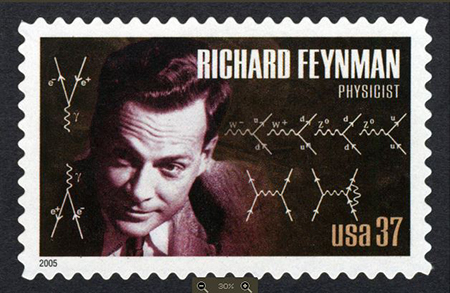
USPS authorized a special postal cancel (United States Postal Service) to honor the 80th birthday of Richard Feynman. This cancel was used in Lake Worth, Florida. For this special day the post office was renamed “Feynman Station.”
The Feynman Diagram used for the postal cancel on this envelope depicts what is known as a “bubble process.” It shows a high energy particle, for example, a cosmic ray (a) from a distant supernova, which emits a high energy photon, for example, a gamma ray (b). The photon, in turn, creates a particle (c) and an anti-particle (d) that exists for a brief moment and then recombines.
As Feynman liked to point out, an anti-particle is the same thing as a particle with negative energy traveling backward in time (which is why the arrow at (d) points backwards, i.e. to the left). So you could say the photon created only one particle that, at first, traveled forward in time (the bottom semi-circle) and then reversed and went back in time (the top semi-circle) and annihilated itself! By inventing diagrams like this, Richard Feynman made it much easier to understand what is going on in the interactions between sub-atomic particles without getting lost in tremendous amounts of tedious math
Working at Los Alamos on the Manhattan Project, Feynman developed a keen appreciation for bureaucracy and all its follies. His vexations for the security managers are also legendary. Here’s a quick version of one story — he asked friends and family to write to him in code, but to not include a key to the code, so he’d have to crack the code to read the letter. Feynman could do it, but the security people couldn’t. Hilarity ensued.
Feynman developed a love for the still-relatively unknown, landlocked Asian nation of Tannu Tuva. It’s just the sort of place to appeal to a character like Feynman — so obscure most atlases didn’t, and don’t, show it at all — seemingly consumed by the Soviet Union, but held in a special status. Home of throat singing — and almost impossible to get to. During the Cold War, Feynman struck up correspondence with people in Tuva, to the concern of Soviet and American intelligence agencies, who seemed not to understand someone might do such thing out of curiosity. Feynman hoped to travel there to visit new friends, but his final bouts of cancer took him before it was possible. Tuva, famous among philatelists only, perhaps, honored Feynman with postage stamps and postcards.
Just try to find a photo of Feynman not smiling. The man was a joy to be around, for most people, most of the time.
Quantum electrodynamics? No, I can’t explain it, either — but his work had a lot to do with how particles wobble. I remember that because, according to Feynman, he got the inspiration for the work for which he won the Nobel while spinning plates, like a Chinese acrobat on the Ed Sullivan Show, to the delight of students in the Cornell University cafeteria, and the shock and horror of the food service people. Who else has yet confessed to such an inspiration for a Nobel?
There’s more — a lot more. Feynman outlined our current generation of computer memory devices — in 1959. No, he didn’t patent the idea. He did patent an idea for a nuclear-powered spacecraft. Another delightful story.
Feynman was featured in print and broadcast ads for Apple — not one, but two (did anyone else get that honor from Apple?). “Think Different.” This is one of Apple Computer’s most successful advertising campaigns. The theme of the campaign is one that celebrates figures in history who changed the world by thinking differently. Richard Feynman was among the chosen figures. Image from the Feynman Group.
Feynman served on the board that approved science books for the California school system –– his stories of that work will shock some, but it will make others shake their heads as they recognize the current crop of cargo-cultists and political bullies who dominate textbook approval processes, knowing nothing at all about what they are doing, or why.
No, I didn’t forget his brilliant work on the commission that studied the Challenger disaster, for NASA. There’s so much stuff to glorify!
In history, Feynman should be remembered much as we remember Thomas Jefferson, as a renaissance man in his time, a man who put great intellect to great work for his nation and all humanity.
The second Apple ad featuring Richard Feynman. An excerpt from Apple Computer’s campaign commercial: “Here’s to the crazy ones, the misfits, the rebels, the troublemakers, the round pegs in the square holes, the ones who see things differently. They’re not fond of rules and they have no respect for the status quo. You can quote them, disagree with them, glorify or vilify them… about the only thing you can’t do is ignore them, because they change things, they push the human race forward; and while some may see them as the crazy ones, we see genius, because the people who are crazy enough to think they can change the world are the ones who do.”
The sages say we shouldn’t have regrets, but I do have one. When the Challenger Commission was meeting in Washington, D.C., I was working on another commission up the street. I knew Feynman was ill, but our work was important, and we’d heard his disease was in remission. I didn’t goof off a day and go to any of the hearings to see him, to get an autograph, to meet the man. I though I’d have other opportunities to do that. Now I regret not having met him in person.
In print, and in film, I know him well. In our family, reading Feynman is something everybody does. Feynman’s memoir was one of the last books I read to our son, Kenny, as he was growing up, and growing into reading on his own. Even reading about Feynman, together, was an adventure. Our son, James, took us into the real physics of Feynman, and though I struggle with it more than James, we still read Feynman, for humor, and physics.
What would be appropriate ways to mark Feynman’s birth? At some future date, I hope we’ll have public readings of his books, showings of the documentaries about him, recreations of his lectures, perhaps. And then everyone can get in a circle, beating drums and singing about getting some orange juice, before sending postcards to our friends in Tuva.
Richard Feynman, we still need you, and miss you dearly.
Tuva’s capital is the delightfully-named Kyzyl. From this map, can you figure out where Tuva is, or how to get there — without Google, or Bing?
Tuva postcard, in honor of Richard Feynman — who loved to drum.
There will always be “More” about Richard Feynman, if we’re lucky:
Do not miss the Friends of Tuva site, which is as much a tribute to Feynman from his good friend Ralph Leighton as it is a tribute to the great little nation of Tuva.
Like faces in clouds, some people claimed to see a link. The first Earth Day, on April 22, 1970, coincided with Lenin’s birthday. There was no link — Earth Day was scheduled for a spring Wednesday, when the greatest number of college students would be on campus.
Link to permanent Earth Day site, at EarthDay.org
Now, years later, with almost-annual repeats of the claim from the braying right wing, it’s just a cruel hoax. It’s as much a hoax on the ill-informed of the right, as anyone else. Many of them believe it.
No, there’s no link between Earth Day and the birthday of V. I. Lenin:
One surefire way to tell an Earth Day post is done by an Earth Day denialist: They’ll note that the first Earth Day, on April 22, 1970, was an anniversary of the birth of Lenin.
Coincidentally, yes, Lenin was born on April 22, on the new style calendar; it was April 10 on the calendar when he was born — one might accurately note that Lenin’s mother always said he was born on April 10.
It’s a hoax. There is no meaning to the first Earth Day’s falling on Lenin’s birthday — Lenin was not prescient enough to plan his birthday to fall in the middle of Earth Week, a hundred years before Earth Week was even planned.
Does Earth Day Promote Communism?
Earth Day 1970 was initially conceived as a teach-in, modeled on the teach-ins used successfully by Vietnam War protesters to spread their message and generate support on U.S. college campuses. It is generally believed that April 22 was chosen for Earth Day because it was a Wednesday that fell between spring break and final exams—a day when a majority of college students would be able to participate.
U.S. Sen. Gaylord Nelson, the guy who dreamed up the nationwide teach-in that became Earth Day, once tried to put the whole “Earth Day as communist plot” idea into perspective.
“On any given day, a lot of both good and bad people were born,” Nelson said. “A person many consider the world’s first environmentalist, Saint Francis of Assisi, was born on April 22. So was Queen Isabella. More importantly, so was my Aunt Tillie.”
April 22 is also the birthday of J. Sterling Morton, the Nebraska newspaper editor who founded Arbor Day (a national holiday devoted to planting trees) on April 22, 1872, when Lenin was still in diapers. Maybe April 22 was chosen to honor Morton and nobody knew. Maybe environmentalists were trying to send a subliminal message to the national subconscious that would transform people into tree-planting zombies. One birthday “plot” seems just about as likely as the other. What’s the chance that one person in a thousand could tell you when either of these guys were born.
My guess is that only a few really wacko conservatives know that April 22 is Lenin’s birthday (was it ever celebrated in the Soviet Union?). No one else bothers to think about it, or say anything about it, nor especially, to celebrate it.
Certainly, the Soviet Union never celebrated Earth Day. Nor was Lenin any great friend of the environment. He stood instead with the oil-drillers-without-clean-up, with the strip-miners-without-reclamation, with the dirty-smokestack guys. You’d think someone with a bit of logic and a rudimentary knowledge of history could put that together.
Inventor of Earth Day teach-ins, former Wisconsin Governor and U.S. Senator Gaylord Nelson
The REAL founder of Earth Day, Wisconsin’s U.S. Sen. Gaylord Nelson, usually recognized as the founder and father of Earth Day, told how and why the organizers came to pick April 22:
Senator Nelson chose the date in order to maximize participation on college campuses for what he conceived as an “environmental teach-in.” He determined the week of April 19–25 was the best bet; it did not fall during exams or spring breaks, did not conflict with religious holidays such as Easter or Passover, and was late enough in spring to have decent weather. More students were likely to be in class, and there would be less competition with other mid-week events—so he chose Wednesday, April 22.
After President Kennedy’s [conservation] tour, I still hoped for some idea that would thrust the environment into the political mainstream. Six years would pass before the idea that became Earth Day occurred to me while on a conservation speaking tour out West in the summer of 1969. At the time, anti-Vietnam War demonstrations, called “teach-ins,” had spread to college campuses all across the nation. Suddenly, the idea occurred to me – why not organize a huge grassroots protest over what was happening to our environment?
I was satisfied that if we could tap into the environmental concerns of the general public and infuse the student anti-war energy into the environmental cause, we could generate a demonstration that would force this issue onto the political agenda. It was a big gamble, but worth a try.
At a conference in Seattle in September 1969, I announced that in the spring of 1970 there would be a nationwide grassroots demonstration on behalf of the environment and invited everyone to participate. The wire services carried the story from coast to coast. The response was electric. It took off like gangbusters. Telegrams, letters, and telephone inquiries poured in from all across the country. The American people finally had a forum to express its concern about what was happening to the land, rivers, lakes, and air – and they did so with spectacular exuberance. For the next four months, two members of my Senate staff, Linda Billings and John Heritage, managed Earth Day affairs out of my Senate office.
Five months before Earth Day, on Sunday, November 30, 1969, The New York Times carried a lengthy article by Gladwin Hill reporting on the astonishing proliferation of environmental events:
“Rising concern about the environmental crisis is sweeping the nation’s campuses with an intensity that may be on its way to eclipsing student discontent over the war in Vietnam…a national day of observance of environmental problems…is being planned for next spring…when a nationwide environmental ‘teach-in’…coordinated from the office of Senator Gaylord Nelson is planned….”
Nelson, a veteran of the U.S. armed services (Okinawa campaign), flag-waving ex-governor of Wisconsin (Sen. Joe McCarthy’s home state, but also the home of Aldo Leopold and birthplace of John Muir), was working to raise America’s consciousness and conscience about environmental issues.
Humor at The ObamaCrat: “Time reported that some suspected the date was not a coincidence, but a clue that the event was ‘a Communist trick,’ and quoted a member of the Daughters of the American Revolution as saying, ‘subversive elements plan to make American children live in an environment that is good for them.'” God forbid!
About.com, “Is Earth Day a communist plot?”; “U.S. Sen. Gaylord Nelson, the guy who dreamed up the nationwide teach-in that became Earth Day, once tried to put the whole “Earth Day as communist plot” idea into perspective.”On any given day, a lot of both good and bad people were born,” Nelson said. “A person many consider the world’s first environmentalist, Saint Francis of Assisi, was born on April 22. So was Queen Isabella. More importantly, so was my Aunt Tillie.”
Mike Ciandella campaigns for Pinocchios at CNS (Lenin asked for “days of service” to honor his birthday? Yeah, and those cans of dehydrated water have been recalled because the water they make isn’t wet.)
Do you know why Earth Day is April 22? (gds44.wordpress.com) [This blog appears not to accept any dissenting views . . . funny, Leninist tactics from a guy who claims not to like Lenin.]
Rich Kozlovich at Paradigms and Demographic; Kozlovich repeats these fantastic lies, without even bothering to hint at any backup: “There is one factor that is known. This whole green stuff was imposed in Nazi Germany and in Soviet Russia and their views are virtually identical to the views of modern greenies and it is a reasonable assumption to think they were inspirational to the green movement of today; who have morphed into the step child of socialism. I think it is fair to question any denials on their part, in that their denials can be being likened to cow flatulence. Back to today.” [Editor’s note: Complete and utter balderdash.]
Wall of Lenin’s Birthday Propaganda Shame from 2010:
David Zeimer, writing in The Wisconsin Law Journal (This guy is particularly nutty. He notes the successes of cleaning up the air and water in and around Milwaukee, and then claims that clean air and water are false goals. Nuts.)
One of the ways you know Earth Day is innocently timed is that the FBI investigated it; in 1970, the FBI investigated hippies, but not organized crime. Go figure.
Don Surber may be as nutty as Zeimer, above — he notes words of concern from 1970, then dismisses the progress that resulted because people worked to change things; clean air is bad, to him, I guess
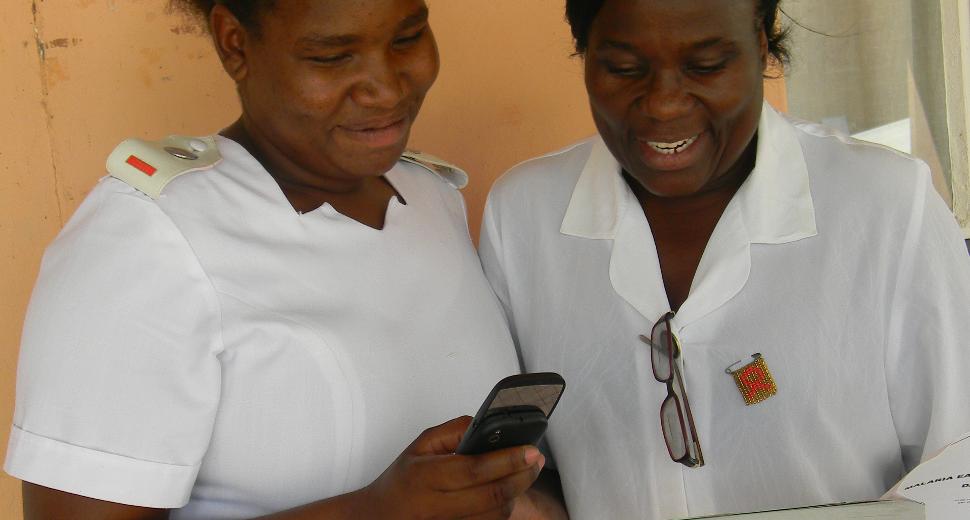
Health workers in Botswana use a cell phone to report malaria diagnoses and commencement of treatment, enabling real-time tracking of malaria outbreaks and rapid public health service responses. Photo from MalariaNoMore.
Interested, and interesting, to discover Botswana has a Facebook page where it appears is posted almost every press release or news item from the government.
I found it because some wag claimed on Twitter that Botswana faces a malaria crisis, and therefore DDT should be ‘brought back from the dead.’
Botswana did post about a malaria outbreak, but the nation appears to have good sense about how to fight malaria. The Tweeter missed that Botswana is already doing what a nation would use DDT for, Indoor Residual Spraying (IRS), and that phrase alone means Botswana’s malaria fighters are alert to any need for DDT should it arise, but also to the severe limitations on DDT use. DDT doesn’t work in about 95% of the nations on Earth.
Botswana is among the ten nations remaining on Earth who use DDT when and where they find a population of mosquitoes still susceptible to DDT. Almost all nations on Earth signed the Persistent Organic Pollutants Treaty (POPs, or Stockholm Agreement), which requires annual reporting of DDT use. But there are 11 other pesticides the World Health Organization (WHO) recommends for IRS. Botswana is unlikely to use DDT where it won’t work, which is most places.
Botswana is one of the DDT Ten in 2016, too. But this is down from 43 nations in 2001. DDT’s effectiveness and time as a tool to fight malaria is mostly gone, vanishing quickly.
Botswana has DDT if it can find a use for it; no more DDT is needed. A malaria outbreak in Botswana is no reason to remove the ban on DDT use on U.S. farms.
Here is the story/press release from Botswana’s government:
MALARIA CASES RISE IN OKAVANGO
North West District has been hard hit by a malaria epidemic with 670 recorded cases and five deaths since the beginning of the rainy season.
Head of the District Health Management Team, Dr Malebogo Pusoentsi revealed this at a press conference aimed at evaluating efforts made in the district to control the disease, recently.
A task force was in the district to assess and appreciate the situation as well as discuss what more could be done going forward.
Dr Pusoentsi said the highly affected region was Okavango which recorded over 90 per cent of the cases.
Highly affected areas include Shakawe, Xakao and Seronga in the Okavango District while in Ngami, Tsau and Mababe were the most affected.
Out of the affected people, it was reported that males were mostly affected as compared to females, and that more than 30 per cent of the affected were children. The most affected areas were said to be schools.
Dr Pusoentsi explained that malaria infection in humans was mainly transmitted through the sting of the female anopheles mosquito, adding that the disease in people could present clinically as either uncomplicated, complicated or asymptomatic, especially for people living in malaria endemic areas.
She stated that prevention of malaria remained a priority with strategies aimed at vector control. She said two strategies have been used to control mosquitoes in the area such as indoor residual spraying and the distribution of the long lasting insecticide treated nets. She added that 57 000 nets having been distributed across the country.
Regarding indoor spraying, Dr Pusoentsi revealed that for the transmission period of 2016/17, the district achieved an average of 69 per cent coverage as compared to the 85 per cent target.
Asked if the district was winning the battle, she said they were on the right track as health officials have doubled up efforts to tackle the epidemic.
She said social mobilisation was effective as the community and leadership were taught to make malaria a priority in their agenda, adding that if one member of a family was affected, chances were high that the rest of the family were also at risk.
Furthermore, Dr Pusoentsi explained that many opportunities still existed at community level to effectively control the spread of malaria, citing the cleaning of surroundings to minimise the breeding spaces for the mosquitoes.
Another strategy was to work collaboratively to ensure community knowledge and participation during the epidemic period. She urged the community to visit health facilities if they experience any symptoms of malaria so that they could be assisted on time.
She noted that common signs and symptoms include high temperature, headache and rigors, pallor and vomiting.
Dr Pusoentsi also noted that Botswana was among the countries which were aiming to eliminate malaria by 2018, adding that as part of the strategy, all efforts and investments had been put in place to control the spread.
Effective surveillance mechanism, she said had been put in place to monitor the disease burden and response efficiency at all times.
In addition, she pointed out that case management and drug supply had been strengthened to ensure quality management of cases of malaria to avoid deaths. (BOPA)
Save
Spread the word; friends don't allow friends to repeat history.
How many ways can we say happy birthday to a great scientist born on Pi Day? So, an encore post.
E=energy; m=mass; c=speed of light
Happy Einstein Day! to us. Albert’s been dead since 1955 — sadly for us. Our celebrations now are more for our own satisfaction and curiosity, and to honor the great man — he’s beyond caring.
Almost fitting that he was born on π Day, no? I mean, is there an E=mc² Day? He’s 138 years old today, and famous around the world for stuff that most people still don’t understand.
Fittingly, perhaps, March 14 now is celebrated as Pi Day, in honor of that almost magical number, Pi, used to calculate the circumference of a circle. Pi is 3. 1415~, and so the American date 3/14 got tagged as Pi Day.
Albert Einstein was born on March 14, 1879, in Ulm, Germany, to Hermann and Pauline Einstein.
26 years later, three days after his birthday, he sent off the paper on the photo-electric effect; that paper would win him the Nobel Prize in Physics in 1921.
In that same year of 1905, he published three other papers, solving the mystery of Brownian motion, describing what became known as the Special Theory of Relativity and solving the mystery of why measurements of the light did not show any effects of motion as Maxwell had predicted, and a final paper that noted a particle emitting light energy loses mass. This final paper amused Einstein because it seemed so ludicrous in its logical extension that energy and matter are really the same stuff at some fundamental point, as expressed in the equation demonstrating an enormous amount of energy stored in atoms, E=mc².
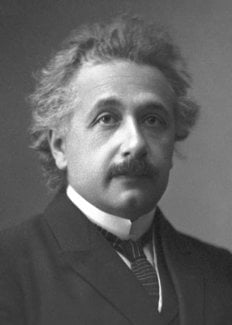
Albert Einstein as a younger man – Nobel Foundation image
Any one of the papers would have been a career-capper for any physicist. Einstein dashed them all off in just a few months, forever changing the fields of physics. And, you noticed: Einstein did not win a Nobel for the Special Theory of Relativity, nor for E=mc². He won it for the photo-electric effect. Irony in history. Nobel committee members didn’t understand Einstein’s other work much better than the rest of us today.
117 years later, Einstein’s work affects us every day. Relativity theory at some level I don’t fully understand makes possible the use Global Positioning Systems (GPS), which revolutionized navigation and mundane things like land surveying and microwave dish placement.
Development of nuclear power both gives us hope for an energy-rich future, and gives us fear of nuclear war. Sometimes, even the hope of the energy rich future gives us fear, as we watch and hope nuclear engineers can control the piles in nuclear power plants damaged by earthquakes and tsunami in Japan.
Albert Einstein on a 1966 US stamp (Photo credit: Wikipedia)
If Albert Einstein was a genius at physics, he was more dedicated to pacifism. He resigned his German citizenship to avoid military conscription. His pacifism made the German Nazis nervous; Einstein fled Germany in the 1930s, eventually settling in the United States. In the U.S., he was persuaded by Leo Szilard to write to President Franklin Roosevelt to suggest the U.S. start a program to develop an atomic weapon, because Germany most certainly was doing exactly that. But while urging FDR to keep up with the Germans, Einstein refused to participate in the program himself, sticking to his pacifist views. Others could, and would, design and build atomic bombs. (Maybe it’s a virus among nuclear physicists — several of those working on the Manhattan Project were pacifists, and had great difficulty reconciling the idea that the weapon they worked on to beat Germany, was deployed on Japan, which did not have a nuclear weapons program.)
Everybody wanted to claim, and honor Einstein; USSR issued this stamp dedicated to Albert Einstein Русский: Почтовая марка СССР, посвящённая Альберту Эйнштейну (Photo credit: HipStamp)
Einstein was a not-great father, and probably not a terribly faithful husband at first — though he did think to give his first wife, in the divorce settlement, a share of a Nobel Prize should he win it. Einstein was a good violinist, a competent sailor, an incompetent dresser, and a great character.
His sister suffered a paralyzing stroke. For many months Albert spent hours a day reading to her the newspapers and books of the day, convinced that though mute and appearing unconscious, she would benefit from hearing the words. He said he did not hold to orthodox religions, but could there be a greater show of faith in human spirit?
Einstein in 1950, five years before his death
When people hear clever sayings, but forget to whom the bon mots should be attributed, Einstein is one of about five candidates to whom all sorts of things are attributed, though he never said them. (Others include Lincoln, Jefferson, Mark Twain and Will Rogers). Einstein is the only scientist in that group. So, for example, we can be quite sure Einstein never claimed that compound interest was the best idea of the 20th century. This phenomenon is symbolic of the high regard people have for the man, even though so few understand what his work was, or meant.
A most interesting man. A most important body of work. He deserves more study and regard than he gets, in history, diplomacy and science.
Does anyone know? What was Albert Einstein’s favorite pie?
Today is March 14th, also known as “Pi Day” for us math geeks out there because March 14th (3/14) is the first 3 digits of π (3.14159…). To celebrate “Pi Day” I highly recommend doing something mathematical while having some pie at 1:59 pm. I recommend Yumology‘s S’mores Pie as it has 3 main ingredients (chocolate, marshmallow, and graham cracker) and about 0.14159 other ingredients like sugar, butter, and stuff. If you are not a math geek, its okay…you can still eat pie and count things like how many stop signs you pass on your way back to work from lunch. Or you could go to the library and take out a book on something fun like binary code. As we like to say, “There are only 10 types of people in the world: Those that understand binary and those that don’t.” Seriously, binary is as easy as 01000001, 01000010, 01000011.
So besides being the cause of much techie “irrational” exuberance, Pi Day is a great way to get some engagement with students.
Marymount High School has several activities, last year they had a design competition incorporating pi; the students then made and sold buttons of each design, proceeds going to the Red Cross.
Hmm- math subject matter, design, production, sales, accounting.
Sounds like what we do in manufacturing. Maybe celebrating Pi Day is not so irrational as first thought.
On March 12, 2009 your lawmakers passed a non-binding resolution (HRES 224) recognizing March 14, 2009 as National Pi Day. It is one of the more legit holidays we discuss here, and it is actually an homage to geeks everywhere who see the date as a reason to celebrate due to its mathematical implications. We say any reason to celebrate anything is just fine by us.
Since we are predominately about food we will suggest a few places to actually enjoy a pie.
If you followed us at all this week you may have seen the pie at Bowl and Barrel pop up on our pages. This is the uber delicious Butterscotch Pie served as the solo dessert at the bowling alley and restaurant. Go eat one of these.
He’s got more pi pie, if you click over there.
Gareth Branwyn at MakeZine offers more pie and a mnemonic:
Spring comes a few hours earlier every year as the planet warms; plants that used to blossom in March and April, now blossom in February. Mexican plum blossoms in Dallas, Texas, February 17, 2017. Photo by Ed Darrell, iPhone 6; please share with attribution.
Spring comes earlier every year in Dallas. Our Mexican plums used to blossom in March and April; for the past three years, we’ve had blossoms well before spring even comes. Last year we had a cold snap that took the young fruit out, after a premature blossoming.
It’s a sign of creeping global warming. Every year I marvel at Al Gore’s powers to convince our Mexican plum to blossom early, part of the “global warming conspiracy” so many fear.
That is, this is a symptom of global warming that cannot be faked, that is from observation, and not from models.
With flowers on fruit trees come hopes of a bountiful harvest. Dreading the underlying meaning of such an early blossom does not change our hopes, nor the birds’ hopes, for a good plum harvest.
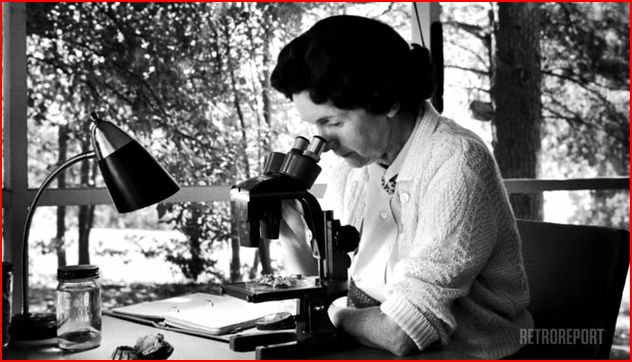
Rachel Carson at a microscope, American Experience/RetroReport image. Did Carson’s work cause an increase in malaria? Is she to blame for continued malaria deaths? No, answers a short film bonus to “Rachel Carson,” the 2017 PBS film.
A straight up, historic look at the question of Rachel Carson’s fault in stopping malaria.
Anti-environmentalists and corporate hoaxsters argue that Rachel Carson should be blamed for an imaginary increase in malaria deaths, after the U.S. banned DDT use on crops.
In conjunction with WGBH’s American Experience film on Carson released early in 2017, this short film focusing on malaria as a continuing plague puts to rest the idea that Carson should be blamed at all.
Soaking in the bathtub, we find the film not strident enough in defense of Carson; but for those strident nuts who claim Carson a murderer, it may have some good effect. And of course, you, intelligent dear reader, will be persuaded more gently.
Where malaria is the question, DDT is not the answer. Where malaria still exists, it’s not Rachel Carson’s fault.
[Today is actually the day! You may fly your flag if you choose. This is the traditional Millard Fillmore’s Bathtub Hubble Day post.]
Lift a glass of champagne today in tribute to Edwin Hubble and his great discovery. Not sure what to call it — Hubble Day, Looking Up Day, Endless Possibilities Day — whatever, this is the anniversary of Edwin Hubble’s announcement that he had discovered the universe is much, much larger than anyone had imagined, containing far more stars than anyone had dared guess.
It’s a big universe out there.
Ultraviolet image of the Andromeda Galaxy. Wired caption: “Photo: Edwin Hubble’s 1920s observations of Andromeda (whose ultraviolet spectrum is rendered here) expanded our notions of the size and nature of a universe that is itself expanding. Galaxy Evolution Explorer image courtesy NASA.”
So, today is a good day to celebrate the universe in all it’s glory – December 30.
On December 30, 1924, Edwin Hubble announced he’d discovered other galaxies in distant space. Though it may not have been so clear at the time, it meant that, as a galaxy, we are not alone in the universe (whether we are alone as intelligent life is a separate question). It also meant that the universe is much, much bigger than most people had dared to imagine.
Hubble was the guy who showed us the universe is not only bigger than we imagined, it’s probably much bigger and much more fantastic than we can imagine. (See J. B. S. Haldane’s “queerer” quote.) Hubble is the guy who opened our imaginations to the vastness of all creation.
Hubble’s work would have been impossible without the earlier work of one of the great, unsung women of science, Henrietta Leavitt, as Wired explained:
He trained the powerful new 100-inch telescope at Mount Wilson in Southern California on spiral nebulae. These fuzzy patches of light in the sky were generally thought to be clouds of gas or dust within our galaxy, which was presumed to include everything in the universe except the Magellanic Clouds. Some nebulae seemed to contain a few stars, but nothing like the multitudes of the Milky Way.
Hubble not only found a number of stars in Andromeda, he found Cepheid variable stars. These stars vary from bright to dim, and a very smart Harvard computationist named Henrietta Leavitt had discovered in 1912 that you could measure distance with them. Given the brightness of the star and its period — the length of time it takes to go from bright to dim and back again — you could determine how far away it is.
Hubble used Leavitt’s formula to calculate that Andromeda was approximately 860,000 light years away. That’s more than eight times the distance to the farthest stars in the Milky Way. This conclusively proved that the nebulae are separate star systems and that our galaxy is not the universe.
How does one celebrate Hubble Day? Here are some suggestions:
Easier than Christmas cards: Send a thank-you note to your junior high school science teacher, or whoever it was who inspired your interest in science. Mrs. Hedburg, Mrs. Andrews, Elizabeth K. Driggs, Herbert Gilbert, Mr. Willis, and Stephen McNeal, thank you.
Rearrange your Christmas/Hanukkah/KWANZAA lights in the shape of the Andromeda Galaxy — or in the shape of any of the great photos from the Hubble Telescope (Andromeda Galaxy pictured above; Hubble images here)
Spend two hours in your local library, just looking through the books on astronomy and the universe
Write a letter to your senators and congressman; tell them space exploration takes a minuscule portion of our federal budget, but it makes us dream big; tell them we need to dream big, and so they’d better make sure NASA is funded well. While you’re at it, put in a plug for funding Big Bird and the rest of public broadcasting, too. Science education in this nation more and more becomes the science shows on NPR and PBS, watched by kids who learned to read and think by watching Big Bird.
Anybody got a good recipe for a cocktail called “The Hubble?” “The Andromeda?” Put it in the comments, please. “The Hubble” should have bubbles in it, don’t you think? What was it the good monk said? He was working to make great wine, but goofed somewhere, and charged the wine with another dose of yeast. When he uncorked the very first bottle of what would come to be called champagne, Benedictine Monk Dom Pierre Perignon said “I am drinking stars!” Except, he said it in French. In any case, a Hubble cocktail should have bubbles, some of Perignon’s stars.
Edwin Hubble, long before the Surgeon General’s 1964 report on smoking made taboo photos of people smoking pipes.
In 1924, he announced the discovery of a Cepheid, or variable star, in the Andromeda Nebulae. Since the work of Henrietta Leavitt had made it possible to calculate the distance to Cepheids, he calculated that this Cepheid was much further away than anyone had thought and that therefore the nebulae was not a gaseous cloud inside our galaxy, like so many nebulae, but in fact, a galaxy of stars just like the Milky Way. Only much further away. Until now, people believed that the only thing existing outside the Milky Way were the Magellanic Clouds. The Universe was much bigger than had been previously presumed.
Later Hubble noted that the universe demonstrates a “red-shift phenomenon.” The universe is expanding. This led to the idea of an initial expansion event, and the theory eventually known as Big Bang.
Hubble’s life offered several surprises, and firsts:
Hubble was a tall, elegant, athletic, man who at age 30 had an undergraduate degree in astronomy and mathematics, a legal degree as a Rhodes scholar, followed by a PhD in astronomy. He was an attorney in Kentucky (joined its bar in 1913), and had served in WWI, rising to the rank of major. He was bored with law and decided to go back to his studies in astronomy.
In 1919 he began to work at Mt. Wilson Observatory in California, where he would work for the rest of his life. . . .
Hubble wanted to classify the galaxies according to their content, distance, shape, and brightness patterns, and in his observations he made another momentous discovery: By observing redshifts in the light wavelengths emitted by the galaxies, he saw that galaxies were moving away from each other at a rate constant to the distance between them (Hubble’s Law). The further away they were, the faster they receded. This led to the calculation of the point where the expansion began, and confirmation of the big bang theory. Hubble calculated it to be about 2 billion years ago, but more recent estimates have revised that to 20 billion years ago.
An active anti-fascist, Hubble wanted to joined the armed forces again during World War II, but was convinced he could contribute more as a scientist on the homefront. When the 200-inch telescope was completed on Mt. Palomar, Hubble was given the honor of first use. He died in 1953.
“Equipped with his five senses, man explores the universe around him and calls the adventure Science.”
(Does anyone have a suitable citation for that video? Where did it come from? Who produced it? Is there more somewhere?)
Happy Hubble Day! Look up!
Resources:
Journey to Palomar site (production currently being broadcast on PBS affiliates – wonderful story of George Ellery Hale and the origins of modern astronomy at Palomar; that’s where Hubble worked)
Andromeda as we can see it today. Wikimedia image: The Andromeda Galaxy is a spiral galaxy approximately 2.5 million light-years away in the constellation Andromeda. The image also shows Messier Objects 32 and 110, as well as NGC 206 (a bright star cloud in the Andromeda Galaxy) and the star Nu Andromedae. This image was taken using a hydrogen-alpha filter.
Or, until that account is unsuspended by the forces supporting Donald Trump: Follow @FillmoreWhite, the account of the Millard Fillmore White House Library
We've been soaking in the Bathtub for several months, long enough that some of the links we've used have gone to the Great Internet in the Sky.
If you find a dead link, please leave a comment to that post, and tell us what link has expired.
Thanks!
Retired teacher of law, economics, history, AP government, psychology and science. Former speechwriter, press guy and legislative aide in U.S. Senate. Former Department of Education. Former airline real estate, telecom towers, Big 6 (that old!) consultant. Lab and field research in air pollution control.
My blog, Millard Fillmore's Bathtub, is a continuing experiment to test how to use blogs to improve and speed up learning processes for students, perhaps by making some of the courses actually interesting. It is a blog for teachers, to see if we can use blogs. It is for people interested in social studies and social studies education, to see if we can learn to get it right. It's a blog for science fans, to promote good science and good science policy. It's a blog for people interested in good government and how to achieve it.
BS in Mass Communication, University of Utah
Graduate study in Rhetoric and Speech Communication, University of Arizona
JD from the National Law Center, George Washington University


 Posted by Ed Darrell















 Millard Fillmore's Bathtub
