“Not Evil, Just Wrong” is slated for release on October 18. This is the film that tried to intrude on the Rachel Carson film earlier this year, but managed to to get booked only at an elementary school in Seattle, Washington — Rachel Carson Elementary, a green school where the kids showed more sense than the film makers by voting to name the school after the famous scientist-author.
The film is both evil and wrong.
Errors just in the trailer:
Claims that Al Gore said sea levels will rise catastrophically, “in the very near future.” Not in his movie, not in his writings or speeches. Not true. That’s a simple misstatement of what Gore said, and Gore had the science right.
” . . . [I]t wouldn’t be a bad thing for this Earth to warm up. In fact, ice is the enemy of life.” “Bad” in this case is a value judgment — global warming isn’t bad if you’re a weed, a zebra mussel, one of the malaria parasites, a pine bark beetle, any other tropical disease, or a sadist. But significant warming as climatologists, physicists and others project, would be disastrous to agriculture, major cities in many parts of the world, sea coasts, and most people who don’t live in the Taklamakan or Sahara, and much of the life in the ocean. Annual weather cycles within long-established ranges, is required for life much as we know it. “No ice” is also an enemy of life.
“They want to raise our taxes.” No, that’s pure, uncomposted bovine excrement.
“They want to close our factories.” That’s more effluent from the anus of male bovines.
The trailer notes the usual claim made by Gore opponents that industry cannot exist if it is clean, that industry requires that we poison the planet. Were that true, we’d have a need to halt industry now, lest we become like the yeast in the beer vat, or the champagne bottle, manufacturing alcohol until the alcohol kills the yeast. Our experience with Rivers and Harbors Act of 1899, the CleanAirActs and the Clean Water Act is that cleaning the environment produces economic growth, not the other way around. A city choked in pollution dies. Los Angeles didn’t suffer when the air got cleaner. Pittsburgh’s clean air became a way to attract new industries to the city, before the steel industry there collapsed. Cleaning Lake Erie didn’t hurt industry. The claim made by the film is fatuous, alarmist, and morally corrupt.
When the human health, human welfare, and environmental effects which could be expressed in dollar terms were added up for the entire 20-year period, the total benefits of Clean Air Act programs were estimated to range from about $6 trillion to about $50 trillion, with a mean estimate of about $22 trillion. These estimated benefits represent the estimated value Americans place on avoiding the dire air quality conditions and dramatic increases in illness and premature death which would have prevailed without the 1970 and 1977 Clean Air Act and its associated state and local programs. By comparison, the actual costs of achieving the pollution reductions observed over the 20 year period were $523 billion, a small fraction of the estimated monetary benefits.
“Some of the environmental activists have not come to accept that the human is also part of the environment.” Fatuous claim. Environmentalists note that humans uniquely possess the ability to change climate on a global scale, intentionally, for the good or bad; environmentalists choose to advocate for actions that reduce diseases like malaria, cholera and asthma. We don’t have to sacrifice a million people a year to malaria, in order to be industrial and productive. We don’t have to kill 700,000 kids with malaria every year just to keep cars.
“They want to go back to the Dark Ages and the Black Plague.” No, that would be the film makers. Environmentalists advocate reducing filth and ignorance both. Ignorance and lack of ability to read, coupled with religious fanaticism, caused the strife known as “the Dark Ages.” It’s not environmentalists who advocate an end to cheap public schools.
The trailer shows a kid playing in the surf on a beach. Of course, without the Clean Water Act and other attempts to keep the oceans clean, such play would be impossible. That we can play again on American beaches is a tribute to the environmental movement, and reason enough to grant credence to claims of smart people like Al Gore and the scientists whose work he promotes.
“I cannot believe that Al Gore has great regard for people, real people.” So, this is a film promoting the views of crabby, misanthropic anal orifices who don’t know Al Gore at all? Shame on them. And, why should anyone want to see such a film? If I want to see senseless acts of stupidity, I can rent a film by Quentin Tarantino and get some art with the stupidity. [Update, November 23, 2009: This may be one of the most egregiously false charges of the film. Gore, you recall, is the guy who put his political career and presidential ambitions on hold indefinitely when his son was seriously injured in an auto-pedestrian accident; Gore was willing to sacrifice all his political capital in order to get his son healed. My first dealings directly with Gore came on the Organ Transplant bill. Gore didn’t need a transplant, didn’t have need for one in his family, and had absolutely nothing to gain from advocacy for the life-saving procedure. It was opposed by the chairman of his committee, by a majority of members of his own party in both Houses of Congress, by many in the medical establishment, by many in the pharmaceutical industry, and by President Reagan, who didn’t drop his threat to veto the bill until he signed it, as I recall. Gore is a man of deep, human-centered principles. Saying “I can’t believe Al Gore has great regard for real people” only demonstrates the vast ignorance and perhaps crippling animus of the speaker.]
That’s a whopper about every 15 seconds in the trailer — the film itself may make heads spin if it comes close to that pace of error.
Where have we seen this before? Producers of the film claim as “contributors” some of the people they try to lampoon — people like Ed Begley, Jr., and NASA’s James E. Hansen, people who don’t agree in any way with the hysterical claims of the film, and people who, I wager, would be surprised to be listed as “contributors.”
Here, see the hysteria, error and alarmism for yourself:
Ann McElhinney is one of the film’s producers. Her past work includes other films against protecting environment and films for mining companies. She appears to be affiliated with junk science purveyors at the Competitive Enterprise Institute, an astro-turf organization in Washington, D.C., for whom she flacked earlier this year (video from Desmogblog):
Climate change denialists (sorry, Mr. Watts – denialism is what it is) frequently argue that since the peak heat year of 1998, the planet has been cooling, and may be in a long-term trend to a much cooler planet.
But my trips to the mountains are always simultaneously joyful and mournful. The story I want to tell is about seeing the effects up close of the North American pine beetle outbreak. It’s devastating the Rocky Mountain forests in the U.S. and Canada and growing exponentially each year. The epidemic is occurring because our winters have not been cold enough to stop the beetles from multiplying. Bark beetles are good for the ecosystem, but not in this amount. The fall colors in our evergreen forests are telling us that global warming is no longer something our kids will face; it’s happening now. And it will accelerate if our forests disappear.
Mr. Watts, it’s not me you have to convince. There are several millions of beetles in Colorado who must be persuaded the climate is not warming — and they’ll be a tough sell, since a colder climate means death to their future generations.
A greater challenge for you, Mr. Watts: Not one of those beetles reads your blog. How will you reach them?
Put together the concepts of prognosis and age, and Dr. Emanuel’s proposal reasonably could be construed as advocating the withholding of some level of medical treatment (probably not basic care, but likely expensive advanced care) to a baby born with Down Syndrome. You may not like this implication, but it is Dr. Emanuel’s implication not Palin’s.
Jacobson misses the greater point here, the part the sticks in the craw of those of us who have lived with these issues for 20 years, or 30 or 40: Dr. Emanuel’s paper discusses how to improve the current system of allocation of resources.
We aren’t debating whether to have “death panels.” The discussion is on how to make them work more equitably, and how to expand health care resources to make the need for such decisions less frequent. Palin’s point is to defend unfair death panels used often. She doesn’t know that, and Jacobson should realize that and not defend it.
Allocation of very scarce medical interventions such as organs and vaccines is a persistent ethical challenge. We evaluate eight simple allocation principles that can be classified into four categories: treating people equally, favouring the worst-off, maximising total benefits, and promoting and rewarding social usefulness. No single principle is sufficient to incorporate all morally relevant considerations and therefore individual principles must be combined into multiprinciple allocation systems. We evaluate three systems: the United Network for Organ Sharing points systems, quality-adjusted life-years, and disability-adjusted life-years. We recommend an alternative system—the complete lives system—which prioritises younger people who have not yet lived a complete life, and also incorporates prognosis, save the most lives, lottery, and instrumental value principles.
He’s working to make the death panels more fair, more accurate, more beneficial. Palin suggests we should leave the current system in place where Palin’s death panels, though working hard, often are unfair and inaccurate, and waste resources.
In the present system, resources generally are allocated first on the basis of who has money. De facto, the system writes off to death anyone with a serious disease who is poor. “Poor” in this case doesn’t mean destitute. An annual income of $60,000 would put one into the category of “poor” I’m talking about here.
These critics, however, didn’t take the time to find out to what Palin was referring when she used the term “level of productivity in society” as being the basis for determining access to medical care. If the critics, who hold themselves in the highest of intellectual esteem, had bothered to do something other than react, they would have realized that the approach to health care to which Palin was referring was none other than that espoused by key Obama health care adviser Dr. Ezekial Emanuel (brother of Chief of Staff Rahm Emanuel).
I took the time to find out. I knew in advance. I’ve sat through hours of legislative hearings on this issue. In my opinion, Sarah Palin is still a carbuncle on the face of this debate. Her calling these panels “death panels” is designed to obfuscate the issues and deny the debate Jacobson says we need to have. She’s providing heat for cheap political gain, not light. She’s defending death, not life.
Shame on her. Jacobson should know better, too. I can all but guarantee that Palin didn’t read Dr. Emanuel’s paper, and didn’t consider the issues at all. I’ll wager she does not know that hospitals in her state make these decisions regularly.
Under Palin’s way, death panels already exist. Death panels make decisions on life or death every day, and the poor and uninsured are at the bottom of the scale of who gets to live, top of the list of who gets to die. Uninsured people often get shut out of the process, allocated pain and death from the start, because they lack insurance.
H.R. 3200 doesn’t do much to change this equation, the authors and legislators hoping to avoid cyanide politics like Palin plays; instead the bill encourages programs to help patients be on the “live if I want to live” side of the equation. These encouraged programs should be bread and butter to legal clinics at most law schools, by the way — great help to the poor in anticipating what to do in life-threatening emergencies. (I mention that because Jacobson is a clinical law professor — I don’t know which end of the legal clinics he works in, but he should know better anyway.)
We’ve already got the debate, and we already know that Palin’s trying to poison the well and fog up the lecturn, so that health care resources are misallocated. In reality, this leads to more unnecessary and preventable deaths.
Yes, let’s have the debate: Palin’s wrong to stand with unfair death decisions. She’s had her say, and she should be held accountable.
Agree or disagree, invite others to join the discussion:
Spread the word; friends don't allow friends to repeat history.
Part-time blogging has its problems. There’s a good post to be done on the trouble with superintendents in the Dallas area, but it requires more digging for links than I’ve had time to do. There’s a post on test results that isn’t done. There are a number of posts on teacher resources.
Health care needs about 20 posts on specific facets, I figure. Most of them will never get done.
Much of the weekend found our family at Baylor Medical Center in Dallas, doing an unintentional and surprise study on health care delivery in emergent situations. This was prelude to a longer unintentional study on the delivery of rehabilitation following stroke.
Faith versus science: No real contest: Science shines out, at every turn when the chips are down. No one involved is a creationist, but of the six people in our family there including the kids, we’re talking three elders, a moderator, a patriarch. Prayers form an adjunct to the medicine, and don’t get in the way of delivery of the medicine. During one operation I mused on how the near-nanomachines that did the work were developed using the evolutionary paradigm.
Without evolution theory, almost all of modern medicine would be impossible, or haphazard at best. On the day P. Z. Myers and the secular club investigated the Creationism Museum in Kentucky, I kept thinking “thank God for evolution.” I don’t regard Ken Ham as the epitome of evil, but his work to spread false ideas about how the world works detracts from better health care in three ways: First, it sucks money from the fight against disease and degeneration; second, it discourages good students from pursuing careers in healing people by leaving them wholly unprepared or unwilling to pursue knowledge; and third, it throws up hurdles for research, by slandering the reputations and intentions of scientists who need our support to build the necessary instititions and do the required research, and discouraging contributors and other funding.
All of our prayers were directed to the benefit of science, contrary to Ken Ham’s evil hopes.
Stand up for good science in your schools. One of the kids in that class may invent a new clot busting, or artery-healing drug that will save your life, or the life and faculties of someone you love.
No kid who avoids evolution and hard science in school will invent life-saving devices or practices.
There were other lessons, too.
Speed counts in a stroke situation. In an odd coincidence, my wife and I were by the fire station when the ambulance roared out. It was good to see cars get out of the way and stop so the ambulance could pass. Seconds save lives — pull over and get out of the way when an emergency vehicle comes up behind you.
All the talk of miracle drugs is just talk if there are medical reasons a particular miracle drug cannot be used.
It’s a lifesaver to have at hand a list of the pharmaceuticals one is prescribed. Different kinds of strokes require different treatments; same with a variety of other afflictions.
Take a book to the hospital. They are called “waiting rooms” for a very good reason. There is no guarantee the program on the television will not be a brain-sucking intellectual vacuum. No guarantee of a television.
Do you have emergency numbers on your cell-phone, as well as on a wall at home? You should. It makes things much, much easier. Why don’t you add them right now?
Whiners who complain about the provisions in the health insurance reform bill that provide training for more doctors and nurses, think about what you would do on Saturday afternoon if you needed a crack neuro-radiologist/surgeon and a machine to give real-time images of blood-flow in a brain.
Fancy machines are expensive. When the surgeon lays out the dangers and potential benefits of a procedure, you don’t want to have to think “will this cost more than $100?” It will cost much more. It’s unfair to your loved ones to have their life’s span or quality determined by how many Ben Franklins you have in your wallet at that moment.
Family are important. Call yours today and let them know you care.
Update – more on stroke: You may want to view earlier posts on the remarkable story, TEDS lecture, book and writings of Jill Bolte Taylor, a brain researcher who herself experienced and much recovered from a devastating stroke. Lecture here, more information here.
Other readings before the pages get too limp:
Intelligent design creationist Bill Dembski probably identifies with Draco Malfoy when he sneaks in to a theatre to watch the Harry Potter series (and you know he has to sneak in because he teaches at a radically fundamentalist Baptist seminary that fired their last women faculty for being of the wrong gender persuasion). How do we know? Go look at the questions on his final exam. If most of us confronted these kinds of views early in our Christian membership, there would be a lot fewer Christians. Is there such a thing as malpractice in philosophy? I didn’t know that misanthropy and ignorance-promotion were practiced, consciously, by any faiths today. (Waggle of the old scrub brush to P. Z. Myers.)
Baby triceratops make poor mounts; even had it been possible (and it wasn’t, by at least tens of millions of years), one doesn’t saddle-train immature animals, not in horses, not in camels, not in elephants — Ken Ham’s portrayal of triceratops baby abuse is just one more clanging sour note in the din he sends out every day. It’s as if the entire Ham organization is wholly unfamiliar with the concept of non-cruelty to animals. It’s the sort of thing done by people who kick their dogs for fun.
Republican members of Congress aren’t showing up in the town hall meeting riots because, for some reason most of them failed to schedule meetings to meet with their constituents this August. It’s almost as if someone planned for Republicans to stay out of the fray. This tells us two things: 1. Republicans are chickens. 2. Republicans are not working with their constituents’ best interests at heart — they don’t give a damn, as Clark Gable might have said. So, if your representative in Congress is a Republican, you’ll have to go tell her or him — they are not seeking your advice otherwise.
How low can the anti-science members of the Texas State Board of Education sink? How deep is the ocean? Scoriated for appointing Know-nothings and intellectual bandits to review social studies curricula, conservatives has asked for yet another anti-education nut to weigh in, a guy named Allan Quist. It would be like asking a Georgia farmer to detail the good points of William Tecumseh Sherman’s life. It would be like asking Cicero for a list of nice places to stay in Carthage. Quist won’t get either of those references, and neither will the other conservative appointees. It’s about a toss-up whether they got the reference to the Know-nothings. The probably don’t have a clue who Millard Fillmore is, either.
Am I being too scathing? What if they recommended lobotomies for your children?
In heated political discussions, I’ve discovered that when people stretch the facts, sometimes they do it to protect their interests; but if they exaggerate and stretch things when the facts are on their side, it’s pathological and you can’t trust them on anything.
As the old joke goes, ‘I once knew a guy who cheated at golf so bad that when he got a hole-in-one, he wrote down “zero” on the score card.’
Scientists at Oregon State University released a study that shows the tilt and wobble of the Earth can trigger ice ages and the ends of ice ages. As you can imagine, climate change skeptics and denialist will jump on this study to say we don’t need to worry about carbon dioxide — ‘warming can’t be blamed on carbon dioxide.’
Read the entire press release, and don’t skip over the parts that are important to policy on air pollution and climate change. The paper indeed says that planetary wobble causes ice ages, and warming between ice ages. That’s part of the climate change debate, probably a sizable win for climate skeptics.
But they can’t leave well enough alone; the study explicitly warns of the warming effects of human-released CO2. Watts left out this paragraph:
“Solar radiation was the trigger that started the ice melting, that’s now pretty certain,” said Peter Clark, a professor of geosciences at OSU. “There were also changes in atmospheric carbon dioxide levels and ocean circulation, but those happened later and amplified a process that had already begun.”
Watts left this out, too, and this qualifies the Oregon State study as “alarmist” under usual skeptic rubrics:
Sometime around now, scientists say, the Earth should be changing from a long interglacial period that has lasted the past 10,000 years and shifting back towards conditions that will ultimately lead to another ice age – unless some other forces stop or slow it. But these are processes that literally move with glacial slowness, and due to greenhouse gas emissions the Earth has already warmed as much in about the past 200 years as it ordinarily might in several thousand years, Clark said.
“One of the biggest concerns right now is how the Greenland and Antarctic ice sheets will respond to global warming and contribute to sea level rise,” Clark said. “This study will help us better understand that process, and improve the validity of our models.”
Peter Clark of Oregon State and his associates published an important study in Science on Friday. The study points to variations in the usual 23-degree tilt of the Earth’s access as triggers for glaciation and retreat of glaciers, over time. The study poses important questions, such as: Has human contribution to greenhouse gases prevented cooling in the past two centuries? The study offers potential insights into research into climate change and human contributions to climate change.
The study in no way exonerates carbon dioxide from implication as a major, human-contributed component to the mix of factors driving climate change in the 21st century. The study is really pretty cool; it should be fodder for geography and environmental science classes this fall, and it should be one factor in the discussion over warming and what we need to do about it.
Watch: Some will try to make it the latest political shuttlecock instead.
Long debate ended over cause, demise of ice ages – may also help predict future
CORVALLIS, Ore. – A team of researchers says it has largely put to rest a long debate on the underlying mechanism that has caused periodic ice ages on Earth for the past 2.5 million years – they are ultimately linked to slight shifts in solar radiation caused by predictable changes in Earth’s rotation and axis.
In a publication to be released Friday in the journal Science, researchers from Oregon State University and other institutions conclude that the known wobbles in Earth’s rotation caused global ice levels to reach their peak about 26,000 years ago, stabilize for 7,000 years and then begin melting 19,000 years ago, eventually bringing to an end the last ice age.
The melting was first caused by more solar radiation, not changes in carbon dioxide levels or ocean temperatures, as some scientists have suggested in recent years.
“Solar radiation was the trigger that started the ice melting, that’s now pretty certain,” said Peter Clark, a professor of geosciences at OSU. “There were also changes in atmospheric carbon dioxide levels and ocean circulation, but those happened later and amplified a process that had already begun.”
The findings are important, the scientists said, because they will give researchers a more precise understanding of how ice sheets melt in response to radiative forcing mechanisms. And even though the changes that occurred 19,000 years ago were due to increased solar radiation, that amount of heating can be translated into what is expected from current increases in greenhouse gas levels, and help scientists more accurately project how Earth’s existing ice sheets will react in the future.
“We now know with much more certainty how ancient ice sheets responded to solar radiation, and that will be very useful in better understanding what the future holds,” Clark said. “It’s good to get this pinned down.”
The researchers used an analysis of 6,000 dates and locations of ice sheets to define, with a high level of accuracy, when they started to melt. In doing this, they confirmed a theory that was first developed more than 50 years ago that pointed to small but definable changes in Earth’s rotation as the trigger for ice ages.
“We can calculate changes in the Earth’s axis and rotation that go back 50 million years,” Clark said. “These are caused primarily by the gravitational influences of the larger planets, such as Jupiter and Saturn, which pull and tug on the Earth in slightly different ways over periods of thousands of years.”
That, in turn, can change the Earth’s axis – the way it tilts towards the sun – about two degrees over long periods of time, which changes the way sunlight strikes the planet. And those small shifts in solar radiation were all it took to cause multiple ice ages during about the past 2.5 million years on Earth, which reach their extremes every 100,000 years or so.
Sometime around now, scientists say, the Earth should be changing from a long interglacial period that has lasted the past 10,000 years and shifting back towards conditions that will ultimately lead to another ice age – unless some other forces stop or slow it. But these are processes that literally move with glacial slowness, and due to greenhouse gas emissions the Earth has already warmed as much in about the past 200 years as it ordinarily might in several thousand years, Clark said.
“One of the biggest concerns right now is how the Greenland and Antarctic ice sheets will respond to global warming and contribute to sea level rise,” Clark said. “This study will help us better understand that process, and improve the validity of our models.”
The research was done in collaboration with scientists from the Geological Survey of Canada, University of Wisconsin, Stockholm University, Harvard University, the U.S. Geological Survey and University of Ulster. It was supported by the National Science Foundation and other agencies.
About the OSU College of Science: As one of the largest academic units at OSU, the College of Science has 14 departments and programs, 13 pre-professional programs, and provides the basic science courses essential to the education of every OSU student. Its faculty are international leaders in scientific research.
Watts did note the abstract of the paper, at Science (to get the full text, you must be a subscriber or pay a high fee for the one article):
Science 7 August 2009:
Vol. 325. no. 5941, pp. 710 – 714
DOI: 10.1126/science.1172873
Research Articles
The Last Glacial Maximum
Peter U. Clark,1,* Arthur S. Dyke,2 Jeremy D. Shakun,1 Anders E. Carlson,3 Jorie Clark,1 Barbara Wohlfarth,4 Jerry X. Mitrovica,5 Steven W. Hostetler,6 A. Marshall McCabe7
We used 5704 14C, 10Be, and 3He ages that span the intervalfrom 10,000 to 50,000 years ago (10 to 50 ka) to constrain thetiming of the Last Glacial Maximum (LGM) in terms of globalice-sheet and mountain-glacier extent. Growth of the ice sheetsto their maximum positions occurred between 33.0 and 26.5 kain response to climate forcing from decreases in northern summerinsolation, tropical Pacific sea surface temperatures, and atmosphericCO2. Nearly all ice sheets were at their LGM positions from26.5 ka to 19 to 20 ka, corresponding to minima in these forcings.The onset of Northern Hemisphere deglaciation 19 to 20 ka wasinduced by an increase in northern summer insolation, providingthe source for an abrupt rise in sea level. The onset of deglaciationof the West Antarctic Ice Sheet occurred between 14 and 15 ka,consistent with evidence that this was the primary source foran abrupt rise in sea level ~14.5 ka.
1 Department of Geosciences, Oregon State University, Corvallis, OR 97331, USA. 2 Geological Survey of Canada, 601 Booth Street, Ottawa, Ontario K1A 0E8, Canada. 3 Department of Geology and Geophysics, University of Wisconsin, Madison, WI 53706, USA. 4 Department of Geology and Geochemistry, Stockholm University, SE-10691, Stockholm, Sweden. 5 Department of Earth and Planetary Sciences, Harvard University, Cambridge, MA 02138, USA. 6 U.S. Geological Survey, Department of Geosciences, Oregon State University, Corvallis, OR 97331, USA. 7 School of Environmental Science, University of Ulster, Coleraine, County Londonderry, BT52 1SA, UK.
Frustration: As of Saturday morning, the day after the publication of the study, the Oregonian has no mention of the thing. Daily papers can be frustratingly slow to report science, and then do it only in brief, and often without full explanation. Here’s a good, international story in the paper’s own backyard, without a report.
Share this story and the science:
Spread the word; friends don't allow friends to repeat history.
“Take it easy! Calm down, stick to the facts!” Polar bear photo by Kathy Crane, NOAA Arctic Research Office
There is no dramatic finding in the release. After you read it, you’ll probably wonder, too, why climate change skeptics don’t want you to read this press release:
The 15th meeting of the IUCN Polar Bear Specialist Group (PBSG), hosted by the Greenland Institute of Natural Resources, was held at the Greenland Representation in Copenhagen Denmark , June 29-July 3, 2009. The Polar Bear Specialist Group is composed of researchers and managers representing each of the five circumpolar nations that signed the International Agreement for the Conservation of Polar Bears of 1973. Since the late 1960s, the members of PBSG have met every 3 to 5 years under the umbrella of the Species Survival Commission of the IUCN (the International Union for the Conservation of Nature and Natural Resources) to review and exchange information, and make recommendations for research and management of polar bears throughout the Arctic.
The PBSG renewed the conclusion from previous meetings that the greatest challenge to conservation of polar bears is ecological change in the Arctic resulting from climatic warming. Declines in the extent of the sea ice have accelerated since the last meeting of the group in 2005, with unprecedented sea ice retreats in 2007 and 2008. The PBSG confirmed its earlier conclusion that unabated global warming will ultimately threaten polar bears everywhere.
The PBSG also recognized that threats to polar bears will occur at different rates and times across their range although warming induced habitat degradation and loss are already negatively affecting polar bears in some parts of their range. Subpopulations of polar bears face different combinations of human threats. The PBSG recommends that jurisdictions take into account the variation in threats facing polar bears.
The PBSG noted polar bears suffer health effects from persistent pollutants. At the same time, climate change appears to be altering the pathways by which such pollutants enter ecosystems. The PBSG encourages international efforts to evaluate interactions between climate change and pollutants.
The PBSG endorses efforts to develop non-invasive means of population assessment, and continues to encourage jurisdictions to incorporate capture and radio tracking programs into their national monitoring efforts. The members also recognized that aboriginal people are both uniquely positioned to observe wildlife and changes in the environment, and their knowledge is essential for effective management.
The PBSG recognizes that where habitats are stable, polar bears are a renewable resource, and reaffirmed its support of the right of aboriginal groups to harvest polar bears within sustainable limits. The PBSG noted that the population of polar bears in Baffin Bay, shared between Greenland and Canada, may simultaneously be suffering from significant habitat change and substantial over harvest, while at the same time interpretations by scientists and local hunters disagree regarding population status. Similarly, the Chukchi Sea polar bear population which is shared by Russia and the United States is likely declining due to illegal harvest in Russia and one of the highest rates of sea ice loss in the Arctic. Consistent with its past efforts to coordinate research and management among jurisdictions, the PBSG recommended that the polar bear populations in Baffin Bay and the Chukchi Sea be reassessed and that harvests be brought into balance with the current sustainable yield.
A variety of management changes have occurred since the PBSG last met in 2005. The PBSG members were particularly pleased that quotas for the harvest of polar bears in Greenland were implemented in January 2006, and that quota reductions have been implemented in some parts of Greenland. Also since the last meeting, the government of Nunavut reduced the harvest quota in Western Hudson Bay because of the documented population decline.
The PBSG reevaluated the status of the 19 recognized subpopulations of polar bears distributed over vast and relatively inaccessible areas of the Arctic. Despite the fact that much new information has been made available since the last meeting, knowledge of some populations is still poor. Reviewing the latest information available the PBSG concluded that 1 of 19 subpopulations is currently increasing, 3 are stable and 8 are declining. For the remaining 7 subpopulations available data were insufficient to provide an assessment of current trend. The total number of polar bears is still thought to be between 20,000 and 25,000. However, the mixed quality of information on the different subpopulations means there is much room for error in establishing that range. That potential for error, given the ongoing and projected changes in habitats and other potential stressors is cause for concern. Nonetheless, the PBSG is optimistic that humans can mitigate the effects of global warming and other threats to polar bears, and ensure that they remain a part of the Arctic ecosystem in perpetuity.
Dr. Erik Born from the Greenland Institute of Natural Resources was elected as the new chairman of the group after Dr. Andrew Derocher from the University of Alberta, who has been serving as chair since 2005.
Well, there is that proclamation of optimism in the penultimate paragraph, that humans can mitigate threats to bears, including global warming. Is that why they don’t want you to read it?
Science-based Medicine carried this article yesterday, and several other blogs have joined in. Below is the article Simon Singh wrote for which he is being sued for libel by the professional association for British chiropractors. It’s a good cause, so I’ll stretch it another little while.
Last year Simon Singh wrote a piece for the Guardian that was critical of the modern practice of chiropractic. The core of his complaint was that chiropractors provide services and make claims that are not adequately backed by evidence – they are not evidence-based practitioners. In response to his criticism the British Chiropractic Association (BCA) sued Simon personally for libel. They refused offers to publish a rebuttal to his criticism, or to provide the evidence Simon said was lacking. After they were further criticized for this, the BCA eventually produced an anemic list of studies purported to support the questionable treatments, but really just demonstrating the truth of Simon’s criticism (as I discuss at length here).
In England suing for libel is an effective strategy for silencing critics. The burden of proof is on the one accused (guilty until proven innnocent) and the costs are ruinous. Simon has persisted, however, at great personal expense.
This is an issue of vital importance to science-based medicine. A very necessary feature of science is public debate and criticism – absolute transparency.This is also not an isolated incident. Some in the alternative medicine community are attempting to assert that criticism is unprofessional, and they have used accusations of both unprofessionalism and libel as a method of silencing criticism of their claims and practices. This has happened to David Colquhoun and Ben Goldacre, and others less prominent but who have communicated to me directly attempts at silencing their criticism.
This behavior is intolerable and is itself unprofessional, an assault on academic freedom and free speech, and anathema to science as science is dependent upon open and vigorous critical debate.
What those who will attempt to silence their critics through this type of bullying must understand is that such attempts will only result in the magnification of the criticism by several orders of magnitude. That is why we are reproducing Simon Singh’s original article (with a couple of minor alterations) on this site and many others. Enjoy.
Here it is:
Beware the spinal trap
Some practitioners claim it is a cure-all but research suggests chiropractic therapy can be lethal
Simon Singh
The Guardian, Original version published Saturday April 19 2008
Edited version published July 29, 2009
You might be surprised to know that the founder of chiropractic therapy, Daniel David Palmer, wrote that “99% of all diseases are caused by displaced vertebrae”. In the 1860s, Palmer began to develop his theory that the spine was involved in almost every illness because the spinal cord connects the brain to the rest of the body. Therefore any misalignment could cause a problem in distant parts of the body.
In fact, Palmer’s first chiropractic intervention supposedly cured a man who had been profoundly deaf for 17 years. His second treatment was equally strange, because he claimed that he treated a patient with heart trouble by correcting a displaced vertebra.
You might think that modern chiropractors restrict themselves to treating back problems, but in fact some still possess quite wacky ideas. The fundamentalists argue that they can cure anything, including helping treat children with colic, sleeping and feeding problems, frequent ear infections, asthma and prolonged crying – even though there is not a jot of evidence.
I can confidently label these assertions as utter nonsense because I have co-authored a book about alternative medicine with the world’s first professor of complementary medicine, Edzard Ernst. He learned chiropractic techniques himself and used them as a doctor. This is when he began to see the need for some critical evaluation. Among other projects, he examined the evidence from 70 trials exploring the benefits of chiropractic therapy in conditions unrelated to the back. He found no evidence to suggest that chiropractors could treat any such conditions.
But what about chiropractic in the context of treating back problems? Manipulating the spine can cure some problems, but results are mixed. To be fair, conventional approaches, such as physiotherapy, also struggle to treat back problems with any consistency. Nevertheless, conventional therapy is still preferable because of the serious dangers associated with chiropractic.
In 2001, a systematic review of five studies revealed that roughly half of all chiropractic patients experience temporary adverse effects, such as pain, numbness, stiffness, dizziness and headaches. These are relatively minor effects, but the frequency is very high, and this has to be weighed against the limited benefit offered by chiropractors.
More worryingly, the hallmark technique of the chiropractor, known as high-velocity, low-amplitude thrust, carries much more significant risks. This involves pushing joints beyond their natural range of motion by applying a short, sharp force. Although this is a safe procedure for most patients, others can suffer dislocations and fractures.
Worse still, manipulation of the neck can damage the vertebral arteries, which supply blood to the brain. So-called vertebral dissection can ultimately cut off the blood supply, which in turn can lead to a stroke and even death. Because there is usually a delay between the vertebral dissection and the blockage of blood to the brain, the link between chiropractic and strokes went unnoticed for many years. Recently, however, it has been possible to identify cases where spinal manipulation has certainly been the cause of vertebral dissection.
Laurie Mathiason was a 20-year-old Canadian waitress who visited a chiropractor 21 times between 1997 and 1998 to relieve her low-back pain. On her penultimate visit she complained of stiffness in her neck. That evening she began dropping plates at the restaurant, so she returned to the chiropractor. As the chiropractor manipulated her neck, Mathiason began to cry, her eyes started to roll, she foamed at the mouth and her body began to convulse. She was rushed to hospital, slipped into a coma and died three days later. At the inquest, the coroner declared: “Laurie died of a ruptured vertebral artery, which occurred in association with a chiropractic manipulation of the neck.”
This case is not unique. In Canada alone there have been several other women who have died after receiving chiropractic therapy, and Edzard Ernst has identified about 700 cases of serious complications among the medical literature. This should be a major concern for health officials, particularly as under-reporting will mean that the actual number of cases is much higher.
If spinal manipulation were a drug with such serious adverse effects and so little demonstrable benefit, then it would almost certainly have been taken off the market.
— Simon Singh is a science writer in London and the co-author, with Edzard Ernst, of Trick or Treatment? Alternative Medicine on Trial. This is an edited version of an article published in The Guardian for which Singh is being personally sued for libel by the British Chiropractic Association.
A new Dust Bowl? (Image updated January 2013; old links dead)
No, I’m not repeating the error of many who take every snowflake as bizarre evidence that global warming has ended.
I think we need to stick to the facts.
2009 may be cooler than 1998, one of the hottest years on record, but that in no way suggests an end to the climate crisis scientists have been tracking for the past couple of decades.
FIREBAUGH, Calif. — The road to Todd Allen’s farm wends past irrigation canals filled with the water that California‘s hot Central Valley depends on to produce vegetables and fruit for the nation. Yet not a drop will make it to his barren fields.
Three years into a drought that evokes fears of a modern-day dust bowl, Allen and others here say the culprit now isn’t Mother Nature so much as the federal government. Court and regulatory rulings protecting endangered fish have choked the annual flow of water from California’s Sierra mountains down to its people and irrigated fields, compounding a natural dry spell.
“This is a regulatory drought, is what it is,” Allen says. “It just doesn’t seem fair.”
For those like Allen at the end of the water-rights line, the flow has slowed to a trickle: His water district is receiving just 10% of the normal allocation of water from federal Bureau of Reclamation reservoirs. He says he’s been forced to lay off all his workers and watch the crops die on his 300 acres while bills for an irrigation system he put in are due.
“My payments don’t stop when they cut my water off,” Allen says.
Although some farmers with more senior water rights are able to keep going, local officials say 250,000 acres has gone fallow for lack of water in Fresno County, the nation’s most productive agriculture county. Statewide, the unplanted acreage is almost twice that.
Unemployment has soared into Depression-era range; it is 40% in this western Fresno County area where most everyone’s job is dependent on farming. Resident laborers who for years sweated in fields to fill the nation’s food baskets find themselves waiting for food handouts.
“The water’s cut off,” complains Robert Silva, 68, mayor of the farm community of Mendota. “Mendota is known as the cantaloupe capital of the world. Now we’re the food-line capital.”
Three years of dry conditions is being felt across much of the nation’s most populous state.
Gov. Arnold Schwarzenegger declared a water emergency in February and asked for 20% voluntary cuts in water use. The U.S. Department of Agriculture’s Drought Monitor lists 44% of the state as in a “severe” drought.
In arid Southern California, cities and water districts have raised rates to encourage conservation and imposed limits on use
AUSTIN – The drought that has gripped Central Texas is approaching the severity of Texas’ most famous drought, the 1950s dry spell that lasted several years, Lower Colorado River Authority officials say.
But the current drought, which began in the fall of 2007, has seen more intense concentrations of high temperatures and less rainfall than the majority of the earlier drought.
“It was hot, yes, it was dry” in the 1950s, said LCRA meteorologist Bob Rose, “but it wasn’t crazy hot like this year.” Soil moisture is negligible now. And with spotty precipitation, “we haven’t been able to generate any runoff” to replenish reservoirs, he said.
“What makes our current drought unique is not the duration but the severity,” Rose said this week at a drought briefing for meteorologists and reporters.
According to drought statistics released by the U.S. Department of Agriculture, 77 of Texas’ 254 counties are in extreme or exceptional drought, the most severe categories. No other state in the continental U.S. has even one area in those categories.
John Nielsen-Gammon, the Texas state climatologist at Texas A&M University, said he expects harsh drought conditions to last at least another month.
In the bone-dry San Antonio-Austin area, the conditions that started in 2007 are being compared to the devastating drought of the 1950s. There have been 36 days of 100 degrees or more this year in an area where the total usually is closer to 12.
Among the most obvious problems are the lack of water in Lake Travis and Lake Buchanan near Austin, two massive reservoirs along the Colorado River that provide drinking water for more than 1 million people and also are popular boating and swimming spots. Streams and tributaries that feed the lakes have “all but dried up,” according to the Lower Colorado River Authority.
San Antonio, which relies on the Edwards Aquifer for its water, is enduring its driest 23-month period since the start of recorded weather data in 1885, according to the National Weather Service. The aquifer’s been hovering just above 640 feet deep, and if it dips below that, the city will issue its harshest watering restrictions yet.
A lot of the problem has to do with timing. About half of the water that recharges the [Northeast] region’s aquifer is from spring snowmelt, said [USGS hydrologist Thomas] Mack, allowing it to be plentiful to residents for summer lawn watering and other uses.
But global warming is causing the snow to melt earlier by around two to four weeks. At the same time, more rain, instead of snow, is expected to fall in the winter. That means the aquifer is filling up earlier in the spring.
The problem is the region’s bedrock aquifer can’t hold water for a long time – filling it up when it is needed the least and draining before the busy summer.
All environmental problems are complex, and global “warming” is massively more complex than any other environmental issue humans have recognized and dealt with. Climate change deals with the entire Earth, and with the two great pools of fluids on the Earth, the oceans and the atmosphere, where the sheer physics of change are nearly impossible to understand, let alone predict.
Perhaps, as local conditions in more and more places demonstrate damages from climate change, skeptics can be brought around to understand that action is required even when we don’t have all the possible data points we’d like.
It was a minor note, really — USGS released a series of satellite photos of ice in the Arctic Ocean. The photos were taken with U.S. defense satellites (“spy” satellites, most likely) under an interesting agreement between the Department of Defense and science agencies to look at ice, essentially to look at the cold, not come in from it.
Part of that agreement is that the photos don’t get released until Defense says there is no reason to hold them secred anymore. For some reason — skullduggery? bureaucracy? — the photos weren’t released during the Bush years. The Obama administration hustled out a series of photos for scientists to study.
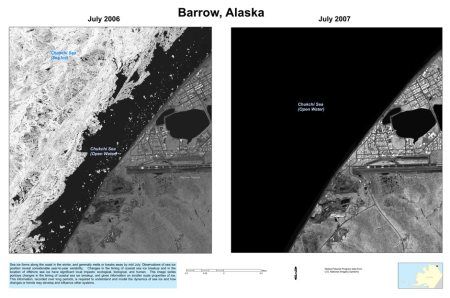
Very few news outlets picked up on the release of the photos. The Guardian ran the most provocative, prepared-for-public-consumption set of two photos of the sea just off of Barrow, Alaska, which showed a dramatic contrast between 2006 and 2007. The icy seas of July 2006 were replaced with miles of clear ocean in July 2007.
The Bathtub ran that poster. And yesterday there was a surge of hits on the article, most going to other posts claiming the photos had been photoshopped. A commenter here said the same. Viewers find it odd that there is a stark contrast between land and sea inthe arctic. Really. No, really.
Now, I had expected someone to defend Bush, to say that the Bush administration hadn’t really suppressed the photos, just didn’t release them.
But photo fraud?
Denialists resorted to that solution first.
Here are reasons mitigating against fraud.
The U.S. Geological Survey (USGS) released the poster with the photos. USGS has a long, long history of accurate science, outside political interference. On a few occasions, USGS reports have been delayed by political appointees — but the instances where one can say the data were corrupted on purpose are very few (if any — I can’t think of one off-hand). USGS would be unlikely as a source of doctored photos.
It is a crime to jigger the scientific results under U.S. law. A few scientists have been caught, tried and jailed. The reality is that most scientist strive to be well on the ethical side of the line of research laws — but it’s a federal crime for government or government-funded scientists to fake results. I’ll wager every scientist at USGS knows that.
USGS released four posters total, and a couple dozen other photos. For Barrow, there were 18 photos from 2005 and 2006, and another 8 photos from 2007-2008. While only four sites were chosen for poster, there are six sites with photos available for study. Were anyone to jigger one photo, others would need to be jiggered to make them match. Since Defense still has the originals, a fraud would probably be discovered.
Government scientists have been champing at the bit for eight years to get rid of the fetters of bureaucrats interfering with their research; they wouldn’t risk a fraud just six months in to the new administration, nor would they be likely to risk a fraud at any time, since they think that the truth is of very high value.
MacsMind jumped on the photos: “Almost so bad it’s laughable”. The blog offers no evidence of fraud, just the spiteful belief of the author. Well, he does offer photos of a January 2006 ice surge, as if to suggest that the ice from January of 2006 should have stayed hugging the coast near Barrow even through 2007, so any photo that shows clear sea must be false. Denialists will abandon all types of measure, even calendars and clocks, in their mad rush to cloak the science. MacsMind even goes so far as to invent a story that the photo was taken at night, and since it shows no lights of ships at sea, they must have been cut out (photos of ice cover generally don’t work well at night — where did he get that?).
Critics of climate change and plans to do something to slow climate change reveal themselves here as not basing their views on the science — here they don’t need the science to “know that it’s wrong.”
Sometimes I wonder if we could cure global warming simply by getting the critics to shut up.
Oh, let’s make them crazy. Here’s the poster showing the contrast in sea ice in the Beaufort Sea; the caption:
This site is near the edge of the ice pack. In summer, as shown here, ponds of meltwater form on the surface. These dark pools absorb more of summertime’s solar radiation than does the surrounding ice, enhancing melting. Observations of sea ice conditions reveal considerable year to year variability. These images, displaying the variability with regard to the amount of melting, are an example of the long term sequential record needed to support understanding and analysis of this dynamic system. Pond coverage monitored over time contributes to estimates of surface reflectivity that are needed to understand and model the dynamics of sea ice mass balance and temperature.
Radar images of sea ice around Barrow, Alaska -"The animation below is from the radar record of the last three days. The images used to produce this animation are from the 10 kW X-band marine radar mounted atop the 4-story ASRC building in downtown Barrow, Alaska, pointed north."
Help cool discussion on climate change; share this post:
Spread the word; friends don't allow friends to repeat history.
Look at the photos and see for yourself. From 2006 to 2007, did sea ice at Barrow, Alaska, increase or decrease?
A comparison of polar sea ice at Barrow, Alaska -- July 2006 on the left, July 2007 on the right - public domain photo from U.S. military satellites. Click for larger view from The Guardian.
Graphic images that reveal the devastating impact of global warming in the Arctic have been released by the US military. The photographs, taken by spy satellites over the past decade, confirm that in recent years vast areas in high latitudes have lost their ice cover in summer months.
The pictures, kept secret by Washington during the presidency of George W Bush, were declassified by the White House last week. President Barack Obama is currently trying to galvanise Congress and the American public to take action to halt catastrophic climate change caused by rising levels of carbon dioxide in the atmosphere.
One particularly striking set of images – selected from the 1,000 photographs released – includes views of the Alaskan port of Barrow. One, taken in July 2006, shows sea ice still nestling close to the shore. A second image shows that by the following July the coastal waters were entirely ice-free.
The photographs demonstrate starkly how global warming is changing the Arctic. More than a million square kilometres of sea ice – a record loss – were missing in the summer of 2007 compared with the previous year.
Spin, from the presidency? Who knew?
Climate change skeptics (read: deniers) say that ice has come back in record amounts in 2008. According to the news article, that isn’t exactly the case.
Nor has this loss shown any sign of recovery. Ice cover for 2008 was almost as bad as for 2007, and this year levels look equally sparse.
* Happy update, 8-2-2009: I’m happy to report I erred. Actually, Anthony Watts reported on the release of the photos on July 15. He didn’t use the Barrow photos, and he certainly did not claim that they are hoax photos. He noted that the previously classified data have been released, and he seemed to think that there is no monkeying around with them. It’ll be interesting to see how he deals with the photos from here on in.
Spread the news!
Spread the word; friends don't allow friends to repeat history.
It would be good news were it not so bad: India, usually considered a threat to U.S. dominance in science, has turned its back on climate science and instead, citing junk science claims, rejected overtures to reduce pollution that affects climate. India appears to have fallen victim to the hoaxters who claim climate change is no big deal.
A split between rich and poor nations in the run-up to climate-change talks widened on Thursday.
India rejected key scientific findings on global warming, while the European Union called for more action by developing states on greenhouse gas emissions.
Jairam Ramesh, the Indian environment minister, accused the developed world of needlessly raising alarm over melting Himalayan glaciers.
He dismissed scientists’ predictions that Himalayan glaciers might disappear within 40 years as a result of global warming.
“We have to get out of the preconceived notion, which is based on western media, and invest our scientific research and other capacities to study Himalayan atmosphere,” he said.
Deadly air pollution obscures the India Gate, New Delhi, India, November 2008 - NowPublic.com
It’s interesting to see these issues play out politically. India and China both understand that the U.S. and Europe have much more to lose from climate change than either of those nations. Climate damage to the U.S. wheat belt, for example, would chiefly close off U.S. production of wheat for export, opening markets for others — like India and China. Critically, such damage also hurts U.S. ability to offset balance of payments issues, providing economic and finance advantages to China’s banks. U.S. ports are much more vulnerable to climate change damage, from increase storms and changing ocean levels, than are ports in India and China — and there are more ports that are vulnerable in the U.S. and Europe.
India’s inaction and recalcitrance should not be used as justification for the U.S. to do nothing, thereby slitting its own patriotic throat.
But watch: Climate denialist blogs, “hate-America-first” outlets like World Net Daily, and Osama bin Laden will hail India’s inaction.
Let’s hope cooler heads prevail, lest we run out of cooler heads.
Years ago, in Virginia, I had learned that Virginia had only one natural lake, the Great Dismal Swamp. Accompanying that chunk of information in that lecture was that Texas had only two natural lakes.
But upon arriving in Texas, I could find reference to only one natural lake, Caddo, and it had ceased being fully natural when its maintenance fell to a dam.
I have found a second natural lake in Texas. It’s not a new discovery at all — it’s just a case of people not having the facts, and overlooking how to find the truth. It’s especially difficult when the lake hides itself.
Our testing coordinator at Molina High School, Brad Wachsmann, spins yarns that belie his youth. In the middle of one yarn last year, corroborated by other yarns, he mentioned that he has family in Big Lake, Texas; and he described visiting and having relatives urge people to run out and see the lake since it’s rebirth in torrential rains.
“A second natural lake in Texas?” I asked. Wachsmann knew the drill. Yes, Big Lake is a natural lake in Texas, and yes, people forget about it.
Texas teachers, listen to your testing coordinators, okay?
All of this came to mind reading the Austin American-Statesman, still a bastion of great journalism despite problems in the newspaper industry. On Monday, July 7, the paper ran a story and an editorial about the clean up of the oil industry refuse that killed the shoreline of part of the lake; the springs that once fed the lake have mostly gone dry, but that’s likely due to agricultural water mining.
It’s a story of boom and bust, environmental degradation for profit, and eventual recovery we hope.
Looking at the landscape that surrounds the Reagan County seat, you wonder whether the name Big Lake was somebody’s idea of joke. It’s dry and dusty, where the flora sprouts reluctantly and lives precariously.
Yet, the West Texas town of Big Lake got its name from a natural lake that was fed by springs that have long since gone dry. While the area may not fit everyone’s definition of photogenic, it has its own brand of charm – charm that could be enhanced if the damage done to the fragile ecosystem by salt spills were reversed or even minimized.
As the American-Statesman’s Ralph K.M. Haurwitz reported in Monday’s editions, the University of Texas and Texas A&M systems have benefited from the $4.4 billion in royalty payments and mineral income produced by its West Texas acreage since Santa Rita No. 1 well came in on May 28, 1923.
The salt water byproduct of oil and natural gas production, however, contaminated 11 square miles near Big Lake, killing most everything that grows. The lack of vegetation allows wind and water erosion.
Hey, it gets better. This is real Texas history, real American history — you can’t make this stuff up. Haurwitz’s article talks about the heritage of Texas education. Remember that old story about setting aside certain sections of townships to help fund education in lands on the American frontier? Texas wasn’t a public lands state as farther west, but it still reserved sections of land for the benefit of education.
Rose petals blessed by a priest? I’ll wager the priest didn’t make the trip to the top of the derrick. Haurwitz wrote:
BIG LAKE — Investors appealed to the patron saint of impossible causes when oil drilling began on University of Texas System land in 1921. It didn’t hurt.
Santa Rita No. 1 blew in on May 28, 1923, after rose petals blessed by a priest were scattered from the top of the derrick at the behest of some Catholic women in New York who had purchased shares in the Texon Oil and Land Co., which drilled that first well.
Since then, the UT System’s 2.1 million acres in West Texas have produced $4.4 billion in royalty payments and other mineral income for the Permanent University Fund, an endowment that supports the UT and Texas A&M University systems.
But this long-running bonanza for higher education exacted a price from the remote, semiarid landscape where it all began. Millions of barrels of salt water, a byproduct of oil and natural gas production, contaminated 11 square miles, or more than 7,000 acres, killing virtually all vegetation and leaving the land vulnerable to wind and water erosion. Hundreds of mesquite stumps with three feet of exposed roots testify to the dramatic loss of topsoil.
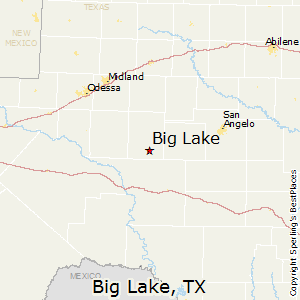
Where in Texas is Big Lake?
The town of Big Lake is just north of the lake itself, on State Highway 137 running north and south, and U.S. Highway 67 running east and west, approximately 65 miles west of San Angelo. Big Lake sits about 10 miles north of Interstate 10, and about 75 miles south of Interstate 20. Big Lake calls itself “the gateway to the Permian Basin.”
Big Lake is the home of Reagan County High School. Jim Morris was baseball coach for the Reagan High Owls when his team persuaded him to try out for a major league baseball team. His story was chronicled, with some artistic license, in the Disney movie “Rookie.”
Land managers are working to stop erosion on the often-dry shores of Big Lake using any trick they can find. One trick: Plant salt grass.
Salt grass? Along Texas’s Gulf Coast, there are a few species of grass that, while not halophytes, are at least salt tolerant. Salt grass. This grass made it profitable to graze cattle on what would otherwise have been unproductive land in the Texas cattle boom. This role in Texas history is memorialized in the Salt Grass Steakhouse chain, now found in five states.
And if planting salt grass works to control erosion, it will help clean up a large part of Texas other natural lake, Big Lake.
Big Lake’s being wet or dry is a whim of local climate. You could say that half of all of Texas’s natural lakes are now dry as a result of continued warming; you could say that two good gully-washers or toad-stranglers could restore water to half of Texas’s natural lakes.
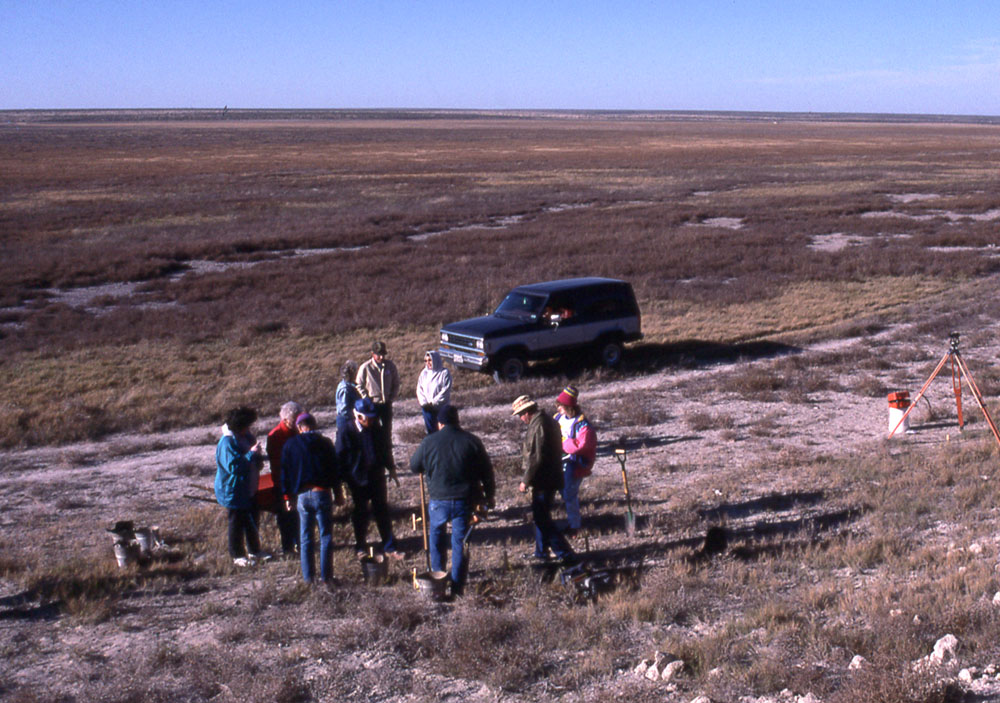
Field crew meeting at the outset of the 1992 excavations at the Big Lake Bison Kill site. The dry bed of Big Lake stretches for miles in the background. Big Lake is an intermittent saline lake or playa, an uncommon landform on the Edwards Plateau. Photo by Larry Riemenschneider, Concho Valley Archeological Society.
More details about Big Lake and prehistory, below the fold.
A hard look shows it’s not just the Deliverance-style local politics at the State Board of Education on science standards. Texas has trouble in a lot of areas.
For example, imagine a hurricane wiped out the town where one of the state’s major medical schools resides, and in the aftermath, rather than working to preserve the jobs of professors who agree to come back to the damaged buildings and storm-wracked town, the university uses the troubles as an excuse to get rid of faculty — not bad faculty, necessarily, just faculty the administration doesn’t like, or doesn’t know, or just for the heck of it.
Or, until that account is unsuspended by the forces supporting Donald Trump: Follow @FillmoreWhite, the account of the Millard Fillmore White House Library
We've been soaking in the Bathtub for several months, long enough that some of the links we've used have gone to the Great Internet in the Sky.
If you find a dead link, please leave a comment to that post, and tell us what link has expired.
Thanks!
Retired teacher of law, economics, history, AP government, psychology and science. Former speechwriter, press guy and legislative aide in U.S. Senate. Former Department of Education. Former airline real estate, telecom towers, Big 6 (that old!) consultant. Lab and field research in air pollution control.
My blog, Millard Fillmore's Bathtub, is a continuing experiment to test how to use blogs to improve and speed up learning processes for students, perhaps by making some of the courses actually interesting. It is a blog for teachers, to see if we can use blogs. It is for people interested in social studies and social studies education, to see if we can learn to get it right. It's a blog for science fans, to promote good science and good science policy. It's a blog for people interested in good government and how to achieve it.
BS in Mass Communication, University of Utah
Graduate study in Rhetoric and Speech Communication, University of Arizona
JD from the National Law Center, George Washington University


 Posted by Ed Darrell









 Millard Fillmore's Bathtub