Top spammers? Really odd mix (please send the Aston-Martin, keep the Kia)

May 21, 2014

A few days ago I noted that this blog is under a severe spam attack series.  Still true, and the spam has increased.

Please, no spam. Apologies to Hormel's Spam.

Please, no spam. Apologies to Hormel’s Spam.

Looking at the spam, the top spammers look really odd.  For years internet pornography and sex talk sites dominated spam, but after the arrest of some top spammers in those fields, it dropped off dramatically.

Today?  Here is a list of six top spammers I’ve got, hitting me with more than 100 spam posts per hour, combined:

  • Quirk Volkswagen, in Manchester, New Hampsire; one of the ip addresses used is 186.95.33.219
  • San Diego Aston-Martin (maybe I should be flattered?), including this ip address: 186.91.230.150
  • OnlyExotic.com, including 186.93.101.107 — a seller of exotic automobiles
  • Paul Cerame Kia in Florissant, Missouri, from 186.95.218.21
  • getforeverrecovery.com, apparently a privately-run detoxification and rehabilitation facility, 223.30.29.210
  • Keller Grover, LLP, a California law firm, including 103.12.160.21

Were I less familiar with spam, I’d think each of these organizations is near bankruptcy, and each is desperately trying to get enough traffic to keep the doors open.  But after years, I’ve discovered that the most desperate generally cannot afford to waste time spamming.

I’d almost wager that these organizations and companies hired some public relations group to “place” their ads across the internet and get hits on the ads.  And I’d almost wager they are unaware of what their hirelings are doing.  A lot of the spam links directly to promotional videos on YouTube.  Yes, it’s against YouTube policies to use spam video links.

What do you think customers of these companies would think, if they knew?  Do you think they get significant business from a thousand comments on Millard Fillmore’s Bathtub?

Spam from Aston-Martin of San Diego.

Hey, Aston-Martin of San Diego — send me one of these including tax and title (I’ll license it here in Texas), you can spam my blog all you want for a year. Heck, I’ll even fly to San Diego at my expense to pick it up from you. But otherwise, please knock off the spam.

Keller Grover, can you tell me -- pro bono, of course -- whether California legal canons endorse a law firm spamming across the internet.  I need to know for a friend.

Keller Grover, can you tell me — pro bono, of course — whether California legal canons endorse a law firm’s spamming across the internet? Can I sue them for unauthorized product placement, or unauthorized advertising, and collect?  I need to know for a friend.

Yes, I’ve protested to these people at their comments sections and by e-mail.

Update: Heh.  Not 12 hours later, someone sent me this link, where Quirk VW said:

Our dealership maintains a strict “no-spam” policy. Subscribers to our e-mail services (or any other feature/service found on our Web site) will not receive unsolicited e-mail messages from us.

That’s my problem:  I didn’t send them any e-mail!

Meanwhile, at Whipped Cream Difficulties, the same complaint, about some of the same spammers.


Insta-Millard: “Not available on the App Store” — real child’s play

May 9, 2014

Found on Twitter:

Deep thoughts on Twitter, about children, childhood, recess and play. https://twitter.com/IntThings/status/464766923201576960

Deep thoughts on Twitter, about children, childhood, recess and play. https://twitter.com/IntThings/status/464766923201576960


Birth of hydrogen phobia: May 6, 1937, the Hindenberg crash

May 6, 2014

May 6, 2014, is the 77th anniversary of the Hindenberg tragedy. Docking at its station in New Jersey, after crossing the Atlantic, a spark ignited the aluminum-based paint on the airship, and the entire craft exploded into flame.

35 people died on the airship, and one on the ground — did you know a few survived? The Associated Press interviewed a man who was 8-years old that day, and a passenger on the airship.

Werner Doehner, an 8-year-old passenger aboard the Hindenburg, saw chairs fall across the dining room door his father had walked through moments before the disaster. He would never see his father alive again.

“Just instantly, the whole place was on fire,” said Doehner, of Parachute, Colo., who is the last surviving passenger. “My mother threw me out the window. She threw my brother out. Then she threw me, but I hit something and bounced back. She caught me and threw me the second time out. My sister was just too heavy for her. My mother jumped out and fractured her pelvis. Regardless of that, she managed to walk.”

Hindenberg on fire

Hindenberg on fire, May 6, 1937.

The disaster erroneously condemned hydrogen in the public’s mind. Despite widespread use of hydrogen gas for cooking and some transportation during World War II (including in the U.S.), use of hydrogen as a fuel beyond that has always faced the hurdle of the “Hindenberg Syndrome,” the fear that the gas would explode.

Is the fear justified?  Fact is that gasoline is much more volatile, more explosive, and generally more dangerous, than hydrogen.  We move, and use, millions of gallons of gasoline in the U.S. every day, worldwide very hour, bound by laws enforcing strict liability, in relative safety.  Most people don’t think about the explosive power of the few gallons of gasoline stored under the rear seat of their car, where the children ride.

What other technologies do we fear irrationally?  What technologies do we irrationally fail to fear so much as we should?

This is mostly an encore post.


Typewriter of the moment: Thomas Merton

April 16, 2014

Thomas Merton's typewriter, at Bellarmine University

Thomas Merton’s typewriter, at Bellarmine University; image from Spiritual Travels blog. Photo by Lori Erickson

One of Thomas Merton’s typewriters sits on display at the Thomas Merton Center at Bellarmine University, in Louisville, Kentucky.

Who? You remember, the guy who wrote The Seven Storey Mountain.

Thomas Merton, O.C.S.O. (January 31, 1915 – December 10, 1968) was an American Catholic writer and mystic. A Trappist monk of the Abbey of Gethsemani, Kentucky, he was a poet, social activist, and student of comparative religion. In 1949, he was ordained to the priesthood and given the name Father Louis.[1][2][3]

Merton wrote more than 70 books, mostly on spirituality, social justice and a quiet pacifism, as well as scores of essays and reviews, including his best-selling autobiography, The Seven Storey Mountain (1948), which sent scores of World War II veterans, students, and even teenagers flocking to monasteries across the US,[4][5] and was also featured in National Reviews list of the 100 best non-fiction books of the century.[6] Merton was a keen proponent of interfaith understanding. He pioneered dialogue with prominent Asian spiritual figures, including the Dalai Lama, the Japanese writer D.T. Suzuki, and the Vietnamese monk Thich Nhat Hanh. Merton has also been the subject of several biographies.

It’s a French typewriter, by Royal, with French characters available for use.

Closeup of Thomas Merton's Royal Typewriter; The Thomas Merton Center

Closeup of Thomas Merton’s Royal typewriter, showing some of the special characters available for French; The Thomas Merton Center


More:  

Another typewriter displayed by the Thomas Merton Center. One of Merton's?

Another typewriter displayed by the Thomas Merton Center. One of Merton’s?


Hans Rosling says “Don’t Panic!” Defusing the population bomb?

February 23, 2014

Yes, that famous Rosling guy with the bouncing bubble, animated charts from TEDS.

TEDS star Hans Rosling, not in over his head.

TEDS star Hans Rosling, not in over his head.

Why not panic?  Rosling’s group, Gapminder, explains:

The world might not be as bad as you might believe!

Don’t Panic – is a one-hour long documentary produced by Wingspan Productions and broadcasted on BBC on the 7th of November 2013.

The visualizations are based on original graphics and stories by Gapminder and the underlaying data-sources are listed here.
Hans’s — “All time favorite graph”, is an animating bubble chart which you can interact with online here and download offline here.

Hans presents some results from our UK Ignorance Survey described here.

Director & Producer; Dan Hillman, Executive Producer: Archie Baron. ©Wingspan Productions for BBC, 2013.    A DVD version of this film is available to order from Wingspan Productions.

Alas, we can’t embed the film.  You must view the video — for free — at the Gapminder site, here.


Typewriter of the moment: Pete Seeger

February 15, 2014

Photo found at the blog of the good Robert Messenger at OzTypewriter:

I can find no identifying information on the photo.  It looks, to me, to have been taken in the 1950s, judging by Pete’s hair and no beard.

Pete Seeger at his typewriter, probably in the 1950s.

Pete Seeger at a typewriter, probably in the 1950s.

It’s an electric typewriter, I think, seeing a cord coming out of the back.  Probably a Royal (I’m not great at identifying typewriters, you know).   Was this taken at Pete’s home in Beacon?  Perhaps.

Can you help in identifying the time and place of this photo?

More:


December 31, 2013: Bright Idea Day, anniversary of Edison’s light bulb

December 30, 2013

Between Christmas and New Year’s Day, here at Millard Fillmore’s Bathtub we celebrate a variety of historically holy days.  December 31, by tradition, is Bright Idea Day, the anniversary of the day Thomas Edison demonstrated for the public a working light bulb in 1879.

100,000 people gather in Times Square, New York City, tonight, and millions more around the world, in festivities for the new year made possible by the work of Thomas Alva Edison.

Here it is, the invention that stole sleep from our grasp, made clubbing possible, and launched 50,000 cartoons about ideas:

The light bulb Thomas Edison demonstrated on December 31, 1879, at Menlo Park, New Jersey - Wikimedia image

The light bulb Thomas Edison demonstrated on December 31, 1879, at Menlo Park, New Jersey – Wikimedia image (GFDL)

The light bulb. It’s an incandescent bulb.

It wasn’t the first bulb. Edison a few months earlier devised a bulb that worked with a platinum filament. Platinum was too expensive for mass production, though — and Edison wanted mass production. So, with the cadre of great assistants at his Menlo Park laboratories, he struggled to find a good, inexpensive filament that would provide adequate life for the bulb. By late December 1879 they had settled on carbon filament.

Edison invited investors and the public to see the bulb demonstrated, on December 31, 1879.

Thomas Edison in 1878, the year before he demonstrated a workable electric light bulb.  Library of Congress image

Thomas Edison in 1878, the year before he demonstrated a workable electric light bulb. CREDIT: Thomas Edison, head-and-shoulders portrait, facing left, 1880. Prints and Photographs Division, Library of Congress. Reproduction number LC-USZ62-98067

Edison’s successful bulb indicated changes in science, technology, invention, intellectual property and finance well beyond its use of electricity. For example:

  • Edison’s Menlo Park, New Jersey, offices and laboratory were financed with earlier successful inventions. It was a hive of inventive activity aimed to make practical inventions from advances in science. Edison was all about selling inventions and rights to manufacture devices. He always had an eye on the profit potential. His improvements on the telegraph would found his laboratory he thought, and he expected to sell the device to Western Union for $5,000 to $7,000. Instead of offering it to them at a price, however, he asked Western Union to bid on it. They bid $10,000, which Edison gratefully accepted, along with the lesson that he might do better letting the marketplace establish the price for his inventions. Other inventive labs followed Edison’s example, such as the famous Bell Labs, but few equalled his success, or had as much fun doing it.  (Economics teachers:  Need an example of the marketplace in action?)
  • While Edison had some financial weight to invest in the quest for a workable electric light, he also got financial support, $30,000 worth, from some of the finance giants of the day, including J. P. Morgan and the Vanderbilts who established the Edison Light Company.
  • Edison didn’t invent the light bulb — but his improvements on it made it commercial. “In addressing the question ‘Who invented the incandescent lamp?’ historians Robert Friedel and Paul Israel list 22 inventors of incandescent lamps prior to Joseph Wilson Swan and Thomas Edison. They conclude that Edison’s version was able to outstrip the others because of a combination of three factors: an effective incandescent material, a higher vacuum than others were able to achieve (by use of the Sprengel pump) and a high resistance lamp that made power distribution from a centralized source economically viable.”
  • Edison’s financial and business leadership acumen is partly attested to by the continuance of his organizations, today — General Electric, one of the world’s most successful companies over the past 40 years, traces its origins to Edison.

Look around yourself this evening, and you can find a score of ways that Edison’s invention and its descendants affect your life. One of the more musing effects is in cartooning, however. Today a glowing lightbulb is universally accepted as a nonverbal symbol for ideas and inventions. (See Mark Parisi’s series of lightbulb cartoons, “Off the Mark.”)

Even with modern, electricity-saving bulbs, the cartoon shorthand hangs on, as in this Mitra Farmand cartoon.

Or see this wonderful animation, a video advertisement for United Airlines, by Joanna Quinn for Fallon — almost every frame has the symbolic lightbulb in it.

Other resources:

Patent drawing for Thomas Edison's successful electric lamp.  Library of Congress

Thomas Edison’s electric lamp patent drawing and claim for the incandescent light bulb CREDIT: “New Jersey–The Wizard of Electricity–Thomas A. Edison’s System of Electric Illumination,” 1880. Prints and Photographs Division, Library of Congress. Reproduction Number LC-USZ62-97960.

Yeah, this is mostly an encore post.

Even More, in 2012 and 2013:


The mighty pen, revisited

October 30, 2013

Before we completely forget about October 29, and events that occurred on that day of the calendar, let’s pause for a moment to remember the introduction of the ballpoint pen.  We do this because the ballpoint pen was such a symbol of modernity after World War II.  And we do this because hand writing utensils seem to be losing fashion, as does handwriting itself.

Let’s not lose all the history.  I wrote this first back in 2006, commemorating the ballpoint.

2006 was the 100th anniversary of the Mont Blanc company, the company that made fountain pens a luxury item even while fountain pens were still the state of the art of pens.

A Reynolds rocket; this is claimed to be the first version of the ballpoint pen sold, on October 29, 1945, in Gimbel's Department Store in New York City.

A Reynolds rocket; this is claimed to be the first version of the ballpoint pen sold, on October 29, 1945, in Gimbel’s Department Store in New York City.

October 29 is the 68st anniversary (according to CBS “Sunday Morning”) or 69th anniversary (see Wikipedia) of the introduction of the ballpoint pen in the U.S., at Gimbel’s Department Store, in New York City. (I go with 1945.)  It was based on a design devised in 1938 by a journalist named László Bíró. Biro produced his pen in Europe, and then in Argentina. But in the U.S., a businessman named Reynolds set up the Reynolds International Pen Company and rushed to market in the U.S. a pen based on several Biros he had purchased in Buenos Aires.

On October 29, 1945 (or 1946), you could purchase a “Reynolds Rocket” at Gimbel’s for $12.50 — about $130 today, adjusted for inflation.

1946 Reynolds Rocket ballpoint pen, from the collection of James P. Reynolds

1946 Reynolds Rocket ballpoint pen, from the collection of James P. Reynolds

Today I continue my search for a ballpoint or rollerball that will write in green, reliably, for grading.  (Turns out red marks panic a lot of kids; some write in blue, so blue won’t work, nor will black; green is a great grading color.)

I use a Waterman Phileas ballpoint, a Cross Radiance fountain pen, a Cross Radiance rollerball (Radiance was discontinued about a year ago), a full set of Cross Century writing implements, a lot of Sanford Uniballs in various colors, and a lot of Pentel Hybrid K-178 gel-rollers, and some Pilot G-2 gel pens (though the green ink versions are unreliable). I also keep several Marvy calligraphic pens for signing things with a flourish. I have a box of $0.10 ballpoints in a briefcase for students who fail to bring a writing utensil.  (Since 2006, I’ve added a Cross pencil similar to the old Radiance design, and another Cross ballpoint in black (the Waterman is blue); the most reliable green-ink pen I’ve found is a Pilot Bravo, but they are tough to find these days in any color, and green is even togher; plus, they are bold-line instruments.)

Jefferson probably wrote the Declaration of Independence with quills he trimmed himself. Lincoln probably used a form of fountain pen to write the Gettysburg Address, but he had no writing utensil with him when he was assassinated at Ford’s Theatre on April 14, 1865. President Johnson made famous the practice of using many pens to sign important documents, such as the Civil Rights Act of 1964; he made gifts of the pens to people who supported the legislation and worked to get it made into law.

And, who said it? Brace yourself.

Beneath the rule of men entirely great,
The pen is mightier than the sword.

Edward Bulwer-Lytton, Baron Lytton, wrote that, in Richelieu, act II, scene ii, a play he wrote in 1839.

Yes, he is the same Bulwer-Lytton who wrote the novel Paul Clifford in 1840, whose opening line is, “It was a dark and stormy night.”

The first ballpoint pen was sold in the United States on October 29, 1945, a few weeks after the surrender of Japan that ended completely the hostilities of World War II.  It was a good year, and a good time to be writing.  Still is, today.

More:


Oops. Future of education already here; reformers missed it (and so did most teachers)

October 17, 2013

You need to see these slides, from Will Richardson.

First, teachers should send a copy of this to their evaluators, principals, and all other admins up to the superintendent.  Sure, it’s possible they’ll fire you for telling the truth.  But if every teacher in your district did it, they might look at the slides and ponder:  What in the hell do our evaluations and test scores have to do with this new future that is already upon us, and around us, and washing away the foundations of what the state legislature claims we must be doing?

Will Richardson

Will Richardson

Second, this is a model presentation.  Notice how few of the slides are cluttered with words.  Notice those slides with words are easy to read, easy to grasp, and complement and are complemented by a lot of great images.  (One of my students got a less-than-A grade on a PowerPoint presentation in another class, and brought me the evaluation:  “Not enough text,” was one of the criticisms he’d gotten.  That teacher is considered a model by too many administrators.)  It’s not a perfect presentation.  Garr Reynolds would have a lot to say about it.  I’ll wager Richardson’s is better than any other presentation you’ve seen this week, in the content, the depth of information, and the way it’s packaged.  (Would have loved to have seen the presentation . . .)  That is particularly true if you’ve been the victim of teacher professional development sessions in the past week.

There are a lot of slides, partly because so few of them are cluttered by text.  (Don’t know how long the presentation went.)  This presentation would win a case against almost every other slide presentation I’ve ever seen from any law firm, who pay tens of thousands to lawyers to make slide presentations that defy understanding.  The world would be ever so much better were lawyers required to watch this, and compare it with their last presentation.

Third (related to and justifying the first), you need to realize how things have changed in the past year, past five years, past decade, and how we as a society and nation failed to account for those changes, or keep up with them, especially in our public AND private elementary and secondary schools.  Richardson understands the changes, and has some great leads on answers.

This presentation appears to have been a hit.  It seems a few people asked Will Richardson for copies (@WillRich45, www.willrichardson.com), which is why it’s on Slideshare.

Richardson highlights the importance of these thoughts at his blog:

If the recent iPad debacle in Los Angeles teaches us anything it’s that no amount of money and technology will change anything without a modern vision of what teaching and learning looks like when every student and every teacher has access to the Internet. As many of us have been saying for far too long, our strategy to deal with the continuing explosion of technology and connections can’t be to simply layer devices on top of the traditional curriculum and engage in digital delivery. Unfortunately, far too few develop a vision that sees that differently.

*     *     *     *     *

Please note: Technology is integrated throughout these initiatives in ways that serve the vision, not the other way around. This isn’t “let’s give everyone an iPad filled with a lot of textbook and personalized learning apps aimed at improving test scores and then figure out how to manage it.” This is about having important conversations around complex, difficult questions:

  • What will schools look like in the future?
  • What kinds of spaces do we need to support instruction and collaborative work in 5-10 years?
  • How will technology transform curriculum, instruction, and assessment?

And how does it work at your school, teachers?  Students?

We missed the revolution.  The kids are ahead of us.

Can  we catch up?

More:


Typewriters of the moment: Mitford and Carson, two environmental journalists

September 24, 2013

The great editorial cartoonist Bill Mauldin of the Chicago Sun-Times illustrates the gender dimension of the controversy over Carson and Silent Spring. In this 27 October 1963 cartoon he pairs her with Jessica Mitford, author of The American Way of Death, a scathing indictment of the funeral home industry. Men from both industries have been flattened under the platens of the women’s typewriters.  All rights reserved © 1963 by Bill Mauldin. Courtesy of Bill Mauldin Estate LLC

The great editorial cartoonist Bill Mauldin of the Chicago Sun-Times illustrates the gender dimension of the controversy over Carson and Silent Spring. In this 27 October 1963 cartoon he pairs her with Jessica Mitford, author of The American Way of Death, a scathing indictment of the funeral home industry. Men from both industries have been flattened under the platens of the women’s typewriters. All rights reserved © 1963 by Bill Mauldin. Courtesy of Bill Mauldin Estate LLC

Captured from Mark Stoll’s “Rachel Carson’s Silent Spring, a book that changed the world,” at the Environment and Society Portal.

A well-fitting image in the few days before the Society of Environmental Journalists (SEJ) opens its 2013 convention in Chattanooga, Tennessee (October 2-4).  It was the power of the typewriter in 1963; the power of the word processor in 2013, more likely.  In either case, it’s the hard work of environmental journalists, who are out to make the world a better place by showing us what it is, what shape it’s in, and how we might conserve it.

More:


Imagequilts, with Edward Tufte and Adam Schwartz

September 5, 2013

These are pretty cool.

Can you use them in a classroom?  Some of these Imagequilts pack a lot of information into a small space — such as the one for Cézanne.

Here, “Subatomic Particles“:

Subatomic particles, by Tufte and Schultz; click image for a larger version

Subatomic particles, by Tufte and Schwartz; click image for a larger version

Paul Cézanne“:

Paul Cezanne, Imagequilt by Tufte and Schwartz

Paul Cezanne, Imagequilt by Tufte and Schwartz. Useful in art history? European history?

Super Advanced Placement (AP) history teacher John Irish created outstanding PowerPoints showing off art of European eras, or American eras, for use in introducing a unit of history (see a smattering of examples here).  Could these Imagequilts substitute, or do it as well, and — especially — faster?

Here’s another, “Pablo Picasso“:

Imagequilt, Pablo Picasso, by Tufte and Schwartz

Imagequilt, Pablo Picasso, by Tufte and Schwartz

This one could be particularly useful in a physics course, or a unit on the history of science.  Richard Feynman may be most famous, pedagogically at least, for his invention and use of Feynman Diagrams.  Most discussions simply mention the things, though a few attempt short explanations.  Rare is to find a good example of a Feynman Diagram, to see just what they are and how they work.  Tufte and Schwartz offer a bunch:

Feynman Diagrams, an Imagequilt from Tufte and Schwartz

Feynman Diagrams, an Imagequilt from Tufte and Schwartz

Imagequilts is a Chrome App, available for download so you can make your own.  Of course, you’ll need to use Google Chrome to get full effect.

Got any Imagequilts you’d like to share?

More:


Wisdom, a checklist about students’ use of technology

August 18, 2013

Cheat Sheet:  What do you want kids to do with technology?  By Bill Ferriter

Cheat Sheet: What do you want kids to do with technology? By Bill Ferriter The Tempered Radical blog.williamferriter.com @plugusin

“Technology is a tool, not a learning outcome,” Bill Ferriter says.  He’s right, of course.

Tip of the old scrub brush to April Niemela@AprilJNiemela.

More, generally:


Typewriter of the moment: Aaron Copland in California

August 15, 2013

Composer Aaron Copland at his typewriter in California; Aaron Copland Collection, Library of Congress, circa 1939 or 1940

Composer Aaron Copland at his typewriter in California; Aaron Copland Collection, Library of Congress, circa 1939 or 1940. The photos is placed as either San Diego or Palm Springs; I’m leaning towards Palm Springs with those mountains. Anyone know?

Oddly, the Library of Congress photo site is down for the weekend; here's an image that shows what the photo should look like.  Links should work again come Monday.

Oddly, the Library of Congress photo site is down for the weekend; here’s an image that shows what the photo should look like. Links should work again come Monday.

Details for scholars and history buffs:

ITEM TITLE

Aaron Copland at typewriter, Palm Springs or San Diego, 1939-1940.

SOURCE

Collection: Aaron Copland Collection; Music Division, Library of Congress
Box/Folder: 472/1
Original format: 1 print: b&w; 2.5 x 2.5 in.

DIGITAL ID

copland phot0077

I don’t think this photo is under any copyright, but the collection contains this general language:

Photographs – used by permission of The Aaron Copland Fund for Music, Inc., 254 West 31st Street, 15th floor, New York, NY 10001, phone 461-6956, fax (212) 810-4567. The Fund’s permission is limited to the right to reproduce the image of Aaron Copland. All rights to use individual photographs are controlled by the respective owners of the copyrights in those photographs. For those listed as unidentified, we invite users to contact us with any information they may have with regard to those items.

Is it odd to find a composer working at a typewriter, and not a piano?  Especially before 1990, music writers had much occasion to use the machines — for lyrics, for descriptions of their music and how the published version should look, and for correspondence — and, baby, do composers have correspondence!  The brand on this machine I have not been able to determine; it’s a portable, I imagine, looking at the case to Copland’s left — the typewriter case.

Was Copland a hunt-and-peck typer?  Looks like to me from this photo.

Did you notice the U.S. flag on the pole on the other side of the house?

I wonder what he was working on, in California, at that time.

More:

English: Aaron Copland

Aaron Copland at a machine where we’d expect to find him — years after the photo at the top. Wikipedia image


Outlaw flying in the American west

August 15, 2013

Old Jules tells a great story here about cranking up the old Cessna and climbing high enough to watch the vast powers of the U.S. military run training operations in the New Mexico Desert.

Pilots, bless ’em, tend toward the ornery end of the scale.  That’s what you want if something breaks on your airplane.  You want a guy at the stick who says, “Dagnab it, let’s see how to get out of this one safely.”  (Shades of Flight.  A great movie, really — did you see it?)

This is the place to insert the heroics of pilots in various times of stress, Wally Stewart and his crew bringing their B-24 bomber back over the Mediterrannean and dropping it perfectly on the runway, where it fell apart from the bullet holes [See KUED resources here].  That brave American Airlines crew in the DC-10 over Detroit, Flight 96, who lost hydraulic control when the rear cargo door blew out, and after a string of blue talking, brought the plane down safely (one flight attendant died in the explosion). Those United Airlines pilots who brought the DC-10 Flight 232 down in Sioux City, Iowa, after the rear engine flew apart and destroyed all control of the tail and rudder.  That brave U.S. Airways crew that executed a perfect landing in the Hudson River with Flight 1549.

I think if you talk with pilots much, you get the idea that they like things a little on the edge.  They don’t develop those cool, steely nerves that save lives by having nothing go wrong, ever, or by not pushing their aircraft where the wonks at the Federal Aviation Administration in Washington, D.C., say aircraft should not be pushed.  We hope they do all this pushing in flight simulators; but we also know better.

Cessnas, and just violating some of the rules, don’t deserve those accolades, really.  These stories tell how pilots might develop the skills the brave guys use later.  But they are stories, nevertheless, and they deserve to be told.  They may not save your life flying, but they’ll enrich your life, and help you get through the stuff here on the ground.

So go read Old Jules’s tale.

Then come back here; here are a couple of stories, true as I remember them (a couple of which really should be tracked down; the American west of the latter-half the of 20th century is full of these stories, and they need to be told).

I told Old Jules:

What’s outlaw in flying?

Two observations.

Years ago, while I was staffing the Senate, my brother, Jerry Jones, who spent a good deal of time in his last 20 years in Page, Arizona, called to ask me to check in on a Senate hearing on some FAA issue or other.  Turns out someone — National Park Service, perhaps? — was asking FAA to significantly tighten rules on flying around NPS stuff, including around Rainbow Bridge National Monument.  Apart from the usual issues of air traffic congestion and safety around conflicts between “fixed wing and rotary wing aircraft” (airplanes and helicopters) in and around the Grand Canyon, there were complaints about small plane pilots flying under Rainbow bridge.  The thing really is massive, and you could put the dome of the U.S. Capitol under it, so it’s about 500 feet high . . . what barnstorming pilot could resist?

A somewhat skeptical group of senators quizzed the FAA and Park Service guys on what the problem was, other than noise and hubbub to hikers (who had hiked a mile from the marina on Lake Powell).  About that time Sen. Barry Goldwater, R-Arizona, shuffled into the hearing.  Goldwater was very protective of grand things to see in Arizona, like Rainbow Bridge, and he was also a pilot.

Barry Goldwater, U.S. Senator (AZ-R)

Barry Goldwater, U.S. Senator, R-Arizona. Wikipedia image.

At some point, one of the officials making a case to yank licenses from pilots who pulled the illegal stunt made a comment that questioned the sanity of any pilot who would do such a thing.  Goldwater sat upright.  You mean any pilot who would do such a thing is crazy? Goldwater asked.  Well, yes — and we don’t want crazy people flying airplanes, the official said.  How about such crazy people representing the people of Arizona and passing judgment on your proposals? Goldwater asked.  Then he said he didn’t want an answer to that, that he had some grave reservations about the proposal, and he left the hearing.

I later caught a conversation with the senator in a hallway, in which someone asked him directly if he’d ever flown under Rainbow Bridge, and he said something like, not enough times that the FAA needs to worry about it.

Brother Jerry started a public service effort in his Page days, Page Attacks Trash, a project to clean up litter in and around Page, on the Navajo Reservation, and in the Lake Powell National Recreation Area (NRA) and Rainbow Bridge NM.  It was a great clean-up effort, got the support of the Salt River Project (who operate the Navajo Generating Station in Page); it was big time.  Iron Eyes Cody, who did the famous anti-littering ad featuring the tear in the eye of an American Indian, sometimes dropped in to help out.

Jerry arranged for some television Public Service Announcements (PSAs) filmed in and around Lake Powell, to fight littering.  One of the spots was shot at Rainbow Bridge.  Jerry’s health had been failing for years, but he’d get his cane and make the hike, just to watch the proceedings and keep it all going well.  They finished the spot, broke sticks (as they used to say in the filming biz), and were walking back to the boats at the marina, Jerry and his cane far in the rear.  Just before the film crew rounded the bend, they heard a small airplane buzzing around and the tell-tale cut of the engine, to lose altitude, before roaring the engine to pass under the stone formation.  One of the cameramen had some footage left, and had the presence of mind to turn on the camera and film the thing.

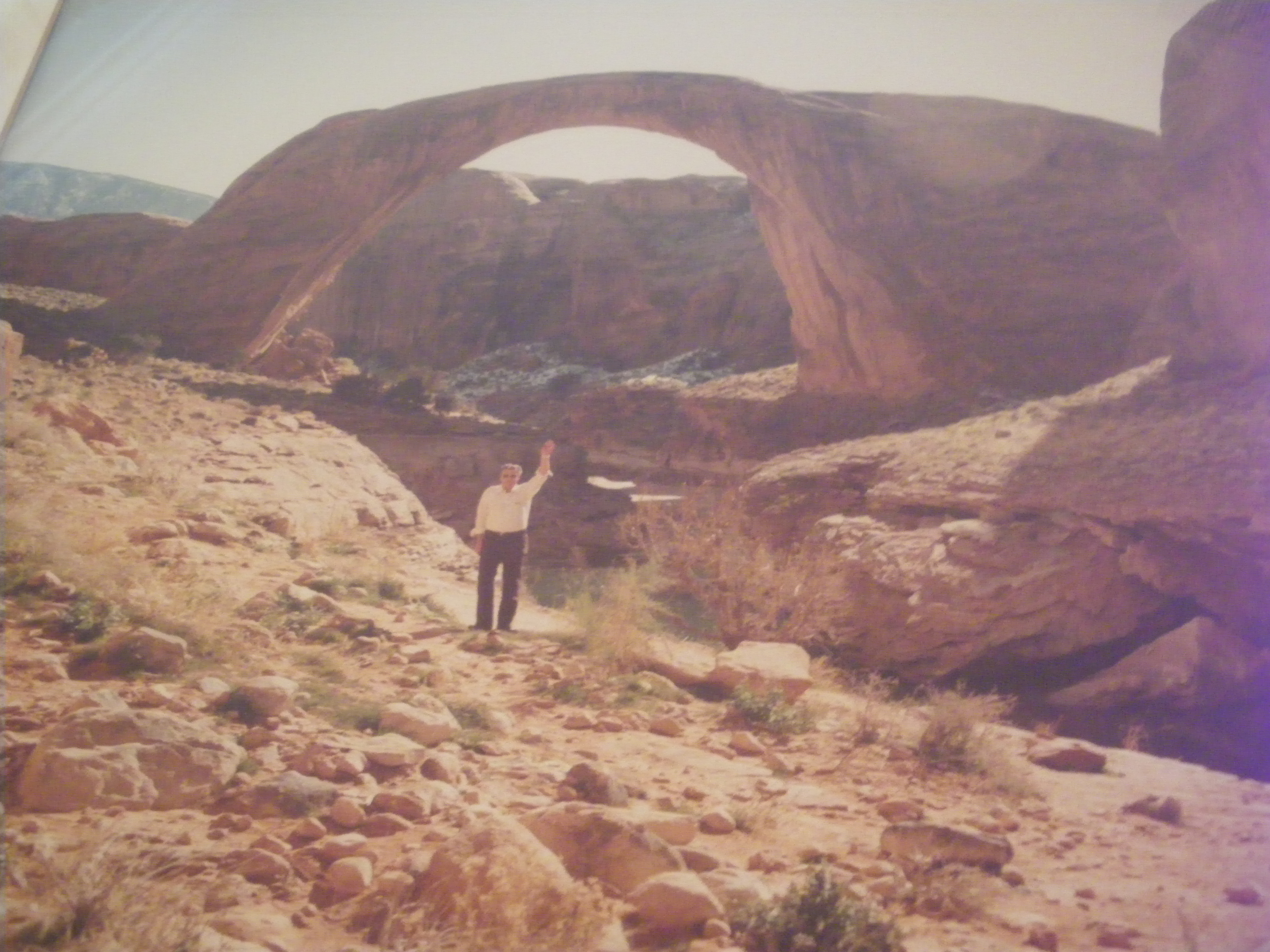
Well, the Park Service and FAA were outraged to hear of the event.  They subpoenaed the film footage, and blew up every frame to see if they could get the tail number on the airplane.  To be honest, I don’t know how that turned out.  I do know that on my wall I have a large photograph of my late brother, two by two-and-a-half feet, waving to the cameraman, with Rainbow Bridge in the background.  That frame didn’t have any useful information, and the law gave him the photo.

The Rainbow Brigde National Monument

Rainbow Bridge National Monument; no, I wouldn’t try to fly a plane under it, either. You could, if you had to, but the authorities would probably track you down like a woodpecker and yank your license. Wikipedia image

Two:

The West Utah Desert remains desolate. On the border between Nevada and Utah, there ain’t much of nothin’. A few roads connect a few ranches, but there’s a good reason U.S. 50 and 6 out there is known as “the loneliest highway in the world.” Bandits might be regarded as welcome company out there sometimes.

Anyway, it was expensive to run copper wires out there, say, 50 miles, to an isolated ranch house, or a lone gas station, or some other building said to be a business. So mostly, AT&T didn’t do it. People who lived and worked out there just had to get along without phone service. Enter a guy named Art Silver Brothers (I think; my memory fades, too), who figured out that radiophone service worked okay. Give people a radiophone — a device which existed then, but which required several pounds of gear and a lot of juice, relatively — and they could dial up the “local” grocery store to check to be sure the milk was good this week, before driving 50 miles to get some dairy whitener for the coffee.

A photo from Beehive Telephone in 2012, showing their service area.

A photo from Beehive Telephone in 2012, showing a part of their service area in Utah, or Nevada, or both. The company still exists!  On their website, they say:  “

Art strung wires where he could, using REA-installed power poles, or fence poles, or whatever he could, and thin, light copper wiring. His Beehive Phone Company was one of the last truly independent phone operations in the U.S., serving a grossly underserved area with patchy service. He didn’t get rich doing it.  He was the company’s only employee most of the time.

Stringing copper over 50 miles for one phone, a company can have difficulty maintaining such lines. Art had a pilot’s license, and he learned he could spot downed lines and other trouble from the air . . . and it was just one step to landing his small airplane on the local road, fixing the problem, and taking off again.

Well, that got the ire of the FAA. They said he shouldn’t do that. They argued that he was impeding traffic an imposing dangers. He said he was keeping lifelines open for people in far-flung places, and it was not a problem for traffic on roads where there might be two vehicles a week passing by. FAA paid for traffic studies on a bunch of those roads; and they enlisted the FCC to try to shut down Silver’s operations.

Remember, part of the system was wired, and part was radio. Turns out that in those pre-cellular days, the radio frequencies Silver used were in the “emergency” spectrum — radio frequencies used by cops and firefighters in places where cops and firefighters existed. FCC took to taping the “phone conversations” of Art’s customers, and in yet another hearing in the Senate, charged that Art was abusing emergency frequencies. The star audio was a tape recording of a woman ordering a significant amount of liquor from a liquor store that served probably six counties in eastern Nevada. FCC argued that obviously was not an emergency, and it amounted to an abuse of spectrum, and it was enough of an abuse to shut down the phone company.

Art finally got his chance to explain. Someone quizzed him about that liquor order, and whether that was appropriate use of emergency radio spectrum.

Well, Art started, the woman making the liquor order was the owning madam of [a] western Nevada brothel, set way in the hell in the middle of nowhere. “And I gotta tell you, if you run a whore house, and you run out of whiskey, that’s an emergency.”

Those were good days to attend hearings in Washington. The Tea Party has ruined all that.

That’s my story; the true facts are probably better.

More:

Jerry Jones and Rainbow Bridge

A bad snapshot of the picture on my wall, Jerry Jones waving from the path in Rainbow Bridge National Monument, moments after a small aircraft flew under the Bridge.


Typewriter of the moment: Superman’s (1950s television)

July 20, 2013

Stumbled across this photo of Superman typing away:

Superman typing.

Superman typing. Is that a Remington? (George Reeves played Superman in the television series that ran from 1952 to 1958, “The Adventures of Superman.”)

I’m pretty sure it’s a Remington, a manual  (if you can tell differently, please let me know).  Superman’s “alter ego” was Clark Kent, whose job in the comics and this television series was as a reporter for the Daily Planet, the newspaper for Metropolis.

Do you think the typewriters on Krypton used a QWERTY keyboard?  How did Superman deal with typographical errors, in the time before Correcting Selectrics?