Last one in the water . . .!

August 12, 2010

Beach sign in Australia - photo by Laura Hale

Sign on an Australian beach. Photo by Laura Hale

Tip of the old scrub brush to Laura Hale.


Dan Valentine – My Sister/My Brother, part 1

August 11, 2010

By Dan Valentine

MY SISTER / MY BROTHER – Part 1

One magical, fairy-tale of an evening, back in 1998, my baby sister Valerie—she is eight-years younger than myself—was knighted by Her Majesty Queen Beatrix of the Netherlands.

And I was there!

She is one of the few ballerinas and/or Americans ever to be so honored.

Funny, just a few short years before in Manhattan, after my sister had performed onstage with the great Russian dancer Rudolf Nureyev—yes, that one!—my mom had doused out a cigarette in the Queen’s half-empty cocktail.  At a reception for members of the Dutch community in town (Walter Cronkite was there), my mom, looking around for an ashtray and not finding one nearby, spotted a half-filled drink and plopped her cig in it.  A moment later, the Queen came back, after a brief newspaper interview, to finish her toddy, only to find a, well, you-know-what in it.

But back to little sister’s knighthood.

Earlier that morning, I had attended a ballet class with my sister.  Ballerinas and their male counterparts take class every day of the week to brush up on their technique and such.  They stretch, move to the Barre, and do sequences in the center of the floor for an hour or so.  This is followed by grueling hours of rehearsals for upcoming and/or present performances.  So, anyway, I was standing by the wayside watching a Russian ballerina from the Bolshoi twirl around and around and around.  We made eye contact and she fainted, dead away.  In my dreams, I caught her in my arms.  In reality, she slumped to the floor.  I like to think it was caused by my George Clooney good looks, but it was probably caused by exhaustion.

That day, for a short time, I was the talk of the company.

Her lifemate, Roeland Kerbosch, an award-winning Dutch film director, had informed me a short time beforehand what was to take place that evening.  I remember smoking—of course! as they say in the Netherlands—by the stage door of the Muziektheater in Amsterdam when my sister showed to suit up.  She told me that she was worried about that night’s performance.  Can’t remember why.  All I was thinking was:  Val, this is going to be one of, if not thee greatest night of your life.

Utah-born ballerina Valerie Valentine, Dutch National Ballet

Valerie Valentine, Dutch National Ballet

Later that evening, Valerie—I call her Val, sometimes Vali—was dancing onstage when suddenly everyone but herself stopped in their tracks.  The conductor put down his baton.  The music stopped.  The performance came to a halt.  My sister, in the middle of a pas de deux or whatever, looked around perplexed.  What the heck is going on?

After a moment, the Mayor of Amsterdam walked on stage and bestowed upon her the Order of the Dutch Lion—the highest honor a non-military person can receive in the Netherlands—in recognition for her 25 years of “significant contribution to the art of dance.”

He read from a scroll:  “Admired for her energy and dedication to her work, Valerie Valentine’s beautiful sense of line, strong technique and expressive, magical stage presence have inspired not only choreographers, but photographers and filmmakers as well . . .”

Needless to say, there was a party afterward.  Cocktails, hors d’œuvres, a band, dancing, etc.  I was very happy for my sister, ecstatically so.  But I left the celebration shortly after it began.

I can’t remember feeling sadder.

Sitting at an outside cafe, just a few a blocks away, was my artist brother Jimmy, uninvited (and rightly so; he was literally crazy as hell), doing his best to drink himself to death, an endeavor he would shortly accomplish.

He died four years later, age 48, in Torremolinos, Malaga, Spain . . . on Valentine’s Day.

Add to FacebookAdd to NewsvineAdd to DiggAdd to Del.icio.usAdd to StumbleuponAdd to RedditAdd to BlinklistAdd to TwitterAdd to TechnoratiAdd to Furl


Geography quiz: Which Midwest city is this?

August 9, 2010

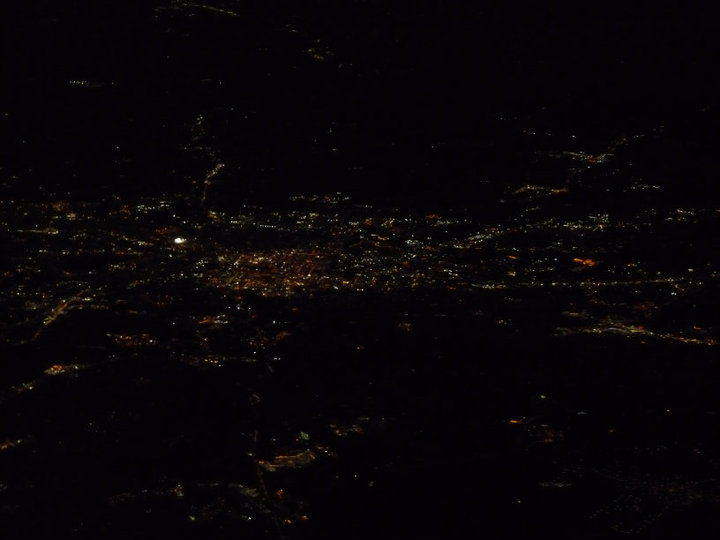
Quick quiz:  Can you identify this Midwest American city?

Mystery Midwest city from the air

Can you identify the city shown in this photo? Photo by James Darrell, flying to DFW from ATL. (Click for larger view)

Can you identify this Midwest city?  The photo was taken about an hour outside of DFW International, flying in from Atlanta Hartsfield.  North in on the right side of the photo.  My quick guess was Oklahoma City, but that was when I thought the departure city was Milwaukee (it could still be OKC).

Can you shed some light, and tell why you think it’s that city?

Night flying is cool.  While I enjoy flying any time, I really enjoy the views from an airplane at night.

Somewhere in the trunk of film-that-may-one-day-be-digitized, I have several photos of smaller cities along the Wasatch Front in Utah, taken during campaigns and business trips in the 1970s and 1980s.  At one time I had a list of the cities in the shots, but that list is long gone.  I wonder whether I could identify those cities today?

Historically, it would be interesting, since most of those small towns now are sizable suburb cities.

Chicago lays out in an orange grid of glowing citrine gemstones at night.  New York City dazzles from 2,000 feet, looking better than any movie you’ve ever seen, and glowing.  Dallas presents a colored outline against the black sky when you come in for a landing (or Fort Worth, with more white lights, if you’re on the west side of the aircraft coming in).  Salt Lake City sparkles and spreads up the mountains and canyons.  St. Louis is neat rows of lighted pathways broken by the snaking Mississippi and Missouri Rivers.  Washington, D.C. is a Shining City on a Hill spectacular when the weather is clear, coming down the Potomac River to National (now Reagan).

Which city is this one, above?

Add to FacebookAdd to NewsvineAdd to DiggAdd to Del.icio.usAdd to StumbleuponAdd to RedditAdd to BlinklistAdd to TwitterAdd to TechnoratiAdd to Furl


Some teachers had great summer experiences

August 6, 2010

One of our more adventurous teachers spent the summer on a Fulbright-Hays program in Senegal, in West Africa.

Lunch in Senegal, William Adkins photo

No, that's not William Adkins. That's his lunch one day in Senegal.

William Adkins’ African adventure blog is here.  Mine it for stuff you can use in economics, art, world history, world geography, or anything else.  He’ll probably give you free reign to use the photos for classroom presentations.

What did you do on your summer vacation?

Add to FacebookAdd to NewsvineAdd to DiggAdd to Del.icio.usAdd to StumbleuponAdd to RedditAdd to BlinklistAdd to TwitterAdd to TechnoratiAdd to Furl


Dan Valentine – Mexican balada

August 5, 2010

So I’m sitting on the back veranda of the hostel here having my first cup of coffee and my first cough from a cigarette—it’s what I do best—when a guest here for relaxation and rest joins me. Best, guest, rest. Perfect internal rhymes and, so far, a perfect morning.

I tell her what I’ve been writing about for the past week or two or so and she says, off the top of her head: “The gays of our lives.”

Now, if that’s not the greatest title for a book on such a topic, I don’t know what is.

In the beginning, I was merely going to write about my gay-bashing. But night after night, culling through my mind subconsciously, I sit straight up in bed and say to myself, “Oh, yeah! The two gay guys the manager at Trevi Towers in Salt Lake found nude in the sauna!” Or: “The time I was called a poof by a Glasgow taxi driver when I didn’t tip him enough!” Or . . . well, the list gets longer every night.

I think I have a book whatever it’s called. But I’m going to think on it for awhile, a day or three.

So, last night, instead of writing another pink-cigarette-lighter piece, I put the finishing touches on a Mexican balada.

In English, of course. I took two years of Spanish in high school, but my mom did my homework. She had spent half of World War II in Chile, Peru, and Boliva. Her first husband was a mining engineer, and back then she spoke fluent Spanish. She wanted to prove to herself that she still had the skill. So, not only did she help me with my homework, she did my homework! As a result, she got an A, I got a D—which averaged out to a C. And I didn’t learn a goddamn thing.

I told my sister this once and she said our mom had done her homework, too. As a result, my mom got another A and my sis, she got a—I didn’t have to ask.

Neither of us can speak Spanish, though she can speak fluent Dutch after living in Amsterdam for some-forty years.

My brother couldn’t speak a word of Spanish, either, though he died in Malaga, Spain, the birthplace of Picasso.

But back to my Mexican balado—a sad, Spanish ballad, sometimes called a tearjerker. In the background, picture mariachis. More than anything else, I guess, it’s a concert/nightclub/theater piece.

*   *   *   *   *

ISN’T THAT THE DUMBEST THING?
By Daniel Valentine (c) 2010

I’ve total recall
Of the summer we met.
That fall and that Christmas
I’ll never forget.

And now, close to Easter,
With thoughts of that year—
Spring break all but here—
Reminiscing, as ev’ryone does,
I remember the spring
That never was.

I imagine a flight and a window seat,
Waves dancing below in the shimmering heat,
Cancun just beyond the wing.
ISN’T THAT THE DUMBEST THING?

Sometimes late at night,
Quarter past one or two,
I’ll smile on those seasons
So sweet, oh-too few.

But round about three-ish
Or four-ish, I find,
What creeps into mind,
Uninvited, when slighted hearts stir,
Are the four days, three nights
That never were.

I imagine a towel for two in the sun,
Our bodies so snug passersby swear we’re one
Whenever we closely cling.
ISN’T THAT THE DUMBEST THING?

Mescal to consume!
Spring break in full swing!
While friends toured the tomb
Of some Mayan king,
I sat alone in my room
By a phone that didn’t ring.

My folks are concerned,
As our others, because:
What good is obsessing
On what never what?

But spring’s here and lovers,
They stroll hand-in-hand,
Barefoot on white sand,
And I can’t help but think of back when.
I remember the spring
That might have been.

I imagine a kiss on a moonlit beach,
Each star in the sky within fingertip reach.
Nearby mariachis sing.
ISN’T THAT THE DUMBEST THING?
The god-damnedest dumbest thing?

(spoken:)
Cancun is a spring break paradise, attracting some
200,000 college students. The 16-mile long island is
located on the tip of the Yucatan Peninsula, between
the Caribbean Sea and the lovely Nichupte Lagoon and
boasts all a spring breaker could ever hope to die
for: beach volleyball, beautiful people, spectacular
sunsets, and lots of other fun stuff, too, like
tequila shots and celebrity sightings. And, though,
I have never been there, I hate the place like I
never hated any place on the face of the Earth
before.

(sung:)
Mescal to consume!
Spring break in full swing!
While friends toured the tomb
Of some Mayan king,
I sat alone in my room
By a phone that didn’t ring.

My folks are concerned,
As are others, because:
What good is obsessing
On what never was?

But spring’s here and lovers,
They stroll hand-in-hand,
Barefoot on white sand,
And I can’t help but think of back when.
I remember the spring
That might have been.

I imagine a flight and a window seat,
Waves dancing below in the shimmering heat,
Cancun just beyond the wing.
ISN’T THAT THE DUMBEST THING?
The god-damnedest dumbest thing?

Send a balada to your friends:

Add to FacebookAdd to NewsvineAdd to DiggAdd to Del.icio.usAdd to StumbleuponAdd to RedditAdd to BlinklistAdd to TwitterAdd to TechnoratiAdd to Furl


Waist deep in Wichita Falls

July 30, 2010

Those falls at the end?  They’re artificial.  Residents of Wichita Falls got tired of explaining what happened to the falls, and built artificial falls over a decade ago.

The unveiling of the falls was a big event — NBC’s Willard Scott covered the story, which shows you how big the event was, and how long ago it was.

I’ve eaten barbecue at the Bar-L Drive In, under the wise tutelage of Joe Tom Hutchison.  It was lunch, though, so we did not sample the Red Draw.

This short film, by Daniel Holoubek, was an entry in Texas Monthly’s “Where I’m From” Short Film Contest.  Amazingly, it did not win.  “Beaumont Stinks” took the Grand Prize.

Texas is that big, and that unique.

Tip of the old scrub brush to Mary Almanza.


Travel is an education of itself

July 27, 2010

It’s a tough place to go to school, but somebody has to do it.

Kenny Darrell in Chania, on the island of Crete

Kenny Darrell in Chania, on the island of Crete, becoming a teacher - photo by Stacy Grace


Dan Valentine – Pink cigarette lighter, part 5

July 23, 2010

By Dan Valentine

THE PINK CIGARETTE LIGHTER — Part 5

Shortly after my little episode with Melody – y’know, the brigadier general’s daughter, so on and so forth, the one with the butcher knife, etc., etc., with the crazy ex-boyfriend – I soon found myself a studio flat of my own in downtown D.C.

The Westpark Apartments, 2130 “P” Street, just west of Dupont Circle and the Metro stop that took me straight to work at the Russell Senate Office Building. The Ritz-Carlton was just around the corner. My good friend Paul Smith, Orrin Hatch’s former press secretary, and I saw Peggy Lee perform there one evening. She had fallen shortly before the engagement and sang on crutches.

The residents at the Westpark were mostly students and professionals. There was a grocery store next door and some of Washington’s better restaurants nearby. Georgetown was a ten-minute walk.

Great location but noisy on weekends. Across the street, I soon learned, was a stretch of very popular gay bars: a gay dance club, a gay sports bar, a gay piano bar, a gay you-name-it. “The cutting edge of Gay nightclubs,” I later read in a local rag.

I lived there for some two years without incident.

Flash-forward half a decade. I had moved my folks from Salt Lake to Arlington, Va. A three-bedroom penthouse apartment, above the Balston Commons Arcade, with a view of the Nation’s Capital. It was to die for! Fourth of July, it was the best seat in the house. Fireworks galore sprouting above the Washington Monument.  During Bush I’s term, when the troops returned home victorious from fighting in Kuwait and Iraq and the whole town celebrated, it was the best seat in the house. Fireworks galore.

One evening, shortly after returning for the second time to the District, I joined my bestest friend for a cocktail or two. We may have even had dinner.

You could smoke in bars and restaurants back then and, like many times before in the past, by the end of the evening, her cigarette lighter ended up in my blue sports coat pocket. She doesn’t smoke cigarettes; though, she’ll light herself a cigar every once in a great while. She prefers to smoke, well, let’s just say she likes to laugh. As I do. Laughter is a sound foundation for any relationship. (My ex-mother-in-law once asked my ex-wife, in front of me, “Why did you marry him?” “He made me laugh,” she said. Her mother sniffed and replied, “I’ve never thought he was funny.” I had to laugh.)

Anyway, the lighter ended up in my pocket when I used my last match and she lent me hers. It was pink.

Many a time I have sat at a table with friends and, by the end of the night, everyone’s lighter or matches or both have wound up in my possession. I’m infamous for it. And many a time, a friend during the evening has slapped his pockets or searched her purse only to find that his or her light is missing. “Where’s my lighter?! Where are my matches?!” Friends always turn to me. “Valentine! Not again!” I get caught up in the conversation at hand and, without thinking, I slip them in my pocket after lighting up.

We had met at a restaurant nearby Dupont Circle, close to my former residence. After bidding goodnight, call-you-later, I thought I’d save a buck or two – I was raised by Depression Kids – and catch a cab to Georgetown for one last drink before going home to Arlington.

In D.C., at the time, there were taxi zones. When I lived on “P” Street, I soon discovered if one wanted to save some cash one had only to stroll a few paces and cross the street at the end of the block to hail a taxi. Back then, every zone your cab entered cost you an extra-added fare.

So, I’m on “P” Street–familiar and friendly territory, or so I thought at the time–a few steps from saving a dollar or so, when I stop to light up. I pulled out my friend’s pink one. I lit my cigarette, pocketed the rest. It was then that someone head-butted me in the back like an NFL guard, plunging me face-first to the pavement. Another man, from out of the shadows, joined in the fun, kicking me in the head and ribs, both of them shouting, “Faggot!” and other slurs I suppose.

I can only suppose that the pink lighter offended them.

I was knocked unconscious. When I came to, I opened my eyes to see two Pink Angels gazing down on me, one with a flashlight beaming on my face.

Every Friday and Saturday, near the stroke of midnight, a group of volunteers, dressed in black berets and jackets, pair off and walk unarmed up and down the gay sections of D.C., making sure gays get home in one-piece. They’re known as Pink Angels. Such groups exist from San Francisco to Greenwich Village.

The two helped me to my feet and guided me to the gay piano bar on the corner. Upon seeing me, the bartender immediately began dialing an ambulance. He didn’t have to pick up the phone book and thumb through its pages to look for the number. I told him to dial me a cab instead. Save a buck here, save buck there. I was raised by Depression Kids.

No doubt, the bartender poured me a drink on the house. And, no doubt, I lit myself a cigarette. Can’t have a drink without a cigarette, swollen-bleeding lips or no. And, without any doubt, I pocketed a book of matches with the bar’s logo on them. Can’t have a cigarette without a light.

The pink lighter was missing, glimmering in a moonlit gutter somewhere.

I was in the Men’s, cleaning up best I could, when the cab arrived. The driver took me to the Georgetown University Hospital emergency room for my wounds. Broken nose (again, for the umpteenth time), multiple bruises, battered ribs, fractured jaw. I may have even had a minor concussion. Can’t remember. That wasn’t meant as a joke. It’s just been that long ago.

Later on that week, I saw a specialist, etc. In all, visits, procedures, more visits, more procedures, it cost me some several thousand dollars. I was unaware at the time–no one volunteered the info–that there is some sort of city fund for such incidents.

The time was the late ’80s, but little has changed.

Just recently I came across a news story on the internet The head read: Wearing Pink Gets Straight Man Gay Bashed. The date: October 2009. The story: A straight man who wore pink to aid breast cancer charities was bashed by men at a Kansas City Chiefs game. The victim, a father of three, had volunteered to wear pink clothing to draw attention to National Breast Cancer Awareness Month. He raised a few hundred dollars, vending pink ribbons and shirts and hats, among other things. Third quarter, he decides to call it a day. He’s heading out of the stadium when two men, drunk, began harassing him because of his pink clothing. One of them punched him in the face. The second threw him to the ground. Both began kicking him in the ribs and head. I can relate. Managing somehow to get to his feet, he scurried for his life, the men chasing after him. Dodging them in between parked cars in the stadium’s lot, he finally escaped.

Sometimes, looking back, I think it may not have been the pink lighter at all. Maybe they were simply hard-core anti-smoking activists. They could very well have been paid assassins hired by my ex-mother-in-law. They may have been Danes! One thing’s for sure: The two wanted to hurt somebody, badly–gay, straight, or Martian–and they did. Me. Wrong place at the wrong time. A lot of life is timing. You win a few, you lose a few.

For some time afterward, I smoked very little, if at all. Wired-fractured jaw. When I was well enough, I visited my bestest friend.

THAT didn’t make me feel better! She was seeing a cop. Upon hearing that, no doubt, I lit-up a cigarette. I left shortly afterward.

A few weeks later, I visited her again. Just happen to be in the area. Yeah, right! I asked how she and the cop were doing. She said she had broken up with the fellow. She had discovered he was gay.

This was at the height of the AIDS scare. AIDS was somewhere in everyone’s mind, in flats on “U” Street, where she was living at the time, and in dark, shadowed doorways on “P” Street.

“He told you that?” I asked.

“No. Not exactly.”

“So, how do you know?”

He, too, it seems, had visited one day, and after he’d left, she had found a book of matches from a gay bar.

“I know you’re not gay. So–.” She showed me the matches. They were mine. From the gay piano bar on “P” Street.

You win a few, you lose a few. One day you’re lying in a puddle of blood, your own; the next day, you’re soaring, eagle-like, high above the clouds, a big-big smile on your face, fractured-jaw and all.

TO BE CONTINUED


Dan Valentine – The pink cigarette lighter, part 4

July 22, 2010

By Dan Valentine

The pink cigarette lighter, part 4

When I was four or five, early ’50s, my dad quit The Salt Lake Tribune and we moved to San Francisco.

Actor Peter Lorre, who was known for his bulging eyes and for co-starring alongside Humphrey Bogart in films such as “Casablanca,” was in Salt Lake to perform in a stage reading from George Bernard Shaw’s play “Don Juan in Hell,” with Charles Laughton and two others. I think one was Agnes Moorehead. Charles Boyer may have been the fourth.

Peter Lorre

Peter Lorre, in "Secret Agent," 1936

My dad wrote: “The man with the ping-pong eyes is in town.” He was quite proud of that lead.

He woke up the next morning, picked the paper up off the front porch, and flipped to his column. It read: “The man with the table-tennis eyes is in town.”

Didn’t have same ring to it. Though, it had his by-line.

Someone on the rewrite desk had changed the lead. My dad blew a gasket and was told that “Ping Pong” was a brand name and the paper didn’t give free advertising. Back then, “Coca-Cola” wasn’t allowed in a story. Instead, carbonated beverage was substituted.

My dad quit shortly there after. One straw too many (in the carbonated beverage.) They had cut his column time after time.

Many years later, when I took over his column, one of the first bits of advice he gave me was: “Don’t read your column in the paper the next morning. It will give you high blood pressure.” I ignored this little nugget and I’ve high-blood pressure ever since.

One evening that very week, the phone rang at home. (We were living on Grove Avenue. The house is still there. I walked by it just a few short years ago.) My dad answered it and the voice on the other line said, “This is Charles Laughton. Join me for a drink.” Get outta here! My dad hung up on the voice. The phone rang again. “Seriously. I’m Charles Laughton. Let’s have a drink together.” Yeah, riiight! My dad slammed the phone down a second time. This little incident haunted my dad for many a year. Was it, indeed, Charles Laughton? I like to think, now that the two are both long parted, that my dad finally joined him for a toddy.

My dad got a job as a reporter, working for the San Francisco Examiner. He was given the Suicide Watch on Golden Gate Bridge, among other things. Yes, there was such a beat back then. Perhaps, still is, with the present economic woes. My dad’s job was to stroll up and down the bridge at night, waiting for distraught people to leap to their death, then write the story.

Noticing that there were many people with a sexual preference other than the so-called norm in the City by the Bay, and with time on his hands during the day, he asked a copy boy or girl to bring him all the files the Examiner had on homosexuals. He thought it would make an interesting human-interest story. The copy person brought him cart after cart, filled with file upon file, and my dad came to the conclusion that the story had been done before, many times, even back then.

My dad returned to Salt Lake a year and a half or so later when Art Deck, The Tribune’s senior editor, who liked my dad and liked the popularity of his column even more, asked him to return.

My first introduction to gays was, no doubt, TV and film. Liberace, Truman Capote, Charles Nelson Reilly, and rumors, just rumors at the time, that Rock Hudson was a member of the select two/three/four/ten/lord knows percent club.

Paul Lynde, who resided in the center square on Hollywood Squares for a long, long time, also comes to mind. He made many a guest appearance on Donny & Marie, filmed at the Osmond Studios in Orem, Utah.

In 1978, in Utah for a guest appearance, he had one too many drinks at the Sun Tavern, a gay bar on the west side of Salt Lake. The police were called. Finding him intoxicated and more than a little belligerent, one of the cops called to the scene reached for his cuffs. Lynde was told to take off his Rolex. Struggling to free it from his wrist, Lynde broke the clasp.

“Now, look what you’ve made me do!” he said, no doubt with that over-the-top way of saying things, sneer, snarl and all, only more so with a few drinks in him. And he slammed the Rolex to the sidewalk and stomped on it with both feet.

It’s in the police report. My dad brought a copy home from The Tribune. Also, in the report, was this: “In case of emergency contact Olive Osmond (Donny and Marie’s mom).” Soon after, he was dropped as a guest star.

The Sun Tavern.

There was a time, at the peak of my dad’s popularity (and, indeed, WAS he ever popular. He was a house-hold name in Utah and parts of Nevada and Idaho. In a well-respected survey conducted by those who did such surveys at the time, his readership in the Intermountain West was shown to be higher than that of the nationally-syndicated columnist Ann Landers)–where was I? Oh, yes, at my dad’s peak, celebrities in town for whatever reason (Myrna Loy, in town to film “Airport;” Martina Martin (Dean Martni’s daughter), in town with Holiday on Ice or Ice Capades (can’t remember which); Gale Storm, TV’s My Little Margie; in town in a play; Ricardo Monteblan, in town for a play; the list goes on and on), they all would pay a call on my dad for publicity for whatever project they were involved in at the moment.

One who walked into The Tribune city room to pay his respects (in exchange for a well-read column item) was Charles Pierce. (Wikipedia: “One of the 20th Century’s foremost female impersonators.”) He was particularly known for his impersonation of Bette Davis. He also did Mae West, Tallulah Bankhead, Gloria Swanson, Katherine Hepburn, Carol Channing, and Joan Crawford, among many others.

My dad interviewed Joan Crawford once. She was in Salt Lake representing Pepsi, her second career. Her fourth husband was president of the carbonated beverage company. After his death in 1959, she was appointed to its Board of Directors. At a Pepsi reception at the Salt Palace, she took a liking to him. So, someone at The Trib told me later. Of course! He made her laugh.

When Charles Pierce invited my dad and mom to come see the show at the Sun Tavern, a gay bar, my mom didn’t say, “What will people think?” She looooved Bette Davis. No matter that it wasn’t really her, it was her spirit that mattered. Bette was her role-model. A piece or two ago, I wrote that my dad looooved Elko, Nevada. Picture my mom saying, “What a dump!” and you’ve got my mom.

My dad looked important, as did my mom. On a flight once a passenger sitting next to him, turned to inquire, “Are you somebody?” My dad replied, “I’ve always thought so.”

When I caught up with my first ship in the Navy, it was docked in Guam. I was buffing a passageway or whatever, as a member of deck force, when a boatswain’s mate, extremely excited, hurried below to tell everyone that Jackie Gleason and Carol Channing were on the pier. You must be kidding! Guam!? We all were allowed to go topside to take a gander and, lo and behold, there they were. My dad and mom.

In my mom’s middle-years, when dressed to the gills, she could pass as Carol Channing’s twin. Both were blondes. (My dad looooved blondes. He used to say, “I don’t know if blondes have more fun, but the people with ‘em do.”)

And my dad, he was often told he looked like Jackie Gleason. Same bulging eyes (ping-pong like, not tennis-table like), same weight near-bouts, both funny as can be. The territorial governor of Guam at the time was from Utah–local angle–and he had flown there, along with my mom, to interview him. Yeah, sure!

I mention this because I can picture my mom dressed to the nines, standing in line to use the Sun Tavern’s only restroom–no need for two!–in between acts and the fellow in front or back complimenting her on her impersonation of Carol Channing. My mom, bless her soul, she was a trouper! But that’s how much she loooooved Bette Davis.

My first recollection of what could be called a gay experience happened in Bountiful, Utah, at a theater-in-the-round musical production of Peter Pan, starring Victor Buono (reputed by some to be gay) as Captain Hook and Ruta Lee (reputed, without question, to be straight) as Peter. I was thirteen or so.

Onstage–scene/act/whatever/I’ve forgot–Tinkerbell was dying, poisoned by Captain Hook, the deadly brew meant for Peter. Kneeling beside her and beside himself, as they say, Peter asked her what he could do to help. She told him that she thought she could get all-better if children just believe in Fairies.

So, in desperation, to save her life, Peter (Ruta Lee) ran to the footlights and asked the audience, “Do you believe in Fairies?”

Children, one and all, me included, shouted, “YES!” (Si, indeed! Hey, Fairies depend on the belief of kids, of all ages.) A very poignant moment … ruined just a tiny bit by a few grown-ups – not many but enough to be heard by me and others – snickering in their seats, aloud, to themselves. (Oh, yeah! I believe in fairies. One styles my wife’s hair.) Very sad and truly scary when you stop to think about it.

A few weeks or months later, another play came to town. It was called “Pajama Bottoms.” The gist of the play: A gay man – though, the word “gay” was never uttered – doesn’t want to be a gay man. So, he decides he is not going to be a gay man. He starts pursuing women. Finally, by the end of the first act, he meets up with one who makes his wish come true. The first act curtain falls as he walks out of the bedroom, a smile on is face. He’s a straight!

The second act consists of him dating woman after woman, sleeping with each of them, because now he’s a man. Still, something’s missing. Love. By the time the final curtain falls, he has found true love.

Very politically incorrect! But, oh, how I loved that play! And I’ll tell you why. The male lead was a friend of Victor Buono’s. I can’t remember his first name, but his last name was McMurtry. And he was told to look up my dad. He got us front row seats and after the show, my dad, mom, and I joined him and the cast (and the cast, other than himself, were all beautiful actresses, six in all) for drinks at the Manhattan Club in Salt Lake. I was, like, fourteen or so then, way underage. But Tony Hatsis, the owner, sat us at a table in the back, and, oh, what a night! When you’re fourteen, you’re not a threat. So, all the young actresses loved me. Oh, what a night! They signed my program and I kept that treasure until just a few months ago. It is now in a Houston dump. But, oh, what a night!

I didn’t give gays much of a thought, good, bad, or indifferent, until I moved to San Francisco in the late ’70s for some-two years.

I was there the night Harvey Milk, the first openly gay person to be elected to public office in the state, was assassinated. It happened just a few blocks from where I was living at the time. Parked cars were set on fire. Police sirens screamed all night long. I’m a very curious fellow, but I stayed put in my room that evening.

Once, while having a drink in a bar, an older gentleman sitting next to me, after conversing some, inquired politely if I wanted to go home with him for the night. I politely declined. I took no offense and went on my way.

In San Francisco, I met a nightclub entertainer at a piano bar on Powell Street. Lucina! German-born. Sang Marlene Dietrich songs. Still is German. Still sings Marlene standards. Still lives in the Bay Area. She used to call me Dahling.

Late night once, she took me to one of the many after-hour gay dance clubs in town, where those dancing up a storm on the floor would inhale Poppers, amyl nitrate, that came in small ampoules. “Pop! Release the fumes! Snort!” Back in the ’70s, in Baghdad by the Bay, young, old, straight, and gay, were “enhancing their lives” with ‘em. I can’t remember my charming, street-wise chantreus taking a trial sniff. But, fool that I am, I did. Just a whiff or two. Research for a future whatever. Yeah, riiiight!

Flip the calendar pages.

After two years in San Francisco, I was given the opportunity to write my dad’s column. He was written out, as they say, and ill. First, it was complications from diabetes. Then, he got shingles. Then, anorexia. And, then, he fell and, well, I’ll write about that some other time …

So, anyway, one day I was flipping through some out-of-town newspapers, looking for a germ of an idea or two for a column, when I came across an item that read: Virtually all the early patients diagnosed with AIDS have used Poppers at least once. My heart sank. I thought to myself: Man, oh, man, am I in trouble!

Soon after, Poppers were found not to be the cause of AIDS. I wiped the sweat off my brow. Whew!

In 1982, Paul Lynde was found dead in his Hollywood home with a bottle of Poppers. Double whew!! I’d only had a whiff or two.


Boy Scout died in fall from Utah’s Gemini Bridges

July 19, 2010

Tragic accident at a spectacular site in Utah’s desert.

A Scout from Wisconsin attempted a leap from one part of a natural bridge to another, lost his balance and fell to his death.  According to the Salt Lake Tribune in Salt Lake City:

A Wisconsin Boy Scout died Saturday after falling 100 feet from Grand County’s Gemini Bridges.

Anthony Alvin, 18, of Green Lake, Wis., was with a Scout group at the Gemini Bridges rock formation, which is on federal land northwest of Moab, deputies wrote in a press statement. At about 9:30 a.m., Alvin tried to jump from one span of the double bridge to the other span, six feet away, when he fell backwards, dropping 100 feet to the bottom of the bridges.

Rescuers rappelled off the bridges and found Alvin had died. His body was lowered down two separate cliffs to the bottom of Bull Canyon, deputies wrote.

Erin Alberty

Anthony Alvin was a member of Troop 630 from Green Lake, Wisconsin, in the Bay Lakes Council, BSA.  The Troop has years of experience in high adventure trips.  This was a transition trip for Alvin, moving from Scout to leader.

High adventure Scouting takes teens to outstanding places with some risks.  Strict safety rules protect Scouts and leaders from most accidents.  Jumping the gap between the two natural bridge sections is a leap that experienced rock climbers and Scouters should advise against — and probably did — precisely because of the dangers of minor mishaps, 100 feet or more in the air.  A six-foot gap would look eminently leapable to a capable young man.

This is a picture of Gemini Bridges from below:

Gemini Bridges, near Moab, Utah - NaturalArches.org image

Gemini Bridges, near Moab, Utah, from below. Image from NaturalArches.org image, photo by Galen Berry.

NaturalArches.org includes details about many of these natural spans in the desert Southwest, in Utah and Arizona.  For Gemini Bridges we get this warning note:

These magnificent twin bridges are a popular 4-wheel drive destination on BLM land northwest of Moab, Utah. A few foolhardy individuals have lost their lives here. One person fell to his death while attempting to jump the 10 feet between the two spans, and in October 1999 a jeep and driver fell 160 feet off the outer span.

From atop the bridges, the gap between the two can appear deceptively small — see one view here.

Gemini Bridges from the trail, on top - PaulandKate.com

For safety’s sake, no one should attempt to leap the gap without proper rock-climbing safety equipment in place and in use — and frankly, I’m not sure how it could be secured even then, in the sandstone.

Redrock country brings out the worst in otherwise adventurous-but-mostly-sane people.  Even rock climbers will act irresponsibly.

Four-wheelers and off-road vehicles frequently climb these trails — despite the dangers, the area offers a huge playground for people out of the jurisdiction of the National Park Service or National Forest Service, each of which discourage excessive vehicular risk taking.   Several sites extoll the glories of conquering these deserts with gasoline-power.

Irresponsible jump at Gemini Bridges, from rockclimbing.com

Irresponsible jump at Gemini Bridges captured on film, from rockclimbing.com

The photo at the bottom shows a memorial plaque to the four-wheeler who lost his life off of Gemini Bridges in 1999.  So long as people make monuments to people who pull daredevil stunts, others who have less experience, or even more sense, will be tempted to try the same daredevil stuff.

Go to these wild and beautiful places.  Please remember they are treacherous, however, and stay safe.

Tribute to Beau James Daley, who died when his jeep plunged off of Gemini Bridges, Utah

Tribute to Beau James Daley, who died when his jeep plunged off of Gemini Bridges, Utah

Also at Millard Fillmore’s Bathtub:

More:


Dan Valentine – Pink cigarette lighter, part 3

July 19, 2010

By Dan Valentine

THE PINK CIGARETTE LIGHTER – Part Three

From the Urban Dictionary: ‘Midnight Cowboy. A 1969 movie starring Jon Voight [Jolie’s daddy] as Joe Buck, from Texas, who comes to The Big Apple, thinking he can make a living selling his body to women. When that fails, he resorts to seeking gay male customers. Hence, the slang term “midnight cowboy”–a male (straight or gay) who seeks gay men who will pay him for sex.’

In the fall of 2009, while I was at The Music City Hostel in Nashville, a kid from the backwoods of some southern state, I forget which one, checked in. Both his parents had recently died and his elderly grandmother had given him what little cash she had so he could come to Nashville. Why Nashville, of all places, I can’t remember. He had no dream of being a singer or a songwriter or anything else connected with the music business.

Many of the regular guests there took an instance dislike to him. The kid’s backwoods accent offended their ears. A lawyer, who had given up his practice in Wisconsin to follow his dream of becoming a music producer, said one night, “I can’t understand a word he says.” “That’s what he says about you,” I said. One and all laughed.

Ron, the owner of the place, had taken me in when he learned I was homeless–bed and breakfast in exchange for chores. But he told me not to mention the word “homeless” to anyone. He didn’t want to upset his guests. Heaven forbid! “And don’t bum any cigarettes from the guests!” Who me?

Funny, many or most of the visiting guests are European, and those in the European Union are a strange breed, indeed! Whenever they take out a pack of cigarettes, they always–and, I mean, always–offer those present a cigarette first before lighting one up for themselves.

One of the first things the young man from the backwoods told me was: Clerks would not accept his I.D. when he tried to buy a bottle at the liquor store down the block. And he had just turned 21! And he couldn’t understand why. In truth, he couldn’t have been more than 19.

What do to? he asked.

“Enjoy a Coke!”

But the young, they rarely listen to their elders. Instead, he soon discovered that he could quench his thirst by simply opening the fridge outside on the porch, when no one was watching. Guests would buy twelve-pack upon twelve-pack, put ‘em in the fridge to chill, drink most of what they had purchased but not all, and go on their way.

As a result, the kid was drunk most of the time. Did I say, most? He was drunk the entire time he was there. Guests were complaining. His backwoods accent was hard enough to take when he was sober.

One night I’m sitting with him outside. I was the only one who would. I felt sorry for him. He had just lost both his folks. Time after time, he would offer me cigarette after cigarette (European-style), as he lit one for himself and popped open the flip-top of another can of beer. Evenings past, I had always declined. This particular night, after hearing pretty much everything the lad had to say, I asked, “Can I bum a cigarette?” just as Ron came over and said he wanted to talk to him. Timing is everything.

The two went inside. The kid came out a short time later and told me that Ron wanted him to leave the premises immediately, if not sooner.

What to do? He had no money. He asked me to talk to Ron on his behalf. So, together we went inside. It was late. Past midnight. I said something like “you just can’t toss the kid out on the street at this hour. I’ve been homeless, and–”

“Follow me,” he said. And I did. Outside. “I told you never to use the word homeless while you’re here.”

“Hey,” I said, “he’s a kid. Both his folks just died. It’s my duty as a fellow human being. Tomorrow he can go to social services.”

Ron said he’d play the kid’s car fare to The Mission.

I don’t think so. The Mission! Stabbings. You name it. Worst-case scenario. “I was told by one-in-the-know NOT to go to The Mission,” I said. “I wasn’t ready, and HE (the kid) really ain’t!”

Ron said he’d drive the boy to the all-night cafe up the block. Give him money for coffee.

I can live with that, not that it was my call, and not that it had anything to do with me at all.

“But I don’t want to hear you say the word ‘homeless’ ever again.”

“No problem. Got a cigarette I can bum? Just joking.”

Funny, he had told all those who worked there that I had been homeless for a short time (very short, three days) and they, in turn, had informed all the regular seasonal guests. At a hostel, you soon learn most every little thing that’s interesting about a person. Unless, of course, your middle name is Clueless.

A few nights later I’m in the hostel lobby–computers, big-screen TV, washer-dryer, dining table and chairs, etc.–when a guest comes in and informs each and all present that he had seen the kid from the southern backwoods standing on the corner by the gay bars, presumably selling his wares.

I like to think he was lost. But probably not.

TO BE CONTINUED

Patio at the Music City Hostel, Nashville

Patio at the Music City Hostel, Nashville


American corporations hide American heroes at Shanghai Expo

July 17, 2010

“Penny pinching” conservatives in Congress shamefully worked to guarantee America’s legacy of freedom would be buried at the current Shanghai Expo.  Architecture writer Fred A. Bernstein reports that the conservatives won, and that the current U.S. exhibit in Shanghai is shamed by exhibits from other nations highlighting American virtues that the U.S. pavilion should have shown:

Where are the examples of American democracy and freedom, of American know-how and imagination, and of American heroes?

Artist's rendering of U.S. pavilion at Shanghai Expo 2010

Artist's rendering of U.S. pavilion at Shanghai Expo 2010 - corporate sponsorship failed to replace government support prohibited by "money-saving" 1990s law

For those things, visitors have to search elsewhere at the Expo: for the statue of Rachel Carson, outside the Broad Air Conditioning pavilion; for a tribute to Frank Gehry, at an exhibit sponsored by the city of Bilbao, Spain (Gehry would have designed a great U.S. pavilion!); and for videos of an American girl, describing what makes cities livable, look to the Russian pavilion. (Incredibly, the Russians shot the video in front of the U.S. Capitol, smartly appropriating an American symbol of freedom.) Carson, Gehry and the girl are Americans worth celebrating.

What will the millions of Chinese who visit the Expo think of the United States? The most sophisticated of them, especially the 45,000 a day who get inside the U.S. pavilion, will see a country determined to promote its corporations rather than its people or its political system. The rest — and this is even scarier — may visit the Expo, a microcosm of the world in 2010, and not think about the U.S. at all.

What in the hell were we thinking?

Bernstein explained what happened:

Seeing a statue of Rachel Carson, the crusading American environmentalist, at the World Expo in Shanghai moved me almost to tears. After all, Carson is a symbol of independent thought and action, both vital U.S. exports.

Too bad the statue wasn’t at the U.S. pavilion. But that building, sponsored in part by Carson’s nemesis, Dow Chemical, was never going to be a celebration of the power of individuals. Indeed, the pavilion, with its bland tribute to “community,” says little about what makes America, and Americans, special.

Check out Bernstein’s piece, “A World Expo flop by the U.S.,” with the subhead:  “Our pavilion at the 2010 World Expo in Shanghai is a huge disappointment, failing to showcase the best of the United States.”

More:


Dan Valentine – The Pink Cigarette Lighter, Part 2

July 13, 2010

By Dan Valentine

THE PINK CIGARETTE LIGHTER – Part 2

I was out on the veranda–inhaling my first drag from a cig, slurping my first sip from a cup–when the morning receptionist appeared.

Upon seeing her, I took a look at an imaginary watch on my wrist (my true watch is in my carry-on–the band broke months ago) and said, “You’re late!” I was joking. I didn’t have the slightest idea what time it was. I wrote into the wee hours.

“You, too?” she said. “Nobody lets me be me in this world.” She was half-joking, but all humor has a serious side, or it wouldn’t be funny. No identification.

I guess, she WAS a little late and Gabby, the manager, had gotten on her case. I can relate. She’s gotten on my case more than once, and I’m a guest.

The other night I was outside, having a cigarette, thinking, pacing, when two Mexican gentlemen stopped to inquire if I had any food to spare. “We not eat.” They were homeless and penniless. They had just come from L.A. where they had found little or no work and had returned home across the border. I told them to wait a sec.

I poked my head inside and told Gabby, “There are two gents in need of something to eat.”

She’s a teacher. In her spare time, she teaches a small group, of four or five, creative writing here at the hostel, which she was busy doing at that moment. She couldn’t very well say no in front of her students, so she got up and went to the kitchen and filled two plastic bags full of goods. She may have even taken a well-guarded and cherished jar of strawberry jam out of the locked safe and included it. (I shouldn’t be so judgmental. She probably would have done the good deed on her own, without me or her students here or not.)

She gave the two gentlemen the bags–in return, the two sincerely thanked her and went on their way– and Gabby turned to me and said, “Charming? Yes?”

Si, indeed!

Sunday afternoon–the staff’s day off–she’s about to leave with no one here but me. I asked, “Do you want me to stay around?” You know, just in case someone wanted to check in.

She sad, “No. Leave. Leave forever!”

I had to laugh.

But where was I? Oh, yes. “Nobody lets me be me in this world.” I love that phrase. It says a lot.

I told her so, and she, the morning receptionist, sat to have a chat about this-and-that. Sat-chat-that. Perfect rhymes. Imperfect world.

During our conversation, among many other things–now aware that I was writing a piece on gays and lesbians and those in between–she informed me that three transvestite prostitutes had been found murdered recently and left on the side of the road between here and Rosarito, a small town up the Baja coast–killed by some macho Mexican male or more, she supposed.

One may have very well been wearing pink, I just thought to myself. It doesn’t take much–I know from personal experience–to fuel the fervor in some to kill or hurt another fellow human being.

The Aztecs used to execute homosexuals, and you don’t wanna know the details of how they went about it. Transvestites–whatever their sexual preference–were executed also and, again, you don’t wanna know the gruesome details.

Under Spanish rule “maschismo” was introduced to the Western Hemisphere: Men are men and should act accordingly. Make war not love.

In the mid-’90s, a Mexicana airline pilot had security guards at Guadalajara International Airport escort two San Francisco-bound lesbians off the plane for engaging in immoral behavior. They were seen holding hands.

Two dozen homosexuals were murdered in Mexico during the first-half of that decade, most of them transvestites. And now, years later in 2010, three more can be added to the list.

My fellow Americans, north of the border, I sincerely and humbly apologize. We are not alone, not by a long shot, not that I thought for a moment that we were. Hatred for those who are born different is universal.

Pearl Harbor was the home port of my first ship when serving in the Navy. This was many decades before don’t-ask-don’t-tell–1969 or so. The scuttlebutt on board at one time was that several snipes in Engineering–not just two but several–had been swiftly discharged for gay activities. From first-hand experience, I know you can’t believe everything, or anything, you hear aboard a ship.

To get from the Naval Base to Waikiki Beach, you had to catch a bus that let you off on Hotel Street in Honolulu, where you waited to transfer to another bus. On Hotel Street, at night, you’d see countless prostitutes plying their trade, many with a large pink button–pink! that color again!–that informed those who could read: “I AM A BOY”! It was the law back them.

You might as well have painted a pink bull’s eye on their chests or backs or foreheads or all three. On the bus coming back at night, you’d see them again, on the side of the highway, plying their trade. I’m sure there were many a gay-bashing. Probably a killing or three. Macho guys just wanna have fun.

On the other hand–there’s always a flip side–the large pink warning labels may well have saved a life or three. False advertising can very well get one killed, too.

I believe in education. I believe in magnet schools, comprehensive public schools, high-school level, with different specialized curricula. Reading-writing-and-arithmetic is all fine and dandy, but you gotta teach everyone, as many as you can, how to make a living, how to put bread on the table. The United Kingdom has nearly 3,000 of ‘em, each specializing in a specialized trade. My sister attended one. The London Royal Ballet School.

In Manhattan, I lived just up the block from one. The Fiorella H. LaGuardia High School of Music & Art & Performing Arts. I spoke there once, representing the BMI Musical Theater Workshop. Ving Rhames, Freddie Prinz, Liza Minneli, Dom Deluise are/were all graduates.

But why just the arts? Whether it be plumbing, carpentry, or automotive mechanics, you gotta teach the young how to make a buck, the earlier the better. A magnet school can give the process some intensity and prestige. Just my own personal opinion, but I’m no expert.

My junior year in high school, I came home after my first day at class, and my dad asked what courses I had signed up for. I told him I had signed up for Creative Writing for one. He told me to check out immediately. Take typing. I did, and it has served me well through the years. In the past, I have always been able to get a job typing. Except in Nashville!

I was stationed in Bremerton, Washington, in the Navy for a couple of months. While there I signed up to take a course in shorthand at the local junior college, taking my dad’s advice again. I had to check out. I was the only male and all the women in the class, the professor said, were so well advanced that she was going to skip the first few chapters of the textbook. The women in the class had all taken shorthand in high school.

My dad also told me when I was VERY young to get a part-time job at a Chinese laundry. This was more than 40 years ago. He said Chinese was the future and I could always get a job as a reporter. My dad was a very smart and savvy man. Stupid me, I got a job delivering the Deseret News instead; it might have been bagging groceries at Albertson’s. I can’t remember. I did both at one time or another.

On one of my first days working for Orrin Hatch, he took me aside and told me what the business at hand was all about. “Economics. Economics. Economics.” He might as well have said the whole world, from beginning of time. Maybe he did.

It’s all about the money, sad or not. And you gotta teach people how to make some. I believe countless magnet high schools throughout the nation would be a good start.

Prostitution is the world’s oldest profession, or so it’s said. And I believe it. Those who don’t have a trade often choose the oldest one, whether by choice or by circumstance, for there is always–and always will be–those who will pay for a prostitute’s fast-fix accessibility.

Straight, gay, lesbian, or transgender, many have sexual needs that can’t be met at home by a loved one, if they have a loved one. Some are attracted to transvestites. Some have a desire–it could very well even be sexual–to murder ‘em.

There is a street in Ensenada, I was told by a visitor from San Diego, known by those north of the border and cab drivers here as Tranny Alley. I asked Salsador about it. He’d never head of it. I had to explain to him what the word “tranny” meant. “Tranny” hasn’t entered the Spanish lexicon–as of yet. Where it exactly is, I don’t wanna know. Somewhere in the world–I have no doubt–is a block of ill-repute known as Granny Alley, too. As an aspiring lyricist, I hear a word and automatically match it in my mine with a rhyme. Tranny. Granny. I’d Google it, but I don’t wanna know.

In the Netherlands, and in a few other European countries, prostitution is legal, as it should be. Take it off the side streets and out of the back alleyways–get rid of the pimps!–and supervise the activity. It’s a revenue-maker for city and state. It’s a good idea just disease-, violent-crime-, and you-name-it-wise.

In Amsterdam, it’s even a tourist attraction. Tourists go view a Rembrandt, take in a Van Gogh, taste-test some funny stuff at a Coffee Shop, and visit what is called “The Street of Women” to take a peek at “The Women in the Windows.” Not necessarily in that order. My dad, when he visited, took a stroll down the street and even convinced my mom to tag along. At first, being raised a staunch Presbyterian, she said no-way. “What will people think?” My dad replied, “They’ll simply think a beautiful new girl’s in town.” Ha-ha. My mom thought it over for a moment, pursed her Presbyterian lips, and joined him for a peek. She was a trouper.

I, myself, took my bestest friend for a peek on our first visit there. We walked by a window showcasing a painted woman with a poodle on her lap. “That’s the job I want!” my good friend said. “A job you can take your dog with you to.” She’s very funny. In Houston, she did stand-up comedy for a time–wrote her own material. “How would you come up with the rent?” I asked. “You gotta entertain a customer or two, at the very least. She pondered the proposition for a sec. “Well, that is a problem, isn’t it?”

All the world’s a Catch-22.

My artist brother, Jimmy, who inherited more than a drop of my mom’s Presbyterian blood, was on a first-name basis with a number of prostitutes in Amsterdam. He painted their portraits while they sat in their windows waiting for customer. There was a gallery showing of the paintings called “Women in the Windows.” It received good reviews. Most everything I own is now somewhere in a Houston dump. I kept the few paintings I possessed by my dear departed brother. One or two are of the women in the windows.

My dad often brought copies of police reports home from The Tribune. In his heart of hearts, I think, his dream was to one day write the Great American Novel. One report, I remember, concerned a sex decoy (an undercover cop) and a prospective John. She was standing on the corner of West 2nd South in Salt Lake. It was well-known at one time for prostitutes. Perhaps, still is.

A customer propositioned her. A twelve- or thirteen-year-old boy. He said he wanted to pay for sex with her. She told him, “Kid, go away.” He said, “I’ve been saving up for months.” “Go away,” she said. “You’re going to get yourself in trouble.” He said, “My girl friend won’t have sex with me. The school slut won’t have anything to do with me. And now, you, a prostitute, won’t have sex with me?!” By this time, a patrol car had arrived on the scene. He was taken into custody.

Sad, perhaps, but very human …

Elko, Nevada, last I heard, has legalized prostitution. And, last I heard, there hasn’t been a rape in years. But that I find had to believe.

As a kid, we visited Elko many times. My dad wasn’t too crazy about Las Vegas–he’d spent a short time there homeless after the war–but he loved Elko. We always stayed at the Commercial Hotel downtown. In the lobby was a huge white Polar Bear, stuffed, standing upright on its hind legs, in a glass case. Very sad.

When I was little, kids were allowed in the casino with their folks. I remember standing by my dad as he rolled the dice. When he won, he’d give me a handful of silver dollars. And I remember putting them on my bed in our room upstairs and running my fingers through them time and again. Such joy!

My dad told me to save them. They may be worth something someday. I gave them to a longtime friend of mine, a pawnbroker in Salt Lake, a few years ago to sell. He put them in his safe. When I inquired about my silver dollars some time later, he informed me that they had disappeared. Poof! He didn’t know what happened to them. Hmmmm! I had also given him all the foreign money I had accumulated on my travels to sell. Poof! They had disappeared, too. Hmmmmm!

But back to Elko. On one visit with my folks–I was in my teens at the time–we checked in, unpacked our bags, and went down to the lobby together. After a short while, I told my dad that I was going up to take a short nap. I may have even stretched my arms out to show how tired I was and yawned. Movie-style. He bid me goodnight, and I caught the elevator upward. I stepped out, pushed the Down button, caught the elevator down to the garage. I had a mission: I was going to lose my virginity that evening at a whorehouse across the tracks. I walked down the street, stepped into the nearest house of ill-repute, and looked around. At the end of the bar–waiting for me–was my dad!

Needless to say, by the end of the night, I was still a virgin. But it was one of the most memorable nights in my entire life. At the time, The Tribune’s circulation included much of northern Nevada. The working women there were all readers of his column, and huge fans. That night we visited many, if not all, the houses across the tracks. I didn’t smoke back then, but I pocketed a matchbook from each place we visited–their logos on the covers. They, too, are now in a dump somewhere on the outskirts of Houston.

My dad was ill much of the time in his later years. First, it was shingles. Next, it was anorexia. He was a big man at one time. With anorexia, he lost tens and tens of pounds. He couldn’t get himself to swallow a bite. One time my sister Valerie visited from Amsterdam. She was standing by him at a stop light in front of The Trib, his arms, as always, filled with out-of-town newspapers–a Milwaukee Journal, a Denver Post, etc.–when his pants fell down to his ankles. Very embarrassing. My sister lifted them up and tightened the belt one notch tighter around his thinning-waist.

He couldn’t eat, but he could drink. And at night I would sit with him until the wee hours while he did.

I remember my mom walking into the living room one night and saying, “Dan, you’re drinking too much. I find bottles behind the books on the bookshelves. I find bottles underneath the bed.”

“They were empty, weren’t they?” my dad would inquired.

“Yes.”

“Well, that’s good. I wouldn’t want to waste any good whiskey.”

“Dan, please come to bed.”

“I will, Elaine. Just let me sit here awhile and die a little.” And he’d pour himself another shot of whiskey.

He would sip, and I would listen while he shared plot-idea after plot-idea for movies, novels, short stories, plays, musicals. Titles for songs. I clung on to every word. My goal, up until recently, was to write everyone of ‘em. Song title-wise, I accomplished the task. The hooks of many of the songs I have written through the years were first heard in the wee hours from my dad and jotted down by me to write later.

One idea, for a two-act play, he called “Ballerina Baby!”

LIGHTS UP

Act One – Scene One

Place: London

Father/Husband: No daughter of mine is going to marry a goddamn queer!

Mother/Wife: Sssh! He’ll hear you.

Father/Husband: I don’t care. No daughter of mine is going to marry a goddamn queer!

The plot? Some background: At a very young age, my sister was accepted to learn her chosen craft at the Royal London Ballet School. Foreigners were allowed to take classes and graduate, but they weren’t allowed to continue on and become members of the Royal London Ballet unless they were British citizens. Or married to one.

Hence, the story: The heroine, the daughter, is befriended by a gay fellow dancer who is a British citizen. Maybe he is Indian or even Jamaican. That would make it even more interesting. Upon graduation, he agrees to marry the American so she can join the Royal Ballet as a corps member. Her father is a Texas bigot–there are some–and is firmly against the idea, to say the least. To make a two-act story short, the gay and the bigot become friends, each learning something from the other.

Act Two – Last Scene

The gay lad and the dad are standing together–talking, etc., whatever–when the gay Brit, out of the blue, pinches his the ass of his new father-in-law! Look of dismay on the dad’s face as …

… the curtain falls.

Through the years, every-so-often, I would work on that play. What little I had is now in a Houston dump.

After graduating from the Royal London Ballet, my sister got a job as a member of the Dutch National Ballet. When she first moved to Amsterdam, she had a flat next door to a gay man who made a living working nights as a female impersonator in a drag revue. On the same floor, across from her, was a straight man who took a liking to her and began stalking her.

One night, late, the straight guy tried to force himself on her. The drag queen next door heard her screams for help, came to her aid, and beat the crap out of him.

My mom soon after flew to Amsterdam and moved in with my sister. My dad son after that visited and took the professional drag queen/hero out for a drink or two. After which, the drag queen invited my dad and mom to see a performance. I can see my mom pursing her Presbyterian lips and saying, “But what will people think?” and my dad replaying, “There’ll just think a beautiful new performer is in town.” Ha-ha. I can also see my mom tagging along. She was a trouper.

One last note in closing: I couldn’t help myself. I HAD to Google “Granny Alley”. And, lo and behold, there IS such a block of ill-repute. Of course! It wouldn’t be Planet Earth without one. It’s located in Liverpool.

You learn something every day, whether you want to or not.

We all have a kink or two. I’m just glad mine isn’t trannies or grannies. Perfect rhyme. Imperfect world.


Chess games of the rich and famous: Duchamp vs. Man Ray

July 9, 2010

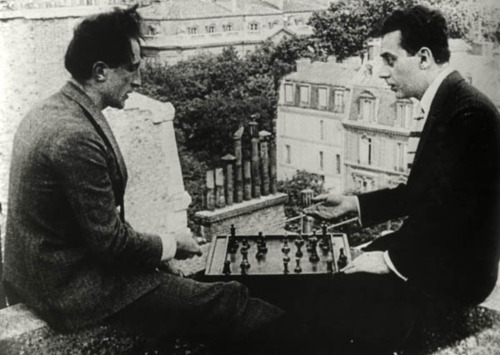
Marcel Duchamp and Man Ray play chess on a rooftop in Paris.

Duchamp again, this time on a rooftop in Paris, playing chess against Man Ray.

The photograph is later than 1915, when Duchamp moved to the U.S. to avoid World War I, and met Ray; it is probably after 1918.

The two even played chess in a movie:

Man Ray directed a number of influential avant-garde short films, known as Cinéma Pur, such as Le Retour à la Raison (2 mins, 1923); Emak-Bakia (16 mins, 1926); L’Étoile de Mer (15 mins, 1928); and Les Mystères du Château de Dé (20 mins, 1929). Man Ray also assisted Marcel Duchamp with his film Anemic Cinema (1926) and Fernand Léger with his film Ballet Mécanique (1924). Man Ray also appeared in René Clair‘s film Entr’acte (1924), in a brief scene playing chess with Duchamp.

The photo above is a still from that 1924 René Clair movie — it comes about 4:30 into the movie (the version shown here is half of the 20-minute movie, with a very modern, surrealist music score added; you can see the entire movie from Pathé, with a more contemporary score, here).

https://vimeo.com/488844088

Update, March 14, 2011:  See also this story from 2008 about Duchamp’s need to play chess, featuring of photo of Duchamp, Teeny Duchamp and the composer John Cage deeply engrossed in a game.  A good read about chess, and Duchamp.

Tip of the old scrub brush to ArtLex.com.


Dan Valentine – The Pink Cigarette Lighter, Part 1

July 9, 2010

By Dan Valentine

THE PINK CIGARETTE LIGHTER – Part One

My bestest friend, she loves the color pink. I’ve known her to order a Pink Lady merely for its soothing and appealing color. One year, for Halloween (or some other special occasion–I forget), she paid hard-earned cash for an expensive carbon-copy of the famous pink strapless gown that Marilyn Monroe wore in Gentlemen Prefer Blondes when singing Diamonds Are a Girl’s Best Friend.

When we bought a home together in southeast Texas, one of the first things we did was have the interior walls sponge-painted. One hot-pink wall for her, one sea-green wall for me, one hot-pink wall for her, one sunshine-yellow wall for me. Very nice, very stylish, very Mexican. Who’d a thought!

Pink cigarette lighter

Pink cigarette lighter, by Bic

Yes, indeedy, she sure loves the color pink! Which is all very fine and well and good. But one late night, many years ago, her color preference came close to costing me my life.

Upon lighting a cigarette on a street corner in Washington, D.C., with a pink lighter that I had absentmindedly lifted from her earlier in the evening, I was gay-bashed and left for dead. I’m lucky to be alive. But ain’t we all?

A recent conversation or three here at the Ensenada Backpacker Hostel brought that memorable night back.

But, first, let me begin by saying, I love a hostel! Extremely affordable and you meet the most interesting folks from all around the world. If I’d been aware of hostels in my youth and middle-age, I’d still be rich. Money-wise. I’ve spent many a dollar, franc, and pound staying in hotel rooms. Oh, the interesting people I could have met!

At the Austin Hostel, I met a young man who makes a living as a Lab Rat. Austin boasts many a medical research center and drug companies pay big bucks to those willing to act as guinea pigs, having themselves inoculated with some new experimental cure-all. Some are paid as much as $3,000 a swallow. And, odds-wise, it’s not a bad way to pay-off one’s credit-card debt. You’ve got a fifty-fifty chance of receiving a placebo.

On my first or second day in Ensenada, I met a semi-retired South Korean war correspondent. He was in Somalia during the Blackhawk-Down fiasco. He saved a naked woman’s life.

He was atop a building, camera rolling, a South Korean competitor–a female–by his side, both doing their jobs, reporting the events at hand, when a naked woman down below on the street appeared, running for her life, chased by dozens of young boys, throwing stones at her. He quickly hurried down the stairs, but all had disappeared. Shortly after, the woman reappeared. He covered her with his coat and escorted her to the roof, just before the young boys returned, searching high and low for her.

The woman had been seen riding in a Jeep beside a male French soldier, representing the United Nations. In that neck of the woods, a major no-no at the time, may still be. Shortly afterward, his South Korean female competitor was recalled and replaced by a male. The young boys? Some undoubtedly grew up to be pirates, commandeering a yacht or whatnot off the Somalian coast for ransom.

He was in Afghanistan when the U.S. first did whatever we did there after 9/11, and told me what he thought we (the U.S.) always tend to do wrong after succeeding on such occasions. We replace the defunct leaders with those raised and educated in Britain or in the U.S., those English-speaking, who have long ago lost touch with their own people and their needs. Few could argue with that.

He left the hostel to travel north. He was seriously thinking of crossing the border with illegals. Once a reporter, always a reporter.

He and I would never have met but for a hostel. He covered the UN for his country while I was in New York, but we ran in different circles, back then. I just hope he didn’t get shot by some crazy American with a gun in Arizona.

Another hostel guest I met here is a retired Bronx fireman. In the ’90s, he and others were called upon to extinguish fire after fire. Neighborhood gangs were setting apartment buildings ablaze, one after another, day in and day out, so as to quickly empty the premises, so they could burgle and run off with whatever valuables were left in sight before the fire trucks arrived.

He had many a story to tell. One afternoon, he was stopped in midtown Manhattan by a cop for walking his dog unleashed. My Bronx friend said he was a fireman. Cops and firemen, they’re a fraternity. They look after each other. The cop asked for picture-ID. At the time, firemen didn’t carry ID’s with pics. So, to make sure he was, indeed, a fireman, the cop drove the offender to his reputed fire station in the Bronx. They walked in, the fireman with the dog explained to his colleagues the circumstances, and they informed the cop, “We’ve seen him around the neighborhood, but God knows what he does.”

Funny. Every morning he cooked breakfast for them, that’s what he did, among other things, like fighting fires. He told his fellow firefighters that if they wanted fresh coffee in the morning–and that went for all the cops in the Bronx who were known to often drop by–they would vouch for him. They finally did.

Sometime afterward, he severely sliced a tendon on a little finger, opening up a can of ham while fixing breakfast. To this day, he can’t wiggle or move it. He went before a medical board of three and they told him that if he had the little pinkie amputated he could go back to work. Decisions, decisions. Firemen in New York are unionized and the union has clout. He’s been retired ever since.

A young man from the mainland of Mexico–I forget exactly where now–stayed for a couple of weeks here recently. What a nice person! The nicest fellow you’d ever want to meet. Always a smile on his face, when he wasn’t laughing. He was in town substituting for a teacher on summer break at a school down the avenida a ways.

Upon checking in at the desk, he introduced himself with a big jovial smile. An hour or so later, I ran into him coming out of an Oxxo (the south-of-the-border Seven-Eleven) with an even bigger smile on his face and a bottle of wine in hand. I watched him join a woman who was behind the wheel of an SUV. A ladies’ man, I thought. Two hours in town and he was with a beautiful senorita. During his short visit, I saw him with many a pretty woman, never a fella.

Each night he would mix and fill to the brim a stainless steel pot of Margaritas and place it in the freezer to chill. “Help yourself!” And I did.

Many a morning in the kitchen, he would say, “Tonight. Margaritas. Yes?”

Si, deed!

I could have sworn he said he was going to stay the summer, but something must have come up. After just a week or two he said he was returning home.

His last night he invited one and all here to a barbecue on the back veranda. Spicy Habernero chicken wings, grilled steaks, and oh yes! Margaritas.

Shortly after he left, Salsador, who works the afternoon/night reception desk, nonchalantly informed me that the substitute teacher was not only jovial but gay. You’re kidding, I said. “What makes you think he was gay?”

“It was obvious,” he said.

Not to me. But what do I know? “How so?”

“My girlfriends and I, we take him for drinks. He told them how to give a man a good–”

Sorry I asked.

“Next day they meet for coffee-time and more instruction, how to give a man a good–”

Please! I get the gist.

Who’d have thought! But, then again, so, so what? Who cares?

A great many, very scary people do.

Like the father of Melody I wrote about a few weeks ago–the brigadier general who thought I must be gay because I’ve never learned to drive. Heterosexuals drive!

Or, the kids in the car in Houston who saw me walking along the street and swerved over to scream out a rolled-down window, “Faggot!” and screeched down the road, tee-hee-ing to themselves. Heterosexuals drive!

A good number of citizens of the U.S. are scared to death of gays. I say citizens of the U.S., and not Americans, because down here folks south the border consider themselves Americans, too. And rightly so. Though, they are a little more laid-back and not as uptight as many of their north-of-the-border fellow Americans.

Folks in the U.S. are frightened of many things: Illegals (unless they’re blowing leaves off front lawns at a cut-rate price), fellow students (Texas is seriously contemplating passing a law to allow students to bring guns to the classroom to protect themselves from fellow students), Federal troops (many want to start independent militias to protect themselves in case of invasion from ourselves).

But gays are especially frightening to many. Their inclination may rub off.

Pink cigarette lighter, by Zippo

Pink cigarette lighter, by Zippo

When I was a kid in the ’50s, one of my favorite TV shows was the Cisco Kid, the Robin Hood of the West, based on an O. Henry short story about a carefree Mexican desperado. Before it was a TV show, it was a B movie series. One, starring Cesear Romero, was The Gay Caballero (1940.)

From the press book: “The Cisco Kid rides again quicker on the draw, more gay, and gallant than ever.” It ever-so-often runs on the Fox Movie Channel. In 1946, a remake was called The Gay Cavalier.

Warner Baxter won the 1929 Best Actor award for his portrayal of the Cisco Kid in the first talkie shot outdoors, called “In Old Arizona”–though, it filmed in Utah.

I mention this because gay caballero perfectly describes–to my chagrin; I hadn’t a clue–the hostel guest I knew briefly. Mexican, charming, happy-go-lucky, and gay.

No, gay-gay! He’s banned from the place now. That’s why he left earlier than expected. He tried to sneak a male lover into his dorm for the night. Not merely once but twice. I hadn’t a clue. My bestest friend thinks my middle name should be Clueless.

Business is slow here at the hostel of late (many up north think they’ll be mowed down by members of the drug cartel if they visit), so I have a dorm room all to myself with connecting bathroom. He had a dorm room to himself as well next to mine but without a bathroom, So, I would leave my door open at night, just a smidge. I’m a light sleeper. Even though I like to think of myself as a let-live-let-live guy, two male lovers going at it within groaning-and-gasping distance would have been very perturbing, to say the least.

I told the lovely morning/mid-afternoon receptionist here, the above tale.

She looked at me, bewildered. “You couldn’t tell?”

I shook my head. Hadn’t a clue.

First tri-mester, we’re all the same sex. Or, so I read once. At birth, ten percent are born different, as some like to describe it. Some say three or four percent. Others will tell you two. Many think it’s a life-style choice, being gay being so much fun.

I didn’t tell her that I had been gay-bashed in Washington, D.C., a few years back. Though, it’s the first thing that comes to mind whenever the subject arises. Two gay men found me passed-out on the sidewalk, badly bruised and bleeding.

“I think I’ll Google my mind and write a piece about all the gay people I’ve come in contact with throughout my life,” I told her.

She raised her hand. “You can add me to the list.”

I hadn’t a clue. She’s engaged to be married to a guy.

I love a hostel!

If you’re a writer, it’s like you’ve died and gone to heaven.

TO BE CONTINUED