Where did North Dakota go?

August 15, 2009

I think it was during the Los Angeles Olympics that I read a story about a guy in Albuquerque, New Mexico, who had called the toll-free number to purchase tickets to some Olympic events.  The seats were available and everything went fine, through the giving of the credit card number — until the woman asked him for his mailing address. [I’ll keep searching for that story . . .]

When he gave his mailing address in Albuquerque, New Mexico, the woman said, “I’m sorry, we can’t sell tickets outside the United States,” or words to that effect.

Despite the man’s pleas that New Mexico is part of the U.S., the woman refused to complete the sale.

Now, Google has lost North Dakota.

Photo below, from Art Hunt’s recent cross country driving extravaganza.

Art Hunt said:  The trip was not without its glitches, such as when we discovered we had apparently reached the end of the world

Art Hunt said: "The trip was not without its glitches, such as when we discovered we had apparently reached the end of the world"


48 years ago today, in Berlin

August 13, 2009

Soviet-bloc communism disabused us of a lot of ideas, including pointing out that when the amplification was turned up a lot, even Robert Frost could be wrong in the voice of his farmer and neighbor character, because high, concrete and concertina wire fences don’t make good neighbors.

A rock wall in Vermont, like the one Robert Frost wrote about -Wikimedia image

A rock wall in Vermont, like the one Robert Frost wrote about -Wikimedia image

Of course, even in demonstrating Frost in error, the communists made the opening clause of “Mending Fences” more poignant:  “Something there is that doesn’t love a wall . . .”

Residents of Berlin awoke on August 13, 1961, to discover that the Soviet-dominated East Germany had begun constructing a wall across Berlin, to keep East Berlin residents from escaping the clutches of communism and walking to freedom in West Berlin.

Go see other Bathtub posts on the topic:

And remember the poet’s telling, “Something there is that doesn’t love a wall.”

A wall Robert Frost would not love - Berlin Wall at Potsdamer Platz, November 1975, from West Berlin - Wikimedia photo

A wall Robert Frost would not love - Berlin Wall at Potsdamer Platz, November 1975, from West Berlin - Wikimedia photo


Free Bing! Ransom the kid home from Japan

August 13, 2009

Bing still has both his ears -- but look what they did to the ears of the kid in back of him.  Help bring Bing home!

Bing still has both his ears -- but look what they did to the ears of the kid in back of him. Help bring Bing home!

Bing Haubrich has made new friends in Japan, but they want to keep him there. In fact, they have threatened to hold him for ransom unless his American friends and family do two things:

1. Answer questions about Japan/Nippon culture and cuisine.

2. Donate money to help his mother pay the plane fare for his trip.

It’s tempting for a young man to stay in Japan, because so far he has found the food to be awesome and the shopping (even in vending machines) to be, let’s say, “unique.” In fact, the Japanese students think that if he stays long enough he could use his ninja powers to be Emperor someday. I don’t think that this would be a good thing for world peace, as Bing has not worked out his “Megalomania” issues and

So, here is one of the questions that they want you to answer:

15. In World War I, the Japanese:

a. Joined the Axis.
b. Joined the Allies.
c. Maintained a strict neutrality.
d. Considered it a European War.

Do you know the answer?  Quick!  Get over to Tangled Up In Blue Guy, and help bring Bing back!

(Hey, head over there if you don’t know the answer. Maybe you’ll learn something — I did!)


Bad guys of Baltimore

August 12, 2009

Or, “How a little study of history can make your visit to a city so much more entertaining and fun.”  At Clio Bluestocking Tales.

Why do visitors leave pennies at this gravesite?  Read the story at Clio Bluestocking Tales

Why do visitors leave pennies at this gravesite? Read the story at Clio Bluestocking Tales

For five weeks, I walked around the streets of Baltimore, or at least the distance between a certain major university known for its doctors, the Inner Harbor, and Fells Point — especially Fells Point — with some diversions elsewhere. As I walked, I began to notice landmarks of some very bad guys who have graced the streets of this interesting city.

Fans of “The Wire” will especially want to read it.  Did you catch the reason Clio is in Baltimore, for the full effect?

It’s not that history tells you how to live your life, or save it; it can make your life worth the living and saving.


India today, in photos

August 3, 2009

Geography teachers, get out your PowerPoints and Keynotes.

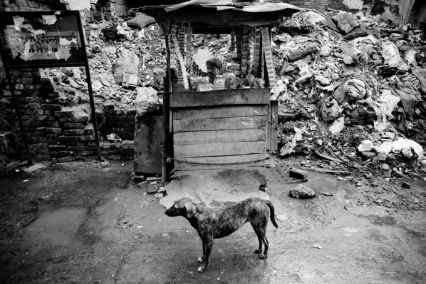
Photo of life in Delhi, India.  From a collection by Belgian photographer Frederik Buyckx, 2009

Photo of life in Delhi, India. From a collection by Belgian photographer Frederik Buyckx, 2009

Thought provoking, occasionally breath-taking photos from a 6:00 a.m. walkaround in Delhi, India; Belgian photographer Frederick Buyckx promises more photos from his recent trip to India and Pakistan, at his blog.

Please share:

Add to FacebookAdd to NewsvineAdd to DiggAdd to Del.icio.usAdd to StumbleuponAdd to RedditAdd to BlinklistAdd to TwitterAdd to TechnoratiAdd to Furl


2009 Poets Forum – October 15 – 17, in New York City

August 3, 2009

This sounds like fun, actually.  I wonder if they offer Continuing Education Units?

Shouldn’t schools make sure all English teachers get to make this pilgrimage at least once every four years?  Principals, are you listening?

Poets Forum Update:
New Events and More Participants Announced for 2009
Discounted passes available for a limited time at poets.org/poetsforum

Participants include Frank Bidart, Rita Dove, Lyn Hejinian,Edward Hirsch, Haryette Mullen, Sharon Olds, Ron Padgett, Carl Phillips, Robert Pinsky, Kay Ryan, Gerald Stern, Susan Stewart, Jean Valentine, Ellen Bryant Voigt, and many more.

The Academy of American Poets invites you to join us in New York City for the annual Poets Forum, a series of events exploring the landscape of contemporary poetry in America.

This year’s Poets Forum includes new talks and discussions with an array of distinguished poets, readings, publication parties, and an expanded selection of literary walking tours, led by poets, through Manhattan and Brooklyn.

“In only three years, the Poets Forum has become the poetry event of the fall, as poets (and fans of poetry) of all aesthetics celebrate and learn about what they all have in a common: a desire to give life itself a shape through language.”
– Carl Phillips

Poets Forum Reading
Thursday, October 15
7 p.m.
Join us for an unforgettable evening as some of the most acclaimed poets of our day come together on one stage to read from their latest work. Featured readers include Frank Bidart, Rita Dove, Lyn Hejinian, Edward Hirsch, Sharon Olds, Ron Padgett, Carl Phillips, Robert Pinsky, Kay Ryan, Gerald Stern, Susan Stewart, and Ellen Bryant Voigt.
The Times Center
242 West 41st Street

Poetry Walking Tours
Friday, October 16
10:30 a.m. & 2 p.m.
Take a trip down the same streets traversed by Walt Whitman, Marianne Moore, E. E. Cummings, Langston Hughes, George Oppen, and countless other poets. Walking tours will explore the literary history of Brooklyn, Harlem, the Museum of Modern Art, the West Village, and SoHo. Tour guides include poets Anselm Berrigan, Jordan Davis, Bob Holman, Katy Lederer, Greg Pardlo, Tom Thompson, and Mónica de la Torre.
Meeting locations throughout New York City.
TOURS ARE RESERVED FOR ALL-EVENTS PASS HOLDERS ONLY

NEW: Poets & Place Talk
Friday, October 16
2 p.m.
“Show Me Your Environment, and I Will Tell You Who You Are”:  Place, Pathos, and the Problems of Identity
David Baker discusses the relationship between poets and their environment.
Philoctetes Center
247 East 82nd Street
Co-sponsored by the Philoctetes Center
RESERVED FOR ALL-EVENTS PASS HOLDERS ONLY

Poets Awards Ceremony Friday, October 15 7 p.m. Celebrate contemporary poetry and recipients of the premier collection of awards for poetry in the United States. The night will include readings and presentations by Linda Gregg, Jennifer K. Sweeney, J. Michael Martinez, Harryette Mullen, James Richardson, Avi Sharon, Jean Valentine, and many others. A reception will follow.
Tishman Auditorium
The New School
66 West 12th Street
Co-sponsored by the New School Creative Writing Program

Poets Forum Discussions Saturday, October 17 10 a.m. – 4 p.m. 6 Sessions Examine the issues central to contemporary poetry as we present a day of engaging and intimate conversations with some of the most renowned poets of our time, including Frank Bidart, Rita Dove, Lyn Hejinian, Edward Hirsch, Harryette Mullen, Sharon Olds, Ron Padgett, Carl Phillips, Robert Pinsky, Kay Ryan, Gerald Stern, Susan Stewart, Jean Valentine, Ellen Bryant Voigt and other special guests.
Tishman Auditorium
The New School
66 West 12th Street
Co-sponsored by The New School Creative Writing Program

“This public forum on American Poetry is the first of its kind for our brave, wild world of poesy. We will leave no stone unturned to address all the voices and all the thoughts that beset, overwhelm, confuse, delight, and alarm us.”
– Gerald Stern

American Poet Publication Party
Saturday, October 17
7 p.m.
Reading and reception for the new fall issue of American Poet, the journal of the Academy of American Poets. Noelle Kocot, Robert Polito, and Brian Teare will read from their work. Ico Art and Music Gallery
606 West 26th Street (at 11th Avenue)
Co-sponsored by the Ico Gallery

Ticket Information
All-Events Pass: $85 before Sept 15 / $110 after
Saturday-Only Tickets: $60
Students (with current ID): Student rates are available by by phone.
Contact: Jennifer Kronovet, (212) 274-0343, ext.10.

Purchase tickets online at poets.org/poetsforum or by phone,(212) 274-0343, ext.10.

All times are subject to change. Contact Jennifer Kronovet at jkronovet@poets.org with further questions.
Academy of American Poets
584 Broadway, Suite 604
New York, NY 10012

212-274-0343


Blue jay, purple pepper

July 23, 2009

We’ve been bumping around 100° F for about a month now.  It’s Texas.  It’s hot.

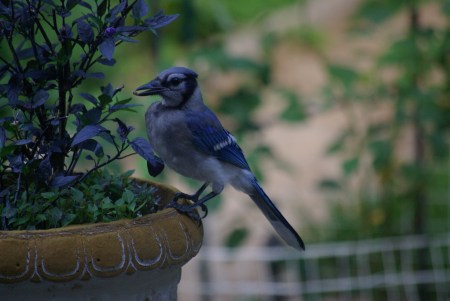
Sometimes the blue jays do all they can to stay out of the sun — like this guy, who was bent on getting some of Kathryn’s weird purple peppers.

Blue jay working to get a purple pepper

Blue jay working to get a purple pepper

Considering these shots were done in the shade, with just a 200 mm zoom, through a foggy window, they came out pretty well.

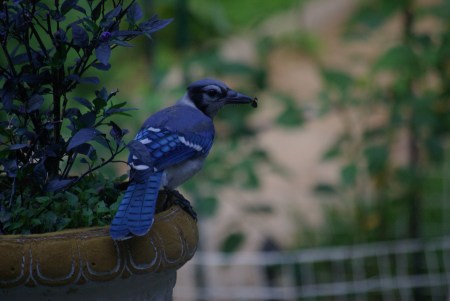
Blue Jay wrestles the pepper from the plant

Blue Jay wrestles the pepper, or something, from the plant.

The peppers eventually grow to be the size of a Bing cherry — too big for the jays, then.  They go after these peppers before they mature, and after they dry.

With her prize, the blue jay heads for its dining area in the live oak.

With her prize, the blue jay heads for its dining area in the live oak.

Mary K left us with her old bird feeder when she moved.  This year we’ve kept feeders in both the front and back yards.  Blue jays appear to have recovered from their West Nile devastation three years ago — we had one family nesting in the live oak earlier, in the spring — and Kathryn learned that the jays like peanuts still in the shell.

It’s been a good year for watching birds in our yard.  Still haven’t captured that little green hummer in a camera, though.


News flash: Texas has a second natural lake!

July 20, 2009

Years ago, in Virginia, I had learned that Virginia had only one natural lake, the Great Dismal Swamp.  Accompanying that chunk of information in that lecture was that Texas had only two natural lakes.

But upon arriving in Texas, I could find reference to only one natural lake, Caddo, and it had ceased being fully natural when its maintenance fell to a dam.

What happened to Texas’s second natural lake?

A Google search right now on “Texas +’natural lake'” produces ten listings on the first page, all of them pointing to the fact that Texas has just one natural lake.  Here are the first five:

I have found a second natural lake in Texas. It’s not a new discovery at all — it’s just a case of people not having the facts, and overlooking how to find the truth.  It’s especially difficult when the lake hides itself.

Our testing coordinator at Molina High School, Brad Wachsmann, spins yarns that belie his youth.  In the middle of one yarn last year, corroborated by other yarns, he mentioned that he has family in Big Lake, Texas; and he described visiting and having relatives urge people to run out and see the lake since it’s rebirth in torrential rains.

“A second natural lake in Texas?” I asked.  Wachsmann knew the drill.  Yes, Big Lake is a natural lake in Texas, and yes, people forget about it.

Texas teachers, listen to your testing coordinators, okay?

All of this came to mind reading the Austin American-Statesman, still a bastion of great journalism despite problems in the newspaper industry.  On Monday, July 7, the paper ran a story and an editorial about the clean up of the oil industry refuse that killed the shoreline of part of the lake; the springs that once fed the lake have mostly gone dry, but that’s likely due to agricultural water mining.

It’s a story of boom and bust, environmental degradation for profit, and eventual recovery we hope.

Looking at the landscape that surrounds the Reagan County seat, you wonder whether the name Big Lake was somebody’s idea of joke. It’s dry and dusty, where the flora sprouts reluctantly and lives precariously.

Yet, the West Texas town of Big Lake got its name from a natural lake that was fed by springs that have long since gone dry. While the area may not fit everyone’s definition of photogenic, it has its own brand of charm – charm that could be enhanced if the damage done to the fragile ecosystem by salt spills were reversed or even minimized.

As the American-Statesman’s Ralph K.M. Haurwitz reported in Monday’s editions, the University of Texas and Texas A&M systems have benefited from the $4.4 billion in royalty payments and mineral income produced by its West Texas acreage since Santa Rita No. 1 well came in on May 28, 1923.

The salt water byproduct of oil and natural gas production, however, contaminated 11 square miles near Big Lake, killing most everything that grows. The lack of vegetation allows wind and water erosion.

Hey, it gets better.  This is real Texas history, real American history — you can’t make this stuff up.  Haurwitz’s article talks about the heritage of Texas education.   Remember that old story about setting aside certain sections of townships to help fund education in lands on the American frontier?  Texas wasn’t a public lands state as farther west, but it still reserved sections of land for the benefit of education.

Rose petals blessed by a priest?  I’ll wager the priest didn’t make the trip to the top of the derrick.  Haurwitz wrote:

BIG LAKE — Investors appealed to the patron saint of impossible causes when oil drilling began on University of Texas System land in 1921. It didn’t hurt.

Santa Rita No. 1 blew in on May 28, 1923, after rose petals blessed by a priest were scattered from the top of the derrick at the behest of some Catholic women in New York who had purchased shares in the Texon Oil and Land Co., which drilled that first well.

Since then, the UT System’s 2.1 million acres in West Texas have produced $4.4 billion in royalty payments and other mineral income for the Permanent University Fund, an endowment that supports the UT and Texas A&M University systems.

But this long-running bonanza for higher education exacted a price from the remote, semiarid landscape where it all began. Millions of barrels of salt water, a byproduct of oil and natural gas production, contaminated 11 square miles, or more than 7,000 acres, killing virtually all vegetation and leaving the land vulnerable to wind and water erosion. Hundreds of mesquite stumps with three feet of exposed roots testify to the dramatic loss of topsoil.

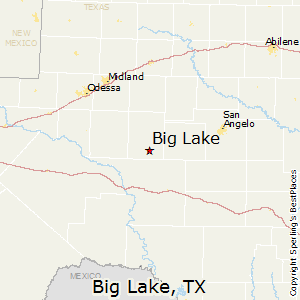
Texas, and Big Lake - from BigLakeTx.com

Where in Texas is Big Lake?

The town of Big Lake is just north of the lake itself, on State Highway 137 running north and south, and U.S. Highway 67 running east and west, approximately 65 miles west of San Angelo.   Big Lake sits about 10 miles north of Interstate 10, and about 75 miles south of Interstate 20.  Big Lake calls itself “the gateway to the Permian Basin.”

Big Lake is the home of Reagan County High School.  Jim Morris was baseball coach for the Reagan High Owls when his team persuaded him to try out for a major league baseball team.  His story was chronicled, with some artistic license, in the Disney movie “Rookie.”

Land managers are working to stop erosion on the often-dry shores of Big Lake using any trick they can find.  One trick:  Plant salt grass.

Salt grass?  Along Texas’s Gulf Coast, there are a few species of grass that, while not halophytes, are at least salt tolerant.  Salt grass.  This grass made it profitable to graze cattle on what would otherwise have been unproductive land in the Texas cattle boom.  This role in Texas history is memorialized in the Salt Grass Steakhouse chain, now found in five states.

And if planting salt grass works to control erosion, it will help clean up a large part of Texas other natural lake, Big Lake.

Big Lake’s being wet or dry is a whim of local climate.  You could say that half of all of Texas’s natural lakes are now dry as a result of continued warming; you could say that two good gully-washers or toad-stranglers could restore water to half of Texas’s natural lakes.

Big Lake Playa, from NightOwl Bakery and Roastery in Big Lake, Texas

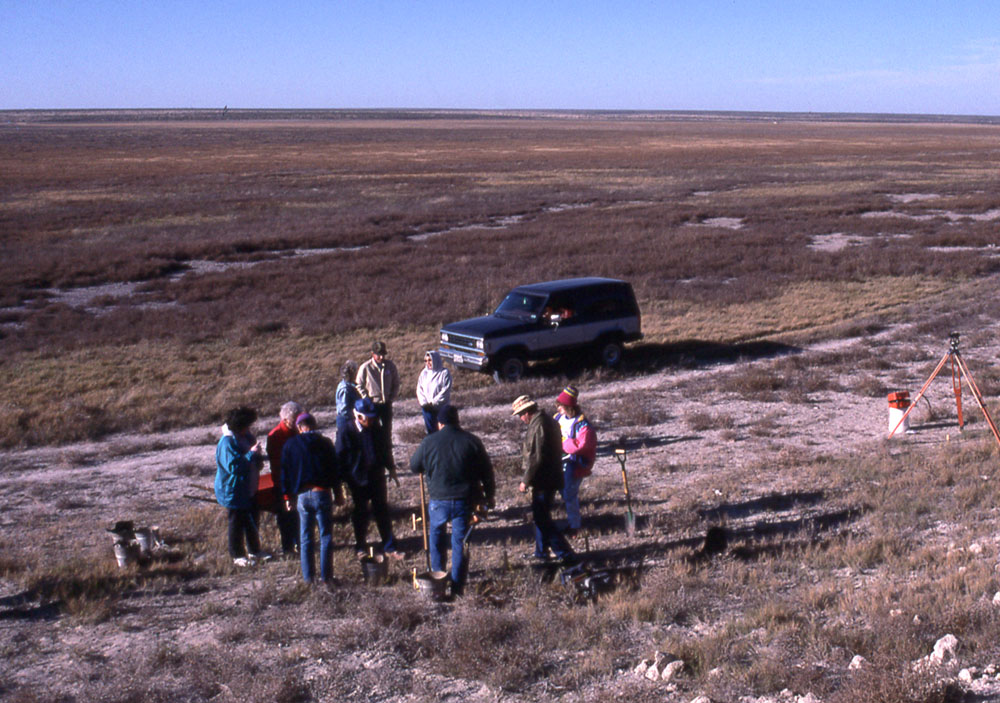
Field crew meeting at the outset of the 1992 excavations at the Big Lake Bison Kill site. The dry bed of Big Lake stretches for miles in the background. Big Lake is an intermittent saline lake or playa, an uncommon landform on the Edwards Plateau. Photo by Larry Riemenschneider, Concho Valley Archeological Society.

More details about Big Lake and prehistory, below the fold.

Read the rest of this entry »


Fireworks in Washington, D.C.

July 6, 2009

President Barack Obama and First Lady Michelle Obama watch the fireworks over the National Mall from the White House on July 4, 2009. (Official White House photo by Pete Souza)

President Barack Obama and First Lady Michelle Obama watch the fireworks over the National Mall from the White House on July 4, 2009. (Official White House photo by Pete Souza) (White House caption)

July 4 in Washington was always a lot of fun, and I always found myself without the right film or the right lens, or knowledge about how to make the exposure work.  Several times I tried to get good shots of the fireworks from the Capitol lawn — no success.  Once we walked the Mall and sat under the fireworks going off, near the Lincoln Memorial (Kathryn won’t let me forget that one).  Bad angle for photos, and for viewing.  Once I tried from the Virginia side of the Potomac.  Not a single good shot.

One of the great joys of electronic photography is getting more of these kinds of shots.

Still, this photograph shows great skill on Souza’s part — lens selection, exposure, and composition come together just right.

Some restrictions apply to use of this photograph.  See notes here.


A rainbow fell on Brooklyn

June 30, 2009

Stars on Alabama, a rainbow fell on Brooklyn — somebody ought to write a song about it.

Rainbow over Brooklyn, June 29, 2009 - photo by JOKelly

Rainbow over Brooklyn, June 29, 2009 - photo by JOKelly

Photo by JimmyOKelly.  Go see the stuff Kelly has posted at FLICKR, before he gets famous.  Poetry in photography.  Nice collection of others’ shots, too.


Grand Canyon airplane disaster, June 30, 1956

June 30, 2009

This is completely an encore post from a year ago today; still thinking about those airplanes and the Grand Canyon.

[2008] Today’s the 52nd [53rd] anniversary of a horrendous accident in the air over the Grand Canyon. Two airliners collided, and 128 people died.

In 1956 there was no national radar system. When commercial flights left airports, often the only contact they had with any form of air traffic control was when the pilots radioed in for weather information, or for landing instructions. Especially there was no system to avoid collisions. As this 2006 story in the Deseret News (Salt Lake City) relates, the modern air traffic control system was spurred mightily by this tragedy.

About 9 a.m. Saturday, June 30, [1956], the TWA flight bound for Kansas City, Mo., and the United flight bound for Chicago left Los Angeles International Airport within three minutes of each other. The TWA flight, carrying 70 people, filed a flight plan to cruise at 19,000 feet. The United flight, with 58 people on board, planned to cruise at 21,000 feet.

About 20 minutes into the flight, TWA pilot Capt. Jack Gandy requested permission to climb to 21,000 feet. An air traffic controller in Salt Lake City turned down Gandy’s request. Then Gandy asked to fly “1,000 on top,” meaning at least a thousand feet above the clouds, which that morning were billowing as high as 30,000 feet. That request was granted.

By the time both planes were over the Grand Canyon, the pilots were flying in and out of the clouds, on visual flight rules and off their prescribed flight plans, apparently typical in those days as pilots veered off course to play tour guide.

No one knows exactly what happened.

It was the last big accident before instigation of the “black box,” so investigators had to piece together details from debris on the ground.

They decided that the left wing and propeller of the United plane hit the center fin of the TWA’s tail and cut through the fuselage, sending Flight 2 nose-first into the canyon, two miles south of the juncture of the Colorado and Little Colorado rivers. The United DC- 7, which had lost most of its left wing, began spiraling down. Capt. Robert Shirley radioed Salt Lake City a garbled message that controllers understood only after they slowed down the recording: “Salt Lake, ah, 718 . . . we are going in.” Flight 718 smashed into a cliff on Chuar Butte.

The accident plays a key role in a Tony Hillerman mystery, Skeleton Man — Hillerman writes about two Navajo Nation policemen.

I’m thinking of the crash today for two reasons. I’m off for a tour of canyons, including both rims of the Grand Canyon, in the next two weeks. The last time I was there was 1986, with the President’s Commission on Americans Outdoors. We flew in on a Twin Otter, coming up from Phoenix, over the Roosevelt Dam, up over the Mogollon Rim, over the Glen Canyon Recreation area and stopping it Page. From Page to Grand Canyon, we took full advantage of the huge windows in the Otter — seeing first hand the sights that the controversial tourist flights were designed to reveal. Safety was a key concern, and we talked about it constantly with the pilots.

A few weeks later, on June 18, 1986, that DeHavilland Twin Otter collided with a Bell Jet Ranger helicopter over the Canyon. 25 people died in that crash.

I have flown over the Canyon a dozen times since then — no longer will airliners dip down to give passengers a better view, not least because airliners cruise tens of thousands of feet higher now than they did then. I think of those airplane accidents every time I see the Canyon.

We’re driving in. We’ll spend a day and a half on the South Rim, and another couple of nights on the North Rim. We’re taking our time on the ground. But if we had time, and we could afford it, I’d love to get up in an airplane or helicopter to see the Canyon from the air again.

Updates, 2009:


Typewriter of the moment: Alistair Cooke for the BBC

June 19, 2009

Alistair Cookes typewriter, displayed at BBC headquarters, Bush House, in London - Photo by Jeff Zycinski

Alistair Cooke's typewriter, displayed at BBC headquarters, Bush House, in London - Photo by Jeff Zycinski

Alas, our students now are too young to remember Alistair Cooke’s hosting of “Masterpiece Theater” on PBS, and of course, back then the BBC America service — if it existed — was available only to shortwave fanatics or people  who traveled a lot to the British Isles.

Perhaps more than anyone else other than Winston Churchill, and maybe the Beatles, Alistair Cooke tied England and America together tightly in the 20th century.  BBC’s other writers are good to brilliant, but even their obituary for Cooke (March 30, 2004) doesn’t quite do him justice:

For more than half a century, Alistair Cooke’s weekly broadcasts of Letter from America for BBC radio monitored the pulse of life in the United States and relayed its strengths and weaknesses to 50 countries.

His retirement from the show earlier this month after 58 years, due to ill health, brought a flood of tributes for his huge contributing to broadcasting.

Perhaps for Cooke, from Cooke’s broadcasts, we could develop a new variation of the Advanced Placement document-based question:  Broadcast-based questions. Heaven knows his Letter From America provided profound material on American history:

BBCs famous broadcaster Alistair Cooke, painted by June Mendoza (copyright Mendoza - www.junemendoza.co.uk)

BBC's famous broadcaster Alistair Cooke, painted by June Mendoza (copyright Mendoza - http://www.junemendoza.co.uk)


Snow photos

December 13, 2008

Forecast is 70 degrees in Dallas on Sunday.

Meanwhile, Catherine Sherman has some photos of snow near Kansas City.  Nice stuff. (I don’t have her permission to copy the photo here — go see her blog.)

I particularly like her photo of the river birch tree.  It appeals to the botanist that still survives within me, plus it gives me hope about the proliferation of electronic cameras and the mass recording of things of interest to science.

Sherman writes that Kansas is the only state which has no native pines.  Is that accurate?  Does that count include Hawaii?  (What are the native pines of Hawaii?)

In short, it’s really cool.


World class chess in Dallas, November 30

November 30, 2008

Looking for something to do in Dallas today?

Go see some international, championship chess sponsored by the University of Texas – Dallas’s world-beating chess team.  The UT-Dallas Grand Master Invitational Tournament has round 9 scheduled to begin at 11:00 a.m., at the Hilton Garden Inn in Richardson, Texas. These are top-level matches (practice rounds for UT-D’s chess team sometimes affect international rankings), so play should continue for quite a while after the start.

Through the MonRoi site, you can watch the chess matches of the Dallas Tournament live — or at least, animations of the boards showing the moves.  You have to register, but it’s free.

Below the fold, the complete press release with all details, from UT-Dallas.

Read the rest of this entry »


Cultural geography mystery – What city is this?

November 12, 2008

I know the city, and I think there are barely enough clues here to figure this one out.  Let me say it is not Los Angeles, though the clues may have led one to figure that out.  I wonder if you can figure this out, or if maybe there are several places that fill this particular bill.

A friend notes in a recent e-mail:

Nothing quite like going into the nearest Vons (right across from the street from campus), hearing French spoken by two guys exiting the store, standing behind two German speakers, East German accent in line to be checked out by a clerk whose first language is Chinese, and hearing two guys rattling away in Russian in the next checkout line.  Oh–and this is after having lunch at the Vietnamese Pho/Banh joint in the same strip mall.
Do you know the city?  Or, do you know another city that fits this bill?
Tell us in comments.
________________
Answer is now in comments.