July 24 – Arrival Day: Journey’s not over until you get there; we are not there yet

July 24, 2015

There’s a lot of encore material here — I think about this in the middle of the summer, and July 24 is a good day to commemorate arrivals: It’s Arrival Day. It’s Touchdown Day.

July 24 – almost the end of the month, but not quite.

  • July 24, 1847: A larger contingent of Mormons, refugees from a literal religious war in Illinois and Missouri, entered into the Salt Lake Valley under the leadership of Brigham Young, who famously said from his wagon sick-bed, “This is the place; drive on!”

In Utah, July 24 is a state holiday, to celebrate the date in 1847 that the Mormon refugees arrived in Salt Lake Valley and began to set up their agriculture and schools.  In Salt Lake City, bands from across the state and floats from many entities form the Days of ’47 Parade.  When I marched with the Pleasant Grove High School Viking Band, the route was  5 miles.  We had only one band uniform, for winter — I lost nearly 10 pounds carrying a Sousaphone.

When the Mormons got to Salt Lake, after a couple of months’ trekking across the plains (then known as “The Great American Desert,” the Great Basin and the Mojave being little known), and after being on the run for well over a year, they got right down to priorities.  Summer was nearly gone, and crops had to be planted quick.  Within a couple of weeks, the Mormons dammed local streams to create irrigation systems to grow what they could before fall (this is, popularly, the first major crop irrigation set up in America); they’d started to lay out plans for settlements, with straight streets based on Cartesian-plane grids:  The first serious community planning?  And they began construction of schools, knowing education to be one of the most important attributes in the foundation of free societies, a position Mormons have reneged on recently in Utah.  Water, communities, schools.

Heck, that’s a good campaign platform today. It’s with sadness I note few people run on such a platform, instead begging voters to be afraid of others who are different in some fashion. Fear quenches no thirst, makes no place for families, nor educates any curious child. Utah’s Mormon pioneers were on the right track. We’ve run out of the ruts, and we are not there yet.

Utahns will be flying their U.S. flags today.  (Remember, President Obama proclaimed this a period of mourning, through July 25; flags should fly half-staff where possible.)

Maybe spending a few weeks struggling across a prairie and risking your life focuses you on the important stuff.  How would it improve America if we put more people on a bus to Omaha, put them out there, and said, “Hike to Salt Lake City from here.”

They’d focus.  Can we start with Paul Ryan, John Boehner and Mitch McConnell? Ted Cruz couldn’t make the journey. Donald Trump would die of sunburn. Wisconsin Gov. Ahab Walker would find no one to swindle, and talking down teachers and community builders wouldn’t be popular among fellow trekkers.

Ah, the good old days!

July 24 features a number 0f other arrivals, too.

From various “Today in History” features, AP, New York Times, and others, not in chronological order:

Buzz Aldrin walks on the moon, July 20, 1969

Buzz Aldrin walks on the moon, July 20, 1969 (Photo credit: Wikipedia)

  • July 24, 1969: Apollo 11 returned to the Earth, and splashed down in the Pacific Ocean, Michael Collins, Buzz Aldrin and Neil Armstrong — Aldrin and Armstrong having landed on the Moon.  In our celebrations of Apollo 11, and in our remembrances of President Kennedy, we may forget, though young kids rarely miss it, that Kennedy didn’t just say ‘Let’s put a guy on the Moon by 1970.’  Getting back safely was a key part of the challenge.

    First, I believe that this nation should commit itself to achieving the goal, before this decade is out, of landing a man on the moon and returning him safely to the earth. No single space project in this period will be more impressive to mankind, or more important for the long-range exploration of space; and none will be so difficult or expensive to accomplish.

    On July 24, 1969, the crew of Apollo 11 returned, safely.

Mormon Tabernacle Choir, and organ

Would there be a Mormon Tabernacle Choir, and organ, had the Mormons settled somewhere other than Utah? Wikipedia photo

  • July 24, 1866: Tennessee became the first of the Confederate States, the former “state in rebellion,” to be readmitted fully to the Union, following the end of the American Civil War. (Does Tennessee celebrate this anniversary in any way?)
  • July 24, 1911:  On July 24, 1911, American archeologist Hiram Bingham arrived at Machu Picchu in Peru.  We still don’t know all the reaons the Incas built that city on the top of very high mountains.  Cell service was not a factor.
  • July 24, 2005: Lance Armstrong won his seventh consecutive Tour de France bicycle race. Little did we know then, the journey wasn’t over. (Lance Armstrong is no relation to Neil Armstrong.  Did I need to point that out?)
English: Cropped image of Richard Nixon and Ni...

Nixon advance man William Safire claimed later than he’d set up the famous “debate” between Eisenhower’s Vice President Richard Nixon and Soviet Communist Party Premier Nikita Khrushchev, at the American National Exhibition in Moscow, 1959. Nixon argued that the technology on display made better the lives of average Americans, not just the wealthiest. (Photo credit: Wikipedia)

  • July 24, 1959: Visiting Moscow, USSR, to support an exhibit of U.S. technology and know-how, Vice President Richard Nixon engaged Soviet Communist Party Secretary and Premier Nikita Khrushchev in a volley of points about which nation was doing better, at a display of the “typical” American kitchen, featuring an electric stove, a refrigerator, and a dishwasher.  Khrushchev said the Soviet Union produced similar products; Nixon barbed  back that even Communist Party leaders didn’t have such things in their homes, typically, but such appliances were within the reach of every American family.  It was the “Kitchen Debate.”Try explaining this to high school U.S. history students.  The textbooks tend to avoid this story, because it stops the class.  That’s a sign it should be used more, I think.  Does the Common Core even touch it?Nixon’s arrival as a major political force in the Cold War grew clear from this event.  The pragmatic stakes of the Cold War were drawn in stark contrast, too.  It’s interesting to ponder that microwave ovens were not part of the exhibit.

Cover of Time Magazine, July 22, 1974, explaining the showdown between President Richard Nixon and the Special Prosecutor, playing out in the U.S. Supreme Court. Image copyright by Time Magazine.

  • July 24, 1974: In U.S. vs. Nixon, The U.S. Supreme Court ruled unanimously that President Richard Nixon had to turn over previously-secret recordings made of conversations in the White House between Nixon and his aides, to the special prosecutor appointed to investigate the Watergate affair and cover-up.  Nixon would resign the presidency within two weeks, the only president to leave office by resignation.
  • July 24, 1975: An Apollo spacecraft splashed down after a mission that included the first link-up of American and Soviet spacecraft.  (The Apollo mission was not officially numbered, but is sometimes called “Apollo 18″ — after Apollo 17, the last trip to the Moon.)

More:

Salt Lake City, Utah, L. Hollard, photographer, 1912. Taking the Long View: Panoramic Photographs, 1851-1991

Library of Congress image caption: Mormon Temple Grounds, Salt Lake City, Utah, L. Hollard, photographer, 1912. Taking the Long View: Panoramic Photographs, 1851-1991 [The building on the far right? That’s the old Hotel Utah, where Kathryn and I had a great wedding reception with plenty of champagne considering our many Mormon family and friends — some of whom may have sampled a little to see what they usually missed. It was such a great reception that the owners of the hotel, the LDS Church, stopped holding wedding receptions there and shortly closed it as a hotel; now it’s an office building with a fantastic lobby that makes any sensible person wistful for what used to be.]

Hoping not to arrive painfully on touchdown:
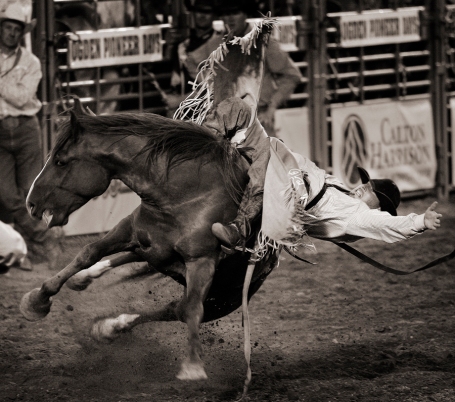
Ogden, Utah, Pioneer Days Rodeo Friday, July 19, 2013.  Photo by Brian Nicholson

Bareback rider Jerad Schlegel of Burns, Colorado, clings to his horse as it falls to the dirt during a re-ride at the Ogden Pioneer Days Rodeo Friday, July 19, 2013. Photo by Brian Nicholson (go see his blog)

Yes, this is mostly an encore post. Fighting ignorance requires patience.

Yes, this is mostly an encore post. Fighting ignorance requires patience.


Remember the day Utah flew the flag backwards, to honor the Union?

January 4, 2015

In 2013, Holly Munson at the Constitution Center wrote up a piece about Utah’s perhaps odd path to statehood, certainly complementary to my reminder that you could fly your flags on January 4, to honor Utah’s statehood, under the U.S. Flag Code.  Munson’s piece was distributed on Yahoo! News.

Yes, this is mostly an encore post. Fighting ignorance requires patience.

Yes, this is mostly an encore post. Fighting ignorance requires patience.  Remembering history takes constant reminders.

Her report is very solid, even though brief, and interesting.  Utah history is nothing if not a convoluted path to statehood through what amounted to a civil war, the Mexican War, the discovery of gold in California, the transcontinental railroads, mining and immigration, Indian wars, old west shootouts, rampant environmental destruction with sheep grazing and mineral extraction and smelting, union strife, astonishing agricultural applications, and a lot of books written from tens of thousands of Mormon pioneer journals — Mormonism appears to be impossible without ink and paper and time to write.

Go read her story.

What caught my eye was the George W. Reed photograph of the Salt Lake City Temple of the Church of Jesus Christ of Latter-day Saints — the LDS, or Mormon church.  The Temple and the Tabernacle, also in the photo, both have their own unique architectural histories, and quirks that make them noteworthy purely from architecture.  (This George W. Reed should not be confused with the Civil War Medal of Honor winner, George W. Reed)

Reed was an early photographer for newspapers in Salt Lake City, and he took some wonderful photos for posterity.  He was also a founder of the leading non-Mormon paper in the state, The Salt Lake Tribune.  At points in its history, it’s been known as an anti-Mormon paper.  The University of Utah’s library holds about five dozen of his photos in their collection, indexed electronically if not quite available yet; there Reed is described:

A pioneer in the development of Utah newspapers, George Reed was originally employed by the Deseret News and in 1871 helped in establishing the Salt Lake Tribune. His photographs include nineteenth century views of Salt Lake City, individuals at Reed’s Avenue home, Wasatch Resort in Little Cottonwood Canyon, and a photograph of the American flag hung on the Salt Lake Temple in 1896 to commemorate Utah’s statehood.

In the collection of Utah State University, in Logan, Reed has yet more papers.  There we get a bit more of his history:

A pioneer in Utah journalism, George W. Reed was born in London, England, on April 7, 1833. He emigrated to Utah in 1862 and became manager of the Deseret News, a position he held until 1871 when he founded the Salt Lake Tribune. In 1882, after a decade at the Tribune, Reed sold his interest in the paper to P. H. Lannan. He married Elizabeth Tuddenham in 1866 and passed away December 1, 1909.

U.S. flag on the Mormon Temple, at Utah statehood in 1896

The Mormon Temple in Salt Lake City, Utah, draped with a U.S. flag in 1896, commemorating the completion of Utah’s statehood campaign when President Grover Cleveland declared Utah a member of the Union. Photo by George W. Reed; Reed worked for the Deseret News, and helped found the Salt Lake Tribune. I do not know whether this photo was published in either paper.  From the George W. Reed Collection, University of Utah Libraries.

Yes, you’re right!  That flag is backwards.  Well, it’s backwards according to the modern U.S. Flag Code, which specifies that when hung from a building, the flag’s union should always be in the viewer’s upper left corner (“northwest” corner were it a standard map).  In the photograph, the union is in the opposite corner.  No, we know the photo is not reversed, because it accurately portrays the location of the Tabernacle, to the west and slightly south of the Temple.

(From what platform did Reed get that photo?  I’ll have to check to be sure it was there in 1896, but I’m thinking he shot from the Salt Lake County Building; it’s a distance, though.  A photographic historical mystery!)

But we hear the protests:  The U.S. Flag Code did not exist in 1896!  How can that be a violation of a code that did not exist?

That’s right, too.

That is an indication that the traditions of flag display that some people get riled up about, that many people think we should amend the Constitution to protect, are new inventions more than old traditions.  Flag code violations are legion by well-meaning citizens celebrating the flag and patriotism, and rare by anyone with any malignant motives.

After a 49-year fight for statehood, through wars with the U.S., fighting with the U.S. forces in Mexico, the administrations of several presidents and 25 different U.S. Congresses, and pledges to change the rules of the church to ban polygamy and put that ban in the state constitution,  the people of Utah, especially the Mormon officials, were not trying to insult America by displaying the flag incorrectly.  Somebody said ‘fly the flag from the Temple,’ and some engineer or custodian got it done.  By 1896, most of the First Amendment litigation done in the U.S. had involved whether Mormons could keep their marriage policies (Mormons lost).  There was no intent to violate any rule of separation of church and state — nor would that be considered a violation today.  Churches may fly the nation’s flag with all the approval that suggests; it’s the government which may not fly a church’s flag.

Finally, there is no grand story in the flag’s being flown backwards.  It’s just one of those historical footnotes that mark the changing mores of the times, in this case, for standards of how to fly the U.S. flag.

Perhaps Utah history textbooks should make note of the day the U.S. flag was flown, backwards, to honor statehood.

More, and related resources:


Utah at 119 years: Fly your flag today for Utah statehood, January 4, 1896

January 4, 2015

Utah Capitol, with flags

South entrance (main) to the Utah State Capitol, with U.S. and Utah flags flying on the single flag poll, and the snow-dusted Wasatch Mountains in the background. Utah State Law Library photo.

Utah joined the Union on January 4, 1896.  It had been a 49-year slog to statehood for Deseret, the Mormon settlement in the Desert.  The size had been pared down, so it would not be the biggest state, incorporating parts of what is now Nevada, Arizona, Oregon, Idaho, Colorado and New Mexico.  New capitals had been tried and cast aside (Fillmore, Utah).  Democratic Party rule was broken when LDS church authorities went door-to-door, calling every other family to the Republican Party, and party parity.  The Mormon Church abandoned polygamy, and adopted a state constitution that gave the vote to women.

Finally, Utah became the 45th state.

You may fly your U.S. flag today for Utah statehood, especially if you’re in Utah.

Happy birthday, Utah!  119 years old today.

More:

U.S. flag in Capitol Reef NP

U.S. flag flying at Capitol Reef National Park, in Utah. Photo by longyang0369, via Flickr

Much of this material appeared here before; this is an annual event, after all.


Family stickers on the van . . . too far

June 6, 2014

It was spotted in Utah, of course (note the mountains in the background).

Yeah, we had that family living next door to us for a while.

Look closely, it appears not to be a claim for a polygamous family . . . oy.  Surely, it is a joke.

Utah too big family - BnvLS6RIMAAl8xY

Maybe it’s a kindergarten teacher who thinks all students are her kids, or his kids. Maybe the driver just wants to start conversation, or convulsions of laughter.


Milky Way over Arches N.P.

May 30, 2014

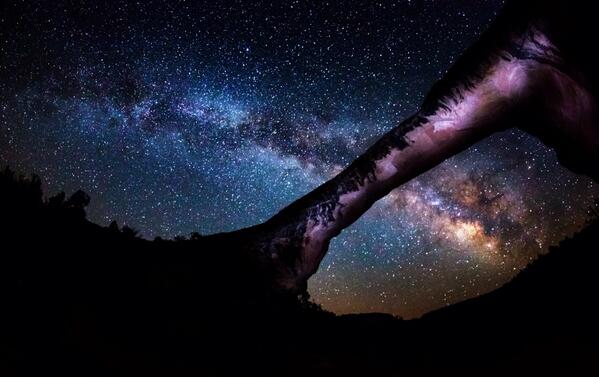
From the Department of Interior's Twitter feed:  Looking for a wow photo? This picture of the Milky Way over Natural Bridges Natl Monument should do the trick. pic.twitter.com/RfuDj7KXSA

From the Department of Interior’s Twitter feed: Looking for a wow photo? This picture of the Milky Way over Natural Bridges Natl Monument should do the trick. pic.twitter.com/RfuDj7KXSA

Owachomo Bridge?  Photographer?  I wish Interior would put in all the details with their photos.


Delicate sunset in Utah

March 21, 2014

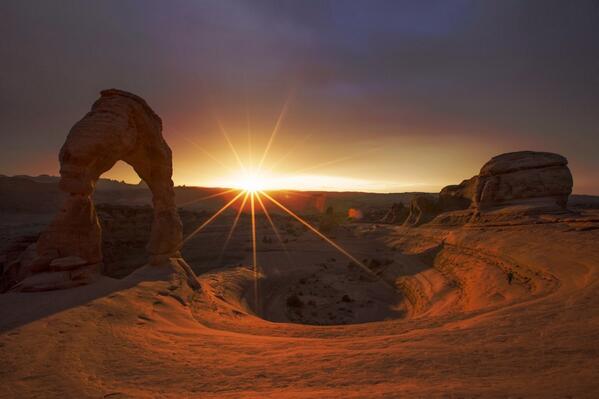
From the U.S. Department of Interior:  This stunning photo of dusk @ArchesNPS by Jonathan Backin is the perfect way to end the week. #utah #nature pic.twitter.com/5bIanEG8sZ

From the U.S. Department of Interior: This stunning photo of dusk @ArchesNPS by Jonathan Backin is the perfect way to end the week. #utah #nature pic.twitter.com/5bIanEG8sZ

Delicate Arch, with a dusting of snow, as the sun sets.

A great reason to live in Moab, Utah, or visit there.


π Day tribute from Arches National Park

March 14, 2014

Happy Pi Day!

Arches National Park Happy Pi Day! “PsyPhi” by Pete Apicella, 2010 Community Artist in the Parks (kh)

Hey, I wonder when Fibonacci’s birthday falls. π


Lightning strike in Monument Valley, Navajo Nation

February 20, 2014

Lightning strikes in Monument Valley, on the Navajo Reservation, Utah.  Photography by Carolyn Slay (Oak Ridge, TN); Monument Valley, UT

Lightning strikes in Monument Valley, on the Navajo Reservation, Utah. Photography by Carolyn Slay (Oak Ridge, TN); Monument Valley, UT Feb. 20 2014 Via smithsonianmag.com.

Lightning strike in Monument Valley, photo by Carolyn Slay of Oak Ridge, Tennessee; Smithsonian Magazine Tumblr Photo of the Day, February 20, 2014.

Rocks on the right can also be seen in this photo; can you help pinpoint the location of the photographer, and names of any of the other formations?


When the Moon hits your eye, in Arches NP

February 12, 2014

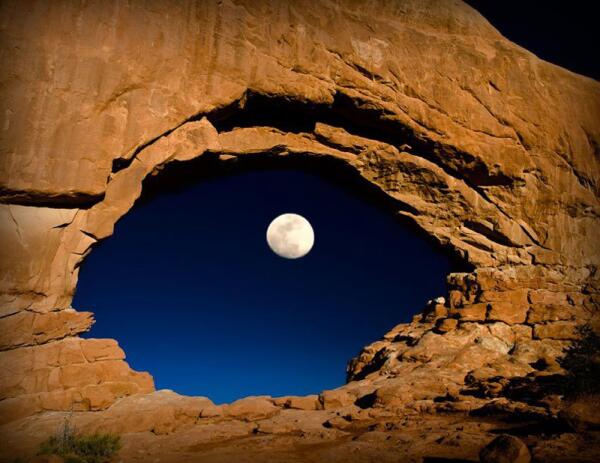
Photo by Lynn Sessions;

Photo by Lynn Sessions; “THE EYE OF THE #MOON: North Window arch at Arches National Park in #Utah. #NatGeo pic.twitter.com/XwHfdWK5Ft

It’s just a click of the shutter?  Ha!

I’m assuming not a lot of post-photo processing on this. Lynn Sessions had to figure out when the Moon would be in the North Window Arch, calculate exposure, and shoot off enough of them to get a decent shot before the Moon moved.  I suspect the rocks were “painted” with a flashlight during the exposure.

(Haven’t yet found the technical details of the shot. But I did find this about the photographer:
I’m a frustrated amateur photographer who is trying to visit every corner in Utah as well as hike/photograph every canyon in southern Utah. More at http://www.DreamBreeze.com )

Patience, planning, creativity — then just push the button.

More:


Sundown on the trail, Bryce Canyon National Park, #2

February 6, 2014

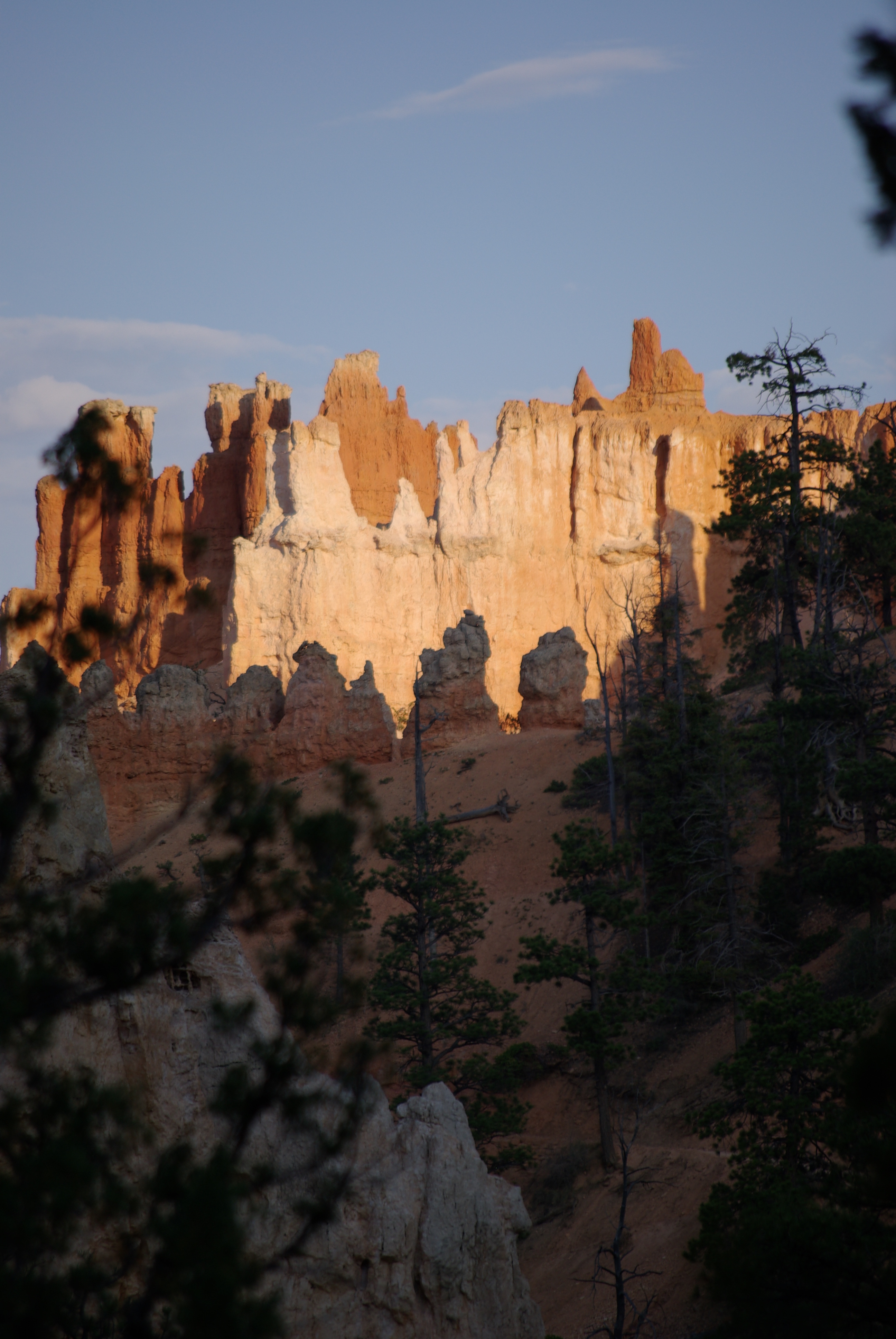
Hiking Bryce Canyon at sundown, one may see rocks in a new way, spotlighted from 93 million miles away.  Photo from 2008, by Ed Darrell

Hiking Bryce Canyon at sundown, one may see rocks in a new way, spotlighted from 93 million miles away. Photo from 2008, by Ed Darrell


Sundown on a trail in Bryce Canyon

February 5, 2014

Sundown shadows of hoodoos on pinnacles, Bryce Canyon National Park, 2008. Photo by Ed Darrell

Sundown shadows of hoodoos on pinnacles, Bryce Canyon National Park, 2008. Photo by Ed Darrell


Flying your U.S. flag for Utah’s statehood? Don’t make this error, and fly it backwards!

January 4, 2014

Last year I discovered Holly Munson’s write up from the Constitution Center about Utah’s perhaps odd path to statehood, certainly complementary to my reminder that you could fly your flags on January 4, to honor Utah’s statehood, under the U.S. Flag Code.  Munson’s piece was distributed on Yahoo! News.

Her report is very solid, even though brief.  Utah history is nothing if not a convoluted path to statehood through what amounted to a civil war, the Mexican War, the discovery of gold in California, the transcontinental railroads, mining and immigration, Indian wars, old west shootouts, rampant environmental destruction with sheep grazing and mineral extraction and smelting, union strife, astonishing agricultural applications, and a lot of books written from tens of thousands of Mormon pioneer journals — Mormonism appears to be impossible without ink and paper and time to write.

Go read her story.

What caught my eye was the George W. Reed photograph of the Salt Lake City Temple of the Church of Jesus Christ of Latter-day Saints — the LDS, or Mormon church.  The Temple and the Tabernacle, also in the photo, both have their own unique architectural histories, and quirks that make them noteworthy purely from an architectural-historical view.  (This George W. Reed should not be confused with the Civil War Medal of Honor winner, George W. Reed)

Reed was an early photographer for newspapers in Salt Lake City, and he took some wonderful photos for posterity.  He was also a founder of the leading non-Mormon paper in the state, The Salt Lake Tribune.  At points in its history, it’s been known as an anti-Mormon paper.  The University of Utah’s library holds about five dozen of his photos in their collection, indexed electronically if not quite available yet; there Reed is described:

A pioneer in the development of Utah newspapers, George Reed was originally employed by the Deseret News and in 1871 helped in establishing the Salt Lake Tribune. His photographs include nineteenth century views of Salt Lake City, individuals at Reed’s Avenue home, Wasatch Resort in Little Cottonwood Canyon, and a photograph of the American flag hung on the Salt Lake Temple in 1896 to commemorate Utah’s statehood.

In the collection of Utah State University, in Logan, Reed has yet more papers.  There we get a bit more of his history:

A pioneer in Utah journalism, George W. Reed was born in London, England, on April 7, 1833. He emigrated to Utah in 1862 and became manager of the Deseret News, a position he held until 1871 when he founded the Salt Lake Tribune. In 1882, after a decade at the Tribune, Reed sold his interest in the paper to P. H. Lannan. He married Elizabeth Tuddenham in 1866 and passed away December 1, 1909.

U.S. flag on the Mormon Temple, at Utah statehood in 1896

The Mormon Temple in Salt Lake City, Utah, draped with a U.S. flag in 1896, commemorating the completion of Utah’s statehood campaign when President Grover Cleveland declared Utah a member of the Union. Photo by George W. Reed; Reed worked for the Deseret News, and helped found the Salt Lake Tribune. I do not know whether this photo was published in either paper.  From the George W. Reed Collection, University of Utah Libraries.

Yes, you’re right!  That flag is backwards.  Well, it’s backwards according to the modern U.S. Flag Code, which specifies that when hung from a building, the flag’s union should always be in the viewer’s upper left corner (“northwest” corner were it a standard map).  In the photograph, the union is in the opposite corner.  No, we know the photo is not reversed, because it accurately portrays the location of the Tabernacle, to the west and slightly south of the Temple.

But we hear the protests:  The U.S. Flag Code did not exist in 1896!  How can that be a violation of a code that did not exist?

That’s right, too.

That is an indication that the traditions of flag display that some people get riled up about, that many people think we should amend the Constitution to protect, are new inventions more than old traditions.  Flag code violations are legion by well-meaning citizens celebrating the flag and patriotism, and rare by anyone with any malignant motives.

After a 49-year fight for statehood, through wars with the U.S., fighting with the U.S. forces in Mexico, the administrations of several presidents and 25 different U.S. Congresses, and pledges to change the rules of the church to ban polygamy and put that ban in the state constitution,  the people of Utah, especially the Mormon officials, were not trying to insult America by displaying the flag incorrectly.  Somebody said ‘fly the flag from the Temple,’ and some engineer or custodian got it done.  By 1896, most of the First Amendment litigation done in the U.S. had involved whether Mormons could keep their marriage policies (Mormons lost).  There was no intent to violate any rule of separation of church and state — nor would that be considered a violation today.  Churches may fly the nation’s flag with all the approval that suggests; it’s the government which may not fly a church’s flag.

Finally, there is no grand story in the flag’s being flown backwards.  It’s just one of those historical footnotes that mark the changing mores of the times, in this case, for standards of how to fly the U.S. flag.

Perhaps Utah history textbooks should make note of the day the U.S. flag was flown, backwards, to honor statehood.

More, and related resources:

Oh, yes! This is an encore post, too. We’re in the business of remembering history around here.


Fly your flag today for Utah statehood, January 4, 1896

January 4, 2014

Utah Capitol, with flags

South entrance (main) to the Utah State Capitol, with U.S. and Utah flags flying on the single flag poll, and the snow-dusted Wasatch Mountains in the background. Utah State Law Library photo.

Utah joined the Union on January 4, 1896.  It had been a 49-year slog to statehood for Deseret, the Mormon settlement in the Desert.  The size had been pared down, so it would not be the biggest state, incorporating parts of what is now Nevada, Arizona, Oregon, Idaho, Colorado and New Mexico.  New capitals had been tried and cast aside (Fillmore, Utah).  Democratic Party rule was broken when LDS church authorities went door-to-door, calling every other family to the Republican Party, and party parity.  The Mormon Church abandoned polygamy, and adopted a state constitution that gave the vote to women.

Finally, Utah became the 45th state.

You may fly your U.S. flag today for Utah statehood, especially if you’re in Utah.

Happy birthday, Utah!  118 years old today.

More:

U.S. flag in Capitol Reef NP

U.S. flag flying at Capitol Reef National Park, in Utah. Photo by longyang0369, via Flickr

Much of this material appeared here before; this is an annual event, after all.


Something about a campfire, in Arches National Park

November 8, 2013

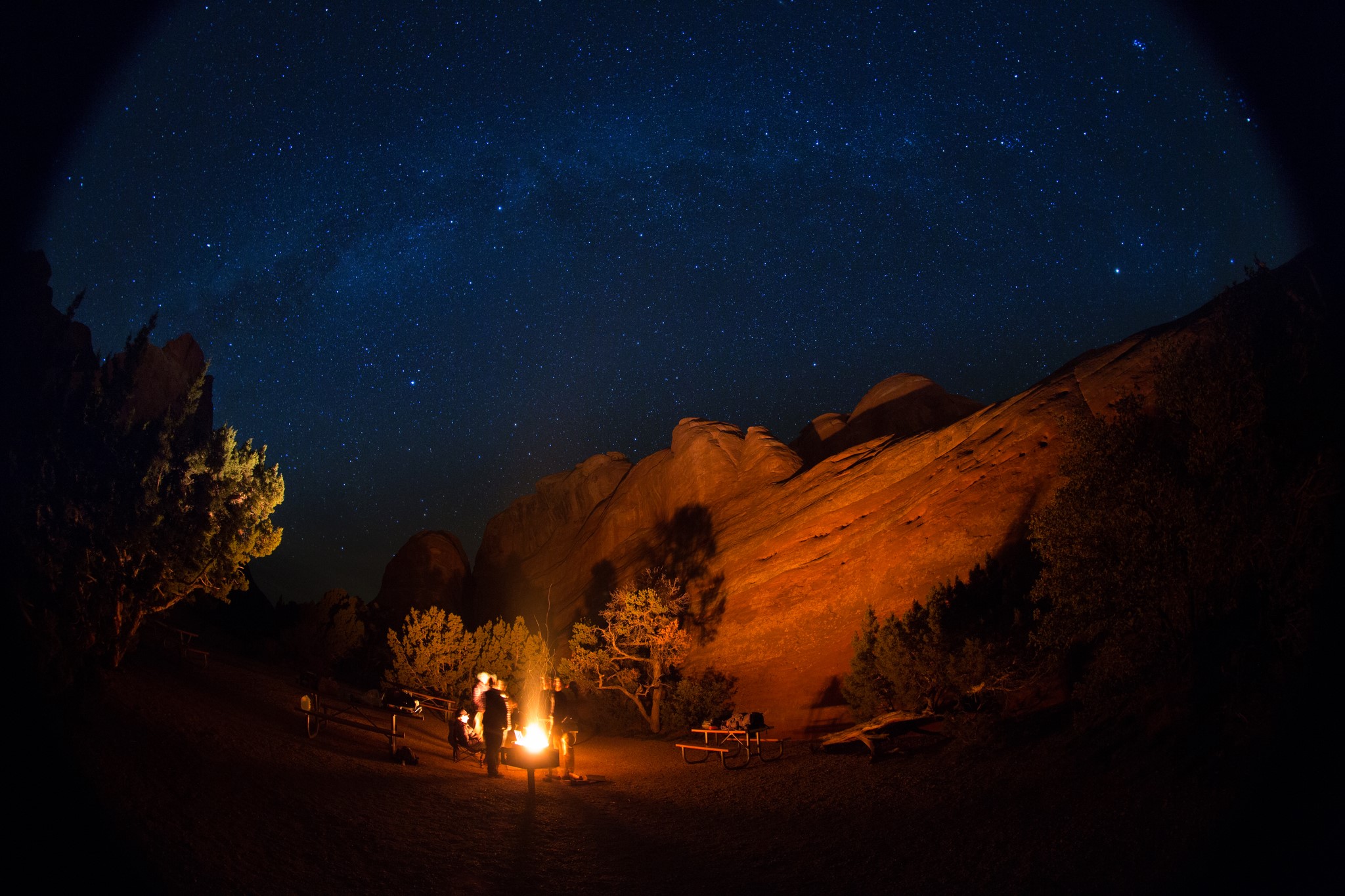
Campfire in Arches National Park, by John Dale, photographer, 2013

Photographer John Dale wrote: “We rolled in to Arches National Park to a beautiful sunset and got to our campsite just as it got dark, but that left us with a clear sky, plenty of stars, and a fire to warm up next to. Here’s a photo from the timelapse I took that night.”

From a photographer named John Dale, via Arches National Park’s Facebook page.

More:

Map of Arches National Park, Utah, United Stat...

Map of Arches National Park, Utah, United States showing predominant features such as arches, peaks, rivers and streams, mines, and roads. (Photo credit: Wikipedia)


ObamaCare working in Utah?

October 11, 2013

GOP panic spreads.  But will they run the correct way in their panic, say to vote for a clean, 12-month continuing resolution and and a raise to $18 trillion in the debt ceiling?

ObamaCare working in Utah.  Who would have imagined that?  The Sherburnes seem happy with what they bought.

Chris Detrick | The Salt Lake Tribune Phil Sherburne and his wife Leia Bell pose for a portrait with their kids Cortez, 11, Oslo, 6, and Ivan, 9, at their home in Salt Lake City Wednesday October 9, 2013. Sherburne and Bell, owners of the frame and art store called Signed & Numbered, succeeded last weekend in signing up for health coverage on healthcare.gov.

Chris Detrick | The Salt Lake Tribune Phil Sherburne and his wife Leia Bell pose for a portrait with their kids Cortez, 11, Oslo, 6, and Ivan, 9, at their home in Salt Lake City Wednesday October 9, 2013. Sherburne and Bell, owners of the frame and art store called Signed & Numbered, succeeded last weekend in signing up for health coverage on healthcare.gov.

More:

M. Turner snapped this self-portrait that went viral in the debate over President Obama's Affordable Health Care Act.  M. Turner photo, via CNN

M. Turner snapped this self-portrait that went viral in the debate over President Obama’s Affordable Health Care Act. M. Turner photo, via CNN