Typewriter and quote of the moment: David McCullough

December 17, 2007

I bought my Royal Standard typewriter in 1965. It was secondhand. I have written everything I’ve ever had published on it, and there is nothing wrong with it.

Giambarba photo of historian David McCullough and his typewriter

  • Pulitzer-winner David McCullough, defending his refusal to write on a computer during a Dallas book-signing.

(Found in Dallas Morning News, Alan Peppard, “Salutations, Year in Review, Local Celebrities,” December 17, 2007, page 1E, in graphic on page 4E)

More from McCullough on typing, and on writing, reading and understanding history, below the fold.

Read the rest of this entry »


Bending science to keep religion rigid

December 17, 2007

Texas A&M University will be home to an institute to train students for careers in nuclear power. This is a logical and welcome extension for one of Texas’s, and one of the nation’s premiere engineering schools. Nuclear power offers opportunities for the nation made more urgent by continuing, inherent problems with carbon-based fossil fuels.

Radioactivity symbol

Texas is the nation’s second largest state. The institute will provide another source for Texas kids to get career training.

The Nuclear Power Institute will help train staff needed to operate new reactors and generating plants. It will also revamp curriculum for junior high, high school and college students who are interested in pursuing careers in the field, according to officials with Texas A&M Engineering.

The institute was established in a joint effort by the Dwight Look College of Engineering and the Texas Engineering Experiment Station (TEES). The Look College is one of the largest engineering colleges in the nation, with nearly 9,000 students and 12 departments.

“The Texas A&M University System is uniquely configured with the ideal combination of education, research and service agencies and universities to lead this effort,” Vice Chancellor and Dean of Engineering Kem Bennett said in a statement released last week. “The institute will make a significant impact upon the work force and economy of the state and nation.”

The Texas A&M University System Board of Regents signed off on the formal creation of the Nuclear Power Institute earlier this month.

There is a high degree of irony in this announcement at this time. While Texas A&M looks to the future with nuclear power, the state weighs whether to allow a Dallas religious school to train teachers that management of nuclear power is based on flawed theory. A&M will train people to manage nuclear power; the Institute for Creation Research (ICR) wants to train high school teachers to teach Texas’s high school kids that nuclear power is mysterious and cannot work.

Does Texas contradict itself? Walt Whitman might have asked. Texas is large. It contains multitudes.

But should it contain a school that teaches much of basic science is just wrong?

It might be nice if a higher percentage of the multitudes had the reasoning power to see what’s wrong with this picture, and why the question is important.

This may be too subtle for people unfamiliar with atomic theory to realize the full impact. Zeno at Halfway There explains the wacky part of ICR’s misunderstanding, or wishful thinking about atomic theory. Simply put, ICR claims to have discovered that God interferes with nuclear reactions, making it difficult to predict that a nuclear reactor won’t suddenly increase its output by ten times, cooking the nuclear power plant and a couple of nearby towns in the doing.

Texas A&M is working to prepare people to live in the late 21st and 22nd centuries. ICR is fighting to take us back to the 16th or 17th century.

If ICR is successful, from what pool will A&M draw its candidates for nuclear engineering and nuclear power management? Against its will, Texas A&M could become one of the largest graduate institutions for all of India and China.

Please see the update, December 18, here:  Texas’s face should be creationism red.


December 17, written in the wind

December 17, 2007

Wright Bros. flyer at Kittyhawk, first flight

Photo from Treasures of the Library of Congress; “First Flight” by John T. Daniels (d. 1948); this is a modern gelatin print from the glass negative.

Ten feet in altitude, 120 feet traveled, 12 seconds long. That was the first flight in a heavier-than-air machine achieved by Orville and Wilbur Wright of Dayton, Ohio, at Kittyhawk, North Carolina, on December 17, 1903.

From the Library of Congress:

On the morning of December 17, 1903, Wilbur and Orville Wright took turns piloting and monitoring their flying machine in Kill Devil Hills, North Carolina. Orville piloted the first flight that lasted just twelve seconds. On the fourth and final flight of the day, Wilbur traveled 852 feet, remaining airborne for 57 seconds. That morning the brothers became the first people to demonstrate sustained flight of a heavier-than-air machine under the complete control of the pilot.

No lost luggage, no coffee, no tea, no meal in a basket, either.

Resources on the Wright Brothers’ first flight:


Quote of the moment: Housman, “accuracy a duty” in history

December 16, 2007

Poet A. E. Housman, with a book - Bryn Mawr College photo


Poet A. E. Housman in 1910, portrait photo by E. O. Hoppé

. . . accuracy is a duty and not a virtue.

A. E. Housman, English poet (1859-1936), Manilius (The Richards Press, 1930), p. xxii ll. 27 sqq


Google the phrase “accuracy is a duty” plus Housman.* You will get several dozen hits.

Historians are fond of citing it, though I suspect that few have actually read Housman’s version of the line. The idea is that historians should not get kudos for accuracy, because in their trade, accuracy is not a virtue, but instead is the baseline duty. Housman arrived at that conclusion in comparing versions of translations of Manilius, and he made the comment in the preface to fifth volume of his own translation of the works of Roman poet Marcus Manilius. Housman’s five volumes were published between 1903 and 1930.

The full quote lacks the punch of the usual truncations, however. The Housman Society in Britain was kind to track down the precise quote and the citation.

p. xxii ll. 27 sqq. I did not quote Brechart’s accuracy, because accuracy is a duty and not a virtue; but if I could have seen the shameful carelessness’ of Breiter and van Wageningen I should have said with emphasis, as I do now, that he was very accurate indeed.

Admit it — like me you were probably unaware that Housman had ever translated Manilius. Perhaps you were unaware that Manilius existed (don’t ask me to recite anything he wrote).
Historians have this further problem: Housman probably was talking about the accuracy of the translation, not accuracy in recording history.

One more quote that has been dragooned into duty in fields unrelated to its usual use. Got a problem with that?

The statement is good advice in every field I can think of.

Update: Go see Elektratrig’s report of Housman’s send-up of Greek tragedy. Well worth the click, just for edification.

*  And if you check it now, you’ll see the search is skewed by this very post; it’s the Heisenberg Principle of the internet.


Creationism school wants to offer master’s degrees

December 15, 2007

If the venerable, old and wrong Institute for Creation Research hoped to sneak through their request to grant graduate science degrees in creationism, they are disappointed this morning. The Dallas Morning News exposed their plans on the front page: “Creation college seeks state’s OK; Dallas school plans master’s in science education, fueling debate over teaching evolution.”

To be more accurate, the headline should have said “fueling debate over teaching creationism,” since that’s where the controversy lies.

Also see the story in the Austin American-Statesman. (Update 12/19/2007 — see these posts, too: Lack of resources; Bending science to keep religion rigid.)

Steve Benson cartoon from 2004, creationists Cartoon by Steve Benson of the Arizona Republic, 2004; via Panda’s Thumb

It’s scary to think people can be granted a degree in lying to innocent children, and that it would be counted as a factor in favor of their teaching, instead of as a problem to be overcome like a bad background report.

But ICR was granting degrees in California. They hope to expand their sales in Texas, closer to the Bible Belt’s buckle.

A state advisory group gave its approval Friday; now the final say rests with the Texas Higher Education Coordinating Board, which will consider the request next month.

How will the state’s serious higher education institutions respond? What should Texas education officials do? It’s a difficult question, really. Generally states allow any institution that gets accreditation to grant degrees. ICR was denied accreditation in California, but set up a separate accrediting company for Bible colleges and religiously affiliated schools. When the U.S. Department of Education authorized that accrediting association as acceptable for Pell Grant and Stafford Grant purposes, California’s ability to stop the madness was limited. Texas allows degrees for colleges that teach chiropractic medicine, and there are probably several other degree granting programs that would raise eyebrows of rational people, were they better known.

“It just seems odd to license an organization to offer a degree in science when they’re not teaching science,” Mr. [Dan] Quinn [of the Texas Freedom Network] said.

“What we’re seeing here is another example of how Texas is becoming the central state in efforts by creationists to undermine science education, especially the teaching of evolution.”

A group of educators and officials from the state Coordinating Board visited the campus in November and met with faculty members. The group found that the institute offered a standard science education curriculum that would prepare them to take state licensure exams, said Glenda Barron, an associate commissioner of the board.

Dr. Barron said the program was held to the same standards that any other college would have to meet.

“The master’s in science education, we see those frequently,” she said. “What’s different – and what’s got everybody’s attention – is the name of the institution.”

No, it’s not the name of the institution that worries us — it’s their history of defending buncombe, hoaxes and falsehoods as science, detracting from the education of science in a major way.

Science education in the U.S. is under assault. ICR is asking Texas to surrender the nation’s future and accept the ICR’s white flag of ignorance as the state’s own. It is unclear to me whether the state may refuse to do that, though it would be the moral thing to do to refuse.

See also:

Read the rest of this entry »


The Story of Stuff

December 15, 2007

How many different lesson plans can you get from this video? How about from this video with the add-ons?

Vodpod videos no longer available. from www.willbrehm.com

posted with vodpod
You can see a higher quality version at Will Brehm’s “Story of Stuff” website.

The site offers a lot. E-mail updates on issues, cheap DVDs of the movie ($10.00 each for the first 10, $9.00 each for the next 10 . . . you may want to get a copy for each social studies classroom), background stories to the movie, story of Annie Leonard, background sheets, lists of organizations working on the issues and reading lists and more. I found no lesson plans, but you can surely cobble one together for an hour class, with 20 minutes taken up by the film. Plus you can download the movie, for free.

Go noodle around the site: There are lots of possibilities for student projects, student discussions, in-class exercises, homework, and fun.

This movie details, quickly and with good humor, the economics of recycling, the economics of waste disposal, and the economics of production. This provides a great gateway to talk about civics and government, and how to make things happen like garbage collection and recycling; a gateway to talk about economics, especially the various flows of money and goods; a gateway to talk about geography and how we have used our land and rivers to bury and carry waste; and how we use natural resources generally.

This would also be a good video for Boy Scout merit badge classes for the Citizenship in the Community and Citizenship in the Nation badges.

Contrasted with most of the industrial grade video I’ve seen for economics classes, this is fantastic. It’s better than any of the sometimes ambitious, but ultimately dull productions from the Federal Reserve Banks (are you listening, Richard Fisher? Hire Will Brehm’s group). (No offense, Osgood — yours is the best of that lot.)

Sen. Tom Coburn, R-Okla., probably has political objections to the movie, claiming it leans left, which indicates it’s in the mainstream. If you’re using any other supplemental material in your classes, this just balances it out.

Screen capture from the film, “Story of Stuff”

How a carnival should be done: 4 Stone Hearth

December 15, 2007

By now you should have learned this is not a place from which to get clockwork notes about blog carnivals to read. Sometimes I look at a carnival, and finding not much to interest me, I assume in all hubris that you won’t find much there, either. More often I get bogged down doing other things and just forget to note some.

I post about carnivals here when I think there is good material.

So, I gotta tell you: Run see the current 4 Stone Hearth, posted at remote central. It’s #29, and it’s a doozey.

4 Stone hearth image, 12-2007, dolmen in snow

For your geography classes, make a note here of Britain’s pyramid, “the inside story.” Didn’t know Britain had a pyramid?

See what I mean? How can you ignore stuff like that?

There are posts about volcanoes, posts about excavating shell mounds and prehistoric garbage dumps (no, Mr. Dembski, no Pebbles cereal boxes), your standard skeleton moving fees story, polyandrous sex and sexual dimorphism among human ancestors, and a couple of notes about the flooding of the Black Sea (“Noah’s flood”) and what that did to human civilization. And a bunch of other stuff.
This isn’t a kids’ carnival in any way. For your geography and history students, there is a lot of material in this one carnival about prehistory, material that simply will not be in the textbooks (but probably should be).

Great stuff. It’ll take a while to wade through all of it, and you will find material that will excite your students in class.

The next Four Stone Hearth is set for December 19th, at The Greenbelt.


Rising at Buffalo News: Carson was right

December 14, 2007

Gerry Rising writes a column for the great newspaper, The Buffalo News (which is part of Warren Buffet’s Berkshire/Hathaway holdings).

Rising wrote a column praising Rachel Carson near her birthday last spring, and got a lot of comment. On November 25 his column dealt with the criticisms of Carson, drawn from comments to his earlier column. Rising’s view is quite middle of the road, and points the way to why the critics of Carson seem so shrill to me.

A single quote (interestingly it was repeated in two of the communications I received) will indicate the response that bothers me: “Rachel Carson is responsible for more deaths than Pol Pot.” Sadly, that statement represents the carefully mounted and continuing attack on Carson.

DDT played an extremely important disease-controlling role in World War II, but consider the following:

• Its supporters credit DDT with eliminating malaria in this country but that disease was already largely gone here by 1939 when Hermann Mueller discovered that the chemical was lethal to insects.

• An international campaign led by Fred Soper to eliminate malaria through use of DDT that indeed saved thousands of lives had largely run out of steam by the early 1960s when “Silent Spring” was published. Mosquitoes were building up resistance and geographical factors particularly in African countries, made spraying extremely difficult. Between 1960 and 1989 deaths from malaria actually decreased when treatment shifted from insecticides to medicine.

• Carson never did call for banning DDT and other pesticides in “Silent Spring.” She wrote, “It is not my contention that chemical insecticides must never be used. I contend that we have allowed these chemicals to be used with little or no advance investigation of their effect on soil, water, wildlife and man himself.”

• The 1972 Environmental Protection Agency ban of DDT in America was instituted 10 years after “Silent Spring” was published and eight years after the author’s death from cancer. Although Carson’s influence was evident, the act cites substantial scientific evidence of DDT’s adverse effects on wildlife and increased insect resistance.

• The focus of “Silent Spring” was on the indiscriminative use of insecticides for agricultural purposes, not on its use as a public health measure. Carson critics have made much of the World Health Organization’s 2006 approval of DDT, but that approval is “under strict control and only for indoor residual spraying,” thus exactly the kind of use Carson supported.


Quote of the moment: Wolfgang Pauli, “not even wrong.”

December 14, 2007

Wolfgang Pauli, before 1945 - Nobel Foundation photo
Photograph of Wolfgang Pauli, circa 1929; photo from Nobel Foundation.

That’s not right. It’s not even wrong.

From Wikipedia:

Wolfgang Pauli (1900-1958), as quoted by R. Peierls

Peierls (1960) writes of Pauli, “… a friend showed him the paper of a young physicist which he suspected was not of great value but on which he wanted Pauli’s views. Pauli remarked sadly ‘That’s not right. It’s not even wrong'”.  (Peierls  R  (1960). “Wolfgang Ernst Pauli, 1900-1958”. Biographical memoirs of fellows of the Royal Society 5: 174-92. Royal Society (Great Britain))

Pauli won the Nobel Prize in Physics in 1945:  “At this stage of the development of atomic theory, Wolfgang Pauli made a decisive contribution through his discovery in 1925 of a new law of Nature, the exclusion principle or Pauli principle. The 1945 Nobel Prize in Physics has been awarded to Pauli for this discovery.”


Bill of Rights Day, December 15

December 14, 2007

Courtesy the Bill of Rights Institute, a few “did you knows” about the Bill of Rights:

Did You Know?

The Bill of Rights was ratified December 15, 1791.
__

Congress adopted twelve amendments, of which only ten were ratified by the states by 1791.
__

Over 200 years later, one more of the original twelve, concerning compensation for Congress was ratified on May 7, 1992, becoming the Twenty-Seventh Amendment.
__

James Madison wrote the Bill of Rights and was inspired, in part, by the Virginia Declaration of Rights, written by George Mason.
__

The Bill of Rights initially applied only to the federal government; however, the Supreme Court, through the Fourteenth Amendment, has incorporated some portions to apply to the states.
__

Only 17 amendments have been ratified since the adoption of the Bill of Rights.


Religion as science in Texas: Graduate degrees in creationism?

December 14, 2007

The venerable missionary group known as the Institute for Creation Research (ICR) moved its headquarters from California to Dallas a few months ago. Anyone who follows science education in America is familiar with this group, who deny that the Earth can be more than a few thousands of years old, who argue that geology, astronomy, chemistry and biology are all based on faulty premises.

Dallas is a good location for a missionary agency that flies to churches around the U.S. to make pitches for money and preach the gospel of their cult. DFW Airport provides same-day flights to most of the U.S. Airlines are glad to have their business.

Years ago ICR tried to get approval from the State of California to grant graduate degrees in science, because their brand of creationism is not taught in any research university, or any other institution with an ethics code that strives for good information and well-educated graduates. ICR got permission only after setting up their own accrediting organization which winks, blinks and turns a blind eye to what actually goes on in science courses taught there. It is unclear if anyone has kept count, but there appear to be a few people with advanced degrees in science from this group, perhaps teaching in the public schools, or in charter schools, or in odd parochial settings.

With a new home in Texas, ICR needs permission of Texas authorities to grant graduate degrees. Texas Observer reported that the Texas Higher Education Coordinating Board put off consideration of the issue until their meeting of January 24 (no action was planned for this meeting, so failure to grant this authority to ICR should not be taken as any sign that the board is opposed to granting it).

Humor aside, this is a major assault on the integrity of education in Texas. For example, here is a statement on college quality from the Higher Education Coordinating Board; do you think ICR’s program contributes in any way, or detracts from these goals?

Enrolling and graduating hundreds of thousands more students is a step in the right direction. But getting a degree in a poor quality program will not give people the competitive edge they need in today’s world economy. Academic rigor and excellence are essential – both at the undergraduate and graduate levels. We also need to attract and support more research in the state for the academic and economic benefits it provides.

Check out the Texas Observer‘s longer post on the issue, and since comments are not enabled there, how about stating here your views on the issue? Comment away.

Tip of the old scrub brush to Texas Citizens for Science.

No, this is not a joke.  Here is the agenda for the meeting this week, in .pdf form.


Carnival!

December 13, 2007

Oh, boy, are we behind.

Here’s the latest Carnival of Education, at the Colossus of Rhodey. Considering the angst in Texas over science standards, and the recent angst in Utah over vouchers, and the national angst over science and math performance, it’s really a rather tame bunch of posts. Great stuff, though, in about every other one.

The 59th History Carnival was put up on December 2 at Westminster Wisdom. We’ve already missed a third of the month we had to read it! In the vein of “how do we know what we know,” the carnival points to Judith Weingarten’s musings/essay/research on the connection (if there is one) between the words “tiger” and “Tigris.” No, not “tigress.” See? You’re hooked on history already. And what can we do with “The Further adventures of Ben Franklin’s ghost?” (Ghost — hell’s bells! — son James was born on Ben Franklin’s birthday; that’s gotta be an omen of good, right?)

We need to get in the carnival mood . . .


Cue Taylor Mali . . .

December 13, 2007

The last line of Taylor Mali’s slam poem about what a teacher makes — remember it?

Here it is, in real life: “Tuff Guy, Crazy Horse, Happy Teacher.” Go see it. It’s at Edu Blah Blah Blahg.


More DDT poisoning

December 13, 2007

[Time passes and internet links die, expire, or otherwise fall into the black hole of irrelevancy. Alas. Rachel Carson is still right.]

Sometimes, when people make gross errors, they get caught. They apologize, or they mumble, and they move on.

A few times, when people make gross errors, they revel in it. Rather than admit the error, they make it again. They say it wasn’t an error. They repeat it, time and again, as if two wrongs make a right, or as if 126 wrongs make a right.

We caught Caosblog repeating some bad stuff about Rachel Carson, and false, good stuff about DDT, and false claims that eagles were not endangered by DDT. We called ’em on it. [But the blogger appears to have deleted the response. It was that good.]

Whoooee! This is the result.  Note the list of unquestioning links to other stuff on the web.  (Yeah. “Milton Fillmore.”  Probably not reading comprehension error so much as rant-blindness.)

If there is anything crazy and mean about Rachel Carson, it’s probably in that list. If there is any wild and insane claim about the safety of DDT, it’s in that list. If there were any accurate information, it would be a miracle. (Well, actually there’s some good information in the National Geographic story about malaria, but I doubt the blog writer bothered to read it.) The blog links to all the Lyndon Larouche crazies, all the tobacco lobbyist crazies, and acts as if such manure is golden.

Very little of it is accurate. Most of the material so far out to lunch, it’s not even wrong. The person who runs the blog sent me an e-mail saying my comments are no longer welcome there, because of the tone of my remarks. Too many links to too much refutation of blog’s points, I gather — too much real information!

DDT poisoning clearly is damaging, with effects far beyond anything Rachel Carson ever predicted.

This is the venal, vicious spirit that Sen. Tom Coburn defends with his hold in the U.S. Senate on honors for Mrs. Carson. This is the spirit with which the anti-Rachel Carson movement rails at environmentalists about malaria in Africa, while holding back funding for anti-malaria projects in Africa.

Woody Allen had a line in Annie Hall that may be appropriate: “There’s nothing wrong with you that couldn’t be cured with Prozac and a polo mallet.”

Reason and evidence won’t do it now. When someone starts out arguing that eagles were not threatened with extinction by the poison that a thousand studies verified was doing them in, you can’t reason them back to reality.

Below the fold: At the second outlet of that blog, conversation carried for a while, though not necessarily so for enlightenment. In 2015, I thought it a good idea to capture some of that.

Read the rest of this entry »


Clay Bennett cartoons

December 13, 2007

I love Thomas Nast cartoons, partly for their dated look. They look like they are 100 years old from the style of the art.

For much the same reason, I love Herblock cartoons. They look like the middle of the 20th century. And Pat Oliphant cartoons look like post-Kennedy modern ideas.

Clay Bennett, winner of the 2007 Curie UN Cartoon Award

Clay Bennett, winner of the 2007 Curie UN Cartoon Award

Clay Bennett cartoons look like 21st century clean to me. There’s a smoothness, a silkiness of color that lends an immediacy to them. They really look good, and they look like they’d project well in a classroom (though I’ve not tried any of Bennett’s, actually).

All four of these cartoonists had or has something to say, too. I’ve enjoyed Bennett’s work in the Christian Science Monitor for some time. His work is clean, but it has a cutting edge that can’t be missed.

So, I was happy to see that he had won a commendation from the Ranan Lurie Cartoon Competition at the UN Correspondents’ Association dinner. Other people see good stuff in his drawings — I’m not alone.

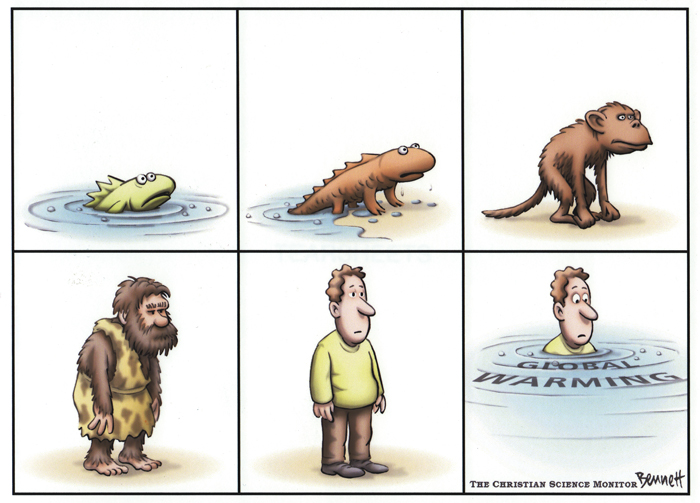
Here’s his UN Lurie award-winning cartoon:

Evolution of Man, to drowning by global warming

Cartoon winner of the 2007 Curie UN Cartoon Award

More of Bennett’s cartoons can be seen here, at the Clay Bennett Archives.

Bennett’s last cartoon in the Monitor was November 17.  The good news:  He’s moving to the Chattanooga Times-Free Press.  We can hope that means one more opening is available for a cartoonist.

One more, below the fold. Read the rest of this entry »