Do you know what socialism is? Really? Episode 1

June 24, 2011

Management consultants seize on all kinds of ideas in the drive to heal businesses from whatever it is that ails them.  This is not criticism delivered lightly, considering the many years I made a living as a management consultant.

At the site for Constitutional Business Consulting, I came across a history of socialism — I think the author’s idea is to convince business managers that they are really using socialism in their management practices, and so the businesses should pay Constitutional Business Consulting to inject some workplace democracy.  It doesn’t really matter — what I liked was the history of socialism claimed at the site, and the comparison to the modern, free-enterprise business model.

We could quibble on the history, but why bother:  The point is worth discussion:

The Origin Of Socialism

Socialism literally sprang from observing the success of capitalism, while believing that conditions for workers could be improved if the control of production were moved from capitalists to the state. A top-down control system, such as that used in large business, was the model for socialist society. Yet the true engine of capitalism, the free market, was overlooked and left out of the plan.

Social reformers, from the early Utopian Socialists to the Marxists, were literally awed by the tremendous success of capitalistic industrial production. In The Communist Manifesto Karl Marx stated:

The bourgeoisie, during its rule of scarce one hundred years, has created more massive and more colossal productive forces than have all preceding generations together. Subjection of Nature’s forces to man, machinery, application of chemistry to industry and agriculture, steam-navigation, railways, electric telegraphs, clearing of whole continents for cultivation, canalization of rivers, whole populations conjured out of the ground—what earlier century had even a presentiment that such productive forces slumbered in the lap of social labor. [1]

The socialists did not want to disrupt this technological miracle, but merely to distribute the profits of it more fairly. They observed the workers earning profits for the wealthy business owners and maintained they were being unfairly exploited. Believing the strength of the system was in its structure, they didn’t want to eliminate businesses, but merely to replace the wealthy business owners with the state.

As early as 1791 Talleyrand, in France, compared the ideal society to a National Workshop. [2] In the 1820s Henri de Saint-Simon envisioned the ideal society as one large factory.[3] After his death, his followers, calling themselves the Saint-Simonians, devised a system in which all of society would be organized like a single factory and socialism was the word they chose to represent it. [4] This was the origin of socialism—the conception of a centrally-planned society run like a business.

Throughout socialist writings the theme is recurring. Thomas More, Etienne Cabet, Louis Blanc, Robert Owen, Wilhelm Weitling, Karl Marx, Friedrich Engels, Sydney Webb, William Clarke, and Nikolai (V.I.) Lenin all relied on a top-down structure, like that used in businesses, as the model for socialist society.[5] While they didn’t all express their philosophies the same way, their line of reasoning was basically this: Capitalism, with its scientific approach, had developed the methods of production to such a degree that they became routine tasks. The wealthy capitalists, desiring to live by the labor of others, had divorced themselves from the day to day duties by training others to perform those tasks. The role of the capitalists had therefore become superfluous, and production could go on without them, thus eliminating the exploitation of the workers.

In his work The State and Revolution, Lenin states:

Capitalism simplifies the functions of ‘state’ administration; it makes it possible to have done with ‘bossing’ and to reduce the whole business to an organization of proletarians (as the ruling class) which will hire ‘workers, foremen and bookkeepers’ in the name of the whole of society. [6]

And The Communist Manifesto proclaims:

The development of Modern Industry, therefore, cuts from under its feet the very foundation on which the bourgeoisie produces and appropriates products. What the bourgeoisie, therefore, produces, above all, is its own grave-diggers…. [7]

And, these views were not just restricted to socialists. Even scholars who were avowedly against socialism, believed the success of businesses, with centralized and top-down controls, proved the viability of socialism. In 1942 Joseph Schumpeter—Chairman of the American Economic Board—saw in large business enterprise all the ear-markings of a socialistic structure, and from this he surmised that capitalism could readily be replaced by socialism. [8]

The passage of time has revealed a conclusion quite different from that of Schumpeter’s. Unfortunately, the naive belief that capitalistic efficiency is due to the top-down structure within businesses is simply grist for the mills of social reformers.

Within a few minutes of finding that site, I found a message at a Facebook site from a guy taking exception to John Kennedy’s famous statement about liberalism. I quoted part of the definition above, noting that socialism was organization “like a business,” and responded:

Perhaps some who claim to see socialism in a health care system where private physicians are chosen by patients to deliver medical care in privately-owned facilities, associating with privately-owned hospitals, using therapeutic devices manufactured by privately-owned businesses and pharmaceuticals developed by privately-owned drug companies, really do mean to rail against such free enterprise. But I’m willing to wager they just don’t know them meaning of the word “socialism” nor would they recognize socialism if it moved into their bedrooms and slept with them every night.

What do we mean when we say, “socialism?”

I wonder what sort of success Constitutional Business Consulting gets?

Footnotes, as listed by Constitutional Business Consulting [hotlinks in the quoted sections should take you back to CBC’s site]:

  1. Marx , Karl; and Engels, Friedrich, The Communist Manifesto, 1848, Penguin Books Ltd., Middlesex, England, 1986, p. 85.
  2. M. Talleyrand-Périgord, Charles Maurice, Rapport sur l’instruction publique fait au nom du comité de constitution de l’Assemblée Nationale, les 10,11, et 19 septembre 1791, Paris, 1791, p. 7-8.
  3. Manuel, Frank E., The New World of Henri Saint-Simon, Harvard University Press, Cambridge, Massachusetts, 1956, p. 308-309, 367.
  4. Hayek, Friedrich A., Individualism and Economic Order, The University of Chicago Press, Chicago, Ill. 1948, p. 3.
  5. Laidler, Harry W., History of Socialism, 1968, Thomas Y. Crowell Company, New York. Although Laidler’s socialist leanings clearly show through, as a single source of diverse socialist viewpoints this 900+ page book is superb. See particularly, p. 28, 48, 62, 95-96, 108, 109, 197-202, 416, 658, and 660.
  6. Lenin, Vladimir Ilich, The State and Revolution, 1917, Penguin Books, New York, 1992, p. 44 See also p. 40, 42-46, 56, 61, 86-87, 90-91, and 98-99.
  7. Marx and Engels, The Communist Manifesto, (noted above), p. 94. Also, p. 85-86.
  8. Schumpeter repeatedly makes claims such as these in Capitalism, Socialism, and Democracy. 1942. New York. Harper & Roe. 1950. See particularly p. 61, 132-134, 186, and 214-215. He also believed managers of American businesses were suitably trained for future roles as leaders in a socialist society, p. 186, 204-205, and 207.

Nope: Lincoln didn’t say that

June 24, 2011

Delightful little feature at Arizona Central (azcentral.com), “AZ Fact Check ’11, Keeping Arizona honest” — Arizona Central is a feature of the Arizona Republic, as I recall (somebody correct me if I err).

I’ve noted before that Abraham Lincoln gets credit for a lot of things he didn’t say.  AZ Fact Check ’11 corrected an Arizona State Senator on attributing to Lincoln a quote against helping people do things they should be doing for themselves.  It’s another case of Twitter getting an elected official in trouble (not a lot of trouble, though, really).

The issue: Whether senator correctly quoted Lincoln

Who said it: Al Melvin, state senator

Arizona State Sen. Al Melvin, Dist 26

Arizona State Sen. Al Melvin, R-District 26

by Alia Beard Rau – June 22, 2011, 11:23 am

What we’re looking at
Sen. Al Melvin, R-Tucson, tweeted a quote that he credited to President Abraham Lincoln.

The comment
“Abe Lincoln: ‘You cannot help people permanently by doing for them what they could and should do for themselves.’ We need to learn from this.”

The forum
Posted on Melvin’s Twitter account June 21.

Analysis
Melvin on June 21 posted several quotes to his Twitter account relating to encouraging individuals to help themselves rather than giving them handouts. He attributed the quotes to Abraham Lincoln.

And Melvin isn’t alone. Others, including President Ronald Reagan, attributed these same quotes to Lincoln.

But according to several books, articles and the website Snopes that deals with debunking urban legends, Lincoln never said the quote.

Historian Arthur Schlesinger addressed the issue in a Washington Post column that ran Sept. 6, 1992.

“. . . in his Houston speech to the Republican National Convention, Ronald Reagan fell for one of the great hoaxes of American history, surpassed in taking people in only by H.L. Mencken`s enchanting fable about Millard Fillmore’s installing the first bathtub in the White House,” Schlesinger wrote. “The author of the less than immortal words Lincoln never said was an ex-clergyman from Erie, Pa., named William J.H. Boetcker.”

Boetcker in 1916 and 1917 produced two booklets based on lectures he gave. The quotes, including the one Melvin cites, are in those booklets.

According to Schlesinger, a conservative group in 1942 put out a leaflet titled “Lincoln on Limitation.” It listed legitimate Lincoln quotes on one side and legitimate Boetcker quotes on the other. Some versions attributed Boetcker’s quotes to Boetcker while others did not, leaving some readers to assume all were from Lincoln.

During the 1940s and 1950s, the quotes were mentioned or printed by increasingly legitimate sources and credited to Lincoln.

“Ever since, Lincoln scholars have been busy swatting the fake quotes down,” Schlesinger wrote. “In the 1960s, the Republican National Committee even warned its speakers, ‘Do not use them as Lincoln’s words!’ but to no avail.”

Bottom line: Historians appear to agree that Lincoln never said the quote that Melvin attributed to Lincoln. The quote was from William J.H. Boetcker.

Sources

They got me at that part where they listed sources with links. What a great little feature!

“We Engrave Herewith The Portrait – From A Photograph By Brady – Of Hon. Abram Lincoln, Of Illinois, The Republican Candidate For President” followed by a sketch of his career. Text below image reads “Hon. Abram Lincoln, Of Illinois, Republican Candidate For President./Photographed By Brady.”

_____________

Nota bene:  I failed to see this notice at that site:  “Fact Check is a service of The Arizona Republic, 12 News and the Walter Cronkite School of Journalism and Mass Communication at Arizona State University. It is not affiliated with www.FactCheck.org, a project of the Annenberg Public Policy Center of the University of Pennsylvania.”

Save

Save


Hoaxed Nebraska nuclear plant crisis update

June 24, 2011

Help me out, Dear Reader:  Here is the English language site of the Russian Federal Atomic Energy Agency (FAEE), the press site.  Can you find any statement at this site relating to the power plants in Nebraska along the flooding Missouri River?

Fires in Japan after tsunami -- not a nuclear power station

What some reports appear to paint as the Nebraska nuclear generating stations (However, please note: In this photo, no nuclear power plants appear)

Cooper nuclear generation station in 1993 floods

What you really see: Cooper Nuclear Generating Station in Nebraska -- still there (from a 1993 photo)

I have found no mention of any U.S. incident.   This suggests the Pakistani news report of a Russian agency report of disaster is hoax, too.

Claims of a crisis in Nebraska are hoaxes,  I think.  The Russian agency from which the report is claimed to have come, does not show such a report.

This is more evidence that the whole flap is a hoax.

True to form, several birther and other conspiracy paranoiac sites claim that these plants in Nebraska are gone, in flames, or leaking water that nearly glows.

Can’t Sarah Palin point her bus to Nebraska and let her press entourage get the real story?


Texas Citizens for Science, new Facebook page

June 23, 2011

One more way to connect with Texas Citizens for Science, the defenders especially of good science in public school classrooms:

Texas Citizens for Science logo

Are you a member?

Hello, Friends of Texas Citizens for Science,

If you haven’t done so yet, please visit the new TCS Facebook Page at <http://www.facebook.com/pages/Texas-Citizens-for-Science/220812611277400?sk=wall> and become a Friend. TCS is only four Friends short of reaching the number to use a shortened URL.

Also, please make a note of our new TCS email address.

The July State Board of Education meeting will be important for us. I will attend and live blog the important parts.

Thank you all very much.

Steven Schafersman, President
Texas Citizens for Science


Michigan governor’s office continues practice honoring fallen soldiers

June 23, 2011

Michigan’s Gov. Rick Snyder chose to continue the practice of his predecessor, Gov. Jennifer Granholm, in ordering flags to be flown at half-staff throughout the state to honor a Michigan soldiers killed in Afghanistan and Iraq.

Good on him.

Description: Description: Description: cid:image001.png@01CC318F.8A7F61B0

Flags to be lowered Monday, June 27
for Private First Class Brian J. Backus

LANSING, Mich. – Gov. Rick Snyder ordered U.S. flags throughout the state to be lowered to half-staff in honor of Private First Class Brian J. Backus on Monday, June 27. Flags should be returned to full-staff on Tuesday, June 28.

Backus, 21, of Harbor Beach, died June 18 in Kandahar province, Afghanistan, of wounds suffered when insurgents attacked his unit with small arms fire.

“Pfc. Backus served our country with bravery and courage.  My thoughts and prayers are with his family and friends at this time of great sorrow,” Snyder said.

Backus was assigned to the 2nd Battalion, 87th Infantry Regiment, 3rd Brigade Combat Team, 10th Mountain Division of Fort Drum, New York. His awards include the National Defense Service Medal, the Afghanistan Campaign Medal, the Global War on Terrorism Service Medal, the Army Service Ribbon and the Combat Medical Badge. Backus deployed with his unit in March 2011 to Afghanistan in support of Operation Enduring Freedom.

The funeral service and arrangements are pending.

When flown at half-staff or half-mast, the U.S. flag should be hoisted first to the peak for an instant and then lowered to the half-staff or half-mast position. The flag should again be raised to the peak before it is lowered for the day.

This message was sent on Thursday, June 23, 2011 at 12:28 p.m.


A century of IBM

June 23, 2011

IBM turned 100 years old last week, on June 16.

IBM logo, 100th anniversary plus the Selectric typewriter

An "element" from an IBM Selectric typewriter, incorporated into a logo celebrating IBM's 100th year

In our studies of the effects of technology in the 20th century, do we give enough information and deference about IBM?  The company surely is not familiar to high school students — seniors for the class of 2012 having been born circa 1994, long after the heyday of the IBM System 360, the once-ubiquitous data punch cards, and the astonishingly advanced Selectric typewriters.  IBM retired the Selectric in 1986, a year before our older son was born, nearly a decade before today’s high school seniors bounced into the world.  The IBM punch cards, introduced in 1928, became difficult to find by the time I was coaching debate at the University of Arizona (we used the cards for debate evidence because they were larger and lighter than index cards, as did many other people in other walks of life).  Computing power of the S/360 paled in comparison to minicomputers available by 1985, and especially in comparison to the desktop microcomputers that dominate our working world today.

I wonder what today’s high school students really understand of the computer revolution?  Do they understand the fundamental roles IBM played in inventing the 21st century?

IBM System 360 at NASA, circa 1969

Caption from IBM: "IBM System/360 at NASA The System/360 Model 75 processed data for the first lunar landing 240,000 miles away from the moon, at NASA’s Manned Spacecraft Center in Houston, Texas. It was one of five System/360 machines used by NASA for the Apollo 11 mission and the same computer that later calculated liftoff data needed by astronauts Neil Armstrong and Edwin 'Buzz' Aldrin for the flight back to Earth."

IBM occupies a particular fond spot in my heart.  Through the National Merit Scholarship program, I had my college paid for in great measure by a four-year grant from IBM, a Thomas J. Watson, Jr., Scholarship.  As I recall it was for about $5,000, much more than adequate for tuition and fees at the University of Utah at under $400/quarter.  Coupled with a more modest scholarship from Utah and my 40 hours/week job in a laboratory, my undergraduate years were financially easy compared to our sons’ studies today.

As a sort of thank-you, I was expected to make an annual trek to the IBM offices in Salt Lake City to report on my progress.  IBMers at the time were still very much on the white-shirt/blue-shirt plan, and the contrast between campus and the IBM office could scarcely have been more stark.  Despite their sponsoring my education, I could not convince IBM to give me a price break on my first IBM Correcting Selectric II; it was a major scrape to come up with the $740, full list price of the beast.

But what a great investment!  My apartment became term-paper central.  At the end of the quarter, I could go without  paying for a meal for two or three weeks.  I did have one apartment manager complain about women spending the night in my apartment, and I don’t think he believed me when I said they were working on term papers.  I had not expected the academic benefits of the machine:  My grades in broadcast classes rose with scripts submitted in easy-to-read Orator typeface; I’m convinced the lack of pencil-corrected errors added a full half-grade to other papers, too.

That typewriter finally succumbed to my unwillingness to pay for the annual servicing from IBM.  I think Kathryn donated it to the Salvation Army sometime after we got to Texas, after two decades of service.  I found another at a garage sale in about 2000, for $10, with six elements and a slew of ribbons and correctapes.  It also succumbed to a lack of service, though, and joined its predecessor at the Salvation Army five years ago.  I’d love to have a good working version today, still, though I can do almost everything it could do with a wordprocessor and a laser printer.

IBM System 360 coming to Japan - IBM image

Caption from IBM: "The System/360 Model 75 processed data for the first lunar landing 240,000 miles away from the moon, at NASA’s Manned Spacecraft Center in Houston, Texas. It was one of five System/360 machines used by NASA for the Apollo 11 mission and the same computer that later calculated liftoff data needed by astronauts Neil Armstrong and Edwin “Buzz” Aldrin for the flight back to Earth. Two men standing on truck w/System/360 logo magnifying-glass IBM System/360 in Japan At Tokai Bank in Japan, all operations were performed manually, forcing employees to run calculations on abacuses into the late hours of the night. The arrival of the System/360 enabled the company to do away with abacuses and, in doing so, send employees home to spend more time with their families, drastically improving morale. Meanwhile, more work was completed in a shorter time frame, and customer satisfaction soared."

IBM’s leadership as a company runs much deeper than simply as an innovator in technology.  IBM for years had the best corporate training available — at American Airlines we benchmarked our training against IBM, when benchmarking was a tool of corporate improvement.  IBM’s people had the good sense to sit us down and explain they had benchmarked their own training against American’s pilot training, which they explained was the model for outstanding training:  Hire people who already know how to do the job, have a lot of experience, and love the work; train them intensively in the company ways and systems, and especially the machines they will use; use simulators to offer much more practice than can safely be had on the job; provide a mentor to monitor closely that the student (pilot) is doing the job right; require extensive refresher courses at least once a year.

At one point IBM had 20% growth in revenues for 20 consecutive years. IBM even figures in one of the great urban legends of the 20th century.  For the film of Arthur C. Clarke’s novel, 2001:  A Space Odyssey, director Stanley Kubrick used a  computer as a central character.  The computer becomes the bad guy in the movie, however; the urban legend is that the company refused to let Kubrick use their logo.  So, the legend claims, Kubrick simply backed up one letter in the alphabet for each letter, and the nefarious HAL computer was born. Both Kubrick and Clarke denied that was the case, noting that HAL was a form of acronym for “Heuristic Algorithmic.”  They also note that IBM computers are pictured in the movie.  The story merely adds to the understanding that IBM was everywhere that technology or good management was found on the planet.

Despite having been eclipsed by its two partners in micro computers, Microsoft and Intel, IBM today offers yet another reinvention of itself, larger than it was when its fortunes were said to have collapsed, a few years before our high school students were born.

CBS Sunday Morning offered a short version of the company’s history on June 12 — fortunately, one of the items CBS posted on YouTube (they don’t put enough of the Sunday Morning stuff there, if you ask me).

More: 


Abrupt end

June 22, 2011

News reports say Sarah Palin quit her bus tour of America less than halfway through.

Sarah Palin's custom-painted bus, parked

Sarah Palin's custom-painted bus, parked -- is this abandoned parking lot the last stop?

That’s rather unusual, don’t you think?  Our Band of Merry History Teachers stuck to our bus tour last week until the bus wore out.  I’d expect Palin to keep it up so long as the air conditioning held out.

No, I’m not running.  I may be better prepared than some of the candidates, but I have a job to do, and I can’t speak Mandarin.

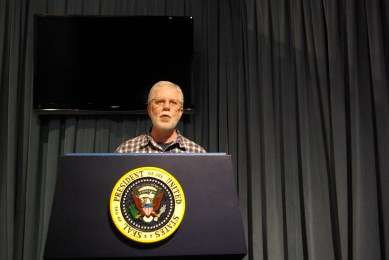
Ed Darrell practices with a teleprompter, to avoid writing on his hand.

Ed Darrell wrestling with the Presidential Seal and a balky teleprompter.


Civil War Sesquicentennial: 26 free books on the Civil War

June 22, 2011

Our librarian friend, Judy Crook, sent a link to the National Park Service website where you can download, free, 26 books on the Civil War.

150th Anniversary Civil War

Logo for 150th Anniversary Civil War - Copyright ©2010 Eastern National. All rights reserved.

Eastern National is celebrating the 150th Anniversary of the Civil War with electronic editions of eParks’ National Park Civil War Series of books. Read them online or own your own paper edition by visiting our Civil War Series store.

With a color printer, a teacher could assemble 26 readers for use in the classroom, or for homework assignments.  The books sell for $8.95 through the NPS bookstore.  The first listed volume, A Concise History of the Civil War, provides a good, brief summary, with some features in the .pdf version teachers should be happy to find:  A list of 25 battles of significance, and black-and-white maps of battle locations and the Confederacy, for examples.

Great idea to make this stuff available for free, online.  I wonder, how many people will really take advantage of the opportunity?

Buy paper copies here, at the eParks Store; here are links to the .pdfs of the 26 volumes, below:

book cover

Cover for A Concise History of THE CIVIL WAR


Schieffer: Education is our first line of defense – CBS News Video

June 22, 2011

Bob Schieffer plugs education and worries about last week’s NAEP report on what students know about history:

Schieffer is right:  Teachers deserve better pay, and that’s probably the quickest and best solution to get our kids up to snuff on history.

And history is our first line of defense.  Minutemen at Lexington and Concord knew why they were fighting, and fought to victory as a result.  Don’t our kids deserve as good an education today?

[I’m posting this on Wednesday — the YouTube version had only 54 views when I did.  Spread the word, will you?]


Punchline too brutal for work: Why it is that environmentalists are the real humanitarians

June 21, 2011

The fictional but very popular memes that environmentalists hate humans, humanity and capitalism wouldn’t bother me so much if they didn’t blind their believers to larger truths and sensible policies on environmental protection.

One may argue the history of the environmental movement, how most of the originators were great capitalists and humanitarians — think Carnegie, Laurance Rockefeller, Theodore Roosevelt, Gifford Pinchot, and all the early medical doctors who warned of the dangers of pollution-caused diseases — but it falls on deaf ears on the other sides.

Here’s the 30-second response, from Humon, in cartoon form:

Mother Gaia explains to humans that they will not be missed when they kill themselves off.

Facts of life and environmental protection – from Humon at Deviant Art

Mother Gaia explains why environmental protection is important, from Humon at Deviant Art

Facts of life and environmental protection – from Humon at Deviant Art

Tip of the old scrub brush to P. Z. Myers, and Mia, whoever she is.  Myers noted, “Environmentalism is actually an act of self defense.”


Scapegoat season

June 21, 2011

Say what?

John Cole at Balloon Juice:

Grampa Simpson at it again:

In comments made over the weekend, Senator John McCain R-AZ., blamed illegal immigrants for the some wildfires that have raged across his state of Arizona.“There is substantial evidence that some of these fires have been caused by people who have crossed our border illegally,” McCain said Saturday at a press conference. “The answer to that part of the problem is to get a secure border.”’

The Senator from Arizona’s comments set off a wildfire of their own, as the Wallow Fire currently blazes across his state across 500,000 miles.

A forest service spokesman on the Wallow fire in Arizona says there’s no evidence that this specific fire was caused by immigrants.

I still can not believe that there are people who want to argue that there would have been no difference between the current Obama administration and a McCain/Palin reign of terror.

What’s going on there?


How to tell that comment on your blog is really spam

June 20, 2011

No kidding, these are actual comments.  Did the authors think no one would notice?

  • Wow! This can be one particular of the most useful blogs We’ve ever arrive across on this subject. Actually Magnificent. I am also an expert in this topic therefore I can understand your hard work.
  • I accept pleasure in seeing sites that appreciate the worth of providing a prime resource for unconditionally free.
  • Keep up the superb piece of work, I read few blog posts on this internet site and I think that your web site is real interesting and has bands of excellent information.
  • You truly make it seem so effortless with your presentation but I find this theme to get truly one thing which I feel I might in no way fully grasp. It seems as well complicated and very broad for me. I am wanting ahead in your up coming post, I will try and get the hang of it!
  • Great site. Plenty of helpful info here. I am sending it to several friends ans additionally sharing in delicious. And naturally, thank you!
  • I’m amazed, I have to admit. Truly rarely will i encounter a weblog that’s both educative and enjoyable, and without a doubt, you have hit the toe nail on the head. Your concept is actually outstanding; the problem is something which not enough people are speaking intelligently about. I am very happy that I stumbled across this during my search for some thing concerning this.  [Yes indeedy, hit that toe nail right on the head.]
  • Hi there, just became aware of your blog through Google, and discovered that it’s truly informative. I am going to watch out for brussels. I’ll be grateful if you keep going this in future. Lots of people will be benefited from your posting. Many thanks, !
  • Valuable information and excellent design you got here! I would like to thanks for your time for sharing your thoughts and time into the stuff you article!! Thumbs up! I just hope to have understood this the way it was meant. With regards, Alesha.
  • Thank you for the auspicious blogpost. It in fact was a amusement account it. Look advanced to more added agreeable from you! However, how could we communicate? Please send a email to [e-mail removed], Many thanks,
  • [From a collection agency address]  I really like your blog.. very nice colors & theme. Did you design this website yourself or did you hire someone to do it for you? Plz answer back as I’m looking to create my own blog and would like to find out where u got this from. many thanks
  • If possible, as you on dexterity, would you brainpower updating your blog with more information? It is extremely sympathetic in return me.

Here at Millard Fillmore’s Bathtub, we strive to “hit the toe nail on the head” with all the “stuff we article,” at least so long as we “on dexterity” and we are “brainpower updating” about it.  I personally check every post to be certain each one is educative.   By all means, watch out for brussels.  I hope you find that added agreeable.

The good people at WordPress, using Akisment, do their best to keep that spam out of comments, too.  Thanks to them.


Nuclear power plant incident in Nebraska?

June 19, 2011

A Pakistani newspaper, The Nation, should not be confused with the U.S. magazine of the same name, as I originally did.

Late Friday The Nation questioned an alleged news blackout around an incident at the Fort Calhoun nuclear power plant outside of Omaha, Nebraska:

A shocking report prepared by Russia’s Federal Atomic Energy Agency (FAAE) on information provided to them by the International Atomic Energy Agency (IAEA) states that the Obama regime has ordered a “total and complete” news blackout relating to any information regarding the near catastrophic meltdown of the Fort Calhoun Nuclear Power Plant located in Nebraska.

According to this report, the Fort Calhoun Nuclear Plant suffered a “catastrophic loss of cooling” to one of its idle spent fuel rod pools on 7 June after this plant was deluged with water caused by the historic flooding of the Missouri River which resulted in a fire causing the Federal Aviation Agency (FAA) to issue a “no-fly ban” over the area.

Located about 20 minutes outside downtown Omaha, the largest city in Nebraska, the Fort Calhoun Nuclear Plant is owned by Omaha Public Power District (OPPD) who on their website denies their plant is at a “Level 4” emergency by stating: “This terminology is not accurate, and is not how emergencies at nuclear power plants are classified.”

So, we have some questions to deal with:

  1. Is there a serious incident at the Fort Calhoun facility?
  2. Has anyone ordered a news blackout, and if so, why?
  3. Is it likely that a Pakistani newspaper relying on Russian sources can better report on a nuclear power plant in Nebraska than, say, the local Omaha newspaper?

As much as we might like to give The Nation a chance at being accurate, how likely is it that a U.S. president could order a complete revocation of emergency safety plans for a nuclear facility, when, by law and regulation, those plans are designed to protect the public?  The story smells bad from the start, just on government processes in the U.S.

The Nation, Fort Calhoun, Nebraska, nuclear power plant

This is the photograph used by The Nation to illustrate its online article claiming a meltdown at the Fort Calhoun nuclear power station in Nebraska. It shows a flooded nuclear power station, Fort Calhoun we might assume. Is it? Does the photograph show any problem besides the flooding?

The Russian report is too strong, probably.  First, there’s no news blackout, as evidenced by local reporting.  Second, our American “be-too-conservative-by-a-factor-of-ten” safety standards make piffles sound like major problems.  The story’s being filtered through a Pakistani newspaper should give us further pause in taking things at face value.

According to the local Nebraska newspaper, the Omaha World-Herald, the Fort Calhoun facility powered down on April 9 for refueling.  Because of the pending floods, it was not yet refired up.  A powered-down reactor is unlikely to melt down.

O W-H, Nebraska’s largest and most venerated newspaper, reports on a second problem at a second nuclear plant.  Reports on the second “incident” give a clear view into just how careful U.S. plants are usually operated:

Cooper Nuclear Station near Brownville, Neb., declared a “Notification of Unusual Event” about 4 a.m. Sunday when the Missouri River there reached a height of 42.5 feet.

The declaration, which has been anticipated by the power plant’s operators, was made as part of safety and emergency preparedness plan the station follows when flooding conditions are in effect.

The plan’s procedures dictate when the Missouri River’s water level reaches 42.5 feet, or greater than 899 feet above sea level, a notification of unusual event is declared. If the river’s level increases to 45.5 feet or 902 feet above sea level, plant operators are instructed take the station offline as a safety measure.

An earlier story at the O W-H dealt specifically with issues at Fort Calhoun, and the flooding — again suggesting there is little danger from that facility.

FORT CALHOUN, Neb. — Despite the stunning sight of the Fort Calhoun nuclear reactor surrounded by water and the weeks of flooding that lie ahead, the plant is in a safe cold shutdown and can remain so indefinitely, the reactor’s owners and federal regulators say.

“We think they’ve taken adequate steps to protect the plant and to assure continued safety,” Victor Dricks, spokesman for the Nuclear Regulatory Commission, said Thursday.

Tim Burke, vice president at Omaha Public Power District, said the plant’s flood barriers are being built to a level that will protect against rain and the release of record amounts of water from upstream dams on the Missouri River.

“We don’t see any concerns around the Fort Calhoun Nuclear Station,” Burke said at a briefing in Omaha Mayor Jim Suttle’s office.

The nuclear plant, 20 miles north of Omaha, was shut down April 9 for refueling. It has not been restarted because of the imminent flooding.

Who do we believe, a Russian report issued more than 6,000 miles from Nebraska, reported in a newspaper in Pakistan, or the local reporters on the beat?

Fort Calhoun nuclear generating plant, flooded by the Missouri River, on June 17, 2011 - Photo by Matt Miller, Omaha  World-Herald

Photo caption from the Omaha World-Herald: "The Fort Calhoun Nuclear Station from the air Thursday. OPPD was putting the finishing touches on federally ordered flood-defense improvements before flooding began. MATT MILLER/THE WORLD-HERALD"

More, other resources:

UPDATE, June 20, 2011:  Let’s call it a hoax

I don’t think I’m going too far out on a limb to call the claims of a serious accident, emergency and potential disaster at the Fort Calhoun site, a hoax.  The Russian report — if it exists — may not have been intended as a hoax, but coupled with filtering through the credulous and gullible foreign press (we’re looking at you, Pakistan’s The Nation), it has risen to hoax level, to be debunked.  Sure, you should be concerned about safety and security at Fort Calhoun and Cooper — but you should be concerned about safety and security at every nuclear power plant around the world, all the time.  This may be a good time for you to reread John McPhee’s brilliant Curve of Binding Energy.  It’s dated — Ted Taylor died October 28, 2004  (was his autobiography ever published?) — but still accurate and informative, plus, any excuse to read any work of McPhee is a great one.


Follow Millard Fillmore’s Bathtub on Twitter

June 19, 2011

Look to the column at the right, and you may notice that I’ve added a widget so you can subscribe to my posts and other ramblings on Twitter.

Missing the boat?  Facebook accounts fell last month in the U.S., suggesting social media may have peaked here.  I’ve had no great luck getting students to subscribe to my classroom blog’s Twitter account.  (“I don’t want to get reminders of tests and quizzes!  They depress me.”).

But let’s see what happens.  Before I did anything more than set up the account we snagged a couple of followers.

Maybe that was pure accident and they’ll bail out, now.

I’ll work to tweet on each post, and maybe a few other things I find from time to time.

Subscribe if you wish:


Gotta know some history — and myth — to get the joke: Greece’s financial crisis

June 19, 2011

From the highly-respected Borowitz Report:

Greece Offers to Repay Loans with Giant Horse

Steed Wheeled Into Brussels at Night

Trojan Horse, image via Borowitz Report

BRUSSELS (The Borowitz Report) – In what many are hailing as a breakthrough solution to Greece’s crippling debt crisis, Greece today offered to repay loans from the European Union nations by giving them a gigantic horse.

Finance ministers from sixteen EU nations awoke in Brussels this morning to find that a huge wooden horse had been wheeled into the city center overnight.

Sometimes I think we could do better than some of the state standards if we just used a New Yorker  cartoon standard:  Kids will be considered educated when they can explain all the cartoons in four consecutive issues of The New Yorker, and tell why they are funny.

In the same piece, Borowitz digs at Palin’s supporters and al-Qaeda’s new CEO.  It’s worth the click.