Troops who fought in two wars now protect public against Missouri River flood and nuclear accident

July 10, 2011

Hoax claims died down a bit across the blogosphere, but the Missouri River still floods, and the two Nebraska nuclear power plants on the Missouri still face threats from the flood.

Comes news via the Omaha World-Herald that members of Nebraska’s and Iowa’s Air National Guard — many of them veterans of Iraq or Afghanistan — patrol the levees, helping protect against floods.  Among points of special concern are the nuclear power plants at Fort Calhoun and Cooper.

The military helicopter’s black shadow dances on an engorged Missouri River as the aircraft slowly loops the flood-encircled Fort Calhoun Nuclear Station — the same left-leaning turns the pilot navigated two days prior.

Warrant Officer Boe Searight, 32, with the Nebraska Air National Guard wants the infrared camera mounted under the chopper to record similar flood scenes for levee experts on the ground to compare.

He and his colleague Chief Warrant Officer 2 Eric Schriner also are looking for new signs of trouble for the flooded plant.

“Keep daily eyes on it and see if anything changes,” says Schriner, 31.

Far below, on mosquito-infested riverbanks, two-person crews with the Nebraska National Guard and Iowa National Guard patrol the Omaha and Council Bluffs levees in mud-caked boots.

Members of the Guard are the front-line levee watchers in an operation that clearly has high stakes: Levees protect about 40,000 people from homelessness in the neighboring river cities — as well as the region’s key airport.

The levee watchers are out there right now — three shifts a day, all week, searching for gopher holes, chasing away sightseers who could fall from the levees, and checking for signs of water seepage.

More than 130 men and women with the Nebraska Army and Air National Guard work each day for flood duty, along with 120 from the Iowa Army and Air National Guard.

The idea is to spot trouble early. Levees don’t always give notice before they rupture, but more often than not they do.

If trouble is spotted, steps can be taken to shore up or boost a weakened levee.

Good to know.  Still no nuclear incident along the lines of the hoax report from the Pakistani outlet alleged to be based on a report from a Russian agency — which is also good news — but no cause for abatement of overall concern.

Sometimes safety preparations work.  Kudos to the Air National Guards, to the Nuclear Regulatory Agency, and to the companies who own  the power plants.  May their work continue to pay off in no nuclear incidents.

Idaho Samizdat noted earlier that the bizarre conspiracy theories haven’t borne out as accurate or true in the least:

The flooding situation in Nebraska has been the subject of bizarre conspiracy theories originating in Russia and Pakistan alleging that a meltdown has occurred at Ft. Calhoun and that the government is covering it up.

One U.S. web site, Business Insider, ran with the story as legitimate and set off a huge round of copy cat reports on the Internet.

Reports of a U.S. news blackout are also part of the conspiracy theory even though Nebraska papers such as the Omaha World-Herald and the New York Times have run major stories on measures by the two reactor sites to prevent the flood waters from reaching important infrastructure such as switch yards


Coach the beauty pageant contestants in critical thinking, please

July 10, 2011

Everybody else has to know it, or suffer without it.

Can you tell which of these is the parody?

Is it this one?

Or is it this one?

Stephen Law reports the science geek won the competition — maybe that will be enough to spur other beauty pageant contestants to get hip to reality?

Susana Speier explained what’s going on at Scientific American’s online site:

Last week, self proclaimed “geek,” Miss California, Alyssa Campanella made beauty pageant history…by default. When the interviewer posed a Theory of Evolution question, she was one of only two delegates to use the scientific definition of the word “theory” in her response.

The honey-drenched, colloquial definition that the majority of her competitors clung to was, yes, diplomatic. Miss California, now Miss USA, however, did not aim to please or to appease the 60% of Americans that a 2009 Gallup Poll concluded do not believe in Evolution. Rather than aiming to please or appease an ignorant majority, The future Miss USA delivered a response that supported an empirical evidence based definition of specified phenomena: the scientific definition of the word, “theory.”

Brains is beauty, it seems to me.  We should certainly run our schools as if intelligence and learning are great virtues in themselves.


Tea partiers: Constipated, now in the dark — what else can they screw up?

July 9, 2011

Life is just a constant bitch for tea partiers.

Rand Paul revealed why he’s full of . . . that certain fecality, shall we say.  He did that in a hearing about light bulbs, and appliances.  Energy conservation gives Rand Paul formication (look it up).

Joker burns money - Warner Brothers publicity still, with Heath Ledger as the Joker

Burning money: Republicans prefer more heat than light, less energy conservation, and the libertarian, self-help yourself to others' money philosophy popularized in recent movies.

But what about efforts to undo the energy conservation bill that practically forces long-lived, low-energy light bulbs on us?  The Tea Party doesn’t like that idea, either.  Michael Patrick Leahy, writing at the blog for Rupert Murdoch’s Broadside Books, explains why he thinks the Tea Party should oppose Fred Upton’s bill to repeal the energy standards Rand Paul castigated.

Basically, none of these guys knows beans about energy, nor much about the technology or science of electricity and lighting — they just like to whine.

Leahy wrote:

Section 3 [of the “Better Use of Light Bulbs Act,” HR 2417] states that “No Federal, State, or local requirement or standard regarding energy efficient lighting shall be effective to the extent that the requirement or standard can be satisfied only by installing or using lamps containing mercury.” This reads to me that Congress is attacking the mercury laden CFL bulbs. The point of the individual economic choice guaranteed in the Constitution, however, is that Congress ought not to favor CFLs over incandescents, just as it ought not to favor incandescents over CFLs. I’m no fan of CFL bulbs personally, but look for CFL manufacturers like GE to make this argument against the bill at every opportunity.

Section 4 of the Act is designed to repeal the light bulb efficiency standards in effect in the State of California since January 1 of this year. The standards are essentially the federal standards that will go into effect January 1, 2012, but moved up a year. While I personally question the legal status of these very specific rules promulgated by the California Energy Commission based on a vague and non-specific 2007 California statute, it seems to me that there are serious Constitutional questions surrounding a Federal law prohibiting a State to establish its own product efficiency standards. While a good argument can be made that the Commerce Clause grants Congress the right to repeal California state regulations, a reasonable argument could be made by opponents of the bill that Congress can’t do this because the state of California is merely establishing local standards, which is its right.

Given these concerns about Sections 3 and 4, what purpose does it serve to include them in the bill? Both raise potential objections to the passage of the bill on the floor of the House if it comes to a vote this week.

Now, granted this is the House of Representatives, and not the Senate where Sen. Paul keeps a chair warmed, occasionally.  Still, is it too much to ask the Tea Party to support the bills it asks for?  Leahy said:

A full and open discussion of these issues in public hearings held by the House Energy and Commerce Committee would have been the right way to begin a legislative process that would have identified and addressed these potential objections. That’s the course that a Committee Chairman seriously committed to repealing the light bulb ban would have taken. Instead, Chairman Upton has followed this secretive, behind closed doors, last minute rushed vote approach.

There was a hearing in the Senate — good enough for most people — and of course, there were hearings on the issue in the House.  The Tea Party was unconscious at the time.  The bill they’re trying to repeal was a model of moderation as touted by the president when it passed, President George W. Bush — and it’s still a good idea to conserve energy and set standards that require energy conservation (the law does not ban incandescent bulbs).

Also, while they’re complaining about the mercury in Compact Fluorescent Light bulbs (CFLs), remember, Dear Reader, they oppose letting our Environmental Protection Agency (EPA) protect you from mercury in your drinking water or the air that you breathe.  Pollution is only worrisome to them if they can use worry as a tool to whine about people making life work without pollution.  A rational person would point out that the mercury released by coal-fired power plants to produce the energy required by repeal of the conservation law would more than equal the mercury from all the CFLs, even were all that mercury to be released as pollution (which it isn’t, if properly disposed of):

8 hours: The amount of time a person must be exposed to the mercury in a CFL bulb to acquire the same mercury level as eating a six-ounce can of tuna, according to Climate Progress’s Stephen Lacey.

Is it too much to ask for reason, circumspection, and a touch of wisdom from these guys?  You’re supposed to drink the tea, Tea Party, not smoke it.

Tucker Carlson’s Daily Caller (can we get on the no-call list?) says Republicans plan to vote for darkness instead of light next Monday.

A wet shake of the old scrub brush in the general direction of Instapundit, who never met a form of pollution he didn’t prefer over clean water or clean air.

_____________

Update:  Mike the Mad Biologist talks sense about the light bulb vote planned by the dim bulbs:

Because it’s not like more efficient light bulbs would be helpful at all:

The American Council on an Energy Efficient Economy says that the standards would eliminate the need to develop 30 new power plants – or about the electrical demand of Pennsylvania and Tennessee combined.

Only Republicans can make the current crop of Democrats look good…

Mike provides more points that make the Upton bill look simultaneously silly and craven:  The current law does not ban incandescent bulbs at all, for example, one manufacturer has introduced two new incandescent bulbs in the past year.  Tea Party Republicans:  No fact left unignored, no sensible solution left undistorted and unattacked.

Also see:


Educators, especially principals and administrators: Follow these guys, will you?

July 9, 2011

In last eight years I’ve spent in frontline education, I cannot count the times I’ve had administrators bring up some management scheme misdescribed and misexecuted as a result, or rejected completely by businesses years ago.  Each time I wonder, don’t these organizational leaders read the management journals, the leadership gurus?

Well, no they don’t.

So, for the three or four principals and administrators who occasionally read this blog, will you do us all a favor?

Follow Tom Peters and Rosabeth Moss Kanter on their Twitter feeds, will you?  A few times a week you’ll get a gem of advice from each of them.  It’ll improve your life, and it will improve your organizations if you pay attention.

Agree or disagree with me — let us know in comments.

Who is Rosabeth Moss Kanter?  You should know her as the author of Teaching Elephants to Dance.  It’s a hoary old classic by now — and not present in any of the libraries of the administrators I see daily.

Who is Tom Peters?  He was co-author of In Search of Excellence, and has gone on to push excellence, quality and good change for the past quarter century plus.

If you, Ms. or Mr. Educator, do not know who these people are, you’re hopelessly behind the times.  If you are not familiar with their writings, your schools are suffering for your ignorance.

Go change something.


Lunch in Waco, Elvis Presley style

July 8, 2011

So I found myself in Waco, Texas, after noon and hungry.  Where to eat?

Fortunately, I’d read about the burger emporium favored by none other than Elvis Presley, Health Camp.

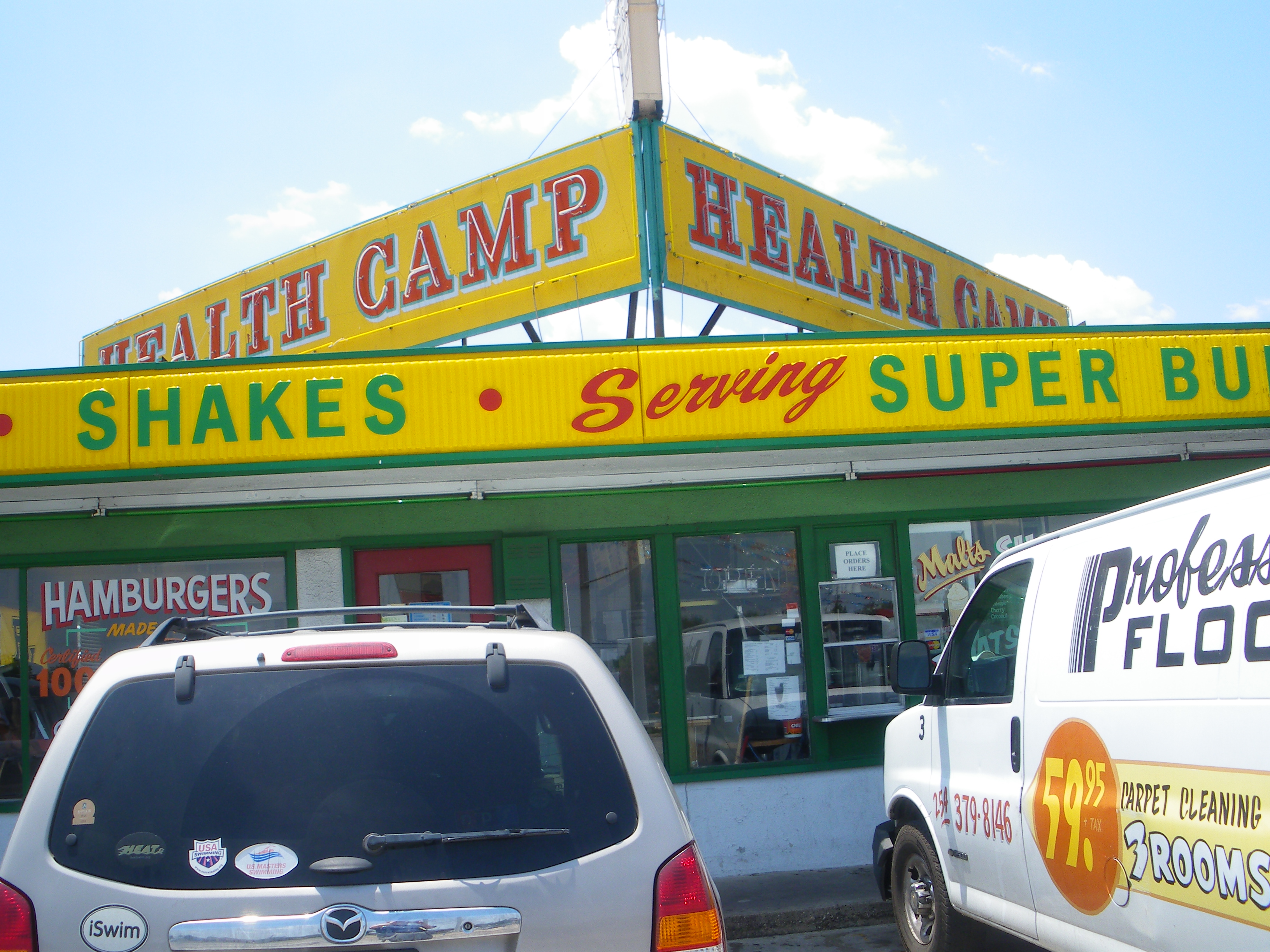
Health Camp Drive In, Waco Texas, Photo by Ed Darrell

Even after the lunch rush cars and pickups crowd the door at Health Camp.

Who names a burger joint “Health Camp?”

Established in 1949, it’s still dispensing “100% Angus ground chuck” burgers.  While it’s not a competitor for the title of World’s Best, to me, it’s a good burger, and the fries were pretty good, too.  The place specializes in milkshakes in a wide variety of flavors, including banana, butterscotch and peanut butter.  I did not ask if the peach flavor comes from fresh, or real peaches.

Here’s a photo from a few years back:

Health Camp burger stand in Waco, Texas

Health Camp burger stand in Waco, Texas - TexasBurgerGuy

It looks much the same.  If you’re passing through on Interstate 35, it’s not really that hard to find it at 2601 Circle Road.  Circle Road terminates literally in a circle — a “circus” in British terminology — less than 100 yards off of I-35.  Take Exit 333A going either north or south, aim for South Valley Mills Road on the east side of the freeway.  The next intersection is the Circle off of Circle Road.  Other roads going into the Circle include LaSalle Avenue, Robinson Road.  Elite Circle Grill has a larger, easier to find sign — and the two essentially share a parking lot.   If you’re at the Elite Circle Grill, you’re close enough to Health Camp to walk.

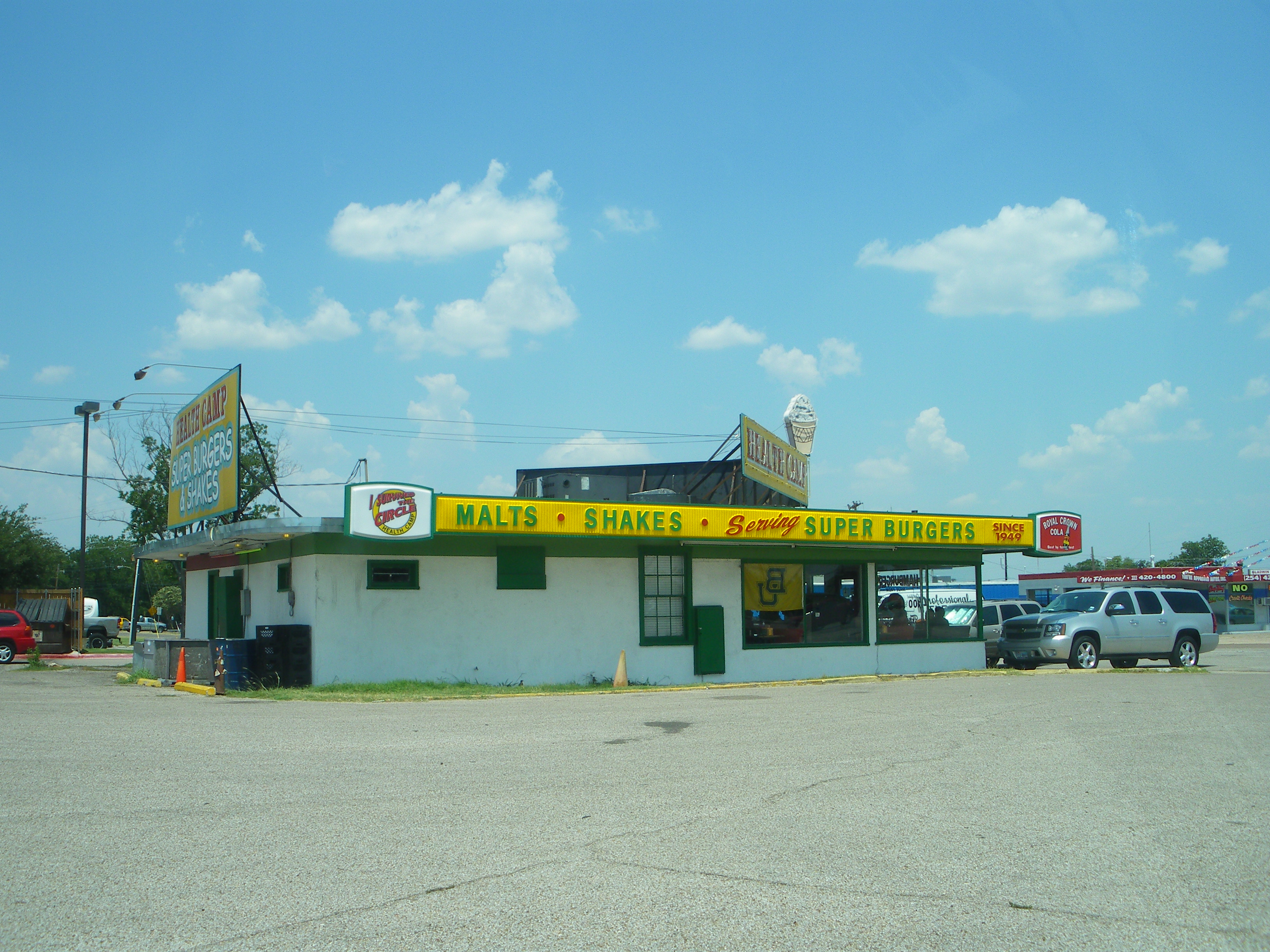
Health Camp in Waco, Evlis's local favorite, photo by Ed Darrell

More parking than needed, Health Camp shares parking lot with the Elite Circle Grill; daytime shots suffer from not showing the neon on the flying-V sign. Photo by Ed Darrell, use encouraged, with attribution.

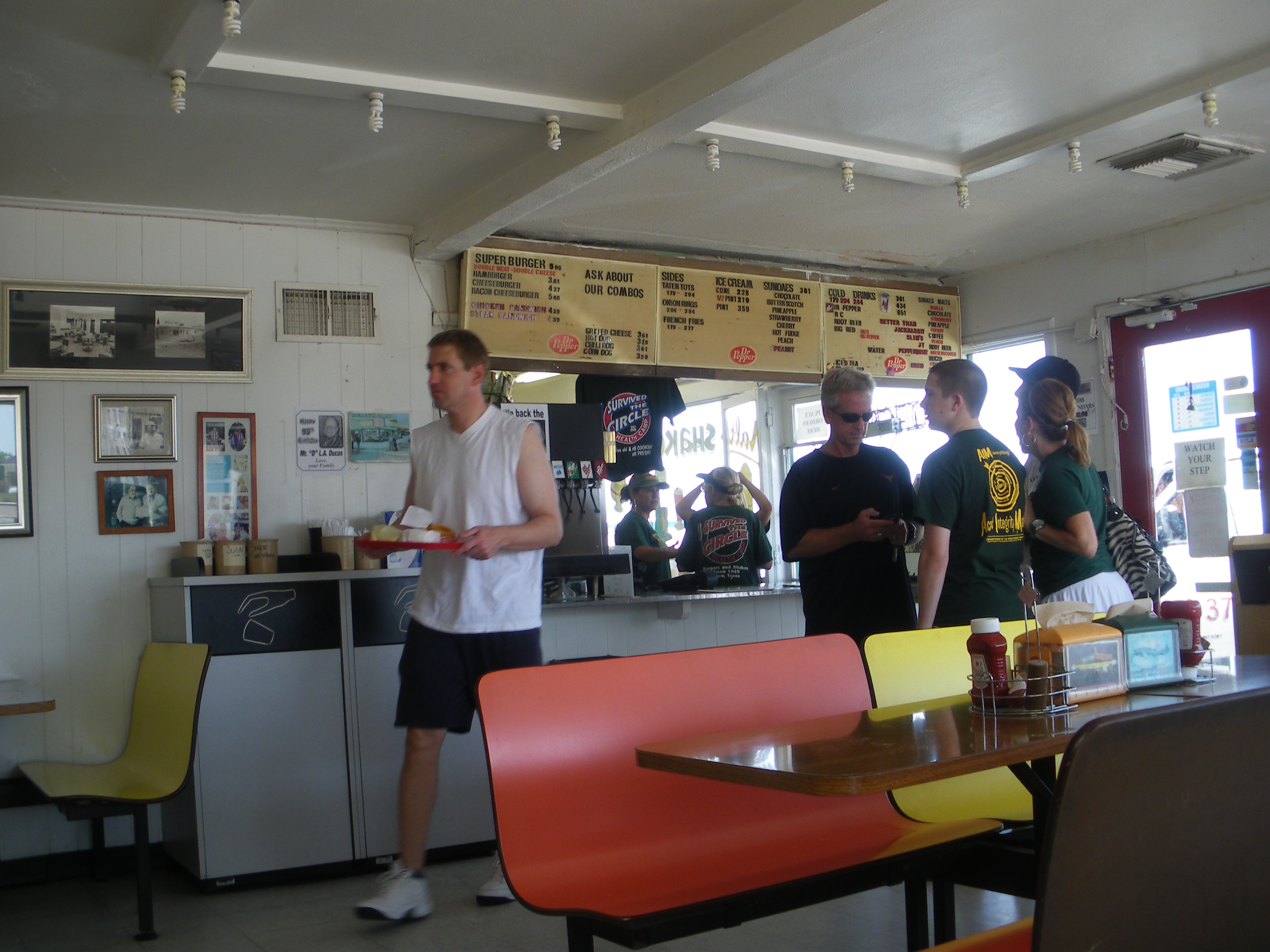
The business here is drive-in food, especially burgers and milkshakes.  Someone did a photo essay on drive-ins in Texas, and a dozen or so framed pictures of famous greasers lines the small dine-in room.  It’s formica and vinyl, and signs with plastic red letters on white — some of which have not been changed in months, perhaps in years.

It’s a classic place.  Not classy, but classic.

Interior of Health Camp Drive-in in Waco, Texas,   photo by Ed Darrell

Atmosphere? You came here for the burgers and the milkshakes. The seats work, the tables are clean, the ketchup isn't watered down. You want decor? Go to McDonalds.

They know what they’ve got.  A combo meal — burger, fries or tots or rings, and drink, will be north of $6.00; add a shake, you’re up to $8.00  Change back from your $10 or $20.

I got a cheeseburger, mayo, “all the way.”  Very good beef, satisfying, fresh and sweet onions.  Fries could have been cut in the place, but I’ll wager they were frozen — not highly processed beyond that.  Fried to a good crisp, they screamed for ketchup.

A stop here beats a stop at any of the big chains, but will cost you a bit more.  True burger aficionados may complain.  Let ’em.

I’ll stop there again with pleasure, unless I think I have time to try the Elite Circle Grill for a comparison.  I thought fondly of the Owl Burger at the Owl Cafe in Albuquerque, and the Big H from Hires Drive-In in Salt Lake City, both superior to the Health Camp product.  But they are related closely enough for horseshoes.

Health Camp cheeseburger and fries - photo by Ed Darrell

The Health Camp cheeseburger comes wrapped unassumingly in paper, served on a plastic tray. Clearly the management puts its effort into ingredients and preparation.


Ben Stein in a nutshell (appropriately)

July 8, 2011

Ben Stein is too easy to kick around anymore.  His views on politics, science, and general public policy have inflated so much above the troposphere that he really cannot speak about life on the ground at all.  The movie mockumentary “Expelled!” provided the early signs of pundit dementia.

Graphic for Ben Stein's American Spectator column

Graphic for Ben Stein's American Spectator column: Even in the art, Stein's out of it; his column is titled, "Nation's Pulse," but the graphic shows Uncle Sam hooked up to a machine measuring everything but his pulse. Even Sam's genitals get wired, but the nurse isn't counting heartbeats, nor does it appear any other monitor is.

At the same time, he’s a friend of dogs.  One of his tributes to his old dog literally brought tears to my eyes, and reminded me much of the old saying that heaven has no room for those who don’t like dogs.  That also raised the horrible vision of spending eternity in a heaven with dog-lovers who also happen to be political idiots.

Stein won’t kick dogs, but he’ll kick scientists, and poor people, and anyone in the middle class.  Maybe heavens don’t take people solely on the basis of their affection for dogs.

I digress.

At the remains of the American Spectator — a once-great, nearly revolutionary and smart journal of conservatism slipped on the slime to twitchy, bumper-sticker politics — Stein’s every-issue column turned to his vacation in an exclusive and expensive home in Sandpoint, Idaho, his distaste for undeveloped land and and outright fear of wilderness, friends, and the birth of his granddaughter, nicknamed Coco:

I feel so worried about Coco, She is only a tiny infant with eyes barely open. What do I want Coco to know? To do her best. To love her parents. To forgive. To be a lot more prudent about money than I am. To be grateful for this, our America, the best place in the universe. To turn her will and her life over to God and turn to Him for help in every situation.

But I wish my parents and Alex’s parents were here to help. And I wish my sister lived closer so she could help. And that Mr Nixon were still alive to give the leaders of this nation some clue about how to lead a nation. I am excited about Coco, but I am scared.

Right emotions, wrong thoughts.  We need Lyndon Johnson, with a concern for eliminating poverty among the aged (something he did!), not Richard Nixon.  With the possible exception of his trip to China, nothing Nixon did couldn’t have been done better by Johnson with another four years, or Humphrey, had we had the sense.

But that’s Stein.  He’s human on the family front, full of emotion, loving dogs, getting a cold treat for his ill wife, worrying about the future his granddaughter faces, especially from his privileged palace in Sandpoint, a nice nearly-wild area unfortunately become home of right-wing militias, Aryan-loving neo-Nazis and Keystone Kops-style militias — then switching to his brain-driven mode from emotion-driven, and doing everything he can to make sure anyone who lacks a few million dollars in the bank courtesy of the Old Man will be unable to rise above the fears.  Stein luckily led a charmed life, dependent on the kindness of family, friends and strangers, and he cannot understand why others don’t do the same.  Stein’s solutions stand magnificently out of reason:  Out of work?  Take a tax cut.  Need money to go to college?  Your father needs a tax cut, if he’s rich.  Health care tough to find because you can’t pay for it?  Tax cuts for the owner of the company you wish to work for.  And stop your arguing for more practical or workable solutions whining.

Stein stands in such sharp contrast to the Nepali prince Siddhartha, whose views of real life led him to forsake his princely heritage and seek spiritual enlightenment.  One hopes for a Stein-like character with the conscience of Siddhartha, but the practicality of Ross Perot who once noted that what America really needs is a political leader who will fill some potholes, and then, instead of holding a press conference about it, fill some more potholes.

Ben Stein’s road of life has been stripped of most potholes.  It’s so smooth, he can’t understand why everyone doesn’t drive that way, going to fancy school’s on Dad’s big money, hobnobbing with Republicans at the country club and occasionally taking the opportunities they toss your way.  Wouldn’t such a life be divine?


Still U.S. flags on the Moon?

July 7, 2011

One of the most dramatic categories of evidence that the U.S. landed men on the Moon is the detritus and other stuff they left behind.  Now we have satellites orbiting the Moon that can send back images of the landing sites with an amazing amount of detail.

Around the 4th of July somebody usually wonders how those flags left behind, are doing.

CBS News reporter Jim Axelrod asked around; you can see his report at YouTube (CBS disallows embedding of these reports, so you’ll need to click the image a couple of times to go to the YouTube site for CBS):

(720 views of this report when I posted this; come on, news hounds, flag fliers and Moon and history buffs, you can boost that total.)


Quote of the moment: President asks the Senate Majority Leader for help on the debt ceiling issue, in 1983

July 7, 2011

In a letter to the Majority Leader of the U.S. Senate, the President wrote:

This letter is to ask for your help and support, and that of your colleagues, in the passage of an increase in the limit on the public debt.

As [the Treasury Secretary] has told you, the Treasury’s cash balances have reached a dangerously low point.  Henceforth the Treasury Department cannot guarantee that the Federal Government will have sufficient cash on any one day to meet all of its mandated expenses, and thus the United States could be forced to default on its obligations for the first time in history.

This country now possesses the strongest credit in the world.  The full consequences of a default — or even the serious prospect of default — by the United States are impossible to predict and awesome to contemplate.  Denigration of the full faith and credit of the United States would have substantial effects on the domestic financial markets and on the value of the dollar in exchange markets.  The Nation can ill afford to allow such a result.  The risks, the costs, the disruptions, and the incalculable damage lead me to but one conclusion:  the Senate must pass this legislation before the Congress adjourns.

I want to thank you for your immediate attention to this urgent problem, and for your assistance in passing an extenstion of the debt ceiling.

Sincerely,

         Ronald Reagan

True then.  Still true now.

Letter from President Ronald Reagan to Senate Majority Leader Sen. Howard Baker, R-Tennessee, November 16, 1983.  The Treasury Secretary at the time was Donald Regan.

Tip of the old scrub brush to mainstream media pillar, The Washington Post, where a .pdf of the letter is available.


Full Moon, waterfalls in Yosemite, modern cameras: Voila! Moonbows!

July 7, 2011

Dick Feynman taught in Rio de Janeiro for a while.  He was frustrated at the way Brazilian students of that day learned physics by rote, instead of in labs.  In a lecture he looked out from the classroom to the sun dancing on the waves of the Atlantic, and he realized it was a beautiful, brilliant demonstration of light refraction, the topic of the day.  Sadly, the students didn’t understand that the beauty before them was a physics problem.  (Was that story in Surely You’re Joking, Mr. Feynman,  or What Do You Care What Others Think?)

Here, a marriage of physics, moonlight, spring runoff over a cliff, and modern photography, in Yosemite.  If you don’t gasp, call your physician and find a new sensei:

(Programs and maintenance of this park are threatened by Republican budget writers, BTW.)


Stroll through history: 100th History Carnival

July 6, 2011

The Century edition, 100th Carnival of History is up on the internet, over at Walking the Berkshires.  Well worth the stroll.

Who says history isn’t sexy or exciting?  Tim Abbott, in the text discussing entrants to the 100th History Carnival, tossed off this gem:

And then we have certain minted pneumismatic artifacts of scholarly interest blogged about at Hypervocal.  Be forewarned that these may be considered NSFW in some quarters.  Are they ancient Roman brothel tokens, or possibly pornographic gaming pieces?  At right, a proposed design for a modern token, suitable for use by disgraced US Congressmen in exchange for sexting services, appropriately priced at “sex asses”, if I remember my High School Latin.

You’ll have to go read it there if you don’t know immediately what he’s talking about.

Other pointers to great posts, with more that I haven’t mentioned:

Now:  Is there some way to sneak a copy of the 100th History Carnival into the e-mail of every member of the Texas Lege?


Cicada killers, 2011 edition

July 6, 2011

It’s slower population growth than in the past, but earlier, too.

In earlier years we’ve had cicada killer wasps — cicada hawks, in some parlance — as early as July 7.  Rains fell all spring in 2010, which discouraged the emergence of cicadas and their predators.  First certified sighting in our backyard did not occur until July 18.

Cicada Killer, with cicada - photo by Ronald F. Billings, Texas Forest Service, Bugwood.org

Cicada Killer, with cicada - photo by Ronald F. Billings, Texas Forest Service, Bugwood.org, via University of Delaware Cooperative Extension

We had modified a planter, and that may have killed some of the larvae.  Generally 2010 was a slow year for the large wasps.  My guess is that they were less active locally because the ground remained wet through July and into August.  I still get e-mails asking about how to get rid of them, and I still recommend watering the spots you want them to leave.  The females sting and paralyze a cicada, then plant that cicada in a tunnel underground with one wasp egg.  The young wasp hatches and feeds on the cicada, emerging usually the next summer to carry on the cycle (in a long summer, there may be a couple of hatchings, I imagine).  Females do not like to tunnel in wet ground, partly because it collapses on them, and I suspect wet ground is conducive to fungi and other pests that kill the eggs or hatchlings. Our wet weather kept them away last year.

I waited to say anything this year because I wanted more, but we saw the first cicada killer wasps this year on June 27, 2011, the earliest date we recorded here.  I had hoped to get a good photo, but that hasn’t happened yet.

Down at Colorado Bend State Park, the cicada killers greeted our arrival, much to the panic of the little kids in the campsite next door.  They were happy to learn the wasps don’t aim to sting them, and the kids actually watched them at work.  One of the wasps reminded me of just how much they like dry ground — she kept tunneling into the fire pit, unused now because of the fire bans that cover 252 of Texas’s 254 counties.  Covering the holes, putting objects over the holes, nothing could dissuade her from using that site.  I hope for the sake of the larvae that they hatch soon, and get out, before someone builds a fire in the pit.  Some of the cicadas in that area hit 110 decibels at least, and they badly need the discipline of a force of cicada killers, if you ask me.

Prowling the yard this morning I found two more emergence holes.  The wasps leave a smaller hole than the cicadas, so I’m pretty sure they are back in force.

Nature, red in tooth and claw, the poets say.  Or in this case, moist in sting.

It’s summer.  By the weather, it’s late summer.   Hello, cicada killers, Sphecius speciosa.

Earlier at Millard Fillmore’s Bathtub:

More:


Watching the drought roll in at Colorado Bend State Park

July 6, 2011

It took me a couple of tries to figure it out — last week when I told people Kathryn and I were off to Colorado Bend State Park to spend time on the river, several people commented about how much cooler it would be there.

What?  West of Killeen about an hour, ten miles of dusty road outside of Bend, Texas (population 1,637), Colorado Bend is not cooler than Dallas.  It was over 100° F every day we were there, stayed well above 90° most  of the nights.

Kathryn Knowles checking wildflowers, Colorado River, Texas

Kathryn studied wildflowers at a spring at the side of the Colorado River during a break from kayaking; this spring's flow was reduced, but still moist enough to create a near-oasis.

Our well-wishers were geographically confused.  They thought we were headed to the Colorado River in Colorado, not the Colorado River in Texas, which is not the same river at all.  I didn’t bother to check the temperatures in Colorado, but one might be assured that it was cooler along the Colorado River in Colorado than it was along the Colorado River in Texas.

It was a return trip.  We stumbled into the park 16 years ago with the kids, for just an afternoon visit.  The dipping pools  in the canyon fed by Spicewood Springs captivated us.  It took a while to get back, and then the kids were off doing their own thing.

So, just a quick weekend of hiking/camping/kayaking/soaking/stargazing/bird watching/botanical and geological study.   Park officials closed the bat caves to human traffic in hope of keeping White Nose Syndrome from the bats; we didn’t bother to sign up for the crawling cave tour through another.

Ed Darrell at Colorado Bend State Park, Texas

The author, still working to master that Go-Pro camera on the hat -- some spectacular shots, but I don't have the movie software to use it all; you know it's hot when SPF 75 sunscreen is not enough.

What did we see?  Drought has a firm grip on Texas, especially in the Hill Country, especially outside of Dallas.  The Colorado River  is mostly spring fed; many of the springs are dry.  No water significant water flowed through the park while we  were there — kayak put-ins have been reduced to the downriver-most ramp, and the bottom of the boat launch ramp is three feet above water.  Gorman Falls attracts visitors and scientists, but the springs feeding it are about spent this year — just a few trickles came over the cliff usually completely inundated with mineral-laden waters.

Drought produces odd things.  The forest canopy around the park — and through most of the Hill Country we saw — is splattered with the gray wood of dead trees, many of which at least leafed out earlier this spring.  The loss to forests is astonishing.  Deer don’t breed well in droughts; deer around the campsites boldly challenge campers for access to grasses they’d ignore in other seasons.  One ranger said he hadn’t seen more than about three fawns from this past spring, a 75% to 90% reduction in deer young (Eastern White Tail, the little guys).  Raccoons are aggressively seeking food from humans, tearing into tents and challenging campers for food they can smell (lock your food in the car!).  Colorado Bend is famous for songbirds, including the endangered Golden Cheeked Warbler, and the elusive, spectacular painted bunting.  But the most commonly-sighted birds this year are turkey vultures, dining on the young that didn’t make it healthy into the summer and won’t survive until fall.

Warming denialists’ claims of “not so bad a drought” ring out as dangerous, wild delusion.  (By actual measurement, Texas average rainfall the past nine months was 8.5 inches, the driest ever recorded in Texas, shattering the old record drought of 1917).

Great trip.  Kathryn’s menu planning was spectacular.  The old Coleman stove  — a quarter century old, now, with fuel almost that old — performed like a champ even without the maintenance it needs (later this week).  Other than the hot nights, it was stellar.

Stellar.  Yeah.  Stars were grand.  It was New Moon, a happy accident.  A topic for another post, later.  Think, “Iridium.”

So posting was slow over the weekend.  How far out in the Hill Country were we?  Neither one of us could get a bar on our phones.  We were so far out the Verizon Wireless guy was using smoke signals.

Thoreau was right, you know.


That flag you flew yesterday — want to burn it today?

July 5, 2011

Some of the more astute students in our high school classes ask questions about everything.  For example, they ask:  “What does the Pledge of Allegiance mean, when it says, ‘ . . . and to the Republic for which it stands?'”

Is the Pledge all that important?  Is the flag all that important?

Maybe.  How would you answer that question, really?

Penn and Teller offer a demonstration:

What do you think?  Did they burn a flag?  Should that sort of performance be legal?

What if Penn and Teller burned a flag in the White House?

An exercise in ambiguity:  A fictional drama about a sleight of hand, illusionary performance.  (Best line:  The answer to the question, “Did you go to law school?”  For the record, yes, I did go to law school.  I’m an amateur clown.)

Did you fly your  flag yesterday?


July 4, 2011 – Fly your flag today

July 3, 2011

Fourth of July: NPR has already read the Declaration of Independence, PBS broadcast the Capitol Fourth concert  last night (maybe a rebroadcast is available — check your local listings), your town has a parade somewhere this weekend, and fireworks are everywhere.

Remember to put your flag up today.

Astronaut Eugene Cernan and the U.S. Flag -- Apollo 17 on the Moon (NASA photo)

Last flag on the Moon: Astronaut Eugene Cernan and the U.S. Flag -- Apollo 17 on the Moon (NASA photo)

Also:

Lunar Reconnaissance Orbiter photo of Apollo 17 landing site

Lunar Reconnaissance Orbiter photo of Apollo 17 landing site

This is mostly an encore post, but I so love that photo of the flag with the Earth in the distance.

Happy birthday, Kathryn!


Little Rock’s Central High School, monument for civil rights

July 1, 2011

On the way out of Little Rock, Arkansas, after our day at the William Jefferson Clinton Presidential Library and Museum, we stopped at the Little Rock Central High School National Historic Site.

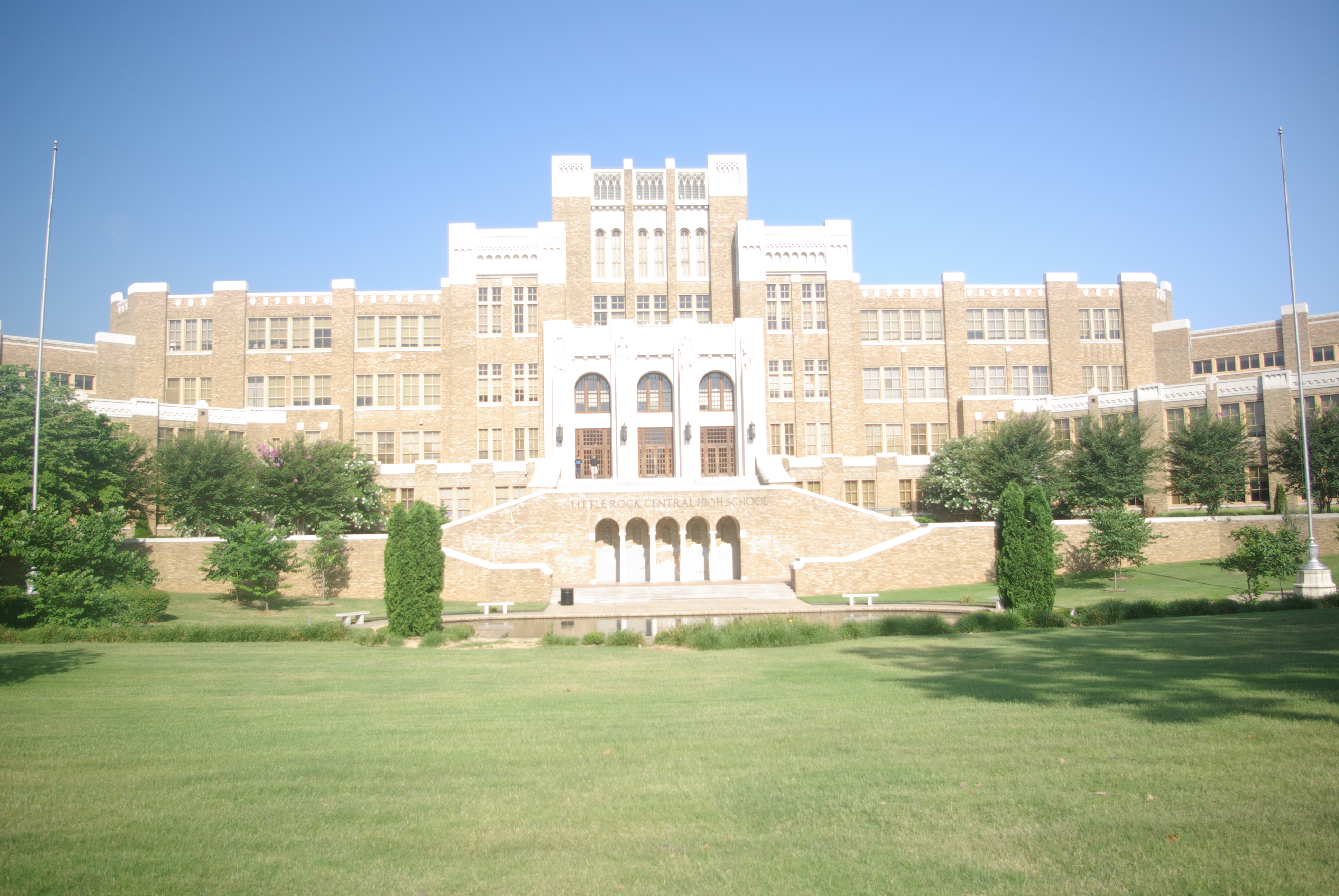
Little Rock Central High School in 2011, photo by Ed Darrell - use permitted with attribution

Little Rock Central High School in 2011, photo by Ed Darrell - use permitted with attribution

In 1957 nine African American kids tried to enroll at the school, breaking high school segregation in Little Rock.  After assuring President Dwight Eisenhower that the Arkansas National Guard would preserve the peace, Gov. Orval Faubus ordered the Guard to keep the students out.  Eisenhower called up the Guard to federal duty, and sent in the 101st Airborne from the regular U.S. Army to enforce the desegregation rules.  (Imagine any president doing that today!)

Pre-Art Deco front of Little Rock Central High School, built in 1927 - photo 2011 by Ed Darrell, use permitted with attribution

Pre-Art Deco front of Little Rock Central High School, built in 1927

Eventually Little Rock closed down all the schools for more than a year, and then federal courts ordered the schools opened, but desegregated.  One black student graduated that first year, Ernest Green.  The other eight all graduated, but from other schools around the world.

Today, it’s history, even in Little Rock.

Little Rock Central High remains in use today.  The National Park Service maintains a visitor center across the intersection from the school, with the old Magnolia Oil gas station, restored, on another corner, and a monument to the Little Rock Nine and civil rights on the remaining corner  (Magnolia Oil was absorbed into Mobil, which took on Magnolia’s flying horse emblem).  Our Dallas Independent School District, Teaching American History Grant group visited in mid-June.  Classes were out.   The visitor center remains open year around.

I was particularly curious to see whether and how the historical events, and the commemoration of them, affect the school itself.
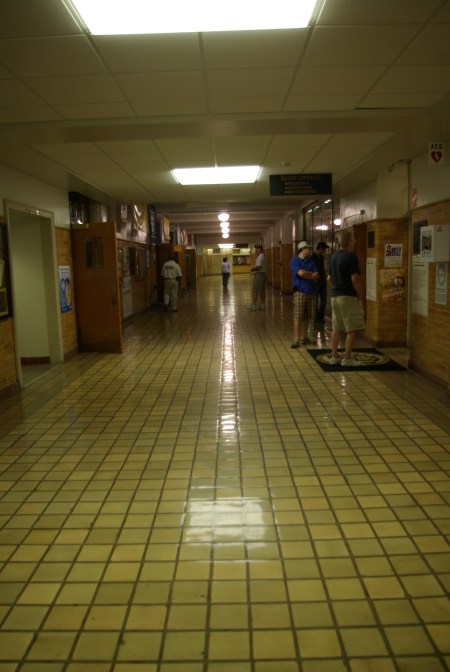
Hallway inside Little Rock Central High School, photo by Ed Darrell, use permitted with attribution

The hallway outside the auditorium on the main floor of Little Rock Central High School.

On the inside, it’s a normal American high school — though in a grand building (I’d compare this to Ogden, Utah’s Ogden High School, a WPA-style project of a decade later’s construction, and a grand old building students and citizens have come to love).

Walls bear posters from student clubs.  Signs direct students to classes, or the auditorium, or the lunchroom.  The office looks more like the 1970s than the 1930s — I suspect it has been updated.  Ceilings have been redone since 1927, with newer fluorescent lighting and acoustic ceiling tiles, which only brings the architecture of 1927 down to 1970s box-style building standards.

Sign announcing a club meeting, Little Rock Central High School, 2011 - photo by Ed Darrell, use permitted with attribution

Walls of Little Rock Central carry notices of club meetings, much as in 1957. Some of the clubs have changed; the Gay-Straight Alliance probably was not active in LIttle Rock in 1957. Changes in U.S. culture in the 54 years since the Little Rock Nine, are reflected in the citizens and their actions, and not necessarily in the physical buildings.

It’s a working school, and not a monument on a pedestal frozen in time in any sense.

The school opened 30 years before it became an icon in the struggle for civil rights.   It is a massive structure, intended perhaps as a sort of monument to Little Rock and to Education.  NPS describes it at their website:

Built in 1927 as Little Rock Senior High School, Central was named “America’s Most Beautiful High School” by the American Institute of Architects.

Designed as a mix of Art Deco and Collegiate Gothic architectural styles, the building is two city blocks long and includes 150,000 square feet of floor space. More than 36 million pounds of concrete and 370 tons of steel went into the building’s construction. It cost $1.5 million to construct in 1927. The school received extensive publicity upon its opening. An article in the Arkansas Gazette said, “we have hundreds of journalists in our fair city for the dedication” of the new high school.

At its construction, Central’s auditorium seated 2,000 people and included a 60 x 160 ft. stage that doubled as the gymnasium. A new library was built in 1969 and named for longtime principal Jess W. Matthews.  In 1953 the school’s name was changed to Little Rock Central High School, in anticipation of construction of a new high school for white students, Hall High School in Pulaski Heights.

Computer classroom at Little Rock Central High, June 2011 - photo by Ed Darrell; use premitted with attribution

Computer classroom at Little Rock Central High - Historic preservation cannot prevent the updating of classroom technology. Wiring these classroomms for computer networks must be quite difficult.

I thought it interesting that the original construction did not include a library.  The auditorium’s doubling as a basketball gymnasium explains the massive stage — suitable for Las Vegas, really.  “Multi-purpose” building for schools originated much earlier than the 1970s as I had imagined.  The 1927 plans included neither the tendency to overbuild fschools for athletics, nor today’s pre-occupation with making schools appear as academic enclaves.

Visiting the site you can learn that the $1.5 million cost consumed the entire building budget for the district in 1927.  In keeping with the separate but equal doctrine of the times (see Plessy v. Ferguson), the Little Rock district “planned” to build a high school for blacks at the same time.  No money remained for either design or construction.

City leaders — I would imagine black city leaders, without much help from whites, but I may be too cynical — raised money to pay the same architects to create a complementary design for the school that would be called Dunbar.  Private funding paid for construction, too.  Exactly this sort of discrimination against blacks roiled across America from 1896 into the 1950s — only 16 states banned discrimination by race, with laws that were not always enforced.  These issues were key to several of the cases rolled into the Supreme Court appeal that we usually call simply The Brown Decision — facilities were involved in the cases in Topeka, Kansas, Prince Edward County, Virginia, Delaware, and Washington, D.C.

Looking at Little Rock Central High School today one can see the physical manifestation of the insidious separate but equal doctrine, and understand perhaps why it collided with the drive for rights in Little Rock, at the corner of 14th Street and South Park Street.  The school’s address is listed as 1500 South Park.  14th Street, running along the north edge of campus, has been renamed Daisy L. Gatson Bates Drive, in honor of the NAACP organizer who provided wise counsel, sage advice, a ride to school on most mornings and friendship to the students who made up the Little Rock Nine.

A large amount of history resides in Little Rock.

Ha! — You don’t need to rely on my photos at all.  Turns out NPS has a photo slide show at their website.  Note how my ideas paralleled theirs — and honest, I didn’t see that before our tour.  Actually, the auditorium curtains were closed, nor did we get into the balcony — the photo from NPS is much better than any I got.

Nota bene: The intense, three-year program of study of U.S. history for this three dozen or so teachers is made possible by a grant from the U.S. Department of Education, a Teaching American History Grant.  Such grants fund the study of American history for teachers across the nation, to spur better teaching from greater understanding and knowledge of history.  These grants generally float at the top of the pool of programs to be cut first when the budget axes fall.  We are grateful to the Department of Education.  And while my writings here do not necessarily reflect the views of any of my employers, past or present, they should — and the Senate, Department of Education and others in the stream of funding would be well-advised to continue these grants.