Quote of the moment: Gold standard a “barbarous relic” – Keynes

January 18, 2012

Portrait of John Maynard Keynes as a younger man

Portrait of John Maynard Keynes as a younger man (who is the artist? where does it hang?)

  • In truth, the gold standard is already a barbarous relic.
    • John Maynard Keynes, Monetary Reform (1924), p. 172

    Did Keynes foresee the rise of Ron Paul, even in 1924?

    Gold Key, weighing one kilogram is used to acc...

More, resources:


Sherffius cartoons from the mount

January 18, 2012

Mount Rushmore, that is:

John Sherffius cartoon, 11-1-2011, Mt. Rushmore advice

John Sherffius, Boulder Camera, November 1, 2011

Is John Sherffius channeling Mount Rushmore?  What do you think?

To understand political cartoons, one needs to understand the iconography used in them.  Certainly Mount Rushmore and the four presidents it portrays is one of the more powerful icons in the United States, a Great Depression-era monumental sculpting project, the genius of Gutzon Borglum writ very, very large, and now a part of the National Park System, as a National Memorial in South Dakota, one of our smallest states in population, and one of the last frontier states in America.

I don’t have a favorite — there are too many good versions, in cartoons, in parody, as patriotic symbol, as a backdrop for Hitchcock movies,  and as a representation of the heritage of Chicago blues, among others.  What is your favorite use of the Mt. Rushmore icon, or your favorite photo of the carvings?  Give us a link in comments, please.


January 17, and auspicious births

January 17, 2012

The First American, Ben Franklin, was born on this day in 1706.  Exactly a century later, Thomas Jefferson’s daughter, Martha, bore James Madison Randolph, the first child born in the White House (fitting that Thomas Jefferson’s grandson would be named after James Madison, no?).  And in 1990, James Darrell was born in Dallas, Texas.

Happy birthday, James!


Say what? India only now figures out DDT kills birds?

January 17, 2012

Here’s a troubling thought:  What if India’s use of DDT now is just as destructive as the use of DDT in the U.S. in the 1950s and 1960s?

Why even mention it?  We’ve been reminded here that in the 21st century India is the world’s leading producer of DDT, and that the nation uses more DDT than the rest of the world combined.

Mon Town Baptist Church in the mist, Nagaland, India - Wikipedia image

Mon Town Baptist Church in the mist, Nagaland, India. The people of the state of Nagaland are mostly Christian, and local Baptist groups were among the most politically active groups who worked to put an end to fighting in the area in the early 1960s – Wikipedia image

From my perch in Dallas, Texas, it’s difficult to get a perspective on just how much DDT is used in the nation, and how much of the use is abusive, out of doors, or leading to environmental contamination.

One of the news feeds picked up on this opinion piece from Maneka Gandhi, blogging at the Nagaland PostNagaland is India’s most northeastern province.

Blyth’s Tragopan is the state bird of Nagaland, India's most northeastern province. A member of the pheasant clan, this beautiful bird is threatened by overhunting and DDT, even though it is chiefly a seed eater.

Blyth’s Tragopan is the state bird of Nagaland, India’s most northeastern province. A member of the pheasant clan, this beautiful bird is threatened by overhunting and DDT, even though it is chiefly a seed eater.

Among other troubling issues:  Ms. Gandhi talks about “with the disappearance of the vulture.”  Ecologists should sit up and take note of that; what cleans up the roadside carrion in Nagaland?

Killing birds due to human activity

[Maneka Gandhi]

16 Jan. 2012 11:51 PM IST

Last week I wrote about the strange and mysterious deaths of birds and fish that have taken place. But how many birds are killed every year due to human activity? I am not going to take into account the billion chickens that are killed at the rate of 1000 every minute, the turkeys, emus, ducks, quail that are slaughtered in the millions. I am talking about the birds you do not eat but kill anyway with deliberate malice or carelessness. Why are you ignorant of these? Because bird bodies are rarely found on the roads.

Night roaming scavengers finish them off very quickly. Here’s one estimate of numbers. A 2005 paper by Wallace Erickson, Gregory Johnson, and David Young (“A Summary and Comparison of Bird Mortality from Anthropogenic Causes with an Emphasis on Collisions”) estimates that 500 million-1 billion birds are killed each year in the U.S. alone from human-related causes.

This includes: Collisions with buildings – 550 million (58.2%) Collisions with power lines – 130 million (13.7%) Cats – 100 million (10.6%) Cars, trucks, etc. –80 million (8.5%) Pesticides – 67 million (7.1%) Communication towers – 4.5 million (0.5%) Wind turbines – 28.5 thousand (less than 0.01%) Airplanes –25 thousand (less than 0.01%) Other sources (oil spills, fishing by-catch, etc) – did not estimate I would put the same number in India.

Perhaps decrease the collision with buildings and increase the pesticide hit ones. While large mortality events make the news, the constant attrition, the constant killing has put one in six bird species worldwide in danger of extinction because of the factors listed above plus habitat loss, invasive species, and climate change. I was in Kolkata recently to start a campaign to save sparrows. It consisted of caps, drawings, speeches and the distribution of bird feeders.

I hope it will work but this much I learnt – very few of the children in the school had even seen a sparrow. How many kinds of birds have you seen? Most cities now just have crows and kites and a few parakeets. Looking at this list, can you see a number of ways that people – from municipalities to individuals can work to prevent at least some of these deaths.

Things like making windows and other structures more visible to birds, keeping cats indoors, and minimizing use of pesticides are all crucial to the survival of many species. The deaths are huge and quick but they are preventable if we just tweak our lifestyles. If I told you that you stood at the edge of a cliff and a little step forward would kill you but if you just sidestepped, you could reach safety, would you not?  Often the disappearance of a bird species alters entire human lifestyles, forcing them to change.

With the disappearance of the vulture most villages have had to think of what to do with cow/bullock dead bodies.

The carcass which would have been cleaned up in an hour by the vultures now becomes a threat to human life. No solutions have been found as yet. The Parsis will have to find another way to honour their dead as the towers of silence have no vultures so an entire religion has changed. China lost its sparrows (killed all of them) and then lost its grain because the insects proliferated. It finally had to import sparrows and start rebreeding them.

Today it is losing them again – as we are. Animal mortality is actually a far larger problem than these numbers might suggest. Just one example: in the U.S. there are some 70 million house cats. Each year they kill off hundreds of millions of native birds and more than a billion small mammals such as rabbits, chipmunks, and squirrels. The numbers are staggering. But they tend to go unnoticed, except by ecological researchers.

Most people consider what these cats (which are non-native, invasive pets) are doing to be “natural.” While animals are killed by weather fluctuations, lightning generated fires, the impacts of volcanism, earthquakes or other natural threats, all these hazards pale in comparison to what humans do to them. We have become by far the most significant factor in the deaths of individual animals, or entire species over the past several centuries.

There are many lethal artifacts of civilization. These range from agricultural toxins, to industrial pollution, to lawn care chemicals, to windows and glass buildings (which attract birds to collide with reflections), to predatory pets, to wires to loss of crucial habitats. So many birds have been killed by DDT alone – and it is still being used.

When the Americans finally noticed that their national bird, the Bald Eagle, was disappearing due to DDT, they banned it. We have lost all our birds of prey because DDT does a lot more than just kill insects. It impacts birds of prey to such a degree that it causes their eggs to weaken so that they can’t hatch.

Our consumption of fish is killing all the shore birds. With sonar fish finders and GPS technology, fish harvesters are decimating swordfish, tuna, and a host of other “food species” as our world population swells to 7 billion.

Make a New Year resolution that goes beyond not smoking, drinking and being nice to your mother/daughter in law. Start by making your house less toxic and by eating organic wheat/dal/rice. Plant as many fruit trees as you can so that birds have somewhere to nest. Choose a village and see if you can help them clean up their water body.

More, resources: 


Arab Spring spreads to Europe?

January 16, 2012

English: Emil Boc speaking.

Romanian Prime Minister Emil Boc - Image via Wikipedia

Eric Koenig wondered, and wrote:

On December 17, 1989, Romanian security forces fired into a crowd in the city of Timişoara. Scarcely a week later, the Romanian revolution was over and Nicolae Ceaușescu and his wife had been toppled and tried and summarily executed. Now thousands of people are protesting in Romania and calling for the ouster of their President (who has been in some political hot water himself, being “suspended” briefly and narrowly escaping impeachment in 2007, during his first term) and many of the protests started in the same city.

Is history repeating itself?  Stay tuned …

http://www.dailystar.com.lb/News/International/2012/Jan-15/159949-romania-protests-spread-despite-health-bill-withdrawal.ashx#axzz1je7ndQhJ

http://www.bbc.co.uk/news/world-europe-16570860

The story isn’t being followed by many US newspapers. Yet.

I think it’s not quite so simple, nor a repeat of 22 years ago.  Romanians protest austerity cuts to their government-paid health plans, according to BBC:

Romanian Prime Minister Emil Boc has called for dialogue and an end to violence after four days of protests against austerity cuts.

Dozens of people were hurt on Sunday, as demonstrators and riot police clashed for a second day running in the capital Bucharest.

The rallies began in support of an official who quit in protest against health care reforms.

But they have grown into a broader hostility towards government policies.

The alliance of opposition parties has called for early elections.

I think the economic grievances are not of the same kind as those in Africa and Arabia, nor are they so deep as the extreme discontent with Ceaușescu’s communist government 22 years ago.

But, who can tell what’s really going on?  We have to depend on reports from Lebanese newspapers, and rewrites of those stories from the Associated Press?

Government change poses astonishing opportunities in the past year, especially these home-grown, nationalist liberation movements.  New resources, cut back from a century ago, leave us without eyes and ears on the ground in too many foreign capitals.

English: Grave of the former dictator Nicolae ...

Bucharest grave of former Romanian dictator Nicolae Ceaușescu - Image via Wikipedia

Why aren’t we hearing more about the Romanian crisis in U.S. news media?  Well, there’s the war in Afghanistan, the ending war in Iraq, and trouble in Nigeria.  Then there is the South Carolina circus.   For all I know, American Idol is in the news today, too.

It’s not like either you are, or I am, Marie, the Queen of Roumania, right?  What could go wrong that might affect us?

Watch.  U.S. papers will pick up the story in small snippets over the next week or so.

Could you find Romania on an unlabeled map?

Map of Romania, from GreenwichMeanTime.com

Map of Romania, from GreenwichMeanTime.com

Location map of Romania, GreenwhichMeanTime.com

Location map of Romania, GreenwhichMeanTime.com


Fruits of the Republican War on Education

January 16, 2012

You didn’t think it was working already?

This story appeared in the Los Angeles Times, which is why Republicans discourage newspaper publishing, and why they discourage programs to teach people to read well and remember history.

In South Carolina, a discrepancy on federal spending

Campaigning Republicans draw cheers with their calls for cuts to government programs. But the state benefits from such programs to a greater extent than many others.

By Alana Semuels, Los Angeles Times

January 14, 2012, 7:55 p.m.

Reporting from Beaufort, S.C.—

When Rick Santorum stood in front of voters at a yacht club in this small town and pledged to slash government spending, especially entitlement programs, Nancy Garvin knew she had found her candidate.

Garvin, 54, said she was sick of seeing government squander money through agencies that don’t do anything, and wants expenditures cut “in half.”

Washington is throwing money away through a lot of wasteful spending,” she said, sitting at a picnic table beneath trees draped in graying Spanish moss.

But Garvin, whose husband, a carpenter, has been out of work for four years, depends on the very government she wants to see cut back. She collects disability insurance — it is what she and her husband have survived on as he’s looked for work. Her mother is on Social Security. Garvin herself used to work as a nurse at a hospital where many patients paid for services through Medicaid, another program using federal money.

Garvin’s views are similar to those of many Republican voters in this conservative state, where candidates pledging to cut government spending were met with resounding applause last week, and where former Gov. Mark Sanford tried to refuse federal stimulus funding on principle.

South Carolina and its residents benefit from government spending, more so than many other states. For every dollar the state pays in federal taxes, it receives $1.35 in federal government benefits. By contrast, California receives only 78 cents for every dollar it pays in taxes.

“We get more back from the federal government than we send in terms of revenue,” said Doug Woodward, an economics professor at the University of South Carolina. “But I’m not sure that a lot of voters would even care if they heard that. When they say they want to see less spending in the state, they’re referring to entitlement programs.”

Much of the money spent in South Carolina goes to the programs that make up a big chunk of the federal budget — defense, Social Security and Medicaid. The state has seven military bases, and received $7 billion in Defense Department spending in 2010. One in five residents in South Carolina receives Social Security benefits — compared with just 13% in California. As an aging state, South Carolina will be more dependent on federal programs such as Social Security in the coming decade, according to AARP.

“People want to see lower government spending, especially on the Republican side,” said Karen Kedrowski, a politics professor at Winthrop University in Rock Hill, S.C. “But when they’re asked specifically about high-dollar items, including Social Security and defense, they are not willing to accept significant cuts.”

Kedrowski’s university recently polled South Carolina Republicans to ask about reducing the deficit by making cuts to government programs: 73% of voters said they weren’t willing to have their current Social Security or Medicare benefits reduced to address budget concerns. More than half said they weren’t willing to cut defense spending either.

It’s not just wealthy Republican voters in the Palmetto State who say they eschew entitlement programs, Kedrowski said.

“There’s also a disproportionate number of low-income people who vote Republican because they respond to the populist messages, even when it is against their economic interests to do so,” she said.

Sheila Barton, 56, runs a floral shop in Pickens, a town that Rick Perry visited recently to stroll down Main Street and shake hands with store owners and residents.

“Americans don’t want a government that’s playing a bigger role in their lives,” Perry had said at a speech earlier that morning. “No one’s ever come up to me and said, ‘We sure need to have more government in our lives.'”

Barton agrees — in principle.

“There’s a lot of things that are wasteful,” she said, but when pressed to name some, she said she couldn’t really think of any off the top of her head. Defense spending should be increased, she said, and people who have paid into Social Security should receive their benefits. And local government programs need more funding, she said — she’s currently a guardian for local children through the court system.

There is some evidence that South Carolina’s opposition to government spending might further strangle the state’s already weak economy — if it leads to cuts in Social Security. Roberto Gallardo of the Southern Rural Development Center says that economies in many small towns in South Carolina are increasingly dependent on Social Security payments.

The percentage of total personal income in South Carolina coming from Social Security’s Old-Age, Survivors and Disability Insurance programs was 7.6% in 2009, up from 3.8% in 1970. South Carolina ranks eighth in the nation on the group’s Social Security Dependency Index, which measures how reliant local economies are on Social Security payments for job creation and consumer spending. Neighboring North Carolina ranked 23rd.

That means candidates have to walk a fine line here — promising to cut government to alleviate voters’ fears, while still preserving the programs that require most of the spending. How else to appeal to such voters as Clifton Anderson of Camden, who went to see Rick Santorum speak in a diner in Ridgeway?

“His ideas of downsizing government are most important to me,” said Anderson, about Santorum. He continued, in the next breath: “I also like his idea about strengthening defense.”

alana.semuels@latimes.com

Copyright © 2012, Los Angeles Times


Fly your flag today, in honor of the Rev. Dr. Martin Luther King, Jr.

January 16, 2012

You already have it up and waving, right?  Did I really need to remind you?

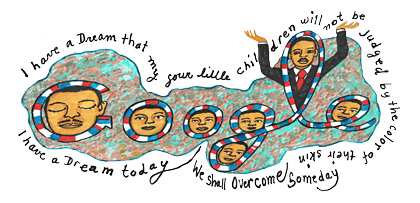
Google logo for Martin Luther King, Jr., Day 2012

Google logo for Martin Luther King, Jr., Day 2012 - click for more information

Fly your flag today, in honor of our nation, and in honor of our nation’s honoring the memory and legacy of the Rev. Dr. Martin Luther King, Jr.

U.S. law encourages Americans to fly the U.S. flag on holidays and a few other occasions. Congress set aside the third Monday in January as a holiday to commemorate the life of the Rev. Dr. Martin Luther King, Jr.

To honor Dr. King, for several years civil rights leaders and others have urged us to find some way to serve our communities on this day — Americans have done it long enough to make it a tradition. Here’s the official find-a-way-to-serve page from the the federal government; look out your window, go spend a few minutes at your city hall, post office, or at the biggest church in town, or walk into any middle school in America, and opportunities to serve will caress you at every turn.

More, much more:

King, by photographer Ben Fernandez's "Countdown to Eternity"

King, by photographer Ben Fernandez's portfolio of photos from one year in the life of Dr. King, "Countdown to Eternity"

MLK logo from Google mlk2010

Google's logo for Martin Luther King, Jr. Day, 2010 - click for more information


Typewriter of the moment: Comedian Stan Laurel

January 16, 2012

Stan Laurel at his typewriter, via Mike Lynch Cartoons

Stan Laurel at his typewriter, where he composed notes to fans. Image via Mike Lynch Cartoons

That is Stan Laurel, half of the comedic team of Laurel and Hardy, famous from the movies of the black & white era, famous from the caricatures in the cartoons our children, perhaps, have seen.  The photo is circa 1958.

Oliver Hardy died in 1957 from a series of strokes, and Laurel suffered a stroke himself.  He was unable to make movies any more, he said.  But he did bother to personally answer all his correspondence from fans.  On the typewriter pictured, he typed out short notes in response the fan mail, like this one, from 1958:

Note from comedian Stan Laurel to a fan - via Mike Lynch Cartoons, via Letters of Note

Note from comedian Stan Laurel to a fan - via Mike Lynch Cartoons, via Letters of Note

Laurel died in 1965.  It’s a bygone era.

No, I haven’t identified the typewriter.

The text of the note can be found at Mike Lynch Cartoons.  I gather Lynch got the images from Letters of Note, a blog devoted to written correspondence of some historic value (it’s very interesting).

  • Laurel and Hardy in “Nothing But Trouble,” 1944

Even more: 


Is Fox News a barrier to further evolution of humans?

January 14, 2012

Rob Rogers, cartoonist with the Pittsburgh Post-Gazette, has an answer:

3,756

Tip of the old scrub brush to Devona Wyant.


DDT news: Ethio Sun reports, “Ethiopia and Botswana in banned DDT pesticide deal”

January 12, 2012

How many hoax claims of Steven Milloy, Roger Bate and other DDT advocates are exposed in this one news story?

Somebody count.  The story reveals

  1. African nations still use DDT.
  2. There’s a lot of DDT in Africa to be used.
  3. Some nations don’t use DDT due to fear of health effects on people; they appear to have weighed the alternatives, and found better ways to fight malaria without DDT.
  4. DDT is cheap in Africa (US$4.50/kilogram).
  5. Despite the U.S. ban on DDT use on U.S. crops, some nations in Africa kept using DDT (the article misstates the case for a worldwide ban — there has never been a worldwide ban).
  6. DDT use is not assumed in Africa to be a great way to fight malaria.

I don’t mean to suggest EthioSun as a sterling source of information; but it’s not difficult to find stories like this with frequency, out of Africa.  Each of them refutes the case for more DDT, so that there really is no good case to be made for more DDT, anywhere.

Ethiopia and Botswana in banned DDT pesticide deal

Posted By On Thursday, January 12, 2012 06:32 AM.

Ethiopia is set to export about 15 tonnes of the banned pesticide, DDT, to Botswana, it has been revealed.

This follows a recent suspension on the use of the pesticide by the Horn of Africa nation, which cited adverse effects of human health and the environment as reasons for the decision.

Adami Tulu Pesticide, a state owned company has huge stocks of DDT, which it will reportedly sell to Botswana at US$4.50 per kilogramme.

It is estimated the company has 450 tonnes of DDT in stock.

The US led a worldwide ban on the use of DDT as a pesticide in 1972 following reports of adverse side effects on humans.

However, Ethiopia along with a few other countries continued the use of DDT in the fight against malaria.

Activists have demanded that the ban be lifted, in order to allow the use DDT in the elimination of malaria, especially in developing countries.

More than half of the estimated 80 million people in Ethiopia are said to be at risk of contracting malaria.

According to the World Health Organisation some countries still use DDT to fight malaria.

The disease killed over half a million people worldwide last year, most of them in Africa.

There was no immediate confirmation from Botswana about the planned export.

Steve Milloy, Roger Bate, Richard Tren, Henry I. Miller and others hoax us when they say DDT can save mankind, or even help save mankind.  See also Tim Lambert’s takedown of Goklany’s post.


Happy 254th birthday, Alexander Hamilton!

January 11, 2012

Today, January 11,  is Alexander Hamilton’s birthday — had he lived so long, he’d be 254 years old today!

Alexander Hamilton on the U.S. ten dollar note - Guardian image

Alexander Hamilton on the U.S. ten dollar note - Guardian image

But of course, the bullet from Aaron Burr’s gun cut Hamilton’s life short, after the duel in Weehawken, New Jersey. Hamilton died of the wound on July 12, 1804. He was 47 years old.

Had Hamilton survived the duel, would he have been elected president? Some people think so. In any case, Hamilton’s wise management of the new nation’s finances, and his establishment of the idea that government should have a working bank, and that good government is a key to economic success of a nation, leave a great legacy for the nation, and the world.

Hamilton’s portrait adorns the U.S. $10 bill.

Read Hamilton’s biography from the U.S. National Archives’ feature on “America’s Founding Fathers/Charters of Freedom” exhibit:

Alexander Hamilton

Alexander Hamilton

Hamilton was born in 1757 on the island of Nevis, in the Leeward group, British West Indies. He was the illegitimate son of a common-law marriage between a poor itinerant Scottish merchant of aristocratic descent and an English-French Huguenot mother who was a planter’s daughter. In 1766, after the father had moved his family elsewhere in the Leewards to St. Croix in the Danish (now United States) Virgin Islands, he returned to St. Kitts while his wife and two sons remained on St. Croix.

The mother, who opened a small store to make ends meet, and a Presbyterian clergyman provided Hamilton with a basic education, and he learned to speak fluent French. About the time of his mother’s death in 1768, he became an apprentice clerk at Christiansted in a mercantile establishment, whose proprietor became one of his benefactors. Recognizing his ambition and superior intelligence, they raised a fund for his education.

In 1772, bearing letters of introduction, Hamilton traveled to New York City. Patrons he met there arranged for him to attend Barber’s Academy at Elizabethtown (present Elizabeth), NJ. During this time, he met and stayed for a while at the home of William Livingston, who would one day be a fellow signer of the Constitution. Late the next year, 1773, Hamilton entered King’s College (later Columbia College and University) in New York City, but the Revolution interrupted his studies.

Although not yet 20 years of age, in 1774-75 Hamilton wrote several widely read pro-Whig pamphlets. Right after the war broke out, he accepted an artillery captaincy and fought in the principal campaigns of 1776-77. In the latter year, winning the rank of lieutenant colonel, he joined the staff of General Washington as secretary and aide-de-camp and soon became his close confidant as well.

In 1780 Hamilton wed New Yorker Elizabeth Schuyler, whose family was rich and politically powerful; they were to have eight children. In 1781, after some disagreements with Washington, he took a command position under Lafayette in the Yorktown, VA, campaign (1781). He resigned his commission that November.

Hamilton then read law at Albany and quickly entered practice, but public service soon attracted him. He was elected to the Continental Congress in 1782-83. In the latter year, he established a law office in New York City. Because of his interest in strengthening the central government, he represented his state at the Annapolis Convention in 1786, where he urged the calling of the Constitutional Convention.

In 1787 Hamilton served in the legislature, which appointed him as a delegate to the convention. He played a surprisingly small part in the debates, apparently because he was frequently absent on legal business, his extreme nationalism put him at odds with most of the delegates, and he was frustrated by the conservative views of his two fellow delegates from New York. He did, however, sit on the Committee of Style, and he was the only one of the three delegates from his state who signed the finished document. Hamilton’s part in New York’s ratification the next year was substantial, though he felt the Constitution was deficient in many respects. Against determined opposition, he waged a strenuous and successful campaign, including collaboration with John Jay and James Madison in writing The Federalist. In 1787 Hamilton was again elected to the Continental Congress.

When the new government got under way in 1789, Hamilton won the position of Secretary of the Treasury. He began at once to place the nation’s disorganized finances on a sound footing. In a series of reports (1790-91), he presented a program not only to stabilize national finances but also to shape the future of the country as a powerful, industrial nation. He proposed establishment of a national bank, funding of the national debt, assumption of state war debts, and the encouragement of manufacturing.

Hamilton’s policies soon brought him into conflict with Jefferson and Madison. Their disputes with him over his pro-business economic program, sympathies for Great Britain, disdain for the common man, and opposition to the principles and excesses of the French revolution contributed to the formation of the first U.S. party system. It pitted Hamilton and the Federalists against Jefferson and Madison and the Democratic-Republicans.

During most of the Washington administration, Hamilton’s views usually prevailed with the President, especially after 1793 when Jefferson left the government. In 1795 family and financial needs forced Hamilton to resign from the Treasury Department and resume his law practice in New York City. Except for a stint as inspector-general of the Army (1798-1800) during the undeclared war with France, he never again held public office.

While gaining stature in the law, Hamilton continued to exert a powerful impact on New York and national politics. Always an opponent of fellow-Federalist John Adams, he sought to prevent his election to the presidency in 1796. When that failed, he continued to use his influence secretly within Adams’ cabinet. The bitterness between the two men became public knowledge in 1800 when Hamilton denounced Adams in a letter that was published through the efforts of the Democratic-Republicans.

In 1802 Hamilton and his family moved into The Grange, a country home he had built in a rural part of Manhattan not far north of New York City. But the expenses involved and investments in northern land speculations seriously strained his finances.

Meanwhile, when Jefferson and Aaron Burr tied in Presidential electoral votes in 1800, Hamilton threw valuable support to Jefferson. In 1804, when Burr sought the governorship of New York, Hamilton again managed to defeat him. That same year, Burr, taking offense at remarks he believed to have originated with Hamilton, challenged him to a duel, which took place at present Weehawken, NJ, on July 11. Mortally wounded, Hamilton died the next day. He was in his late forties at death. He was buried in Trinity Churchyard in New York City.

Image: Courtesy of The National Portrait Gallery, Smithsonian Institution

Post mostly borrowed, with express permission, from Mr. Darrell’s Wayback Machine.

Remember to watch for progress on “The Alexander Hamilton Mixtape,” a hip-hop version of Alexander Hamilton’s life by Lin-Manuel Miranda, seen here performing Aaron Burr’s soliloquey, at the White House.


EU charges airlines for carbon emissions on flights to Europe; airlines, other nations rankled

January 10, 2012

Been to court once, looks like it’s going again.  The Economist reported this week:

AS OF January 1st, American, Chinese and all the world’s airlines are being billed for the carbon emissions of their flights into and out of the European Union. About time, too: airlines contribute 2-3% of global emissions, yet they were hitherto free to pollute. The European initiative, which brings airlines into the EU’s existing cap-and-trade regime, the Emissions Trading Scheme (ETS), is a modest corrective. The hope is that it will speed the creation of a long-promised, more ambitious successor, governing all the world’s airspace.

Foreign airlines, needless to say, are unhappy. So are their governments. Because flights into the EU have been included in their entirety, not just the portion within European airspace, they detect an infringement of their sovereignty. Last month, in response to a suit from an American industry body, Airlines for America (A4A), the European Court of Justice dismissed that concern. A4A, which claims, improbably, that the scheme will cost its members more than $3 billion by 2020, may file a fresh suit in the High Court in London.

Especially hopping mad are warming denialists, who fear that charges for carbon emissions will cause emitters to reduce emissions, which might have an effect on global warming, thereby making the denialists out to be wrong.

Better not to be proven wrong than to have a cleaner planet, they reckon.


January 10 — what year?

January 10, 2012

Doesn’t every day of the year have some great anniversaries?

Borrowed completely from the Wayback Machine, with explicit permission:

Just trying to keep the history wires warm while we’re testing in the cold, a bit of olla podrida.

Today in history? For January 10:

Millard Fillmore campaign medallion from 1856 Know-Nothing Party - National Archives

From the National Archives: “This campaign medallion from the 1856 presidential election is a predecessor to the candidate bumper sticker. The small hole punched at the top would have allowed a person to sew the medallion to a jacket or coat, or string it on a chain. Pictured in the center of the medallion is former President Millard Fillmore. “

The U.S. National Archive wrote that campaign medallions in 1856 were like bumper stickers today — and they featured a photo of the Millard Fillmore medallion from the Know-Nothing Party.

Fillmore was nominated by the American Party, also known as the “Know-Nothing” Party, as their Presidential candidate. The Know-Nothing party was staunchly anti-immigrant and Protestant, and feared the large number of German and Irish Catholics who were coming into the United States at the time.

This medallion is one of many campaign-related objects from the Truman Library. When it first opened in 1957, President Truman wanted the Library to become a general center for the study of the presidency, not just focused on him. As a result, the Library actively sought out presidential-related objects to collect. The Library will be featuring more campaign history throughout this 2012 election year.

-More at the Truman Library

Millard Fillmore. What would presidential comedy be, without Millard Fillmore?

The Little Camera.com features photos of the Library of Congress and the U.S. Capitol, in the snow.

National Archives also posts that the Lend-Lease Act was introduced in Congress on January 10, 1941 — with the patriotic number, “H. R. 1776.” After two months of debate Congress passed it, and President Franklin Roosevelt signed it into law on March 11. It didn’t stop the war from coming to the U.S. later that year, in December.

Students need to tune into American Experience on PBS: Billy the Kid tonight, Custer’s Last Stand, next week.

On January 10, 1861, Florida seceded from the Union, according to American Memory at the Library of Congress.

Compared to many other Southern states, Florida saw little military action. Strategically important coastal cities, such as Jacksonville and Saint Augustine, switched hands between the North and South but the interior of the state remained under Confederate control. When Lee surrendered in 1865, Tallahassee was the only Southern capital east of the Mississippi that was still held by rebel forces.

The Learning Network at The New York Times reminded us that on January 10, 1946, the first General Assembly of the United Nations convened in London.

What sort of history are you making today?


Quote of the moment: Accurate history in New Hampshire, ask the drag queens

January 10, 2012

RuPaul

RuPaul

“Remember, this country was founded by a bunch of men wearing wigs!”

 — RuPaul, touring New Hampshire to make sure no one confuses Ron Paul with him

More accurate than history we’ve heard from Newt Gingrich, Ron Paul, and others.  Only in America, eh?


Annals of Global Warming: Decade from 2000-2009 warmest on record, NASA found

January 9, 2012

From about a year ago, a NASA release, for the record and the annals:

RELEASE : 10-017

January 21, 2010

NASA Research Finds Last Decade was Warmest on Record, 2009 One of Warmest Years

WASHINGTON — A new analysis of global surface temperatures by NASA scientists finds the past year was tied for the second warmest since 1880. In the Southern Hemisphere, 2009 was the warmest year on record.

Although 2008 was the coolest year of the decade because of a strong La Nina that cooled the tropical Pacific Ocean, 2009 saw a return to a near-record global temperatures as the La Nina diminished, according to the new analysis by NASA’s Goddard Institute for Space Studies (GISS) in New York. The past year was a small fraction of a degree cooler than 2005, the warmest on record, putting 2009 in a virtual tie with a cluster of other years –1998, 2002, 2003, 2006, and 2007 — for the second warmest on record.

“There’s always interest in the annual temperature numbers and a given year’s ranking, but the ranking often misses the point,” said James Hansen, GISS director. “There’s substantial year-to-year variability of global temperature caused by the tropical El Nino-La Nina cycle. When we average temperature over five or ten years to minimize that variability, we find global warming is continuing unabated.”

January 2000 to December 2009 was the warmest decade on record. Looking back to 1880, when modern scientific instrumentation became available to monitor temperatures precisely, a clear warming trend is present, although there was a leveling off between the 1940s and 1970s.

In the past three decades, the GISS surface temperature record shows an upward trend of about 0.36 degrees F (0.2 degrees C) per decade. In total, average global temperatures have increased by about 1.5 degrees F (0.8 degrees C) since 1880.

“That’s the important number to keep in mind,” said GISS climatologist Gavin Schmidt. “The difference between the second and sixth warmest years is trivial because the known uncertainty in the temperature measurement is larger than some of the differences between the warmest years.”

The near-record global temperatures of 2009 occurred despite an unseasonably cool December in much of North America. High air pressures from the Arctic decreased the east-west flow of the jet stream, while increasing its tendency to blow from north to south. The result was an unusual effect that caused frigid air from the Arctic to rush into North America and warmer mid-latitude air to shift toward the north. This left North America cooler than normal, while the Arctic was warmer than normal.

“The contiguous 48 states cover only 1.5 percent of the world area, so the United States’ temperature does not affect the global temperature much,” Hansen said.

GISS uses publicly available data from three sources to conduct its temperature analysis. The sources are weather data from more than a thousand meteorological stations around the world, satellite observations of sea surface temperatures, and Antarctic research station measurements.

Other research groups also track global temperature trends but use different analysis techniques. The Met Office Hadley Centre in the United Kingdom uses similar input measurements as GISS, for example, but it omits large areas of the Arctic and Antarctic where monitoring stations are sparse.

Although the two methods produce slightly differing results in the annual rankings, the decadal trends in the two records are essentially identical.

“There’s a contradiction between the results shown here and popular perceptions about climate trends,” Hansen said. “In the last decade, global warming has not stopped.”

For more information about GISS’s surface temperature record, visit:

http://data.giss.nasa.gov/gistemp/

For video and still images about this story, visit:

http://svs.gsfc.nasa.gov/goto?010557

For more information about NASA and agency programs, visit:

http://www.nasa.gov

– end –