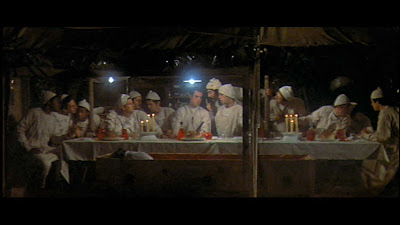
From Samantha Stendal, a film student at the University of Oregon, a brilliant film reaction to the Steubenville, Ohio rape and trials.

Samantha Stendal, University of Oregon
More:
From Samantha Stendal, a film student at the University of Oregon, a brilliant film reaction to the Steubenville, Ohio rape and trials.
Samantha Stendal, University of Oregon
More:
 3 Comments |
  Citizenship, History, Nonviolent protest, Video and film, Violence | Tagged: Civility, film, Nonviolence, Real Men, Samantha Stendal, Steubenville rape, Violence |
  Permalink
 Posted by Ed Darrell
Glenn Frankel at the University of Texas wrote a book about the John Ford movie, “The Searchers.” It’s release, and stories about it, should remind us of the history of Quanah Parker, the last great, chief of the Comanches. “The Searchers” was loosely based on a true story, the kidnapping of Cynthia Ann Parker, by Comanches, and her subsequent life with the tribe, and her recapture by white relatives. She had married in the tribe — Quanah Parker was her son.
Back in June 2008 I posted this:

Quanah Parker, a Kwahadi Comanche chief; full-length, standing in front of tent.
Photographed by Lanney. Public Domain photo.
National Archives, “Pictures of Indians in the United States”
Photographs of Native Americans reside among the publicly and internet available materials of the National Archives. Images can be ordered in sets of slides, or as individual prints, though many are available in quality high enough for PowerPoint works and use on classroom materials. Many of the photos are 19th century.
Quanah Parker stands as one of the larger Native Americans in Texas history. This photo puts a face to a reputation in Texas history textbooks. Texas teachers may want to be certain to get a copy of the photo. His life story includes so many episodes that seem to come out of a Native American version of Idylls of the King that a fiction writer could not include them all, were they not real.

Quanah in European-American business attire. (Photo credit: Wikipedia)
Quanah Parker’s epitaph reads:
Resting Here Until Day Breaks
And Shadows Fall and Darkness Disappears is
Quanah Parker Last Chief of the Comanches
Born 1852
Died Feb. 23, 1911
Other Resources:
Resources new in 2013:
1 Comment | A Good Story, Education, Heroes, History, History images, Native Americans, Religion, Texas, Texas history | Tagged: Cynthia Ann Parker, Education, History, History images, National Archives, Native Americans, photography, Quanah Parker, Texas | Permalink
Posted by Ed Darrell
It’s that Easter season among western Christian sects; this is Holy Week, which commemorates Jesus’s final entry into Jerusalem and the events leading Jesus’s crucifixion.
Our congregation will stage a “living” Last Supper a la da Vinci, which got me to thinking about the painting, which reminded me of this post from years ago; some minor updating, and I’ve added a new version I found from ABC’s series, “Lost,” which was in the middle of its run when I posted this originally in 2008:
Jeremy Barker at Popped Culture assembled more than 30 versions of contemporary recastings of DaVinci’s painting of “The Last Supper.” There’s the Simpsons version, the cartoon version with Disney and Warner Bros. characters. There’s the Sopranos version, and the Battlestar Galactica version.
For example, the Robert Altman version, from M*A*S*H:

Last Supper, M*A*S*H style
If you need a 20 minute lesson on the influence of Renaissance art on contemporary art, this is one many high school kids may find interesting, if not amazingly historically informative. I suspect there is a great lesson plan hiding in there about 20th century history as reflected in parody art.
It’s a brilliant and subtle demonstration of the power of DaVinci’s art that there are so many copy cat pictures, don’t you think?
I did notice, however, that Barker left out the Mel Brooks version, from “History of the World, Part I.” It may not fit the meme.
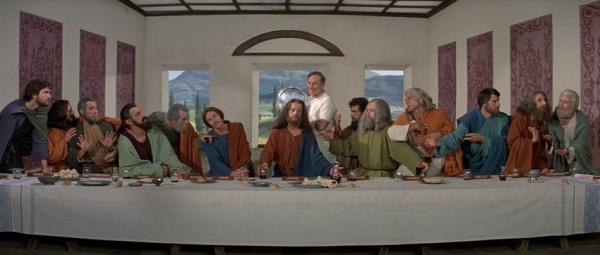
“Last Supper” as portrayed in Mel Brooks’s “History of the World, Part I”
Finally, looking today I found this “Lost” version of the Last Supper at Art is Everywhere, showing the meme is live and well.

“Lost” Last Supper; probably a publicity still, found at Art is Everywhere.
Do you have favorite parodies or homages of the Last Supper left off of these lists of 31 different versions? By all means, list them in comments, with links if you have them.
Resources:
Resources added in 2013:
3 Comments | Art, History, History and art, Religion, Renaissance | Tagged: Art, Entertainment, History, Humor, Renaissance | Permalink
Posted by Ed Darrell

4,500 posts here? Where else is “4500” notable? Look at this beautiful, vintage computer from 1986, a National FS-4500: This MSX 2 computer was marketed as a wordprocessor system, and indeed it is! It has a big 24 dots thermal printer built-in, wordprocessor software (Word Processor, MSX Sentence Paragraph Exchanger, Dictionary, MSX Address Book, Name Card and MSX JE 1 & 2). Impressive. It was available in black or white case. Image and caption from OldComputers.com
Just passed 4,500 posts here at Millard Fillmore’s Bathtub. Closing in on 4 million views.
If I had a nickel for every post, or a penny for every view . . .
4,500 is a good number, for posts for a blog named after a hoax perpetrated about the obscurity of our 13th president.
Any other significance to the number 4,500?

Dodge Ram 4500, at Chrysler’s Saltillo Plant, Saltillo, Mexico.
6 Comments | Administrivia | Tagged: Administrivia | Permalink
Posted by Ed Darrell

This photo will set off most sufferers of Obama Derangement Syndrome — who can’t stand Superman’s duplicating Obama’s stance. Can’t find details on this photo — I believe it was taken in Metropolis, Illinois, in 2008.
In my post drafts I have a longish one on various forms of crazy that, well, make me crazy. It includes a lot of illogical things that populate the internet and political discussions like dysentery in a poorly-run refugee camp on the border of two third world nations at war with each other.
But it’s still hanging fire. Plus, my description of the various anti-Obama crazinesses isn’t so cogent as our friend Jim provided in comments to an earlier post.
So, for your edification, and in the hopes that some sufferers of Obama Derangement Syndrome (ODS) may seek help on their own, or that you may be able to persuade them to seek help, here’s what Mr. Stanley wrote about it (all links added by me, here):
As with any mental illness, Obama Derangement Syndrome’s treatment must begin with an accurate diagnosis. It is certainly possible that what passes for ODS may actually be nothing more complicated than food poisoning. Got ahold of some bad clams? It will pass. It could be severe constipation. Nothing an enema can’t clear up. But if you’ve ruled out the usual suspects, follow this handy checklist to determine if you are an ODS sufferer. Remember, admitting you have a problem is the first step toward lucidity and wellness.
You may have Obama Derangement Syndrome…
- . . . if you believe he was a CIA operative fighting with the Afghan rebels and against the Soviets in the 1980s. Your case of ODS may be terminal if you believe this, and yet now believe Obama is, himself, a Marxist.
- . . . if you suspect he had that great American patriot, Andrew Breitbart, murdered. Extra points if you are sure the Obamas have had as many people murdered as you believed the Clintons did. Still more bonus points if you think gay sex orgies were connected to his murder spree.
- . . . if you are reasonably sure President Obama orchestrated Hurricane Sandy in order to improve his chances at the polls in 2012; planned and ordered either the Sandy Hook school massacre or Aurora Theater massacre to create a pretext for a giant “gun-grab”; and was behind the BP oil spill and/or the Massey Energy coal mine disaster in an effort to justify tighter regulation of business.
- . . . if you believe the President used an executive order to hand over U.S. territory to Russia. [Or to the UN, or to anyone else.]
- . . . if you have seen incontrovertible “proof” that Obama removed the American flag from Air Force One and replaced it with his campaign logo; has consistently refused to say the Pledge of Allegiance or salute the flag; seldom if ever wears an American flag lapel pin and steadfastly resists suggestions from staffers that he say “God bless America” at the end of his speeches.
- . . . if you know that he was a member of the Black Panthers, the Weather Underground, the American Communist Party, the American Fascist/Third Way Movement, the Illuminati, the German-American Bund, the Campfire Girls of America and Friends of Ish Kabibble.
- . . . if you believe President Obama has a “secret plan” to remove evangelical Christian young people from their homes and place them in FEMA or UN-run re-education camps.
- . . . if you believe the birth certificate is a forgery, never existed in the first place or that it exists – but that it, upon careful examination, shows that Barack Obama was sired by a jackal.
- . . . if you have seen “evidence” that he furnished the Oval Office with Islamic or Middle Eastern décor; that he has changed the name of the WH Christmas tree to the WH “Holiday” tree; that he wears jewelry with secret Koranic verses on it; or that he was sworn in on the Holy Koran and not the Bible.
- . . . if you believe he had the October, 2012 jobs report altered.
- . . . or if you believe President Obama is part lizard, the Antichrist or a former CIA operative who was teleported to Mars.
If any of these resonate with you as plausible, reasonable or outright true, seek help for ODS immediately. There is no shortage of treatment options. One might begin by cancelling subscriptions to Stormfront, Newsmax, Citizen Magazine, World Net Daily, Conservapedia and World Magazine. Additional recommendations include a Fox “News” fast, putting your “Left Behind” books in the recycle bin and avoiding those personalities who may function as enablers of ODS. Such individuals include Glenn Beck, James Dobson, Rush Limbaugh, Tom Sowell, Laura Ingraham, Texe Marrs, Hal Lindsey, Sean Hannity, Bill O’Reilly, Michelle Malkin, Ann Coulter, Allen West and Rick “Man on Dog” Santorum. (This is, of course, not an exhaustive list.)
Side effects resulting from successful ODS treatment may include increased lucidity, rationality, compassion and diminished feelings of inadequacy and self-loathing. People who have recovered from ODS report a significant reduction in suspicion and mistrust of those of different races, religions and cultures. Ask your mental health professional if receiving ODS treatment is right for you.
Mr. Stanley got through that entire list without mentioning Kenya, Bill Ayers, or the Illinois Bar disciplinary procedures.
You may be suffering from Obama Derangement Syndrome, if the symptoms listed above describe you.
There’s hope for you, if you are a sufferer. ObamaCare covers treatment.
Obama Derangement Syndrome may be a lot more prevalent that he thinks!
More:
7 Comments | History, Humor, Politics, Rampant stupidity, Reality | Tagged: Barack Obama, Obama Derangement Syndrome, Politics, Rampant stupidity, Reality | Permalink
Posted by Ed Darrell
What would Madison do?
James Madison’s work, not only on the Constitution, but on making the Constitution and new government work, and on creating the foundation pilings for that Constitution and society, should make his words and ideas key points of study for us, and his principles should be our guiding principles much more than they are today.
Madison is the forgotten founder, I’ve argued.

JMU press release caption: JMU President Jon Alger, second from left, presents a wreath at the tomb of President James Madison in honor of his 262nd birthday.
James Madison University President Jon Alger spoke at the ceremonies honoring Madison’s birthday last Saturday, March 16, at Madison’s mountain home, Montpelier, Virginia (a few miles from Jefferson’s Monticello). In his speech, Alger urged a return to civility in discussion of politics, a return to focus on important ideas and the processes by which we discuss them, and make decisions in our national government.
Alger’s remarks deserve a much wider audience, I think. I asked JMU for a copy, and they pointed to the university’s website where the entire speech is posted. I repost it here. Please spread the word.
Jon Alger’s Montpelier remarks
President Jonathan R. Alger
James Madison University
Remarks on the Occasion of James Madison’s 262nd Birthday
March 16, 2013
at James Madison’s Gravesite, Montpelier
Orange, Virginia
(Remarks interrupted by rain)Good afternoon. Honored guests, members of the Montpelier Board of Directors, President Imhoff and Montpelier staff, members of the James Madison University Board of Visitors, faculty, students and alumni, family, friends and fellow Madison enthusiasts, it is my great honor to speak at this hallowed place. On this day 262 years ago, James Madison was born. Perhaps more so than any other president or founder, James Madison is responsible for the creation and miraculous endurance of our republic. Known as the Father of the U.S. Constitution, James Madison’s contributions to our nation should be remembered by every American. The sacred fire of liberty lit by Madison’s ideas burns to this day and draws us here to honor him.
I came to Montpelier for the first time only a few months ago. As a great admirer of James Madison, to me the trip here felt like a pilgrimage. When the mansion first came into view as we made our way up the long sweeping drive, I was struck by the majesty of the moment—as we feel when in the presence of greatness. During that visit, Montpelier board president Greg May invited me to speak at this annual event as we strode down a pathway that Madison himself must have walked many times. I could not have been more honored.
Indeed, this is a dream come true for me. As a political science major and history minor in college, I read many of the same texts Madison himself studied—as well as some of Madison’s own work. Even as a young child, I admired the creative genius of our forefathers. While other kids had stuffed animals or model airplanes displayed in their bedrooms, on my dresser I proudly exhibited a set of small ceramic statues of the American presidents. I like to root for underdogs and was always partial to Madison, because his was the shortest statue. Today his picture hangs proudly in my office.
As many of you know, Montpelier and James Madison University have long had a special bond. It began when Dr. Clarence Geier, an archaeologist at Madison, arranged an archaeology field school here at Montpelier more than 25 years ago. Our students and faculty have been coming to Montpelier ever since and have participated in digs all across the grounds. (Except for right here, of course. They are not allowed to dig in this particular area. You never know with undergraduates!)
From then the relationship between our two institutions has blossomed. This past November a bus containing JMU faculty, staff and me – as well as my wife Mary Ann and daughter Eleanor – came here to spend a day brainstorming with the Montpelier leadership and staff on ways to deepen our relationship even further. The primary objective of this deeper relationship is to bring more attention to James Madison and his ideas. This objective reflects the missions of our two great institutions, but it must go beyond those gathered here today. As a nation, we are in great need of what I will call a Return to Madison.
It is true that, during the past few years, more and more American citizens are professing respect for the U.S. Constitution. The document was read on the floor of the U.S. House of Representatives for only the second time in history this past January. In fact, Representative Bob Goodlatte of Virginia’s Sixth District – JMU’s district – opened the reading with a delivery of the document’s Preamble. That’s a good start, but as a nation we must go much further. For this newfound reverence toward the U.S. Constitution to elevate us as a nation, we must explore and gain a deeper understanding of the principles on which the U.S. Constitution is based. We must Return to Madison.
Now, by suggesting this return, I don’t mean that we become a nation of history buffs (although that would be OK with me). Rather, a Return to Madison would provide us with very real and practical insights into how we as a society should confront issues facing us all.
Starting with a realistic view of human nature, Madison believed that politics was driven by “interest,” not by “virtue.” In his excellent work, The Sacred Fire of Liberty, Madison scholar Lance Banning captured this core principle. He wrote, “Madison did not assume that a republic could depend upon a superhuman readiness to sacrifice self-interest to the common good. Taking humans for the interested, opinionated creatures they are, Madison asserted that in a pluralistic, large republic, partial interests would be counterbalanced by competing interests.”
This was not new political thinking, of course. During the 16th century in Florence, Machiavelli (whose work was more nuanced than is often remembered today) explored what he called the “effectual truth” of politics. In other words, as Paul Rahe writes in his book, Machiavelli’s Liberal Republican Legacy, “[I]n order to avoid their ruin and achieve their preservation, men should govern themselves in accordance with how they do behave rather than in the distorting light of how they ought to.”
So Madison’s great innovation was to devise a system of government that sought to create political and civic conditions allowing the interests of individual citizens, groups, regions and other entities to balance one another so that no one of them could overtake the rest. He recognized that we would be a society with diverse perspectives and experiences, and that we needed a structure to allow that diversity to flourish.
Today – while publicly professing faith in the Constitution as a document – we seem to have forgotten this essential element. Far too often, our public discourse on the important challenges of our time degenerates into shallow shouting matches and name-calling in which we cry for the elimination of opposing views on political, social, economic and cultural issues. The people we despise across the political aisle, the fools on the television spouting their ridiculously wrongheaded opinions, the heathens who believe in a different god than we do – we not only hold them in utter contempt, we behave as if we want their ideas extinguished. And if they were extinguished – oh, if only they were extinguished – we believe the world would be a better place. If only we all agreed on everything – wouldn’t that be great! Yet we must be careful what we wish for. If that kind of wish were to come true, not only would our lives be much more boring—but our society would stop progressing and stagnate.
A Return to Madison would shine a light on the fact that the strength of our republic relies on the existence of opposing ideas and perspectives. Voices who advocate for Wall Street and others who focus on Main Street? They need each other. Republicans and Democrats need each other. Without the diversity of ideas and opinions, our civic balance would tilt and our system eventually would topple. The great man we honor today knew this was true. We as a society need to embrace this notion and continue debating the important issues of the day, but with reason and civility—not with hatred and hopes for total domination. We need each other. And I believe that spreading the understanding that our great Constitution is based squarely on this principle could lead to greater social harmony. Boy, do we need a Return to Madison.
Madison’s Federalist 10 is recognized the world over as one of the great examples of political thought in history. You might remember that Madison published the Federalist with Alexander Hamilton and John Jay in newspapers while the states were considering whether to ratify the proposed Constitution. Of these 85 essays, Madison’s 10th is widely considered to be one of the best, and it’s about balancing competing interests. I love it for the philosophy it expresses, but also because it contains one of his most elegant turns of a phrase. If you’ve read much Madison, you know that his writing can be (to be honest) dense and elliptical. He is not often quoted in today’s sound-bite culture. But in the Federalist 10 he wrote, “liberty is to faction what air is to fire…” Think about that for a moment. “Liberty is to faction, what air is to fire…” Madison was making the point that liberty creates a nourishing environment for faction. At the time, great fear existed that too much liberty could lead to dangerous factions emerging. Madison was resolute, however, and he completes the idea by writing, “But it could not be a less folly to abolish liberty, which is essential to political life, because it nourishes faction, than it would be to wish the annihilation of air, which is essential to animal life, because it imparts to fire its destructive agency.”
Madison is saying that even though liberty allows faction to thrive, it should not be curtailed. He goes on to observe, “As long as the reason of man continues fallible, and he is at liberty to exercise it, different opinions will be formed.”
Thus even as Madison advocated for liberty despite its dangers, he was sure to remind his Federalist readers that man’s passionately held views are imperfect. Therefore, if we claim to respect our Constitution and if we understand this fundamental premise, we have a responsibility to change the tone of much of our civic dialogue. Now, to be clear, I am not arguing that we should hold our views any less dear. Passion leads great people to act. And I am not suggesting that we all adopt a relativist perspective – right and wrong do exist. As enlightened as Madison and his colleagues were for their time on so many issues, for example, even they were unable to come to grips with the tragic injustice of slavery
If Madison were here today, however, I believe he would remind us of our human limitations when we encounter and react to opinions that differ from our own. We can all benefit from trying to listen to and understand the views of others with civility and respect, even as we hold and espouse our own cherished points of view. As the president of the university named for James Madison, I feel strongly that our institution of higher education can best honor his legacy by embracing the diversity of perspectives and backgrounds in our society, while fostering and modeling civil and respectful discourse on the great issues of our time. That is part of the reason why I began my own presidency with a “Listening Tour” to hear, and learn from, the richly diverse voices and opinions of our university community.
In my inaugural address yesterday at the university, I called for James Madison University to be the national model for the engaged university—an institution that combines a commitment to teaching and learning with a conviction that all humans are interconnected. This combination embodies James Madison’s ideals. If we enlighten ourselves through education and believe that we all are connected – even with those with whom we might passionately disagree – we honor Madison. I intend for this idea to be a hallmark of my administration at JMU.
Another hallmark will be to continue deepening the relationship between the university and Montpelier. Some of the ideas generated during our visit here in November already are taking shape. For instance, staff in our department of History and our Adult Degree Program are working with faculty here in the Center for the Constitution to create a course about James Madison and his ideas that includes online and in-person instruction, as well as visits here. The course will be available to JMU students and the general public. As we celebrated Madison Week on our campus these past few days, Montpelier has honored our university by loaning us several artifacts from its own collection. These exchanges are reminders of the man to whom we owe so much. Our educational initiatives can go a long way to motivate those who profess their faith in the U.S. Constitution to deepen their understanding of its underlying principles, and thus inspire a Return to Madison.
Let me share with you a personal story of my own heightened sense of Madison’s, and Montpelier’s, significance. While inside the house, I was surprised by how moved I was when I sat in the modest room that is believed to be Madison’s study. The thought that I was in the very room where James Madison read Machiavelli and Locke and Montesquieu and all the others; the room where he synthesized thousands of years of thinking into a framework for our most important founding document; the room looking west toward unsettled lands of great promise; the room in which James Madison addressed civilization’s most intractable problem – how to govern ourselves – I was filled with a sense of wonder and awe.
Yet another way in which the university will connect with Montpelier and its legacy will be to honor the memory of Dolley Madison, the great woman buried beside our 4th President. Dolley was herself an intellectual and social force who played a profound leadership role by convening people of different backgrounds for civil discourse. In fact, Yale University historian Catherine Allgor wrote, “Dolley’s assumption that compromise would be the salvation of the system marks her as one of the most sophisticated politicians of her time.” Through a new initiative called Women for Madison, our university will celebrate the vital role women play in leadership and cultivating a culture of philanthropy.
Finally, as an advocate of education and an ardent student himself, I believe Madison would have enjoyed meeting today’s students who benefit from his legacy in this free and civil society. I wonder how he would have felt meeting students attending the university named for him. We have several with us today – can you come and join me here?
As many of you know, JMU has a robust study abroad program. I will tour several of our study abroad programs this summer for the first time as president, and my second stop will be Florence, the great city where republican thought reemerged during the 16th century. Machiavelli was the most influential Florentine political thinker of that time, and his work influenced Madison greatly. In fact, Machiavelli appears in one of James Madison’s adolescent “commonplace” books. A commonplace book was like an academic diary. Students during the era when Madison grew up dutifully filled their commonplace books with notes, quotations and poetry.
Students of our era – such as these fine students – and I will visit Machiavelli’s gravesite at the Basilica di Santa Croce in central Florence this summer. We will take with us the moving experience of being here at James Madison’s gravesite, and reflect on the republican ideal with which both men—and so many other people throughout history—have grappled. It is quite fitting that students attending a university named for James Madison make this journey, connect these two places and contemplate their meaning.
With this symbolic gesture, we hope to inspire all the students of James Madison University, the visitors to James Madison’s Montpelier and all who bear witness, to Return to Madison. Let’s go from this ceremony with a renewed sense of our roles as citizens, and of the power we have to live the ideals James Madison handed down to us through the ages. Thank you
Who in Congress listens? Who in media and commentary listens? Who in the academic life listens?
More:

Fireworks over James Madison University, on the inauguration of new University President Jonathan R. Alger, in early March 2013. Despite the somewhat tenuous links to this post, I like the photograph. Image from JMU’s UBeTheChange blog.
3 Comments | Citizenship, Education, Government, History, James Madison, Politics, U.S. Constitution | Tagged: Civility, Education, Government, James Madison, James Madison University, Jonathan R. Alger, March 16, Montpelier, Politics, U.S. Constitution | Permalink
Posted by Ed Darrell
More Iceland than Aurora. Not necessarily bad. Great timelapse photos.
You have my permission to turn down the music volume.
Filmmaker Anna Possberg wrote:
Iceland has become a popular destination since the singer Björk made her island famous by her songs. Yet few people know Iceland during wintertime. And I am sure that they miss a beautiful part of the island: the snow covered rocks, the magic arctic light and especially the phantastic aurora borealis dancing in the sky. The days spent at the Jokülsarlon glacial lake were one of the most beautiful and peaceful Christmas time I remember.

Jökulsárlón, a glacial lake in Iceland. To the right, the mouth of the glacier Vatnajökull. Wikipedia photo
More:
Leave a Comment » | Astronomy, Geography - Physical, Nature, Time-lapse photography, Travel | Tagged: Astronomy, Aurora Borealis, geography, Iceland, Nature, Timelapse Photography, Travel | Permalink
Posted by Ed Darrell
Fireworks for James Madison’s birthday?

Loren Holmes photograph straight up of Aurora borealis over Eureka, Alaska, on March 13, 2013. AlaskaDispatch.com
I love fireworks. Kathryn and I have been known to drive a couple hundred miles to see a good show. Fireworks in honor of the guy who gave us the Constitution and the First Amendment (and much more), seems a great idea to me.
But no one did it . . .
Sometimes the Sun, Moon, stars and planets conspire.
Here’s one of the best, most inspiring five minutes you’ll spend this week. Look what the Sun sent us, filmed in time-lapse glory above Eureka, Alaska, on March 16, 2013, the anniversary of James Madison’s birthday; from AlaskaDispatch.com:
A timelapse of the Aurora Borealis, Northern Lights, over Eureka, Alaska on March 16, 2013. Taken with a Canon 5D Mark III and 24mm f/1.4 and 70-200 f/2.8 lenses. Compiled from 3800 images, with exposures between 2 seconds and 30 seconds.
AlaskaDispatch.com provided a slide show of Holmes’s better photos, too.
Tip of the old scrub brush to Dr. M. P. Bumsted.
More:
3 Comments | Alaska, Astronomy, Geography - Physical, Nature, Science, Travel | Tagged: Alaska, Astronomy, Aurora, Aurora Borealis, geography, Nature, Northern Lights, photography, Science, Timelapse Photography, Travel | Permalink
Posted by Ed Darrell
At the Belle Grove Bed and Breakfast blog we get a nice report and lots of photos from the James Madison birthday celebration last Saturday at Montpelier, Madison’s mountain retreat and home in Virginia.

Wreaths in honor of James Madison’s birthday, March 16, 2013, at his grave site at Montpelier, Virginia. Photos by Michelle and Brett Darnell, Belle Grove Plantation B&B
Best report I’ve seen — go over there and give it a read and view.

James Alger, President of James Madison University, delivered an address, “Return to James Madison.” Montpelier CEO Kat Imhof sits to his immediate right. Photos by the Darnells
James Madison University’s President Jonathan Alger delivered an address, “Return to Madison.” I’m hoping someone still has a copy in electronic form that we can get hold of.
More:

View from a basement window at James Madison’s Montpelier near Barboursville, Virginia, storm clouds clear and the Blue Ridge Mountains come into view (2011) (Photo by gsputrich)
1 Comment | History, James Madison, Presidents, Travel | Tagged: History, James Madison, March 16, Montpelier Virginia, Travel | Permalink
Posted by Ed Darrell
Students of history will notice inaccuracies in this video right away.
They are dreams, an imagining of the great “if only.”
Santayana’s Ghost looks on, hoping we’ll get the message, remember history, and act accordingly.
“Imagine a World Without Hate,” from the ADL.
Join ADL in our Centennial Year as we Imagine a World Without Hate™, one where the hate crimes against Martin Luther King, Anne Frank, Matthew Shepard and others did not take place. Support us in the fight against bigotry and extremism by sharing this inspirational video and taking the pledge to create a world without hate at http://www.adl.org/imagine.
Imagine a World Without Hate™. We Do. Join Us.
Tip of the old scrub brush to Pat Carrithers and Upworthy. Pat writes in to remind us of the great John Greenleaf Whittier poem, “Maud Muller”:
“For of all sad words of tongue or pen,
The saddest are these: “It might have been!”
More:

American poet John Greenleaf Whittier’s study at his home in Amesbury, Massachusetts. Scanned from The Works of John Greenleaf Whittier: illustrated with steel portraits and photogravures by John Greenleaf Whittier, edited by Elizabeth Hussey Whittier. Published by Houghton, Mifflin and Company, 1892. Item notes: v. 7 (Photo credit: Wikipedia)
2 Comments | History, Martin Luther King, Nonviolent protest, Politics, Santayana's ghost | Tagged: ADL, Anne Frank, Anti-Defamation League, bullying, Hate crime, History, Holocaust, Martin Luther King, Matthew Shepard, Nonviolence, Politics, Santayana | Permalink
Posted by Ed Darrell
Not big news — they do this almost every year — but I want to put down the anchor on this story.

A photo from the distant, but indefinite past: “EASTER EGG ROLLING, WHITE HOUSE” “1 negative : glass ; 5 x 7 in. or smaller” (Photo credit: Wikipedia)
Why do I want to anchor it? In about three days, if tradition holds, I’ll get an e-mail from some vet madder than hell that Obama shut out the kids of military veterans from the Easter Egg Roll; the story he sends will probably claim Obama changed it to a Ramadan Relleno Roll, or something.
I post it here so I can find it quickly, then. Obama H8ers will distort every piece of good news. You can see the drumbeat start in the “More” section below. A Continuing Resolution passed the Senate today, and is expected to win approval in the House tomorrow, providing funds to continue the Easter Egg roll on April 13, as well as the rest of the government through the end of the Fiscal Year.

President Barack Obama cheers on children participating in rolling eggs across the South Lawn Monday, April 13, 2009, during the White House Easter Egg Roll. (Photo credit: Wikipedia)
More:
Update: Turns out that Fox News had already slammed Obama, falsely, for keeping the Egg Roll on the calendar. As Mediaite reported, Fox News’s Megyn Kelly charged it was all politics, prompting White House press guy Jay Carney to explain the event is paid for out of donations, not out of the budget.
5 Comments | Accuracy, Barack Obama, Political Smear, Politics, President Obama | Tagged: Accuracy, Barack Obama, Easter Egg Roll, Michelle Obama, Political Smear, Politics, President Obama, White House | Permalink
Posted by Ed Darrell
Press release from The Journal of Animal Ecology (links added here):
For polar bears, it’s survival of the fattest
One of the most southerly populations of polar bears in the world – and the best studied – is struggling to cope with climate-induced changes to sea ice, new research reveals. Based on over 10 years’ data the study, published in the British Ecological Society‘s Journal of Animal Ecology, sheds new light on how sea ice conditions drive polar bears’ annual migration on and off the ice.
Led by Dr. Seth Cherry of the University of Alberta, the team studied polar bears in western Hudson Bay, where sea ice melts completely each summer and typically re-freezes from late November to early December. “This poses an interesting challenge for a species that has evolved as a highly efficient predator of ice-associated seals,” he explains. “Because although polar bears are excellent swimmers compared with other bear species, they use the sea ice to travel, hunt, mate and rest.”

Caption from EurekAlert: An adult female polar bear wearing a GPS-satellite linked collar with her two 10-month-old cubs waits for the sea ice to re-form onshore in western Hudson Bay, Manitoba, Canada. Photo Copyright Andrew Derocher, Univeristy of Alberta.
Polar bears have adapted to the annual loss of sea ice by migrating onto land each summer. While there, they cannot hunt seals and must rely on fat reserves to see them through until the ice returns.
Dr. Cherry and colleagues wanted to discover how earlier thawing and later freezing of sea ice affects the bears’ migration. “At first glance, sea ice may look like a barren, uniform environment, but in reality, it’s remarkably complex and polar bears manage to cope, and even thrive, in a habitat that moves beneath their feet and even disappears for part of the year. This is an extraordinary biological feat and biologist still don’t fully understand it,” he says.
From 1991-97 and 2004-09, they monitored movements of 109 female polar bears fitted with satellite tracking collars. They tagged only females because males’ necks are wider than their heads, so they cannot wear a collar. During the same period, the team also monitored the position and concentration of sea ice using satellite images.
“Defining precisely what aspects of sea ice break-up and freeze-up affect polar bear migration, and when these conditions occur, is a vital part of monitoring how potential climate-induced changes to sea ice freeze-thaw cycles may affect the bears,” he says.
The results reveal the timing of polar bears’ migration can be predicted by how fast the sea ice melts and freezes, and by when specific sea ice concentrations occur within a given area of Hudson Bay.
According to Dr. Cherry: “The data suggest that in recent years, polar bears are arriving on shore earlier in the summer and leaving later in the autumn. These are precisely the kind of changes one would expect to see as a result of a warming climate and may help explain some other studies that are showing declines in body condition and cub production.”
Recent estimates put the western Hudson Bay polar bear population at around 900 individuals. The population has declined since the 1990s, as has the bears’ body condition and the number of cubs surviving to adulthood.

Caption from EurekAlert: This is a subadult polar bear on a lake on the shores of Hudson Bay in Manitoba, Canada in November waiting for the sea ice to re-form. Copyright Andrew Derocher, Univeristy of Alberta.
Because polar bears’ main food source is seals, and these are hunted almost exclusively on sea ice, the longer bears spend on land, the longer they must go without energy-rich seals. “Climate-induced changes that cause sea ice to melt earlier, form later, or both, likely affect the overall health of polar bears in the area. Ultimately, for polar bears, it’s survival of the fattest,” says Dr. Cherry.
He hopes the results will enable other scientists and wildlife managers to predict how potential climate-induced changes to sea ice freeze-thaw cycles will affect the ecology, particularly the migration patterns, of this iconic species.
###Seth Cherry et al (2013). ‘Migration phenology and seasonal fidelity of an Arctic marine predator in relation to sea ice dynamics’, doi: 10.1111/1365-2656.12050, is published in the Journal of Animal Ecology on Wednesday 20 March 2013.
More:
8 Comments | Climate change, climate_change, Global warming, History, Politics, Research, Science, Wildlife | Tagged: British Ecological Society, Climate change, geography, Global warming, History, Hudson Bay, Journal of Animcal Ecology, Polar Bears, Politics, Research, Science, Seth Cherry, Wildlife | Permalink
Posted by Ed Darrell
Feynman speaking from the grave? You decide:

Richard Feynman, at a hearing of the Rogers Commission, demonstrates with a glass of ice water and a piece of O-ring material, how cold makes the O-rings inflexible; photo credit unknown
Richard Feynman, in the Rogers Commission Report on the Space Shuttle Challenger Accident, appendix (1986)
More:
4 Comments | Famous quotes, Physics, Politics, Quotes, Science | Tagged: Famous quotes, Physics, Politics, Quotes, Richard Feynman, Science | Permalink
Posted by Ed Darrell
Well, actually it’s a Snark-brand tuner. But when I saw the name, my mind just reeled with possibilities.
Your snark is not quite up to snuff? Tune it up!
From a notice I got from Hello Music!

Snark tuners! Alas, it’s for the benefit of guitar players, not to sharpen the snark of internet trolls, nor for other snarky commenters. Suggested originally by the late, lamented Hello Music.
It’s actually a good buy, for a guitar player. But if you were looking to snarken up your snark, you’re out of luck — unless your snark comes in whole tones . . .

Close-up of the Snark SN-1tuner. Close-up of the Snark Tuner – -50 to +50, you know if your snark is spot on! I mean, you know if your guitar is in tune.
Close-up of the Snark SN-1tuner. Close-up of the Snark Tuner – -50 to +50, you know if your snark is spot on! I mean, you know if your guitar is in tune.
Technical specifications:
Overview
What It Is: This is the Snark SN-1 Clip On Tuner in Blue. The SN-1 has a Full Color Display that rotates 360 degrees, and a clip that stays put when you clip it on. You can transpose keys, calibrate pitch, and there’s even a tap tempo metronome. This Snark tuner has a High Sensitivity Vibration Sensor, and it can be used on front or back of headstock.Why this is a great opportunity: Clip on Vibration sensitive tuners are great for tuning in a loud environment, especially with acoustic guitars. This one has a large colorful display that’s easy to read, but the real kicker is the built in metronome. Win.
Hello Music SKU: HMSNA3140
Specifications Features:
– Full Color Display
– Display Rotates 360 Degrees
– Stay Put Clip
– Fast and Deadly Accurate
– Tap Tempo Metronome
– Pitch Calibration 415-466 Hz
– Transpose Feature
Woulda been useful when I was performing. Would Lewis Carroll have used one, do you think?
May get one yet, even though it won’t help with the internet. How times change.
Even though it’s not what I imagined, like telling the difference between a burro and a burrow, I know several people who need to have this recommended to them — how about you?
“Fast and Deadly Accurate.” I like that.
More:
1 Comment | Humor, Music, Weblogs | Tagged: blogging, Electronic tuner, Guitar, Humor, Music, Snark Tuner | Permalink
Posted by Ed Darrell
Most high school history students don’t know about it. Most high school history students in Texas don’t know about it.

New London School, New London, Texas, before the 1937 disaster. Photo from the New London Museum
I wonder, sometimes, how many Texans remember at all.
I wonder, too, if there are lessons to be learned from the New London tragedy, while the nation debates what to do to prevent recurrences of school shootings.
The deadliest disaster ever to hit a public school in the U.S. struck on March 18, 1937, when a natural gas explosion destroyed the new school building at New London, Texas, killing about 300 people — 76 years ago today.

The remains of the London School after the explosion of March 18, 1937. Wikipedia photo
Noise from the blast alerted the town, and many people in the oilfields for many miles. Telephone and telegraph communication got word out. Oil companies dismissed their employees, with their tools, to assist with rescue and recovery efforts. Notably, 20-year-old Walter Cronkite came town to report the news for a wire service.
Investigation determined that a leak in a newly-installed tap into the waste gas pipe coming from nearby oil fields probably allowed natural gas to accumulate under the building. A spark from a sander started a fire in gas-filled air, and that in turn exploded the cavern under the school. School officials approved the tap to the waste gas line to save money. Natural gas is odorless. One result of the disaster was a Texas law requiring all utility natural gas to be odorized with ethyl mercaptan.
Though the Great Depression still gripped the nation, wealth flowed in New London from oil extraction from the nearby oil fields. The school district completed construction on a new building in 1939, just two years later — with a pink granite memorial cenotaph in front.
Today, disasters produce a wealth of litigation, tort suits trying to get money to make the injured whole, and to sting those at fault to change to prevent later disasters. In 1937 official work cut off such lawsuits.
Three days after the explosion, inquiries were held to determine the cause of the disaster. The state of Texas and the Bureau of Mines sent experts to the scene. Hearings were conducted. From these investigations, researchers learned that until January 18, 1937, the school had received its gas from the United Gas Company. To save gas expenses of $300 a month, plumbers, with the knowledge and approval of the school board and superintendent, had tapped a residue gas line of Parade Gasoline Company. School officials saw nothing wrong because the use of “green” or “wet” gas was a frequent money-saving practice for homes, schools, and churches in the oilfield. The researchers concluded that gas had escaped from a faulty connection and accumulated beneath the building. Green gas has no smell; no one knew it was accumulating beneath the building, although on other days there had been evidence of leaking gas. No school officials were found liable.
These findings brought a hostile reaction from many parents. More than seventy lawsuits were filed for damages. Few cases came to trial, however, and those that did were dismissed by district judge Robert T. Brown for lack of evidence. Public pressure forced the resignation of the superintendent, who had lost a son in the explosion. The most important result of the disaster was the passage of a state odorization law, which required that distinctive malodorants be mixed in all gas for commercial and industrial use so that people could be warned by the smell. The thirty surviving seniors at New London finished their year in temporary buildings while a new school was built on nearly the same site. The builders focused primarily on safety and secondarily on their desire to inspire students to a higher education. A cenotaph of Texas pink granite, designed by Donald S. Nelson, architect, and Herring Coe, sculptor, was erected in front of the new school in 1939. (Texas Handbook of History, Online, from the Texas State Historical Association)
Of about 500 students, more than 50% of them died. Once the new school and memorial were built, and the law passed requiring utilities to odorize natural gas so leaks could be detected earlier, survivors and rescuers rather shut down telling the history. A 1977 reunion of survivors was the first in 40 years.

New London School shortly after the March 18, 1937, explosion. Photo from the New London Museum.
Because of that healing silence, the story slipped from the pages of most history books.
Trinity Mother Frances Hospital treated the victims; a 2012 film from the hospital offers one of the best short histories of the events available today.
New London, and the New London Museum, work to remember the dead and honor them. Work continues on a film about the disaster, perhaps for release in 2013:
Now, more than 75 years later, the London Museum, across the highway from where the original school was destroyed, keeps alive the memory of much of a generation who died on that terrible day.
This video was produced by Michael Brown Productions of Arlington, TX as a prelude to a feature documentary on the explosion and its aftermath which is planned for
the spring of 2013. . . .
What are the lessons of the New London Disaster? We learned to remember safety, when dealing with natural gas. A solution was found to alert people to the presence of otherwise-odorless, explosive gases, a solution now required by law throughout the U.S. Natural gas explosions decreased in number, and in damages and deaths. Wealthy schools districts, cutting corners, can create unintended, even disastrous and deadly consequences. Quick rebuilding covers the wounds, but does not heal them.
Remembering history takes work; history not remembered through the work of witnesses, victims and survivors, is quickly forgotten — to the detriment of history, and to the pain of the witnesses, victims and survivors.

New, New London School and granite cenotaph memorial to the victims of the 1937 explosion. Photo from Texas Bob Travels.
More:
Houston’s KHOU-TV produced a short feature on the explosion in 2007:
5 Comments | Disasters, Education, History, Texas, Texas history | Tagged: Capturing history, Disasters, Education, Gas explosion, History, New London School Disaster, Texas | Permalink
Posted by Ed Darrell


Ed Darrell on Texas's Colorado River


Come on in, the water's fine. Come often: Cleanliness is next to godliness.


 Millard Fillmore's Bathtub