Kill Devil Hills, North Carolina: Wright Bros. National Memorial

December 17, 2012

Kill Devil Hills monument to theWright Brothers

Wikipedia description: Standing sixty feet (18.3 meters) tall and perched atop a ninety foot (27.4 meters) stabilized sand dune known as Kill Devil Hill, this monument towers over Wright Brothers National Memorial Park in Kill Devil Hills, NC. The park commemorates and preserves the site where the Wright brothers launched the world’s first successful sustained, powered flights in a heavier-than-air machine. The inscription that wraps around the base of the monument states “In commemoration of the conquest of the air by the brothers Wilbur and Orville Wright. Conceived by genius, achieved by dauntless resolution and unconquerable faith.” Photo by Ken Thomas, taken with a Panasonic Lumix DMC-FZ50 in Dare County, NC, USA.

At this site, on December 17, 1903, Wilbur and Orville Wright first achieved flight in a heavier-than-air machine.


British Airways: Crazy-like-a-fox patriotism in advertising

July 13, 2012

This television advertisement is circulating among airline and travel folk:

Why would British Airways make an ad that encourages Britons to stay at home during the Olympics?

Join the conversation and see the plane on your own street at http://www.facebook.com/britishairways #HomeAdvantage

This summer, the greatest sports event on Earth comes to London. And our best sportsmen and women have a once in a lifetime opportunity, to compete at the highest level with the whole country behind them. That’s why we’re asking the nation to join together, to give our athletes the greatest home advantage we can give them. It could be the difference in seconds and millimetres, turning silver into gold. This summer, there’s nowhere else in the world to be.

Even more analysis:

Millard Fillmore traveled to London after his presidency.  One story claims that, upon meeting Fillmore, Queen Victoria proclaimed him “the handsomest man” she had ever met.

After the death of his daughter Mary, Fillmore went abroad. While touring Europe in 1855, Fillmore was offered an honorary Doctor of Civil Law (D.C.L.) degree by the University of Oxford. Fillmore turned down the honor, explaining that he had neither the “literary nor scientific attainment” to justify the degree.[22] He is also quoted as having explained that he “lacked the benefit of a classical education” and could not, therefore, understand the Latin text of the diploma, adding that he believed “no man should accept a degree he cannot read.”[9]

Tip of the small, folding travel scrub brush to Gil Brassard, believe it or not.

More:


NAACP petition to Hollywood movie makers for Black History Month

February 11, 2012

Good idea, I think:

NAACP

Ed,

Growing up, I remember marveling at the stories about the bravery, courage, and patriotism demonstrated by the Tuskegee Airmen.

I was happy to see them gain renewed recognition through the recent film Red Tails. Their story of persevering through a pervasive culture of prejudice to become American heroes is one we should tell more often.

But as we celebrate Black History Month and honor the African-American heroes in our lives, we must remember that films celebrating the contributions of people of color remain few and far between. That’s why I’m asking you to sign onto a letter asking movie studios to bring more of these stories to the silver screen.

Sign our letter encouraging Hollywood to create more films like Red Tails, celebrating the contributions of African-Americans throughout our history:

http://action.naacp.org/letter-to-studio

The facts about the production of films showing African-American heritage, and the employment of African-Americans in Hollywood, are alarming.

In 2009, Screen Actors Guild President Ken Howard said, “the diverse and multicultural world we live in today is still not accurately reflected in the portrayals we see on the screen.” And last year, the Writers Guild of America released a study showing the minority share of employment in feature films had fallen to 5%, its lowest level in ten years.

We must reverse these trends. With your help, we can send a message to the Hollywood studios that the public wants to see more films on the contributions of diverse communities, written, directed, and produced by filmmakers from all walks of life.

Make no mistake — we have come a long way since the Tuskegee Airmen flew in the face of a society that thought them incapable of achieving the feats of bravery they regularly demonstrated. Now we must ensure their legacy will be passed on to future generations.

Join us in telling Hollywood we need more films celebrating African-American culture and contributions:

http://action.naacp.org/letter-to-studio

After you sign the letter, I hope you’ll go see Red Tails in the theaters this weekend. It’s a great way to continue celebrating Black History Month. And if you have already seen it, see it again!

Thank you,

Vic Bulluck

Executive Director
NAACP Hollywood Bureau

P.S. Join us on February 17th as we honor those who have achieved milestones in the fields of social justice and art. The 43rd Annual NAACP Image Awards will air live on NBC at 8:00 p.m. (7:00 p.m. central).

Have you seen “Red Tails” yet?  What did you think?

(Oy.  Have you heard the controversy in Dallas about taking classes to see it?)

More:


EU charges airlines for carbon emissions on flights to Europe; airlines, other nations rankled

January 10, 2012

Been to court once, looks like it’s going again.  The Economist reported this week:

AS OF January 1st, American, Chinese and all the world’s airlines are being billed for the carbon emissions of their flights into and out of the European Union. About time, too: airlines contribute 2-3% of global emissions, yet they were hitherto free to pollute. The European initiative, which brings airlines into the EU’s existing cap-and-trade regime, the Emissions Trading Scheme (ETS), is a modest corrective. The hope is that it will speed the creation of a long-promised, more ambitious successor, governing all the world’s airspace.

Foreign airlines, needless to say, are unhappy. So are their governments. Because flights into the EU have been included in their entirety, not just the portion within European airspace, they detect an infringement of their sovereignty. Last month, in response to a suit from an American industry body, Airlines for America (A4A), the European Court of Justice dismissed that concern. A4A, which claims, improbably, that the scheme will cost its members more than $3 billion by 2020, may file a fresh suit in the High Court in London.

Especially hopping mad are warming denialists, who fear that charges for carbon emissions will cause emitters to reduce emissions, which might have an effect on global warming, thereby making the denialists out to be wrong.

Better not to be proven wrong than to have a cleaner planet, they reckon.


George Jetson come true? Maverick Flying Car at Oshkosh

April 14, 2011

Next time somebody asks ‘where’s my flying car?” you can show them this.

Steve Saint of I-TEC drove his road-legal flying car from Florida to Oshkosh this summer. Since then the FAA has also issued the Maverick a S-LSA aircraft airworthiness certificate. I-TEC hopes to be in production by EAA Oshkosh 2011.

[Because it comes with built-in autoplay from the Experimental Aircraft Association, it’s below the fold.]

Read the rest of this entry »


The view from the seat of the pilot of the Enola Gay / Smithsonian National Air and Space Museum

December 19, 2010

Old friend and thorn in the side Gil Brassard in Baton Rouge alerted us to this wonderful marriage of modern technology and history from David Palermo Photography — an interactive, panoramic view of the cockpit of the Enola Gay, the B-29 from which the first atomic bomb used in war was dropped.

How can you use this in class, teachers?  Got a lesson plan that puts a student in the seat of the pilot?

Vodpod videos no longer available.

Enola Gay / Smithsonian National Air and Space …, posted with vodpod

For technical reasons beyond my ken, one may not make this a full screen image. No problem. Go to David Palermo’s site, and see this as big as your computer monitor. I recommend viewing it there — it’s better, really.

Palermo has a portfolio of cockpits he’s shot at the Smithsonian, including the French Concorde, Gemini VII, a Bell Huey helicopter, Mercury Friendship VII, and a Lockheed Martin X-35 — with spherical panoramas available of those and more (look for the link that says “HD360°” and look at the drop-down menu).  He sells massive prints of the cockpits — something special for aviation and space buffs.


October 14: Chuck Yeager/BOOM! Day

October 15, 2010

Rats. On October 14 I missed noting the anniversary of Chuck Yeager’s great feat, breaking the sound barrier in level flight.

BOOM! Day.

Greg Laden’s blog reminded me, “Happy Anniversary, the Breaking of the Barrier.” Below, what I wrote in 2007, mostly still accurate.

_____________

Panorama of the Mountains noted the 60th anniversary of the first known faster-than-sound flight by a human — October 14, 1947. Test pilot and all-around good guy Chuck Yeager did it.

Bell X-1, on display at National Air and Space Museum

Bell X-1 displayed at the National Air and Space Museum

This is a great post-World War II, Cold War story of technology that should pique interest in the time and the events for many students. For a 90 minute class, a solid lesson plan could be developed around the science and technology of the flight (yes, even in history — this is key stuff in the development of economics, too). The physics of sound, a brief history of flight and aircraft, the reasons for post-war development of such technologies, the political situation: There are a dozen hooks to get into the topic. Fair use would cover showing a clip from “The Right Stuff” about the flight, and there are some dramatic clips there. (The movie is 3 hours and 13 minutes; great stuff in a format too long for classroom use. Is there any possibility your kids would read the Tom Wolfe book?)

When will someone – the Air Force? NASA? an aircraft company? — put together a DVD with authorized film clips from the newsreels and the movie, and suggested warm ups and quiz questions?

Back in the bad old days one of my elementary school teachers did an entire morning on the speed of sound, aircraft engineering, and the history of faster-than-sound flight. I learned the accurate way to measure the distance to lightning by counting seconds to the thunder (it’s about a mile for every 5 seconds, not a mile for every second, as our school-yard lore had it).

Chuck Yeager at C. R. Smith Museum, 7-25-2010 - photo by Ed Darrell

Brig. Gen. Chuck Yeager at the C. R. Smith Museum at American Airlines HQ, July 25, 2010. Photo by Ed Darrell

This program, to fly at the speed of sound, at what is now Edwards Air Force Base changed the way science of flight is done in the U.S. Yeager led the group of Air Force pilots who proved that military pilots could do the testing of aircraft; the project proved the value of conducting research with experimental aircraft on military time. The methods developed for testing, evaluating, redesigning and retesting are still used today. The drive for safety for the pilots also grew out of these early efforts at supersonic flight.

Yeager’s flight came when technology was cool, not just for the virtual reality role playing games (RPGs), which were still decades in the future, but because it was new, interesting, and it opened a world of possibilities. We all wanted to fly airplanes, especially small, fast airplanes. A sonic boom over southern Idaho produced a couple dozen calls to the local police and fire departments (long before 911 emergency calling systems), and a couple of paragraphs in the local newspaper.Later, when we moved to Utah County at the foot of Mt. Timpanogos, we kids relished the flights of fighter jets at 6,000 or 7,000 feet above MSL on their way to or from Hill AFB in Ogden, only a thousand feet or so above our heads in those mountain valleys.

Whether authorized to fly them or not, the fighter jocks recruited us kids with their ground-hugging forays. And if one jet occasionally passed the speed of sound, the school bus-stop would buzz with it for a couple of days, as we tried to determine whether anybody ever really lost a window to such fun and excitement as a sonic boom. We could hardly wait to be the pilots of those airplanes, giving a start and a thrill to housewives across America who worried their replica Ming vases and picture windows would crash to smithereens.

Supersonic transport excited me then, and still does. As a lover of the environment, perhaps I should have stood firmly against supersonic flights of the British-French Concord over the U.S., but I hoped a compromise could be reached. New York to Los Angeles in two hours seemed like a good idea to me at the time, and it still does. The U.S. legislated ban on supersonic passenger flights probably doomed the idea of supersonic transport. Boeing dropped its plans to build a competitor to the Concord. The Concord itself never got the support it needed to continue production and refinement of the idea. By the time the Concord was retired in October 2004, it was 50-year-old technology.

I wondered at the time what would have happened had research on passenger supersonic flight continued. Shutting off technology is a strange thing. Steam engine technology was poised to make a great leap forward in the early 20th century, some argue. Diesel and gasoline engine sales blocked the leap, especially the creation of the Diesel-electric railroad locomotive engine.

But make no mistake about it: The Concord was fun. My friend Perry W. Buffington — as amiable and useful a traveling companion as is known in the modern world — found a fantastic fare for a Concord flight for us over the Christmas-New Year’s holidays, 1978 and 1979. We flew to London on a Delta L-1011 on Christmas night; we spent a week in London getting cheap tickets to great shows (the Royal Ballet’s Nutcracker, featuring a kid I knew from Spanish Fork, Utah; Pirates of Penzance at D’Oyly Carte; Evita in the first run, as I recall; a great revival of Oliver! Great stuff, cheap tickets). Then, to cap it off, the Concord from London to New York. Mach 2, on January 1.

It snowed record depths in all of southern England. On New Year’s Eve day, we skated the snow-packed streets to Harrod’s for last minute souvenir shopping, and bumped into Lauren Bacall. Then we sat in the bar of the hotel and watched the news reports of how the entire country was shut down by the snow, including the British Railroad. Our flight out seemed to be due a delay, at least. But we got a call from British Airways confirming the flight, later that night. So on January 1 we got a snowcat — not really, just a brave taxi — to the downtown check-in office of BA.

Then the show kicked in. The agent checking us in took our bags, reached into a drawer and pulled out a roll of pound notes. Without breaking his conversation with us, he beckoned over a woman who was helping passengers onto the shuttle bus to Heathrow, handed her the roll of bills and said simply, “Concord for these gentleman.” She sprinted to the curb outside and hailed a taxi. The agent had called the airport and informed us that while nothing else had flown, “The Concord will depart on schedule. Thank you for flying British Air — your taxi is waiting.” The woman at the curb held the door for us — no bus shuttle for Concord passengers!

The taxi rocketed to Heathrow. I don’t know how much BA paid, but the driver was extremely happy to move us at extreme speeds over slippery roads.

Concord waiting lounges provided the best amenities. Separated from even First Class lounges, the free champagne, and any other liquor, was served on the ground as well as in the air. For morning departures, a chef in the lounge created elaborate egg dishes to order, for breakfast.

Flying the Concord was always a celebrity experience. The festive feeling of our New Year’s Day flight zoomed considerably when Lauren Bacall breezed into the waiting room. (The only other time I got into a Concord lounge was at Dulles a few years later; Ray Charles checked in for the flight. He asked for a window seat.) We watched a television news report that all flights at Heathrow were delayed by the snow as we got the announcement the Concord was ready to board, on time. If our flight wasn’t the only flight leaving Heathrow that day, it was definitely the first. “Snow doesn’t bother the Concord,” one agent explained.

Supersonic flight passenger jets present special problems to air traffic control, especially with their speed. Plus, they fly better where the air is thinner. So instead of the normal 30,000 to 45,000 feet altitude of commercial airliners, Concords flew at about 70,000 feet. This becomes clear to a passenger on take off: Concords get off the ground, and then take a radically steeper climb that, from the inside, feels like going straight up. At cruising altitude, at about noon, a passenger looking out the window can look up to see the blue sky disappearing into darkness (a night flight with the Aurora Borealis must have been some great spectacle).

Concord’s cabin was not spacious. It held 100 passengers, a bit smaller than a modern 737. The food service was divine, with plenty of stewards on hand to attend to passengers. Among the best lamb chops I’ve ever had (and mind you, I come from sheep country). Complimentary champagne, wine, and cigars — “not Cuban, I’m sorry,” the steward explained. “U.S. rules.”

Sit back, sip the champagne, or puff a cigar and sip the port, and watch the Machmeter: “0.5 . . . 0.7 . . . 0.9 . . . 1.0 (Mach 1, the speed of sound).” The ride, smooth as it was, got a lot smoother. The entire aircraft was quieter. “1.3 . . . 1.7 . . . 2.0.” Twice the speed of sound is half as scary as Mach 1, once you’re already moving so fast.

Two hours from Heathrow to JFK. We flew faster than the time zones changed, landing a couple of hours earlier than our departure. Time travel!

(The week in London, airfare there, and the Concord back, was under $1,500 in 1978. Inflation affected the prices before the Concord retired.)

Two in my immediate family have flown faster than sound. My brother, Wes, flew F-4s. And champagne and steward service notwithstanding, he had the much better deal. He did it more often, and he had the stick.

Chuck Yeager did it first, in level flight (there is some conjecture that a British pilot had done it earlier, in a dive — but he didn’t recover from the dive).

How best to commemorate breaking the sound barrier? Do it again!

Photo of Astronauts Chuck Yeager and Dave Scott, with their co-pilots, prior to the 60th anniversary sound-barrier breaking flight, 2007 Edwards AFB

Astronauts Chuck Yeager and Dave Scott, with their co-pilots, prior to the 60th anniversary sound-barrier breaking flight, 2007 Edwards AFB

Edwards Air Force Base, September 21, 2007 – General Yeager flew a US Air Force F-16 to commemorate the 60th anniversary of Breaking the Sound Barrier (October 14, 2007), the 60th anniversary of the United States Air Force (September 18, 2007) and 65 years of General Yeager flying in military cockpits. Yeager was part of a flight of four planes; two F-16’s with Gen. Chuck Yeager and Maj. Gen. Joe Engle aboard, and two T-38’s carrying F-15 pilot Fitz Fulton, NASA Astronaut Col. Dave Scott, and Commander Curt Bedke. Yeager and Engle’s F-16’s broke the sound barrier high above the Base Operations Center – a double sonic boom, then the four planes executed a slow straight through pass, pitched out, landed, and taxied up to the hanger where the 2007 Air Force Ball was about to begin, attended by more than 1,000. Hundreds of ball guests, in gowns, tuxedoes, and dress blues, were assembled to greet the flyers, who snapped on black bowties and strolled into the ball wearing their flight suits. Gen. Yeager was honored at the dinner with a 60th Anniversary Sound Barrier Busting cake.

Additional resources:


Geography quiz: Which Midwest city is this?

August 9, 2010

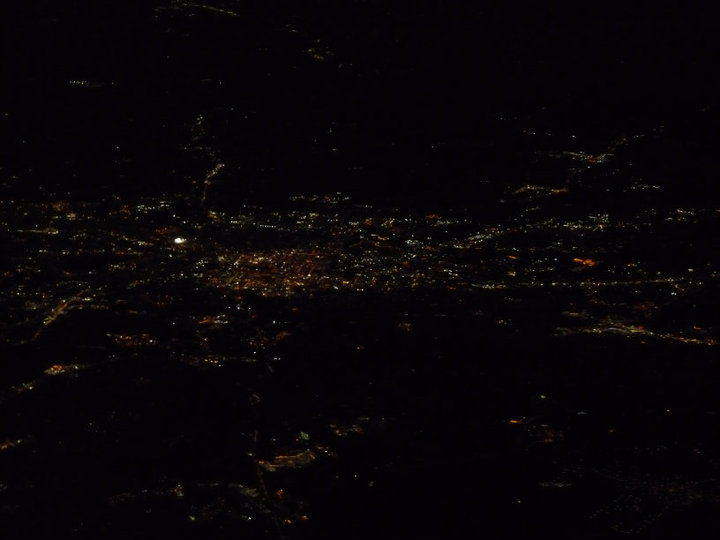
Quick quiz:  Can you identify this Midwest American city?

Mystery Midwest city from the air

Can you identify the city shown in this photo? Photo by James Darrell, flying to DFW from ATL. (Click for larger view)

Can you identify this Midwest city?  The photo was taken about an hour outside of DFW International, flying in from Atlanta Hartsfield.  North in on the right side of the photo.  My quick guess was Oklahoma City, but that was when I thought the departure city was Milwaukee (it could still be OKC).

Can you shed some light, and tell why you think it’s that city?

Night flying is cool.  While I enjoy flying any time, I really enjoy the views from an airplane at night.

Somewhere in the trunk of film-that-may-one-day-be-digitized, I have several photos of smaller cities along the Wasatch Front in Utah, taken during campaigns and business trips in the 1970s and 1980s.  At one time I had a list of the cities in the shots, but that list is long gone.  I wonder whether I could identify those cities today?

Historically, it would be interesting, since most of those small towns now are sizable suburb cities.

Chicago lays out in an orange grid of glowing citrine gemstones at night.  New York City dazzles from 2,000 feet, looking better than any movie you’ve ever seen, and glowing.  Dallas presents a colored outline against the black sky when you come in for a landing (or Fort Worth, with more white lights, if you’re on the west side of the aircraft coming in).  Salt Lake City sparkles and spreads up the mountains and canyons.  St. Louis is neat rows of lighted pathways broken by the snaking Mississippi and Missouri Rivers.  Washington, D.C. is a Shining City on a Hill spectacular when the weather is clear, coming down the Potomac River to National (now Reagan).

Which city is this one, above?

Add to FacebookAdd to NewsvineAdd to DiggAdd to Del.icio.usAdd to StumbleuponAdd to RedditAdd to BlinklistAdd to TwitterAdd to TechnoratiAdd to Furl


Chuck Yeager in Dallas

July 31, 2010

Brig. Gen. Chuck Yeager, C. R. Smith Museum, Ft. Worth Texas,  July 25, 2010

Can you tell at what angle his airplane was, at this moment of the story? Brig. Gen. Chuck Yeager, C. R. Smith Museum, Ft. Worth Texas, July 25, 2010 - (photo by Ed Darrell - use permitted with attribution)

Brig. Gen. Chuck Yeager accepted a donation of an old footlocker related to an old friend for the American Airlines C. R. Smith Museum, on Sunday, July 25, 2010, at the Museum in Fort Worth.  He spoke for nearly two hours, showing a film biography, and taking questions from the audience of nearly 300, including about 80 other pilots.

Do we need to introduce Yeager? He’s recognized as the first man to break the sound barrier in level flight, a veteran of flying in U.S. wars from World War II to Vietnam, and one of the most storied and respected test pilots ever, flying for low pay for the Air Force.  His exploits open the story of the Mercury Astronauts in Tom Wolfe’s The Right Stuff, and the movie that followed.

I’ve heard him speak briefly before, but this was a great treat.  I’m sure he can be caught sometime without a smile, but not on this day.  Yeager spoke about his great love, flying.   He minced no words — you won’t find an unedited video of this speech, I’ll wager.

Enthusiasm for a topic goes a long way to make a great speaker.  Yeager has enthusiasm.

In our family, we’ve always enjoyed laughing about our fighter pilot, Wes.  When he drove the delivery truck for my father’s furniture and appliance store, he’d vocalize the way he wished the engine sounded in a five-speed racer, and not the three-speed manual, six-cylinder 1955 GMC he was driving.  It was charming way back then, in the GMC.

We suspected he did the same thing when he was flying jets.  His co-pilots would never deny it.

I think all great pilots do little things they are not aware of when they really enjoy the flying, or the story about the flying.

See Gen. Yeager’s left hand in the photo above?  He’s talking about flying.  From his hand, you can tell the attitude of the airplane at that point of the story.

And in the photo below?  I think that’s the one where he’s explaining a dog fight.

See the story in his hands?

Yeager, explaining a dogfight - photo by Ed Darrell, use permitted with attribution

Chuck Yeager explains a dogfight to a DFW audience - photo by Ed Darrell, use permitted with attribution


Very large bird

June 30, 2010

DFW Airport - Kenny Darrell leaves for Greece

Kathryn, Kenny, Kenny's grandfather Ken Knowles, under the giant wishbone at DFW Airport

Actually, he’s been in Crete now for two weeks, and he’s deep into training for how to teach.  I’m just slow on getting the posts up.

Kenny left for Greece, despite the lack of visitor facilities on either side of the TSA checkpoints, we all went along for the ride and the farewell, Kathryn, Kathryn’s father Ken Knowles, and I.  Airport art and history displays always fascinate me — there are some great pieces hidden away in U.S. airports.  Sometimes the airlines even spring to pay for the stuff (I wonder how much this thing cost).

A great place for a photo of a family  wishing someone bon voyage. A wishbone, how appropriate.  Was this just a coincidence, or is it a little, pricey arty joke?  “Silver bird.”  Oh.  Right.

It’s metal.  I think it’s the wishbone of a Boeing 767.

Kenny leaves for Greece - detail - IMGP2085

Kenny Darrell and his grandfather, Ken Knowles; DFW Airport, under the giant wishbone -- Kathryn snapping a shot at the right.

Bon voyage, Kenny!

Terry Allen sculpture, Wish, 2005 (DFW Airport)

Terry Allen sculpture, Wish, 2005 (DFW Airport)

More:


Definition of “urbanization”: Glowing Cities Under a Nighttime Sky on Flickr – Photo Sharing

October 2, 2009

Pleasant to watch, this time-lapse composition highlights the light pollution aspect of increasing urbanization across the United States.  The photographer, a Dutch architect, notes that each streak of light represents a city, as he flies across the American Midwest to touchdown in San Francisco (SFO).  It’s a visual definition of urbanization, isn’t it?

On my night time flight back to SF from Amsterdam, I noticed that the lights from cities were making the clouds glow. Really spectacular and ethereal – it was really seeing the impact of urban environments from a different perspective. Each glow or squiggle represents one town or city!

Luckily the flight was half empty, so I was able to set up an improvised stabilizer mound made up of my bags, pillows, and blankets for my camera to sit on.

We were around the midwest at the beginning of the clip, and there were fewer cities once we hit the rockies. the bridge at the end is the san mateo bridge.

Technique: 1600iso; beginning – 1 (30sec) exposure / 45secs; end – 1 (4sec) exposure / 10 secs; total elapsed time: around 3 hours?

Equipment used: Nikon D300 (interval shooting mode), Tokina 12-24mm.

Music: Bloc Party – Signs

Stunning, beautiful and troubling at the same time.

Vodpod videos no longer available.

more about “Definition of “urbanization”: Glowin…“, posted with vodpod

Can you use this in your classroom?

Tip of the old scrub brush to One Man’s Blog.

Share the light with your friends:

Add to FacebookAdd to NewsvineAdd to DiggAdd to Del.icio.usAdd to StumbleuponAdd to RedditAdd to BlinklistAdd to TwitterAdd to TechnoratiAdd to Furl


American Airlines welcomes pets, at JFK Airport

July 15, 2009

Old buddy Jack Keady writes:

I swear – I don’t make this stuff up:

Cats and Dogs Welcome (and comfortable) at JFK
American Airlines has installed a new Pet Relief Area at the JFK International Airport in New York. More»

Is this important?  Ask anyone who travels with a beloved four-legged critter.  Well, we don’t have to ask — AA vet Dennis Crosby tells the story:

I think it is a great idea.  Every time we take our dog to Ft. Myers, airport palm trees get irrigated immediately upon arrival.

Could have really used this at DFW about 3 years ago.  On the way home to Chicago via a connection, my family and I experienced an air interruption about 30 minutes out of DFW. Back at the gate in front of Dickey’s barbeque, we were advised that we would leave in 4 hours at 515 PM.  Went to the Admirals Club and tried to keep an eye on updates.  Final check revealed that the flight had left in 2 hours , 10 minutes before I checked for the third time with the folks at the reception desk. Given that it was on a January 3, our options were  few – they finally put us on a positioning 777 five hours later. Needless to say, we could not keep our pup, whose vet prescribed sedative had worn off much earlier, inside his soft sided carry on bag.  The zipper broke and out burst Marshall, our Bichon Frise.  He is a nice dog, and he eventually made friends with everyone in the Admirals Club when he slipped out of his leash.  At that point, I was beyond caring.

Anyway, about an hour before departure, I took little Marshall to the men’s room and did my best to show him what to do.  I am sure that image must be quite horrific to most of you.  Marshall elected to ignore me and make friends with the other folks there as well.

As departure time came, we realized that the zipper on Marshall’s bag was irreparably broken.  My wife Patti took the shoelace out of one of her tennis shoes and we literally “stitched” him back in.  And then we flew home to Chicago, looking at that point very much like the Clampett family.  After a missed approach in icy fog at ORD, we finally got to the claim area 16 hours after our initial flight had left FLL.  Nature being what it is, Marshall had an immediate explosive decompression of his own, right there in the claim area of my alma mater.  Luckily, most of the folks pushing through the claim area did not notice – or at least did not notice until sometime later.

Great idea at JFK.  I urge AA to build one at ORD too. I know Marshall would be grateful.

O’Hare used to have large ficus trees throughout its terminals, and small flocks of resident sparrows who blundered in through open doors or ramp doors.  One crowded winter night I watched a guy sneak his pup up into the large pot holding one of the trees to irrigate it.  When he caught me laughing he explained the dog had been cooped up for more than eight hours, four of them stranded on some runway waiting for Air Traffic Control clearance.

I pointed out to him that American had far more trees in its area than United did, and he should have been glad to be flying American.  He said he would watch for trees in other terminals.

Too bad that guy doesn’t read this blog.

Tip of the old scrub brush to Jack Keady.  Keep us posted on all the important stuff, Jack!


Grand Canyon airplane disaster, June 30, 1956

June 30, 2009

This is completely an encore post from a year ago today; still thinking about those airplanes and the Grand Canyon.

[2008] Today’s the 52nd [53rd] anniversary of a horrendous accident in the air over the Grand Canyon. Two airliners collided, and 128 people died.

In 1956 there was no national radar system. When commercial flights left airports, often the only contact they had with any form of air traffic control was when the pilots radioed in for weather information, or for landing instructions. Especially there was no system to avoid collisions. As this 2006 story in the Deseret News (Salt Lake City) relates, the modern air traffic control system was spurred mightily by this tragedy.

About 9 a.m. Saturday, June 30, [1956], the TWA flight bound for Kansas City, Mo., and the United flight bound for Chicago left Los Angeles International Airport within three minutes of each other. The TWA flight, carrying 70 people, filed a flight plan to cruise at 19,000 feet. The United flight, with 58 people on board, planned to cruise at 21,000 feet.

About 20 minutes into the flight, TWA pilot Capt. Jack Gandy requested permission to climb to 21,000 feet. An air traffic controller in Salt Lake City turned down Gandy’s request. Then Gandy asked to fly “1,000 on top,” meaning at least a thousand feet above the clouds, which that morning were billowing as high as 30,000 feet. That request was granted.

By the time both planes were over the Grand Canyon, the pilots were flying in and out of the clouds, on visual flight rules and off their prescribed flight plans, apparently typical in those days as pilots veered off course to play tour guide.

No one knows exactly what happened.

It was the last big accident before instigation of the “black box,” so investigators had to piece together details from debris on the ground.

They decided that the left wing and propeller of the United plane hit the center fin of the TWA’s tail and cut through the fuselage, sending Flight 2 nose-first into the canyon, two miles south of the juncture of the Colorado and Little Colorado rivers. The United DC- 7, which had lost most of its left wing, began spiraling down. Capt. Robert Shirley radioed Salt Lake City a garbled message that controllers understood only after they slowed down the recording: “Salt Lake, ah, 718 . . . we are going in.” Flight 718 smashed into a cliff on Chuar Butte.

The accident plays a key role in a Tony Hillerman mystery, Skeleton Man — Hillerman writes about two Navajo Nation policemen.

I’m thinking of the crash today for two reasons. I’m off for a tour of canyons, including both rims of the Grand Canyon, in the next two weeks. The last time I was there was 1986, with the President’s Commission on Americans Outdoors. We flew in on a Twin Otter, coming up from Phoenix, over the Roosevelt Dam, up over the Mogollon Rim, over the Glen Canyon Recreation area and stopping it Page. From Page to Grand Canyon, we took full advantage of the huge windows in the Otter — seeing first hand the sights that the controversial tourist flights were designed to reveal. Safety was a key concern, and we talked about it constantly with the pilots.

A few weeks later, on June 18, 1986, that DeHavilland Twin Otter collided with a Bell Jet Ranger helicopter over the Canyon. 25 people died in that crash.

I have flown over the Canyon a dozen times since then — no longer will airliners dip down to give passengers a better view, not least because airliners cruise tens of thousands of feet higher now than they did then. I think of those airplane accidents every time I see the Canyon.

We’re driving in. We’ll spend a day and a half on the South Rim, and another couple of nights on the North Rim. We’re taking our time on the ground. But if we had time, and we could afford it, I’d love to get up in an airplane or helicopter to see the Canyon from the air again.

Updates, 2009:


Bathtub reading on a warm June Sunday

June 7, 2009

I thought everybody does serious reading in the bathtub, no?

The Boneyard at Davis-Monthan Air Force Base near Tucson, Arizona; the Pima Air & Space Museum now offers bus tours of the 309th Maintenance and Regeneration Groups collection of scrapped and very historic airplanes

The Boneyard at Davis-Monthan Air Force Base near Tucson, Arizona; the Pima Air & Space Museum now offers bus tours of the 309th Maintenance and Regeneration Group's collection of scrapped and very historic airplanes

Can’t soak all day.


May 22, 1906: Patent to Wright Bros. for “flying machine”

May 23, 2009

In a drawer in a file box in the U.S. Patent Office in Washington, D.C., is a study in black ink on white paper, lines that resemble those images most of us have of the first Wright Bros. flyer, usually dubbed “Kittyhawk” after the place it first took to the air.

Drawing 1 from patent granted to Orville Wright for a flying machine

Drawing 1 from patent granted to Orville Wright for a flying machine

The patent was issued on May 22, 1906, to Orville Wright, Patent No. 821393, for a “flying machine.”

It makes more sense if you turn the drawing on its side.

Wright Bros. flying machine, from patent drawing

Wright Bros. flying machine, from patent drawing

Why did it take three years to get the patent issued?

Below the fold, the rest of the patent.

Read the rest of this entry »