Climate denialists on Texas weather 2011: Ain’t no heat wave, on average

August 8, 2011

You couldn’t make this stuff up.

In defense of his claim that Texas has not warmed over the last century (“Texas temperatures not rising; Wisconsin temperatures not rising”) and, therefore, Texas does not suffer from global warming, and therefore there is no global warming and no ill effects from warming, Steve Goddard posted this today:

Year-To-Date In Texas

Posted on August 7, 2011 by stevengoddard

Almost as warm as 1927, 1925 and 1953. Only a degree cooler than 1911.

http://www.ncdc.noaa.gov/oa/climate/research/cag3/tx.html

It’s heading for 105°, but since it was 15° one day in February, that averages to 60°, so Texas is okay, according to Goddard.  In their drive to fuzz up the facts and surround policy debates with snark, the denialists will deny anything, leave no weather record untwisted, and deny the sweat on the nose on their face.  According to Goddard, snow in the Great Basin means no drought in Las Vegas, as shown by there being no drought affecting Lake Powell.

Remember Straight Dope’s Cecil Adams’s old line?  “Fighting ignorance since 1973 (it’s taking longer than we thought.)”  Yeah, that applies to climate denialists in quantity.

Here’s what’s going on in Texas right now:

Vodpod videos no longer available.

  •  Texas A&M says the drought of 2011 is the worst ever 1-year drought in Texas history; note how their press release describes the event, and the increasing heat:

    Preliminary reports from the National Climatic Data Center indicate that July 2011 was the warmest month ever recorded statewide for Texas, with data going back to 1895, [State Climatologist John] Nielsen-Gammon reports. The average temperature of 87.2 degrees broke the previous record of 86.5 degrees set in 1998. The June average temperature of 85.2 was a record for that month and now ranks fifth warmest overall.

    Rainfall totals were also unusually light across the state. The July monthly total of 0.72 inches ranks third driest, surpassed by the 0.69 inches recorded in both 1980 and 2000. This is the fifth consecutive month in which precipitation totals were among the 10 driest for that month, says the Texas A&M professor.

Drought and searing heat in Texas.  Caused by climate change?  That’s difficult to say, difficult to trace.  Made worse by climate change?  Most likely.

Dallas media track the consecutive days over 100° F.  It’s a form of misery index — people can recover from a day or two over the century mark.  But more than a couple of days and the heat begins to take a heavier toll on people, on plants and animals, on houses, on cars, on crops, on everything we do in Texas.  It’s difficult to make news make sense on weather stories.  Tracking the number of days over 100° gives a quick graphic for television news, and puts the story into the vein of a sports record story, a narrative people know.

Here’s how things stack up in Dallas, in terms of days over 100°:

Rank Year Consecutive 100° days
1 1980 42
2 2011 37 (and counting)
3 1998 29
4 1952 25
5 1999 24
6 1954 20
7 2006 19
8 2010 18
8 1978 18
10 1956 17

If one looks at the heat streaks, one cannot help but notice that all of the top ten streaks have come since 1952, and that three are in the last decade, five since 1998.  Brutal heat streaks appear to be coming more frequently, many close on the heels of previous heat streaks, and with greater severity.

That is what one would expect from global warming.

Moreover, the recent streaks show greater oscillations.  2011 also saw snow and freezing weather in Dallas, a rarity.  Greater oscillations in weather also would be expected from global warming.

Goddard offers a comparison of January to June temperatures — the coolest part of the calendar year, and leaving out most of the heat-streak days — and on that basis of a half-comparison, he suggests (doesn’t say — he doesn’t want to be caught lying outright) that there isn’t a warming problem in Dallas in 2011.

Heat stroke?  It’s a figment of your socialist imagination.  14 dead?  They probably were smokers.  Global warming?   Not if Steve Goddard can find a statistic somewhere that can be manipulated to appear to deny it.

What do his charts show for July and August of those years?

Finally, there is this:   Assume for a moment that there has been no significant warming in Texas as a complete landmass over the past 100 years:  Does that mean Texas is not battered by any warming that occurs elsewhere?

Of course not.  The current drought in Texas is thought to be triggered in no small part by the La Niña effect, a chilling of the surface of the Pacific in a broad band that stretches west of Peru for about 5,000 miles to the far South Pacific.  La Niña is a counterpart to El Niño, a warming of the same band of water that produces different, not-average weather effects.  The cycles are not well understood as to cause — there are good hypotheses being tested — but it has been observed that, especially in the latter part of the 20th century and the first decade of the 21st, these cycles are speeding up.  The best, not-disproven hypothesis is that these cycles react and speed up due to global warming.

So, to the best of our hypothesizing today, the Texas drought is a function of global warming, in timing, frequency and severity.

This demonstrates the ultimate problem with using a local temperature readings to make authoritative statements about global warming, even averaged over about a hundred million acres like Texas:  Problems of global warming are not always simply problems of temperature, and non-local causes may cause local effects that will not show up in temperature, especially local effects in precipitation, in timing and amounts.

Botanists, foresters, range scientists and biogeographers noticed effects of warming 50 years ago, with the migration of species northward, and up mountainsides.  Wildlife managers noticed altered migrations of game birds and non-game birds about the same time, migration alterations that continue to today.  Plant zones used by farmers and gardeners demonstrate a good deal of change, generally favoring warming, over the past century.  Evidence for warming is quite solid without a single temperature reading.

A bastion of average temperature non-increases, if Texas is one, may still be hammered by warming and its effects in the Pacific, and especially in the Gulf of Mexico.  Is it fair to say the entire system shows no signs of warming?

So we should ask:  Are temperatures and precipitation averages, frequencies, timing and totals, about average for the last century or two?  Then  the case for global warming is a bit weaker.

Dallas will eclipse the previous record string of 100° F days in the next week.  All of Texas is in severe drought, and most of the state is in extreme drought.  Sounds as if there is something going on with the climate.

Last year the denialism sites lit up with a report that a fourth grade student in South Texas had a science project that disproved global warming, and which won an award from the National Science Foundation.  It was a sad hoax.  The speed with which these sites pounced on the report should have warned us that a school of thought devoid of practical results from the lab bench or observation in nature gets too desperate for results, and will cut corners to claim them.  Goddard’s reports repeat the bad methodology of that hoax.

Richard Feynman once wrote, wryly, “Science is the belief in the ignorance of experts.”  Goddard and other denialists appear to read that wrongly, thinking that experts are not to be trusted, and that all experts are ignorant of all things, and therefore stupid.

Politics and especially the politics of science cry out for someone to read Feynman — actually read what he wrote.  Feynman said we should not assume all scientists are infallible.  He did not write that all scientists are fallible and wrong.


Annals of Global Warming: Toles cartoon, seven years ago we were a decade overdue for action

July 14, 2011

Tom Toles cartoon on global warming inaction, from 2004

A Tom Toles cartoon from 2004

Insert a definition of “filibuster” here.

Then pray for action.

Then call your congressman, and him/her to act, now.

_____________

Note on Tom Toles from the Department of Earth Sciences, G-107 Environmental Geology, Indiana University-Purdue University at Indianapolis (IUPUI):  “A political cartoon from the Washington Post on climate change. Tom Toles, a political cartoonist, often pens cartoons on environmental issues. His cartoons are often reprinted in other newspapers (Washington Post/Universal Press Syndicate).”


Meanwhile, in the evolution debates, where we find the Mother of All Denialism . . .

June 29, 2011

Other fronts in the War on Education may have earned more attention here in the Bathtub, lately — and in state legislatures.  Threats from the dilution and elimination of good, hard science courses continue to pose problems, especially from creationists and their shyer, camouflage troops from the Chapel of Intelligent Design.

We need to stay aware of the creationist/creationism threat.  At its heart, creationism requires adherents to reject the facts of science, to reject the workings of science, and to reject the functions of debate about what is real, and what is not.  It is to me a rather simple discussion of the quality of evidence.

Eugenie Scott and her colleagues from the National Center for Science Education provide a great update in what is going on, with a great video, and an informative and troubling explanation of the links between creationism and the “unbelievers” in climate change.

Be sure to watch the first ten minutes, to see the video update on the fight to keep good science education in schools, especially the teaching of evolution.


Good news? One denialist non-think-tank shuttered

June 24, 2011

Britain’s Independent reported on June 21 that the London version of the International Policy Network closed its doors.  The group was known for its anti-environmental protection, anti-science, pro-rapacious development stands.

Alas, the U.S. version clings on.

The International Policy Network, once the most persuasive and active think tanks campaigning against climate change science, has disbanded in the UK after what appears to be a spilt between its leading members.

A document released following a Freedom of Information request shows that the charity’ s chairwoman Linda Whetstone and her brother Michael Fisher held a private meeting in which they agreed to abandon the name of IPN UK after more than a decade. The meeting, held by telephone in November 2010, was perfectly within the charity’s rules.

The minutes of the meeting, which cover a single side of an A4 sheet of paper, were obtained by The Independent this week and reveal that Whetstone also resigned from the board of the International Policy Network in the United States, despite being a leading member of the organisation.

This newspaper has also confirmed that Professor Julian Morris, the founding director of the IPN in the UK and then president, is no longer working for the sister organisation in the US where he was earning $137,000. He is now vice president for research at a rival think tank, the Reason Foundation.

Professor Morris, after speaking at a meeting on Wednesday, June 15 being held by a new think tank called the Legatum Institute, said: “The IPN is scaling down. There were two organisations, the IPN US Inc and IPN UK and now the two organisations are pursuing independent paths.”

Asked whether the IPN had split over climate change, he added: “It is a long and complex story. It is what it is. I can see where you’re going with this.”

I wish I were so omniscient.  I wonder where Morris thought that line of questioning was going?

The Independent  summarized some of the less savory parts of the funding issues for the organization (John Mashey surely knows all this):

The closure of the free market IPN follows years of controversy about Exxon funding, alleged links to the tobacco industry and contested claims about AIDs and the pesticide DDT.

It is possible, however, that the closure may be linked to family connections involving David Cameron that meant IPN could no longer exist as a major force of climate denial.

Whetstone is the mother-in-law of Steve Hilton, who is the director of strategy for the prime minister and was godfather to his son Ivan. Hilton is the man who persuaded the Conservative leader to adopt a robust stance on climate change and hug Huskies on the Norwegian glacier to illustrate his commitment.

Hilton’s wife, Rachel Whetstone, is a vice president at Google for communications, which has donated millions to climate change causes, including creating 21 Google Science Communication Fellows.

Linda Whetstone and her brother Michael, the trustees present at the private meeting, are the children of Sir Anthony Fisher who was an ideological disciple and former student of the father of neoliberalism, Friedrich Hayek. Fisher senior masterminded the global network of neoliberal think tanks, including setting up more than 150 organisations himself.

IPN was home to unlikely and highly-questionable science claims, and a refuge for cranks like Roger Bate, whom readers of this blog will recognize from the DDT and Rachel Carson hoax propaganda.

The launch of the International Policy Network’s first publication Adapt or Die was reported in November 2004. The charity claimed climate change was a myth, that sea levels were not rising and that global warming would benefit humans by increasing fish stocks.

At that time Dr Roger Bate was also a director of the IPN. Morris and Bate were both named in a letter asking the tobacco company RJ Reynolds for £50,000 in funding for a book about the “myth of scientific risk assessment” which would deny the effects of passive smoking.

Morris denied involvement, but a book titled What Risk? edited by Bate was later produced in which Bate acknowledged Morris for his support.

The IPN name soon became associated with ExxonMobil after the American oil giant revealed in its own publications that it granted almost £250,000 ($400,000) to the IPN in the US between 2003 and 2006. An examination of IPN UK accounts registered at Companies House revealed that from 2003 to 2005 the US think tank in turn granted £204,379 to the IPN in London.

Exxon stopped funding the IPN following a letter in 2006 from Bob Ward who was then at the Royal Society calling on the world’ s largest seller of fossil fuel to stop funding organisations that were actively spreading misinformation about the science of human forced climate change. Ward is now at the Grantham Institute at the LSE in London.

An IPN statement at the time said: “The implication that IPN is somehow being funded by Exxon to promote ‘climate change denial’ (per the Guardian’s salacious headline) is preposterous nonsense. IPN’s founder and executive director, Julian Morris, has personally been involved in the climate change debate since writing his undergraduate thesis on the subject in 1992 and neither his views nor those of IPN have ever been influenced by any financial contributor.”

It is nothing but good news when such a cloud over the bright sunshine of good science, good information, and good policy, goes out of business.  One may wish there were more good news in store, or that more of the denialist groups would follow the example.

The good a non-profit may do oft dies with its disincorporation papers and is buried in some musty, dusty archive.  The evil such groups do lives on long after — sometimes propogated, zombie-like, in other organizations.

Until its dissolution the IPN has been central to the climate change denial machine. While receiving funding from Exxon, the organisation launched Adapt or Die in Washington in 2004 and published two further climate change books in time for the COP-10 meeting held that year in Argentina.

The IPN also attended the inquiry into the economics of climate change held by the House of Lords economic affairs committee, which was attended by Lord Lawson. Lawson claims in his book, Memoirs of a Tory Radical, that he began to question the science of climate change during the hearings. He would then go on to form the sceptic Global Warming Policy Foundation.

The think tank also established and launched the Civil Society Coalition on Climate Change which, it claims, included 40 other organisations around the world. The IPN then “ coordinated participation of CSCCC members” at the UN climate meeting in Bali in 2008, distributing hundreds of copies of its report to delegates, participants and journalists for free.

The IPN was launched when the UK charity Atlas Economic Research Foundation, which was founded in July 1971, became part of the international network. During its existence the London office of the think tank raised more than £2.5million from donors. The organisation will continue in some form under the name Network for a Free Society.

Despite repeated attempts to contact her Linda Whetstone was unavailable for comment.

Against damaging climate change, we needed to start major pollution clean-up efforts two or three years ago.  IPN’s legacy may yet lie in the destruction yet to be done to to the human race by the harmful effects of uncontrolled, and perhaps, now uncontrollable climate change.  IPN shares some of the blame for the lack of anti-pollution action at the Copenhagen conference at the end of 2009, and for the lack of other coordinated international work to control pollution since then.


Chronic drought complicated by chronic denialism

May 26, 2011

Which is worse:  To be in the depths of a drought, or to deny drought where it exists?

I ask the question because, as one cannot tear one’s eyes away from a train wreck about to occur, I watch Steve Goddard’s blog.  Occasionally Steve or one of his fellow travelers says something so contrary to reality or fact that I can’t resist pointing it out.

In some discussion over there, Goddard suggested that because there is above-average snowpack around Salt Lake City and in Northern Utah, Lake Powell’s decade-long struggle with extreme drought is over.  Therefore, to Goddard, global warming does not exist.

(No, I’m not really exaggerating.  Seriously.  Go look.  No one there seems to have ever had a course in logic, nor in English composition and essay writing.  If Al Gore got svelte, one suspects half the commenters there would never be able to speak again.)

It is true that this year, contrary to the past decade, snowpack is high along the Wasatch Front and in the Uinta Mountains of Utah, and in Wyoming and Colorado areas that drain into the Green and Colorado Rivers.  Consequently, forecasters say that Lake Powell may gain a few feet of depth this year.  Powell is down about 50 feet, however, and even a record snowpack won’t erase the effects of drought on the lake.  (Yeah, I know:  The Wasatch doesn’t drain into the Colorado system — it drains to the Great Salt Lake, as indeed do many of the streams that have great snowpack in Utah — so a lot of the record snowpack won’t get within 400 miles of Lake Powell.  That’s geography, and it would be one more area that commenters would embarrass themselves in.  Don’t ask the pig to sing if you aren’t going to spend the time to teach it; if you need the aphorism on teaching pigs to sing, look it up yourself.)

Since Lake Powell won’t lose a lot of elevation this year, the Goddardites (Goddardians?  Goddards?  Goddardoons?) pronounce the U.S. free of drought.

Right.

Check it out for yourself, Dear Reader.  Here’s an animation from the National Drought Center, showing drought measurements in the contiguous 48 states plus Alaska and Hawaii, over the past 12 weeks:

Drought in the U.S., 12 weeks ending May 17, 2011, National Drought Mitigation Center, U of Nebraska-Lincoln

Drought in the U.S., 12 weeks ending May 17, 2011, National Drought Mitigation Center, U of Nebraska-Lincoln - click on map for a larger version at the Drought Monitor site.

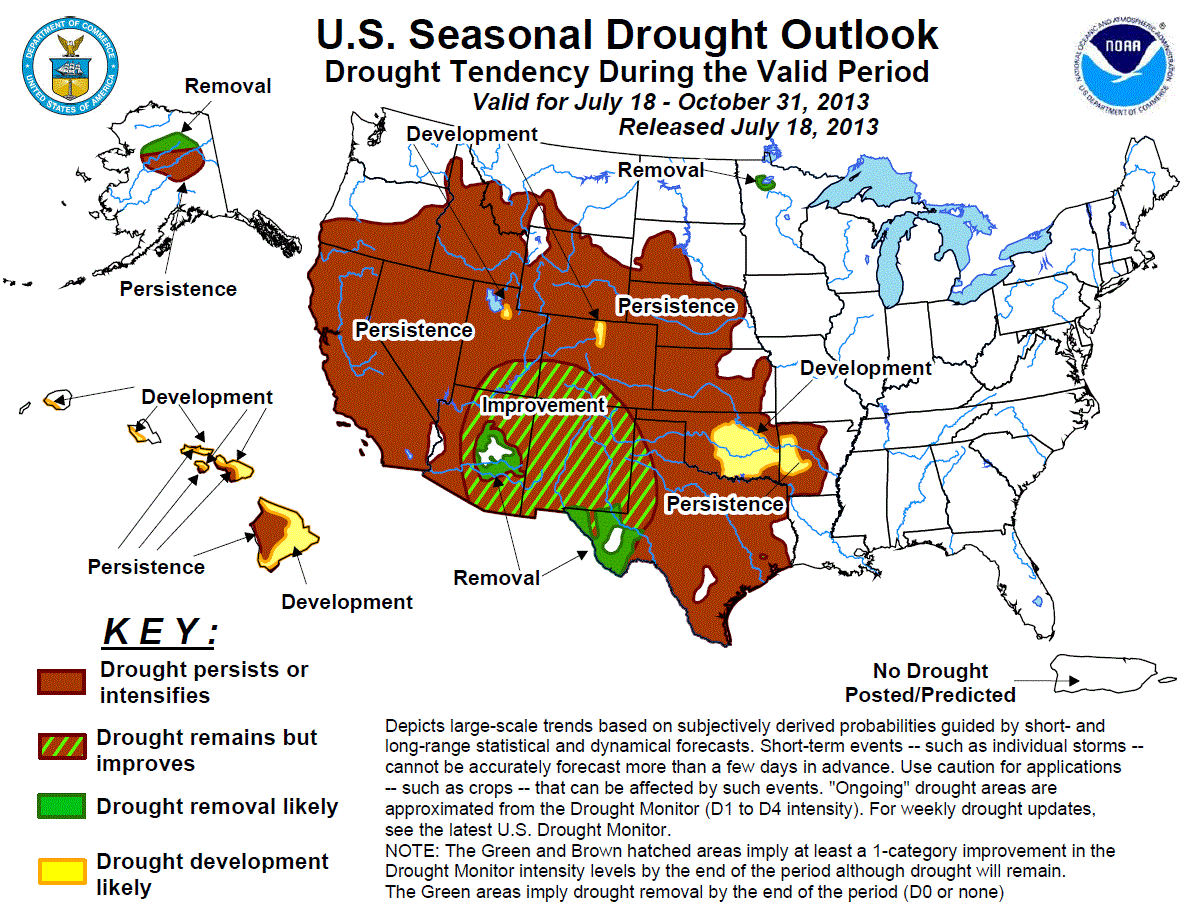
Here’s the drought outlook map from the Climate Prediction Center at NOAA:

U.S. Seasonal Drought Outlook Map, released May 19, 2011, NOAA and the Climate Prediction Center

U.S. Seasonal Drought Outlook Map, released May 19, 2011, NOAA and the Climate Prediction Center - click image for a larger version at NOAA's site.

It would be wonderful were these droughts to break soon.  But that is very unlikely.

So, why would anyone deny it?

Then, just to indicate the bait-and-switch logic these guys use, Goddard came back with a claim that the 1956 drought in Texas was worse, as if that means the current drought doesn’t exist.  Fore reasons apparent only to those whose heads get pinched by tinfoil hats, he also notes the CO2 levels for 1956.  I think I know what point he’s trying to make, but someone should tell him that apples are not oranges, and comparing apples and oranges to pomegranates doesn’t increase the supply of tennis balls.

Let’s just stick to the facts.  The experts who must operate the dams and lakes and get water to Mexico on schedule say the drought along the Colorado persists.  Who are we to gainsay them?

Resources:  

GEOSat photos of Lake Powell and drought, 2000 to 2004 - Dr. Paul R. Baumann, SUNY - Oneonta College

GEOSat photos of Lake Powell and drought, 2000 to 2004 - Dr. Paul R. Baumann, SUNY - Oneonta College


What sort of crazy is the warming denialist?

April 21, 2011

I’ve got to stop looking over there.

Goddard’s got a post up showing the great disregard he has for the facts, and the law, and history, etc., etc., etc.  It may be an unintentional showing, but there it sits, “like a mackerel in the moonlight, both shining and stinking.”

Jerome Corsi, that serial fictionalizer of vital issues, has a book out promoting his slimy schemes besmirch President Obama.  Goddard urges people to buy it.

But they really pile on in the comments.  It’s almost as if Casey Luskin had a whole family just like himself, and they got together to whine about Judge Roberts again.

Warming denialism, creationism and birthers — is it all just three minor variations on the same brain-sucking virus?  Or could three different diseases produce the same sort of crazy on so many different issues?

I’m reminded of the old saw that you cannot reason a person out of a position he didn’t reach by reason.  These guys will never see the light.  Heaven knows, it ain’t evidence that gets ’em where they are now.

Previous posts at Millard Fillmore’s Bathtub:

Special kind of birther crazy:


No, DDT is not the easy answer to malaria

February 13, 2011

Roger Bate and Richard Tren, the Dynamic Duo of DDT, have been busy lately.  Bate appears to have found additional funding from the radical right-wing American Enterprise Institute, where I gather he has been prowling the halls trying to sell others there on the idea that DDT is an easy solution to malaria, and only mad, despotic environmentalist megalomaniacs have stopped DDT from saving Africa from malaria, the American economy from depression, and Major League Baseball from the designated hitter rule.  (I thought it odd that his bio doesn’t mention his work for tobacco interests as integral to his organizing.)

Graphic from a 1950s-era ad for DDT

Graphic from a 1950s-era ad for DDT. No, it's not right -- it's Madison Avenue then, expressing the claims of the "DDT-is-good-for-you" hoaxsters of today.

I don’t exaggerate much, if at all.

So, I’ll bore you with rebuttals over the space of the next few days.  Especially among the right-wing echo chambers, comments are frequently moderated to oblivion when they are allowed at all.

For example, there is a site that calls itself Minnesota Prager Discussion Group — a site for Dennis Prager groupies.  Here’s a post that may have been prompted by a Dennis Prager broadcast, but which cites a scurrilous pamphlet written by Bates and Tren, with Donald Roberts, carrying all sorts of calumny against environmentalists, health care professionals, diplomats, environmentalists and scientists — cloaked in a high degree of disrespect for readers who, they hope, have never bothered to read Rachel Carson and have forgotten everything they may have ever read about DDT and environmental harms it causes.

Here’s the post on DDT and malaria there:

Malaria Can Be Easily Controlled by DDT

Posted on February 2, 2011 by Glenn H. Ray

DDT Still Critical in Fight against Insect-Borne Diseases

Through a mix of environmental fervor, self-interest and disregard for evidence-based policy, United Nations (UN) agencies are misleading the public about the insecticide DDT — mistakenly claiming it is not needed and can be eliminated globally by 2020, says Donald Roberts, emeritus professor of tropical medicine at Uniformed Services University of the Health Sciences, Roger Bate, the Legatum Fellow in Global Prosperity at the American Enterprise Institute, and Richard Tren, the executive director of Africa Fighting Malaria.

  • UN agencies are misleading the public by claiming that malaria can be controlled without insecticides, notably DDT; the stated aim is to stop DDT use globally by 2020.
  • UN agencies are committing scientific fraud by deliberately and incorrectly interpreting data on malaria control using noninsecticide methods.

While DDT is no panacea, it is still a critical weapon in the battle against malaria and other insect-borne diseases, say Roberts, Bate and Tren.

Source: Roger Bate, Donald Roberts and Richard Tren, “The United Nations’ Scientific Fraud against DDT,” American Enterprise Institute, January 21, 2011.

Above information came from the National Center of Policy Analysis

Dennis Prager regularly reminds his listeners that many tens of thousands of lives can be saved by approving DDT uses in certain areas in Africa.

Oy.  Helluva lotta error and deception packed in a couple hundred words.

So, I tried to help the “discussion group” get to some more accurate understanding of DDT and malaria.

Ed Darrell, on February 2, 2011 at 4:53 pm said:

1. There is no shortage of DDT.

2. Not only is DDT not a panacea, it is increasingly not effective against malaria-carrying mosquitoes.

3. Richard Tren leads an astro-turf organization that collects hundreds of thousands of dollars, but does very little if anything to actually fight malaria. These sorts of diatribes increase contributions to his organization’s coffers, but they don’t help fight malaria.

4. In actual practice over the last decade, bednets have proven to reduce malaria by 50% to 85% in areas where they are deployed; DDT is only 25% to 50% effective.

5. Bednets cost about $10 and last about five years — $2.00 per year. DDT costs upwards of $12 per application, and must be applied twice per year — $24.00 per year. Bednets stop mosquitoes cold. DDT depends on mosquitoes biting people first, then resting on a DDT-coated wall — and we hope that it’s a young mosquito that has not yet contracted malaria itself and is not shedding the parasites.

6. Malaria deaths, worldwide, are lower now than at any other time in human history. Since the U.S. stopped using DDT on cotton in 1972, the death rate to malaria has been cut in half. The death toll to malaria is, today, less than 25% of what it was when DDT use was at its peak. Statistically, it appears that cutting DDT use also cuts malaria.

7. We know that’s not the case, but those statistics prove that we can beat malaria without DDT — as indeed, the U.S. Army beat malaria without DDT to build the Panama Canal by 1915, 24 years before DDT was discovered to have any insecticidal properties. In the U.S., with the great aid of the Tennessee Valley Authority, malaria was essentially wiped out by 1939 — seven years before DDT became available for use against mosquitoes. No nation relying on DDT has been able to eradicate malaria.

Roger Bate, Donald Roberts and Richard Tren commit health care terrorism when they tell their fraud-laced stories against the UN and the health care professionals who fight malaria. Shame on them.

Did the author read anything I wrote?  He responded, politely for a guy who didn’t quite get it:

Glenn H. Ray, on February 9, 2011 at 12:19 pm said:

Ed Darrell: Thank you very much for this information.

Let us assume every item you mention is accepted beyond debate..

Malaria still ravages populations in Africa. We are not beating malaria without DDT.

Dennis Prager agrees with you regarding the value of bed nets and from his visits to Africa, has encouraged financial support to increase their availability.

The question still remains, why is DDT still banned rather than being available for use where needed?

My responses:

Sometimes the facts stare us in the face and we can’t see them.

You said:

Malaria still ravages populations in Africa. We are not beating malaria without DDT.

We have cut malaria 75% from when DDT was heavily used. We are beating malaria as best we can since DDT advocates overused DDT and made it ineffective against most populations of mosquitoes. (WHO’s program to eradicate malaria was effectively ended in 1965 because overuse of DDT by large agricultural interests had bred mosquitoes resistant to and immune to DDT; today, every mosquito on Earth carries the alleles that make them resistant and immune to DDT.)
It doesn’t matter how much we whine about DDT being “banned,” DDT doesn’t work to beat malaria now, and it was never intended to be more than a very temporary solution while medical care, treating the humans, did the real work.

When we beat malaria (as in the U.S.), the fact that humans do not have the disease means that mosquitoes cannot catch it from humans. That means the mosquito bites go back to being annoyances, and we don’t need to worry about them.

Malaria is a disease of humans. If we concentrate on the mosquitoes, we can reduce it, temporarily. If we concentrate on treating the disease, and preventing the disease in humans, we can forget about mosquitoes.

Dennis Prager agrees with you regarding the value of bed nets and from his visits to Africa, has encouraged financial support to increase their availability.

Then why is he talking smack against them? He’s talking untruths about DDT, untruths carried by the anti-bednet lobby, like the so-called “Africa Fighting Malaria” lobbying group. Bednets are twice to almost four times as effective as DDT, if they are used exclusive of each other. You don’t get that impression from Prager. Bednets cost a fraction of what DDT treatments cost. Bednets are effective longer than DDT treatments.

We can beat malaria without DDT. We can’t beat malaria without bednets. If he has no truck against bednets, Prager should get out of the bed of the anti-bednet, pro-DDT lobby, and talk about beating malaria.

The question still remains, why is DDT still banned rather than being available for use where needed?

No, the question is, why aren’t you listening?

DDT is not banned anywhere in Africa, and never has been. DDT is freely available to any government who wishes to use it — or private groups who wish to use it.

DDT doesn’t work as it once did, plus, it’s a deadly poison to fish, amphibians, reptiles, birds and small mammals. DDT is unsafe in use outside of Indoor Residual Spraying, where it is increasingly less effective — and Africans are nervous about IRS because their children keep getting sick with strange new diseases even when the kids are safe from malaria. There may be no solid connection between the new syndromes and DDT, but since DDT is not a panacea, not as effective as untreated bednets, and much less effective than treated bednets — why take a chance?

Opposition to DDT today comes from Dennis Prager’s and AFM’s friends in business in Africa. The only serious opposition to DDT I’ve found in Africa was in Uganda, where businessmen sued to stop spraying two years ago.

What in the world makes you think there isn’t all the DDT out there that health workers need?

Any discussion of fighting malaria that involves DDT takes away from the serious fight to beat malaria. A lot of westerners think DDT is a magic potion, and that if we just poison the hell out of Africa with the stuff, we can beat malaria without serious effort, without serious research, without improving the lives of the poor people of Africa who are victimized by the disease.

We beat malaria in the U.S. by improving housing, beefing up public health services, and increasing incomes of families of victims. It took 20 years of concentrated work — all before DDT was even discovered to kill bugs.

To beat malaria in Africa, we must improve housing, beef up medical care, both diagnoses and treatment of the disease, and improve the lives of the families of victims to prevent new disease-causing bites.

It’s tough work. Prager appears not to have the stomach for it. If so, he should say so, instead of claiming, falsely, that DDT could do the job.

Malaria proves a tough foe, difficult to beat. DDT could play a very small role in the defeat of malaria, but more DDT won’t help, and malaria isn’t winning because DDT isn’t available. DDT is readily available. DDT doesn’t work anymore, and DDT was never intended to be a sole weapon.

And:

Lancet recently devoted most of an issue to fighting malaria, and how to beat it. Lancet is perhaps the world’s leading medical journal, certainly among the top three, with no axe to grind, and concerned with improving the condition of humans throughout the world — from a medical care perspective.

The articles come from the world’s leading malaria fighters and those in the vanguard of research on how to beat malaria.

Here’s the executive summary (8 pages in .pdf form).

Did you notice? No call for DDT.

Can you and Dennis Prager please get on board with the campaign to beat malaria? Howling about false, junk science claims that DDT should be used to poison Africa isn’t a ticket to get on that malaria-fighting train.

Mr. Ray responded again:

Thank you again for your interaction. It has been my understanding that many of the claims about the toxicity of DDT to the living groups you have listed has been exaggerated, particularly in regard to the bird populations.
As you might note, malaria control is not my field of expertise, but I have read this claim from two sources over the past decade, but I cannot refer you to them.
I shall remember your ‘corrections’ in any discussion I might have in the future about DDT.

I am certain Dennis has no connections with any businesses in Africa dealing with DDT.

Denial among people who admit that they don’t know much about the topic is really quite amazing, isn’t it?

I made one more comment, but Ray has held it in his site’s moderation queu for enough days I am convinced he plans to leave it there.  Here is what I posted that he has not yet let through:

Ed Darrell, on February 10, 2011 at 12:49 am said: Your comment is awaiting moderation.

Thank you again for your interaction. It has been my understanding that many of the claims about the toxicity of DDT to the living groups you have listed has been exaggerated, particularly in regard to the bird populations.

Peer review research over the past 40 years has borne out the early research from 1945 through 1961 that showed DDT is a killer of birds, reptiles, fish, amphibians and small mammals. I am unaware of any study anywhere that denies this toxicity, except with regard to insects who produce new generations quickly enough to evolve resistance and immunity.

Discover magazine looked for studies saying DDT doesn’t harm larger animals, but found none. In November 2007 the magazine noted:

In fact, Carson may have underestimated the impact of DDT on birds, says Michael Fry, an avian toxicologist and director of the American Bird Conservancy’s pesticides and birds program. She was not aware that DDT—or rather its metabolite, DDE—causes eggshell thinning because the data were not published until the late 1960s and early 1970s. It was eggshell thinning that devastated fish-eating birds and birds of prey, says Fry, and this effect is well documented in a report (pdf) on DDT published in 2002 by the Department of Health and Human Services’ Agency for Toxic Substances and Disease Registry (ATSDR). The report, which cites over 1,000 references, also describes how DDT and its breakdown products accumulate in the tissues of animals high up on terrestrial and aquatic food chains—a process that induced reproductive and neurological defects in birds and fish.

DDT kills birds outright, through acute poisoning. That was what first sounded the alarms at Michigan State University, the University of Wisconsin, and a dozen other places across the U.S. DDT accumulates in fat tissues, and poisons the brains of migrating birds when they are under stress during migration. DDT poisons chicks of birds in the eggs, killing them outright, or making them unable to feed after hatching. DDT makes female birds unable to lay competent eggs (thins the eggshells), which means even if the chick is free of the toxins, the egg can’t protect it through incubation. DDT scrambles the sex organs of birds, making hermaphrodites, and making both genders unable to mate successfully.

Most of these death mechanisms apply in other species, too. The saving grace for humans is that we are so large. DDT doses required for much of this documented damage is much higher than we get. Still, in humans, modest amounts of DDT mimic estrogen, producing premature onset of menses in little girls, and swollen mammaries and shrunken testes in boys.

There are several studies that indicate the carcinogenic effects of DDT are weak in humans. Those studies frequently are touted as having “proven DDT harmless.” Not at all. They only show that DDT isn’t as bad as tobacco in causing cancers. That’s not an endorsement of health.

As you might note, malaria control is not my field of expertise, but I have read this claim from two sources over the past decade, but I cannot refer you to them.

Any source you have will trace back to the junk science promulgated by Steven Milloy, a former henchman of the tobacco lobby, and Gordon Edwards, a formerly respected entomologist who appears to have gone off the deep end with an obsession against Rachel Carson. Neither ever published any research to back up their claims. Edwards is dead, and Milloy is a long-time political propagandist — you won’t see any research from them.

Search Pub-Med. Check the ornithology and wildlife journals. Under U.S. law, were DDT not a deadly toxin, EPA could not ban it. DDT manufacturers sued EPA to overturn the ban, and they lost twice. The courts agree that the evidence against DDT is more than sufficient for regulation of the stuff as EPA did.

I shall remember your ‘corrections’ in any discussion I might have in the future about DDT.

Thank you. Feel free to check my blog, Millard Fillmore’s Bathtub, for further developments on malaria.

The hoax case for DDT, and against Rachel Carson, the UN, the World Health Organization and all of science and medical care, is getting a significant set of boosts from Tren, Bate and Roberts this winter.  Let us hope, if only for the sake of truth and accuracy, that their stuff doesn’t get any more traction than it already has.

Other recent postings on DDT and malaria and policy


Watt’s Up puts collective hand into the fan – er, um, windmill

February 6, 2011

In the march to brand all non-fossil fuel use as politically incorrect (at least for those who deny global warming should get our policy making attention), the poobahs and commenters at Watts Up have outdone themselves in seeing conspiracies under the ice, mountains where there are molehills, and molehills where there are mountains.

If you wonder whether global warming deniers are biased, Watts’s blog just confessed.

We’re quite frozen in here in Texas, you know.  The unseasonable warm air (high pressure) over the Arctic that warms the sea and melts the ice also pushed the Arctic air south over the U.S.  Where that frigid air met wet air coming from the Gulf of Mexico, weather ensued (yeah, warming may have increased the amount of moisture, too — but that just makes the anti-warmists go blind, so we won’t say it).

Texas got hit with rolling power blackouts last week, when the cold weather increased demand for electricity and crimped the ability of several utilities to bring on power plants build to generate to meet such extra demands.  Some coal-fired plants were off-line, a couple froze up, and natural gas supplies were not in the right place at the right time, so some natural gas plants couldn’t fire up.

But Anthony Watts, seeing spooks behind every clump of Texas Bluestem (Big or Little), promptly got a post up blaming wind power turbines. His post’s headline gives you the whole story as Watts spun it:  “We Spent Billions on Wind Power… and All I Got Was a Rolling Blackout.”

If you’re wondering just what in the world he was thinking, you’d be demonstrating more common sense than the average global warming denier.

Freezing rain had been predicted, but not so much as Texas got.  The follow-up snow also surpassed predictions and expectations — for example, the “skiff to 1″ accumulation” predicted for Dallas turned into 5″ to 7″ through much of the area — stopping any hope that the ice might clear so schools could reopen.  Texas got slammed by the same enormous storm that slammed much of the Midwest and Northeast, with similar results.  For Super Bowl host cities Fort Worth, Arlington and Dallas, that created big problems.  Texas is not equipped to deal with much winter weather, let alone so much in so little time.

In cold weather, power plants fail.  Sometimes power lines fail when the plants stay up.  Sometimes it’s just a question of wheeling power from one part of a local, regional or national grids.  Sometimes the wheeling fails because a switch fails or . . . a failure of capacity can have myriad causes.  In the past, we covered for these problems with additional generating capacity, in excess of what might be needed at any point — mandated by state and local utility commissions to insure power at all times.

Texas deregulated electrical power more than a decade ago, too — which means that market forces govern what gets built and whether there is any emergency generating capacity.

Free enterprise cannot take any blame in the kingdom of those who deny climate and economics.  So when the rolling blackouts plagued Texas, the search for a scapegoat became frenetic.   The question was, who could take the blame that could cast what was perceived to be the most aspersional light on Al Gore, the case for global warming, and anything approaching “green energy?”

Ah, there’s the target!   Wind power.

Watts Up quickly claimed that Texas windmill-generated electricity had failed, if not in fact, then in economic hypothesis.  If the windmills didn’t fail themselves, it must be that the money invested in them could have been better invested in coal-fired power plants, or oil-fired plants, and the blame can be squarely laid at the feet of Michael Mann, or the UN’s IPCC, or Al Gore, or Rachel Carson, or John Muir, or Aeolus — or anyone other than the real trouble, the freakish weather.  Avoiding blame on the weather is important to denialists, because such “perfect storm” combinations come astonishingly close to the predictions of some global warming hypotheses.

So blame must be established, far from the house of warming denialists if possible.  Watts’ blog attacked windpower all through 2010; ignoring any rebuttals, all Watts had to do was point to his earlier published articles.

Days later the facts come out, as revealed in a lengthy investigative story published this morning in the Dallas Morning News with this lead:

The operators of Texas’ electricity grid blamed myriad problems at power plants across Texas for last week’s rolling blackouts.  But interviews and a review of documents by The Dallas Morning News reveal that the breakdown of a cluster of coal-fired power plants in Central Texas was at the heart of the problem.

These facts were known days ago.  In fact the second comment at Watts’ blog corrected the record:

Walt Stone says:

I believe it was two power plants, one coal and one gas fired.

http://fuelfix.com/blog/2011/02/02/whats-behind-the-blackouts-power-plants-not-designed-for-cold-weather/

Could Watts ever concede a possible error?  Not yet, not on his blog, nor anywhere else.  Texas electric grid officials said early they had coal-fired power plants down; they’ve stuck to that story.  Reporting by the state’s major newspapers and other news organizations has borne out that story.

Continuing their leading reporting on energy and environment issues, the Texas Tribune, an on-line publication by a non-profit group, specifically asked about wind power shortages as alleged by Watts:

TT: Were there problems with wind-power plants needing to be shut down for high winds or icing blades, and also did nuclear plants have any problems?

[Trip] Doggett [CEO of the Electricity Reliability Council of Texas (ERCOT)]: I’m not aware of any nuclear plant problems, and I’m not aware of any specific issues with wind turbines having to shut down due to icing. I would highlight that we put out a special word of thanks to the wind community because they did contribute significantly through this time frame. Wind was blowing, and we had often 3,500 megawatts of wind generation during that morning peak, which certainly helped us in this situation.

Is there any room for the wind nay-sayers to squirm on this?

One publication which should be keyed into the facts poked fun at Watts’ hypothesis, although in a subtle, implicit fashion.  Energy Tribune’s story by Philip E. Lewis, comparing Texas to King Canute, noted that Texas has bragged about its energy reliability and separateness from the rest of the state.  What to do in the next energy crisis?

But no worries, I have the perfect solution: Next time power plants are “tripping,” ERCOT (irony alert: Electric Reliability Council of Texas) should issue an order for the wind to blow harder in West Texas. If the wind is reluctant to comply, ERCOT should brook no nonsense and immediately escalate. Surely an order from the governor’s office will do the trick.

Based on little more than antipathy towards wind power, bloggers beginning with Anthony Watts started a hoax rumor that wind power is to blame for Texas’s electricity shortage problems.  Very little  basis could be found for such a claim, and in the days since the events, that little basis is evaporating.  It’s time to put that claim to bed.

Sorta post script:  I am aware of the claims at Meteorological Musings that wind generation is, somehow, to blame — if for no other reason than that it could not play Superman and bring a few thousand megawatts online with no notice to save the rest of the grid.  As best I can cipher it, the claim is that because not every wind generator was on line, wind generators should have been able to take up the slack.  Of course, no other energy source could step in to take up the slack, either, including those who were scheduled to do it.  I don’t put a lot of stock in the claim that we need to be particularly stern with wind generating companies when other generating companies fall down on the job.  For that matter, there is a Reuters article listed at Watts Up that said a wind shortage added to the problems, but it didn’t suggest in any way that a wind shortage caused the problems — and it’s from 2008, not 2011.  I don’t believe problems in 2008 contributed to blackouts in 2011.   I’m also aware that Energy Tribune is hostile to wind generated power.  Testimony contrary to interest . . .

More:

Tip of the old scrub brush to a commenter named Bryan Brown.


Climate science cranks: Wrong in small things, wrong in all things?

January 23, 2011

Earlier we discussed the political jabs lacking scientific merit at the blogs that have sprung up to harry and heckle climate scientists, especially a relatively new one called, inaptly, “haunting the library.”

The author and commenters have taken to calling Dr. James Hansen “Beijing Jim,” thinking it a cleverly insulting nickname.

What?

James Hansen, at Americans Who Tell the Truth.org

Portrait of James Hansen for James Hansen, at Americans Who Tell the Truth.org

I almost regret asking.  Why “Beijing Jim?”

They started it when Hansen wrote an opposite-editorial page piece for the South China Post, urging China to act against global warming anyway, despite the U.S.’s failure to take aggressive-enough action yet.

haunting the library tries to spin the piece as Hansen moving over to China’s side in all issues, a position they seem to think is somehow unpatriotic (and therefore, insulting to Hansen).

Actually, in the article, Hansen doesn’t let China off the hook at all.  It’s a patient, well-aimed call to China to do the right things.  Only by misreporting and misrepresenting what Hansen said can climate science cranks spin it.

James Hansen takes the honorable high road, calling on the world’s most-polluting nations to take action now to save our children’s and grandchildren’s future.  haunting the library issues schoolyard, childish and churlish taunts.

Oh, but Dear Reader, you’re already guessing at the particular intellectual clumsiness I’m getting to, aren’t you?  It’s about that taunting name, “Beijing Jim.”  It’s unfair and undeserved because Hansen represented America well, and honorably.  “Free Enterprise Jim” would be closer to the facts.

It’s also geographically wrong.  South China Morning Post is a Hong Kong newspaper, not Beijing.  Hong Kong is the Chinese outpost of rampant free enterprise, as you know and the rest of the world knows.  Hong Kong is not Beijing.

The climate science cranks at haunting the library don’t know climate science, don’t know newspaper publishing, and flail at geography, too. They’re cranky, too.  Cranky cranks.  Poetic, almost.

More:

_____________

January 24, 2011:  Others are watching, too.  Tim Lambert at Deltoid makes gentle correction of an Andrew Bolt column relying on misinformation from hauntingthelibrary.  Good discussion there.


But the Earth still warms

January 18, 2011

Political activists who oppose working to stop or slow greenhouse gas emissions in order to slow global warming find themselves in awkward positions recently.

Before, during and after the Copenhagen meeting in December 2009 they predicted that warming had stopped, and that we are entering a period of global cooling.  Alas for their claim, the planet refuses to cool.  The decade ending in 2009 was the warmest in human history; 2010 itself turned out to be one of the warmest years in history, worldwide.

NOAA graphic: Indicators of global warming: “Seven of these indicators would be expected to increase in a warming world, and observations show that they are, in fact, increasing. Three would be expected to decrease and they are, in fact, decreasing.”

Somebody stole hundreds of e-mails from one of the climate research clusters in England, and the anti-action activists claimed that the messages would reveal wrong-doing on the part of scientists, perhaps even criminal action.  Instead, five separate investigations discovered no wrong-doing on the parts of scientists, but a lot of hard work gone for too little action because of the anti-science shenanigans of the anti-action crew.  The science showing global warming remains untouched, with no significant body of research showing contrary.

One of the loudest voices against claims of global warming, Christopher Monckton, was unmasked as a blowhard and a fraud.    Scientists organized to refute the hoax claims of the anti-action activists.

So, the anti-action activists are sore.  They don’t take criticism well, and they especially don’t like anyone who points out their errors.

Sadly, they didn’t learn from the their past hoaxes.  So if even a lowly high school teacher should point out an error of history, they resort to making false claims and censorship against the teacher.  They have no data to back their case, nothing but invective to rebut with.

And so it was that a rather new site, hauntingthelibrary, took my comment noting where they could find the data to disabuse their wild claims, stripped it out, and substituted words I did not and would not write.

Fraud again, this time from hauntingthelibraryHoaxFraud even in small things.

The movement against the science of global warming is rotten to its core.  (Seriously — most sites would be happy to note the pingback from this blog; the blogger had to act to block the pingback from showing up.  What are they so afraid of?)

Legend says that Galileo, backing out of the audience with the Pope in which he was put under house arrest after having “recanted” any claim that the Earth orbits the Sun, said quietly, “Still, it moves.”  Even the Pope’s powers through the Inquisition could not stop the Earth orbiting the Sun.  No matter how powerful the denial propaganda machines, no matter how many anti-science bloggers they recruit, the Earth keeps on stubbornly warming up.

Or, as Galileo might have said, “Eppure, lei si scalda!”

_____________

Update: Then there is Anti-Gore Effect Sillies Syndrome — claiming Gore erred, when he didn’t.  It’s demonstrated with the infection fully affecting the judgment of its victims at this odd place, XD Talk Forums.


More:

Earlier at Millard Fillmore’s Bathtub:

Photo by W. W. MacFarlane - Pine bark beetle damage in Teton National Forest

Photo by W. W. MacFarlane – NPR caption: “Many dead trees appear gray and red on the high-mountain slopes of Union Pass Bridger in Teton National Forest in Wyoming”


Lens incompetence: Watts Up looks through the wrong end of the telescope

December 27, 2010

The wags and denialists over at Anthony Watts’ joint are up to their old tricks, accusing others of their own errors.  Today it’s a guest post by Bernie Lewin, in which he claims that climate warming was all psychological, a “scare”:

Yet we can find precedents to this science-base scare in many health scares of recent decades, and also in environmental scares since the DDT cancer scare triggered by Silent Spring, politicised by the EDF and legalized by the newly formed EPA. (See Scared to Death which finds a repeating pattern to these science-based scares.)

Woman looking through the wrong end of a telescope

This woman might be corrected; global warming denialists will staunchly insist she knows what she’s doing and doesn’t need YOUR advice.

He fails to even think that Rachel Carson was right.  Lewin demonstrates incompetence at history, law and science, and the first point of the Scout Law, all in one sentence.

So much error.  So little time to correct.

  1. Carson didn’t claim DDT caused cancer. She noted that we create thousands of chemicals that may cause cancer, that cancers were rising in frequency, and that there was no testing of the new substances prior to their marketing.   Was there a DDT/cancer scare?  Lewin doesn’t offer any evidence.  (We had to correct Matt Ridley on this a couple of weeks ago — see his post here.)
  2. EDF (Environmental Defense Fund, now known as Environmental Defense) was on DDT without Carson — suing to stop DDT spraying (for no good reason) on Long Island in 1968.  EDF relied on science that was courtroom ready.  (I had misremembered the year of EDF’s suit in an earlier version of this post; my apologies to the two or three who may have read it.)  EDF’s suits established, on the basis of science, that DDT is an uncontrollable poison in the wild.  Lewin ignores science and law in his off-hand indictment of Carson’s book and ED.
  3. EPA didn’t act against DDT until 1972.  EPA banned DDT use on agricultural crops in the U.S. because DDT kills non-target species and, basically, entire ecosystems.  EPA was specific:  The ban had nothing to do with cancer.  Once again, Lewin ignores history, science and law.

So, in Lewin’s guest post, we see the pattern that continues at Watts’s place — unfair and wrong indictments of science, ignorance of history, little understanding of law.

All while trying to mock scientists:  ‘Of course scientists are almost always wrong,’ Watts’s blog argues, once again.

Watts won’t let me correct his errors there, even though he’s still coddling those who misdescribe Rachel Carson as a mass murderer, while denying he does it himself.  Consequently his readers won’t be alerted to this post because Watts or his minions will edit out the automatic ping his blog gets that this post is here.  Propaganda promoting falsehood can’t stand the sunlight of fact and truth.

Just because there’s a scare doesn’t mean there’s not a reason to be scared.  DDT is a deadly toxin, so long-lived that it almost cannot ever be eradicated from the environment.  It kills everything small, quickly, unless so much of it is used that the small things evolve quickly to be resistant and immune to it.

So, if we are to assume, as Lewin wrote, that the anti-warming bunch is to warming what the campaign against Rachel Carson by the DDT manufacturers was to DDT’s harms, we get a hint of what’s really up at Watts Up:  Any anti-warming claim is a hoax.  Why put it so cryptically, if that’s what they meant to say?

When Lewin looks at the history of DDT and Rachel Carson, he’s looking at the false history, and he draws the wrong conclusions.  Should we trust a guy so sloppy with the facts to be right on anything else?


EPA at 40: Director Jackson claims too much?

December 18, 2010

EPA turned 40 on December 2.* EPA Director Lisa Jackson somehow wangled a few inches from the Wall Street Journal’s opinion page to extol the virtues of the agency.

She’s come under fire from some quarters, including especially the Home for Unwed Crabs,  for overstating the case.  Did she?

EPA Director Lisa P. Jackson

EPA Director Lisa P. Jackson

Or is this one more case of using environmentalists as scapegoats by the hard right, and other know-nothings and know-not-enoughs?

Jackson’s piece makes mild defense of a great idea in government, I think.  To me, the critics appear hysterical in comparison.

In tracking this down, I discovered that Matt Ridley had been given some really bum information about Rachel Carson, DDT and malaria, which appears in his new book, The Rational Optimist. To his credit, Ridley made a quick correction of the grossest distortions.  He defends the premises, still, however, which I find troubling. There may be subject for a later comment.

Disinformation is insidious.  Claims against the accuracy and reputation of Rachel Carson follow the stories of Millard Fillmore’s bathtub, but with darker, malignant intent.

Seriously:  What does Lisa Jackson overstate here?

The EPA Turns 40

‘Job-killing’ environmental standards help employ more than 1.5 million people.

Forty years ago today, the U.S. Environmental Protection Agency opened its doors, beginning a history of improvements to our health and environment. We reach this milestone exactly one month after the midterm elections strengthened the influence of groups and individuals who threaten to roll back the EPA’s efforts.

Last month’s elections were not a vote for dirtier air or more pollution in our water. No one was sent to Congress with a mandate to increase health threats to our children or return us to the era before the EPA’s existence when, for example, nearly every meal in America contained elements of pesticides linked to nerve damage, cancer and sometimes death. In Los Angeles, smog-thick air was a daily fact of life, while in New York 21,000 tons of toxic waste awaited discovery beneath the small community of Love Canal. Six months before the EPA’s creation, flames erupted from pollution coating the surface of Cleveland’s Cuyahoga River, nearly reaching high enough to destroy two rail bridges.

These are issues that are above politics. The last 40 years have seen hard-won advances supported by both sides of the aisle, and today the EPA plays an essential role in our everyday lives. When you turn on the shower or make a cup of coffee, the water you use is protected from industrial pollution and untreated sewage. In fact, drinking water in Cleveland was recently shown to be cleaner than a premium brand of bottled water. You can drive your car or catch a bus without breathing dangerous lead pollution. At lunch, would you prefer your food with more, or less, protection from pesticides?

The most common arguments against these protections are economic, especially as we continue to recover from the worst downturn since the Great Depression. Fortunately, the last 40 years show no evidence that environmental protection hinders economic growth. Neither the recent crisis nor any other period of economic turmoil was caused by environmental protection. In fact, a clean environment strengthens our economy.

Special interests have spent millions of dollars making the case that we must choose the economy or the environment, attacking everything from removing lead in gasoline to cleaning up acid rain. They have consistently exaggerated the cost and scope of EPA actions, and in 40 years their predictions have not come true.

We have seen GDP grow by 207% since 1970, and America remains the proud home of storied companies that continue to create opportunities. Instead of cutting productivity, we’ve cut pollution while the number of American cars, buildings and power plants has increased. Alleged “job-killing” regulations have, according to the Commerce Department, sparked a homegrown environmental protection industry that employs more than 1.5 million Americans.

Even in these challenging times, the EPA has been part of the solution, using Recovery Act investments in water infrastructure, clean-diesel innovation and other projects to create jobs and prepare communities for more growth in the years ahead.

The EPA’s efforts thrive on American ingenuity and entrepreneurship. Holding polluters accountable sparks innovations like the Engelhard Corporation’s catalytic converter, which pioneered the reduction of toxic emissions from internal combustion engines, and DuPont’s replacements for chlorofluorocarbons (CFCs), which protected the ozone layer while turning a profit for the company. One executive told me that the EPA’s recent standards for greenhouse gas emissions from cars will help create hundreds of jobs in a state where his company operates—a state whose U.S. senators have both opposed the EPA’s authority to regulate greenhouse gases.

These attacks are aimed at the EPA, but their impacts are felt by all Americans. Pollutants like mercury, smog and soot are neurotoxins and killers that cause developmental problems and asthma in kids, and heart attacks in adults. We will not strengthen our economy by exposing our communities and our workers to more pollution.

In these politically charged times, we urge Congress and the American people to focus on results from common-sense policies, not inaccurate doomsday speculations. That is how we can confront our nation’s economic and environmental challenges and lay a foundation for the next 40 years and beyond.

Ms. Jackson is administrator of the Environmental Protection Agency.

* [Oops. Same birthday as Donna. Happy birthday, Donna! Happy EPA’s 40th (yours, too? can’t be much more, can it?)]


DDT hoaxsters predictably spinning India/malaria deaths story — wrongly

October 28, 2010

People so wedded to a hoax, or just wrong, view of events cannot be swayed away from their convictions easily.

Elizabeth Whelan’s hoax science policy group, the American Council on Science and Health (ACSH), put out a press release taking note of the study published in Lancet that calls into question the count of malaria deaths in India promulgated by the World Health Organization (WHO).  You remember, the study suggests the malaria death toll among adults in India may be as high as 200,000 annually, compared to the 15,000 estimated by WHO.

ACSH can’t resist the spin.  Implicit the debunking may be, but the study thoroughly debunks ACSH’s claim that more DDT will help defeat malaria.  India is the world’s greatest user of DDT, using more than all the rest of the world together.  Clearly a surplus usage of DDT has not created the miracle end to malaria that ACSH and other hoaxsters claim it would.

Still, ACSH sticks to their views, even when those views are grossly wrong.  ACSH said, “ACSH has called for resumed use of indoor residual spraying of small amounts of DDT to prevent mosquito bites, repel mosquitoes, and reduce malaria deaths.”

No word from India on whether it will dramatically reduce DDT use to meet ACSH’s call for “small amounts.”

ACSH’s press release calls attention to a Wall Street Journal Blog article describing WHO’s response to the Lancet-published study of India malaria deaths — WHO questions the “verbal autopsy” methodology, and says it stands by its estimates of malaria deaths in the nation:

“The new study uses verbal autopsy method which is suitable only for diseases with distinctive symptoms and not for malaria,” WHO’s India representative Nata Menabde said in an email statement Thursday.

The WHO says it takes into account only confirmed cases of malaria and surveys those using healthcare facilities.

Malaria symptoms include fever, flu-like illness and muscle aches. Malaria is endemic to parts of India, where many people live in mosquito-infested areas. Confirming the presence of malaria requires tests like the “Peripheral Smear for Malarial Parasite” and “Rapid Malaria Antigen”.

Lancet said the determinations made by its field researchers were reviewed by two of 130 trained doctors for all the 6,671 districts who determined whether or not the person had died from malaria.

The data concluded that 205,000 deaths before the age of 70, mainly in rural areas, were caused by malaria each year – 55,000 in early childhood, 30,000 among children ages five to 14 and 120,000 people 15 and older.

The WHO called for further review of the study.

“Malaria has symptoms common with many other diseases and cannot be correctly identified by the local population,” Dr. Menabde said, adding: “The findings of the study cannot be accepted without further validation.”


Quote of the moment: Lewis Carroll on Republican politics, climate skeptics, DDT advocates and creationism

October 26, 2010

Alice and the Red Queen

Alice and the Red Queen – illustration by Sir John Tenniel

Alice laughed: “There’s no use trying,” she said; “one can’t believe impossible things.”

“I daresay you haven’t had much practice,” said the Queen. “When I was younger, I always did it for half an hour a day. Why, sometimes I’ve believed as many as six impossible things before breakfast.”

Charles Lutwidge Dodgson, writing under the name Lewis Carroll,
Alice in Wonderland, 1866

[Yes, the illustration is from Through the Looking Glass, 1871]


Warming deniers surprised by winter

July 27, 2010

Were you writing fiction, you couldn’t make this stuff up.

Another bastion of people misled by the lack of a Hemingway-brand Solid Gold Sh*t Detector™.

Another person proud as heck of her denial of global warming, points to cattle freezing in South America in July as proof that the Earth’s atmosphere is not warming.

At a blog called Frugal Café Blog Zone, “Where it’s chic to be cheap… Conservative social & political commentary, with frugality mixed in,” blogger Vicki McClure Davidson headlined the piece:

“Remember Al Gore’s “Global Warming” Hoax? People & Cattle in South America Are Dying from Extreme Cold in July”

Gee, how to break this news to her?

Vickie, sit down.  This is something you should have learned in geography in junior high:  In the Southern Hemisphere, winter starts on June 21It’s cold in South America in July, because it’s winter in South America in July.

Cold in winter.  They don’t expect it.  These warming denialists provide the evidence those crabs need, who wonder whether there shouldn’t be some sort of “common sense test” required to pass before allowing people to vote, or drive, or have children.

Oh, it gets worse:

Another site picked up the post.  No, seriously.  (Has Anthony Watts seen this yet?)

  • Voting Female [I am convinced that is a sock puppet site designed to insult women; no woman could be that stupid, could she?]

Earth at northern solstice

Earth at northern solstice - Wikimedia image