Clay Bennett’s cartoon tops out the Lurie/UN Political Cartoon Awards

December 31, 2011

Clay Bennett of the Chattanooga Times-Free Press took the top prize and $10,000 in the 2011 UNCA and the United Nations Society of Writers and Artists Ranan Lurie Political Cartoon awards.

Clay Bennett, award-winning cartoonist for the Chattanooga Times-Free Press

Clay Bennett, award-winning cartoonist for the Chattanooga Times-Free Press

Bennett earned honorable mentions before in this competition.  His distinctive, almost simple style, and his sharp and incisive wit, make Bennett a great cartoonist, one of my favorites for a long time.

His 2011 Lurie Award winner depicted the breakdown in Palestinian/Israeli peace talks:

Clay Bennett's Lurie/UN Award winning cartoon, Chattanooga Times-Free Press

Clay Bennett's Lurie/UN Award winning cartoon, Chattanooga Times-Free Press; inspired by Escher, perhaps, it shows the difficulty in even getting started any talks on Mideast peace.

I especially like the ambidextrous feature:  The cartoon works upside down, too.

Congratulations, Mr. Bennett, and all the winners in the 2011 Lurie/UN Cartoon Awards.

More:


7 billion people on Earth?

October 25, 2011

Exponential growth’s potential to rapidly change the numbers of a situation tends to fall out of the thoughts of most people, who don’t see such things occur in daily life.

You should stop and think about this one for a minute:  World population will tip to over 7 billion people soon, maybe in the next week, but most assuredly by next spring.

A very large crowd in a stadium

Seven billion people? Really?  Are the concessions adequate?  The restrooms?

Joel E. Cohen wrote about the event in Sunday’s New York Times:

ONE week from today, the United Nations estimates, the world’s population will reach seven billion. Because censuses are infrequent and incomplete, no one knows the precise date — the Census Bureau puts it somewhere next March — but there can be no doubt that humanity is approaching a milestone.

The first billion people accumulated over a leisurely interval, from the origins of humans hundreds of thousands of years ago to the early 1800s. Adding the second took another 120 or so years. Then, in the last 50 years, humanity more than doubled, surging from three billion in 1959 to four billion in 1974, five billion in 1987 and six billion in 1998. This rate of population increase has no historical precedent.

Can the earth support seven billion now, and the three billion people who are expected to be added by the end of this century? Are the enormous increases in households, cities, material consumption and waste compatible with dignity, health, environmental quality and freedom from poverty?

(Joel E. Cohen, a mathematical biologist and the head of the Laboratory of Populations at Rockefeller University and Columbia University, is the author of “How Many People Can the Earth Support?”)

We’re in for some dramatic shifts in concentrations of people, if not shifts in how we think of the world (thinking is always slower than reality).

While the bulge in younger people, if they are educated, presents a potential “demographic dividend” for countries like Bangladesh and Brazil, the shrinking proportion of working-age people elsewhere may place a strain on governments and lead them to raise retirement ages and to encourage alternative job opportunities for older workers.

Even in the United States, the proportion of the gross domestic product spent on Social Security and Medicare is projected to rise to 14.5 percent in 2050, from 8.4 percent this year.

The Population Reference Bureau said that by 2050, Russia and Japan would be bumped from the 10 most populous countries by Ethiopia and the Democratic Republic of Congo.

I’m not ready, and neither are most other people, I’ll wager.  How about you?

More: 


Starvation crisis in North Korea (Reuters report via Al Jazeera)

October 9, 2011

Some images may be shocking to young children.  This is information you need to have.

Al Jazeera carried this report, an edited version of a report from Reuters, who somehow got video and interviews from inside North Korea, if we are to grant credence to the report.

In a hospital in Pyongyang, doctors monitor a group of weak infants, some of whom are already showing signs of malnutrition and sickness. They are the most vulnerable members of a population suffering from extreme food shortages.

According to the United Nations, one third of all children under the age of five in North Korea are malnourished, and other countries have become less interested in donating food as the “hermit kingdom” battles efforts to constrain its nuclear program.

The UN World Food Programme says public distributions are running extremely low, and they are only able to help half the people who need aid. Meanwhile, the countries rulers stage outsized military parades, and some wonder whether food donations are being siphoned off to them.

North Korea recently granted a Reuters news crew access to the country, and Al Jazeera’a Khadija Magardie reports on the plight they found.

The longer Reuters report can be viewed here (but I can’t figure out how to embed it at the Bathtub).

Climate-change aggravated severe weather adds to the serious nutrition shortages in North Korea, according to Reuters written reports.

Famine in North Korea is one more vital topic ignored by the presidential and Congressional campaigns, and conservatives in their rush to get Obama out of office.

More:


USAID policy statement on DDT and malaria control

February 16, 2011

USAID-paid tools and pesticides used to prevent malaria in a campaign coordinated with the government in Tanzania. USAID photo.

USAID-paid tools and pesticides used to prevent malaria in a campaign coordinated with the government in Tanzania. USAID photo.


The U.S. Agency for International Development (USAID) issued a statement on their support for the use of DDT, where appropriate.  I don’t have a date — if you know the date, please let me know — but for the record, here’s the statement.

Those who claim the U.S. discourages the use of DDT to the detriment of African and Asians, are incorrect in their claims, once again.

USAID Support for Malaria Control in Countries Using DDT

USAID and Malaria

USAID activities for malaria control are based on a combination of internationally-accepted priority
interventions and country-level assessments for achieving the greatest public health impact, most importantly, the reduction of child mortality (deaths).

Contrary to popular belief, USAID does not “ban” the use of DDT in its malaria control programs. From a purely technical point of view in terms of effective methods of addressing malaria, USAID and others have not seen DDT as a high priority component of malaria programs for practical reasons. In many cases, indoor residual spraying of DDT, or any other insecticide, is not cost effective and is very difficult to maintain. In most countries in Africa where USAID provides support to malaria control programs, it has been judged more cost-effective and appropriate to put US government funds into preventing malaria through insecticide-treated nets, which are every bit as effective in preventing malaria and more feasible in countries that do not have existing, strong indoor spraying programs.

USAID country missions provide support to national malaria control programs in about 21 countries in sub-Saharan Africa, where the burden of malaria deaths is the highest. This support covers a broad range of activities, according to local priorities, resource availability and complementary activities by other donors and multinational institutions in each country.

International efforts to fight malaria are largely coordinated by Roll Back Malaria (RBM), a global partnership that includes leaders from across Africa, African health institutions, the World Health Organization (WHO), UNICEF, World Bank, UNDP, multi-lateral agencies, international, national and local NGOs, and the private sector. USAID is a key RBM partner. RBM has identified three priority interventions to reduce deaths and illness from malaria. These are consistent with USAID ’s priority areas for investment in malaria. These are:

1. Insecticide-Treated Nets (ITNs) for young children and pregnant women.
2. Prompt and Effective Treatment with an anti-malarial drug within 24 hours of onset of fever
3. Intermittent Preventive Therapy (IPT) for pregnant women as a part of the standard ante –
natal services.

Each of these interventions is backed by solid evidence of effectiveness under program conditions and effective in reducing the sickness and death from malaria, especially in Africa. For example, proper use of ITNs can reduce overall child deaths by up to 30% and significantly reduce sickness in children and pregnant women.

DDT in Malaria Programs

DDT is only used for malaria control through the spraying of interior house walls – Indoor Residual Spraying, or (IRS). A number of other insecticides can also be used for IRS, and are in many countries when those alternative insecticides are safer and equally effective. IRS, when efficiently conducted in appropriate settings, is considered to be as efficacious as ITNs in controlling malaria.

In most countries in Africa where USAID provides support to malaria control programs, it has been judged more cost-effective and appropriate to put US government funds into other malaria control activities than IRS. USAID has funded non-IRS support to malaria control programs in countries in which DDT is being used, for example, Eritrea, Zambia, Ethiopia and Madagascar.

USAID regulations (22 CFR 216) require an assessment of potential environmental impacts of supporting either the procurement or use of pesticides in any USAID assisted project, but if the evidence assembled in preparing such an environmental review indicates that DDT is the only effective alternative and it could be used safely such as interior wall spraying undertaken with WHO application protocols, then that option would be considered. The U.S. government is signatory to the Stockholm Convention on Persistent Organic Pollutants (the POPS treaty), which specifically allows an exemption for countries to use DDT for public health use in vector control programs, as long as WHO guidelines are followed and until a safer and equally effective alternative is found. The US voted in favor of this exemption.

There are a few situations in which IRS with DDT is generally found to be appropriate. For example, in South Africa when certain mosquitoes developed resistance to the major alternative class of insecticides, the synthetic pyrethroids, DDT was used. Such situations are relatively rare, however, and demonstrate the value of the provisions of the POPs Treaty, which restrict and document use of DDT, but provide for its use when appropriate.

USAID Interventions

USAID is emphasizing prevention via mosquito nets dipped in pyrethriods – a synthetic insecticide originally found in chrysanthemums. USAID is supporting an innovative Africa regional public-private venture for the commercial distribution of ITNs. In 2003 USAID’s NetMark Project launched insecticide-treated net products in Zambia, Senegal, Ghana, and Nigeria selling more than 600,000 nets and 500,000 insecticide re-treatments during its first five months of operation. In 2004, NetMark will launch in at least five more countries in Africa.

USAID also invests in development of new tools for malaria control, particularly vaccine development and the response to increasing drug resistance. USAID is funding projects to discover and dispense new drugs such as Arteminisin-based combination therapies (ACT), which have proven to be more effective against malaria than the traditional drugs chloroquine and mefloquine. USAID also supports the development of new policies and strategies for use of these new therapies, as well as the improvement of both public and private health systems. Since 1998, the agency has aggressively supported the development of the combination therapy as a safe and effective alternative treatment.  In addition, USAID and its global partners in RBM are working to ensure sustained financing of the drugs. USAID has played a critical role in drawing attention to the spread of drug resistance in Africa and in assisting countries in effectively treating malaria, including the use of combination therapy.

In summary, USAID directs its support for malaria control programs based on evidence for maximum impact on reducing child deaths. Based on this criterion, for most countries with USAID support for malaria control in sub-Saharan Africa, indoor residual spraying (regardless of the choice of insecticide) has not been judged to be the most effective use of US government funds. USAID continues to plan its support for national malaria control programs in sub -Saharan Africa on a country by country basis, and will continue to strive to use US taxpayer funds as efficiently and effectively as possible with the most appropriate tools at our disposal to reduce deaths from malaria.

I suspect that statement is dated.  Here is a site at USAID that details the policy on DDT, malaria and mosquitoes, and includes a different statement under the same title as the above:

USAID and Malaria

USAID activities for malaria control are based on a combination of internationally accepted priority interventions and country-level assessments for achieving the greatest public health impact, most importantly, the reduction of child mortality (deaths).

USAID backs a comprehensive approach to prevent and treat malaria. This includes:

  • Spraying with insecticides (“indoor residual spraying,” or IRS) in communities: IRS is the organized, timely spraying of an insecticide on the inside walls of houses or dwellings. It is designed to interrupt malaria transmission by killing adult female mosquitoes when they enter houses and rest on the walls after feeding, but before they can transmit the infection to another person. IRS has been used for decades and has helped eliminate malaria from many areas of the world, particularly where the mosquitoes are indoor-resting and where malaria is seasonally transmitted. USAID and the President’s Malaria Initiative (PMI) activities include conducting environmental assessments, training spray teams, procuring insecticide and equipment, and developing and evaluating spraying activities.
  • Insecticide-treated mosquito nets (ITNs): Bednets treated with insecticide have been proved highly effective in killing mosquitoes. In addition, the netting acts as a protective barrier.  Consistently sleeping under an ITN can decrease severe malaria by 45 percent, reduce premature births by 42 percent, and cut all-cause child mortality by 17 to 63 percent. PMI is expanding access to free and highly subsidized nets while also creating commercial markets in African countries.
  • Lifesaving drugs: Artemisinin-based combination therapies (ACTs) are the most effective and rapidly acting drugs currently available for treating malaria.  PMI activities include purchasing ACT drugs; setting up management and logistics systems for their distribution through the public and private sectors; and training health care workers and community caregivers in their use.
  • Intermittent preventive treatment for pregnant women (IPTp): Each year, more than 30 million African women living in malaria-endemic areas become pregnant and are at risk for malaria. IPTp involves the administration of at least two doses of sulfadoxine-pyrimethamine (SP) to a pregnant woman through antenatal care services.  The treatment helps to protect pregnant women against maternal anemia and low birthweight, which contributes to between 100,000 and 200,000 infant deaths annually in Africa.  PMI activities include purchasing SP, training health care workers in administering the drug, and providing information about IPTp to pregnant women.

USAID and DDT

USAID supports indoor residual spraying (IRS) with DDT as an effective malaria prevention strategy in tropical Africa in those specific situations where it is judged to be the best insecticide for IRS both epidemiologically and entomologically and based on host-country policy. Its use for IRS to prevent malaria is an allowable exception under the Stockholm Convention – also known as the Persistent Organic Pollutants Treaty or POPs Treaty – when used in accordance with WHO guidelines and when safe, effective, and affordable alternatives are not available. For a variety of reasons, some countries do not conduct IRS or have not registered DDT for use in their malaria control programs.  The reasons may include the epidemiological situation of the country, the organizational capacity of the program, or in some cases, concerns related to their agricultural export market.  The Stockholm Convention aims to eventually end the use of all POPs, including DDT.

The determination of which of the WHO-approved insecticides to use for USAID’s IRS programs is made in coordination with the host-country malaria control program, with the primary objective of preventing as many malaria infections and deaths as possible.  That determination is based on cost-effectiveness; on entomological factors; on local building materials; and on host-country policy.  USAID adheres to strict environmental guidelines, approval processes, and procedures for the use of DDT and all other WHO-approved insecticides in its malaria control programs. As part of our environmental assessments and safer use action plans, we help countries build capacity for safe and judicious use of all chemicals used in their malaria control programs, including DDT

The fact is that DDT is more effective and less expensive than many other insecticides in many situations; as a result, it is a very competitive choice for IRS programs.   DDT specifically has an advantage over other insecticides when long persistence is needed on porous surfaces, such as unpainted mud walls, which are found in many African communities, particularly in rural or semi-urban areas.

USAID has never had a “policy” as such either “for” or “against” DDT for IRS.  The real change in the past two years has been a new interest and emphasis on the use of IRS in general – with DDT or any other insecticide – as an effective malaria prevention strategy in tropical Africa.  (Recent successful applications of IRS, particularly in the southern Africa region, have also contributed to the keen interest among donors and among African malaria control programs.)  For example, in Fiscal Year 2005, USAID supported less than $1 million of IRS in Africa, with programs utilizing insecticides purchased by the host government or another donor.  For fiscal year 2007, in the PMI and in other bilateral programs, USAID will support over $20 million in IRS programs in Africa, including the direct purchase of insecticides.  This dramatic increase in the scale of our IRS programs overall is the greatest factor in DDT’s recent prominence in USAID programs.

USAID Issue Briefs

President’s Malaria Initiative (PMI)

Tanks of pesticide (DDT?) used for Indoor Residual Spraying (IRS) against malaria in Africa bear the labels to indicate USAID paid for the tools and the pesticide, contrary to hoaxsters' claims.

Tanks of pesticide (DDT?) used for Indoor Residual Spraying (IRS) against malaria in Africa bear the labels to indicate USAID paid for the tools and the pesticide, contrary to hoaxsters’ claims.

Update: If you’re here from a religious discussion group that veered off into malaria and DDT, you’d do well to use this site’s search feature, and search for DDT.  Most of the statements from those favoring DDT in your discussion are pure, buncombe, junk science, as this site and several others reveal.


American corporations hide American heroes at Shanghai Expo

July 17, 2010

“Penny pinching” conservatives in Congress shamefully worked to guarantee America’s legacy of freedom would be buried at the current Shanghai Expo.  Architecture writer Fred A. Bernstein reports that the conservatives won, and that the current U.S. exhibit in Shanghai is shamed by exhibits from other nations highlighting American virtues that the U.S. pavilion should have shown:

Where are the examples of American democracy and freedom, of American know-how and imagination, and of American heroes?

Artist's rendering of U.S. pavilion at Shanghai Expo 2010

Artist's rendering of U.S. pavilion at Shanghai Expo 2010 - corporate sponsorship failed to replace government support prohibited by "money-saving" 1990s law

For those things, visitors have to search elsewhere at the Expo: for the statue of Rachel Carson, outside the Broad Air Conditioning pavilion; for a tribute to Frank Gehry, at an exhibit sponsored by the city of Bilbao, Spain (Gehry would have designed a great U.S. pavilion!); and for videos of an American girl, describing what makes cities livable, look to the Russian pavilion. (Incredibly, the Russians shot the video in front of the U.S. Capitol, smartly appropriating an American symbol of freedom.) Carson, Gehry and the girl are Americans worth celebrating.

What will the millions of Chinese who visit the Expo think of the United States? The most sophisticated of them, especially the 45,000 a day who get inside the U.S. pavilion, will see a country determined to promote its corporations rather than its people or its political system. The rest — and this is even scarier — may visit the Expo, a microcosm of the world in 2010, and not think about the U.S. at all.

What in the hell were we thinking?

Bernstein explained what happened:

Seeing a statue of Rachel Carson, the crusading American environmentalist, at the World Expo in Shanghai moved me almost to tears. After all, Carson is a symbol of independent thought and action, both vital U.S. exports.

Too bad the statue wasn’t at the U.S. pavilion. But that building, sponsored in part by Carson’s nemesis, Dow Chemical, was never going to be a celebration of the power of individuals. Indeed, the pavilion, with its bland tribute to “community,” says little about what makes America, and Americans, special.

Check out Bernstein’s piece, “A World Expo flop by the U.S.,” with the subhead:  “Our pavilion at the 2010 World Expo in Shanghai is a huge disappointment, failing to showcase the best of the United States.”

More:


July 8, 1853: Perry anchors U.S. ships in Edo Bay, the beginning of American Imperialism

July 8, 2010

History item:  On July 8,1853 four black ships led by USS Powhatan and commanded by Commodore Matthew Perry, anchored at Edo (Tokyo) Bay. Never before had the Japanese seen ships steaming with smoke. They thought the ships were “giant dragons puffing smoke.” They did not know that steamboats existed and were shocked by the number and size of the guns on board the ships.

President Millard Fillmore, defying H. L. Mencken’s later, crabby, hoax claim of do-little-government, sent Matthew C. Perry to Japan to open Japan as a refuge for shipwrecked sailors, and as a coaling stop for steamships.  For the previous 200 years, Japan had been closed to all but a few Dutch and Chinese traders.   On July 8, 1853, Perry’s small fleet sailed boldly into restricted waters of Japan and anchored.

Delivering the American presents to the Emperor of Japan, at Yokohama.  Nimitz Museum, Annapolis

Delivering the American presents to the Emperor of Japan, at Yokohama. A. O. P. Nicholson image, 1856 publication, “Narrative of the Expedition of an American Squadron to the China Seas and Japan” – artist not identified (Washington, A. O. P. Nicholson, 1856); Nimitz Museum, Annapolis. A list of the presents can be seen at a link near the end of this post; some of the gifts, such as the model of the steam engine, can be identified in this picture.

Perry told the Emperor he would return the following year for an answer.  Perry returned on March 8, 1854, and within a month concluded the Convention of Kanagawa, opening Japan to trade from the west.  Generally unheralded, this may have been one of the more important pieces of U.S. diplomacy in history, especially considering the dramatic rise of Japan as an economic and military power, on the basis of the trade Commodore Perry demanded Japan engage in.

More:

Japanese woodblock print showing one of Perry's ships - Nagasaki Prefecture, via MIT

Japanese woodblock print showing one of Perry’s ships – Nagasaki Prefecture, via MIT

Documents below the fold

Read the rest of this entry »


Colorado legislature says ‘bring the USS Pueblo home’

February 4, 2010

It’s a story about a series of the grandest and bravest hoaxes by U.S. soldiers held in extremely hostile enemy prisons.  Coloradans, especially those from the city of Pueblo, the namesake of the ship, have not forgotten.

U.S.S. Pueblo, moored in Pyongyang, Peoples Republic of Korea - Wikipedia image

U.S.S. Pueblo, moored in Pyong Yang, Peoples Republic of Korea where the North Koreans try to exploit their capture of the ship by offering tours - Wikipedia image

Spurred by its members from Pueblo, the Colorado state legislature passed a resolution on Monday asking the U.S. government to ask North Korea to return the U.S.S. Pueblo to the U.S.  The spyship was captured, probably illegally, in 1968 with Capt. Lloyd Bucher and his crew, with the loss of one crewman’s life in the capture skirmish.

North Korea (more formally known as the Peoples Republic of Korea or PRK) held Bucher and his crew eleven months in that tragic year of 1968.  The crew were tortured, but PRK finally agreed to release them in December.

During their capture the crew had signed hoax confessions that, while wildly embarrassing to the PRK, got the crew in hot water when they returned to the U.S.

Millard Fillmore’s Bathtub officially and formally approves of any legislative action honoring the captain and crew of the Pueblo, and would like to see the ship returned.

Earlier stories on the Pueblo and its capture:

An account in Korea Times suggests North Korea seized the Pueblo simply to save face after a disastrous attempt to assassinate the president of South Korea.

The entire story about the legislative resolution, from the Pueblo Chieftan, is below the fold.

Read the rest of this entry »


Lurie/UN Award, 2nd place cartoon

January 10, 2010

2nd place cartoon in the 2009 Ranan Lurie/UN Awards -- by Silvan Wegmann, Sonntag (Switzerland)

2nd place cartoon in the 2009 Ranan Lurie/UN Awards -- by Silvan Wegmann, Sonntag (Switzerland)

What if Obama can’t live up to the hopes Europe has for him?  This cartoon won 2nd place, $5000, for Swiss cartoonist Silvan Wegmann in the Ranan Lurie/UN Cartoon competition.

(See first place cartoon here.)


Chess games of the rich and famous: Begin vs. Brzezinksi

October 18, 2009

Israel's Prime Minister Menachim Begin and Carter administration National Security Advisor Zbigniew Brzezinski square off, at Camp David, Maryland - 1978

Israel's Prime Minister Menachim Begin and Carter administration National Security Advisor Zbigniew Brzezinski square off, at Camp David, Maryland - 1978 (September?)

Zbigniew Brzezinski likes chess.  One of his books on diplomacy compares good diplomacy to a chess game – 1997, The Grand Chessboard. In 1978, a nearly two-week negotiating session with President Jimmy Carter acting as intermediary between Egypt’s President Anwar Sadat and Israel’s Prime Minister Menachim Begin led to the peace treaties between Egypt and Israel, known as the Camp David Accords.

This photograph probably was taken sometime during that period in September 1978.

Your move:

Add to FacebookAdd to NewsvineAdd to DiggAdd to Del.icio.usAdd to StumbleuponAdd to RedditAdd to BlinklistAdd to TwitterAdd to TechnoratiAdd to Furl


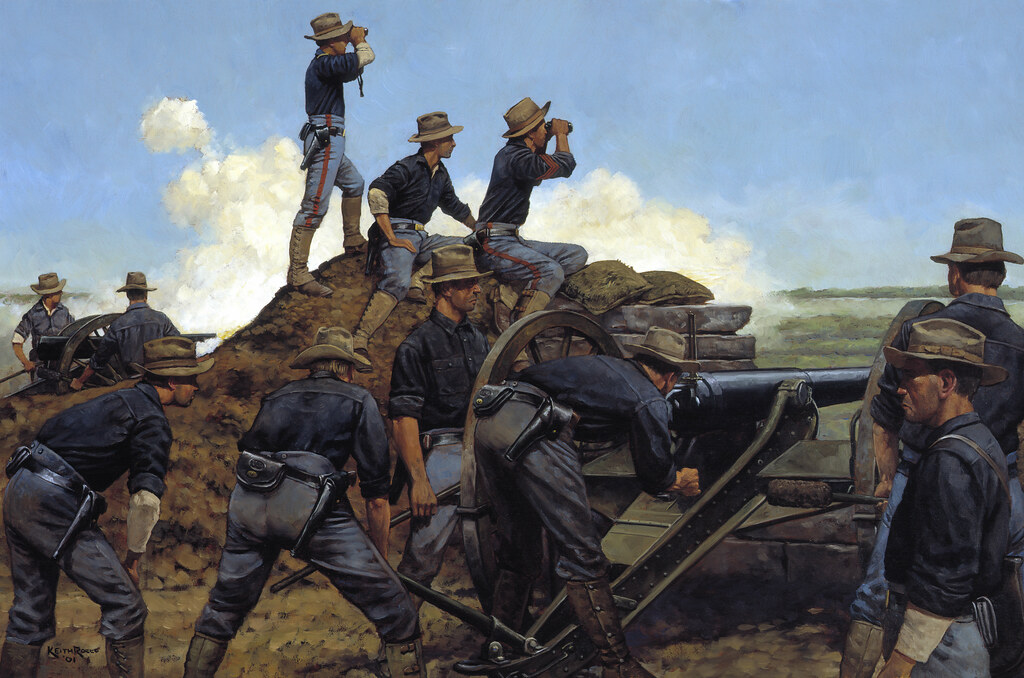
Utah Light Artillery in the Philippines, Spanish-American War

August 13, 2009

The Utah Light Artillery, painting by Keith Rocco -- August 13, 1898, Manila, Philippine Islands August 13, 1898, Manila, Philippine Islands  On April 6, 1898, Congress declared war on Spain and President William McKinley organized United States forces for the Splendid Little War. Of the tens of thousands of regular, volunteer and National Guard (Militia) troops who served, 343 Utah Guardsmen saw service in the Philippine Islands. On May 1st, after the Navys stunning victory at Manila Bay, McKinley authorized an invasion force to capture the Philippine archipelago from Spain. Organized into two batteries, the Utah Light Artillery mustered into federal service on May 9, 1898 at Fort Douglas, Utah. Shortly thereafter, at Camp Merritt near San Francisco, the Utah Artillery became part of Brig. Gen. Francis V. Greenes brigade of the U.S. VIII Corps under the command of Maj. Gen. Wesley Merritt.  Leaving San Francisco, Greenes brigade first raised the U.S. flag in Guam and then arrived on the island of Luzon on July 17, 1898. In the Philippines, 15,000 Americans not only faced 13,000 Spanish soldiers but a second army of some 12,000 Philippine rebels under Emilo Aguinaldo. The rebels had been fighting for national independence from Spain and hoping for American assistance. When Merritt ordered to keep the rebels out of the fight against Spain, the rebels became a second possible enemy.  On August 13th, the Utah Artillery supported Greenes brigade as it attacked towards the old city of Manila. The battle was predetermined to be a limited one in order to preserve Spanish honor and minimize casualties. The rebels, however, made this impossible. As American forces moved quickly against the Spanish defenses, a race to the old city center developed between the Americans and Aguinaldos rebels. The Utah batteries fired and re-deployed several times providing close and accurate support for the infantry attacks.  The Utah Light Artillery continued in federal service for another year and fought in the Philippine Insurrection until returning to Utah in August 1899. Todays 145th Field Artillery, Utah Army National Guard, carries on the history and traditions of the Utah Light Artillery.

Utah Light Artillery in the Spanish-American War – National Guard Heritage Gallery

On April 6, 1898, Congress declared war on Spain and President William McKinley organized United States forces for the “Splendid Little War.” Of the tens of thousands of regular, volunteer and National Guard (Militia) troops who served, 343 Utah Guardsmen saw service in the Philippine Islands. On May 1st, after the Navy’s stunning victory at Manila Bay, McKinley authorized an invasion force to capture the Philippine archipelago from Spain. Organized into two batteries, the Utah “Light” Artillery mustered into federal service on May 9, 1898 at Fort Douglas, Utah. Shortly thereafter, at Camp Merritt near San Francisco, the Utah Artillery became part of Brig. Gen. Francis V. Greene’s brigade of the U.S. VIII Corps under the command of Maj. Gen. Wesley Merritt.

Leaving San Francisco, Greene’s brigade first raised the U.S. flag in Guam and then arrived on the island of Luzon on July 17, 1898. In the Philippines, 15,000 Americans not only faced 13,000 Spanish soldiers but a second army of some 12,000 Philippine rebels under Emilo Aguinaldo. The rebels had been fighting for national independence from Spain and hoping for American assistance. When Merritt ordered to keep the rebels out of the fight against Spain, the rebels became a second possible enemy.

On August 13th, the Utah Artillery supported Greene’s brigade as it attacked towards the “old” city of Manila. The battle was predetermined to be a “limited” one in order to preserve Spanish honor and minimize casualties. The rebels, however, made this impossible. As American forces moved quickly against the Spanish defenses, a race to the old city center developed between the Americans and Aguinaldo’s rebels. The Utah batteries fired and re-deployed several times providing close and accurate support for the infantry attacks.

The Utah Light Artillery continued in federal service for another year and fought in the Philippine Insurrection until returning to Utah in August 1899. Today’s 145th Field Artillery, Utah Army National Guard, carries on the history and traditions of the Utah Light Artillery.

All text from the National Guard Heritage Gallery.


India accepts climate junk science; U.S. suffers

July 25, 2009

It would be good news were it not so bad:  India, usually considered a threat to U.S. dominance in science, has turned its back on climate science and instead, citing junk science claims, rejected overtures to reduce pollution that affects climate.  India appears to have fallen victim to the hoaxters who claim climate change is no big deal.

From the Financial Times:

A split between rich and poor nations in the run-up to climate-change talks widened on Thursday.

India rejected key scientific findings on global warming, while the European Union called for more action by developing states on greenhouse gas emissions.

Jairam Ramesh, the Indian environment minister, accused the developed world of needlessly raising alarm over melting Himalayan glaciers.

He dismissed scientists’ predictions that Himalayan glaciers might disappear within 40 years as a result of global warming.

“We have to get out of the preconceived notion, which is based on western media, and invest our scientific research and other capacities to study Himalayan atmosphere,” he said.

As if the atmosphere of the Himalayan range is unaffected by emissions from Europe or Asia.  As if the glaciers in the Himalayas, and the snowfall,  and the water to India’s great rivers, come independent from the rest of the world.

Deadly air pollution obscures the India Gate, New Delhi, India, November 2008 - NowPublic.com

Deadly air pollution obscures the India Gate, New Delhi, India, November 2008 - NowPublic.com

It’s interesting to see these issues play out politically.   India and China both understand that the U.S. and Europe have much more to lose from climate change than either of those nations.  Climate damage to the U.S. wheat belt, for example, would chiefly close off U.S. production of wheat for export, opening markets for others — like India and China.  Critically, such damage also hurts U.S. ability to offset balance of payments issues, providing economic and finance advantages to China’s banks.  U.S. ports are much more vulnerable to climate change damage, from increase storms and changing ocean levels, than are ports in India and China — and there are more ports that are vulnerable in the U.S. and Europe.

India’s inaction and recalcitrance should not be used as justification for the U.S. to do nothing, thereby slitting its own patriotic throat.

But watch:  Climate denialist blogs, “hate-America-first” outlets like World Net Daily, and Osama bin Laden will hail India’s inaction.

Let’s hope cooler heads prevail, lest we run out of cooler heads.

Shake of the old scrub brush to Brown Hell and Watt’s Up With That.

If this is important to you, please share it; click on the button you choose below.

Add to FacebookAdd to NewsvineAdd to DiggAdd to Del.icio.usAdd to StumbleuponAdd to RedditAdd to BlinklistAdd to TwitterAdd to TechnoratiAdd to Furl


Typewriter of the moment: Alistair Cooke for the BBC

June 19, 2009

Alistair Cookes typewriter, displayed at BBC headquarters, Bush House, in London - Photo by Jeff Zycinski

Alistair Cooke's typewriter, displayed at BBC headquarters, Bush House, in London - Photo by Jeff Zycinski

Alas, our students now are too young to remember Alistair Cooke’s hosting of “Masterpiece Theater” on PBS, and of course, back then the BBC America service — if it existed — was available only to shortwave fanatics or people  who traveled a lot to the British Isles.

Perhaps more than anyone else other than Winston Churchill, and maybe the Beatles, Alistair Cooke tied England and America together tightly in the 20th century.  BBC’s other writers are good to brilliant, but even their obituary for Cooke (March 30, 2004) doesn’t quite do him justice:

For more than half a century, Alistair Cooke’s weekly broadcasts of Letter from America for BBC radio monitored the pulse of life in the United States and relayed its strengths and weaknesses to 50 countries.

His retirement from the show earlier this month after 58 years, due to ill health, brought a flood of tributes for his huge contributing to broadcasting.

Perhaps for Cooke, from Cooke’s broadcasts, we could develop a new variation of the Advanced Placement document-based question:  Broadcast-based questions. Heaven knows his Letter From America provided profound material on American history:

BBCs famous broadcaster Alistair Cooke, painted by June Mendoza (copyright Mendoza - www.junemendoza.co.uk)

BBC's famous broadcaster Alistair Cooke, painted by June Mendoza (copyright Mendoza - http://www.junemendoza.co.uk)


June 12, 1898 – U.S. flag rises over Guantanamo Bay

June 12, 2009

Hoisting the flag at Guantanamo, Cuba, June 12, 1898.  Image from the American Memory Collection at the Library of Congress

Hoisting the flag at Guantanamo, Cuba, June 12, 1898. Edward H. Hart, photographer. Image from the American Memory Collection at the Library of Congress

Oh, it’s important in retrospect, no?

On June 10, 1898, U.S. Marines landed at Guantánamo Bay. For the next month, American troops fought a land war in Cuba that resulted in the end of Spanish colonial rule in the Western Hemisphere. Cuban rebels had gained the sympathy of the American public while the explosion and sinking of the U.S.S. Maine, widely blamed on the Spanish despite the absence of conclusive evidence, further boosted American nationalistic fervor.

On June 12, the area was secured and the flag posted.

Read a lot more about this event, and get resources on the Spanish-American War, at the Library of Congress.


Fidel, on Sen. Lugar’s Cuba proposal

April 7, 2009

Heck, while we’re looking at Cuba, take a read of Fidel Castro’s comments on Sen. Richard Lugar’s proposal to talk to Cuba.


Millard Fillmore and March 8: Hurrah! and R.I.P.

March 8, 2009

Commodore Matthew C. Perrys squadron in Japan, 1854 - CSSVirginia.org image

The Black Ships — Commodore Matthew C. Perry’s squadron in Japan, 1854 – CSSVirginia.org image from Gleason’s Pictorial Drawing Room Companion, Boston, May 15, 1852 (also, see BaxleyStamps.com); obviously the drawing was published prior to the expedition’s sailing.

On March 8, 1854, Commodore Matthew C. Perry landed for the second time in Japan, having been sent on a mission a year earlier by President Millard Fillmore.  On this trip, within 30 days he concluded a treaty with Japan which opened Japan to trade with the U.S. (the Convention of Kanagawa), and which began a cascade of events that opened Japan to trade with the world.

Commodore Matthew C. Perry in 1852 photograph, Library of Congress via WikiMedia

Commodore Matthew C. Perry in 1852 photograph, Library of Congress via WikiMedia

Within 50 years Japan would come to dominate the seas of the the Western Pacific, and would become a major world power.

1854 japanese woodblock print of U.S. Navy Commodore Matthew C. Perry. Peabody Museum: The characters located across the top read from right to left, A North American Figure and Portrait of Perry. According to the Peabody Essex Museum, this print may be one of the first depictions of westerners in Japanese art, and exaggerates Perrys western features (oblong face, down-turned eyes, bushy brown eyebrows, and large nose).  But compare with photo above, right.  Peabody Museum holding, image from Library of Congress via WikiMedia

1854 japanese woodblock print of U.S. Navy Commodore Matthew C. Perry. Peabody Museum: “The characters located across the top read from right to left, ‘A North American Figure’ and ‘Portrait of Perry.’ According to the Peabody Essex Museum, ‘this print may be one of the first depictions of westerners in Japanese art, and exaggerates Perry’s western features (oblong face, down-turned eyes, bushy brown eyebrows, and large nose).'” But compare with photo above, right. Peabody Museum holding, image from Library of Congress via WikiMedia

Then, 20 years later, on March 8, 1874, Millard Fillmore died in Buffalo, New York.

The Perry expedition to Japan was the most famous, and perhaps the greatest recognized achievement of Fillmore’s presidency.  Fillmore had started the U.S. on a course of imperialistic exploitation and exploration of the world, with other expeditions of much less success to Africa and South America, according to the story of his death in The New York Times:

The general policy of his Administration was wise and liberal, and he left the country at peace with all the world and enjoying a high degree of prosperity. His Administration was distinguished by the Lopez fillibustering expeditions to Cuba, which were discountenanced by the Government, and by several important expeditions to distant lands. The expedition to Japan under Commodore Perry resulted in a favorable treaty with that country, but that dispatched under Lieut. Lynch, in search of gold in the interior of Africa, failed of its object. Exploring expeditions were also sent to the Chinese seas, and to the Valley of the Amazon.

Here we are in 2013, 160 years after the end of Millard Fillmore’s presidency, 159 years after Commodore Perry’s success on the mission to Japan Fillmore sent him on, 139 years after Millard Fillmore’s death, and not yet have we come to grips with Fillmore’s real legacy in U.S. history. Most of that legacy, we don’t even acknowledge in public. Santayana’s Ghost paces nervously.