Where did North Dakota go?

August 15, 2009

I think it was during the Los Angeles Olympics that I read a story about a guy in Albuquerque, New Mexico, who had called the toll-free number to purchase tickets to some Olympic events.  The seats were available and everything went fine, through the giving of the credit card number — until the woman asked him for his mailing address. [I’ll keep searching for that story . . .]

When he gave his mailing address in Albuquerque, New Mexico, the woman said, “I’m sorry, we can’t sell tickets outside the United States,” or words to that effect.

Despite the man’s pleas that New Mexico is part of the U.S., the woman refused to complete the sale.

Now, Google has lost North Dakota.

Photo below, from Art Hunt’s recent cross country driving extravaganza.

Art Hunt said:  The trip was not without its glitches, such as when we discovered we had apparently reached the end of the world

Art Hunt said: "The trip was not without its glitches, such as when we discovered we had apparently reached the end of the world"


Bad guys of Baltimore

August 12, 2009

Or, “How a little study of history can make your visit to a city so much more entertaining and fun.”  At Clio Bluestocking Tales.

Why do visitors leave pennies at this gravesite?  Read the story at Clio Bluestocking Tales

Why do visitors leave pennies at this gravesite? Read the story at Clio Bluestocking Tales

For five weeks, I walked around the streets of Baltimore, or at least the distance between a certain major university known for its doctors, the Inner Harbor, and Fells Point — especially Fells Point — with some diversions elsewhere. As I walked, I began to notice landmarks of some very bad guys who have graced the streets of this interesting city.

Fans of “The Wire” will especially want to read it.  Did you catch the reason Clio is in Baltimore, for the full effect?

It’s not that history tells you how to live your life, or save it; it can make your life worth the living and saving.


Global cooling? That would be good news for the forests

August 12, 2009

Climate change denialists (sorry, Mr. Watts – denialism is what it is) frequently argue that since the peak heat year of 1998, the planet has been cooling, and may be in a long-term trend to a much cooler planet.

Has anyone told the beetles?

Has anyone told the pine bark beetles (Dendroctonus ponderosae) that are devastating North American forests?

Colorado conifers affected by pine bark beetles (brown trees are dead) - image from Chad Crawford,  Homebrewed Christianity

Colorado conifers affected by pine bark beetles (brown trees are dead) - image from Chad Crawford, Homebrewed Christianity

I was interested to find this photo and this post at Homebrewed Christianity, by Chad Crawford.

But my trips to the mountains are always simultaneously joyful and mournful. The story I want to tell is about seeing the effects up close of the North American pine beetle outbreak. It’s devastating the Rocky Mountain forests in the U.S. and Canada and growing exponentially each year. The epidemic is occurring because our winters have not been cold enough to stop the beetles from multiplying. Bark beetles are good for the ecosystem, but not in this amount. The fall colors in our evergreen forests are telling us that global warming is no longer something our kids will face; it’s happening now. And it will accelerate if our forests disappear.

Mr. Watts, it’s not me you have to convince.  There are several millions of beetles in Colorado who must be persuaded the climate is not warming — and they’ll be a tough sell, since a colder climate means death to their future generations.

A greater challenge for you, Mr. Watts:  Not one of those beetles reads your blog.  How will you reach them?

Crawford went to Colorado and saw Fr. Thomas Berry.  Maybe we should buy a ticket to Colorado for Watts.


Climate skeptic shell game: ‘Please don’t read how CO2 amplifies warming’

August 8, 2009

In heated political discussions, I’ve discovered that when people stretch the facts, sometimes they do it to protect their interests; but if they exaggerate and stretch things when the facts are on their side, it’s pathological and you can’t trust them on anything.

As the old joke goes, ‘I once knew a guy who cheated at golf so bad that when he got a hole-in-one, he wrote down “zero” on the score card.’

Scientists at Oregon State University released a study that shows the tilt and wobble of the Earth can trigger ice ages and the ends of ice ages. As you can imagine, climate change skeptics and denialist will jump on this study to say we don’t need to worry about carbon dioxide — ‘warming can’t be blamed on carbon dioxide.’

In fact, Anthony Watts has already done that.

Read the entire press release, and don’t skip over the parts that are important to policy on air pollution and climate change.  The paper indeed says that planetary wobble causes ice ages, and warming between ice ages.  That’s part of the climate change debate, probably a sizable win for climate skeptics.

But they can’t leave well enough alone; the study explicitly warns of the warming effects of human-released CO2.  Watts left out this paragraph:

“Solar radiation was the trigger that started the ice melting, that’s now pretty certain,” said Peter Clark, a professor of geosciences at OSU. “There were also changes in atmospheric carbon dioxide levels and ocean circulation, but those happened later and amplified a process that had already begun.”

Watts left this out, too, and this qualifies the Oregon State study as “alarmist” under usual skeptic rubrics:

Sometime around now, scientists say, the Earth should be changing from a long interglacial period that has lasted the past 10,000 years and shifting back towards conditions that will ultimately lead to another ice age – unless some other forces stop or slow it. But these are processes that literally move with glacial slowness, and due to greenhouse gas emissions the Earth has already warmed as much in about the past 200 years as it ordinarily might in several thousand years, Clark said.

“One of the biggest concerns right now is how the Greenland and Antarctic ice sheets will respond to global warming and contribute to sea level rise,” Clark said. “This study will help us better understand that process, and improve the validity of our models.”

Peter Clark of Oregon State and his associates published an important study in Science on Friday.  The study points to variations in the usual 23-degree tilt of the Earth’s access as triggers for glaciation and retreat of glaciers, over time.  The study poses important questions, such as:  Has human contribution to greenhouse gases prevented cooling in the past two centuries?  The study offers potential insights into research into climate change and human contributions to climate change.

The study in no way exonerates carbon dioxide from implication as a major, human-contributed component to the mix of factors driving climate change in the 21st century.  The study is really pretty cool; it should be fodder for geography and environmental science classes this fall, and it should be one factor in the discussion over warming and what we need to do about it.

Watch:  Some will try to make it the latest political shuttlecock instead.

Here’s the full press release:

8-6-09

Media Release

Long debate ended over cause, demise of ice ages – may also help predict future

CORVALLIS, Ore. – A team of researchers says it has largely put to rest a long debate on the underlying mechanism that has caused periodic ice ages on Earth for the past 2.5 million years – they are ultimately linked to slight shifts in solar radiation caused by predictable changes in Earth’s rotation and axis.

In a publication to be released Friday in the journal Science, researchers from Oregon State University and other institutions conclude that the known wobbles in Earth’s rotation caused global ice levels to reach their peak about 26,000 years ago, stabilize for 7,000 years and then begin melting 19,000 years ago, eventually bringing to an end the last ice age.

The melting was first caused by more solar radiation, not changes in carbon dioxide levels or ocean temperatures, as some scientists have suggested in recent years.

“Solar radiation was the trigger that started the ice melting, that’s now pretty certain,” said Peter Clark, a professor of geosciences at OSU. “There were also changes in atmospheric carbon dioxide levels and ocean circulation, but those happened later and amplified a process that had already begun.”

The findings are important, the scientists said, because they will give researchers a more precise understanding of how ice sheets melt in response to radiative forcing mechanisms. And even though the changes that occurred 19,000 years ago were due to increased solar radiation, that amount of heating can be translated into what is expected from current increases in greenhouse gas levels, and help scientists more accurately project how Earth’s existing ice sheets will react in the future.

“We now know with much more certainty how ancient ice sheets responded to solar radiation, and that will be very useful in better understanding what the future holds,” Clark said. “It’s good to get this pinned down.”

The researchers used an analysis of 6,000 dates and locations of ice sheets to define, with a high level of accuracy, when they started to melt. In doing this, they confirmed a theory that was first developed more than 50 years ago that pointed to small but definable changes in Earth’s rotation as the trigger for ice ages.

“We can calculate changes in the Earth’s axis and rotation that go back 50 million years,” Clark said. “These are caused primarily by the gravitational influences of the larger planets, such as Jupiter and Saturn, which pull and tug on the Earth in slightly different ways over periods of thousands of years.”

That, in turn, can change the Earth’s axis – the way it tilts towards the sun – about two degrees over long periods of time, which changes the way sunlight strikes the planet. And those small shifts in solar radiation were all it took to cause multiple ice ages during about the past 2.5 million years on Earth, which reach their extremes every 100,000 years or so.

Sometime around now, scientists say, the Earth should be changing from a long interglacial period that has lasted the past 10,000 years and shifting back towards conditions that will ultimately lead to another ice age – unless some other forces stop or slow it. But these are processes that literally move with glacial slowness, and due to greenhouse gas emissions the Earth has already warmed as much in about the past 200 years as it ordinarily might in several thousand years, Clark said.

“One of the biggest concerns right now is how the Greenland and Antarctic ice sheets will respond to global warming and contribute to sea level rise,” Clark said. “This study will help us better understand that process, and improve the validity of our models.”

The research was done in collaboration with scientists from the Geological Survey of Canada, University of Wisconsin, Stockholm University, Harvard University, the U.S. Geological Survey and University of Ulster. It was supported by the National Science Foundation and other agencies.

About the OSU College of Science: As one of the largest academic units at OSU, the College of Science has 14 departments and programs, 13 pre-professional programs, and provides the basic science courses essential to the education of every OSU student. Its faculty are international leaders in scientific research.

Watts did note the abstract of the paper, at Science (to get the full text, you must be a subscriber or pay a high fee for the one article):

Science 7 August 2009:
Vol. 325. no. 5941, pp. 710 – 714
DOI: 10.1126/science.1172873

Research Articles

The Last Glacial Maximum

Peter U. Clark,1,* Arthur S. Dyke,2 Jeremy D. Shakun,1 Anders E. Carlson,3 Jorie Clark,1 Barbara Wohlfarth,4 Jerry X. Mitrovica,5 Steven W. Hostetler,6 A. Marshall McCabe7

We used 5704 14C, 10Be, and 3He ages that span the interval from 10,000 to 50,000 years ago (10 to 50 ka) to constrain the timing of the Last Glacial Maximum (LGM) in terms of global ice-sheet and mountain-glacier extent. Growth of the ice sheets to their maximum positions occurred between 33.0 and 26.5 ka in response to climate forcing from decreases in northern summer insolation, tropical Pacific sea surface temperatures, and atmospheric CO2. Nearly all ice sheets were at their LGM positions from 26.5 ka to 19 to 20 ka, corresponding to minima in these forcings. The onset of Northern Hemisphere deglaciation 19 to 20 ka was induced by an increase in northern summer insolation, providing the source for an abrupt rise in sea level. The onset of deglaciation of the West Antarctic Ice Sheet occurred between 14 and 15 ka, consistent with evidence that this was the primary source for an abrupt rise in sea level ~14.5 ka.
1 Department of Geosciences, Oregon State University, Corvallis, OR 97331, USA.
2 Geological Survey of Canada, 601 Booth Street, Ottawa, Ontario K1A 0E8, Canada.
3 Department of Geology and Geophysics, University of Wisconsin, Madison, WI 53706, USA.
4 Department of Geology and Geochemistry, Stockholm University, SE-10691, Stockholm, Sweden.
5 Department of Earth and Planetary Sciences, Harvard University, Cambridge, MA 02138, USA.
6 U.S. Geological Survey, Department of Geosciences, Oregon State University, Corvallis, OR 97331, USA.
7 School of Environmental Science, University of Ulster, Coleraine, County Londonderry, BT52 1SA, UK.

Supporting online material, including a solid discussion of methods and several charts that are not contained in the full publication, is available, free, in .pdf form.  Warning to creationists:  This is heavy on science using radioactive isotopes for dating.  For that matter, it’s loaded with a lot of other science that climate change skeptics generally dismiss as “computer simulation” instead of hard data.  How will they treat this study?  Skeptically?  Don’t bet on it.

Resources:

Share this story and the science:

Add to FacebookAdd to NewsvineAdd to DiggAdd to Del.icio.usAdd to StumbleuponAdd to RedditAdd to BlinklistAdd to TwitterAdd to TechnoratiAdd to Furl


Geographical lottery: Gambling with health care

August 4, 2009

Is it true that kids can’t get insured in Texas if their parents have two vehicles?  I mean, this is Texas, the anti-mass transit state — how can you get a kid to the emergency room for the high-cost health care if you don’t have two cars, one for work, one for the family?

Children’s Defense Fund will help you contact your legislators to recommend improving health care for children.

How is the insurance weather where you are? Share the news:

Add to FacebookAdd to NewsvineAdd to DiggAdd to Del.icio.usAdd to StumbleuponAdd to RedditAdd to BlinklistAdd to TwitterAdd to TechnoratiAdd to Furl


India today, in photos

August 3, 2009

Geography teachers, get out your PowerPoints and Keynotes.

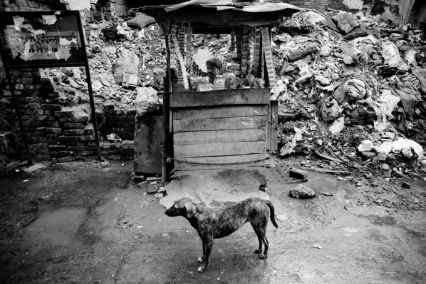
Photo of life in Delhi, India.  From a collection by Belgian photographer Frederik Buyckx, 2009

Photo of life in Delhi, India. From a collection by Belgian photographer Frederik Buyckx, 2009

Thought provoking, occasionally breath-taking photos from a 6:00 a.m. walkaround in Delhi, India; Belgian photographer Frederick Buyckx promises more photos from his recent trip to India and Pakistan, at his blog.

Please share:

Add to FacebookAdd to NewsvineAdd to DiggAdd to Del.icio.usAdd to StumbleuponAdd to RedditAdd to BlinklistAdd to TwitterAdd to TechnoratiAdd to Furl


Press release on polar bears the climate change skeptics hope you won’t read

August 2, 2009

Why did the self-proclaimed skeptics work so hard to discredit this meeting before it even occurred?  Why have they ignored this press release?

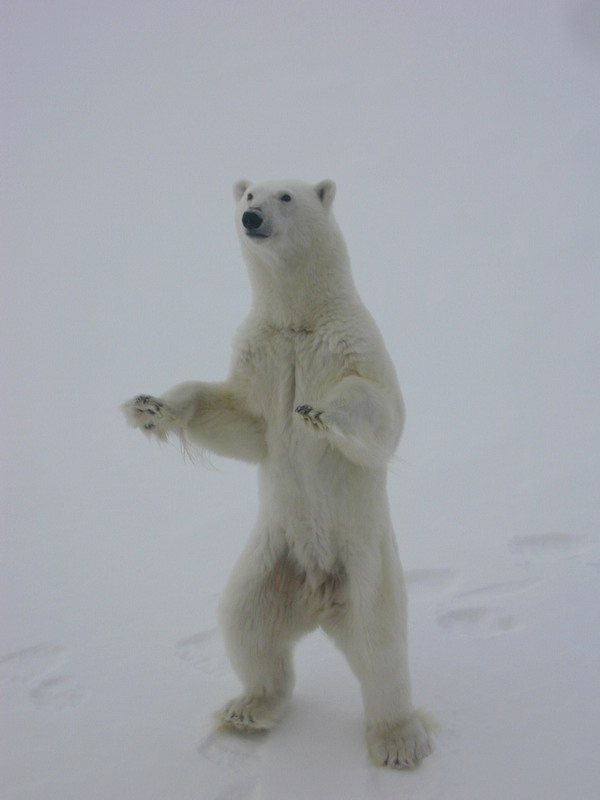
Take it easy! Calm down, stick to the facts! Polar bear photo by Kathy Crane, NOAA Arctic Research Office

“Take it easy! Calm down, stick to the facts!” Polar bear photo by Kathy Crane, NOAA Arctic Research Office

There is no dramatic finding in the release.  After you read it, you’ll probably wonder, too, why climate change skeptics don’t want you to read this press release:

15th meeting of PBSG in Copenhagen, Denmark 2009

PRESS RELEASE

The 15th meeting of the IUCN Polar Bear Specialist Group (PBSG), hosted by the Greenland Institute of Natural Resources, was held at the Greenland Representation in Copenhagen Denmark , June 29-July 3, 2009.  The Polar Bear Specialist Group is composed of researchers and managers representing each of the five circumpolar nations that signed the International Agreement for the Conservation of Polar Bears of 1973.  Since the late 1960s, the members of PBSG have met every 3 to 5 years under the umbrella of the Species Survival Commission of the IUCN (the International Union for the Conservation of Nature and Natural Resources) to review and exchange information, and make recommendations for research and management of polar bears throughout the Arctic.

The PBSG renewed the conclusion from previous meetings that the greatest challenge to conservation of polar bears is ecological change in the Arctic resulting from climatic warming.  Declines in the extent of the sea ice have accelerated since the last meeting of the group in 2005, with unprecedented sea ice retreats in 2007 and 2008. The PBSG confirmed its earlier conclusion that unabated global warming will ultimately threaten polar bears everywhere.

The PBSG also recognized that threats to polar bears will occur at different rates and times across their range although warming induced habitat degradation and loss are already negatively affecting polar bears in some parts of their range. Subpopulations of polar bears face different combinations of human threats.  The PBSG recommends that jurisdictions take into account the variation in threats facing polar bears.

The PBSG noted polar bears suffer health effects from persistent pollutants.  At the same time, climate change appears to be altering the pathways by which such pollutants enter ecosystems. The PBSG encourages international efforts to evaluate interactions between climate change and pollutants.

The PBSG endorses efforts to develop non-invasive means of population assessment, and continues to encourage jurisdictions to incorporate capture and radio tracking programs into their national monitoring efforts. The members also recognized that aboriginal people are both uniquely positioned to observe wildlife and changes in the environment, and their knowledge is essential for effective management.

The PBSG recognizes that where habitats are stable, polar bears are a renewable resource, and reaffirmed its support of the right of aboriginal groups to harvest polar bears within sustainable limits.  The PBSG noted that the population of polar bears in Baffin Bay, shared between Greenland and Canada, may simultaneously be suffering from significant habitat change and substantial over harvest, while at the same time interpretations by scientists and local hunters disagree regarding population status.  Similarly, the Chukchi Sea polar bear population which is shared by Russia and the United States is likely declining due to illegal harvest in Russia and one of the highest rates of sea ice loss in the Arctic. Consistent with its past efforts to coordinate research and management among jurisdictions, the PBSG recommended that the polar bear populations in Baffin Bay and the Chukchi Sea be reassessed and that harvests be brought into balance with the current sustainable yield.

A variety of management changes have occurred since the PBSG last met in 2005.  The PBSG members were particularly pleased that quotas for the harvest of polar bears in Greenland were implemented in January 2006, and that quota reductions have been implemented in some parts of Greenland.  Also since the last meeting, the government of Nunavut reduced the harvest quota in Western Hudson Bay because of the documented population decline.

The PBSG reevaluated the status of the 19 recognized subpopulations of polar bears distributed over vast and relatively inaccessible areas of the Arctic. Despite the fact that much new information has been made available since the last meeting, knowledge of some populations is still poor.  Reviewing the latest information available the PBSG concluded that 1 of 19 subpopulations is currently increasing, 3 are stable and 8 are declining.  For the remaining 7 subpopulations available data were insufficient to provide an assessment of current trend.  The total number of polar bears is still thought to be between 20,000 and 25,000.  However, the mixed quality of information on the different subpopulations means there is much room for error in establishing that range.  That potential for error, given the ongoing and projected changes in habitats and other potential stressors is cause for concern.  Nonetheless, the PBSG is optimistic that humans can mitigate the effects of global warming and other threats to polar bears, and ensure that they remain a part of the Arctic ecosystem in perpetuity.

Dr. Erik Born from the Greenland Institute of Natural Resources was elected as the new chairman of the group after Dr. Andrew Derocher from the University of Alberta, who has been serving as chair since 2005.

Well, there is that proclamation of optimism in the penultimate paragraph, that humans can mitigate threats to bears, including global warming.  Is that why they don’t want you to read it?

How are the polar bears?  They are in trouble.  The Polar Bear Specialist Group says we should help them out, that we can do things to save the bears.  Why would the “skeptics” not want us to know that?

Other resources:

Save


Climate change denialism in bloom

July 28, 2009

It was a minor note, really — USGS released a series of satellite photos of ice in the Arctic Ocean.  The photos were taken with U.S. defense satellites (“spy” satellites, most likely) under an interesting agreement between the Department of Defense and science agencies to look at ice, essentially to look at the cold, not come in from it.

Part of that agreement is that the photos don’t get released until Defense says there is no reason to hold them secred anymore.  For some reason — skullduggery?  bureaucracy? — the photos weren’t released during the Bush years.  The Obama administration hustled out a series of photos for scientists to study.

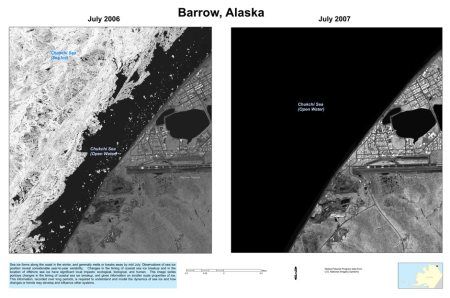
Very few news outlets picked up on the release of the photos.  The Guardian ran the most provocative, prepared-for-public-consumption set of two photos of the sea just off of Barrow, Alaska, which showed a dramatic contrast between 2006 and 2007.  The icy seas of July 2006 were replaced with miles of clear ocean in July 2007.

The Bathtub ran that poster.  And yesterday there was a surge of hits on the article, most going to other posts claiming the photos had been photoshopped.  A commenter here said the same.  Viewers find it odd that there is a stark contrast between land and sea inthe arctic.  Really.  No, really.

So, they said, those photos must be Photoshopped.  At least one radical right blog claimed the Guardian published a fake photo.

Now, I had expected someone to defend Bush, to say that the Bush administration hadn’t really suppressed the photos, just didn’t release them.

But photo fraud?

Denialists resorted to that solution first.

Here are reasons mitigating against fraud.

  1. The U.S. Geological Survey (USGS) released the poster with the photos.  USGS has a long, long history of accurate science, outside political interference.   On a few occasions, USGS reports have been delayed by political appointees — but the instances where one can say the data were corrupted on purpose are very few (if any — I can’t think of one off-hand).  USGS would be unlikely as a source of doctored photos.
  2. It is a crime to jigger the scientific results under U.S. law.   A few scientists have been caught, tried and jailed.  The reality is that most scientist strive to be well on the ethical side of the line of research laws — but it’s a federal crime for government or government-funded scientists to fake results.  I’ll wager every scientist at USGS knows that.
  3. USGS released four posters total, and a couple dozen other photos.  For Barrow, there were 18 photos from 2005 and 2006, and another 8 photos from 2007-2008.    While only four sites were chosen for poster, there are six sites with photos available for study.  Were anyone to jigger one photo, others would need to be jiggered to make them match.  Since Defense still has the originals, a fraud would probably be discovered.
  4. Government scientists have been champing at the bit for eight years to get rid of the fetters of bureaucrats interfering with their research; they wouldn’t risk a fraud just six months in to the new administration, nor would they be likely to risk a fraud at any time, since they think that the truth is of very high value.

MacsMind jumped on the photos:  “Almost so bad it’s laughable”. The blog offers no evidence of fraud, just the spiteful belief of the author.  Well, he does offer photos of a January 2006 ice surge, as if to suggest that the ice from January of 2006 should have stayed hugging the coast near Barrow even through 2007, so any photo that shows clear sea must be false.  Denialists will abandon all types of measure, even calendars and clocks, in their mad rush to cloak the science.  MacsMind even goes so far as to invent a story that the photo was taken at night, and since it shows no lights of ships at sea, they must have been cut out (photos of ice cover generally don’t work well at night — where did he get that?).

Critics of climate change and plans to do something to slow climate change reveal themselves here as not basing their views on the science — here they don’t need the science to “know that it’s wrong.”

Sometimes I wonder if we could cure global warming simply by getting the critics to shut up.

Oh, let’s make them crazy.  Here’s the poster showing the contrast in sea ice in the Beaufort Sea; the caption:

This site is near the edge of the ice pack. In summer, as shown here, ponds of meltwater form on the surface. These dark pools absorb more of summertime’s solar radiation than does the surrounding ice, enhancing melting. Observations of sea ice conditions reveal considerable year to year variability. These images, displaying the variability with regard to the amount of melting, are an example of the long term sequential record needed to support understanding and analysis of this dynamic system. Pond coverage monitored over time contributes to estimates of surface reflectivity that are needed to understand and model the dynamics of sea ice mass balance and temperature.

Beaufort Sea, showing ice in 2006 and in 200

Beaufort Sea, showing ice in 2001 and in 2007

More information:

Radar images of sea ice around Barrow, Alaska

Radar images of sea ice around Barrow, Alaska -"The animation below is from the radar record of the last three days. The images used to produce this animation are from the 10 kW X-band marine radar mounted atop the 4-story ASRC building in downtown Barrow, Alaska, pointed north."

Help cool discussion on climate change; share this post:

Add to FacebookAdd to NewsvineAdd to DiggAdd to Del.icio.usAdd to StumbleuponAdd to RedditAdd to BlinklistAdd to TwitterAdd to TechnoratiAdd to Furl


Great Arctic sea ice hoax exposed

July 26, 2009

Look at the photos and see for yourself.  From 2006 to 2007, did sea ice at Barrow, Alaska, increase or decrease?

A comparison of polar sea ice at Barrow, Alaska -- July 2006 on the left, July 2007 on the right - public domain photo from U.S. military satellites.

A comparison of polar sea ice at Barrow, Alaska -- July 2006 on the left, July 2007 on the right - public domain photo from U.S. military satellites. Click for larger view from The Guardian.

These photos appeared in The Guardian — did they appear in any U.S. papers? — with a story that said the photos had been withheld by the Bush administration, and were recently released by the Obama administration.  (Bet these photos never show up on Anthony Watts’s blog.)*

Graphic images that reveal the devastating impact of global warming in the Arctic have been released by the US military. The photographs, taken by spy satellites over the past decade, confirm that in recent years vast areas in high latitudes have lost their ice cover in summer months.

The pictures, kept secret by Washington during the presidency of George W Bush, were declassified by the White House last week. President Barack Obama is currently trying to galvanise Congress and the American public to take action to halt catastrophic climate change caused by rising levels of carbon dioxide in the atmosphere.

One particularly striking set of images – selected from the 1,000 photographs released – includes views of the Alaskan port of Barrow. One, taken in July 2006, shows sea ice still nestling close to the shore. A second image shows that by the following July the coastal waters were entirely ice-free.

The photographs demonstrate starkly how global warming is changing the Arctic. More than a million square kilometres of sea ice – a record loss – were missing in the summer of 2007 compared with the previous year.

Spin, from the presidency?  Who knew?

Climate change skeptics (read:  deniers) say that ice has come back in record amounts in 2008.  According to the news article, that isn’t exactly the case.

Nor has this loss shown any sign of recovery. Ice cover for 2008 was almost as bad as for 2007, and this year levels look equally sparse.

Science News noted the declassification, but without the hint of skullduggery on the part of the Bush administration.  The poster above comes from the USGS, which also included three more posters, one of the Beaufort Sea and two of glaciers — all of them showing declines in ice.

Stories that Arctic sea ice is expanding seem to be premature.

So all the claims that global warming has ended, that ice is threatening to extend its range and plunge us back into a cooling period — just hoax? Yep, just hoax.

Tip of the old scrub brush to Watching the World from Nicaraugua.

Update, 7-27-2009: A story going around the internet claims the poster at the top of this post is faked.  The poster comes from the U.S. Geological Survey, so I doubt it’s faked — they have no dog in the fight to fake it.  I think this goes to show that climate change “skeptics” have been sucked in by their own denial virus, and they will not even entertain information to the contrary of their beliefs.

*   Happy update, 8-2-2009: I’m happy to report I erred.  Actually, Anthony Watts reported on the release of the photos on July 15.  He didn’t use the Barrow photos, and he certainly did not claim that they are hoax photos.  He noted that the previously classified data have been released, and he seemed to think that there is no monkeying around with them.   It’ll be interesting to see how he deals with the photos from here on in.

Spread the news!

Add to FacebookAdd to NewsvineAdd to DiggAdd to Del.icio.usAdd to StumbleuponAdd to RedditAdd to BlinklistAdd to TwitterAdd to TechnoratiAdd to Furl


News flash: Texas has a second natural lake!

July 20, 2009

Years ago, in Virginia, I had learned that Virginia had only one natural lake, the Great Dismal Swamp.  Accompanying that chunk of information in that lecture was that Texas had only two natural lakes.

But upon arriving in Texas, I could find reference to only one natural lake, Caddo, and it had ceased being fully natural when its maintenance fell to a dam.

What happened to Texas’s second natural lake?

A Google search right now on “Texas +’natural lake'” produces ten listings on the first page, all of them pointing to the fact that Texas has just one natural lake.  Here are the first five:

I have found a second natural lake in Texas. It’s not a new discovery at all — it’s just a case of people not having the facts, and overlooking how to find the truth.  It’s especially difficult when the lake hides itself.

Our testing coordinator at Molina High School, Brad Wachsmann, spins yarns that belie his youth.  In the middle of one yarn last year, corroborated by other yarns, he mentioned that he has family in Big Lake, Texas; and he described visiting and having relatives urge people to run out and see the lake since it’s rebirth in torrential rains.

“A second natural lake in Texas?” I asked.  Wachsmann knew the drill.  Yes, Big Lake is a natural lake in Texas, and yes, people forget about it.

Texas teachers, listen to your testing coordinators, okay?

All of this came to mind reading the Austin American-Statesman, still a bastion of great journalism despite problems in the newspaper industry.  On Monday, July 7, the paper ran a story and an editorial about the clean up of the oil industry refuse that killed the shoreline of part of the lake; the springs that once fed the lake have mostly gone dry, but that’s likely due to agricultural water mining.

It’s a story of boom and bust, environmental degradation for profit, and eventual recovery we hope.

Looking at the landscape that surrounds the Reagan County seat, you wonder whether the name Big Lake was somebody’s idea of joke. It’s dry and dusty, where the flora sprouts reluctantly and lives precariously.

Yet, the West Texas town of Big Lake got its name from a natural lake that was fed by springs that have long since gone dry. While the area may not fit everyone’s definition of photogenic, it has its own brand of charm – charm that could be enhanced if the damage done to the fragile ecosystem by salt spills were reversed or even minimized.

As the American-Statesman’s Ralph K.M. Haurwitz reported in Monday’s editions, the University of Texas and Texas A&M systems have benefited from the $4.4 billion in royalty payments and mineral income produced by its West Texas acreage since Santa Rita No. 1 well came in on May 28, 1923.

The salt water byproduct of oil and natural gas production, however, contaminated 11 square miles near Big Lake, killing most everything that grows. The lack of vegetation allows wind and water erosion.

Hey, it gets better.  This is real Texas history, real American history — you can’t make this stuff up.  Haurwitz’s article talks about the heritage of Texas education.   Remember that old story about setting aside certain sections of townships to help fund education in lands on the American frontier?  Texas wasn’t a public lands state as farther west, but it still reserved sections of land for the benefit of education.

Rose petals blessed by a priest?  I’ll wager the priest didn’t make the trip to the top of the derrick.  Haurwitz wrote:

BIG LAKE — Investors appealed to the patron saint of impossible causes when oil drilling began on University of Texas System land in 1921. It didn’t hurt.

Santa Rita No. 1 blew in on May 28, 1923, after rose petals blessed by a priest were scattered from the top of the derrick at the behest of some Catholic women in New York who had purchased shares in the Texon Oil and Land Co., which drilled that first well.

Since then, the UT System’s 2.1 million acres in West Texas have produced $4.4 billion in royalty payments and other mineral income for the Permanent University Fund, an endowment that supports the UT and Texas A&M University systems.

But this long-running bonanza for higher education exacted a price from the remote, semiarid landscape where it all began. Millions of barrels of salt water, a byproduct of oil and natural gas production, contaminated 11 square miles, or more than 7,000 acres, killing virtually all vegetation and leaving the land vulnerable to wind and water erosion. Hundreds of mesquite stumps with three feet of exposed roots testify to the dramatic loss of topsoil.

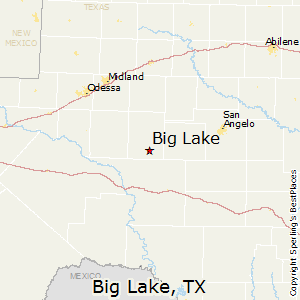
Texas, and Big Lake - from BigLakeTx.com

Where in Texas is Big Lake?

The town of Big Lake is just north of the lake itself, on State Highway 137 running north and south, and U.S. Highway 67 running east and west, approximately 65 miles west of San Angelo.   Big Lake sits about 10 miles north of Interstate 10, and about 75 miles south of Interstate 20.  Big Lake calls itself “the gateway to the Permian Basin.”

Big Lake is the home of Reagan County High School.  Jim Morris was baseball coach for the Reagan High Owls when his team persuaded him to try out for a major league baseball team.  His story was chronicled, with some artistic license, in the Disney movie “Rookie.”

Land managers are working to stop erosion on the often-dry shores of Big Lake using any trick they can find.  One trick:  Plant salt grass.

Salt grass?  Along Texas’s Gulf Coast, there are a few species of grass that, while not halophytes, are at least salt tolerant.  Salt grass.  This grass made it profitable to graze cattle on what would otherwise have been unproductive land in the Texas cattle boom.  This role in Texas history is memorialized in the Salt Grass Steakhouse chain, now found in five states.

And if planting salt grass works to control erosion, it will help clean up a large part of Texas other natural lake, Big Lake.

Big Lake’s being wet or dry is a whim of local climate.  You could say that half of all of Texas’s natural lakes are now dry as a result of continued warming; you could say that two good gully-washers or toad-stranglers could restore water to half of Texas’s natural lakes.

Big Lake Playa, from NightOwl Bakery and Roastery in Big Lake, Texas

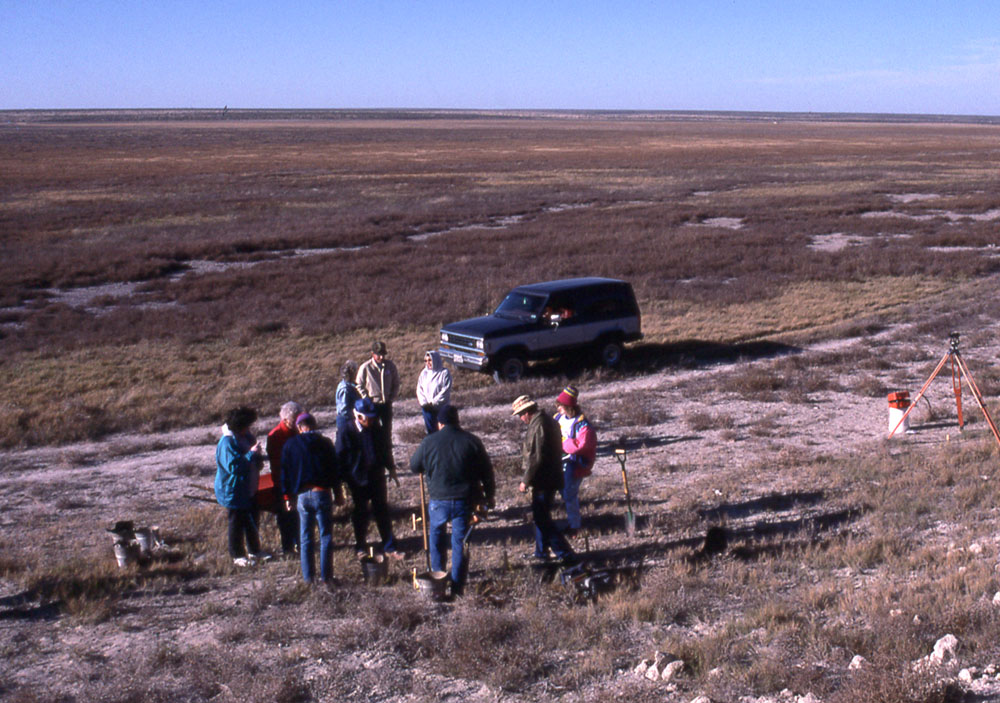
Field crew meeting at the outset of the 1992 excavations at the Big Lake Bison Kill site. The dry bed of Big Lake stretches for miles in the background. Big Lake is an intermittent saline lake or playa, an uncommon landform on the Edwards Plateau. Photo by Larry Riemenschneider, Concho Valley Archeological Society.

More details about Big Lake and prehistory, below the fold.

Read the rest of this entry »


Trouble at the Texas State Board of Education: Social studies curriculum

July 15, 2009

I’m posting on the run from an AP Summer Institute at Texas Christian University, so just the facts.

Today’s Fort Worth Start Telegram featured a story on the social studies curriculum battles in the Texas State Board of Education.  It’s one of those stories that does well in presenting the facts, but for the sake of “objectivity” treats the yahoos of the review committee — David Barton and Peter Marshall in particular — as respected academics.

Of particular note, a very brief summary of the credientials and comments of the “expert” reviewing panel.

Should Texas be worried?

See immediately previous post with the address to listen to live webcasts of the Board’s meetings this week.


Can your 9-year old kid help her rescuers?

June 23, 2009

This kid is from Heber, Utah — odds are he’s a Mormon, and he’s a Cub Scout.  Wolf elective #23 includes “Tell what to do if you get lost.”  But it’s an elective for a 7-year old, and in panic, a 9-year old may not remember.  We hope that this training will be part of the Outdoorsman requirement for a second-year Webeloes Scout, at age 10 or 11, but this kid wasn’t there yet.

Utah, showing Daggett County - from Pioneer, Utahs online library

Utah, showing Daggett County - from Pioneer, Utah's online library

So, this story from the Salt Lake Tribune is a morality tale.  One of the morals is that we need to drill our kids on what to do if they get lost, in the city, or in the wild:


Search crews found lost hiker, 9, after he left behind clues

Updated: 06/22/2009 10:51:25 AM MDT

Daggett County search crews found a missing 9-year-old hiker Sunday night thanks to a footprint, a granola bar wrapper, pieces of his raincoat and a backpack that he left behind as he wandered through the Ashley National Forest.Grayson Wynne’s first words to his father, Kynan: “Happy Father’s Day.”

Grayson, from Heber City, was hiking Saturday evening toward Daggett Lake to camp for a couple of days with his family when he was separated from the group.

Search and rescue teams, family members and volunteers — totaling more than 100 people — looked for Wynne on Saturday night and Sunday morning. Some rode horses or mules, others walked.

Grayson said he thought about his parents, prayed and cried while he was lost. He told searchers he spent the night under a log and didn’t get much sleep. He could hear searchers yelling his name but could not tell from which direction they were coming.

Searchers found a granola bar wrapper about 300 yards off of the main trail, and family members recognized the snack matched those Grayson had in his backpack. Rescuers also found a small footprint by a creek bed early Sunday, about 400 yards from the granola wrapper, the sheriff’s office said in a news release.

They later found Grayson’s black backpack, which he later told crews he left behind the night before because it was getting too heavy.

Based on Grayson’s belongings, Daggett County searchers said it appeared the boy was

following the creek, so they focused the rescue effort in specific areas along the water.A helicopter flew a bloodhound and her handler to the spot where the backpack was found. Before they could begin searching for Grayson, he heard the helicopter and headed for a meadow where he hoped the pilot would see him.

Grayson waved his last piece of yellow rain slicker to get the helicopter crew’s attention. He had been tearing the jacket apart and leaving behind chunks to trace his footsteps.

As he waved his slicker, two searchers rode up on horseback and found him in the meadow.

Grayson was taken to the command center, where he was checked by medical teams and reunited with his family. The boy’s feet were wet and cold, but he was in “good health and spirits,” the Sheriff’s Office said.

“This search was successful due to the many searchers and volunteers, and to Grayson for being such a strong little boy with a lot of common sense,” the Sheriff’s Office said in a news release.

I’m not entirely sure where the family was — in addition to the Ashley National Forest, there is the Flaming Gorge National Recreation Area in tiny Daggett County, in Utah’s northeast corner, for families to hike and camp in.

Daggett County was the last of the 29 counties in Utah to be organized, cut out of the much larger Uintah County.  I know the story well.  My maternal grandfather was one of the organizers of the county and the loser of the first election for sheriff (a great story of the power of women voting, for another time).  My mother was born in a the chicken coop her family lived in, in Manila, as her father was building what was to be the biggest house in the county (and the first with rooms set aside for indoor plumbing).


Bathtub reading on a warm June Sunday

June 7, 2009

I thought everybody does serious reading in the bathtub, no?

The Boneyard at Davis-Monthan Air Force Base near Tucson, Arizona; the Pima Air & Space Museum now offers bus tours of the 309th Maintenance and Regeneration Groups collection of scrapped and very historic airplanes

The Boneyard at Davis-Monthan Air Force Base near Tucson, Arizona; the Pima Air & Space Museum now offers bus tours of the 309th Maintenance and Regeneration Group's collection of scrapped and very historic airplanes

Can’t soak all day.


Is Texas the state most vulnerable to global climate change?

June 6, 2009

John Mashey occasionally graces these pages with his comments — a cool, reasoned head on hot issues like global warming/global climate change, despite his history in computers or maybe because of it (which would put the lie to the idea that computer programming explains why so many computer programmers are wacky intelligent design advocates).

Mashey offered a comment over at RealClimate on a post about hoaxer and science parodist Christopher Monckton — a comment you ought to read if  you think about Texas ever, and especially if you like the place.  It’s comment #413 on that Gigantor blog.

Monckton wrote a letter to the New York Times and attached to it a graph.  The graph, it turns out, probably would need to be classified in the fiction section of a library or book store, were it a book.  Much discussion occurs, absent any appearance by Monckton himself who does not defend his graphs by pointing to sources that might back what his graphs say, usually.

In short, the post and the extensive comments shed light on the problems of veracity which plague so many who deny either that warming is occurring, or that air pollution from humans might have anything to do with it, or that humans might actually be able to do anything to mitigate the changes or the damage, or that humans ought to act on the topic at all.

So I’ve stolen Mashey’s comment lock, stock and barrel, to give it a little more needed highlight.

If you follow environmental issues much, you probably know Count Christopher Monckton as a man full of braggadocio and bad information on climate.  He is known to have worked hard to hoodwink the U.S. Congress with his claims of expertise and policy legitimacy, claiming to be a member of the House of Lords though he is not (some climate change deniers in Congress appear to have fallen for the tale).  He pops up at denialist conferences, accuses scientists of peddling false information, and he is a shameless self-promoter.

After much discussion, Mashey turned his attention to claims that Texans don’t know better than Monckton, and other things; Mashey notes that denialists cite Monckton’s performance at a conservative political show in Texas, instead having paid attention to real climate scientists who were meeting just up the road, for free:

AGW’s impact depends on where you live
OR
Texas is Not Scotland, even when a Scottish peer visits

1) SCOTLAND
Viscount Monckton lives in the highlands of Scotland (Carie, Rannoch, 57degN, about the same as Juneau, AK, but warmer from Gulf Stream.)

a) SEA LEVEL, STORMS
Most of Scotland (esp the highlands) is well above sea level, and in any case, from Post-Glacial Rebound, it’s going up. [Not true of Southern England.]

b) PRECIPITATION
Scotland gets lots of regular precipitation. From that, he likely gets ~1690mm or more rainfall/year, noticeably more than Seattle or Vancouver.

Scotland has complex, variable weather systems, with more rain in West than in East, but has frequent precipitation all year.

c) TEMPERATURE
Scotland’s climate would likely be better with substantial warming. See UK Met Office on Scotland, which one might compare with NASA GISS Global Annual Mean Surface Air Temperature Change. Scotland average maximum temperatures are 18-19C in the summer, i.e., in most places it might occasionally get up to 70F, although of course it varies by geography. +3C is no big deal. The record maximum was 32.9C (91F), set in 2003. Maybe there is yet a good future for air-conditioning/cooling vendors.

If one does a simple linear regression on both sets of annual data, one finds that SLOPE(Scotland) = .0071C/year, SLOPE(world) = .0057C/year, i.e., Scotland is warming slightly faster than the world as a whole.

d) AGRICULTURE
The combination of b) and c) is, most likely *good* for agriculture in Scotland. There is plenty of rain, and higher temperatures mean less snow and a longer growing season. Great!

In addition, the British geoscientist/vineyard archaeologist Richard Selley thinks that while it may be too hot for good vineyards in Southern England by 2080, it will be fine for some areas of Scotland.
Future Loch Ness Vineyard: great!

e) OIL+GAS, ENERGY
Fossil fuel production (North Sea oil&gas) is very important to the Scotland economy. Wikipedia claims oil-related employment is 100,000 (out of total population of about 5M).

Scotland has not always been ecstatic to be part of the UK.

2) TEXAS
The Viscount Monckton spoke for Young Conservatives of Texas, April 28 @ Texas A&M, which of course has a credible Atmospheric Sciences Department. Of course, many of them were unable to hear the Viscount because they were in Austin at CLIMATE CHANGE Impacts on TEXAS WATER, whose proceedings are online. See especially Gerald North on Global Warming and TX Water.

Monckton delivered his message: “no worries, no problems” which might well fit Scotland just fine, at least through his normal life expectancy.

The message was delivered to Texans typically in their 20s, many of whom would expect to see 2060 or 2070, and whose future children, and certainly grandchildren, might well see 2100.

Texas is rather different from Scotland, although with one similarity (oil+gas).

a) SEA LEVEL, STORMS

Texas has a long, low coastline in major hurricane territory.
Brownsville, TX to Port Arthur is a 450-mile drive, with coastal towns like Corpus Christi, Galveston, and Port Arthur listed at 7 feet elevations. The center of Houston is higher, but some the TX coast has subsidence issues, not PGR helping it rise. The Houston Ship Canal and massive amounts of infrastructure are very near sea level. More people live in the Houston metropolitan area + rest of the TX coast than in all of Scotland.

Of course, while North Sea storms can be serious, they are not hurricanes. IF it turns out that the intensity distribution of hurricanes shifts higher, it’s not good, since in the short term (but likely not the long term), storm surge is worse than sea level rise.

Hurricane Rita (2005) and Hurricane Ike (2008) both did serious damage, but in some sense, both “missed” Houston. (Rita turned North, and hit as a Category 3; Ike was down to Category 2 before hitting Galveston).

Scotland: no problem
TX: problems already

b) RAINFALL
Texas is very complex meteorologically, and of course, it’s big, but as seen in the conference mentioned above (start with North’s presentation), one might say:

– The Western and Southern parts may well share in the Hadley-Expansion-induced loss of rain, i.e., longer and stronger droughts, in common with NM, AZ, and Southern CA. Many towns are dependent on water in rivers that come from the center of the state, like the Brazos.

– The NorthEast part will likely get more rain. [North’s comment about I35 versus I45 indicates uncertainty in the models.]

– Rain is likely to be more intense when it happens, but droughts will be more difficult.

Extreme weather in TX already causes high insurance costs, here, or here.

Scotland: no problem
Texas: problems.

c) TEMPERATURE

Texas A&M is ~31degN, rather nearer the Equator than 57degN.
Wikipedia has a temperature chart. It is rather warmer in TX, but is also more given to extremes.

Scotland: +3C would be dandy,
Texas: +3C not so dandy.

d) AGRICULTURE
Between b) and c), less water in dry places, more water in wet places, more variations in water, and higher temperatures (hence worse evaporation/precipitation difference) are not good news for TX agriculture, or so says Bruce McCarl, Professor of Agricultural Economics at TAMU.

For audiences unfamiliar with Texas A&M, the “A” originally stood for Agriculture, and people are called Aggies. One might assume that agricultural research is valued.
Politically, “Aggie-land” would not be considered a hotspot of hyper-liberal folks prone to becoming climate “alarmists”.

Scotland: warmer, great! Wine!
Texas: serious stress.

d) OIL+GAS, ENERGY
Here, there is more similarity: fossil fuels are economically important.

On the other hand, Scotland was settled long before the use of petroleum, and while places like the highlands are very sparse, cities like Edinburgh and Glasgow are relatively dense, and many villages are quite walkable. Warmer temperatures mean *lower* heating costs.

Texas has naturally developed in a very different style, and with forthcoming Peak Oil, this may be relevant. In 2006, according to EIA, Texas was #1 in energy consumption, 5th per-capita (after AK, WY, LA, ND) and uses 2X/capita of states like NY or CA. Some of that is inherent in different climate and industry.

Sprawling development in a state with water problems, subject to dangerous weather extremes, and already seriously-dependent on air-conditioning, may end being expensive for the residents.

Scotland: makes money from fossil energy, but it was mostly built without it. Warmer temperatures reduce energy use.
Texas: already uses ~2.5-3X higher energy/capita, compared to Scotland. Warmer temperatures likely raise energy use.

3. SUMMARY

Gerald North’s talk ended by asking:
“Is Texas the most vulnerable state?”

That sounds like an expert on trains, hearing one coming in the distance, standing on the tracks amidst a bunch of kids, trying to get them off the tracks before there’s blood everywhere.

On the other side, someone safely away from tracks keeps telling the kids that experts are wrong, there is no danger, so they can play there as long as they like.

You will be well informed if you also read Mashey’s comments at #120 and #132.


Insanity at Texas state school board – economics, geography and history

May 27, 2009

Tim Ritz cartoon, for Americans United

Tim Ritz cartoon, for Americans United

Texas Freedom Network’s Insider blog reports that embattled chairman Don McLeroy is working to create a panel of experts to review studies curricula.  The experts he has proposed so far are all well-known cranks in academia, people who bring their axes to grind on the minds of innocent children.

This panel is a bold insult to Texas’s community of economists, historians, and other practitioners of fields of social studies, not to mention educators.  A more qualified panel of experts could be assembled in the coffee break rooms of the history departments at most of Texas’s lesser known state colleges and universities.

Why does Don McLeroy hate Texas so?

I’ve been buried in teaching, grading, planning and the other affairs of the life of a teacher, and had not paid much attention to the movement on this issue (“movement” because I cannot call it “progress”).  My students passed the state tests by comfortable margins, more than 90% of them; this news from SBOE makes me despair even  in the face of the news that our achievements are substantial in all categories.

The panel lacks knowledge and experience in economics, geography and history.  The panel is grotesquely unbalanced — at least two of the panel members remind me of Ezra Taft Benson, who was Secretary of Agriculture for Dwight Eisenhower.  When he resigned from that post, he complained that Eisenhower was too cozy with communism.  Barton and Quist lean well to the right  of Ezra Taft Benson.  Quist has complained of socialist and Marxist leanings of Reagan administration education policy and policy makers.

Samuel Morse sent the first telegraphic message on May 24, 1844:  “What hath God wrought?”

Sitting here on the morning of May 27, 2009, I wonder what rot hath Don.