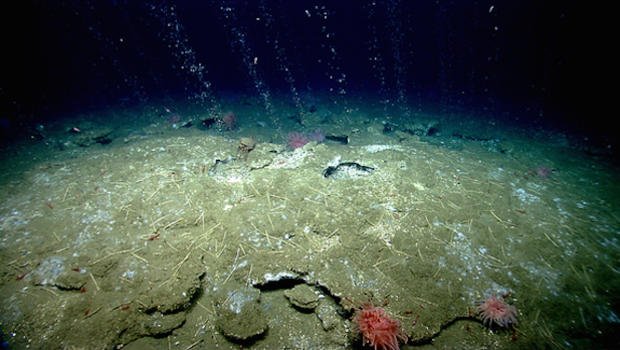
Arctic Ocean gives up more methane than scientists predicted

March 4, 2010

Here’s another point of science that will give rational people concern, and which cannot in any way be explained as “no problem” by stolen e-mails:  Methane releases from the floor of the East Siberian Arctic are much larger than predicted.

Methane hydrates releasing methane gas in bubbles in the ocean - i.treehugger image

Underwater methane gas plumes, Photo: NOAA Okeanos Explorer Program, 2013

Methane is a more powerful greenhouse gas than carbon dioxide.  Frozen forms of methane dot the bottoms of our oceans.  Warming of the oceans might be able to trigger an explosive thawing of the methane hydrates, as the frozen forms are known, seriously adding to our worldwide greenhouse gas problems.

Story here at Global ChangeScience article on which that post is based, here.

Cool SONAR pictures of methane bubbling up from the floor of the Arctic Ocean, but scary once you realize what they are, at this vintage post at Millard Fillmore’s Bathtub.

Is there any chance this research will merit a mention at the climate denialist blogs?


Libertarians for junk science

February 21, 2010

Yeah, I agree — but ask yourself, you who call yourselves “libertarian” or “skeptic,” why you’re not asking the same questions?

From the Murph Report, “Libertarians for junk science.”  From a guy named Kevin Carson, a self-described anarchist — and voice in the wilderness.

He discusses the unthinking acceptance political libertarians and conservatives give to all stories against  doing something about global warming, and about DDT’s problems.


Another warming contrarian who can’t/won’t shoot straight

February 12, 2010

Joanne Nova is, I gather, a former television personality in Australia now blogging away against science and the study of climate change at JoNova.  Here’s how far off the track she is:  She’s been sucked in by Monckton,  as some great scientist and hero — he whose biggest achievements are to call scientists “bedwetters” and attack the reputations of famous dead women (what is it about Monckton and dead women?).

Her latest post is a hoot. She’s claiming that the case for global warming is coming apart.  She illustrates it with this PhotoShop™ masterpiece (note the “JoNova” in the lower lefthand corner, and note it well):

JoNova's PhotoShop of Glen Canyon Dam for an article on wildly inaccurate claims about climate change; original photo copyright by Wild Nature Images.

JoNova defaces photo of Glen Canyon Dam. Original photo copyright by Wild Nature Images.

Glen Canyon Dam poses problems for serious advocates of environnmental protection for many reasons, not the least being the death of Glen Canyon.  This dam represents one of the greatest losses of the environmental movement.  That’s not why Nova chose the photos, I’m sure — I’d be surprised if she could find Glen Canyon on a map, and I’m all but certain she’s clueless about the controversy about the dam (don’t even wonder whether she’s ever read Ed Abbey).

Regardless where one stands on the issues around Glen Canyon Dam, one cannot look at this photo without seeing the white stripe from the water behind the dam, running about 50 feet up the canyon walls.

Check out the original, copyrighted photo here, at WildNatureImages.com (and maybe buy a copy — it’s a great photo of the dam, Lake Powell and the area; no bluer sky anywhere).  I presume that, even with the huge “JoNova” on it, Nova will allow free duplication of her original work; but why didn’t she credit the guy who took the photo (Ron Niebrugge) and the people who put it on the internet for her (WildNatureImages.com)?  Update:  Nova is giving credit, now.

The original, without comment, is at once more beautiful, more awe-striking, and more accurate a portrayal of the effects of climate than Nova’s doctored version:

Glen Canyon Dam - photo by Ron Niebrugge, at WildNatureImages.com

Glen Canyon Dam, photo by Ron Niebrugge, at WildNatureImages.com. Displayed here with express written permission.

See, climate change is thought to be one of the culprits for that white line. Glen Canyon Dam is in straits right now, as is the Colorado River Compact that created the legal justification for constructing the dam, because precipitation in the mountains where the Colorado River is born has fallen dramatically in the past couple of decades — and Lake Powell has shrunk to a vestige of its former self, of its planned extent, of the extent hoped for in cooler times.

Lake Powell's drop, circa 2008, photo by Marco Ammannati via National Parks Traveler

Lake Powell's drop, circa 2008, photo by Marco Ammannati via National Parks Traveler. Caption from National Parks Traveler: "At Glen Canyon National Recreation Area, years of drought, possibly an indicator of climate change, have revealed Lake Powell's bathtub walls. Spring runoff, however, could soon make those bathtub walls vanish."

JoNova uses a photograph showing the harms of climate change, to claim that climate change does not occur.

Is this the stupidest anti-climate change statement ever made?

Offer your candidates for dumber or stupider claims below.  It’s time we started counting and cataloging.

More:


MSM understand dangers of warming

February 1, 2010

Editorial in the St. Louis Post-Dispatch, another of America’s great legacy of great newspapers:

The decade that ended in 2009 was the warmest on record, NASA reported earlier this month. It displaced the decade of the 1990s as the warmest ever. The 1990s displaced the 1980s.

Last year was the second-warmest since 1880, when modern temperature measurements began. The warmest year on record was 2005. All of the 10 warmest years on record have occurred since 1998. Perhaps you’re starting to see a pattern.

Tip of the old scrub brush to Open Mind, who also notes that the last decade was the warmest ever.


No climate change denialists will apply

January 28, 2010

Australia is looking for a scientist to head up the next round of Australia’s reports to the Intergovernmental Panel on Climate Change (IPCC).

But who would want a job that pays nothing and brings a great deal of grief?  Crikey notes that scientists, especially Australian scientists, get slandered and libeled daily by climate change denialists.  Not to mention the death threats.

That fat pay the denialists keep claiming comes to the scientists, and urges them to misreport the data?

The only remuneration IPCC scientists get – as a quick check of last week’s ad would have made clear — is travel costs and living expenses while they are at IPCC meetings.  The IPCC work is on top of their day jobs as academics and researchers.

That’s right, ladies and gentleman:  Climate Denialist Extraordinaire Christopher Monckton profits from his obnoxious and error-filled lectures more than the guys who do the heavy lifting.

You know that denialists won’t apply to do the job.  Most of us suspect they don’t have the courage of their convictions to do it, but there’s another problem:  Very few of them are qualified.  They don’t do science.

Bookmark the story. Remind the denialists of it from time to time.

IPCC art, on AR5 process

(New year’s greetings from the IPCC.)


Where’s that global cooling the denialists promised?

January 20, 2010

Forgetting that the planet has seasons, climate denialists for months have been hoo-hooing  about snowfalls and cold weather.  Some of the more serious propagandists among them claim that the Earth is now in a cooling cycle, and that temperatures have been falling since the record hot year of 1998.

Really?

Head on over to Open Mind, and take a look at the facts.

NASA GISS [Goddard Institute for Space Studies] has released the estimated monthly temperature for December 2009, which closes out the year 2009, which closes out the decade of the 2000s. The result: 2005 is still the hottest calendar year, 2009 is the 2nd-hottest year ever, although it’s really in a statistical tie with 1998, 2002, 2003, 2006, and 2007.

They’ve confused weather with climate.  They’ve failed to keep score.  Perhaps they’ve spent wasted their time hacking e-mails instead of measuring climate.

RealClimate carries the news in a post by some of NASA’s top scientists, including James Hansen:

The past year, 2009, tied as the second warmest year in the 130 years of global instrumental temperature records, in the surface temperature analysis of the NASA Goddard Institute for Space Studies (GISS). The Southern Hemisphere set a record as the warmest year for that half of the world. Global mean temperature, as shown in Figure 1a, was 0.57°C (1.0°F) warmer than climatology (the 1951-1980 base period). Southern Hemisphere mean temperature, as shown in Figure 1b, was 0.49°C (0.88°F) warmer than in the period of climatology.

How will the critics treat this news?  And, what were they doing during the past decade when all those warm days rolled into weeks, rolled into months and years, and finally, to the warmest decade ever?

Global land  temperature mean for the decade ending 2009, plus hemispheric comparisons

Caption from RealClimate: Figure 1. (a) GISS analysis of global surface temperature change. Green vertical bar is estimated 95 percent confidence range (two standard deviations) for annual temperature change. (b) Hemispheric temperature change in GISS analysis. (Base period is 1951-1980. This base period is fixed consistently in GISS temperature analysis papers. . . Base period 1961-1990 is used for comparison with published HadCRUT analyses in Figures 3 and 4.)

Heat things up a bit, and spread the alarm:

Add to FacebookAdd to NewsvineAdd to DiggAdd to Del.icio.usAdd to StumbleuponAdd to RedditAdd to BlinklistAdd to TwitterAdd to TechnoratiAdd to Furl


Tonight in Iowa City! DDT and myth lecture

January 19, 2010

A reminder that Prof. O’Shaughnessy’s lecture on DDT and myths rolls tonight in Iowa City.  We hope to have a report, later.

As we posted earlier:

Do we have any readers in Iowa City?  Near Iowa City?

A presentation on the history of malaria and DDT, and the recent use and abuse of those stories to flog environmentalists and others on the internet, is set for the Hardin Library for Health Sciences at the University of Iowa in Iowa City, on January 19, 2010 (next Tuesday).

If you’re there, can you snap a couple of pictures to send, and get any handouts, and write up a piece about it?

Here is the press notice on-line:

Presentation on the History of Malaria and DDT

The University of Iowa History of Medicine Society invites you to hear Patrick T. O’Shaughnessy, PhD, Associate Professor, Department of Occupational and Environmental Health, University of Iowa, speak on “Malaria and DDT: the History of a Controversial Association” on Tuesday, January 19th, 5:30 to 6:30, room 2032 Main Library. [in Iowa City, Iowa.]

Dr. O’Shaughnessy observes:  ”Although it helped prevent millions of cases of malaria after its widespread use in the 1950’s, the pesticide DDT was banned from use in the United States and fell out of favor as an agent to reduce cases of malaria around the world. This history of the events associated with the effort to eradicate malaria, as well as the environmental movement that led to the ban on DDT, will center on the story of a story that incorporated both issues and grew into a modern myth still seen in books and multiple websites today.”

The session is free and open to the public.  Light refreshments will be served.

Hardin Library for the Health Sciences stands on the campus in Iowa City.

Hardin Library for the Health Sciences
600 Newton Road
Iowa City, IA 52242-1098

319-335-9871

The Hardin Library for the Health Sciences is located on Newton Road, directly north of the University of Iowa Hospitals and Clinics and approximately 1/2 mile east of Carver-Hawkeye Arena.  Go here for directions and more information.

Maybe I’m not the only bothered by the usual abuse of history and science on the issues of DDT and malaria.

Note: Tim Lambert notes at Deltoid that O’Shaughnessy is the guy who wrote what may be the definitive work on the famous — or infamous — Borneo Cat Drop. If you live in or near Iowa City, this lecture may be a wise investment of time.  High school teachers, your students could benefit, too.


Monckton’s profiteering: Climate denialists rake in the money

January 19, 2010

Bizarre as it may seem, the imagined profiteering of environmentalists has becoma favorite complaint of global warming deniers.  Ignoring the fact that he’s on the board of Apple Computers and a very savvy investor, and ignoring the facts of his donation of proceeds he gets from lectures, deniers claim Al Gore has gotten rich off of warning people about global warming.

They even complain when researchers get grants to study the stuff, as if the researchers were buying Maseratis and taking vacations to the Caribbean on the money.

How could they think that?

Might it be because the deniers really are pulling in high dollar, luxury fees to campaign against the science?  Christopher Monckton, warming denialist extraordinaire, is touring Australia.  Comes this little slip of public relations:

During this tour, Lord Monckton will be chaperoned by wealthy mining consultant and geologist Professor Ian Plimer. Lord Monckton will also be getting a fee of $20,000 and all his travel and accommodation – somewhere in the region of $100,000 – will be paid for.

Who might be paying for Monckton’s tour?* China?  India?  We don’t know, but following Monckton’s lead, we might hope that the western intelligence agencies are investigating Monckton to see just what he’s up to.

$120,000 to make up political smears that damage national policies and science?  Mencken would be ashamed.

More:

_____________

* It’s a paraphrase of Monckton, who evilly worried about funding for climate research and ill-funded environmental groups, “Goodness knows where they get it from!  Foreign governments, possibly!  I don’t know!  I haven’t looked.  But it’s certainly an alarming question:  Are the environmental movements being backed by China or India so they won’t have to compete with us for natural resources because we will have shut our industry down.  It’s a question that the security services, I hope, are looking at, because it certainly worries me.”

Annals of Global Warming: Bering Strait, choke point and butterfly effect

January 17, 2010

From the National Science Foundation, we get more stuff that students in high school ought to learn, stuff which would give the conservatives on the Texas State Board of Education full-fledged conniptions, stuff that just doesn’t fit into Texas’s Teach-To-The-Test™ education standards.

Reading the press release brings home two points to me.  First, for the sake of Texas social studies standards, this story tells the physical effects of “choke points.”  The Bering Strait limited human migration to populate the America’s, meeting the definition of choke point favored by Texas Essential Knowledge and Skills (TEKS), and this story sheds light on that issue.  But it also points out that choke points affect more than just humans.  This was a key finding of the President’s Commission on Americans Outdoors that led to a recommendation that we create green corridors favorable for animal migration.  In the Bering Strait, it’s migration of ice and cold and warm water that get choked off — and that, too, affects human history.  Second, this may enlighten students to the butterfly effect noted in the science we call chaos, where a small physical perturbation in one area can have enormous consequences later, and far away, in the dynamic systems that keep our planet alive.  (Yeah, the Bering Strait is bigger than a butterfly.  I know.)

Press Release 10-003

Global Ice Age Climate Patterns Influenced by Bering Strait

Small geographic feature has large impacts on climate

Ice pouring through the Bering Strait, from the Arctic to Pacific Ocean - NASA photo via NSF

Ice is shown choking the Bering Strait in recent times; the ice moves from the strait south to the Bering Sea. Credit: NASA

January 10, 2010

In a vivid example of how a small geographic feature may have far-reaching impacts on climate, new research shows that water levels in the Bering Strait helped drive global climate patterns during ice age episodes dating back more than 100,000 years.

The international study, led by scientists at the National Center for Atmospheric Research (NCAR) in Boulder, Colo., found that the repeated opening and closing of the narrow strait due to fluctuating sea levels affected currents that transported heat and salinity in the Atlantic and Pacific Oceans.

As a result, summer temperatures in parts of North America and Greenland oscillated between comparatively warm and cold phases, causing ice sheets to alternate between expansion and retreat and affecting sea levels worldwide.

While the findings do not directly bear on current global warming, according to Steve Nelson, National Science Foundation (NSF) program director for NCAR, they highlight the complexity of Earth’s climate system and the fact that seemingly insignificant changes can lead to dramatic tipping points for climate patterns, especially in and around the Arctic.

“The global climate is sensitive to impacts that may seem minor,” says NCAR scientist Aixue Hu, the project’s lead scientist. “Even small processes, if they are in the right location, can amplify changes in climate around the world.”

The research results are published this week in the journal Nature Geoscience.

Funded by NSF and the U.S. Department of Energy, the scientists used the latest generation of supercomputers to study past climate at a level of detail that would have been impossible just a few years ago.

Hu and his colleagues set out to solve a key mystery of the last glacial period: Why, starting about 116,000 years ago, did northern ice sheets repeatedly advance and retreat for about the next 70,000 years? The enormous ice sheets held so much water that sea levels rose and dropped by as much as about 100 feet (30 meters) during these intervals.

In other cases, scientists have associated such major oscillations in climate with fluctuations in Earth’s orbit around the Sun. But in the time period the research team looked at, the orbital pattern did not correspond with the geologic movement of the ice sheets and associated sea level changes.

The researchers considered an alternative possibility: that changes in the Bering Strait, the main gateway in the Northern Hemisphere between the Atlantic and Pacific Oceans, might have affected ocean currents across much of the globe.

Although small–the strait is currently about 50 miles (80 kilometers) wide between Russia and the westernmost islands of Alaska–it allows water to circulate from the relatively fresh north Pacific to the saltier north Atlantic via the Arctic Ocean. This flow is instrumental to regulating the strength of a current known as the meridional overturning circulation, a key driver of heat from the tropics to the poles.

Using the NCAR-based Community Climate System Model, a powerful computer tool for studying worldwide climate, the researchers compared the responses of ice age climate to conditions in the Bering Strait.

They ran the model on new supercomputers at NCAR and the Department of Energy’s Oak Ridge National Laboratory, enabling them to focus on smaller-scale geographic features that, until recently, could not be captured in long-term simulations of global climate.

The simulations accounted for the changes in sea level, revealing a recurring pattern–each time playing out over several thousand years–in which the reopening and closing of the strait had a far-reaching impact on ocean currents and ice sheets.

As the climate cooled because of changes in Earth’s orbit, northern ice sheets expanded. This caused sea levels to drop worldwide, forming a land bridge from Asia to North America and nearly closing the Bering Strait.

With the flow of comparatively fresh water from the Pacific to the Atlantic choked off, the Atlantic grew more saline. The saltier and heavier water led to an intensification of the Atlantic’s meridional overturning circulation, a current of rising and sinking water that, like a conveyor belt, pumps warmer water northward from the tropics.

This circulation warmed Greenland and parts of North America by about 3 degrees Fahrenheit (1.5 degrees Celsius)–enough to reverse the advance of ice sheets in those regions and reduce their height by almost 400 feet (112 meters) every thousand years. Although the Pacific cooled by an equivalent amount, it did not have vast ice sheets that could be affected by the change in climate.

Over thousands of years, the Greenland and North American ice sheets melted enough to raise sea levels and reopen the Bering Strait.

The new inflow of fresher water from the Pacific weakened the meridional overturning circulation, allowing North America and Greenland to cool over time. The ice sheets resumed their advance, sea levels dropped, the Bering Strait again mostly closed, and the entire cycle was repeated.

The combination of the ocean circulation and the size of the ice sheets–which exerted a cooling effect by reflecting sunlight back into space–affected climate throughout the world.

The computer simulations showed that North America and Eurasia warmed significantly during the times when the Bering Strait was open, with the tropical and subtropical Indian and Pacific Oceans, as well as Antarctica, warming slightly.

The pattern was finally broken about 34,000 years ago, the point in Earth’s 95,000-year orbital cycle at which the planet was so far from the Sun at certain times of year that the ice sheets continued to grow even when the Bering Strait closed.

When the orbital cycle brought Earth closer to the Sun in the northern winter, the ice sheets retreated sufficiently about 10,000 years ago to reopen the strait. This helped lead to a relatively stable climate, nurturing the rise of civilization.

“This kind of study is critical for teasing out the nuances of our climate system,” says NCAR scientist Gerald Meehl, a co-author of the paper. “If we can improve our understanding of the forces that affected climate in the past, we can better anticipate how our climate may change in the future.”

In addition to NCAR, the study team included researchers from the National Center for Scientific Research (CNRS) in France, University of Colorado in Boulder, Catholic University of Louvain in Belgium, Australian National University and Harvard University.

-NSF-
Download the high-resolution JPG version of the image [of ice flowing through the Bering Strait, above]. (1.4 MB)

Bering Strait, NASA photo via National Science Foundation

The Bering Strait separates the U.S. and Russia by only 90 kilometers. Credit: NASA

Download the high-resolution JPG version of the image. (570 KB)

Currents move warm and cold water across the Arctic Ocean - UCAR map

Altered currents once produced ocean warming (right, dark red) that melted ice sheets. Credit: UCAR

Download the high-resolution JPG version of the image. (680 KB)

Media Contacts
Cheryl Dybas, NSF (703) 292-7734 cdybas@nsf.gov
David Hosansky, NCAR/UCAR (303) 497-8611 hosansky@ucar.edu

The National Science Foundation (NSF) is an independent federal agency that supports fundamental research and education across all fields of science and engineering. In fiscal year (FY) 2009, its budget is $9.5 billion, which includes $3.0 billion provided through the American Recovery and Reinvestment Act. NSF funds reach all 50 states through grants to over 1,900 universities and institutions. Each year, NSF receives about 44,400 competitive requests for funding, and makes over 11,500 new funding awards. NSF also awards over $400 million in professional and service contracts yearly.

Get News Updates by Email

Useful NSF Web Sites:
NSF Home Page: http://www.nsf.gov
NSF News: http://www.nsf.gov/news/
For the News Media: http://www.nsf.gov/news/newsroom.jsp
Science and Engineering Statistics: http://www.nsf.gov/statistics/
Awards Searches: http://www.nsf.gov/awardsearch/

Bookmark those sites, teachers.

More:


Annals of Global Warming: Research isn’t the road to riches

January 13, 2010

A popular theme among climate denialists claims that researchers are getting rich off of contracts to do research into global warming, and so they skew their data in order to make sure they can get future contracts.

This notion demonstrates an alarming lack of information about how research grants from government and other sources work.  Climate researchers aren’t buying big fancy homes and fast cars.  They aren’t getting rich off what little research money comes their way — that money goes into research.

Here’s one way to tell:  Canadian researchers into the changing conditions in the Arctic can’t get <i>to</i> the Arctic to do their work.  Were they getting rich off of grants, this would not happen.

Stories in Nature this week, and most of the stuff is available to the public, free:

J. England photo - Helicoptering research gear to researchers in the Canadian Arctic - Nature Magazine

J. ENGLANDGetting people and supplies into remote Arctic field sites requires expensive air support. - Nature photo

  • Canadian Arctic researchers left out in the cold

    The Arctic is one of the fastest-changing landscapes in the world: its glaciers, sea ice and animals are being radically affected by climate change, and the melting environment could in turn have huge impacts on rising temperatures. It is imperative that scientists continue to monitor these conditions. Yet Canadian scientists are finding it increasingly difficult to get out in the field to do their work, says John England in an Opinion piece. This is discussed further in an Editorial and with the author in the Nature Podcast, all free in Nature this week.

    Credit: J. England

Canada needs a polar policyJ. ENGLAND

Getting people and supplies into remote Arctic field sites requires expensive air support.


Annals of Global Warming: Warming in the middle troposphere, cooling in the lower stratosphere, 1995-2007

January 2, 2010

This is a post out of history, from the good people at NASA’s Earth Observatory, on July 6, 2007.  For those of who are not climate scientists or particularly advanced in our acumen in dealing with the large datasets and complex mathematics of global warming, this Earth Observatory Image of the Day may improve understanding.

Atmospheric Temperature Trends, 1979-2005

Posted July 6, 2007

Atmospheric Temperature Trends, 1979-2005

Climate models predict that the build up of greenhouse gases should warm the lower layer of the atmosphere, called the troposphere, and cool the layer above it, the stratosphere. Greenhouse gases accumulate in the troposphere where they absorb energy radiated from the Earth and re-emit energy back to the surface. Because the gases trap heat in the lower parts of the atmosphere, the stratosphere cools down. This pattern of warming in the lower atmosphere and cooling in the stratosphere is a hallmark of greenhouse gas warming in global climate models.

These images show temperature trends in two thick layers of the atmosphere as measured by a series of satellite-based instruments between January 1979 and December 2005. The top image shows temperatures in the middle troposphere, centered around 5 kilometers above the surface. The lower image shows temperatures in the lower stratosphere, centered around 18 kilometers above the surface. Oranges and yellows dominate the troposphere image, indicating that the air nearest the Earth’s surface warmed during the period. The stratosphere image is dominated by blues and greens, indicating cooling.

Globally, the troposphere warmed, and the stratosphere cooled during this period. Local trends varied. The greatest tropospheric warming was in the Arctic, where warming is amplified as snow and ice melt. The Antarctic, on the other hand, showed cooling. Some researchers have explained the localized cooling as a side effect of the ozone hole on atmospheric circulation over Antarctica. Loss of ozone cools the stratosphere, a change which intensifies the vortex of winds that encircle the continent. The stronger vortex isolates the air over the continent, cooling the stratosphere even further. At different times of the year, the unusually cold air dips down from the stratosphere and into the troposphere.

The cooling trend in the stratosphere was probably not solely due to greenhouse gas warming at lower altitudes; loss of ozone also cools the stratosphere. In the stratosphere, two warm spots over Antarctica and the Arctic appear to defy the overall cooling trend. One explanation for these warm spots is that polar stratospheric temperatures can fluctuate widely. The poles, especially the Arctic, experience periodic events known as sudden stratospheric warmings, during which the vortex of winds that circles the poles breaks down. When this happens, the stratosphere can warm several tens of degrees Celsius in a few days. Although these events are more common in the Arctic, a significant sudden stratospheric warming also occurred in the Antarctic stratosphere in 2002 and may help explain the apparent warming trend. Whether the localized warming trend is significant is still uncertain.

The measurements were taken by Microwave Sounding Units and Advanced Microwave Sounding Units flying on a series of National Oceanic and Atmospheric Administration (NOAA) weather satellites. The instruments record microwave energy emitted from oxygen molecules in the atmosphere. Warmer molecules release more energy than cooler molecules, so scientists can measure the temperature of the atmosphere by recording the amount of microwave energy being emitted. Early analyses of these measurements showed little or no warming in the troposphere, where models predicted that warming should be occurring. For a time, these measurements caused some people to question the validity of global climate models and greenhouse gas warming. Scientists discovered, however, that the satellites carrying the microwave instruments had drifted in their orbits over time, so that more recent measurements were taken at a different time of day than older measurements. Once scientists accounted for this bias and other differences between the individual instruments, the measurements showed a warming trend in the troposphere, consistent with surface observations of rising global temperature.

Re-analysis of the satellite measurements answered one of the frequently asked questions about global warming: why didn’t the early satellite data show warming in the lower layer of the atmosphere? To read more on this topic, see Global Warming Questions & Answers, which addresses this and other common questions about global warming.

    Further reading

  • Global Warming Questions & Answers on the Earth Observatory.
  • Global Warming, a fact sheet published on the Earth Observatory.
  • Fu, Q., Johanson, C.M., Warren, S.G., Seidel, D.J. (2004, May 6). Contribution of stratospheric cooling to satellite-inferred tropospheric temperature trends. Nature, 429, 55-58.
  • Johanson, C.M., Fu, Q. (2007 June). Antarctic atmospheric temperature trend patterns from satellite observations. Geophysical Research Letters, 34, L12703.
  • Karl, T. R., Hassol, S. J., Miller, C. D., and Murray, W. L., editors. (2006). Temperature Trends in the Lower Atmosphere: Steps for Understanding and Reconciling Differences. A Report by the Climate Change Science Program and the Subcommittee on Global Change Research, Washington, DC. Accessed June 8, 2007.
  • Ramaswamy, V., Schwarzkopf, M.D., Randel, W.J., Santer, B.D., Soden, B.J., Stenchikov, G.L. (2006, Feb 24). Anthropogenic and natural influences in the evolution of lower stratospheric cooling. Science, 311, 1138-1141.
  • Remote Sensing Systems. (2007, June 12). Description of MSU and AMSU Data Products. Accessed July 5, 2007.

NASA image created by Jesse Allen, using data provided courtesy of Remote Sensing Systems. Caption information courtesy Carl Mears, Remote Sensing Systems, and Paul Newman and Joel Susskind NASA Goddard Space Flight Center.

Spread the historic word:

Add to FacebookAdd to NewsvineAdd to DiggAdd to Del.icio.usAdd to StumbleuponAdd to RedditAdd to BlinklistAdd to TwitterAdd to TechnoratiAdd to Furl


Chinese government behind “climategate” hacking?

January 1, 2010

Conspiracy fans — a category which appears to include almost all climate change denialists — won’t like the news from Planet Green’s “Planet 100.”  This little news show claims evidence that China was the source of the hacking of the University of East Anglia’s climate related e-mails.

Why won’t the denialists like it?  They won’t like it because it makes sense:  Who stood to profit from embarrassing scientists just before the Copenhagen meetings?  China, who wished to avoid any binding agreements, would gain simply by sowing confusion.

Evidence is pretty thin, but for the first time since the hacked e-mails were published, there’s a plausible motive.   Also, the source is also not wholly pristine or reputable in science stuff — the Daily Mail of London, which specializes in gossipy tabloid news.  Watch that space.

P.S.  — Don’t miss the squid invasion story in the same newscast.

Resources:


Climate change, and DDT: Monckton’s inconvenient and inaccurate history

December 31, 2009

Oh, Christopher Monckton raves on, and gullible or horribly ignorant journalists let him.  Maybe Michael Coren is both gullible and horribly ignorant.

Monckton’s grotesque errors of history suggest that he’s probably wrong on the science, too, considering that his studies were in the classics, and not science.  If he can’t get stuff right in his area of expertise, it’s almost impossible that he’d be right far afield.

I don’t know Coren’s other work, but the way he turned his microphone over to Monckton in the interview below is disturbing, with no challenge given to wild flights of imagination Monckton took, posed as history.  The Kennedy administration wasn’t that long ago; Rachel Carson’s book Silent Spring had a 40th anniversary edition that is still on the shelves.  Bald eagles, the national bird of the United States, climbed off the endangered species list just a few months ago with accompanying dozens of news stories that explained DDT had nearly wiped the species out.

Coren slept through all of that?  Monckton thought no one would remember the accurate history?

Monckton’s appearance on Michael Coren’s program on CTS (a Canadian network) obnoxiously slapped my browser.  You may recall I had checked out Monckton’s speech to an unquestioning group of students at a religious college in Minnesota.  At about the same time, he showed up on Coren’s program, saying much of the same things he’d said earlier in Minnesota.
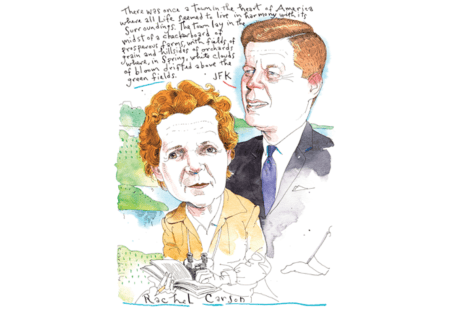
Rachel Carson persuaded President John Kennedy on her knowledge of oceans; it was the good science that hooked him. Illustration from Audubon Magazine: CARSON AND CAMELOT, Illustration by Joe Ciardiello

Rachel Carson persuaded President John Kennedy on her knowledge of oceans; it was the good science that hooked him. Illustration from Audubon Magazine: CARSON AND CAMELOT, Illustration by Joe Ciardiello

Have you ever interviewed a truly pathological liar?  Hoaxsters tell falsehoods, and the truly pathological ones keep exaggerating as they tell, testing the waters to see how much the audience will believe.  I think Monckton is one of those.

Consequently, the falsehoods grow grander as the hoaxster finds the audience gullibly lapping up the milk of human imagination.

Take this example, Monckton in part 5 of his interview comedy routine with Coren.  Coren doesn’t question any of the confabulations Monckton comes up with, apparently having been born after 1975 and never read much history of science or the enviornmental movement, and apparently having somehow missed the dozens of news stories in recent years on the recovery and removal from the Endangered Species List of the bald eagle and brown pelican, and recovery of osprey and peregrine falcons (does Canada have Google?  does Coren know how to use it?  does Coren have no producer, no fact checkers?)

Nor, apparently, does Monckton have any ability to control his ability to say patently offensive and absolutely impossible things to blame others.  Monckton blames Jackie Kennedy for killing 40 million kids with malaria; never mind that he’s wrong, he pushes on to call President Jack Kennedy “her foolish husband;” never mind that he’s got all his facts wrong, he proceeds to call William Ruckleshaus “an environmental nincompoop”:

[At 2:50 of the video]

LORD MONCKTON: I think it is particularly sad that what is essentially a scientific question has been politicized.  In Britain it’s different.  All parties have sort of gone along with the bedwetting theory.  They’ve all said, “Oh, yes!  We’re doomed!”

The Conservative Party — which is nominally the right-wing party, though now it’s kind of center-left, really — it has come out and said — in fact it has produced the stupidest document on climate change that I’ve ever seen, it’s even stupider than Al Gore’s film; it’s unbelievable how half-witted it is.  It isn’t universal that it’s right-left.

Certainly it is true to say that the left are more enthusiastic about this, worldwide, than anyone else.

But, you see, then, they’ve got it wrong before.  Let’s take the DDT example, where 41 years ago, Jackie Kennedy read Rachel Carson’s Silent Spring.  And the thesis of this book was that because of DDT and other chemicals we were pouring into the atmosphere, the world was going to be so grossly polluted that every species other than humankind would die, and then eventually we would die, too.  And it was all going to be terrible.

From where did Monckton get the idea that Jackie Kennedy read Carson’s book, and that she initiated action? Famously, President Kennedy took a question about DDT in one of his popular afternoon press conferences.  He said he had read the book, and that he was looking into it.

President Kennedy did in fact task his science advisers to check out the book.  The President’s Science Advisory Council (PSAC) reported on May 15, 1963.  They said Carson’s book was accurate, and that the government should act immediately to investigate harms from synthetic chemicals including DDT.

Carson didn’t write anything about ‘pouring chemicals into the atmosphere.’  One of the great concerns among wildlife biologists was the damage done in water — where, it turned out, DDT was quickly absorbed into all living things, which then multiplied the dosages of DDT several million times as it climbed up the trophic ladder (food chains).  The problem with DDT is that it doesn’t go into the air, or water, but is instead rapidly absorbed by living tissue.  DDT sprayed in an estuary is taken up by first-level producers, including zooplankton, phytoplankton and plants, as well as any other creature that happens by.  As these producers are consumed by creatures higher up the food chain, the dosage multiplies geometrically.

Carson didn’t whine as Monckton claims she did.  She coolly and calmly laid out the facts.  The facts were, and are, that DDT and its sister compounds pose serious dangers to living things.

And Jackie Kennedy read this, and shivered, and plucked at the sleeve of her husband — who was then President of the United States — and said:  “Look.  You’ve got to do something about this!  We’ve got to save the planet from DDT!”

Isn’t that a remarkable coincidence?  Jackie Kennedy’s husband was president of the United States! He always had such cute cuffs to tug on, too.  Monckton’s infantilizing the First Lady and President of the U.S. lacks the charm Monckton must think it adds.

Jackie Kennedy was a smart and capable woman, a journalist who went on to a long and successful career as an editor at a major publishing house.  Monckton’s disparaging of Mrs. Kennedy here is uncalled for, untoward, and ugly — and factually wrong.

I’m sure that if the president’s wife told him to look into an issue, he did.  She was not in the habit of being frivolous or silly.  There is film of President Kennedy at a press conference, being asked by a reporter if there is any official reaction on Carson’s book (hardly the pillow-side sleeve tug Monckton imagines); and anyone can check the presidential papers to see the report from the science advisors.  As we know now, Carson was right.  The Nobel winners  and others on the PSAC agreed.  Incidentally, they won their Nobels for hard research, not by writing letters to the editor of an publication from an organization that won a Nobel and then getting a sycophant to manufacture a replica Nobel, as Monckton claims with his dime-store “Nobel pin” (like a man whose mother refused to buy a deputy sheriff star for his cowboy games).

In his efforts to make the story entertainingly memorable, Monckton gives us the equivalent of passed gas in a crowded elevator.

But, Dear Reader — Dear God! — brace yourself:

And so Kennedy appointed a friend of his who was an environmental nincompoop, to take charge of the Environmental Protection Agency.

How can we know Monckton is lying? Well, John Kennedy died in November 1963.  The Environmental Protection Agency took form seven years later, in the administration of Richard Nixon, the man Kennedy defeated for the presidency in 1960.  John Kennedy was dead, and his younger brother suffered assassination, too.  Monckton’s English — U.S. history is not his forte.

So, EPA did not exist in John Kennedy’s life.  Unless Monckton claims Kennedy came back from the grave and wrested the pen from Nixon’s hand, it would have been impossible for Kennedy to appoint anyone to be in charge of the Environmental Protection Agency.

To whom is Monckton referring as director?  William Ruckelshaus, the old Republican political operator?  Monckton’s slip of the grip on history is so severe that it can’t be restored.  He’s so far out in fantasy land it’s difficult to tell.

But let’s take the next line:

Result:  Unfortunately; they banned DDT.

Ruckelshaus was Director of EPA when DDT was banned.  Ruckelshaus signed the documents.  Monckton could only be referring to Ruckelshaus.  To make his case for DDT, Monckton must bend time and all of politics.

And then, Monckton, of all people, refers to Ruckelshaus as a “nincompoop.” Um, Monck, this is one of the heroes of the Saturday Night Massacre, one of America’s better lawyers of that time or any time, a committed man of reason and solid environmental credentials.  If Ruckelshaus is an environmental nincompoop, Monckton is a lobotomized environmental pisant with a bad attitude.  (Regardless whatever he may be, Monckton has a bad attitude.)

We confront the reality here that Monckton is not engaging in any discussion about science, where simple facts of history got wrong can be subject to swift and gracious correction.  He’s off in Faux Propagandaland, making up nasty things to say as he bulldozes through the facts and truth, pushing them out of the way of his rant.  Facts, history and science be damned!, Monckton froths.  This is a crusade against the evils of socialism, and Monckton will carry on the war even when there are no socialists and no evil!  So what if they are not socialists!  Monckton will label them so and that will be that!

Oy.  Monckton’s so far out in left field at Wrigley that he’s in the bar across the street.

This was copied worldwide, because the left got going.  “Aha! We can show who’s boss!  We can ban DDT!”

Nope, sorry.  Sweden banned DDT, and then the U.S. banned DDT from use around babies, and then in 1972 the U.S. banned use of DDT in agriculture.  Most European nations eventually followed with tighter regulations.  History shows, however, that DDT was never banned in most of the world.  In the U.S., sadly, DDT manufacture for export continued until 1984 (to the day before the enactment of the Superfund bill), and DDT manufacture continues today in India and China.

Not only did the left not ban DDT around the world, no one did.

Not content to merely rape history and stuff its bloody body in a garbage can, Monckton then invents a whole new class of evil for environmentalists to do:

And of course a lot of them were in league with people who were producing chemicals other than DDT, which they wanted to replace, so they were making money out of it the usual — unfortunately the usual money-packed story, and inglorious story.

Got that?  He says Kennedy, though dead for nearly a decade, conspired to ban DDT so he could get kickbacks from companies who manufactured competing pesticides. And so did Ruckelshaus, one of the few men who stood up to Richard Nixon and refused to fire Archibald Cox.  Monckton says Ruckelshaus was crooked, and taking kickbacks from chemical companies.

So, they banned DDT.  Now, DDT is, in fact, safe enough you can eat it by the tablespoonful — I wouldn’t recommend that, but you can do that, it won’t hurt you if you do.  It’s completely harmless to humans.  It’s completely harmless to birdlife and animals.

In 1975 a committee of the House of Representatives asked for a history of EPA.  Among other topics, the DDT restrictions were discussed — here’s a 312-page document showing which harms were of greatest concern, and what was the science that backed the analysis of those harms.  It’s 312 pages that Monckton hopes you will never read.  He probably hopes it doesn’t even exist anymore.

By 1975 all the harms of DDT worried about by Rachel Carson 13 years before had been confirmed, with the slightly happy news that DDT is not a potent human carcinogen, but a weak one.

The only thing it’s harmful to is the anopheles mosquito, which is the vector that carries the falciparum parasite that causes malaria.  And to the aedes egyptii mosquito, which carries the yellow fever parasite.  It’s fatal — and really fatal — to both of them.

DDT acutely kills fish, birds and bats.  Had Monckton done his research, he’d have seen the plea from the U.S. Army to keep DDT available for poisoning bats in old, dilapidated barracks.  (EPA did not keep that use.)  DDT manufacturers bragged about how deadly the stuff was, in trying to make a case that it should be left on the market for unrestricted use.  40 years later, wild populations of bats are beginning to recover from collateral poisoning from DDT.  Bats fall into that branch of the animal kingdom known as mammals, where humans also fall.  Generally, if a poison is toxic to one mammal, it will be toxic to all others if dose is altered to consider body mass.  But also, if a substance is carcinogenic to one mammal, it will be cancer-causing to other mammals, too.

In mosquito control DDT is problematic.   It kills mosquitoes, but it also kills all other small creatures.  Especially, it kills those things that prey on mosquitoes — other insects, birds and arachnids, fish and small animals especially.  Since mosquitoes recover from DDT rather quickly, and predators take much longer to recover, this means an outdoor dose of DDT will result in a dramatic population explosion of malaria-carrying mosquitoes in a few weeks, as the mosquitoes recover more quickly than their predators do.

Monckton appears to think DDT is selective to mosquitoes.  DDT is a broad-scale killer, not selective in any way we know.

And the guy who invented it, who was German, got the Nobel Prize, because before DDT was introduced, a million people a year around the world, nearly all of them children, were dying of malaria.  It was one of the biggest killers.

Paul Muller won the Nobel in Medicine in 1948 for discovering that DDT kills insects.  But he was not the guy who invented the stuff more than 50 years earlier. Once again, where it’s easy to check facts, Monckton just doesn’t get the facts straight.

Before DDT was introduced, and for a long time thereafter, malaria killed about three million people annually.  When WHO conducted its eradication campaign, malaria deaths fell to about two million per year by the middle 1960s.  Once DDT use in that campaign was stopped, malaria death rates continued to fall to about a million a year today.  Malaria incidence and deaths rose in the 1980s when the malaria parasites themselves developed resistance to medicines used to treat and cure malaria in humans.

The chief barrier to lower malaria infection rates is education on barriers against mosquito exposure.  The chief barrier to lower malaria death totals is the development and delivery of pharmaceuticals to treat infected humans.  DDT is a panacea in neither theatre.

DDT came along and deaths fell to 50,000.

Monckton is flat out wrong.  He’s off by a factor of 20.  He’s making this stuff up.

We were on the point of wiping it out.

Flat out wrong again.  The World Health Organization (WHO) undertook a very ambitious program to eradicate malaria in the 1950s.  By the mid-1960s it was clear the program could not work:  In Africa, overuse of DDT (in agriculture) bred mosquitoes resistant to and immune to DDT.  Worse, in most of Subsaharan Africa, governments were not stable enough to have the discipline required to mount an effective campaign against the disease, knocking down the insect carriers briefly, then furiously treating humans with the disease so that when the mosquitoes returned there would be no pool of human infection from which to draw the disease.  This is all detailed in one of those fascinating New Yorker profiles of the legendary Fred Soper, by Macolm Gladwell.  For most of the world, we’ve never been to the point of wiping out malaria, and in those places where we’ve been successful in wiping out the disease, DDT was not the chief weapon.

When the left got in on the act — it’s exactly the same people:  the Environmental Defense Fund — you know — people who have got hundreds of millions of dollars in the bank!  Goodness knows where they get it from!  Foreign governments, possibly!  I don’t know!  I haven’t looked.  But it’s certainly an alarming question:  Are the environmental movements being backed by China or India so they won’t have to compete with us for natural resources because we will have shut our industry down.  It’s a question that the security services, I hope, are looking at, because it certainly worries me.

Monckton at his most scurrilous, and most distant from the facts.  Are environmental groups funded by China?  No.  In any case, the environmental groups don’t have nearly the funding of the pro-DDT groups, with their corporate funds. While we’re thinking about it, we should think about which side China would intervene on, were China to follow through on its historic reluctance to do anything about global warming.  Who is running around the world claiming we need to do nothing, and should do nothing?  Christopher Monckton.

If Monckton is worried about who is funding him, I’m sure the CIA and FBI would be happy to let him tell them about his well of money  he uses to frustrate the United Nations and treaty obligation of a hundred nations.  (Bill Dembski?  Are you still alive?  Why don’t you turn Monckton in — you’ve still got the number of Homeland Security, don’t you?)

Perhaps most egregious, or most funny, is this:  Environmental Defense has been a leader among all agencies, governmental and NGO, to urge the extremely limited use of DDT in indoor residual spraying – and yet, they are the one group Monckton complains about.

It’s a wonder to me that Monckton can figure out which part of his foot goes into his shoes first, in the mornings.  He has such a flair for getting the facts exactly wrong, and then getting into a dudgeon about his own error.  Monckton:  Not only wrong, but 180 degrees precisely wrong.

But there was the Environmental Defense Fund, and it came in and said, “Right, we’re going to press for a ban on DDT.” They succeeded.

The number of deaths went back up, from 50,000 a year to a million a year, and it stayed there for 40 years, while the likes of me were saying, “This is killing millions.  It ought to be stopped.  What on Earth is the World Health Organization doing?”

And eventually, just three years ago, on the 15th of September, 2006, Dr. Arata Kochi of the World Health Organization said, “Right.”  He said, “In this field, politics usually predominates.  Now we are going to take a stand on the science and the data.”  He ended the ban on DDT and declared that once again it would be the frontline of defense against the mosquito.

DDT has never been banned in most of the world — especially not in Africa.  WHO never banned DDT, they simply stopped using it when it ceased to be effective. Plus, you’ll recall from just a few paragraphs above, Environmental Defense (formerly EDF)  led the campaign to get DDT restored to use in IRS campaigns in Africa.

Monckton’s game is worse than blaming the messenger — he’s blaming the heroes.

COREN:  40 million people died . . .

MONCKTON:  Children!

COREN:   . . . because Jackie Kennedy read a silly book.

MONCKTON:  Yep.

COREN:   . . . and her foolish husband bought into it.

So, Coren’s bought Moncktons rude infantilizing of the Kennedys and all the false claims that went into it.  Anybody know how old Coren is?  Was he even alive in 1962?  If not, can he read?  Does he?  Carson’s book is out now in the 2002 40th anniversary edition, still available for anyone interested in the facts.

MONCKTON:  And then, the entire international left came in on the act.  And that was what did the damage.

And so the problem is that you have this political faction which likes to show who’s boss.  That’s the characteristic of the left.  They are instinctive interventionists.  And I know this is a little much of a political point, but it is unfortunately true that it was they who pushed the DDT ban.  And it was they who — to this day! — will say that David Suzuki and others who advocated this ban — and David Suzuki will tell you today that he regards this as one of the most successful campaigns he ever conducted.  That killed 40 million people, nearly all of them children. And it took 40 years before this decision could be reversed.  Why?  Because we had to wait until all the people responsible for the original decision had either retired or died, and were no longer in the way of doing the decent thing.

COREN:  Because they thought it was harmful to people, to animals . . .

MONCKTON:  They didn’t think any such thing.  It was purely to show who was boss.  There was never any scientific case for this.

Well, it’s in Canada, after all, so Monckton feels obligated to take a swipe at the most prominent local scientist who urges environmental protection.  David Suzuki was probably active in Canada on pesticide regulation, but of course he played only a tangential role in the U.S. action, which is what Monckton complains about here.  Suzuki was no personal confidante of the Kennedys.  Suzuki was 27 in 1963, probably completing graduate school.  Monckton’s swipe at Suzuki is almost completely gratuitous.

This is where the serious charges come.  Monckton accuses Carson, and all environmentalists, of ignoring human conditions.  He accuses us — he accuses you, since you were not active to stop the DDT ban — of being mass murderers, because, he claims, DDT would have been a safe and effective way to fight malaria, which has killed about a million people a year worldwide over the past 40 years.

Monckton is dead wrong.

First, malaria fighters stopped using DDT heavily in Africa in the early 1960s, years before any nation banned the substance.  There were three problems that contributed to the cessation of DDT use, as outlined by Malcolm Gladwell in his heavily researched and authoritative tribute to malaria fighter Fred Soper in The New Yorker:

  1. Many nations in Africa did have governments capable of conducting the regimented campaign necessary to successfully eradicate malaria — and in fact, most of the nations in Subsaharan Africa didn’t participate in the campaign at all.  Soper’s goal was to knock down mosquitoes for at least six months, and in that time cure malaria in every human.  When the mosquitoes came roaring back — as everyone in the program knew they would — there would be no pool of malaria in humans from which the mosquitoes could get infected.  The program was to break the chain of transmission required for the life cycles of the malaria parasites.  But that meant that governments had to have health care systems that could accurately diagnose malaria, and often which malaria parasite, and complete a cycle of treatment needed to flush the parasites out of the infected humans.  In the end, many entire nations simply did not participate.
  2. Malaria fighters were well aware of the race they were running:  Mosquitoes breed quickly, and consequently evolve quickly.  WHO’s malaria fighting teams understood it was a simply matter of time before mosquitoes became resistant or immune to DDT.  If that happened before malaria could be eradicated in a country or region, the game was over.  Resistance to DDT in mosquitoes started showing up as early as 1948 in Greece; by the 1960s several populations of mosquitoes were highly resistant.  (Today, every mosquito on Earth carries at least one of the two alleles that produces DDT immunity — and some carry as many as 60 copies of the two alleles, leaving them completely unaffected by DDT.)
  3. Industry didn’t get on board with the campaign.  Over-use of DDT out of doors by agricultural interests speeded the evolution of DDT-resistant mosquitoes.  Industrial use competed against, and ultimately frustrated, health care use of DDT.

Gladwell describes how WHO abandoned the eradication campaign with DDT as the key element, in the middle 1960s.  This was done not as a reaction to Carson’s book, but because the mosquitoes showed resistance.  Malaria fighters couldn’t build medical care in several nations at once while racing agriculture to use DDT.  WHO turned to other methods of fighting the parasites.

It’s important to note that WHO cannot dictate to nations what they do, nor did WHO ever “ban” DDT.  There are a lot of claims that there was pressure applied by environmentalists to get DDT use stopped, but the facts remain that DDT manufacture for export to Africa continued in the United States for more than a decade after DDT use was stopped in the U.S.  Manufacture of DDT moved to Africa and Asia — India and China make the stuff today.  Any African nation who wished to use DDT could have gotten it cheaply and in great quantity.

Second, there is no indication that DDT could have saved any more lives.  Simple mathematics tells the story:  The WHO eradication campaign reduced world-wide deaths from a high of 4 million annually, to about 2 million annually.  Each nation that eradicated malaria did so by raising incomes and improving the housing of poor people, making effective screening from mosquitoes the central part of the campaign.  Also, nations copied what the U.S. had done prior to the discovery that DDT killed insects:  They institute improved public health campaigns to educate people how to avoid being bitten, and to diagnose the disease and deliver knock-out pharmaceuticals quickly.

But, since heavy DDT use was stopped, the malaria rates continued to fall until recently.  Over the last decade, annual deaths numbered under a million, lower than when DDT use was at its greatest.  It’s impossible to square decreasing death rates with Monckton’s claim that DDT is a panacea against malaria, still.

Finally to this point of DDT and malaria, we have a conundrum:  Those nations who still use DDT, still have epidemic malaria.  If, as Monckton says, DDT is a miracle weapon against malaria, those nations that use DDT should be malaria-free.  If we think through the process, we see that malaria eradication is a much greater task that simply killing mosquitoes, and too complex to be cured simply by poisoning Africa and Africans.

Monckton ultimately tries to reduce the complex science, medical, geographical, political and education issues of malaria to a political question.  He accuses everyone who ever worked to reduce DDT use of being part of an out-of-control, monolithic and unthinking “left.”  It’s a popular idea among loud talkers from the right, including Monckton, Limbaugh, Rockwell, Hannity, the Hoover Institute, and most people who resist the science of global warming.  Monckton’s crude revisions of history away from accuracy might be justified as proper propaganda, if there were a noble political goal behind his work.  No noble goal can be discerned, latent or patent.

Many on the western left, in North America and Britain, urged tighter controls on DDT, especially once it became clear that the stuff was dangerous.  They got this from a long tradition of conservation in the U.S., for example, and not from any particular political orientation.  Fact is, the radical, socialist left who took over Russia and created the Soviet Union, who dominated Eastern Europe after World War II and who created the Peoples Republic of China, have always been unfriendly toward environmental protection, including the banning of DDT.  There was no ban on DDT use in the Soviet Union, nor in China.

Conservation, and the fight against pollution, is a product of western, capitalist nations.  It may be surprising news to a few, but the American conservation movement was led by people like John D. Rockefeller II, and Laurance Rockefeller, the Vanderbilts, and other people who were wealthy enough to have time to look around to see what was happening to America’s wild resources — or who appreciated the value of wilderness and conservation and the role it played in making America great.  Monckton is turning his back on one of the greater achievements of American capitalism, the strong desire to preserve the wild, and have clean air and clean water, for the health and benefit of all citizens.  Monckton completely shuns this great heritage of western civilization.  It’s quite astounding.

Ultimately, the decisions to reduce the use of, and now to phase out DDT (under 2001’s Persistent Organic Pesticides Treaty (POPs)) were scientific decisions.  In the U.S., the National Academy of Sciences wrote about DDT early on, noting (with an egregious typographical error) the great utility and benefit DDT provides to humans, but finally weighing the harmful effects and finding that they outweigh the benefits.  The number of assessments of DDT by august scientific and policy bodies is impressive, each deciding DDT had to go:  The 1958 U.S. Forest Service, the 1963 President’s Science Advisory Council, two federal courts in the U.S., the Food and Drug Administration in 1969, the U.S. Environmental Protection Agency in 1972, two more federal appellate courts ruling on the appropriateness and scientific soundness of EPA’s rule, the National Academy of Sciences, Congress under the Resource Conservation and Recovery Act (RCRA, the Superfund Act), and finally an international treaty between nearly 100 nations.  At each step science was the driving force.  At most steps, an absence of sound science would have made the ruling go the opposite way.

But all that is legal “mumbo-jumbo” to Monckton.  All that science is for naught, to Monckton’s classics trained mind.  What Monckton wants, Monckton should have, damn the facts, damn the courts, damn the scientists, damn history.

It’s really astonishing to add up the error Monckton piles on.

It’s the same with global warming.  There is no scientific case for this, either.  It’s the same people, trying to assert themselves in the same way.  They have succeeded, yet again, in getting the entire classe politique . . .

COREN:  I wish we had another hour.

So, with Monckton dead wrong or hallucinating on DDT, we should now trust him on global warming? No, we should not trust him on any issue.

Monckton will not understand those issues, either.  They are even more complex.

Update:  Monckton continues to smear the Kennedys in Australia, nearly two months later.

More:

Help others to remember history, so as not to be condemned to repeat it:

Add to FacebookAdd to NewsvineAdd to DiggAdd to Del.icio.usAdd to StumbleuponAdd to RedditAdd to BlinklistAdd to TwitterAdd to TechnoratiAdd to Furl


The unbearable lightness of climate denialist thought

December 28, 2009

Maybe “emptiness” would be a better description.

Carbon dioxide’s greenhouse gas functions were discovered in the 19th century.  The physics are beyond dispute by rational people.

But that doesn’t stop the hard-core denialists from searching for a way to deny the undeniable.  Anthony Watts hosts a guest post from a guy who says that because the atmosphere is complex, the physics of global warming do not apply.

The guest poster is Willis Eschenbach.  His argument?  Well, rivers don’t run straight to the sea; they meander.  Ergo, water doesn’t run downhill in a complex system.   Consequently, no global warming.  In another place he argues that humans are not metal, therefore, no global warming.

I mean — sweet Mother of Pearl! —  this guy even denies the existence of the Army Corps of Engineers, and river straightening:

The results of changes in such a flow system are often counterintuitive. For example, suppose we want to shorten the river. Simple physics says it should be easy. So we cut through an oxbow bend, and it makes the river shorter … but only for a little while. Soon the river readjusts, and some other part of the river becomes longer. The length of the river is actively maintained by the system. Contrary to our simplistic assumptions, the length of the river is not changed by our actions.

No wonder they place all their bets on stealing e-mails from scientists.  Somebody show that man the South Platte River through Denver, Colorado, or the Los Angeles River through Los Angeles, or the Mississippi from Arkansas to the Gulf.  Somebody give that man a paddle!

Here are a couple of clues:  First, water always runs downhill — capillary action being the exception.  Eschenbach doesn’t propose capillary action as a driver of river meandering.  Any hydrologist will tell  you, however, that even a meandering river runs downhill.  Second, human beings don’t conduct heat like metal blocks.  Even a dead human won’t conduct heat like a copper block, but especially a living human will radiate heat away through several different paths, so that heating the feet of a human will not cause a concomitant rise in temperature of the head.  But, heck, if you soak the human’s head in hot water, it won’t warm like a block of steel, either.  The examples offered in this piece get pushed past the brink of absurdity.  It’s impossible for me to believe that Eschenbach — or Watts — fails to understand the physics so greatly.  I can only imagine that they are driven by a fanatic devotion to an idea of the result they hope to see, and that blinds them to the errors they make.

Finally, water’s flow, downhill or up with capillary action, doesn’t negate global warming.  Human conductivity affects warming not at all, also.

(No, “constructal theory” doesn’t have much to do with itConstructal theory generally doesn’t apply to atmospheric conditions, since the air is, technically, not alive, but a dynamic fluid system already highly evolved for these purposes.  Even for those cases in which contructal ideas apply to non-living systems, constructal theory does not claim that laws of physics are suspended or held in abeyance, as Eschenbach claims at Watts’s blog.  The idea of constructal theory is that systems not in equilibrium, will, over time, figure out (evolve) more efficient means to get into equilibrium.  This has nothing to do with the fact of CO2 acting as a greenhouse gas.  Constructal theory would only suggest that, over time, the atmosphere would develop systems to get heat distributed better despite CO2, which means that warming would not be held in abeyance at all, but spread out further and farther.)

Watts is already hot that I posted science links at his place on another post.  Go see what other commenters can get away with.  Can the camel’s nose of real science push into the WUWT tent?

Share the lightness:


Add to FacebookAdd to NewsvineAdd to DiggAdd to Del.icio.usAdd to StumbleuponAdd to RedditAdd to BlinklistAdd to TwitterAdd to TechnoratiAdd to Furl


Anthony Watts: ‘Don’t bother me with the sarcastic facts’

December 27, 2009

Somebody needs to come up with new corollaries of Poe’s Law to cover climate skeptics.

Anthony Watts posts a series on polar bears, with Grandpa Bear kvetching about what his grandson is learning in public polar bear school about climate change.

I commented, posting a link to the press release of the Polar Bear Study Group, the world’s longest-established and most-respected organization on polar bear populations and population health.  It’s a rather dull press release, really, on the last meeting of the group last summer:

The PBSG renewed the conclusion from previous meetings that the greatest challenge to conservation of polar bears is ecological change in the Arctic resulting from climatic warming.  Declines in the extent of the sea ice have accelerated since the last meeting of the group in 2005, with unprecedented sea ice retreats in 2007 and 2008. The PBSG confirmed its earlier conclusion that unabated global warming will ultimately threaten polar bears everywhere.

The PBSG also recognized that threats to polar bears will occur at different rates and times across their range although warming induced habitat degradation and loss are already negatively affecting polar bears in some parts of their range. Subpopulations of polar bears face different combinations of human threats.  The PBSG recommends that jurisdictions take into account the variation in threats facing polar bears.

The PBSG noted polar bears suffer health effects from persistent pollutants.  At the same time, climate change appears to be altering the pathways by which such pollutants enter ecosystems. The PBSG encourages international efforts to evaluate interactions between climate change and pollutants.

The PBSG endorses efforts to develop non-invasive means of population assessment, and continues to encourage jurisdictions to incorporate capture and radio tracking programs into their national monitoring efforts. The members also recognized that aboriginal people are both uniquely positioned to observe wildlife and changes in the environment, and their knowledge is essential for effective management.

All I posted was the link.

The response at Watts’ What’s Up With That?

Censored:

Ed Darrell (20:50:48) :

[snip – pointless sarcasm]

Is that emblematic of the state climate “skeptics” are in these days, that a dull recitation of the facts is “sarcasm?” “Don’t confuse us with the facts,” they seem to be saying.  And, if they really think they’re making headway with stolen e-mails, why are they so crabby?

More politics than science, more bluster than discussion.

This cartoon scares them, too.  Maybe they know something’s up:

Chris Riddell cartoon, December 20, 2009, The Observer

Chris Riddell cartoon, December 20, 2009, The Observer

Follow up: Gail Zawacki at Wit’s End neatly captures the tell-tale signs of denialism at workCarol Kane had a great line in Annie Hall: “I love being reduced to a cultural stereotype.”  Denialists everywhere appear to share that emotion.

Add to FacebookAdd to NewsvineAdd to DiggAdd to Del.icio.usAdd to StumbleuponAdd to RedditAdd to BlinklistAdd to TwitterAdd to TechnoratiAdd to Furl