A day to fly a flag: Martin Luther King, Jr.

January 19, 2009

Old Glory and the Rev. Dr. Martin Luther King, Jr.

Old Glory and the Rev. Dr. Martin Luther King, Jr. - "Dr. Martin Luther King, Jr., addresses the crowd outside the United Nations, April 15, 1967," by Benedict J. Fernandez

Our flags get a double shot of exercise this week.  Flags fly on the third Monday of January in honor of the Rev. Dr. Martin Luther King, Jr.

Tomorrow, the flags fly in honor of the inauguration of the president of the U.S., a once-every-four-years event.  Back-to-back flag fly dates.

We live in a brief period when history piles up deeply, so quickly  it is almost beyond our ability to take it in, let alone appreciate the experience.  41 years after the death Martin Luther King, Jr., we prepare to swear in an African-American as president.

For the first time in U.S. history, we fly flags in honor of two different African-Americans, on consecutive days, with sanction from the Congress and laws of the United States.

P. Z. Myers wonderfully reflects on the legacy and thoughts of King here, “There are good reasons to honor Martin Luther King, Jr.,” letting King speak for himself.  History is Elementary features a good sampling of materials teachers can use on King, here, “King Day, 2009.” Farm School hightlights King’s advocacy of nonviolence with a good focus on his Nobel Peace Prize acceptance speech.

So, go put your flag up today, and fly it tomorrow, too.

Rev. Martin Luther King, Jr., and President Lyndon B. Johnson, at the White House, on December 3, 1963 - photo by Yoichi Okamoto; public domain, LBJ Library/National Archives

Rev. Martin Luther King, Jr., and President Lyndon B. Johnson, at the White House, on December 3, 1963 - photo by Yoichi Okamoto; public domain, LBJ Library/National Archives


“Maybe the best reason yet for being happy that Obama was elected”

January 4, 2009

Go look at Barry Weber’s post at First Morning.

Spend at least a full minute looking at that photograph.

Wow!

Look at every single face. Each face is the verse of an epic poem. Each expression is a note in a symphony. Here are a hundred eyes full of excitement and joy, and..(though these kids don’t know it yet their parents and grandparents do)..hope. This is the kind of Hope that straightens paths, brightens colors, and builds bridges to possibilities. It is the kind of Hope that I feel so grateful to have been able to witness, and even feel in my own heart.

But, just look at these kids! Whatever I might feel is peanuts compared to the smiles, laughter, and amazement of these young ones.

By many accountings, these are dark days for the United States.  Those faces show the light of the future — they may be the light of the future.

Nice catch, Mr. Weber.


Happy Hubble Day! Look up

December 30, 2008

Ultraviolet image of the Andromeda Galaxy, first known to be a galaxy by Edwin Hubble on December 30, 1924 - Galaxy Evolution Explorer image courtesy NASA

Ultraviolet image of the Andromeda Galaxy, first known to be a galaxy by Edwin Hubble on December 30, 1924 - Galaxy Evolution Explorer image courtesy NASA

Today is a good day to celebrate the universe in all it’s glory – December 30. Below, mostly an encore post.

This year for Hubble Day, Wired picked up on the story (with a gracious link to last year’s post here at the Bathtub).  Wired includes several links to even more information, a good source of information.

Hubble was the guy who showed us the universe is not only bigger than we imagined, it’s probably much bigger and much more fantastic than we can imagine. Hubble is the guy who opened our imaginations to the vastness of all creation.

How does one celebrate Hubble Day?  Here are some suggestions:

  • Easier than Christmas cards:  Send a thank-you note to your junior high school science teacher, or whoever it was who inspired your interest in science.  Mrs. Hedburg, Mrs. Andrews, Elizabeth K. Driggs, Herbert Gilbert, Mr. Willis, and Stephen McNeal, thank you.
  • Rearrange your Christmas/Hanukkah/KWANZAA lights in the shape of the Andromeda Galaxy — or in the shape of any of the great photos from the Hubble Telescope (Andromeda Galaxy pictured above; Hubble images here)

    A few of the images from the Hubble Telescope

    A few of the images from the Hubble Telescope

  • Go visit your local science museum; take your kids along – borrow somebody else’s kids if you have to (take them along, too)
  • Spend two hours in your local library, just looking through the books on astronomy and the universe
  • Anybody got a good recipe for a cocktail called “The Hubble?”  “The Andromeda?”  Put it in the comments, please

The encore post, from last year:

December 30, 1924, Edwin Hubble announced the results of his observations of distant objects in space.

PBS

Edwin Hubble - source: PBS

In 1924, he announced the discovery of a Cepheid, or variable star, in the Andromeda Nebulae. Since the work of Henrietta Leavitt had made it possible to calculate the distance to Cepheids, he calculated that this Cepheid was much further away than anyone had thought and that therefore the nebulae was not a gaseous cloud inside our galaxy, like so many nebulae, but in fact, a galaxy of stars just like the Milky Way. Only much further away. Until now, people believed that the only thing existing ouside the Milky Way were the Magellanic Clouds. The Universe was much bigger than had been previously presumed.

Later Hubble noted that the universe demonstrates a “red-shift phenomenon.” The universe is expanding. This led to the idea of an initial expansion event, and the theory eventually known as Big Bang.

Hubble’s life offered several surprises, and firsts:

Hubble was a tall, elegant, athletic, man who at age 30 had an undergraduate degree in astronomy and mathematics, a legal degree as a Rhodes scholar, followed by a PhD in astronomy. He was an attorney in Kentucky (joined its bar in 1913), and had served in WWI, rising to the rank of major. He was bored with law and decided to go back to his studies in astronomy.

In 1919 he began to work at Mt. Wilson Observatory in California, where he would work for the rest of his life. . . .
Hubble wanted to classify the galaxies according to their content, distance, shape, and brightness patterns, and in his observations he made another momentous discovery: By observing redshifts in the light wavelengths emitted by the galaxies, he saw that galaxies were moving away from each other at a rate constant to the distance between them (Hubble’s Law). The further away they were, the faster they receded. This led to the calculation of the point where the expansion began, and confirmation of the big bang theory. Hubble calculated it to be about 2 billion years ago, but more recent estimates have revised that to 20 billion years ago.

An active anti-fascist, Hubble wanted to joined the armed forces again during World War II, but was convinced he could contribute more as a scientist on the homefront. When the 200-inch telescope was completed on Mt. Palomar, Hubble was given the honor of first use. He died in 1953.

“Equipped with his five senses, man explores the universe around him and calls the adventure Science.”

That news on December 30, 1924, didn’t make the first page of the New York Times. The Times carried a small note on February 25, 1925, that Hubble won a $1,000 prize from the American Academy for the Advancement of Science.

(Does anyone have a suitable citation for that video?  Where did it come from?  Who produced it?  Is there more somewhere?)

Happy Hubble Day!  Look up!

Resources:


Remember the Pueblo, the crew and Commander Bucher, and the Great Hoaxes of 1968

December 24, 2008

They are safely back on American soil.  Except for the boat, the U.S.S. Pueblo, which remains in North Korea, the biggest bauble for a failed North Korean government that clings to power at the price of the lives of its people.

 General Charles H. Bonesteel III, U.S. Army, Commander-in-Chief, United Nations Command, (left) and Rear Admiral Edwin M. Rosenberg, USN, Commander Task Force 76, (right) greet members of Pueblos crew as they arrive at the U.N. Advance Camp, Korean Demilitarized Zone, on 23 December 1968, following their release by the North Korean government. USS Pueblo (AGER-2) and her crew had been captured off Wonsan on 23 January 1968. Note Christmas decorations.  Official U.S. Navy Photograph.

General Charles H. Bonesteel III, U.S. Army, Commander-in-Chief, United Nations Command, (left) and Rear Admiral Edwin M. Rosenberg, USN, Commander Task Force 76, (right) greet members of Pueblo's crew as they arrive at the U.N. Advance Camp, Korean Demilitarized Zone, on 23 December 1968, following their release by the North Korean government. USS Pueblo (AGER-2) and her crew had been captured off Wonsan on 23 January 1968. Note Christmas decorations. Official U.S. Navy Photograph.

40 years ago, yesterday, the crew of the Pueblo was repatriated, after 11 months of grueling prison time, and torture, and hoaxes that best demonstrate American views on authority.

Harry Iredell, one of the most active chroniclers of the Pueblo, wrote:

On December 23rd, 11 months to the day of their capture, the crew of the PUEBLO walked, one every 15 seconds, across the Bridge of no Return to freedom and the opportunity to live the rest of their lives.

I had expected to write a lot more about 1968 through this year, the 40th anniversary — but events overtake a part-time blogger, often, and I am no exception.

I would like to see some recognition given to the crew of Pueblo at the end of this year.  They deserve it for their great service to our nation, in the first place.

But in the second place, their story is a talisman of what happened to the U.S. in that stormy year, a year that I believe was one of the most traumatic in U.S. history.  It was a year of bad news mostly, from Vietnam, in civil rights with the assassination of Rev. Dr. Martin Luther King, Jr., and in politics with the assassination of New York’s Sen. Robert F. Kennedy. on the night he won the California primary in the presidential race. One reason we think to remember the good news of Apollo 8 at the end of the year, is that the rest of 1968 was so bad.  Apollo 8’s stunning success in the last week of the year was a refreshing and hopeful contrast to the despairing news from the rest of the year.  Even the release of the Pueblo crew did not erase the bad taste from the capture, and their torture by North Korea.

Here is what I wrote about 1968 a while ago, in “Penetration however slight:  More on a good and noble hoax — the U.S.S. Pueblo” :

1968 was depressing.

What was so bad? Vietnam manifested itself as a quagmire. Just when Washington politicians predicted an end in sight, Vietcong militia launched a nationwide attack in South Vietnam on the Vietnamese New Year holiday, Tet, at the end of January. Civil rights gains stalled, and civil rights leaders came out in opposition to the Vietnam war. President Johnson fared poorly in the New Hampshire primary election, and eventually dropped out of the race for the presidency (claiming he needed to devote time to making peace in Vietnam). Labor troubles roiled throughout the U.S., including a nasty strike by garbage collectors in Memphis. It didn’t help to settle the strike that the sanitation workers were almost 100% African American, the leadership of Memphis was almost 100% white, and race relations in the city were not so good as they might have been – the strike attracted the efforts of the Southern Christian Leadership Conference, and Martin Luther King, Jr. – who was assassinated there in early April. In response, riots broke out in 150 American cities.

Two months later, in June, with the Vietnam War as a very divisive issue, the presidential campaign was marked by great distress of voters and increasing polarization. Sen. Robert F. Kennedy appeared to pull into the lead when he won the California primary in June, but he was assassinated that night. Tens of thousands of anti-war protesters, angry at President Johnson, showed up at the Democratic National Convention in Chicago – with Johnson out of the race, the protests were essentially for show. Mayor Richard J. Daley took offense at the protesters, and Chicago policemen, who considered themselves the political opposites of the shaggy-haired protesters, attacked the protesters with clubs and tear gas. A national commission later called it a “police riot.” Vice President Hubert Humphrey could not make his opposition to the Vietnam War known soon enough or broadly enough, and had a tough campaign against Republican, former Vice President Richard Nixon, who promised that he had a “secret” peace plan for Vietnam. Nixon won in a squeaker. Nixon had no secret peace plan.

At the end of the year, the U.S. got a feel-good story out of the Apollo Project, when NASA launched Apollo 8, which orbited the Moon on Christmas Eve.

Throughout the year, there was the continuing sore of Americans held captive by the Republic of North Korea.

Commander Lloyd M. Bucher and the men of the U.S.S. Pueblo were captured by a superior force of North Korean gunboats on January 23, 1968, a few days before the Tet Offensive. The capture and 11 months of captivity were a trial for the 84 men, and an embarrassment for the U.S. Tortured and unable to effect an escape, Bucher and his men did the next best thing: They played hoaxes that made the North Koreans look silly.

Among other things, Cmdr. Bucher had signed a confession demanded (by torture) by North Korea. When news of this confession was revealed in the western press, observers were concerned that a U.S. citizen would succumb to making what was regarded as a false confession, but a coup for communist totalitarians. The texts of the confessions and other material from the captives, however, revealed something quite different. The confessions were written or edited largely by Bucher and the crew, and to an American with any familiarity with popular culture, they were hilarious.

My recollection was that at least one of the confessions was that the Pueblo had indeed penetrated North Korean territorial waters, but it was phrased to make it sound like the definition of rape offered in the Uniform Code of Military Justice (UCMJ). I could not find any record of that confession on the internet.

At some length, I succeeded in getting a copy of the out-of-print autobiography of Cmdr. Bucher, to check my memory of the confessions. The book is out of print. I found a couple of copies at a used book vendor, very inexpensive, through Amazon.com. However, shortly after ordering the books, I was informed by both the Post Office and the vendor that the books had been destroyed by sorting machinery. Fortunately, they had been shipped separately, and one finally arrived.

Unfortunately, the “Final, final confession” does not contain what I recall. However, the book revealed that after the writing of the “Final, final,” Bucher’s crew was asked to write more – apologies to the people of North Korea, and other propaganda documents. It was in those documents that the text I recalled, appeared.

2008 marks 40 years since that terrible year, 40 years since the Pueblo incident. For the sake of posterity, and to aid your lesson plans, here is the part of the confessions I recall which has not been available lately.

Bucher: My Story, Commander Lloyd M. Bucher, USN, with Mark Rascovich, Doubleday 1970, Dell 1971; p. 342

We did in fact get away with a composition that matched my Final, Final Confession for brazen kidding of the KORCOMS, and which far surpassed it in subtlety. Blended into the standard Communist verbosity were such lines of our own as:

“We, as conscientious human beings who were cast upon the rocks and shoals of immorality by the tidal waves of Washington’s naughty policies know that neither the frequency nor the distances of these transgressions into the territorial waters of this sovereign peace-loving nation matter because penetration however slight is sufficient to complete the act. (“Rocks and Shoals” is Navy slang for the Uniform Code of Military Justice and the last line contains the essential definition of rape.)

This was both delivered over film and TV and published in the “Ping-pong Times.” The Glorious General was well pleased and set the same team to working on the next letter.

North Korea was anxious to cash in on the propaganda opportunities of the confessions and other material, and spread these documents as far as their naïve public relations offices could. Eventually, in late November or early December, a photograph of the captives, intended to show them healthy and having a good time, was distributed to newspapers. In the photo, the crew were shown smiling on a basketball court, holding a basketball, with a few of their North Korean guards. The photo was not published widely in the United States, however, because almost to a man, the crew were displaying what they had told the North Koreans was a “Hawaiian good luck symbol” – extended middle fingers. U.S. papers thought the photo inappropriate. European papers published it, however, and eventually Time Magazine ran the photo, with an explanation.

When news got back to Pyong Yang that the North Koreans had been hoaxed, the North Koreans instituted a week of beatings and torture. Within a couple of weeks, however, the North Koreans handed over the crew back to the U.S., at Panmunjon. U.S. officials were convinced that their signing an insincere confession got the Pueblo crew released. Anyone who ever read O. Henry’s Ransom of Red Chief suspected the North Koreans got the crew out of North Korea before they could hoax the government completely away.

Fortunately, Lloyd Bucher and the crew of the Pueblo did not follow H. L. Mencken’s advice after the Fillmore Bathtub hoax, and swear off hoaxes completely.

The “confessions” were hoaxes, great and glorious hoaxes in the best “Kilroy was here” spirit of American fighting forces.  Unsure that they wouldn’t be executed, after being tortured, American Navy people still had the piss and vinegar to kick their captors in the ass.

A Navy Yeoman Second Class holds a U.S. flag, to be used to drape the coffin of Seaman Duane Hodges, who was killed when USS Pueblo  (AGER-2) was captured by the North Koreans off Wonsan on 23 January 1968. Seaman Hodges body was returned to American custody with the ships other crewmen, at the Korean Demilitarized Zone, 23 December 1968.  Official U.S. Navy Photograph

A Navy Yeoman Second Class holds a U.S. flag, to be used to drape the coffin of Seaman Duane Hodges, who was killed when USS Pueblo (AGER-2) was captured by the North Koreans off Wonsan on 23 January 1968. Seaman Hodges' body was returned to American custody with the ship's other crewmen, at the Korean Demilitarized Zone, 23 December 1968. Official U.S. Navy Photograph

There ought to be a special medal for that sort of stuff.  There isn’t.  More people should know and remember the story.  Not enough do.

Resources:

At Millard Fillmore’s Bathtub

Other sources


Historic winds of December

December 17, 2008

In English, it’s just one letter difference between “winds” and “wings.”  An encore post, commemorating one historic event from December 17 involving both winds and wings:

December 17, written in the wind

Wright Bros. flyer at Kittyhawk, first flight

Photo from Treasures of the Library of Congress; “First Flight” by John T. Daniels (d. 1948); this is a modern gelatin print from the glass negative.

Ten feet in altitude, 120 feet traveled, 12 seconds long. That was the first flight in a heavier-than-air machine achieved by Orville and Wilbur Wright of Dayton, Ohio, at Kittyhawk, North Carolina, on December 17, 1903.

From the Library of Congress:

On the morning of December 17, 1903, Wilbur and Orville Wright took turns piloting and monitoring their flying machine in Kill Devil Hills, North Carolina. Orville piloted the first flight that lasted just twelve seconds. On the fourth and final flight of the day, Wilbur traveled 852 feet, remaining airborne for 57 seconds. That morning the brothers became the first people to demonstrate sustained flight of a heavier-than-air machine under the complete control of the pilot.

No lost luggage, no coffee, no tea, no meal in a basket, either.

Resources on the Wright Brothers’ first flight:


Whiskey and Cigar Day 2008: Churchill and Twain

November 30, 2008

Encore Post:  From 2007; alas, things at the Texas State Board of Education have gotten no better.

Mark Twain, afloat

November 30 is the birthday of Mark Twain (1835), and Winston Churchill (1874).

Twain had a comment on recent actions at the Texas Education Agency:

In the first place God made idiots. This was for practice. Then He made School Boards.

– Following the Equator; Pudd’nhead Wilson’s New Calendar

The Nobel literature committees were slow; Twain did not win a Nobel in Literature; he died in 1910. Churchill did win a Nobel Prize in Literature, in 1953.

Both men were aficionados of good whiskey and good cigars. Both men suffered from depression in old age.

Both men made a living writing, early in their careers as newspaper correspondents. One waged wars of a kind the other campaigned against. Both were sustained by their hope for the human race, against overwhelming evidence that such hope was sadly misplaced.

churchill-time-cover-man-of-the-year-1941.jpg

Both endured fantastic failures that would have killed other people, and both rebounded.

Both men are worth study.

Twain, on prisons versus education: “Every time you stop a school, you will have to build a jail. What you gain at one end you lose at the other. It’s like feeding a dog on his own tail. It won’t fatten the dog.” – Speech, November 23, 1900

Churchill on the evil men and nations do:

“No One Would Do Such Things”

“So now the Admiralty wireless whispers through the ether to the tall masts of ships, and captains pace their decks absorbed in thought. It is nothing. It is less than nothing. It is too foolish, too fantastic to be thought of in the twentieth century. Or is it fire and murder leaping out of the darkness at our throats, torpedoes ripping the bellies of half-awakened ships, a sunrise on a vanished naval supremacy, and an island well-guarded hitherto, at last defenceless? No, it is nothing. No one would do such things. Civilization has climbed above such perils. The interdependence of nations in trade and traffic, the sense of public law, the Hague Convention, Liberal principles, the Labour Party, high finance, Christian charity, common sense have rendered such nightmares impossible. Are you quite sure? It would be a pity to be wrong. Such a mistake could only be made once—once for all.”

—1923, recalling the possibility of war between France and Germany after the Agadir Crisis of 1911, in The World Crisis,vol. 1, 1911-1914, pp. 48-49.

Image of Twain aboard ship – origin unknown. Image of Winston S. Churchill, Time Magazine’s Man of the Year for 1941, copyright 1941 by Time Magazine.

More on Mark Twain

More on Winston Churchill

Orson Welles, with Dick Cavett, on Churchill, his wit, humor and grace (tip of the old scrub brush to the Churchill Centre):


Texas used to be full of ’em

November 20, 2008

Best of Texas features a tribute to Doug Tinker, “Lookout, Ann Richards, Another Texas Giant is Headed Your Way.”

I hadn’t heard the news (did you even bother to tell us, Dallas Morning News?).  If you’re not steeped in Tejaniana — or Texana, if you prefer — you may not have known about Doug Tinker.

He was the sort of guy who was the best of Texas.  Just telling the truth about him sounds like you’re telling a whopper – but it’s so satisfying to be able to tell such stories and know they’re the truth, too.

Best of Texas had a better vantage point than I had from here in the Bathtub — so read the story there (artfully dotted with links so you can check it out if you don’t think a human being could live that large).  And think:  Where would we be without good friends like Best of Texas, to tell the history worth the listening — and more, where would we be without good people like Doug Tinker, to make the history worth the telling?

Sometimes, people tell history so somebody will repeat it.  Then they tip their champagne bottle with the straw in it to the clouds and say, “Take that! George Santayana!”

The Ghost of Santayana laughs, too.

More:


Faith and Freedom speaker series: Barbara Forrest at SMU, November 11

November 10, 2008

Update:  Teachers may sign up to get CEU credits for this event.  Check in at the sign-in desk before the event — certificates will be mailed from SMU later.

It will be one more meeting of scientists that Texas State Board of Education Chairman Dr. Don McLeroy will miss, though he should be there, were he diligent about his public duties.

Dr. Barbara Forrest, one of the world’s foremost experts on “intelligent design” and other creationist attempts to undermine the teaching of evolution, will speak in the Faith and Freedom Speaker Series at Southern Methodist University (SMU) in Dallas.   Her evening presentation will serve as a warning to Texas: “Why Texans Shouldn’t Let Creationists Mess with Science Education.”

Dr. Forrest’s presentation is at 6:00 p.m., in the Hughes-Trigg Student Center in the Hughes-Trigg Theatre, at SMU’s Campus. The Faith and Freedom Speaker Series is sponsored by the Texas Freedom Network’s (TFN) education fund.  Joining TFN are SMU’s Annette Caldwell Simmons School of Education and Human Development, Center for Teaching Excellence, Department of Anthropology, Department of Biological Sciences, and Department of Philosophy.

Hughes-Trigg is at 3140 Dyer Street, on SMU’s campus (maps and directions available here).

Seating is limited for the lecture; TFN urges reservations be made here.

Dr. Forrest being interviewed by PBSs NOVA crew, in 2007.  Southeastern Louisiana University photo.

Dr. Forrest being interviewed by PBS's NOVA crew, in 2007. Southeastern Louisiana University photo.

From TFN:

Dr. Barbara Forrest
is Professor of Philosophy at Southeastern Louisiana University. She is the co-author with Paul R. Gross of Creationism’s Trojan Horse: The Wedge of Intelligent Design (2004; 2007), which details the political and religious aims of the intelligent design creationist movement.  She served as an expert witness in the first legal case involving intelligent design, Kitzmiller et al. v. Dover Area School District. She is a member of the Board of Directors for the National Center for Science Education and Americans United for Separation of Church and State. Widely recognized as a leading expert on intelligent design, she has appeared on Larry King Live, ABC’s Nightline, and numerous other television and radio programs.

Also see:


90 years ago today, the fighting 369th won the war

September 25, 2008

You won’t find it phrased that way in any of the textbooks, but it would improve the telling of history of World War I if we did tell it that way.  This retelling promises to be a good one.

It might improve race relations in the U.S., too.

The story of the Harlem Hellfighters, the 369th Infantry Regiment, and their bravery and fighting acumen in World War I, make for a gripping day of war stories, if you’re looking for stories of heroism.

Edge of the American West is one of those blogs that will make you smarter as you read it, rather than angrier.  If someone is wrong somewhere on the internet, Edge of the American West will help you keep it in perspective.


A day in the life of a teacher: One more life saved

September 17, 2008

Some do, some teach, some teach and do.

Kudos to Coach Russ Henrie in Delta, Utah (one of my mother’s home towns), for knowing CPR, and delivering it at a crucial time.


September 17, 490 B.C.: Athenians triumph at the Battle of Marathon

September 17, 2008

A smaller, less-highly regarded force of Athenians faced a larger, better trained, more experienced army of Persians.  Sparta’s promised reinforcements had not yet arrived.

And yet the Greeks triumphed over the Persians at Marathon.  How?

Historian Jason K. Fosten described the tactics, and the battle, in the February 2007 issue of Military History:

Two Greek generals followed the dictates of Santayana, whose ghost couldn’t exist because his corporeal existence was nearly 2,500 years in the future — they studied history, and they made plans to avoid the errors others had made in the past.

The two Athenian commanders, Callimachus and Miltiades (the latter having fought in the Persian army himself), used their knowledge of Persian battle tactics to turn the tide further in their favor. As the clatter of spears, swords and shields echoed through the valley, the Greeks had ensured that their best hoplites (heavily armed infantry) were on the flanks and that their ranks were thinned in the center. Persian battle doctrine dictated that their best troops, true Persians, fought in the center, while conscripts, pressed into service from tribute states, fought on the flanks. The Persian elite forces surged into the center of the fray, easily gaining the ascendancy. But this time it was a fatal mistake. The Persian conscripts whom the Hellenic hoplites faced on the flanks quickly broke into flight. The Greeks then made another crucial decision: Instead of pursuing their fleeing foes, they turned inward to aid their countrymen fighting in the center of the battle.

By then, the Persians were in a state of utter confusion. Their tactics had failed, their cavalry was absent and their archers were useless. Their more heavily armed and armored opponents, who could sense that victory was close, were attacking them from three sides and pushing them into the sea. The Persians fled back to their ships. Many of the Athenians, buoyed by their success, dragged several of the Persian vessels to shore, slaughtering those on board.

When the day was over, the Greeks had won one of history’s most famous victories, claiming to have killed about 6,400 Persians for the loss of only 192 Athenians. The Spartans eventually arrived, but only after the battle was long over. To assuage their disbelief in the Athenians’ victory, they toured the battlefield. To their amazement, they found the claim of victory was indeed true. The Athenians had defeated the most powerful empire in the Western world.

It was a great victory.  The Athenians had been so certain of defeat, however, that they had made plans to burn Athens and have Athenians left behind commit suicide rather than be captured by the Persians.  In order to prevent the plans from going through, they needed one more tremendous piece of history, and they called on their runner:

With time of the essence, the Athenians dispatched Pheidippides to inform Athens’ populace of their victory before the troops arrived. The tale goes that after running the 26 miles from Marathon to Athens, Pheidippides exclaimed: “Rejoice! We conquer!” then died from exhaustion. Whether true or not, that is the source of the modern-day marathon race; the distance of the modern race reflects the distance Pheidippides ran.

I opened world history this year asking how many had seen the movie “300.”  It produced some excitement, which I was glad to see.  Not enough students knew that it was based on a real battle.  We recounted the story of the victories at Thermopylae and Salamis, and then told the story of the set up for that war, the Greek victory at Marathon.  It was just after the Olympics closed — tying the battles to the last event of the Olympics, in honor of Pheidippides, made for a great class, for me.  For the students?  I hope so.

One of my intended learning points was that history is about the stories, not about memorizing dates and places.  Stories, they like.  Dates and places, not so much.

Another point:  History is all around us, even when we play couch potato and just watch the Olympics.

I knew I’d scored when a student asked me after class whether I knew when this year’s marathon would be rebroadcast, so she could watch it.


400 years of river history: NY celebrates Hudson, Champlain and Fulton in 2009

July 26, 2008

Okay, it’s the 202nd anniversary of Robert Fulton’s historic, 32-hour steamboat trip from New York City to Albany, demonstrating the viability of steamboat travel for commerce on the Hudson.  But for such a historic river, why not delay that fete for a couple of years and roll it into the 400th anniversary of Champlain’s exploration of the lake that now bears his name, and Henry Hudson’s discover of the mouth of the river to the south, the Hudson, whose mouth is home to New York City.

400 years of Hudson River history in 2009 - Hudson, Champlain, Fulton

400 years of Hudson River history in 2009 - Hudson, Champlain, Fulton

And so 2009 marks the Quadricentennial Celebration on the Hudson, honoring Hudson, Fulton and Champlain.

Alas, the committee to coordinate the celebration along the length of the river was not put in place until February, so there is a scramble.  Local celebrations will proceed, but the overall effort may fall short of the 1909 tricentennial, with replicas of Hudson’s ship, Half Moon, and Champlain’s boats, and Fulton’s steamer, and parades, and festivals, and . . .

Still, the history is notable, and the stories worth telling.

Most of my students in U.S. and world history over the past five years have been almost completely unaware of any of these stories.  One kid was familiar with the Sons of Champlin, the rock band of Bill Champlin, because his father played the old vinyl records.  Most students know nothing of the lore of Hudson, the mutiny and the old Dutch stories that have thunder caused by Hudson and his loyal crewman bowling in the clouds over the Catskills.  They don’t even know the story of Rip van Winkle, since it’s not in the Texas Essential Knowledge and Skills (TEKS) list and so gets left out of even elementary school curricula.  Is this an essential piece of culture that American children should know?  American adults won’t know it, if we don’t teach it.

Henry Hudson, from a woodcut

Henry Hudson, from a woodcut

Explorations and settlement of Quebec by Samuel de Champlain get overlooked in post-NCLB texts.  Texts tend to make mention of the French settlement of Canada, but placing these explorations in the larger frame of the drive to find a route through or around North America to get to China, or the often-bitter contests between French, English, Spanish, Dutch and other European explorers and settlers gets lost.  French-speaking Cajuns just show up in histories of Texas and the Southwest, with little acknowledgment given to the once-great French holdings in North America, nor the incredible migration of French from Acadia to Louisiana that gives the State of Louisiana such a distinctive culture today.

French explorer and settler Samuel de Champlain

French explorer and settler Samuel de Champlain

Champlain’s explorations and settlement set up the conflict between England and France that would result in the French and Indian War in the U.S., and would not play out completely until after the Louisiana Purchase and War of 1812.

Fulton’s steamboat success ushered in the age of the modern, non-sail powered navies, and also highlights the role geography plays in the development of technology. The Hudson River is ideally suited for navigation from its mouth, north to present-day Albany.  This is such a distance over essentially calm waters that sail would have been preferred, except that the winds on the Hudson were not so reliable as ocean winds.  Steam solved the problem.  Few other rivers in America would have offered such an opportunity for commercial development — so the Hudson River helped drive the age of steam.

New York City remains an economic powerhouse.  New York Harbor remains one of the most active trading areas in the world.  Robert Fulton helped propel New York ahead of Charleston, Baltimore and Boston — a role in New York history that earned him a place in for New York in the U.S. Capitol’s Statuary Hall.  The steamboat monopoly Fulton helped establish was a key player in Gibbons v. Ogden, the landmark Supreme Court case in which the Court held that Congress has the power to regulate commerce between states — an upholding of the Commerce Clause against the old structures created under colonial rule and the Articles of Confederation.

Robert Fultons statute in the U.S. Capitol - photo by Robert Lienhard

Robert Fulton's statute in the U.S. Capitol - photo by Robert Lienhard

400 years of history along the Hudson, a river of great prominence in world history.  History teachers should watch those festivities for new sources of information, new ideas for classroom exercises.

Resources:


Historic images: Quanah Parker, Last Chief of the Comanches

June 19, 2008

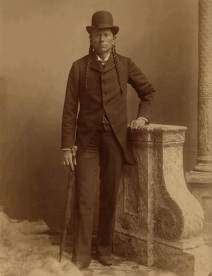
Quanah Parker, photo by Lanney

Quanah Parker, a Kwahadi Comanche chief; full-length, standing in front of tent.
Photographed by Lanney. Public Domain photo.
National Archives, “Pictures of Indians in the United States”

Photographs of Native Americans reside among the publicly and internet available materials of the National Archives. Images can be ordered in sets of slides, or as individual prints, though many are available in quality high enough for PowerPoint works and use on classroom materials. Many of the photos are 19th century.

Quanah Parker stands as one of the larger Native Americans in Texas history. This photo puts a face to a reputation in Texas history textbooks. Texas teachers may want to be certain to get a copy of the photo. His life story includes so many episodes that seem to come out of a Native American version of Idylls of the King that a fiction writer could not include them all, were they not real.

  • Quanah’s mother was part of the famous Parker family that helped settle West Texas in the 1830s. Cynthia Ann Parker was captured in 1836 when Comanches attacked Fort Parker, near present-day Groesbeck, Texas, in Limestone County. (See Fort Parker State Park.) Given a new name, Nadua (found one), she assimilated completely with the Nocona band of Comanches, and eventually married the Comanche warrior Noconie (also known as Peta Nocona). Quanah was their first child, born in 1852.
  • Nadua was captured by a Texas party led by Lawrence Sullivan “Sul” Ross in 1860, in the Battle of Pease River. Noconie, Quanah, and most of the Nocona men were off hunting at the time, and the fact of Nadua’s capture was not realized for some time. Nadua asked to return to the Comanches and her husband, but she was not allowed to do so. When her youngest daughter, who had been captured with her, died of an infection, Nadua stopped eating, and died a few weeks later.
  • Sul Ross was a character in his own right. At the time he participated in the raid that recaptured Cynthia Parker, he was a student at Baylor University (“What do I do on summer breaks? I fight Indians.”) At the outbreak of the Civil War, Ross enlisted in the Confederate Army as a private. Over 135 battles and skirmishes he rose to the rank of Brigadier General, the ninth youngest in the Confederate Army. A successful rancher and businessman back in Texas after the war, he won election as governor in 1887, served two very successful terms (he resolved the Jaybird-Woodpecker War in Fort Bend County, and had to call a special session of the legislature to deal with a budget surplus), refused to run for a third term, and was named president of Texas Agricultural and Mechanical College (Texas A&M) within a few days of stepping down as governor. Ross’s leadership of the college is legendary — students put pennies near a statue of Ross in a traditional plea to pass final exams, among many other traditions. After his death, Texas created Sul Ross State University, in Alpine, Texas, in his honor.
  • Quanah Parker’s father, Noconie, died a short time after his mother’s capture. He left the Nocona band, joined the Destanyuka band under Chief Wild Horse, but eventually founded his own band with warriors from other groups, the Quahadi (“antelope eaters”) (also known as Kwahadi). The Quahadi band grew to be one of the largest and most notorious, always with Quanah leading them. The Quahadis refused to sign the 1867 Medicine Lodge Treaties, and so avoided immediate internment to a reservation. However, dwindling food supplies and increasing opposition forced Quanah to retire to a reservation in 1875, in what is now southwestern Oklahoma. This was the last Comanche band to come to the reservation.
  • Quanah was appointed Chief of all the Comanches.
  • Through investments, Quanah became rich — probably the richest Native American of his time.
  • Quanah hunted with President Theodore Roosevelt.

    Quanah Parker in later life, as a successful businessman. Wikipedia image, public domain

    Quanah Parker in later life, as a successful businessman. Wikipedia image, public domain

  • Rejecting monogamy and Christianity, Quanah founded the Native American Church movement, which regards the use of peyote as a sacrament. Quanah had been given peyote by a Ute medicine man while recovering from wounds he’d suffered in battle with U.S. troops. Among his famous teachings: The White Man goes into his church and talks about Jesus. The Indian goes into his Tipi and talks with Jesus.
  • Photo at right: Quanah Parker in his later life, in his business attire. Photo thought to be in public domain.
  • Bill Neeley wrote of Quanah Parker: “Not only did Quanah pass within the span of a single lifetime from a Stone Age warrior to a statesman in the age of the Industrial Revolution, but he never lost a battle to the white man and he also accepted the challenge and responsibility of leading the whole Comanche tribe on the difficult road toward their new existence.”
  • Quanah Parker died on February 23, 1911. He is buried at Fort Sill Cemetery, Oklahoma, next to his mother and sister.

Quanah Parker’s epitaph reads:

Resting Here Until Day Breaks
And Shadows Fall and Darkness Disappears is
Quanah Parker Last Chief of the Comanches
Born 1852
Died Feb. 23, 1911

Other Resources:

Spread Quanah’s story:

Add to FacebookAdd to NewsvineAdd to DiggAdd to Del.icio.usAdd to StumbleuponAdd to RedditAdd to BlinklistAdd to TwitterAdd to TechnoratiAdd to Furl


Jill Bolte Taylor in the NY Times

June 2, 2008

Jill Bolte Taylor’s inspiring story of stroke and recovery in a brain function specialist got a nice treatment in the New York Times a week ago:  “A superhighway to bliss.


Armed Forces Day, May 17 – Fly your flag

May 12, 2008

Flag etiquette reminder: Armed Forces Day is the third Saturday in May, this year on May 17. This is one of the days Congress suggests we should fly our flags. There may be events near your home.

Armed Forces Day 2008 poster

Resources: