This week, EPA bashing took front and center on the performance stage that passes as Congress these days. There is a school of thought that thinks EPA should be eviscerated because EPA is carrying out the mandate an earlier Congress gave it, to clean up the air. Especially, the recent assailants claim, EPA should not try to reduce carbon emissions, because clean air might cost something.
Steven Milloy, who makes crude and false claims against William Ruckelshaus, a great lawyer and the hero of the Saturday Night Massacre. Why does Milloy carry such a pathetic grudge?
Wholly apart from the merits, or great lack of merits to those arguments, the anti-EPA crowd is just ugly.
78-year-old William Ruckelshaus, the Hero of the Saturday Night Massacre, a distinguished lawyer and businessman, and the founding Director of EPA who was called back to clean it up after the Reagan administration scandals, granted an interview on EPA bashing to Remapping Debate, an ambitious, independent blog from the Columbia School of Journalism designed to provide information essential to policy debates that too-often gets overlooked or buried. [Remapping Debate sent a note that they are not affiliated with CSJ; my apologies for the error.]
Ruckelshaus, as always, gave gentlemanly answers to questions about playing politics with science, and bashing good, honest and diligent government workers as a method of political discourse.
He’s the 20th century’s only mass murderer to survive and thrive (as a venture capitalist) in the 21st century.
Milloy owes Ruckelshaus an apology and a complete retraction. I rather hope Ruckelshaus sues — while Milloy will claim the standards under New York Times vs. Sullivan as a defense, because Ruckelshaus is a public figure, I think the only question a jury would have to deal with is how much malice aforethought Milloy exhibits. Malice is obvious. Heck, there might not even be a question for a jury — Milloy loses on the law (nothing he claims against Ruckelshaus is accurate or true in any way).
This is much more damning than what got two NPR officials to lose their jobs.
Who will stand up for justice here? Rep. Upton? Rep. Boehner? Anthony Watts?
I tried to offer a correction, and since then have written Milloy demanding an apology and retraction — neither comment has surfaced yet on Milloy’s blog. Here’s the truth Milloy hasn’t printed:
No, Sweeney did not rule that DDT is not a threat to the environment. He said quite the opposite. Sweeney wrote, in his ruling:
20. DDT can have a deleterious effect on freshwater fish and estuarine organisms when directly applied to the water.
21. DDT is used as a rodenticide. [DDT was used to kill bats in homes and office buildings; this was so effective that, coupled with accidental dosing of bats from their eating insects carrying DDT, it actually threatened to wipe out some species of bat in the southwest U.S.]
22. DDT can have an adverse effect on beneficial animals.
23. DDT is concentrated in organisms and can be transferred through food chains.
On that basis, two federal courts ruled that DDT must be taken off the market completely. Sweeney agreed with the findings of the courts precisely, but he determined that the law did not give him the power to order DDT off the market since the newly-proposed labels of the DDT manufacturers restricted use to emergency health-related tasks. With the benefit of rereading the two federal courts’ decisions, Ruckelshaus noted that the courts said the power was already in the old law, and definitely in the new law. [See, for example, EDF v. Ruckelshaus, 439 F. 2d 584 (1971)]
DDT was banned from use on crops in the U.S. as an ecosystem killer. It still is an ecosystem killer, and it still deserves to be banned.
Ruckelshaus’s order never traveled outside the U.S. DDT has never been banned in most nations of the world, and even though DDT has earned a place on the list of Dirty Dozen most dangerous pollutants, even under the Persistent Organic Pollutants Treaty of 2001, DDT is available for use to any country who wishes to use it.
Please get your facts straight.
Would you, Dear Reader, help spread the word on Facebook, Reddit, Twitter, or any other service you have, that the Brown Lobby has gone too far in it’s error-based propaganda against clean air and those who urge a better environment? Please?
Spread the word; friends don't allow friends to repeat history.
Tuesday morning, March 8, the Republican-controlled House of Representatives Committee on Energy and Commerce opened hearings on global warming, staging an assault on science with a series of witnesses, some of whom recently have made a career out of mau-mauing scientists.
Dr. Donald Roberts’ testimony to the House Committee on Energy and Power, on March 8, 2011, presented a grand collection of Bogus History, coupled with Bogus Science. Roberts has an unfortunate history of presenting doctored data and false claims to Congress.
One witness took after the EPA directly and Rachel Carson by implication, with a specious claim that DDT is harmless. Donald Roberts is a former member of the uniformed public health service. Since retiring, and perhaps for a while before, he started running with a bad crowd. Of late he’s been working with the Merry Hoaxsters of the unrooted Astroturf organization Africa Fighting Malaria (AFM), a group dedicated to publishing editorials tearing down the reputation of Rachel Carson, the World Health Organization (WHO) and the Environmental Protection Agency (EPA).
(That would all be purple prose, were it not accurate in its description of people, organizations and their actions.)
Why was Roberts testifying at a hearing on global warming? He’s carrying water for the anti-science, “please-do-nothing” corporate crowd. It’s a tactic from the old tobacco lobbyist book: Roberts claims that scientists got everything wrong about DDT, and that the ban on DDT done in error has wreaked havoc in the third world. Therefore, he says, we should never trust scientists. If scientists say “duck!” don’t bother, in other words.
Roberts is in error. Scientists, especially Rachel Carson, were dead right about DDT. Because corporate interests refused to listen to them, the overuse and abuse of DDT rendered it ineffective in the fight against malaria, and DDT use as part of a very ambitious campaign to eradicate malaria had to be abandoned in 1965. The entire campaign had to be abandoned as a result, and more than 30 million kids have died since.
So don’t grant credence to Roberts now. He’s covering up one of the greatest industrial screw-ups in history, a screw up that, by Roberts’ own count, has killed 30 million kids. What in the world would motivate Roberts to get the story so wrong, to the detriment of so many kids?
Roberts said:
Putting issues of EPA budget aside, I want to introduce my technical comments with a quote from a recent Associated Press article with a lead statement “none of EPA’s actions is as controversial as its rules on global warming.” In my opinion, this is wrong.
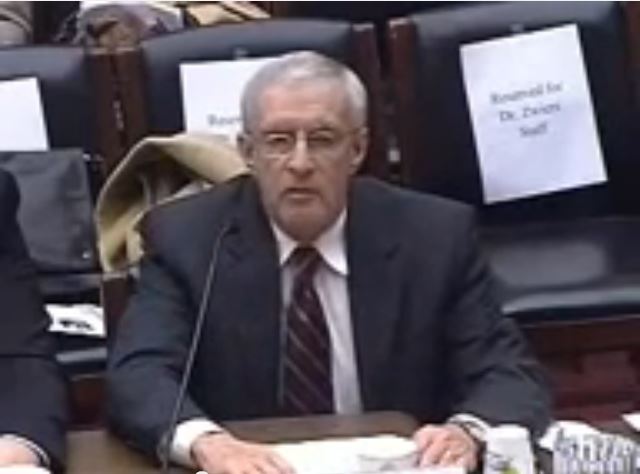
Dr. Donald Roberts testifying to the House Energy Committee, March 8, 2011. Screen capture from Committee video.
Roberts is correct here in his opinion. It is simply wrong that EPA’s rules on global warming and controls of the pollutants that cause it should be controversial. Among air pollution scientists the rules are not controversial. Among climate scientists the rules are not controversial. Roberts and his colleagues at the so-called Competitive Enterprise Institute, Africa Fighting Malaria (AFM), and American Enterprise Institute (AEI) work hard to manufacture controversy where the science does not support their case.
It is wrong. Roberts should be ashamed.
Roberts said:
Almost forty years ago EPA banned DDT in the United States. Its action against DDT was extraordinarily controversial, and still is. As activists advanced fearful claims against DDT, the EPA was warned, over and over again, a ban would destroy critically important disease control programs and millions upon millions of poor people in developing countries would die as consequence. Leaders of the World Health and Pan American Health Organizations, and even the U.S. Surgeon General warned against the ban. The EPA banned DDT anyway, and the doomsday predictions of those public health leaders proved prescient.
EPA’s ban on DDT in the U.S. was limited to the United States. Roberts doesn’t say it flat out, but he implies that the U.S. ban on spraying DDT on cotton fields in Texas and Arkansas — and cotton was about the only crop where DDT was still used — somehow caused a ban on DDT in Africa, or Asia, or South America, or other places where malaria still occurs.
I’m also not sure that health officials “pleaded” to stop the U.S. ban on any grounds, but certainly they did not plead with Ruckelshaus to keep spraying DDT on cotton. Roberts is making stuff up in effect, if not in intent.
Probably more to the point, health officials had stopped significant use of DDT in Africa in 1965, seven years before EPA acted in the U.S., because overuse of DDT on crops in Africa had bred mosquitoes that were resistant and immune to the stuff. Since 1955, in close cooperation with the malaria-fighting experts from the Rockefeller Foundation including the great Fred Soper, WHO carried on a methodical, militant campaign to wipe out malaria. The program required that public health care be beefed up to provide accurate malaria diagnoses, and complete treatment of human victims of the parasitic disease. Then an army of house sprayers would move in, dosing the walls of houses and huts with insecticide. Most malaria-carrying mosquitoes at the time would land on the walls of a home or hut after biting a human and getting a blood meal, pausing to squeeze out heavy, excess water to make flight easier. If the wall were coated with an insecticide, the mosquito would die before being able to bite many more people, maybe before becoming capable of spreading malaria.
DDT was Soper’s insecticide of choice because it was long-lasting — six months or more — and astonishingly deadly to all small creatures it contacted.
But, as Malcolm Gladwell related in his 2001 paean to Soper in The New Yorker, Soper and his colleagues well understood they were racing against the day that mosquitoes became resistant enough to DDT that their program would not work. They had hoped the day would not arrive until the late 1970s or so — but DDT is such an effective killer that it greatly speeds evolutionary processes. In the mid-1960s, before an anti-malaria campaign could even be mounted in most of Subsaharan Africa, resistant and immune mosquitoes began to stultify the campaign. By 1965, Soper’s crews worked hard to find a substitute, but had to switch from DDT. By 1972 when the U.S. banned DDT use on cotton in the U.S., it was too late to stop the resistance genes from killing WHO’s anti-malaria program. In 1969 WHO formally abandoned the goal of malaria eradication. The fight against malaria switched to control.
Roberts claims, implicitly, that people like those who worked with Soper told EPA in 1971 that DDT was absolutely essential to their malaria-fighting efforts. That could not be accurate. In 1969 the committee that oversaw the work of the UN voted formally to end the malaria eradication project. In effect, then, Roberts claims UN and other health officials lied to EPA in 1971. It is notable that Soper is credited with eradicating malaria from Brazil by 1942, completely without DDT, since DDT was not then available. Soper’s methods depended on discipline in medical care and pest control, and careful thought as to how to beat the disease — DDT was a help, but not necessary.
Interestingly, the only citation Roberts offers is to his own, nearly-self-published book, in which he indicts almost all serious malaria fighters as liars about DDT.
Can Roberts’ testimony be trusted on this point? I don’t think we should trust him.
In fact, DDT and the eradication campaign had many good effects. In 1959 and 1960, when DDT use was at its peak in the world, malaria deaths numbered about 4 million annually. The eradication campaign ultimately was ended, but it and other malaria-fighting efforts, and general improvements in housing and sanitation, helped cut the annual death toll to 2 million a year by 1972.
After the U.S. stopped spraying DDT on cotton, mosquitoes did not migrate from Texas and Arkansas to Africa. As noted earlier, the EPA order stopping agricultural use, left manufacturing untouched, to increase U.S. exports. So the ban on DDT in the U.S. increased the amount of DDT available to fight malaria.
Malaria fighting, under Soper’s standards, required great discipline among the malaria fighters — the sort of discipline that governments in Subsaharan Africa could not provide. Had WHO not slowed its use of DDT because of mosquito resistance to the stuff, WHO still would not have been able to mount eradication campaigns in nations where 80% of residences could not be sprayed regularly.
Advances in medical care, and better understanding of malaria and the vectors that spread it, helped continue the downward trend of malaria deaths. There was a modest uptick in the 1980s when the parasites themselves developed resistance to the drugs commonly used to treat the disease. With the advent of pharmaceuticals based on Chinese wormwood, or artemisinin-based drugs, therapy for humans has become more effective. Today, the annual death toll to malaria has been cut to under a million, to about 900,000 per year — a 75% drop from DDT’s peak use, a 50% drop from the U.S. ban on farm use of DDT.
With the assistance of WHO, most nations who still suffer from malaria have adopted a strategy known as Integrated Vector Management, or IVM (known as integrated pest management or IPM in the U.S.). Pesticides are used sparingly, and insect pests are monitored regularly and carefully to be sure they are not developing genetic-based resistance or immunity to the pesticides. This is the method that Rachel Carson urged in 1962, in her book, Silent Spring. Unfortunately, much of the malaria-suffering world didn’t come to these methods until after the turn of the century.
Progress against malaria has been good since 2001, using Rachel Carson’s methods.
Don Roberts’ blaming of science, EPA, WHO, and all other malaria fighters is not only misplaced, wrong in its history and wrong in its science, but it is also just nasty. Is there any way Roberts could not know and understand the facts?
These are the facts Roberts works to hide from Congress:
“Science” and scientists were right about DDT. DDT is a dangerous substance, uncontrollable in the wild according to federal court findings and 40 years of subsequent research. If we were to judge the accuracy of scientists about DDT, we would have to conclude that they were deadly accurate in their judgment that use of DDT should be stopped.
If the ban on DDT was controversial in 1972, it should not be now. All research indicates that the judgment of EPA and its director, William Ruckelshaus, was right.
EPA was not warned that a ban on agricultural use of DDT would harm public health programs, in the U.S., nor anywhere else in the world. In any case, EPA’s jurisdiction ends at U.S. borders — why would WHO say anything at all?
DDT use to fight malaria had been curtailed in 1965, years before the U.S. ban on farm use, because overuse of DDT on crops had bred DDT-resistant and DDT-immune mosquitoes. Consequently, there was not a huge nor vociferous lobby who warned that health would be put at risk if DDT were banned. Claims that these warnings were made are either false or grossly misleading.
Malaria death rates declined to less than 50% of what they were when DDT was banned from farm use in the U.S. — there was no “doomsday” because the U.S. stopped spraying DDT on cotton, and there never has been a serious shortage of DDT for use against malaria, anywhere in the world.
How much of the rest of the testimony against doing something about global warming, was complete hoax?
[Editor’s note: My apologies. I put this together on three different machines while conducting other activities. On proofing, I find several paragraphs simply disappeared, and edits to make up for the time of composing and fix tenses, got lost. It should be mostly okay, now, and I’ll add in the links that disappeared shortly . . . oh, the sorry work of the part-time blogger.]
Update, 2015: Video of the hearing, from YouTube:
Spread the word; friends don't allow friends to repeat history.
This letter, written on the day established for the first meeting of the Congress, sets the scene as the members began to gather in New York City. Morris’s concern that the “public expectation seems to be so highly wound up that I think disappointment must inevitably follow after a while, nothwithstanding that I believe there will be inclination and abilities in the two houses to do every thing that reasonable and sensible men can promise to themselves, but you know well how impossible it is for public measures to keep pace with the sanguine desires of the interested, the ignorant, and the inconsiderate parts of the Community.” eloquently expressed the challenge that faced the members of the new Congress.
Odd stuff:
New York City was bustling with 29,000 residents in 1789
Spread the word; friends don't allow friends to repeat history.
George Washington signed the law authorizing the first U.S. census on March 1, 1790. [True]
[Satire, below?]
I presume, then, that the post-Boston, Tea Party dates from the protests of the census beginning on March 2, 1790. “Nothing but what the founders intended in the Constitution,” was the muddled battle cry of the early Tea Partiers.
Editorials pointed out that Washington himself had presided at the Constitutional Convention, but Tea Partiers would have none of it. “If the King James Version was good enough for Jesus, it’s good enough for the ‘new King George,’ they yelled in New York City, outside Washington’s home. “Patrick Henry didn’t throw tea in Baltimore Harbor so some tyrant could ask us how many are in our family!”
Washington denied that the capital’s move to Philadelphia later that year had anything to do with the protests.
Spread the word; friends don't allow friends to repeat history.
In a meeting hall at Washington-on-the-Brazos, Texans meet to write the Texas Declaration of Independence, released March 2, 1836; image from Portal to Texas History
So, put some barbecue in the smoker, get a Shiner for you and your pet armadillo, sit back and enjoy the holiday. If you’re near Washington-on-the-Brazos, go to the ceremony. You’d better be sure you’ve got plenty of Blue Bell Ice Cream.
What? You don’t get the day off? You know, Texas schools don’t even take the day off any more.
I thought things were going to change when the Tea Party got to Austin and Washington? What happened?
Original Manuscript, Texas Declaration of Independence - Texas State Library and Archives Commission
Text from the image above:
The Unanimous
Declaration of Independence
made by the
Delegates of the People of Texas
in General Convention
at the Town of Washington
on the 2nd day of March 1836
When a government has ceased
to protect the lives, liberty and property
of the people, from whom its legitimate
powers are derived, and for the advance-
ment of whose happiness it was inst-
ituted, and so far from being a guaran-
tee for the enjoyment of those inesti-
mable and inalienable rights, becomes
an instrument in the hands of evil
rulers for their oppression.
New program from Yosemite National Park’s “Nature Notes.”
This one has something to appeal to the heart of almost everybody: Photos from Ansel Adams, photos from Galen Rowell, interviews with sons of each, discussion of the (properly) much-maligned old “firefall” of hot fire coals for tourists — and the story of the natural firefall one might see, if the conditions are right, and if one is in Yosemite in the right place, on the right days of February.
This video was produced by Steven M. Bumgardner, with extra camera help from Josh Helling. Those guys do great work. It features photographer Michael Frye, Michael Adams, Ansel Adams’ son, and Tony Rowell, the son of Galen Rowell.
Spread the word; friends don't allow friends to repeat history.
Propagandists against Rachel Carson and — inexplicably — for DDT awoke a few weeks ago. We’re seeing a flurry of op-eds, opinion pieces and other editorial placements making false claims for DDT, and against Rachel Carson, one of the science heroes of the 20th century.
The campaign of hoaxes, urging more and heavier use of DDT, and falsely impugning environmentalists, continues. Alas.
Jay Ambrose of Scripps Howard News Service, still wrong about DDT
Jay Ambrose used to be a full-time editor for the Scripps Howard newspapers. Since he retired he writes occasional opinion pieces. In the past three years or so he’s mentioned his desire to bring back the poison DDT, to poison Africa in the hope it might also get malaria, for example.
A few weeks ago he went after global warming with the same alacrity and lack of accurate information.
Let’s review a few facts about the history of DDT:
The World Health Organization (WHO) carried on a super-ambitious campaign to eradicate malaria from the world starting in 1955. It was a race against time — super malaria-fighter Fred Soper, who spearheaded early campaigns for the Rockefeller Foundation , understood that overuse of DDT in agriculture or any other venue could push malaria-carrying mosquitoes to develop resistance to DDT. WHO’s campaign involved Indoor Residual Spraying of DDT, coating the walls of homes with the stuff; then with biting mosquitoes reduced, a careful campaign of medical care would cure human victims of the disease. When the mosquitoes came roaring back at the end of the campaign, there would be no infected humans from whom the insects could get the parasite that causes the disease — voila! — no more malaria. WHO lost the race; by 1965 Soper’s group already found resistant and immune mosquitoes in central Africa, and most of the nations in the Subsaharan Africa had not been able to mount an anti-malaria campaign. DDT use in Africa was scaled back, therefore, and by 1969, WHO’s international board voted to abandon the campaign, made impossible to complete by abuse of DDT.
Even though DDT was cheap and plentiful, however, many African nations found it simply did not work anymore. Work continued to fight DDT through all other means including especially treating the disease in humans, and malaria incidence and deaths continued to decline.
At the end of the 1970s, the malaria parasites began to develop resistance to chloroquine and other traditional drugs used to cure humans of the stuff. It was a shortage of drugs to treat humans that caused the uptick in malaria over a decade ago, not a lack of DDT. Progress against malaria slowed for a few years, until artemisinin-based drugs were discovered to work against the disease, and means could be found to speed up production of the drug (originally from a Chinese plant, a member of the wormwood family).
By the turn of the century, it became clear that a miracle, one-punch solution to beat malaria is unlikely to be found. Many nations turned to a method of malaria control including “integrated vector management,” which includes the use of pesticides (including DDT) in careful rotation to prevent mosquitoes from developing resistance or immunity to any one poison. This is the method championed by Rachel Carson in her 1962 book, Silent Spring.
At the time of the U.S. ban on DDT use on crops, annual malaria deaths ran about 2 million. By 2000, that rate had been cut in half, to about 1 million annually. Today, and since 2005, the annual death toll to malaria has been estimated by WHO to be under 900,000 — less than half the death rate in 1972 when the U.S. banned DDT use on crops, and a 75% reduction in deaths in 1960, when DDT use was at its peak. Malaria deaths today are the lowest in human history.
DDT Malaria continues to be a priority disease, with added emphasis in the past decade with massive interventions funded by the Bill and Melinda Gates Foundation, and the President’s Initiative on Malaria. Bill Gates is regarded as a great optimist, but he says he is working to eradicate malaria from the world. Key tools of the eradication campaign are bednets, which are cheaper and more effective than DDT, and integrated vector management. The Gates Foundation campaign strikes continuing blows of great magnitude against the disease in those nations where it can work.
Few of these facts are acknowledged by Jay Ambrose, who wrongly claims that DDT had alone been the great vanquisher of malaria, and who claims that Africans, unduly swayed by a long-dead Rachel Carson, had failed to use DDT though they knew in their hearts it would save their children.
The main thing is to avoid what happened with DDT. Because of a ban to protect wildlife from the pesticide in this country, it became more scarce, and a consequence was its being employed sparingly if at all in wildlife-safe, indoor spraying to combat malaria in Africa. Though not always, DDT can be enormously effective in stopping the disease while posing minimal threats.
The estimate is that millions of African children died because of misplaced values and overreactions.
Then why does he continue to falsely indict Rachel Carson, William Ruckelshaus and EPA, and “environmentalists,” and wrongly urge the poisoning of Africa with DDT?
I do not know.
Are his views on global warming similarly in error? If history shows a trend, yes.
Spread the word; friends don't allow friends to repeat history.
The veteran reader of this blog — can there be more than one? — may recall the kerfuffle a couple of years ago when there was a “swarm” of earthquakes in the Yellowstone. Alas for those prone to panic attacks, the swarm ran through the Hanukkah/Ramadan/Christmas/KWANZAA/New Year’s holidays, when other news is slack.
What the Yellowstone Caldera might look like from space, by moonlight, on a clear night, if you can imagine the borders of Yellowstone National Park very vividly – Smith and Siegel, 2000
You might understand, then, why I say Greg Laden turns his considerable story-telling prowess to the issue late. Still, his prowess towers over the rest of us, and he tells a great story.
1) Wear a seat belt when driving around in the region;
2) Don’t feed the bears and make sure you understand bear safety; and
3) Somebody is going to get blasted by some kind of volcano in the area some day, but even if you live there the chances are it won’t be you.
The joy is in the journey — go read Laden’s explanation of the rising lava. Heck, even those of us who think we know that stuff understand it better when he explains it.
He said it: Spanish-American philosopher and writer George Santayana, early in his career (Photo: Wikipedia)
Ridley Scott‘s outstanding 2001 movie, “Blackhawk Down,” opened with the quote, but attributing it to Plato, according to Plato expert Bernard Suzanne in Paris. One philosopher is as good as another, you might say, so it’s understandable that a good line from a modern philosopher like Santayana might be attributed to one of the most famous philosophers of all time (“they all look alike,” I hear someone saying). Or, the cynics might say, perhaps Santayana lifted it from Plato — after all, who but another philosopher would actually read the stuff? Who would know?
Suzanne’s sleuthing is impressive if only because it shows the murkiness of the issue. According to Suzanne:
The quote is popular among American soldiers (ask one — report back in comments).
Michael Takiff found it attributed to Plato by a U.S. soldier in Vietnam, writing home, in a book published in 2003.
No one has found it in any of Plato’s dialogues — at least, no one Suzanne can find.
The Imperial War Museum, in London, has the quote engraved on its walls, attributed to Plato. The museum opened in 1936. Santayana’s version was published in 1922.
Reminder: Santayana said it here: Soliloquies in England and Later Soliloquies, number 25 (1922)
Who put it on the wall of the Imperial War Museum, and why did they misattribute it, just a dozen years after Santayana wrote it?
Helen Keller at her typewriter, circa 1946 – Perkins School for the Blind
Helen Keller at her typewriter, circa 1946. Perkins School for the Blind caption: In 1902, Helen Keller became the first person who was deafblind to write a book. Her autobiography, The Story of My Life, was the first of 14 books she wrote in her lifetime.
His Excellency General Washington by Phillis Wheatley
George Washington, as he appears on the one dollar bill.
Celestial choir! enthron’d in realms of light,
Columbia’s scenes of glorious toils I write.
While freedom’s cause her anxious breast alarms,
She flashes dreadful in refulgent arms.
See mother earth her offspring’s fate bemoan,
And nations gaze at scenes before unknown!
See the bright beams of heaven’s revolving light
Involved in sorrows and the veil of night!
The Goddess comes, she moves divinely fair,
Olive and laurel binds Her golden hair:
Wherever shines this native of the skies,
Unnumber’d charms and recent graces rise.
Muse! Bow propitious while my pen relates
How pour her armies through a thousand gates,
As when Eolus heaven’s fair face deforms,
Enwrapp’d in tempest and a night of storms;
Astonish’d ocean feels the wild uproar,
The refluent surges beat the sounding shore;
Or think as leaves in Autumn’s golden reign,
Such, and so many, moves the warrior’s train.
In bright array they seek the work of war,
Where high unfurl’d the ensign waves in air.
Shall I to Washington their praise recite?
Enough thou know’st them in the fields of fight.
Thee, first in peace and honors—we demand
The grace and glory of thy martial band.
Fam’d for thy valour, for thy virtues more,
Hear every tongue thy guardian aid implore!
One century scarce perform’d its destined round,
When Gallic powers Columbia’s fury found;
And so may you, whoever dares disgrace
The land of freedom’s heaven-defended race!
Fix’d are the eyes of nations on the scales,
For in their hopes Columbia’s arm prevails.
Anon Britannia droops the pensive head,
While round increase the rising hills of dead.
Ah! Cruel blindness to Columbia’s state!
Lament thy thirst of boundless power too late.
Proceed, great chief, with virtue on thy side,
Thy ev’ry action let the Goddess guide.
A crown, a mansion, and a throne that shine,
With gold unfading, WASHINGTON! Be thine.
American Poet Phillis Wheatley, detail from the Boston Women’s Memorial on Commonwealth Ave.
Who was the inspiring woman, Phillis Wheatley? Read her biography at the Academy of American Poets site.
Phillis Wheatley was the first black poet in America to publish a book. She was born around 1753 in West Africa and brought to New England in 1761, where John Wheatley of Boston purchased her as a gift for his wife. Although they brought her into the household as a slave, the Wheatleys took a great interest in Phillis’s education. Many biographers have pointed to her precocity; Wheatley learned to read and write English by the age of nine, and she became familiar with Latin, Greek, the Bible, and selected classics at an early age. She began writing poetry at thirteen, modeling her work on the English poets of the time, particularly John Milton, Thomas Gray, and Alexander Pope. Her poem “On the Death of the Rev. Mr. George Whitefield” was published as a broadside in cities such as Boston, New York, and Philadelphia and garnered Wheatley national acclaim. This poem was also printed in London. Over the next few years, she would print a number of broadsides elegizing prominent English and colonial leaders.
More, at the AAP site.
Spread the word; friends don't allow friends to repeat history.
The ruling families of Libya and Wisconsin pledge to fight to hold on to power, splitting their nations if necessary rather than concede to democratic forces.
White House with U.S. flag at night; photo by Keith Stanley, kestan.com
Residents of the United States celebrate Presidents Day today, a holiday that grew out of celebrations of the birthdays of both George Washington (February 22, 1732) and Abraham Lincoln (February 12, 1809), both of whom were born in February (under the “new” Gregorian calendar).
Gypsy Rose Lee at her typewriter, New York World-Telegram and the Sun staff photographer: Palumbo, Fred, photographer. Photo via Wikimedia from Library of Congress
Or, until that account is unsuspended by the forces supporting Donald Trump: Follow @FillmoreWhite, the account of the Millard Fillmore White House Library
We've been soaking in the Bathtub for several months, long enough that some of the links we've used have gone to the Great Internet in the Sky.
If you find a dead link, please leave a comment to that post, and tell us what link has expired.
Thanks!
Retired teacher of law, economics, history, AP government, psychology and science. Former speechwriter, press guy and legislative aide in U.S. Senate. Former Department of Education. Former airline real estate, telecom towers, Big 6 (that old!) consultant. Lab and field research in air pollution control.
My blog, Millard Fillmore's Bathtub, is a continuing experiment to test how to use blogs to improve and speed up learning processes for students, perhaps by making some of the courses actually interesting. It is a blog for teachers, to see if we can use blogs. It is for people interested in social studies and social studies education, to see if we can learn to get it right. It's a blog for science fans, to promote good science and good science policy. It's a blog for people interested in good government and how to achieve it.
BS in Mass Communication, University of Utah
Graduate study in Rhetoric and Speech Communication, University of Arizona
JD from the National Law Center, George Washington University


 Posted by Ed Darrell








 Millard Fillmore's Bathtub

