Tonight in Iowa City! DDT and myth lecture

January 19, 2010

A reminder that Prof. O’Shaughnessy’s lecture on DDT and myths rolls tonight in Iowa City.  We hope to have a report, later.

As we posted earlier:

Do we have any readers in Iowa City?  Near Iowa City?

A presentation on the history of malaria and DDT, and the recent use and abuse of those stories to flog environmentalists and others on the internet, is set for the Hardin Library for Health Sciences at the University of Iowa in Iowa City, on January 19, 2010 (next Tuesday).

If you’re there, can you snap a couple of pictures to send, and get any handouts, and write up a piece about it?

Here is the press notice on-line:

Presentation on the History of Malaria and DDT

The University of Iowa History of Medicine Society invites you to hear Patrick T. O’Shaughnessy, PhD, Associate Professor, Department of Occupational and Environmental Health, University of Iowa, speak on “Malaria and DDT: the History of a Controversial Association” on Tuesday, January 19th, 5:30 to 6:30, room 2032 Main Library. [in Iowa City, Iowa.]

Dr. O’Shaughnessy observes:  ”Although it helped prevent millions of cases of malaria after its widespread use in the 1950’s, the pesticide DDT was banned from use in the United States and fell out of favor as an agent to reduce cases of malaria around the world. This history of the events associated with the effort to eradicate malaria, as well as the environmental movement that led to the ban on DDT, will center on the story of a story that incorporated both issues and grew into a modern myth still seen in books and multiple websites today.”

The session is free and open to the public.  Light refreshments will be served.

Hardin Library for the Health Sciences stands on the campus in Iowa City.

Hardin Library for the Health Sciences
600 Newton Road
Iowa City, IA 52242-1098

319-335-9871

The Hardin Library for the Health Sciences is located on Newton Road, directly north of the University of Iowa Hospitals and Clinics and approximately 1/2 mile east of Carver-Hawkeye Arena.  Go here for directions and more information.

Maybe I’m not the only bothered by the usual abuse of history and science on the issues of DDT and malaria.

Note: Tim Lambert notes at Deltoid that O’Shaughnessy is the guy who wrote what may be the definitive work on the famous — or infamous — Borneo Cat Drop. If you live in or near Iowa City, this lecture may be a wise investment of time.  High school teachers, your students could benefit, too.


Monckton’s profiteering: Climate denialists rake in the money

January 19, 2010

Bizarre as it may seem, the imagined profiteering of environmentalists has becoma favorite complaint of global warming deniers.  Ignoring the fact that he’s on the board of Apple Computers and a very savvy investor, and ignoring the facts of his donation of proceeds he gets from lectures, deniers claim Al Gore has gotten rich off of warning people about global warming.

They even complain when researchers get grants to study the stuff, as if the researchers were buying Maseratis and taking vacations to the Caribbean on the money.

How could they think that?

Might it be because the deniers really are pulling in high dollar, luxury fees to campaign against the science?  Christopher Monckton, warming denialist extraordinaire, is touring Australia.  Comes this little slip of public relations:

During this tour, Lord Monckton will be chaperoned by wealthy mining consultant and geologist Professor Ian Plimer. Lord Monckton will also be getting a fee of $20,000 and all his travel and accommodation – somewhere in the region of $100,000 – will be paid for.

Who might be paying for Monckton’s tour?* China?  India?  We don’t know, but following Monckton’s lead, we might hope that the western intelligence agencies are investigating Monckton to see just what he’s up to.

$120,000 to make up political smears that damage national policies and science?  Mencken would be ashamed.

More:

_____________

* It’s a paraphrase of Monckton, who evilly worried about funding for climate research and ill-funded environmental groups, “Goodness knows where they get it from!  Foreign governments, possibly!  I don’t know!  I haven’t looked.  But it’s certainly an alarming question:  Are the environmental movements being backed by China or India so they won’t have to compete with us for natural resources because we will have shut our industry down.  It’s a question that the security services, I hope, are looking at, because it certainly worries me.”

Fly your U.S. flag today, in honor of the Rev. Dr. Martin Luther King, Jr.

January 18, 2010

King Center poster for MLK Day 2010

King Center poster for MLK Day 2010

Fly your flag today.

U.S. law encourages Americans to fly the U.S. flag on holidays and a few other occasions.  Congress set aside the third Monday in January as a holiday to commemorate the life of the Rev. Dr. Martin Luther King, Jr.

To honor Dr. King, for several years civil rights leaders and others have urged us to find some way to serve our communities on this day — Americans have done it long enough to make it a tradition.  Here’s the official find-a-way-to-serve page from the the federal government; look out your window, go spend a few minutes at your city hall, post office, or at the biggest church in town, or walk into any middle school in America, and opportunities to serve will caress you at every turn.

More, much more:

King, by photographer Ben Fernandez's "Countdown to Eternity"

King, by photographer Ben Fernandez's portfolio of photos from one year in the life of Dr. King, "Countdown to Eternity"

MLK logo from Google mlk2010

Google's logo for Martin Luther King, Jr. Day, 2010 - click for more information

Share a dream:

Add to FacebookAdd to NewsvineAdd to DiggAdd to Del.icio.usAdd to StumbleuponAdd to RedditAdd to BlinklistAdd to TwitterAdd to TechnoratiAdd to Furl


Annals of Global Warming: Bering Strait, choke point and butterfly effect

January 17, 2010

From the National Science Foundation, we get more stuff that students in high school ought to learn, stuff which would give the conservatives on the Texas State Board of Education full-fledged conniptions, stuff that just doesn’t fit into Texas’s Teach-To-The-Test™ education standards.

Reading the press release brings home two points to me.  First, for the sake of Texas social studies standards, this story tells the physical effects of “choke points.”  The Bering Strait limited human migration to populate the America’s, meeting the definition of choke point favored by Texas Essential Knowledge and Skills (TEKS), and this story sheds light on that issue.  But it also points out that choke points affect more than just humans.  This was a key finding of the President’s Commission on Americans Outdoors that led to a recommendation that we create green corridors favorable for animal migration.  In the Bering Strait, it’s migration of ice and cold and warm water that get choked off — and that, too, affects human history.  Second, this may enlighten students to the butterfly effect noted in the science we call chaos, where a small physical perturbation in one area can have enormous consequences later, and far away, in the dynamic systems that keep our planet alive.  (Yeah, the Bering Strait is bigger than a butterfly.  I know.)

Press Release 10-003

Global Ice Age Climate Patterns Influenced by Bering Strait

Small geographic feature has large impacts on climate

Ice pouring through the Bering Strait, from the Arctic to Pacific Ocean - NASA photo via NSF

Ice is shown choking the Bering Strait in recent times; the ice moves from the strait south to the Bering Sea. Credit: NASA

January 10, 2010

In a vivid example of how a small geographic feature may have far-reaching impacts on climate, new research shows that water levels in the Bering Strait helped drive global climate patterns during ice age episodes dating back more than 100,000 years.

The international study, led by scientists at the National Center for Atmospheric Research (NCAR) in Boulder, Colo., found that the repeated opening and closing of the narrow strait due to fluctuating sea levels affected currents that transported heat and salinity in the Atlantic and Pacific Oceans.

As a result, summer temperatures in parts of North America and Greenland oscillated between comparatively warm and cold phases, causing ice sheets to alternate between expansion and retreat and affecting sea levels worldwide.

While the findings do not directly bear on current global warming, according to Steve Nelson, National Science Foundation (NSF) program director for NCAR, they highlight the complexity of Earth’s climate system and the fact that seemingly insignificant changes can lead to dramatic tipping points for climate patterns, especially in and around the Arctic.

“The global climate is sensitive to impacts that may seem minor,” says NCAR scientist Aixue Hu, the project’s lead scientist. “Even small processes, if they are in the right location, can amplify changes in climate around the world.”

The research results are published this week in the journal Nature Geoscience.

Funded by NSF and the U.S. Department of Energy, the scientists used the latest generation of supercomputers to study past climate at a level of detail that would have been impossible just a few years ago.

Hu and his colleagues set out to solve a key mystery of the last glacial period: Why, starting about 116,000 years ago, did northern ice sheets repeatedly advance and retreat for about the next 70,000 years? The enormous ice sheets held so much water that sea levels rose and dropped by as much as about 100 feet (30 meters) during these intervals.

In other cases, scientists have associated such major oscillations in climate with fluctuations in Earth’s orbit around the Sun. But in the time period the research team looked at, the orbital pattern did not correspond with the geologic movement of the ice sheets and associated sea level changes.

The researchers considered an alternative possibility: that changes in the Bering Strait, the main gateway in the Northern Hemisphere between the Atlantic and Pacific Oceans, might have affected ocean currents across much of the globe.

Although small–the strait is currently about 50 miles (80 kilometers) wide between Russia and the westernmost islands of Alaska–it allows water to circulate from the relatively fresh north Pacific to the saltier north Atlantic via the Arctic Ocean. This flow is instrumental to regulating the strength of a current known as the meridional overturning circulation, a key driver of heat from the tropics to the poles.

Using the NCAR-based Community Climate System Model, a powerful computer tool for studying worldwide climate, the researchers compared the responses of ice age climate to conditions in the Bering Strait.

They ran the model on new supercomputers at NCAR and the Department of Energy’s Oak Ridge National Laboratory, enabling them to focus on smaller-scale geographic features that, until recently, could not be captured in long-term simulations of global climate.

The simulations accounted for the changes in sea level, revealing a recurring pattern–each time playing out over several thousand years–in which the reopening and closing of the strait had a far-reaching impact on ocean currents and ice sheets.

As the climate cooled because of changes in Earth’s orbit, northern ice sheets expanded. This caused sea levels to drop worldwide, forming a land bridge from Asia to North America and nearly closing the Bering Strait.

With the flow of comparatively fresh water from the Pacific to the Atlantic choked off, the Atlantic grew more saline. The saltier and heavier water led to an intensification of the Atlantic’s meridional overturning circulation, a current of rising and sinking water that, like a conveyor belt, pumps warmer water northward from the tropics.

This circulation warmed Greenland and parts of North America by about 3 degrees Fahrenheit (1.5 degrees Celsius)–enough to reverse the advance of ice sheets in those regions and reduce their height by almost 400 feet (112 meters) every thousand years. Although the Pacific cooled by an equivalent amount, it did not have vast ice sheets that could be affected by the change in climate.

Over thousands of years, the Greenland and North American ice sheets melted enough to raise sea levels and reopen the Bering Strait.

The new inflow of fresher water from the Pacific weakened the meridional overturning circulation, allowing North America and Greenland to cool over time. The ice sheets resumed their advance, sea levels dropped, the Bering Strait again mostly closed, and the entire cycle was repeated.

The combination of the ocean circulation and the size of the ice sheets–which exerted a cooling effect by reflecting sunlight back into space–affected climate throughout the world.

The computer simulations showed that North America and Eurasia warmed significantly during the times when the Bering Strait was open, with the tropical and subtropical Indian and Pacific Oceans, as well as Antarctica, warming slightly.

The pattern was finally broken about 34,000 years ago, the point in Earth’s 95,000-year orbital cycle at which the planet was so far from the Sun at certain times of year that the ice sheets continued to grow even when the Bering Strait closed.

When the orbital cycle brought Earth closer to the Sun in the northern winter, the ice sheets retreated sufficiently about 10,000 years ago to reopen the strait. This helped lead to a relatively stable climate, nurturing the rise of civilization.

“This kind of study is critical for teasing out the nuances of our climate system,” says NCAR scientist Gerald Meehl, a co-author of the paper. “If we can improve our understanding of the forces that affected climate in the past, we can better anticipate how our climate may change in the future.”

In addition to NCAR, the study team included researchers from the National Center for Scientific Research (CNRS) in France, University of Colorado in Boulder, Catholic University of Louvain in Belgium, Australian National University and Harvard University.

-NSF-
Download the high-resolution JPG version of the image [of ice flowing through the Bering Strait, above]. (1.4 MB)

Bering Strait, NASA photo via National Science Foundation

The Bering Strait separates the U.S. and Russia by only 90 kilometers. Credit: NASA

Download the high-resolution JPG version of the image. (570 KB)

Currents move warm and cold water across the Arctic Ocean - UCAR map

Altered currents once produced ocean warming (right, dark red) that melted ice sheets. Credit: UCAR

Download the high-resolution JPG version of the image. (680 KB)

Media Contacts
Cheryl Dybas, NSF (703) 292-7734 cdybas@nsf.gov
David Hosansky, NCAR/UCAR (303) 497-8611 hosansky@ucar.edu

The National Science Foundation (NSF) is an independent federal agency that supports fundamental research and education across all fields of science and engineering. In fiscal year (FY) 2009, its budget is $9.5 billion, which includes $3.0 billion provided through the American Recovery and Reinvestment Act. NSF funds reach all 50 states through grants to over 1,900 universities and institutions. Each year, NSF receives about 44,400 competitive requests for funding, and makes over 11,500 new funding awards. NSF also awards over $400 million in professional and service contracts yearly.

Get News Updates by Email

Useful NSF Web Sites:
NSF Home Page: http://www.nsf.gov
NSF News: http://www.nsf.gov/news/
For the News Media: http://www.nsf.gov/news/newsroom.jsp
Science and Engineering Statistics: http://www.nsf.gov/statistics/
Awards Searches: http://www.nsf.gov/awardsearch/

Bookmark those sites, teachers.

More:


Texas Navy supports honest history in Texas schools

January 15, 2010

John Mashey was too shy to raise the question in a thread, but he e-mailed me asking about the witness list for the hearing before the Texas State Board of Education on social studies standards:  “Texas Navy?” he asked.

Two witnesses listed their affiliation as “Texas Navy.” Edwin Greiner and Dick Brown, both admirals in the Texas Navy, were scheduled to testify early on Wednesday afternoon.

Now, a Nebraska or Utah Navy might not make a lot of sense, since both of those states are landlocked.  Texas needed a navy in the past, and at least twice, ships were commissioned and sailed for Texas, in 1835 and 1837.

In 1958, Texas Governor Price Daniel re-activated the Texas Navy with the purpose of “assuring the survival of Texas’ Naval history, boundaries, water resources, and for the civil defense of Texas.”  In 1973, the Texas Legislature authorized the charter of the Texas Navy Association, Inc., as the official body to oversee the operation of the Texas Navy.

Recruiting poster for Texas Navy

Click here to join the Texas Navy

You can join the Texas Navy.  Both the men listed on the witness list claim rank of Admiral, which is not a position one attains merely by joining — so we might conclude they have done something in the past to merit the promotion.

Consider joining.  Your membership will help preserve the history and tradition of the Texas Navy.  And — who knows? — you may want to testify to the Texas State Board of Education some day.  It looks like they’ll bump you to the first of the list, if you’re a member of the Texas Navy.

(Does anyone know what these Texas Navy officials told the SBOE?  Anyone have a copy of their testimony?  I’ll check with Steve Schafersman at Texas Citizens for Science to see if he knows . . .)


Malaria, DDT and internet myth: Lecture at University of Iowa on January 19

January 14, 2010

Do we have any readers in Iowa City?  Near Iowa City?

A presentation on the history of malaria and DDT, and the recent use and abuse of those stories to flog environmentalists and others on the internet, is set for the Hardin Library for Health Sciences at the University of Iowa in Iowa City, on January 19, 2010 (next Tuesday).

If you’re there, can you snap a couple of pictures to send, and get any handouts, and write up a piece about it?

Here is the press notice on-line:

Presentation on the History of Malaria and DDT

The University of Iowa History of Medicine Society invites you to hear Patrick T. O’Shaughnessy, PhD, Associate Professor, Department of Occupational and Environmental Health, University of Iowa, speak on “Malaria and DDT: the History of a Controversial Association” on Tuesday, January 19th, 5:30 to 6:30, room 2032 Main Library. [in Iowa City, Iowa.]

Dr. O’Shaughnessy observes:  ”Although it helped prevent millions of cases of malaria after its widespread use in the 1950’s, the pesticide DDT was banned from use in the United States and fell out of favor as an agent to reduce cases of malaria around the world. This history of the events associated with the effort to eradicate malaria, as well as the environmental movement that led to the ban on DDT, will center on the story of a story that incorporated both issues and grew into a modern myth still seen in books and multiple websites today.”

The session is free and open to the public.  Light refreshments will be served.

Hardin Library for the Health Sciences stands on the campus in Iowa City.

Hardin Library for the Health Sciences
600 Newton Road
Iowa City, IA 52242-1098

319-335-9871

The Hardin Library for the Health Sciences is located on Newton Road, directly north of the University of Iowa Hospitals and Clinics and approximately 1/2 mile east of Carver-Hawkeye Arena.  Go here for directions and more information.

Maybe I’m not the only bothered by the usual abuse of history and science on the issues of DDT and malaria.

Update: Tim Lambert notes at Deltoid that O’Shaughnessy is the guy who wrote what may be the definitive work on the famous — or infamous — Borneo Cat Drop. If you live in or near Iowa City, this lecture may be a wise investment of time.  High school teachers, your students could benefit, too.


Social studies train wreck at Texas State Board of Education: Live! A Nation at Risk

January 13, 2010

Steve Schafersman will live blog the hearings on social studies standards before the Texas State Board of Education (SBOE) today, at Evo-Sphere.  Schafersman is president of Texas Citizens for Science, and a long-time activist for better education in Texas on all topics.

Rapid updates or live-blogging should be available at the blog of the Texas Freedom Network, TFN Insider.

It’s Item #6 on the SBOE agenda, with a title that tips off the trouble:

Item #6 — Public Hearing Regarding Proposed Revisions to 19 TAC Chapter 113, Texas Essential Knowledge and Skills for Social Studies, and Chapter 118, Texas Essential Knowledge and Skills for Economics with Emphasis on the Free Enterprise System and Its Benefits.

Schafersman e-mailed an introduction to the meeting:

Some say the Social Studies public testimony by the religious right, liberals, etc., then the SBOE debate, motions to amend, votes, etc. is a bigger circus than adopting the science standards. Judge for yourself. You can watch the entire circus, carnival, and sideshow on the webcast video at http://www.texasadm in.com/cgi- bin/tea.cgi

This is Texas democracy in action, when sullen and tight-lipped State Board members listen to public testifiers for 3 minutes each and profoundly ignore them since they already know what they are going to do. But I, at least, feel better after speaking so I don’t later feel responsible for the crappy amendments, changes, and policies that come out of this horrible Board because I did nothing. The proposed Social Studies standards written by the panels composed of teachers and professors are excellent (when have I heard this before), but the SBOE can’t wait to shamelessly impose their own Religious Right agenda on them.

You’ll recall that SBOE has at every possible turn disregarded the advice of famous and serious historians, respected free-market-advocating economists, geographers and educators on these standards.  Economists, for example, want Texas kids to learn about “capitalism,” since that’s what it’s called by economists and policy makers, and colleges.  SBOE thinks “capitalism” sounds too subversive, and wishes instead to require Texas kids to learn about “free enterprise” instead.

‘A rose by any other name’ you think, until you start thinking of how Texas kids do on standardized tests, college admission exams, and the punchline on the joke, about Texas kids being told not to study capitalism.  No siree, no capitalism in the fictional home of J. R. Ewing, never mind the real-life capitalists like T. Boone Pickens or H. Ross Perot (Jr. and Sr.).

In Dallas, the city prepares to name a street after Cesar Chavez, the great Hispanic union organizer and advocate for working Americans.  In Austin, SBOE works to strike all mentions of Chavez, because they dislike the politics of heroes of our ethnic minorities (soon to be a majority in Texas).  In Washington historians and policy-makers follow the legacy of Thurgood Marshall, the great civil rights attorney and first African-American to sit on the U.S. Supreme Court.  In Austin, SBOE thinks Marshall should be left out of history books.  Many of us suspect he’s anathema to the white right-wing in Austin:  A smart, successful and noble man of color.

Mel and Norma Gabler died years ago, but their history lingers in the halls of education policy in Austin.  It’s Shakespearean.

This is a massive battle.  David Barton worked for 30 years to gut history standards nationally to teach a history of America that never was, and as the official religionist appointee of the right-wing SBOE members, he stands on the brink of accomplishing much of the revisionism he’s advocated.  See the Texas Tribune story on the issue, “Hijacking History.”

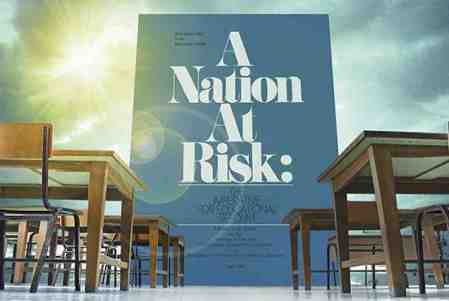
Generally we shouldn’t negotiate with terrorists, Ronald Reagan said.  At the SBOE, we’ve put the terrorists in charge of history and economic curricula — if not the terrorist themselves, at least the terrorists’ camels’ noses.  Texas’s process has earned flashing red-light, claxon-sounding repeating of the words of Ronald Reagan’s Commission on Excellence in Education:  If a foreign nation did this to us, we’d consider it an act of war [excerpt below the fold].

Make no mistake about it.  SBOE’s goal is to roll back any of the reforms left from Reagan’s Commission’s work.  Our nation is more at risk from foreign competition than ever before.  SBOE plans to give away a bit more of our future to China, this week.

Our saving grace is the general incompetence of SBOE members to make significant reform in Texas’s wounded schools, reeling from unworkable and damaging requirements under the No Child Left Behind Act and a testing program that severely limits what can be taught in any social studies course other than those bastions of learning left in International Baccalaureate programs and Advanced Placement courses (estimates are that between 5% and 10% of Texas high school students can take one of those good courses).  Whatever silliness, craziness or lies SBOE orders to  be taught, it can’t be taught and tested well.  Inertia preventing change works to save America in this case.

In business, most CEOs at least appreciate the value of having good front-line employees who are the ones who really deliver the service or product and produce the profit of the enterprise (even if they don’t treat those employees so well as the employees deserve).  Education may be the last bastion of flogging the horse that should be pulling the cart instead.  In this case, having well-trained teachers in the classroom is the last hope for Texas, Texas parents and Texas students — and Texas’s economic future and future in liberty.  Teachers are the last defense of freedom in Texas.  Today SBOE will make another assault on the ramparts that protect the teachers in their work.

When will the French fleet arrive to lend aid?  Will it arrive at all?  And if it arrives, will Texas kids know better than to shoot at the ships?

Carol Haynes, who claims to have a doctorate in some discipline, told the board how to rewrite the standards to completely change the history of the civil rights movement in their last hearing on the topic.  According to Haynes, apparently, Dr. Martin Luther King, Jr., was opposed to civil rights and Barry Goldwater was in favor — the Board didn’t offer to correct her revisionism, but instead asked her to go beyond her three minutes in fawning acceptance. This appears to be SBOE’s approval of various Other Universe hypotheses offered by Star Trek, allowing any damned thing at all to be taught as history (except the right stuff).  Haynes is scheduled to testify again (#128), probably very late at night, but perhaps in time for the 10:00 p.m. Texas television news broadcasts.  Oy.

Excerpt from the Report of the Commission on Excellence in Education, A Nation at Risk, below the fold.

ae_summer2015mehta_opener-1100x736

Cover of A Nation at Risk: The Imperative for Educational Reform, the 1983 report that started the education reform mess. AFT graphic.

Stand up for your nation, it’s children and future; sound the alarm:

Add to FacebookAdd to NewsvineAdd to DiggAdd to Del.icio.usAdd to StumbleuponAdd to RedditAdd to BlinklistAdd to TwitterAdd to TechnoratiAdd to Furl


Read the rest of this entry »


“Who remembers Paul’s tweet to the Romans?”

January 13, 2010

It’s just such a brilliant question about technology, human communication and history, that I had to make it into it’s own post.

In response to this post about Edith Wharton’s extensive writings and what she’d have done today with e-mail, Mark posted the comment:

Who remembers Paul’s tweet to the Romans?

Helluva question.  What does your Sunday school class say?  What does your literature professor say?  What does your history teacher say?  Send ’em a tweet and see.

Mark also posts occasionally at The Divine Afflatus.


Story of Cap and Trade – yes? no?

January 11, 2010

From the same woman who gave us the brilliant “The Story of Stuff” a while back, a new film that says cap-and-trade policies are destructing and not to be trusted. What do you think?

I think it’s a great explanatory piece, despite my disagreements with her policy.  It’s probably a great film to use in economics class, yes?


Trouble at Texas Board of Education: Social studies

January 11, 2010

Here is a news rundown of stories on the Texas State Board of Education, who have been planning for a year now to mess up social studies standards for Texas public schools, this week.

Get on your horse and warn Texans:  The Idiots are coming to get your good schoolbooks:

Add to FacebookAdd to NewsvineAdd to DiggAdd to Del.icio.usAdd to StumbleuponAdd to RedditAdd to BlinklistAdd to TwitterAdd to TechnoratiAdd to Furl


Happy Birthday, Milly!

January 7, 2010

Millard Fillmore was born January 7, 1800. Had he lived, Millard Fillmore would be 210 years old today, and probably very cranky, and looking for a good book to read.

Millard Fillmore (unknown artist, circa 1840) - National Portrait Gallery

Millard Fillmore (unknown artist, circa 1840) - National Portrait Gallery

Would you blame him for being cranky?  He opened Japan to trade.  He got from Mexico the land necessary to make Los Angeles a great world city and the Southern Pacific a great railroad, without firing a shot.  Fillmore promoted economic development of the Mississippi River.  He managed to keep a fractious nation together despite itself for another three years.  Fillmore let end the practice of presidents using slaves to staff the White House (then called “the President’s Mansion”).

Then in 1852 his own party refused to nominate him for a full term, making him the last Whig to be president.  And to add insult to ignominy, H. L. Mencken falsely accused him of being known only for adding a bathtub to the White House, something he didn’t do.

As Antony said of Caesar, the good was interred with his bones — but Millard Fillmore doesn’t even get credit for whatever evil he might have done:  Fillmore is remembered most for being the butt of a hoax gone awry, committed years after his death.  Or worse, he’s misremembered for what the hoax alleged he did.

Even beneficiaries of his help promoting the Mississippi River have taken his name off their annual celebration of the eventFillmore has been eclipsed, even in mediocrity (is there still a Millard Fillmore Society in Washington?).

Happy birthday, Millard Fillmore.

Millard Fillmore was a man of great civic spirit, a man who answered the call to serve even when most others couldn’t hear it at all.  He was a successful lawyer, despite having had only six months of formal education (a tribute to non-high school graduates and lifelong learning).  Unable to save the Union, he established the University of Buffalo and the Buffalo and Erie County Historical Society.  And, it is said of him, that Queen Victoria said he was the most handsome man she had ever met.

A guy like that deserves a toast, don’t you think?

Resources:


Are you ready? Millard Fillmore’s birthday, January 7

January 6, 2010

Millard Fillmore turns 210 tomorrow.

Millard Fillmore in the 1850s, NY Times image, Wikimedia

Millard Fillmore in the 1850s, wondering about that birthday cake. Wikimedia, via New York Times image

How do you plan to celebrate?

Some are planning big fetes:

From 10:00AM to 3:00PM on Sun Jan 10, 2010.

Save the date! Cayuga-Owasco Lakes Historical Society will once again host a birthday party for Millard Fillmore on Sunday, January 10 from 10:00am to 3pm. The history museum at 14 West Cayuga Street will be open for visitors and will serve refreshments in honor of our 13th President’s birthday. This will be the last official function until March, 2010. Throughout December the house will be open on Mondays 9:00 am until noon. If you have not visited lately, the recently refurbished Fillmore Room features a timeline of his life and presidency as well as photos and memorabilia.  (From Auburnpub.com)

Tradition is on a glide path at the University of Buffalo, a school founded by Millard Fillmore; from the UB Media Center:

Media Advisory: UB to Commemorate 210th Birthday of Millard Fillmore

Release Date: January 6, 2010

BUFFALO, N.Y. — The University at Buffalo will uphold a longstanding winter tradition as it celebrates the 210th anniversary of the birth of Millard Fillmore, UB’s first chancellor and the 13th president of the United States, at a ceremony to be held at 10 a.m. Jan. 7 at Fillmore’s gravesite in Forest Lawn Cemetery.

The outdoor ceremony marking the 210th anniversary of Fillmore’s birth on Jan. 7, 1800, is hosted by UB, the Forest Lawn Group and the Buffalo Club. It is free and open to the public.

The commemoration address will be delivered by James A. Willis, UB executive vice president for university support services. Wreaths will be presented by Col. Timothy G. Vaughn, 107th Mission Support Group Commander, New York Air National Guard, representing the White House; Marc Adler, adjunct professor in Millard Fillmore College and immediate past president of the UB Alumni Association, representing UB; Charles M. Mitschow, president of the Buffalo Club; and Dean H. Jewett, chairman of the board of the Forest Lawn Group.

The invocation will be presented by The Rev. Joel Miller, minister of the Unitarian Universalist Church of Buffalo. The UB Police Color Guard will present the flags, and West Richter, a UB student and member of the UB Marching Band, will play taps.

A reception with refreshments will immediately follow in the Forest Lawn Chapel.

Fillmore helped establish UB, serving as its first chancellor from 1847 until his death in 1874. He also was instrumental in framing the charter transforming the Village of Buffalo into the City of Buffalo. He helped establish Buffalo General Hospital, the SPCA, the Buffalo Historical Society, the Fine Arts Academy, Buffalo Savings Bank, Buffalo’s public library system and the Buffalo Club. As a congressman, he secured funding to enlarge the Buffalo Harbor and expand the Erie Canal. Fillmore served as president from 1850 to 1853.

This year marks the 45th anniversary of UB’s stewardship of Fillmore’s service, but the tradition to honor Fillmore dates back to 1937. From 1937 until 1965, the ceremonies were staged by the City of Buffalo and the Buffalo Board of Education. The events were administered by Irving R. Templeton, a 1909 graduate of UB, who scheduled two programs annually on or near Jan. 7, one in City Hall and one in Forest Lawn.

The responsibility shifted to UB when Templeton died in 1965. Although UB participated in the Fillmore birthday commemoration during Templeton’s stewardship, the university took over the ceremonies and made it a community event starting in 1966.

Media arrangements: Charles Anzalone onsite at 440-8824.

According to Buffalo Rising!, tradition wins out at Forest Lawn, New York, too:

By Sandy Starks

Okay… the frenzy of holiday visits and activities are past, the decorations are put away, and the final game in regular season football has been played. The winter doldrums are about to set in, and what are we to do?

The Forest Lawn Cemetery Heritage Foundation has come up with programming that will help you get over the inevitable winter blues. We all love the Summer in the Cemetery tours the cemetery offered each year, so in 2010 the folks at Forest Lawn have decided to celebrate the winter season by hosting a four-part series of concerts and lectures to be held at the historic chapel, located in the heart of the cemetery.

On the second Sunday of each month, January through April, at 2PM, programs will include a mini concert, followed by a lecture on a topic related to Forest Lawn and the History of Buffalo. This Sunday January 10th, the topic will be The History of Music in Buffalo.

Music Librarian, Raya Lee, teams up with one of Buffalo’s favorite musical talents, Bruce Woody, to discuss how music evolved in Buffalo. The lecture includes information about the opening of the first music store in 1827, the first performance of super-star Jenny Lind in 1851, an overview featuring the greatest musical artists of the day, their stories, and the birth of the Buffalo Philharmonic Orchestra.

People featured in the lecture include Millard Fillmore, James P. Sheppard, owner of the first music store in Buffalo; Marian de Forest, Zorah Berry, and conductors John Lund and Charles Kuhn. Tunes, some we are familiar with such as “Shuffle off to Buffalo,” “Buffalo Gals,” and “Somewhere Over the Rainbow” (Harold Arlen), will be played throughout the lecture.

The series continues with a program on February 14th, with The Entertainers and Writers of Forest Lawn, presented by: Forest Lawn researcher, Patrick Kavanagh with a musical presentation performed by Buffalo musicians Billy McEwen and Joe Head.

Many of us know about Darwin Martin of the Larkin Soap Company but there is much to know about John Larkin and the company itself. The March 14th program, A Review of the Larkin Soap Company – A Man and His Products will familiarize us the dynamic Buffalo business. Larkin Enthusiast Jerry Puma will talk about the Larkin Soap Company and bring some of his Larkin collection for you to view. A musical presentation by The Docenko Brothers rounds out this fun yet informative day.

The series concludes on April 11th, with a talk by Author Laura Pederson (if you haven’t read the book Buffalo Gal yet, that is another way to beat the winter blues), talking about Smokestacks & Skyscrapers: A Lighthearted History of Buffalo. The musical presentation will be by Grace Stumberg, a rising Buffalo musical talent and student at Villa Maria College.

Admission is $15. Tickets may be purchased at Forest Lawn’s administration office, 1411 Delaware Avenue or by calling 716.885.1600. Ask about the discount that is available for all four programs.


Texas social studies standards: Crisis is now

January 6, 2010

How bad is it?  Washington Monthly features a solid, long story on what is going on in Austin this week and next in Texas social studies standards.  I wish that outstanding publication had a much greater circulation.

Even in Minnesota, P. Z. Myers is concerned:  “Be afraid” he warns his readers.  In comments there, a guy named BlackWolf puts it bluntly:

Once, a guy in a schoolbook storage room was the killer.

Now, the books themselves are becoming dangerous.

You can help.  You can testify next week.  You can send comments.  The Texas Freedom Network can help you be heard.

Please let the State Board of Education know that Texas, and the nation, needs good social studies standards.  As we noted last month, it’s time to stand up for education and social studies:

Make Your Voice Heard at January Public Hearing

The process of revising social studies curriculum standards for Texas public schools is moving into a critical stage. And a public hearing the board has scheduled for January may be the only opportunity for you to speak out against the far right’s efforts to corrupt standards for history, government and other social studies classes.

The final drafts of the proposed standards prepared by writing teams made up of teachers, academics and other community members are reflective of mainstream academic scholarship in the various subject areas. It is clear that members of these writing teams largely resisted intense political pressure from far right, rejecting attempts to remove key civil rights figures and make other politically motivated revisions. (See the Background section at the bottom of this e-mail for a more detailed account of the politicization of this curriculum process.)

But as with science and language arts, far-right SBOE members are already plotting to undo the work of the writing teams of social studies.

Take Action

The State Board of Education so far has scheduled only one public hearing on the proposed standards. That hearing is likely to occur either on January 13 or January 14 in Austin.

If you are interested in speaking at the hearing, please click here. TFN will help you register to speak before the board and be an effective voice against efforts to politicize our children’s classrooms.

This may be the only opportunity the board provides for Texans to speak out on the proposed standards. If we are to prevent far-right SBOE members from turning social studies classrooms into tools for promoting political agendas, then it’s critical that the board hears from people like you! Click here to sign up for more information on how to testify in January.

___________________________________________________

Background on Social Studies Review Process to Date

Earlier this year, TFN exposed and derailed several attempts by the far right to hijack the social studies curriculum revision process. Members of the state board – or their appointees to review panels and writing teams – tried at various times to:

  • Remove civil rights champions like César Chávez and Thurgood Marshall from the standards, calling them poor examples of citizenship
  • Turn Joseph McCarthy – who discredited himself and dishonored Congress with his infamous Red-baiting smear campaign in the 1950s – into an American hero
  • Rewrite history and portray America’s Founders as intending to establish a Christian nation with laws based on a fundamentalist reading of the Bible

Members of the writing teams largely rejected these fringe ideas in the final drafts of the standards they submitted to the board. Chávez and Marshall remain in the curriculum. The American history standards do not whitewash the damaging history of McCarthyism. And under the proposed standards students would still learn that the Founders created a nation in which all people are free to worship – or not – as they choose without coercion or interference by government.

We must ensure that the board adopts curriculum standards that reflect mainstream academic scholarship in social studies. This is vitally important because the results of this decision will be reflected in the next generation of social studies textbooks around the country.

Click here to let TFN know you are willing to testify at the state board.


Millard Fillmore, Whig candidate for Vice President

January 5, 2010

Campaign print from 1848 presidential election:

Millard Fillmore, Whig candidate for Vice President - Library of Congress

Millard Fillmore, Whig candidate for Vice President - Currier and Ives print, 1848, After a daguerreotype by John Plumbe, Jr. - Library of Congress

January 7, 2010, is the 210th anniversary of Millard Fillmore’s birth.


Stubborn Birthers soldier on

January 4, 2010

Birther “Dr. Kate” sez there’s a case coming to a hearing in Pennsylvania that will go to the Supreme Court no matter how this hearing turns out.

Here’s the table of contents to Kerchner v. Obama. Here’s the full complaint, according to Dr. Kate.

Probably the best thing going for the plaintiffs is that Orly Taitz only appears by name in a bizarre accounting of everything ever said on the issue (except for the lack of evidence and reasons this case will fail which, oddly, isn’t included in the complaint; everything else is included).

I predict the case will be dismissed, but it may be dismissed with prejudice.  That is, if it really does come to a hearing.  Is that really possible?

Warn others so they don’t get trampled:

Add to FacebookAdd to NewsvineAdd to DiggAdd to Del.icio.usAdd to StumbleuponAdd to RedditAdd to BlinklistAdd to TwitterAdd to TechnoratiAdd to Furl