Why a campfire? (reprise)

October 26, 2012

It was more than five years ago I originally posted this?  Heck, I won’t even add links or a “More” section at the bottom.  I deserves to be repeated though, I think, especially in an election year when we wish we could gather more people around a campfire.  Here goes:

Training adult Scout leaders always produces a few puzzled looks, and occasional passionate, fearful rebukes, when I note that a campfire gives a boy or a girl an opportunity to play with fire.

No, I don’t mean, exactly, that we should let kids play with fire.  There are rules — what’s burning must be in the fire pit, is the chief rule.

There is some primal need to watch a fire, to study it, to experiment with it, and finally just to watch it go. If you camped as a kid, you probably know what I mean.

Camp fires are universal.  This one was outside Bangalore.

Camp fires are universal. This one was outside Bangalore.

Every kid needs to do that.  It’s a part of growing up.  It’s a necessary memory for healthy and sane adults.

Start a fire, and a kid will get a stick and poke the burning logs and, especially, the red-, yellow- and white-hot coals after the fire burns a while.  They’ll start the stick on fire, put it out, and light it again.  They’ll pull the stick out of the fire and watch the flame consume the stick.  Kids will experiment with different things on the fire, to see whether, how fast, and how they burn.

Just keep it in the fire pit.

A Scoutmaster can tell which kids have been camping. A Scoutmaster knows which kids have been able to sit around a campfire and play with fire in that way.  Kids who know fire are more mature, generally, more relaxed about the excitement of the stuff, and much more careful with it.  Scouts who have dabbled in the campfire respect fire for what it is and for what it can do, good and bad.

What you’ll remember 20 years later, or 30 years, or (God bless me!) 40 years, and I hope 50 and 60 years, is the watching of the fire as the flames die down to a red and pulsing bed of coals.

You’ll remember some of the stories — Freddy Jonas’s often-told story of racing down the Champs Elysee in horse-drawn carriages, bribing the driver of the other carriage to go slower to win the race; the story of Rulon Skinner, the best non-swimming canoe instructor on Earth, and the big canoe race in which his opponent finally tipped Skinner’s canoe, and then yelled “snake!” to appeal to Skinner’s other great fear; the night the bear invaded the camp at Ben de la Tour, a bear later found to have antlers and four hooves.  You’ll remember the s’mores, and you’ll forget how messy they are.  You’ll remember the time you waited for the cobbler to cook after someone forgot to start the charcoal, or the the time the story got so good you forgot to take the cobbler off the fire, and how the Dutch oven had to be thrown away because it never would come clean.

You may remember that little fox at Camp Carter, sneaking just beyond the light of the fire and carefully circling every chair, looking for something good to eat, to steal.  Or that stupid porcupine that, now that you think of it must have been rabid, heading straight for the fire there in the only stand of Ponderosa pine in Utah County, up Payson Canyon.  And that will trigger the story of the night the fire wouldn’t start in the Catskills, and what seemed like hundreds of giant porcupines convened in bacchanalian festivities while campers dared not sleep, in their tents.

Someone will mention retiring U.S. flags, and you’ll remember the retirement ceremony for the flag from the widow of the veteran, how she insisted that you promise the flag would be burned completely and honorably, and warned “he’ll be watching!”  You’ll remember the mass flag retirement after the lifting of the burn ban at Wisdom, and how you suddenly realized lots of flags put out lots of toxic fumes — but somebody ad libbed a part to the ceremony to add time to let the fumes clear, and no Scout noticed (you hope!).

We haven’t even gotten to the singing.

I was put in mind of the power of the campfire with a remembrance from Real Live Preacher writing at High Calling:

I remember how worried we were the first time we tried to set one of those brush piles on fire. We nervously stood before a ten-foot high, fifteen-foot wide mound with a can of lighter fluid and a couple of matches. I squirted a modest amount around the bottom of the pile and stood back while Michael threw the match. That’s when we discovered that it’s surprisingly difficult to set things on fire. Now I marvel at stories of people casually throwing cigarettes out of their cars and setting whole forests ablaze. Michael and I had a hard time starting fires even when we used diesel fuel and a blowtorch.

It takes about five hours to burn a giant pile of brush and cedar, so Michael and I would start a fire, then sit on the tailgate of the brown pickup truck and talk while we kept an eye on it. Apart from the searing heat and looking like chimney sweeps, it was fun. I’m always looking for guilt-free reasons to sit around and talk with friends. I don’t suppose I’ll ever have as good an excuse as I did back then.

A guilt-free reason to sit around and talk with friends?  A campfire is an automatic reason — guilt only obtains if there’s a ban on burning where you’re making the fire.

Carl Buell painted another one that took my breath away the first time I saw it.  Go see it. (I’m asking permission on this one; it may take a little while. Posted below with permission.)

That’s not a photograph, you can tell because it so well preserves what you remember — better than any photograph ever could —  it preserves what you remember from that campout up in the San Franciscos the night the sky was so blue so late and you could see the whole moon from the earthglow — or was it in New Mexico?  Probably not Colorado because there aren’t any mountains — oh, but if he’s looking east, it could have been south of Pueblo . . . no, maybe near Albion in the Sawtooths . . . Buell works in the east; it’s probably up in Maine . . . but he lived and painted in Marin County.

Didn’t he perfectly capture that night?
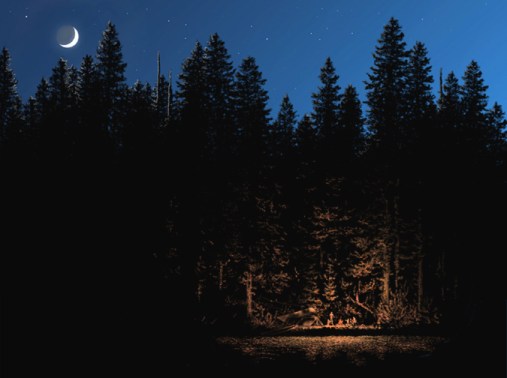
Campfire, by Carl Buell.  Copyright Carl Buell, all rights reserved; used with permission


Night skies at Yosemite, in time-lapse

September 6, 2012

Yosemite National Park, watching stars, with time-lapse photography.  The only way life gets better than this is to go there and film it yourself.  Yosemite Nature Notes 19.

Description from Nature Notes:

Yosemite’s vast acreage and remote location protect some of the darkest night skies in the country. Astronomers, photographers and city dwellers flock to the park to take advantage of this unique opportunity to view planets, stars, and galaxies.

Producer is Steven M. Bumgardner, and it features, inter alia, an interview with Shawn Reeder, whose time-lapse work I’ve highlighted before.

For classroom use, some topics and questions to pursue:

  • For geography, where is Yosemite N.P.?  Flying commercially, which airport is the best to get to the park?

    President Teddy Roosevelt and conservationist John Muir at Overhanging Rock, Glacier Point, Yosemite

    President Teddy Roosevelt and conservationist John Muir pose at Overhanging Rock at the top of Glacier Point, near which the men camped in a hollow and awoke to five inches of snow in 1903. National Park Service image

  • Map reading and orientation:  In the time-lapse sequences, you can frequently see lights streaking across the sky.  Those are commercial airliners — can you tell what airport they are headed to, or from?  Can you tell which ones are coming, which going?
  • Science:  What star formations do you see in these photographs that you can see from your house?  What star formations are not visible from your house?
  • Government:  Who signs the checks that pay the rangers pictured in the film?  For which agency do the work, in which branch of which government?
  • People in the film discuss light pollution from nearby cities.  Is there an agency in the federal government who has jurisdiction over light pollution?  How about an  agency in the state government?  What are the rules on light pollution for cities around Yosemite?
  • Can you identify the landmarks, the cliffs, rocks, mountains and rivers, portrayed in the film?  (Students might use a USGS topographical map, California state tourist promotion maps and websites, National Park Service databases, Google Earth, Google,  and a wide variety of other sources.
  • Who was president of the U.S. when Yosemite was set aside as a National Park, and what were the controversies surrounding it?
  • Who was John Muir?  Who was Frederick Law Olmsted?  What were their roles in the history of Yosemite?
  • Who lived in Yosemite, if anyone, before the Spanish missions were established in California?  When were the missions established?  How did the U.S. gain possession of the Yosemite Valley?

Photos from just another day at Denali . . .

August 15, 2012


Interior Dept photo, America's Great Outdoors, Denali National Park and Preserve

Interior Department photo, America’s Great Outdoors, at Denali National Park and Preserve; photo caption from AGO said, “We’re not sure it’s possible to take a bad photo up there!”  Click for larger view.

More:

Update:  Interior tweeted another photo later today.

Denali Wildflower, U.S. Department of Interior

From the U.S. Department of Interior Tweet: This morning we gave you an amazing shot of #Denali. Would you believe this one is from the same place? Whether large or small, beauty in Denali is everywhere you look. #Alaska

Can someone identify the flower?


“Does it get better than this?” U.S. flag and Denali

August 10, 2012

Instagram from the Department of Interior, yesterday:

U.S. flag and Denali on an almost-clear day; Department of Interior photo, August 2012 - public domain

U.S. flag and Denali on an almost-clear day; Department of Interior photo, August 2012 – public domain

usinterior Tweeted, “Does it get any better than this?”

Denali, also known as Mt. McKinley, is the highest point in North America, 20,320 feet (6,194 m) above sea level.  Measured base to peak, it’s the tallest mountain on land on Earth — Everest and other Himilayan peaks rise from a very high plateau.  Denali is high enough that it makes its own weather.  Finding a day when the mountain is not almost completely obscured by clouds is rare, locals say.  Finding an almost-clear view, with blue sky in the background, is a cause for photographer excitement.

You’ll notice straight-line clouds in the sky — condensation trails from passenger jets.  I wonder how many flights bend a little to get a better view of the mountain for passengers?  Do big airlines even do that anymore?

Nice shot.  I could learn to like Instagram with more photos of this quality.

Better, it would be nice to be there, taking these shots.

More, including the controversy over the mountain’s name:


Yosemite time-lapse tour

July 25, 2012

From Project Yosemite, a series of cool time-lapses, from one of the coolest spots on Earth, Yosemite National Park.

Details on the film, and how to track down the artists and see more, from Project Yosemite’s Vimeo site:

A collaborative project by Sheldon Neill and Colin Delehanty. What started as an idea turned into an ongoing adventure to timelapse Yosemite in an extreme way.

We were complete strangers before it all started, but after we met on Vimeo our idea came into sight, and then began the challenge to make numerous trips to YNP where we would capture the beautiful landscape it offers for visitors every year.

We invite you to watch our video in hopes you’ll witness Yosemite like never before.

Project Yosemite

Yosemite HD

This video is a collaboration between Sheldon Neill and Colin Delehanty. All timelapses were shot on the Canon 5D Mark II with a variety of Canon L and Zeiss CP.2 Lenses.

Project Yosemite Website: projectyose.com
Facebook Page: facebook.com/projectyose
Contact info: info@projectyose.com

Thanks to Dynamic Perception for their motion controlled dolly and continued support!

Dynamic Perception Website: dynamicperception.com

Track: Outro
Album: Hurry Up, We’re Dreaming
Artist: M83
Site: ilovem83.com
Publishing: emimusicpub.com
Licensing: bankrobbermusic.com

This whole project has been an amazing experience. The two of us became friends through Vimeo and explored a shared interest in timelapsing Yosemite National Park over an extended period of time. We’d like to expand this idea to other locations and would appreciate any suggestions for a future project.

Project Yosemite was featured as a main story on Yosemite National Park’s Spring Newsletter.: yosemitepark.com/timelapse-sprnews-2012.aspx

To view this in 2K, visit: youtu.be/OwFbjJasW3E
Be sure to change the quality settings to ‘Original’.

Twitter:
twitter.com/#!/SheldonNeill
twitter.com/#!/delehanty

Facebook:
facebook.com/sheldon.neill
facebook.com/delehanty

Behind The Scenes: vimeo.com/35223326
By Dalton Runberg

Our hearts go out to the families of Markus Praxmarer who lost his life while climbing Half Dome on September 19th, 2011 and Ranger Ryan Hiller, who was crushed by a tree January 22nd 2012. They will be missed. (A photo of Ranger Ryan Hiller can be found to the right, above the statistics counter)

Generalized geologic map of the Yosemite area....

Generalized geologic map of the Yosemite area. (USGS image) (Photo credit: Wikipedia)

Yosemite National Park is spectacular, and much photographed than other great natural places of beauty.  How much does it benefit from being in California, closer to many people with good cameras and great photographic skills, to an extent that more distant, spectacular parks like Glacier N.P., Yellowstone N.P and Big Bend N.P. do not benefit? How does that affect management of the parks? How does that affect how people view their own local adventure areas?

Will Project Yosemite be back with more?

More:


Turk’s Cap, native Texas flower in 90 seconds

June 26, 2012

Short piece from Texas Parks & Wildlife:

Turk’s cap is a native Texas shrub that attracts hummingbirds, butterflies and moths. This easy-to-care for plant is named for the shape of its small blooms. To learn more about Texas native species and habitats, see http://www.tpwd.state.tx.us/huntwild/wild/wildlife_diversity/

Must admit I was unaware it’s a Texas native, though Kathryn has had it in all of our Texas gardens.  I love the blossoms.  I wish our local hummingbirds loved it as much as the photo in the video shows, but we have other plants they love and a feeder.  Butterflies like it, too.

Few other plants equal the intense red of the flowers.  Turk’s cap requires less water than many less spectacular, non-native plants.  Ours keep coming back year after year.  What more do you want in a good garden plant?

I wish my photos were so good as those used in the film.

More, and related material:


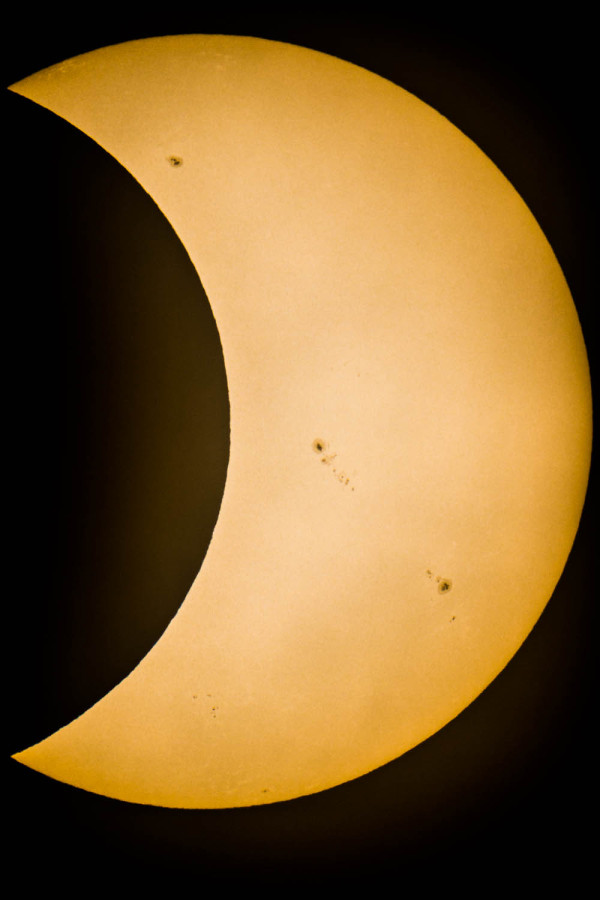
Eclipse? Opportunity for photographers to show off

May 24, 2012

Some photographers have the patience and skills to show off well.  Found this picture of last week’s eclipse, by Mark Langridge, on TwitPic:

Mark Langridge photo, May 20, 2012 annular eclipse

Mark Langridge photograph of the May 20, 2012 annular eclipse

Annular eclipse of May 20, 2012 - photo by Langridge via twitpic

Annular eclipse of May 20, 2012 – photo by Mark Langridge via twitpic

Mr. Langridge provided details; he used a Celestron telescope with his Nikon camera:

Celestron CGEM 800 HD, Canon EOS 60Da, Kendrick Astro baadar solar filter.

Blow this image up, or go to Langridge’s TwitPic site and see it in its large format, glorious detail.  You can see the mountains on the Moon . . .


Fossil walrus porn

December 23, 2011

Walrus baculum fossil, from Retrieverman

What is it? If you were a lady walrus a few million years ago, you wouldn't have to ask!

I can’t do it justice.  Go read about the photo at Retrieverman’s site.

My students hear it often:  Truth is stranger and often much more interesting than fiction.  It certainly applies in history, and it applies in science, too.


Bored in class? Do some math, for fun.

December 22, 2011

This is a good video that all math teachers ought to see (heck, I can figure out how to use it as a bell ringer in social studies, I think).

I had to mention it, just because of Michael Tobis’s wonderful headline at Planet 3.0:  “Bored in class?  Do some math instead.”

I confess to being caught doing math instead, in English, in history — and in art we often made mathematical games to create patterns.  From the stuff I see on walls in schools, that’s still popular.

Some time ago I ordered a poster from Max Temkin, the brilliant poster propagandist/artist.  It says that the universe is easy to understand if you speak its language, and that language is mathematics.  True.

Also true that in most of the disciplines that work into classes we call social studies, we do not have the ability to discern the cool patterns like Fibonacci numbers in pine cones, pineapples and sunflower blossoms.  People look for those pattersn in history anyway, and that poses a key problem to policy makers.  People want to see a pattern, expect to see a pattern, and historians cannot meet that expectation, other than quoting Santayana.

Maybe one of my students will be the one who discerns a key pattern.  It’ll be one of the slackers, if it happens.


Scenes from a beach: At the edge of the sea

December 20, 2011

Interesting little bauble in the Biloxi-Gulfport (Mississippi) Sun-Herald, I think from their columnist George Thatcher:

Cover of Rachel Carson's "The Edge of the Sea"

Good teacher resource for National Environmental Week, April 15-21, 2012

December 20 Scenes from the beach

“To stand at the edge of the sea,” wrote Rachel Carson, “… is to have knowledge of things that are as eternal, as any earthly life can be.”* The things that we see this morning–a cerulean sea and sky, the shorebirds, the sun still near the horizon — are identically the same objects that could be seen in Cambrian times, eons ago. There is a sense of the eternal in the objects viewed today. And I suppose there will be little change in a faraway eon that lies in some future age. — Diary, autumn 2011

* At the Edge of the Sea by Rachel Carson; Signet Books, New York (1955)

Read more here: http://www.sunherald.com/2011/12/19/3641733/december-20-scenes-from-the-beach.html#storylink=cpy

One should read Rachel Carson to get closer to the universe, not for political reasons, not necessarily for the science.  But being scientifically accurate, and being close to the pulse of the universe, Carson’s views will change your politics for the better if you really read and listen.


Can the Houston toad survive Texas wildfires and droughts?

November 25, 2011

New short from the Texas Parks and Wildlife people:

The smoke may be gone but the Bastrop fires of Labor Day weekend are still a smoldering concern for biologists. They’re keeping tabs on the Houston Toad. And with only an estimated 2,000 left in Texas, this endangered species is facing its next challenge as the drought continues. More on Houston toads at http://www.houstonzoo.org/HoustonToad/

For background, see this earlier reel from TPWS on the fires at Bastrop State Park:


Theological disproof of evolution? Hornworms and braconid wasps

November 7, 2011

“Nature red in tooth and claw,” the poet Tennyson said.

Darwin thought these critters a clear disproof of creationism — no god would make such creatures intentionally!

Mark reports at The Divine Afflatus:

Hornworm Hosts its Destruction

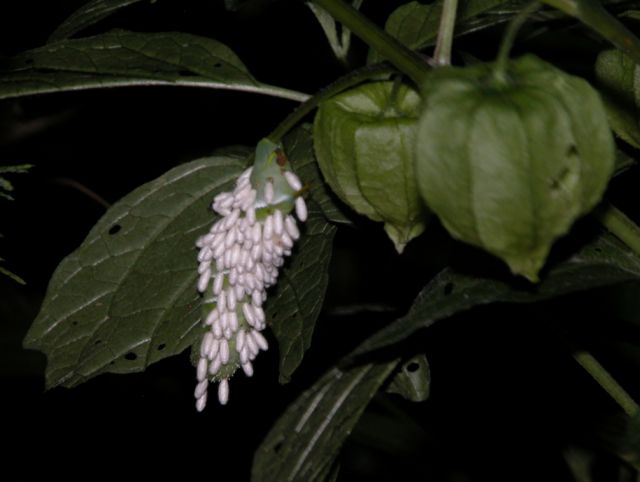
While admiring some ground cherries outside my front door, I noticed a number of leaves had been stripped off. Not grazed on by the deer that frequent the area, more like eaten by caterpillars. After a brief search I spotted a hornworm munching away. I didn’t bother killing the hornworm because, after all, the ground cherries are weeds growing amongst the black-eyed susans, and it’s less work for me if they take care of the weeds.

I looked again a few days later, and saw that the hornworm had sprouted numerous white appendages. These are the cocoons of pupating braconid wasps. Braconid wasps are parasitoids that inject their eggs beneath the skin of the host (hornworms are favored by the braconid wasp Contesia congregatus). After feeding on the convenient meal surrounding them, the wasp larvae emerge and spin their coccons, attached to the body of the unfortunate hornworm. In a few days, adult wasps emerge from their cocoons, leaving a dead caterpillar.

I later spotted a second hornworm, which suffered the same fate as the first.

Ewwwwwwww!


Glories of Glacier N.P.

November 6, 2011

Seven-plus minutes of good reason to get your tail to Glacier National Park as soon as you can.

Produced and shot by Joshua Thompson, this is part of an award-winning film made to promote the park and get money for the research that the park hosts.

Grizzly Bears, Bighorn Sheep, spectacular sunsets and more…..

Part 3 of the recently shot Glacier DVD. This 20 min. film recently was nominated for best new nature documentary in the music category as well received an award for photography from the Wildlife Film Festival held in May of 2008. All funds for this project are being donated to the Glacier National Park Fund. For more info: http://www.glaciernationalparkfund.org/cart.php?page=glacier_national_park_fu…

I’ve been there only once.  A wise American would get there before turning 35, and return several times.


Amazing film – Flight of the eagle owl

October 8, 2011

Imagine for a moment that you are a wee little mousie, sitting on a tuft of grass nibbling on a seed. You think you feel a breath of a breeze from in back of you and you turn around to see this beautiful thing

Vodpod videos no longer available.

Amazing nature – The Eagle Owl, posted with vodpod

Beautiful, but terrible, too.

Owls fly silently. Their feathers have evolved to move without rustles, to let the wind slip through them without making a whish. Owls demonstrate evolution at its mightiest, and nature, as the poets note, “red in tooth and claw.”

Filmed at 1000 frames per second, according to Dogworks.com.  According to Vurtrunner at YouTube, filmed with a
Photron Full HD High Speed Camera SA2.

I’d like to know more about this film.  Trained owl?  Wild owl enticed by what kind of bait?  Longer movie about eagle owls?  I’m not familiar with them.  So many little mysteries on the internet.

_____________

Update:  From YouTube’s account of SloMoHighSpeed:

New Photron SA-2 High Definition High Speed Camera. Shot of ‘Checkers’ the eagle owl, 1000fps 1920×1080 resolution. Shot by SlowMo (www.slowmo.co.uk). See the owl and other birds of prey at www.turbarywoods.co.uk.

From Wikipedia

The Eurasian Eagle-owl (Bubo bubo) is a species of eagle owl resident in much of Europe and Asia. It is also one of the largest types of owls.

*   *   *   *   *   *

The Eagle Owl is a large and powerful bird, smaller than the Golden Eagle but larger than the Snowy Owl. It is sometimes referred to as the world’s largest owl, but this is actually the Blakiston’s Fish Owl, which is slightly bigger on average.[2][3] The Eagle Owl has a wingspan of 138–200 cm (55–79 in) and measures 58–75 cm (23–30 in) long. Females weigh 1.75-4.5 kg (3.9-10 lbs) and males weigh 1.5-3.2 kg (3.3-7 lbs).[4][5][6] In comparison, the Barn Owl weighs about 500 grams (1.1 lbs).

Tip of the old scrub brush to Kathryn.


Sky islands in Yosemite National Park

September 19, 2011

Nature Notes #16 from the good people at Yosemite National Park:  Sky Islands.

Throughout the Sierra Nevada, high flat plateaus are found at elevations around twelve and thirteen thousand feet. These isolated sky islands are the home to unique plant communities that are found nowhere else.