Not an emerald ash borer — but what is it?

August 21, 2013

Emerald green beetle, looks a lot like a longhorn.  I feared it to be a dreaded emerald ash borer, but it’s not.

Okay.  What is it?  Any body know?

From our Backyard Collection, two weeks ago:

What is this one? Looks like a longhorn beetle, emerald green.

What is this one? Looks like a longhorn beetle, emerald green. Not an emerald ash borer. Anyone know?

It’s too big to be an emerald ash borer.

Our mystery beetle is too big to be an emerald ash borer.

Our mystery beetle is too big to be an emerald ash borer. Brilliant orange underside.

Perhaps a flower longhorn beetle?

Caption from Field and Swamp Animals and their habitats:  Flower longhorn beetle (Encyclops caerulea), Glassmine Gap Trail, Macon County, NC, 5/28/13

Caption from Field and Swamp Animals and their habitats: Flower longhorn beetle (Encyclops caerulea), Glassmine Gap Trail, Macon County, NC, 5/28/13

Where’s Bug Girl when we need her?  (Moving?)  Roused Bear? Beetles in the Bush?

Update, mystery solved:  Ted C. MacRae said (see comments) it’s the bumelia borer (Plinthocoelium suaveolens).  He wrote about it here. So, Kathryn, what are they eating in our backyard? Bumelia lanuginosa is a Texas native; do we have one, or a relative, in the garden?  Dallas-area Dirt Doctor Howard Garrett says they’re mostly harmless in the garden.  (Here’s a closeup, from MacRae’s blog):

Brumelia borer, from Beetles in the Bush.  Photo by Ted C. MacRae

Bumelia borer, Plinthocoelium suaveolens,  from Beetles in the Bush. Photo by Ted C. MacRae


Campout Bingo cards, from the National Wildlife Federation

August 16, 2013

Found this via a stream of Pinterest and other blog posts:  National Wildlife Federation (NWF) put together four great camping bingo cards to use with your kids — depending on how wild your backyard is, you may not even need to go far to play.

Here in South Dallas County, you can see much of this stuff with a stroll through a local nature preserve.

Teachers, you can use this idea, with pictures and words, yes?

Camping Bingo card from the National Wildlife Federation (NWF)

Camping Bingo card from the National Wildlife Federation (NWF); it comes in a set of four, in .pdf format

Here’s the link to get the four cards NWF created in .pdf. If you want to create your own (history, geography, mathematics, language arts) teachers, here’s a blank form in .pdf.

Tip of the old scrub brush to Duncanville ISD’s Judy Henry.

More:


Mountain goat nemeses everywhere!

August 12, 2013

Normally I might just let this beautiful photo slide by without comment.

In this case, I find this particularly frustrating.  See that creature?  That’s the same goat that blocked my trail in Glacier National Park.  I’m sure of it.  I’d recognize those beady eyes and horns anywhere! (See the first story linked to in the “more’ section; maybe this goat stopped in Washington on the way to Alaska.)

He’s probably in Alaska now under the Federal Goat Protection Program.

Harding Icefield Trail @KenaiFjordsNPS. #alaska pic.twitter.com/yozsSLnrcD

Interior US Dept of Interior 6h Caption from the Department of Interior: That’s quite the hike to the top. Harding Icefield Trail @KenaiFjordsNPS. #alaska pic.twitter.com/yozsSLnrcD

He probably thinks he’s safe there at Kenai Fjords National Park.  Ha!  He’s farther away, but that just means I have farther to travel to find him!

I’m taking a longer telephoto, a wide angle, and a first aid kit, next time.  I’ll be prepared!

More:


New Boy Scout merit badge: Sustainability

July 25, 2013

It’s Eagle required, too — well, Scouts can choose either Environmental Science or Sustainability, but must earn one or the other to earn Eagle rank.

Image of the Sustainability merit badge, from MeritBadge.org

Image of the Sustainability merit badge, from MeritBadge.org

Requirements for the new Sustainability merit badge were released on July 16, concurrent with the 2013 National Scout Jamboree at the Summit.  A lot of people missed the announcement, I’ll wager.

It’s good news.  Conservation and nature-related merit badges have suffered a decline in Scouting, it seems to me.  The conservation series was very much the keystone of a trek to Eagle when I was a Scout, at least as important as the citizenship series.  But I don’t see that emphasis in Scouting today, sadly.

BSA recently created a Mining merit badge, which created some quiet grumbles among conservationists — this new, Eagle-path badge more than makes up for that, I think (though mining is a great topic for Scouts, especially in the western U.S., I think).  This will not set well with the anti-conservation, anti-Agenda 21 crowd and their merry hoaxsters.  But nothing BSA does is removed from political criticism from the right any more (see this odd photo choice for the Sustainability badge notice at the radical right-wing Daily Caller site).

This announcement gives me hope.

More:

Below the fold, the requirements and announcement from Bryan on Scouting, at Scouting Magazine’s site, verbatim and in total.

Read the rest of this entry »


Annals of global warming: Climate change hammers the Adelie penguins

July 22, 2013

Adelie penguins struggle to survive changes in their nesting and feeding sites caused by warming air and waters around Antarctica

Adelie penguins struggle to survive changes in their nesting and feeding sites caused by warming air and waters around Antarctica

New, very short film from the E. O. Wilson Biodiversity Foundation highlights threats to Adelie penguins from climate change, already.  Actor and conservation activist Harrison Ford narrated “Ghost Rookeries, Climate Change and the Adelie Penguin.”

Details from the Biodiversity Foundation at their YouTube site:

Published on Jun 26, 2013

“Ghost Rookeries,” narrated by actor, conservationist, and member of the E.O. Wilson Biodiversity Foundation (EOWBF) Board of Advisors Harrison Ford, conveys the story of the Adelie Penguin, whose habitat—and thus the biodiversity of all of Antarctica—is being threatened by real-time environmental changes.

“The consequences of a loss of biodiversity could encompass everything from altering key Antarctic marine food chains to the loss of species that may hold cures to cancer,” writes Dr. James McClintock, whose recent book, ‘Lost Antarctica: Adventures in a Disappearing Land’ (Palgrave/MacMilllan, 2012), forms the basis of “Ghost Rookeries.”

The E.O. Wilson Biodiversity Foundation (EOWBF) and the Association of Zoos and Aquariums (AZA) will be embarking on an exciting new initiative beginning in the summer of 2013. Beginning with “Ghost Rookeries: Climate Change and the Adelie Penguin” (4 minutes, 2013), short videos produced by the EOWBF will be shown at select AZA-accredited zoos and aquariums located in the United States. With the vast reach of AZA-accredited zoos and aquariums, “Ghost Rookeries” and future videos will be seen by millions of visitors.

Dr. Paula Ehrlich, President and CEO of the EOWBF, calls “Ghost Rookeries” and the partnership with AZA “. . . a wonderful way to engage audiences about the importance of preserving our biological heritage through story. The Adelie Penguin is an iconic story, a symbol, of the real-time effect of climate change on biodiversity.”

“Ghost Rookeries” was produced by the E.O. Wilson Biodiversity Foundation, with the University of Alabama at Birmingham, and the the Tennessee Aquarium.

This film looks at a small part of the Adelie penguin population, on Torgerson Island, near Palmer Station.  This population symbolizes the difficulties of dealing with climate change, or even knowing what the effects will be.  Critics of pollution control to stop climate change argue that populations of all animals and plants will adapt.  Indeed the last decade saw a rise in total numbers of Adelies across Antarctic waters, and Gentoo penguins have set up new colonies to avoid warming air and waters.

More careful watchers note problems, though.  Warming air, and decreasing hard ice, brings more snow — nominally good, if one assumes the snow turns to ice.  In this case, the snows are brief, and they melt quickly.  It’s the cold meltwater that kills the chicks, drowning them.  This may be counterintuitive, or even ironic,  that warming causes a cold water seabird to drown, or die of hypothermia.  Nature is stranger than we can imagine, and often strange enough that it defies the understanding of scientifically-dilettante politicians.

Generally the loss of ice is the biggest problem for penguins; specific populations face entirely different threats, however, depending on the local effects of climate change.

Dr. Jim McClintock, in Antarctica.  A professor at the University of Alabama-Birmingham

Dr. Jim McClintock, in Antarctica. A professor at the University of Alabama-Birmingham, he wrote Antarctica Lost, upon which the film about the Adelie penguins is based.

The film is a short project based off of the work of Dr. Jim McClintock, an almost-legendary Antarctic researcher based out of the University of Alabama at Birmingham (UAB).  McClintock published a book on his work last year that deals with many different aspects of climate change in the Southern Ocean and its continental land mass, Lost Antarctica, Adventures in a Disappearing Land.

More:


Lake Superior, Pictured Rocks National Lakeshore

July 19, 2013

Superior Fury - Lake Superior near Miner’s Beach in Pictured Rocks National Lakeshore during a gale at sunrise.  Photo: Steve Perry

Superior Fury – Lake Superior near Miner’s Beach in Pictured Rocks National Lakeshore during a gale at sunrise. Photo: Steve Perry, via America’s Great Outdoors

Admit it:  That’s not how you usually think of Lake Superior, is it?

Tip of the old scrub brush to America’s Great Outdoor on Tumblr.

More:


Thunder is impressive, but it’s lightning that does the work

July 11, 2013

Nice photo from Texas Storm Chasers:

David Reimer's great shot of lightning, about 10:00 p.m. in Norman, Oklahoma, July 11, 2013

David Reimer’s great shot of lightning, about 10:00 p.m. in Norman, Oklahoma, July 11, 2013

Good luck, and keep ’em coming, David!

(Mark Twain observed:  “Thunder is good, thunder is impressive; but it is lightning that does the work.” (Letter, August 28, 1908))


What rocks Yosemite? Granite

July 7, 2013

Yosemite’s Nature Notes #20 (I’m behind):  A short film discussing the astonishing manifestations of granite in Yosemite National Park.

English: El Capitan in Yosemite National Park ...

El Capitan in Yosemite National Park viewed from the Valley Floor — one of the more famous granite formations in the Park. Wikipedia image

The film is simply named, “Granite.”  Steven Bumgardner produced the film.

Yosemite’s chief formations are granite, an igneous rock.  Much of the terrain was carved in the granite by glaciers and glaciation — so what Yosemite shows is how fire and ice combine to make rock, to make rock formations, and to make rocks of astonishing beauty.

(This is not a place to bolster creationist ideas.  This is real science, looking at God’s handiwork first hand.)

A North Carolina university makes field trips to Yosemite?  I’d love to take that class!

Watching this film, you get a sense of how important it can be to the education of our children to travel in the summers, to take vacations to our National Parks, and to places like Yosemite.

Where are you taking your kids this summer?  Kids, where are you going?

Enjoy it.  Geology lessons are often fun, and this one, on film, is more fun than most.

More:

Close-up of granite from Yosemite National Par...

Close-up of granite from Yosemite National Park, valley of the Merced River – Wikipedia image


Supercell cloud near Booker, Texas, timelapse

June 29, 2013

Still shot of the Supercell near Booker, Texas - photo by Mike Olbinski (copyright, rights reserved)

Still shot of the Supercell near Booker, Texas – photo by Mike Olbinski (copyright, rights reserved)

Photographer Mike Olbinski was on the road, near Booker, Texas, when the storm rolled in. According to him, he was on the wrong side of the storm to get great photos, and he set up at the wrong spot . . .

Judge for yourself:

Olbinski said at Vimeo:

Find more of my work here: mikeolbinski.com

Also follow me on Instragram for storm photos and whatnot – instagram.com/mikeolbinski

Still print of this storm can be found here if interested: gallery.mikeolbinski.com/stormchasing/h6015e87e#h6015e87e

Technical deets: Canon 5D2, Rokinon 14mm 2.8…first three clips were at 1-second intervals = 880ish photos, the last sequence was around 90, 5-second exposures

Music by Kevin MacLeod – incompetech.com/
————-

It took four years but I finally got it.

A rotating supercell. And not just a rotating supercell, but one with insane structure and amazing movement.

I’ve been visiting the Central Plains since 2010. Usually it’s just for a day, or three, or two…but it took until the fourth attempt to actually find what I’d been looking for. And boy did we find it.

No, there was no tornado. But that’s not really what I was after. I’m from Arizona. We don’t get structure like this. Clouds that rotate and look like alien spacecraft hanging over the Earth.

We chased this storm from the wrong side (north) and it took us going through hail and torrential rains to burst through on the south side. And when we did…this monster cloud was hanging over Texas and rotating like something out of Close Encounters.

The timelapse was shot on a Canon 5D Mark II with a Rokinon 14mm 2.8 lens. It’s broken up into four parts. The first section ends because it started pouring on us. We should have been further south when we started filming but you never know how long these things will last, so I started the timelapse as soon as I could.

One thing to note early on in the first part is the way the rain is coming down on the right and actually being sucked back into the rotation. Amazing.

(Read more there.)

More time-lapse clouds and storms, and photos you can buy, at Olbinski’s blog.


You didn’t believe in Ents, and then you met the redwoods

June 19, 2013

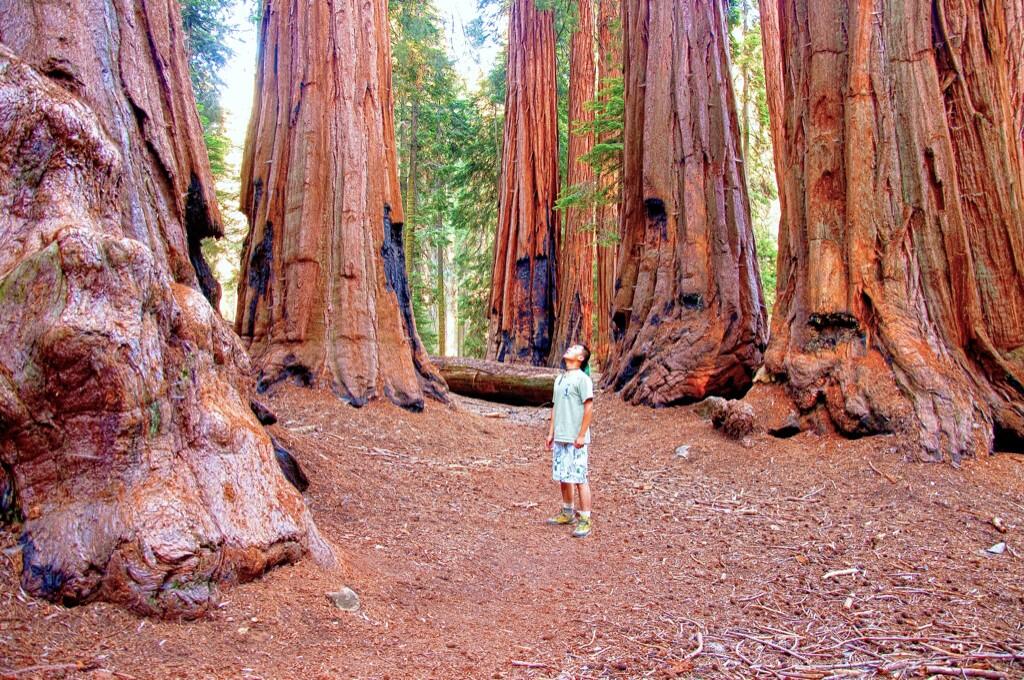
Giant redwoods in Sequoia-Kings National Parks

US Department of Interior, May 30, 2013 – Sometimes you have to look up to appreciate the beauty of America’s great outdoors. @SequoiaKingsNPS


Quote of the moment: Rachel Carson, on why her nature writing sounds so much like poetry

June 14, 2013

Rachel Carson said:

“If there is poetry in my book about the sea, it is not because I deliberately put it there, but because no one could write truthfully about the sea and leave out the poetry.”

Cover of The Gentle Subversive, by Mark Hamilton Lytle, for Oxford University Press.

Cover of The Gentle Subversive, by Mark Hamilton Lytle, for Oxford University Press.

Bug Girl wrote a fine review last year of an often over-looked book on Carson, The Gentle Subversive: Rachel Carson, Silent Spring, and the Rise of the Environmental Movement  (Mark Hamilton Lytle, 2007. Oxford Univ. Press.)  It’s worth your click over there to read a nice piece on Carson, on women in science, and on nature writing.

Bug Girl spends the necessary time and space answering critics of Carson, of Silent Spring, and those few odd but incredibly active and loud advocates who claim we can conquer disease if we can only spread enough DDT poison around the Earth.  Go see.

I find it impossible to stand in a place like Yosemite and not hear John Muir‘s voice — and it’s probably that John Muir found that, too.  Or stand on the shores of Waldon Pond and not hear Henry David Thoreau, or stand on sandy soil in Wisconsin and not hear Aldo Leopold, or sit on a redrock outcropping in southern Utah and not hear Ed Abbey.  They probably heard similar voices.  But they had the presence of mind to write down what they heard.

Writing wonderful prose, or poetry, must be easier when the subject sings of itself in your ears, and paints itself in glory for your eyes.

If Carson’s prose borders on poetry, does that add to, or subtract from its science value?

More:

U.S. President Theodore Roosevelt (left) and n...

U.S. President Theodore Roosevelt (left) and nature preservationist John Muir, founder of the Sierra Club , on Glacier Point in Yosemite National Park. In the background: Upper and lower Yosemite Falls. Wikipedia image


“Hit the trail!” June 1 is National Trails Day

June 1, 2013

National Trails Day logo

National Trails Day is the first Saturday in June, each year.

June 1 is National Trails Day, celebrated the first Saturday of June each year.  It’s a day designated by hikers and users of trails, the people who use trails for health, fun and adventure.

This should be a particularly American, and broadly celebrated event.  We are a nation of trails throughout our history — including in no particular order the Natchez Trace, the Chisholm Trail, various Trails of Tears, the Cumberland Trail, the Oregon Trail, the Overland Trail, the Goodnight Trail, the Santa Fe Trail, the Mission Trails, and countless others.  We fly across the continent in five hours today; when European explorers came, they explored the place on foot, first.  When humans migrated across the Bering Land Bridge, they came on foot, and populated the Americas from the Arctic Circle to Tierra del Fuego.

Hiking is much of who we are.

When is National Trails Day®?

This year National Trails Day® will occur on June 1, 2013. National Trails Day is always the first Saturday in June.

What is National Trails Day®?

American Hiking Society‘s National Trails Day® (NTD) is a celebration of America’s magnificent Trail System, occuring annually on the first Saturday in June. NTD features a series of outdoor activities, designed to promote and celebrate the importance of trails in the United States. Individuals, clubs and organizations from around the country host National Trails Day® events to share their love of trails with friends, family, and their communities. NTD introduces thousands of Americans to a wide array of trail activities: hiking, biking, paddling, horseback riding, trail running, and bird watching and more. For public and private land managers alike, National Trails Day® is a great time to showcase beautiful landscapes and special or threatened locales as thousands of people will be outside looking to participate in NTD events.

National Trails Day® evolved during the late ‘80s and ‘90s from a popular ethos among trail advocates, outdoor industry leaders and political bodies who wanted to unlock the vast potential in America’s National Trails System, transforming it from a collection of local paths into a true network of interconnected trails and vested trail organizations. This collective mindset hatched the idea of a singular day where the greater trail community could band together behind the NTD moniker to show their pride and dedication to the National Trails System.

View the National Trails Day® historical timeline.

Why Celebrate Trails?

America’s 200,000 miles of trails allow us access to the natural world for recreation, education, exploration, solitude, inspiration, and much more. Trails give us a means to support good physical and mental health; they provide us with a chance to breathe fresh air, get our hearts pumping, and escape from our stresses. All it takes is a willingness to use them!

National Trails Day® also aims to highlight the important work thousands of volunteers do each year to take care of America’s trails. Trails do not just magically appear for our enjoyment; their construction and maintenance takes hours of dedicated planning and labor. So give thanks to your local volunteers and consider taking a day to give back to your favorite trail.

Who Can Host a National Trails Day® event?

Anyone can host a National Trails Day® event. If you need help with programming ideas or would like more information, take some time to read through the materials on the host information page. There you will find all the information you need to host a successful event. Once you’ve planned the event, remember to register it!

Who Can Attend a National Trails Day® event?

Anyone is allowed to attend public NTD events, unless otherwise noted. All public events are listed under the event search page. Events registered as “private” will not appear on the event search page.

What Kinds of Events are Included?

National Trails Day® events involve a broad array of activities, including hiking, bike riding, trail maintenance, birding, wildlife photography, geocaching, paddle trips, trail running, trail dedications, health-focused programs, and children’s activities. Whatever you like to do outdoors, there is bound to be an event to fit your interests. If you don’t find the type of event you want, then plan it yourself — and be sure to register it.

How do Trails Make You Healthy?

Trails give you the opportunity to get your heart pumping, lungs expanding, and muscles working at various levels of difficulty, thereby improving your physical as well as mental well-being. With obesity rates skyrocketing, exercise is increasingly important, and trails provide a wide variety of opportunities for being physically active.

Does National Trails Day® have to be the first Saturday in June?

If your organization has a conflict with the first Saturday in June, plan your National Trails Day® event for a day or weekend that works best for you. No matter what day you choose, be sure to register your event with American Hiking Society; the national attention will draw more participants and media, and American Hiking Society will help you throughout the entire planning process.

Looking for ways to get involved year round?

Become a member of American Hiking Society or join the Alliance of Hiking Organizations.

Got a picture of your favorite trail?  Send it in, or link to it in comments.

Menunkatuck Blue-Blazed (CFPA) Trail. Particip...

Menunkatuck Blue-Blazed (CFPA) Trail. Participants in the National Trails Day 2010 inaugural Menunkatuck Trail hike sponsored by the Connecticut Forest and Park Association (CFPA), Guilford Conservation Land Trust (GCLT) and the New Haven Hiking Club (NHHC). Wikipedia photo

More:


Poster for World Turtle Day (May 23)

May 23, 2013

World Turtle Day, Share the Roads!

Nice reminder, featuring an Eastern Box Tortoise (I think). Image from Conscious Companion.


More:


May 23 is World Turtle Day

May 23, 2013

English: Turtles. Français : Tortoises. Deutsc...

English: Turtles. Français : Tortoises. Deutsch: Schildkröten. Griechische Schildkröte (Testudo graeca). ¼. Klappschildkröte (Cinosternum pensylvanicum). ¼. Sumpfschildkröte (Cistudo lutaria). ¼. Matamata (Chelys fimbriata). 1/16. Großkopfschildkröte (Platysternum megalocephalurn). ¼. Lederschildkröte (Dermatochelys coriacea). 1/20. Karettschildkröte (Chelone imbricata). 1/20. (Photo credit: Wikipedia)

Just found out.  Never heard of it before — and I’m rather a turtle & tortoise kind of guy, so you’d think I’d know that.

May 23 is World Turtle Day.  In fact, this is the 13th World Turtle Day.

No grand pronouncements from Congress, probably — American Tortoise Rescue picked a day, and that was that.

American Tortoise Rescue (ATR) is sponsoring its 13th annual World Turtle Day 2013 on May 23rd.  The day was created as an annual observance to help people celebrate and protect turtles and tortoises and their disappearing habitats around the world.  Susan Tellem and Marshall Thompson, founders of ATR, advocate humane treatment of all animals, including reptiles.  Since 1990, ATR has placed about 3,000 tortoises and turtles in caring homes.  ATR assists law enforcement when undersize or endangered turtles are confiscated and provides helpful information and referrals to persons with sick, neglected or abandoned turtles.

“World Turtle Day was started to increase respect and knowledge for the world’s oldest creatures.  These gentle animals have been around for about 200 million years, yet they are rapidly disappearing as a result of the exotic food industry, habitat destruction, global warming and the cruel pet trade,” says Tellem. “We are seeing smaller turtles coming into the rescue meaning that older adults are disappearing from the wild thanks to the pet trade, and the breeding stock is drastically reduced.  It is a very sad time for turtles and tortoises of the world.”  (See slide show here http://www.slideshare.net/tellem/where-have-all-the-turtles-gone.)

Turtles, Tortoises, and Terrapins are reptiles...

Turtles, Tortoises, and Terrapins are reptiles of the Order Testudines (all living turtles belong to the crown group Chelonia), most of whose body is shielded by a special bony or cartilagenous shell developed from their ribs. (Photo credit: Wikipedia)

Tellem says, “We are thrilled to learn that organizations throughout the world now are observing World Turtle Day, including those in India, Australia, the UK and many other countries.”  Tellem notes that biologists and other experts predict the complete disappearance of these reptiles within the next 50 years.  She recommends that adults and children do a few small things that can help to save turtles and tortoises for the next generation:

  • Never buy a turtle or tortoise from a pet shop as it increases demand from the wild.
  • Never remove turtles or tortoises from the wild unless they are sick or injured.
  • If a tortoise is crossing a busy street, pick it up and send it in the same direction it was going – if you try to make it go back, it will turn right around again.
  • Write letters to legislators asking them to keep sensitive habitat preserved or closed to off road vehicles, and to prevent off shore drilling that can lead to more endangered sea turtle deaths.
  • Report cruelty or illegal sales of turtles and tortoises to your local animal control shelter.
  • Report the sale of any turtle or tortoise of any kind less than four inches.  This is illegal throughout the U.S.

“Our ultimate goal is to stop the illegal trade in turtles and tortoises around the world.  Our first priority here in the U.S. is to stop pet stores and reptile shows from selling illegal hatchling tortoises and turtles,” says Thompson.  “We also need to educate people who are unfamiliar with their proper care about the real risk of contracting salmonella from turtles.  Schools and county fairs are no place for turtles. Wash your hands thoroughly every time you touch a turtle or its water, and do not bring turtles into homes where children are under the age of 12.”

For answers to questions and other information send e-mail to info@tortoise.com; on Twitter @tortoiserescue; “Like” American Tortoise Rescue at www.Facebook.com/AmericanTortoiseRescue; and join World Turtle Day on www.Facebook.com/WorldTurtleDay.

Here’s to you Freddie, the Western Box Tortoise from Idaho, and Truck, the desert tortoise from Southern Utah, the friends of my youth.  And all you others.

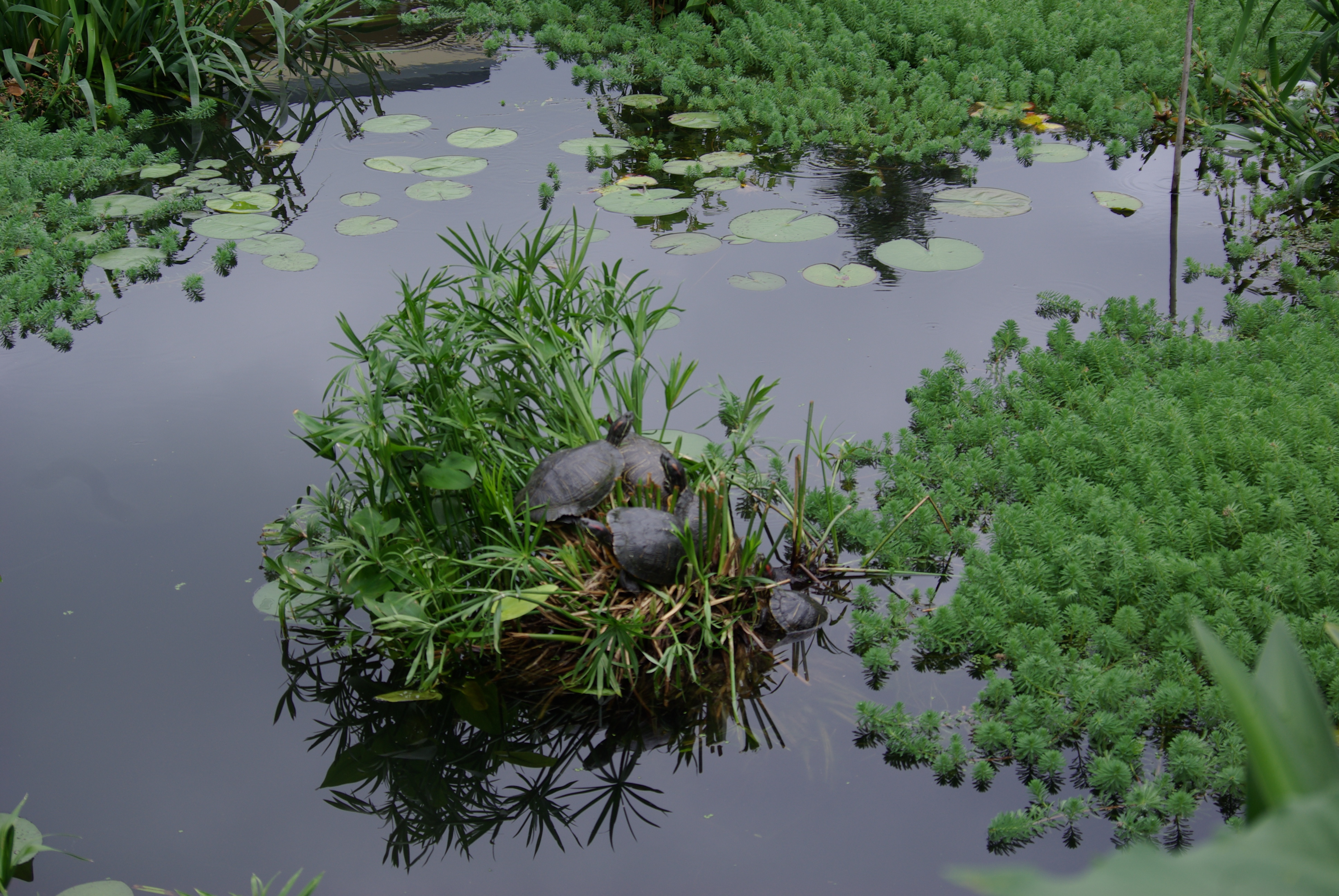
Red-eared sliders, turtles at Texas Discovery Gardens - photo by Ed Darrell

Red-eared sliders cluster together to catch the sun on a spring day at Texas Discovery Gardens at Fair Park in Dallas. Photo by Ed Darrell, 2010

More:


Grosbeak!

May 1, 2013

Our goldfinches left several weeks ago.  The cedar waxwings came through in at least three big waves, starting in February (and the last just over a week ago).  House finches moulted, and the breeding males have bright red heads. Migrating robins left us by the end of January, but a lot more residents stayed with us.

We have at least one, and maybe three cardinal families.  A black-capped chickadee family stuck around.  Haven’t seen a titmouse in a month, but I think they’re still in the neighborhood.  The black-chinned hummingbird family is back, and maybe a few other hummers.  The resident blue jays and white-winged doves duke it out every day.  Carolina wren stayed, and may have already fledged; but there are too many wrens for one family — is that a Bewick’s wren?

What’s THAT?

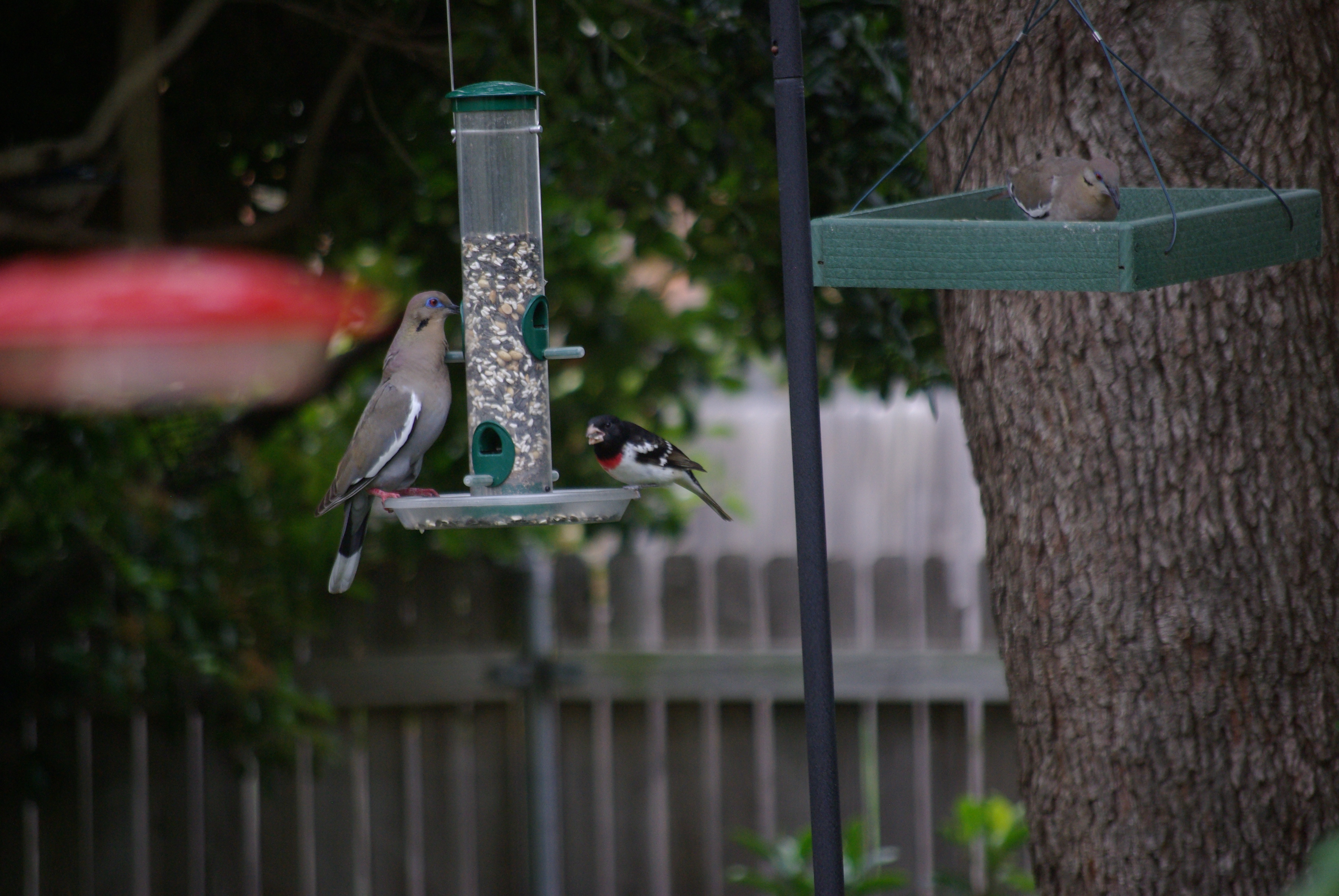
White winged dove and rose-breasted grosbeaki

White-winged dove, left, can’t scare away the rose-breasted grosbeak from the songbird feeder. Photo by Ed Darrell

IMGP4861

Look closer. Photo by Ed Darrell

It’s a rose-breasted grosbeak, Pheucticus ludovicianus.  It seems late for migrating birds, but only because so many migratory species migrate earlier these days.

Haunts of the rose-breasted grosbeak, from Cornell University's ornithological laboratory.

Haunts of the rose-breasted grosbeak, from Cornell University’s ornithological laboratory.

Would love to have a grosbeak family, but the Cornell ornithologists say this is fly-through territory.  Maybe that explains why it won’t scare by the white-winged dove, Zenaida asiatica.  Dallas is the western edge of the grosbeaks’ migratory path, but the eastern edge of the dove’s territory.  They probably don’t see much of each other.

We don’t even advertise clean restrooms.

More: