Here’s an ass you’ll really like, if you have room

July 12, 2012

Wild burros on the range, USA - Wikipedia

Wild burros on the range – Wikipedia photo

If you’re in Lubbock this weekend, and if you have a corral that needs an equine inhabitant, you can buy an ass — a burro — from the Bureau of Land Management.  Or a horse.

Do a favor for some ass today, if you can:

From the coolly-named Lubbock Avalanche-Journal (some links added):

Wild horse, burro auction set at Panhandle-South Plains Fairgrounds

More than 50 animals are expected to be adopted.

Posted: July 11, 2012 – 11:13pm  |  Updated: July 12, 2012 – 12:32am

By ELLYSA GONZALEZ

AVALANCHE-JOURNAL

The United States Bureau of Land Management will host a wild horse and burro adoption at the Panhandle-South Plains Fairgrounds today through Saturday.

More than 50 animals are expected to be adopted.

According to a news release, animals are periodically removed from the range to “maintain healthy herds” and protect the land. It says more than 225,000 wild horses and burros have been adopted since 1973.

The animals are described as “iconic symbols of America’s western heritage.”

Adoption fees will start at $125, as set by law.

The age requirement to adopt an animal is 18. Buyers must have no animal abuse on their records as well as room for the animal to dwell.

Buyers’ records will be checked at the time of adoption.

At least 400 square feet of corral space is required per animal as well as a 6-foot corral fence for adult horses and a 5-foot fence for yearlings. Animals must also have access to food, water and shelter.

Buyers must load animals in covered stock-type trailers with swing gates and sturdy walls and floors, according to the news release.

People who adopt horses at least 4 years of age will receive a one-time care-and-feeding allowance of $500 from the bureau after one year upon receiving official ownership titles.

The news release states that no younger horses, burros and trained animals are eligible for the allowance.

Adoptions will be from 2-6 p.m. today, 8 a.m.-6 p.m. Friday and 8 a.m.-noon Saturday. Animals are available on a first-come, first-served basis.

Bureau staff will be available at the site to help with loading, questions and applications. The fairgrounds are located at the northeast corner of Broadway and U.S. 87.

For more information, call (866) 468-7826 or visit http://www.blm.gov/nm/oklahoma.

Adopted wild burro, Wikipedia image

A formerly wild burro after adoption. 2005 photo from Wikipedia

By the way, you’re qualified to participate in discussions here, right?  I mean, you do know the difference between a burro and a burrow, don’t you?

More: 


Turk’s Cap, native Texas flower in 90 seconds

June 26, 2012

Short piece from Texas Parks & Wildlife:

Turk’s cap is a native Texas shrub that attracts hummingbirds, butterflies and moths. This easy-to-care for plant is named for the shape of its small blooms. To learn more about Texas native species and habitats, see http://www.tpwd.state.tx.us/huntwild/wild/wildlife_diversity/

Must admit I was unaware it’s a Texas native, though Kathryn has had it in all of our Texas gardens.  I love the blossoms.  I wish our local hummingbirds loved it as much as the photo in the video shows, but we have other plants they love and a feeder.  Butterflies like it, too.

Few other plants equal the intense red of the flowers.  Turk’s cap requires less water than many less spectacular, non-native plants.  Ours keep coming back year after year.  What more do you want in a good garden plant?

I wish my photos were so good as those used in the film.

More, and related material:


Possibly more ‘possum

March 19, 2012

More shots of our rather tame, wild neighbor.

Possum on the fence in Dallas IMGP8930 - Ed Darrell photo, creative commons

S/he may have been trying to reach the safety of the area under the heat pump -- but the dogs caught on, and "treed" it on the fence. I worried about rabies, but it seemed healthy.

I’m torn, really — are they cute, or really ugly?

Possum in Dallas IMGP8937 - Ed Darrell photo, creative commons

Walt Kelly would have been pleased at its familiarity with the idea of a mugwump, as it demonstrates, here.

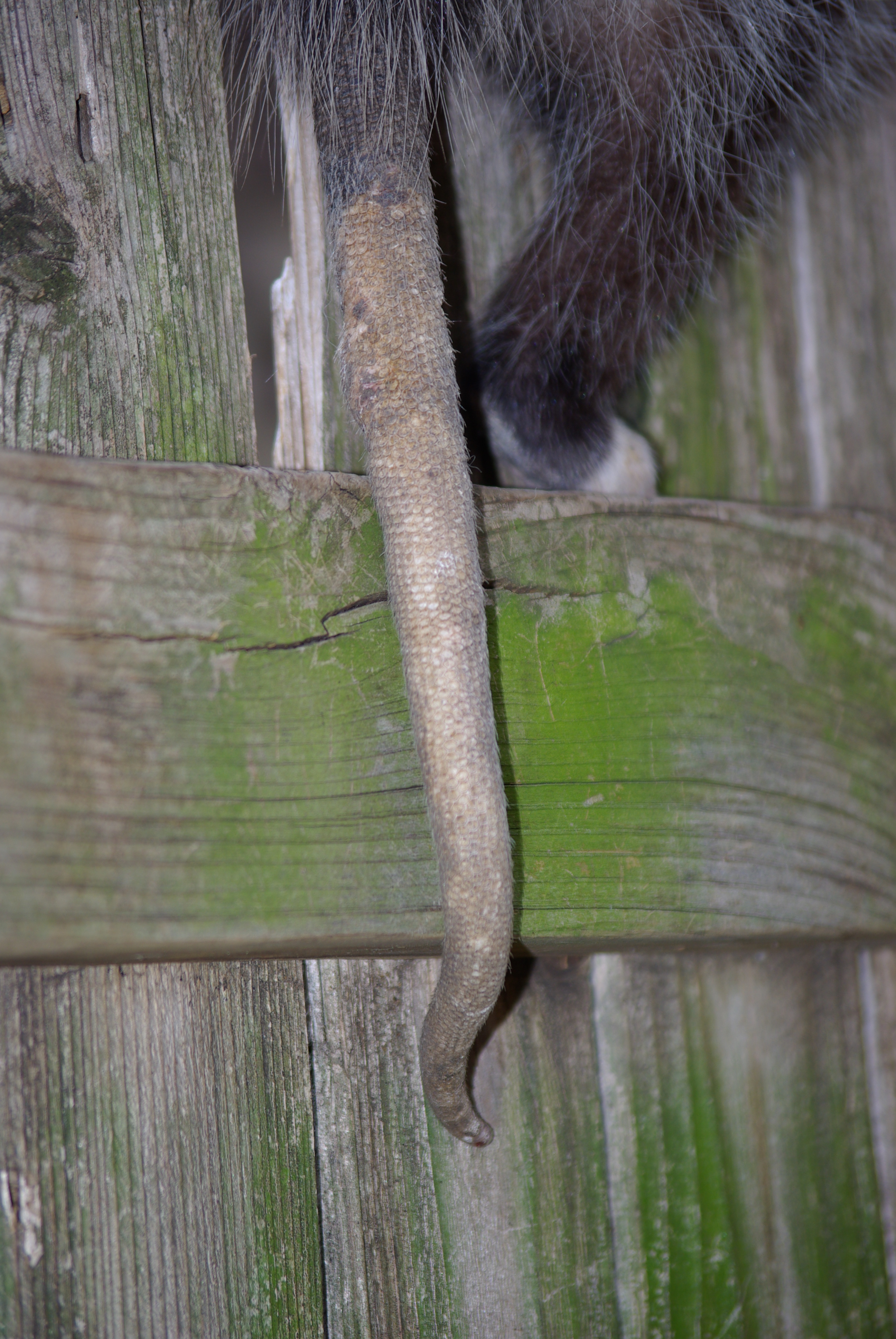
A possum's tail IMGP8935 - Ed Darrell photo, creative commons

The hairless, "rat" tail is one of the least attractive features. How much cuter would it be with a furry tail?

Possum on the fence - IMGP8933 Ed Darrell photo, creative commons

He does have a very cute, pink nose, however. You could get used to dealing with these little guys.


Playing with the ‘possum in the backyard

March 17, 2012

No, not “playing possum.”  Playing WITH the ‘possum.

The mostly-dachsund harasses any animal that may wish to take up residence under our shed — or, in some cases, under the heat pump.  The animals usually stick around for a while, though, because there is so much good stuff to dig up there.  For our part, we don’t mind when they dig up and dispose of the grubs, most of the time.

But these creatures — a possum, a raccoon a couple of years ago, armadilloes from time to time, or even rats (before Smokey the cat took them out, one by one) — eventually wander off, mostly unseen by us because they’re nocturnal.

Yesterday morning both dogs went nuts, and when I looked out, I realized they had something treed.  Between the mostly-dachsund and the border setter, they average out to a couple of beagles, and they can tree something if they want to.  Can’t get it, but they can tree it.

Possum on the fence IMGP2893 (2) photo by Ed Darrell creative commons copyright

It's an election year, so why shouldn't one of Pogo's cousins be on the fence?

It’s probably the same one I saw a few weeks ago when taking coffee grounds to the compost pile (maybe the caffeine is keeping this guy up days, eh?).  Kenny caught him crossing the alley late one night, in the headlights, of course.

I brought the dogs in, and turned them out an hour later, thinking the guy had plenty of time to get to his daytime hiding place.

They treed him again. (Actually, that’s the second treeing, pictured above.)

Later they got him on the fence in a different part of the yard.

Possum in dallas, peeking through the photinia

Possum caught in the early morning, peeking through the Chinese photinia (not red tip). Flash photography confuses the little guys, I think.

By this time I worried that the critter might be suffering from an illness — like rabies, which tends to make nocturnal animals come out in daylight, and be mean.

But there are no other symptoms.  I was relieved this morning to find new digs from the critter.  If he, or she, is digging for food, it’s probably not rabid.

In his jaunts around the world last year Kenny mentioned how ugly possums are, to one of his friends from Britain, who immediately took issue.  Cute?

Turns out Kenny’s friend was referring to the Australian possum, which is quite cute.

Australian ring-tailed possum, photo by kookr

Australian ring-tailed possum, photo by kookr. Australia has 27 different species of possum, all of them cuter and more cuddly than their American cousins.

Ours is not an Australian import.

I hope the bob whites come back, too.  Maybe it was just the drought that discouraged them last year.

It’s been a good year for wildlife, at least those with wings.  One day last week we had a tree full of cedar waxwings, passing through.  Blue jays and white-winged doves flew around them, and into the same tree.  There were a bunch of robins out — making eight weeks of sightings of the things, which leads me to understand some sizable population is staying in the Dallas area now, instead of just migrating through as they would, formerly.  On the live oak, the yellow-belly sapsucker probed for new grubs.  And on the trunk of the red oak the waxwings gathered in, another woodpecker, wholly oblivious to the cacophony, looked for emerging insects itself.   On local roads I’ve seen a bobcat — first for Texas, for me — and a few coyotes (while cousin-in-law Amanda has video of what looks to be wolves, in California!).  We haven’t gone out to look at the snowy owl in Rockwall, but there’s a chance of adding a rarity to the life-list.

With luck, we’ll get the toads, soon.  We should do well — Kathryn’s worked hard to make the yard a refuge for wildlife.  We’re mostly organic, so there should be no poisons to accumulate in any insect-eating critters.  We feed birds, several different species, and we have water for animals in front and back yard.  The National Wildlife Federation will certify your yard as a backyard wildlife habitat.  Working to get there is most of the fun; watching the wildlife is the gravy.

Backyard wildlife study is great fun.

More:


More misunderstanding of the case against DDT

December 21, 2011

Well-meaning but misinformed dog breeder Terrierman (a guy who goes by the handle PBurns, too)  is just the latest to fall victim to false and nearly false claims about DDT and its effects on birds.

One of the claims made by pro-DDT and anti-environmental protection, anti-science groups is that DDT is not the bad guy in bird deaths.  The late DDT-nut Gordon Edwards said DDT had nothing to do with eagle deaths, and pointed to the 300-year decline in eagle populations from the time European settlers began shooting at them.  This idea has been touted by the chief junk science purveyor, Steven Milloy, and by many others over the years.

So, in one of his several posts slamming eagle conservation efforts that include stopping the use of DDT, Terrierman said:

What’s the story? Simple: that Bald Eagles and Osprey were pushed to the edge of extinction by DDT.

Not True.

Actually, that is true.  Terrierman got it wrong.  DDT was, indeed, threatening the very existence of the bald eagle.  While it is true that there were other pressures, some long-standing, it is also true that once those problems were cleared, DDT still barred the recovery of the eagle, plus other species like osprey, peregrine falcons, and brown pelicans.

What is the story?  The story is that eagles have been under assault since Europeans found America.  By 1900, eagle populations across North America were dramatically and drastically reduced.  A federal law in 1918 made it illegal to shoot eagles, but it had little effect.  A tougher law passed in 1940 finally got some traction.

But eagle recovery didn’t take off.  In the late 1940s and early 1950s bird watchers, and bird counters like those volunteers who contribute to the annual Audubon Christmas Bird Count, noticed that young eagles disappeared.  Simply, adult, breeding eagles were not able to produce young who survived to migrate, mature, and breed later.

The culprit was DDT.  DDT kills young eagles in three ways, known in the 1960s.  It poisons them so they cannot grow in the egg.  It poisons them so they die after a period of growth.  It poisons them so they are unable to eat and digest properly, so they die shortly after they hatch.

DDT can also screw up the sexual organs of young birds, so they are unable to breed — perhaps a fourth way DDT kills young, by simply preventing their creation.

Then, in the 1970s, we found another way DDT kills species:  DDT makes the eagle hens unable to form competent eggshells.  The young die because the eggs cannot survive incubation.

DDT also kills adult eagles, especially migrating birds.  DDT accumulates in fat tissues, those fats that migrating birds burn.  When the birds migrate, the DDT comes out, and it can literally stop the heart or brain of the bird in flight.  (It kills bats the same way.)  Birds lost in migration rarely get found for necropsy.   The bird count simply falls, the population sinks one individual closer to extinction.

Does the dog breeder know all of this?  I can’t tell — I tried to correct his errors at his blog site, but after I provided a link to an article that showed DDT appears to be harming California condors as well — in a post he has censored in moderation and which will never see the light of day at Terrierman, I predict — it’s clear he’s not up to gentle correction.

One more blog from which I am banned from telling the facts.

PBurns, if you’re bold enough to comment here, your comments won’t be censored (so long as not profane).  We need robust discussion, and I encourage it.

Below the fold — my final post to Terrierman, which he won’t allow through moderation.

Read the rest of this entry »


Can the Houston toad survive Texas wildfires and droughts?

November 25, 2011

New short from the Texas Parks and Wildlife people:

The smoke may be gone but the Bastrop fires of Labor Day weekend are still a smoldering concern for biologists. They’re keeping tabs on the Houston Toad. And with only an estimated 2,000 left in Texas, this endangered species is facing its next challenge as the drought continues. More on Houston toads at http://www.houstonzoo.org/HoustonToad/

For background, see this earlier reel from TPWS on the fires at Bastrop State Park:


Joy of pollination, according to Louie Schwartzberg

November 21, 2011

It’s a TEDS Talk, of course

Birds do it, bees do it, even educated fleas do it.  Plants do it, too, but often with the help of animals.

Here are some of the most glorious pictures of sex you’ll ever see, filmed by Louie Schwartzberg.  Anyone who has ever tried to take a good photograph should marvel at these shots, and the skill and artistry and luck it took to get them:

What will we do if the bees vanish?

The lowdown:

http://www.ted.com Pollination: it’s vital to life on Earth, but largely unseen by the human eye. Filmmaker Louie Schwartzberg [of Moving Art] shows us the intricate world of pollen and pollinators with gorgeous high-speed images from his film “Wings of Life,” inspired by the vanishing of one of nature’s primary pollinators, the honeybee.


Glories of Glacier N.P.

November 6, 2011

Seven-plus minutes of good reason to get your tail to Glacier National Park as soon as you can.

Produced and shot by Joshua Thompson, this is part of an award-winning film made to promote the park and get money for the research that the park hosts.

Grizzly Bears, Bighorn Sheep, spectacular sunsets and more…..

Part 3 of the recently shot Glacier DVD. This 20 min. film recently was nominated for best new nature documentary in the music category as well received an award for photography from the Wildlife Film Festival held in May of 2008. All funds for this project are being donated to the Glacier National Park Fund. For more info: http://www.glaciernationalparkfund.org/cart.php?page=glacier_national_park_fu…

I’ve been there only once.  A wise American would get there before turning 35, and return several times.


Amazing film – Flight of the eagle owl

October 8, 2011

Imagine for a moment that you are a wee little mousie, sitting on a tuft of grass nibbling on a seed. You think you feel a breath of a breeze from in back of you and you turn around to see this beautiful thing

Vodpod videos no longer available.

Amazing nature – The Eagle Owl, posted with vodpod

Beautiful, but terrible, too.

Owls fly silently. Their feathers have evolved to move without rustles, to let the wind slip through them without making a whish. Owls demonstrate evolution at its mightiest, and nature, as the poets note, “red in tooth and claw.”

Filmed at 1000 frames per second, according to Dogworks.com.  According to Vurtrunner at YouTube, filmed with a
Photron Full HD High Speed Camera SA2.

I’d like to know more about this film.  Trained owl?  Wild owl enticed by what kind of bait?  Longer movie about eagle owls?  I’m not familiar with them.  So many little mysteries on the internet.

_____________

Update:  From YouTube’s account of SloMoHighSpeed:

New Photron SA-2 High Definition High Speed Camera. Shot of ‘Checkers’ the eagle owl, 1000fps 1920×1080 resolution. Shot by SlowMo (www.slowmo.co.uk). See the owl and other birds of prey at www.turbarywoods.co.uk.

From Wikipedia

The Eurasian Eagle-owl (Bubo bubo) is a species of eagle owl resident in much of Europe and Asia. It is also one of the largest types of owls.

*   *   *   *   *   *

The Eagle Owl is a large and powerful bird, smaller than the Golden Eagle but larger than the Snowy Owl. It is sometimes referred to as the world’s largest owl, but this is actually the Blakiston’s Fish Owl, which is slightly bigger on average.[2][3] The Eagle Owl has a wingspan of 138–200 cm (55–79 in) and measures 58–75 cm (23–30 in) long. Females weigh 1.75-4.5 kg (3.9-10 lbs) and males weigh 1.5-3.2 kg (3.3-7 lbs).[4][5][6] In comparison, the Barn Owl weighs about 500 grams (1.1 lbs).

Tip of the old scrub brush to Kathryn.


Big cats and laser pointers?

September 20, 2011

Oh, yeah, we know what you teachers do with your fancy laser pointers in the off-hours.  When you’re not torturing your students with Death by PowerPoint, highlighting the vocabulary words, pointing out the routes on the maps, and generally making your students a little jealous of your tools, you take the lasers home to torture your kitties.

If you’re a teacher with a science bent, you might even do a little experimentation:  Do cats chase green lasers, too?  Blue ones?  What about those filters that make starbursts, do they drive cat’s wild?

Ah, but teachers with a science bent, and access to some really big cats . . .

From Big Cat Rescue:

Q: Do Tigers, Leopards & Lions chase laser pointers like domestic cats? Big Cat Rescue decided to find out! …

Do BIG CATS like catnip?? Check out the video! http://www.youtube.com/watch?v=tklx3j7kgJY

For more info about BIG CAT RESCUE visit: http://www.bigcatrescue.org
Find us on FACEBOOK: http://www.facebook.com/pages/Big-Cat-Rescue-Tampa-FL/122174836956?ref=sgm
MYSPACE: http://www.myspace.com/1bigcatrescue
TWITTER: http://twitter.com/BigCatRescue
DONATE: http://bigcatrescue.com/donate/

THANK YOU!

If you text TIGER to 20222 *A one-time donation of $10 will be added to your mobile phone bill or deducted from your prepaid balance. Standard messaging/data rates may apply. All charges are billed by and payable to your mobile service provider. Service is available on most carriers. Donations are collected for the benefit of the Big Cat Rescue by the Mobile Giving Foundation and subject to the terms found at http://www.mobilecommons.com/t/. You can unsubscribe at any time by texting STOP to short code 20222; HELP to 20222 for help.

Tip of the old scrub brush to Ed Yong at Not Exactly Rocket Science.


“Out of Yellowstone,” Nature Conservancy film on surviving the winter, and surviving the future

September 19, 2011

It seems like just a few months ago that Kathryn the Trophy Wife™ and I honeymooned in Yellowstone National Park, for a glorious January week.  On more than one occasion we had Old Faithful all to ourselves — it seemed like such an indulgence.

Seems just a few months ago, but that was before the 1988 fires, before our 1989 vacation there, before our 2004 ceremony casting the ashes of brother Jerry and his wife Barbara to the Yellowstone winds.

Will Yellowstone be there for our children, and for our grandchildren, as it has been for my lifetime?  The Nature Conservancy produced a 16-minute film showing much of the glory of winter of the place, and talking about the problems.

For the deer, elk and pronghorn in and around Yellowstone National Park, surviving the winter means finding adequate food and areas with low snow accumulation. But this critical winter range is increasingly threatened by energy and residential development. At stake is the very future of the Greater Yellowstone region’s iconic wildlife. This film highlights the voices of those working together to save these magnificent herds: ranchers, conservationists, scientists and others. http://www.nature.org/yellowstone

Growing up in the Mountain West, I learned to appreciate the stark beauty of the cold northern desert — but seldom is that beauty captured on film so well as it is here.  Phlogiston Media, LLC, made a remarkable, beautiful film, about a remarkable, beautiful land threatened by gritty, banal and mundane development.

This movie has been viewed only 542 times when I posted it.  Spread the word, will you?


Plan to save the spotted owls

August 2, 2011

A lawyer complains in the Wall Street Journal that the plan from the U.S. Fish and Wildlife Service (USFWS) intended to help the endangered spotted owl should be dismissed because, well, the spotted owl is still endangered, and after all, didn’t the spotted owl personally shut down the entire lumber industry in the Northwest?

Well, no, the owl didn’t shut down the mills.

But before we discuss, can we at least read the shorthand version of what USFWS has to say?  Here’s the press release on the plan:

Plan Marks New Route for Recovering Northern Spotted Owl and Promoting Healthy Northwest Forests

Contact:
Janet Lebson
503-231-6179
janet_lebson@fws.gov


The U.S. Fish and Wildlife Service today released a final revised recovery plan for the threatened northern spotted owl, stepping up actions that so far have helped stem but not reverse the old-growth forest raptor’s decline. The revised plan identifies three main priorities for achieving spotted owl recovery:  protecting the best of its remaining habitat, actively managing forests to improve forest health, and reducing competition from barred owls, a native of eastern North America that has progressively moved into the spotted owl’s range in Washington, Oregon, and northern California.

“For more than 20 years, northern spotted owl recovery has been a focal point of broader forest conservation efforts in the Pacific Northwest,” said Robyn Thorson, the U.S. Fish and Wildlife Service’s Pacific Northwest Regional Director. “This revised recovery plan is based on sound science and affirms that the best things we can do to help the spotted owl turn the corner are conserving its habitat, managing the barred owl, and restoring vitality to our forests.”

The U.S. Fish and Wildlife Service will use the recovery plan to work with land managers in the Pacific Northwest such as the U.S. Forest Service and Bureau of Land Management, as well as other federal and non-federal landowners, to advise them on habitat management activities that can benefit the spotted owl and contribute to improved forest health.

Because about 20 million acres of U.S. Forest Service lands and about 2 million acres of Bureau of Land Management lands are potentially affected by recovery plan recommendations, the three agencies worked together on key recommendations related to forest management. Both agencies provided formal letters of support for the plan’s recovery goals.

“This recovery plan is a welcome update to the state of the science surrounding the northern spotted owl,” said Cal Joyner, Deputy Regional Forester for the Pacific Northwest Region of the U.S. Forest Service. “The plan will help us implement a mix of actively managing and protecting habitat to best contribute to conservation and recovery.”

“The recovery plan provides space to develop ecological forestry principles and to actively manage our public forests to achieve the twin goals of improving ecological conditions and supplying timber,” said Ed Shepard, Oregon/Washington State Director for the Bureau of Land Management. “We look forward to continuing our close cooperation with the Fish and Wildlife Service as we put the science from the recovery plan to work in our planning, in evaluating proposed timber projects, and in improving forest health.”

Overarching recommendations in the revised plan include:

  • Conservation of spotted owl sites and high-value spotted owl habitat across the landscape. This means the habitat protections provided under land use plans on federal land will continue to be a focus of recovery, but protection of other areas is likely needed to achieve full success (including some of the lands previously slated for potential timber harvest on federal lands, and possibly non-federal lands in certain parts of the owl’s range where federal lands are limited).
  • Active management of forests to make forest ecosystems healthier and more resilient to the effects of climate change and catastrophic wildfire, disease, and insect outbreaks. This involves an “ecological forestry” approach in certain areas that will restore ecosystem functioning and resiliency. This may include carefully applied prescriptions such as fuels treatment to reduce the threat of severe fires, thinning, and restoration to enhance habitat and return the natural dynamics of a healthy forest landscape. The U.S. Fish and Wildlife Service recommends this approach in areas where it promotes ecosystem function and is in the best long-term interest of spotted owl recovery. The agency also strongly affirms adaptive management principles to continually evaluate and refine active forest management techniques.
  • Management of the encroaching barred owl to reduce harm to spotted owls. Most of the recovery actions the U.S. Fish and Wildlife Service has carried out since finalizing the spotted owl’s 2008 recovery plan deal with the barred owl threat. A major part of this is developing a proposal for experimental removal of barred owls in certain areas to see what effect that would have on spotted owls, and then to evaluate whether or not broad scale removal should be considered. This portion of the 2008 plan was not significantly revised.

“While the new recovery plan has been refined and improved from the 2008 version, the U.S. Fish and Wildlife Service continues to implement the most important recommendations,” said Acting U.S. Fish and Wildlife Service Director Rowan Gould. “We have begun to address the barred owl threat, improved survey protocols, and developed incentives for private landowners to voluntarily participate in recovery actions. We look forward to expanding conservation partnerships to contribute to the spotted owl’s recovery.”

Since the northern spotted owl was listed as threatened under the Endangered Species Act (ESA) 21 years ago, the U.S. Fish and Wildlife Service and recovery partners are benefitting from far more information on what factors most affect its survival and productivity. This includes a broader body of scientific knowledge on the species itself and forest ecosystem dynamics — including variables such as climate change and the role of natural disturbances such as wildfire. Recovery partners also are taking advantage of new science and technology to develop more precise tools for analyzing how different strategies can contribute to recovery.

In addition, land managers have made significant strides in advancing active forest management techniques to promote the health and resilience of forest ecosystems. The recovery plan emphasizes the concept of adaptive management to apply new knowledge and science to those techniques on an ongoing basis. This is a more mainstream approach today than in 1994 when the Northwest Forest Plan was created to address the needs of several forest-dependent species, including the spotted owl, and the region’s timber industry.

The U.S. Fish and Wildlife Service developed a final recovery plan specific to the spotted owl for the first time in 2008. As the agency and recovery partners moved forward in implementing many recommendations in the 2008 plan, the U.S. Fish and Wildlife Service initiated a targeted scientific revision to some portions of that plan after facing legal challenges and critical reviews from leading scientific organizations in the conservation community.

The U.S. Fish and Wildlife Service tapped the knowledge and perspectives of public and private sector experts over the last two years in developing this revised plan, the draft of which was released in September 2010. The agency held more than 30 workshops and meetings with public and private partners throughout the spotted owl’s range to share information, evaluate options, and incorporate valuable input during the revised plan’s development. The U.S. Fish and Wildlife Service accepted public comments on the draft revised plan for a 90-day period and received more than 11,700 comments. In April 2011, the agency released an updated Appendix C, relating to a new habitat modeling tool, for an additional 30-day public comment period and received about 20 public comments.

The revised recovery plan does not include recommendations from the 2008 plan for a new habitat conservation network of “Managed Owl Conservation Areas.” Rather than creating a potentially confusing new land classification, the plan identifies the scientific rationale and parameters for habitat protection and will revise the spotted owl’s designated critical habitat to reflect the latest scientific information about areas essential for the owl’s recovery. Identifying this habitat through the critical habitat process — as the ESA intended — will be more efficient and provide land managers and the public with additional opportunities for review and comment.

For a recovery timeline, Frequently Asked Questions, related information, and the recovery plan itself, visit www.fws.gov/oregonfwo.

America’s fish, wildlife and plant resources belong to all of us, and ensuring the health of imperiled species is a shared responsibility. The Service is working to actively engage conservation partners and the public in the search for improved and innovative ways to conserve and recover imperiled species. To learn more about the Service’s Endangered Species program, go to http://www.fws.gov/endangered/.

The mission of the U.S. Fish and Wildlife Service is working with others to conserve, protect and enhance fish, wildlife, plants and their habitats for the continuing benefit of the American people. We are both a leader and trusted partner in fish and wildlife conservation, known for our scientific excellence, stewardship of lands and natural resources, dedicated professionals and commitment to public service. For more information on our work and the people who make it happen, visit www.fws.gov. Connect with our Facebook page at www.facebook.com/usfws, follow our tweets at www.twitter.com/usfwshq, watch our YouTube Channel at http://www.youtube.com/usfws and download photos from our Flickr page at http://www.flickr.com/photos/usfwshq.

-FWS-

Stay tuned for the response, and my response to the response.

_____________

Oooooh, bonus!  Story in the Daily Astorian says saving the spotted owl habitat also ties up carbon, helping out with the fight against global warming.


Watching the drought roll in at Colorado Bend State Park

July 6, 2011

It took me a couple of tries to figure it out — last week when I told people Kathryn and I were off to Colorado Bend State Park to spend time on the river, several people commented about how much cooler it would be there.

What?  West of Killeen about an hour, ten miles of dusty road outside of Bend, Texas (population 1,637), Colorado Bend is not cooler than Dallas.  It was over 100° F every day we were there, stayed well above 90° most  of the nights.

Kathryn Knowles checking wildflowers, Colorado River, Texas

Kathryn studied wildflowers at a spring at the side of the Colorado River during a break from kayaking; this spring's flow was reduced, but still moist enough to create a near-oasis.

Our well-wishers were geographically confused.  They thought we were headed to the Colorado River in Colorado, not the Colorado River in Texas, which is not the same river at all.  I didn’t bother to check the temperatures in Colorado, but one might be assured that it was cooler along the Colorado River in Colorado than it was along the Colorado River in Texas.

It was a return trip.  We stumbled into the park 16 years ago with the kids, for just an afternoon visit.  The dipping pools  in the canyon fed by Spicewood Springs captivated us.  It took a while to get back, and then the kids were off doing their own thing.

So, just a quick weekend of hiking/camping/kayaking/soaking/stargazing/bird watching/botanical and geological study.   Park officials closed the bat caves to human traffic in hope of keeping White Nose Syndrome from the bats; we didn’t bother to sign up for the crawling cave tour through another.

Ed Darrell at Colorado Bend State Park, Texas

The author, still working to master that Go-Pro camera on the hat -- some spectacular shots, but I don't have the movie software to use it all; you know it's hot when SPF 75 sunscreen is not enough.

What did we see?  Drought has a firm grip on Texas, especially in the Hill Country, especially outside of Dallas.  The Colorado River  is mostly spring fed; many of the springs are dry.  No water significant water flowed through the park while we  were there — kayak put-ins have been reduced to the downriver-most ramp, and the bottom of the boat launch ramp is three feet above water.  Gorman Falls attracts visitors and scientists, but the springs feeding it are about spent this year — just a few trickles came over the cliff usually completely inundated with mineral-laden waters.

Drought produces odd things.  The forest canopy around the park — and through most of the Hill Country we saw — is splattered with the gray wood of dead trees, many of which at least leafed out earlier this spring.  The loss to forests is astonishing.  Deer don’t breed well in droughts; deer around the campsites boldly challenge campers for access to grasses they’d ignore in other seasons.  One ranger said he hadn’t seen more than about three fawns from this past spring, a 75% to 90% reduction in deer young (Eastern White Tail, the little guys).  Raccoons are aggressively seeking food from humans, tearing into tents and challenging campers for food they can smell (lock your food in the car!).  Colorado Bend is famous for songbirds, including the endangered Golden Cheeked Warbler, and the elusive, spectacular painted bunting.  But the most commonly-sighted birds this year are turkey vultures, dining on the young that didn’t make it healthy into the summer and won’t survive until fall.

Warming denialists’ claims of “not so bad a drought” ring out as dangerous, wild delusion.  (By actual measurement, Texas average rainfall the past nine months was 8.5 inches, the driest ever recorded in Texas, shattering the old record drought of 1917).

Great trip.  Kathryn’s menu planning was spectacular.  The old Coleman stove  — a quarter century old, now, with fuel almost that old — performed like a champ even without the maintenance it needs (later this week).  Other than the hot nights, it was stellar.

Stellar.  Yeah.  Stars were grand.  It was New Moon, a happy accident.  A topic for another post, later.  Think, “Iridium.”

So posting was slow over the weekend.  How far out in the Hill Country were we?  Neither one of us could get a bar on our phones.  We were so far out the Verizon Wireless guy was using smoke signals.

Thoreau was right, you know.


Bull baiting bill not appearing ready, Utah legislator proposes for killing horses instead

January 20, 2011

You couldn’t make this stuff up, and if you did, you should see a therapist.

As the Utah 2011 legislative session gets underway, state Rep. Curt Oda wasted no time in introducing a bill that reflects his legislative priority. He is not using his position as a legislator, however, to try to create jobs, improve schools, or protect children, for example. Instead, his bill, H.B. 210,  encourages the torture and killing of animals.

Oda wants to amend the state’s animal cruelty law, Section 76-9-301, to exempt “pests” and “feral” animals from the definition of animal. This means that to the extent they were protected, these animals would no longer be protected by the state’s animal cruelty law. Oda is reported to have told a local newspaper that “feral” animals and “pests” could be shot with a bow and arrow, for example, decapitated or clubbed to death.

Why kill horses with such brutality?  Dog fighting and cock fighting clearly wouldn’t fly?  Bear baiting won’t work — not enough bears?  Surely there are more humane ways to deal with “pest” animals.


Butterflies are free, to move about the country

October 24, 2010

Great mysteries of science, history and spirit call to us:  How do the monarch butterflies do it?

Monarch butterflies (Danaus plexippus) fly north from their enclave in Mexico every spring, stopping to lay eggs on milkweed plants.  After a migration of several hundred miles, that first group that left Mexico dies off.  Their offspring hatch in a few days, devour the milkweed, make a chrysalis, metamorphose into butterflies, then fly farther north, where they repeat their parents’ behavior:  Lay some eggs, and die.  Within three generations, they’ve spread north into Canada.

Kathryn's butterfly plantings, October 2010 - photo by Ed Darrell

Inviting the monarchs in: You can see how Kathryn worked to attract butterflies. In this photo, you can see the butterfly weed (a milkweed), red Turk's cap, and blue ageratum especially for the monarchs.

Then the fourth generation does something so strange and wonderful people can’t stop talking about it:  They fly back to Mexico, to the same trees their great-great-great grandparents left.  There they sip some nectar, get some water, and spend a lot of time hanging in great globs, huddling over the winter, to start life for generations of monarch butterflies the next spring.

Sometimes in Texas in October, we can see clouds of monarch butterflies winging south.  If we’re lucky, they stop to visit our backyards and gardens, and we might provide some water and nectar to urge them homeward.  Kathryn, of course, plants the stuff the monarchs like, to help them, and to give us a chance to see them.

Monarch habitat in Mexico is under severe stress and threat.  Late storms and early freezes decimated monarch populations over the last decade [yes, that’s the proper use of “decimated;” look it up].  Human plantings are more critical to the monarch butterflies than ever before.

Two years ago Kathryn and I spent a September morning outside the library at Lawrence University, in Appleton, Wisconsin, watching monarchs sip nectar from local flowers for their journey.  Those same butterflies — we hope — passed through Texas a couple of weeks later.

Two weeks ago . . . well, see for yourself:

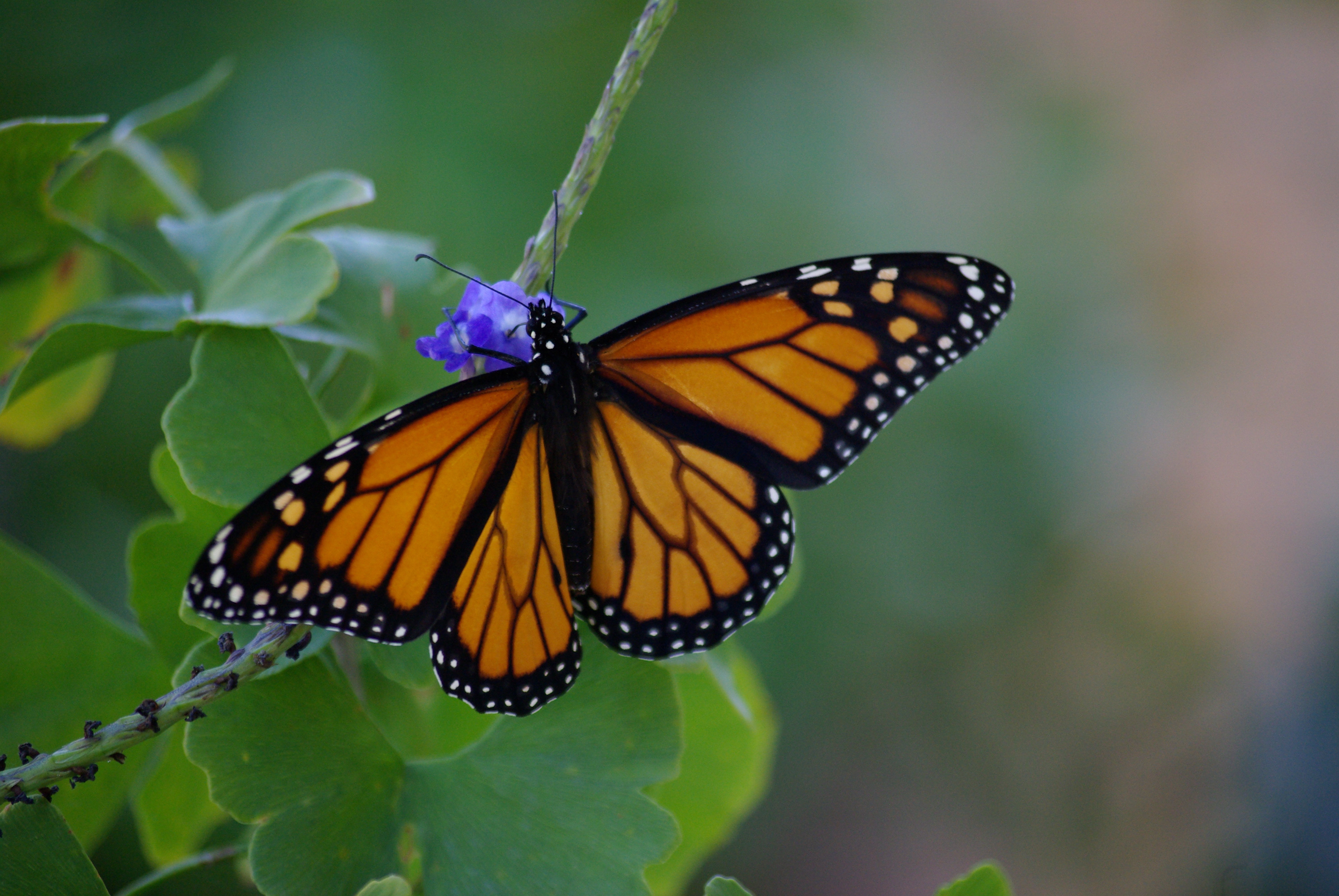
Monarch butterfly on blue porterweed, Dallas, TX October 2010 - photo by Ed Darrell IMGP5343

A monarch butterfly feeds on blue porterweed in Kathryn's garden, October 2010 - photo by Ed Darrell

Monarch butterfly on blue porterweed, Dallas, October 20101 - photo by Ed Darrell IMGP5347

. . . we're here with the camera, little guy, just open up those wings, please . . .

Monarch  butterfly on blue porterweed, Dallas, Texas October 2010 - photo by Ed Darrell IMGP5345

That's it! Beautiful! Have a safe trip, and come back next spring, will you?

Resources, more:

Conoclinium coelestinum