100 years of Eagle Scouts

August 1, 2012

Today marks the 100th anniversary of the Eagle Scout rank, awarded first to Scout Arthur Eldred.  2.1 million Eagles so far.

Do you have an Eagle Scout in your family?  Tell us about it in comments.

Also:


Celebrate Social Security “birthday,” August 14, 2012 at FDR Library

August 1, 2012

Press release from the FDR Presidential Library and Home; some informational links added here:
FOR IMMEDIATE RELEASE
For press inquiries: Cliff Laube (845) 486-7745

FDR Presidential Library and Museum to host

2012 NATIONAL BIRTHDAY PARTY FOR SOCIAL SECURITY

August 14, 2012 at 11:00 a.m.
Henry A. Wallace Center at the FDR Presidential Library and Home

Reservations are required as seating is limited. For reservations call co-chair Stefan Lonce at (914) 629-4580.

HYDE PARK, NY — The Franklin D. Roosevelt Presidential Library and Museum will host a 2012 National Birthday Party for Social Security at 11:00 a.m. on Tuesday, August 14, 2012. Event co-chair Dr. Christopher Breiseth, Francis Perkins Center board member and former President and CEO of the Roosevelt Institute, will lead the festivities. The program will celebrate the 77th Anniversary of the signing of the Social Security Act by President Franklin D. Roosevelt with readings of the 1935 and 1983 social security signing statements, “A Promise to All Generations: Stories and Essays about Social Security and Frances Perkins” (co-edited by Dr. Breiseth), and “Driving with FDR: A Calendrical Biography.” The forthcoming book “Driving with FDR” is written by event co-chair Stefan Lonce, editor of The Montauk Sun newspaper.

Attendees will celebrate the occasion with refreshments — including two special birthday cakes — and free admission to the Roosevelt Library’s current special exhibition, “The Roosevelts: Public Figures, Private Lives,” the largest photography exhibit ever assembled on the lives and public careers of Franklin and Eleanor Roosevelt. This program will be held in the Henry A. Wallace Visitor and Education Center at the FDR Presidential Library and Home.

Reservations are required as seating is limited. For reservations call co-chair Stefan Lonce at (914) 629-4580.

The Franklin D. Roosevelt Presidential Library and Museum is dedicated to preserving historical material and providing innovative educational programs, community events, and public outreach. It is one of thirteen presidential libraries administered by the National Archives and Records Administration. For information about the FDR Presidential Library call (800) 337-8474 or visit www.fdrlibrary.marist.edu.

Historic Hyde Park is a group of government and private non-profit organizations based in Hyde Park, New York. Each has a unique mission, but all are united in their dedication to extending the legacy of Franklin and Eleanor Roosevelt to new generations. HHP includes the Franklin D. Roosevelt Presidential Library and Museum, the Home of Franklin D. Roosevelt National Historic Site, Eleanor Roosevelt National Historic Site, the Eleanor Roosevelt Center at Val-Kill, the Franklin and Eleanor Roosevelt Institute, and Vanderbilt Mansion National Historic Site. For more information about HHP visit www.HistoricHydePark.org.

# # #

Composite photo of people at FDR's signing of Social Security Act -- SSA image

From Social Security Administration: There were many photographs taken of the Social Security Act signing ceremony. The posing was different in many of the photographs and in no single photograph are all the participants visible. This composite photograph shows all of the participants in a single image. (See identification below)

People listed in the photograph, according to the Social Security Administration, “Who is who, and why they were there”:

1. Rep. Jere Cooper (D-TN). Cooper was a member of the House Ways and Means Committee and would go on in subsequent years to become something of an expert on Social Security topics and he was a major force in Social Security legislative developments during the 1940s to the mid-1950s. Mr. Cooper also rose to the position of Chairman of the Ways & Means Committee during the Eighty-fourth and Eighty-fifth Congresses.

2. Rep. Claude Fuller (D-AR). Fuller was a member of the Ways & Means Committee and was generally opposed to the Administration’s bill. During Committee consideration he made motions seeking to strike key provisions of the legislation. But when his efforts failed, he compromised with the Administration and joined in voting for passage of the bill.

3 . Rep. Robert Doughton (D-NC) was chairman of the House Ways and Means Committee. As such he was the principal official sponsor of the legislation in the House.

4. Rep. Frank Buck (D-CA) was a second-generation industrialist and fruit grower from California. He was a member of the House Ways & Means Committee, which had jurisdiction of the bill in the House. He graduated from Harvard Law School and served five terms in Congress, from 1933 until his death in 1942. (Representative Buck has often been misidentified in photos of the signing as being Edwin Witte. Witte, in fact, was not in the signing photographs.)

5. Rep. John Boehne, Jr.(D-IN) succeeded his father as a representative from Indiana. He was first swept into office in the 1932 elections with President Roosevelt and strongly supported FDR’s programs. At first, he was against the Social Security bill and wanted to exempt industrial employers with their own pension systems.

6 . Sen. Robert Wagner (D-NY) was born in Germany, immigrated to New York City, attended law school and was elected to the Senate in 1926. He served four terms. He was a close associate of Frances Perkins and helped draft several early New Deal measures. Wagner introduced the bill into the Senate. His son, Robert F. Wagner, was mayor of New York City for 16 years.

7 . Sen. Alben Barkley (D-KY) was a seven-term Congressman before being elected to the Senate in 1926. By 1937, he was Senate Majority Leader and a decade later, Vice President of the United States. He was an ardent New Dealer and helped shepherd the Social Security Act through the Senate. He argued for “a universal and uniform program in general.” He didn’t want to exempt certain private groups merely because they already had pension systems, as was proposed by some conservatives in the Congress.

8 . This individual is presently unknown.

9 . Sen. Robert LaFollette, Jr., (PROG-WI) was the eldest son of Robert LaFollette, a progressive Senator from Wisconsin and one-time presidential candidate. When his father died in 1925, Robert Jr., then only 30 years old, was appointed to succeed him. Initially elected as a Republican, LaFollette changed his party affiliation to the Progressive Party in 1934. LaFollette served on the House-Senate conference committee that drafted the final version of the Social Security bill. He served in the Senate until 1946, when he was defeated by Joseph McCarthy. In 1953, LaFollette committed suicide in Washington, D.C.

10 . Rep. John Dingell, Sr. (D-MI). Rep. Dingell was a member of the House Ways & Means Committee. He was a prominent leader in Congress in sponsoring social insurance legislation and teamed with Senator Wagner he authored a couple of important precursor bills to the Social Security Act. (Several authors have identified Dingell as “unidentified man” in some versions of the signing photo.)

11. Sen. Augustine Lonergan (D-CT) was a native of Connecticut and a graduate of Yale University. Although he was a four-term Congressman, he served only one term in the Senate. During the discussions on the Social Security bill, Lonergan gave information about various private insurance annuities to show how they compared to the social insurance program that was being proposed.

12 . Frances Perkins was appointed Secretary of Labor in 1933, making her the first woman to hold a cabinet-level position. Like FDR, she was a child of privilege, but became a strong advocate for the poor and working class. She began her career in New York City as a social worker and held several responsible State government jobs. She served as head of Roosevelt’s Committee on Economic Security, set up in 1934. The Social Security legislation sprang from this committee.

13. Rep. Frank Crowther (R-NY) was a Republican member of the House Ways & Means Committee;

14. Sen. William H. King (D-UT). King was a conservative Democrat and member of the Senate Finance Committee. King expressed persistent opposition to many features of the bill as it was being considered, and his support of the legislation was in doubt until the last possible minute. In the end, he voted for passage of the Social Security Act. (Senators King and Harrison have often been confused in the signing photos, including,we are embarrassed to admit, in SSA’s own OASIS magazine. Clue: King has a bowtie, Harrison has a regular long tie.)

15. Rep. David J. Lewis (D-MD) was a member of the House Ways & Means Committee and was probably the leading expert on social insurance legislation on the Committee. It was Lewis, a former coal miner and self-taught lawyer, who introduced the Social Security bill into the House on January 17, 1935. However, Chairman Doughton, exercising what he took to be the Chairman’s privileges, made a copy of Lewis’ bill and submitted it himself. Then he persuaded the House clerk to give him a lower number than Lewis’ copy. Newspapers then began calling the bill “The Wagner-Doughton bill.” When Lewis found out, he sputtered and swore, then went to work to understand every sentence and master the arguments in favor of the bill. And when David Lewis walked down the aisle of the House to debate on the bill’s behalf, he received a standing ovation–a subtle rebuke to Chairman Doughton’s high-handed treatment.

16 . Sen. Byron Patton “Pat” Harrison (D-MS) was a Congressman for 8 years before being elected to the Senate in 1918. In his book “The Development of the Social Security Act,” Edwin Witte gives Harrison credit for his “adroit” handling of the Social Security bill in the Senate Finance Committee. According to Witte, Title II would not have been approved by the Committee without Sen. Harrison’s help. Harrison went on to serve in the Senate for the rest of his life and was elected President pro tempore 6 months before his death in June 1941. (In other versions of the signing photo, Sen. Harrison can be more clearly seen wearing a white suit and tie and holding his trademark cigar.)

17. Sen. Joseph Guffey (D-PA) was 65 years old at the time the Social Security Act was passed, although he was only a first-term Senator. From Pennsylvania, he served two terms before being defeated in 1946. His vote on the Social Security bill was in doubt until the final roll call.

18. Senator Edward Costigan (D-CO), a member of the Finance Committee.

19. Rep. Samuel B. Hill (D-WA) was a member of the House Ways & Means Committee.

20. Rep. Fred Vinson (D-KY) was a member of the House Ways & Means Committee. He would go on to serve as Secretary of the Treasury and as a Justice and Chief Justice of the Supreme Court.

21 . President Franklin D. Roosevelt.

NOTE: For more biographical information on any of the members of Congress see the U. S. Senate Biographical Directory of the United States Congress on the Senate website

Astonishing to me that one person in the photograph remains unidentified.  Can you help identify the man?

More:


Desperate Republicans? Recycling four-year-old PhotoShop hoaxes . . .

July 31, 2012


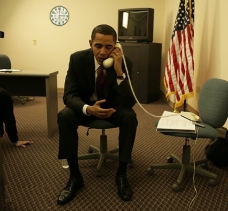
This is an encore post, from August of 2008.  We need to recall, an issue early in the Democratic primaries was ‘who would you want on the Hotline at 2:00 a.m.’  Sometime before the end of the primaries, a jokester mashed up a photo of candidate Barack Obama, changed the line on the phone handpiece, and added a clock at 3:00 a.m. on the wall. 

Republicans picked up on the photo, and thinking it a real photo, shipped it around during the general campaign.  It was a hoax then, and it still is.  I found it today on Facebook, and found people defending the hoax photo as real.  Oy, it will be that kind of election as Republicans get more desperate and more crude.  The encore post:

Dennis at Thinking in a Marrow Bone — not an Obama supporter, mind you — posted a conversation he had with a guy who posted a hoaxed photo of Barack Obama, purporting to show him holding a landline telephone upside down.

This is the hoax photo

The real photograph. Notice there is no clock on the wall, and the phone works properly. By the way, the suit fits, too — Obama’s a very tall man, and that’s what a well-fitting suit looks like on a tall man sitting in a low chair.


Dennis called him on the hoax. After a few rounds of weak defense, and then moral waffling of significant proportion, the hoaxer deleted the comments from his blog. Dennis preserved the conversation at TMB.

Moral of the story: Don’t believe much of what you hear or see, without corroboration. If a claim casts aspersions on someone, and comes on the internet, check it out before granting credence. Thanks to Dennis, an honest guy, for exposing the hoax and preserving the record of it.

Hoaxers are malicious and will do almost anything to damage Obama, even if it requires bringing down the U.S. and burning the flag. No wonder George Washington wanted out of this sort of politics.

Question: What’s the deal with the clock in the doctored photo? [Oh – it says “3:00 o’clock”]

Honor roll: Bloggers and others who exposed the hoax:

Dishonor roll, the Little List, bloggers who tried to perpetrate and perpetuate the hoax, or who got suckered themselves:

Special Consideration:


Test “priming”: Malcolm Gladwell on how to push test results, and why tests might not work

July 31, 2012

Who is the interviewer, Allan Gregg?

From the YouTube site:

Malcolm Gladwell in an interview about Blink explains priming, and re-states some of the examples of priming from Blink with CC (closed captions)

Here’s a longer excerpt of the interview; from TVO (TVOntario)?

Discussion:  Gladwell appears to confirm, for testing results, the old aphorism attributed to Henry Ford:  “If you think you can, or if you think you can’t, you’re right.”  Gladwell seems to be saying that the student’s view of his or her abilities at the moment the test starts rules in a significant way how the student performs — worse, for teachers, it’s the student’s unconscious view of his or her abilities.  As a final shot in class, I have often had students predict their performance on state tests.   I have them write what they think they will scores.  Then I ask them to predict what they would have scored, had they applied themselves seriously to study of history — and of course, almost always the students have a fit of honesty and predict their scores would have been higher.  Then I ask them to pretend they had studied, and cross out the lower predicted score and replace it with the higher predicted score.  At the schools where I’ve taught, we do not administer the tests to our own students, and such exercises are prohibited on the day of the test.  Too bad, you think?

Another exercise I’ve found useful for boosting scores is to give the students one class period, just over an hour, to take the entire day-long TAKS social studies test, in the on-line version offered by the Texas Education Agency.  Originally I wanted students to get scared about what they didn’t know, and to get attuned to the questions they had no clue about so they’d pick it up in class.  What I discovered was that, in an hour, clearly with the pressure off (we weren’t taking it all that seriously, after all, allowing just an hour), students perform better than they expected.  So I ask them to pass a judgment on how difficult the test is, and what they should be scoring — almost unanimously they say they find the test not too difficult on the whole, and definitely conquerable by them.

What else could we do with students, if we knew how to prime them for tests, or for writing papers, or for any other piece of performance on which they would be graded?

With one exception, my administrators in Dallas ISD have been wholly inuninterested in such ideas, and such results — there is no checkbox on the teacher evaluation form for using online learning tools to advance test scores, and administrators do not regard that as teaching.  The one exception was Dorothy Gomez, our principal for two years, who had what I regarded as a bad habit of getting on the intercom almost every morning to cheer on students for learning what they would be tested on.  My post-test surveys of students showed those pep talks had been taken to heart, and we got much better performance out of lower-performing groups and entire classes during Gomez’s tenure (she has since left the district).

Also, if psychological tricks can significantly affect test scores, surely that invalidates the idea that we can use any test score to evaluate teacher effectiveness, unless immediate testing results is all we want teachers to achieve.  Gladwell said in this clip:

To me that completely undermines this notion, this naive notion that many educators have that you can reduce someone’s intelligence to a score on a test.  You can’t.

More:


Another stunning time-lapse study of Yosemite, from Shawn Reeder

July 31, 2012

Clearly I need to intern with Shawn Reeder.  His piece on Yosemite shows the natural objects of beauty in their best lights, over and over:  “Yosemite Range of Light.”

Reeder and his project were described at the Sierra Club website:

The two-year project, Yosemite Range of Light, uses nearly 7,000 high-resolution still photos to create an inspiring vision of light and granite, capturing rolling cloud formations and the rainbow-lit waterfalls of Yosemite.

Reeder first came to Yosemite after winning a local waiter contest where he grew up in Maryland. First prize was a trip to Napa Valley wine-country, but the 18-year-old convinced the prize committee to offer a change of venue. Choosing Yosemite as his destination instead, he brought along his best friend, who happened to have a camera. . . .

“I came out for a week and I did my first backpacking trip ever. We hiked to the top of Half Dome via the cables, which was an incredible experience. We hiked the whole South-Rim Trail from Glacier Point to Tunnel View. It to

More:

English: Panorama of view of Yosemite Valley i...

Panorama of view of Yosemite Valley including Half Dome and Diving Board as seen from Glacier Point in Yosemite National Park. (Photo credit: Wikipedia)


Pixar’s 22 rules for a good story (how do they fit your organization?)

July 30, 2012

Pixar logo, with flourishes

From The Pixar Touch, a set of rules for writing a good story to translate to the screen.

Good rules to keep in mind for composition of stories in English, no?  Good rules of writing to keep in mind for any essay writing.

Where else do these rules apply?

Pixar story rules (one version)

Sunday, May 15, 2011 at 03:39PM

Pixar story artist Emma Coats has tweeted a series of “story basics” over the past month and a half — guidelines that she learned from her more senior colleagues on how to create appealing stories:

#1: You admire a character for trying more than for their successes.

#2: You gotta keep in mind what’s interesting to you as an audience, not what’s fun to do as a writer. They can be v. different.

#3: Trying for theme is important, but you won’t see what the story is actually about til you’re at the end of it. Now rewrite.

#4: Once upon a time there was ___. Every day, ___. One day ___. Because of that, ___. Because of that, ___. Until finally ___.

#5: Simplify. Focus. Combine characters. Hop over detours. You’ll feel like you’re losing valuable stuff but it sets you free.

#6: What is your character good at, comfortable with? Throw the polar opposite at them. Challenge them. How do they deal?

#7: Come up with your ending before you figure out your middle. Seriously. Endings are hard, get yours working up front.

#8: Finish your story, let go even if it’s not perfect. In an ideal world you have both, but move on. Do better next time.

#9: When you’re stuck, make a list of what WOULDN’T happen next. Lots of times the material to get you unstuck will show up.

#10: Pull apart the stories you like. What you like in them is a part of you; you’ve got to recognize it before you can use it.

#11: Putting it on paper lets you start fixing it. If it stays in your head, a perfect idea, you’ll never share it with anyone.

#12: Discount the 1st thing that comes to mind. And the 2nd, 3rd, 4th, 5th – get the obvious out of the way. Surprise yourself.

#13: Give your characters opinions. Passive/malleable might seem likable to you as you write, but it’s poison to the audience.

#14: Why must you tell THIS story? What’s the belief burning within you that your story feeds off of? That’s the heart of it.

#15: If you were your character, in this situation, how would you feel? Honesty lends credibility to unbelievable situations.

#16: What are the stakes? Give us reason to root for the character. What happens if they don’t succeed? Stack the odds against.

#17: No work is ever wasted. If it’s not working, let go and move on – it’ll come back around to be useful later.

#18: You have to know yourself: the difference between doing your best & fussing. Story is testing, not refining.

#19: Coincidences to get characters into trouble are great; coincidences to get them out of it are cheating.

#20: Exercise: take the building blocks of a movie you dislike. How d’you rearrange them into what you DO like?

#21: You gotta identify with your situation/characters, can’t just write ‘cool’. What would make YOU act that way?

#22: What’s the essence of your story? Most economical telling of it? If you know that, you can build out from there.

Presumably she’ll have more to come. Also, watch for her personal side project, a science-fiction short called Horizon, to come to a festival near you.

Tip of the old scrub brush to Farnam Street, who adds:

Still curious?Watch as Kurt Vonnegut explains the different shapes that stories can take.

Where else can you use this?

Consider the project you’ve got to lead, with one person from each department in your company.  What is your vision (the hackneyed but apt word) for how the project ends up?  Storyboard it — and keep in mind these 22 rules.  What’s the essence of your view of the project?  Can you tell it in a minute?  Get the story down to 30 seconds.  What are the stakes, if you get this project done well?  What are the stakes if you fail?   Everybody on the team knows the stakes?  Is your plan on paper?  Have you revised it?

More:


Quote of the moment: Hemingway, writers need “shock-proof, [excrement] detector”

July 30, 2012

Ernest Hemingway and cat Cristobal, Cuba; JFK Library collection

Ernest Hemingway with his cat, Cristobal, at his home, Finca Vigia, San Francisco de Paula, Cuba.  Date unknown (circa 1955?) Photo from Ernest Hemingway Collection, John F. Kennedy Presidential Library and Museum, Boston. (Copyright status unknown)

Was Ernest Hemingway the greatest writer in English of the 20th century?  Fortunately we don’t have to choose.  We can read Hemingway, and Faulkner (with whom he had a few bones to pick), and Hammett, and Parker, and Feynman, and Vonnegut, Bellow, Morrison, dos Passos,  Shaw, Kipling, Ford, Conrad and a dozen more, enjoying each for the gifts she or he demonstrated so well on a page.

Any way you stack it, though, Hemingway was a great one.

In an interview with George Plimpton, published in the Paris Review in 1958, Hemingway talked about what it takes to be a great writer.  Maybe it’s something one needs to be born with:

The most essential gift for a good writer is a built-in, shock-proof, shit detector. This is the writer’s radar and all great writers have had it.

If we could make a machine to substitute for that, a solid-gold, built-in, shock-proof [excrement] detector, we could improve writing, politics, government, business, and a hundred other fields of endeavor.

If we had a just and appropriately skeptical world, everyone would have one, a “solid gold, built-in, shock-proof [excrement] detector.”

What an enormous If.

Also at Millard Fillmore’s Bathtub:


Shorter Anthony Watts: Ignore cities, discount all NOAA sites that show warming, and global warming doesn’t look so bad

July 30, 2012

Since he prefers a Kim Jong Il-style commenter policy –“only those who flatter the Premier need comment” — Anthony Watts‘s site doesn’t get the pleasure of my visits much, anymore.  Consequently I missed the announcement he made last week that he was “suspending” his blog, at least temporarily, until some great news came out.

English: Anthony Watts, June, 2010. Speaking i...

Anthony Watts, June, 2010. Speaking in Gold Coast, Australia, on a tour searching to find some place on Earth not affected by global warming. (Photo: Wikipedia)

Now the great news is out.  I think.  Watts may have been right to suspend blogging.  He should have kept the suspension longer.

Watts says NOAA‘s temperature measurement in the U.S. is way off, and that if we ignore all the cities, and if we ignore sites that show the greatest increases in temperature over the past century or so, global warming doesn’t look so bad.

Watts said he is the lead author on a new paper questioning all warming calculations:

This pre-publication draft paper, titled An area and distance weighted analysis of the impacts of station exposure on the U.S. Historical Climatology Network temperatures and temperature trends, is co-authored by Anthony Watts of California, Evan Jones of New York, Stephen McIntyre of Toronto, Canada, and Dr. John R. Christy from the Department of Atmospheric Science, University of Alabama, Huntsville, is to be submitted for publication.

Wait a minute.  “Prepublication draft paper?”  ” . . . to be submitted for publication?”

Yes, Dear Reader, that claxon you hear is your and my Hemingway III Solid Gold [Excrement] Detectors™ going off.  It may be a false alarm, but still — isn’t this how bogus science is done, isn’t this what Robert Park warns us about?  Indeed, in the Seven Warning Signs of Bogus Science, Park says to pay attention to key indicators:  “1. The discoverer pitches the claim directly to the media.”  It is, indeed, a press release from Watts, about a paper he hopes to get through the peer review process at some point in the future — but it has not yet been pitched to the science journals.  (Yes, that’s also one of the Seven Warning Signs of Bogus History . . . one discipline at a time, please.)

What’s the rush?  Oh:  Tuesday, July 31, is the deadline for peer reviewed papers to be submitted to the international agency studying climate change, the Internatioinal  (IPCC), for consideration and inclusion in the next report.

Same old stuff, new day.  Watts has been arguing for years that NOAA’s temperature measurements err, but after the Berkeley Earth Surface Temperatures (BEST) Project determined that warming exists, even using Watts’s modified measurements and accounting for his claimed errors, some of us hoped Watts might turn to blogging about science, instead.

No, Watts turned to finding a hint of a methodology that might support his preconceived notions.  He found one.

So, Watts’s big announcement is that he’s found a methdology which favors his criticisms of NOAA; so we should ignore temperature readings from cities, because cities are hot, and we should ignore temperature readings from suburbs of cities, because suburbs are warm; and if we do that, then warming in the U.S. doesn’t look so bad.

Were I allowed to ask questions at Watts’s blog, I’d ask why we should ignore warming in cities, because are they not part of the planet?  Oh, well.

The Twitter version:

Watts: Ignore city temps (hot!) and ‘burbs (warm!), temps on farms don’t show so much global warming!  Oops – did we say that before?

Anthony, how about you suspend your blog until you get the paper accepted at a good journal?  Make sure you got the numbers right . . .

More:


Got Obama’s back, he’s got ours . . .

July 29, 2012

Not sure why I love this photo so:

President Obama poses for snapshots with citizens in a midwest cafe . . . summer 2012

President Obama poses for snapshots with people in a midwest cafe, summer 2012 – via Instagram

Partly it’s the spontaneity of the event.  You know that Barack Obama grins broadly into the cellphone camera or other small, amateur electronic camera on the other side.  The people on either side of him grin, too.

Partly it’s the ease with which the President of the United States becomes just Barry posing for pictures when people ask him to.

Partly it’s the serendipity of someone being wholly out of location to take the grinning teeth photo, but having the presence of mind to snap a picture from the back, showing not only the president at ease, but the people posing with him wholly comfortable with the situation — ‘hold on to each other, everybody smile . . . [click].’

Partly it’s the completely unexpected nature of the happenstance photo.  Were it posed, the flags would be bigger, posted correctly; the hand sanitizer would be moved out of the way.  Were it posed, the notices under the mints for sale would be moved, so the camera could see the other side.

I’m also fond of the wallpaper border that makes the top frame of the picture.

Someone sent me a link to the photo a few weeks ago.  I wish I could pin it down to location and date, and to who took the photo.


Ben Sargent gets to the truth on voter identification litigation . . .

July 29, 2012


As usual, Ben Sargent can help but blab the truth on voter identification and voter fraud.  From one of America’s great newspapers, the Austin (Texas) American-Statesman:

Ben Sargent on voter identification law litigation, July 16, 2012, Austin American-Statesman (Also Go Comics)

Ben Sargent in the Austin (Texas) American-Statesman, July 16, 2012 (Go Comics syndication)

More, earlier at Millard Fillmore’s Bathtub:

Other Resources:


Junk science in education: Testing doesn’t work, can’t evaluate teachers

July 29, 2012

Diane Ravitch, who once had the ear of education officials in Washington and would again, if they have a heart, brains, and a love for the U.S. defended teachers and teaching in a way that is guaranteed to make conservatives and education critics squirm

Cordial relations with Randi Weingarten may not rest well with our teacher friends in New York — but listen to what Dr. Diane Ravitch said at this meeting of the American Federation of Teachers.

  • “Teachers are under attack.”
  • “The public schools are under attack.”
  • “Teachers unions are under attack.”
  • “Public schools are not shoe stores.  They don’t open and close on a dime.”
  • “‘Value-added assessment,’ used as it is today, is junk science.”

If you care about education, if you care about your children and grandchildren, if you care about the future of our nation, you need to listen to this.


458

AFT HQ description:

Diane Ravitch, education activist and historian, rallied an enthusiastic audience at the AFT 2012 Convention with her sharp criticism of education “reform” that threatens public schools.

It’s all true.

More Resources and News:


Propaganda posters: J. C. Leyendecker’s Uncle Sam at bat (fit for August)

July 28, 2012

Get in the game with Uncle Sam, WWI poster by J. C. Leyendecker, Museum of Play image

“Get in the Game with Uncle Sam” poster from World War I, by J. C. Leyendecker in 1917 — image from National Museum of Play

No matter how much the Texas State Board of Education wishes to run away from America’s heritage, we can’t.

Nor should we want to.

Propaganda is not a bad word.  There is bad propaganda, stuff that doesn’t work.  There is propaganda for bad purposes, stuff that promotes bad policies, or evil.  But good propaganda is stronger, long-lasting, often full of great artistic merit, and instructive.

Images of Uncle Sam provide clear pictures of what Americans were thinking, from the oldest versions to today.

This poster above is a World War I poster designed to convince Americans to get involved in the war effort.  J. C. Leyendecker, a noted illustrator, cast Uncle Sam as a baseball player up to bat.  The poster says simply, “Get in the game with Uncle Sam.”  Perhaps uniquely, this poster showed Sam in yellow-striped pants, instead of the more traditional red-striped.  Could an artist take such liberty today?

Nicolas Ricketts at the Strong Museum of National Play offered a good, concise description of the politics and history of the poster at the blog for the Museum (links added for your convenience):

Meanwhile, then-president Woodrow Wilson, who had won reelection in 1916 on an anti-war platform, faced the need for American participation in the terrible “Great War” raging in Europe. He and his cabinet knew that American involvement loomed. But how could the government convince the American public that this was necessary? One idea was to create a poster that urged Americans to metaphorically “Get in the Game,” along with their patriotic national symbol, Uncle Sam.

Artist J. C. Leyendecker (1874-1951) designed the poster, commissioned by the Publicity Committee of the Citizens Preparedness Association, a pro-war organization with federal support which also sponsored “preparedness parades” and other nationalistic activities. Leyendecker himself emigrated from Germany at age eight and was approaching the pinnacle of his career in 1917 when he created this work.

The poster just preceded James Montgomery Flagg’s famous “I Want You” image of Uncle Sam, which later became the best-known likeness of the country’s unofficial symbol. Leyendecker’s version, in spite of his baseball bat, is possibly less affable to contemporary eyes than Flagg’s friendlier Sam. But the bat he holds connected him to many Americans, who perhaps then decided that America should “get in the game.”

Some of this older propaganda had a humorous twist I think is too often missing from modern posters.  It was more effective for that, I think.

The image of Sam at bat shows up in many places in the internet world, but most often stripped of its identifying links to Leyendecker.  That does disservice to the art, to history, and to Leyendecker, who was one of our nation’s better illustrators for a very long time.

Visit the National Museum of Play in Rochester, New York.

More posters, almost random, found through Zemanta:

English: Uncle Sam recruiting poster.

The most famous Uncle Sam recruiting poster, by James Montgomery Flagg (1917). (Photo credit: Wikipedia)

James Montgomery Flagg 1917 poster: "Boys...

James Montgomery Flagg 1917 poster: “Boys and girls! You can help your Uncle Sam win the war – save your quarters, buy War Savings Stamps” / James Montgomery Flagg . (Photo credit: Wikipedia)


Louisiana plans to use vouchers to teach creationism

July 27, 2012

News from the National Center for Science Education — I get e-mail, and it’s probably best to pass it along quickly, unedited, except for links in the text of the article, and the photo of Zack Kopplin, which I added:

VOUCHERS FOR CREATIONISM IN LOUISIANA?

Louisiana is about to spend almost twelve million dollars to fund the teaching of creationism, charges Zack Kopplin, famous for organizing the effort to repeal the so-called Louisiana Science Education Act. In Kopplin’s sights now is a controversial new voucher program in the state that uses public school funds to pay for tuition and certain fees at private schools for students who attend low-performing public schools and whose family income is below 250% of the federal poverty level. When the Board of Elementary and Secondary Education considered a set of accountability guidelines for such private schools at its July 24, 2012, meeting, Kopplin testified that of the roughly 6600 spaces available for students under the program, 1350 will be filled, as the Lafayette Independent Weekly(July 26, 2012) described it, “at private Christian schools that teach creationism and peg evolution as ‘false science.’”

Zack Kopplin, brave teen fighting for good science education in Louisiana

Zack Kopplin, brave teen fighting for good science education in Louisiana

According to the Alexandria Town Talk (July 25, 2012), “A number of the schools on the voucher list teach creationism, a doctrine that holds that God created all life out of nothing, and either don’t mention the theory of evolution or teach that it is false science. State Board of Elementary and Secondary Education [BESE] policy on teaching science requires that public schools teach what is in textbooks but they can supplement with BESE-approved material to promote ‘critical thinking’ on alternatives to evolution.” Superintendent of Education John C. White told the newspaper that BESE had approved the curriculum for all of the schools. “Not teaching evolution could show up in the required state testing for students receiving vouchers, he said, and there could be repercussions ‘if a school shows a fundamental disregard’ for conducting the test.”

Writing earlier in the New Orleans Times-Picayune (July 18, 2012) about Kopplin’s research on the private schools expected to receive new students through the voucher program, columnist James Gill commented, “It is impossible to prepare fully for such a massive reform as going voucher, and some undeserving private schools are bound to receive an OK from harried state officials. But a religious takeover on this scale cannot be accidental. Of the schools on Zack Kopplin’s list, one believes that scientists are ‘sinful men,’ and declares its view ‘on the age of the earth and other issues is that any theory that goes against God’s word is in error.’ Another avers that evolution is ‘extremely damaging to children individually and to society as a whole.’ A third tells students to write an essay explaining how ‘the complexity of a cell shows it must be purposefully designed.’ And so it goes.”

The creationist instructional material used by such schools include textbooks from Bob Jones University Press and A Beka Books — which were described by the University of California system in the ACSI v. Stearns case as “inappropriate for use as primary texts in college preparatory science courses due to their characterizations of religious doctrine as scientific evidence, scientific inaccuracies, failure to encourage critical thinking, and overall un-scientific approach” — and Accelerated Christian Education. A textbook from ACE that argued against evolution on the grounds that the Loch Ness monster not only exists but also is a living plesiosaur (incorrectly described as a dinosaur) understandably attracted the attention of The Scotsman (June 25, 2012) and was widely ridiculed nationally and internationally.

The voucher program is presently under legal challenge from the Louisiana Association of Educators and the Louisiana Federation of Teachers along with a number of local school boards. But the issue of the state’s funding the teaching of creationism is not part of the challenge. Rather, as the New Orleans Times-Picayune (July 10, 2012) explained, “Two key issues are at play in the voucher suit: whether providing private schools with money from the Minimum Foundation Program violates the [Louisiana state] constitution by redirecting those funds from public schools, and whether a last-minute vote setting the new MFP formula in place received enough support in the state House to carry the force of law.” The state will be allowed to implement the voucher program while the challenge works its way through the court system, the newspaper reported.

For the article in the Lafayette Independent Weekly, visit:
http://www.theind.com/news/11055-kopplin-state-paying-116m-to-schools-teaching-creationism

For the article in the Alexandria Town Talk, visit:
http://www.thetowntalk.com/article/20120725/NEWS01/120725003/Louisiana-vouchers-going-mainly-church-affiliated-schools

For James Gill’s column in the New Orleans Times-Picayune, visit:
http://www.nola.com/opinions/index.ssf/2012/07/vouchers_are_a_creationists_be.html

For NCSE’s collection of material from ACSI v. Stearns, visit:
http://ncse.com/creationism/legal/acsi-v-stearns

For the article in The Scotsman, visit:
http://www.scotsman.com/news/odd/loch-ness-monster-cited-by-us-schools-as-evidence-that-evolution-is-myth-1-2373903

For the article on the challenge to the voucher program in the New
Orleans Times-Picayune, visit:
http://www.nola.com/politics/index.ssf/2012/07/judge_denies_injunction_in_vou.html

And for NCSE’s previous coverage of events in Louisiana, visit:
http://ncse.com/news/louisiana

With all the troubles Louisiana has, with rebuilding from storms, a dysfunctional food distribution system, a dysfunctional health care distribution system, clean up from the Gulf oil spill of 2010, and erosion problems especially in the Gulf bordering parishes, why is Louisiana wasting time and brain power on creationism?


One more time: Intelligent design is a pig that still doesn’t fly

July 26, 2012

Gee, I think I first posted this more than a year before the Pennsylvania decision.  In any case, the subject has come up once again in another forum:  Why don’t we teach intelligent design as an “alternative” idea in public school science classes?  The answer is, simply, ID is not science.  It’s not an alternative hypothesis, it’s a chunk of minority cult religious dogma.
Most bad science claims recirculate year after year, until they are simply educated out of existence in the public mind.  We can hope intelligent design falls into that category.  But we might worry that modern creationism, begun as a backlash to the anti-Soviet, National Defense Education Act‘s effects on beefing up science teaching in American schools, survives.
Picture from Flying Pig Brewery, Seattle, Washington
Image: Flying Pig Brewing Co., Everett, Washington

[From 2006 and 2007]:

We’re talking past each other now over at Right Reason, on a thread that started out lamenting Baylor’s initial decision to deny Dr. Francis Beckwith tenure last year, but quickly changed once news got out that Beckwith’s appeal of the decision was successful.

I noted that Beckwith’s getting tenure denies ID advocates of an argument that Beckwith is being persecuted for his ID views (wholly apart from the fact that there is zero indication his views on this issue had anything to do with his tenure discussions). Of course, I was wrong there — ID advocates have since continued to claim persecution where none exists. Never let the facts get in the way of a creationism rant, is the first rule of creationism.

Discussion has since turned to the legality of teaching intelligent design in a public school science class. This is well settled law — it’s not legal, not so long as there remains no undisproven science to back ID or any other form of creationism.

Background: The Supreme Court affirmed the law in a 1987 case from Louisiana, Edwards v. Aguillard (482 U.S. 578), affirming a district court’s grant of summary judgment against a state law requiring schools to teach creationism whenever evolution was covered in the curriculum. Summary judgment was issued by the district court because the issues were not materially different from those in an earlier case in Arkansas, McLean vs. Arkansas (529 F. Supp. 1255, 1266 (ED Ark. 1982)). There the court held, after trial, that there is no science in creationism that would allow it to be discussed as science in a classroom, and further that creationism is based in scripture and the advocates of creationism have religious reasons only to make such laws. (During depositions, each creationism advocate was asked, under oath, whether they knew of research that supports creationism; each answered “no.” Then they were asked where creationism comes from, and each answered that it comes from scripture. It is often noted how the testimony changes from creationists, when under oath.)

Especially after the Arkansas trial, it was clear that in order to get creationism into the textbooks, creationists would have to hit the laboratories and the field to do some science to back their claims. Oddly, they have staunchly avoided doing any such work, instead claiming victimhood, usually on religious grounds. To the extent ID differs from all other forms of creationism, the applicability of the law to ID was affirmed late last year in the Pennsylvania case, Kitzmiller v. Dover. (Please go read that case!)

Read the rest of this entry »


LCV’s “Flat Earth Five,” targets for election defeat – two named, who are the last three?

July 26, 2012


Naming one of their top five targets per week, the League of Conservation Voters (LCV) will name three more Members of Congress to their “Flat Earth Five,” members who not only vote against LCV positions, but also seem to dwell among flat-Earth believers on science, generally.

First two of the Flat Earth Five:

  1. Rep. Ann Marie Buerkle (N.Y.)
  2. Rep. Dan Benishek (Mich.)

Who will fill the three remaining slots — and will they survive election?