Willie Nelson Blvd.

August 12, 2012


Willie Nelson Blvd, Austin, Texas - IMGP2228 photo by Ed Darrell (please attribute)

Waiting for the bats in Austin, and I looked up to find I was on Willie Nelson Boulevard!

A star on the sidewalk in Hollywood is nice, I suppose.  But how many recording or film artists get streets named after them in the capital city of their home state?

And, can you list that as a good reference on your sentencing report on a possession charge?

Details, from the Austin American-Statesman:

2nd Street renamed for Willie Nelson

By Sarah Coppola | Thursday, May 27, 2010, 10:55 AM

Part of Second Street will now bear the honorary name Willie Nelson Boulevard.

The City Council approved the change this morning as a tribute to the singer, who has lived in the Austin area nearly 40 years and sold more than 50 million records.

The city will install Willie Nelson Boulevard signs this summer at every block along Second Street from Trinity Street to San Antonio Street. The formal name, mailing addresses and street signs for Second Street will stay the same, but residents and businesses along the street will be able to receive mail using the Willie Nelson Boulevard address, said Mayor Lee Leffingwell, who proposed the idea.

A nonprofit group, Capital Area Statues, is raising money to put a full-size statue of Nelson on Second Street, in front of the new Austin City Limits studio. That nonprofit commissioned the sculpture and unveiled a smaller version of it earlier this month.

More Willie Nelson


Sourcing Thomas Jefferson quotes: “A country with no border . . .”

August 12, 2012

A group calling itself “Patriotic Moms” claims to quote Thomas Jefferson:

Thomas Jefferson 3x4

Thomas Jefferson said a lot, and kept careful records of about 15,000 letters — but did he ever say a country without a border is not a country? (Photo credit: Wikipedia)

“A country with no Border is not a country.”

I can’t find that in Jefferson’s writings.  Anybody know if Jefferson said or wrote anything like that?  Got a citation?

Is this another fake Jefferson quote?

Update:  My determination is that no, Jefferson did not say it at all.

More, reference:


Romney/Ryan: U.S. can’t afford to be great any more

August 11, 2012

Democrats assembled some quick looks at federal budgeting with Paul Ryan and Mitt Romney:

Someone with a handle LLORT3 maybe put it concisely:  “We need healthcare, not wealthcare.”

The lines for the election seem to me to very well drawn:  Back to the Gilded Age, or on to the 21st century.

What do you think?  Did Romney just double down on a Marie Antoinette economy?  Will more than 20% of Americans vote to screw the middle class like that?

Related information:


“Does it get better than this?” U.S. flag and Denali

August 10, 2012

Instagram from the Department of Interior, yesterday:

U.S. flag and Denali on an almost-clear day; Department of Interior photo, August 2012 - public domain

U.S. flag and Denali on an almost-clear day; Department of Interior photo, August 2012 – public domain

usinterior Tweeted, “Does it get any better than this?”

Denali, also known as Mt. McKinley, is the highest point in North America, 20,320 feet (6,194 m) above sea level.  Measured base to peak, it’s the tallest mountain on land on Earth — Everest and other Himilayan peaks rise from a very high plateau.  Denali is high enough that it makes its own weather.  Finding a day when the mountain is not almost completely obscured by clouds is rare, locals say.  Finding an almost-clear view, with blue sky in the background, is a cause for photographer excitement.

You’ll notice straight-line clouds in the sky — condensation trails from passenger jets.  I wonder how many flights bend a little to get a better view of the mountain for passengers?  Do big airlines even do that anymore?

Nice shot.  I could learn to like Instagram with more photos of this quality.

Better, it would be nice to be there, taking these shots.

More, including the controversy over the mountain’s name:


EPA photograph exhibit in Dallas: Progress in environmental protection?

August 8, 2012

Let’s see what history shows.  EPA started a photographic record of environmental conditions, in 1971.  Recently the project gained light again with help of the National Archives.  Parts of the record are touring the country, and the display is available in Dallas for a week (photos added):

National “Documerica” Environmental Photo Exhibit Comes to Dallas

(DALLAS – August 7, 2012) The Environmental Protection Agency will open “Documerica” exhibit of photographs depicting environmental conditions of the past and present beginning August 7, 2012. The display arrives in Dallas after a quick stop in Austin at the Texas Environmental Superconference as part of its national tour. The exhibit will be open on the 7th Floor at Fountain Place in downtown Dallas through August 14, 2012.

(From the Documerica-1 Exhibition. For Other I...

One of the photos in the Documerica archives, looking to me to be from Texas, along Texas’s Colorado River (I have no idea whether this is one of the photographs displayed) (From the Documerica-1 Exhibition. For Other Images in This Assignment, See Fiche Numbers 27, 28, 31, 32, 33.) (Photo credit: The U.S. National Archives)

From its development in 1971, “Documerica” became the United States’ first serious pictorial examination of the environment. The project collected more than 15,000 images, documenting the environmental and human conditions of this country when EPA was starting its mission. The idea was to visually record the difference in conditions in later years, providing the public with a measurement of progress made to accomplish goals set by Congress.

Forty years later the project was rediscovered with the help of National Archives. “State of the Environment” launched Earth Day 2011 as an opportunity for the public to participate and engage in a modern revitalization of Documerica. There are more than 1,900 new images that have been submitted to EPA through Flickr.

The EPA photo project will continue accepting submissions through the end of 2013. Public entries will be considered for a larger exhibit of both projects set for March-September 2013 at the U.S. National Archives’ Lawrence F. O’Brien Gallery in Washington, D.C.

-30-

To learn more and to follow the project, visit: www.epa.gov/stateoftheenvironment
To match images near you, a selection of the full record is available on the National Archives Flickr photostream

More about activities in EPA Region 6 is available at http://www.epa.gov/aboutepa/region6.html

Can I make time to go?

Fountain Place, in Dallas; image from Dallas Architecture

EPA’s art exhibit is on the 7th floor of Fountain Place, this building, usually listed at 1445 Ross Avenue. It’s between the Woodall Rodgers Freeway and Ross Avenue, between North Field Street and North Akard Street, Metered parking may be available; it should be a not-too-difficult walk from the West End, if done before the temperature rises above 95 degrees (as it is predicted to do each day in the next week).

The building that houses the exhibit is a landmark in Dallas, designed by I. M. Pei; fountains and trees grace the base of the building.  If you’re not a denizen of daytime downtown Dallas, it might be worth a trip to see.

Alas, the fleeting nature of the stay in Dallas means it will be long gone before any environmental science classes can be assigned to view it.

Fortunately the photographs are available on Flickr — teachers, will you let us know what devious assignments you make out of this collection of historic photographs?

Additional Resources: 


Democratic snark at Romney turnabouts

August 7, 2012

At least when the Democrats do a video snipe at a candidate, they put their name on it.  Most of the clever stuff against Obama is, I suspect, manufactured by some group in the employ of the Republican National Committee, but anonymous, to protect the originators of the hoaxes and inaccuracies.

Maybe the Democrats are proud of this one.  I also suspect there is no good answer to it that wouldn’t bend the truth:  “Mitt vs. Mitt”

Generally, Republicans are better at producing this kind of snark.  Generally, their stuff includes a lot of stuff that’s made up.  Which claims in this video aren’t accurate?  Any?


Quote of the moment: Jefferson, on reason in a republic

August 7, 2012

Bust of Jefferson in the Great Hall, Library of Congress (Jefferson Building) - photo by Carol Highsmith

Bust of Jefferson in the Great Hall, Library of Congress (Jefferson Building) – photo by Carol Highsmith. The plaster bust of Thomas Jefferson (1743–1826) is a copy of a work by the French sculptor Jean-Antoine Houdon (1741–1828).

In a republican nation, whose citizens are to be led by reason and persuasion, and not by force, the art of reasoning becomes of first importance.

Thomas Jefferson in a letter to David Harding, from Monticello, April 20, 1824; found in The Quotable Jefferson, collected and edited by John P. Kaminski, Princeton University Press 2006, p. 162.

I worry that perhaps we have as a people, abandoned the ideal of being ruled by reason and persuasion.

What’s your mileage?

Great Hall of the Library of Congress, Thomas Jefferson Building - Carol Highsmith photo

Great Hall of the Library of Congress viewed from the second floor, Thomas Jefferson Building – Carol Highsmith photo. Note bust of Jefferson, opposite


Typewriter of the moment: LBJ’s teleprompter typewriter

August 6, 2012

LBJ Library photo by Mike Geissinger

July 27, 1967, in preparations for President Lyndon B. Johnson’s televised address to the Nation concerning civil unrest in American cities, an unidentified White House Staff member types President Johnson’s address for a teleprompter – LBJ Library photo by Mike Geissinger, public domain (Other sizes of photo available at LBJ Library site)

The first personal computers were more than a decade away.  Today’s teleprompters — a computer screen mounted to reflect into a glass in front of a television camera lens — had not been conceived.  Teleprompters were cathode-ray tube televisions attached to a massive television camera with a clunky device.  The image would be reversed to reflect correctly.  Into that television would be a closed-circuit feed of a scrolling piece of paper on which was typed, in very large letters, the script the speaker was to read.  In this case, of course, the speaker was the President of the United States, Lyndon B. Johnson.

In 1967, a special typewriter was required to type out the oversized-font, easy-to-read script on a roll of paper with sprocket holes along the side to enable an automated scrolling.

Just looking at the equipment for the technology of the time is an education.

Schematic of teleprompter system, from Wikimedia Commons

Schematic of teleprompter system:
1. Video camera
2. Shroud
3. Video monitor
4. One-way mirror
5. Image from subject
6. Image from video monitor

Teleprompters allow someone reading a script to look directly into the television camera lens, giving an impression to a viewer that the person is speaking directly to them, instead of glancing down at a script and back at a camera.  Research showed viewers tend to grow disinterested in people looking down at a script, and would more likely be engaged by someone appearing to look at them.

Teleprompters existed in the 1950s, but many local television stations did not use them until into the 1960s — news broadcasts of the time often featured the anchors reading from written scripts on a desk in front of the broadcaster.  A few intrepid news anchors, throwbacks to a more theatrically-inclined era, would memorize an entire script every night.

The schematic is based on modern, smaller television cameras and modern, thin devices to project the word images.  Older versions were larger — sometimes much larger.

Ed Mason as a studio technician, adjusting the teleprompter before a local broadcast - WCIA TV (Illinois) circa 1957

Ed Mason as a studio technician, adjusting the teleprompter before a local broadcast, WCIA television, Channel 3 in Champaign, Illinois; photos from site of DougQuick.com, an on-line tour of history of broadcasting

One popular version put a simple paper scroller mounted above the lens of the very large, studio television cameras — a broadcaster’s eyes could focus an inch above the lens, and viewers couldn’t tell he or she was not looking directly into the lens.

Modern teleprompter mounted on television camera, circa 2005 - Wikipedia image

Modern teleprompter mounted on television camera, circa 2005; text is projected from a thin screen on the top of the camera lens – Wikipedia image

Teleprompters emerged as a symbolic political whipping device in the early 21st century. Partisans wishing to impugn the intelligence of a politician complain that he or she cannot speak extemporaneously, without a script. Oddly, the charge was rarely leveled at President Ronald Reagan, famous for his use of scripts in almost every situation. Reagan’s White House pushed modernizing of the technical devices employed at the White House, including the latest in teleprompter devices.

The most frequently-seen politician-used teleprompters today are simple stands, “conference” teleprompters, designed as much to allow a speaker to use teleprompters with a live audience as to facilitate television use.  The devices are simple stands with a highly-reflective, clear plastic or glass on the top, and computer screen on the floor shining up.

A modern,

A modern, “conference” teleprompter of the style usually seen at public appearances by politicians.

Modern teleprompters cost a fraction of earlier versions.  Everybody uses them now — I’ve even heard of first-time candidates who did not have to go to teleprompter school.

Here I am, reading from a teleprompter at the George H. W. Bush Library and Museum in College Station, Texas, in 2011:

Ed Darrell tries out the Presidential podium and teleprompter

Here I am trying out the teleprompter and podium at the George H. W. Bush Library and Museum, College Station, Texas, in 2011.

And more people using teleprompters, with years in captions, so far as I can get them.

Teleprompter script used by President Kennedy; JFK Library collection, image by thewastesmile

Teleprompter script used by President John F. Kennedy, from Kennedy Library collection; image by a private party.

President Reagan using a teleprompter, in speech from the Oval Office - undated

President Reagan often used teleprompters — in a computerized form by then.

Teleprompter in use:  LBJ addresses the nation prior to signing the Civil Rights Act of 1964, on July 2, 1964 - LBJ Library and Museum photo

Teleprompter in use:  In the White House East Room, President Lyndon B. Johnson used a teleprompter to address the nation in a live television broadcast, just before he signed the 1964 Civil Rights Act. People watching include Attorney General Robert Kennedy, Senator Hubert Humphrey, First Lady “Lady Bird” Johnson, Rev. Martin Luther King, Jr., F.B.I. Director J. Edgar Hoover, Speaker of the House John McCormack. Television cameras are broadcasting the ceremony.

A more modern use:

Judy Licht using a teleprompter in a broadcast from Italy.

Broadcaster Judy Licht using a teleprompter in broadcast or taping from Piazza Duomo, Milan, Italy, in September 2007.


August 6, 1945: Hiroshima felt atomic warfare, 67 years ago today

August 6, 2012

Mostly an encore post; some links added in quoted text, for ease of reference.
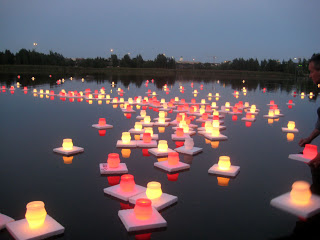
Hiroshima citizens float candles in the river, Hiroshima Day 2008

Hiroshima residents float lanterns in the river to remember the dead after a traditional Hiroshima Day concert (2008?); the concert and lantern floating are annual events

67 years ago, U.S. military action brought a quick close to hostilities without an invasion of Japan, with the detonation of two atomic bombs, one over Hiroshima on August 6, 1945, and one over Nagasaki on August 9.

Events marking the anniversary last year and this year carry the spectre of the Fukushima nuclear power plant, which experienced core meltdowns in reactors as a result of a tsunami earlier in 2011.  Anti-nuclear activists in Australia note similarities between the bombs ending the war, and the disaster at Fukushima.

Daily Yomiuri Online carried a description of memorial events in Hiroshima in 2008, from Yomiuri Shimbun:

NAGASAKI–The Nagasaki municipal government held a ceremony Saturday marking the 63rd anniversary of the atomic bombing of the city, at which participants called for the abolition of all nuclear weapons.

A total of 5,650 A-bomb survivors, representatives of victims’ families from around the nation and Nagasaki citizens participated in the ceremony. Prime Minister Yasuo Fukuda also attended the ceremony, which was held in Nagasaki Peace Park near ground zero.

Nagasaki Mayor Tomihisa Taue read out the Nagasaki Peace Declaration, which urges the worldwide abolition of nuclear weapons.

“Human beings have no future unless nuclear weapons are eliminated. We shall clearly say no to nuclear weapons,” Taue said.

The ceremony started at 10:40 a.m. Three books listing the names of 3,058 people confirmed to have died as a result of the bombing in the past year were placed inside a memorial box in front of the Peace Statue.

The total number of books listing the names of the deceased is 147, and the number of names is 145,984.

Representatives of surviving victims, bereaved families, the prime minister and Hiroshima Mayor Tadatoshi Akiba placed flowers at the site.

At 11:02 a.m., the time the atomic bomb struck, ceremony participants offered a silent prayer. At the same time, local high school students rang the Bells of Nagasaki.

In the peace declaration, Taue read from an academic paper written by four people, including a former U.S. secretary of state, which promoted a new policy for developing nuclear weapons. The proposal encouraged countries to ratify the Comprehensive Test Ban Treaty. The mayor said world nuclear powers “should sincerely fulfill their responsibility of nuclear disarmament,” and urged the government to pass the three nonnuclear principles into law.

This year also marks the 100th anniversary of the birth of Takashi Nagai, a medical doctor who helped rescue of victims after the bombing.

The mayor referenced one of the doctor’s remarks, saying: “There are no winners or losers in a war. There is only destruction.”

Shigeko Mori, 72, representing survivors of the bombing, read out an oath for peace that said Japan should promote its Constitution and the three nonnuclear principles to the rest of the world to prevent nuclear proliferation.

Fukuda gave a speech, saying, “Japan should play a responsible role in the international community as a nation cooperating for peace.”

(Aug. 10, 2008)

Other information:

Other related posts at Millard Fillmore’s Bathtub:

Remembering that U.S. involvement in World War II as a combatant came after the Japanese sneak attack on Pearl Harbor on December 7, 1941, one may respect and appreciate the Japanese national desire to commemorate the brutal end of the war with conversations about peace and how to achieve it.  The film below is a short, touching introduction to the Hiroshima Peace Museum website:


Related articles, 2012:

A-Bomb Dome in Hiroshima, Japan

A-Bomb Dome at Ground Zero, Hiroshima, Japan (Photo credit: Wikipedia)

Save


Gold medal to NASA and JPL: Mars mission succeeds against overwhelming odds

August 6, 2012

Curiosity is on the ground.

What were the odds?  What did NASA and Jet Propulsion Laboratories (JPL) need to overcome?   Watch this:

Did that astonshingly Rube Goldberg-looking set of devices work?

Here’s the news, from NBC’s science editor Alan Boyle:

PASADENA, Calif. — After eight years of planning and eight months of interplanetary travel, NASA’s Mars Science Laboratory pulled off a touchdown of Super Bowl proportions, all by itself. It even sent pictures from the goal line.

The spacecraft plunged through Mars’ atmosphere, fired up a rocket-powered platform and lowered the car-sized, 1-ton Curiosity rover to its landing spot in 96-mile-wide (154-kilometer-wide) Gale Crater. Then the platform flew off to its own crash landing, while Curiosity sent out a text message basically saying, “I made it!”

That message was relayed by the orbiting Mars Odyssey satellite back to Earth. A radio telescope in Australia picked up the message and sent it here to NASA’s Jet Propulsion Laboratory. When the blips of data appeared on the screens at JPL’s mission control, the room erupted in cheers and hugs.

Congratulations!  We need good news, and this is great news.

So far as I can tell, no U.S. television network covered the event live in Pasadena.  What a shame.

More:


Port Isaac, Cornwall: Depends on your point of view

August 5, 2012

What you see in this photo may depend on where you sit, or stand.

Aerial photo of Port Isaac, from Facebook, August 2012

Aerial photo of Port Isaac, Cornwall, from Facebook, August 2012; attributed to Wimp.com

It’s a photo of a town in Cornwall, England:  Port Isaac.  Lovely photo, showing the verdant hills around the town where grains grow in some abundance (the town’s name means “corn port,” suggesting a thriving grain trade a millennium ago), sheep or other animals graze, and showing the port from which fishermen sail to bring in bounty from the oceans.  The picturesque little town is popular among writers and other artists.  It’s historic and quaint streets make a popular backdrop for television and film production — the popular BBC series “Doc Martin” films there.

Since some internet “cool stuff” site (Wimp.com?  I can’t find it there) picked up the photo, it’s become popular around the internet and on Facebook.  Generally the identifiers for the town get stripped away as the ‘net is wont to do.  So conjecture pops up in comments:

English: Roscarrock Hill, Port Isaac The first...

Roscarrock Hill, Port Isaac The first house on the right is Fern Cottage, made famous as the house of Doc Martin, in the TV series of the same name. (Photo credit: Wikipedia)

  • Secret town, cut off from the rest of civilization?
  • Wasn’t that area once forested, and doesn’t the photo show the perils of deforestation for agricultural, or any other purposes? “Many moons ago before humanity it was beautifully covered with pristine forests full of life. It’s now a self-centred disaster brought by humanity…this pic is ugly !”
  • Isn’t it idyllic, and who wouldn’t want to live there?  “This looks like Cornwalls beautiful rocky edge of the world,I just love the area and holiday there most years,maybe one day i will have saved enough to retire there ,it is truly a stunningly wonderful place to be come rain or shine.”
  • If only there were no people there!  “our planet earth is still beautiful you just have to look at it from a distance.”
  • See how the town is sprawling into the pastures?  See the dangers of (small-town) urban sprawl?
  • London is prettier.
  • You should see Ireland/Wales/Norway!

Ugly or beautiful — opinions differ depending on what the poster thinks it is, and what the poster thinks s/he knows about the place.

Perhaps its really a shot of Rohrshach, Norway . . .

More:

Cornwall

Rohrshach?  Do you see the face?  (It’s actually Cornwall (Photo credit: joeflintham))


Coffee truck

August 4, 2012

Some days I need industrial quantities of industrial strength coffee.  I was happy and excited to catch up to this truck in Illinois earlier this summer.

Pilot Truck Stops' coffee truck

Alas, the truck carries gasoline, with just an advertisement for coffee . . . Pilot Truck Stops coffee truck, photo by Ed Darrell

You know the result:  The “1203” hazardous cargo number means it’s gasoline, not coffee.  What a cruel trick!

Update, April 2017: A website called Fedora now has this photo as an available wallpaper. I hope it gets picked up, and I hope they pay royalties.

Save


Notebook – an animation look at reality in a digital age

August 4, 2012

I’m up for a brilliant little idea not carried on too long.

Stumbled into this film from four years ago.  The producer/director/creator explains it:

Noteboek (English title: Notebook) consists of 4 short experimental films where I try to confuse the reality.
In these films, illusions and expectations are challenged.

Noteboek is a short film and part of my graduation project.

[Music: The White Stripes-Seven Nation Army.]

And where is Evelien Lohbeck today?

If you want to see more work please visit:
evelienlohbeck.com

The guy’s woman’s got a wicked sense of the surreal, and a good sense of humor.

Tip of the old scrub brush to Le Web  . . . et le reste.

More:


UFOs? GOP says ‘you gotta believe’ – Primer on Voter ID laws and their gross injustice

August 3, 2012

Quoted completely from Bill Moyers’ site; he makes the case clearly:

Moyers & Company | The Hollow Defense of Voter ID Laws

UFO Sightings Are More Common Than Voter Fraud

August 2, 2012

by Hamed Aleaziz, Dave Gilson and Jaeah Lee, Mother Jones

We’re proud to collaborate with Mother Jones in sharing graphs and charts that reveal truth about voting obstacles. Scroll down for stats and facts related to efforts to restrict voting, the prevalence of voter ID laws, what discourages new voters and the the pervasive fiction of voter fraud.


BLOCK THE VOTE

Since 2001, nearly 1,000 bills that would tighten voting laws have been introduced in 46 states.

24 voting restrictions have passed in 17 states since 2011. This fall, new laws could affect more than 5 million voters in states representing 179 of the 270 electoral votes needed to win the presidency.

In the past two years, 5 battleground states (Florida, Iowa, Ohio, Pennsylvania, and Wisconsin) have tightened their voting laws.

As of April, 74 restrictive voting laws were on the table in 24 states.

Sources: Brennan Center for Justice, NAACP


CARD-CARRYING AMERICANS ONLY

Since 2011, 34 states have introduced laws requiring voters to show photo ID, and 9 states have passed photo ID laws, affecting 3.8 million voters.

2.2 million registered voters did not vote in 2008 because they didn’t have proper ID.

*Does not include laws awaiting DOJ clearance, blocked by courts, or not in effect until after 2012. Source: National Conference of State Legislatures

Last year, 12 states introduced laws requiring birth certificates or other proof of citizenship to vote; 3 passed.

Only 48 percent of women have a birth certificate with their current legal name on it.

Texas’ new ID law permits voters to use concealed-handgun licenses as proof of identity, but not state university IDs.

Sources: Brennan Center for JusticeGabriel R. Sanchez, Stephen A. Nuño, and Matt A. Barreto


DISCOURAGING NEW VOTERS

80 percent of the 75 million eligible voters who did not take part in the 2008 election were not registered to vote.

In 2008, more than 1/3 of voters cast ballots before Election Day. In 2011, 5 states passed bills to restrict early voting.

States with Election Day registration have 7 to 12 percent greater turnout than states without. Last year, 5 states introduced bills that eliminate Election Day registration.

12 percent of minority voters report registering through voter drives, twice the rate of white voters. In 2011, Florida and Texas passed laws making registration drives much harder to organize.

Florida state Sen. Mike Bennett, a supporter of the tougher voter registration law, said, “I don’t have a problem making it harder. I want people in Florida to want to vote as bad as that person in Africa who walks 200 miles across the desert. This should not be easy.”

Source: Caltech/MIT Voting Technology Project


LOCKING OUT EX-CONS

4 million Americans who have completed prison sentences are ineligible to vote. 38 percent of disenfranchised voters are African American.

13 percent of African-American men cannot vote due to criminal records, a rate 7 times the national average.

The United States and Belgium are the only democracies that disenfranchise citizens for lengthy or indefinite periods after completing prison sentences.

To regain their voting rights, released felons in Iowa must provide the address of the judge who convicted them and a credit report showing they have paid off their court costs. “They make the process just about impossible,” said a 40-year-old ex-con who’d stolen a soda machine as a teen.


IN SEARCH OF STOLEN VOTES

dog voting

While defending its precedent-setting photo ID law before the Supreme Court, Indiana was unable to cite a single instance of voter impersonation in its entire history.

A 2005 report by the American Center for Voting Rights claimed there were more than 100 cases of voter fraud involving 300,000 votes in 2004. A review of the charges turned up only 185 votes that were even potentially fraudulent.

In support of a voter ID law, Kansas Secretary of State (and the legal brains behind a slew of anti-immigration laws) Kris Kobach cited 221 incidents of voter fraud in the state between 1997 and 2010. Yet those cases produced just 7 convictions — none related to impersonating other voters.

Last December, Republican National Committee Chairman Reince Priebus declared that Wisconsin is “absolutely riddled with voter fraud.” In fact, the state’s voter fraud rate in 2004 was 0.0002 percent — just 7 votes.

In 2008, John McCain said fraudulent registrations collected by ACORN were “one of the greatest frauds in voter history in this country, maybe destroying the fabric of democracy.” The Congressional Research Service found no proof that anyone improperly registered by ACORN tried to vote.

Federal convictions for election fraud, 2002-05

  • Voting while ineligible: 18
  • Voting multiple times: 5
  • Registration fraud: 3

UNIDENTIFIED FLYING OBJECTS

Dog and UFO

Between 2000 and 2010, there were:

649 million votes cast in general elections

47,000 UFO sightings

441 Americans killed by lightning

13 credible cases of in-person voter impersonation

Special hat tip to craigconnects.org

Additional sources:

  • A 2005 report by the American Center for Voting Rights…: The Myth of Voter Fraud by Lorraine C. Minnite
  • 13 credible cases…: Justin Levitt, Loyola Law School

From the show

Related Features:

So there’s the case in a nutshell — a large, meaty nut’s shell.

More: 


The melting away of climate denialism?

August 2, 2012

Ben Sargent, on 2012 heat wave and views of global warming, Austin American-Statesman, July 24, 2012

Ben Sargent, Austin (Texas) American-Statesman, July 24, 2012

If only it were true that heat, weather, or any other data or information, could cause global warming denialism to melt away . . .