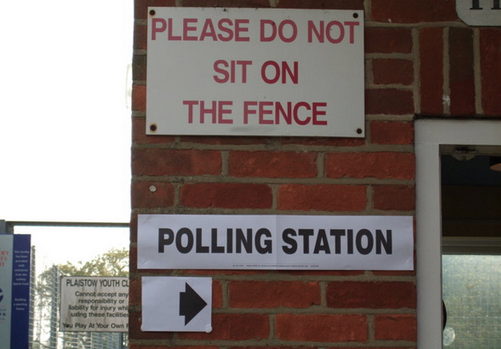
Polling station, in unnamed location in Scotland (?) posted on Twitter during the referendum on Scotland independence, but around since at least April 2014. From @standrewsradio
“Please do not sit on the fence.”
It would work in Texas elections this year, too. 97% of eligible Scot voters registered to vote; as I write this, it looks like about 90% of those people voted in the election.
Ain’t democracy grand?
“Vote: It’s what citizens do.”
Update: Seems to be at the Plaistow Youth Center, in England.
From BBC:
BBC caption: After four weeks of campaigning the polls are closed, we now await the result of the general election. Quentin Gadd spotted these signs at a polling station, he says, “Is this proof positive that the organisers of the Plaistow Youth Centre are taking a stand against those who choose to abstain?”
The photo may be from 2010, from this site, which identifies the photo location further, with a different photo: “Sign at the polling station in Plaistow, West Sussex, on Local Council Polling Day.”
Spread the word; friends don't allow friends to repeat history.
From the voting festivities in Scotland today, a very graphic demonstration of why one should never, never, never drink and play bagpipes.
From Twitter, Wall Street Journal’s account: Photos: Scotland votes in independence referendum | http://on.wsj.com/1ubZMTH
In every other way, this vote should be closely watched. Two nations pushed together by force of arms hundreds of years ago, discussing whether and how to split up. No guns. No tanks. Lots of discussion, lots of fun, lots of ballots. 97% of eligible voters registered to vote, and indications are at least 90% of them turned out.
Can you imagine what would happen in U.S. elections if 90% of registered voters showed up at the polls, instead of 40%, or 30%? Can you imagine if 97% of U.S. eligible voters bothered to register, instead of the less-than-50% we have now?
You bagpipes would flame, too.
Spread the word; friends don't allow friends to repeat history.
Caption from Department of Interior’s Tumblr site: 225 years ago today, the Constitution of the United States was signed in Independence Hall. Today, you can tour the Hall and see where the Declaration of Independence and Constitution were both signed, and you can also view the Liberty Bell [close by]. This is a site not to miss while visiting Philadelphia. Photo: National Park Service
Howard Chandler Christy’s “Signing of the Constitution,” 1940; Architect of the Capitol image. This massive, 20′ x 30′ painting hangs in the House Wing of the U.S. Capitol, in the east stairway — a location where, alas, most people cannot get to without a guide anymore.
Click to the Architect of the Capitol’s site for the story of the painting, intended by Congress to fill a gap in the story of America told by art in the Rotunda and throughout the halls of the building.
Dr. Gordon Lloyd, Pepperdine University’s School of Public Policy, and expert in the Constitution and its history. I met Lloyd almost a decade ago, in programs for history teachers, sponsored by the Bill of Rights Institute, Liberty Fund, and National Endowment for the Humanities.
Every year there are a few more tools on the internet to study the Constitution with, for teachers to use in the classroom on Constitution Day and every day. I wonder what will be the effects in another decade.
How important is it that students learn the Constitution, what it says, and how it affects our daily lives? How important is it that students learn the history of the creation of the Constitution, and does that history reverberate for those students as they venture out into their roles as citizens in the republic created by the document?
CONSTITUTION DAY AND CITIZENSHIP DAY, CONSTITUTION WEEK, 2014
– – – – – – –
BY THE PRESIDENT OF THE UNITED STATES OF AMERICA
A PROCLAMATION
Eleven years after a small band of patriots declared the independence of our new Nation, our Framers set out to refine the promise of liberty and codify the principles of our Republic. Though the topics were contentious and the debate fierce, the delegates’ shared ideals and commitment to a more perfect Union yielded compromise. Signed on September 17, 1787, our Constitution enshrined — in parchment and in the heart of our young country — the foundation of justice, equality, dignity, and fairness, and became the cornerstone of the world’s oldest constitutional democracy.
For more than two centuries, our founding charter has guided our progress and defined us as a people. It has endured as a society of farmers and merchants advanced to form the most dynamic economy on earth; as a small army of militias grew to the finest military the world has ever known; and as a Nation of 13 original States expanded to 50, from sea to shining sea. Our Founders could not have foreseen the challenges our country has faced, but they crafted an extraordinary document. It allowed for protest and new ideas that would broaden democracy’s reach. And it stood the test of a civil war, after which it provided the framework to usher in a new birth of freedom through the 13th, 14th, and 15th Amendments.
America’s revolutionary experiment in democracy has, from its first moments, been a beacon of hope and opportunity for people around the world, inspiring some to call for freedom in their own land and others to seek the blessings of liberty in ours. The United States has always been a nation of immigrants. We are strengthened by our diversity and united by our fidelity to a set of tenets. We know it is not only our bloodlines or an accident of birth that make us Americans. It is our firm belief that out of many we are one; that we are united by our convictions and our unalienable rights. Each year on Citizenship Day, we recognize our newest citizens whose journeys have been made possible by our founding documents and whose contributions have given meaning to our charter’s simple words.
Our Constitution reflects the values we cherish as a people and the ideals we strive for as a society. It secures the privileges we enjoy as citizens, but also demands participation, responsibility, and service to our country and to one another. As we celebrate our Nation’s strong and durable framework, we are reminded that our work is never truly done. Let us renew our commitment to these sacred principles and resolve to advance their spirit in our time.
In remembrance of the signing of the Constitution and in recognition of the Americans who strive to uphold the duties and responsibilities of citizenship, the Congress, by joint resolution of February 29, 1952 (36 U.S.C. 106), designated September 17 as “Constitution Day and Citizenship Day,” and by joint resolution of August 2, 1956 (36 U.S.C. 108), requested that the President proclaim the week beginning September 17 and ending September 23 of each year as “Constitution Week.”
NOW, THEREFORE, I, BARACK OBAMA, President of the United States of America, do hereby proclaim September 17, 2014, as Constitution Day and Citizenship Day, and September 17 through September 23, 2014, as Constitution Week. I encourage Federal, State, and local officials, as well as leaders of civic, social, and educational organizations, to conduct ceremonies and programs that bring together community members to reflect on the importance of active citizenship, recognize the enduring strength of our Constitution, and reaffirm our commitment to the rights and obligations of citizenship in this great Nation.
IN WITNESS WHEREOF, I have hereunto set my hand this sixteenth day of September, in the year of our Lord two thousand fourteen, and of the Independence of the United States of America the two hundred and thirty-ninth.
BARACK OBAMA
In that case, Happy Constitution Week!
What should we do tomorrow?
Spread the word; friends don't allow friends to repeat history.
Amendments 11 through 27 — notice that, although not ratified until 1991, the 27th Amendment was in the package of amendments proposed by James Madison in 1789, a package of twelve proposed amendments, of which ten were ratified within a few months to become the Bill of Rights
Rotunda for the charters of Freedom at National Archives (NARA) building in Washington, D.C. Here displayed are the Declaration of Independence, the Bill of Rights, and the U.S. Constitution. (Photo credit: Wikipedia)
In Ghana: Community members perform a scene to educate others on how and why to use bednets. (USAID/Kasia McCormick) 2012. USAID Africa Bureau, via Wikimedia
In stark contrast to the usual hoax stories we get in the U.S. about malaria and DDT, the United Nations General Assembly this past week passed a resolution noting progress made in fighting the parasitic disease.
The United Nations General Assembly at its 68th Session, adopted Resolution A/68/L.60, “Consolidating Gains and Accelerating Efforts to Control and Eliminate Malaria in Developing Countries, Particularly in Africa, by 2015” by consensus.
Recognising progress made through political leadership and a broad range of national and international actions to scale-up malaria control interventions, this annual resolution urges governments, United Nations agencies, and all stakeholders to work together to meet the targets set out in the Roll Back Malaria Partnership’s Global Malaria Action Plan (GMAP) and the UN’s Millennium Development Goals (MDGs).
An official statement issued in Accra and copied the Ghana News Agency said with just less than 500 days until the 2015 deadline of the MDGs, the adoption of this resolution by the General Assembly reiterates the commitment of UN Member States to keep malaria high on the international development agenda.
“We have seen tremendous progress against this killer disease in recent years, but continued success will require increased political and financial commitment from donor and endemic governments alike. Together we can scale-up efforts and continue saving lives,” it said.
The statement said since 2001, the World Health Organisation (WHO) estimated that malaria death rates have decreased by nearly 50 per cent in Africa alone, where 90 per cent of all malaria-related deaths still occur – contributing to a 20 per cent reduction in global child mortality and helping drive progress towards UN MDG 4.
“Between 2001 and 2012, collective efforts helped avert an estimated 3.3 million deaths (69 per cent) of which were in the 10 countries with the highest malaria burden in 2000 and more than half of the 103 countries that had ongoing malaria transmission in 2000 are meeting the MDG of reversing malaria incidence by 2015.
“Despite these advances, almost half of the world’s population remains at risk from malaria, with an estimated 207 million cases of infection around the world each year and 627,000 deaths. Around the world, a child still dies from malaria every minute.
“The resolution calls for donor and endemic governments alike to support global malaria control efforts, including the secretariat of the Roll Back Malaria Partnership, and to intensify efforts to secure the political commitment, partnerships and funds needed to continue saving lives.
“Increased financing will be critical to further advancements, as current international and domestic financing for malaria of US 2.5 billion dollars in 2012 amounts to less than half of the US 5.1 billion dollars estimates to be needed annually through 2020 to achieve universal coverage of malaria control interventions,” the statement said.
In 2012, United Nations Secretary-General Ban Ki-moon named malaria as a top priority of his second mandate. Malaria control has consistently proven to be a strong global health investment, generating high return on low investments.
Impacting all eight of the United Nations MDGs, malaria prevention and treatment serves as an entry point to help advance progress against other health and development targets across the board by reducing school absenteeism, fighting poverty, and improving maternal and child health.
Did you see that report in your local newspapers, or on radio or television?
Star-spangled Banner and the War of 1812 – The original Star-Spangled Banner, the flag that inspired Francis Scott Key to write the song that would become our national anthem, is among the most treasured artifacts in the collections of the Smithsonian’s National Museum of American History in Washington, D.C.
Every school kid learns the story of the “Star-Spangled Banner,” or should.
During the War of 1812, Georgetown lawyer Francis Scott Key, stood aboard a British ship in Baltimore Harbor to negotiate the release of his friend, Dr. William Beanes, who had been taken prisoner while the British stormed through Bladensburg, Maryland, after burning Washington, D.C. Key witnessed the British shelling of Fort McHenry, the guardian of Baltimore’s harbor. Inspired when he saw the U.S. flag still waving at dawn after a night of constant shelling, Key wrote a poem.
Key published the poem, suggested it might be put to the tune of “Anachreon in Heaven” (a tavern tune popular at the time) — and the popularity of the song grew until Congress designated it the national anthem in 1931. In telling the story of the latest restoration of that garrison flag now housed at the Smithsonian Museum of American History,Smithsonian Magazine repeated the story in the July 2000 issue: “Our Flag Was Still There.”
It’s a wonderful history with lots of splendid, interesting details (Dolley Madison fleeing the Executive Mansion clutching the Gilbert Stuart portrait of George Washington, the guy who had introduced Dolley to James Madison and then snubbed them after they were married; the British troops eating the White House dinner the Madisons left in their haste; the gigantic, 42 by 30 foot flag sewn by Mary Pickersgill, a Baltimore widow trying to support her family; the rag-tag Baltimore militia stopping cold “Wellington’s Invicibles;” the British massing of 50 boats and gunships; and much more).
It’s a grand and glorious history that stirs the patriotic embers of the most cynical Americans.
And it’s all true.
So it doesn’t deserve the voodoo history version, the bogus history created by some person preaching in a church (I gather from the “amens”) that is making the rounds of the internet, stripped of attribution so we can hunt down the fool who is at fault.
We got this in an e-mail yesterday; patriots save us, there must be a hundred repetitions that turn up on Google, not one correcting this horrible distortion of American history.
Horrible distortion of American history
(The full version is a mind-numbing 11 minutes plus. Some people have put it on other sites. )
There was no ultimatum to to Baltimore, nor to the U.S., as this fellow describes it.
Key negotiated for the release of one man, Dr. Beanes. There was no brig full of U.S. prisoners.
It’s Fort McHenry, not “Henry.” The fort was named after James McHenry, a physician who was one of the foreign-born signers of the Constitution, who had assisted Generals Washington and Lafayette during the American Revolution, and who had served as Secretary of War to Presidents Washington and Adams.
Fort McHenry was a military institution, a fort defending Baltimore Harbor. It was not a refuge for women and children.
The nation would not have reverted to British rule had Fort McHenry fallen.
The battle was not over the flag; the British were trying to take Baltimore, one of America’s great ports. At this point, they rather needed to since the Baltimore militia had stunned and stopped the ground troops east of the city. There’s enough American bravery and pluck in this part of the story to merit no exaggerations.
To the best of our knowledge, the British did not specifically target the flag.
There were about 25 American casualties. Bodies of the dead were not used to hold up the flag pole — a 42 by 30 foot flag has to be on a well-anchored pole, not held up by a few dead bodies stacked around it.
You can probably find even more inaccuracies (please note them in comments if you do).
The entire enterprise is voodoo history. The name of Francis Scott Key is right; the flag is right; almost everything else is wrong.
Please help: Can you find who wrote this piece of crap? Can you learn who the narrator is, and where it was recorded?
I keep finding troubling notes with this on the internet: ‘My school kids are going to see this to get the real story.’ ‘Why are the libs suppressing the truth?’ ‘I didn’t know this true story before, and now I wonder why my teachers wouldn’t tell it.’
If Peter Marshall and David Barton gave a gosh darn about American history, they would muster their mighty “ministries” to correct the inaccuracies in this piece. But they are silent.
Now everybody’s celebrating. Time for a quick reprise of this post from June.
Published on Jun 19, 2014
Grammy Award winning bluegrass band the Steep Canyon Rangers, well known for their work with Steve Martin, perform a special version of “The Star-Spangled Banner” for the Smithsonian’s National Museum of American History in honor of the song’s 200th anniversary.
The museum will “Raise It Up!” and celebrate the 200th anniversary by uniting the original manuscript with the flag at the Museum from June 14-July 6, 2014 and holding a special event at the museum on Flag Day (Saturday, June 14, 2014). Join the party: http://anthemforamerica.smithsonian.com/
Special thanks to the team at Wool and Tusk for their hard work and creativity: Scott Mele, Roger Pistole, Derek West, Joe Pisapia, David Bartin, Michael Freeman, Alexis Kaback, Daniel Walker, Jeff Rosen, Harvey Moltz, and Greg and Erin Whiteley.
In the United States, Patriot Day, observed as the National Day of Service and Remembrance, occurs on September 11 of each year in memory of the 2,977 killed in the 2001 September 11 attacks.
To further honor the dead, and survivors, many people participate in a day of service to others.
PATRIOT DAY AND NATIONAL DAY OF SERVICE AND REMEMBRANCE, 2014
– – – – – – –
BY THE PRESIDENT OF THE UNITED STATES OF AMERICA
A PROCLAMATION
America will never forget the September tragedy that shook our Nation’s core 13 years ago. On a day that began like so many others, a clear blue sky was pierced by billowing black smoke as a wave of grief crashed over us. But in one of our darkest moments, we summoned strength and courage, and out of horrible devastation emerged the best of our humanity. On this solemn anniversary, we pause in remembrance, in reflection, and once again in unity.
On September 11, 2001, nearly 3,000 men, women, and children — friends and neighbors, sisters and brothers, mothers and fathers, sons and daughters — were taken from us with a heartbreaking swiftness and cruelty. As we come together once more to mourn their loss, we also recall how the worst terrorist attack in our history brought out the true character of the American people. Courageous firefighters rushed into an inferno, brave rescue workers charged up stairs, and coworkers carried others to safety. Americans in distant cities and local towns united in common purpose, demonstrating the spirit of our Nation; people drove across the country to volunteer, donors lined up to give blood, and organizations collected food and clothing. And in our Nation’s hour of need, millions of young Americans raised in a time of peace volunteered to don the uniforms of our country’s military and defend our values around the world.
As we remember all those we lost on that day and the Americans who made the ultimate sacrifice in the wars that followed, we must strive to carry forward their legacy. On this National Day of Service and Remembrance, we take up their unfinished work and pay tribute to their lives with service and charity. Through these acts and quiet gestures, we can honor their memory and reclaim our sense of togetherness. I encourage all Americans to visit www.Serve.gov or www.Servir.gov to learn more about service opportunities across our country.
In the face of great terror, some turned to God and many found comfort in family and friends — but all Americans came together as one people united not only in our grief, but also in our determination to stand with one another and support the country we love. Today and all days, we remember the patriots who endure in the hearts of our Nation and their families who have known the awful depths of loss. In their spirit, let us resolve to move forward together and rededicate ourselves to the ideals that define our Union as we work to strengthen our communities and better our world.
By a joint resolution approved December 18, 2001 (Public Law 107-89), the Congress has designated September 11 of each year as “Patriot Day,” and by Public Law 111-13, approved April 21, 2009, the Congress has requested the observance of September 11 as an annually recognized “National Day of Service and Remembrance.”
NOW, THEREFORE, I, BARACK OBAMA, President of the United States of America, do hereby proclaim September 11, 2014, as Patriot Day and National Day of Service and Remembrance. I call upon all departments, agencies, and instrumentalities of the United States to display the flag of the United States at half-staff on Patriot Day and National Day of Service and Remembrance in honor of the individuals who lost their lives on September 11, 2001. I invite the Governors of the United States and its Territories and interested organizations and individuals to join in this observance. I call upon the people of the United States to participate in community service in honor of those our Nation lost, to observe this day with appropriate ceremonies and activities, including remembrance services, and to observe a moment of silence beginning at 8:46 a.m. Eastern Daylight Time to honor the innocent victims who perished as a result of the terrorist attacks of September 11, 2001.
IN WITNESS WHEREOF, I have hereunto set my hand this tenth day of September, in the year of our Lord two thousand fourteen, and of the Independence of the United States of America the two hundred and thirty-ninth.
BARACK OBAMA
Do you plan any special service today?
Spread the word; friends don't allow friends to repeat history.
It’s fun to read through the list of statehood dates and ponder just how such a date is calculated (consider the first 13 colonies and their becoming states); but however it was calculated, September 9 is California’s day.
U.S. and California flags flying from the same flagpole.
Fly your flags, California.
3-cent stamp honoring California’s statehood centennial, in 1950. Image from Rockhounds.com
California was the 31st state admitted; 31-star flags were in use until Minnesota’s statehood in 1858. Here’s a unique design on the 31-star motif:
31-star flag with stars arranged in “Great Star” constellation suggested by War of 1812 Navy hero Samuel Reid, a wearer of the Congressional Medal of Honor. Reid urged 13 stripes instead of 15, which Congress accepted; but he also urged the Great Star design, which was not accepted. Placement of stars in the field remained unencumbered by rules until the Eisenhower administration. Photo from Jeff R. Bridgman Antiques.
Spread the word; friends don't allow friends to repeat history.
“The Problem We All Live With,” Norman Rockwell, 1964; oil on canvas, Norman Rockwell Museum, Stockbridge, Massachusetts
Ruby Bridges with President Barack Obama, in 2011:
President Obama and Ruby Bridges viewing Normal Rockwall’s painting, “The Problem We All Live With,” at the White House in 2011. Photo by Pete Souza, public domain.
Ms. Bridges tells some of her story:
Spread the word; friends don't allow friends to repeat history.
U.S. flag displayed in the National Center for the Constitution, Philadelphia. Photo by Jeffrey M. Vinocur, via Wikimedia. Constitution Day is September 17.
Flag flying dates in September? Three more (you flew your flag for Labor Day, right?):
September 9, for California statehood
September 11, for Patriot Day (not listed in the U.S. Flag Code, but encouraged in other law. Public Law No. 107-89)
Seriously, go read this whole essay — especially if you’re looking for some snarky way to complain about the ban on DDT.
It is tough for a single publication or its author to have an impact across nations, cultures, genres, and disciplines. It is tougher still for their appearance on the world stage to spark a social movement, rekindle human values and awareness, and create new mandates for action. And toughest of all is when the author is a woman, a scientist, who must overcome the prejudices of her time−of gender, of notions of progress, of the omnipotence of untrammelled industry−to articulate a clear-eyed, renewed vision of a better world, a cleaner environment, where people do not merely live, but flourish.
If I had to pick one exemplary work from the environmental canon that does this and does it well, it would be the one that burst on the scene on this day, 16 June, all of 52 years ago, in the United States of America and then swiftly encompassed, in its scope and sweep, the rest of the world. The book, SilentSpring, and its author, marine biologist Rachel Carson, are widely credited to be the sparks that lit the fire of the global environmental movement. Carson, whose 107th birth anniversary came and passed quietly on May 27, with little fanfare other than a commemorative Google Doodle, died fifty years ago after a battle with breast cancer. Why should we bother to remember Rachel Carson and Silent Spring? What could a woman, a book, from over five decades ago have to do with the enormously changed world we live in today? Yet, over the last few weeks, during fieldwork and travels in India’s northeast and the Western Ghats mountains, I thought frequently of Rachel Carson and her prescient words in Silent Spring.
Or, until that account is unsuspended by the forces supporting Donald Trump: Follow @FillmoreWhite, the account of the Millard Fillmore White House Library
We've been soaking in the Bathtub for several months, long enough that some of the links we've used have gone to the Great Internet in the Sky.
If you find a dead link, please leave a comment to that post, and tell us what link has expired.
Thanks!
Retired teacher of law, economics, history, AP government, psychology and science. Former speechwriter, press guy and legislative aide in U.S. Senate. Former Department of Education. Former airline real estate, telecom towers, Big 6 (that old!) consultant. Lab and field research in air pollution control.
My blog, Millard Fillmore's Bathtub, is a continuing experiment to test how to use blogs to improve and speed up learning processes for students, perhaps by making some of the courses actually interesting. It is a blog for teachers, to see if we can use blogs. It is for people interested in social studies and social studies education, to see if we can learn to get it right. It's a blog for science fans, to promote good science and good science policy. It's a blog for people interested in good government and how to achieve it.
BS in Mass Communication, University of Utah
Graduate study in Rhetoric and Speech Communication, University of Arizona
JD from the National Law Center, George Washington University


 Posted by Ed Darrell








 Millard Fillmore's Bathtub