If you’re teaching world history, or art, or government, or environmental science, or geography, this might be a great blog to track.
Senegal is a very interesting place. Note on the map how it completely surrounds its neighbor nation of The Gambia.
Senegal, map courtesy of the U.S. Federal Aviation Administration (FAA)
France held the nation as a colony once upon a time, from 1850 to independence of the Mali Federation in 1960 — one of the national languages is French, but regional languages are numerous, Wolof, Soninke, Seereer-Siin, Fula, Maninka, and Diola. The Mali Federation was short-lived, and Senegal broke off in August of 1960.
If you listen to NPR, you’ve probably heard their reporter signing off in that distinct way she does, “Tthis is Ofeibea Quist-Arcton, for NPR, in Dah-KAHHH!” (Not to be confused with Dacca, Pakistan).
The French colonies of Senegal and the French Sudan were merged in 1959 and granted their independence as the Mali Federation in 1960. The union broke up after only a few months. Senegal joined with The Gambia to form the nominal confederation of Senegambia in 1982, but the envisaged integration of the two countries was never carried out, and the union was dissolved in 1989. The Movement of Democratic Forces in the Casamance (MFDC) has led a low-level separatist insurgency in southern Senegal since the 1980s, and several peace deals have failed to resolve the conflict. Nevertheless, Senegal remains one of the most stable democracies in Africa. Senegal was ruled by a Socialist Party for 40 years until current President Abdoulaye WADE was elected in 2000. He was reelected in February 2007, but has amended Senegal’s constitution over a dozen times to increase executive power and weaken the opposition, part of the President’s increasingly autocratic governing style. Senegal has a long history of participating in international peacekeeping and regional mediation.
The country is tropical, hot and humid. Geographically, it is low, rolling plains.
Dakar is about as far west as one can go on the African continent. (See the map inset — Senegal is in dark green).
Senegal has iron ores, and phosphorus (ancient bird droppings?). It’s not a rich nation, but it’s better off than many developing countries.
Adkins is in for a great adventure, no?
Africa, showing Senegal - CIA Factbook
Spread the word; friends don't allow friends to repeat history.
Jeff Danziger cartoon, for the New York Times Syndicate, on Texas State Board of Education “changes” to Texas social studies texts.
People for the American Way have joined the fight for good education in Texas, pushing better social studies education standards. The Texas State Board of Education will conduct final votes on social studies standards in May.
Grotesque slashes damaged social studies standards in the last round of amendments. Conservatives will probably try to keep secret their proposed changes, offering a flurry of last-minute amendments carefully designed to gut serious education and make the standards work as indoctrination for young conservatives instead.
PFAW has good reason to fear. Here’s their letter. from PFAW President Michael Keegan:
Dear People For Supporter,
Thomas Jefferson banned in Texas schools? Maybe… if the Right has its way. The fight is still on to keep absurd changes out of the Texas social studies textbook standards, with the final standards set to be adopted by the Texas State Board of Education (SBOE) on May 21.
Right-wing members of the SBOE are using the textbook standards in Texas to rewrite history in a way that could impact students across the U.S., tossing out facts in favor of propaganda like:
America is a Christian country, founded on “Biblical principles.”
Conservative icons from Ronald Reagan to Newt Gingrich, Phyllis Schlafly, the Moral Majority and even Sen. Joseph McCarthy are history’s “good guys,” but progressives and progressive values are at odds with what it means to be “American.”
Words like “democracy” (sounds like “Democrat!”) have nothing to do with America — we’re a Republic — In fact, “capitalism” has sort of a negative connotation to some, so they want that word to be universally replaced with “free market.”
Some of the major contributions of Thomas Jefferson — arguably America’s greatest thinker — are on the chopping block, as are the contributions of other important figures not favored by the zealots on the Texas State Board of Education, like Cesar Chavez and Thurgood Marshall. (Who’s next? Martin Luther King? FDR?)
Texas is just ground zero for what is clearly a national effort. We need to make sure that whatever standards are adopted in Texas, they do not affect the social studies textbooks used by students in other states.
The Texas State Board of Education traditionally has tremendous power in determining the content of textbooks not only for Texas students but for students across the U.S. Texas reviews and adapts textbook standards for the major subjects every six years, and because of the size of the state’s market, textbook publishers often print books consistent with the Texas standards. Last year, they attracted national ridicule for trying to inject creationism into science textbooks. This year, they’re voting on social studies standards.
The right-wing majority on the State Board wants indoctrinate Texas students into this new perverse revisionist history. PFAW is supporting our allies on the ground in Texas who are working to make sure students have the chance to learn history as it occurred, not how the Far Right wish it had happened. But we need to do all we can to make sure this is not exported to other states and school districts as well. Help us take extremism out of textbook decision making and let our children learn the truth in the classroom.
“Follow the Money” is a video summarizing the results from the project by Northwestern University grad students Daniel Grady and Christian Thiemann. Using data from the website Where’s George?, they have been able to track the movement of U.S. paper currency. What can you learn from this? That there are natural borders within the U.S. that don’t necessarily follow state borders, and it can also be used to predict the spread of disease because it maps movement of people within the U.S.
From Maria Popova on BrainPickings.org: This may sound like dry statistical uninterestingness, but the video visualization of the results is rather eye-opening, revealing how money — not state borders, not political maps, not ethnic clusters — is the real cartographer drawing our cultural geography. The project was a winner at the 2009 Visualization Challenge sponsored by the National Science Foundation and AAA.
Malaria plagues too many nations, still. Between 400 million and 500 million people in the world get infected with one form of the malaria parasites every year. About a million die, most of those children. Death disproportionately strikes pregnant women, too.
World Health Organization (WHO) chart on the life cycle of malaria
Advances in medicines and advances in controls of the insects that help transmit the disease led to several campaigns to eradicate the disease over the past 60 years. Malaria no longer torments most of Europe and most of North America, but it remains a serious, economy-crippling disease across Africa and Asia.
Malaria also poses as a political football. Over the next couple of weeks you can find dozens of articles on valiant efforts to fight malaria, including the RollBack Malaria Campaign, and efforts by the Gates Foundation and histories of the work of the Rockefeller Foundation. But you can also find a pernicious political campaign against malaria fighters and “environmentalists,” claiming that DDT is a magic potion that could have ridded the world of malaria by killing off all the mosquitoes, if only that great mass murderer, Rachel Carson, had not imposed her will on the unstable dictators of African nations who did all they could to prove to Ms. Carson that they were environmentally friendly by banning DDT.
Over the next two weeks I will ask myself a hundred times, why do these people fiddle with trying to impugn scientists, physicians and environmentalists, while fevers burn in the brains of children across Africa and Asia?
Here’s another opportunity to put real, cutting edge technology in your classroom. In fact, your kids could probably invent all sorts of new uses for it.
Have you even heard of this stuff? Can you use it, live, with the equipment you’ve got?
Blaise Aguera y Arcas of MicroSoft demonstrated augmented-reality maps using the power of Bing maps, Flickr, Worldwide Telescope, Video overlays and Photosynth, to an appreciative and wowed audience at TEDS:
My prediction: One more advance in computer technology that classrooms will not see in a timely or useful manner.
But have you figured out how to use this stuff in your geography, history, economics or government classes? Please tell us about it in comments. Give examples and links, please.
A 7.2 magnitude earthquake has hit the Mexican peninsula of Baja California, killing at least one person and causing tremors as far away as Nevada.
The quake struck at 1540 (2240 GMT), 26km (16 miles) south-west of Guadalupe Victoria in Baja California, at a depth of 32km, said the US Geological Survey.
Some people are still trapped in their homes in the city of Mexicali, where a state of emergency has been declared.
It was the worst quake to hit the region for many years, officials said.
The US Geological Survey said some 20 million people felt tremors from the largest quake to hit the area since 1992.
My students with Mexico connections tend to come from farther east, and higher in the mountains — I don’t think I have a single student who visits Baja California on breaks. But the news will prompt questions from them tomorrow.
A magnitude 7.2 earthquake occurred at 3:40:40 p.m. (local time at the epicenter) on Sunday, 4 April 2010 in Baja California, approximately 75 km south of the Mexico-USA border. The earthquake occurred at shallow depth (approximately 10 km) along the boundary zone between the North American and Pacific plates. Since earthquakes have been recorded instrumentally, only two similar sized earthquakes have been recorded in the area. The first was the 1892 earthquake estimated at magnitude 7.0-7.2 along the Laguna Salada fault just south of the USA-Mexico border. The second was the 1940 Imperial Valley magnitude 6.9 earthquake which occurred in southernmost California. Today’s event is located nearly in line with these earthquakes along the plate boundary, but is situated farther to the south. There are several active faults in the vicinity of today’s earthquake, and the particular fault that generated this quake has not yet been determined. Faulting is complex in this region, because the plate boundary is transitional between the ridge-transform system in the Gulf of California and the continental transform system in the Salton Trough. Most of the major active faults are right-lateral strike-slip faults with a northwest-southeast orientation, similar in style to the San Andreas fault to the north. Other faults in the vicinity with the same orientation include the Cerro Prieto fault and the Laguna Salada fault.
USGS "shake map" for the April 4 7.2 quake near Mexicali, Mexico - Click to go to USGS site
What other questions can we anticipate? Somebody will ask whether this quake is related to the Haiti and Chilean quakes (probably not closely related). Somebody will wonder about the Pacific Ring of Fire, and this quake’s relation to volcanoes and general earthquake activity around the Pacific (high relationship). Someone will want to know about quakes in your area. Is this the precursor to “the Big One?”
The USGS site is a good place to start on all of those questions.
A friend wrote me the other day wondering what I thought about the global warming hoax. I told him I thought denialists and contrarians have acted shamefully claiming that warming is not occurring.
My friend wrote back puzzled. He had meant, what did I think about the collapse of the false claims of warming? He said he had understood that almost all the claims of warming were hoaxes cast by a cabal of conspiratorialist scientists who had gotten fat government contracts only on the condition that they claimed there is warming.
It’s actually been about two weeks since I got that message, but it’s a common thought around the world. The thieves who stole e-mails from scientists did what Shakespeare termed worse: They stole the good names of scientists. The thieves’ accomplices, especially in blogs but also in brazen journals of bias like The Australian and The Daily Mail, successfully transplanted a stick they claimed was the end of warming science, and they’ve managed to keep it spray-painted green to convince careless observers that it’s alive.
That tree won’t flower. God’s earth doesn’t care about such falsehoods, but goes on cycling as Darwin noted. In that cycling, warming continues faster than apace, burning our future and our children’s futures in bits noted only by careful scientists.
While AnthonyWatts and other denialists gloated about heavy snows — we’re still cleaning up broken trees and destroyed groves and forests here in Dallas — fact is the North American west suffered from a snow drought. You may have seen part of it if you watched the Olympics from Vancouver. It was unseasonably warm, and until the second week there was a great shortage of natural snow for snow events.
We may forget about the ecological chains that weather actually push. Over at Ralph Maughan’s Wildlife News I found a story about the annual count of elk in Wyoming/Montana/Idaho. Ralph tracks all sorts of wildlife news, but especially news about wolves and wolf reintroductions. Wolf packs prey on elk when they can. The health of elk herds affects the health of wolf packs.
In January I heard there would be no elk count this year because the lack of snow made counting pretty much impossible. I’m glad the amount of snow increased because these numbers are important. Gaps in the data are harmful.
How much have you heard about snowfall shortages in the west, other than the Olympics? The drought is pretty bad up there. Much of the Mountain west, on both sides of the Rockies, gets water from the melting snows. It doesn’t rain much in the spring and summer, but melting snows supply rivers throughout the year. One reader commented at Maughan’s blog:
I have been in the back country of Montana, Idaho and Washington in the last 3 months and I can tell you, there is no snow to really speak of, the place I stay in Montana normally has about 5-6 feet of snow on the ground in January and when I returned around the first part of January, it had about a foot, Bozeman was very low snow as was Great Falls and Billings, Sandpoint has flowers blooming already, the Columbia River Gorge area up in the Mountains above the Gorge is greening up real well, no snow and Mount Hood has not had much snow either.
Right now, it looks very bleak for river levels this year, My wife was on the phone with her cousin in Florence, MT and Her Uncle in Lincoln, MT this week and they are saying the snow is just not there this year and expects that fishing this year will be very poor due to low water levels and higher river temps, one lives on the Blackfoot and the other on the Bitterroot..
Looks like unless we have a strong spring rain season, things could get dicey this year..
Anecdotal news, just one spot of rather amorphous data, right?
Surely not all the droughts nor drought effects can be blamed on warming — but the rolling disasters of dead forests, especially from pine borers and pine bark beetles, across North America, can be fairly attributed to global warming. Average winters would kill the insects — where average winters now are a rarity, forests that have stood at least since Columbus are dying out. Many of the dying forests predate the coming of all humans to the Americas, 37,000 years ago or so.
Housing prices will rise. Wildfires will increase. Water emergencies will be declared, and restrictions on development in water-strapped counties and states will be enacted.
Humans can deny warming and human causation. But even the Rockies cry out.
Who will listen?
US Drought Monitor, March 16, 2010 – Click image for updated maps
Spread the word; friends don't allow friends to repeat history.
Three earthquakes in a week do not make a swarm. Interesting that the last post on an earthquake in Oklahoma drew earthquake conspiratorialists and “skeptics.” Too many people distrust all science and sources of information these days.
Here’s the dirt on Oklahoma’s shaking in the last week, from the U.S. Geological Service site:
Earthquake List for Map Centered at 36°N, 97°W
Update time = Sat Mar 6 18:00:02 UTC 2010
Here are the earthquakes in the Map Centered at 36°N, 97°W area, most recent at the top.
(Some early events may be obscured by later ones.)
Click on the underlined portion of an earthquake record in the list below for more information.
This isn’t unusual at all, of course. I think many people just don’t understand that earthquakes happen all the time, but they usually get crowded out of the newspaper because no one really cares.
Laugh, and the world laughs with you;
Weep, and you weep alone.
For the sad old earth must borrow it’s mirth,
But has trouble enough of its own.
Sing, and the hills will answer;
Sigh, it is lost on the air.
The echoes bound to a joyful sound,
But shrink from voicing care.
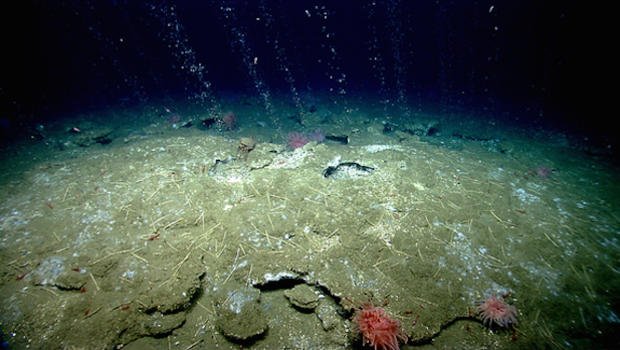
Here’s another point of science that will give rational people concern, and which cannot in any way be explained as “no problem” by stolen e-mails: Methane releases from the floor of the East Siberian Arctic are much larger than predicted.
Underwater methane gas plumes, Photo: NOAA Okeanos Explorer Program, 2013
Methane is a more powerful greenhouse gas than carbon dioxide. Frozen forms of methane dot the bottoms of our oceans. Warming of the oceans might be able to trigger an explosive thawing of the methane hydrates, as the frozen forms are known, seriously adding to our worldwide greenhouse gas problems.
Coastal-Change and Glaciological Map of the Palmer Land Area, Antarctica: 1947—2009
By Jane G. Ferrigno,1 Alison J. Cook,2 Amy M. Mathie,3 Richard S. Williams, Jr.,4 Charles Swithinbank,5 Kevin M. Foley,1 Adrian J. Fox,2 Janet W. Thomson,6 and Jörn Sievers
Introduction
Cover of USGS publication, Coastal-Change and Glaciological Map of the Palmer Land Area, Antarctica: 1947—2009
Reduction in the area and volume of the two polar ice sheets is intricately linked to changes in global climate, and the resulting rise in sea level could severely impact the densely populated coastal regions on Earth. Antarctica is Earth’s largest reservoir of glacial ice. Melting of the West Antarctic part alone of the Antarctic ice sheet would cause a sea-level rise of approximately 6 meters (m), and the potential sea-level rise after melting of the entire Antarctic ice sheet is estimated to be 65 m (Lythe and others, 2001) to 73 m (Williams and Hall, 1993). The mass balance (the net volumetric gain or loss) of the Antarctic ice sheet is highly complex, responding differently to different climatic and other conditions in each region (Vaughan, 2005). In a review paper, Rignot and Thomas (2002) concluded that the West Antarctic ice sheet is probably becoming thinner overall; although it is known to be thickening in the west, it is thinning in the north. The mass balance of the East Antarctic ice sheet is thought by Davis and others (2005) to be positive on the basis of the change in satellite-altimetry measurements made between 1992 and 2003.
Measurement of changes in area and mass balance of the Antarctic ice sheet was given a very high priority in recommendations by the Polar Research Board of the National Research Council (1986), in subsequent recommendations by the Scientific Committee on Antarctic Research (SCAR) (1989, 1993), and by the National Science Foundation’s (1990) Division of Polar Programs. On the basis of these recommendations, the U.S. Geological Survey (USGS) decided that the archive of early 1970s Landsat 1, 2, and 3 Multispectral Scanner (MSS) images of Antarctica and the subsequent repeat coverage made possible with Landsat and other satellite images provided an excellent means of documenting changes in the cryospheric coastline of Antarctica (Ferrigno and Gould, 1987). The availability of this information provided the impetus for carrying out a comprehensive analysis of the glaciological features of the coastal regions and changes in ice fronts of Antarctica (Swithinbank, 1988; Williams and Ferrigno, 1988). The project was later modified to include Landsat 4 and 5 MSS and Thematic Mapper (TM) images (and in some areas Landsat 7 Enhanced Thematic Mapper Plus (ETM+) images), RADARSAT images, aerial photography, and other data where available, to compare changes that occurred during a 20- to 25- or 30-year time interval (or longer where data were available, as in the Antarctic Peninsula). The results of the analysis are being used to produce a digital database and a series of USGS Geologic Investigations Series Maps (I-2600) (Williams and others, 1995; Swithinbank and others, 2003a,b, 2004; Ferrigno and others, 2002, 2005, 2006, 2007, 2008, and in press; and Williams and Ferrigno, 2005) (available online at http://www.glaciers.er.usgs.gov).
The paper version of this map is available for purchase from the USGS Store.
What’s the condition of glaciers in Antarctica? Now you can look it up.
The most noticeable and dramatic changes that can be seen on the Palmer Land area map are the retreat of George VI, Wilkins, Bach, and northern Stange Ice Shelves. The northern ice front of George VI Ice Shelf was at its farthest extent during our period of observation between 1966 and 1974. It retreated, losing 906 km2 between 1974 and 1992 and 87 km2 between 1992 and 1995. After 1995, it retreated an additional 1 km to more than 6 km by 2001. The southern George VI ice front retreated considerably from 1947 to the late 1960s. From the late 1960s to 1973, there was additional substantial retreat, the greatest during the period of measurements. From 1973 to 2001, there was overall noticeable retreat.
Wilkins Ice Shelf had four ice fronts up till 2009; all retreated during the time period of our study, but Wilkins “a” and “b” have had the most dramatic change, including extensive calving in 2009 that eliminated ice front “b” and threatened the future of the ice shelf. During the period of observation, the Bach Ice Shelf front maintained a fairly consistent profile, and advanced or retreated at the same time along the entire ice front. The overall trend of Bach Ice Shelf is retreat. On the northern Stange Ice Shelf during the period of observation, the 1947, 1965–66, 1973, and 1986 ice fronts were more advanced, and the 1997 and 2001 ice fronts were more in retreat. However, the earlier data are less accurate geographically, and it is difficult to quantitatively analyze them. The later satellite images are more accurate, and it is possible to measure overall advance from 1986 to 1989, then retreat from 1989 to 1997 and from1997 to 2001; the net result was retreat.
The three coastal-change and glaciological maps of the Antarctic Peninsula (I–2600–A, –B, and –C) portray one of the most rapidly changing areas on Earth. The changes exhibited in the region are widely regarded as among the most profound and unambiguous examples of the effects of global warming yet seen on the planet.
Resources:
.pdf Map of the Palmer Land Area — if you have the printer, this is suitable for a detailed, poster-sized map of Antarctica and its ice
These .pdfs are suitable for papers sizes roughtly 8.5 by 11 inches in the U.S. — but they probably would scale up nicely for poster-size maps, too. The maps are in color, and in German.
Spread the word; friends don't allow friends to repeat history.
That’s probably not entirely accurate, let’s rephrase: Hawaii didn’t get a significant tsunami from the Chilean quake. The Hawaiians didn’t miss it at all. Hawaiians moved to higher ground. They prepared for disaster. Then the disaster didn’t occur.
That’s good news, especially since there remains disaster in Chile to worry about.
Or, until that account is unsuspended by the forces supporting Donald Trump: Follow @FillmoreWhite, the account of the Millard Fillmore White House Library
We've been soaking in the Bathtub for several months, long enough that some of the links we've used have gone to the Great Internet in the Sky.
If you find a dead link, please leave a comment to that post, and tell us what link has expired.
Thanks!
Retired teacher of law, economics, history, AP government, psychology and science. Former speechwriter, press guy and legislative aide in U.S. Senate. Former Department of Education. Former airline real estate, telecom towers, Big 6 (that old!) consultant. Lab and field research in air pollution control.
My blog, Millard Fillmore's Bathtub, is a continuing experiment to test how to use blogs to improve and speed up learning processes for students, perhaps by making some of the courses actually interesting. It is a blog for teachers, to see if we can use blogs. It is for people interested in social studies and social studies education, to see if we can learn to get it right. It's a blog for science fans, to promote good science and good science policy. It's a blog for people interested in good government and how to achieve it.
BS in Mass Communication, University of Utah
Graduate study in Rhetoric and Speech Communication, University of Arizona
JD from the National Law Center, George Washington University


 Posted by Ed Darrell







 Millard Fillmore's Bathtub