December 13, 2008
Forecast is 70 degrees in Dallas on Sunday.
Meanwhile, Catherine Sherman has some photos of snow near Kansas City. Nice stuff. (I don’t have her permission to copy the photo here — go see her blog.)
I particularly like her photo of the river birch tree. It appeals to the botanist that still survives within me, plus it gives me hope about the proliferation of electronic cameras and the mass recording of things of interest to science.
Sherman writes that Kansas is the only state which has no native pines. Is that accurate? Does that count include Hawaii? (What are the native pines of Hawaii?)
In short, it’s really cool.
Spread the word; friends don't allow friends to repeat history.
 1 Comment |
  Botany, Geography - Physical, Images, Science, Travel | Tagged: Botany, geography, photography, Snow, Travel |
  Permalink
 Posted by Ed Darrell
November 25, 2008
New Yorkers, Vermonters and Candadians continue to celebrate 400 years since Hudson and Champlain, and 200 years since Robert Fulton brought steam power to the Hudson’s commercial ways.
Tugster: A Waterblog features some nice shots, and a couple of stunning shots, of the reconstruction of Henry Hudson’s ship, Half Moon. Great stuff for presentations, and he likes to share.
Tugster is an outstanding repository of images of tugboats, ships and other things related to the commerce of Greater New York Harbor, and boats on the water generally. Tugster’s collection of images should be regular source material for teachers of history, economics, geography and government.
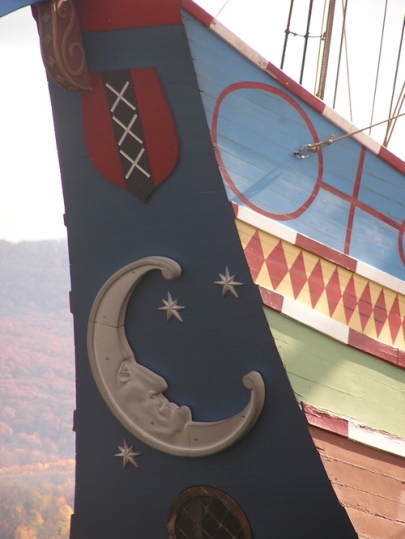
Stern of Half Moon, Henry Hudson's ship; from Tugster: A Waterblog
Notice how the figurehead frightens even the trees to blazing red.

Bowsprite of Henry Hudson's Half Moon, via Tugster: A Waterblog
Tugster tells us that Henry Hudson himself is blogging, channeling across 400 years — perhaps tired of duckpins with his crew in the Adirondacks (hello, Rip van Winkel!). Can your students correspond with Henry Hudson?
Resources:
Spread the word; friends don't allow friends to repeat history.
2 Comments | Education, Explorers and Exploration, Geography - Physical, Geography - Political, Henry Hudson, History, History images, History video sources, Lesson plans, Museums, Science, World history | Tagged: Age of Discovery, geography, Half Moon, Henry Hudson, History, Hudson River, Lesson plans, New York, Quadricentennial | Permalink
Posted by Ed Darrell
November 19, 2008
Bookmark this site, geography teachers: Farm School is going to New York City for the “American Thanksgiving” holiday. Check out the long list of rich resources.
Any student or teacher doing a project on modern New York City should send a note of Thanksgiving to Farm School, eh?
Spread the word; friends don't allow friends to repeat history.
4 Comments | Education, Geography - Economic, Geography - Physical, Geography - Political, History, Travel | Tagged: geography, Lesson plans, New York City, Student projects | Permalink
Posted by Ed Darrell
November 12, 2008
I know the city, and I think there are barely enough clues here to figure this one out. Let me say it is not Los Angeles, though the clues may have led one to figure that out. I wonder if you can figure this out, or if maybe there are several places that fill this particular bill.
A friend notes in a recent e-mail:
Nothing quite like going into the nearest Vons (right across from the street from campus), hearing French spoken by two guys exiting the store, standing behind two German speakers, East German accent in line to be checked out by a clerk whose first language is Chinese, and hearing two guys rattling away in Russian in the next checkout line. Oh–and this is after having lunch at the Vietnamese Pho/Banh joint in the same strip mall.
Do you know the city? Or, do you know another city that fits this bill?
Tell us in comments.
________________
Answer is now in comments.
Spread the word; friends don't allow friends to repeat history.
6 Comments | Geography - Political, Immigration, Politics, Travel | Tagged: Culture, geography, Mystery, Politics, Tourism, Travel | Permalink
Posted by Ed Darrell
November 2, 2008
[See report on January 6, 2014 series of earthquakes here.]

Texas earthquake, 2.7 magnitude – Saturday, November 01, 2008 at 11:54:30 (UTC) – Coordinated Universal Time, Saturday, November 01, 2008 at 06:54:30 AM local time at epicenter – epicenter in Las Colinas, Irving, Texas.
Some Texans hope for a Texas earthquake on Tuesday. Four years ago Dallas County voters resisted the Red Tide, voting for a Democrat in every judicial race on the ballot where a Democrat was running, electing a Democrat for sheriff, and putting a Democrat in as District Attorney for the first time since Noah disembarked the boat on the mountain in Turkey.
Voters in Dallas County, Harris County (Houston), and Bexar County (San Antonio) seem prepared to do it again.
That would be a virtual earthquake.
Meanwhile, the Dallas area has had a series of real earthquakes over in the end of this week. The biggest was about 3.0 on the Richter Scales, barely detectable to most people. But this is big stuff around here. We sit on some of the most geologically stable land in North America. Earthquakes are rare, and usually small.
We’ve had eight quakes in the past two days. Despite their low magnitude, a few people are worried. Students are interested, not least because they worry about a destructive quake. For people who live in Tornado Alley, fears of earthquakes seem odd, at least to those of us who grew up in more earthquake-prone provinces.
Here’s the list from the U.S. Geological Survey (USGS):
Earthquake List for Map Centered at 33°N, 97°W
Update time = Sun Nov 2 4:00:04 UTC 2008
Here are the earthquakes in the Map Centered at 33°N, 97°W area (go see the map), most recent at the top. (Some early events may be obscured by later ones.) Click on the underlined portion of an earthquake record in the list below for more information.

Map of Irving, Texas, showing the epicenter of an earthquake November 1, 2008 – near the development known as Las Colinas
Two fault lines run under the Dallas-Fort Worth area, the Mexia and Balcones faults — but both are said to be “inactive.” Earthquakes in this area are about as common as Democrats in statewide offices.
Resources, news coverage:
Historically, Texas has not been a hotbed of earthquake activity, between 1973 and 2012. Texas Seismicity Map from USGS.

Texas Seismicity, 1973-2012. USGS
Spread the word; friends don't allow friends to repeat history.
4 Comments | Geography - Physical, geology, History, Science, Texas | Tagged: earthquakes, geography, geology, History, Science, Texas | Permalink
Posted by Ed Darrell
October 7, 2008
Viewers of NOVA tonight get to see some of the pride of Dallas on display. “Arctic Dinosaurs” documents the work of a paleontologist from the Dallas Museum of Nature and Science digging dinosaurs in or near the Arctic Circle.
NOVA takes viewers on an exciting Arctic trek as one team of paleontologists attempts a radical “dig” in northern Alaska, using explosives to bore a 60-foot tunnel into the permafrost in search of fossil bones. Both the scientists and the filmmakers face many challenges while on location, including plummeting temperatures and eroding cliffs prone to sudden collapse. Meanwhile, a second team of scientists works high atop a treacherous cliff to unearth a massive skull, all the while battling time, temperature, and voracious mosquitoes.
The hardy scientists shadowed in “Arctic Dinosaurs” persevere because they are driven by a compelling riddle: How did dinosaurs—long believed to be cold-blooded animals—endure the bleak polar environment and navigate in near-total darkness during the long winter months? Did they migrate over hundreds of miles of rough terrain like modern-day herds of caribou in search of food? Or did they enter a dormant state of hibernation, like bears? Could they have been warm-blooded, like birds and mammals? Top researchers from Texas, Australia, and the United Kingdom converge on the freezing tundra to unearth some startling new answers.
Tony Fiorillo, curator of earth sciences at the Dallas museum, is one of the scientists featured in the NOVA production. The film highlights the museum’s efforts to push science work as well as displays for the public.
Previously, the museum had relied on Texas volunteers to help unearth and mount displays on prehistoric creatures from Texas, under the direction of Charles Finsley, a venerable Texas geologist. One one hand, it’s good to see the level of science kicked up a notch or two. On the other hand, it was great to have such a high level outlet for amateur and future, volunteer scientists at a major museum.
In any case, the PBS program demonstrates that science goes on in Texas despite foolish creationist eruptions from the State Board of Education. Every piece of accurate information helps eclipse the anti-science leanings of education officials.
Resources:
_______________________________
Update: Wonderful program. There’s a lot of good science, and a good deal of geography in the program. Geography teachers may want to think about using this as supplement to anything dealing with Alaska, or the Arctic.
Spread the word; friends don't allow friends to repeat history.
2 Comments | Education, Evolution, Geography - Physical, Paleontology, Science, Television, Texas | Tagged: Arctic, Dinosaurs, Education, Evolution, geography, Media, Paleontology, Science, Texas | Permalink
Posted by Ed Darrell
October 2, 2008
The exhibit is gone, but the memory, and the on-line educational features still remain.

Spectacular digital map of Africa, showing current development. Map copyright by Allan Sluis, courtesy of NAVTEQ and ESRI
Geography teachers should explore the on-line version of the Field Museum’s exhibit, “Maps: Finding Our Place in the World.”
This exhibit is by itself an argument for live internet links for students. Take a few minutes to peruse some fo the interactive features, like the world map that leads to photos of the major exhibit pieces.
We need more material like this, freely available in classrooms.
Also, see especially:
Spread the word; friends don't allow friends to repeat history.
1 Comment | Geography - Economic, Geography - Physical, Geography - Political, Lesson plans, Maps, Museums, On-line education, On-line learning, Technology, Technology in the classroom, World history | Tagged: Field Museum, geography, Lesson plans, Maps, On-line learning | Permalink
Posted by Ed Darrell
September 30, 2008

Atchison, Topeka & Santa Fe Railroad, 1899 - from the Library of Congress
American Memory at the Library of Congress features dozens of historic railroad maps of U.S. railroads.
This is a great collection for U.S. history presentations on development of the railroads, or on settlement of the west, in particular.
The Railroad maps represent an important historical record, illustrating the growth of travel and settlement as well as the development of industry and agriculture in the United States. They depict the development of cartographic style and technique, highlighting the achievement of early railroaders. Included in the collection are progress report surveys for individual lines, official government surveys, promotional maps, maps showing land grants and rights-of-way, and route guides published by commercial firms.
Heck, if nothing else, these make great backgrounds for PowerPoint presentations.
Bookmark the site — kids working on projects specific to a state or region should have a field day with these things.
Spread the word; friends don't allow friends to repeat history.
2 Comments | Education, Geography - Economic, Geography - Political, Historic documents, History, History and art, History images, Maps, Railroads, Transportation, Travel | Tagged: Education, geography, History, History images, Maps, Railroads, Transportation, Travel | Permalink
Posted by Ed Darrell
September 25, 2008
New candidate for “oldest rocks on Earth,” from Canada. They come in perhaps as old as 4.28 billion years.
They’re older than John McCain!
Spread the word; friends don't allow friends to repeat history.
1 Comment | Bell Ringers, Creationism, Evolution, Geography - Physical, geology, History, Science, Travel | Tagged: Bell Ringer, Cool Stuff, Creationism, Evolution, geography, geology, History, Science, Travel | Permalink
Posted by Ed Darrell
September 20, 2008
“Bong Recreation Area?” In Wisconsin?

Sign pointing to Bong Recreation Area, in Wisconsin. Named after Maj. Richard Bong, the pilot.
The Walrus covered it pretty well, three years ago. It’s not what you feared, or hoped.
It’s a recreation area made from a closed U.S. Air Force Base. Maj. Richard Bong, a native of Wisconsin, was the top fighter ace for the U.S. in World War II. He is a recipient of the Congressional Medal of Honor.
Spread the word; friends don't allow friends to repeat history.
1 Comment | Congressional Medal of Honor, Geography - Political, Humor, Travel, World War II | Tagged: Bong, Congressional Medal of Honor, geography, Humor, Richard Bong, Road Signs, Travel, World War II | Permalink
Posted by Ed Darrell
September 19, 2008
A bit unexpectedly, I’m in the wilds of Wisconsin at the moment and on the road the next couple of days. Posting is likely to be sparse.
But the American open road is, as always, very interesting.
For example, according to the billboards, somewhere in Wisconsin there is a restaurant named Brisco’s (after Brisco County, Texas?), which claims to feature cuisine (a French word) of a “southwestern” flavor. What does that mean?
Their billboard features a Wyoming-style cowboy, a saguaro cactus (from 800 miles south of Wyoming) in front of Delicate Arch, the signature arch of Arches National Park, near Moab, Utah, (well out of cattle company and still at least 400 miles from saguaro country). Only on a billboard in Wisconsin . . .
Spread the word; friends don't allow friends to repeat history.
3 Comments | Administrivia, Botany, Geography - Physical, Geography - Political, Natural history, Travel, Weblogs | Tagged: Adventure, blogging, geography, Travel | Permalink
Posted by Ed Darrell
September 8, 2008
There’s a geography exercise and social studies bell ringer in this somewhere [links added]:

From the Deseret News: “Ben Lomond Peak towers above Ogden (Utah). The mountain is believed to have inspired the Paramount movie logo, below, in use since 1914. (Ravell Call, Deseret News)
What is the most “paramount” mountain in Utah?
How about Timpanogos Peak, Kings Peak, Mount Nebo, Mount Olympus. Lone Peak or Twin Peaks?
It’s none of the above because one of Hollywood’s most familiar images — the famous Paramount Pictures logo — was inspired by Weber County’s Ben Lomond Peak.
As such, Ben Lomond — not even the highest summit in Weber County — may be the most famous mountain in the Beehive State.
The peak is given credit for prompting creation of the majestic but fictional mountain in the popular Paramount design, based on two histories of the motion-picture company.
According to Leslie Halliwell’s “Mountain of Dreams,” a biography of Paramount, founder William Hodkinson grew up in Ogden and the logo was “a memory of childhood in his home state of Utah.”
Compare it to the Paramount Pictures logo now:

Paramount Pictures logo
Teachers may want to hustle over to the Deseret News site to capture the story for classroom use — the online version includes a short set of slides of a hike to the top of the peak (it’s a climb most reasonably healthy people can make in a day – “reasonably healthy” to include acclimated to the altitude).
What other geographic features have become commercial logos? How do images of geography affect our culture?
For my money, I still like Timpanogos better, even if the Osmonds did use it.
See the 2012 update of this post; there is a bit more information available on the 100th anniversary of Paramount Pictures.
Spread the word; friends don't allow friends to repeat history.
3 Comments | Bell Ringers, Business, Geography - Physical, geology, Lesson plans, Warm-up exercises | Tagged: Bell Ringer, Ben Lomond, Ben Lomond Mountain (Utah), Education, geography, Mountains, Paramount Mountain, Paramount Pictures, Paramount Pictures Logo, Utah, warm-up | Permalink
Posted by Ed Darrell
September 6, 2008
Especially you economics teachers, look at this very carefully:

Six cans of juice, at a store on Baffin Island - photo from Tales from the Arctic
How much do you pay for juice at your local market?
“The High Cost of Northern Living” at Arctic Economics points to Tales from the Arctic and “Believe me now?”
How much per ounce?
Kennie (at Tales from the Arctic) features a bunch of unbelievable prices. Getting goods to towns in the far north of North America, in Canada and Alaska, is a major production. Transportation and handling kick prices up a bit.
We’ll find out how alert Sarah Palin is when somebody asks her the price of a gallon of milk . . .
More seriously, economics teachers might find some object lessons in these photos, and a good presentation on supply and demand, and the costs of distribution.
Milk at $8.50 a gallon? Even in Canadian currency, that burns.
I wonder: Do prices like these make economics any easier to teach to high school kids? Does the urgency of high prices make the subject more relevant?
Tip of the frozen scrub brush to Arctic Economics, of course.
Spread the word; friends don't allow friends to repeat history.
6 Comments | Economics, Food history, Freedom - Economic, Geography - Economic, Geography - Physical, Maps, Personal finance, Transportation, Travel | Tagged: Alaska, Canada, Economics, geography, Market Basket, Travel | Permalink
Posted by Ed Darrell
August 28, 2008
You’d think someone like National Geographic Society would hustle down there to find it.
Whatever happened to the expedition that took off on the trek to photograph what was rumored to be a world-class waterfall newly discovered in Peru? The cataract was rumored to be among the world’s tallest.
Perhaps a reader who reads Spanish might find some news in the South American newspapers. Has anyone seen any news?
Spread the word; friends don't allow friends to repeat history.
1 Comment | Adventure, Conservation, Environmental protection, Geography - Physical, Geography - Political, Natural history, Natural resources, Science, Travel | Tagged: Adventure, geography, Peru, South America, Travel, Waterfalls | Permalink
Posted by Ed Darrell
August 23, 2008
In the summer of my 8th year, after my uncle, Roland Christian*, sent me his collection of “official” state maps from his latest cross-country drive, several of us kids tried to collect maps of all 50 states. Considering we were in Burley, Idaho, it’s amazing that we could accumulate 36 different states, just by our badgering local gasoline stations for the free ones. We got on our bicycles and visited the stations, one after the other.
Free educational materials: A memory from a distant past.
I haven’t seen a free map from a gas station in years, maybe two decades. My love of geography, my love of chasing odd city names, strange routes, great sights, and history, was spurred by that map collection, I’m sure.
Today, though oil companies have gotten out of the tourism and driving promotion business, state tourism offices, or state road departments typically issue free maps. How to find them all?
To the rescue comes Less Than a Shoestring, with a list of the places to ask in each state, to get a free road map of the state. These maps are great helps for students doing a “project” on a different state. For the history class on your own state, if your school offers such a course, I think such maps are indispensable.
We teach Texas state history and geography in 7th grade. When I taught that course, one of the best classroom aids I had was a collection of the official map of Texas — a year old, but I got a couple dozen copies from the state’s tourism promotion group. They were anxious to get rid of the old maps, and I was very happy to have them.
Here’s something curious: The site, Less Than a Shoestring, doesn’t list a place to get a map from the District of Columbia — Washington, D.C. You’d think that a town that depends so much on tourism would have an office to promote tourism that would pass out maps to make tourists’ trips easier. Is this just an indication of the great dysfunction of the D.C. government, or did we miss finding the site? Let me know in comments.
Tip of the old scrub brush to the Business Blog @ Capital Active.
____________________________
* Uncle Roland was a minister for the 7th-Day Adventists, and he traveled to preach around the country. Stuck in a small Idaho town for my first nine years, I thought Roland was a great world traveler. He always stopped to spend a night when he was within a state or two — he was a minister trying to travel on a shoestring, after all — and with his wonderful, deep, preacher’s voice, he had wonderful stories to tell. I miss him still, more than two decades after his death. Which of your nieces and nephews can you influence as Roland did?
Read the rest of this entry »
Spread the word; friends don't allow friends to repeat history.
1 Comment | Education, Geography - Physical, Geography - Political, History, Landmarks, Manipulables (i.e., Maps, Toys, Travel | Tagged: Education, geography, History, Maps, Teaching, Tourism, Travel | Permalink
Posted by Ed Darrell




 Millard Fillmore's Bathtub