Is your science class as smart as a U-Haul truck?

October 23, 2013

We had to fight to keep this stuff in Texas science books.

Then, out on the street, I see a U-Haul truck.

U-Haul truck features geographic information, and geology information

U-Haul truck features geographic information, and geology information, about Arkansas and its Crater of Diamonds State Park.

Detail:  U-Haul truck features a graphic description of the geology and information about Arkansas's Crater of Diamonds State Park.

Detail: U-Haul truck features a graphic description of the geology and information about Arkansas’s Crater of Diamonds State Park.

Well played, U-Haul.  Can Texas catch up?

Update, October 24, 2013:  Turns out U-Haul has a website that features all of the graphics they use on their trucks.  I sense a geography or state history assignment in here, somewhere, social studies teachers.  Reminds me of the animals that used to (still do?) grace the tails of Frontier Airlines airplanes, the Native American on the tails of Alaska Airlines, and other specific destination promoting tricks businesses have used over the years.  Wish more businesses would do that.

http://twitter.com/SuperGraphic/status/393408729388834816

More:


Twitter open thread: Noah’s flood

July 30, 2013

No, the evidence doesn’t point to a Noachic flood.  Evidence contradicts the idea.

Welcome, @crazy_stairz @EdDarrell @paulmc107 @StrangerGirl2 @HomunculusLoikm @LogicBobomb, and anyone else who wants to join in.  Usual rules of civility apply.

Discussing this, and its many cousins:

http://twitter.com/crazy_stairz/status/362325832305348609


What rocks Yosemite? Granite

July 7, 2013

Yosemite’s Nature Notes #20 (I’m behind):  A short film discussing the astonishing manifestations of granite in Yosemite National Park.

English: El Capitan in Yosemite National Park ...

El Capitan in Yosemite National Park viewed from the Valley Floor — one of the more famous granite formations in the Park. Wikipedia image

The film is simply named, “Granite.”  Steven Bumgardner produced the film.

Yosemite’s chief formations are granite, an igneous rock.  Much of the terrain was carved in the granite by glaciers and glaciation — so what Yosemite shows is how fire and ice combine to make rock, to make rock formations, and to make rocks of astonishing beauty.

(This is not a place to bolster creationist ideas.  This is real science, looking at God’s handiwork first hand.)

A North Carolina university makes field trips to Yosemite?  I’d love to take that class!

Watching this film, you get a sense of how important it can be to the education of our children to travel in the summers, to take vacations to our National Parks, and to places like Yosemite.

Where are you taking your kids this summer?  Kids, where are you going?

Enjoy it.  Geology lessons are often fun, and this one, on film, is more fun than most.

More:

Close-up of granite from Yosemite National Par...

Close-up of granite from Yosemite National Park, valley of the Merced River – Wikipedia image


Darwin’s death, April 19, 1882

April 20, 2013

We shouldn’t get out of April 19 — a day marked by significant historic events through the past couple hundred years — without remembering that it is also the anniversary of the death of Darwin.

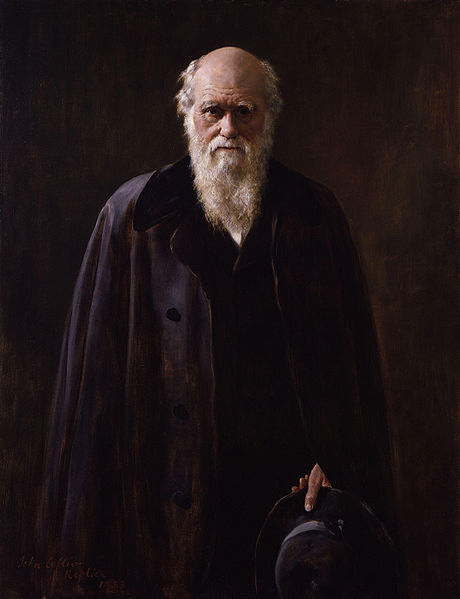
Charles Darwin in 1881, by John Collier

Charles Darwin in 1881, portrait by John Collier; after a Collier painting hanging in the Royal Society

Immortality?  Regardless Darwin’s religious beliefs (I’ll argue he remained Christian, thank you, if you wish to argue), he achieved immortality solely on the strength of his brilliant work in science. Of course he’s best known for being the first to figure out that natural and sexual selection worked as tools to sculpt species over time, a theory whose announcement he shared with Alfred Russel Wallace, who independently arrived at almost exactly the same theory but without the deep evidentiary backup Darwin had amassed.

But had evolution turned out to be a bum theory, Darwin’s other works would have qualified him as one of the greatest scientists of all time, including:

Darwin's theory set out a sequence of coral re...

Darwin’s theory set out a sequence of coral reef formation around an extinct volcanic island, becoming an atoll as the island and ocean floor subsided. Courtesy of the U.S. Geological Survey (Photo credit: Wikipedia)

US Geological Survey graphic demonstrating how coral atolls form on the sinking remains of old volcanic sea mounts, as Darwin described. Wikimedia commons image

  • World’s greatest collector of biological samples:  During his five years’ voyage on HMS Beagle, Darwin collected the largest collection of diverse plant and animal life ever by one person (I believe the record still stands); solely on the strength of his providing actual examples to the British Museum of so much life in so many different ecosystems worldwide, before he was 30 Darwin won election to the Royal Society.  (His election was engineered partly by friends who wanted to make sure he stayed in science, and didn’t follow through on his earlier plan to become a preacher.)
  • Geology puzzle solver:  Coral atolls remained a great geological mystery.  Sampling showed coral foundations well below 50 feet deep, a usual limit for coral growth.  In some cased old, dead coral were hundreds of feet deep.  In the South Pacific, Darwin looked at a number of coral atolls, marvelous “islands” that form almost perfectly circular lagoons.  Inspired partly by Lyell’s new encyclopedic review of  world geology, Darwin realized that the atolls he saw were the peaks of volcanic mounts.  Darwin hypothesized that the volcanoes grew from the ocean floor to the surface, and then the islands were colonized by corals.  The round shape of the volcano gave the atoll its shape.  Then the volcanic mounts eroded back, or sank down, and corals continued to grow on the old foundations.  It was a perfectly workable, natural explanation for a long-standing geologic puzzle.  (See Darwin’s monograph, Structure and Distribution of Coral Reefs.)
  • Patient watcher of flowers:  Another great mystery, this time in biology, concerned how vines twined themselves onto other plants, rocks and structures.  Darwin’s genius in designing experiments shone here:  He put a vine in his study, and watched it.  Over several hours, he observed vine tendrils flailing around, until they latched on to something, and then the circular flailing motion wrapped the tendril around a stick or twig. Simple observation, but no one had ever attempted it before.  (See On the Movements and Habits of Climbing Plants.)
  • Champion of earthworms, and leaf mould:  Darwin suspected the high fertilizer value of “leaf mould” might be related to the action of earthworms.  Again, through well-designed experiments and simple observation, Darwin demonstrated that worms moved and aerated soil, and converted organic matter into even richer fertilizer. (See The Formation of Vegetable Moulds Through the Action of Worms.)
  • Creation of methodological science:  In all of this work, Darwin explained his processes for designing experiments, and controls, and made almost as many notes on how to observe things, as the observations themselves.  Probably more than any other single man, Darwin invented and demonstrated the use of a series of processes we now call “the scientific method.”  He invented modern science.

Any of those accomplishments would have been a career-capping work for a scientist.  Darwin’s mountains of work still form foundations of geology and biology, and are touchstones for genetics.

Born within a few hours of Abraham Lincoln on February 12, 1809, Darwin survived 17 years longer — 17 extremely productive years.  Ill through much of his life with mystery ailments, perhaps Chaga’s Disease, or perhaps some other odd parasite or virus he picked up on his world travels, Darwin succumbed to heart disease on April 19, 1882.

More:


Other side of the mountain: Timpanogos

February 26, 2013

East side of Timpanogos, by the Heber Valley Convention and Visitors Bureau:

Timpanogos from the east - replacement for photo that originally nested here. Utah.com image

Timpanogos from the east – replacement for photo that originally nested here. Utah.com image

Mt. Timpanogos, east side. Heber Valley CVB photo

Mt. Timpanogos, east side. Heber Valley CVB photo. Click image for larger view.

Tip of the old scrub brush to Susan Reeve Lewis.


Post-Valentine’s Day olla podrida

February 22, 2013

How’s the NRA going to spin this one?

Psy got more than 7 billion views on one video.  Can you help Sesame Street get to one billion, total?  It’s a better cause.  And it may frost the heck out of Sal Khan, too.

Sesame Street actually has a lot of video up for YouTube use — that is, for your use.  This is one of the most important educational sites on the entire internet. 992,469,603 total views at this moment.

Whose educational video works best, Sal Khan’s or Cookie Monsters?

U.S. Rep. Marsha Blackburn, R-Tennessee, said she doesn’t think we need an increase in the minimum wage, especially not to the $9 level President Obama asked.  She said her $2.15 minimum wage was enough . . .

Oops:

At that time, the minimum wage was $1.60, equivalent to $10.56 in today’s terms. Today’s minimum wage is equivalent to just $1.10 an hour in 1968 dollars, meaning the teenage Blackburn managed to enter the workforce making almost double the wage she now says is keeping teenagers out of the workforce.

Do Republicans ever learn history, or make the minor mathematical calculations to adjust for historic inflation?  Pretty tough to flunk history, math and economics in such a short statement.

Is there a rational reason that Wisconsin Rep. Paul Ryan’s  solutions to U.S. problems always involve economic pain to others?  Will cuts in food and health care make these 600,000 children smarter, too?

Here you go, Mittens in winter:

The Mittens in winter, by Howard Noel, via National Wildlife Federation

Caption from the National Wildlife Federation: Howard Noel’s photo of Monument Valley captures the East and West Mitten Buttes, as well as Merrick’s Butte on the right. These natural sandstone and shale structures are just a few of the world-famous geological features in Monument Valley Navajo Tribal Park, located along the Arizona-Utah state line within the Navajo Nation Reservation. The Utah resident used a Canon EOS 5D Mark II camera and a 24-105mm lens.

Where in Utah does Howard Noel hail from?  While I’ve been by these formations in winter, it was never with a camera to catch the snow.  This park is an ideal place to spend a couple of days learning landscape photography, if you’re looking for a place to try out your new camera.  Great place to be anytime, for me.

Hey, if you’re planning drive to see the Mittens, you should be aware that part of Highway 89 is out of commission due to a slump off the roadway between Flagstaff and Page, Arizona — the Navajo Reservation being as large as it is, and as unroaded as it is, when a main road goes out, detours can be spectacularly long.   Earthly Musings carries geological explanations, history and great photos.  How much detour?  This one requires a job to the east, through Tuba City, probably adding about an hour to the trip between those two cities.

The Arizona Department of Transportation says traffic will detour around the closure by using U.S. 160 and State Route 98, adding 45 miles of driving. (emphasis added here)

Meanwhile, in the rest of America? This is okay.  America is ashamed of Rush Limbaugh’s ranting, too.  Fair, no?

Why was the death toll so high in season 3 of “Downton Abbey?”  Writer Julian Fellowes explained it’s a kind of contract issue — anti-regulation types will no doubt crawl out of the woodwork to complain about government interference in the right of contract in English theatre.


Time machine! For Digital Learning Day

February 6, 2013

Screen shot from HHMI's iPad app, Earth Viewer -- the time machine function.

Screen shot from HHMI’s iPad app, Earth Viewer — the time machine function.

Stealing the entire post from P. Z. Myers at Pharyngula:

I’ve been playing with it for a while. It turns out that when you go back to Cretaceous Morris, you need to be able to swim really well, but Cambrian Morris is high and dry on a fairly small landmass (whoa, but oxygen is way down and carbon dioxide way up). You can have your own time machine, too — it’s the EarthViewer app for iPad, and it’s free from HHMI Here’s what it has:

• Data and continental reconstructions dating back billions of years

• Climate and carbon dioxide data for the last 100 years

• The ability to manipulate the globe and zoom to any location

• Track the location of modern cities back over 500 million years

• In depth features on major geological and biological events in Earth history

• Clickable details on geologic eons, eras, and periods

• Automated play modes

• An extensive reference list

• Suggestions for classroom use

• Tutorial videos

Did I mention that it’s free? This HHMI thing is pretty danged sweet.

There is no creationist/Noah’s Flood version.

No Windows version, yet, either.

Did we mention the Howard Hughes Medical Institute made this and related apps free?


Millard Canyon, Utah — not named for Millard Fillmore

January 14, 2013

Winter view of Millard Canyon, Canyonlands NP, Utah

Caption from the NPS crew at Canyonlands National Park: View from the Maze: Millard Canyon’s winter mood. We are looking north. Note how the heat from the east to southeast facing cliffs has melted the snow below – even in this ultra-frigid time. Taking a break under a southeast facing cliff is a good way to warm up while on a Canyonlands hike. (GC) (via Facebook)

In a state where they once named the proposed state capital “Fillmore,” and the county in which that town sat, “Millard,” to try to curry favor with President Millard Fillmore for the state’s petition to gain statehood, one might logically think that a spectacular desert canyon not far away called Millard Canyon might also be named in honor of our 13th president.

LocMap Canyonlands National Park

Location map, Canyonlands National Park, image from Wikipedia

Not so, in this case.  According to John W. van Cott’s Utah Place Names (University of Utah Press, 1990):

MILLARD CANYON (Garfield County) originates at French Springs southeast of Hans Flat. The canyon drains north northeast into the Green River at Queen Anne Bottom. According to Baker, “They learned later that they had misunderstood this name; instead of honoring a president, it was named for an undistinguished `Miller’ who did nothing more than leave this small, mistaken mark on the map” (Baker, Pearl. Robbers Roost Recollections. Logan, UT: Utah State University Press, 1976, p. 33). The name was even misspelled Millard.

Millard Fillmore is off the hook on this one.

Garfield County, Utah, was named after President James Garfield.

So, who was this “Miller” guy?

(Post inspired by image from the Canyonlands NP Facebook site; temperature at the time of the photo was near 0°F.)

More:


Utah’s Mount Timpanogos, no PhotoShop needed

November 16, 2012

Here’s a good demonstration of why you don’t need PhotoShop, but a decent camera and a steady hand instead.

Utah's Mt. Timpanogos in snow, by Craig Clyde, 2012

Utah’s Mt. Timpanogos in snow, by Craig Clyde, 2012 (rights probably reserved).  Click for larger version.

Craig Clyde took this photo of Utah Valley‘s Mt. Timpanogos, probably from Saratoga Springs, on the west side of Utah Lake, after one of the first snows of 2012.  (This area had a few farm fields when I grew up there.)  It’s a great photo for several reasons.

It’s a formerly unusual view, there being so few people on the west side of the lake until recent development.  It pictures all of Timpanogos, with American Fork Canyon on the left, Mahogany Mountain, Big Baldy, and Provo Canyon on the right.  It’s an afternoon shot, you can tell from the angle of the sun (the mountain runs on a north-south axis), and the darkness on the lower mountains may be caused by the Sun’s setting behind the mountain range on the west side of  the lake.  Timpanogos in white, in the afternoon sunshine, is one of the greatest images of a mountain you’ll ever see.

Tip of the old scrub brush to Craig Clyde.  Mr. Clyde and I attended high school together — haven’t seen him in more than 30 years; not sure, but I don’t think he’s the same Craig Clyde in the movie business.

More:


Sometimes beauty is in the timing . . . Capitol Reef National Park

November 8, 2012

Long-time Scout friend Hal Rosen said he caught some good photos here, too — but none at this precise moment:

Temple of the Sun, Capitol Reef NP, photo by Mike Saemisch, October 29, 2012

Temple of the Sun, Capitol Reef NP, photo by Mike Saemisch, October 29, 2012

First you must get to Capitol Reef National Park, in Utah — one of Utah’s unfairly large number of five National Parks.  Then you take your “high-clearance vehicle” (not necessarily 4-wheel drive) out on the dirt roads in Cathedral Valley, and you hope for a crystal blue sky like this one.  Then you happen to get there just as the sun is right at the peak of the formation . . .

You had to be there.  Mike Saemisch was there just over a week ago, on October 29, 2012, and fortunately caught this photograph with the Sun as part of a sparkling spire on a sandstone formation known as the Temple of the Sun.

Digital photography changes the way one tours these places.  Fortunately.  Take the kids, and make sure they find it on a map so they can use your trip as fodder for their 9th grade geography class.

More:

  • A different angle, at a different time, by Scott Jarvie:  “A 3.5hr timelapse taken late on a cloudy night at the Temple of the Moon with the Temple of the Sun in the background. March 17, 2012.”

Creationism vs. Christianity (a reprise)

October 30, 2012

This is an encore post, a repeat post from about four years ago, back in 2008.  For some reason the post got a couple hundred hits one day this past week, probably from a reference at another blog that I could not track.  I reread it — still true, still good stuff.  In this campaign year of 2012, I am dismayed at how anti-science and the denial of reality haunts election discussions, especially on-line, but also in the newspapers and magazines, on television and radio, in diners and drugstore fountains, in churches and PTA meetings.  Denial of reality may or may not be a genuine ailment to humans.  When it becomes a core belief of a significant number of people, denial can cripple our nation, our states, cities and towns. We need to ask deep questions.  We need to have real answers, not fantasies nor dangerous delusions.
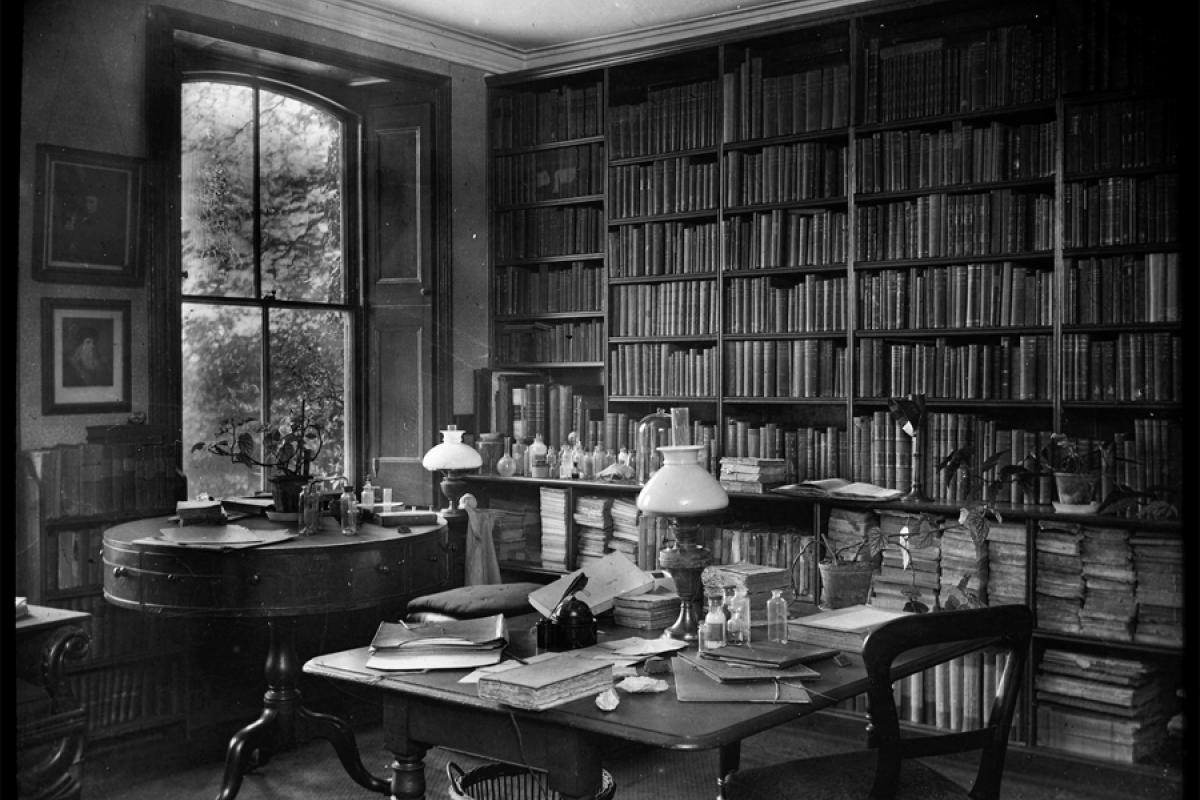
PhotonQ-Charles Darwin 's Office

Charles Darwin’s study, where he conducted experiments and made many of the observations he wrote about. Photo: National Endowment for the Humanities

Denying reality plagues us as an actual political response to several problems.  Denialists wander so far down paths of disreality, they argue that we should ignore serious problems, and that the problems will then go away.

Should we teach the science of evolution to our children, or should we pretend fairy tales will substitute?  This has deep meaning to those who understand that Charles Darwin’s greatest contribution to science probably was his strict methodology, which required observation of things in nature before writing about them as if authoritative. 

Early in his life Darwin recognized that the natural world he saw, in Brazil, in the Galapagos Islands, in Australia and Tasmania, in South Africa, bore little resemblance to the world portrayed as authoritative by the great William Paley in his Natural Theology.  Throughout his science career Darwin observed real things in real time.  For his monograph on coral atolls, Darwin extensively observed the volcanic island phenomena throughout the South Pacific.  To write about barnacles, Darwin raised them in tanks in his study.  Looking at the mystery of exactly how the ivy twines, Darwin put a plant before him, and watched it, unraveling the secrets of how tendrils “knew” what to latch onto for support of the vine.  To write about leaf moulds, Darwin observed worms at work, in his lab and in his gardens.  To show the variation existing in what we now call the genome of a species, Darwin made extensive interviews and correspondence with animal husbanders of pigs, sheep and cattle, and he raised pigeons for generations himself, demonstrating how variations can be expressed that drive populations of one species to split into two through natural, everyday processes familiar to anyone who observed nature, and accessible by anyone who made methodical notes.

This familiarity with reality made Darwin a great scientist.  The methodology proved extendable into other areas when he carefully observed the mediums to whom his brother had cast great credence.  Charles revealed to Erasmus that spirit knocking on the tables at the séances did not occur so long as they held the hands of the mediums, who were then unable to feign the knocking. 

Ultimately it provided some despair to Darwin, too:  In the face of criticism from William Thompson, Lord Kelvin, that the Earth was not old enough to allow for evolution as Darwin suggested it must have occurred, Darwin had no answer.  Lord Kelvin calculated the ages of the Earth and Sun to be no more than 200 million years.  This was shown by the present temperatures and color of the Earth and the Sun, and calculated by Lord Kelvin from how long it would take the Earth, known to be composed of much iron and nickel, to cool from white hot to current temperatures.  Lord Kelvin ventured deep into coal mines to measure the temperatures of the Earth deep underground, to confirm his calculations.  At his death, though he defended his own observations of fossils and breeding of live animals, Darwin had no response for those arguments.  Darwin thought there must be other forces at play.  Only some years later did Ernest Rutherford find the secret of the Earth’s heat:  Radioactive decay in the mantle and core of the planet keeps it warm.  Measures of heat loss for such a large body had not accounted for continuous heating from within.  A short while later astronomers and physicists discovered problems with Lord Kelvin’s calculations of the age of the Sun:  The Sun is not composed of iron, cooling from white hot temperatures, but instead is hydrogen, fusing into helium, and making its own heat.

Darwin’s calculations of the age of the Earth were more accurate than Lord Kelvin’s, based on Darwin’s crude calculations of how long it might take animals and plants to have evolved from much more primitive forms.  History demonstrated by easily observable things provided greater accuracy than history devised without benefit of grounding in reality.

In what other realms might grounding in reality produce answers different from what some expect, even producing better questions that many ask?  Should we consider the migratory pattern changes of birds, fish and mammals, as indicators of a warming climate, over rebuttals provided by untested claims that measuring stations might not be placed correctly?  Can we actually “cool” atoms with lasers, and use individual atoms to store information, no matter how counterintuitive that might sound?  Can it be true that teaching people about contraception, and about sex, actually prompts teenagers (and others) to reduce sexual activity and look for love, rather than just sex?  Does extending medical coverage to an entire population actually decrease total health care costs as observed in all other nations where that solution has been tried, or will it increase costs because the only way to reduce medical costs is to ration it, either with a bureaucracy, or by cutting off access by backdoor, death panel means testing (no money, no health care)?  Is there any place Arthur Laffer‘s “curve” of increasing tax revenues by cutting tax rates, actually does not work — or any place it actually works?  Has any society in history ever gotten rich by showering riches on the rich, and ignoring the poor, the merchants, and the working class?

In short, how does reality we know, inform us about reality yet to be?  Which is the more potent predictor, observed reality, or hoped-for results to the contrary?

Our future hangs on how we answer the question, probably more than what the answer actually is.

I believe Christians, the largest faith group in the U.S., have a duty to stand for reality, and truth discovered by observation.  That was the issue in 2008, too.

Here is my post of four years ago.  I noticed a few of the links no longer work; I’ll replace them with working links as I can.  If you find a bad link, please note it in comments; and if you have a better link, note that, too.

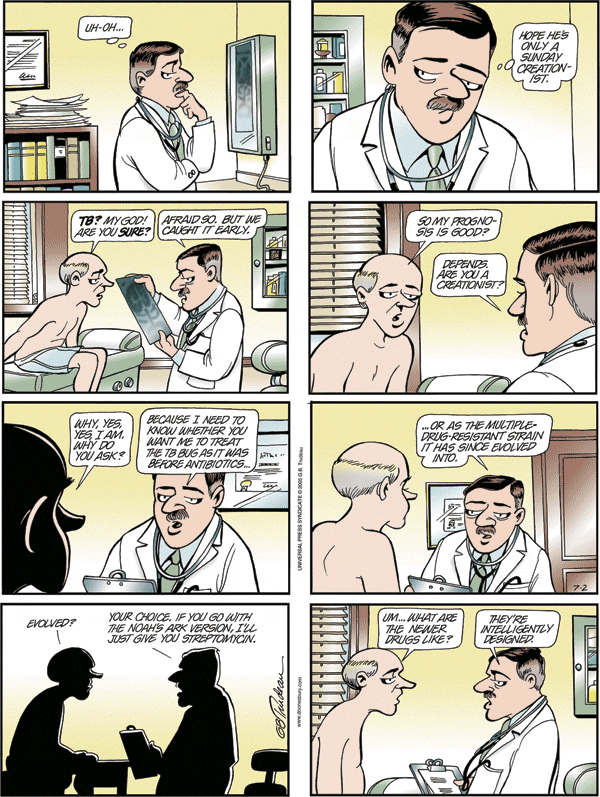
Several weeks ago [in 2008] I responded to a lengthy thread at Unreasonable FaithThe original post was Garry Trudeau’s “Doonesbury” cartoon of the guy in a doctor’s office, just diagnosed with an infection.  The physician asks the guy if he’s a creationist, explaining that if he is, the doc will treat him with old antibiotics in honor of his belief that evolution of bacteria doesn’t occur.

Charles Darwin's Study, Down House. Photo by and copyright held by Bob Radlinski. Radlinski's description: Darwin regularly spent about 5 hours a day here for 40 years and kept a chamber pot behind the partition so that he wouldn't have to trek to the toilet. But he still had time for an active family life with his wife Emma and their 10 children. The low stool with casters was used to spin himself from one desk where he dissected in front of the window to another where he took notes or wrote up labels—the stool the children were allowed to use for their games, punting themselves around the living room with long poles. The sitting room at the back of the house has large windows that go to the floor so that on nice days, the children (and dogs) could roam back and forth from house to garden at will.

Charles Darwin’s Study, Down House, where Darwin wrote all of his publications after his marriage. Photo by and copyright held by Bob Radlinski. Radlinski’s description: Darwin regularly spent about 5 hours a day here for 40 years and kept a chamber pot behind the partition so that he wouldn’t have to trek to the toilet. But he still had time for an active family life with his wife Emma and their 10 children. The low stool with casters was used to spin himself from one desk where he dissected in front of the window to another where he took notes or wrote up labels—the stool the children were allowed to use for their games, punting themselves around the living room with long poles. The sitting room at the back of the house has large windows that go to the floor so that on nice days, the children (and dogs) could roam back and forth from house to garden at will.

Point being, of course, that evolution occurs in the real world.  Creationists rarely exhibit the faith of their claims when their life, or just nagging pain, is on the line.  They’ll choose the evolution-based medical treatment almost every time.  There are no creationists in the cancer or infectious disease wards.

At one point I responded to a comment loaded with typical creationist error.  It was a long post.  It covered some ground that I’ve not written about on this blog.  And partly because it took some time to assemble, I’m reposting my comments here.  Of course, without the Trudeau cartoon, it won’t get nearly the comments here.

I’ll add links here when I get a chance, which I lacked the time to do earlier.  See my post, below the fold.

Read the rest of this entry »


“Does it get better than this?” U.S. flag and Denali

August 10, 2012

Instagram from the Department of Interior, yesterday:

U.S. flag and Denali on an almost-clear day; Department of Interior photo, August 2012 - public domain

U.S. flag and Denali on an almost-clear day; Department of Interior photo, August 2012 – public domain

usinterior Tweeted, “Does it get any better than this?”

Denali, also known as Mt. McKinley, is the highest point in North America, 20,320 feet (6,194 m) above sea level.  Measured base to peak, it’s the tallest mountain on land on Earth — Everest and other Himilayan peaks rise from a very high plateau.  Denali is high enough that it makes its own weather.  Finding a day when the mountain is not almost completely obscured by clouds is rare, locals say.  Finding an almost-clear view, with blue sky in the background, is a cause for photographer excitement.

You’ll notice straight-line clouds in the sky — condensation trails from passenger jets.  I wonder how many flights bend a little to get a better view of the mountain for passengers?  Do big airlines even do that anymore?

Nice shot.  I could learn to like Instagram with more photos of this quality.

Better, it would be nice to be there, taking these shots.

More, including the controversy over the mountain’s name:


Women to match our mountains: Women at Work, Parts 1 and 2

February 12, 2012

I do love the tops of mountains, and I wish I could climb them.  Fortunately, there are cameras, people who know how to use them, and people who know how to edit film to tell a story, and put us all in awe.

Plus, living among us are people brave enough and skilled enough to get to the tops of those mountains, people who make the filming possible and worthwhile.

“Women at Work” is a film of a climb by “the Cirque Ladies 2010,” described by Emily Stifler:

In summer 2010, Lorna Illingworth, Madaleine Sorkin and I spent 25 days in the Cirque of the Unclimbables, Northwest Territories, Canada. Our goal was to free climb the entire 1963 Original Route on the sheer 2000′ Southeast Face of Proboscis, and grants from the American Alpine Club encouraged us to document the adventure. The result: Women at Work (VI 5.12 R).

Cirque of the Unclimbables?  Okay, I’ll watch.

Part 1

Part 2

More: 

Half the fun is getting there:  Camp in shelters made by Mother Nature:

Camping under large boulder in Fairy Meadows, Cirque of the Unclimbables - SummitPost.org

Camping under large boulder in Fairy Meadows, Cirque of the Unclimbables - SummitPost.org - "Nice roof," one wag commented

Map of Cirque of the Unclimbables, from Nahanni.com

Map of Cirque of the Unclimbables, from Nahanni.com; those dots are not settlements


Map to Cirque of the Unbclimbables and area, from BlackFeather.com, a tour company

Map to Cirque of the Unbclimbables and area, from BlackFeather.com, a tour company


Watching the drought roll in at Colorado Bend State Park

July 6, 2011

It took me a couple of tries to figure it out — last week when I told people Kathryn and I were off to Colorado Bend State Park to spend time on the river, several people commented about how much cooler it would be there.

What?  West of Killeen about an hour, ten miles of dusty road outside of Bend, Texas (population 1,637), Colorado Bend is not cooler than Dallas.  It was over 100° F every day we were there, stayed well above 90° most  of the nights.

Kathryn Knowles checking wildflowers, Colorado River, Texas

Kathryn studied wildflowers at a spring at the side of the Colorado River during a break from kayaking; this spring's flow was reduced, but still moist enough to create a near-oasis.

Our well-wishers were geographically confused.  They thought we were headed to the Colorado River in Colorado, not the Colorado River in Texas, which is not the same river at all.  I didn’t bother to check the temperatures in Colorado, but one might be assured that it was cooler along the Colorado River in Colorado than it was along the Colorado River in Texas.

It was a return trip.  We stumbled into the park 16 years ago with the kids, for just an afternoon visit.  The dipping pools  in the canyon fed by Spicewood Springs captivated us.  It took a while to get back, and then the kids were off doing their own thing.

So, just a quick weekend of hiking/camping/kayaking/soaking/stargazing/bird watching/botanical and geological study.   Park officials closed the bat caves to human traffic in hope of keeping White Nose Syndrome from the bats; we didn’t bother to sign up for the crawling cave tour through another.

Ed Darrell at Colorado Bend State Park, Texas

The author, still working to master that Go-Pro camera on the hat -- some spectacular shots, but I don't have the movie software to use it all; you know it's hot when SPF 75 sunscreen is not enough.

What did we see?  Drought has a firm grip on Texas, especially in the Hill Country, especially outside of Dallas.  The Colorado River  is mostly spring fed; many of the springs are dry.  No water significant water flowed through the park while we  were there — kayak put-ins have been reduced to the downriver-most ramp, and the bottom of the boat launch ramp is three feet above water.  Gorman Falls attracts visitors and scientists, but the springs feeding it are about spent this year — just a few trickles came over the cliff usually completely inundated with mineral-laden waters.

Drought produces odd things.  The forest canopy around the park — and through most of the Hill Country we saw — is splattered with the gray wood of dead trees, many of which at least leafed out earlier this spring.  The loss to forests is astonishing.  Deer don’t breed well in droughts; deer around the campsites boldly challenge campers for access to grasses they’d ignore in other seasons.  One ranger said he hadn’t seen more than about three fawns from this past spring, a 75% to 90% reduction in deer young (Eastern White Tail, the little guys).  Raccoons are aggressively seeking food from humans, tearing into tents and challenging campers for food they can smell (lock your food in the car!).  Colorado Bend is famous for songbirds, including the endangered Golden Cheeked Warbler, and the elusive, spectacular painted bunting.  But the most commonly-sighted birds this year are turkey vultures, dining on the young that didn’t make it healthy into the summer and won’t survive until fall.

Warming denialists’ claims of “not so bad a drought” ring out as dangerous, wild delusion.  (By actual measurement, Texas average rainfall the past nine months was 8.5 inches, the driest ever recorded in Texas, shattering the old record drought of 1917).

Great trip.  Kathryn’s menu planning was spectacular.  The old Coleman stove  — a quarter century old, now, with fuel almost that old — performed like a champ even without the maintenance it needs (later this week).  Other than the hot nights, it was stellar.

Stellar.  Yeah.  Stars were grand.  It was New Moon, a happy accident.  A topic for another post, later.  Think, “Iridium.”

So posting was slow over the weekend.  How far out in the Hill Country were we?  Neither one of us could get a bar on our phones.  We were so far out the Verizon Wireless guy was using smoke signals.

Thoreau was right, you know.


Big bone sale in Dallas, part 2: Is P. Z. Myers bidding on this one?

June 12, 2011

It’s perfect for him.  Perfect.  Bidding stands at about $2,500 at the moment:

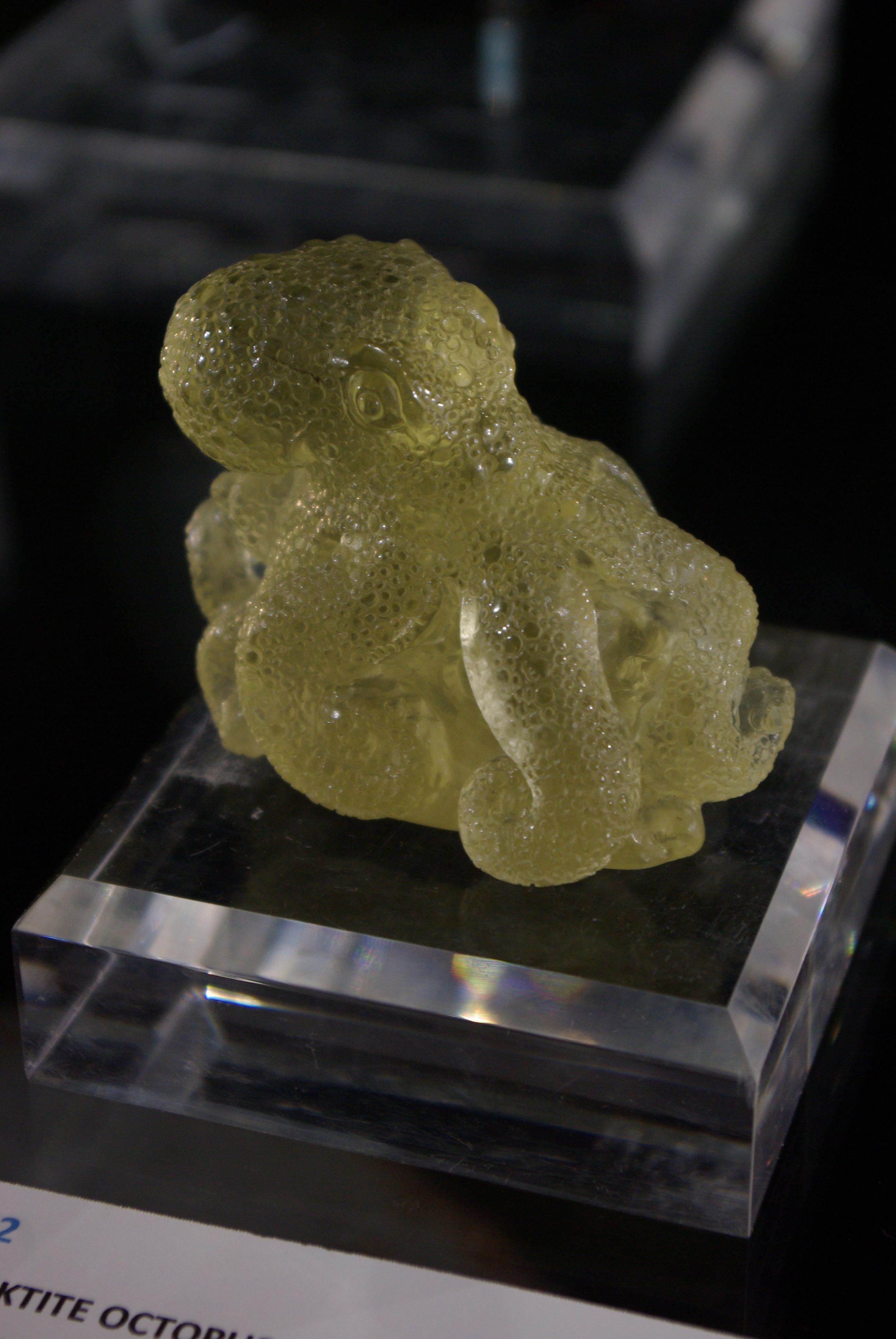
Gem tektite octopus - Heritage Auctions June 12, 2011 - IMGP6864 - copyright Ed Darrell, use permitted with attribution

Did our cephalopod overlords leave this for us, 29 million years ago? It's looking right at you, you know.

Is P. Z. Myers bidding on this thing?

According to the catalogue from Heritage Auctions, this piece of glass was formed in what is now the Libyan Sahara 29 million years ago when a meteoroid struck the sand, creating massive heat that fused sand into glass.  This light lemonade colored glass comes from only a small part of the Libyan sands.  Tektite is collectible by itself.  Some craftsman (unidentified and unplaced in time by Heritage Auctions) carved this piece into a cephalopod.

Taking an uncommonly large and clear specimen, the master lapidarist has carved the form of a malevolent-looking octopus, with superb rugose skin texture and a mass of curling tentacles. With a gorgeous translucence and lovely delicate green/yellow color, this exceptional sculpture measures 2¾ x 2 x 1¾ inches. Estimate: $2,800 – $3,200.

Compared to the giant articulated dinosaurs about 50 feet away from the display, one could easily overlook this little gem.  Still, bidding online looked to be pretty active.  Is P.Z. still in the British Isles?  Is he bidding by internet?  Is his Trophy Wife™ planning a Father’s Day surprise?

Tektites should pique your interest, Dear Reader.  Glass formed only when interplanetary objects smash into the planet, providing clues to the makeup of our solar system and universe, dating back well before recorded time, found in only a few fields around the Earth.  They are the perfect marriage-merger of geology, astronomy, geography, natural history, history and, in this case, art.   They are popular among collectors.    Who walks away with this one this afternoon?