Texas earthquakes! No, really

November 2, 2008

[See report on January 6, 2014 series of earthquakes here.]

30 AM local time at epicenter - epicenter in Las Colinas, Irving, Texas.

Texas earthquake, 2.7 magnitude – Saturday, November 01, 2008 at 11:54:30 (UTC) – Coordinated Universal Time,  Saturday, November 01, 2008 at 06:54:30 AM local time at epicenter – epicenter in Las Colinas, Irving, Texas.

Some Texans hope for a Texas earthquake on Tuesday.  Four years ago Dallas County voters resisted the Red Tide, voting for a Democrat in every judicial race on the ballot where a Democrat was running, electing a Democrat for sheriff, and putting a Democrat in as District Attorney for the first time since Noah disembarked the boat on the mountain in Turkey.

Voters in Dallas County, Harris County (Houston), and Bexar County (San Antonio) seem prepared to do it again.

That would be a virtual earthquake.

Meanwhile, the Dallas area has had a series of real earthquakes over in the end of this week. The biggest was about 3.0 on the Richter Scales, barely detectable to most people.  But this is big stuff around here.  We sit on some of the most geologically stable land in North America.  Earthquakes are rare, and usually small.

We’ve had eight quakes in the past two days.  Despite their low magnitude, a few people are worried.  Students are interested, not least because they worry about a destructive quake.  For people who live in Tornado Alley, fears of earthquakes seem odd, at least to those of us who grew up in more earthquake-prone provinces.

Here’s the list from the U.S. Geological Survey (USGS):

Earthquake List for Map Centered at 33°N, 97°W


Update time = Sun Nov 2 4:00:04 UTC 2008

Here are the earthquakes in the Map Centered at 33°N, 97°W area (go see the map), most recent at the top.  (Some early events may be obscured by later ones.)  Click on the underlined portion of an earthquake record in the list below for more information.

MAG UTC DATE-TIME
y/m/d h:m:s
LAT
deg
LON
deg
DEPTH
km
LOCATION
MAP 2.7 2008/11/01 11:54:30 32.873 -96.968 5.0 3 km ( 2 mi) N of Irving, TX
MAP 2.5 2008/11/01 11:53:46 32.766 -97.035 5.0 6 km ( 4 mi) NNW of Grand Prairie, TX
MAP 2.9 2008/10/31 21:01:01 32.788 -97.028 5.0 8 km ( 5 mi) N of Grand Prairie, TX
MAP 2.9 2008/10/31 20:54:18 32.831 -97.028 5.0 6 km ( 4 mi) WSW of Irving, TX
MAP 2.9 2008/10/31 07:58:23 32.832 -97.012 5.0 5 km ( 3 mi) WSW of Irving, TX
MAP 2.6 2008/10/31 05:33:45 32.871 -96.971 5.0 3 km ( 2 mi) N of Irving, TX
MAP 3.0 2008/10/31 05:01:54 32.836 -97.029 5.0 6 km ( 4 mi) WSW of Irving, TX
MAP 2.6 2008/10/31 04:25:52 32.800 -97.016 5.0 7 km ( 4 mi) SW of Irving, TX
Map of Irving, Texas, showing the epicenter of an earthquake November 1, 2008 - near the development known as Las Colinas

Map of Irving, Texas, showing the epicenter of an earthquake November 1, 2008 – near the development known as Las Colinas

Two fault lines run under the Dallas-Fort Worth area, the Mexia and Balcones faults — but both are said to be “inactive.”  Earthquakes in this area are about as common as Democrats in statewide offices.

Resources, news coverage:

Historically, Texas has not been a hotbed of earthquake activity, between 1973 and 2012.  Texas Seismicity Map from USGS.

Texas Seismicity, 1973-2012. USGS

Texas Seismicity, 1973-2012. USGS


Lookin’ good, for 4.28 billion years old

September 25, 2008

New candidate for “oldest rocks on Earth,” from Canada.  They come in perhaps as old as 4.28 billion years.

They’re older than John McCain!


Crankin the geology stupid past 11 . . .

August 17, 2008

It’s gotta be a virus, and pray to God it isn’t contagious.

Jennifer Marohasy made jaws drop with a stunningly under-informed claim about energy equilibrium and light bulbs, confusing watts as a measure of heat, getting thermodynamics wrong, and generally acting as if her wits temporarily headed to the beach.

And then she came right back with this one [moved to here]:

I have become curious about something. The core of the Earth is alleged to be molten. It’s also a fact that the deeper you dig into the Earth, the warmer it gets. Where is that heat coming from… surely not from the Sun. What’s the possibility that the Earth generates some of it’s own heat from geothermal processes?

The possibility is 100%. Ernest Rutherford had the goods on the issue just after the turn of the 19th to the 20th centuries. He won the Nobel Prize for Chemistry in 1908 for his work on radioactivity, which included calculations on how the planet Earth is heated from within. Some sources say Rutherford identified planetary heating as early as 1896.

Ernest Rutherford, Nobel Foundation photo

Ernest Rutherford, Nobel Foundation photo

Marohasy lives in Australia — is Google disabled for that continent or something?

These are the people who lead the charge for climate change skeptics? Anthony Watts, where are you?

This is a preview of the sort of ignorance that will elbow its way into Texas science if the State Board of Education succeeds in dumbing down Texas science classes, pulling down the intelligence quotient with creationism.

“Alleged to be molten.”

And water is alleged to be wet.


Institute for Creation Research: Still fraudulent after all these years

August 13, 2008

Sometime in the spring I let a long-running discussion with pastor Joe Leavell taper off. I thought I’d be back to it more quickly. It’s that sort of summer.

In one of his last posts, Joe said he’d been to a lecture by some folks from the Institute for Creation Research, the same bunch that tried to hornswoggle Texas into letting them grant graduate degrees in science education and biology for teaching creationism to their students instead, as a way of injecting creationism into the schools stealthily but still illegally. Texas refused to give them the authorityICR promises to appeal and sue for the privilege.

Joe said:

The response was rather lengthy, but they talked about the research that they have been doing over the past 7-8 years or so and the difference accredited scientists that are working for them. They also claimed that creationists get criticized for not writing peer reviewed articles in journals, but they claimed that they had submitted countless articles over the years and they all get rejected. They simply can’t get printed, was the claim, so they print their own stuff. They also pointed me to the RATE project, which honestly, without knowing a ton about science (though I do know some), is very convincing to me.

Here’s the link:
https://www.icr.org/rate/

The main argument that I found convincing was the presence of helium in the rocks which wouldn’t be there if the rocks were millions of years old. They said they’ve been working on this project about 8 years and have spent $1.5 million on it. They also submitted all of their research to top labs in the country to make sure they weren’t accused of “fudging” the evidence. Check it out (if you have time) and let me know what you come up with.

I’ll be brief in my response here, at least to start: Same old fraud, not even new wineskins.

Dr. Russell Humphreys, a famous creationism crank (to serious geologists and other scientists), claims that the amount of helium he detected in some zircon crystals was so high that the crystals could not be more than a few thousands of years old, rather than the millions of years old all other dating methods by all other scientists produce. Humphreys’ findings have never been submitted to any science journal for publication, but were instead distributed to donors to a creationist ministry.

Oh, Joe: These guys depend on a lack of normal skepticism and a lack of knowledge to perpetrate these frauds on honest Christians. I do wish more Christians would hold their feet to the fire.

A few observations:

First, this project exhibits most of Bob Parks’ seven warning signs of bogus science. Those signs are:

  1. The discoverer pitches the claim directly to the media. In this case, to media and donors.
  2. The discoverer says that a powerful establishment is trying to suppress his or her work. This thread runs through all ICR work. Humphreys’ later attempts at character assassination against his critics specifically for their critiques of the RATE project are exactly the warning sign of bogus science that we should expect, from bogus science. (See the final three paragraphs here.)
  3. The scientific effect involved is always at the very limit of detection. This sign, not so much.
  4. Evidence for a discovery is anecdotal. In place of the usual description of methodologies used so other scientists can replicate the measurement, we get a story about samples for other purposes, purloined for this measurement. Most of the critical references to the conclusion were unpublished, or revealed only in crank science publications.
  5. The discoverer says a belief is credible because it has endured for centuries. See the paper: “Many creationists believed . . .”
  6. The discoverer has worked in isolation. In this case, it’s difficult to know for certain; there is no methodology, no statement of where the work was carried, by whom, and no peer review. No other labs appear to be working on these issues. Dollars to doughnuts this work at government laboratories in Oak Ridge and Los Alamos is not catalogued in the labs’ work records, nor is it reported to Congress. Not only working in isolation, but completely on the sly.
  7. The discoverer must propose new laws of nature to explain an observation. Humphreys had earlier proposed diffusion rates far in excess of anything measured, and in this case, he assumes similar, completely uncorroborated conclusions.

Second, the conclusions have been challenged (“debunked” might be a better description) by scientists who know the subject matter. There’s a thorough discussion on Talk.Origins, by Kevin Henke (at the University of Kentucky); to summarize, there is no reason to think that helium could get out of those zircon crystals at depth, especially under the pressures at the depths the samples were recovered from; plus there are other problems:

Throughout Humphreys (2005), Dr. Humphreys stresses that his YEC conclusions must be correct because his Figure 2 shows a supposedly strong correlation between his “creation model” and vacuum helium diffusion measurements from Humphreys (2003a, 2004). However, Dr. Humphreys’ diagram has little scientific merit. First of all, his helium diffusion experiments were performed under a vacuum rather than at realistic pressures that model the subsurface conditions at Fenton Hill (about 200 to 1,200 bars; Winkler, 1979, p. 5). McDougall and Harrison (1999), Dalrymple and Lanphere (1969) and many other researchers have already shown that the diffusion of noble gases in silicate minerals may decrease by at least 3-6 orders of magnitude at a given temperature if the studies are performed under pressure rather than in a vacuum. Secondly, because substantial extraneous helium currently exists in the subsurface of the Valles Caldera, which is only a few kilometers away from the Fenton Hill site, Dr. Humphreys needs to analyze his zircons for 3He, and quartz and other low-uranium minerals in the Fenton Hill cores for extraneous 4He. Thirdly, chemical data in Gentry et al. (1982b) and Zartman (1979) indicate that Humphreys et al. and Gentry et al. (1982a) may have significantly underestimated the amount of uranium in the Fenton Hill zircons, which could reduce many of their Q/Q0 values by at least an order of magnitude and substantially increase Humphreys et al.‘s “creation dates.” Dr. Humphreys needs to perform spot analyses for 3He, 4He, lead, and uranium on numerous zircons from all of his and R. Gentry’s samples so that realistic Q/Q0 values may be obtained.

The “dating” equations in Humphreys et al. (2003a) are based on many false assumptions (isotropic diffusion, constant temperatures over time, etc.) and the vast majority of Humphreys et al.‘s critical a, b, and Q/Q0 values that are used in these “dating” equations are either missing, poorly defined, improperly measured or inaccurate. Using the best available chemical data on the Fenton Hill zircons from Gentry et al. (1982b) and Zartman (1979), the equations in Humphreys et al. (2003a) provide ridiculous “dates” that range from hundreds to millions of “years” old (average: 60,000 ± 400,000 “years” old [one significant digit and two standard deviations] and not 6,000 ± 2,000 years as claim by Humphreys et al., 2004). Contrary to Humphreys (2005), his mistakes are not petty or peripheral, but completely discredit the reliability of his work.

I think ICR is affect loaded. For years they argued that because there is so little helium in the atmosphere, the Earth cannot be very old. Helium gas floats to the top of the atmosphere and drifts off into space, so there can never be a large accumulation of the stuff in the air. ICR is making a similar argument here: That helium must migrate out of rocks and drift away. Alas, there isn’t much support for the claim that helium cannot be contained in a rock matrix, especially under significantly greater pressures achieved in large rock masses, deep underground. There are a lot of examples of gases being trapped in rocks; that helium in the air drifts away does not mean helium in rock will drift away.

Third, the RATE project tends to rely on disproven or highly questionable claims, rather than solid science. The claims of polonium haloes once were published in a reputable journal, but retracted by the journal after scientists trying to replicate the results discovered that the author had sampled much newer magma intrusions in granite*, and not the base granite at all (* that is, lava that squeezed into cracks in the granite). ICR continues on as if the paper had not been found faulty, as if the results had never been retracted. In any other context, this would be considered academic fraud at best. Were it done as research under a federal grant, it would be a felony.

Fourth, there is the issue of whether RATE can do anything other than fog up the area. One of the original goals of RATE was to date the rocks from Noah’s flood. As you know, claims that such a flood ever occurred are regarded as crank science among geologists. After several years of discussion and meetings, RATE participants announced they had been unable to distinguish which rocks on Earth are pre-flood, and which are post flood. Consequently, dating the rocks of the flood was precluded because they could not be found, reliably (or at all!).

This is long-term scam stuff, Joe. How many little old ladies and upstanding men in how many congregations have given how many millions of dollars to this quackery? Imagine what good could have been done had those dollars gone to honest enterprise among Christians.

Joe, does this stuff make you angry? It should. ICR confesses to have spent $1.5 million in this project over eight years — ostensibly a science project, and yet not one single publishable science paper out of it.

This is academic fraud of the most foul kind, to me. It angers me that ICR carries on these frauds with money contributed by trusting Christians. One has a right to expect better ethics from people who claim to be engaged in ministry for Jesus, I believe.


Disaster at Arches National Park

August 10, 2008

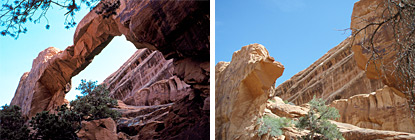
Wall Arch, 12th largest, one of the better-known and most-seen natural arches in Arches National Park, Utah, collapsed.

Wall Arch, before and after collapse - National Park Service photos

Wall Arch, before and after collapse – National Park Service photos

“Not being a geologist, I can’t get very technical but it just went kaboom,” [Arches NP] Chief Ranger Denny Ziemann said. “The middle of the arch just collapsed under its own weight. It just happens.”

Wall Arch, located along the popular Devils Garden Trail, was 71 feet tallwide and 33 1/2 feet widetall, ranking it 12th in size among the known arches inside the park. Lewis T. McKinney first reported and named Wall Arch in 1948.

No one reported observing the arch collapse and there were no visitor injuries, the National Park Service said.

Read the report from the Salt Lake Tribune.

Some tourist on Sunday, August 3, or Monday, August 4, got the last photograph of Wall Arch still standing. Was it you? Were you close? Give us a shout in the comments if so.

Other resources:

x

Other blogs and later reports:


Alpine Loop? Try Utah’s, gentler, prettier than Colorado’s

August 6, 2008

Utah’s canyons have so many pretty spots. Taking visitors through them I always heard about how no one expected such beauty in the desert. So I was excited to see the headline in Sunday’s Dallas Morning News about taking the Alpine Loop.

Autumn aspens in Utahs Alpine Loop - Wikimedia photo

Autumn aspens in Utah's Alpine Loop - Wikimedia photo

Prettiest drive you can make in a day. Start out in American Fork, head up American Fork Canyon, cross over to the backside of Mt. Timpanogos — you’ll see aspen, pines, fir, some of the prettiest streams you’ve ever seen anywhere. Some years back the Utah Travel Council had a spectacular poster showing the colors in the fall — about five shades each of red, gold and green, aspen and cottonwoods against the balsam and Douglas fir and a few scattered pines. Stop and hike up to Timpanogos Cave National Monument. See where the glacier was on the east side of Timpanogos.

End up passing Robert Redford’s Sundance Ski Resort, and down Provo Canyon (when I skied there it was $6.50 for a full-day pass; have the rates gone up?) — finish up with dinner in a good restaurant in Provo (or drive the 36 miles back to Salt Lake City and have world-class sushi at Takashi).

Alas. The article was about Colorado’s Alpine Loop. Who knew Colorado even had one by that name?

I suspect the Colorado version is less-traveled. The author took a four-wheel-drive vehicle.

Utah Travel Council photo of the Alpine Loop showing some of the autumn colors -- not the great shot from the long-ago poster, alas.

Utah Travel Council photo of the Alpine Loop showing some of the autumn colors -- not the great shot from the long-ago poster, alas.

Utah’s Alpine loop is paved the entire way, closed maybe only during a winter of very heavy snow. If you’re just passing through, you can do the drive in three hours or less, easily. If you have a day, grab a picnic, and spend some time stopping to enjoy the mountains.

(Go see Rich Legg’s photos of the east side of Timpanogos, here.)

Some time I’d like to check out the Colorado version. Odds are that I’ll be back in Utah County before then, however, and odds are you’ll be closer to the Utah version than the Colorado version, too.

You know the old saying about “take time to stop and smell the balsam, and ooh and aah at the aspen?” The Alpine Loop is what the aphorist was thinking about. Theodore Roosevelt would have gone there, had he known about it. You know about it now.

Windleys Google map of Utahs Alpine Loop, around Mt. Timpanogos

Windley's Google map of Utah's Alpine Loop, around Mt. Timpanogos


Smoke without fire, in California

August 6, 2008

Geology, geography, meteorology, climatology, chemistry — whatever you call it, reality always trumps fiction.

From the headline, “Ventura County hot spot puzzles experts,” I wondered whether a caldera was sending a telegram. Probably not.*

The ground smokes, but there is no fire. Experts’ best guess: Drought causes the ground to dry out, and crack. Petroleum stuff (in gas form) bubbles up from underground, into the cracked earth. Oxygen from the surface mixes deep. Somewhere underground the hydrocarbons meet the oxygen and the resulting combustion heats the ground to 800° Fahrenheit.

It’s a dry land analog of the methane hydrates warming and bubbling up in the ocean. The waste products contribute to greenhouse gas emissions, but so would the emissions if they didn’t burn first.

Cause or effect of climate change? Significant?

*  The Long Valley Caldera is about 300 miles north of Ventura County.  Ventura County itself is not particularly volcanically active, from what I understand.

Geologist finds meteor crater – on Google Earth

April 11, 2008

Geologist Arthur Hickman used Google Earth to look at part of Australia he was studying. In the satellite photos provided by Google Earth, Hickman noticed something no one else had seen: An impact crater.

Hickman Crater, Australia

For his alertness, Hickman had the 270-meter crater named after him.


Boost geology, boost science education

March 7, 2008

Kevin Padian’s article in February’s GeoTimes urges improvements in geology in textbooks, as a means of boosting science education and achievement overall.

I don’t want to imply that every geologist should be visiting third-grade classrooms and discussing radiometric dating with the students. That wouldn’t be comfortable for most of us, or most of them. But we can support a strong geological curriculum by getting involved in state and local textbook adoption procedures and curriculum development. Those folks need good scientific advice, and we need to listen to them to see how we can best meet their needs.

I’m actually going to suggest something even easier — something that most of us who teach in colleges and universities do all the time: improve the textbooks we use.

Texas’s state school board is running in exactly the opposite direction, undertaking several initiatives to dumb down science texts, even after approving a requirement for a fourth year of science classes required for graduation.

We can hope Texas’s policy makers will listen to veteran scientist educators like Padian.

Evolution of tetrapods, from Kevin Padian

Click thumbnail for larger chart to view. Evolution of Tetrapods, courtesy of Kevin Padian.

“Padian is a professor of Integrative Biology and curator in the Museum of Paleontology at the University of California at Berkeley, and president of the National Center for Science Education.”


Canute of the mountains

February 6, 2008

King Canute could not hold back the tide -- unknown artist

King Canute* couldn’t hold back the tides.

Surely the Utah legislature doesn’t think they can hold back the rumblings of the Rocky Mountains, either — but the proposed legislation raises delectable questions about the role of government in preventing disasters, especially using zoning laws as the method of prevention.

Good discussion material for government, civics, geology and “integrated physics and chemistry (IPC).”

* Canute was a Viking. Is anyone from Pleasant Grove, Utah, wondering about the symbolism here, with the high school mascot being the Viking, and the town being located at the foot of the mountains, almost astride the Wasatch Fault?
Image source. Better site: “King Canute on the Seashore.”


Carnivals!

January 28, 2008

Bloggers are out there looking for the good posts, the real meat of Bloggovia, to serve it up to you in a tight bundle. Here’s where you find such purveyors:


And just who is Tim Panogos?

November 5, 2007

Mt Timpanogos, from geobloggers, photo by a4gpa

Yes, there really are mountains of such stark beauty, in Utah, next to civilization.


Ten minutes on Yellowstone NP in winter, with outdoor writer Tim Cahill

November 4, 2007

Yellowstone National Park is just a cool place. If you’re not using it for anything in your geography and U.S. history courses, you’re missing out.

Here’s a ten-minute video that the producers hope you’ll show far and wide to encourage television stations to pick up the series. It’s a ten-minute pilot for “Travelers’ Tales,” featuring outdoor writer Tim Cahill, a founder of Outside magazine, and photographer Tom Murphy.

Here are some of the points you might use in class:

  • Yellowstone in winter, especially the wildlife, like bison, elk and coyotes (all shown), and wolves (not shown)
  • Volcanic geology — Yellowstone is the world’s largest caldera, after all
  • Diversity of landforms in the U.S., or in the world. More than half the hot water features on the planet are in Yellowstone
  • Travel and adventure
  • What makes good writing (travel writing in this case)
  • Western geography
  • Development of the west, especially after the Lewis and Clark Expedition

The video features a lot of snow, elk, bison and coyotes, hot springs flowing into a river making swimming in January feasible, Mammoth Hot Springs and the travertine pools, and the cold northern desert of sagebrush and juniper.

Questions you might consider to turn this into a warm-up exercise (bell ringer):

Geography, not answered in the video (map or internet exercise):

  1. Yellowstone National Park covers parts of which three states?
  2. Yellowstone National Park is mostly located in which state?
  3. What is the most famous feature of Yellowstone National Park?
  4. Ashfall Beds State Park features ancient mammals killed by an eruption in the Yellowstone Caldera. Where is Ashfall Beds State Park?
  5. Thomas Moran played a key role in getting Congress to designate Yellowstone as a park. What did he do to help convince Congress to act?

Geography, answered in the video:

  1. What year was Yellowstone designated a National Park by Congress?
  2. What sort of volcanic feature is the entire Yellowstone area?
  3. The Yellowstone Caldera explodes catastrophically about every 600,000 years, according to some geologists. How long has it been since the last such catastrophic explosion?
  4. The wags say there are two seasons in Yellowstone, ______ and winter.
  5. What is a “hot pot?”

Come see Texas’ new canyon!

October 9, 2007

Canyon Lake Gorge, Gorge website photo

Having a brand new canyon is sort of a once in a lifetime experience. It might even be more rare than that.

Texas’s Canyon Lake Gorge opened to the public last week — a gorge, a canyon, that was carved out over a couple of days in 2002 when flood waters charging over an overtaxed dam cut through soft soils and soft rock to expose millions of years of sediments. Dinosaur footprints were exposed by the flood, too.

A torrent of water from an overflowing lake sliced open the earth in 2002, exposing rock formations, fossils and even dinosaur footprints in just three days. Since then, the canyon has been accessible only to researchers to protect it from vandals, but on Saturday it opens to its first public tour.

“It exposed these rocks so quickly and it dug so deeply, there wasn’t a blade of grass or a layer of algae,” said Bill Ward, a retired geology professor from the University of New Orleans who started cataloging the gorge almost immediately after the flood.

The mile-and-a-half-long gorge, up to 80 feet deep, was dug out from what had been a nondescript valley covered in mesquite and oak trees. It sits behind a spillway built as a safety valve for Canyon Lake, a popular recreation spot in the Texas Hill Country between San Antonio and Austin.

The reservoir was built in the 1960s to prevent flash flooding along the Guadalupe River and to assure the water supply for central Texas. The spillway had never been overrun until July 4, 2002, when 70,000 cubic feet of water gushed downhill toward the Guadalupe River for three days, scraping off vegetation and topsoil and leaving only limestone walls.

Canyon Lake is southwest of Austin, almost due west from San Marcos about 20 miles. The lake backed up from a 1960 flood control project dam built by the U.S. Army Corps of Engineers — the new Canyon Lake Gorge is managed jointly by the Corps and the Guadalupe-Blanco River Authority.

Watch carefully, dear reader: Creationists will soon start to claim that the rapid cutting of this canyon verifies a young age for all canyons, and shows that the Earth’s geology can indeed be very young. But that claim will gloss over the fact that while the gorge was cut quickly, it was cut through sediments that took millions or billions of years to lay down. The Associated Press reports problems with such a hypothesis:

The sudden exposure of such canyons is rare but not unprecedented. Flooding in Iowa in 1993 opened a limestone gorge behind a spillway at Corvalville Lake north of Iowa City, but that chasm, Devonian Fossil Gorge, is narrower and shallower than Canyon Lake Gorge.

Neither compares to the world’s most famous canyon. It took water around 5 million to 6 million years to carve the Grand Canyon, which plunges 6,000 feet at its deepest point and stretches 15 miles at its widest.

The more modest Canyon Lake Gorge still displays a fault line and rock formations carved by water that seeped down and bubbled up for millions of years before the flooding.

Some of the canyon’s rocks are punched with holes like Swiss cheese, and the fossils of worms and other ancient wildlife are everywhere. The rocks, typical of the limestone buried throughout central Texas, date back “111 million years, plus or minus a few hundred thousand years,” Ward said.

Six three-toed dinosaur footprints offer evidence of a two-legged carnivore strolling along the water. The footprints were temporarily covered with sand to protect them as workers reinforced the spillway, but they’ll be uncovered again eventually, Rhoad said.

Tours for the new gorge are booked for the next six months. Details on how to reserve space can be found at the website of the Gorge Preservation Society (GPS).


Texas earthquake!

September 23, 2007

Epicenter of Texas earthquake

Really. A Texas earthquake. September 15, 2007.

Missed it? Well, it was at the dinner hour, 06:16:42 PM (CDT). You may have thought it was Bubba’s great sauce for the barbecue, or the raspberry in the iced tea.

US Geological Survey provides a state-by-state listing of latest earthquakes. Texas is not a particularly active zone — but there are quakes, even here.

This last one, just over a week ago, was a 2.7 on the Richter scale, too weak to merit much news coverage even in the flatlands. It shook Milam County and surprised people there, but it didn’t do much damage:

In terms of destruction, the earthquake was hardly significant.

Emergency responders said they knew of only one report of damage: A teapot fell off of a woman’s stove.

In California, people probably wouldn’t have even noticed the tremor. But this earthquake happened in the Lone Star State and left Brazos Valley residents baffled.

“You just don’t expect your house to shake,” said Burleson County resident Karen Bolt. She was in her trailer home cleaning dishes when the temblor began.

USGS provides more details than you can use:

Magnitude 2.7
Date-Time
  • Saturday, September 15, 2007 at 23:16:42 (UTC) – Coordinated Universal Time
  • Saturday, September 15, 2007 at 06:16:42 PM local time at epicenter
  • Time of Earthquake in other Time Zones

    Location 30.74N 96.74W
    Depth 5.0 kilometers
    Region CENTRAL TEXAS
    Distances 35 km (20 miles) W of Bryan, Texas
    65 km (40 miles) ENE of Taylor, Texas
    110 km (70 miles) ENE of AUSTIN, Texas
    170 km (105 miles) NW of Houston, Texas
    Location Uncertainty Error estimate: horizontal +/- 16.2 km; depth fixed by location program
    Parameters Nst=4, Nph=4, Dmin=123.3 km, Rmss=1.25 sec, Erho=16.2 km, Erzz=0 km, Gp=130.4 degrees
    Source USGS NEIC (WDCS-D)
    Remarks Felt in the Caldwell-Rockdale area.
    Event ID ushhc

    Still, Texans should be relieved it was a small one. The largest recorded Texas earthquake was in 1931, with an epicenter near Valentine. At 5.7 magnitude and VII intensity, it nearly destroyed the little town of Valentine.

    In terms of magnitude and damage, this is the largest earthquake known to have occurred in Texas. The most severe damage was reported at Valentine, where all buildings except wood-frame houses were damaged severely and all brick chimneys toppled or were damaged. The schoolhouse, which consisted of one section of concrete blocks and another section of bricks, was damaged so badly that it had to be rebuilt. Small cracks formed in the schoolhouse yard. Some walls collapsed in adobe buildings, and ceilings and partitions were damaged in wood-frame structures. Some concrete and brick walls were cracked severely. One low wall, reinforced with concrete, was broken and thrown down. Tombstones in a local cemetery were rotated. Damage to property was reported from widely scattered points in Brewster, Jeff Davis, Culberson, and Presidio Counties. Landslides occurred in the Van Horn Mountaiins, southwest of Lobo; in the Chisos Mountains, in the area of Big Bend; and farther northwest, near Pilares and Porvenir. Landslides also occurred in the Guadalupe Mountains, near Carlsbad, New Mexico, and slides of rock and dirt were reported near Picacho, New Mexico. Well water and springs were muddied throughout the area. Also felt in parts of Oklahoma, New Mexico, and in Chihauhua and Coahuila, Mexico.

    Texas history courses could make some use of these data, for map reading exercises, and for general geography about the state. Click on the map below, the isoseismal map of the 1931 Valentine, Texas quake, and geography teachers will begin to dream of warm-up exercises right away.

    Isoseismal map of 1931 earthquake near Valentine, Texas

    USGS offers a wealth of information on Texas’ geology and geography — stream flow information, drought information — collected in one spot for each state in a “Science in your backyard” feature.

    Pick your state, pick your topic, and go.