From the U.S. National Archives Administration: Dated June 23, 1868, this is the printed patent drawing for a “Type-Writer” invented by Christopher L. Sholes, Carlos Glidden, and J. W. Soule. Drawing for a Typewriter, 06/23/1868 Drawing for a Typewriter, 06/23/1868 (ARC Identifier: 595503); Patented Case Files, 1836 – 1956; Records of the Patent and Trademark Office; Record Group 241; National Archives.
Links below can get us into position to commemorate the day adequately. Maybe celebrate with ribbons, without the wrapping paper and boxes? (Okay, maybe puns aren’t the way.)
Between Christmas and New Year’s Day, here at Millard Fillmore’s Bathtub we celebrate a variety of historically holy days. December 31, by tradition, is Bright Idea Day, the anniversary of the day Thomas Edison demonstrated for the public a working light bulb, in 1879.
100,000 people gather in Times Square, New York City (surely not the 1 million predicted by NBC!) tonight, and millions more around the world, in festivities for the new year made possible by the work of Thomas Alva Edison.
Here it is, the invention that stole sleep from our grasp, made clubbing possible, and launched 50,000 cartoons about ideas:
The light bulb Thomas Edison demonstrated on December 31, 1879, at Menlo Park, New Jersey – Wikimedia image (GFDL)
The light bulb. It’s an incandescent bulb.
It wasn’t the first bulb. Edison a few months earlier devised a bulb that worked with a platinum filament. Platinum was too expensive for mass production, though — and Edison wanted mass production. So, with the cadre of great assistants at his Menlo Park laboratories, he struggled to find a good, inexpensive filament that would provide adequate life for the bulb. By late December 1879 they had settled on carbon filament.
Edison invited investors and the public to see the bulb demonstrated, on December 31, 1879.
Thomas Edison in 1878, the year before he demonstrated a workable electric light bulb. CREDIT: Thomas Edison, head-and-shoulders portrait, facing left, 1880. Prints and Photographs Division, Library of Congress. Reproduction number LC-USZ62-98067
Edison’s successful bulb indicated changes in science, technology, invention, intellectual property and finance well beyond its use of electricity. For example:
Edison’s Menlo Park, New Jersey, offices and laboratory were financed with earlier successful inventions. It was a hive of inventive activity aimed to make practical inventions from advances in science. Edison was all about selling inventions and rights to manufacture devices. He always had an eye on the profit potential. His improvements on the telegraph would found his laboratory he thought, and he expected to sell the device to Western Union for $5,000 to $7,000. Instead of offering it to them at a price, however, he asked Western Union to bid on it. They bid $10,000, which Edison gratefully accepted, along with the lesson that he might do better letting the marketplace establish the price for his inventions. Other inventive labs followed Edison’s example, such as the famous Bell Labs, but few equalled his success, or had as much fun doing it. (Economics teachers: Need an example of the marketplace in action?)
Edison didn’t invent the light bulb — but his improvements on it made it commercial. “In addressing the question ‘Who invented the incandescent lamp?’ historians Robert Friedel and Paul Israel list 22 inventors of incandescent lamps prior to Joseph Wilson Swan and Thomas Edison. They conclude that Edison’s version was able to outstrip the others because of a combination of three factors: an effective incandescent material, a higher vacuum than others were able to achieve (by use of the Sprengel pump) and a high resistance lamp that made power distribution from a centralized source economically viable.”
Look around yourself this evening, and you can find a score of ways that Edison’s invention and its descendants affect your life. One of the more musing effects is in cartooning, however. Today a glowing lightbulb is universally accepted as a nonverbal symbol for ideas and inventions. (See Mark Parisi’s series of lightbulb cartoons, “Off the Mark.”)
Even with modern, electricity-saving bulbs, the cartoon shorthand hangs on, as in this Mitra Farmand cartoon.
Brilliant cartoon from Mitra Farmand, Fuffernutter (regrettably, we note this site is no longer there; but with some hope, we find a new site here)
Or see this wonderful animation, a video advertisement for United Airlines, by Joanna Quinn for Fallon — almost every frame has the symbolic lightbulb in it.
Electrification of America, and the consequent spread of electric lighting and electrical machines to make domestic and industrial life more productive, and the spread of great public works to enable these and other inventions to spread, were made possible by a people roughly united in advancing progress, what historians now call “the progressive agenda” and the great advances of the Progressive Era.
Could we get such agreement among workers, corporate bosses and many levels of government today? When we celebrate anniversaries, like the demonstration of the light bulb, we celebrate the united polity that made such things possible, too.
Thomas Edison’s electric lamp patent drawing and claim for the incandescent light bulb CREDIT: “New Jersey–The Wizard of Electricity–Thomas A. Edison’s System of Electric Illumination,” 1880. Prints and Photographs Division, Library of Congress. Reproduction Number LC-USZ62-97960.
It’s still solid, and most school administrators still miss the point. Teachers get sent to courses to “learn to do a PowerPoint,” but rarely can anyone leading those courses tell when to use a PowerPoint, or Keynote, and when a simple list on a chalkboard/whiteboard is more effective, or perhaps when having students copy a list would be more effective, or when students making a poem/song/poster of a point would be more effective.
An international law firm recently directed that it’s army of a couple thousand lawyers would, henceforth, use Prezi instead of PowerPoint. Nevermind that the lawyers hadn’t mastered PowerPoint and don’t have a clue what to do with Prezi: Some “managing co-partner” was taken in by the swoops of Prezi. More than four years ago I learned Prezi at a technology course for technologies my district later decided not to support (money, use, lack of internet connections, etc., etc. — I suspected a lack of planning and thinking about how technology could be used). In the course, I asked the instructor how to tell when to use Prezi instead of PowerPoint — and how to embed YouTube videos for classroom use of a Prezi. After working for too long, we decided we couldn’t figure out how to embed videos, and so PowerPoint might be more useful. Then the instructor confessed he didn’t know how to embed videos in PowerPoint, either.
Let alone, when does a video work better than other instructional methods? Long or short? Notes, quiz, or oral feedback?
Many Texas districts struggle to teach “keyboarding” to students who have difficulty printing notes, letter by letter, because they don’t know cursive writing (and therefore, cannot read their teachers’ comments on their written work).
Is “integrating technology” really the problem?
Anyway, here’s Mr. Ferriter’s list, a checklist to tell whether you’re getting close to actually using technology, or whether you’re just ringing the bells and tooting the whistles of machines on the desks.
Cheat Sheet: What do you want kids to do with technology? By Bill Ferriter The Tempered Radical blog.williamferriter.com @plugusin
_________________________________
What do you want kids to do with technology?
Wrong answers
Right answers
· Make Prezis
· Raise awareness
· Start blogs
· Start conversations
· Create Wordles
· Find answers
· Publish Animotos
· (Answers to
THEIR questions)
· Design flipcharts
· Join partners
· Post to EdModo
· Make a difference
· Use Whiteboard
· Take action
· Develop apps
· Drive change
Technology is a tool, NOT a learning outcome
_________________________________
“Technology is a tool, not a learning outcome,” Bill Ferriter says. He’s right, of course.
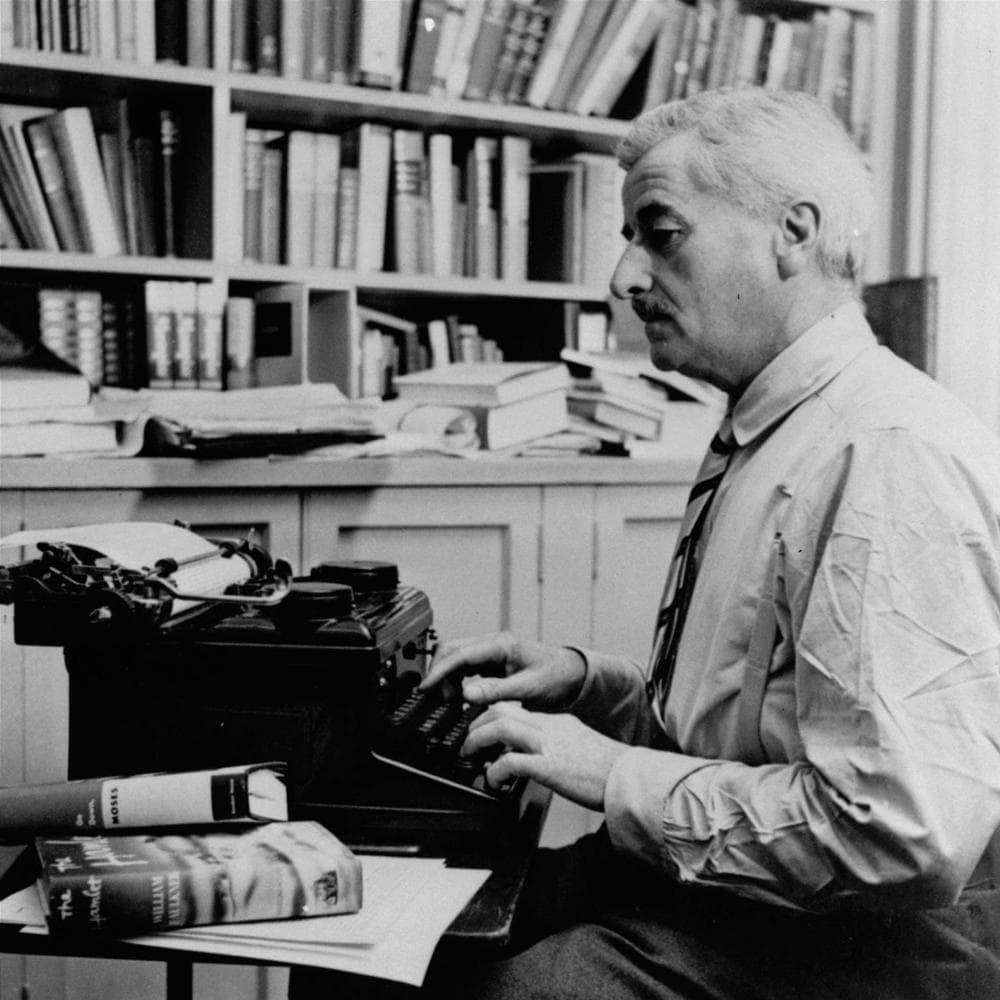
William Faulkner at his typewriter, August 12, 1954, at his home in Oxford, Mississippi. Associated Press photo, via ShelfLife
William Faulkner at his typewriter, August 12, 1954, at his home in Oxford, Mississippi. Associated Press photo.
The photo was probably posed; the two books to the left of the typewriter are Faulkner books. Faulkner may have written in a pressed shirt and tie, but I doubt it.
In a drawer in a file box in the U.S. Patent Office in Washington, D.C., is a study in black ink on white paper, lines that resemble those images most of us have of the first Wright Bros. flyer, usually dubbed “Kittyhawk” after the place it first took to the air.
Drawing 1 from patent granted to Orville Wright for a flying machine
The patent was issued on May 22, 1906, to Orville Wright, Patent No. 821393, for a “flying machine.”
It makes more sense if you turn the drawing on its side.
Between Christmas and New Year’s Day, here at Millard Fillmore’s Bathtub we celebrate a variety of historically holy days. December 31, by tradition, is Bright Idea Day, the anniversary of the day Thomas Edison demonstrated for the public a working light bulb, in 1879.
100,000 people gather in Times Square, New York City, tonight, and millions more around the world, in festivities for the new year made possible by the work of Thomas Alva Edison.
Here it is, the invention that stole sleep from our grasp, made clubbing possible, and launched 50,000 cartoons about ideas:
The light bulb Thomas Edison demonstrated on December 31, 1879, at Menlo Park, New Jersey – Wikimedia image (GFDL)
The light bulb. It’s an incandescent bulb.
It wasn’t the first bulb. Edison a few months earlier devised a bulb that worked with a platinum filament. Platinum was too expensive for mass production, though — and Edison wanted mass production. So, with the cadre of great assistants at his Menlo Park laboratories, he struggled to find a good, inexpensive filament that would provide adequate life for the bulb. By late December 1879 they had settled on carbon filament.
Edison invited investors and the public to see the bulb demonstrated, on December 31, 1879.
Thomas Edison in 1878, the year before he demonstrated a workable electric light bulb. CREDIT: Thomas Edison, head-and-shoulders portrait, facing left, 1880. Prints and Photographs Division, Library of Congress. Reproduction number LC-USZ62-98067
Edison’s successful bulb indicated changes in science, technology, invention, intellectual property and finance well beyond its use of electricity. For example:
Edison’s Menlo Park, New Jersey, offices and laboratory were financed with earlier successful inventions. It was a hive of inventive activity aimed to make practical inventions from advances in science. Edison was all about selling inventions and rights to manufacture devices. He always had an eye on the profit potential. His improvements on the telegraph would found his laboratory he thought, and he expected to sell the device to Western Union for $5,000 to $7,000. Instead of offering it to them at a price, however, he asked Western Union to bid on it. They bid $10,000, which Edison gratefully accepted, along with the lesson that he might do better letting the marketplace establish the price for his inventions. Other inventive labs followed Edison’s example, such as the famous Bell Labs, but few equalled his success, or had as much fun doing it. (Economics teachers: Need an example of the marketplace in action?)
Edison didn’t invent the light bulb — but his improvements on it made it commercial. “In addressing the question ‘Who invented the incandescent lamp?’ historians Robert Friedel and Paul Israel list 22 inventors of incandescent lamps prior to Joseph Wilson Swan and Thomas Edison. They conclude that Edison’s version was able to outstrip the others because of a combination of three factors: an effective incandescent material, a higher vacuum than others were able to achieve (by use of the Sprengel pump) and a high resistance lamp that made power distribution from a centralized source economically viable.”
Look around yourself this evening, and you can find a score of ways that Edison’s invention and its descendants affect your life. One of the more musing effects is in cartooning, however. Today a glowing lightbulb is universally accepted as a nonverbal symbol for ideas and inventions. (See Mark Parisi’s series of lightbulb cartoons, “Off the Mark.”)
Even with modern, electricity-saving bulbs, the cartoon shorthand hangs on, as in this Mitra Farmand cartoon.
Brilliant cartoon from Mitra Farmand, Fuffernutter
Or see this wonderful animation, a video advertisement for United Airlines, by Joanna Quinn for Fallon — almost every frame has the symbolic lightbulb in it.
Electrification of America, and the consequent spread of electric lighting and electrical machines to make domestic and industrial life more productive, and the spread of great public works to enable these and other inventions to spread, were made possible by a people roughly united in advancing progress, what historians now call “the progressive agenda” and the great advances of the Progressive Era.
Could we get such agreement among workers, corporate bosses and many levels of government today? When we celebrate anniversaries, like the demonstration of the light bulb, we celebrate the united polity that made such things possible, too.
Thomas Edison’s electric lamp patent drawing and claim for the incandescent light bulb CREDIT: “New Jersey–The Wizard of Electricity–Thomas A. Edison’s System of Electric Illumination,” 1880. Prints and Photographs Division, Library of Congress. Reproduction Number LC-USZ62-97960.
At IMDB: Billy Wilder and I.A.L. Diamond at work on the screenplay for Irma la Douce
Billy Wilder’s reputation as a great film director would not be possible, but for the typewriter. It is fate, perhaps, that we find several photographs of Mr. Wilder with various typewriters. In the photo above, he’s pictured working with I. A. L. Diamond, “Izzy.” The pair collaborated on at least 17 different screenplays.
This one is clearly a Royal; Hollywood Legacy’s Pinterest site: “BILLY WILDER and frequent screenwriter partner, I.A.L. DIAMOND. “Izzy” is seated at the typewriter, with Wilder standing, as usual. Wilder liked to “think on his feet” and was a notorious pacer. Wilder & Diamond wrote 17 films together, including: SOME LIKE IT HOT, THE APARTMENT, LOVE IN THE AFTERNOON, IRMA LA DOUCE”
Wilder’s scripts often featured writers and others who used typewriters. He had almost a fetish for featuring typewriters in his movies. How could we not like a guy who loved typewriters like that?
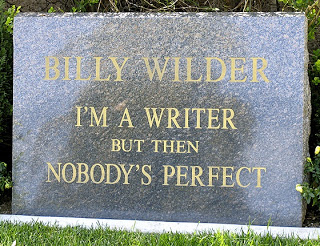
From the great Oz Typewriters site: “Wilder died in Beverly Hills on March 27, 2002. Here is what is on his tombstone
August 26 is the anniversary of the first television broadcast of professional baseball, in 1939; the future-legendary Red Barber called a doubleheader between his Brooklyn Dodgers and the Cincinnati Reds from Ebbets field.
Both games were carried on experimental television station W2XBS, which evolved into New York’s NBC affiliate Channel 2, WNBC. Two stationary cameras were used, in contrast to the several used in modern broadcasts — and it was in black and white. About 3,000 people are estimated to have watched.
The Reds won the opener, 5-2, but the Dodgers roared back in game 2, 6-1.
Ebbets field is gone. The Dodgers absconded to Los Angeles in the 1950s. Baseball games are in color.
Red Barber is gone, too. We have great play-by-play guys, and wonderful color commentators. There will never be another Red Barber though. Below is an old post noting Barber’s ways with typewriters.
The great Red Barber, when his hair was still red, working at his typewriter, with a volume of Roget’s Thesaurus close by.
Many of us knew Red chiefly through his weekly chats with Bob Edwards at NPR’s Morning Edition. The biographies say Red died in 1992. That was 19 years ago — it seems more recent than that. (Edwards left Morning Edition in 2004.)
It may be ironic to show Barber at his typewriter. He would be more accurately portrayed, perhaps, behind a microphone at a baseball park.
From 1939 through 1953 Barber served as the voice of the Brooklyn Dodgers. He was working for the New York Yankees when he retired in 1966. Barber had the distinction of broadcasting baseball’s first night game on May 24, 1935 in Cincinnati and the sport’s first televised contest on August 26, 1939 in Brooklyn.
During his 33-year career Barber became the recognized master of baseball play-by-play, impressing listeners as a down-to-earth man who not only informed but also entertained with folksy colloquialisms such as “in the catbird seat,” “pea patch,” and “rhubarb” which gave his broadcasts a distinctive flavor. (Radio Hall of Fame)
Ho Chi Minh at his typewriter. Photo from EarthStation 1
The image looks to me to have been lifted off of a film or video; by the non-white color of his beard, this must have been taken sometime before 1955. I’ve found no other details on the photo, especially nothing on the typewriter. Anybody know the date of the photo, the occasion, the location, or the typewriter?
But there you go: Ho Chi Minh, the leader of the Vietnam freedom fighters against the Japanese in World War II, then against the French colonialists (his forces then called Viet Minh, and later Viet Cong), and then of North Vietnam against South Vietnam and the United States after 1954, until his death in 1969.
Ha! A second photo of Ho and a typewriter, from Greg Hocfell:
Ho Chi Minh at his typewriter. Photo via Greg Hocfell
Might those photos be from the same session? Ho looks about the same age, his hair and beard are about the same color, and he’s wearing a dark shirt with white buttons in each.
From the U.S. National Archives Administration: Dated June 23, 1868, this is the printed patent drawing for a “Type-Writer” invented by Christopher L. Sholes, Carlos Glidden, and J. W. Soule. Drawing for a Typewriter, 06/23/1868 Drawing for a Typewriter, 06/23/1868 (ARC Identifier: 595503); Patented Case Files, 1836 – 1956; Records of the Patent and Trademark Office; Record Group 241; National Archives.
Will you remind me in 2015, a week or so in advance, so we can get appropriate celebratory posts up here at Millard Fillmore’s Bathtub?
Links below can get us into position to commemorate the day adequately, next year.
David Goodis at his typewriter. Image from Jon Winokur’s “Advice to Writers”
What a writer’s desk! A manual typewriter (Royal? I think so); a fountain pen and a bottle of ink; a solid cigarette lighter and a half-full ashtray. Judging by the papers on the desk, I’d say he’s working on a screenplay (from the format), and the buildings outside the window look a lot like the Warner Bros. studio lot.
There are three rules for writing a novel. Unfortunately, no one knows what they are.
Did Winokur think the photo was of Maugham? (I found the photo also at an article on Maugham at Oz.Typewriter; I left a comment for Robert Messenger.)
Who is David Goodis? He wrote Dark Passage, which is probably famous mostly for the movie version starring a young Humphrey Bogart.
David Loeb Goodis (March 2, 1917 – January 7, 1967) was an American writer of crime fiction, noted for his prolific output of short stories and novels epitomizing the noir fiction genre. A native of Philadelphia, Goodis alternately resided there and in New York City and Hollywood during his professional years. Yet, throughout his life he maintained a deep identification with the city of his birth, Philadelphia. Goodis cultivated the skid row neighborhoods of his home town, using what he observed to craft his hard-boiled sagas of lives gone wrong, realized in dark portrayals of a blighted urban landscape teeming with criminal life and human despair.
“Despite his [university] education, a combination of ethnicity (Jewish) and temperament allowed him to empathize with outsiders: the working poor, the unjustly accused, fugitives, criminals.” [1]
From 1939 to the middle of the 1940s, Goodis wrote perhaps 5 million words in stories for pulp fiction magazines, an output rivaled by few, if anyone. Unlike his contemporaries, Dashiell Hamett and Raymond Chandler, Goodis’s work escaped reprinting.
During the 1940s, Goodis scripted for radio adventure serials, including Hop Harrigan, House of Mystery, and Superman. Novels he wrote during the early 1940s were rejected by publishers, but in 1942 he spent some time in Hollywood as one of the screenwriters on Universal’s Destination Unknown. His big break came in 1946 when his novel Dark Passage was serialized in The Saturday Evening Post, published by Julian Messner and filmed for Warner Bros. with Humphrey Bogart and Lauren Bacall heading the cast. Delmer Daves directed what is now regarded as a classic film noir, and a first edition of the 1946 hardcover is valued at more than $800.
Arriving in Hollywood, Goodis signed a six-year contract with Warner Brothers, working on story treatments and scripts. In 1947, Goodis wrote the script for The Unfaithful, a remake of Somerset Maugham‘s The Letter. Some of his scripts were never produced, such as Of Missing Persons and an adaptation of Raymond Chandler‘s The Lady in the Lake. Working with director Delmer Daves, he wrote a screen treatment for a film, Up Till Now, which Daves described as “giving people a look at themselves and their [American] heritage”. This film too was never made but Goodis used some of its elements in his 1954 novel, The Blonde on the Street Corner.[3]
Goodis is also credited with writing the screenplay to The Burglar, a 1957 film noir directed by Paul Wendkos that was based on his 1953 novel published by Lion Books. It was the only solely authored screenplay to be produced by him. The film was written and directed by Philadelphians, as well as being shot in Philadelphia. Dan Duryea and Jayne Mansfield were cast in the lead roles, and The Burglar still stands as one of the greatest heist films ever made. It was re-made in 1971 by Henri Verneuil as the French-Italian film Le Casse, starring Omar Sharif.
Spread the word; friends don't allow friends to repeat history.
From Moyers’s Facebook feed: Happy 80th Birthday, Bill Moyers! Here he is at 16 years old as a cub reporter at the Marshall News Messenger newspaper in Marshall, Texas, the town (pop. 25,000) where he grew up
A newsroom Royal. A lot of good writers started out on those.
Moyers went astray after a while, and got a divinity degree and ordination in Dallas, at Southwest Theological Seminary — but Lyndon Johnson had been watching him before at the University of Texas and University of North Texas, and snatched him up as a press aide.
You probably know Moyers from Public Television. Yesterday was his 80th birthday — he was born June 5, 1934, in Hugo, Oklahoma.
E. B. White writing in his boat shed overlooking Allen Cove, 1976, using a portable manual typewriter. Photo by Jill Krementz, from her book, The Writer’s Image.
Someone much more familiar with typewriters may be able to identify the machine.
Don’t you love the way the water looks as though it’s a painting, a work of art, hanging on the wall?
Turns out White was very fond of Dachsunds.
E. B. White at work, with his Dachsund, Minnie, looking on.
Or, until that account is unsuspended by the forces supporting Donald Trump: Follow @FillmoreWhite, the account of the Millard Fillmore White House Library
We've been soaking in the Bathtub for several months, long enough that some of the links we've used have gone to the Great Internet in the Sky.
If you find a dead link, please leave a comment to that post, and tell us what link has expired.
Thanks!
Retired teacher of law, economics, history, AP government, psychology and science. Former speechwriter, press guy and legislative aide in U.S. Senate. Former Department of Education. Former airline real estate, telecom towers, Big 6 (that old!) consultant. Lab and field research in air pollution control.
My blog, Millard Fillmore's Bathtub, is a continuing experiment to test how to use blogs to improve and speed up learning processes for students, perhaps by making some of the courses actually interesting. It is a blog for teachers, to see if we can use blogs. It is for people interested in social studies and social studies education, to see if we can learn to get it right. It's a blog for science fans, to promote good science and good science policy. It's a blog for people interested in good government and how to achieve it.
BS in Mass Communication, University of Utah
Graduate study in Rhetoric and Speech Communication, University of Arizona
JD from the National Law Center, George Washington University


 Posted by Ed Darrell












 Millard Fillmore's Bathtub