January 4 is Utah Statehood Day – Utahns fly their U.S. flags

January 4, 2018

I don’t think I ever knew anyone in Utah who had a Utah state flag.

But on Utah Statehood Day, the Flag Code says to fly the U.S. flag, so it’s okay.

Giant U.S. flag flies over Grovecreek Canyon, near Pleasant Grove, Utah (July 4, 2016). KSL News photo by Devan Dewey

Giant U.S. flag flies over Grovecreek Canyon, near Pleasant Grove, Utah (July 4, 2016). KSL News photo by Devan Dewey

Utah’s statehood came on January 4, 1896, after 49 years of attempts to join the union.

Utah is also one of those states that actually celebrates statehood day. The government calendar starts on January 4, the day new officials are sworn into office.

I chose the photo above partly because it demonstrates Utahns unusual love for the U.S. flag, and partly because it’s from my Utah hometown of Pleasant Grove. Not sure why they chose Grovecreek Canyon for this display — I think it would have been more spectacular a few miles south, at the mouth of Battlecreek Canyon, with a better view of Mt. Timpanogos in the background.

Happy 122nd birthday, Utah.

Utah Highways magazine caption for the video:

Utah Valley is very patriotic – sort of like Texas except that Texas doesn’t have mountains large enough to fly the largest flag ever flown in the U.S.! (According to http://followtheflag.org/) This flag is over 1/4 acre in size – that’s bigger than the lot my house sits on. See this flag for yourself until July 10 in the mouth of Grove Creek Canyon (http://utahhighways.com/utah-hiking/g…) above Pleasant Grove, Utah.


July 2017: What dates do we fly the flag?

July 13, 2017

Caption from the Kansas Historical Society:

Caption from the Kansas Historical Society: “This is an illustration showing President Abraham Lincoln hoisting the American flag with thirty-four stars upon Independence Hall, Philadelphia, February 22, 1861. Copied from Harper’s Weekly, March 9, 1861.” Engraving by Frederick De Bourg Richards

July 4. Surely everyone knows to fly the flag on Independence Day, the anniversary of the Declaration of Independence.*

In the month of the grand patriotic celebration, what other dates do we fly the U.S. flag? July 4 is the only date designated in the Flag Code for all Americans to fly the flag.  Three states joined the union in July, days on which citizens of those states should show the colors, New York, Idaho and Wyoming.

Plus, there is one date many veterans think we should still fly the flag, Korean War Veterans Armistice Day on July 27.  Oddly, the law designating that date urges flying the flag only until 2003, the 50th anniversary of the still-standing truce in that war.  But the law still exists.  What’s a patriot to do?

Patriots may watch to see whether the president issues a proclamation for the date.

From Pinterest:

From Pinterest: “Riders in the patriotic horse group Americanas from Rexburg, Idaho, participate in the 163rd annual Days of ‘47 KSL 5 Parade Tuesday July 24, 2012 [in Salt Lake City, Utah]. (Chris Detrick | The Salt Lake Tribune)”

Generally we don’t note state holidays or state-designated flag-flying events, such as Utah’s Pioneer Day, July 24, which marks the day in 1847 that the Mormon pioneers in the party of Brigham Young exited what is now Emigration Canyon into the Salt Lake Valley. But it’s a big day in Utah, where I spent a number of years and still have family. And I still have memories, not all pleasant, of that five-mile march for the Days of ’47 Parade, in that wool, long-sleeved uniform and hat, carrying the Sousaphone. Pardon my partisan exception. Utahns will fly their flags on July 24.

  • Idaho statehood, July 3 (1890, 43rd state)
  • Independence Day, July 4
  • Wyoming statehood, July 10 (1890, 44th state)
  • New York statehood, July 26 (1788, 11th state)
  • National Korean War Veterans Armistice Day, July 27 (flags fly at half-staff, if you are continuing the commemoration which was designated in law only until 2003)

More:

_____________

* July 4? But didn’t John Adams say it should be July 2?  And, yes, the staff at Millard Fillmore’s Bathtub sadly noted that, at the Georgetown, Texas, July 4 parade in 2011 pictured at top, it appears no one saluted the U.S. flag as it passed, as the Flag Code recommends. MFB’s been fighting flag etiquette ignorance since 2006. It’s taking much, much longer than we wished.

Image of the entire cover of the March 9, 1861, Harper's Magazine,

Image of the entire cover of the March 9, 1861, Harper’s Weekly, “A Journal of Civilization.” From a sale at Amazon.com

Yes, this post is a bit late this year.

Yes, this is mostly an encore post. Fighting ignorance requires patience.

Yes, this is mostly an encore post. Fighting ignorance requires patience.

Save


Elk on the Utah skyline

March 7, 2017

Utah’s wildlife managers were plugging the deadline to apply for permits to take an elk in the wild, and they added this picture:

Utah elk in the sagebrush, with mountains in the background. Photo from Utah Division of Wildlife Resources,

Utah elk in the sagebrush, with mountains in the background. Photo from Utah Division of Wildlife Resources, “courtesy Jim Shuler.”

Don’t know the location, but I’m guessing south of Provo, since the mountains in the back look a little redder than they would be just from afternoon sunlight (anyone know?).

In my original home town, Burley, Idaho, we got Challenge Dairy products. For reasons I don’t remember or know, my mother bought Challenge butter over others, from a large display in the small Sparr’s Grocery (did I get the name right? Still there?) . I liked their stuff because they had the coolest logo. I regretted losing access to that stuff when we moved to Utah.

Butter box from Challenge Dairy showing the full logo for the company.

Butter box from Challenge Dairy showing the full logo for the company.

That photo above reminded me of the Challenge logo.

Surprised to discover Challenge Dairy is a California co-op, and not an Idaho concern.

Today we get Challenge Butter in our local Tom Thumb supermarkets in North Texas — but Tom Thumb was bought by Safeway, which was bought by Albertson’s, both of whom have deep history in the west.

Deadline for Utah elk permits was March 2, by the way. Probably about the same time next year, for 2018, if you’re looking to hunt.


U.S. flag on the McPolin Barn, Park City, Utah (It’s Utah Statehood Day!)

January 4, 2017

Most Utah citizens regard themselves as patriots. It’s a state where almost every home has at least one U.S. flag, and where many neighborhoods will be festooned with them on any U.S. holiday.

January 4 is Utah’s statehood day. I ran across this photo of the picturesque McPolin Barn in Park City, Utah, up in the Wasatch Mountains in ski country.

For Utah Statehood day, I pass it along:

U.S. flag displayed on the McPolin Barn, Park City, Utah. Date unknown, photographer unknown (if you can identify the photographer, please do!)

U.S. flag displayed on the McPolin Barn, Park City, Utah. Date unknown, photographer unknown (if you can identify the photographer, please do!)

Save

Save


Utah flies U.S. flags on January 4 for statehood: 121 years in 2017 – old enough to drink

January 4, 2017

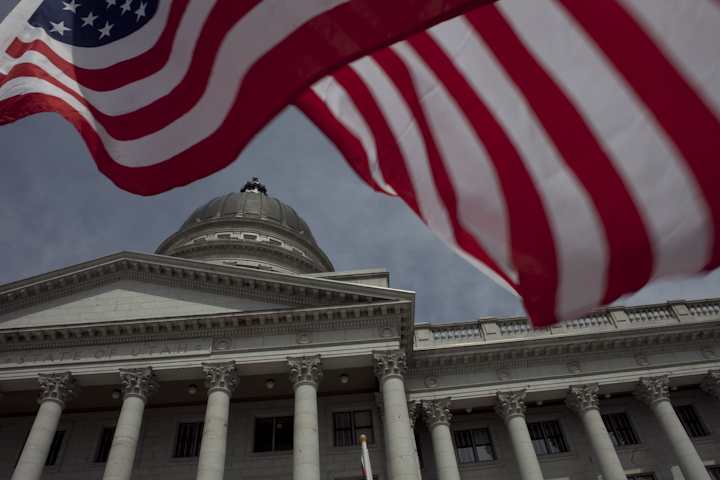
U.S. flag flying in front of the Utah State Capitol. Utah State Capitol image.

U.S. flag flying in front of the Utah State Capitol. Utah State Capitol image.

U.S. flags fly in Utah today in honor of Utah statehood. It’s also the day that new, elected state officers take their oaths and take their offices. Utah is 121 years in the union — as a state, it’s old enough to drink, though you may have difficulty finding a drink there among the teetotaling Mormons.

Utah joined the Union on January 4, 1896.  It had been a 49-year slog to statehood for Deseret, the Mormon settlement in the Desert.  The size had been pared down, so it would not be the biggest state, incorporating parts of what is now Nevada, Arizona, Oregon, Idaho, Colorado and New Mexico.  New capitals had been tried and cast aside (Fillmore, Utah).  Democratic Party rule was broken when LDS church authorities went door-to-door, calling every other family to the Republican Party, and party parity.  The Mormon Church abandoned polygamy, and adopted a state constitution that gave the vote to women.

Finally, Utah became the 45th state.

You may fly your U.S. flag today for Utah statehood, especially if you’re in Utah.

Happy birthday, Utah!  121 years old today.

Big dance in Fillmore to celebrate, Saturday:

Next federal flag-flying date: January 6, in honor of New Mexico’s statehood.

More:

One of my favorite Utah photos: U.S. flag at the south end of Mount Timpanogos; photo from Orem, Utah, by Bob Walker.

One of my favorite Utah photos: U.S. flag at the south end of Mount Timpanogos; photo from Orem, Utah, by Bob Walker.

Yes, this is mostly an encore post. Fighting ignorance requires patience.

Yes, this is mostly an encore post. Fighting ignorance requires patience.

Save

Save


Wasatch rainbow timelapse

May 18, 2016

Just your average spring day along the Wasatch Front in north Utah County, in Highland, Utah in Salt Lake County. Time lapse of the old mountains, and the clouds dancing around them as the sun goes down. A hint of the beauty the people of Utah live with every day — and that I hope they don’t take for granted!

It’s great there are so many electronic cameras around these days. A thousand times I’ve watched these things and lamented they couldn’t be captured. Mt. Timpanogos hides just the other side of that first line of mountains; if you know where to look, you can see its hulking shadow.

(When I lived in Utah County, this site was farmers’ fields, from here to the mountains.)

Tip of the old scrub brush to the Blue Lemon Cafe, “DanPopeGood4Utah,” and Evelyn Jeffries.


Park Avenue Trail, Arches National Park – splendidly divine

April 6, 2016

Park Avenue Trail in Arches National Park, Bud Walley photo, Department of Interior image

From Interior’s Facebook feed: The massive sandstone monoliths along Park Avenue Trail at Arches National Park in Utah have imaginative and descriptive names. You won’t regret this easy one-mile hike. Where else can you walk in the shadows of the Tower of Babel, the Organ, the Three Gossips and Sheep Rock? Photo by Bud Walley (www.sharetheexperience.org). — at Arches National Park.

And a reminder that Utah’s Sen. Mike Lee and Texas’s Sen. Ted Cruz think this land should be developed. Want a condo on that cliff?

I’d prefer to hike it. I’d prefer to know it’s there, available for hiking without development, even when I can’t hike it.

It’s your public land. You get to use it, undeveloped, or you don’t get to use it if the land is developed. We still have a voice, and time to speak.


Timpanogos timelapse, a reverse setting sun?

February 25, 2016

Again from Twitter, a series of photographs of Utah’s Mount Timpanogos.

From top to bottom, it looks like a sunrise on the mountain. But Timpanogos faces west; the sun rises from behind this face. Two possible explanations. The more mundane explanation would be that the series starts with the bottom photo, progressing to the top. Shadows support that explanation.

The slightly more colorful explanation would be, as we often see here in Texas, weather moving from west to east; and in the late afternoon a cover of clouds moves far enough east that the setting sun finally is uncovered, peeking out from underneath the clouds to light the land with that wonderful golden hour sun for a few minutes, before setting.

Timpanogos, like the rock it is, sits majestically either way.

Tweet from sofiaaugustineadams (@sofiaaadams): Mountain time #timelapse #timpanogos

Tweet from sofiaaugustineadams (@sofiaaadams): Mountain time #timelapse #timpanogos

I Tweeted Ms. Adams (I’m presuming her name to be Sofia Augustine Adams) to ask which it is. For those who love Timpanogos, it won’t matter much.

My guess is the photo was taken from south of Orem, Utah, probably near Interstate Highway 15 which transects Utah County.

Update: Ms. Adams informs us  (see comments) it is a setting sun, with the bottom photo being the first in the series. Thank you!


Oil in Mt. Timpanogos?

February 19, 2016

During the RARE II Wilderness Assessment process, and during the Sagebrush Rebellion of the 1970s and 1980s, wildcatters along the Rocky Mountains spine of the west would say we couldn’t rule out any area as having no oil unless we drilled first.

But no one’s found oil in Timpanogos.

Instead, we’ve found Timpanogos in oil.

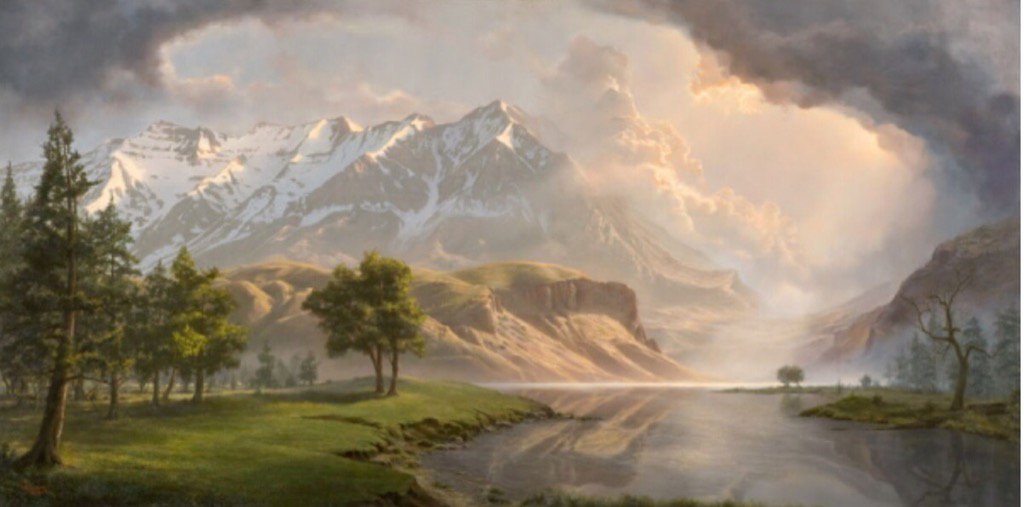
Mt. Timpanogos Millennium, by Adam Abram (b. 1976). From Tweet by Don Ruggles (@DHRuggles) and @TeresaVeiga1

Mt. Timpanogos Millennium, by Adam Abram (b. 1976). From Tweet by Don Ruggles (@DHRuggles) and @TeresaVeiga1

It’s an interesting view of the mountain, from the southwest. At the right of the picture is Provo Canyon. The body of water must be the Provo River, but in a serene state I think could not have existed at any time. The bluffs shown past the juniper trees are unfamiliar to me.  I’m guessing the artist, Adam Abram, has idealized Timpanogos as the Mormon pioneers might have found it. The area portrayed is probably part of Orem, Utah, today — covered by housing tracts and power lines.

Anyone know? A topological map covering the mouth of Provo Canyon to where the river enters Utah Lake might offer much more specific information. I don’t have one of those at the moment.

Compare it with this photo of Timpanogos (in late summer) by Bob Walker of Orem, 2012:

Utah's Mount Timpanogos looking Northeast; Provo Canyon to the left of the photo. Photo by Bob Walker.

Utah’s Mount Timpanogos looking Northeast; Provo Canyon to the left of the photo. Photo by Bob Walker.

Almost update: I went looking for Adam Abram. You can hang a print of his Mount Timpanogos Millennium for under $30 (a bargain).

Abram explains his painting:

I grew up in the shadow of beautiful Mt. Timpanogos.  This mountain, towering over Utah Valley, stands at 11,749 feet above sea level and once rose above the shores of ancient Lake Bonneville.  Its name is a Paiute word meaning “river of rock.” My goal as an artist was to memorialize my favorite mountain with a 19th century style similar to the Hudson River School. In the process of creation, I did studies of several trees from around the mountain and painted them in.  Sadly, those trees have been torn down with the growth of business and home development. This painting is a tribute to the beauty and majesty of this incredible mountain. This painting won 3rd place in the prestigious 2007 International ARC salon.

I’m not alone in loving that mountain. Who knew?


Cold day sunrise under Mt. Timpanogos

February 12, 2016

Tweet from @CharBailey5479: Sunrise shroud on Mt. Timpanogos - have a great day! #utwx #utah

Tweet from @CharBailey5479: Sunrise shroud on Mt. Timpanogos – have a great day! #utwx #utah

Utah’s Mount Timpanogos rises on the east side of Utah Valley, in Utah County, over Utah Lake.

At about 6,000 feet above the valley floor, the mountain can make its own weather at times. On a cold winter morning, sun struggling to climb over the peak can expose clouds from sublimating ice on the mountain, or clouds from ice crystals blown off the top slopes.

Any way they form, it can be a spectacular start to another day.

Much of my childhood was spent about five miles south and east of the spot this photo was taken (American Fork?). The mountain filled most of my bedroom window. A sunrise like this one would look like a forest fire in my room. But film was expensive, and my camera was a snapshot special.

Thanks to @CharBailey5479, whoever you are.


Remember the day they flew the U.S. flag backwards from the Mormon Temple in Salt Lake City?

January 4, 2016

Holly Munson at the Constitution Center wrote up a piece about Utah’s perhaps odd path to statehood, certainly complementary to my reminder that you could fly your flags on January 4, to honor Utah’s statehood, under the U.S. Flag Code.  Munson’s piece was distributed on Yahoo! News.

Her report is very solid, even though brief.  Utah history is nothing if not a convoluted path to statehood through what amounted to a civil war, the Mexican War, the discovery of gold in California, the transcontinental railroads, mining and immigration, Indian wars, old west shootouts, rampant environmental destruction with sheep grazing and mineral extraction and smelting, union strife, astonishing agricultural applications, and a lot of books written from tens of thousands of Mormon pioneer journals — Mormonism appears to be impossible without ink and paper and time to write.

Go read her story.

What caught my eye was the George W. Reed photograph of the Salt Lake City Temple of the Church of Jesus Christ of Latter-day Saints — the LDS, or Mormon church.  The Temple and the Tabernacle, also in the photo, both have their own unique architectural histories, and quirks that make them noteworthy purely from architecture.  (This George W. Reed should not be confused with the Civil War Medal of Honor winner, George W. Reed)

Reed was an early photographer for newspapers in Salt Lake City, and he took some wonderful photos for posterity.  He was also a founder of the leading non-Mormon paper in the state, The Salt Lake Tribune.  At points in its history, it’s been known as an anti-Mormon paper.  The University of Utah’s library holds about five dozen of his photos in their collection, indexed electronically if not quite available yet; there Reed is described:

A pioneer in the development of Utah newspapers, George Reed was originally employed by the Deseret News and in 1871 helped in establishing the Salt Lake Tribune. His photographs include nineteenth century views of Salt Lake City, individuals at Reed’s Avenue home, Wasatch Resort in Little Cottonwood Canyon, and a photograph of the American flag hung on the Salt Lake Temple in 1896 to commemorate Utah’s statehood.

In the collection of Utah State University, in Logan, Reed has yet more papers.  There we get a bit more of his history:

A pioneer in Utah journalism, George W. Reed was born in London, England, on April 7, 1833. He emigrated to Utah in 1862 and became manager of the Deseret News, a position he held until 1871 when he founded the Salt Lake Tribune. In 1882, after a decade at the Tribune, Reed sold his interest in the paper to P. H. Lannan. He married Elizabeth Tuddenham in 1866 and passed away December 1, 1909.

U.S. flag on the Mormon Temple, at Utah statehood in 1896

The Mormon Temple in Salt Lake City, Utah, draped with a U.S. flag in 1896, commemorating the completion of Utah’s statehood campaign when President Grover Cleveland declared Utah a member of the Union. Photo by George W. Reed; Reed worked for the Deseret News, and helped found the Salt Lake Tribune. I do not know whether this photo was published in either paper.  From the George W. Reed Collection, University of Utah Libraries.

Yes, you’re right!  That flag is backwards.  Well, it’s backwards according to the modern U.S. Flag Code, which specifies that when hung from a building, the flag’s union should always be in the viewer’s upper left corner (“northwest” corner were it a standard map).  In the photograph, the union is in the opposite corner.  No, we know the photo is not reversed, because it accurately portrays the location of the Tabernacle, to the west and slightly south of the Temple.

But we hear the protests:  The U.S. Flag Code did not exist in 1896!  How can that be a violation of a code that did not exist?

That’s right, too.

That is an indication that the traditions of flag display that some people get riled up about, that many people think we should amend the Constitution to protect, are new inventions more than old traditions.  Flag code violations are legion by well-meaning citizens celebrating the flag and patriotism, and rare by anyone with any malignant motives.

After a 49-year fight for statehood, through wars with the U.S., fighting with the U.S. forces in Mexico, the administrations of several presidents and 25 different U.S. Congresses, and pledges to change the rules of the church to ban polygamy and put that ban in the state constitution,  the people of Utah, especially the Mormon officials, were not trying to insult America by displaying the flag incorrectly.  Somebody said ‘fly the flag from the Temple,’ and some engineer or custodian got it done.  By 1896, most of the First Amendment litigation done in the U.S. had involved whether Mormons could keep their marriage policies (Mormons lost).  There was no intent to violate any rule of separation of church and state — nor would that be considered a violation today.  Churches may fly the nation’s flag with all the approval that suggests; it’s the government which may not fly a church’s flag.

Finally, there is no grand story in the flag’s being flown backwards.  It’s just one of those historical footnotes that mark the changing mores of the times, in this case, for standards of how to fly the U.S. flag.

Perhaps Utah history textbooks should make note of the day the U.S. flag was flown, backwards, to honor statehood.

More, and related resources:

Yes, this is mostly an encore post. Fighting ignorance requires patience.

Of course this is an encore post. Fighting ignorance requires patience. No one has changed the Utah history textbooks yet.


Utah at 120: Fly colors for Utah statehood, January 4, 1896

January 4, 2016

Utah Capitol, with flags

South entrance (main) to the Utah State Capitol, with U.S. and Utah flags flying on the single flag poll, and the snow-dusted Wasatch Mountains in the background. Utah State Law Library photo.

Utah joined the Union on January 4, 1896.  It had been a 49-year slog to statehood for Deseret, the Mormon settlement in the Desert.  The size had been pared down, so it would not be the biggest state, incorporating parts of what is now Nevada, Arizona, Oregon, Idaho, Colorado and New Mexico.  New capitals had been tried and cast aside (Fillmore, Utah).  Democratic Party rule was broken when LDS church authorities went door-to-door, calling every other family to the Republican Party, and party parity.  The Mormon Church abandoned polygamy, and adopted a state constitution that gave the vote to women.

Finally, Utah became the 45th state.

You may fly your U.S. flag today for Utah statehood, especially if you’re in Utah.

Happy birthday, Utah!  120 years old today.

Next federal flag-flying date: January 6, in honor of New Mexico’s statehood.

More:

U.S. flag in Capitol Reef NP

U.S. flag flying at Capitol Reef National Park, in Utah. Photo by longyang0369, via Flickr

Much of this material appeared here before; this is an annual event, after all.


Tearing down historic Chipman’s Department Store, American Fork Utah, 1992

November 11, 2015

Caption on photo from American Fork Public Library:

Caption on photo from American Fork Public Library: “This photo was taken February, 1992, just before final demolition of the Chipman store. The last thing to fall was the front part, with the C H I P M A N name still intact.”

In 1962, a position for my father heading the furniture department at Chipman’s Mercantile in American Fork, Utah, prompted our family’s move from Burley, Idaho. We found a home in Pleasant Grove, about five miles south and east of American Fork.

I was rather surprised to find this photo in digital collections I was searching through the Provo, Utah, public library.

Description of the photo:

Title Partial demolition of Chipman’s, formerly Chipman’s Mercantile, on the corner of Main Street, Merchant Street and Center Street. Built in 1884, demolished in 1992.
Description Partial demolition of Chipman’s, formerly Chipman’s Mercantile, on the corner of Main Street, Merchant Street and Center Street. Built in 1884 by James and Stephen L. Chipman. The store was once the biggest department store in Utah County. It was demolished in 1992.
Subject American Fork, (Utah); Business enterprises; Department stores; Wrecking;
Date 1992-02-01
Photographer Peterson, Wanda S.
Rights Copyright 1992 American Fork City. This work is licensed under a Creative Commons Attribution-NonCommercial-NoDerivatives 4.0 International License, http://creativecommons.org/licenses/by-nc-nd/4.0/
Publisher Published by American Fork Public Library; Digitized and hosted by Utah Valley University

It’s symbolic of the history of places we lose all too easily.

Plus, it brings back so many memories of the small towns in which I grew up.

Chipman’s played a big role in the development of American Fork, and northern Utah County. The store was an early success, and the Chipman family became locally prominent, and played an interesting role in the development of science education at two Utah universities.

Two Chipman sisters (daughters of James or Stephen Chipman?) married scientists. One married the great chemist, Henry Eyring, who took a position at the University of Utah to stay close to his wife’s family. The other married the great physicist Harvey Fletcher, who took a position at Brigham Young University, again to stay close to his wife’s family.  Harvey Fletcher served on the board of Chipman’s for a time, and bought furniture there. My father asked me to accompany him on a delivery to the Fletcher’s Provo home, probably trying to prompt an interest in science in me. A few years later in Chipman’s store, my father introduced me to the Fletchers’ son, James C. Fletcher, who would later become president of the University of Utah, and then twice head NASA.

Mrs. Fletcher made great cookies. I wasn’t prescient enough to get even autographs from any of them.

On a July day, probably about 1968, during a street fair, the band I played in performed from the back of a flatbed truck on the street to the right of the photo. We discovered Dick Gardiner’s Farfisa organ lost its tuning in the sun.

The site of the store was turned into a parking lot. The Bank of American Fork put up some drive-up tellers on the site later.


Signs of life: Eagles on Highway

July 30, 2015

One of our local pharmacists travels on vacations, and takes photos.  Pharmacies being what they are, people wait in line with nothing to do but count ticks on the clock.  No one takes a book to the pharmacy to wait.

But the guy, Mark de Zeeuw, has a good sense of customer service.  He got one of those photo frames that had a video display to show photos.  Over time, it morphed to an extra computer screen, and probably an old computer (don’t know for sure).

At the Tom Thumb supermarket in Duncanville, Texas, customers get to see photos of the pharmacist’s travels.  A lover of travel and photography, and a too-frequent customer at the pharmacy, I think I may have seen every photo on that harddrive.  Many of them are very good. He travels to Alaska and across the American west, and he’s got at least one telephoto that works well on wildlife — this I know from watching the photos.  I’ve never discussed it with the guy (who is always busy working on prescriptions, or fighting with insurance companies over the phone; Tom Thumb’s being a large company, there may be other pharmacists on duty at the time).

Okay, I’m shy.  I’ve wanted to ask him for copies of several of the photos to share, one in particular.  It’s a nice shot of the yellow warning/information signs you see at the side of a highway.  With a bright blue sky in back, and obviously a lot of unpopulated territory, it says “Eagles On Highway.”  I broke the shyness enough to learn it was a photo from eastern Utah.

Surely someone else noticed the sign?

Yep! Wonders of Google, Bing and flickr:  Here’s a shot I found at Wanderlust Cafe:

“Eagles on Hwy.” Sign on eastbound Interstate 70, near the Moab turnoff in Utah. Photo by Lou Ann Granger, via Wanderlust Cafe

Out on Interstate 70, the rabbits and occasional ground squirrel, lizard or coyote fall victim to speeding cars in the night.  In the daylight, carrion eaters — including eagles — clean up the road.  Alas, eagles have not been bred to recognize those vehicles, tiny in the distance, rush at them at 70 miles per hour. Worse, it’s a violation of federal law and regulations to kill the eagles (few are ever cited for accidents).

Local authorities put up signs warning drivers of this odd hazard: “Eagles on Highway.” Drivers are supposed to slow down, be wary, and avoid hitting the eagles.

Others grew curious about the signs, too. The Deseret News in Salt Lake City explained back in 1990 that six of the signs were put up, in hopes of reducing kills of immature golden eagles.

They have to rank as the most unusual highway signs anywhere in the state. But preliminary indications are the six “Eagles on Highway” warning signs in central Utah are doing the job.

Not a single golden eagle was struck by a car during the 1989-90 winter season.In the two years previous, 30 golden eagles were killed and another 11 crippled by automobiles on a stretch of I-70 between the Colorado border and the San Rafael Swell.

“We don’t know whether it’s because the mild winter has spread the birds around more or whether it’s because the prairie dog population is down and the birds have moved elsewhere, or what,” said Miles Moretti, regional supervisor for the Division of Wildlife Resources.

“What we do know is we’ve received a lot of comments from people seeing signs and watching the birds and being aware of the problem. From a public awareness standpoint the program is a success.”

I wonder if we can track down someone in authority with numbers to show the signs are working after 25 years.  And maybe I can get a copy of pharmacist de Zeeuw’s photo here — his is better, I think.

More:

Read the rest of this entry »


Catching the Subway, in Zion National Park, Utah

July 25, 2015

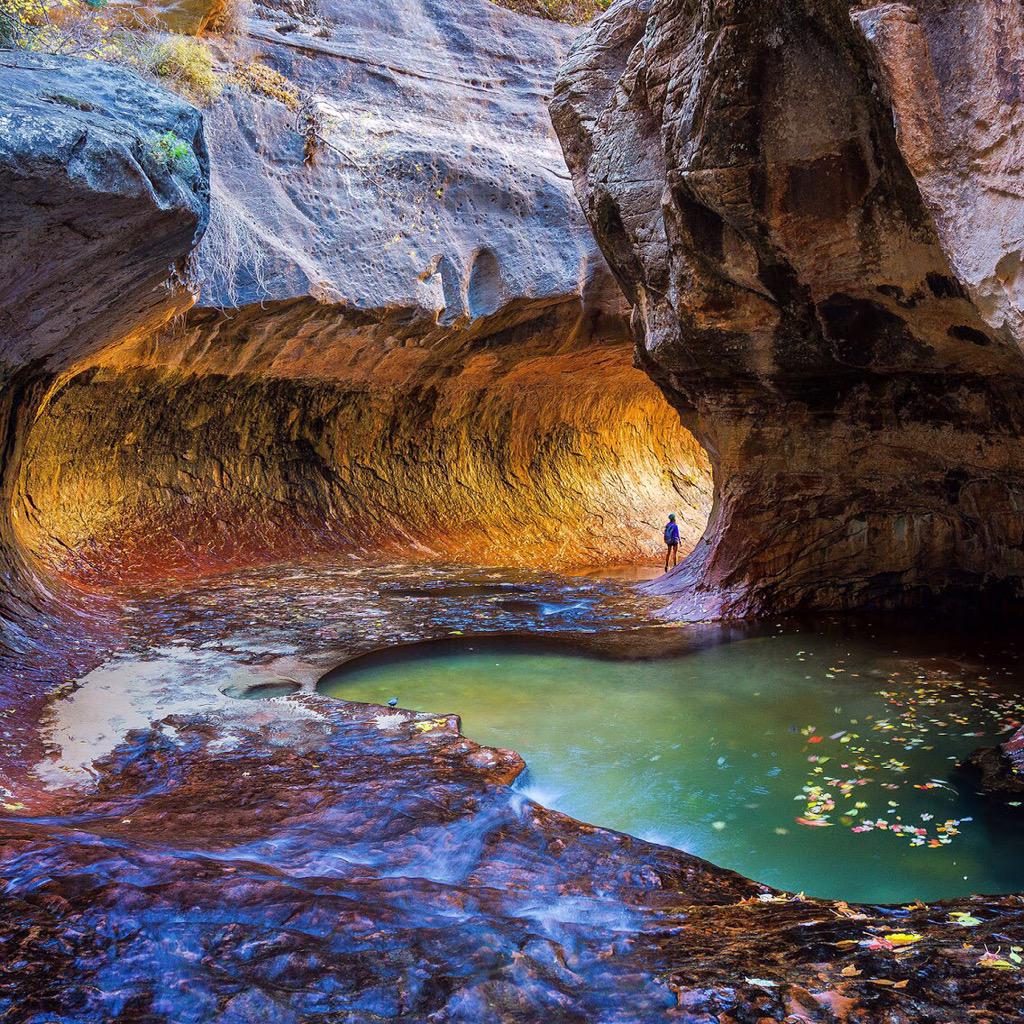
US Department of Interior Tweet: Simply stunning: That's the only way we can describe @ZionNPS's Subway. Pic by Tiffany Nguyen #Utah

US Department of Interior Tweet: Simply stunning: That’s the only way we can describe @ZionNPS’s Subway. Pic by Tiffany Nguyen #Utah

Gotta get back there.

James and Michelle made a trek there in 2013.

Subway in Zion Canyon National Park, photo by Michelle Xiang Li, 2013 (some rights reserved)

Subway in Zion Canyon National Park, photo by Michelle Xiang Li, 2013 (some rights reserved)

I wonder if it’s possible to take a dozen photos there without a few that take your breath away.

Rock, water and leaves. Photo from the Subway trip, by Michelle Xiang Li, 2013

Rock, water and leaves. Photo from the Subway trip, by Michelle Xiang Li, 2013