Blue jay, purple pepper

July 23, 2009

We’ve been bumping around 100° F for about a month now.  It’s Texas.  It’s hot.

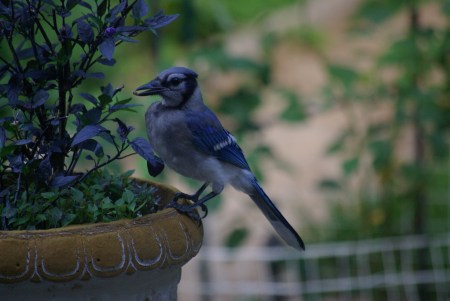
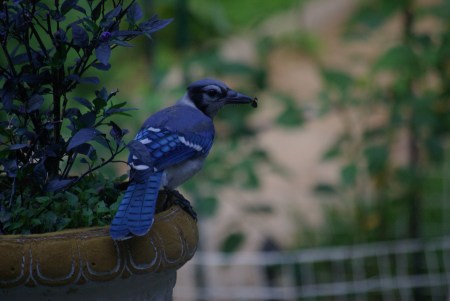
Sometimes the blue jays do all they can to stay out of the sun — like this guy, who was bent on getting some of Kathryn’s weird purple peppers.

Blue jay working to get a purple pepper

Blue jay working to get a purple pepper

Considering these shots were done in the shade, with just a 200 mm zoom, through a foggy window, they came out pretty well.

Blue Jay wrestles the pepper from the plant

Blue Jay wrestles the pepper, or something, from the plant.

The peppers eventually grow to be the size of a Bing cherry — too big for the jays, then.  They go after these peppers before they mature, and after they dry.

With her prize, the blue jay heads for its dining area in the live oak.

With her prize, the blue jay heads for its dining area in the live oak.

Mary K left us with her old bird feeder when she moved.  This year we’ve kept feeders in both the front and back yards.  Blue jays appear to have recovered from their West Nile devastation three years ago — we had one family nesting in the live oak earlier, in the spring — and Kathryn learned that the jays like peanuts still in the shell.

It’s been a good year for watching birds in our yard.  Still haven’t captured that little green hummer in a camera, though.


Moving Civil War Memory. No, I mean, it’s really moving.

July 22, 2009

Civil War Memory said:

This past weekend I mentioned that there are some big changes to Civil War Memory on the horizon.  Well, today is the day that I announce that Civil War Memory is moving to WordPress.org.  All the posts and comments have been moved to the new site, which can be found at http://cwmemory.com/.   Please update your blogroll as soon as possible.  In about a month I will unveil a brand new theme for the blog.


Warning: Universal coverage will save lives, money and pain

July 22, 2009

Utah Savage tells the story:

My friend Z is doing amazingly well, considering. She is complying with her oncologists. But now that the radiation is burning her throat, and the chemo is making her queazy, the doctors are prescribing drugs that will alleaviate these problems. But Z doesn’t believe in Western medicine and when it came time to sign up for Medicare she assumed that she would never get sick enough to ever need the part A, B and D of Medicare coverage. Now she needs them all and the enrollment period won’t come around again until November. It is part D that would have paid for her drugs. It is part D that would make a drug that costs $150 at most $3.50. I audibly gasped when she told me that she didn’t have part D. I couldn’t help myself. I said, “But you need part D.” She was furious and shouted, “Don’t tell me what I should have done. That doesn’t help me now.” And of course she’s right. Now that it’s too late, it doesn’t help to tell her what she should have done.

If you’re healthy, you never think you’re going to need insurance and prescription drug coverage. And if you’re young you never think your going to get ill. But everyone needs insurance. That is why the healthcare debate is so terribly important. We need a public option. Please call your Congressional Representative and lobby for a public option for healthcare. We need you healthy. We need you paying attention to the issues that will make a difference in all our lives.

We are not allowed to drive a car without insurance and we don’t think twice about that. But we are so careless when it comes to insurance for our own health. It should be mandatory that everyone is covered with health insurance.

Does your mileage differ?  Tell us in comments.


I’d give the kid a good grade, I think

July 22, 2009

Can any teacher recognize genius in the classroom?  Especially when I taught in alternative programs, I was frequently astounded by the great work students did that was just enough off the mark of the assignment that it might have gotten a zero were it not so brilliant, and had I not had a few extra minutes to grade (thanks to smaller classes).

Wee Mousie’s Cinema Burlesque — what do you do with stuff like that?

This is the stuff Creative Commons is made for, by the way.


Maggie rose

July 22, 2009

Exquisite blooms of the "Maggie" rose (bourbon class) - in Kathryn Knowles' garden, summer 2009

Exquisite blooms of the "Maggie" rose (bourbon class) - in Kathryn Knowles' garden, summer 2009

Yes, I intended to leave the spent blossom there.  This is a real garden, where the flowers grow and fade.

Maggie is a “found” rose, robust in much of Texas, and a favorite of my wife’s.  The blossoms tend to glow, even at mid-day.  It will blossom all summer when it’s happy.  Maggie’s fragrance earns it a spot in Kathryn’s garden.

Maggie was one of five roses designated by Texas A&M’s horticulturists in 2005 for testing as one of a handful of roses easy to grow (read:  “difficult to kill, really”) in Texas.  Many rose varieties do not do well in southern heat and humidity — Maggie is one exception.

Maggie is a “found” Bourbon rose. It was collected in Louisiana by Dr. William Welch, Extension horticulturist from College Station. Maggie reaches 8 feet in height and 4 feet in width. Its flowers are medium red, very double, very fragrant, and it is a repeat bloomer. Researchers have found Maggie does best when trained on a pillar or fence. It is designated for zones 6-9.

“Arethusa, Jaune Desprez and Maggie are winter hardy throughout the entire state,” George said. “Bon Silene and Comtesse du Cayla, however, are winter hardy across most of the state except for Amarillo and the northern Panhandle area.”


Our nation’s first man in space

July 20, 2009

Our first man in space got there by a route most people can’t guess:  Balloon.

Joe Kittinger recounted his adventures to the CBS Morning Show, how he leaped from a balloon at the edge of space for the Air Force, to prove that humans could survive a fall from such distances, in the event of an emergency that required an astronaut to bail out.

Kittinger bailed out of the balloon at over 102,000 feet, nearly three times the height of Mt. Everest into the atmosphere.

But Elton John never wrote a song about “Balloon Man.”


News flash: Texas has a second natural lake!

July 20, 2009

Years ago, in Virginia, I had learned that Virginia had only one natural lake, the Great Dismal Swamp.  Accompanying that chunk of information in that lecture was that Texas had only two natural lakes.

But upon arriving in Texas, I could find reference to only one natural lake, Caddo, and it had ceased being fully natural when its maintenance fell to a dam.

What happened to Texas’s second natural lake?

A Google search right now on “Texas +’natural lake'” produces ten listings on the first page, all of them pointing to the fact that Texas has just one natural lake.  Here are the first five:

I have found a second natural lake in Texas. It’s not a new discovery at all — it’s just a case of people not having the facts, and overlooking how to find the truth.  It’s especially difficult when the lake hides itself.

Our testing coordinator at Molina High School, Brad Wachsmann, spins yarns that belie his youth.  In the middle of one yarn last year, corroborated by other yarns, he mentioned that he has family in Big Lake, Texas; and he described visiting and having relatives urge people to run out and see the lake since it’s rebirth in torrential rains.

“A second natural lake in Texas?” I asked.  Wachsmann knew the drill.  Yes, Big Lake is a natural lake in Texas, and yes, people forget about it.

Texas teachers, listen to your testing coordinators, okay?

All of this came to mind reading the Austin American-Statesman, still a bastion of great journalism despite problems in the newspaper industry.  On Monday, July 7, the paper ran a story and an editorial about the clean up of the oil industry refuse that killed the shoreline of part of the lake; the springs that once fed the lake have mostly gone dry, but that’s likely due to agricultural water mining.

It’s a story of boom and bust, environmental degradation for profit, and eventual recovery we hope.

Looking at the landscape that surrounds the Reagan County seat, you wonder whether the name Big Lake was somebody’s idea of joke. It’s dry and dusty, where the flora sprouts reluctantly and lives precariously.

Yet, the West Texas town of Big Lake got its name from a natural lake that was fed by springs that have long since gone dry. While the area may not fit everyone’s definition of photogenic, it has its own brand of charm – charm that could be enhanced if the damage done to the fragile ecosystem by salt spills were reversed or even minimized.

As the American-Statesman’s Ralph K.M. Haurwitz reported in Monday’s editions, the University of Texas and Texas A&M systems have benefited from the $4.4 billion in royalty payments and mineral income produced by its West Texas acreage since Santa Rita No. 1 well came in on May 28, 1923.

The salt water byproduct of oil and natural gas production, however, contaminated 11 square miles near Big Lake, killing most everything that grows. The lack of vegetation allows wind and water erosion.

Hey, it gets better.  This is real Texas history, real American history — you can’t make this stuff up.  Haurwitz’s article talks about the heritage of Texas education.   Remember that old story about setting aside certain sections of townships to help fund education in lands on the American frontier?  Texas wasn’t a public lands state as farther west, but it still reserved sections of land for the benefit of education.

Rose petals blessed by a priest?  I’ll wager the priest didn’t make the trip to the top of the derrick.  Haurwitz wrote:

BIG LAKE — Investors appealed to the patron saint of impossible causes when oil drilling began on University of Texas System land in 1921. It didn’t hurt.

Santa Rita No. 1 blew in on May 28, 1923, after rose petals blessed by a priest were scattered from the top of the derrick at the behest of some Catholic women in New York who had purchased shares in the Texon Oil and Land Co., which drilled that first well.

Since then, the UT System’s 2.1 million acres in West Texas have produced $4.4 billion in royalty payments and other mineral income for the Permanent University Fund, an endowment that supports the UT and Texas A&M University systems.

But this long-running bonanza for higher education exacted a price from the remote, semiarid landscape where it all began. Millions of barrels of salt water, a byproduct of oil and natural gas production, contaminated 11 square miles, or more than 7,000 acres, killing virtually all vegetation and leaving the land vulnerable to wind and water erosion. Hundreds of mesquite stumps with three feet of exposed roots testify to the dramatic loss of topsoil.
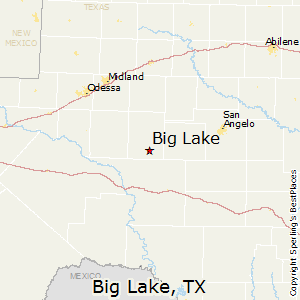
Texas, and Big Lake - from BigLakeTx.com

Where in Texas is Big Lake?

The town of Big Lake is just north of the lake itself, on State Highway 137 running north and south, and U.S. Highway 67 running east and west, approximately 65 miles west of San Angelo.   Big Lake sits about 10 miles north of Interstate 10, and about 75 miles south of Interstate 20.  Big Lake calls itself “the gateway to the Permian Basin.”

Big Lake is the home of Reagan County High School.  Jim Morris was baseball coach for the Reagan High Owls when his team persuaded him to try out for a major league baseball team.  His story was chronicled, with some artistic license, in the Disney movie “Rookie.”

Land managers are working to stop erosion on the often-dry shores of Big Lake using any trick they can find.  One trick:  Plant salt grass.

Salt grass?  Along Texas’s Gulf Coast, there are a few species of grass that, while not halophytes, are at least salt tolerant.  Salt grass.  This grass made it profitable to graze cattle on what would otherwise have been unproductive land in the Texas cattle boom.  This role in Texas history is memorialized in the Salt Grass Steakhouse chain, now found in five states.

And if planting salt grass works to control erosion, it will help clean up a large part of Texas other natural lake, Big Lake.

Big Lake’s being wet or dry is a whim of local climate.  You could say that half of all of Texas’s natural lakes are now dry as a result of continued warming; you could say that two good gully-washers or toad-stranglers could restore water to half of Texas’s natural lakes.
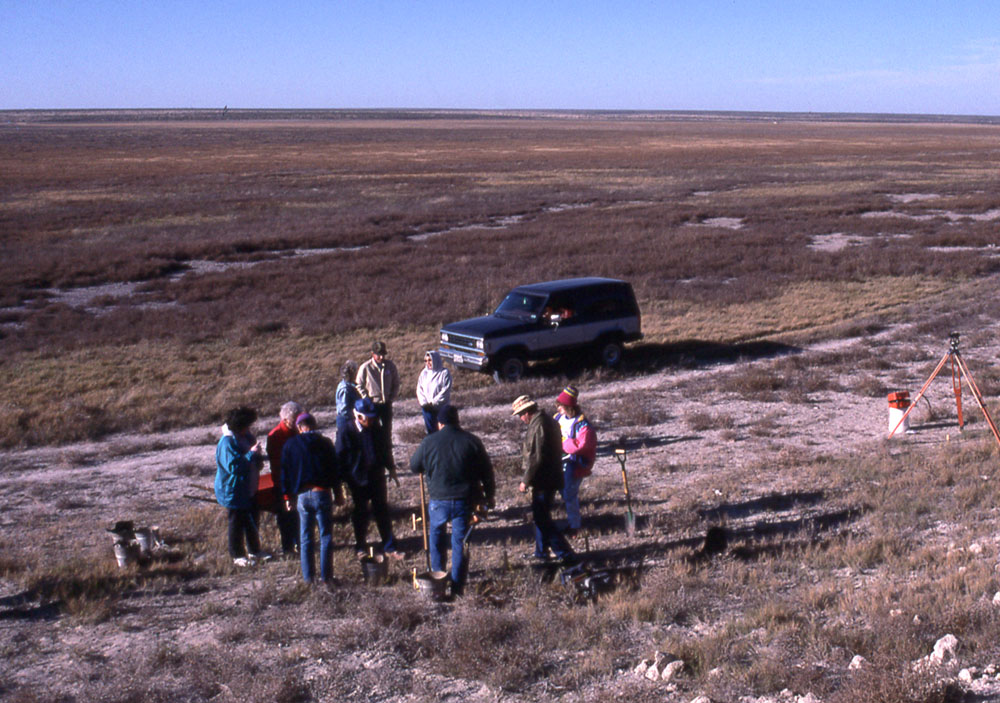
Big Lake Playa, from NightOwl Bakery and Roastery in Big Lake, Texas

Field crew meeting at the outset of the 1992 excavations at the Big Lake Bison Kill site. The dry bed of Big Lake stretches for miles in the background. Big Lake is an intermittent saline lake or playa, an uncommon landform on the Edwards Plateau. Photo by Larry Riemenschneider, Concho Valley Archeological Society.

More details about Big Lake and prehistory, below the fold.

Read the rest of this entry »


Wiley Drake is an illegal alien

July 19, 2009

Wiley Drake cannot show us his green card, and so, by his standards, he is an illegal alien.

What’s that you say?  Drake was born in the U.S.?  So was Obama, and it doesn’t stop Drake from claiming Obama illegal.  The only criterion Drake offers is that Obama doesn’t have a green card.  On that criterion, Drake is also an illegal alien, since he has no green card, either.

As God is our witness, we could not make this stuff up.

Do  you think Drake is part of the reason California is having such great fiscal difficulties?

Seriously, Wiley Drake does not speak for God, nor even for other Christians.  That was a shameful performance on Drake’s part not least because he didn’t have a clue how shameful it was.  The Bible says Christian elders have an obligation to rebuke false doctrine, false preachers and hooey.  Consider Drake rebuked.

Not that Drake would ever listen to a Christian elder.

Tip of the old scrub brush to Savior Breath posting at Pharyngula.


Scientist steps in to try to save the day

July 19, 2009

On the one hand, you hope he’s got a good copy of the original cast recording of “Man of La Mancha,” with the late Richard Kiley singing the importance of dreaming the impossible dream.  On the other hand, you hope it’s not an impossible situation at all.

Mathematics Professor Lorenzo Sadun declared his candidacy for the Texas State Board of Education seat representing District 10. He’ll be running against incumbent Cynthia Dunbar in a district that has a history of electing people with little or no education background and a commitment to scorched Earth conservative policies — if Dunbar chooses to run again.  Dunbar has not announced her intentions.

Sadun is professor of mathematics at the University of Texas, in Austin.

Mathematics Prof. Lorenzo Sadun, University of Texas - Daily Texan photo by Mike Paschal

Mathematics Prof. Lorenzo Sadun, University of Texas - Daily Texan photo by Mike Paschal

In the 2006 election, there was no Democratic nominee. Dunbar ran against a Libertarian and won approximately 70 percent of the vote. The 2010 primary election is scheduled for March, and Sadun declared last week that he will seek the Democratic nomination.

The Place 10 seat-holder may become very influential. With the board almost evenly split, a negative or positive vote can greatly affect educational policy and standards.

If Sadun is elected, he will be the only scientist on the board. He said that even though he may encounter opposition from members of the board, he will find a common ground with his colleagues and will pursue agreement without sacrificing the quality of education for Texas students.

“Despite my taking a fairly hard line, I am a conciliator,” Sadun said. “I have not met a person who knew so much I couldn’t teach them something, and I’ve never met someone who knew so little that they couldn’t teach me something.”

District 10 includes 14 counties surrounding Travis County to the east of the county, and the northern part of Travis County.  Travis, home to the Texas state capital Austin and one of Texas’s five supercounties, was split in education board districts to limit the influence of its  highly-educated, more liberal voter population.

District 10, Texas State Board of Education

District 10, Texas State Board of Education

Burnt Orange Report wrote that Dunbar will face opposition if she chooses to run again.

Events in District 10 offer a sign of hope that the era ended when apathy from candidates and voters allowe anti-public education forces to dominate the Texas State Board of Education.  And if Sadun were to win, it would be the first time a working scientist was elected to SBOE.

Who knows?  Sadun could succeed — but if he wins a seat on the SBOE, it’s not likely he’d sing that other song Richard Kiley made famous, “Stranger in Paradise.”  He’s no stranger to quality education, and SBOE isn’t paradise.


Probably not the way to get a good reputation among scientists

July 19, 2009

Tensions between science and religion, and science and business, continue to drag down Texas’s hopes to be known as a major research location.

A hard look shows it’s not just the Deliverance-style local politics at the State Board of Education on science standards.  Texas has trouble in a lot of areas.

For example, imagine a hurricane wiped out the town where one of the state’s major medical schools resides, and in the aftermath, rather than working to preserve the jobs of professors who agree to come back to the damaged buildings and storm-wracked town, the university uses the troubles as an excuse to get rid of faculty — not bad faculty, necessarily, just faculty the administration doesn’t like, or doesn’t know, or just for the heck of it.

This ain’t no way to run a medical school.

The rolling disaster that hit the Universityof Texas Medical Branch in Galveston, starting with Hurricane Ike, continued through unexpected layoffs of faculty on top of the 3,000 people laid off due to storm damage.  The layoffs were unjustified, too, many thought, and so they appealed.  The appeals process seems to have offered only a semblance of justice, to many of those involved, according to an article in The Scientist (free subscription required).

The story hasn’t got much traction in Texas media.


World history sources and images from the Library of Congress

July 19, 2009

World Treasures of the Library of Congress looks like a good source of images and information for world history classes and student projects.

Magna charta cum statutis angliae, (Great Charter with English Statutes). Library of Congress

Magna charta cum statutis angliae, (Great Charter with English Statutes). Library of Congress

These links are to exhibits that are closed, but whose images are still maintained on line.  The Library promises to update exhibits, and on line collections will grow, too.

There really is some remarkable stuff, most of it obscure enough to be really cool, still.

A 16th century miniature pictures Rustam, the hero of the Persian national epic, The Shah Namah, tossed into the sea by the demon Akwan. (Library of Congress, Near East Section).

A 16th century miniature pictures Rustam, the hero of the Persian national epic, The Shah Namah, tossed into the sea by the demon Akwan. (Library of Congress, Near East Section).


Carnival of the Liberals #95, at Neural Gourmet

July 18, 2009

Liberals in America struggle as they try to deal with the little bit of success in the last elections.  Used to sniping from the sidelines for the past eight years, and unused to having a president who doesn’t make them pull their hair out at least once a day, liberals might be excused for breathing a massive sigh of relief and taking a few weeks off.

Oh, but that few weeks’ vacation did serious damage to the liberal presence on the internet.

The Carnival of the Liberals is back in a new and improved constitution, with an eye on working for liberal, patriotic ideals with a majority in the U.S. House of Representatives and the U.S. Senate, and a president who might actually do some of the things that need to be done.

Carnival of the Liberals #95, at Neural Gourmet

Typical liberal concerns, you know:  Taxesfamily values; how to make torture work; waving the flag.

More seriously, there are some good articles there.  Go check it out.  The new format looks promising.  Liberals need to get back to the kicking and shoving that make politics work.


Alas, that’s the way it is: Walter Cronkite dead at 92

July 18, 2009

You can’t explain the influence of Walter Cronkite to a high school kid today.  They don’t have any experience that begins to corroborate what you’d say.

Walter Cronkite in the last decade - Texas Parks and Wildlife photo by Richard Roberts

Walter Cronkite in the last decade - Texas Parks and Wildlife photo by Richard Roberts

Along with Chet Huntley and David Brinkley on NBC, Mr. Cronkite was among the first celebrity anchormen. In 1995, 14 years after he retired from the “CBS Evening News,” a TV Guide poll ranked him No. 1 in seven of eight categories for measuring television journalists. (He professed incomprehension that Maria Shriver beat him out in the eighth category, attractiveness.) He was so widely known that in Sweden anchormen were once called Cronkiters. (from the New York Times)

I’m saddened at the death of Cronkite.  One of the things that saddens me is that he probably could have anchored for at least a decade past when he last signed off.  Nothing against Dan Rather, at least not from me — just that Cronkite was one of a kind.  He won’t be missed by too many people alive today who never had a chance to see him work.

So, go see him work. Media Decoder has a series of YouTube pieces showing what Cronkite could do, what Cronkite did.  It’s history go see.

Other posts on Cronkite at Millard Fillmore’s Bathtub:

More, probably better stuff


Zachary Taylor’s death, and Millard Fillmore’s ascendance to the presidency — in detail

July 17, 2009

Elektratig recounts President Zachary Taylor’s death, and Millard Fillmore’s swearing in as the 13th president, in deeper and more interesting detail than I had.

Bookmark that site, social studies teachers: It’s a great site for details on Millard Fillmore that your students won’t find easily anywhere else — and on Zachary Taylor, and on politics and history in general in the two decades prior to the Civil War.  Go see:  “Zachary Taylor is no more!”


Star-spangled voodoo history

July 16, 2009

Star-spangled Banner and the War of 1812 - The original Star-Spangled Banner, the flag that inspired Francis Scott Key to write the song that would become our national anthem, is among the most treasured artifacts in the collections of the Smithsonian’s National Museum of American History in Washington, D.C.

Star-spangled Banner and the War of 1812 – The original Star-Spangled Banner, the flag that inspired Francis Scott Key to write the song that would become our national anthem, is among the most treasured artifacts in the collections of the Smithsonian’s National Museum of American History in Washington, D.C.

(Hey, Dear Reader; this post got an update many months later — you may want to check it out for better links and more information.)

Every school kid learns the story of the “Star-Spangled Banner,” or should.

During the War of 1812, Georgetown lawyer Francis Scott Key, stood aboard a British ship in Baltimore Harbor to negotiate the release of his friend, Dr. William Beanes, who had been taken prisoner while the British stormed through Bladensburg, Maryland, after burning Washington, D.C.  Key witnessed the British shelling of Fort McHenry, the guardian of Baltimore’s harbor.  Inspired when he saw the U.S. flag still waving at dawn after a night of constant shelling, Key wrote a poem.

Key published the poem, suggested it might be put to the tune of “Anachreon in Heaven” (a tavern tune popular at the time) — and the popularity of the song grew until Congress designated it the national anthem in 1931.  In telling the story of the latest restoration of that garrison flag now housed at the Smithsonian Museum of American History, Smithsonian Magazine repeated the story in the July 2000 issue:  “Our Flag Was Still There.”

It’s a wonderful history with lots of splendid, interesting details (Dolley Madison fleeing the Executive Mansion clutching the Gilbert Stuart portrait of George Washington, the guy who had introduced Dolley to James Madison and then snubbed them after they were married; the British troops eating the White House dinner the Madisons left in their haste; the gigantic, 42 by 30 foot flag sewn by Mary Pickersgill, a Baltimore widow trying to support her family; the rag-tag Baltimore militia stopping cold “Wellington’s Invicibles;” the British massing of 50 boats and gunships; and much more).

It’s a grand and glorious history that stirs the patriotic embers of the most cynical Americans.

And it’s all true.

So it doesn’t deserve the voodoo history version, the bogus history created by some person preaching in a church (I gather from the “amens”) that is making the rounds of the internet, stripped of attribution so we cannot hunt down the fool who is at fault.

We got this in an e-mail yesterday; patriots save us, there must be a hundred repetitions that turn up on Google, not one correcting this horrible distortion of American history.

Horrible distortion of American history

(The full version is a mind-numbing 11 minutes plus.  Some people have put it on other sites.)

Why do I complain?

  1. It was the War of 1812, not the Revolutionary War — there were 15 states, not 13 colonies.
  2. There was no ultimatum to to Baltimore, nor to the U.S., as this fellow describes it.
  3. Key negotiated for the release of one man, Dr. Beanes.  There was no brig full of U.S. prisoners.
  4. It’s Fort McHenry, not “Henry.”  The fort was named after James McHenry, a physician who was one of the foreign-born signers of the Constitution, who had assisted Generals Washington and Lafayette during the American Revolution, and who had served as Secretary of War to Presidents Washington and Adams.
  5. Fort McHenry was a military institution, a fort defending Baltimore Harbor.  It was not a refuge for women and children.
  6. The nation would not have reverted to British rule had Fort McHenry fallen.
  7. There were 50 ships, not hundreds.  Most of them were rafts with guns on them.  Baltimore Harbor is an arm of Chesapeake Bay; Fort McHenry is not on the ocean.
  8. The battle started in daylight.
  9. Bogus quote:  George Washington never said “What sets the American Christian apart from all other people in this world is he will die on his feet before he will live on his knees.”  Tough words.  Spanish Civil War.  Not George Washington.  I particularly hate it when people make up stuff to put in the mouths of great men.  Washington left his diaries and considerably more — we don’t have to make up inspiring stuff, and when we do, we get it wrong.
  10. The battle was not over the flag; the British were trying to take Baltimore, one of America’s great ports.  At this point, they rather needed to since the Baltimore militia had stunned and stopped the ground troops east of the city.  There’s enough American bravery and pluck in this part of the story to merit no exaggerations.
  11. To the best of our knowledge, the British did not specifically target the flag.
  12. There were about 25 American casualties.  Bodies of the dead were not used to hold up the flag pole — a 42 by 30 foot flag has to be on a well-anchored pole, not held up by a few dead bodies stacked around it.

You can probably find even more inaccuracies (please note them in comments if you do).

The entire enterprise is voodoo history.  The name of Key is right; the flag is right; almost everything else is wrong.

Please help:  Can you find who wrote this piece of crap?  Can you learn who the narrator is, and where it was recorded?

I keep finding troubling notes with this on the internet: ‘My school kids are going to see this to get the real story.’  ‘Why are the libs suppressing the truth?’  ‘I didn’t know this true story before, and now I wonder why my teachers wouldn’t tell it.’

It’s voodoo history, folks.  It’s a hoax.  The real story is much better.

If Peter Marshall and David Barton gave a gosh darn about American history, they would muster their mighty “ministries” to correct the inaccuracies in this piece.  But they are silent.

Clearly, it’s not the glorious history of this nation they love.

More:

Please share that voodoo, as you do so well:

Add to FacebookAdd to NewsvineAdd to DiggAdd to Del.icio.usAdd to StumbleuponAdd to RedditAdd to BlinklistAdd to TwitterAdd to TechnoratiAdd to Furl

Save

Save