Obama on health care: With an eye and an ear to history; with heart to those who hurt

August 16, 2009

Did you catch Obama’s op-ed in the New York Times yesterday?

OUR nation is now engaged in a great debate about the future of health care in America.

Of what famous speech does that line remind you?

Obama is looking to past presidents’ efforts to push legislation, too — learning from the failures and hoping not to repeat (think Wilson and the campaign to ratify the Treaty of Versailles), learning from successes and hoping to expand (think of Lyndon Johnson and the creation of grants to college students).

Mostly, Obama’s hoping to give a boost to health care reform efforts slowed by the vicious, false rumor campaign against it.

See what Obama himself wrote, below the fold.

Read the rest of this entry »


Where did North Dakota go?

August 15, 2009

I think it was during the Los Angeles Olympics that I read a story about a guy in Albuquerque, New Mexico, who had called the toll-free number to purchase tickets to some Olympic events.  The seats were available and everything went fine, through the giving of the credit card number — until the woman asked him for his mailing address. [I’ll keep searching for that story . . .]

When he gave his mailing address in Albuquerque, New Mexico, the woman said, “I’m sorry, we can’t sell tickets outside the United States,” or words to that effect.

Despite the man’s pleas that New Mexico is part of the U.S., the woman refused to complete the sale.

Now, Google has lost North Dakota.

Photo below, from Art Hunt’s recent cross country driving extravaganza.

Art Hunt said:  The trip was not without its glitches, such as when we discovered we had apparently reached the end of the world

Art Hunt said: "The trip was not without its glitches, such as when we discovered we had apparently reached the end of the world"


George W. Bush’s legacy in a pie chart

August 15, 2009

Matthew Yglesias made the chart from figures supplied by David Leonhardt in the New York Times.

Why is the Obama administration so constrained, and why is it so difficult to find ways to fund any change in health care?

Sources of our federal deficits, August 2009

Sources of our federal deficits, August 2009

Leonhardt wrote:

The story of today’s deficits starts in January 2001, as President Bill Clinton was leaving office. The Congressional Budget Office estimated then that the government would run an average annual surplus of more than $800 billion a year from 2009 to 2012. Today, the government is expected to run a $1.2 trillion annual deficit in those years.

You can think of that roughly $2 trillion swing as coming from four broad categories: the business cycle, President George W. Bush’s policies, policies from the Bush years that are scheduled to expire but that Mr. Obama has chosen to extend, and new policies proposed by Mr. Obama.

The first category — the business cycle — accounts for 37 percent of the $2 trillion swing. It’s a reflection of the fact that both the 2001 recession and the current one reduced tax revenue, required more spending on safety-net programs and changed economists’ assumptions about how much in taxes the government would collect in future years.

Yglesias described the chart’s inputs:

— “The first category — the business cycle — accounts for 37 percent of the $2 trillion swing.”

— Second, Bush-era legislation “like his tax cuts and the Medicare prescription drug benefit, [that] not only continue to cost the government but have also increased interest payments on the national debt.”

— Third, “Obama’s main contribution to the deficit is his extension of several Bush policies, like the Iraq war and tax cuts for households making less than $250,000 […] 20 percent of the swing.”

— Fourth, “About 7 percent comes from the stimulus bill that Mr. Obama signed in February.”

— Fifth, “only 3 percent comes from Mr. Obama’s agenda on health care, education, energy and other areas.”

Got any solutions for the deficits? Growing the economy may be the only way out — demonstrating, as if we needed to, the precarious situation we find ourselves in.  It’s a tightrope walk.


Don’t “dip” the American flag

August 14, 2009

So far I’ve been able to learn that Joe Bruni is a firefighter.  Beyond that, I don’t know much other than his YouTube series on flag etiquette is very good — not perfect, but very, very good.

In this episode he talks about carrying a flag.  I wish he’d discussed it in terms of a flag ceremony, but he gets the basics right.

Younger Scouts, Cub Scouts, Brownies and Bluebirds will have difficulty holding a large flag and pole vertical — get a flag harness to help them out (usually less than $25.00 at Scout supply shops).

He’s got a bunch of these.  I’ll pass them along as I get a chance to view them.

(Joe Bruni — who are you?)


Republican death trip

August 14, 2009

Senate Finance Committee members said yesterday they would strip out of the health care discussion any mention of helping older Americans or others with terminal diseases make adequate plans with, for example, durable powers of attorney and living wills.

Newt Gingrich and others on the wackaloon right have made the topic toxic, despite it’s having been urged by Republicans, to ensure privacy and individual rights near the end of death.

And so, also, we bid farewell to morality, reason and backbone among Republicans nationally.

Two pieces you should read:

  1. “Republican Death Trip,” Paul Krugman’s column today in the the New York Times
  2. “Sarah Palin’s death panels,” at former Labor Sec. Robert Reich’s blog

Refusing to be shouted down, on rants against health care reform

August 13, 2009

People who just know they’re right, damn the facts, irritate me; I’m allergic to unnecessary bull excrement.

Here, at The Elephant’s Child, I scratched the itch a bit.

The post from Elephant’s Child is answered, ad seriatum.  (I wrote this on the fly, and I may have missed a statistic here or there; if I find errors, I’ll correct ’em.)  EC’s responses are indented:

Remember that this thread starts out with your savaging a program to support child abuse prevention programs.

We will have to agree to disagree. The federal government runs the Indian Health Service which is a disgrace and a tragedy.

Private health care on the Navajo, Hopi, Pine Ridge and other major reservations is [essentially] non-existent. Yes, the IHS is inadequate by any rational standards. It’s also underfunded, and a key problem is that many enrolled members of tribes lack other health insurance.

The federal program may be a wreck, but it’s 1000% better than the private alternative, which in that case is nothing at all.

And this is what I fear: Without government intervention, Indians are left to die from easily preventable and easily treatable diseases. Without government intervention, 50 million other Americans are left to die from easily preventable and easily treatable diseases, and 150 million more have limited access.

For reasons I cannot fathom, you favor letting the people die rather than fixing things. Surely you’re not making that decision on the basis of any rational system of rationing, are you? I don’t think the poor and unemployed “deserve to die.” Talk about death panels!

They run Medicare, which is going broke from waste, fraud and abuse.

Absolutely false. Medicare has problems from rapid inflation by the private sector and other causes. But it is NOT “going broke from waste, fraud and abuse” by any measure. Compared to private health care, Medicare is purer than distilled water.

They run Medicaid, ditto.

Ditto. Medicaid has problems from overuse because too many people lack private insurance. Waste, fraud and abuse are significantly reduced from private systems.

Which leads me to wonder why you favor a system that is going broke from inflation, waste, fraud and abuse. The denialism runs strong in you.
(No — it’s going broke mainly from uncontrolled inflation — but if you can make wild unsubstantianted charges, I can at least point out that your favored position is worse.)

And they run the VA, which has some bright spots and poor care in general, at least according to vets.

And what does the private insurance system do for vets? Any injury due to war is excluded from coverage.

Again, you choose no coverage over some coverage. Whose side are you on? Not the vets’ side, it appears.

Our current health care system is the best in the world. We have better outcomes for the major diseases, and most people are satisfied with their health insurance and happy with their care.

Except for heart and lung disease, where Canada, France and England lay it all over us, on an epidemiological basis. Their systems do a lot fewer major procedures because there is much less heart disease, and problems are discovered earlier and treated much more effectively and cheaply.

Yes, the U.S. does a lot more heart transplants, easily by double. The problem is we have nearly quadruple the need for heart transplants. Heart disease is often preventable, almost always treatable, well before heart transplant time. It’s cheaper and better for the patient if we treat heart disease before it progresses to cripple the victim.

Yeah, we do more transplants. The tragedy you don’t name is that we need to do them.

We pay more for it in general because we can afford it.

Have you discussed this with small businesses? We can’t “afford” to pay double what every body else pays. These incredible expenses broke Chrysler and General Motors. The cost keeps small businesses from creating plans for employees.

Worse, that $6,000 per capita includes spending for the 50 million people excluded from easy access. We pay double for services, and we pay for a lot that we don’t get. Talk about waste!

Our system spends nearly 25% of every “health care” dollar in insurance administration, mostly designed to keep the minority of uninsured from getting care at all.

Don’t tell me we should spend hundreds of billions of dollars to bar the doctors’ offices doors, and then claim any system is more wasteful. There is no more wasteful system possible, and it’s a moral imperative that we fix it.

We pay double because the system is broken. We can’t afford it.

Medical care has been transformed in recent years with CT scans, MRIs and all sorts of new drugs and treatments that have saved and extended life. That’s expensive, but worth it.

Mostly unavailable to about half of Americans. Insurance plans pay for surgery that costs six to eight times a CAT scan, because it doesn’t like “expensive technology” without justification. If a CAT scan discovers no problem requiring surgery, insurance won’t pay. “Doctor error.” So doctors don’t use the technology as it could best be used.

But when that heart disease that could have been prevented ends up in the surgery theatre, Katy bar the doors on expenses!

The health care bill before Congress is estimated by the CBO to cost $1.2 trillion over the next ten years, and another trillion over the 2nd decade. Health care costs will increase by 8% a year while revenues increase at only 5%.

Without it, health care costs will continue to rise at nearly twice that rate, 15% annually.

Don’t look now, but the lousy bill you don’t like is better than the catastrophe you’re defending.

Yes, I did read the bill. Medicare was estimated by the CBO to cost $12 billion by 1990. By 1990, it cost $110 billion.

Why? Do you know?

Medicare was expanded because it worked so well. Plus, it turns out there was a much greater need than anyone had projected.

In 1994, health care inflation was estimated to run about 8% annually if the Clinton plan didn’t get passed. Instead it ran closer to 16%.

The problem you cite is doubled in private insurance. Don’t tell me you don’t like waste and then propose to double the waste.

Waste is waste whether it’s government-run or private business run, and it hammers costs either way. Greater waste hammers us more greatly.

Government-run health care will cost vastly more than private insurance ever cost.

That’s not so for programs in either Medicaid or Medicare, compared to comparable coverage offered by private companies. The record, in every other nation AND in the U.S., is that government-run systems are cheaper. Especially where government simply takes over the payment, and not the delivery (leaving private health care providers as private health care providers), government systems are vastly less expensive.

This is why the insurance companies started to squawk about how unfair it would be for the government to compete against them. Competition is the key to an effective free-enterprise system — we need to inject some into health care now.

Doctors will leave the profession — Some doctors have estimated that 20% of doctors will retire early.

Compared to the estimates of 30% of doctors are retiring early now, right? We’ve had a physician shortage for 40 years. Here in Texas nearly 20% of our counties have no physicians at all. There is a reauthorization for a 40-year-old program to encourage medical students to graduate and serve these populations — you called it “socialism.”

Or you didn’t know it was in the bill.

Either way, the sensible solution would be to pass the bill and get more doctors for less money to serve the underserved areas, thereby reducing the incredible expenses of health care and even greater expenses of delivering no health care to millions of Americans.

There is nothing whatsoever in the house bill that will reduce costs.

The single most important cost-saving step is to cover people who lack insurance. No program can reduce costs at all without that. That’s a key target in the bill.

The cheapest health care system is the one that delivers care appropriately, on a timely basis. We spend an inordinate amount of money in the last 6 months of patients’ lives — 50% by some estimates — because they lacked good health care that would have kept them more sentient and more ambulatory until death.

The most important thing we can do is move health care delivery from the old to the younger, from the hospital emergency room to the doctor’s office. We can only improve that if everyone has access to a doctor on a timely basis, for the delivery of simply preventive programs, for the delivery of early treatment of disease.

Government health care has failed in Massachusetts, failed in Hawaii, failed in Tennessee, failed in Oregon, and failed in Maine.
To cut costs, which the government will have to do, they will have no choice but to ration.

We ration health care now by cutting out one out of every seven people for no care at all (though we pay for it — they just don’t get it; the money goes to “insurance company administration” instead of health care delivery). We ration health care now by denying technology to most Americans. That rationing saves no money for the nation — it seems to double the cost.

In contrast, Medicare patients, in the biggest government-run program, are the single least-rationed group.

There will be rationing until we equalize access, which will require more doctors, more clinics, more nurses, less emergency room use and more doctor’s office visits. But that rationing now is draconian and cruel, based chiefly on whether one works for a company with a health plan or not.

That’s unfair and cruel. Worse, it multiplies the costs for everybody. (An enormous part of hospital charges to private insurance-covered people is to provide the pool of money for indigent care.) Multiplies, not “adds to.”

Non-fraudulent waste may be many times fraudulent waste. We need to stop it.

The first step is to cover everybody.

Both presidential health care advisers Ezekiel Emanuel MD, and Peter Orzag, his budget director,have pointed out extensively the high costs of end-of-life care and the need to cut back on those expenses.

Under the present system, yes. Emanuel’s paper in January talked about the rationing decisions made now, how unfair they are, and how they increase pain and suffering.

Damn straight we need to reduce those costs — to increase delivery of health care.

Don’t defend private rationing by pretending it doesn’t exist, or by pretending it’s more fair, when no study shows it is fair or cheap.

Pain pills for the older folks instead of hip replacements or motorized wheel chairs.

That’s what happens today, yes. Unless, of course, they’re on Medicare, the government run program. That’s why the advertising for carts for the immobile notes that the companies selling the carts will take care of Medicare paperwork.

God help you if you’re not on Medicare. Private insurance won’t.

All government-run health care programs ration care. Which they do because they will not do the things that would actually reduce the cost of health care, like tort reform, increasing free market competition, offer insurance across state lines, and offer medical savings accounts, high deductible policies.

Hold on — Medicare and Medicaid allow free market competition, offer insurance nationally (in contrast to private plans), and allow medical savings accounts (though that’s not a viable solution for the poor, unemployed, students and retired people).

Tort costs about 1% of health care — and to my view, it works well. I don’t think swimming pool companies should be able to suck the bowels out of children without paying for it.

We do have a tort problem with OB-GYN, but it is largely caused by the insurance companies’ refusal to defend good doctors. That’s not a tort reform issue.

You cite problems that exist now, problems that are subject to attack by H.R. 3200. We’re not going to get anything at all if yammering yahoos don’t stop fighting against all change.

Doing nothing is cruel and costly. If you want to make a case for adding something to H.R. 3200, make the case.

Defense of current incredible waste is not a rational, moral option.

All health care systems ration health care. Our system rations health care on income and geography, and age. Higher incomes, big-company-employed, urban locations, and higher ages get the care.

Is that smart? It’s not cheap.

I don’t think These all are proven to save costs, but the trial lawyers are second only to the Unions as financial support for Democrats.

Those figures aren’t accurate, or they demonstrate that political giving doesn’t have much effect.

Tort cases take up the slack where government regulation ends. Should we allow McDonald’s to keep burning old ladies almost to death? (I thought you were for reducing costs, no?) Unless you will allow the Ministry of Coffee Temperature to regulate every fast-food drive through, tort cases are real money savers in the long run. (It cost less than $2.00 to fix the Pinto’s gas tank so it wouldn’t explode on impact. How many lives should we have sacrificed instead? I thought you were for reducing pain and suffering.)

I know no Republican or Conservative who does not observe that Liberals want to guarantee equality of outcome.

But none of them can show anyone who actually proposes to do it, not since Lenin abandoned the idea in 1920. I know no Democrat or Liberal or Republican or Conservative who urges equality of outcome. I’ll wager you can’t name major players who do, if you can name anyone at all.

That’s the problem with a lot of Republicans and conservatives — they’re not even tilting at windmills, they’re tilting at wind. We need action to make things better.

You propose we stick with the most wasteful and inefficient health care program in the industrialized world, one guaranteed to bankrupt the nation, or collapse soon.

Better you should tilt at windmills.

It’s obvious in their legislation. All kids get vaccinated, they are required to be vaccinated before they can enter kindergarten, and help is available if they cannot afford it. Silly claim.

All kids getting vaccinated (religious exceptions honored), is a great idea, a high ideal, compassionate, money-saving and wise.

My brother had polio, and the complications killed him early. I’m partially deaf from measles, or maybe scarlet fever. I don’t think vaccinations are bad things at all. Back when we lost 1 out of 3 babies before their second birthdays to infectious disease, the nation was not better off.

Universal health coverage keeps a population healthy, learning and working. You don’t like it? Take a look at any nation where disease is rampant — like malaria in Uganda. The lack of simple preventive measures tends to cripple a nation’s economy and destabilize its government.

That’s not good.

I would challenge most of your claims, but there is no point. According to what I know to be true, you are vastly misinformed, but you probably think that of me. I simply do not have time to carry on pointless discussions.

Who was it who observed, it’s not what we don’t know, it’s what we know that isn’t true that gets us into trouble?

==========================

Don’t you be shouted down, either;  Share the facts, with the system of your choice:

Add to FacebookAdd to NewsvineAdd to DiggAdd to Del.icio.usAdd to StumbleuponAdd to RedditAdd to BlinklistAdd to TwitterAdd to TechnoratiAdd to Furl


Republicans screw up again: “Death panels” amendment was a Republican’s doing — and there’s a logical explanation

August 13, 2009

Protesters like to complain that advocates don’t know what is in the health care bill, but day by day it becomes more and more obvious that it is the critics who don’t know what the bill proposes, or why.

Washington Post policy blogger Ezra Klein tracked down who put the “death panels” clause into health care reform bills being debated by the U.S. Senate.  (Yes, this demonstrates the value of the daily press, how they more thoroughly and accurately get the story than most bloggers do, or can. )

Turns out that it was a very conservative, Republican legislator from Georgia who put the amendment in the bill, for good and noble purposes.

So, all the sturm und drang about “death panels?”  It demonstrates that opponents of the bill don’t care what it actually does, or how beneficial it may be.  Like Napoleon at Waterloo, they think that they must win this fight at all costs, even if it brings down the nation.

Klein’s interview with Isaakson is below, in its entirety.

Is the Government Going to Euthanize your Grandmother? An Interview With Sen. Johnny Isakson.

I’ve seen the pain and suffering in families with a loved one with a traumatic brain injury or a crippling degenerative disease become incapacitated and be kept alive under very difficult circumstances when if they’d have had the chance to make the decision themself they’d have given another directive and I’ve seen the damage financially that’s been done to families and if there’s a way to prevent that by you giving advance directives it’s both for the sanity of the family and what savings the family has it’s the right decision, certainly more than turning it to the government or a trial lawyer.

isaksonofficialphoto.JPG

U.S. Sen. Johnny Isaakson, R-Georgia - photo from Isaakson's office

Sarah Palin’s belief that the House health-care reform bill would create “death panels” might be particularly extreme, but she’s hardly the only person to wildly misunderstand the section of the bill ordering Medicare to cover voluntary end-of-life counseling sessions between doctors and their patients.

One of the foremost advocates of expanding Medicare end-of-life planning coverage is Johnny Isakson, a Republican Senator from Georgia. He co-sponsored 2007’s Medicare End-of-Life Planning Act and proposed an amendment similar to the House bill’s Section 1233 during the Senate HELP Committee’s mark-up of its health care bill. I reached Sen. Isakson at his office this afternoon. He was befuddled that this had become a question of euthanasia, termed Palin’s interpretation “nuts,” and emphasized that all 50 states currently have some legislation allowing end-of-life directives. A transcript of our conversation follows.

Is this bill going to euthanize my grandmother? What are we talking about here?

In the health-care debate mark-up, one of the things I talked about was that the most money spent on anyone is spent usually in the last 60 days of life and that’s because an individual is not in a capacity to make decisions for themselves. So rather than getting into a situation where the government makes those decisions, if everyone had an end-of-life directive or what we call in Georgia “durable power of attorney,” you could instruct at a time of sound mind and body what you want to happen in an event where you were in difficult circumstances where you’re unable to make those decisions.

This has been an issue for 35 years. All 50 states now have either durable powers of attorney or end-of-life directives and it’s to protect children or a spouse from being put into a situation where they have to make a terrible decision as well as physicians from being put into a position where they have to practice defensive medicine because of the trial lawyers. It’s just better for an individual to be able to clearly delineate what they want done in various sets of circumstances at the end of their life.

How did this become a question of euthanasia?

I have no idea. I understand — and you have to check this out — I just had a phone call where someone said Sarah Palin’s web site had talked about the House bill having death panels on it where people would be euthanized. How someone could take an end of life directive or a living will as that is nuts. You’re putting the authority in the individual rather than the government. I don’t know how that got so mixed up.

You’re saying that this is not a question of government. It’s for individuals.

It empowers you to be able to make decisions at a difficult time rather than having the government making them for you.

The policy here as I understand it is that Medicare would cover a counseling session with your doctor on end-of-life options.

Correct. And it’s a voluntary deal.

It seems to me we’re having trouble conducting an adult conversation about death. We pay a lot of money not to face these questions. We prefer to experience the health-care system as something that just saves you, and if it doesn’t, something has gone wrong.

Over the last three-and-a-half decades, this legislation has been passed state-by-state, in part because of the tort issue and in part because of many other things. It’s important for an individual to make those determinations while they’re of sound mind and body rather than no one making those decisions at all. But this discussion has been going on for three decades.

And the only change we’d see is that individuals would have a counseling session with their doctor?

Uh-huh. When they become eligible for Medicare.

Are there other costs? Parts of it I’m missing?

No. The problem you got is that there’s so much swirling around about health care and people are taking bits and pieces out of this. This was thoroughly debated in the Senate committee. It’s voluntary. Every state in America has an end of life directive or durable power of attorney provision. For the peace of mind of your children and your spouse as well as the comfort of knowing the government won’t make these decisions, it’s a very popular thing. Just not everybody’s aware of it.

What got you interested in this subject?

I’ve seen the pain and suffering in families with a loved one with a traumatic brain injury or a crippling degenerative disease become incapacitated and be kept alive under very difficult circumstances when if they’d have had the chance to make the decision themself they’d have given another directive and I’ve seen the damage financially that’s been done to families and if there’s a way to prevent that by you giving advance directives it’s both for the sanity of the family and what savings the family has it’s the right decision, certainly more than turning it to the government or a trial lawyer.

Update, August 14: Time’s Swampland blog notes that the the Republicans passed exactly the same language in a bill signed into law by George W. Bush in 2003, the Medicare prescription drug bill — except that bill limited application only to the terminally ill.  That provision worked well in protecting the rights of patients in end-of-life scenarios, so it was determined to expand the plan.  42 Republican Senators voted for it then.

I’m sorry, did you say something?  I’m having difficulty hearing you with all these hypocrickets chirping away.

Share the facts:

Add to FacebookAdd to NewsvineAdd to DiggAdd to Del.icio.usAdd to StumbleuponAdd to RedditAdd to BlinklistAdd to TwitterAdd to TechnoratiAdd to Furl


48 years ago today, in Berlin

August 13, 2009

Soviet-bloc communism disabused us of a lot of ideas, including pointing out that when the amplification was turned up a lot, even Robert Frost could be wrong in the voice of his farmer and neighbor character, because high, concrete and concertina wire fences don’t make good neighbors.

A rock wall in Vermont, like the one Robert Frost wrote about -Wikimedia image

A rock wall in Vermont, like the one Robert Frost wrote about -Wikimedia image

Of course, even in demonstrating Frost in error, the communists made the opening clause of “Mending Fences” more poignant:  “Something there is that doesn’t love a wall . . .”

Residents of Berlin awoke on August 13, 1961, to discover that the Soviet-dominated East Germany had begun constructing a wall across Berlin, to keep East Berlin residents from escaping the clutches of communism and walking to freedom in West Berlin.

Go see other Bathtub posts on the topic:

And remember the poet’s telling, “Something there is that doesn’t love a wall.”

A wall Robert Frost would not love - Berlin Wall at Potsdamer Platz, November 1975, from West Berlin - Wikimedia photo

A wall Robert Frost would not love - Berlin Wall at Potsdamer Platz, November 1975, from West Berlin - Wikimedia photo


Free Bing! Ransom the kid home from Japan

August 13, 2009

Bing still has both his ears -- but look what they did to the ears of the kid in back of him.  Help bring Bing home!

Bing still has both his ears -- but look what they did to the ears of the kid in back of him. Help bring Bing home!

Bing Haubrich has made new friends in Japan, but they want to keep him there. In fact, they have threatened to hold him for ransom unless his American friends and family do two things:

1. Answer questions about Japan/Nippon culture and cuisine.

2. Donate money to help his mother pay the plane fare for his trip.

It’s tempting for a young man to stay in Japan, because so far he has found the food to be awesome and the shopping (even in vending machines) to be, let’s say, “unique.” In fact, the Japanese students think that if he stays long enough he could use his ninja powers to be Emperor someday. I don’t think that this would be a good thing for world peace, as Bing has not worked out his “Megalomania” issues and

So, here is one of the questions that they want you to answer:

15. In World War I, the Japanese:

a. Joined the Axis.
b. Joined the Allies.
c. Maintained a strict neutrality.
d. Considered it a European War.

Do you know the answer?  Quick!  Get over to Tangled Up In Blue Guy, and help bring Bing back!

(Hey, head over there if you don’t know the answer. Maybe you’ll learn something — I did!)


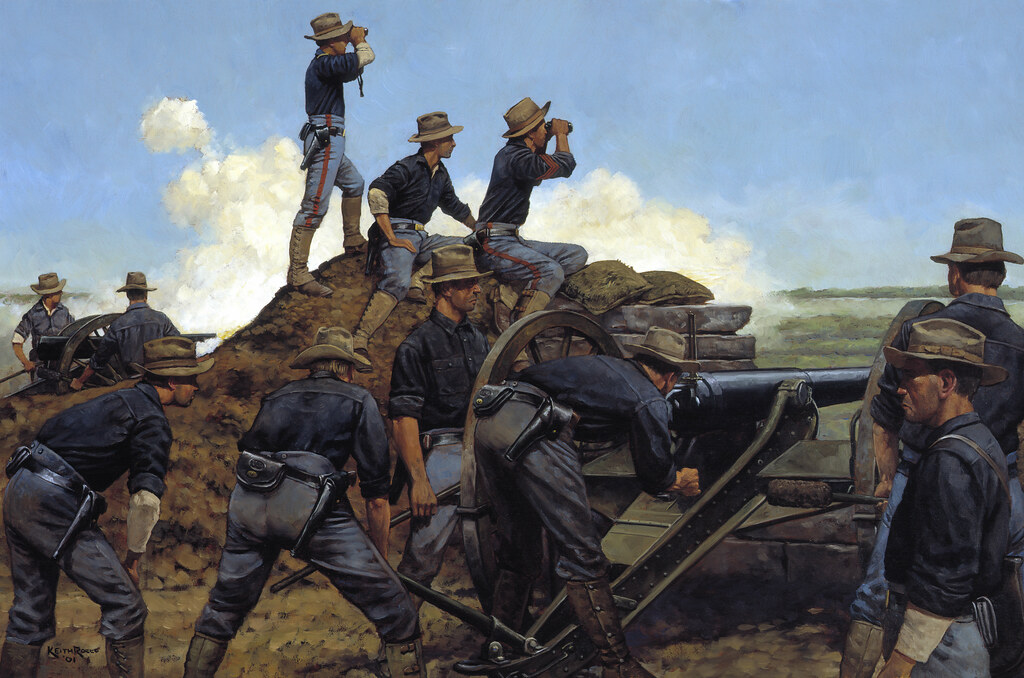
Utah Light Artillery in the Philippines, Spanish-American War

August 13, 2009

The Utah Light Artillery, painting by Keith Rocco -- August 13, 1898, Manila, Philippine Islands August 13, 1898, Manila, Philippine Islands  On April 6, 1898, Congress declared war on Spain and President William McKinley organized United States forces for the Splendid Little War. Of the tens of thousands of regular, volunteer and National Guard (Militia) troops who served, 343 Utah Guardsmen saw service in the Philippine Islands. On May 1st, after the Navys stunning victory at Manila Bay, McKinley authorized an invasion force to capture the Philippine archipelago from Spain. Organized into two batteries, the Utah Light Artillery mustered into federal service on May 9, 1898 at Fort Douglas, Utah. Shortly thereafter, at Camp Merritt near San Francisco, the Utah Artillery became part of Brig. Gen. Francis V. Greenes brigade of the U.S. VIII Corps under the command of Maj. Gen. Wesley Merritt.  Leaving San Francisco, Greenes brigade first raised the U.S. flag in Guam and then arrived on the island of Luzon on July 17, 1898. In the Philippines, 15,000 Americans not only faced 13,000 Spanish soldiers but a second army of some 12,000 Philippine rebels under Emilo Aguinaldo. The rebels had been fighting for national independence from Spain and hoping for American assistance. When Merritt ordered to keep the rebels out of the fight against Spain, the rebels became a second possible enemy.  On August 13th, the Utah Artillery supported Greenes brigade as it attacked towards the old city of Manila. The battle was predetermined to be a limited one in order to preserve Spanish honor and minimize casualties. The rebels, however, made this impossible. As American forces moved quickly against the Spanish defenses, a race to the old city center developed between the Americans and Aguinaldos rebels. The Utah batteries fired and re-deployed several times providing close and accurate support for the infantry attacks.  The Utah Light Artillery continued in federal service for another year and fought in the Philippine Insurrection until returning to Utah in August 1899. Todays 145th Field Artillery, Utah Army National Guard, carries on the history and traditions of the Utah Light Artillery.

Utah Light Artillery in the Spanish-American War – National Guard Heritage Gallery

On April 6, 1898, Congress declared war on Spain and President William McKinley organized United States forces for the “Splendid Little War.” Of the tens of thousands of regular, volunteer and National Guard (Militia) troops who served, 343 Utah Guardsmen saw service in the Philippine Islands. On May 1st, after the Navy’s stunning victory at Manila Bay, McKinley authorized an invasion force to capture the Philippine archipelago from Spain. Organized into two batteries, the Utah “Light” Artillery mustered into federal service on May 9, 1898 at Fort Douglas, Utah. Shortly thereafter, at Camp Merritt near San Francisco, the Utah Artillery became part of Brig. Gen. Francis V. Greene’s brigade of the U.S. VIII Corps under the command of Maj. Gen. Wesley Merritt.

Leaving San Francisco, Greene’s brigade first raised the U.S. flag in Guam and then arrived on the island of Luzon on July 17, 1898. In the Philippines, 15,000 Americans not only faced 13,000 Spanish soldiers but a second army of some 12,000 Philippine rebels under Emilo Aguinaldo. The rebels had been fighting for national independence from Spain and hoping for American assistance. When Merritt ordered to keep the rebels out of the fight against Spain, the rebels became a second possible enemy.

On August 13th, the Utah Artillery supported Greene’s brigade as it attacked towards the “old” city of Manila. The battle was predetermined to be a “limited” one in order to preserve Spanish honor and minimize casualties. The rebels, however, made this impossible. As American forces moved quickly against the Spanish defenses, a race to the old city center developed between the Americans and Aguinaldo’s rebels. The Utah batteries fired and re-deployed several times providing close and accurate support for the infantry attacks.

The Utah Light Artillery continued in federal service for another year and fought in the Philippine Insurrection until returning to Utah in August 1899. Today’s 145th Field Artillery, Utah Army National Guard, carries on the history and traditions of the Utah Light Artillery.

All text from the National Guard Heritage Gallery.


Straight talk: Berenbaum on DDT and malaria

August 12, 2009

Plus, she’ll answer your questions.

But hurry.

One of the world’s great authorities on mosquitoes, May Berenbaum at the University of Illinois Urbana-Champaign, spends this week talking about mosquitoes and malaria, and answering your questions.

Public Radio International runs a feature this week with Dr. Berenbaum answering questions.

(Hey, Beck!  Are you decent this week?)

(Steven Milloy?  Got the guts to ask a real scientist a question?)

You should see these first:

Life Cycle of Malaria, WHO and Campaign to Roll Back Malaria

Life Cycle of Malaria, WHO and Campaign to Roll Back Malaria

You like straight talk – why not share it with others?

Add to FacebookAdd to NewsvineAdd to DiggAdd to Del.icio.usAdd to StumbleuponAdd to RedditAdd to BlinklistAdd to TwitterAdd to TechnoratiAdd to Furl


Bad guys of Baltimore

August 12, 2009

Or, “How a little study of history can make your visit to a city so much more entertaining and fun.”  At Clio Bluestocking Tales.

Why do visitors leave pennies at this gravesite?  Read the story at Clio Bluestocking Tales

Why do visitors leave pennies at this gravesite? Read the story at Clio Bluestocking Tales

For five weeks, I walked around the streets of Baltimore, or at least the distance between a certain major university known for its doctors, the Inner Harbor, and Fells Point — especially Fells Point — with some diversions elsewhere. As I walked, I began to notice landmarks of some very bad guys who have graced the streets of this interesting city.

Fans of “The Wire” will especially want to read it.  Did you catch the reason Clio is in Baltimore, for the full effect?

It’s not that history tells you how to live your life, or save it; it can make your life worth the living and saving.


Global cooling? That would be good news for the forests

August 12, 2009

Climate change denialists (sorry, Mr. Watts – denialism is what it is) frequently argue that since the peak heat year of 1998, the planet has been cooling, and may be in a long-term trend to a much cooler planet.

Has anyone told the beetles?

Has anyone told the pine bark beetles (Dendroctonus ponderosae) that are devastating North American forests?

Colorado conifers affected by pine bark beetles (brown trees are dead) - image from Chad Crawford,  Homebrewed Christianity

Colorado conifers affected by pine bark beetles (brown trees are dead) - image from Chad Crawford, Homebrewed Christianity

I was interested to find this photo and this post at Homebrewed Christianity, by Chad Crawford.

But my trips to the mountains are always simultaneously joyful and mournful. The story I want to tell is about seeing the effects up close of the North American pine beetle outbreak. It’s devastating the Rocky Mountain forests in the U.S. and Canada and growing exponentially each year. The epidemic is occurring because our winters have not been cold enough to stop the beetles from multiplying. Bark beetles are good for the ecosystem, but not in this amount. The fall colors in our evergreen forests are telling us that global warming is no longer something our kids will face; it’s happening now. And it will accelerate if our forests disappear.

Mr. Watts, it’s not me you have to convince.  There are several millions of beetles in Colorado who must be persuaded the climate is not warming — and they’ll be a tough sell, since a colder climate means death to their future generations.

A greater challenge for you, Mr. Watts:  Not one of those beetles reads your blog.  How will you reach them?

Crawford went to Colorado and saw Fr. Thomas Berry.  Maybe we should buy a ticket to Colorado for Watts.


Do not go gently . . . go rockin’!

August 12, 2009

Christopher Street, New York City, August 6, 2009.  Photo by Jeff Simmerman

Christopher Street, New York City, August 6, 2009. Photo by Jeff Simmerman

Does this guy know about Dylan Thomas?  (Go listen to Thomas read his own poem.) Sir Paul McCartney may want to change the lyric to “when I’m 94.”

Photo appeared at And I Am Not Lying.

Tip of the old scrub brush to Mark Frauenfelder, and Dr. Pamela Bumsted.

Help keep rock ‘n roll alive; share:

Add to FacebookAdd to NewsvineAdd to DiggAdd to Del.icio.usAdd to StumbleuponAdd to RedditAdd to BlinklistAdd to TwitterAdd to TechnoratiAdd to Furl


MoveOn.org: Top 5 health care reform lies

August 11, 2009

I get e-mail from all sides — this one reflects a lot of my thinking, and came suitably footnoted:

Dear MoveOn member,

The health care fight has turned ugly, fast. Right-wing mobs are crashing congressional town halls,1 lies are spreading via anonymous email chains,2 and Sarah Palin bizarrely said that President Obama was going to set up a “death panel,” whatever that is.3

Many of these claims are just incredible—but if we don’t fight back with the truth, the right will continue to poison the health care debate. So as part of our Real Voices for Change campaign this August, we’re working to set the record straight.

Check out the list below: “Top Five Health Care Lies—and How to Fight Back.” Can you spread the word by passing this email along to 10 of your friends today?

Also, if you’re on Facebook, please post the list today by clicking here: http://www.moveon.org/r?r=51746. If you’re on Twitter, retweet: @MoveOn Check out the Top 5 Health Care Lies—and How to Fight Back. http://bit.ly/Bncs5

Top Five Health Care Reform Lies—and How to Fight Back

Lie #1: President Obama wants to euthanize your grandma!!!

The truth: These accusations—of “death panels” and forced euthanasia—are, of course, flatly untrue. As an article from the Associated Press puts it: “No ‘death panel’ in health care bill.”4 What’s the real deal? Reform legislation includes a provision, supported by the AARP, to offer senior citizens access to a professional medical counselor who will provide them with information on preparing a living will and other issues facing older Americans.5

Lie #2: Democrats are going to outlaw private insurance and force you into a government plan!!!

The truth: With reform, choices will increase, not decrease. Obama’s reform plans will create a health insurance exchange, a one-stop shopping marketplace for affordable, high-quality insurance options.6 Included in the exchange is the public health insurance option—a nationwide plan with a broad network of providers—that will operate alongside private insurance companies, injecting competition into the market to drive quality up and costs down.7

If you’re happy with your coverage and doctors, you can keep them.8 But the new public plan will expand choices to millions of businesses or individuals who choose to opt into it, including many who simply can’t afford health care now.

Lie #3: President Obama wants to implement Soviet-style rationing!!!

The truth: Health care reform will expand access to high-quality health insurance, and give individuals, families, and businesses more choices for coverage. Right now, big corporations decide whether to give you coverage, what doctors you get to see, and whether a particular procedure or medicine is covered—that is rationed care. And a big part of reform is to stop that.

Health care reform will do away with some of the most nefarious aspects of this rationing: discrimination for pre-existing conditions, insurers that cancel coverage when you get sick, gender discrimination, and lifetime and yearly limits on coverage.9 And outside of that, as noted above, reform will increase insurance options, not force anyone into a rationed situation. 

Lie #4: Obama is secretly plotting to cut senior citizens’ Medicare benefits!!!

The truth: Health care reform planswill not reduce Medicare benefits.10 Reform includes savings from Medicare that are unrelated to patient care—in fact, the savings comes from cutting billions of dollars in overpayments to insurance companies and eliminating waste, fraud, and abuse.11

Lie #5: Obama’s health care plan will bankrupt America!!!

The truth: We need health care reform now in order to preventbankruptcy—to control spiraling costs that affect individuals, families, small businesses, and the American economy.

Right now, we spend more than $2 trillion dollars a year on health care.12 The average family premium is projected to rise to over $22,000 in the next decade13—and each year, nearly a million people face bankruptcy because of medical expenses.14 Reform, with an affordable, high-quality public option that can spur competition, is necessary to bring down skyrocketing costs. Also, President Obama’s reform plans would be fully paid for over 10 years and not add a penny to the deficit.15

We’re closer to real health care reform than we’ve ever been—and the next few weeks will decide whether it happens. We need to make sure the truth about health care reform is spread far and wide to combat right wing lies.

Can you forward this email to your friends today? And remember, also post it on Facebook by clicking here: http://www.moveon.org/r?r=51746. And on Twitter, by retweeting: @MoveOn Check out the Top 5 Health Care Lies—and How to Fight Back. http://bit.ly/Bncs5

Thanks for all you do.

–Nita, Kat, Ilya, Michael and the rest of the team

P.S. Want more? Check out this great new White House “Reality Check” website: http://www.whitehouse.gov/realitycheck/ or this excellent piece from Health Care for America Now on some of the most outrageous lies: http://www.moveon.org/r?r=51729&id=16778-5763840-nJFS5Ux&t=1

Sources:

1. “More ‘Town Halls Gone Wild’: Angry Far Right Protesters Disrupt Events With ‘Incomprehensible’ Yelling,” Think Progress, August 4, 2009.
http://www.moveon.org/r?r=51733&id=16778-5763840-nJFS5Ux&t=2

2. “Fight the smears,” Health Care for America NOW, accessed August 10, 2009.
http://www.moveon.org/r?r=51729&id=16778-5763840-nJFS5Ux&t=3

3. “Palin Paints Picture of ‘Obama Death Panel’ Giving Thumbs Down to Trig,” ABC News, August 7, 2009.
http://www.moveon.org/r?r=51728&id=16778-5763840-nJFS5Ux&t=4

4. “No ‘death panel’ in health care bill,” The Associated Press, August 10, 2009.
http://www.moveon.org/r?r=51747&id=16778-5763840-nJFS5Ux&t=5

5. “Stop Distorting the Truth about End of Life Care,” The Huffington Post, July 24, 2009.
http://www.moveon.org/r?r=51730&id=16778-5763840-nJFS5Ux&t=6

6. “Reality Check FAQs,” WhiteHouse.gov, accessed August 11, 2009.
http://www.whitehouse.gov/realitycheck/faq#i1

7. “Why We Need a Public Health-Care Plan,” The Wall Street Journal, June 24, 2009.
http://www.moveon.org/r?r=51737&id=16778-5763840-nJFS5Ux&t=7

8. “Obama: ‘If You Like Your Doctor, You Can Keep Your Doctor,'” The Wall Street Journal, 15, 2009.
http://www.moveon.org/r?r=51736&id=16778-5763840-nJFS5Ux&t=8

9. “Reality Check FAQs,” WhiteHouse.gov, accessed August 10, 2009.
http://www.whitehouse.gov/realitycheck/faq#r1

10. “Obama: No reduced Medicare benefits in health care reform,” CNN, July 28, 2009.
http://www.moveon.org/r?r=51748&id=16778-5763840-nJFS5Ux&t=9

11. “Reality Check FAQs,” WhiteHouse.gov, accessed August 10, 2009.
http://www.whitehouse.gov/realitycheck/faq#s1

12. “Reality Check FAQs,” WhiteHouse.gov, accessed August 10, 2009.
http://www.whitehouse.gov/realitycheck/faq#c1

13. “Premiums Run Amok,” Center for American Progress, July 24, 2009.
http://www.moveon.org/r?r=51667&id=16778-5763840-nJFS5Ux&t=10

14. “Medical bills prompt more than 60 percent of U.S. bankruptcies,” CNN, June 5, 2009.
http://www.moveon.org/r?r=51735&id=16778-5763840-nJFS5Ux&t=11

15. “Reality Check FAQs,” WhiteHouse.gov, accessed August 10, 2009.
http://www.whitehouse.gov/realitycheck/faq#c1

Sources for the Five Lies:

#1: “A euthanasia mandate,” The Washington Times, July 29, 2009.
http://www.moveon.org/r?r=51732&id=16778-5763840-nJFS5Ux&t=12

#2: “It’s Not An Option,” Investor’s Business Daily, July 15, 2009.
http://www.moveon.org/r?r=51743&id=16778-5763840-nJFS5Ux&t=13

#3: “Rationing Health Care,” The Washington Times, April 21, 2009.
http://www.moveon.org/r?r=51742&id=16778-5763840-nJFS5Ux&t=14

#4: “60 Plus Ad Is Chock Full Of Misinformation,” Media Matters for America, August 8, 2009.
http://www.moveon.org/r?r=51734&id=16778-5763840-nJFS5Ux&t=15

#5: “Obama’s ‘Public’ Health Plan Will Bankrupt the Nation,” The National Review, May 13, 2009.
http://www.moveon.org/r?r=51744&id=16778-5763840-nJFS5Ux&t=16

Want to support our work? We’re entirely funded by our 5 million members—no corporate contributions, no big checks from CEOs. And our tiny staff ensures that small contributions go a long way. Chip in here.

Agree with MoveOn?  Disagree?  Please share:

Add to FacebookAdd to NewsvineAdd to DiggAdd to Del.icio.usAdd to StumbleuponAdd to RedditAdd to BlinklistAdd to TwitterAdd to TechnoratiAdd to Furl