BP Republicans

July 12, 2010

Heh.  The facts are leaking out, so to speak:  BP Republicans.


Quote of the moment: David Brooks, books vs. internet

July 12, 2010

Wisdom comes in keen insights:

These different cultures foster different types of learning. The great essayist Joseph Epstein once distinguished between being well informed, being hip and being cultivated. The Internet helps you become well informed — knowledgeable about current events, the latest controversies and important trends. The Internet also helps you become hip — to learn about what’s going on, as Epstein writes, “in those lively waters outside the boring mainstream.”

But the literary world is still better at helping you become cultivated, mastering significant things of lasting import. To learn these sorts of things, you have to defer to greater minds than your own. You have to take the time to immerse yourself in a great writer’s world. You have to respect the authority of the teacher.

Right now, the literary world is better at encouraging this kind of identity. The Internet culture may produce better conversationalists, but the literary culture still produces better students.

It’s better at distinguishing the important from the unimportant, and making the important more prestigious.

David Brooks, “The Medium is the Medium,” New York Times, July 9, 2010, page A23


I get e-mail: Media Matters calls bluffs of climate change “skeptics”

July 10, 2010

Media Matters may be a site worth tracking more closely, not only on climate issues:

Media Matters: The greatest science “scandal” “in the history of man” predictably falls apart

In their never-ending quest to prove that they understand the intricacies of climate science better than actual climate scientists, conservative media figures routinely promote any ridiculous “evidence” they think undermines the scientific consensus about climate change.

This is a group that repeatedly points to snowstorms in February as proof that global warming is not real; claims that CO2 can’t be a pollutant because “we breathe” it; and ignores actual temperature data to baselessly claim that the Earth is really “cooling.”

Last year, conservative climate change skeptics, in the words of Wall Street Journal’s Kimberly Strassel, thought they had found a “gold mine.” Conservative media figures seized on emails stolen from climate scientists and proceeded to completely distort their contents. As we pointed out repeatedly at the time, this “scandal” relied on outrageous misrepresentations of the stolen emails and did not in any way undermine the scientific consensus about climate change.

Nevertheless, conservative media figures incessantly hyped the non-scandal with their usual overblown rhetoric:

  • Glenn Beck — who says he is not a conspiracy theorist, remember — suggested in the wake of “Climategate” that climate change is a “scam.” He also said that if the United Nations’ Intergovernmental Panel on Climate Change report “had been done by Japanese scientists, there is not enough knives on planet Earth for hara-kiri.”
  • Noted climatologist Rush Limbaugh, who frequently decries the supposed global warming “hoax,” proposed that all of the scientists involved in “Climategate” should be “named and fired, drawn and quartered, or whatever it is.”
  • Andrew Breitbart called for “capital punishment” for NASA scientist James Hansen, because “Climategate” was supposedly “high treason.”
  • The Washington Times, Michelle Malkin, Ann Coulter, Investor’s Business Daily, The American Spectator’s Robert Stacy McCain, Rich Lowry, Newsmax’s James Hirsen, and Michael Ledeen all joined forces to smear the scientific consensus on climate change as a “cult.”
  • Fox News’ Mike Huckabee explained that “Jesus would be a truthseeker” while discussing the “revelation” that scientists had “cooked” climate change data.

The crew at Fox & Friends spent this year’s Earth Day promoting an important cause. No, not encouraging environmental consciousness — they devoted the show to pushing “Climategate” falsehoods in order to falsely claim that “scientists held back data that discredits theories on global warming.” They were joined by Brent Bozell of the Media Research Center, who was there to complain about non-Fox networks “dismiss[ing]” and “ignor[ing]” the story.

Last December, Bozell told Lou Dobbs that “Climategate” is the “biggest scandal in terms of science, finance, and politics … in the history of man.” After Bozell compared the climate science “cover-up” to “the craziness” of Dan Brown’s fiction, he actually managed to draw laughter from Dobbs. Unfortunately, contrary to Bozell’s suggestion that media outlets ignored the story, numerous non-Fox “Climategate” stories adopted conservatives’ dishonest framing of the non-story.

And now for the inevitable conclusion of this manufactured controversy.

As reported by The New York Times’ Andrew Revkin — who, by the way, Rush Limbaugh thinks should “just go kill” himself — the Independent Climate Change Email Review “cleared climate scientists and administrators” involved in “Climategate” of “malfeasance.” This follows several other exonerations of the scientists involved in the phony scandal. In response, Media Matters, joined by numerous progressive and clean energy groups, called on all outlets that reported on the original “Climategate” controversy to set the record straight.

So this leaves us where we were before the “Climategate” freakout: There is still overwhelming scientific evidence supporting the theory of global warming.

And once again conservative media proved that they don’t hesitate to rely on blatant distortions, outright falsehoods, and a complete disregard for reality to advance their political causes.

Mainstream media outlets would be doing everyone a service if they remembered that the next time they decide to report on whatever Rush Limbaugh, Glenn Beck, Fox News, and the perpetual conservative outrage machine are yelling about.

Conservatives’ phony scandal of the week: The Obama Justice Department and the New Black Panther Party

While we’re on the subject of manufactured scandals that respectable media outlets shouldn’t take seriously, Fox News and its friends in the conservative echo chamber spent much of the week promoting phony, trumped-up allegations against the Justice Department.

In short, conservative media outlets have been aggressively promoting the charge by GOP activist J. Christian Adams that President Obama’s Justice Department engaged in racially charged “corruption” when it partially dismissed a case against members of the New Black Panther Party for allegedly engaging in voter intimidation outside of a Philadelphia polling center on Election Day in 2008.

As we have documented extensively, Adams should not be trusted. He is a long-time right-wing activist with extensive ties to the Bush-era politicization of the Justice Department. Adams himself has admitted that he lacks first-hand knowledge to support his accusations. Additionally, Adams’ charge that the DOJ’s action in the New Black Panther case shows unprecedented, racially motivated corruption is undermined by the fact that the Obama DOJ obtained judgment against one of the defendants, and that the Bush DOJ declined to pursue similar allegations against a group of Minutemen — one of whom was carrying a gun — in 2006.

Even the Republican vice chairwoman of the U.S. Commission on Civil Rights called the New Black Panthers case “very small potatoes” and said an investigation into the DOJ’s decision is full of “overheated rhetoric filled with insinuations and unsubstantiated charges.”

And yet again, the fact that this is a completely manufactured scandal didn’t stop conservative media figures from engaging in one of their time-honored traditions: attempting to obscure their own problems with race by accusing others of racism.

Radio host Jim Quinn — who once told “race-baiting” African-American “ingrates” to “get on your knees” and “kiss the American dirt” because slavery brought them to the U.S. — hyped the New Black Panther story by calling the civil rights community “race-baiting poverty pimps.”

Rush Limbaugh — who earlier this week announced that if Obama wasn’t black he’d be a “tour guide in Honolulu” and claimed Obama is using the office of the presidency to seek “payback” for the country’s history of racism — forwarded Adams’ charge that the case was dropped because of racially charged corruption.

Beck, who infamously called President Obama a “racist” with a “deep seated hatred for white people or the white culture,” declared that the Obama administration is “full” of “people that will excuse” the “hatred” of the New Black Panthers. He also relied on falsehoods to try to connect Obama to the New Black Panthers, and claimed today that the New Black Panthers are part of Obama’s “army of thugs.”

Of course, the New Black Panthers are a fringe hate group, and only a cynical race-baiter like Glenn Beck would claim they are somehow part of Barack Obama’s imaginary “army of thugs.”

But I’m sure they appreciate all of the publicity, courtesy of Glenn Beck and Fox News.

Bek Younuhvercity

This week also marked the launch of Beck’s latest attempt to grab money from “educate” his audience: Beck University.

As Beck described it, the online Beck University is an “academic program” that would be a “unique experience bringing together experts in the fields of religion, American history, and economics.” At the outset of the first “course” — Faith 101, with frequent Beck guest/promoter of historical misinformation David Barton — Beck announced that viewers “will learn more in the next hour than you’ve probably learned in your entire life about American history.”

Laughable hyperbole aside, as we pointed out this week, Glenn Beck is uniquely unqualified to found a university, considering he regularly traffics in bizarre conspiracy theories, distortions, and downright falsehoods on a wide variety of subjects.

The day after the first “course” at Beck University, Beck stood in front of his blackboard and labeled various historical figures “heros” or “villians.”

And lastly, by my count, between his TV show last night and his radio program today, Beck launched no fewer than four baseless charges that, by his standards, should get him fired.

This weekly wrap-up was compiled by Media Matters’ Ben Dimiero.

Whom the gods destroy, they first make mad, Euripides said (paraphrased).  With that ancient wisdom in hand, one might be well advised not to stand next to Glenn Beck or Fox News.

If Glenn Beck wishes to know the evils of Woodrow Wilson or Theodore Roosevelt, I can point him to sources.  In spite of those evils, however, they remain heroes of American history for the good things they did.  Beck criticizes them for those good things, however, and not for their failures (including Wilson’s patent racism, and Roosevelt’s failure to push for integration at opportune times — to Beck, those would be virtues, I fear).

Visit Media Matters here, sign up for Media Matters’ e-mail newsletter here.


Republican advice to incest/rape victims: ‘Make lemonade’

July 9, 2010

You couldn’t make this stuff up if you tried.  I get e-mail from Democrats who think incest and rape victims should be protected:

Angle’s Lemons

Nevada Republican Sharron Angle might want to steer clear of radio talk shows.

Angle – who wants abortion banned under all circumstances – suggested that a 13-year-old girl who was raped by her father should just turn “a lemon situation into lemonade.” This is the same woman who suggested that getting pregnant after a rape just might be “God’s plan.”

This kind of utter disdain for the impact of rape on women’s lives simply can’t be tolerated – especially in the United States Senate.

Join us in telling Sharron Angle that her views are insensitive and out of touch.


Chess games of the rich and famous: Duchamp vs. Man Ray

July 9, 2010

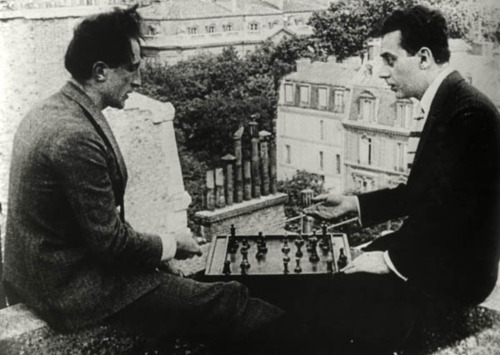
Marcel Duchamp and Man Ray play chess on a rooftop in Paris.

Duchamp again, this time on a rooftop in Paris, playing chess against Man Ray.

The photograph is later than 1915, when Duchamp moved to the U.S. to avoid World War I, and met Ray; it is probably after 1918.

The two even played chess in a movie:

Man Ray directed a number of influential avant-garde short films, known as Cinéma Pur, such as Le Retour à la Raison (2 mins, 1923); Emak-Bakia (16 mins, 1926); L’Étoile de Mer (15 mins, 1928); and Les Mystères du Château de Dé (20 mins, 1929). Man Ray also assisted Marcel Duchamp with his film Anemic Cinema (1926) and Fernand Léger with his film Ballet Mécanique (1924). Man Ray also appeared in René Clair‘s film Entr’acte (1924), in a brief scene playing chess with Duchamp.

The photo above is a still from that 1924 René Clair movie — it comes about 4:30 into the movie (the version shown here is half of the 20-minute movie, with a very modern, surrealist music score added; you can see the entire movie from Pathé, with a more contemporary score, here).

https://vimeo.com/488844088

Update, March 14, 2011:  See also this story from 2008 about Duchamp’s need to play chess, featuring of photo of Duchamp, Teeny Duchamp and the composer John Cage deeply engrossed in a game.  A good read about chess, and Duchamp.

Tip of the old scrub brush to ArtLex.com.


Dan Valentine – The Pink Cigarette Lighter, Part 1

July 9, 2010

By Dan Valentine

THE PINK CIGARETTE LIGHTER – Part One

My bestest friend, she loves the color pink. I’ve known her to order a Pink Lady merely for its soothing and appealing color. One year, for Halloween (or some other special occasion–I forget), she paid hard-earned cash for an expensive carbon-copy of the famous pink strapless gown that Marilyn Monroe wore in Gentlemen Prefer Blondes when singing Diamonds Are a Girl’s Best Friend.

When we bought a home together in southeast Texas, one of the first things we did was have the interior walls sponge-painted. One hot-pink wall for her, one sea-green wall for me, one hot-pink wall for her, one sunshine-yellow wall for me. Very nice, very stylish, very Mexican. Who’d a thought!

Pink cigarette lighter

Pink cigarette lighter, by Bic

Yes, indeedy, she sure loves the color pink! Which is all very fine and well and good. But one late night, many years ago, her color preference came close to costing me my life.

Upon lighting a cigarette on a street corner in Washington, D.C., with a pink lighter that I had absentmindedly lifted from her earlier in the evening, I was gay-bashed and left for dead. I’m lucky to be alive. But ain’t we all?

A recent conversation or three here at the Ensenada Backpacker Hostel brought that memorable night back.

But, first, let me begin by saying, I love a hostel! Extremely affordable and you meet the most interesting folks from all around the world. If I’d been aware of hostels in my youth and middle-age, I’d still be rich. Money-wise. I’ve spent many a dollar, franc, and pound staying in hotel rooms. Oh, the interesting people I could have met!

At the Austin Hostel, I met a young man who makes a living as a Lab Rat. Austin boasts many a medical research center and drug companies pay big bucks to those willing to act as guinea pigs, having themselves inoculated with some new experimental cure-all. Some are paid as much as $3,000 a swallow. And, odds-wise, it’s not a bad way to pay-off one’s credit-card debt. You’ve got a fifty-fifty chance of receiving a placebo.

On my first or second day in Ensenada, I met a semi-retired South Korean war correspondent. He was in Somalia during the Blackhawk-Down fiasco. He saved a naked woman’s life.

He was atop a building, camera rolling, a South Korean competitor–a female–by his side, both doing their jobs, reporting the events at hand, when a naked woman down below on the street appeared, running for her life, chased by dozens of young boys, throwing stones at her. He quickly hurried down the stairs, but all had disappeared. Shortly after, the woman reappeared. He covered her with his coat and escorted her to the roof, just before the young boys returned, searching high and low for her.

The woman had been seen riding in a Jeep beside a male French soldier, representing the United Nations. In that neck of the woods, a major no-no at the time, may still be. Shortly afterward, his South Korean female competitor was recalled and replaced by a male. The young boys? Some undoubtedly grew up to be pirates, commandeering a yacht or whatnot off the Somalian coast for ransom.

He was in Afghanistan when the U.S. first did whatever we did there after 9/11, and told me what he thought we (the U.S.) always tend to do wrong after succeeding on such occasions. We replace the defunct leaders with those raised and educated in Britain or in the U.S., those English-speaking, who have long ago lost touch with their own people and their needs. Few could argue with that.

He left the hostel to travel north. He was seriously thinking of crossing the border with illegals. Once a reporter, always a reporter.

He and I would never have met but for a hostel. He covered the UN for his country while I was in New York, but we ran in different circles, back then. I just hope he didn’t get shot by some crazy American with a gun in Arizona.

Another hostel guest I met here is a retired Bronx fireman. In the ’90s, he and others were called upon to extinguish fire after fire. Neighborhood gangs were setting apartment buildings ablaze, one after another, day in and day out, so as to quickly empty the premises, so they could burgle and run off with whatever valuables were left in sight before the fire trucks arrived.

He had many a story to tell. One afternoon, he was stopped in midtown Manhattan by a cop for walking his dog unleashed. My Bronx friend said he was a fireman. Cops and firemen, they’re a fraternity. They look after each other. The cop asked for picture-ID. At the time, firemen didn’t carry ID’s with pics. So, to make sure he was, indeed, a fireman, the cop drove the offender to his reputed fire station in the Bronx. They walked in, the fireman with the dog explained to his colleagues the circumstances, and they informed the cop, “We’ve seen him around the neighborhood, but God knows what he does.”

Funny. Every morning he cooked breakfast for them, that’s what he did, among other things, like fighting fires. He told his fellow firefighters that if they wanted fresh coffee in the morning–and that went for all the cops in the Bronx who were known to often drop by–they would vouch for him. They finally did.

Sometime afterward, he severely sliced a tendon on a little finger, opening up a can of ham while fixing breakfast. To this day, he can’t wiggle or move it. He went before a medical board of three and they told him that if he had the little pinkie amputated he could go back to work. Decisions, decisions. Firemen in New York are unionized and the union has clout. He’s been retired ever since.

A young man from the mainland of Mexico–I forget exactly where now–stayed for a couple of weeks here recently. What a nice person! The nicest fellow you’d ever want to meet. Always a smile on his face, when he wasn’t laughing. He was in town substituting for a teacher on summer break at a school down the avenida a ways.

Upon checking in at the desk, he introduced himself with a big jovial smile. An hour or so later, I ran into him coming out of an Oxxo (the south-of-the-border Seven-Eleven) with an even bigger smile on his face and a bottle of wine in hand. I watched him join a woman who was behind the wheel of an SUV. A ladies’ man, I thought. Two hours in town and he was with a beautiful senorita. During his short visit, I saw him with many a pretty woman, never a fella.

Each night he would mix and fill to the brim a stainless steel pot of Margaritas and place it in the freezer to chill. “Help yourself!” And I did.

Many a morning in the kitchen, he would say, “Tonight. Margaritas. Yes?”

Si, deed!

I could have sworn he said he was going to stay the summer, but something must have come up. After just a week or two he said he was returning home.

His last night he invited one and all here to a barbecue on the back veranda. Spicy Habernero chicken wings, grilled steaks, and oh yes! Margaritas.

Shortly after he left, Salsador, who works the afternoon/night reception desk, nonchalantly informed me that the substitute teacher was not only jovial but gay. You’re kidding, I said. “What makes you think he was gay?”

“It was obvious,” he said.

Not to me. But what do I know? “How so?”

“My girlfriends and I, we take him for drinks. He told them how to give a man a good–”

Sorry I asked.

“Next day they meet for coffee-time and more instruction, how to give a man a good–”

Please! I get the gist.

Who’d have thought! But, then again, so, so what? Who cares?

A great many, very scary people do.

Like the father of Melody I wrote about a few weeks ago–the brigadier general who thought I must be gay because I’ve never learned to drive. Heterosexuals drive!

Or, the kids in the car in Houston who saw me walking along the street and swerved over to scream out a rolled-down window, “Faggot!” and screeched down the road, tee-hee-ing to themselves. Heterosexuals drive!

A good number of citizens of the U.S. are scared to death of gays. I say citizens of the U.S., and not Americans, because down here folks south the border consider themselves Americans, too. And rightly so. Though, they are a little more laid-back and not as uptight as many of their north-of-the-border fellow Americans.

Folks in the U.S. are frightened of many things: Illegals (unless they’re blowing leaves off front lawns at a cut-rate price), fellow students (Texas is seriously contemplating passing a law to allow students to bring guns to the classroom to protect themselves from fellow students), Federal troops (many want to start independent militias to protect themselves in case of invasion from ourselves).

But gays are especially frightening to many. Their inclination may rub off.

Pink cigarette lighter, by Zippo

Pink cigarette lighter, by Zippo

When I was a kid in the ’50s, one of my favorite TV shows was the Cisco Kid, the Robin Hood of the West, based on an O. Henry short story about a carefree Mexican desperado. Before it was a TV show, it was a B movie series. One, starring Cesear Romero, was The Gay Caballero (1940.)

From the press book: “The Cisco Kid rides again quicker on the draw, more gay, and gallant than ever.” It ever-so-often runs on the Fox Movie Channel. In 1946, a remake was called The Gay Cavalier.

Warner Baxter won the 1929 Best Actor award for his portrayal of the Cisco Kid in the first talkie shot outdoors, called “In Old Arizona”–though, it filmed in Utah.

I mention this because gay caballero perfectly describes–to my chagrin; I hadn’t a clue–the hostel guest I knew briefly. Mexican, charming, happy-go-lucky, and gay.

No, gay-gay! He’s banned from the place now. That’s why he left earlier than expected. He tried to sneak a male lover into his dorm for the night. Not merely once but twice. I hadn’t a clue. My bestest friend thinks my middle name should be Clueless.

Business is slow here at the hostel of late (many up north think they’ll be mowed down by members of the drug cartel if they visit), so I have a dorm room all to myself with connecting bathroom. He had a dorm room to himself as well next to mine but without a bathroom, So, I would leave my door open at night, just a smidge. I’m a light sleeper. Even though I like to think of myself as a let-live-let-live guy, two male lovers going at it within groaning-and-gasping distance would have been very perturbing, to say the least.

I told the lovely morning/mid-afternoon receptionist here, the above tale.

She looked at me, bewildered. “You couldn’t tell?”

I shook my head. Hadn’t a clue.

First tri-mester, we’re all the same sex. Or, so I read once. At birth, ten percent are born different, as some like to describe it. Some say three or four percent. Others will tell you two. Many think it’s a life-style choice, being gay being so much fun.

I didn’t tell her that I had been gay-bashed in Washington, D.C., a few years back. Though, it’s the first thing that comes to mind whenever the subject arises. Two gay men found me passed-out on the sidewalk, badly bruised and bleeding.

“I think I’ll Google my mind and write a piece about all the gay people I’ve come in contact with throughout my life,” I told her.

She raised her hand. “You can add me to the list.”

I hadn’t a clue. She’s engaged to be married to a guy.

I love a hostel!

If you’re a writer, it’s like you’ve died and gone to heaven.

TO BE CONTINUED


Power Line, on NASA and Islam: When you start believing your own fictions, you’re in trouble

July 8, 2010

Astronaut Charles Bolden, veteran of four space missions. President Barack Obama appointed Bolden to be NASA Administrator. NASA image.

Astronaut Charles Bolden, veteran of four space missions. President Barack Obama appointed Bolden to be NASA Administrator. NASA image.

Let go of the power line, step back, and no one else will get hurt.

Paul Mirengoff at the much-read, and as we shall see, too-much-trusted PowerLine, asks a heckuva a question:

As Scott points out in the post immediately below, the news that President Obama tasked NASA head Bolden, as perhaps his foremost mission, with raising Muslim self-esteem is entirely absent from the New York Times and the Washington Post, as well as the nightly newscasts of ABC, NBC, and CBS. Why?

It might be, as Mirengoff goes on to speculate wildly and without reason, because the news agencies are taking payoffs from Obama, or just so enthralled with him that they can’t bring themselves to report bad news.

Think about that for a moment:  News agencies unwilling to report bad news?  Is your Hemingway Sh__ Detector working yet?  Mine’s clanging something fierce.

Does Mirengoff seriously think the Poobahs at Disney sit around issuing orders that ABC news gatherers ignore bad news about Obama?  Has Mirengoff been in some sort of plastic bubble, deprived of newspapers and television for the past four years?

Why the silent treatment?  Because it’s very much a not-much-news story, Paul.  It doesn’t say what you think it says, or worse, what you know it doesn’t say, but claim it does for whatever trouble you can stir up.

Charles Bolden, NASA’s administrator, explained for a news channel that broadcasts to the Middle East, what his job is with regard to the Arabic and Islamic populations (this is the version reported by York):

“When I became the NASA administrator, [Obama] charged me with three things,” NASA head Charles Bolden said in a recent interview with the Middle Eastern news network al-Jazeera. “One, he wanted me to help re-inspire children to want to get into science and math; he wanted me to expand our international relationships; and third, and perhaps foremost, he wanted me to find a way to reach out to the Muslim world and engage much more with dominantly Muslim nations to help them feel good about their historic contribution to science, math, and engineering.”

Good reporters would look at the interview, and realize the PowerLine guys got the story dead wrong.  Not bothering to speculate on why part-time yahoos misreported the story, they’d go on to real news.

Note carefully what Bolden said, and then note carefully what he did not say.  Bolden didn’t say the mission of NASA had changed.  Bolden didn’t say Obama told him to ignore the mission of NASA.  Bolden said NASA, arguably our nation’s most famous and vanguard science agency, has a top duty to inspire children to do well in science in math, to cooperate with other nations in exploring space as we have done since at least the Reagan administration, and, for audiences in Arabic nations, to help them understand Arabic contributions to science.

“Let go of the power line, step back, and no one else will get hurt.” Downed powerline in New Jersey, in summer 2011. Photo by Saed Hindash, The Star-Ledger

Bolden did not say, as Hot Air misreported, “NASA’s spaced-out mission no longer includes  . . . space.”  Hot Air isn’t reporting.  This is a time-tested propaganda technique they engage in:  MSU, “making [stuff] up.”

Which of those goals does Power Line disagree with?  Each of them is a noble enterprise on its own.

But, pausing for just a moment to make liars out of Power Line and the Examiner, and others, ABC News got it right. How soon do you think Mirengoff or Scott Johnson at Power Line will update their story to note ABC reported it?  How much longer before others do?

Media Matters, who tend to be more careful and much, much more accurate, tells most of the story in the headline of their story:  “Yet again, an Obama official says ‘Muslim,’ right-wing media freakout follows.”

If ABC can get it right, why not these other guys?

Yellow journalism was bad enough the first time around.  PowerLine, could you at least take the time to get the story right?  If you don’t have a Hemingway to help you out, you can always use the old Cheech and Chong Excrement Detection Method.  I don’t recommend it, but it tends to make reporters more careful if they ever use it once.

You gotta wonder why these people spread easily-falsified, malignant rumors.  Who are they working for?  It’s pretty clear they don’t have much respect for their readers.

This is a hoax, people.  NASA has not changed its mission.  The president cannot change NASA’s mission since that is dictated by law (it requires an “act of Congress,” literally).  NASA’s chief did not say that stupid thing others claim — he’s not stupid. Don’t pretend it’s news, don’t pretend it’s a problem when the head of NASA says he’s trying to promote interest in science, math and history, and international cooperation.  That’s his job.

No one was assigned the job to get the story wrong.  I wish people would quit working so hard at it.

What is Obama’s policy on NASA?  Here’s the 2011 Budget Message.

Here’s the full Al Jazeera interview these guys misreported:

Here’s the Wall of Shame of blogs, reporters and news outlets who screwed up the reporting, in addition to Powerline, twice.

Also see this:  Obama:  A bold new course for NASA

Save

Save


July 8, 1853: Perry anchors U.S. ships in Edo Bay, the beginning of American Imperialism

July 8, 2010

History item:  On July 8,1853 four black ships led by USS Powhatan and commanded by Commodore Matthew Perry, anchored at Edo (Tokyo) Bay. Never before had the Japanese seen ships steaming with smoke. They thought the ships were “giant dragons puffing smoke.” They did not know that steamboats existed and were shocked by the number and size of the guns on board the ships.

President Millard Fillmore, defying H. L. Mencken’s later, crabby, hoax claim of do-little-government, sent Matthew C. Perry to Japan to open Japan as a refuge for shipwrecked sailors, and as a coaling stop for steamships.  For the previous 200 years, Japan had been closed to all but a few Dutch and Chinese traders.   On July 8, 1853, Perry’s small fleet sailed boldly into restricted waters of Japan and anchored.

Delivering the American presents to the Emperor of Japan, at Yokohama.  Nimitz Museum, Annapolis

Delivering the American presents to the Emperor of Japan, at Yokohama. A. O. P. Nicholson image, 1856 publication, “Narrative of the Expedition of an American Squadron to the China Seas and Japan” – artist not identified (Washington, A. O. P. Nicholson, 1856); Nimitz Museum, Annapolis. A list of the presents can be seen at a link near the end of this post; some of the gifts, such as the model of the steam engine, can be identified in this picture.

Perry told the Emperor he would return the following year for an answer.  Perry returned on March 8, 1854, and within a month concluded the Convention of Kanagawa, opening Japan to trade from the west.  Generally unheralded, this may have been one of the more important pieces of U.S. diplomacy in history, especially considering the dramatic rise of Japan as an economic and military power, on the basis of the trade Commodore Perry demanded Japan engage in.

More:

Japanese woodblock print showing one of Perry's ships - Nagasaki Prefecture, via MIT

Japanese woodblock print showing one of Perry’s ships – Nagasaki Prefecture, via MIT

Documents below the fold

Read the rest of this entry »


The scientist’s work desk

July 8, 2010

This should be close to the top of “Best Places to Work.”

Condor flight pen observation booth - Amanda Holland photo, all rights reserved

Condor flight pen observation booth – Amanda Holland photo, all rights reserved

From my desk at the Senate Democratic Policy Committee I could look up to a crystal chandelier 10 feet across.  Out the west window was a view over the National Museum of Art, down the mall to the Washington Monument and Lincoln Memorial.  25 yards away, over specially-ordered Italian tile, was the gallery to the World’s Greatest Deliberative Body.  From my desk at the Senate Labor Committee I looked out on that grand Calder sculpture in the Hart Senate Office Building atrium.  A couple of my memorable offices.

The work spaces I miss?  That water tank in Shiprock, New Mexico, with the million-dollar view of the Shiprock; that trailer laboratory we parked in Huntington Canyon, Utah.   That old dock on the Sawkill in the Hudson Valley of New York, by the old snag where the pileated woodpeckers nested and raised their brood.

Cousin-in-law Amanda Holland took this photo of her work station, above.  This is a place where real science gets done.  Amanda wrote:

I get to sit here for hours at a time, recording condor behavior. It does not get old. These birds are AMAZING. You can see a couple condors perched on a snag in the back of the flight pen.

Real work, for real good.  That’s always the best place to work.


Stolen e-mails report: Scientists in the clear, science solid

July 7, 2010

So far it’s a shut out against the “skeptics” of global warming.*

From Science Insider (the AAAS breaking news blog):

The fifth and, so far, most thorough major investigation into the published mails from the University of East Angia’s Climatic Research Unit (CRU) has given the CRU a relatively clean bill of health. (See the full report.) The independent inquiry into so-called “Climategate”, instigated by UEA and headed by former civil servant Muir Russell, examined the conduct of the CRU scientists following allegations sparked by the so-called “Climategate” e-mails. It looked at selective use of data, subverting of peer review, and failure to respond fully to requests under the Freedom of Information Act (FOIA).

The report was unequivocal in its backing of the scientists in terms of research integrity, though it did criticize their openness. “Their rigour and honesty as scientists are not in doubt,” it said. In response to the assertion that CRU had withheld data, the report found that it was mostly not theirs to withhold but was easily accessible in public databases. One of the report’s authors, physicist Peter Clarke of the University of Edinburgh in the United Kingdom, told a press briefing today that they were able to download the relevant data “in a few minutes” and then process it in the same way as CRU had done, producing similar final results. “It took a couple of days of code writing,” he said. The authors found no evidence of bias by CRU in its selection of data. Allegations of misuse of tree ring data were also put aside.

Some of the 1000 e-mails that appeared on the Internet suggested that CRU Director Phil Jones had tried to influence peer review of papers he disagreed with and prevented them from being cited by reviews of the Intergovernmental Panel on Climate Change (IPCC).

On the subject of peer review, Russell said that expressing “robust opinions [about papers] was typical during peer review.” And after consulting with editors of the IPCC report, the panel concluded that the CRU scientists were “parts of teams and not individuals responsible for the wording of the reports,” Russell says.

Where the CRU scientists did fall down was in their openness to requests for data. “There was a consistent pattern of failing to display the proper degree of openness,” Russell says. And the report criticizes UEA for failing to recognize its statutory requirements under the FOIA and also the risk to the reputation of the university and to the credibility of U.K. climate science. Panel member James Norton said that “now more than ever scientists need to be open. Scientists don’t own their own data and at most have a temporary lease.”

More:

_____________

*  They’ve complained about being called denialists — maybe we should start calling them “gullibles,” especially since they seized on the thin reed of these stolen e-mails to claim that the victimized scientists were the ones who had done something wrong, since they fell for the fourth-grade science project hoax, and since they fell for the Spanish bomb-in-the-mail hoax.


Chess games of the rich and famous: House Speaker Joe Cannon vs. Congress

July 7, 2010

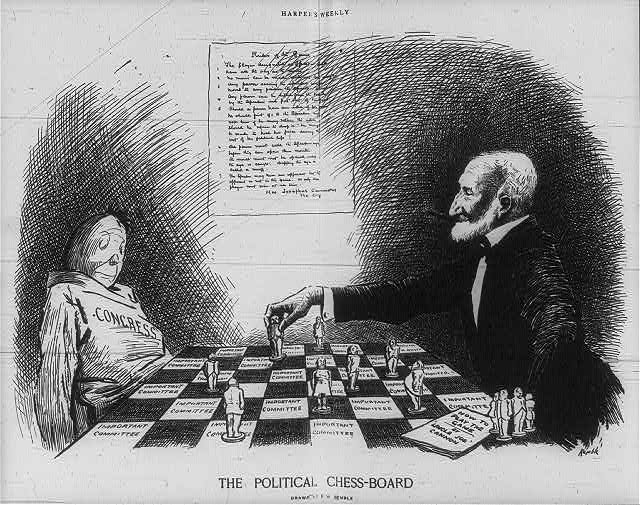
Cartoon - Cannon, Joe, The Poltiical Chessboard, Harpers 2-05-1910 - 3b23316r

The Poltiical Chessboard, Harper's Magazine, February 5, 1910, by E. W. Kemble - Library of Congress image

Description from the Library of Congress:

Joseph Cannon playing chess with straw man labelled “Congress,” using toy men on chessboard with squares labelled “important committee” and “freak committee.”

Legendary House Speaker Joe Cannon — after whom the Cannon House Office Building is named — is remembered for the almost absolute power he held over the House of Representatives.  Here’s the generic description at Wikipedia:

House Speaker Joseph G. Cannon - Wikimedia image, photo from October 1915

House Speaker Joseph G. Cannon - Wikimedia image, photo from October 1915

Cannon wielded the office of Speaker with unprecedented power. At the time of Cannon’s election the Speaker of the House concurrently held the chair of the Rules Committee, which determined under what rules and restrictions bills could be debated, amended, and voted on, and in some cases whether they would be allowed on the floor at all. As such, Cannon effectively controlled every aspect of the House’s agenda: Bills reached the floor of the house only if Cannon approved of it, and then in whatever form he determined—with he himself deciding whether and to what extent the measures could be debated and amended.

Cannon also reserved to himself the right to appoint not only the chairs of the various House committees, but also all of committees’ members, and (despite the seniority system that had begun to develop) used that power to appoint his allies and proteges to leadership positions while punishing those who opposed his legislation. Crucially, Cannon exercised these powers to maintain discipline within the ranks of his own party: the Republicans were divided into the conservative “Old Guard,” led by Cannon, and the progressives, led by President Theodore Roosevelt. His committee assignment privileges ensured that the party’s Progressive element was essentially powerless in the House, and his control over the legislative process obstructed progressive legislation.

Progressives wished to break Cannon’s ability to control so completely the flow of legislation.  By early 1910, progressives in the Republican Party especially chafed under Cannon’s rule.  Anxious for revolt, they struck on March 17, just a few weeks after this cartoon appeared.

On March 17, 1910, after two failed attempts to curb Cannon’s absolute power in the House, Nebraska Representative George Norris [of Nebraska] led a coalition of 42 progressive Republicans and the entire delegation of 149 Democrats in a revolt. With many of Cannon’s most powerful allies absent from the Chamber, but enough Members on hand for a quorum, Norris introduced a resolution that would remove the Speaker from the Rules Committee and strip him of his power to assign committees.

While his lieutenants and the House sergeant-at-arms left the chamber to collect absent members in attempt to rally enough votes for Cannon, the Speaker’s allies initiated a filibuster in the form of a point of order debate. When Cannon supporters proved difficult to find (many of the staunchest were Irish and spent the day at various St. Patrick’s Day celebrations), the filibuster continued for 26 hours, with Cannon’s present friends making repeated motions for recess and adjournment. When Cannon finally ruled the resolution out of order at noon on March 19, Norris appealed the resolution to the full House, which voted to overrule Cannon, and then to adopt the Norris resolution.

Cannon managed to save some face by promptly requesting a vote to remove him as Speaker, which he won handily since the Republican majority would not risk a Democratic speaker replacing him. However, his iron rule of the House was broken, and Cannon lost the Speakership when the Democrats won a majority later that same year.

Instead of the Speaker’s wishes, committee assignments and chairs were selected by a seniority system.

Cannon lost his seat representing Illinois in the progressive tide of 1912, but regained it in 1914, and served another four terms in the House, to 1922.

I have found no information on whether Cannon actually played chess.

Norris’s star was on the rise at the same time.  Though he supported Theodore Roosevelt in the election of 1912, when Roosevelt bolted the Republican Party and ran as a Progressive or “Bullmoose Party” nominee for president, Norris stayed with the Republican Party and won election to the U.S. Senate in 1912.

Norris became an isolationist, and was one of six senators to vote against the declaration of war in 1917 that pushed the U.S. into World War I.  Norris also opposed the Versailles Treaty, and played an important role in keeping the treaty from U.S. ratification.  He supported Franklin Roosevelt’s New Deal Reforms a decade-and-a-half later, and one of the early dams of the Tennessee Valley Authority is named for him.  Norris’s role in the New Deal, and in pushing progressive reforms well into the 20th century, is not fully appreciated, for example:

In 1932, along with Rep. Fiorello H. La Guardia, Norris secured passage of the Norris-La Guardia Act, which outlawed the practice of requiring prospective employees not to join a labor union as a condition of employment (the so-called yellow-dog contract) and greatly limited the use of court injunctions against strikes.

A staunch supporter of President Roosevelt’s New Deal programs, Norris sponsored the Tennessee Valley Authority Act of 1933. In appreciation, the TVA Norris Dam and a new planned city in Tennessee were named after him.[3][4] Norris was also the prime Senate mover behind the Rural Electrification Act that brought electrical service to under-served and unserved rural areas across the United States.

Switching to the Democratic Party in 1936 when the Republicans fell into the minority, Norris generally supported New Deal efforts but did not fear to oppose ideas he found unworthy, regardless their source or party connection.  His opposition to President Franklin Roosevelt’s “court packing” plan helped smother the idea.  Norris finally lost election in 1942.  Norris is one of eight U.S. senators profiled in John F. Kennedy’s book, Profiles in Courage.


Another study on human health and DDT: ADHD linked to DDT and other pesticides

July 7, 2010

Extravagant and way-too-enthusiastic claims that DDT is “harmless” to human health keep getting marginalized by new studies on the topic.

This week the Journal of the American Medical Association (JAMA) reported another study that links DDT to Attention Deficit Hyperactivity Disorder, “Increased Risk of ADHD Associated With Early Exposure to Pesticides, PCBs.”

I don’t have a full copy of the report yet.  Here is what is publicly available for free:

Individuals who are exposed early in life to organophosphates or organochlorine compounds, widely used as pesticides or for industrial applications, are at greater risk of developing attention-deficit/hyperactivity disorder (ADHD), according to recent studies. Previous studies had linked ADHD with very high levels of childhood exposure to organophosphate pesticides, such as levels experienced by children living in farming communities that used these chemicals. But a recent study using data from the National Health and Nutrition Examination Survey (NHANES) found that even children who experience more typical levels of pesticide exposure, such as from eating pesticide-treated fruits and vegetables, have a higher risk of developing the disorder.

JAMA. 2010;304(1):27-28.

Many of the chief junk science promoters will ignore this study, as they ignore almost all others — Steven Milloy, Roger Bate, Richard Tren, CEI, etc., etc.  How often does the junk science apple have to hit people before they figure out these people are malificent actors, when they claim DDT is harmless and we need more?

See also:


Snail zombies in our garden!

July 6, 2010

It became really apparent during the rains last week.

Snails crawl up the walls and plants around our patio, and appear to wait to die there.  We’ve moved them back down to the soil, and they climb up again.

Kathryn remarked at the army of snails on the garage wall, beneath a bird feeder . . . that was the clue.

I don’t think ours do that eye-stalk thing.  Worse for the parasites, most of the birds ignore the snails.

Tip of the old scrub brush to Kate at The Urban Primate.

MacDowell’s book kept me out of church for at least a decade.

In the later pages he talks about how many copies of the Bible there are, and he says that’s an indication of how accurate it is, and that it’s the truth.  That’s like saying any document I create becomes  more truthful the higher the number of Xerox copies I make.

I figured that was one of the stupidest claims ever made.  Maybe it was the crowd I was in with, but the more devout Christians (except for the Mormons, but that’s a different tale) swooned over the claim.  I thought that any belief system that was so devoid of logic, and which required adherents to abandon all reason, was foolish.

About five years ago I picked it up again when one of our youth ministers asked me about it, and I skimmed through it again looking for any cogent, careful and compelling argument.  Of course, this was long after law school and due diligence work in the law . . . I thought it more foolish than I had found it years before.

I summed it up this way for the youth minister:  If there were evidence, we wouldn’t need faith.  We call it a faith proudly, and we discuss the mysteries.  It’s a tragedy that MacDowell has been divorced from that sweet part of Christian discovery and leap of faith.  Were there evidence enough for a verdict, we’d not need faith, and it would be impossible to be anything other than an agnostic who has found the evidence.

Your mileage may differ, but if so, you need a tune-up.

Ed Darrell
Dallas


Chess games of the rich and famous: Marcel Duchamp

July 6, 2010

Duchamp playing chess

Sculptor and conceptual artist Marcel Duchamp playing chess. Unknown photographer, via Concepts into Virtualities

Marcel Duchamp, according to Andrew Stafford:

Marcel Duchamp (1887-1968), the painter and mixed media artist, was associated with Cubism, Dadaism and Surrealism, though he avoided any alliances. Duchamp’s work is characterized by its humor, the variety and unconventionality of its media, and its incessant probing of the boundaries of art. His legacy includes the insight that art can be about ideas instead of worldly things, a revolutionary notion that would resonate with later generations of artists.

Also, he liked to play chess.

Marcel Duchamp with chess set designed by his friend, Max Ernst

Marcel Duchamp with chess set designed by his friend, Max Ernst

The photograph at left comes from ChessMate.com:

. . . Marcel Duchamp, enjoying a chess set designed and presented to him by fellow artist, Max Ernst.

To say that Duchamp was an avid chess player would be an understatement. He played at approximately expert to master strength, and it is well known that he had — during the later part of his formidable career as a visual artist — given up the pursuit of art in favor of chess.

Here is an interesting quote about art and chess that is attributed to Marcel Duchamp:

“I am still a victim of chess. It has all the beauty of art — and much more. It cannot be commercialized. Chess is much purer than art in its social position.”

You will also want to see:

  • “Half-naked Thursday:  Eve Babitz with Marcel Duchamp,” at You Can Hire An Artist.   Is it safe for work or school?  The photo shows Duchamp in a gallery filled with his works at in 1963, playing chess with Eve Babitz, who is nude.   (The museum is identified as the “Pasadena Art Museum,” which would be the Pasadena Museum of Art of California See the explanation from Kathleen Benton in comments; I think it more likely that the museum is the Norton Simon Museum, also in Pasadena, but showing much more modern art and European art. (The Pasadena Art Museum is wonderful, by the way — an outstanding place to spend an afternoon; the Norton Simon is one you must see in your lifetime.)
  • “Not Wanting to Say Anything About Marcel,” by John Cage, at the Norton Simon Museum in Pasadena.

Africa Fighting Malaria claims to be fighting malaria

July 6, 2010

In response to earlier analysis here, that Africa Fighting Malaria (AFM) does not appear to do much to fight malaria, Richard Tren wrote a comment to a post at TropIKA.

Tren is unlikely to respond here; I gather he does not want to answer questions.

I will comment more completely later — I’m still not sure just what AFM does to fight malaria.  It’s humorous that he calls my question an “ad hominem” attack; I ask the questions because Tren has led the fight in the unholy smear campaign against Rachel Carson, against the U.S. Fish and Wildlife Service, against dozens of other scientists and science itself, against saving the bald eagle, against wise use of pesticides, against bed nets, against fighting malaria other than poisoning Africa. Most recently, as Tren mentions, he published a book that repeats much of the inaccurate claims and hoaxes he has relied on before.  But he’s concerned about attacks on him personally, and not the substance.

Why am I concerned at all?  The AFM-led assault on the World Health Organization, Rachel Carson, malaria fighters in public health, scientists and environmentalists  has come at an extremely high cost in human life. It is impossible to know how many people have died needlessly from malaria, yellow fever, leishmaniasis, dengue fever and other insect-borne diseases in the absence of medical care or prevention programs in lieu of DDT, but it must be millions — many of them could have been saved but for policy-makers’ beliefs that an increase in DDT could poison these people to health quickly and cheaply.  The campaign in favor of DDT has hampered serious efforts to fight malaria especially, such as Nothing But Nets and USAID’s support for prophylactic measures to beat the disease.

Does Tren answer the question well, what does AFM actually do to fight malaria?

Help me find some substance here in Tren’s letter (unedited by me in any way):

Paul,

It’s hard to know whether or not to respond to this. To say that we are ‘under fire’ because of the sniping and ad-hominem attacks from a blogger who has, for some or other reason, decided to take issue with my organization is an exaggeration to say the least. However even though your post has so far received zero comments I’d like to make a few things clear for the record.

AFM was founded in South Africa in 2000 and we opened an office in the United States in 2003. We maintain an office and a presence in South Africa as well as an office in the Washington DC. You say that we have focused most of our attention on one issue – the desirability of using DDT in mosquito control programs. Actually we focus on malaria control programs, not mosquito control programs; but to an extent you are correct. We have focused on this issue because DDT continues to play an important role in malaria control in many southern African programs (and in some other countries) and over the years other countries, such as Uganda have attempted to use DDT but have been harshly criticized and domestic and international groups forcing DDT spraying programs to close down. AFM defends DDT because of its outstanding record in saving lives and because it is under attack. The scare stories and smear campaigns against this insecticide are so pervasive and the misunderstanding about it so widespread that it is vital for some group or individual to provide a counterbalance, based on sound science.

AFM was a critical voice in securing an exemption for the use of DDT in the Stockholm Convention, and our research and advocacy work helped to usher in far-reaching reforms to US support for malaria control. We recently published a major book on DDT and its role in malaria control – The Excellent Powder – see http://www.excellentpowder.org. Additionally, we have responded to several recent publications that seek to limit the use of DDT (and interestingly other insecticides such as pyrethroids), with letters in Environmental Health Perspectives, British Journal of Urology International and working papers published on our own website. We have publicly exposed and criticized the way in which anti-insecticide advocacy groups, like Pesticide Action Network, have lobbied against indoor residual spraying programs that are funded and maintained by the President’s Malaria Initiative (PMI). All of these letters and papers can be accessed from our website – if any of your readers have any difficulty in accessing them, I’d be happy to forward them.

A word on our critical review of a paper published in British Journal of Urology International. Several researchers from the University of Pretoria published a paper in late 2009 claiming that DDT use in IRS would increase the chance that a boy would be born with a urogenital birth defect by around 33%. This paper was widely covered in the media and caused considerable problems for the malaria control programs in southern Africa. One scientist in particular even claimed on a public TV program that DDT was linked to the case of intersex South African athlete, Caster Semenya; this was further promoted in the print media causing great concern among people living in malaria areas. As we documented in our review, the research paper was very deeply flawed and the conclusions of the authors were premature to say the least. Although it required a considerable investment of time and effort, we respond with a formal review of both the paper and the outrageous claims made in the media for which there was no scientific evidence. Our letter to the journal, which was co-authored by some senior malaria scientists from South Africa, was published in the journal. Although the authors of the paper were given ample opportunity to respond to our criticisms, they declined – which is telling.

You make the point that we have focused on DDT – true, we have done so because there is a need for someone to respond to the never-ending claims of harm. Someone has to stand up and defend the malaria control programs that are using DDT and implementing effective malaria control measures – perhaps if some of the other advocacy groups or individuals stepped up and helped to defend IRS and the use of public health insecticides, we wouldn’t have to spend so much of our time and energy doing it.

In addition to defending the use of public health insecticides, we strongly advocate for investments in new insecticides and against regulations and policies that may hamper access to insecticides or investment in new insecticides. For instance in 2008/9 we coordinated a response to proposed EU regulation of insecticides that could limit access to insecticides. (The various documents that I describe are available on our website) As an example of our work in this regard, we recently held a successful policy briefing on Capitol Hill (in Washington, D.C.) involving stakeholders from advocacy groups, donor agencies and the private sector. Again details of this are available on our website.

Aside from our advocacy and defense of public health insecticides, we have been successful in exposing the ongoing use of sub-standard malaria medicines as well as fake medicines in Africa. Our research studies have been published in Malaria Journal, PLoS One, and other journals. In order to maintain this project and to get safe and effective malaria medicines out to communities we have raised funds for malaria treatments and have focused on increasing access in Uganda. Again, details are available on our website.

Lastly AFM is involved in a research and advocacy program to remove import tariffs and non-tariff barriers from malaria commodities. As malaria programs are scaled up, it is increasingly important to ensure that barriers to access are removed – import tariffs and non-tariff barriers can be significant and AFM is very excited to be involved in this important area of research and advocacy. See http://www.m-tap.org for more details.

So, I hope that this helps to answer the questions about what we do. We are a policy and research group, we have never pretended to be anything else and our track record stands for itself.

Paul, if you want to have a discussion about our work, I’d be happy to correspond with you and your colleagues on a basis of cordiality and respect. I would be delighted to debate our work on DDT, public health insecticides, drug quality and import tariffs and non-tariff barriers, but let’s leave the sniping bloggers and their misleading and biased comments out of this.

Richard Tren