Cover of Vanity Fair, October 2012, Issue #626, containing Michael Lewis’s article, “Obama’s Way.”
One can read Obama’s books. One can read the stories about him by people who know him. One can read stories by good journalists who write about people in high office.
I’m fascinated with the profile of Obama in the current issue of Vanity Fair, by Michael Lewis, “Obama’s Way.” It lends insights on leadership, foreign policy, and how a celebrity or high office holder (or both) can work to stay grounded and do a good job.
To someone who has staffed government agencies, and worked for elected and appointed officials, Lewis’s profile tells a lot in just a few words.
One summer morning I met him outside the private elevator that brings him down from the residence. His morning commute, of roughly 70 yards, started in the ground-floor center hall, and continued past a pair of oil paintings, of Rosalynn Carter and Betty Ford, and through two sets of double doors, guarded by a Secret Service officer. After a short walk along a back porch, guarded by several other men in black, he passed through a set of French doors into the reception area outside the Oval Office. His secretary, Anita, was already at her desk. Anita, he explained, has been with him since he campaigned for the Senate, back in 2004. As political attachments go, eight years isn’t a long time; in his case, it counts as forever. Eight years ago he could have taken a group tour of the White House and no one would have recognized him.
Passing Anita, the president walked into the Oval Office. “When I’m in Washington I spend half my time in this place,” he said. “It’s surprisingly comfortable.” During the week he is never alone in the office, but on weekends he can come down and have the place to himself. The first time Obama set foot in this room was right after he’d been elected, to pay a call on George Bush. The second time was the first day he arrived for work—and the first thing he did was call in several junior people who had been with him since long before anyone cared who he was so they might see how it felt to sit in the Oval Office. “Let’s just stay normal,” he said to them.
You should read the article. And pass it on. Get the print version, secretly run a few copies and pass them around to your friends and people you go to church with, or your poker buddies, or the other professors in the biology department. What do they think of the story?
Stick to the facts, in other words. Make your own decisions on good information.
Lou Pritchett? You still out in the wilderness? Read this.
“Let’s just stay normal.”
Michael Lewis and President Barack Obama walk the White House colonnade during interviews for the article in the photo; image from the article in the magazine, October 2012; White House photo by Pete Souza
Spread the word; friends don't allow friends to repeat history.
Even during the sturm und drang and donner und blitzen of a presidential election year, scientists carry on their work to understand our planet, its weather and climate, and help others understand it, too.
Good on them.
Comes this morning an e-update newsletter from the National Academy of Sciences, with news on the study of climate change.
First:
A National Strategy for Advancing Climate Modeling
A new report from the National Research Council concludes that climate models will need to evolve substantially to deliver climate projections at the scale and level of detail desired by decision makers. As climate change has pushed climate patterns outside of historic norms, the need for detailed projections is growing across all sectors, including agriculture, insurance, and emergency preparedness planning.
Despite much recent progress in developing reliable climate models, there are still efficiencies to be gained across the large and diverse U.S. climate modeling community. Evolving to a more unified climate modeling enterprise–in particular by developing a common software infrastructure shared by all climate researchers, and holding an annual climate modeling forum–could help speed progress.
Learn more about the report at a free webinar on September 28 at 1:30 pm EST, where you’ll be able to watch live presentations by the report’s authoring committee and ask questions about the report’s findings.
Second:
New Website Provides “101” on Climate Modeling
Earth’s climate system is, in a word, complicated. It incorporates thousands of factors that interact in space and time around the globe and over many generations. For several decades, scientists have used the world’s most advanced computers to both simulate climate and predict future climate. Industries such as those mentioned above increasingly rely on information from these models to guide decision making–and with a changing climate, the information is more important than ever. Along with its new report about advancing climate modeling, the Board on Atmospheric Sciences and Climate has released Climate Modeling 101, a website designed to help the public learn more about the basics of climate modeling–how they work and why they are important. The site features short videos and animations that explain everything from the difference between climate and weather to how climate models are built and verified.
Third:
Impact of Himalayan Glaciers on Water Supply Unclear
Another report from National Research Council, released on September 12, 2012, concludes that, although scientific evidence shows that most glaciers in South Asia’s Hindu Kush Himalayan region are retreating, the consequences for the region’s water supply are unclear. The study looks at the Hindu Kush Himalayan region, where several of Asia’s great river systems meet, providing water for drinking, irrigation, and other uses for about 1.5 billion people.
Recent studies show that at lower elevations, glacial retreat is unlikely to cause significant changes in water availability over the next several decades, but other factors, including groundwater depletion and increasing human water use, could have a greater impact. Higher elevation areas could experience altered water flow in some river basins if current rates of glacial retreat continue, but shifts in the location, intensity, and variability of rain and snow due to climate change will likely have a greater impact on regional water supplies.
Along with the report, the NRC has released a slideshow of stunning images and data-rich maps that explain what was learned in the report.
I believe that religion, generally speaking, has been a curse to mankind – that its modest and greatly overestimated services on the ethical side have been more than overcome by the damage it has done to clear and honest thinking.
I believe that no discovery of fact, however trivial, can be wholly useless to the race, and that no trumpeting of falsehood, however virtuous in intent, can be anything but vicious.
I believe that all government is evil, in that all government must necessarily make war upon liberty. . .
I believe that the evidence for immortality is no better than the evidence of witches, and deserves no more respect.
I believe in the complete freedom of thought and speech. . .
I believe in the capacity of man to conquer his world, and to find out what it is made of, and how it is run.
I believe in the reality of progress.
I — but the whole thing, after all, may be put very simply. I believe that it is better to tell the truth than to lie. I believe that it is better to be free than to be a slave. And I believe that it is better to know than be ignorant.
The Mencken Society plans an event commemorating his birthday. David Donovan will speak on “H.L. Mencken and the Saturday Night Club” on Saturday, September 29, 2012 at 1:00 p.m. at the the Pratt Library’s Southeast Anchor Library, 3601 Eastern Avenue (S Conkling St), Baltimore, MD 21224. Donovan is a librarian and musicologist from the Pratt Library; the Saturday Night Club was a group of musicians with whom Mencken played piano.
Presidential Proclamation — Honoring the Victims of the Attack in Benghazi, Libya
HONORING THE VICTIMS OF THE ATTACK IN BENGHAZI, LIBYA
– – – – – – –
BY THE PRESIDENT OF THE UNITED STATES OF AMERICA
A PROCLAMATION
As a mark of respect for the memory of John Christopher Stevens, United States Ambassador to Libya, and American personnel killed in the senseless attack on our diplomatic facility in Benghazi, by the authority vested in me as President of the United States by the Constitution and the laws of the United States of America, I hereby order that the flag of the United States shall be flown at half-staff at the White House and upon all public buildings and grounds, at all military posts and naval stations, and on all naval vessels of the Federal Government in the District of Columbia and throughout the United States and its Territories and possessions until sunset, September 16, 2012. I also direct that the flag shall be flown at half-staff for the same length of time at all United States embassies, legations, consular offices, and other facilities abroad, including all military facilities and naval vessels and stations.
IN WITNESS WHEREOF, I have hereunto set my hand this twelfth day of September, in the year of our Lord two thousand twelve, and of the Independence of the United States of America the two hundred and thirty-seventh.
BARACK OBAMA
Spread the word; friends don't allow friends to repeat history.
John F. Kennedy at Rice University, Houston, Texas, Sept 12, 1962 – photo from NASA
There is no strife, no prejudice, no national conflict in outer space as yet. Its hazards are hostile to us all. Its conquest deserves the best of all mankind, and its opportunity for peaceful cooperation many never come again. But why, some say, the moon? Why choose this as our goal? And they may well ask why climb the highest mountain? Why, 35 years ago, fly the Atlantic? Why does Rice play Texas?
We choose to go to the moon. We choose to go to the moon in this decade and do the other things, not because they are easy, but because they are hard, because that goal will serve to organize and measure the best of our energies and skills, because that challenge is one that we are willing to accept, one we are unwilling to postpone, and one which we intend to win, and the others, too.
Why this speech in Houston? There’s more here than just a speech in a football stadium. Kennedy was working to save the space initiative, and to make America more secure.
In this quest, Kennedy lays out the reasons we need strong science research programs funded by our federal government, and strong science educational achievement in all of our schools.
President John F. Kennedy (1961-1963) awoke on April 12, 1961, to the news that the Soviet Union had won the race to put a man into space. Kennedy immediately met with Vice President Lyndon Johnson in the White House to discuss the embarrassment of the Soviets beating America again. “Can we put a man on the moon before them?” Kennedy asked. A few weeks later, Kennedy challenged the nation to “commit itself to achieving the goal, before this decade is out, of landing a man on the moon and returning him safely to earth.”
Kennedy challenged Congress and the imaginations of all Americans a few weeks later, when on May 25, in a special Joint Session of Congress, he proposed a Moon exploration program. In a speech outlining defense and foreign policy needs to make the U.S. secure and safe against threats from Soviet communism, or any other nation or faction, Kennedy spoke openly about the space race that had been waged since October 4, 1957, when the Soviet Union became the first nation on Earth to orbit an artificial satellite, Sputnik.
Finally, if we are to win the battle that is now going on around the world between freedom and tyranny, the dramatic achievements in space which occurred in recent weeks should have made clear to us all, as did the Sputnik in 1957, the impact of this adventure on the minds of men everywhere, who are attempting to make a determination of which road they should take. Since early in my term, our efforts in space have been under review. With the advice of the Vice President, who is Chairman of the National Space Council, we have examined where we are strong and where we are not, where we may succeed and where we may not. Now it is time to take longer strides–time for a great new American enterprise–time for this nation to take a clearly leading role in space achievement, which in many ways may hold the key to our future on earth.
I believe we possess all the resources and talents necessary. But the facts of the matter are that we have never made the national decisions or marshalled the national resources required for such leadership. We have never specified long-range goals on an urgent time schedule, or managed our resources and our time so as to insure their fulfillment.
Recognizing the head start obtained by the Soviets with their large rocket engines, which gives them many months of leadtime, and recognizing the likelihood that they will exploit this lead for some time to come in still more impressive successes, we nevertheless are required to make new efforts on our own. For while we cannot guarantee that we shall one day be first, we can guarantee that any failure to make this effort will make us last. We take an additional risk by making it in full view of the world, but as shown by the feat of astronaut Shepard, this very risk enhances our stature when we are successful. But this is not merely a race. Space is open to us now; and our eagerness to share its meaning is not governed by the efforts of others. We go into space because whatever mankind must undertake, free men must fully share.
I therefore ask the Congress, above and beyond the increases I have earlier requested for space activities, to provide the funds which are needed to meet the following national goals:
First, I believe that this nation should commit itself to achieving the goal, before this decade is out, of landing a man on the moon and returning him safely to the earth. No single space project in this period will be more impressive to mankind, or more important for the long-range exploration of space; and none will be so difficult or expensive to accomplish. We propose to accelerate the development of the appropriate lunar space craft. We propose to develop alternate liquid and solid fuel boosters, much larger than any now being developed, until certain which is superior. We propose additional funds for other engine development and for unmanned explorations–explorations which are particularly important for one purpose which this nation will never overlook: the survival of the man who first makes this daring flight. But in a very real sense, it will not be one man going to the moon–if we make this judgment affirmatively, it will be an entire nation. For all of us must work to put him there.
The race was on. The Soviet Union’s massive rocket engines gave them a decided advantage. Kennedy’s challenge captured the imagination of Americans and America. Necessary money flowed from Congress, but not in a completely free flow. Some opposed the nation’s efforts in space exploration because they thought spending on space exploration detracted from the nation’s defense efforts. Kennedy continued to stress the connection between space exploration and defense. He was backed by successes — Navy Commander Alan Shepard, Jr., had successfully launched into space and returned safely; and on February 20, 1962, pilot Marine Capt. John Glenn orbited the Earth three times, catching the U.S. up almost to where the Soviet Union was in manned space exploration.
Kennedy understood that constant attention, constant selling of the space program would be necessary. So in September 1962 he found himself in Houston, the newly-designated home of the manned space program, and he took the opportunity to cast the American goals in the space race as peaceful, good for all mankind, and definitely worth the massive costs.
Notice in how he casts putting a human on the Moon in league with other great achievements of civilization. Kennedy was truly shooting for the stars.
Notice also how he relates space exploration to practical applications then in existence, such as communication, navigation of ships at sea, and weather forecasting. This was years before geosynchronus satellites were used for everyday telephone conversations, years before quantum theory was harnessed for Global Positioning Systems (GPS) and digital personal, handheld telephones, and before the newly-invented printed circuits were miniaturized to make computer calculating a possibility in space — the Moon landing was done with slide rules and hand calculations.
Just over 14 months later Kennedy would die in Texas, in Dallas, on November 22, 1963. On July 20, 1969, Neil Armstrong and Buzz Aldrin landed the Eagle Lunar Module on the Moon, at the Sea of Tranquility. A few hours later, on July 21, they stepped out on the Moon. From Kennedy’s speech to Congress, the task had taken 8 years, one month and 26 days.
Buzz Aldrin on the Moon, with Neil Armstrong, the U.S. flag, and the Eagle Lunar Module reflected in his helmet visor, July 21, 1969 – NASA photo via Wikimedia
Please share.
Spread the word; friends don't allow friends to repeat history.
Posted on Sep 12, 2012 09:47:27 AM | Administrator Charles Bolden
NASA Administrator, Major General Charles F. Bolden, Jr (Wikipedia image, probably from official photo; photo added here)
Today marks the 50th anniversary of President Kennedy’s “Address at Rice University on the Nation’s Space Effort,” when the young president shifted our efforts in space from low to high gear. In proclaiming, “We choose to go to the moon,” Kennedy propelled our space program to the forefront of American culture and consciousness, galvanizing an historic effort on which we continue to build today.
Accomplishing Kennedy’s goals, both tangible and intangible, we have taken on his vision to create new challenges and now reach toward new capabilities and destinations. Neil Armstrong first left humanity’s footprint on the moon, and more importantly helped raise the “banner of freedom and peace,” fulfilling Kennedy’s vow to “not see [space] governed by a hostile flag of conquest.”
And we now stand on Armstrong’s shoulders to create a sustainable vision for the future exploration of space. Much like those aboard the Apollo 7, 8, 9, and 10 missions cleared the path for Apollo 11 and Armstrong to land on the moon, our Curiosity rover on Mars is clearing the path for humans – Americans – to land on Mars. Our space program has developed new technologies that made human expansion into the solar system a reality. It created a global enterprise, now spinning off into the private sector, which continues to advance our nation and our world.
We realize now as we did then that we are not just on a mission to discover the universe; we are on a mission to discover ourselves. As astronaut Bill Anders, one of the first three humans to see the far side of the moon, put it, “We came all this way to explore the moon, and the most important thing is that we discovered the Earth.” We cannot forget that the purpose of space exploration is to make life on Earth better, even as we “increase our knowledge and unfold our ignorance,” as Kennedy said, and as we continuously raise the bar of human achievement.
As Kennedy hoped for greater achievements in science and education, in culture, and for peace, he could not have foreseen the degree to which we have unfolded our ignorance. He envisioned “new techniques of learning and mapping and observation, by new tools and computers for industry, medicine, the home as well as the school.”
There are literally thousands of examples of exploration technology being adapted for life on Earth, and a few areas where we have surpassed Kennedy’s greatest dreams: artificial hearts; retrofit systems that convert gas-powered vehicles into gas-electric hybrids, used in such trucks as mail delivery trucks for the U.S. Postal Service; health and fitness monitoring technology capable of measuring and recording vital signs of soldiers, first responders, professional athletes, and consumers seeking to get in shape; and parachutes capable of rescuing entire planes.
Our fleet of Earth observation satellites track hurricanes and wildfires and are able to analyze landslide motion and keep watch on agricultural fields. They provide continuity of data over the long term to help us see how our planet continues to change as a unified system. Our research on the International Space Station has helped us understand processes such as bone and muscle loss especially applicable to our senior citizens.
All this innovation has saved countless lives and billions of dollars, all the while creating thousands of jobs.
And we continue to reach higher. We have opened a new door to commercial space, for instance, helping facilitate a new space transportation industry to low Earth orbit.
Today, to “organize and measure the best of our energies and skills,” as Kennedy charged us, we’re doing things like landing that small SUV-size rover on Mars, now transmitting high definition images and information, which will lead to a better understanding of the Martian environment and the different ways Mars and Earth evolved. By 2018 we will launch our new James Webb Space Telescope, which will serve as our eye in the sky, peering deeper into the universe than ever before.
We’re building our Space Launch System, the most powerful rocket in history, and Orion, the new multi-purpose vehicle crew capsule, which will lead to the first-ever crewed missions beyond the low Earth orbit and the Moon into deep space. President Obama charged us with increasingly difficult challenges, beginning with sending astronauts to an asteroid by 2025 and Mars by the mid-2030s. The journey there will be full of discoveries and new technological breakthroughs.
So while President Kennedy christened our sails on the new sea of space exploration, our work is far from done. Thanks to President Obama, this generation’s young president, we are witnessing a christening of a rejuvenated space program, where we will traverse previously untouched terrain, learning from our past and building on it to forge a bright future.
To watch President Kennedy’s historic speech, visit:
Flags at the Washington Monument fly at half staff, with the dome of the U.S. Capitol in the background. Fly your flag at half-staff today, Patriot Day.
Americans are urged to fly flags today, at half-staff, in honor of patriots and those who died in the attacks on the U.S. on September 11, 2001.
(b) Proclamation.— The President is requested to issue each year a proclamation calling on— (1) State and local governments and the people of the United States to observe Patriot Day with appropriate programs and activities;
(2) all departments, agencies, and instrumentalities of the United States and interested organizations and individuals to display the flag of the United States at halfstaff on Patriot Day in honor of the individuals who lost their lives as a result of the terrorist attacks against the United States that occurred on September 11, 2001; and
(3) the people of the United States to observe a moment of silence on Patriot Day in honor of the individuals who lost their lives as a result of the terrorist attacks against the United States that occurred on September 11, 2001.
Patriot Day formerly occurred earlier in the year; information on flag flying has not been added to the Flag Code portions of U.S. law, and consequently this news gets missed.
Fly your flag today, at half-staff. Remember when flying a flag at half-staff, it is first raised to full staff, then slowly lowered to the half-staff position. When the flag is retired at the end of the day, it should again be crisply raised to the full-staff position before being lowered.
A flag attached to a pole that does not allow a half-staff position should be posted as usual.
Description
On April 21, 2009, President Barack Obama signed legislation that for the first time officially established September 11 as a federally recognized National Day of Service and Remembrance.
By pledging to volunteer, perform good deeds, or engage in other forms of charitable service during the week of 9/11, you and your organization will help rekindle the remarkable spirit of unity, service and compassion shared by so many in the immediate aftermath of the attacks. And you’ll help create a fitting, enduring and historic legacy in the name of those lost and injured on 9/11, and in tribute to the 9/11 first responders, rescue and recovery workers, and volunteers, and our brave military personnel who continue to serve to this day.
Check in your own community to find opportunities for service projects.
I am using this in my classroom to teach the personal impact of 9/11 on real people. If you have fifteen minutes to spare it is worth the time. You might want to have a bandanna nearby, though. It is a bit of a tearjerker.
Ten years later: remembering the man who led people to safety after terrorists struck the World Trade Center on September 11th — a former Boston College lacrosse player whose trademark was a red bandanna.
If you use this film, please tell us about it.
Spread the word; friends don't allow friends to repeat history.
In New York and in Washington, Government which has rendered more than lip service to our Constitutional Democracy has done a work for the protection and preservation of our institutions that could not have been accomplished by repression and force.
Let me warn you and let me warn the Nation against the smooth evasion which says, “Of course we believe all these things; we believe in social security; we believe in work for the unemployed; we believe in saving homes. Cross our hearts and hope to die, we believe in all these things; but we do not like the way the present Administration is doing them. Just turn them over to us. We will do all of them — we will do more of them, we will do them better; and, most important of all, the doing of them will not cost anybody anything.”
But, my friends, these evaders are banking too heavily on the shortness of our memories. No one will forget that they had their golden opportunity—twelve long years of it.
Remember, too, that the first essential of doing a job well is to want to see the job done. Make no mistake about this: the Republican leadership today is not against the way we have done the job. The Republican leadership is against the job’s being done.
Oliphant’s cartoon shows a future under Mitt Romney and continued GOP domination of the House and Senate — no more Neil Armstrongs doing peaceful work for NASA, like going to the Moon. Tyson expresses hope for something different.
No, it’s not “time to come inside, Grampaw.” It’s time to vote. Vote for the guys whose budget doesn’t say “America cannot afford to be great anymore, American cannot afford to dream.”
Ha! A third thought:
Cover of Goodnight, Moon, by Margaret Wise Brown, with illustrations by Clement Hurd
Not a chess game that really happened, but a virtual chess game with the highest stakes ever:
Caption from George Mason collection: In this game Stalin‘s main opponent would be Harry Truman, the board Germany, and the opening gambit would occur in Berlin. Image by Leslie Illington. Source: National Library I of Wales.
Stalin’s pieces include “Eastern Bloc,” and “Berlin Blockade.” Trumans pieces include a knight, “Air Lift,” and a piece looking a lot like Gen. Dwight Eisenhower, “Atlantic Alliance.”
This month marks the 55th anniversary of the first attempt to desegregate Little Rock’s Central High School, by the nine brave students known as the Little Rock Nine.
Now the school carries a designation as a National Historic Site, managed by the National Park Service. A Visitors Center for interpretation and information stands across the street — and that will be the center of the official commemoration of the 55th anniversary of the desegregation crisis. Experts, scholars, celebrities, and a film festival.
Ain’t that great about America? We have a great crisis; it takes a couple of years but we work through it. Then we designate the site for historical purposes, and within a half-century we have a festival where, among other things, we note how much progress we’ve made as a nation in living up to the ideals laid out in the Declaration of Indpendence, the Constitution, the Gettysburg Address and the Letter from Birmingham Jail. Only in America, right?
Here’s a list of events and activities I got in e-mail today. If you’re in the area Sepember 21 through 25, go see. Call for reservations.
Events run from Friday, Sept. 21 – Tuesday, Sept. 25 and will include appearances by:
The Little Rock Nine
Tuesday, Sept. 25th at Argenta Community Theater
Tuesday, Sept. 25th at Argenta Community Theater
Sunday, Sept. 23rd at Argenta Community Theater
Friday, Sept. 21 – Tuesday, Sept. 25 – The Reel Civil Rights Film Festival
The Little Rock Film Festival presents The Reel Civil Rights Film Festival which will be featuring documentaries and films related to past and present civil and human rights issues in the United States and abroad; an intimate conversation with iconic Olympic Gold Medalist Tommie Smith; guest directors; panel discussions; and a special awards ceremony to honor the Little Rock Nine and humanitarian Harry Belafonte.
Saturday, Sept. 22 – MTV’s “Real World” Kevin Powell Speaks!
Kevin Powell, activist, writer, public speaker, and entrepreneur speaks at Oxford American Magazine, located at 1300 Main St. in Little Rock at 10 am.
Tuesday, Sept. 25 – Film Screening, Ceremony to honor Little Rock Nine and Harry Belafonte
Screening of Harry Belafonte’s documentary, Sing Your Song: The Music, Hope and Vision of a Man and an Era, guest remarks by Mr. Belafonte; and an awards ceremony to honor both the Little Rock Nine and Belafonte at Argenta Community Theater, located at 405 Main St. in North Little Rock at 6 pm.
For a complete line up of events and ticket information, please follow the link below:
or drop by Little Rock Central High School National Historic Site
About Us
Little Rock Central High School National Historic Site is located at 2120 W. Daisy L. Gatson Bates Drive, diagonally across the street from Central High School. The visitor center is open from 9:00 a.m. – 4:30 p.m., seven days a week. Admission is free. For more information, call 501.374.1957 or email chsc_visitor_center@nps.gov.
Little Rock Central High School National Historic Site
2120 W. Daisy L Gatson Bates Drive
Little Rock, Arkansas 72202
501.374.1957
Spread the word; friends don't allow friends to repeat history.
Yosemite’s vast acreage and remote location protect some of the darkest night skies in the country. Astronomers, photographers and city dwellers flock to the park to take advantage of this unique opportunity to view planets, stars, and galaxies.
For classroom use, some topics and questions to pursue:
For geography, where is Yosemite N.P.? Flying commercially, which airport is the best to get to the park?
President Teddy Roosevelt and conservationist John Muir pose at Overhanging Rock at the top of Glacier Point, near which the men camped in a hollow and awoke to five inches of snow in 1903. National Park Service image
Map reading and orientation: In the time-lapse sequences, you can frequently see lights streaking across the sky. Those are commercial airliners — can you tell what airport they are headed to, or from? Can you tell which ones are coming, which going?
Science: What star formations do you see in these photographs that you can see from your house? What star formations are not visible from your house?
Government: Who signs the checks that pay the rangers pictured in the film? For which agency do the work, in which branch of which government?
People in the film discuss light pollution from nearby cities. Is there an agency in the federal government who has jurisdiction over light pollution? How about an agency in the state government? What are the rules on light pollution for cities around Yosemite?
Can you identify the landmarks, the cliffs, rocks, mountains and rivers, portrayed in the film? (Students might use a USGS topographical map, California state tourist promotion maps and websites, National Park Service databases, Google Earth, Google, and a wide variety of other sources.
Who was president of the U.S. when Yosemite was set aside as a National Park, and what were the controversies surrounding it?
Who lived in Yosemite, if anyone, before the Spanish missions were established in California? When were the missions established? How did the U.S. gain possession of the Yosemite Valley?
Spread the word; friends don't allow friends to repeat history.
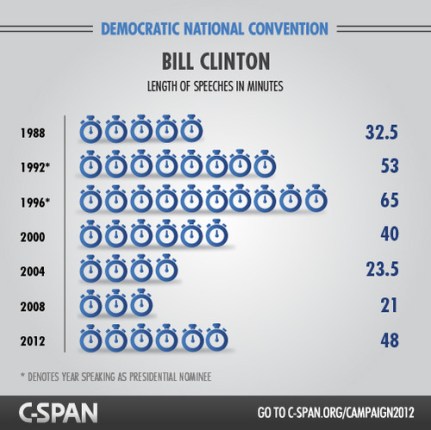
Especially when one recalls that in 1988, pundits said Bill Clinton‘s 32-minute speech was way too long, too dull, and the end of his political career, this chart is interesting:
Infographic: Bill Clinton’s Length of #DNC Speeches in Minutes Since 1988 #cspanDNC
Or, until that account is unsuspended by the forces supporting Donald Trump: Follow @FillmoreWhite, the account of the Millard Fillmore White House Library
We've been soaking in the Bathtub for several months, long enough that some of the links we've used have gone to the Great Internet in the Sky.
If you find a dead link, please leave a comment to that post, and tell us what link has expired.
Thanks!
Retired teacher of law, economics, history, AP government, psychology and science. Former speechwriter, press guy and legislative aide in U.S. Senate. Former Department of Education. Former airline real estate, telecom towers, Big 6 (that old!) consultant. Lab and field research in air pollution control.
My blog, Millard Fillmore's Bathtub, is a continuing experiment to test how to use blogs to improve and speed up learning processes for students, perhaps by making some of the courses actually interesting. It is a blog for teachers, to see if we can use blogs. It is for people interested in social studies and social studies education, to see if we can learn to get it right. It's a blog for science fans, to promote good science and good science policy. It's a blog for people interested in good government and how to achieve it.
BS in Mass Communication, University of Utah
Graduate study in Rhetoric and Speech Communication, University of Arizona
JD from the National Law Center, George Washington University


 Posted by Ed Darrell






 Millard Fillmore's Bathtub