Good teacher resource for National Environmental Week, April 15-21, 2012
December 20 Scenes from the beach
“To stand at the edge of the sea,” wrote Rachel Carson, “… is to have knowledge of things that are as eternal, as any earthly life can be.”* The things that we see this morning–a cerulean sea and sky, the shorebirds, the sun still near the horizon — are identically the same objects that could be seen in Cambrian times, eons ago. There is a sense of the eternal in the objects viewed today. And I suppose there will be little change in a faraway eon that lies in some future age. — Diary, autumn 2011
* At the Edge of the Sea by Rachel Carson; Signet Books, New York (1955)
One should read Rachel Carson to get closer to the universe, not for political reasons, not necessarily for the science. But being scientifically accurate, and being close to the pulse of the universe, Carson’s views will change your politics for the better if you really read and listen.
Spread the word; friends don't allow friends to repeat history.
Birds do it, bees do it, even educated fleas do it. Plants do it, too, but often with the help of animals.
Here are some of the most glorious pictures of sex you’ll ever see, filmed by Louie Schwartzberg. Anyone who has ever tried to take a good photograph should marvel at these shots, and the skill and artistry and luck it took to get them:
What will we do if the bees vanish?
The lowdown:
http://www.ted.com Pollination: it’s vital to life on Earth, but largely unseen by the human eye. Filmmaker Louie Schwartzberg [of Moving Art] shows us the intricate world of pollen and pollinators with gorgeous high-speed images from his film “Wings of Life,” inspired by the vanishing of one of nature’s primary pollinators, the honeybee.
Spread the word; friends don't allow friends to repeat history.
Alas, money ran out, or the proprietors simply decided not to support it anymore (it was originally sponsored by AT&T), or something, but for whatever reason the game is no longer found at the Bell Museum.
One of my favorite examples of evolution and how we can see it in living things today: The laryngeal nerve of the giraffe, linking larynx to brain, a few inches away — but because of evolutionary developments, instead dropping from the brain all the way down the neck to the heart, and then back up to the larynx. In giraffes the nerve can be as much as 15 feet long, to make a connection a few inches away. Richard Dawkins explains:
All mammals have the nerve, and as a result of our fishy ancestry, in all mammals, the nerve goes down the neck, through a heart blood vessel loop, and back up. In fish, of course, the distance is shorter — fish have no necks.
Go see — unless you’re a creationist. If you’re a creationist you’ll see so much that you’ll begin to doubt your faith in creationism and anti-science, and then you’re likely to confuse that with doubt of God, and you can’t stand such a faith trial.
Jack Horner may look familiar to you. Or you may not recognize him without the cowboy hat. Horner is famous enough in dinosaurphile circles that a character who looked like Horner, down to the red shirt and cowboy hat, was included in the Jurassic Park movies.
This is, in loose form, real science. It’s the sort of stuff that somehow gets squeezed out of science curricula in middle schools and high schools. What student will not find it interesting to talk about why we can’t clone dinosaurs from mosquitoes trapped in amber, but how we can regress a chicken to bring out atavistic traits?
Such material may cause apoplexy among some cliques at the Texas State Board of Education — because this reinforces evolution ideas. Horner says, “We can fix the chicken — because evolution works.”
Science teachers: Can you find some way to shoehorn this stuff back into your classes?
Spread the word; friends don't allow friends to repeat history.
Oblivious to Mendel’s work and significance, and to much else in the world of knowledge, the Texas State Board of Education debates how to frustrate the teaching of evolution with hearings in Austin tomorrow, and a vote on supplementary materials to texts in biology on Friday, July 22.
Mendel would urge, pray for Texas and the children who will be saddled with the decision of the Texas SBOE.
It took me a couple of tries to figure it out — last week when I told people Kathryn and I were off to Colorado Bend State Park to spend time on the river, several people commented about how much cooler it would be there.
What? West of Killeen about an hour, ten miles of dusty road outside of Bend, Texas (population 1,637), Colorado Bend is not cooler than Dallas. It was over 100° F every day we were there, stayed well above 90° most of the nights.
Kathryn studied wildflowers at a spring at the side of the Colorado River during a break from kayaking; this spring's flow was reduced, but still moist enough to create a near-oasis.
Our well-wishers were geographically confused. They thought we were headed to the Colorado River in Colorado, not the Colorado River in Texas, which is not the same river at all. I didn’t bother to check the temperatures in Colorado, but one might be assured that it was cooler along the Colorado River in Colorado than it was along the Colorado River in Texas.
It was a return trip. We stumbled into the park 16 years ago with the kids, for just an afternoon visit. The dipping pools in the canyon fed by Spicewood Springs captivated us. It took a while to get back, and then the kids were off doing their own thing.
So, just a quick weekend of hiking/camping/kayaking/soaking/stargazing/bird watching/botanical and geological study. Park officials closed the bat caves to human traffic in hope of keeping White Nose Syndrome from the bats; we didn’t bother to sign up for the crawling cave tour through another.
The author, still working to master that Go-Pro camera on the hat -- some spectacular shots, but I don't have the movie software to use it all; you know it's hot when SPF 75 sunscreen is not enough.
What did we see? Drought has a firm grip on Texas, especially in the Hill Country, especially outside of Dallas. The Colorado River is mostly spring fed; many of the springs are dry. No water significant water flowed through the park while we were there — kayak put-ins have been reduced to the downriver-most ramp, and the bottom of the boat launch ramp is three feet above water. Gorman Falls attracts visitors and scientists, but the springs feeding it are about spent this year — just a few trickles came over the cliff usually completely inundated with mineral-laden waters.
Drought produces odd things. The forest canopy around the park — and through most of the Hill Country we saw — is splattered with the gray wood of dead trees, many of which at least leafed out earlier this spring. The loss to forests is astonishing. Deer don’t breed well in droughts; deer around the campsites boldly challenge campers for access to grasses they’d ignore in other seasons. One ranger said he hadn’t seen more than about three fawns from this past spring, a 75% to 90% reduction in deer young (Eastern White Tail, the little guys). Raccoons are aggressively seeking food from humans, tearing into tents and challenging campers for food they can smell (lock your food in the car!). Colorado Bend is famous for songbirds, including the endangered Golden Cheeked Warbler, and the elusive, spectacular painted bunting. But the most commonly-sighted birds this year are turkey vultures, dining on the young that didn’t make it healthy into the summer and won’t survive until fall.
Warming denialists’ claims of “not so bad a drought” ring out as dangerous, wild delusion. (By actual measurement, Texas average rainfall the past nine months was 8.5 inches, the driest ever recorded in Texas, shattering the old record drought of 1917).
Great trip. Kathryn’s menu planning was spectacular. The old Coleman stove — a quarter century old, now, with fuel almost that old — performed like a champ even without the maintenance it needs (later this week). Other than the hot nights, it was stellar.
Stellar. Yeah. Stars were grand. It was New Moon, a happy accident. A topic for another post, later. Think, “Iridium.”
So posting was slow over the weekend. How far out in the Hill Country were we? Neither one of us could get a bar on our phones. We were so far out the Verizon Wireless guy was using smoke signals.
Thoreau was right, you know.
Spread the word; friends don't allow friends to repeat history.
December 27 is one of those days — many of us are off work, but it’s after Boxing Day, and it’s not yet on to New Year’s Eve or Day. We should have celebrated, maybe.
We should celebrate it as a day of portent: A good embarkation, and a good, safe end to a nation-encouraging trip to almost touch the Moon.
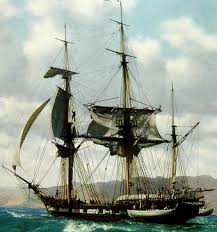
HMS Beagle, on a voyage of discovery
On December 27, 1831, Charles Darwin and H.M.S. Beagle set sail on an around-the-world voyage of discovery that would change all of science, and especially biology, forever.
December 27 1831
After a few delays, H.M.S. Beagle headed out from Plymouth with a crew of 73 under clear skies and a good wind. Darwin became sea-sick almost immediately.
Darwin never fully overcame his seasickness, but he fought it well enough to become the single greatest collector of specimens in history for the British Museum and British science, a distinction that won him election to science societies even before his return from the trip — and cemented his life in science, instead of in the church. Darwin’s discoveries would have revolutionized biology in any case. In analyzing what he had found, a few years later and with the aid of experts at the British Museum, Darwin realized he had disproved much of William Paley’s hypotheses about life and its diversity, and that another, more basic explanation was possible. This led to his discovery of evolution by natural and sexual selection.
Mini-sheet from the Royal Mail in 2009 honoring Darwin's discoveries in the Galapagos Islands
On December 27, 1968, Apollo 8 splashed down after a successful and heartening trip to orbit the Moon. The three crewmen, Commander Frank Borman, James A. Lovell, Jr., and William A. Anders, had orbited the Moon, a very important milestone in the methodological race to put humans on the Moon (which would be accomplished seven months later). 1968 was a terrible year for the U.S., with the North Korean capture of the U.S.S. Pueblo, assassinations of Rev. Martin Luther King, Jr., and Sen. Robert F. Kennedy during the presidential campaign, riots in dozens of American cities, nasty political conventions with riots at the Democratic Convention in Chicago, a contentious and bitter election making sore the nation’s divide over Vietnam policy, and other problems. On Christmas Eve, Borman, Lovell and Anders broadcast from orbit around the Moon, a triumphant and touching moment for the Apollo Program and Americans around the world. Their safe return on December 27 raised hopes for a better year in 1969.
In 1968, NASA engineers were scrambling to meet President Kennedy’s challenge to land a man on the moon by decade’s end. Because delays with the lunar module were threatening to slow the Apollo program, NASA chose to change mission plans and send the crew of Apollo 8 all the way to the moon without a lunar module.
Exactly 42 years ago, the three astronauts of Apollo 8 became the first humans to orbit another celestial object. As they came around the dark side for the third time, Frank Borman, the commander, finally turned their capsule around. And then they saw the Earth.
Borman: Oh my God! Look at that picture over there! Here’s the Earth coming up. Wow, is that pretty.
Anders: Hey, don’t take that, it’s not scheduled.
Borman: (laughing) You got a color film, Jim?
Anders: Hand me that roll of color quick, will you…
One of the resulting photos taken by Anders on a Hasselblad camera became one of the world’s most iconic images.
As Bill Anders recalls it:
I just happened to have one with color film in it and a long lens. All I did was to keep snapping… It’s not a very good photo as photos go, but it’s a special one. It was the first statement of our planet Earth and it was particularly impressive because it’s contrasted against this startling horizon… After all the training and studying we’d done as pilots and engineers to get to the moon safely and get back, [and] as human beings to explore moon orbit, what we really discovered was the planet Earth.
Yeah, we missed toasting it on time in 2010. Plan to raise a glass on December 27, 2011, to Good Trip Day for the human race. December 27 is a day we should remember, for these achievements.
Spread the word; friends don't allow friends to repeat history.
Great mysteries of science, history and spirit call to us: How do the monarch butterflies do it?
Monarch butterflies (Danaus plexippus) fly north from their enclave in Mexico every spring, stopping to lay eggs on milkweed plants. After a migration of several hundred miles, that first group that left Mexico dies off. Their offspring hatch in a few days, devour the milkweed, make a chrysalis, metamorphose into butterflies, then fly farther north, where they repeat their parents’ behavior: Lay some eggs, and die. Within three generations, they’ve spread north into Canada.
Inviting the monarchs in: You can see how Kathryn worked to attract butterflies. In this photo, you can see the butterfly weed (a milkweed), red Turk's cap, and blue ageratum especially for the monarchs.
Then the fourth generation does something so strange and wonderful people can’t stop talking about it: They fly back to Mexico, to the same trees their great-great-great grandparents left. There they sip some nectar, get some water, and spend a lot of time hanging in great globs, huddling over the winter, to start life for generations of monarch butterflies the next spring.
Sometimes in Texas in October, we can see clouds of monarch butterflies winging south. If we’re lucky, they stop to visit our backyards and gardens, and we might provide some water and nectar to urge them homeward. Kathryn, of course, plants the stuff the monarchs like, to help them, and to give us a chance to see them.
Monarch habitat in Mexico is under severe stress and threat. Late storms and early freezes decimated monarch populations over the last decade [yes, that’s the proper use of “decimated;” look it up]. Human plantings are more critical to the monarch butterflies than ever before.
Two years ago Kathryn and I spent a September morning outside the library at Lawrence University, in Appleton, Wisconsin, watching monarchs sip nectar from local flowers for their journey. Those same butterflies — we hope — passed through Texas a couple of weeks later.
Two weeks ago . . . well, see for yourself:
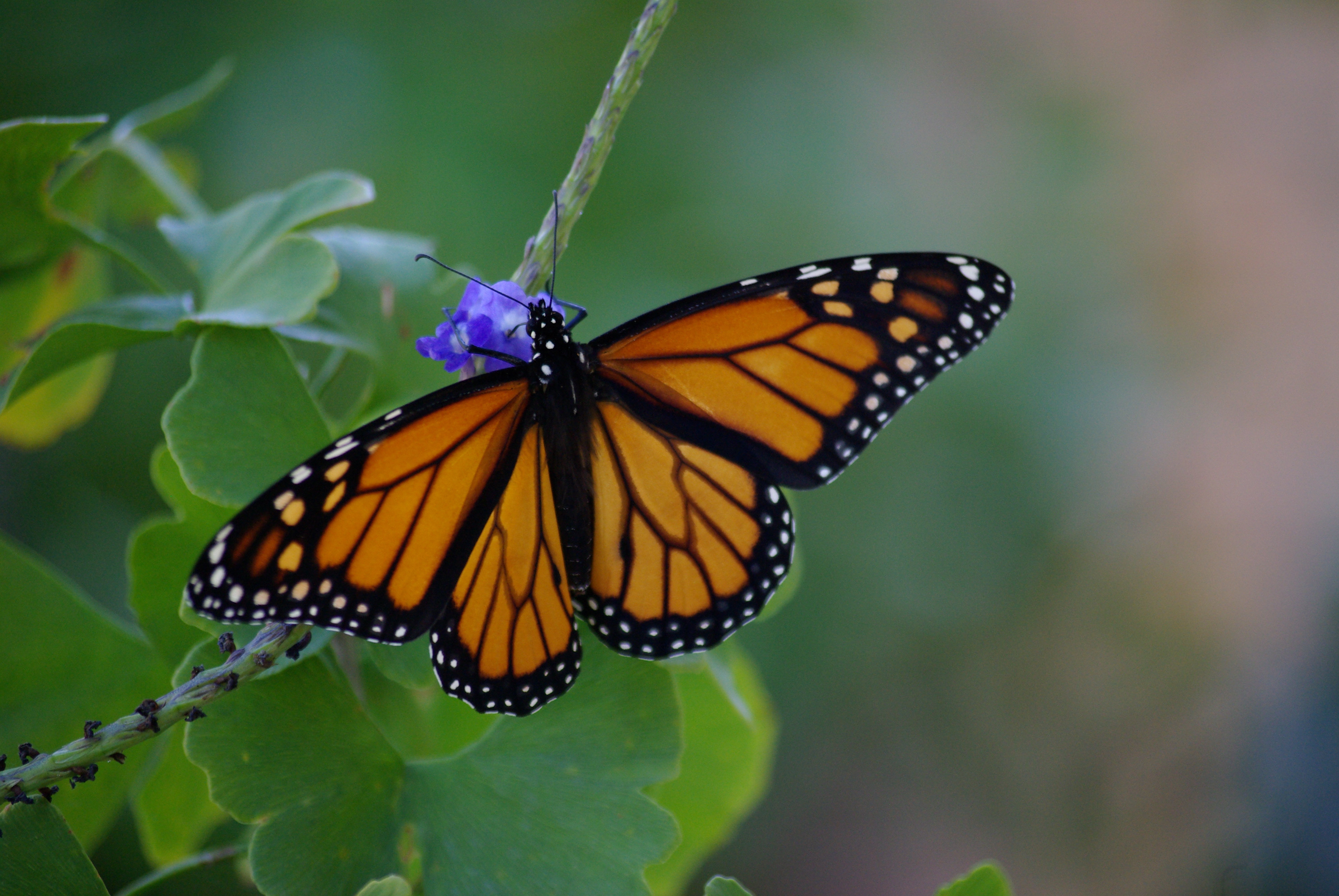
A monarch butterfly feeds on blue porterweed in Kathryn's garden, October 2010 - photo by Ed Darrell
. . . we're here with the camera, little guy, just open up those wings, please . . .
That's it! Beautiful! Have a safe trip, and come back next spring, will you?
Turk’s Cap passes under a lot of aliases: Drummond Wax-mallow, Texas Mallow, Mexican Apple, Red Mallow, May Apple, Wild Turk’s Cap, Bleeding Heart; Malvaviscus drummondii (M. arboreus var. drummondii)
Butterfly weed — there are several plants that take this name in various parts of the country, this one is Asclepias tuberosa, but Kathryn’s bloom redder and more intense yellow than any of the photos I’ve seen on line.
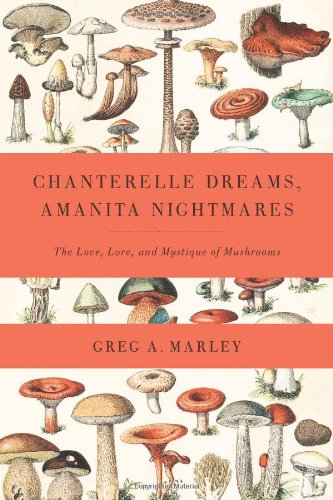
Cover of Chanterelle Dreams, Amanita Nightmares, by Greg Marley
Saturday, October 30 from 4-6:00 pm
at Farmers Fare on Route 90 in Rockport [Maine]
Light refreshments served and beverages available
Chanterelle Dreams, Amanita Nightmares: The Love, Lore and Mystique of Mushrooms
Welcome a new book by Greg Marley, celebrating the wonder and mystery of mushrooms. Enjoy a readable, captivating and informative collection of great mushroom stories. From world-class edibles (with recipes) to the most deadly, learn about the mushrooms in your neighborhood and how to invite them into your life, or even how to grow your own.
Hey, if you’re in the neighborhood, drop in.
Spread the word; friends don't allow friends to repeat history.
Our internet’s best expert in bedbugs, Bug Girl, recently featured another post relating how DDT drove evolution of bedbugs, so that bedbugs are no longer susceptible to DDT. You should go read what Bug Girl said.
And you can view the video here, too; let’s spread the word, eh?
As Bug Girl describes it:
I discovered that bed bug evolution–specifically resistance to pesticides–was also the subject of the National Evolutionary Synthesis Center‘s podcast this month. A FASCINATING interview with one of the grand old men of evolutionary genetics, James Crow. He worked on DDT resistance back in the late 40s and 50s.
Watch, and increase your knowledge.
Spread the word; friends don't allow friends to repeat history.
Appearing to be aware they are losing the battle of the classroom to real science, creationists have taken a sneakier way to undermine science education. P. Z. Myers explains:
A lot of people have been writing to me about this free webgame, CellCraft. In it, you control a cell and build up all these complex organelles in order to gather resources and fight off viruses; it’s cute, it does throw in a lot of useful jargon, but the few minutes I spent trying it were also a bit odd — there was something off about it all.
Where do you get these organelles? A species of intelligent platypus just poofs them into existence for you when you need them. What is the goal? The cells have a lot of room in their genomes, so the platypuses are going to put platypus DNA in there, so they can launch them off to planet E4R1H to colonize it with more platypuses. Uh-oh. These are Intelligent Design creationist superstitions: that organelles didn’t evolve, but were created for a purpose; that ancient cells were ‘front-loaded’ with the information to produced more complex species; and that there must be a purpose to all that excess DNA other than that it is junk.
Suspicions confirmed. Look in the credits.
Also thanks to Dr. Jed Macosko at Wake Forest University and Dr. David Dewitt at Liberty University for providing lots of support and biological guidance.
Those two are notorious creationists and advocates for intelligent design creationism. Yep. It’s a creationist game. It was intelligently designed, and it’s not bad as a game, but as a tool for teaching anyone about biology, it sucks. It is not an educational game, it is a miseducational game. I hope no one is planning on using it in their classroom. (Dang. Too late. I see in their forums that some teachers are enthusiastic about it — they shouldn’t be).
No such thing as a free lunch. If it sounds too good to be true, it probably is. Free software for use in educating kids about biology, sounds too good to be true.
_____________
In comments, Lars Doucet disavows creationist intent. So the creationist/intelligent design factors were added just to make the game more playable, and not as an attempt to introduce or endorse creationism or intelligent design.
Or, until that account is unsuspended by the forces supporting Donald Trump: Follow @FillmoreWhite, the account of the Millard Fillmore White House Library
We've been soaking in the Bathtub for several months, long enough that some of the links we've used have gone to the Great Internet in the Sky.
If you find a dead link, please leave a comment to that post, and tell us what link has expired.
Thanks!
Retired teacher of law, economics, history, AP government, psychology and science. Former speechwriter, press guy and legislative aide in U.S. Senate. Former Department of Education. Former airline real estate, telecom towers, Big 6 (that old!) consultant. Lab and field research in air pollution control.
My blog, Millard Fillmore's Bathtub, is a continuing experiment to test how to use blogs to improve and speed up learning processes for students, perhaps by making some of the courses actually interesting. It is a blog for teachers, to see if we can use blogs. It is for people interested in social studies and social studies education, to see if we can learn to get it right. It's a blog for science fans, to promote good science and good science policy. It's a blog for people interested in good government and how to achieve it.
BS in Mass Communication, University of Utah
Graduate study in Rhetoric and Speech Communication, University of Arizona
JD from the National Law Center, George Washington University


 Posted by Ed Darrell









 Millard Fillmore's Bathtub