Press release on polar bears the climate change skeptics hope you won’t read

August 2, 2009

Why did the self-proclaimed skeptics work so hard to discredit this meeting before it even occurred?  Why have they ignored this press release?

Take it easy! Calm down, stick to the facts! Polar bear photo by Kathy Crane, NOAA Arctic Research Office

“Take it easy! Calm down, stick to the facts!” Polar bear photo by Kathy Crane, NOAA Arctic Research Office

There is no dramatic finding in the release.  After you read it, you’ll probably wonder, too, why climate change skeptics don’t want you to read this press release:

15th meeting of PBSG in Copenhagen, Denmark 2009

PRESS RELEASE

The 15th meeting of the IUCN Polar Bear Specialist Group (PBSG), hosted by the Greenland Institute of Natural Resources, was held at the Greenland Representation in Copenhagen Denmark , June 29-July 3, 2009.  The Polar Bear Specialist Group is composed of researchers and managers representing each of the five circumpolar nations that signed the International Agreement for the Conservation of Polar Bears of 1973.  Since the late 1960s, the members of PBSG have met every 3 to 5 years under the umbrella of the Species Survival Commission of the IUCN (the International Union for the Conservation of Nature and Natural Resources) to review and exchange information, and make recommendations for research and management of polar bears throughout the Arctic.

The PBSG renewed the conclusion from previous meetings that the greatest challenge to conservation of polar bears is ecological change in the Arctic resulting from climatic warming.  Declines in the extent of the sea ice have accelerated since the last meeting of the group in 2005, with unprecedented sea ice retreats in 2007 and 2008. The PBSG confirmed its earlier conclusion that unabated global warming will ultimately threaten polar bears everywhere.

The PBSG also recognized that threats to polar bears will occur at different rates and times across their range although warming induced habitat degradation and loss are already negatively affecting polar bears in some parts of their range. Subpopulations of polar bears face different combinations of human threats.  The PBSG recommends that jurisdictions take into account the variation in threats facing polar bears.

The PBSG noted polar bears suffer health effects from persistent pollutants.  At the same time, climate change appears to be altering the pathways by which such pollutants enter ecosystems. The PBSG encourages international efforts to evaluate interactions between climate change and pollutants.

The PBSG endorses efforts to develop non-invasive means of population assessment, and continues to encourage jurisdictions to incorporate capture and radio tracking programs into their national monitoring efforts. The members also recognized that aboriginal people are both uniquely positioned to observe wildlife and changes in the environment, and their knowledge is essential for effective management.

The PBSG recognizes that where habitats are stable, polar bears are a renewable resource, and reaffirmed its support of the right of aboriginal groups to harvest polar bears within sustainable limits.  The PBSG noted that the population of polar bears in Baffin Bay, shared between Greenland and Canada, may simultaneously be suffering from significant habitat change and substantial over harvest, while at the same time interpretations by scientists and local hunters disagree regarding population status.  Similarly, the Chukchi Sea polar bear population which is shared by Russia and the United States is likely declining due to illegal harvest in Russia and one of the highest rates of sea ice loss in the Arctic. Consistent with its past efforts to coordinate research and management among jurisdictions, the PBSG recommended that the polar bear populations in Baffin Bay and the Chukchi Sea be reassessed and that harvests be brought into balance with the current sustainable yield.

A variety of management changes have occurred since the PBSG last met in 2005.  The PBSG members were particularly pleased that quotas for the harvest of polar bears in Greenland were implemented in January 2006, and that quota reductions have been implemented in some parts of Greenland.  Also since the last meeting, the government of Nunavut reduced the harvest quota in Western Hudson Bay because of the documented population decline.

The PBSG reevaluated the status of the 19 recognized subpopulations of polar bears distributed over vast and relatively inaccessible areas of the Arctic. Despite the fact that much new information has been made available since the last meeting, knowledge of some populations is still poor.  Reviewing the latest information available the PBSG concluded that 1 of 19 subpopulations is currently increasing, 3 are stable and 8 are declining.  For the remaining 7 subpopulations available data were insufficient to provide an assessment of current trend.  The total number of polar bears is still thought to be between 20,000 and 25,000.  However, the mixed quality of information on the different subpopulations means there is much room for error in establishing that range.  That potential for error, given the ongoing and projected changes in habitats and other potential stressors is cause for concern.  Nonetheless, the PBSG is optimistic that humans can mitigate the effects of global warming and other threats to polar bears, and ensure that they remain a part of the Arctic ecosystem in perpetuity.

Dr. Erik Born from the Greenland Institute of Natural Resources was elected as the new chairman of the group after Dr. Andrew Derocher from the University of Alberta, who has been serving as chair since 2005.

Well, there is that proclamation of optimism in the penultimate paragraph, that humans can mitigate threats to bears, including global warming.  Is that why they don’t want you to read it?

How are the polar bears?  They are in trouble.  The Polar Bear Specialist Group says we should help them out, that we can do things to save the bears.  Why would the “skeptics” not want us to know that?

Other resources:

Save


Drought: Heckuva way to run the end to global warming

July 30, 2009

“This is a hell of a way to run a desert.”
Utah Gov. Scott Matheson, during floods in 1983

A new Dust Bowl?

A new Dust Bowl? (Image updated January 2013; old links dead)

No, I’m not repeating the error of many who take every snowflake as bizarre evidence that global warming has ended.

I think we need to stick to the facts.

2009 may be cooler than 1998, one of the hottest years on record, but that in no way suggests an end to the climate crisis scientists have been tracking for the past couple of decades.

Cooler weather in New York does not offset the rest of reality.

Reality is we have crushing droughts in California and Texas.

California drought explained by USA Today:

FIREBAUGH, Calif. — The road to Todd Allen’s farm wends past irrigation canals filled with the water that California‘s hot Central Valley depends on to produce vegetables and fruit for the nation. Yet not a drop will make it to his barren fields.

Three years into a drought that evokes fears of a modern-day dust bowl, Allen and others here say the culprit now isn’t Mother Nature so much as the federal government. Court and regulatory rulings protecting endangered fish have choked the annual flow of water from California’s Sierra mountains down to its people and irrigated fields, compounding a natural dry spell.

“This is a regulatory drought, is what it is,” Allen says. “It just doesn’t seem fair.”

For those like Allen at the end of the water-rights line, the flow has slowed to a trickle: His water district is receiving just 10% of the normal allocation of water from federal Bureau of Reclamation reservoirs. He says he’s been forced to lay off all his workers and watch the crops die on his 300 acres while bills for an irrigation system he put in are due.

“My payments don’t stop when they cut my water off,” Allen says.

Although some farmers with more senior water rights are able to keep going, local officials say 250,000 acres has gone fallow for lack of water in Fresno County, the nation’s most productive agriculture county. Statewide, the unplanted acreage is almost twice that.

Unemployment has soared into Depression-era range; it is 40% in this western Fresno County area where most everyone’s job is dependent on farming. Resident laborers who for years sweated in fields to fill the nation’s food baskets find themselves waiting for food handouts.

“The water’s cut off,” complains Robert Silva, 68, mayor of the farm community of Mendota. “Mendota is known as the cantaloupe capital of the world. Now we’re the food-line capital.”

Three years of dry conditions is being felt across much of the nation’s most populous state.

Gov. Arnold Schwarzenegger declared a water emergency in February and asked for 20% voluntary cuts in water use. The U.S. Department of Agriculture’s Drought Monitor lists 44% of the state as in a “severe” drought.

In arid Southern California, cities and water districts have raised rates to encourage conservation and imposed limits on use

Texas drought, detailed in the Dallas Morning News:

AUSTIN – The drought that has gripped Central Texas is approaching the severity of Texas’ most famous drought, the 1950s dry spell that lasted several years, Lower Colorado River Authority officials say.

But the current drought, which began in the fall of 2007, has seen more intense concentrations of high temperatures and less rainfall than the majority of the earlier drought.

“It was hot, yes, it was dry” in the 1950s, said LCRA meteorologist Bob Rose, “but it wasn’t crazy hot like this year.” Soil moisture is negligible now. And with spotty precipitation, “we haven’t been able to generate any runoff” to replenish reservoirs, he said.

“What makes our current drought unique is not the duration but the severity,” Rose said this week at a drought briefing for meteorologists and reporters.

With state officials warning of wildfire dangers, and water restrictions spreading rapidly across the state, Texas Gov. Rick Perry (R) issued disaster declarations for 167 of the states 254 counties.

Texas suffers more than California, across a broader area with deeper drought, according to the Associated Press:

According to drought statistics released by the U.S. Department of Agriculture, 77 of Texas’ 254 counties are in extreme or exceptional drought, the most severe categories. No other state in the continental U.S. has even one area in those categories.

John Nielsen-Gammon, the Texas state climatologist at Texas A&M University, said he expects harsh drought conditions to last at least another month.

In the bone-dry San Antonio-Austin area, the conditions that started in 2007 are being compared to the devastating drought of the 1950s. There have been 36 days of 100 degrees or more this year in an area where the total usually is closer to 12.

Among the most obvious problems are the lack of water in Lake Travis and Lake Buchanan near Austin, two massive reservoirs along the Colorado River that provide drinking water for more than 1 million people and also are popular boating and swimming spots. Streams and tributaries that feed the lakes have “all but dried up,” according to the Lower Colorado River Authority.

San Antonio, which relies on the Edwards Aquifer for its water, is enduring its driest 23-month period since the start of recorded weather data in 1885, according to the National Weather Service. The aquifer’s been hovering just above 640 feet deep, and if it dips below that, the city will issue its harshest watering restrictions yet.

Self-professed climate skeptics will argue that everything is hunky-dory and we can continue blundering along pollutiong willy-nilly because droughts alone are not evidence of warming, and so cannot rebut spot evidence of increased rainfall or local cooling.  Notice how they try to have the argument both ways?  Local weather counts for their side, but can’t count against it.

It’s more complex than that.  Much of the damage from climate change occurs in the upset of a balance in local ecosystems.  The Green Blog at the Boston Globe site discusses the subtle, ecosystem distorting effects and how easy they are to miss in the grand schemes of things.

A lot of the problem has to do with timing. About half of the water that recharges the [Northeast] region’s aquifer is from spring snowmelt, said [USGS hydrologist Thomas] Mack, allowing it to be plentiful to residents for summer lawn watering and other uses.

But global warming is causing the snow to melt earlier by around two to four weeks. At the same time, more rain, instead of snow, is expected to fall in the winter. That means the aquifer is filling up earlier in the spring.

The problem is the region’s bedrock aquifer can’t hold water for a long time – filling it up when it is needed the least and draining before the busy summer.

All environmental problems are complex, and global “warming” is massively more complex than any other environmental issue humans have recognized and dealt with.  Climate change deals with the entire Earth, and with the two great pools of fluids on the Earth, the oceans and the atmosphere, where the sheer physics of change are nearly impossible to understand, let alone predict.

Perhaps, as local conditions in more and more places demonstrate damages from climate change, skeptics can be brought around to understand that action is required even when we don’t have all the possible data points we’d like.

Resources:


Climate change denialism in bloom

July 28, 2009

It was a minor note, really — USGS released a series of satellite photos of ice in the Arctic Ocean.  The photos were taken with U.S. defense satellites (“spy” satellites, most likely) under an interesting agreement between the Department of Defense and science agencies to look at ice, essentially to look at the cold, not come in from it.

Part of that agreement is that the photos don’t get released until Defense says there is no reason to hold them secred anymore.  For some reason — skullduggery?  bureaucracy? — the photos weren’t released during the Bush years.  The Obama administration hustled out a series of photos for scientists to study.

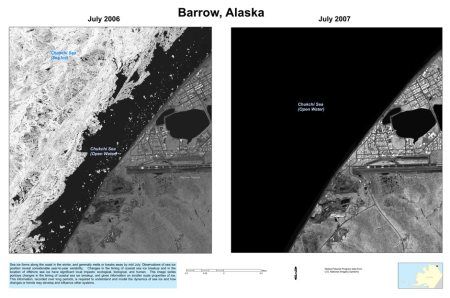
Very few news outlets picked up on the release of the photos.  The Guardian ran the most provocative, prepared-for-public-consumption set of two photos of the sea just off of Barrow, Alaska, which showed a dramatic contrast between 2006 and 2007.  The icy seas of July 2006 were replaced with miles of clear ocean in July 2007.

The Bathtub ran that poster.  And yesterday there was a surge of hits on the article, most going to other posts claiming the photos had been photoshopped.  A commenter here said the same.  Viewers find it odd that there is a stark contrast between land and sea inthe arctic.  Really.  No, really.

So, they said, those photos must be Photoshopped.  At least one radical right blog claimed the Guardian published a fake photo.

Now, I had expected someone to defend Bush, to say that the Bush administration hadn’t really suppressed the photos, just didn’t release them.

But photo fraud?

Denialists resorted to that solution first.

Here are reasons mitigating against fraud.

  1. The U.S. Geological Survey (USGS) released the poster with the photos.  USGS has a long, long history of accurate science, outside political interference.   On a few occasions, USGS reports have been delayed by political appointees — but the instances where one can say the data were corrupted on purpose are very few (if any — I can’t think of one off-hand).  USGS would be unlikely as a source of doctored photos.
  2. It is a crime to jigger the scientific results under U.S. law.   A few scientists have been caught, tried and jailed.  The reality is that most scientist strive to be well on the ethical side of the line of research laws — but it’s a federal crime for government or government-funded scientists to fake results.  I’ll wager every scientist at USGS knows that.
  3. USGS released four posters total, and a couple dozen other photos.  For Barrow, there were 18 photos from 2005 and 2006, and another 8 photos from 2007-2008.    While only four sites were chosen for poster, there are six sites with photos available for study.  Were anyone to jigger one photo, others would need to be jiggered to make them match.  Since Defense still has the originals, a fraud would probably be discovered.
  4. Government scientists have been champing at the bit for eight years to get rid of the fetters of bureaucrats interfering with their research; they wouldn’t risk a fraud just six months in to the new administration, nor would they be likely to risk a fraud at any time, since they think that the truth is of very high value.

MacsMind jumped on the photos:  “Almost so bad it’s laughable”. The blog offers no evidence of fraud, just the spiteful belief of the author.  Well, he does offer photos of a January 2006 ice surge, as if to suggest that the ice from January of 2006 should have stayed hugging the coast near Barrow even through 2007, so any photo that shows clear sea must be false.  Denialists will abandon all types of measure, even calendars and clocks, in their mad rush to cloak the science.  MacsMind even goes so far as to invent a story that the photo was taken at night, and since it shows no lights of ships at sea, they must have been cut out (photos of ice cover generally don’t work well at night — where did he get that?).

Critics of climate change and plans to do something to slow climate change reveal themselves here as not basing their views on the science — here they don’t need the science to “know that it’s wrong.”

Sometimes I wonder if we could cure global warming simply by getting the critics to shut up.

Oh, let’s make them crazy.  Here’s the poster showing the contrast in sea ice in the Beaufort Sea; the caption:

This site is near the edge of the ice pack. In summer, as shown here, ponds of meltwater form on the surface. These dark pools absorb more of summertime’s solar radiation than does the surrounding ice, enhancing melting. Observations of sea ice conditions reveal considerable year to year variability. These images, displaying the variability with regard to the amount of melting, are an example of the long term sequential record needed to support understanding and analysis of this dynamic system. Pond coverage monitored over time contributes to estimates of surface reflectivity that are needed to understand and model the dynamics of sea ice mass balance and temperature.

Beaufort Sea, showing ice in 2006 and in 200

Beaufort Sea, showing ice in 2001 and in 2007

More information:

Radar images of sea ice around Barrow, Alaska

Radar images of sea ice around Barrow, Alaska -"The animation below is from the radar record of the last three days. The images used to produce this animation are from the 10 kW X-band marine radar mounted atop the 4-story ASRC building in downtown Barrow, Alaska, pointed north."

Help cool discussion on climate change; share this post:

Add to FacebookAdd to NewsvineAdd to DiggAdd to Del.icio.usAdd to StumbleuponAdd to RedditAdd to BlinklistAdd to TwitterAdd to TechnoratiAdd to Furl


Great Arctic sea ice hoax exposed

July 26, 2009

Look at the photos and see for yourself.  From 2006 to 2007, did sea ice at Barrow, Alaska, increase or decrease?

A comparison of polar sea ice at Barrow, Alaska -- July 2006 on the left, July 2007 on the right - public domain photo from U.S. military satellites.

A comparison of polar sea ice at Barrow, Alaska -- July 2006 on the left, July 2007 on the right - public domain photo from U.S. military satellites. Click for larger view from The Guardian.

These photos appeared in The Guardian — did they appear in any U.S. papers? — with a story that said the photos had been withheld by the Bush administration, and were recently released by the Obama administration.  (Bet these photos never show up on Anthony Watts’s blog.)*

Graphic images that reveal the devastating impact of global warming in the Arctic have been released by the US military. The photographs, taken by spy satellites over the past decade, confirm that in recent years vast areas in high latitudes have lost their ice cover in summer months.

The pictures, kept secret by Washington during the presidency of George W Bush, were declassified by the White House last week. President Barack Obama is currently trying to galvanise Congress and the American public to take action to halt catastrophic climate change caused by rising levels of carbon dioxide in the atmosphere.

One particularly striking set of images – selected from the 1,000 photographs released – includes views of the Alaskan port of Barrow. One, taken in July 2006, shows sea ice still nestling close to the shore. A second image shows that by the following July the coastal waters were entirely ice-free.

The photographs demonstrate starkly how global warming is changing the Arctic. More than a million square kilometres of sea ice – a record loss – were missing in the summer of 2007 compared with the previous year.

Spin, from the presidency?  Who knew?

Climate change skeptics (read:  deniers) say that ice has come back in record amounts in 2008.  According to the news article, that isn’t exactly the case.

Nor has this loss shown any sign of recovery. Ice cover for 2008 was almost as bad as for 2007, and this year levels look equally sparse.

Science News noted the declassification, but without the hint of skullduggery on the part of the Bush administration.  The poster above comes from the USGS, which also included three more posters, one of the Beaufort Sea and two of glaciers — all of them showing declines in ice.

Stories that Arctic sea ice is expanding seem to be premature.

So all the claims that global warming has ended, that ice is threatening to extend its range and plunge us back into a cooling period — just hoax? Yep, just hoax.

Tip of the old scrub brush to Watching the World from Nicaraugua.

Update, 7-27-2009: A story going around the internet claims the poster at the top of this post is faked.  The poster comes from the U.S. Geological Survey, so I doubt it’s faked — they have no dog in the fight to fake it.  I think this goes to show that climate change “skeptics” have been sucked in by their own denial virus, and they will not even entertain information to the contrary of their beliefs.

*   Happy update, 8-2-2009: I’m happy to report I erred.  Actually, Anthony Watts reported on the release of the photos on July 15.  He didn’t use the Barrow photos, and he certainly did not claim that they are hoax photos.  He noted that the previously classified data have been released, and he seemed to think that there is no monkeying around with them.   It’ll be interesting to see how he deals with the photos from here on in.

Spread the news!

Add to FacebookAdd to NewsvineAdd to DiggAdd to Del.icio.usAdd to StumbleuponAdd to RedditAdd to BlinklistAdd to TwitterAdd to TechnoratiAdd to Furl


India accepts climate junk science; U.S. suffers

July 25, 2009

It would be good news were it not so bad:  India, usually considered a threat to U.S. dominance in science, has turned its back on climate science and instead, citing junk science claims, rejected overtures to reduce pollution that affects climate.  India appears to have fallen victim to the hoaxters who claim climate change is no big deal.

From the Financial Times:

A split between rich and poor nations in the run-up to climate-change talks widened on Thursday.

India rejected key scientific findings on global warming, while the European Union called for more action by developing states on greenhouse gas emissions.

Jairam Ramesh, the Indian environment minister, accused the developed world of needlessly raising alarm over melting Himalayan glaciers.

He dismissed scientists’ predictions that Himalayan glaciers might disappear within 40 years as a result of global warming.

“We have to get out of the preconceived notion, which is based on western media, and invest our scientific research and other capacities to study Himalayan atmosphere,” he said.

As if the atmosphere of the Himalayan range is unaffected by emissions from Europe or Asia.  As if the glaciers in the Himalayas, and the snowfall,  and the water to India’s great rivers, come independent from the rest of the world.

Deadly air pollution obscures the India Gate, New Delhi, India, November 2008 - NowPublic.com

Deadly air pollution obscures the India Gate, New Delhi, India, November 2008 - NowPublic.com

It’s interesting to see these issues play out politically.   India and China both understand that the U.S. and Europe have much more to lose from climate change than either of those nations.  Climate damage to the U.S. wheat belt, for example, would chiefly close off U.S. production of wheat for export, opening markets for others — like India and China.  Critically, such damage also hurts U.S. ability to offset balance of payments issues, providing economic and finance advantages to China’s banks.  U.S. ports are much more vulnerable to climate change damage, from increase storms and changing ocean levels, than are ports in India and China — and there are more ports that are vulnerable in the U.S. and Europe.

India’s inaction and recalcitrance should not be used as justification for the U.S. to do nothing, thereby slitting its own patriotic throat.

But watch:  Climate denialist blogs, “hate-America-first” outlets like World Net Daily, and Osama bin Laden will hail India’s inaction.

Let’s hope cooler heads prevail, lest we run out of cooler heads.

Shake of the old scrub brush to Brown Hell and Watt’s Up With That.

If this is important to you, please share it; click on the button you choose below.

Add to FacebookAdd to NewsvineAdd to DiggAdd to Del.icio.usAdd to StumbleuponAdd to RedditAdd to BlinklistAdd to TwitterAdd to TechnoratiAdd to Furl


News flash: Texas has a second natural lake!

July 20, 2009

Years ago, in Virginia, I had learned that Virginia had only one natural lake, the Great Dismal Swamp.  Accompanying that chunk of information in that lecture was that Texas had only two natural lakes.

But upon arriving in Texas, I could find reference to only one natural lake, Caddo, and it had ceased being fully natural when its maintenance fell to a dam.

What happened to Texas’s second natural lake?

A Google search right now on “Texas +’natural lake'” produces ten listings on the first page, all of them pointing to the fact that Texas has just one natural lake.  Here are the first five:

I have found a second natural lake in Texas. It’s not a new discovery at all — it’s just a case of people not having the facts, and overlooking how to find the truth.  It’s especially difficult when the lake hides itself.

Our testing coordinator at Molina High School, Brad Wachsmann, spins yarns that belie his youth.  In the middle of one yarn last year, corroborated by other yarns, he mentioned that he has family in Big Lake, Texas; and he described visiting and having relatives urge people to run out and see the lake since it’s rebirth in torrential rains.

“A second natural lake in Texas?” I asked.  Wachsmann knew the drill.  Yes, Big Lake is a natural lake in Texas, and yes, people forget about it.

Texas teachers, listen to your testing coordinators, okay?

All of this came to mind reading the Austin American-Statesman, still a bastion of great journalism despite problems in the newspaper industry.  On Monday, July 7, the paper ran a story and an editorial about the clean up of the oil industry refuse that killed the shoreline of part of the lake; the springs that once fed the lake have mostly gone dry, but that’s likely due to agricultural water mining.

It’s a story of boom and bust, environmental degradation for profit, and eventual recovery we hope.

Looking at the landscape that surrounds the Reagan County seat, you wonder whether the name Big Lake was somebody’s idea of joke. It’s dry and dusty, where the flora sprouts reluctantly and lives precariously.

Yet, the West Texas town of Big Lake got its name from a natural lake that was fed by springs that have long since gone dry. While the area may not fit everyone’s definition of photogenic, it has its own brand of charm – charm that could be enhanced if the damage done to the fragile ecosystem by salt spills were reversed or even minimized.

As the American-Statesman’s Ralph K.M. Haurwitz reported in Monday’s editions, the University of Texas and Texas A&M systems have benefited from the $4.4 billion in royalty payments and mineral income produced by its West Texas acreage since Santa Rita No. 1 well came in on May 28, 1923.

The salt water byproduct of oil and natural gas production, however, contaminated 11 square miles near Big Lake, killing most everything that grows. The lack of vegetation allows wind and water erosion.

Hey, it gets better.  This is real Texas history, real American history — you can’t make this stuff up.  Haurwitz’s article talks about the heritage of Texas education.   Remember that old story about setting aside certain sections of townships to help fund education in lands on the American frontier?  Texas wasn’t a public lands state as farther west, but it still reserved sections of land for the benefit of education.

Rose petals blessed by a priest?  I’ll wager the priest didn’t make the trip to the top of the derrick.  Haurwitz wrote:

BIG LAKE — Investors appealed to the patron saint of impossible causes when oil drilling began on University of Texas System land in 1921. It didn’t hurt.

Santa Rita No. 1 blew in on May 28, 1923, after rose petals blessed by a priest were scattered from the top of the derrick at the behest of some Catholic women in New York who had purchased shares in the Texon Oil and Land Co., which drilled that first well.

Since then, the UT System’s 2.1 million acres in West Texas have produced $4.4 billion in royalty payments and other mineral income for the Permanent University Fund, an endowment that supports the UT and Texas A&M University systems.

But this long-running bonanza for higher education exacted a price from the remote, semiarid landscape where it all began. Millions of barrels of salt water, a byproduct of oil and natural gas production, contaminated 11 square miles, or more than 7,000 acres, killing virtually all vegetation and leaving the land vulnerable to wind and water erosion. Hundreds of mesquite stumps with three feet of exposed roots testify to the dramatic loss of topsoil.

Texas, and Big Lake - from BigLakeTx.com

Where in Texas is Big Lake?

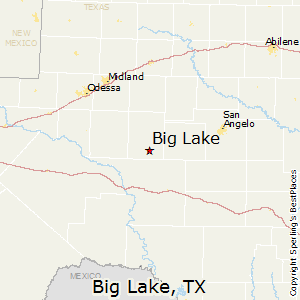
The town of Big Lake is just north of the lake itself, on State Highway 137 running north and south, and U.S. Highway 67 running east and west, approximately 65 miles west of San Angelo.   Big Lake sits about 10 miles north of Interstate 10, and about 75 miles south of Interstate 20.  Big Lake calls itself “the gateway to the Permian Basin.”

Big Lake is the home of Reagan County High School.  Jim Morris was baseball coach for the Reagan High Owls when his team persuaded him to try out for a major league baseball team.  His story was chronicled, with some artistic license, in the Disney movie “Rookie.”

Land managers are working to stop erosion on the often-dry shores of Big Lake using any trick they can find.  One trick:  Plant salt grass.

Salt grass?  Along Texas’s Gulf Coast, there are a few species of grass that, while not halophytes, are at least salt tolerant.  Salt grass.  This grass made it profitable to graze cattle on what would otherwise have been unproductive land in the Texas cattle boom.  This role in Texas history is memorialized in the Salt Grass Steakhouse chain, now found in five states.

And if planting salt grass works to control erosion, it will help clean up a large part of Texas other natural lake, Big Lake.

Big Lake’s being wet or dry is a whim of local climate.  You could say that half of all of Texas’s natural lakes are now dry as a result of continued warming; you could say that two good gully-washers or toad-stranglers could restore water to half of Texas’s natural lakes.

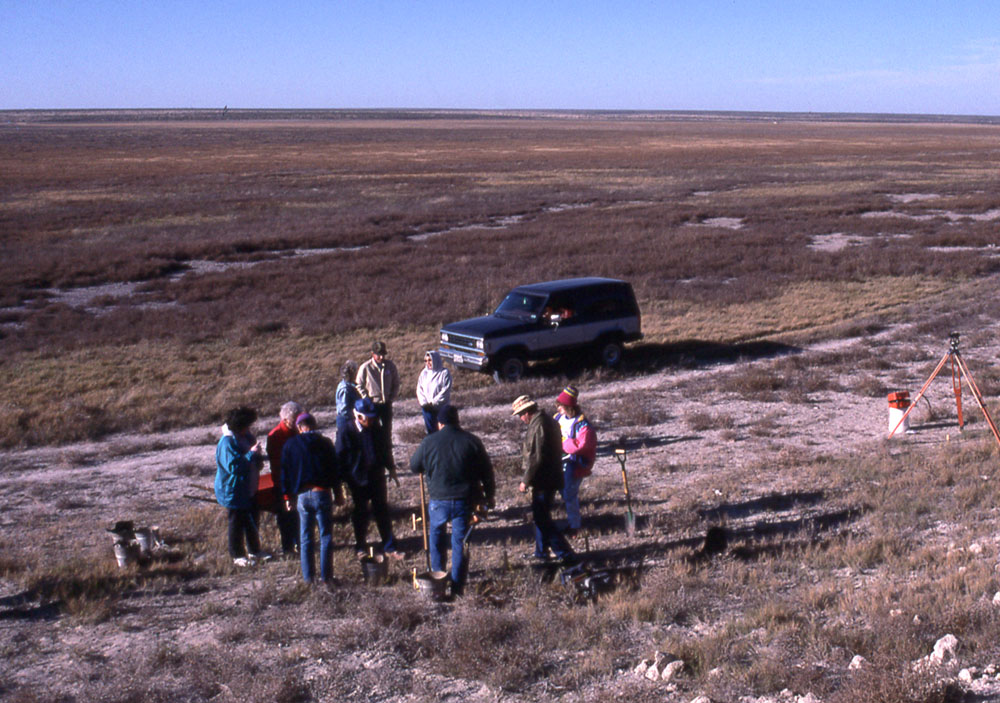
Big Lake Playa, from NightOwl Bakery and Roastery in Big Lake, Texas

Field crew meeting at the outset of the 1992 excavations at the Big Lake Bison Kill site. The dry bed of Big Lake stretches for miles in the background. Big Lake is an intermittent saline lake or playa, an uncommon landform on the Edwards Plateau. Photo by Larry Riemenschneider, Concho Valley Archeological Society.

More details about Big Lake and prehistory, below the fold.

Read the rest of this entry »


Hoax exposed: “The Great Global Warming Swindle’s” swindle

July 14, 2009

Nicely done, too, I think; this is one more alarm bell to tell us why there will be no Nobel Peace Prize for global warming deniers.

From the same guy who so brilliantly brings us the Global Warming Crock of the Week:

Tip of the old scrub brush to Tim Lambert at Deltoid.


Cicada hawks a month early – another sign of climate change?

July 2, 2009

Well I remember summer camp as a Boy Scout, annually at Maple Dell, a few miles up Payson Canyon, Utah.  Troop 17 camped the week of July 4th, by tradition.  Most other troops avoided that week so families could get together on the holiday — there would be half the usual number of Scouts, and we had a lot more opportunities to hit the rifle range, archery range, rowboats and canoes.  Over four years, we noticed that the annual cicada invasion would usually start near the end of that week, as the Utah heat started its march toward August records.  It was a good week to camp, to avoid the heat and the astounding noise of those insects.

As an Explorer, and junior camp staff member later, I spent entire summers at Maple Dell.  We’d start in early June, when the Payson River still ran icy from the snow runoff, and when our sleeping bags would be coated with frost in the morning.  Cicadas in July said it was warming.  Cicadas in August screamed it was hot — sometimes near 100° F, a dramatic shift from the frost just eight weeks earlier.

In Maryland, one year we lived through the confluence of the 13-year and 17-year locusts, which are related to cicadas. (Bug Girl?  You out there?  Help me out on these details.)  The adults would literally coat trees.  They’d mate and die, and fall to the street, where cars would smush them — driving was more treacherous than driving on ice.  What few predators there were — and the predators seemed awfully few in relation to the billion locusts per acre — would eat their fill, and then ignore the rest of the mob.  The locusts came earlier than the cicadas, as I recall — but still later in the summer.

A post I wrote two years ago has been getting a lot of hits. In late July 2007 I wrote of the return of the cicada hawks, here in Dallas.  Each summer since, about the time the cicada hawks return, people start cruising the web to find out how to get rid of them, mostly (don’t, they’re practically harmless).   As I watched the traffic counts, I noticed that I had posted it on July 20 back in 2007.  I wrote that the wasps had been around for about ten days, then.  Last year I posted a welcome to the wasps on July 8.

Cicada killers at Boisenberry Lane, Dallas

Cicada killer wasps on Boisenberry Lane, Dallas, 2008 - copyright Ed Darrell

I saw my first cicada-killer wasp in 2009 about  June 10.  We didn’t have cicadas, then, that I could find.  The cicadas started buzzing on June 21, the first day of summer.  Our backyard is quite busy with cicada hawks right now, tracking down the cicadas and digging the holes in which to store the cicada zombies.

I hate to crash the denialists’ parties, but it sure seems to me that this cicada season thing is moving up.  The tilt of the Earth is still 23°.  The amount of daylight is the same.  What factors other than climate warming would cause these insects to come earlier each year?  What’s your experience?

More information:


I get e-mail from climate denialists

June 30, 2009

I took issue with JCScuba’s characterizing water conservation as “Nazi.”  First he purged my posts, and then I started getting e-mails.

The last one — at least I hope it’s the last one from this guy — sic:

Obama is a nazi in the making, don’t tell me what I can write on my blog, you polliticially correct asshole, I think you are doing a great deal of projection as you try to psychoalalyze me. I wouldn’t bother to give you the press, and I doubt if I’ve been on your blog just answere one of your inane remarks. So crawl back under your bed with your blanket and suck you thumb, don’t worry about you bed being wet all Lib’s are bed weters.

He’s forgotten he posted here earlier today, and he thinks Obama, on the way  to being a socialist, is also becoming a “nazi.”

Forgive me, but I think he needs to conserve on the stuff he’s mixing with his water.  It’s the high cost of denying green.  Is this just a manifestation of Denialism Disease?  What do you think?


Godwin’s Law overload: Warming denialist calls water conservation “Nazi”

June 30, 2009

You couldn’t sell a fictional story where people are this nutty.

Go see. The abominable Steve Milloy — a guy so wacky he cannot be parodied (take that, Poe!) — calls water conservation “Nazi.” He complains about a provision in the Waxman-Markey Clean Energy Act that encourages innovation in water conservation devices.

Milloy flouts Godwin’s Law right off the bat.  You can’t make this stuff up.

And — may God save us from these people — Milloy has followers.  Check out the graphic here, with Obama portrayed as a marching Brownshirt.  It’s almost too stupid to be racist, but it’s certainly incendiary.  He even admits he thinks saving water is a good idea, and he’d like to have one of the devices complained about. (This guy knows he’s in error — he censors posts that question any part of his rant.) See the ugly meme expand, here.

Girl Scout/EPA water conservation badge -EPA image

Girl Scout/EPA water conservation badge -EPA image

Water conservation equals flag-waving in America, and has done so for a at least a hundred years. Those of us who grew up in the Intermountain West may be a little more attuned to the drive — Hoover Dam, Glen Canyon Dam, Flaming Gorge Dam, the Central Arizona Project, the Central Utah Project, the Colorado River aqueduct that carries water to Los Angeles, it’s impossible to live in the West and not be conscious of water’s value, its precious qualities.

Today, the many benefits of controlling water in this way are evident in the extensive development that has taken place throughout the West over the past 100 years.  Huge cities have been created and millions of people live, work, and recreate in this desert region.  But, as the West continues to grow, we must face the problem of continually increasing demands on a finite supply of water.  This includes human population needs and the needs of the environment.

But one doesn’t need to be from the cold northern desert of southern Idaho to figure out that saving water is a good idea.

Most homeowners would like to save money.  Americans spend between $600 and $1600 for washing machines that cut water usage by up to 75% (we just replaced our two-decades-old Maytag with a water conserving front-loader).  Go to the appliance stores and listen to the conversations.  People who could better afford the $200 models discuss how they will cut costs elsewhere to get the water saving versions — because their water bills are so high.

Much of of the rest of America works to conserve water out of necessity. Texas cities have mandatory water conservation laws, like Temple, Richwood, Austin and Dallas.  Texas rural areas fight to save water, too.  California cities demonstrate that water conservation works, saving investments in ever-grander and more environmentally-damaging water importation schemes, and allowing for population growth where water shortages would otherwise prohibit new homes.  Water conservation is a big deal across the nation:  In Raleigh, North Carolina; in Seminole County, Florida;  in Nebraska; in the State of Maryland.  An April drive across Wisconsin a few years ago convinced me it is the most waterlogged state in the nation, Louisiana notwithstanding — but even in Wisconsin, wise people work to conserve water for agriculture, one of the state’s leading industries and employers.

What’s the next step up from Godwin’s Law?  These guys like Milloy and his camp followers can only get crazier, benignly, if they head to the meadow and graze with the cattle.  Crazier non-benignly?  Let’s not go there.

But let us address the odious comparison to Nazis directly.  In World War II, when freedom was on the line, there was a drive to conserve resources in America.  Americans grew their own vegetables in Victory Gardens.

Poster encouraging patriotic conservation, for the war effort in World War II

Poster encouraging patriotic conservation, for the war effort in World War II

Americans collected scrap metal, iron, copper and aluminum, to be made into war machines to save the world.  Americans conserved rubber and gasoline by restricting automobile use.  There was the famous poster, “When you ride alone, you ride with Hitler.”  Conservation was understood to be a patriotic response to the challenges the nation faced.

Bill Maher updated the poster with his 2005 book, When You Ride Alone You Ride With Bin Laden. Maher urged civic actions like those that helped the U.S. during World War II, including conservation of gasoline and other resources.   Maher understands that wise use of resources is something a people should strive for, especially when in competition with other nations, either in a hot war or in trade or influence.  Conservation remains a patriotic behavior, and opposing conservation remains a call to support the enemies of America, in war, in trade, in policies.

Update of the World War II poster, for our times.  Image from Barnes and Noble

Update of the World War II poster, for our times. Image from Barnes and Noble

It’s not just a coincidence that Boy Scouts and Girl Scouts (in conjunction with the U.S. EPA for the past several years) learn water conservation as integral parts of their programs, chartered by Congress, to promote civic leadership in America’s youth.  Those groups charged with teaching actual patriotism understand conservation to be a high duty, a high calling, something that all patriots do.

So, let’s face it.  If you crap on a 6-gallon flushing toilet, you crap with Bin Laden.  When you shower with a non-flow restricting shower head, you shower with Bin Laden.

Yes, it sounds creepy.  It is.

You hope Milloy and the other Neobrownshirts* have parents or other family to pull them back from the brink, but then you see Congress.

Yeah, the Nazis were the Brownshirts, in Germany.  In Italy the fascists wore black shirts.  Brown is generally the opposite of green, in political and business parlance — for example, development of a previously undeveloped piece of property is “greenfield development,” while redevelopment of a previously-developed parcel is “brownfield development.”  Since Milloy is opposed to anything “green,” I think it only fair that his shirt color match his politics.  It’s his choice, after all.

Well, what about you, Climate Change Skeptics?

"Well, what about you, Climate Change 'Skeptics?'"


Watt’s Up censors dissents on claims of climate report censorship

June 27, 2009

Want to wager whether this post will ever escape the censors at Watt’s Up?

Anthony Watts is trying to make hay out of the two EPA guys who disagree with EPA’s position on global warming.  In contrast to the Bush administration, EPA is not suppressing agency scientists who argue EPA and the nation need to act on climate change, and Watts and his coterie of followers now claim that clinging to the majority view is “suppression” of the corporate, pro-pollution folks.

Is there suppression?  As I understand it, no one at EPA has been told to shut up.  The White House no longer dictates report conclusions contrary to the scientists at EPA.  In this case, it’s a couple of economists who argue with the science conclusions, so it’s difficult to argue that there is suppression of science.  Their complaint is that their views did not prevail at EPA.

But just to put icing on the issue, the dissenting report of well over 100 pages was published sub-rosa by the Competitive Enterprise Institute (CEI), the crank science, radical, private-enterprise-is-right-facts-be-damned group that is wrong on every other science issue they touch (DDT, for starters).

Early on I wrote to Watts that I am disappointed he’s fallen in with the former (current?) tobacco lobbyists at CEI.  In a second post, I pointed out that CEI is not a science-interested group, as evidenced by their parody of an Apple ad, zinging Al Gore, mainly.  That’s not science work, but pure propaganda (and false to boot).  That got a couple of responses, and this morning I offered the post below.  I think they’ve round-canned my comment.  Dissent is something they regard as sacred only when it suits them.

But tell me, am I wrong?  Is CEI well within bounds to argue that the Clean Energy Act will make the U.S. a totalitarian state?

And, has CEI ever been right about an issue?  Anybody got such evidence?

The post, sent just after 10:00 a.m. CDT:

David Hagan, interesting survey — of course, it covered the Bush administration and the efforts you now support to suppress evidence of global warming and the human contributions to it.  So, now that EPA is going the other way, are you urging a return to suppression of scientists?

Sam [Kazman, CEI]:

But do you really think that Al Gore’s serving on Apple’s board “speaks to his technical acumen”? Could it possibly speak, instead, to his political clout?

In my work with Gore, I’ve noticed that he’s way ahead of almost all other politicians in science.  He was right on air pollution in the ’70s, right on water pollution, right on DDT, right on orphan drugs, right on organ transplantation, and right on saving AARPANET, which is now the internet.  Yes, he’s there because of his technical acumen.  No one at CEI has the science chops of Al Gore — which is a sad testament to both the political acumen and the poor science content at CEI more than anything else, but still a fact.

The point of our video is that political attempts to restrict CO2 emissions may well produce a “1984”-style society. The war on carbon footprints will become very similar to the never-ending war portrayed in Orwell’s novel, with constantly shifting battlefronts and alliances, all resulting in increasing regulation of our lives.

Watts hates it when I call such statements bovine excrement, so let me just say that that statement alone contributes more methane to global warming than a herd of dairy cows.

It’s silly, and in this case insulting to everyone, to pretend these sorts of things are really in the offing.  CEI didn’t exist then, but this is the same sort of unfounded fear mongering we heard when the Clean Air Act was passed.  Perhaps not surprisingly, we’ve discovered that the companies that worked hardest to comply with the provisions of the act also are the more successful, 40 years later, with the possible exceptions of Exxon-Mobil and Chevron.

When we read “1984,” it’s good to recall that among the chief warnings of the book is the call to stick to the facts, to avoid false propaganda, and to beware large corporate interests who tell us they are taking our money for our own benefit.

The Clean Air Act did not result in militant totalitarianism, nor will controls on carbon emissions.

Ironically, there’s a good case to be made that the control on particulate emissions achieved by the Clean Air Act now contributes to global warming, because the particulates no longer offset the greenhouse gases.  No serious person would conclude that the answer is to increase particulate pollution.

Nor would a serious person, looking at the regulatory effects of the Clean Air Act, make such a radical claim as you make here.  Such overblown rhetoric is a danger to serious discussion — note how it’s raised my ire — and a clear indication that CEI is not about science in any shape or form.  Your statement is irresponsible in the highest degree, unsupported by history and current legislation.  Shame on CEI.

Godwin’s law seems entirely inadequate here.  CEI claims the Clean Energy Act — which has yet to pass the Senate, so we don’t really know what it will look like if it gets close to becoming law — will make the U.S. a totalitarian state.  These claims are reckless, irresponsibly alarmist at best.

Why won’t the climate change denialists like Anthony Watts allow discussion about the more radical, more reckless claims?


Clean energy bill needs your help

June 25, 2009

Call your Congressman, the person who represents you in the U.S. House of Representatives, and urge a “yea” vote on the comprehensive clean energy bill.

You can check your representative at several places, or follow the instructions through RePower America, listed below the video from our old friend Al Gore.

Repower America said in an e-mail:

Clean energy bill needs our support

Any moment now, the House will be voting on the boldest attempt to rethink how we produce and use energy in this country. The bill’s passage is not assured. Call your Representative today.

  • Call 877-9-REPOWER (877-9-737-6937) and we’ll connect you to your Representative right after providing you with talking points. (We’re expecting high call volume, and if you are unable to be connected please use our secondary line, 866-590-0971.)
  • When connected to your Representative’s office, just remember to tell them your name, that you’re a voter, and that you live in their district. Then ask them to “vote ‘yes’ on comprehensive clean energy legislation.”

They’d like you to report your contact, here.

What?  You haven’t been following the debate?  Here’s what the pro-pollution, give-all-your-money-to-Canada, Hugo Chavez, and the Saudis group hopesHere’s where the anti-pollution, pro-frog and clean environment people say the proposed act is way too weak as it stands.  Here’s the House Energy and Commerce Committee drafts and discussion of the billConsumer Reports analyzed the bill here (and said it can’t be passed into law fast enough despite its flaws).

Call now.  Pass the word to your friends.  Tell your children to call — their kids deserve better than the path we’re on now.

More information and discussion:


Wool ripped from this blogger’s eyes

June 23, 2009

One of my DDT blog post alerts turned up this one at Butter Side Down, which is as close to perfect in accuracy and conciseness as I have seen lately.

Here’s a question that I was asked this weekend, one which I’ve been asked more than once: how anyone can justify the ban on DDT when millions of people are dying of malaria?

It’s a good question.

Unfortunately, it’s the wrong question. It’s wrong because it’s based on three premises:

  1. DDT has been banned;
  2. In areas where mosquitoes are endemic millions are needlessly suffering and dying from malaria deaths that are preventable if spraying DDT is allowed; and
  3. DDT is a panacea that strikes down mosquitoes without fail.

All three premises are wrong.

If this guy woman can be so wise, why cannot others at least follow him her?


Encore post: Rebutting junk science, “100 things to know about DDT” point #6 (the “500 million saved” or “500 million died” errors)

June 22, 2009

Encore post — originally posted in August 2007.  Another in a continuing series, showing the errors in JunkScience.com’s list of “100 things you should know about DDT.” (No, these are not in order.)  In the summer of 2009, the denialists have trotted this error out again.

Steven Milloy and the ghost of entomologist J. Gordon Edwards listed this as point six in their list of “100 things you should know about DDT “[did Edwards really have anything to do with the list before he died?]:

6. “To only a few chemicals does man owe as great a debt as to DDT… In little more than two decades, DDT has prevented 500 million human deaths, due to malaria, that otherwise would have been inevitable.”

[National Academy of Sciences, Committee on Research in the Life Sciences of the Committee on Science and Public Policy. 1970. The Life Sciences; Recent Progress and Application to Human Affairs; The World of Biological Research; Requirements for the Future.]

In contrast to their citation for the Sweeney hearing record, which leads one away from the actual hearing record, for this citation, the publication actually exists, though it is no longer available in print. It’s available on-line, in an easily searchable format. [I urge you to check these sources out for yourself; I won’t jive you, but you should see for yourself how the critics of Rachel Carson and WHO distort the data — I think you’ll be concerned, if not outraged.] The quote, though troubled by the tell-tale ellipses of the science liar, is accurately stated so far as it goes.

The problems? It’s only part of the story as told in that publication.  The National Academy of Science calls for DDT to be replaced in that book; NAS is NOT calling for a rollback of any ban, nor is NAS defending DDT against the claims of harm. The book documents and agrees with the harms Rachel Carson wrote about eight years earlier.

Sign at the National Academy of Sciences building, Washington, D.C.

Sign at the National Academy of Sciences building, Washington, D.C.

Milloy (and Edwards, he claims), are trying to make a case that the National Academy of Sciences, one of the more reputable and authoritative groups of distinguished scientists in the world, thinks that DDT is just dandy, in contrast to the views of Rachel Carson and environmentalists (who are always cast as stupid and venal in Milloy’s accounts) who asked that DDT use be reduced to save eagles, robins and other songbirds, fish, and other wildlife, and to keep DDT useful against malaria.

First, there is no way that a ban on DDT could have been responsible for 500 million deaths due to malaria.  Calculate it yourself, the mathematics are simply impossible: At about 1 million deaths per year, if we assume DDT could have prevented all of the deaths (which is not so), and had we assumed usage started in 1939 instead of 1946 (a spot of 7 years and 7 million deaths), we would have 69 million deaths prevented by 2008. As best I can determine, the 500 million death figure is a misreading from an early WHO report that noted about 500 million people are annually exposed to malaria, I’m guessing a bit at that conclusion — that’s the nicest way to attribute it to simple error and not malicious lie. It was 500 million exposures to malaria, not 500 million deaths. It’s unfortunate that this erroneous figure found its way into a publication of the NAS — I suppose it’s the proof that anyone can err.

This error, “500 million deaths,” crops up in several publications after it was originally made near the end of the 1960s; honest researchers would get a good copy editor who would do the math and realize that 500 million people would not have died from malaria had there been no control at all, since 1939, when DDT was discovered to have insecticidal properties. Were Milloy and Edwards making a good faith case, I’d excuse it; but Edwards was a scientist and should have known better, Milloy has been spreading this falsehood long enough he could not fail to know better.

But the actual publication from the National Academy of Sciences suggests other issues that JunkScience.com would rather you not know about.

Importantly and specifically, the National Academy of Sciences is calling for broad research 1.) to avoid the problems that DDT presented (problems which Junk Science denies exist), and 2.) to combat the continuing evolution of the insect pests (evolution which Junk Science also denies), and 3.) to provide insecticides that hit specific targets to avoid the collateral damage of harming helpful insects, other animals and especially predators of the harmful insects (more problems that Junk Science pretends do not exist).

Three pages carry references to DDT in the book, The Life Sciences: Recent Progress and Application to Human Affairs — The World of Biological Research Requirements for the Future (National Academy of Sciences, 1970). This was a study of the state of science in several areas, with a survey of places particularly ripe for research considering human needs in the world. It was a sort of road map of where governments and other funders of research should spend their research monies in order to have the greatest beneficial effects.

The book suggests the need for extensive funding for research in biology over the following decade or two, or four. Were Milloy and Edwards correct that DDT was the panacea lifesaver, one might wonder why DDT was included in the book at all except to note a great success that precludes need for further research. That’s not what the book says at all.

Among the chief recommendations, NAS said research had to focus on rapidly biodegradable, closely targeted chemical pesticides to replace the DDT-style, long-lived, broad spectrum pesticides. NAS recognized the environmental dangers of DDT first and foremost in the introduction and statement of key recommendations:

It is imperative that new, degradable insecticides and pesticides with highly specific actions be devised and that their ecological consequences be understood, as it is imperative that the full ecological impact of the existing armamentarium of such agents be evaluated. Classical dose responses, evaluated only in terms of mortality or morbidity statistics, will not suffice; such data also must include an assessment in terms of modern knowledge of cell physiology, metabolism, and cytogenetics. [see page 11 of the book.]

These are exactly the things Milloy and Edwards ignore. This is a warning that simple toxicity tests on humans are not enough — pesticides need to be tested for downstream effects. That is what Rachel Carson called for in Silent Spring, research to understand the full effects of chemicals we use in the wild. This recommendation from NAS fully recognizes that chemicals like DDT, while they may offer significant benefits, can at the same time be significantly dangerous and damaging.

From the general introduction, the NAS authors point to three specific DDT-related issues. In general, the NAS view of DDT can be summarized like this: ‘DDT produced some great benefits fighting harmful insects, but its benefits need to be balanced against its great dangers and great potential for long-term damage. DDT is the poster child for beneficial chemicals that are also hazardous. We need to understand all the dangers as well as some of the benefits, in order to make wise decisions on chemical use. In the interim, where we have gaps in our knowledge, we should be careful.’

By carefully selecting only part of a statement by the NAS in one of the three areas of research, and leaving out all the qualifying statements, Milloy and the late Edwards misrepresent what NAS said. NAS was not calling for greater use of DDT. NAS was not calling for continued use of DDT. NAS was not criticizing any of the bans on DDT usage. NAS was saying we don’t know how great is the danger from DDT, and more study is needed; and use of DDT must be restricted in the interim.

Excerpt 1: Crop research

Increase research in rotating crops, herbicides and pesticides: In a section mentioning the need for alternative treatments, and commending organic methods of farming, on page 182 NAS notes the efficacy of crop rotation, and then talks about the need to have several different tools available to get rid of weeds and insect pests.

Similarly, recognition of the insecticidal properties of DDT in 1939, initially used against insects directly injurious to man, indicated the intelligent application of understanding of insect physiology, entomology, pharmacology, and the arts of the organic chemist could prevent crop destruction by insects. To date, the use of 2,4-D has increased yearly even though it has been replaced in part, and DDT is being withdrawn because of concern for its potentially adverse effects on man, transfer to the general environment, prolonged persistence, destruction of beneficial insects and possibly other wildlife, and stimulation of resistance in the target insects. These are now matters of broad general concern, and it is regrettable that public decisions must be made on the basis of our limited knowledge. But these compounds paved the way for modern agriculture. Without their equivalent, modern intensive agriculture is not possible, and, just as the continual breeding of new crop strains is imperative, so too is a continuing search for effective herbicides and pesticides, optimally with specific effects on offending organisms, degradable in the soil and nontoxic to man and animals. Attainment of these goals will require continuously increasing understanding of plant and insect physiology and life cycles.

Control of undesirable species by biological means is, in many ways, the most attractive possibility for future exploration. The notion is by no means new; attempts at such control began late in the nineteenth century. Indeed, some 650 species of beneficial insects have been deliberately introduced into the United States from overseas, of which perhaps 100 are established. These are now major factors in the control of aphids and a variety of scale insects and mealybugs. More recently, microbes and viruses have been considered for these purposes, a few of which are being used; for example, spores of the bacterium B. thuringiensis are used to control the cabbage looper and the alfalfa caterpillar. Some insects have been utilized for control of weeds — e.g., prickly pear in Australia and the Klamath weed in the western United States — while a combination of the cinnabar moth and the ragwort seed fly is required to keep down the population of the toxic range weed, the tansy ragwort.

There is no ringing endorsement for bringing back DDT, but rather a much more sophisticated understanding demonstrated that a variety of tools, some chemical and some living, need to brought to bear in agriculture and health — coupled with a clear understanding that non-beneficial effects need to be studied and understood, for all attempts to control pests for crops, and threats to humans. This is quite contrary to the general tone of Milloy’s and Edwards’s list, and far beyond the misleading snippet they offer.

Near the end of that first paragraph, the NAS call for pesticides that are pest specific, rapidly degradable once released, and nontoxic to humans and other beneficial creatures, targets and shoots directly at DDT, which is non-specific, long-lived in the soil, and toxic to almost everything.

That’s just the first of the three mentions of DDT.

Excerpt 2: Industrial technologies – Pesticide research

The second mention is in a discussion specific to pesticides. The NAS panel recommends research to find safe, short-lived alternatives that target specific pests. DDT is a long-lived toxin that has broad targets. This is a very long entry, but unlike the JunkScience.com guys, I think accuracy is more than one quote ripped out of context; in context, you see that NAS is not defending DDT as a safe, panacea against malaria.

I quote from the NAS publication at length, below; I want you to see that NAS is not contradicting Rachel Carson in any way; in fact, NAS is paying homage to Carson, adopting her calls to action in research and development, while updating the science which showed, in 1969, that Carson was right more than anyone could have known. Because it’s a long quote, I’ll put it in a different color, not boxing it where the formatting gets out of hand:

___________________________

From: The Life Sciences: Recent Progress and Application to Human Affairs — The World of Biological Research Requirements for the Future (National Academy of Sciences, 1970)

[Beginning on page 213]

Pesticides

As noted earlier, the properties of DDT and 2,4-D inaugurated a new era in management of our living resources and gave rise to a new industry. Each touched off a wave of research that continues to the present, seeking newer compounds that are species-specific, safe, and degradable. For the moment, the use of such compounds is indispensable; until superior means and materials are found, these compounds are essential to the success of our agriculture, while assisting in maintenance of our woodlands and protection of our health. It is the scale of this use, rather than their intrinsic toxicity, that has properly generated public concern over the effects of these chemicals on the public health. In 1966, total production of all pesticides in the U.S. was 1,012,598,000 pounds.

The rapid increase in use occurred because new pesticides have been developed that control hitherto uncontrolled pests, and broader use of pesticides in large-scale agriculture has increased crop yields significantly. Current trends in crop production involving large acreages, greater use of fertilizers, and intensive mechanized cultivation and harvesting offer particularly favorable opportunities for insect pests and would result in large crop losses to these pests unless control measures were applied.

The increased number of new pesticides in part reflects a second generation of pesticides with more appropriate persistence for economic control of specific pests, more complete control of the pest, less hazard for the applicator, or less hazardous residues on the crop. An additional impetus to the development of the pesticides comes from the fact that many insect pests have developed resistance to the older pesticides. The development of pest resistance does not necessarily entail the development of more dangerous pesticides; the new agent need only be chemically different to overcome resistance. The continuing search for new, more nearly ideal pesticides requires the joint effort of research teams composed of organic chemists, biochemists, pharmacologists, physiologists, entomologists, and botanists. The effort is managed much like the development of new drugs, each chemical entity being tested in a “screen” of a variety of insects.

About 73 percent of the total insecticide usage is in agriculture, and about 25 percent is used in urban areas by homeowners, industry, the military, and municipal authorities. The remaining 2 percent is applied to forest lands, grassland pasture, and on salt and fresh water for mosquito control. Over 50 percent of the insecticide used in agriculture is applied to cotton acreage alone.

When insect-control measures are not used in agriculture, insect pests take 10 to 50 percent of the crop, depending on local conditions. Losses of this magnitude are not readily tolerated in the United States in the face of a rapidly increasing population and a concomitant decrease in agricultural acreage. In this sense, the use of pesticides might be deemed essential at this time for the production and protection of an adequate food supply and an adequate supply of staple fiber. While alternative methods of pest control are under investigation and development, they are not yet ready to displace completely the chemical pesticides, and it appears that a pesticide industry will be required for some years to come.

Pesticides have been tremendously effective, but individual pesticides, like sulfa drugs and antibiotics, tend to lose their effectiveness as species resistance to them develops. Hence, there will be a continuing search for new pesticides as long as pesticides are considered to be required for the economy or the public health. This search will require the continuing participation of able biologists. As with drugs, new pesticides, optimally, should be selectively toxic for specific pests, rather than broadly toxic against a wide variety of pests with serious side-effects on nonpest species. Broad-spectrum pesticides affect an essential enzyme or system common to a wide variety of pests. A selective pesticide, on the other hand, either should affect an essential enzyme or system peculiar to a particular pest or should be applied in such a way that only the particular pest gains access to it.

An interesting example of a selective pesticide is the rodenticide norbormide, which is highly toxic for rats, particularly for the Norway rat. By contrast, the acute oral toxicity of norbormide for other species is much lower, the lethal dose for a great variety of birds and mammals, per kilogram of body weight, being more than 100 times greater. The mechanism of the selective toxic action of the norbormide for rats is not yet elucidated.

Achievement of target specificity requires a sophisticated knowledge of the anatomical, physiological, or biochemical peculiarities of the target pest as compared with other pests or vulnerable nonpests; a pesticide may then be developed that takes advantage of these peculiarities. This is obviously not easy to accomplish, and norbormide may prove to be unique for many years. An alternative is the introduction of a systemic pesticide into the host or preferred food of the target pest. Other pests or nonpests would not contact the pesticide unless they shared the same host or food supply. As an example, a suitable pesticide may be applied to the soil and imbibed by the root system of a plant on which the pest feeds. The pest feeding on the plant then receives a toxic dose. The application of attractants or repellents (for nontarget species) would increase the selectivity of the systemic pesticide. The use of systemic pesticides on plants used for food by humans or domestic animals poses an obvious residue problem.

There has been a strong public reaction against the continued use of pesticides on the grounds that such use poses a potential threat to the public health as well as being a hazard to wildlife. Careful investigations have so far failed to establish the magnitude of the threat to the public health; i.e., there are as yet few if any clear-cut instances of humans who have suffered injury clearly related to exposure to pesticides that have been used in the prescribed manner. Report No. 1379 of the 89th Congress (July 21, 1966)* concluded:

The testimony balanced the great benefits of disease control and food production against the risks of acute poisoning to applicators, occasional accidental food contamination and disruption of fish and wildlife. . . . The fact that no significant hazard has been detected to date does not constitute adequate proof that hazards will not be encountered in the future. No final answer is possible now, but we must proceed to get the answer. (Italics ours [NAS]).

Failure to establish such hazard does not mean that it does not exist. There are no living animals, including those in the Antarctic, that do not bear a body burden of DDT. Large fish kills and severe effects on bird populations have been demonstrated. The large-scale use of these agents has been practiced for less than two decades, and use has increased annually until this year (1969). Whereas the anticholinesterase compounds, which have high acute toxicity (and hence are highly hazardous to the applicator), are readily and rapidly degraded in nature, the halogenated hydrocarbons are not. With time, their concentration in the soil and in drainage basins, lakes, ponds and even the oceans must continue to increase, thereby assuring their buildup in plant and animal tissues. Over a sufficient time period, this is potentially disastrous. And should such a period pass without relief, the situation could not be reversed in less than a century. Because of the large economic benefit to the farmer, it is pointless to adjure him to be sparing; unless restrained by law, he will make his judgment in purely personal economics terms. But mankind badly needs the incremental food made possible by use of effective pesticides, and the enormous benefit to public health of greatly reducing the population of insects that are disease vectors is a self-evident boon to humanity. Thus it is imperative that alternative approaches to pest control be developed with all possible dispatch, while we learn to use available pesticides only where they are clearly necessary and desirable and to apply them in the minimal amounts adequate to the purpose.

A recent development in insect-pest control has been the possible use of juvenile hormone. This hormone, normally produced by insects and essential for their progress through the larval stages, must be absent from the insect eggs if the eggs are to undergo normal maturation. If juvenile hormone is applied to the eggs, it can either prevent hatching or result in the birth of immature and sterile offspring. There is evidence to suggest that juvenile hormone is much the same in different species of insects, and analogs have been prepared that are effective in killing many species of insects, both beneficial and destructive. There would, therefore, be great danger of upsetting the ecological balance if juvenile hormone were applied on a large scale.

What is needed, then, is development of chemical modifications of juvenile hormone that would act like juvenile hormone for specific pests but not for other insects. For example, a preparation from balsam fir, which appears to be such an analog, has been identified and is effective against a family of bugs that attack the cotton plant, but not against other species. If it proves possible to synthesize similar analogs specific for other pests, a new type of pesticide may emerge. If this happens, it will be extremely important to explore possible side-effects on other insect species and on warm-blooded animals before introduction of yet a new hazard into the biosphere.

We cannot rest with existing pesticides, both because of evolving resistance to specific compounds and because of the serious long-term threat posed by the halogenated hydrocarbons. While the search for new, reasonably safe pesticides continues, it is imperative that other avenues be explored. It is apparent that this exploration will be effective only if there is, simultaneously, ever-increasing understanding of the metabolism, physiology, and behavior of the unwanted organisms and of their roles in the precious ecosystems in which they and we dwell.

__________________

* U.S. Congress. Senate. Committee on Government Operations. Interagency Environmental Hazards Coordination, Pesticides and Public Policy (Senate Report 1379). Report of the Subcommittee on Reorganization and International Organizations (pursuant to S. R. 27, 88th Cong., as amended and extended by S. R. 288), 89th Cong., 2d sess., Washington, D.C., U.S. Government Printing Office, 1966.

________________________________

Anyone should be able to see from various parts of that excerpt that NAS was not defending DDT as harmless; that instead, NAS was saying that despite its great utility, DDT use needed to be extremely limited, and that substitutes for it needed to be found as quickly as possible — and then, the substitutes need to be researched to make sure they don’t have unintended bad effects, on other species, at other places, at other times.

Excerpt 3: The Great Hazards – Man and his environment

The third excerpt has the money quote — it contains an obvious error of fact, but an error that has been seized upon and trumpeted from one end of the world to the other: The 500 million dead miscalculation. Critics of environmental stewards like to trot this out, sometimes going so far as to accuse Carson and environmentalists of genocide, for the deaths of 500 million people that would have been prevented but for our concerns ‘for a few silly birds.’

I reiterate, the mathematics do not work. If we assumed 5 million deaths to malaria every year for the 20th century, we’d get 500 million deaths. Records indicate total deaths as high as 3 million in some years; since World War II, deaths have averaged about 1 million per year. So, even were it true that DDT bans unnecessarily caused all those deaths (and it’s not true), the total, between 1946 and 2006 would be about 50 million deaths. The “500 million deaths” figure is incorrect by a multiple of 10, at least, in addition to being absolutely in error historically. DDT never offered the realistic hope of eradicating malaria; by 1965, it was already failing where it was applied, and human institutional failures (not environmentalists) prevented its application in places where it might have helped.

The National Academy of Sciences (NAS) discusses hazards from chemistry and biochemistry, in one of its final chapters studying life sciences and their applications to human affairs. NAS authors write about the need to study causes of deaths and how to prevent them (including lung cancer and smoking), and there is discussion on the difficulty of getting clear answers to every question. In a section titled “Man and his environment,” NAS discusses environmental damage: Deforestation, pollution, and animal and plant extinctions. On page 430, there is an example given of supposedly beneficial chemicals turning toxic once released; DDT is the example:

Then NAS discusses DDT:

Large-scale use of pesticides can start a chain in which these substances concentrate in plant an animal tissues and, when ingested, accumulate in the adipose [fat] tissue of the human body. As an illustration of this process, consider the record of Clear Lake, California, where DDD (a breakdown product of DDT) entered the lake at 0.02 part per million (ppm). A year later, its concentration was 10 ppm in the plankton, 900 ppm in fish that eat the plankton, and 2,700 ppm in fish that eat fish that eat plankton. No data are available concerning people who ate such fish.

* * * * *

The effects of these changes in the environment on man himself are not known.

NAS notes that absence of proof of damage should not imply safety, and the article notes that small doses of pollutants, repeated over time, can cause serious health problems.

And then, on page 432, NAS discusses the harmful, latent effects of substances considered to be beneficial — using DDT as the example:

Until reliable evidence thus obtained becomes available, public health measures designed to minimize exposure to such pollutants are patently advisable. But surely a rule of reason should prevail. To only a few chemicals does man owe as great a debt as to DDT. It has contributed to the great increase in agricultural productivity, while sparing countless humanity from a host of diseases, most notably, perhaps, scrub typhus and malaria. Indeed, it is estimated that, in a little more than two decades, DDT has prevented 500 million deaths due to malaria that would otherwise have been inevitable. Abandonment of this valuable insecticide should be undertaken only at such time and in such places as it is evident that the prospective gain to humanity exceeds the consequent losses. At this writing, all available substitutes for DDT are both more expensive per crop-year and decidedly more hazardous to those who manufacture and utilize them in crop treatment or for other, more general purposes.

The health problems engendered by undesirable contaminants of the environment may also be raised by substances that are intentionally ingested. Only large-scale, long-term epidemiological research will reveal whether the contraceptive pills, pain killers, sleeping pills, sweetener, and tranquilizers, now consumed on so great a scale, have any untoward long-range effects on their consumers.* Man has always been exposed to the hazards of his environment and it may well be that he has never been more safe than he is today in the developed nations. Food contamination is probably minimal as compared with that in any previous era, communal water supplies are cleaner, and, despite the smog problem, air is probably less polluted than in the era of soft coal or before central heating systems were the norm. Witness the fact that jungle dwelling natives of South America exhibit a considerably higher incidence of chromosomal aberrations in their somatic cells than does the American population. But modern man also increasingly exposes himself to the chemical products of his own technologies and has both the biological understanding to ascertain the extent of such hazards and the prospect of technological innovation to minimize them where they are demonstrated. To do less would be improvident and derelict.

__________________________

* This sentence was written in June 1969. Revelations of the untoward effects of both steroid contraceptives and cyclamates were made public months later.

__________________________

As presented by the “100 facts about DDT” list, all the qualifiers, warnings, and listed harms of DDT are left off. The numbers cited in the quoted section are in error, and considering that the NAS was calling for research into the harms of DDT, research to replace DDT with chemicals that were short-lived, more carefully targeted by species, and fully researched to avoid the collateral harms DDT caused, it seems dishonest to present that edited quote as an endorsement of DDT. It is no endorsement at all.

And so, it is dishonest to present the quote at all so grossly out of context.

Steven Milloy should strike #6 from his list of “100 things you should know about DDT.”

Save

Save


Recycling = Patriotism

June 14, 2009

Once upon a time it was a patriotic action to recycle things.

Boy Scouts distributed posters urging recycling during World War II - National Scouting Museum via National Archives

Boy Scouts distributed posters urging recycling during World War II - National Scouting Museum via National Archives

Once upon a time the nation’s future hinged on the ability of Americans to conserve resources and energy sources, especially gasoline.  So Americans, from the president to the lowliest boy, united to urge Americans to recycle rubber, metal, rags and paper.  It was the patriotic thing to do.

Make it do or do without - poster encouraging recycling and conservation for World War II

Make it do or do without - poster encouraging recycling and conservation for World War II

Did the recycling make significant contributions to the resources necessary to win the war?  A few argue that the value of the campaigns was uniting people toward a common goal.  But there were some clear connections between recycling of some products and the resources delivered to soldiers at the front that aided their fighting.

In the Pacific, Japan cut off U.S. access to rubber in Indochina.  Rubber from South America and Africa could be intercepted in shipping by German u-boats.  Metal refining from ores required more energy than refining from scrap.  Although the U.S. entered the war as the world’s leading petroleum exporting nation, gasoline and Diesel fuel supplies were precious for airplanes, tanks and other machines directly supporting the troops.

Recycling was patriotic in every possible meaning of the word.

Is it really a news flash?  Recycling is still the patriotic thing to do.

Waster paper made the boxes in which blood plasma was shipped to battlefield hospitals and medics

Waster paper made the boxes in which blood plasma was shipped to battlefield hospitals and medics

So the anti-green drive against recycling, demonstrated by Green Hell, tells us that the campaign against environmental concern, against environmental protection, against Al Gore, and against Rachel Carson, is not in our national interest.

What the hell?  They’re pro-garbage? Who in the world pays for this campaign Milloy runs, Vladimir Putin?  Vlad the Impaler?

Digg: http://digg.com/d1toaH