More evidence of climate change: Arctic methane hydrates evaporating

August 21, 2009

It’s a pretty picture, but it should strike a bit of fear once you know what it is.

New Scientist explains:

Sonar image of methane plumes rising from methane hydrates on the Arctic Ocean floor; image from National Oceanography Centre, Southampton (Britain)

Sonar image of methane plumes rising from methane hydrates on the Arctic Ocean floor; image from National Oceanography Centre, Southampton (Britain)

It’s been predicted for years, and now it’s happening. Deep in the Arctic Ocean, water warmed by climate change is forcing the release of methane from beneath the sea floor.

Over 250 plumes of gas have been discovered bubbling up from the sea floor to the west of the Svalbard archipelago, which lies north of Norway. The bubbles are mostly methane, which is a greenhouse gas much more powerful than carbon dioxide.

The methane is probably coming from reserves of methane hydrate beneath the sea bed. These hydrates, also known as clathrates, are water ice with methane molecules embedded in them.

The methane plumes were discovered by an expedition aboard the research ship James Clark Ross, led by Graham Westbrook of the University of Birmingham and Tim Minshull of the National Oceanography Centre, Southampton, both in the UK.

Fortunately, the methane is not making it out of the water — yet.  The gases are absorbed before they get to the surface — but that increases ocean acidity.  If, and when, the methane hits the atmosphere, it will contribute to greenhouse warming of the planet.  This could create a runaway heat effect:  Warmer waters cause hydrates to release methane to the atmosphere, which causes the atmosphere to warm more, faster.

Scientists have not dismissed all other possibilities, but methane hydrate melting is the most likely cause:

Cohen cautions that the Arctic methane may not be from hydrate, but could be coming from the methane’s primary source, which might be deep within the Earth.

If that was the case, the warming of the West Spitsbergen current may not be to blame.

He says that the large amounts of methane being released make this unlikely, however: “If the methane is all primary, it would be an unprecedented amount.” So the idea that the hydrates are at least partly to blame is more plausible. “It’s not definitively proven, but it’s certainly reasonable,” he says.


Alaska’s salmon go missing. Why?

August 21, 2009

It’s one of those environmental mysteries that would be fun and intrigueing, were it not so worrisome.

Alaska’s King Salmon disappeared from traditional river runs this year.  Again.

From Reuters:  A sockeye salmon scurries through shallow water in the Adams River while preparing to spawn near Chase, British Columbia northeast of Vancouver October 11, 2006.  REUTERS/Andy Clark

From Reuters: "A sockeye salmon scurries through shallow water in the Adams River while preparing to spawn near Chase, British Columbia northeast of Vancouver October 11, 2006. REUTERS/Andy Clark"

Reasons could be one of many, or several:  Changing ocean currents, pollock fishing accidental catches of salmon, plankton blooms, conditions on the rivers, competition from “ranched” salmon.

Consumers may see only the rise in price and a change in labeling in the supermarket.

Effects on employment and food supply in Alaska are huge, and crippling.

Canada fisheries are affected, too.

Climate change probably plays a role, in any scenario anyone poses:

“It’s quite the shocking drop,” said Stan Proboszcz, fisheries biologist at the Watershed Watch Salmon Society. “No one’s exactly sure what happened to these fish.”

Salmon are born in fresh water before migrating to oceans to feed. They return as adults to the same rivers to spawn.

Several theories have been put forward to try to explain the sockeye’s disappearance:

* Climate change may have reduced food supply for salmon in the ocean.

* The commercial fish farms that the young Fraser River salmon pass en route to the ocean may have infected them with sea lice, a marine parasite.

* The rising temperature of the river may have weakened the fish.

The Canadian government doesn’t know what’s killing the fish, but believes the sockeye are dying off in the ocean, not in fresh water, based on healthy out-migrations, said Jeff Grout, regional resource manager of salmon for the Department of Fisheries and Oceans.

In this case, even a small change in climate can have huge effects on ecosystems and specific populations of animals.  It’s one of those climate change issues that climate change skeptics and denialists prefer not to talk about at all.  If, as they allege, concern over climate change is entirely political, driven by bad information and false claims from over-active environmentalists, these problems should not exist at all.

But the problems do exist.  A fishery that had been stable for 50 years previously, the entire time it was tracked so carefully, suddenly becomes fishless.  Watch those rivers and fisheries.

Tip of the old scrub brush to Pamela Bumsted.

Help save the salmon; tell others:

Add to FacebookAdd to NewsvineAdd to DiggAdd to Del.icio.usAdd to StumbleuponAdd to RedditAdd to BlinklistAdd to TwitterAdd to TechnoratiAdd to Furl


How about another cup of coffee? (Global Warming Conspiracy)

August 18, 2009

Encore post from September 17, 2007 — maybe more appropriate today than ever before.

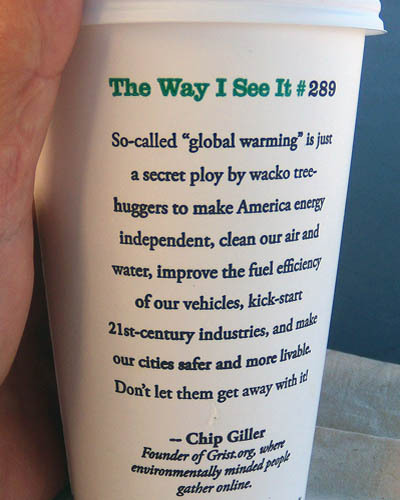
Found this on my coffee cup today:

The Way I See It #289

So-called “global warming” is just

a secret ploy by wacko tree-

huggers to make America energy

independent, clean our air and

water, improve the fuel efficiency

of our vehicles, kick-start

21st-century industries, and make

our cities safer and more livable.

Don’t let them get away with it!

Chip Giller
Founder of Grist.org, where
environmentally-minded people
gather online.

Starbucks Coffee Cup, The Way I See It #289 (global warming)

Look! Someone found the same cup I found!

Add to FacebookAdd to NewsvineAdd to DiggAdd to Del.icio.usAdd to StumbleuponAdd to RedditAdd to BlinklistAdd to TwitterAdd to TechnoratiAdd to Furl

Save


New junk science movie: “Not evil, just wrong”

August 16, 2009

I warned you about it earlierCrank science sites across the internet feature news of another cheap hit on Rachel Carson and science in movie form.

“Not Evil, Just Wrong” is slated for release on October 18. This is the film that tried to intrude on the Rachel Carson film earlier this year, but managed to to get booked only at an elementary school in Seattle, Washington — Rachel Carson Elementary, a green school where the kids showed more sense than the film makers by voting to name the school after the famous scientist-author.

The film is both evil and wrong.

Errors just in the trailer:

  1. Claims that Al Gore said sea levels will rise catastrophically, “in the very near future.”  Not in his movie, not in his writings or speeches.  Not true.  That’s a simple misstatement of what Gore said, and Gore had the science right.
  2. ” . . . [I]t wouldn’t be a bad thing for this Earth to warm up.  In fact, ice is the enemy of life.”  “Bad” in this case is a value judgment — global warming isn’t bad if you’re a weed, a zebra mussel, one of the malaria parasites, a pine bark beetle, any other tropical disease, or a sadist.  But significant warming as climatologists, physicists and others project, would be disastrous to agriculture, major cities in many parts of the world, sea coasts, and most people who don’t live in the Taklamakan or Sahara, and much of the life in the ocean.  Annual weather cycles within long-established ranges, is required for life much as we know it.  “No ice” is also an enemy of life.
  3. “They want to raise our taxes.”  No, that’s pure, uncomposted bovine excrement.
  4. “They want to close our factories.”  That’s more effluent from the anus of male bovines.
  5. The trailer notes the usual claim made by Gore opponents that industry cannot exist if it is clean, that industry requires that we poison the planet.  Were that true, we’d have a need to halt industry now, lest we become like the yeast in the beer vat, or the champagne bottle, manufacturing alcohol until the alcohol kills the yeast.  Our experience with Rivers and Harbors Act of 1899, the Clean Air Acts and the Clean Water Act is that cleaning the environment produces economic growth, not the other way around.  A city choked in pollution dies.  Los Angeles didn’t suffer when the air got cleaner.  Pittsburgh’s clean air became a way to attract new industries to the city, before the steel industry there collapsed.  Cleaning Lake Erie didn’t hurt industry.  The claim made by the film is fatuous, alarmist, and morally corrupt.

    When the human health, human welfare, and environmental effects which could be expressed in dollar terms were added up for the entire 20-year period, the total benefits of Clean Air Act programs were estimated to range from about $6 trillion to about $50 trillion, with a mean estimate of about $22 trillion. These estimated benefits represent the estimated value Americans place on avoiding the dire air quality conditions and dramatic increases in illness and premature death which would have prevailed without the 1970 and 1977 Clean Air Act and its associated state and local programs. By comparison, the actual costs of achieving the pollution reductions observed over the 20 year period were $523 billion, a small fraction of the estimated monetary benefits.

  6. “Some of the environmental activists have not come to accept that the human is also part of the environment.”  Fatuous claim.  Environmentalists note that humans uniquely possess the ability to change climate on a global scale, intentionally, for the good or bad; environmentalists choose to advocate for actions that reduce diseases like malaria, cholera and asthma.  We don’t have to sacrifice a million people a year to malaria, in order to be industrial and productive.  We don’t have to kill 700,000 kids with malaria every year just to keep cars.
  7. “They want to go back to the Dark Ages and the Black Plague.”  No, that would be the film makers.  Environmentalists advocate reducing filth and ignorance both.  Ignorance and lack of ability to read, coupled with religious fanaticism, caused the strife known as “the Dark Ages.”  It’s not environmentalists who advocate an end to cheap public schools.
  8. The trailer shows a kid playing in the surf on a beach.  Of course, without the Clean Water Act and other attempts to keep the oceans clean, such play would be impossible.  That we can play again on American beaches is a tribute to the environmental movement, and reason enough to grant credence to claims of smart people like Al Gore and the scientists whose work he promotes.
  9. “I cannot believe that Al Gore has great regard for people, real people.”  So, this is a film promoting the views of crabby, misanthropic anal orifices who don’t know Al Gore at all?  Shame on them.  And, why should anyone want to see such a film?  If I want to see senseless acts of stupidity, I can rent a film by Quentin Tarantino and get some art with the stupidity.  [Update, November 23, 2009: This may be one of the most egregiously false charges of the film.  Gore, you recall, is the guy who put his political career and presidential ambitions on hold indefinitely when his son was seriously injured in an auto-pedestrian accident; Gore was willing to sacrifice all his political capital in order to get his son healed.  My first dealings directly with Gore came on the Organ Transplant bill.  Gore didn’t need a transplant, didn’t have need for one in his family, and had absolutely nothing to gain from advocacy for the life-saving procedure.  It was opposed by the chairman of his committee, by a majority of members of his own party in both Houses of Congress, by many in the medical establishment, by many in the pharmaceutical industry, and by President Reagan, who didn’t drop his threat to veto the bill until he signed it, as I recall.   Gore is a man of deep, human-centered principles.  Saying “I can’t believe Al Gore has great regard for real people” only demonstrates the vast ignorance and perhaps crippling animus of the speaker.]

That’s a whopper about every 15 seconds in the trailer — the film itself may make heads spin if it comes close to that pace of error.

Where have we seen this before?  Producers of the film claim as “contributors” some of the people they try to lampoon — people like Ed Begley, Jr., and NASA’s James E. Hansen, people who don’t agree in any way with the hysterical claims of the film, and people who, I wager, would be surprised to be listed as “contributors.”

It’s easy to suppose these producers used the same ambush-the-scientist technique used earlier by the producers of the anti-science, anti-Darwin film “Expelled!

Here, see the hysteria, error and alarmism for yourself:

Ann McElhinney is one of the film’s producers.  Her past work includes other films against protecting environment and films for mining companies.  She appears to be affiliated with junk science purveyors at the Competitive Enterprise Institute, an astro-turf organization in Washington, D.C., for whom she flacked earlier this year (video from Desmogblog):

Remember, too, that this film is already known to have gross inaccuracies about Rachel Carson and DDT, stuff that high school kids could get right easily.

Anyone have details on McElhinney and her colleague, Phelim McAlee?

More:

Related posts, at Millard Fillmore’s Bathtub:

Please spread the word:

Add to FacebookAdd to NewsvineAdd to DiggAdd to Del.icio.usAdd to StumbleuponAdd to RedditAdd to BlinklistAdd to TwitterAdd to TechnoratiAdd to Furl


Global cooling? That would be good news for the forests

August 12, 2009

Climate change denialists (sorry, Mr. Watts – denialism is what it is) frequently argue that since the peak heat year of 1998, the planet has been cooling, and may be in a long-term trend to a much cooler planet.

Has anyone told the beetles?

Has anyone told the pine bark beetles (Dendroctonus ponderosae) that are devastating North American forests?

Colorado conifers affected by pine bark beetles (brown trees are dead) - image from Chad Crawford,  Homebrewed Christianity

Colorado conifers affected by pine bark beetles (brown trees are dead) - image from Chad Crawford, Homebrewed Christianity

I was interested to find this photo and this post at Homebrewed Christianity, by Chad Crawford.

But my trips to the mountains are always simultaneously joyful and mournful. The story I want to tell is about seeing the effects up close of the North American pine beetle outbreak. It’s devastating the Rocky Mountain forests in the U.S. and Canada and growing exponentially each year. The epidemic is occurring because our winters have not been cold enough to stop the beetles from multiplying. Bark beetles are good for the ecosystem, but not in this amount. The fall colors in our evergreen forests are telling us that global warming is no longer something our kids will face; it’s happening now. And it will accelerate if our forests disappear.

Mr. Watts, it’s not me you have to convince.  There are several millions of beetles in Colorado who must be persuaded the climate is not warming — and they’ll be a tough sell, since a colder climate means death to their future generations.

A greater challenge for you, Mr. Watts:  Not one of those beetles reads your blog.  How will you reach them?

Crawford went to Colorado and saw Fr. Thomas Berry.  Maybe we should buy a ticket to Colorado for Watts.


Climate skeptic shell game: ‘Please don’t read how CO2 amplifies warming’

August 8, 2009

In heated political discussions, I’ve discovered that when people stretch the facts, sometimes they do it to protect their interests; but if they exaggerate and stretch things when the facts are on their side, it’s pathological and you can’t trust them on anything.

As the old joke goes, ‘I once knew a guy who cheated at golf so bad that when he got a hole-in-one, he wrote down “zero” on the score card.’

Scientists at Oregon State University released a study that shows the tilt and wobble of the Earth can trigger ice ages and the ends of ice ages. As you can imagine, climate change skeptics and denialist will jump on this study to say we don’t need to worry about carbon dioxide — ‘warming can’t be blamed on carbon dioxide.’

In fact, Anthony Watts has already done that.

Read the entire press release, and don’t skip over the parts that are important to policy on air pollution and climate change.  The paper indeed says that planetary wobble causes ice ages, and warming between ice ages.  That’s part of the climate change debate, probably a sizable win for climate skeptics.

But they can’t leave well enough alone; the study explicitly warns of the warming effects of human-released CO2.  Watts left out this paragraph:

“Solar radiation was the trigger that started the ice melting, that’s now pretty certain,” said Peter Clark, a professor of geosciences at OSU. “There were also changes in atmospheric carbon dioxide levels and ocean circulation, but those happened later and amplified a process that had already begun.”

Watts left this out, too, and this qualifies the Oregon State study as “alarmist” under usual skeptic rubrics:

Sometime around now, scientists say, the Earth should be changing from a long interglacial period that has lasted the past 10,000 years and shifting back towards conditions that will ultimately lead to another ice age – unless some other forces stop or slow it. But these are processes that literally move with glacial slowness, and due to greenhouse gas emissions the Earth has already warmed as much in about the past 200 years as it ordinarily might in several thousand years, Clark said.

“One of the biggest concerns right now is how the Greenland and Antarctic ice sheets will respond to global warming and contribute to sea level rise,” Clark said. “This study will help us better understand that process, and improve the validity of our models.”

Peter Clark of Oregon State and his associates published an important study in Science on Friday.  The study points to variations in the usual 23-degree tilt of the Earth’s access as triggers for glaciation and retreat of glaciers, over time.  The study poses important questions, such as:  Has human contribution to greenhouse gases prevented cooling in the past two centuries?  The study offers potential insights into research into climate change and human contributions to climate change.

The study in no way exonerates carbon dioxide from implication as a major, human-contributed component to the mix of factors driving climate change in the 21st century.  The study is really pretty cool; it should be fodder for geography and environmental science classes this fall, and it should be one factor in the discussion over warming and what we need to do about it.

Watch:  Some will try to make it the latest political shuttlecock instead.

Here’s the full press release:

8-6-09

Media Release

Long debate ended over cause, demise of ice ages – may also help predict future

CORVALLIS, Ore. – A team of researchers says it has largely put to rest a long debate on the underlying mechanism that has caused periodic ice ages on Earth for the past 2.5 million years – they are ultimately linked to slight shifts in solar radiation caused by predictable changes in Earth’s rotation and axis.

In a publication to be released Friday in the journal Science, researchers from Oregon State University and other institutions conclude that the known wobbles in Earth’s rotation caused global ice levels to reach their peak about 26,000 years ago, stabilize for 7,000 years and then begin melting 19,000 years ago, eventually bringing to an end the last ice age.

The melting was first caused by more solar radiation, not changes in carbon dioxide levels or ocean temperatures, as some scientists have suggested in recent years.

“Solar radiation was the trigger that started the ice melting, that’s now pretty certain,” said Peter Clark, a professor of geosciences at OSU. “There were also changes in atmospheric carbon dioxide levels and ocean circulation, but those happened later and amplified a process that had already begun.”

The findings are important, the scientists said, because they will give researchers a more precise understanding of how ice sheets melt in response to radiative forcing mechanisms. And even though the changes that occurred 19,000 years ago were due to increased solar radiation, that amount of heating can be translated into what is expected from current increases in greenhouse gas levels, and help scientists more accurately project how Earth’s existing ice sheets will react in the future.

“We now know with much more certainty how ancient ice sheets responded to solar radiation, and that will be very useful in better understanding what the future holds,” Clark said. “It’s good to get this pinned down.”

The researchers used an analysis of 6,000 dates and locations of ice sheets to define, with a high level of accuracy, when they started to melt. In doing this, they confirmed a theory that was first developed more than 50 years ago that pointed to small but definable changes in Earth’s rotation as the trigger for ice ages.

“We can calculate changes in the Earth’s axis and rotation that go back 50 million years,” Clark said. “These are caused primarily by the gravitational influences of the larger planets, such as Jupiter and Saturn, which pull and tug on the Earth in slightly different ways over periods of thousands of years.”

That, in turn, can change the Earth’s axis – the way it tilts towards the sun – about two degrees over long periods of time, which changes the way sunlight strikes the planet. And those small shifts in solar radiation were all it took to cause multiple ice ages during about the past 2.5 million years on Earth, which reach their extremes every 100,000 years or so.

Sometime around now, scientists say, the Earth should be changing from a long interglacial period that has lasted the past 10,000 years and shifting back towards conditions that will ultimately lead to another ice age – unless some other forces stop or slow it. But these are processes that literally move with glacial slowness, and due to greenhouse gas emissions the Earth has already warmed as much in about the past 200 years as it ordinarily might in several thousand years, Clark said.

“One of the biggest concerns right now is how the Greenland and Antarctic ice sheets will respond to global warming and contribute to sea level rise,” Clark said. “This study will help us better understand that process, and improve the validity of our models.”

The research was done in collaboration with scientists from the Geological Survey of Canada, University of Wisconsin, Stockholm University, Harvard University, the U.S. Geological Survey and University of Ulster. It was supported by the National Science Foundation and other agencies.

About the OSU College of Science: As one of the largest academic units at OSU, the College of Science has 14 departments and programs, 13 pre-professional programs, and provides the basic science courses essential to the education of every OSU student. Its faculty are international leaders in scientific research.

Watts did note the abstract of the paper, at Science (to get the full text, you must be a subscriber or pay a high fee for the one article):

Science 7 August 2009:
Vol. 325. no. 5941, pp. 710 – 714
DOI: 10.1126/science.1172873

Research Articles

The Last Glacial Maximum

Peter U. Clark,1,* Arthur S. Dyke,2 Jeremy D. Shakun,1 Anders E. Carlson,3 Jorie Clark,1 Barbara Wohlfarth,4 Jerry X. Mitrovica,5 Steven W. Hostetler,6 A. Marshall McCabe7

We used 5704 14C, 10Be, and 3He ages that span the interval from 10,000 to 50,000 years ago (10 to 50 ka) to constrain the timing of the Last Glacial Maximum (LGM) in terms of global ice-sheet and mountain-glacier extent. Growth of the ice sheets to their maximum positions occurred between 33.0 and 26.5 ka in response to climate forcing from decreases in northern summer insolation, tropical Pacific sea surface temperatures, and atmospheric CO2. Nearly all ice sheets were at their LGM positions from 26.5 ka to 19 to 20 ka, corresponding to minima in these forcings. The onset of Northern Hemisphere deglaciation 19 to 20 ka was induced by an increase in northern summer insolation, providing the source for an abrupt rise in sea level. The onset of deglaciation of the West Antarctic Ice Sheet occurred between 14 and 15 ka, consistent with evidence that this was the primary source for an abrupt rise in sea level ~14.5 ka.
1 Department of Geosciences, Oregon State University, Corvallis, OR 97331, USA.
2 Geological Survey of Canada, 601 Booth Street, Ottawa, Ontario K1A 0E8, Canada.
3 Department of Geology and Geophysics, University of Wisconsin, Madison, WI 53706, USA.
4 Department of Geology and Geochemistry, Stockholm University, SE-10691, Stockholm, Sweden.
5 Department of Earth and Planetary Sciences, Harvard University, Cambridge, MA 02138, USA.
6 U.S. Geological Survey, Department of Geosciences, Oregon State University, Corvallis, OR 97331, USA.
7 School of Environmental Science, University of Ulster, Coleraine, County Londonderry, BT52 1SA, UK.

Supporting online material, including a solid discussion of methods and several charts that are not contained in the full publication, is available, free, in .pdf form.  Warning to creationists:  This is heavy on science using radioactive isotopes for dating.  For that matter, it’s loaded with a lot of other science that climate change skeptics generally dismiss as “computer simulation” instead of hard data.  How will they treat this study?  Skeptically?  Don’t bet on it.

Resources:

Share this story and the science:

Add to FacebookAdd to NewsvineAdd to DiggAdd to Del.icio.usAdd to StumbleuponAdd to RedditAdd to BlinklistAdd to TwitterAdd to TechnoratiAdd to Furl


Christian environmental stewardship: Disciples of Christ and the Alverna Covenant

August 5, 2009

I learned something new tonight.  The Disiciples of Christ formally adopted wise environmental stewardship as a denominational goal in 1981.

History of the Alverna Covenant

The Alverna Covenant was written by members of the Task Force on Christian Lifestyle and Ecology of the Christian Church (Disciples of Christ) while meeting at Alverna Retreat Center, a Franciscan retreat in Indianapolis, Ind. The name has added significance. Alverna is named for Mt. Alverna in Italy, the mountain retreat given to Francis of Assisi. Francis is honored for his concern for the care of and relatedness of all creation. The 800th anniversary of Francis’ birth was celebrated in 1981, the year the Alverna Covenant was first introduced at the General Assembly of the Christian Church (Disciples of Christ).

The Alverna Covenant

Whereas:

  • God has created the world with finite resources;
  • God has given to us the stewardship of the earth;
  • God has established order through many natural cycles.

And it is evident that:

  • We are consuming resources at a rate that cannot be maintained;
  • We are interrupting many natural cycles;
  • We are irresponsibly modifying the environment through consumption and pollution;
  • We are populating the earth at a rate that cannot be maintained;

As a member of the human family and a follower of Jesus Christ, I hereby covenant that:

  • I will change my lifestyle to reduce my contribution to pollution;
  • I will support recycling efforts;
  • I will search for sustainable lifestyles;
  • I will work for public policies which lead to a just and sustainable society;
  • I will share these concerns with others and urge them to make this Covenant.
  • What other denominations have statements on wise resource stewardship? What do they say?

    Tip of the old scrub brush to Darrel Manson, who writes at Hollywood Jesus.

    Resources:


    India accepts climate junk science; U.S. suffers

    July 25, 2009

    It would be good news were it not so bad:  India, usually considered a threat to U.S. dominance in science, has turned its back on climate science and instead, citing junk science claims, rejected overtures to reduce pollution that affects climate.  India appears to have fallen victim to the hoaxters who claim climate change is no big deal.

    From the Financial Times:

    A split between rich and poor nations in the run-up to climate-change talks widened on Thursday.

    India rejected key scientific findings on global warming, while the European Union called for more action by developing states on greenhouse gas emissions.

    Jairam Ramesh, the Indian environment minister, accused the developed world of needlessly raising alarm over melting Himalayan glaciers.

    He dismissed scientists’ predictions that Himalayan glaciers might disappear within 40 years as a result of global warming.

    “We have to get out of the preconceived notion, which is based on western media, and invest our scientific research and other capacities to study Himalayan atmosphere,” he said.

    As if the atmosphere of the Himalayan range is unaffected by emissions from Europe or Asia.  As if the glaciers in the Himalayas, and the snowfall,  and the water to India’s great rivers, come independent from the rest of the world.

    Deadly air pollution obscures the India Gate, New Delhi, India, November 2008 - NowPublic.com

    Deadly air pollution obscures the India Gate, New Delhi, India, November 2008 - NowPublic.com

    It’s interesting to see these issues play out politically.   India and China both understand that the U.S. and Europe have much more to lose from climate change than either of those nations.  Climate damage to the U.S. wheat belt, for example, would chiefly close off U.S. production of wheat for export, opening markets for others — like India and China.  Critically, such damage also hurts U.S. ability to offset balance of payments issues, providing economic and finance advantages to China’s banks.  U.S. ports are much more vulnerable to climate change damage, from increase storms and changing ocean levels, than are ports in India and China — and there are more ports that are vulnerable in the U.S. and Europe.

    India’s inaction and recalcitrance should not be used as justification for the U.S. to do nothing, thereby slitting its own patriotic throat.

    But watch:  Climate denialist blogs, “hate-America-first” outlets like World Net Daily, and Osama bin Laden will hail India’s inaction.

    Let’s hope cooler heads prevail, lest we run out of cooler heads.

    Shake of the old scrub brush to Brown Hell and Watt’s Up With That.

    If this is important to you, please share it; click on the button you choose below.

    Add to FacebookAdd to NewsvineAdd to DiggAdd to Del.icio.usAdd to StumbleuponAdd to RedditAdd to BlinklistAdd to TwitterAdd to TechnoratiAdd to Furl


    News flash: Texas has a second natural lake!

    July 20, 2009

    Years ago, in Virginia, I had learned that Virginia had only one natural lake, the Great Dismal Swamp.  Accompanying that chunk of information in that lecture was that Texas had only two natural lakes.

    But upon arriving in Texas, I could find reference to only one natural lake, Caddo, and it had ceased being fully natural when its maintenance fell to a dam.

    What happened to Texas’s second natural lake?

    A Google search right now on “Texas +’natural lake'” produces ten listings on the first page, all of them pointing to the fact that Texas has just one natural lake.  Here are the first five:

    I have found a second natural lake in Texas. It’s not a new discovery at all — it’s just a case of people not having the facts, and overlooking how to find the truth.  It’s especially difficult when the lake hides itself.

    Our testing coordinator at Molina High School, Brad Wachsmann, spins yarns that belie his youth.  In the middle of one yarn last year, corroborated by other yarns, he mentioned that he has family in Big Lake, Texas; and he described visiting and having relatives urge people to run out and see the lake since it’s rebirth in torrential rains.

    “A second natural lake in Texas?” I asked.  Wachsmann knew the drill.  Yes, Big Lake is a natural lake in Texas, and yes, people forget about it.

    Texas teachers, listen to your testing coordinators, okay?

    All of this came to mind reading the Austin American-Statesman, still a bastion of great journalism despite problems in the newspaper industry.  On Monday, July 7, the paper ran a story and an editorial about the clean up of the oil industry refuse that killed the shoreline of part of the lake; the springs that once fed the lake have mostly gone dry, but that’s likely due to agricultural water mining.

    It’s a story of boom and bust, environmental degradation for profit, and eventual recovery we hope.

    Looking at the landscape that surrounds the Reagan County seat, you wonder whether the name Big Lake was somebody’s idea of joke. It’s dry and dusty, where the flora sprouts reluctantly and lives precariously.

    Yet, the West Texas town of Big Lake got its name from a natural lake that was fed by springs that have long since gone dry. While the area may not fit everyone’s definition of photogenic, it has its own brand of charm – charm that could be enhanced if the damage done to the fragile ecosystem by salt spills were reversed or even minimized.

    As the American-Statesman’s Ralph K.M. Haurwitz reported in Monday’s editions, the University of Texas and Texas A&M systems have benefited from the $4.4 billion in royalty payments and mineral income produced by its West Texas acreage since Santa Rita No. 1 well came in on May 28, 1923.

    The salt water byproduct of oil and natural gas production, however, contaminated 11 square miles near Big Lake, killing most everything that grows. The lack of vegetation allows wind and water erosion.

    Hey, it gets better.  This is real Texas history, real American history — you can’t make this stuff up.  Haurwitz’s article talks about the heritage of Texas education.   Remember that old story about setting aside certain sections of townships to help fund education in lands on the American frontier?  Texas wasn’t a public lands state as farther west, but it still reserved sections of land for the benefit of education.

    Rose petals blessed by a priest?  I’ll wager the priest didn’t make the trip to the top of the derrick.  Haurwitz wrote:

    BIG LAKE — Investors appealed to the patron saint of impossible causes when oil drilling began on University of Texas System land in 1921. It didn’t hurt.

    Santa Rita No. 1 blew in on May 28, 1923, after rose petals blessed by a priest were scattered from the top of the derrick at the behest of some Catholic women in New York who had purchased shares in the Texon Oil and Land Co., which drilled that first well.

    Since then, the UT System’s 2.1 million acres in West Texas have produced $4.4 billion in royalty payments and other mineral income for the Permanent University Fund, an endowment that supports the UT and Texas A&M University systems.

    But this long-running bonanza for higher education exacted a price from the remote, semiarid landscape where it all began. Millions of barrels of salt water, a byproduct of oil and natural gas production, contaminated 11 square miles, or more than 7,000 acres, killing virtually all vegetation and leaving the land vulnerable to wind and water erosion. Hundreds of mesquite stumps with three feet of exposed roots testify to the dramatic loss of topsoil.

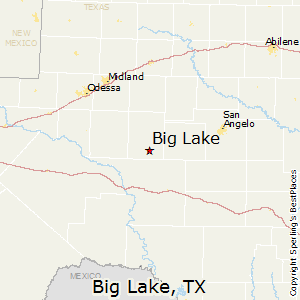
    Texas, and Big Lake - from BigLakeTx.com

    Where in Texas is Big Lake?

    The town of Big Lake is just north of the lake itself, on State Highway 137 running north and south, and U.S. Highway 67 running east and west, approximately 65 miles west of San Angelo.   Big Lake sits about 10 miles north of Interstate 10, and about 75 miles south of Interstate 20.  Big Lake calls itself “the gateway to the Permian Basin.”

    Big Lake is the home of Reagan County High School.  Jim Morris was baseball coach for the Reagan High Owls when his team persuaded him to try out for a major league baseball team.  His story was chronicled, with some artistic license, in the Disney movie “Rookie.”

    Land managers are working to stop erosion on the often-dry shores of Big Lake using any trick they can find.  One trick:  Plant salt grass.

    Salt grass?  Along Texas’s Gulf Coast, there are a few species of grass that, while not halophytes, are at least salt tolerant.  Salt grass.  This grass made it profitable to graze cattle on what would otherwise have been unproductive land in the Texas cattle boom.  This role in Texas history is memorialized in the Salt Grass Steakhouse chain, now found in five states.

    And if planting salt grass works to control erosion, it will help clean up a large part of Texas other natural lake, Big Lake.

    Big Lake’s being wet or dry is a whim of local climate.  You could say that half of all of Texas’s natural lakes are now dry as a result of continued warming; you could say that two good gully-washers or toad-stranglers could restore water to half of Texas’s natural lakes.

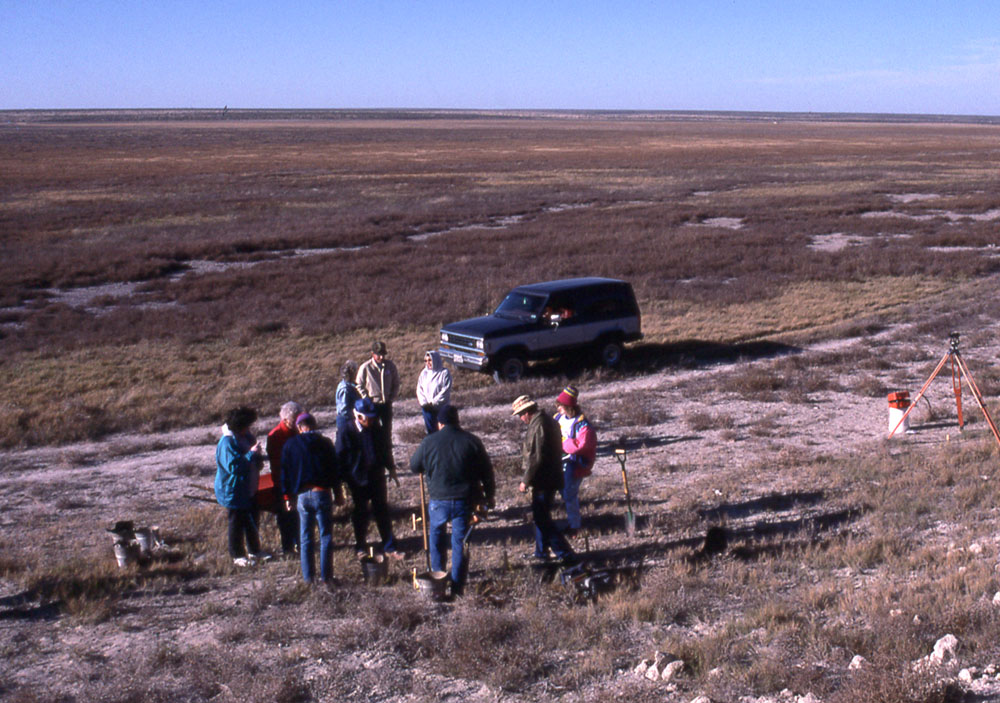
    Big Lake Playa, from NightOwl Bakery and Roastery in Big Lake, Texas

    Field crew meeting at the outset of the 1992 excavations at the Big Lake Bison Kill site. The dry bed of Big Lake stretches for miles in the background. Big Lake is an intermittent saline lake or playa, an uncommon landform on the Edwards Plateau. Photo by Larry Riemenschneider, Concho Valley Archeological Society.

    More details about Big Lake and prehistory, below the fold.

    Read the rest of this entry »


    Unintentional climate change humor at the Washington Post

    July 15, 2009

    Despite the woes afflicing the daily press, The Washington Post still makes space for humor, even on its opposite-editorial page.  Here’s a humorous piece on cap-and-trade legislation to fight climate change, published I would guess with an eye to the date of July 14, the anniversary of Bastille Day.  Is it unintentional humor?

    Unemployed?  Let ’em eat airplane-hunted caribou soaked in petroleum, eh, Sarah?

    Palin’s piece doesn’t ramble as much as her press conference on quitting the governor’s chair, but it makes about an equal amount of sense.  While whining that the current legislative proposal is the wrong way to go, Palin doesn’t hint at what might be the right way to go to reduce air pollution, help prevent global warming, and keep energy available.

    Churchill noted that democracy is the worst form of government ever devised by men, except, of course, for all the others.  Obama supports cap-and-trade legislation that is the worst thing we could do, except for anything else proposed, and especially except for doing nothing at all.

    Resources:


    Hoax exposed: “The Great Global Warming Swindle’s” swindle

    July 14, 2009

    Nicely done, too, I think; this is one more alarm bell to tell us why there will be no Nobel Peace Prize for global warming deniers.

    From the same guy who so brilliantly brings us the Global Warming Crock of the Week:

    Tip of the old scrub brush to Tim Lambert at Deltoid.


    Insurance experts: Get ready for climate change now

    July 12, 2009

    Climate change denialism is an astounding ball of contradictions and conundrums.

    For example, while most denialists claim to be free-market devotees, they pointedly ignore market indications that climate change is real, aggravated by human actions (and inaction), and that humans can do anything about it.

    Look at the insurance industry.  I’ve noted often that, here in Texas, we pay higher premiums on home insurance because climate change has produced worse weather, which costs insurance companies a lot.  Insurance company actuaries are paid to predict the future, reliably.  If they fail, insurance companies die quickly.

    Weather-related catastrophes, such as wildfires, are posing a serious threat to the insurance industry worldwide. (Photograph source: John McColgan, Bureau of Land Management, Alaska Fire Service.) Caption from Berkeley Lab Research News

    Weather-related catastrophes, such as wildfires, are posing a serious threat to the insurance industry worldwide. (Photograph source: John McColgan, Bureau of Land Management, Alaska Fire Service.) Caption from Berkeley Lab Research News

    The “market” girds itself to fight climate change that governments are not going to move fast enough to prevent.  This will cost you a lot of money.

    A good place to go for information about climate change and how it affects is the Lawrence Berkeley Laboratories, a group that studies the future and is no longer limited (if it ever was) to nuclear future issues.

    Insurance in a Climate of Change, The Greening of Insurance in a Warming World, is loaded with information about insurance industry calculations of what the future is, and how insurance companies might and should react to the changes.

    How relevant are weather-related natural disasters for insurers, and is there any evidence that the situation is worsening?

    Globally, we are seeing about $80 billion/year in weather-related economic losses, of which $20 billion (about a quarter) are insured. This is like a “9/11” every year. Weather-related losses represent about 90% of all natural disaster losses, and the data I just cited do not include an enormous amount of aggregate losses from small-scale or gradual, non-catastrophic events (e.g., lightning, soil subsidence, gradual sea-level rise).

    Inflation-adjusted economic losses from catastrophic events rose by 8-fold between the 1960s and 1990s and insured losses by 17-fold. Losses are increasing faster than insurance premiums. The insured share of total losses has increased dramatically in recent decades, and variability is increasing (a key trouble sign for risk-wary insurers). Weather-related catastrophes have clearly visible adverse effects on insurance prices, and availability. Of particular concern are the so-called “emerging markets” (developing countries and economies in transition”, which already have $375 billion per year in insurance premiums (about 12% of the global market at present, but rising). They are significantly more vulnerable to climate change than are industrialized countries. Emerging markets are the center of growth for the industry, yet they are also the center of vulnerability.

    Increased exposures are surely influenced—and no doubt heavily in some areas—by rising demographic and socioeconomic exposures. Yet, the rise in losses has outpaced population, economic growth, and insurance penetration. The science of “attribution analysis” is still in primitive stages, and thus we cannot yet quantify the relative roles of global climate change and terrestrial human activities. Some have prematurely jumped to the conclusion [PDF] that demographic trends explain the entire rise in observed losses. In the year 2005, three independent refereed <!– –>scientific articles drew linkages between hurricane trends and climate change.

    Denialists claim weather stations are badly-placed, and so we need not worry about climate change since warming can’t accurately be measured — never mind the worldwide rise in temperatures of atmosphere and oceans.   Denialists claim that the greenhouse effect cannot be blamed on carbon dioxide emissions since carbon dioxide is such a small proportion of the gases in the atmosphere, apparently wholly unaware of the greenhouse effect in atmospheric gases, or unaware that only a thin pane of glass makes a greenhouse work.  Denialists claim that polar bears do not decline precipitously, yet, so all wildlife will be unaffected – nevermind the dramatic shifts in migration patterns of birds and migrating mammals, and the dramatic shift in the arrival of spring.  Denialists claim that Boston Harbor has survived 300 years of human development, so all harbors can survive any increase in ocean levels, nevermind the pending disasters of islands sinking out of site and destroying entire nations in the South Pacific, and never mind the drownings in Bengla Desh at every cyclone.

    Most denialists rent apaartments or own homes.  Denying the insurance increases will be more difficult, though I fully expect Anthony Watts and Co. will deny that the insurance company actions and studies of global warming are warranted or accurate.

    Is there any good news in all of this?

    By all means. Insurers need to look no farther than their roots as founders of the original fire departments, early advocates for building codes and fire safety, etc. That is to say that insurers’ history is all about risk management and loss prevention. The same thinking can apply in the case of climate change. Just as insurers fought fire risks through encouraging fire safety, better modeling, and fire suppression, so too can they be part of the climate change solution. This can take many forms, ranging from providing new insurance products (e.g., for carbon trading or energy savings insurance [PDF]), to promoting energy-efficient and renewable technologies [PDF] that also help prevent everyday losses, to engaging in the broader policy discussion on climate change. Insurers can also be part of improving the underlying science of climate change, modeling, and impacts assessment. We maintain an extensive compilation of examples of how leading insurers are stepping into the arena in a constructive manner.

    Alas, there is no insurance against the dithering of climate change denialists.

    Go, with all thy internet getting, get thee wisdom.


    Abitibi restructuring – recycling hangs by a thread

    July 10, 2009

    Texas being Texas, recycling is not a big deal.  Oh, it makes a lot of money where it’s done, but there are cities where officials and citizens are happier making big, nasty landfills, rather than recycling to save money.

    Across Texas one company has set up voluntary recycling deals with schools that both get some recycling done in cities, and provide money to the schools.  That company, Aabitibi, now AbitibiBowater, is in bankruptcy.  In Dallas, schools have been bouncing the recycling bins off of school grounds due to an ordinance that requires the bins to be hidden by fences (they are not that unattractive).

    New guy on watch to finish the restructuring.  Good luck!

    Tip of the old scrub brush to Waste News.


    Godwin’s Law overload: Warming denialist calls water conservation “Nazi”

    June 30, 2009

    You couldn’t sell a fictional story where people are this nutty.

    Go see. The abominable Steve Milloy — a guy so wacky he cannot be parodied (take that, Poe!) — calls water conservation “Nazi.” He complains about a provision in the Waxman-Markey Clean Energy Act that encourages innovation in water conservation devices.

    Milloy flouts Godwin’s Law right off the bat.  You can’t make this stuff up.

    And — may God save us from these people — Milloy has followers.  Check out the graphic here, with Obama portrayed as a marching Brownshirt.  It’s almost too stupid to be racist, but it’s certainly incendiary.  He even admits he thinks saving water is a good idea, and he’d like to have one of the devices complained about. (This guy knows he’s in error — he censors posts that question any part of his rant.) See the ugly meme expand, here.

    Girl Scout/EPA water conservation badge -EPA image

    Girl Scout/EPA water conservation badge -EPA image

    Water conservation equals flag-waving in America, and has done so for a at least a hundred years. Those of us who grew up in the Intermountain West may be a little more attuned to the drive — Hoover Dam, Glen Canyon Dam, Flaming Gorge Dam, the Central Arizona Project, the Central Utah Project, the Colorado River aqueduct that carries water to Los Angeles, it’s impossible to live in the West and not be conscious of water’s value, its precious qualities.

    Today, the many benefits of controlling water in this way are evident in the extensive development that has taken place throughout the West over the past 100 years.  Huge cities have been created and millions of people live, work, and recreate in this desert region.  But, as the West continues to grow, we must face the problem of continually increasing demands on a finite supply of water.  This includes human population needs and the needs of the environment.

    But one doesn’t need to be from the cold northern desert of southern Idaho to figure out that saving water is a good idea.

    Most homeowners would like to save money.  Americans spend between $600 and $1600 for washing machines that cut water usage by up to 75% (we just replaced our two-decades-old Maytag with a water conserving front-loader).  Go to the appliance stores and listen to the conversations.  People who could better afford the $200 models discuss how they will cut costs elsewhere to get the water saving versions — because their water bills are so high.

    Much of of the rest of America works to conserve water out of necessity. Texas cities have mandatory water conservation laws, like Temple, Richwood, Austin and Dallas.  Texas rural areas fight to save water, too.  California cities demonstrate that water conservation works, saving investments in ever-grander and more environmentally-damaging water importation schemes, and allowing for population growth where water shortages would otherwise prohibit new homes.  Water conservation is a big deal across the nation:  In Raleigh, North Carolina; in Seminole County, Florida;  in Nebraska; in the State of Maryland.  An April drive across Wisconsin a few years ago convinced me it is the most waterlogged state in the nation, Louisiana notwithstanding — but even in Wisconsin, wise people work to conserve water for agriculture, one of the state’s leading industries and employers.

    What’s the next step up from Godwin’s Law?  These guys like Milloy and his camp followers can only get crazier, benignly, if they head to the meadow and graze with the cattle.  Crazier non-benignly?  Let’s not go there.

    But let us address the odious comparison to Nazis directly.  In World War II, when freedom was on the line, there was a drive to conserve resources in America.  Americans grew their own vegetables in Victory Gardens.

    Poster encouraging patriotic conservation, for the war effort in World War II

    Poster encouraging patriotic conservation, for the war effort in World War II

    Americans collected scrap metal, iron, copper and aluminum, to be made into war machines to save the world.  Americans conserved rubber and gasoline by restricting automobile use.  There was the famous poster, “When you ride alone, you ride with Hitler.”  Conservation was understood to be a patriotic response to the challenges the nation faced.

    Bill Maher updated the poster with his 2005 book, When You Ride Alone You Ride With Bin Laden. Maher urged civic actions like those that helped the U.S. during World War II, including conservation of gasoline and other resources.   Maher understands that wise use of resources is something a people should strive for, especially when in competition with other nations, either in a hot war or in trade or influence.  Conservation remains a patriotic behavior, and opposing conservation remains a call to support the enemies of America, in war, in trade, in policies.

    Update of the World War II poster, for our times.  Image from Barnes and Noble

    Update of the World War II poster, for our times. Image from Barnes and Noble

    It’s not just a coincidence that Boy Scouts and Girl Scouts (in conjunction with the U.S. EPA for the past several years) learn water conservation as integral parts of their programs, chartered by Congress, to promote civic leadership in America’s youth.  Those groups charged with teaching actual patriotism understand conservation to be a high duty, a high calling, something that all patriots do.

    So, let’s face it.  If you crap on a 6-gallon flushing toilet, you crap with Bin Laden.  When you shower with a non-flow restricting shower head, you shower with Bin Laden.

    Yes, it sounds creepy.  It is.

    You hope Milloy and the other Neobrownshirts* have parents or other family to pull them back from the brink, but then you see Congress.

    Yeah, the Nazis were the Brownshirts, in Germany.  In Italy the fascists wore black shirts.  Brown is generally the opposite of green, in political and business parlance — for example, development of a previously undeveloped piece of property is “greenfield development,” while redevelopment of a previously-developed parcel is “brownfield development.”  Since Milloy is opposed to anything “green,” I think it only fair that his shirt color match his politics.  It’s his choice, after all.

    Well, what about you, Climate Change Skeptics?

    "Well, what about you, Climate Change 'Skeptics?'"


    Jesus would have wept, but He was dehydrated from the heat

    June 30, 2009

    This rather captures it well, don’t you think?

    But if you watched the debate [on climate change fighting legislation in the U.S. House of Representatives] on Friday, you didn’t see people who’ve thought hard about a crucial issue, and are trying to do the right thing. What you saw, instead, were people who show no sign of being interested in the truth. They don’t like the political and policy implications of climate change, so they’ve decided not to believe in it — and they’ll grab any argument, no matter how disreputable, that feeds their denial.

    Indeed, if there was a defining moment in Friday’s debate, it was the declaration by Representative Paul Broun of Georgia that climate change is nothing but a “hoax” that has been “perpetrated out of the scientific community.” I’d call this a crazy conspiracy theory, but doing so would actually be unfair to crazy conspiracy theorists. After all, to believe that global warming is a hoax you have to believe in a vast cabal consisting of thousands of scientists — a cabal so powerful that it has managed to create false records on everything from global temperatures to Arctic sea ice.

    Yet Mr. Broun’s declaration was met with applause.

    Those are the words of Nobel Prize-winning economist Paul Krugman.  If Krugman gets a second Nobel for following the IPCC’s Nobel-winning advocacy, Rep. Broun will cite that as evidence of conspiracy, probably claim it as a conspiracy of “smart, intelligent people.”

    See all of Krugman’s column in the New York Times.