Signs of life: Eagles on Highway

July 30, 2015

One of our local pharmacists travels on vacations, and takes photos.  Pharmacies being what they are, people wait in line with nothing to do but count ticks on the clock.  No one takes a book to the pharmacy to wait.

But the guy, Mark de Zeeuw, has a good sense of customer service.  He got one of those photo frames that had a video display to show photos.  Over time, it morphed to an extra computer screen, and probably an old computer (don’t know for sure).

At the Tom Thumb supermarket in Duncanville, Texas, customers get to see photos of the pharmacist’s travels.  A lover of travel and photography, and a too-frequent customer at the pharmacy, I think I may have seen every photo on that harddrive.  Many of them are very good. He travels to Alaska and across the American west, and he’s got at least one telephoto that works well on wildlife — this I know from watching the photos.  I’ve never discussed it with the guy (who is always busy working on prescriptions, or fighting with insurance companies over the phone; Tom Thumb’s being a large company, there may be other pharmacists on duty at the time).

Okay, I’m shy.  I’ve wanted to ask him for copies of several of the photos to share, one in particular.  It’s a nice shot of the yellow warning/information signs you see at the side of a highway.  With a bright blue sky in back, and obviously a lot of unpopulated territory, it says “Eagles On Highway.”  I broke the shyness enough to learn it was a photo from eastern Utah.

Surely someone else noticed the sign?

Yep! Wonders of Google, Bing and flickr:  Here’s a shot I found at Wanderlust Cafe:

“Eagles on Hwy.” Sign on eastbound Interstate 70, near the Moab turnoff in Utah. Photo by Lou Ann Granger, via Wanderlust Cafe

Out on Interstate 70, the rabbits and occasional ground squirrel, lizard or coyote fall victim to speeding cars in the night.  In the daylight, carrion eaters — including eagles — clean up the road.  Alas, eagles have not been bred to recognize those vehicles, tiny in the distance, rush at them at 70 miles per hour. Worse, it’s a violation of federal law and regulations to kill the eagles (few are ever cited for accidents).

Local authorities put up signs warning drivers of this odd hazard: “Eagles on Highway.” Drivers are supposed to slow down, be wary, and avoid hitting the eagles.

Others grew curious about the signs, too. The Deseret News in Salt Lake City explained back in 1990 that six of the signs were put up, in hopes of reducing kills of immature golden eagles.

They have to rank as the most unusual highway signs anywhere in the state. But preliminary indications are the six “Eagles on Highway” warning signs in central Utah are doing the job.

Not a single golden eagle was struck by a car during the 1989-90 winter season.In the two years previous, 30 golden eagles were killed and another 11 crippled by automobiles on a stretch of I-70 between the Colorado border and the San Rafael Swell.

“We don’t know whether it’s because the mild winter has spread the birds around more or whether it’s because the prairie dog population is down and the birds have moved elsewhere, or what,” said Miles Moretti, regional supervisor for the Division of Wildlife Resources.

“What we do know is we’ve received a lot of comments from people seeing signs and watching the birds and being aware of the problem. From a public awareness standpoint the program is a success.”

I wonder if we can track down someone in authority with numbers to show the signs are working after 25 years.  And maybe I can get a copy of pharmacist de Zeeuw’s photo here — his is better, I think.

More:

Read the rest of this entry »


Powers of Ten – Charles and Ray Eames’ brilliant, before-its-time film

May 23, 2015

Images from

Images from “Powers of Ten,” 1977 edition. From IconEye

AMNH’s “The Known Universe” is a cool film. Putting up that last post on the film, I looked back and noted that when I had previously written about the brilliant predecessor films from Charles and Ray Eames, “Powers of Ten,” the Eames films were not freely available on line.

That’s been fixed.

I like to use films like this as warmups to a year of history, and as a reminder once we get into studying the history of space exploration, of just how far we’ve come in understanding the universe, and how big this place is.

Of course, that means wer are just small parts.

The Eames’s genius showed the scale of things, from a couple picnicking in a park, to the outer reaches of the universe, and then back, zooming into the innermost reaches of a human down to the sub-atomic level.

There’s a series of these films; this one, published on YouTube by the Eames Office, was done in 1977, one of the later versions.

How can you use this in class, teachers? (I recommend buying it on DVD, as I did; better sound and pictures, generally.)

Film information:

Uploaded on Aug 26, 2010

Powers of Ten takes us on an adventure in magnitudes. Starting at a picnic by the lakeside in Chicago, this famous film transports us to the outer edges of the universe. Every ten seconds we view the starting point from ten times farther out until our own galaxy is visible only a s a speck of light among many others. Returning to Earth with breathtaking speed, we move inward- into the hand of the sleeping picnicker- with ten times more magnification every ten seconds. Our journey ends inside a proton of a carbon atom within a DNA molecule in a white blood cell. POWERS OF TEN © 1977 EAMES OFFICE LLC (Available at http://www.eamesoffice.com)

At the Eames Office Youtube site, you may find the film in with Mandarin Chinese, German, and Japanese translations (no Spanish?).  If you’re unfamiliar with the work of this couple — you would recognize much of the stuff they designed, I’m sure — check out a short film on an exhibit on Ray Eames (which has concluded, sadly):

More:

The very recognizable, famous Eames Chair, from Herman Miller. Ideally, you can sit in your Eames Chair while watching

The very recognizable, famous Eames Chair and Ottoman, from Herman Miller. Ideally, you can sit in your Eames Chair while watching “Powers of Ten.” Herman Miller image.


New Appalachian Wildlife Refuge protects very rare species: Mountain Bogs National Wildlife Refuge

May 15, 2015

A 39-acre donation from The Nature Conservancy and a lot of work by the Carolina Mountain Land Conservancy joined to birth a new National Wildlife Refuge in North Carolina.

Welcome the Mountain Bogs National Wildlife Refuge.

Jack-in-the-pulpit, one of the less rare of the rare plants protected by the creation of the Mountain Bogs National Wildlife Refuge in North Carolina. USFWS photo

Jack-in-the-pulpit, one of the less rare of the rare plants protected by the creation of the Mountain Bogs National Wildlife Refuge in North Carolina. USFWS photo

The April 22, 2015, press release from USFWS:

New National Wildlife Refuge Established to Protect Some of Appalachia’s Rarest Places

April 22, 2015

Trout lily blooming at Mountain Bogs National Wildlife Refuge. Credit: Gary Peeples, USFWS.

Trout lily blooming at Mountain Bogs National Wildlife Refuge. Credit: Gary Peeples, USFWS.

Asheville, N.C. – The Mountain Bogs National Wildlife Refuge became America’s 563rd refuge today.

U.S. Fish and Wildlife Service Deputy Director Jim Kurth visited Western North Carolina to announce the establishment of a new national wildlife refuge devoted to the conservation of southern Appalachian mountain bogs, one of the rarest and most imperiled habitats in the United States.  North Carolina is home to 11 refuges; Mountain Bogs Refuge is the first one west of Charlotte.

“The establishment of Mountain Bogs National Wildlife Refuge marks a turning point in the efforts of a number of dedicated partners in preserving this unique and threatened habitat,” said Kurth. “It will provide a focal point for mountain bog conservation in the area, and highlights the importance of our National Wildlife Refuge System in preserving our nation’s spectacular biodiversity for future generations of Americans.”

“While western North Carolina has beautiful swaths of conserved public lands, mountain bogs, which are home to several endangered species, are largely unprotected,” said Mike Oetker, Deputy Regional Director for the Service’s Southeast Region.  “People have worked for decades to conserve these bogs, and creating this refuge was an opportunity to build on that effort in a significant way.”

The Nature Conservancy donated an easement on a 39-acre parcel in Ashe County, the site of Kurth’s visit, which formally establishes the refuge.

“Today’s announcement is the culmination of years of work by conservation partners at the local, state and national level,” said The Nature Conservancy’s Fred Annand, who coordinates the Conservancy’s acquisition work. “Many people have worked together for years to make today a reality. Successful conservation depends on partnership, and that’s certainly the case today.”

Mountain bogs are typically small and widely scattered across the landscape, often isolated from other wetlands. Important to wildlife and plants, mountain bogs are home to five endangered species – bog turtles, green pitcher plant, mountain sweet pitcher plant, swamp pink (a lily), and bunched arrowhead. They also provide habitat for migratory birds and game animals, including mink, woodcock, ruffed grouse, turkey, and wood duck. Bogs are breeding habitat for many species of amphibians, especially salamanders, of which the Southern Appalachians have the greatest diversity in the nation. Bogs also provide key benefits to humans. They have a natural capacity for regulating water flow, holding floodwaters like giant sponges and slowly releasing water to nearby streams decreasing the impacts of floods and droughts.

In addition to The Nature Conservancy, Carolina Mountain Land Conservancy has long been active in bog conservation and has been supportive of establishing the new refuge.

“Southern Appalachian bogs are biodiversity hotspots,” said Kieran Roe, Executive Director at Carolina Mountain Land Conservancy. “But they are disappearing from our region at a rapid rate. Less than 20 percent of the mountain bogs that once existed still remain, so their protection is critical.”

The refuge may eventually grow to 23,000 acres, depending on the willingness of landowners to sell and the availability of funds to purchase those lands. To guide acquisition, and bog conservation in general, the Service has identified 30 sites, or Conservation Partnership Areas, containing bogs and surrounding lands. These sites are scattered across Alleghany, Ashe, Avery, Clay, Graham, Henderson, Jackson, Macon, Transylvania, Wilkes and Watauga counties in North Carolina, and Carter and Johnson counties in Tennessee. The Service will look primarily within these Conservation Partnership Areas to acquire land and/or easements. For those acres that won’t be acquired, the Service will work to support private landowners in their stewardship activities. Funding to acquire land and easements would likely come from the Land and Water Conservation Fund, funded by fees collected from the sale of publicly-owned offshore oil and gas drilling leases.

While some parts of the refuge would likely be too fragile for recreation, the Service anticipates other parts could be open for wildlife-based recreation, including hunting, fishing, wildlife observation and photography, education, and interpretation.

The Service manages national wildlife refuges for the conservation of fish, wildlife and plants. In 1903 President Theodore Roosevelt created the first national wildlife refuge to protect brown pelican breeding grounds on the east coast of Florida. The Refuge System now includes 563 refuges across the nation, protecting more than 150 million acres. It’s the only system of federally-managed lands dedicated to wildlife. For more information, visit www.fws.gov/mountainbogs.

The National Wildlife Refuge System protects wildlife and wildlife habitat on more than 150 million acres of land and water from the Caribbean to the Pacific, Maine to Alaska. Refuges also improve human health, provide outdoor recreation and support local economies. Visit our home page at http://www.fws.gov/refuges. Follow us on Facebook and Twitter.

Our Dallas area trout lilies have all blossomed, weeks ago. Interesting that bog-bound trout lilies share so much in common with their drier land cousins a few thousand miles away.

More:


Cute pictures of polar bears, masking tragedy

March 17, 2015

It came from @planetpics on Twitter.

A beautiful picture of a polar bear cub getting a lift across the water from its mom!  Life on Earth/@planetpics

“A beautiful picture of a polar bear cub getting a lift across the water from its mom!” Life on Earth/@planetpics

Couldn’t help but wonder if that cub will survive the next few months, let alone to adulthood.

Generally, polar bear mothers den on pack ice, and the cub would be kept on the ice while the mother hunted from that platform.  Polar bears can swim, but not well, and not far, usually.  They cannot hunt while swimming.  To eat, they wait on the ice for seals to come up for air, then grab the seals.

Lack of hard ice platforms, pack ice, means mother polar bears can’t hunt to feed their cubs.  While an adult polar bear can swim a distance to find ice, the cubs can’t. And if the adult doesn’t find hard ice, they perish.  Long swims are deadly to cubs.

It’s a cute pic, and we hope momma bear is swimming to an ice platform and can feed that cute little cub so it grows and flourishes.

We know the odds are against it.


Queenstown, New Zealand: “Why we fly,” and what most people never get to see

February 9, 2015

Old buddy Gil Brassard (from the airline days) sent me a slightly different version of this video; this is the YouTube version from “Mr. Goodviews.” It’s shot from the cockpit of a commercial airliner coming into Queenstown, New Zealand:

Details:

Published on Oct 23, 2013

…sometimes what a pilot sees in a day, people won’t see in their lifetimes..
amazing Queenstown, New Zealand.
I invite people of the world to come visit this beautiful country and its people.

It was probably shot with a camera like a GoPro stuck on the window pointing out, in robot mode so the copilot and pilot gave full attention to flying the aircraft, and were not distracted by operating a camera in a cockpit.  I mention this because US Federal Aviation Administration is looking into claims that selfies from cockpits — usually of small planes — may have contributed to accidents in the air.  We may see some bans on shooting such videos in the future.

Enjoy ’em while you can.

Noodling around YouTube, I also found these videos of airplanes in and out of Queenstown, New Zealand.

Landing without the clouds:

Published on Apr 4, 2013

ZQN Baret arrival

And a passenger’s view of take-off and climb-out (longer piece, no music edited in):

Published on Feb 7, 2014

Flying over New Zealand from south to north. Nice views of Lake Wakatipu and Queenstown. Passing over Mount Cook – the highest mountain in New Zealand. Later a landing at Auckland Airport.

Better videos of this route anywhere?

Even cooler videos of other routes?

Can’t say how often I’ve regretted not having a good video camera on my flight from Farmington, New Mexico, to Provo, Utah, in a Cessna, especially coming down Provo Canyon.  But alas, that was before video was even portable . . .


Coffee City? Population seems awfully low

February 6, 2015

Coffee City sign.

Coffee City, Texas

Our friend Jim Stanley posted this on Facebook.

Population count seems too low, doesn’t it?  Must be a pretty tight filter.

Caption these yourself. From the City of Coffee City website.

Caption these yourself. From the City of Coffee City website.

More:


Happy New Year from Yellowstone NP

January 27, 2015

(Yeah, I’m behind. Tell me news.)

New Year’s felicitations from Yellowstone National Park.

The Yellowstone in winter is best, the old timers tell me.  I agree.

Details:

Published on Jan 1, 2015

Winter landscapes in Yellowstone inspire artist and NPS employee Lynn Bickerton Chan. Produced by NPS/Neal Herbert.  600


Yosemite Park’s Dawn Wall climbers: They made it!

January 15, 2015

Tommy Caldwell and Kevin Jorgeson on January 14 completed their free-climb ascent of the 3,000-foot Dawn Wall on El Capitan in Yosemite National Park — labeled the toughest free climb in the world.

Wow. Just wow.

The path up, the Dawn Wall on El Capitan.  San Francisco Chronicle graphic by John Blanchard, on a photo by Nate Ptacek/Patagonia

The path up, the Dawn Wall on El Capitan. San Francisco Chronicle graphic by John Blanchard, on a photo by Nate Ptacek/Patagonia

This interactive piece at the New York Times should give the proper sense of awe for what they’ve done. (If you’re a climber, you may want to get some more technical reports from YosemiteBigWall.com, who contributed to that interactive presentation.)

PBS’s Newshour had among the best reports:


Yosemite Nature Notes: Ghost towns

January 13, 2015

Up on the Tioga Pass, Dana Village, Bennettville and the abandoned Golden Crown Mine tell part of the story of the 1890s gold rush in the Sierra Nevada.

Mining in California, okay. Mining at 11,000 feet in the Sierra Nevada, and staying there all winter?

Great history, geography, and explanation that every U.S. history student should know, about gold rushes, about boom towns, about mining entrepreneurs and investors, about failed enterprises and about the aftermath.

Published on Nov 19, 2014

Sitting on the crest of the Sierra Nevada, Tioga Pass is a gateway to Yosemite’s past. In 1880, a gold and silver rush erupted here, and miners flocked to Tioga Hill in droves.

Today, the ghosts of these miners work can be seen in the stone walls of Dana Village, rusty machinery at Bennettville, and the log cabins of the Golden Crown Mine. Even today’s popular Tioga Road was once a simple wagon road built to access the wealth of minerals that were never found.

It’s another great production by Steven Bumgardner, featuring two National Park Service rangers, Yenyen Chan and Greg Stock.

More:

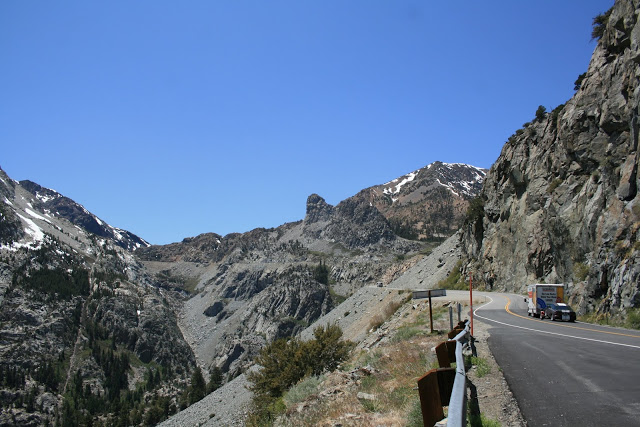
Tioga Road.  Travelers who took this photo made the drive in a large RV -- so you can do it, too.  Photo from stillhowlynntravels

Tioga Road. Travelers who took this photo made the drive in a large RV — so you can do it, too. Photo from stillhowlyntravels

Map showing how to get to Tioga Pass in Yosemite National Park (at the eastern end of the red line).  Map from Undiscovered-Yosemite.com.

Map showing how to get to Tioga Pass in Yosemite National Park (at the eastern end of the red line). Map from Undiscovered-Yosemite.com.


Texas earthquakes, 2014

January 7, 2015

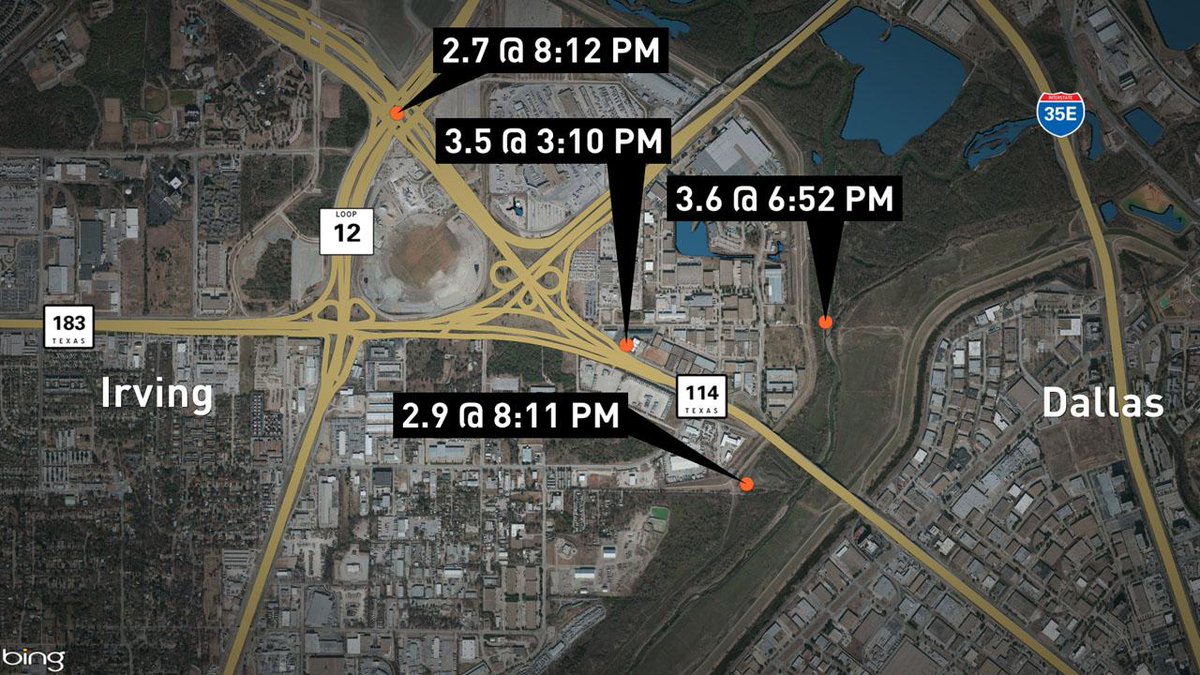
WFAA Channel 8 map of four quakes confirmed by 10:00 p.m. news casts, showing how close the quakes are in proximity to each other and the site of the old Cowboys Football Stadium.

WFAA Channel 8 map of four quakes confirmed by 10:00 p.m. news casts, showing how close the quakes are in proximity to each other and the site of the old Cowboys Football Stadium.

This Tweet from our local NBC TV affiliate sums it up nicely.

North Texas shook yesterday — not big quakes, but a bunch of ’em — and that doesn’t sit well with Texas oil executives, since it seems likely gas and oil drilling, especially hydraulic fracturing (fracking), and especially waste-water reinjection seem to be causes.

I grew up in Utah.  We had quakes you could feel, at least weekly.  Our home sat less than a mile west of the Wasatch Fault.  Many mornings my mother would stand drinking her coffee, looking over the stove and out our kitchen window at Mt. Timpanogos, remarking on the earthquakes.  Most often we couldn’t feel them, but the power and telephone lines that slashed through our $10 million view of the mountain would dance in sine waves during quakes. It was pretty cool.

Along the more famous faults, one rarely comes on more than a couple of quakes a day.

Dallas — more accurately, Irving — is far away from most major faults, and rarely has more than a couple of quakes a year in recent human history.

So this swarm of quakes makes news!

WTVT Channel 11 (CBS) reported:

DALLAS (CBSDFW.COM/AP) – Nine earthquakes, three of them with a 3-point magnitude or greater, rocked North Texas Tuesday into early Wednesday, knocking items off walls, causing cracks to appear in ceilings and generally rattling nerves across the region.

“The last one really shook,” said CBS 11 anchor and reporter Ken Molestina, who felt the the earth move in the White Rock Lake area of Dallas.

The latest quake, reported just before 1 a.m. Wednesday, measured in at a 3.1 magnitude, and was centered near the convergence of State Highway 114, Loop 12, and the Airport Freeway near the old Texas Stadium site in Irving.

Others felt the temblor in the Uptown area of Dallas and as far away as Bedford and Mesquite.

Here’s a list of the quakes in order of when they happened:

7:37 a.m.                    2.3 magnitude

3:10 p.m.                    3.5 magnitude

6:52 p.m.                    3.6 magnitude

8:11 p.m.                    2.9 magnitude

8:12 p.m.                    2.7 magnitude

9:54 p.m.                    1.7 magnitude

10:05 p.m.                  2.4 magnitude

11:02 PM                   1.6 magnitude

12:59 AM                   3.1 magnitude

Rafael Abreu, a geophysicist with the USGS, spoke with NewsRadio 1080 KRLD and said while the Irving earthquakes happened only hours apart, given the strength and intensity, “we’re not calling it an aftershock.”

At last count Tuesday night, there had been 24 or more earthquakes in the Irving area since November 1, 2014.

Jokes fly, too.  Not this much shaking since Elvis toured the area heavily in 1957, some say.

Screen capture of USGS reports of four earthquakes in or near Irving, Texas, on January 6, 2014

Screen capture of USGS reports of four earthquakes in or near Irving, Texas, on January 6, 2014

Recent studies show earthquakes in other areas linked to oil and gas drilling and extraction.  All of these quakes are in close proximity to working wells or wells being drilled.

What’s the Earth trying to tell us?

Details from USGS on biggest quake, January 6, 2014

Details from USGS on biggest quake, January 6, 2014

More:

Historically, Texas has not been a hotbed of earthquake activity, between 1973 and 2012.  Texas Seismicity Map from USGS.

Texas Seismicity, 1973-2012. USGS


Devil’s Tower, Wyoming, and stars at night

January 5, 2015

Tweet from the Wilderness Society. Devil's Tower National Monument, in Wyoming, at night.

Tweet from the Wilderness Society. Devil’s Tower National Monument, in Wyoming, at night. Photo by Alex Weimer, from his flickr feed


Time lapse of latest eruption of Mexico’s Popocatépetl Volcano

December 30, 2014

It’s a 17-second video, a compilation of photos (over how much time?) showing the December 29, 2014 eruption of Popocatépetl.

Published on Dec 29, 2014

Eruptions are captured by webcamsdemexico, which is another indication that good, inexpensive electronic imaging devices change the way we study and experience natural events in the world today.

17 seconds of great drama. Are there other good images from this eruption?

Satellite photo of Popocatepetl, earlier. Image via CNN/Mexico

Satellite photo of Popocatepetl, earlier. Image via CNN/Mexico

More:


Vancouver painted in timelapse

December 3, 2014

Nice way to see a city.  From Daniel Chen.

Details offered from the photographer:

Lights + City + Timelapse

Enjoy!

Gear: Canon Full Frame (5D3, 6D, someolder shots on crop)
Many lenses but mostly Rokinon 14mm, Tamron 24-70mm VC
Custom timelapse MOCO

Track: Energico by AJ Hochhalter

Tip of the old scrub brush to SuperVancouver.


Star trails at the Desert View Watchtower

December 3, 2014

Wilderness Society on Twitter:  Star trails over the famous Desert View Watchtower at the Grand Canyon. Have a good night...  (Photo by Spencer Goad)

Wilderness Society on Twitter: Star trails over the famous Desert View Watchtower at the Grand Canyon. Have a good night… (Photo by Spencer Goad)

More:

  • Desert View Watchtower – South rim lookint across to the North Rim (I wonder what are those lights across the Canyon?)
  • Who is Spencer Goad?  THE Spencer Goad?

Snow brings beauty to Conway Summit, California

November 21, 2014

From our public lands, from the Twitter feed of the U.S. Department of Interior:

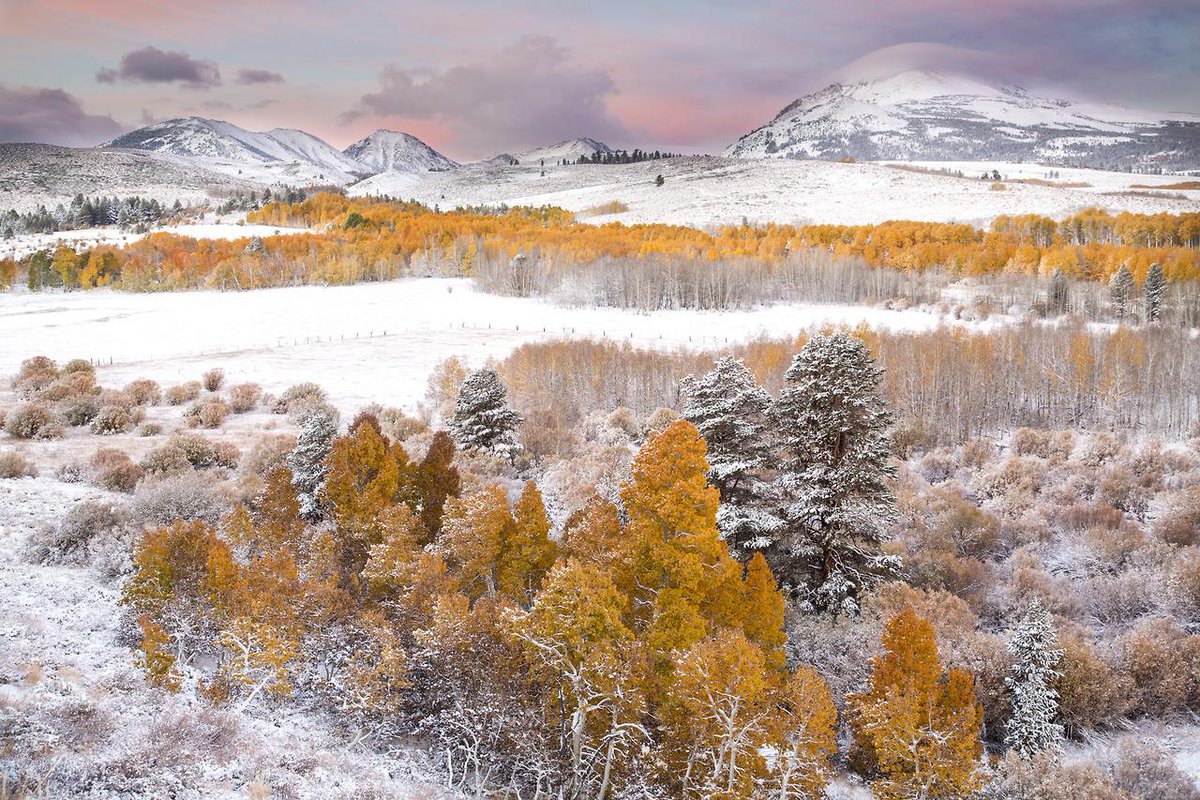
@Interior caption: Fall foliage and snow-capped peaks make for a stunning shot of Conway Summit #California @BLMca #nature

@Interior caption: Fall foliage and snow-capped peaks make for a stunning shot of Conway Summit #California @BLMca #nature

In my winter drives through the desert mountains of the Great Basin I often marveled at how a dusting of snow could turn a landscape generally painted in tones of brown with a little green into almost black and white. Then there are those black and white landscapes slashed by stunning gashes of color, or tinted subtley.

Conway Summit shows the stunning gashes of color this week. Grays, whites, blacks — and gold and pink.  It’s in the western part of California, near Nevada and Mono Lake:

Conway Summit (el. 8,143 feet (2,482 m)) is a mountain pass in Mono County, California. It is traversed by U.S. Highway 395, which connects Bridgeport and the East Walker River on the north side of the pass to Mono Lake and Lee Vining to the south.[1][2] It marks the highest point on U.S. 395, which also traverses high passes at Deadman Summit and Devil’s Gate Pass.[3]

Conway Summit is named after John Andrew Conway, a settler in the area in 1880.[3][4] Geographically, it was formed from an upland plateau by the sinking of the land in the Mono basin area.[5] The Sawtooth Ridge of the eastern Sierra Nevada, topped by 12,279-foot (3,743 m) Matterhorn Peak, rise to the west of the pass; Green Creek and Virginia Lakes, in the Sierra Nevada to the west of the pass, are two local destinations for fishing, camping and aspen trees. The Bodie Hills and the infamous Bodie ghost town lie to the east.

This scene comes from our public lands, the undifferentiated lands held in trust by the Bureau of Land Management (BLM) and managed for multiple uses.  You and I may look at this photo and marvel at the beauty of America, and say a little prayer of thanks for our public lands.  Sens. Mike Lee and Ted Cruz see potential for high-dollar vacation residences throughout this scene, if only the land could be sold off.