National Park Service video, and of course, featuring some stunning time-lapse photography.
696
 1 Comment |
  Geography - Physical, Geography - Political, History, National Parks, Travel | Tagged: geography, History, National Park Service, Travel, Washington D.C. |
  Permalink
 Posted by Ed Darrell
It’s not exactly a hoax. It started out as just bad reporting of history.
In his search for an easier route from Spain to China, in which he stumbled into the Americas, Christopher Columbus knew with certainty the Earth is a round ball. The story that he proved the Earth round, or rather than he laid the foundations for Magellan to prove the Earth round, is only a story, mostly devoid of fact. Sailors knew something was up just from their having watched things while sailing on the ocean. One can deduce the ball shape of the planet by watching other ships as they sail away, and sink below the horizon. Were sailors of a more scientific bent, they could have made much of the fact that the guy in the crow’s nest could see a ship moving away — or an island or a continent — for a time longer than those a few dozen feet below, on the deck of the ship.
Long before that a Greek librarian and polymath, Eratosthenes, figured out that the surface of the Earth is curved, deduced that the planet is basically a ball, and calculated very closely how big the ball is, merely by noting the different shadows cast by the sun at the Spring/Vernal Equinox. Carl Sagan used this story way back in his famous PBS series, Cosmos. It’s still interesting, informative and instructive today (surely Texas 9th grade geography teachers use this example all the time, no? 9th grade math teachers? Say, what?).
You can find this and more Sagan videos at the Carl Sagan Portal on YouTube.
How did he do it? Wikipedia — as usual — has a good, relatively lay explanation:

Bathtub Art Figure 1: Eratosthenes’ measurement of the Earth’s circumference.
Eratosthenes calculated the circumference of the Earth without leaving Egypt. Eratosthenes knew that, on the summer solstice, at local noon in the Ancient Egyptian city of Swenet (known in Greek as Syene, and in the modern day as Aswan) on the Tropic of Cancer, the sun would appear at the zenith, directly overhead (he had been told that the shadow of someone looking down a deep well would block the reflection of the Sun at noon). Using a gnomon, he measured the sun’s angle of elevation at noon on the solstice in his hometown of Alexandria, and found it to be 1/50th of a circle (7°12′) south of the zenith. Assuming that the Earth was spherical (360°), and that Alexandria was due north of Syene, he concluded that the meridian arc distance from Alexandria to Syene must therefore be 1/50 = 7°12’/360°, and was therefore 1/50 of the total circumference of the Earth. His knowledge of the size of Egypt after many generations of surveying trips for the Pharaonic bookkeepers gave a distance between the cities of 5,000 stadia (about 500 geographical miles or 927.7 km). This distance was corroborated by inquiring about the time that it takes to travel from Syene to Alexandria by camel. He rounded the result to a final value of 700 stadia per degree, which implies a circumference of 252,000 stadia. The exact size of the stadion he used is frequently argued. The common Attic stadion was about 185 m,[9] which would imply a circumference of 46,620 km, which is off the actual circumference by 16.3%; too large an error to be considered as ‘accurate’. However, if we assume that Eratosthenes used the “Egyptian stadion”[10] of about 157.5 m, his measurement turns out to be 39,690 km, an error of less than 2%.[11]
Description of Bathtub Art Figure 1:
Syene (
) is located on the Tropic of Cancer, so that at summer solstice the sun appears at the zenith, directly overhead. In Alexandria (
) the sun is
south of the zenith at the same time. So the circumference of earth can be calculated being
times the distance
between
Erastothenes measured the angle

Tropic of Cancer sign in Western Sahara, placed by trans-Sahara racers, in English and Hungarian Photo: Wikipedia
A fun little exercise, but a remarkable achievement for anyone about 240 years before the birth of of the Biblical Jesus. Syene, now known as Aswan, is on what we now call the Tropic of Cancer (the “tropics” were named by the Greeks, but I am uncertain whether the line had that name in Eratosthenes’s time). The date is probably not important, so much as the observation that the sun was vertical at noon on a given date — and then Eratosthenes’s experiment to see whether that were true in Alexandria, and then his understanding of what that might mean and his work to assemble the data to make the calculations. High school students — heck, junior high school students — should be able to figure all that out today, if they had the basics down. I suspect that knowing this story would be a spur to students to learn the elements of the mystery and how it was solved, and what it might mean for later navigators of the oceans, land and air, for astronomers, for farmers and for mathematics.
I also like this story because it presents a strange conundrum, a paradox about what people know, and what they may reason from the foundation of what they know. Our friend and frequent commenter Morgan, whose blog he calls the House of Eratosthenes. I suspect he thinks himself some latter-day Eratosthenian (“Latter-day Erats?”). He says as much in his blog FAQ:
I’m just like Eratosthenes peeking into a well here, and I don’t know what it means yet.
It’s an entertaining read and more enlightening that one might think from his forays here, so you probably ought to go read the FAQ and the reasons Morgan misbelieves liberals miss out on Eratosthenes’s wisdom. Morgan has an explanation of Eratosthenes and his discoveries which I find too brief to be accurate (and I’m not sure why Morgan finds the name “Beta” to be dubious; being a polymath was not a small thing then, or now; second best in everything means one is first in the All-Around, first in the academic centathlon or millathlon — no mean set of feats at all). I find that funny because, while he makes a pretense and some effort to following Eratosthenes and scientific methods, to me he seems to find science and logic things to run away from, as in our recent discussion where he ends up defending Anthony Watts’s erroneous views because Watts’s critics didn’t link to Watts (see comments in “It’s raining crazy,” and see also Morgan’s own post, which defies explanation). Eratosthenes would find that funny, too, I hope, but not a demonstration of Eratosthenian logic and calculation.
Does anyone doubt where Carl Sagan would be in the debate between the dozen serious scientists and hundreds of political wankers who deny climate change, and the thousands of scientists and good citizens who recognize that it occurs and think we should get on with saving the future?
(Did James Burke cover Eratosthenes in his brilliant series Connections? Which episode?)
Tip of the old scrub brush to Fred Clark at Slacktivist, whose compilation posts often overflow with stuff you ought to know or see, and whose post today sent me to Joe at It’s Okay to Be Smart and “Top 10 Reasons We Know The Earth Is Round.”
More:
4 Comments | Christopher Columbus, Geography - Physical, History, Libraries, Science | Tagged: Carl Sagan, Christopher Columbus, Cosmos, Earth, Eratosthenes, geography, History, Librarians, Science | Permalink
Posted by Ed Darrell

Caption from the NPS crew at Canyonlands National Park: View from the Maze: Millard Canyon’s winter mood. We are looking north. Note how the heat from the east to southeast facing cliffs has melted the snow below – even in this ultra-frigid time. Taking a break under a southeast facing cliff is a good way to warm up while on a Canyonlands hike. (GC) (via Facebook)
In a state where they once named the proposed state capital “Fillmore,” and the county in which that town sat, “Millard,” to try to curry favor with President Millard Fillmore for the state’s petition to gain statehood, one might logically think that a spectacular desert canyon not far away called Millard Canyon might also be named in honor of our 13th president.

Location map, Canyonlands National Park, image from Wikipedia
Not so, in this case. According to John W. van Cott’s Utah Place Names (University of Utah Press, 1990):
MILLARD CANYON (Garfield County) originates at French Springs southeast of Hans Flat. The canyon drains north northeast into the Green River at Queen Anne Bottom. According to Baker, “They learned later that they had misunderstood this name; instead of honoring a president, it was named for an undistinguished `Miller’ who did nothing more than leave this small, mistaken mark on the map” (Baker, Pearl. Robbers Roost Recollections. Logan, UT: Utah State University Press, 1976, p. 33). The name was even misspelled Millard.
Millard Fillmore is off the hook on this one.
Garfield County, Utah, was named after President James Garfield.
So, who was this “Miller” guy?
(Post inspired by image from the Canyonlands NP Facebook site; temperature at the time of the photo was near 0°F.)
More:
1 Comment | Geography - Physical, geology, Millard Fillmore, National Parks, Travel, Utah | Tagged: Canyonlands National Park, geography, geology, Millard Fillmore, photography, Travel, Utah | Permalink
Posted by Ed Darrell
Take a look at this sunset shot:

Sunset on BLM land near the Little Snake River, in northwest Colorado. Photo by Shannon Diszmang, via Royal Gorge National Recreation Area.
Note from America’s Great Outdoors blog:
Earlier this year, the Royal Gorge Recreation Area staff had a photo contest on their Facebook page and here is one of the great photos that was submitted. Here’s what photographer, Shannon Diszmang, had to say about it.
“This is BLM land in Northwest Colorado (Little Snake River district). I fell in love with this place. The red haze in this photo is the smoke coming from the wildfires on the west coast at the time. This is one of the lowest light pollution spots in our state which makes star gazing the absolute best.”
So, if you’re nearby, and you want a good place to look at the Geminid meteor shower tonight, odds are high there will be little light pollution here. If there aren’t many clouds, you’re in luck.
More:
P.S.: The stunningly beautiful photo above is NOT the winner of the photo contest(!). BLM wrote in a November press release:
CAÑON CITY, Colo. – Today the BLM Royal Gorge Field Office announced the winners of its BLM-sponsored photo contest. The two winners were decided by the public via the RGFO’s Facebook page: one winner is based on the most “likes” and the other is based on the most “shares.” Only those “likes” and “shares” that originated from the Royal Gorge Facebook page were tallied towards a winner.
Chris Nelson’s photo was the most “liked” and is a scenic shot taken from Chaffee County Road 175 between Cañon City and Salida. Nelson’s photo received 64 “likes.”
The most “shared” photo was submitted by David Madone and portrayed several deer in an alfalfa field near Cañon City. Madone’s photo received 20 shares.
Both photos will be featured on the RGFO’s Facebook page throughout November and may be featured in future BLM Colorado publications and social media sites.
The photo contest began Oct. 2 and ended Nov. 4 with more than 60 photos submitted. All the photos that were entered into the contest may be viewed via the “Photo Contest” album on the RGFO’s Facebook page: http://www.facebook.com/BLMRoyalGorge
Yeah, were I you, I’d go see what the winners looked like.
4 Comments | Astronomy, Bureau of Land Management (BLM), Geography - Physical, Outdoor Recreation, photography, Public Lands, Travel | Tagged: Astronomy, BLM, Bureau of Land Management, Colorado, geography, Outdoor Recreation, photography, Travel | Permalink
Posted by Ed Darrell
Here’s a good demonstration of why you don’t need PhotoShop, but a decent camera and a steady hand instead.

Utah’s Mt. Timpanogos in snow, by Craig Clyde, 2012 (rights probably reserved). Click for larger version.
Craig Clyde took this photo of Utah Valley‘s Mt. Timpanogos, probably from Saratoga Springs, on the west side of Utah Lake, after one of the first snows of 2012. (This area had a few farm fields when I grew up there.) It’s a great photo for several reasons.
It’s a formerly unusual view, there being so few people on the west side of the lake until recent development. It pictures all of Timpanogos, with American Fork Canyon on the left, Mahogany Mountain, Big Baldy, and Provo Canyon on the right. It’s an afternoon shot, you can tell from the angle of the sun (the mountain runs on a north-south axis), and the darkness on the lower mountains may be caused by the Sun’s setting behind the mountain range on the west side of the lake. Timpanogos in white, in the afternoon sunshine, is one of the greatest images of a mountain you’ll ever see.
Tip of the old scrub brush to Craig Clyde. Mr. Clyde and I attended high school together — haven’t seen him in more than 30 years; not sure, but I don’t think he’s the same Craig Clyde in the movie business.
More:
1 Comment | Geography - Physical, geology, Nature, photography, Travel, Utah | Tagged: American Fork Canyon, Craig Clyde, geography, geology, Mount Timpanogos, Mt. Timpanogos, Nature, photography, Provo Canyon, Travel, Utah Valley | Permalink
Posted by Ed Darrell
Long-time Scout friend Hal Rosen said he caught some good photos here, too — but none at this precise moment:

Temple of the Sun, Capitol Reef NP, photo by Mike Saemisch, October 29, 2012
First you must get to Capitol Reef National Park, in Utah — one of Utah’s unfairly large number of five National Parks. Then you take your “high-clearance vehicle” (not necessarily 4-wheel drive) out on the dirt roads in Cathedral Valley, and you hope for a crystal blue sky like this one. Then you happen to get there just as the sun is right at the peak of the formation . . .
You had to be there. Mike Saemisch was there just over a week ago, on October 29, 2012, and fortunately caught this photograph with the Sun as part of a sparkling spire on a sandstone formation known as the Temple of the Sun.
Digital photography changes the way one tours these places. Fortunately. Take the kids, and make sure they find it on a map so they can use your trip as fodder for their 9th grade geography class.
More:
Leave a Comment » | Geography - Physical, geology, National Parks, Natural history, Outdoor Recreation, photography, Travel, Utah | Tagged: Capitol Reef National Park, geography, geology, Kodachrome Basin State Park, Outdoor Recreation, photography, Travel, Utah | Permalink
Posted by Ed Darrell
You got the Tweet?

Miter Basin, Sequoia and Kings Canyon National Parks, California; photo by Kristin Glover, NPS (public domain)
Photo from NPS employee Kristin Glover, at Miter Basin.
We should go see for ourselves, no?
If you go today, vote before you go. This is one of the areas to be opened to energy exploration — oil and gas drilling or other mining — under Mitt Romney’s “energy plan” and the GOP National Platform.
More:
Leave a Comment » | Geography - Physical, geology, National Parks, Natural history, Nature, photography, Travel | Tagged: environment, geography, National Parks, Natural history, Nature, Outdoor Recreation, photography, Sequoia & Kings Canyon NPs, Travel | Permalink
Posted by Ed Darrell
Note today in Al Gore’s Journal:
Flooding Costs October 1, 2012 : 10:32 AM
Time Magazine cover for April 28, 2008 – How to Win the War On Global Warming
A new report from Swiss Re finds that the financial impact of flooding has doubled in the past decade – climate is a major driver:
“Flood losses are increasing at an alarming rate while the insurability of floods provides unique challenges for the industry, according Swiss Re’s latest report, “Flood – an underestimated risk: Inspect, inform, insure”.” …
“No other natural catastrophe impacts as many people as flooding with an estimated 500 million people affected every year. Insured flood losses are also increasing significantly; 1970’s annual claims were between USD 1–2 billion, whereas insured flood losses amounted to USD 15 billion in 2011. Recent flood events in Thailand, Australia and the Philippines have shown that floods are now rivalling earthquakes and hurricanes in terms of economic losses.” …
“Population growth, demographic change, a higher concentration of assets in exposed areas, greater vulnerability of insured objects and climate change are all contributing to the increasing costs of flood damage. The rising costs of floods are creating challenges for the insurance industry and the economic viability of flood insurance is currently an issue under scrutiny.”
More:
20 Comments | Business, Climate change, climate_change, Disasters, Geography - Physical, Global warming, History, Politics | Tagged: Al Gore, Business, Climate change, Disasters, geography, Global warming, History, Politics, Science, Swiss Re | Permalink
Posted by Ed Darrell
You wondered how anyone could ever fall in love with the modern megalopolis that is Los Angeles?
Along comes Colin Rich with this video ode, visual poetry to an essential chunk of America. Oh, yeah, it’s got lots of time-lapse. Notice how the photography turns simple airplanes into something akin to shooting stars, and notice how even an ugly old radio tower crowded with microwave and digital communication antennae turn into things of grace, if not beauty:
More information from Colin Rich:
Music: M83, “Echoes of Mine” off of ‘Hurry Up, We’re Dreaming.’ Available from Mute Records, EMI Music
Download the song/album here here: itunes.apple.com/us/album/midnight-cityCinematography, Direction, and Editing by: Colin Rich: facebook.com/colinrich1
Produced by Pacific Star Productions pacstarpro.comA big thanks to Matthews MSE (msegrip.com) especially to Bob Kulesh, Tyler & Ed Phillips for their generous support and patience of this lengthy endeavor. Most of the linear motion control shots were captured using their FloatCam DC Slider, a wonderful piece of engineering for the time lapse world.
‘Nightfall’ is a three minute tour of light through the City of Angels.
I shot “Nightfall” in an attempt to capture Los Angeles as it transitioned from day to night. As you probably know, LA is an expansive city so shooting it from many different angles was critical. Usually I was able to capture just one shot per day with a lot of driving, exploring, and scouting in between but the times sitting in traffic or a “sketchy” neighborhood often lead to new adventures and interesting places.
Nightfall in particular is my favorite time to shoot time lapse. Capturing the transition from day to night while looking back at the city as the purple shadow of Earth envelopes the eastern skyline and the warm distant twinkling halogen lights spark to life and give the fading sun a run for her money- this will never grow old or boring to me.
In this piece, it was important to me for the shots to both capture and accentuate the movement of light through the day and night and the use of multiple motion control techniques allowed me to do so.
I hope you enjoy watching it as much as I enjoyed creating it.
An English translation of the lyrics-
“It is late. I am looking for my other home, taking an unfamiliar path: a small trail near the factories and the city, cutting through the forest. I can barely see nature when suddenly, night falls. I am engulfed by a world of silence, yet I am not afraid. I fall asleep for a few minutes at the most, and when I wake up, the sun is there and the forest is shining with a bright light.
I recognize this forest. It is not an ordinary forest, it is a forest of memories. My memories. The white and noisy river, my adolescence. The tall trees, the men I have loved. The birds in flight, and in the distance, my lost father.
My memories aren’t memories anymore. They are there, with me, dancing and embracing, singing and smiling at me.
I look at my hands. I caress my face, and I am 20 years old. And I love like I have never loved before.”
Surely this film can be used, at least for a bell ringer or warmup, in geography classes.
Leave a Comment » | Geography - Economic, Geography - Physical, photography, Time-lapse photography, Travel, Video and film | Tagged: Travel Geography | Permalink
Posted by Ed Darrell
Press release from the Texas Alliance for Geographic Education (TAGE):
This year’s Geography Awareness Week theme is Declare Your Interdependence! Geographers around the nation will celebrate our interconnectedness November 11-17, 2012!
To celebrate, TAGE is sponsoring the 25th Annual Poster Contest
How are you connected to the rest of the globe on a daily basis? What images demonstrate interdependence for you? This year’s posters should illustrate different forms and examples of interdependence. Focus on the physical and cultural processes that keep you connected around the globe, and how this shapes your daily life.More information on the Poster Contest, including rules, registration, and resources at http://www.geo.txstate.edu/tage/geography-awareness-week.html
Poster Contest Registration: Deadline October 19; Posters due to the TAGE office by October 25Information on National Geographic’s Geography Awareness Week, http://www.geographyawarenessweek.org
Please contact us if you have any questions, and feel free to share with us new resources or ideas that you may have. We will continue to add resources and links as we find them to help you demonstrate interdependence to your classroom.
Let’s make this the best poster contest yet!
Maggie Hutchins
—
Texas Alliance for Geographic Education
Department of Geography
Texas State University
601 University Drive
San Marcos, TX 78666
http://www.geo.txstate.edu/tage/
phone: (512) 245-3827
fax: (512) 245-1653
Related Articles and Resources:
Leave a Comment » | Education, Education quality, Geography - Economic, Geography - Physical, Geography - Political | Tagged: Education, geography, Geography Awareness Week, National Geographic Society, TAGE, Texas Alliance for Geographic Education | Permalink
Posted by Ed Darrell

Interior Department photo, America’s Great Outdoors, at Denali National Park and Preserve; photo caption from AGO said, “We’re not sure it’s possible to take a bad photo up there!” Click for larger view.
More:
Update: Interior tweeted another photo later today.

From the U.S. Department of Interior Tweet: This morning we gave you an amazing shot of #Denali. Would you believe this one is from the same place? Whether large or small, beauty in Denali is everywhere you look. #Alaska
Can someone identify the flower?
1 Comment | Alaska, Geography - Physical, National Parks, Natural history, Nature, Outdoor Recreation, photography, Travel | Tagged: Alaska, Denali, Denali National Park and Preserve, geography, Mount McKinley, National Parks, Nature, Outdoor Recreation, photography, Travel | Permalink
Posted by Ed Darrell
Instagram from the Department of Interior, yesterday:

U.S. flag and Denali on an almost-clear day; Department of Interior photo, August 2012 – public domain
usinterior Tweeted, “Does it get any better than this?”
Denali, also known as Mt. McKinley, is the highest point in North America, 20,320 feet (6,194 m) above sea level. Measured base to peak, it’s the tallest mountain on land on Earth — Everest and other Himilayan peaks rise from a very high plateau. Denali is high enough that it makes its own weather. Finding a day when the mountain is not almost completely obscured by clouds is rare, locals say. Finding an almost-clear view, with blue sky in the background, is a cause for photographer excitement.
You’ll notice straight-line clouds in the sky — condensation trails from passenger jets. I wonder how many flights bend a little to get a better view of the mountain for passengers? Do big airlines even do that anymore?
Nice shot. I could learn to like Instagram with more photos of this quality.
Better, it would be nice to be there, taking these shots.
More, including the controversy over the mountain’s name:
3 Comments | Alaska, Geography - Physical, geology, National Parks, Natural history, Nature, photography, Travel | Tagged: Alaska, Denali, Denali National Park and Preserve, geography, geology, Mount McKinley, National Parks, photography, Travel, US Department of Interior | Permalink
Posted by Ed Darrell
What you see in this photo may depend on where you sit, or stand.

Aerial photo of Port Isaac, Cornwall, from Facebook, August 2012; attributed to Wimp.com
It’s a photo of a town in Cornwall, England: Port Isaac. Lovely photo, showing the verdant hills around the town where grains grow in some abundance (the town’s name means “corn port,” suggesting a thriving grain trade a millennium ago), sheep or other animals graze, and showing the port from which fishermen sail to bring in bounty from the oceans. The picturesque little town is popular among writers and other artists. It’s historic and quaint streets make a popular backdrop for television and film production — the popular BBC series “Doc Martin” films there.
Since some internet “cool stuff” site (Wimp.com? I can’t find it there) picked up the photo, it’s become popular around the internet and on Facebook. Generally the identifiers for the town get stripped away as the ‘net is wont to do. So conjecture pops up in comments:

Roscarrock Hill, Port Isaac The first house on the right is Fern Cottage, made famous as the house of Doc Martin, in the TV series of the same name. (Photo credit: Wikipedia)
Ugly or beautiful — opinions differ depending on what the poster thinks it is, and what the poster thinks s/he knows about the place.
Perhaps its really a shot of Rohrshach, Norway . . .
More:

Rohrshach? Do you see the face? (It’s actually Cornwall (Photo credit: joeflintham))
3 Comments | Geography - Physical, Geography - Political, History, Humor, photography, psychology, Travel | Tagged: Cornwall, England, geography, History, Humor, photography, Port Isaac, psychology, Travel | Permalink
Posted by Ed Darrell
From Project Yosemite, a series of cool time-lapses, from one of the coolest spots on Earth, Yosemite National Park.
Details on the film, and how to track down the artists and see more, from Project Yosemite’s Vimeo site:
A collaborative project by Sheldon Neill and Colin Delehanty. What started as an idea turned into an ongoing adventure to timelapse Yosemite in an extreme way.
We were complete strangers before it all started, but after we met on Vimeo our idea came into sight, and then began the challenge to make numerous trips to YNP where we would capture the beautiful landscape it offers for visitors every year.
We invite you to watch our video in hopes you’ll witness Yosemite like never before.

Yosemite HD
This video is a collaboration between Sheldon Neill and Colin Delehanty. All timelapses were shot on the Canon 5D Mark II with a variety of Canon L and Zeiss CP.2 Lenses.
Project Yosemite Website: projectyose.com
Facebook Page: facebook.com/projectyose
Contact info: info@projectyose.comThanks to Dynamic Perception for their motion controlled dolly and continued support!
Dynamic Perception Website: dynamicperception.com
Track: Outro
Album: Hurry Up, We’re Dreaming
Artist: M83
Site: ilovem83.com
Publishing: emimusicpub.com
Licensing: bankrobbermusic.comThis whole project has been an amazing experience. The two of us became friends through Vimeo and explored a shared interest in timelapsing Yosemite National Park over an extended period of time. We’d like to expand this idea to other locations and would appreciate any suggestions for a future project.
Project Yosemite was featured as a main story on Yosemite National Park’s Spring Newsletter.: yosemitepark.com/timelapse-sprnews-2012.aspx
To view this in 2K, visit: youtu.be/OwFbjJasW3E
Be sure to change the quality settings to ‘Original’.Twitter:
twitter.com/#!/SheldonNeill
twitter.com/#!/delehantyFacebook:
facebook.com/sheldon.neill
facebook.com/delehantyBehind The Scenes: vimeo.com/35223326
By Dalton RunbergOur hearts go out to the families of Markus Praxmarer who lost his life while climbing Half Dome on September 19th, 2011 and Ranger Ryan Hiller, who was crushed by a tree January 22nd 2012. They will be missed. (A photo of Ranger Ryan Hiller can be found to the right, above the statistics counter)

Generalized geologic map of the Yosemite area. (USGS image) (Photo credit: Wikipedia)
Yosemite National Park is spectacular, and much photographed than other great natural places of beauty. How much does it benefit from being in California, closer to many people with good cameras and great photographic skills, to an extent that more distant, spectacular parks like Glacier N.P., Yellowstone N.P and Big Bend N.P. do not benefit? How does that affect management of the parks? How does that affect how people view their own local adventure areas?
Will Project Yosemite be back with more?
More:
1 Comment | Geography - Physical, National Parks, Natural history, Nature, photography, Yosemite | Tagged: Canon EOS 5D Mark II, Colin Delehanty, geography, Nature, photography, Sheldon Neill, Yosemite National Park | Permalink
Posted by Ed Darrell
Another good reason to follow the National Archives on Twitter, Tumblr and other media: Great updates.
Like this one on the explosive arrival of the Atomic Age:
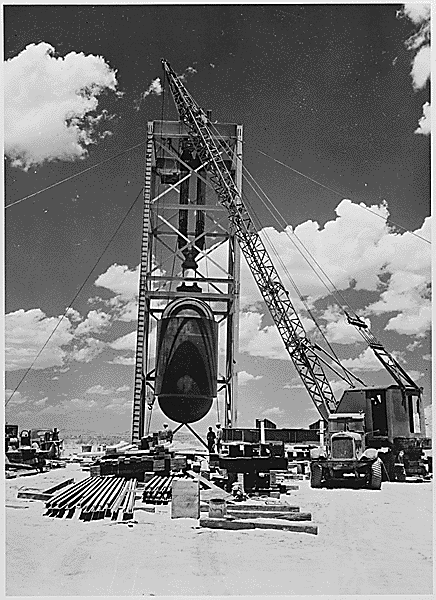
Atomic Age Begins
On July 16, 1945 the United States tested a nuclear device, code named “Trinity”, for the first time in White Sands Proving Ground, New Mexico.
Left: [“Jumbo” atomic device being positioned for “Trinity” test at Alamogordo, New Mexico.], 1945
Right: [“Trinity” explosion], 07/16/1945
Source: research.archives.gov

Rare color photograph of the first nuclear test at Trinity site, July 16, 1945. Blurriness is in the original photograph (done when color photography was still fairly new). (Photo credit: Wikipedia)
3 Comments | 1941-1945, Atomic Bomb, Geography - Physical, History, Nuclear weapons, Physics, World War II | Tagged: 16 July 1945, Atomic Age, Atomic Bomb, geography, History, National Archives, Nuclear weapon, Physics, Science, Trinity, World War II | Permalink
Posted by Ed Darrell
You are currently browsing the archives for the Geography – Physical category.


Ed Darrell on Texas's Colorado River


Come on in, the water's fine. Come often: Cleanliness is next to godliness.


 Millard Fillmore's Bathtub