Eye on Yellowstone: Earthquake swarm’s second round

January 10, 2009

More mostly small, less-than-3.0 magnitude earthquakes rumbled the Yellowstone Caldera, with a shift in location.

While not exactly an everyday event, still “not uncommon.”  Scientists are just watching, and they detect no other signs of an imminent eruption.

Here’s the note as of about 5:00 a.m. January 10, Central time, from the Yellowstone Volcano Observatory (YVO):

YELLOWSTONE VOLCANO OBSERVATORY INFORMATION RELEASE
Friday, January 9, 2009 19:44 MST (Saturday, January 10, 2009 02:44 UTC)

YELLOWSTONE VOLCANO (CAVW#1205-01-)
44.43°N 110.67°W, Summit Elevation 9203 ft (2805 m)
Volcano Alert Level: NORMAL
Aviation Color Code: GREEN

Small Earthquake Swarm on 9 January 2009 near northeast corner of Yellowstone Caldera

A currently modest swarm of earthquakes began in the northeast corner of the Yellowstone Caldera, about 10 miles (16 km) NNE of the north end of the Yellowstone Lake swarm that was active in late December and early January. As of 1930 MST, 10 earthquakes had been located by the University of Utah Seismograph Stations, the largest with M= 3.3 and two other events with M >2.0. Located depths are between 2 and 4 km.

Yellowstone Volcano Observatory staff and collaborators are analyzing the data from this and from the earlier Yellowstone Lake swarm and are checking for any changes to the thermal areas located near the epicenters. We will provide further information as it becomes available.

—–
The Yellowstone Volcano Observatory (YVO) is a partnership of the U.S. Geological Survey (USGS), Yellowstone National Park, and University of Utah to strengthen the long-term monitoring of volcanic and earthquake unrest in the Yellowstone National Park region. Yellowstone is the site of the largest and most diverse collection of natural thermal features in the world and the first National Park. YVO is one of the five USGS Volcano Observatories that monitor volcanoes within the United States for science and public safety.

It’s winter in Yellowstone, a great time to go.  It’s the best time to go, my Yellowstone-obsessed brother would say.  A swarm of earthquakes means you’ll have something to talk about at breakfast before taking your camera out to get once-in-a-lifetime shots of nature.

Earthquakes are normal in much of the Rocky Mountains, and in much of the rest of the Intermountain West.  My mother used to enjoy quietly sipping coffee at the stove in her kitchen in Pleasant Grove, Utah, and saying “Oh. We’re having another earthquake.”  She’d watch the power and telephone wires, which formed neat sine waves during quakes.

Experts are watching, and probably sipping their coffee, too.

.”]Image 1. Yellowstone Lake showing location and times of the recent earthquakes from Dec. 27, 2008 (blue) to Jan. 8, 2009 (red). The M 3.0 and greater earthquakes are shown as stars, the smaller earthquakes are shown as circles. During the swarm, the earthquake locations appear to have moved north. For more information on the depths of the earthquakes, see the cross section from X to X below. Click on the image for a full-size version.

See resource lists at earlier MFBathtub posts:


All quiet on the Yellowstone front (almost)

January 6, 2009

Here’s the on-line helicorder view of January 5 — a quiet day at Lake Woebegone Yellowstone.  Click on the image to go to the site and see for yourself (in a larger format, too).

Compare the image below, with the image here, to see the difference a few days makes.

Helicorder data from January 5, 2008, Yellowstone Lake, West Thumb station (YLT)

Helicorder data from January 5, 2008, Yellowstone Lake, West Thumb station (YLT)


Yellowstone earthquake swarm finished?

January 5, 2009

No Few significant quakes recorded at all for January 4, nor so far for January 5 (6:30 a.m. Central) maybe the quakes took a day off in honor of Utah Statehood Day.

Update, January 6, 6:00 a.m. Central: The map now shows 11 quakes magnitude 1 or greater on January 3, 5 on January 4, and one on January 5.  This is significantly less action than the quakes every ten minutes or so when the swarm was at its peak.

Is the swarm done? This is the longest period of no-quake activity in Yellowstone since at least December 27, 2008.

Here’s the USGS data for 11:30 p.m. (Central), January 4:

Update time = Mon Jan 5 5:27:27 UTC 2009

Here are the earthquakes in the Map Centered at 44°N, 110°W area, most recent at the top.
(Some early events may be obscured by later ones.)
Click on the underlined portion of an earthquake record in the list below for more information.

MAG UTC DATE-TIME
y/m/d h:m:s
LAT
deg
LON
deg
DEPTH
km
LOCATION
MAP 2.6 2009/01/03 00:23:22 44.669 -110.163 1.0 43 km ( 26 mi) SSW of Cooke City-Silver Gate, MT
MAP 2.7 2009/01/02 20:33:53 44.553 -110.338 0.9 61 km ( 38 mi) SSW of Cooke City-Silver Gate, MT
MAP 2.2 2009/01/02 20:24:50 44.509 -110.371 0.0 61 km ( 38 mi) ESE of West Yellowstone, MT
MAP 2.7 2009/01/02 20:23:57 44.556 -110.357 1.3 60 km ( 38 mi) SSE of Gardiner, MT

So there was only one quake on January 3, and none on January 4.

Swarms are “not uncommon,” but caldera supereruptions are extremely rare.

Time Magazine tracked down the head of the Yellowstone Volcano Observatory (YVO), Jake Lowenstern:

Jake Lowenstern, Ph.D., YVO’s chief scientist, who also is part of the USGS Volcano Hazards Team, told TIME that a supervolcano event does not appear to be imminent. “We don’t think the amount of magma exists that would create one of these large eruptions of the past,” he said. “It is still possible to have a volcanic eruption comparable to other volcanoes. But we would expect to see more and larger quakes, deformation and precursory explosions out of the lake. We don’t believe that anything strange is happening right now.” Last summer YVO installed new instrumentation in boreholes 500 to 600 ft. deep to better detect ground deformation.  Says Lowenstern: “We have a lot more ability to look at all the data now.” (See an interactive graphic depicting how scientists monitor volcanoes.)

Plan your vacation to Yellowstone now. Transportation will be cheaper (you can fly to Jackson Hole), and if there is any effect of the earthquake swarm, it would be to reduce tourist reservations at local hotels.

Now is the time to book your visit.


Yellowstone ready to blow? Not likely

December 31, 2008

Every science nut is, and quite a few fear mongers are following the story of the swarm of small earthquakes miles beneath the waters of Yellowstone Lake.

They know Yellowstone is in the middle of a supervolcano, and they can’t help but wonder whether the Yellowstone Caldera is ready to blow.

Even Cecil Adams at the Straight Dope wonders in the headline whether Yellowston is ready blow, in what must be one of the best-timed, prepared-in-advance columns in any newspaper in the world in 2008.  (My skiepticism for Cecil Adams’ stuff increased mightily when I noticed he had gotten much wrong on Rachel Carson’s claims about DDT and birds, but I digress.)

So is Yellowstone going to blow?

Not likely.  According to me. (I’m a lawyer and teacher — what authority does my prediction have?)

Serious scientists are being more careful.  I asked Relu Burlacu at the University of Utah Seismograph Station, the group that is the front line in the monitoring of Yellowstone, whether this is The Big One.

“The short answer is,” he said, “we don’t know.”

57 quakes, at least, have been recorded for December 31 so far (15:05 UTC).  Since Saturday, there have been more than 300 quakes (conservative estimate).  Because the quakes are so tightly packed, geographically, but from depths covering several miles underground, some amateurs suggest the quakes suggest magma or water moving up a pipe toward the surface.

The professionals I spoke with today are very circumspect about saying what is going on, stopping far short of making predictions about what will happen.  Most telling, they’re taking tonight and tomorrow off, New Year’s Eve and New Year’s Day.  Oh, someone will be on hand to make sure the machines are working, and if there’s a truly significant event, there will be alerts.  But the current swarm is not something that alarms the monitoring people, nor is it something they have not seen before.

Mr. Berlacu explained — patiently, I must add — that so far, there has been just monitoring.  With so many events, one of the problems is determining when one event ends, and the next begins.  There is a great deal of work to be done pinpointing locations of temblors, triangulating from several different recording stations.

“This is not uncommon,” Berlacu said.  He noted that 1985 had a swarm of quakes that continued for nearly three months, with the swarm just tapering off.

Charts from the earthquake monitoring station on Yellowstone Lake, showing raw data recording by the University of Utah Seismograph Stations, Earthquake Information Center, for December 31, 2008.  These data must be correlated and corroborated with data from other stations in the area to determine locations of geological events, depths, duration, start and end, before complete analysis can be done.

Charts from the earthquake monitoring station on Yellowstone Lake, showing raw data recording by the University of Utah Seismograph Stations, Earthquake Information Center, for December 31, 2008. These data must be correlated and corroborated with data from other stations in the area to determine locations of geological events, depths, duration, start and end, before complete analysis can be done.

Reality is that the scientists who study Yellowstone’s vulcanism expect eruptions in the future. But they expect smaller eruptions, not the massive supervolcano disaster usually portrayed over the last five or ten years.  Yes, a massive eruption is possible.  Yes, it could be an enormous disaster.

In a video explaining the geology of the Yellowstone caldera, Yellowstone National Park Geologist Hank Heasler explains there are three things geologists think will presage a large volcanic event in the caldera:

  1. An increase in earthquakes, or a swarm of earthquakes, plus
  2. Significantly increased ground deformation, such as a rise of several feet or several meters, plus
  3. Increased thermal activity in the thermal features of the Park.

The current swarm lacks the second two features.  Even so, experts note that all three conditions might be met, without any major eruption.

No, it’s not likely to happen in our lifetimes. Read this entertaining piece by Jake Lowenstern in Geotimes, from June 2005. Lowenstern is the director of the Yellowstone Volcanic Observatory (YVO):

Of course, the Yellowstone caldera is a volcano, and it almost certainly will erupt again someday. It’s possible, though unlikely, that future eruptions could reach the magnitude of Yellowstone’s three largest explosive eruptions, 2.1 million, 1.3 million and 640,000 years ago. Smaller eruptions, however, are far more likely, and no eruption seems imminent on the timescale that most people truly care about — their lifetime or perhaps even the next few hundred or thousands of year

Small eruptions do not make for the grand drama desired by television executives and producers.

Instead, the technicians monitor what happens; conclusions, the explanation for what happened, will have to wait for later analysis.

Resources:


Public Lands insanity

November 16, 2008

Remember when Strange Maps “discovered” that so much of the 13 western states is owned by the Federal Government?  On the one hand, it was nice to see people paying attention to public lands in the west.

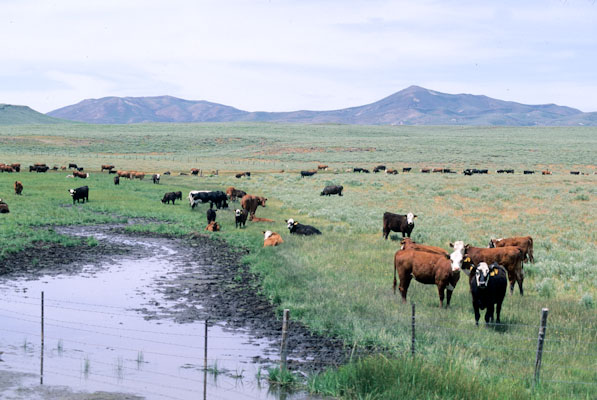
Public lands in a western state, with grazing cattle. Wild Earth Guardians image.

Public lands in a western state, with grazing cattle. Wild Earth Guardians image.

Public lands.  Photo from the Montana Wildlife Federation

Public lands. Photo from the Montana Wildlife Federation

At the Bathtub, we remarked on the history of the issue with a map that showed where the publicly-owned lands really are (the Strange Maps version only showed a dot in the middle of each state proportionate to the federal land held in the state.)  On the other hand, it was an open invitation for know-nothings and know-littles to jump in with silly ideas.  Remarkably, the post remained free of such folderol — until just recently.

None of these sites gives any serious thought to the idea.  None provides a scintilla of an iota of analysis to indicate it would be a good idea.

As one of the the principal spokesmen for the Sagebrush Rebellion in the early days, I want it known that I’ve thought these issues through, and argued them through, and followed the documentation for 30 years (Holy frijole!  I’m old!).  Issues with public lands revolve around stewardship.  Bad stewardship is not improved by a change in ownership.  Ownership change has all too often only led to worse stewardship.  Selling off the public lands is a generally stupid idea.

Certain local circumstances change the nature of a tiny handful of such deals — but not often, not in many places, and not enough to make a significant contribution to retiring any debt the federal government owns.

On the other hand, incomes from these lands typically runs a few multiples of the costs of managing them.  The Reagan administration discovered the lands were a great source of money to offset losses in other places, and for that reason (I suspect) never really got on the Sagebrush Rebellion band wagon — or, maybe Reagan’s higher officials just didn’t get it.

It’s troubling that such a flurry of stupidity strikes now, during a transition of presidents. This is how stupid ideas get traction, like kudzu on a cotton farm, while no one is paying deep attention.  Let’s put this idea back into its coffin with a sagebrush stake in its heart.

Bottom line:  Keep public lands in federal trust.  The Sagebrush Rebellion is over.  The sagebrush won.

_____________

Speaking of presidential transitions, who should be Secretary of Interior?  Stay tuned.

More:

Update 2014: The original GSA map showing percentages of federal holdings in each state (including Indian Reservations as federal holdings), as published in Strange Maps when it was still active.

Update 2014: The original GSA map showing percentages of federal holdings in each state (including Indian Reservations as federal holdings), as published in Strange Maps when it was still active.


Atomic history, nuclear future

October 19, 2008

We’re going to see more nuclear power plants in the U.S., it’s a safe bet.  Both presidential candidates support developing alternatives to oil and coal.  Nuclear power is one of the alternatives.

John McCain kept repeating his comfort words, that ‘storage of wastes is not a problem.’ There is not a lot of evidence to support his claims.  With turmoil in financial markets, however, the nuclear power issue has gotten very little serious attention or scrutiny.  From the push to get compensation for radiation victims of atomic weapons and development in the U.S., I learned that the issue is not really whether wastes and other materials can be safely used and wastes stored. The issues are entirely issues of will.

Advantage to Obama, I think.  He’s not claiming that the storage problems are all solved.  A clear recognition of reality is good to have in a president.

Son Kenny sent a link to a history site, Damn Interesting, and it tells the story of the Techa River in the old Soviet Union — a place condemned for generations by the nuclear excesses of the past.

To make the story briefer, in their rush to produce nuclear weapons, the Soviets did nothing to protect Russia from radioactive waste products until it was much too late.  Efforts to reduce radioactive emissions, by storing them in huge underwater containers, resulted in massive explosions that released more radiation than Chernobyl (What?  You hadn’t heard of that, either?).

It’s a reminder that safety and security with peaceful uses of nuclear power depend on humans doing their part, and thinking through the problems before they arise.

Can we deal with radioactive wastes?  We probably have the technology.  Do we have the will? Ask yourself:  How many years has the U.S. studied Yuccan Mountain to make a case to convince Nevadans to handle the waste?  How many more decades will it take?

How is our history of dealing with nuclear contamination issues?  Not good.

Last spring SMU’s history department sponsored a colloquium on a power generation in the southwest, specifically with regard to coal and uranium mining on the Navajo Reservation.   We’ve been there before.

One of the photos used in one of the lectures, by Colleen O’Neill of Utah State, showed two Navajo miners outside a uranium mine during a previous uranium boom.  Neither one had a lick of protective equipment.  Underground uranium mining exposes miners to heave concentrations of radon gas, and if a miner is unprotected by breathing filters at least, there is a nearly 100% chance the miner will get fatal lung cancers.

Of the 150 Navajo uranium miners who worked at the uranium mine in Shiprock, New Mexico until 1970, 133 died of lung cancer or various forms of fibrosis by 1980 ([Ali, 2003] ).

Our Senate hearings on radiation compensation, in the 1970s, produced dozens of pages of testimony that Atomic Energy Commission officials understood the dangers, but did nothing to protect Navajo miners (or other miners, either).  It is unlikely that anyone depicted in those photos is alive today.

AP Photo  (borrowed from ehponline.org)

"Mine memory - Navajo miners work the Kerr-McGee uranium mine, 7 May 1953. Today, uranium from unremediated abandoned mines contaminates nearby water supplies. image: AP Photo" (borrowed from ehponline.org) This photo is very close to the one used by Prof. O'Neill. It may have been taken at nearly the same time. If you know of any survivors from this photo, please advise.

At a refining facility on the Navajo Reservation, highly radioactive wastewater was stored behind an inadequate earthen dam.  The dam broke, and the wastes flowed through a town and into local rivers.  Contamination was extensive.

Attempts to collect for the injuries to Navajo miners and their families were thrown out of court in 1980, on the grounds that the injuries were covered under workers compensation rules (where injury compensation was also denied, generally).

Navajos organized to protest the power plant. One wonders whether they can win it.

Sen. McCain seems cock sure that radioactive wastes won’t kill thousands of Americans in the future as they have in the past.  The uranium mining and uranium tailings issues occurred in Arizona, the state McCain represents.  Does he know?

We regard ourselves in the U.S. as generally morally superior to “those godless communists.”  Can we demonstrate moral superiority with regard to development of peacetime nuclear power, taking rational steps to protect citizens and others, and rationally, quickly and fairly compensating anyone who is injured?

That hasn’t happened yet.

When [uranium] mining [on the Navajo Reservation] ceased in the late 1970’s, mining companies walked away from the mines without sealing the tunnel openings, filling the gaping pits, sometimes hundreds of feet deep, or removing the piles of radioactive uranium ore and mine waste. Over 1,000 of these unsealed tunnels, unsealed pits and radioactive waste piles still remain on the Navajo reservation today, with Navajo families living within a hundred feet of the mine sites. The Navajo graze their livestock here, and have used radioactive mine tailings to build their homes. Navajo children play in the mines, and uranium mine tailings have turned up in school playgrounds (103rd Congress, 1994 ).

Think of the story of Techa River as a warning.

Resources:


Disaster in Yellowstone Park: 20 years after the fires, it’s healing

September 17, 2008

High school students weren’t alive when Yellowstone burned in 1988. Do you remember?

NASA infrared satellite photograph of Yellowstone fires in 1988

NASA infrared satellite photograph of Yellowstone fires in 1988

It was a conflagration that made hell look like good picnicking. 1988 was a particularly dry summer, and hot. Lightning and human carelessness ignited fires across western North America. Five huge fires raged out of control, and burned huge swaths out of forests in Yellowstone National Park that probably hadn’t seen fire in 80 years, maybe longer.

The Salt Lake Tribune featured several stories about the fires and Yellowstone’s recovery today, “Yellowstone: Back from the ashes,” how wildland firefighting changed, a great chart on fire succession stages, and another chart on the effects of the fire on larger animals in the Yellowstone system.

Old Faithfull erupts against background of smoke from 1988 fires - NPS photo by Deanna Marie Dulen

Old Faithfull erupts against background of smoke from 1988 fires - NPS photo by Deanna Marie Dulen

The 1988 fires made history in several ways; it was the first time so many fires had burned simultaneously. Ultimately some of the fires merged into even greater conflagrations. The fires forced the shutdown of tourism and other activities in the Park. Inadequacies in fire fighting equipment, staffing and policies were highlighted and displayed in newspapers and on television for weeks, forcing changes in policies by cities, states and the federal government.

Some good came out of the fires. Much undergrowth and dead wood had choked off plant diversity in some places in the Park. The fires opened new meadows and offered opportunities for some species to expand their ranges.

Scientifically, a lot of information came out of the fires. The mystery of when aspen would seed out was solved — new aspen seedlings appeared in areas where the fires had sterilized the ground with extremely high temperatures that seemed to trigger the seeds to germinate.

Our visits in 1989 offered a lot of opportunities to look at very bleak landscapes.

Yellowstone National Park in 1989, a year after the big fires - Copyright 1989 and 2008, Ed Darrell

Yellowstone National Park in 1989, a year after the big fires - Copyright 1989 and 2008, Ed Darrell

Recover of the forested areas began rather quickly, but will take time to cover over all the scars of the fires.

Other resources:


Lost expedition? Where’s the photos of the “new” Peruvian waterfall?

August 28, 2008

You’d think someone like National Geographic Society would hustle down there to find it.

Whatever happened to the expedition that took off on the trek to photograph what was rumored to be a world-class waterfall newly discovered in Peru?  The cataract was rumored to be among the world’s tallest.

Perhaps a reader who reads Spanish might find some news in the South American newspapers.  Has anyone seen any news?


Spectacular waterfall discovered in Peru – adventurers off to document it

August 16, 2008

Gocta was unknown until a few years ago — to the outside world. Local Peruvians knew about it, but said little. Gocta turned out to be the third highest waterfall in the world

Lightning has struck Peru again: A week ago an expedition left paved-road civilization to document another very high waterfall, perhaps higher than Gocta, whose existence was only recently discovered, outside of local residents — who said nothing because they feared the reaction of the outside world, or they just didn’t think that anyone else would be particularly interested. The expedition includes “representatives of the sub-regional direction of Bagua Grande and Utcubamba, from Utcubamba’s National Institute of Culture, a topographer of the provincial municipality and a cameraman.”

Perus Gocta, the third-highest waterfall in the world - Alberto Pintado photo

Peru's Gocta, the third-highest waterfall in the world - Alberto Pintado photo

A local explorer, Obed Cabanillas Silva, who seems to be coordinating local efforts to make the cataract known, said there are “stone structures” on the path to the waterfall. Could there be undiscovered, uncharted ruins of former How does the rest of the world miss a waterfall higher than a 250-story building? Here’s a Google Earth challenge — how many other giant waterfalls are there in Peru, “undiscovered” by the rest of the world? Remember the recent discovery of an impact crater in Australia?

The expedition of “discovery” set off a week ago — can you beat them to the thing, on Google Earth, or with any other LandSat image? (The few pieces of data on the specific location I have are at the bottom of this post.)

Gocta itself came to light in 2005 when a German engineer working on a water project close by, persuaded the Peruvian government to survey the uncharted, unnamed waterfall. When the surveyors came back with a report the thing was 2,532 feet hight, the German, Stefan Ziemandorff, checked his National Geographic Guide, figured it was third largest in the world, and had the good sense to call a press conference to let everyone else know. (Ziemandorff first heard of the cataract in 2002.)

World Waterfall Database is more picky. They rank Gocta at #16 right now — something about free fall, flow amounts, other measures.

The discovery of Gocta produced documentation of other spectacular water features nearby, Catarata Yumbilla (870 m) and Cataratas la Chinata (580 m). One might wonder about what methodical search of the area might find.

Read the rest of this entry »


In the Utah desert, a GPS is no substitute for common sense

August 10, 2008

A cardinal rule of driving the western U.S. is this: Don’t head off through the mountains or desert without knowing how you’re going to get back, or get to the next smattering of civilization.

Why? Old friend Peter B. Pope once trekked a chunk of Wyoming with another friend, and they had a bit of an altitude sickness scare. After three days above 9,000 feet, they realized they needed to get down, and that was a problem — miles of hiking. Help?

They picked that area of Wyoming to hike because the USGS topographical map showed no roads at all in that section. Real adventure territory. The only way to get help was to get out, and what they needed, really, was just to get out.

Or, consider the sign that used to greet travelers leaving Green River, Utah, going west on U.S. Highway 50: “No services for next 140 miles.” I once stopped to help a guy who had run out of gas 42 miles into that stretch. He confessed he’d seen the sign, but thought a bit less than a quarter-tank of gas in his old gas guzzler would do it. It hadn’t occurred to him it also meant no food or water, or towns, or telephones (I wonder if that road has cell coverage now). He was thinking of walking back for gas. 42 miles. It was well over 100°. I’m sure the highway patrol could have found him before he died.

Maps help. A compass is good. Having the skills of a First Class Boy Scout to use the map and compass together also benefits travelers.

If you have a compass, you still need a map; if you have a GPS, you still need to know whether the roads are passable. In short, you need to know where you’re going, how to get there, and whether you have the equipment to make the trip.

Comes this story from the Associated Press, in USA Today, about a “convoy” of people who thought they’d use a GPS to navigate the back country from Bryce Canyon National Park to the Grand Canyon. The only appropriate response is the one Will Smith’s character gave the woman whose husband had been killed so his skin could be used as a disguise by a giant interstellar cockroach in “Men In Black.” He said: “I mean . . . damn!”

Old friend, John Hollenhorst’s story of the incident on KSL-TV (Channel 5) carries pictures and maps that show just how foolish is the assumption that “a GPS and a cell phone are all they need to get by.”

Vodpod videos no longer available.

more about “ksl.com – Deputies rescue tourists lo…“, posted with vodpod

(KSL ought to let Hollenhorst play the expert on this story — he’s an Eagle Scout and once was an accomplished outdoorsman himself, perhaps still is.)

The group took off heading south from Grosvenor Arch, a natural arch south of the National Geographic-named Kodachrome Basin State Park. To get to Kodachrome Basin, you travel ten miles on unpaved roads. Going south out of Kodachrome Basin to Grosvenor Arch, you find the roads get less well-maintained. The maps show nothing but dirt roads, though some maps show a rather major dirt road that connects with Highway U.S. 89 east of Kanab, Utah, on the way to Page, Arizona. Most highway maps probably don’t convey the reality of the situation. This is the landscape you find:

White Cliffs in the Grand Staircase/Escalante National Monument (BLM photo)

White Cliffs in the Grand Staircase/Escalante National Monument (BLM photo)

It’s not exactly friendly to non-four-wheel-drive vehicles. It’s not friendly to any vehicle.

You don’t see a lot of roads in the 50 or 70 miles you can see, either. Roads that go through that area are unpaved, often unauthorized, and shouldn’t be on any map. Hollenhorst painted the scene:

The Californians ventured into one of the roughest and most remote landscapes in the United States. They believed their GPS unit would lead them back to a paved highway. They wound up desperately calling relatives in California in the middle of the night.

Yes, Virginia — and New York, and California — there really are places like that in America.

One relative, Esther Lahiji, said, “They ran out of gas and they lost their way. It was dark at night. And thank God they could charge their cell phones in their cars.”

The convoy of four vehicles, containing 13 adults and 10 children, had visited Bryce Canyon and Kodachrome Basin. But it left pavement to visit Grosvenor Arch. Using a GPS unit, they tried to reconnect to a paved road far to the south. But they got lost in a network of dirt roads, which Kane County Sheriff Lamont Smith says often lead nowhere.

“Those little spurs, those little dirt sandy spurs go out to the cliffs and dead-end,” he said.

With one vehicle stuck in sand and others running out of gas, they couldn’t go back. And heat was an issue, especially for the children.

The group stumbled into an area with cell phone coverage skipping from a distant tower — an area of accidental coverage (weather can change such coverage patterns — they are hit and miss, at best). They were able to phone for help.

After they called for help by cell phone, rescuers delivered food, water and gasoline and escorted them out.

Sheriff Smith says tourists just shouldn’t rely on a GPS unit in such rugged country.

“If you go off the pavement, you either need to ask the locals where the road goes or which roads to take, or else just stay on the paved roads, because a lot of these roads just don’t go anywhere,” he said.

Need we say it? Out there, one may not find locals to talk to. Last time Kathryn and I visited Kodachrome Basin, there were no other parties camping there — in August, at the height of the tourist season. South of the park? Are you serious? (We didn’t visit Kodachrome this summer.)

From Grosvenor Arch, to get to the Grand Canyon, go north back to Utah State Road 12; it’s about 20 miles. Then go east, through Tropic, Utah, and past the entrance to Bryce Canyon National Park to U.S. Highway 89 (about 30 miles). Highway 89 south to Kanab is another of the most spectacular drives in America, through miles and miles of millions of years of petrified sand dunes — white, red, ochre, maroon, purple and chocolate cliffs, juniper-pinyon desert, pink sands, green cottonwoods, and nice paved roads.

You can stop for coffee in Kanab, in the afternoon at a book/outdoors outfitter/coffee shop, Willow Canyon Outdoor (we stopped three different days — it’s a great cup of good coffee in an area more than 200 miles from the nearest Starbucks; which Starbucks may have the New York Times, Willow Canyon will have the latest High Country News to read; we picked up a couple of CDs of Beethoven for the drive, and had I had more sense, I could have gotten some good trekking poles there).

From Willow Canyon Outdoor, it’s about 40 miles to where that dirt road from Bryce Canyon enters U.S 89, if you survive the drive. It’ll take you two to three hours to make the drive and get coffeed up on paved road if you take the long way — this group from California spent several times that amount of time, and risked their lives.

Paved roads, great scenery, good coffee, nice drive, or you can eat dust and threaten your life. You choose.

Resources:


Disaster at Arches National Park

August 10, 2008

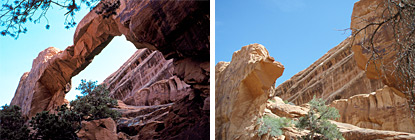
Wall Arch, 12th largest, one of the better-known and most-seen natural arches in Arches National Park, Utah, collapsed.

Wall Arch, before and after collapse - National Park Service photos

Wall Arch, before and after collapse – National Park Service photos

“Not being a geologist, I can’t get very technical but it just went kaboom,” [Arches NP] Chief Ranger Denny Ziemann said. “The middle of the arch just collapsed under its own weight. It just happens.”

Wall Arch, located along the popular Devils Garden Trail, was 71 feet tallwide and 33 1/2 feet widetall, ranking it 12th in size among the known arches inside the park. Lewis T. McKinney first reported and named Wall Arch in 1948.

No one reported observing the arch collapse and there were no visitor injuries, the National Park Service said.

Read the report from the Salt Lake Tribune.

Some tourist on Sunday, August 3, or Monday, August 4, got the last photograph of Wall Arch still standing. Was it you? Were you close? Give us a shout in the comments if so.

Other resources:

x

Other blogs and later reports:


Alpine Loop? Try Utah’s, gentler, prettier than Colorado’s

August 6, 2008

Utah’s canyons have so many pretty spots. Taking visitors through them I always heard about how no one expected such beauty in the desert. So I was excited to see the headline in Sunday’s Dallas Morning News about taking the Alpine Loop.

Autumn aspens in Utahs Alpine Loop - Wikimedia photo

Autumn aspens in Utah's Alpine Loop - Wikimedia photo

Prettiest drive you can make in a day. Start out in American Fork, head up American Fork Canyon, cross over to the backside of Mt. Timpanogos — you’ll see aspen, pines, fir, some of the prettiest streams you’ve ever seen anywhere. Some years back the Utah Travel Council had a spectacular poster showing the colors in the fall — about five shades each of red, gold and green, aspen and cottonwoods against the balsam and Douglas fir and a few scattered pines. Stop and hike up to Timpanogos Cave National Monument. See where the glacier was on the east side of Timpanogos.

End up passing Robert Redford’s Sundance Ski Resort, and down Provo Canyon (when I skied there it was $6.50 for a full-day pass; have the rates gone up?) — finish up with dinner in a good restaurant in Provo (or drive the 36 miles back to Salt Lake City and have world-class sushi at Takashi).

Alas. The article was about Colorado’s Alpine Loop. Who knew Colorado even had one by that name?

I suspect the Colorado version is less-traveled. The author took a four-wheel-drive vehicle.

Utah Travel Council photo of the Alpine Loop showing some of the autumn colors -- not the great shot from the long-ago poster, alas.

Utah Travel Council photo of the Alpine Loop showing some of the autumn colors -- not the great shot from the long-ago poster, alas.

Utah’s Alpine loop is paved the entire way, closed maybe only during a winter of very heavy snow. If you’re just passing through, you can do the drive in three hours or less, easily. If you have a day, grab a picnic, and spend some time stopping to enjoy the mountains.

(Go see Rich Legg’s photos of the east side of Timpanogos, here.)

Some time I’d like to check out the Colorado version. Odds are that I’ll be back in Utah County before then, however, and odds are you’ll be closer to the Utah version than the Colorado version, too.

You know the old saying about “take time to stop and smell the balsam, and ooh and aah at the aspen?” The Alpine Loop is what the aphorist was thinking about. Theodore Roosevelt would have gone there, had he known about it. You know about it now.

Windleys Google map of Utahs Alpine Loop, around Mt. Timpanogos

Windley's Google map of Utah's Alpine Loop, around Mt. Timpanogos


400 years of river history: NY celebrates Hudson, Champlain and Fulton in 2009

July 26, 2008

Okay, it’s the 202nd anniversary of Robert Fulton’s historic, 32-hour steamboat trip from New York City to Albany, demonstrating the viability of steamboat travel for commerce on the Hudson.  But for such a historic river, why not delay that fete for a couple of years and roll it into the 400th anniversary of Champlain’s exploration of the lake that now bears his name, and Henry Hudson’s discover of the mouth of the river to the south, the Hudson, whose mouth is home to New York City.

400 years of Hudson River history in 2009 - Hudson, Champlain, Fulton

400 years of Hudson River history in 2009 - Hudson, Champlain, Fulton

And so 2009 marks the Quadricentennial Celebration on the Hudson, honoring Hudson, Fulton and Champlain.

Alas, the committee to coordinate the celebration along the length of the river was not put in place until February, so there is a scramble.  Local celebrations will proceed, but the overall effort may fall short of the 1909 tricentennial, with replicas of Hudson’s ship, Half Moon, and Champlain’s boats, and Fulton’s steamer, and parades, and festivals, and . . .

Still, the history is notable, and the stories worth telling.

Most of my students in U.S. and world history over the past five years have been almost completely unaware of any of these stories.  One kid was familiar with the Sons of Champlin, the rock band of Bill Champlin, because his father played the old vinyl records.  Most students know nothing of the lore of Hudson, the mutiny and the old Dutch stories that have thunder caused by Hudson and his loyal crewman bowling in the clouds over the Catskills.  They don’t even know the story of Rip van Winkle, since it’s not in the Texas Essential Knowledge and Skills (TEKS) list and so gets left out of even elementary school curricula.  Is this an essential piece of culture that American children should know?  American adults won’t know it, if we don’t teach it.

Henry Hudson, from a woodcut

Henry Hudson, from a woodcut

Explorations and settlement of Quebec by Samuel de Champlain get overlooked in post-NCLB texts.  Texts tend to make mention of the French settlement of Canada, but placing these explorations in the larger frame of the drive to find a route through or around North America to get to China, or the often-bitter contests between French, English, Spanish, Dutch and other European explorers and settlers gets lost.  French-speaking Cajuns just show up in histories of Texas and the Southwest, with little acknowledgment given to the once-great French holdings in North America, nor the incredible migration of French from Acadia to Louisiana that gives the State of Louisiana such a distinctive culture today.

French explorer and settler Samuel de Champlain

French explorer and settler Samuel de Champlain

Champlain’s explorations and settlement set up the conflict between England and France that would result in the French and Indian War in the U.S., and would not play out completely until after the Louisiana Purchase and War of 1812.

Fulton’s steamboat success ushered in the age of the modern, non-sail powered navies, and also highlights the role geography plays in the development of technology. The Hudson River is ideally suited for navigation from its mouth, north to present-day Albany.  This is such a distance over essentially calm waters that sail would have been preferred, except that the winds on the Hudson were not so reliable as ocean winds.  Steam solved the problem.  Few other rivers in America would have offered such an opportunity for commercial development — so the Hudson River helped drive the age of steam.

New York City remains an economic powerhouse.  New York Harbor remains one of the most active trading areas in the world.  Robert Fulton helped propel New York ahead of Charleston, Baltimore and Boston — a role in New York history that earned him a place in for New York in the U.S. Capitol’s Statuary Hall.  The steamboat monopoly Fulton helped establish was a key player in Gibbons v. Ogden, the landmark Supreme Court case in which the Court held that Congress has the power to regulate commerce between states — an upholding of the Commerce Clause against the old structures created under colonial rule and the Articles of Confederation.

Robert Fultons statute in the U.S. Capitol - photo by Robert Lienhard

Robert Fulton's statute in the U.S. Capitol - photo by Robert Lienhard

400 years of history along the Hudson, a river of great prominence in world history.  History teachers should watch those festivities for new sources of information, new ideas for classroom exercises.

Resources:


Russians leverage climate change for economic advantage: The Arctic Bridge

July 22, 2008

In the U.S. we still have people throwing themselves in front of Zambonis to protest doing anything about global warming. In Russia, warming is taken as a fact.

And so Russians get a leg up on U.S. companies, in this case working to open an Arctic “bridge” for shipping goods from Russia to Canada and back.

Bookmark this site, Arctic Economics, you economics and geography teachers.


Geography hidden in plain sight

June 18, 2008

Strange Maps features federally-owned lands. Those of us who grew up in the west tramping those federal lands, and those of us who worked policy for those lands rarely think they should be listed as “strange” maps. Beautiful land maps, perhaps. God’s Country. It’s funny others regard it as so strange.

But we get clues. In comments at Strange Maps I noted a corporate meeting where I was chastised and ostracized for making a simple statement of fact about the ownership of lands in the west. Other than we veterans of the Sagebrush Rebellion (on all sides), ranchers, miners, and members of the Sierra Club, Wilderness Society, National Recreation and Parks Association (NRPA) [Barry Tindall? Are you still out there?], National Parks Conservation Association (NPCA), and enrolled tribal members, who pays attention to that stuff?

Too few in government pay enough attention. Fewer people outside government pay attention, especially if they don’t live in states in which the federal lands reside.

Public lands are all around us, yet we don’t see them as anything much different from any other land. Too often we don’t even see them for the resources they are. It’s as if we had a treasure of diamonds, rubies and gold, and we put it on display, and no one could see it.

For example, there was a major decision in federal district court on an issue of federalism last Friday — did you hear of it in your local newspaper, or on your local television or radio news? Nor are most people familiar with the move to amend the 1872 Mining Act, nor could most Americans describe for you what the 1872 Mining Act is or why it’s worth billions of dollars annually to the federal government, state governments, and mining corporations.

Strange Maps showed only the amount of land in federal hands in each state. Below is a map that shows where are the actual federal holdings, from the online National Atlas (nationalatlas.gov) — a map of federal lands and Indian Reservations. (A .gif preview is below; below that is a link to a .pdf file you can download.) The light green is National Forest land; the yellow is Bureau of Land Management land. The red plots are Indian reservations. Click on the map for the enlargement, you can see that Nevada, for example, has just thin threads of private lands (in white), mostly along U.S. Highway 50, and around Las Vegas.

All Federal Lands and Indian Reservations; NationalAtlas.gov, now archived at USGS

All Federal Lands and Indian Reservations; NationalAtlas.gov, now archived at USGS


Flip the pages of most geography texts, however, and you’ll find little clue of the role federal lands play in modern America, let alone the historical roles played.

History?

Sure. Notice that most of the public lands held today are in 13 western states, generally the last states allowed into the union (not exactly; Oklahoma is a 20th century admission — but it has Indian reservations; read on). Outside the 13 original colonies, which became the 13 original states, and Vermont (#14), all the land in the U.S. was held by the federal government at one time. Much of the territory between the 13 original states and the Mississippi was ceded to the U.S. by Britain in the Treaty of Paris, which ended the American Revolution. Americans thought the land useful for farming, chiefly, so the intention was to devise the lands to private holders. To that end the various Northwest Ordinances (e.g., 1785, 1786, 1787 and later) established systems to sell off the lands into private hands.

Disposal of the lands required the creation of a bureau to do the job. The General Land Office was created in 1812, and remained part of the federal government until it was folded into the new Bureau of Land Management in 1946.

That some of the lands might have national value, and should be held in federal title, did not surface as a complete idea until the Progressive Era, with the emphasis on land stewardship, under Teddy Roosevelt, Taft, and their successors. Even then, the general idea was to get most of the lands into private ownership. Roosevelt worked to preserve the most scenic and most unique lands.

Beginning with the Northwest Ordinances, the federal government set aside two sections in every township for the benefit of education. Local governments sold the tracts and put the money to school construction, or put the schools on those sections. Some of the tracts in the far western states are still there, unsold and providing no benefits to the schools. In some cases this is because the tracts are stuck inside federally-held tracts, in National Forests, in National Parks. Texas dedicated some of its state lands to provide funding for the University of Texas. Fortunately, these tracts happened to be on a pool of oil. When oil development took off, Texas’s university systems benefited (the Texas A&M System got a third of the rights along the way).

Poster advertising lands in Nebraska and Iowa

Development of the Transcontinental Railroad was financed by massive grants of land to the railroad companies. Even today the fortunes of the old Burlington Northern Railroad (now BNSF) are swelled by coal on land granted to the original companies building the rails, land the company has held for all these years. The thin line of private land across northern Nevada originally was the route of the Central Pacific Railroad — now it is approximately the route of U.S. Highway 50, “America’s Loneliest Highway.”

President Abraham Lincoln signed the Homestead Act on May 20, 1862. Under the Act, any American could lay claim to public lands for a small fee, and if he could live on the land for five years, title was vested in that citizen. This explanation comes from a lesson plan at the National Archives:

The new law established a three-fold homestead acquisition process: filing an application, improving the land, and filing for deed of title. Any U.S. citizen, or intended citizen, who had never borne arms against the U.S. Government could file an application and lay claim to 160 acres of surveyed Government land. For the next 5 years, the homesteader had to live on the land and improve it by building a 12-by-14 dwelling and growing crops. After 5 years, the homesteader could file for his patent (or deed of title) by submitting proof of residency and the required improvements to a local land office.

When I was a child in southern Idaho, customers at my parents’ furniture store included many people who were still trying to make a go of things on homesteads north of Burley, Idaho, on “the North Side.” Much of the land granted this way could not support a family, and the failure rate of these homesteads in the 1950s and 1960s was probably more than 50 percent (I’m swagging the figure — if you have better statistics, send them along).

Overall, the Homestead Act shaped America’s character as a home for entrepreneurs:

By 1934, over 1.6 million homestead applications were processed and more than 270 million acres—10 percent of all U.S. lands—passed into the hands of individuals. The passage of the Federal Land Policy and Management Act of 1976 repealed the Homestead Act in the 48 contiguous states, but it did grant a ten-year extension on claims in Alaska.

Much of the land that open for homesteading was desert, unsuitable for farming. It was available for grazing cows and sheep, though, and much of it was overgrazed. (Grazing alone wouldn’t meet the homestead requirements.) It was not until the 1970s that people outnumbered sheep in Utah, for example. In the first three decades of the 20th century enormous flocks of sheep grazed much of what is now considered Utah’s western desert territory, flocks of thousands of sheep, or tens of thousands.

These lands, too arid for farming, too hilly for much of anything else, too far away from settlements for other commerce, eventually formed the core of lands held by the Bureau of Land Management (BLM) in the Department of Interior. BLM manages 264 million acres of land, far and away the biggest land management agency in the federal government. Much of the land was severely overgrazed by 1930, and after the harsh lessons of the Dustbowl, Congress tried to rope in grazing and set it up in a rational scheme in the Taylor Grazing Act of 1934, one of the lesser noted chunks of the New Deal era.

The major federal land management agencies today include the Department of Interior’s BLM, National Park Service, Fish and Wildlife Service, Bureau of Reclamation, and to a lesser and more complicated degree, the Bureau of Indian Affairs; the Department of Agriculture’s National Forest Service; and the Department of Defense, especially in the western public lands states (think Nevada gunnery range, Skull Valley and Dugway Proving Grounds, Utah, and Area 51).

Each area of land management policy is controversial to some degree, but even these controversies rarely rise to the level of public acknowledgment. The latest starlet’s sexcapades will grab headlines away from the major effort to overhaul mining law, for example. In the 1980s, Alaska voted on a proposal to secede from the union, but the issue barely got three paragraphs in the Washington Post or New York Times, two of the newspapers that are generally very good in covering such issues. This post barely scratches the surface of these issues.

(Digression: I first encountered Molly Ivins when she reported for the NY Times out of the Denver bureau; as a Scout I had hiked and traveled much of Utah and the west; as a Senate staffer to a western senator, I was intimately familiar with most of the land in Utah especially. Ivins wrote a story on a protection issue on a chunk of land and a formation I’d not been familiar with, and in sparring with her about the article, it became very clear that she had pulled out sources we didn’t know about, and that she knew the stuff about as well as we did. Anyone who bothers to give a damn about western lands can earn my respect with such careful research.)

As a side note, Strange Maps suggested that the District of Columbia was all federal lands, but most of the District has been devised into private property, and commenters noted that. Here is a map of the District showing its federally-maintained lands.

District of Columbia and Federal Lands; NationalAtlas.gov (now at USGS)

District of Columbia and Federal Lands; NationalAtlas.gov (now at USGS)

Other resources:

Other related posts at the Bathtub: