What does Superstorm Sandy tell us about how to vote? Is disaster aid “immoral?”

October 29, 2012

Is it immoral for the federal government to coordinate disaster responses, and to provide aid for disasters, especially during and after superstorms like Sandy?

SUOMI view of Hurricane Sandy, early October 29, 2012 - NASA image

Caption from NASA: This night-view image of Hurricane Sandy was acquired by the Visible Infrared Imaging Radiometer Suite (VIIRS) on the Suomi NPP satellite around 2:42 a.m. Eastern Daylight Time (06:42 Universal Time) on October 28, 2012. In this case, the cloud tops were lit by the nearly full Moon (full occurs on October 29). Some city lights in Florida and Georgia are also visible amid the clouds.
CREDIT: NASA/Suomi NPP – VIIRS/Michael Carlowicz

I was troubled when GOP Louisiana Gov. Bobby Jindal called for cuts to disaster forecasting and especially our volcano monitoring systems, in 2009. I’ve been troubled by slams at NASA and NOAA with calls to cut budgets for orbiting satellites used to forecast storms and floods and other disasters, from the GOP.

And, with Sandy bearing down on the U.S. Northeast, Middle Atlantic and New England states (where older son Kenny lives in building that is, we hope, about 20 feet above sea level), I’ve been troubled by memories of calls for cuts to FEMA in the Republican presidential primaries.

Correspondent James Kessler tracked down a transcript from a campaign event in June, a presidential candidate cavalcade broadcast by CNN, with John King as moderator/anchor.  Look at this exchange:

KING: What else, Governor Romney? You’ve been a chief executive of a state. I was just in Joplin, Missouri. I’ve been in Mississippi and Louisiana and Tennessee and other communities dealing with whether it’s the tornadoes, the flooding, and worse. FEMA is about to run out of money, and there are some people who say do it on a case-by-case basis and some people who say, you know, maybe we’re learning a lesson here that the states should take on more of this role. How do you deal with something like that?

ROMNEY: Absolutely. Every time you have an occasion to take something from the federal government and send it back to the states, that’s the right direction. And if you can go even further and send it back to the private sector, that’s even better.

Instead of thinking in the federal budget, what we should cut — we should ask ourselves the opposite question. What should we keep? We should take all of what we’re doing at the federal level and say, what are the things we’re doing that we don’t have to do? And those things we’ve got to stop doing, because we’re borrowing $1.6 trillion more this year than we’re taking in. We cannot…

KING: Including disaster relief, though?

ROMNEY: We cannot — we cannot afford to do those things without jeopardizing the future for our kids. It is simply immoral, in my view, for us to continue to rack up larger and larger debts and pass them on to our kids, knowing full well that we’ll all be dead and gone before it’s paid off. It makes no sense at all.

Can you imagine how different the world would be today had Americans shared that view in 1936, or 1940, or 1942?  Immoral to do what is necessary to preserve the future, because we have to borrow to do some of it?

Has Romney changed his position in the last 24 hours?  I predict he will change it very soon, if he hasn’t already flip-flopped on it.  Of course, he may double down on crazy, and stand pat.   What do you think a rational patriot would do in this case?  [At about 1:00 p.m. Central Time, I heard an NPR radio news report — Romney urges private contributions to the Red Cross.  Meanwhile, President Obama has been working all morning to make sure the disaster response from the federal government is coordinated with affected states.] [Ha! But within hours, Romney has taken the almost-opposite position again.  World land speed record for flips on an issue?]

I erred, perhaps.  I had thought Mitt Romney the most capable and sober of the GOP candidates for president, and I urged by GOP friends to support Romney if they had no chance of completely recovering their senses by November.  Now I realize that, on the GOP side, “most capable” should be “most nearly capable,” and still means “incapable.”  And “sober” means nothing at all.  Perhaps worse, he’s still the best of the GOP lot this year.  Even worse, he has a chance to win.

Can we blame Romney?  Yes, we can blame people who reject science and don’t think of consequences past election day.  Yesterday Greg Laden offered a long post on what we should have learned from the “Storm of 1938” and the remnants of Hurricane Irene that slammed the Northeast in 2011, “What you need to know about Frankenstorm Hurricane Sandy”:

Here’s the thing. Imagine that a storm like Sandy came along in either of two years; 70 years ago or 35 years ago. Sandy is much larger and contains much more energy than the ’38 storm, or for that matter, of any known storm of the North Atlantic (we’ll get to that below). If Sandy hit the region in the 1930s, it would have been without warning, and it would have been prior to the reconstruction of seawalls and the development of flood mitigation measures inland that have happened in recent decades. Sandy, in ’38, would kill tens of thousands and destroy thousands of structures. That would be an average Sandy, a Sandy not being as bad as the most dire predictions we are considering today as the storm begins to take a grip on the eastern seaboard.

A Sandy of 35 years ago would have been predicted. The ability to see hurricanes coming was in place, but not as well developed as it is today. We would have seen Sandy coming, but her massiveness and extent, and her exact trajectory, would probably have been unknown. But at least there would be warning. Many of the seawalls and flood mitigation systems would have been in place, but the overbuilding on barrier islands and other vulnerable coastal regions would have been at or near a peak. With evacuations, Sandy would not kill 10s of thousands… probably only hundreds. But the number of buildings destroyed would be unthinkable. Most of those buildings are now gone or shored up. A Sandy in 1975 would have left some very interesting coastal archaeology for me to have observed during my trips to the shore in the 1980s. Very interesting indeed.

Mr. Laden always offers a good view of science, and his history is good here, too.

We can learn from the past.  FEMA is charged with learning from past disasters.  It’s a function of federal government we would be foolish to forego.  “Austere” shouldn’t mean “stupid.”

What do you think?  Is it immoral for the federal government to provide disaster assistance?

More:


Gradient Sun, NASA video for classroom use

October 21, 2012

Real science often is more fantastic that the stuff people make up. Haldane was right.

Still shot from NASA solar gradient video

Not the Sun you’re used to seeing.

In a century our studies of the Sun progressed from the deep calculations based on erroneous assumptions of what our star is make of  (Lord Kelvin‘s calculations on how long the iron in the Sun would take to cool to its present color), to today’s solar studies, in which nearly every moment of the Sun’s life is recorded through a half dozen different sensors, by satellites and telescopes and whatever other means we have to capture data from the Sun’s burning.

It’s hard science — but it borders on art, too, doesn’t it?  Watch this:

Gradient Sun [HD Video], originally uploaded by NASA Goddard Photo and Video.

What’s going on here?

Via Flickr:

Watching a particularly beautiful movie of the sun helps show how the lines between science and art can sometimes blur. But there is more to the connection between the two disciplines: science and art techniques are often quite similar, indeed one may inform the other or be improved based on lessons from the other arena. One such case is a technique known as a “gradient filter” – recognizable to many people as an option available on a photo-editing program. Gradients are, in fact, a mathematical description that highlights the places of greatest physical change in space. A gradient filter, in turn, enhances places of contrast, making them all the more obviously different, a useful tool when adjusting photos. Scientists, too, use gradient filters to enhance contrast, using them to accentuate fine structures that might otherwise be lost in the background noise. On the sun, for example, scientists wish to study a phenomenon known as coronal loops, which are giant arcs of solar material constrained to travel along that particular path by the magnetic fields in the sun’s atmosphere. Observations of the loops, which can be more or less tangled and complex during different phases of the sun’s 11-year activity cycle, can help researchers understand what’s happening with the sun’s complex magnetic fields, fields that can also power great eruptions on the sun such as solar flares or coronal mass ejections.

The images here show an unfiltered image from the sun next to one that has been processed using a gradient filter. Note how the coronal loops are sharp and defined, making them all the more easy to study. On the other hand, gradients also make great art. Watch the movie to see how the sharp loops on the sun next to the more fuzzy areas in the lower solar atmosphere provide a dazzling show.

NASA/Goddard Space Flight Center

NASA/Goddard Space Flight Center

To download this video go to: svs.gsfc.nasa.gov/goto?11112

NASA image use policy.

NASA Goddard Space Flight Center enables NASA’s mission through four scientific endeavors: Earth Science, Heliophysics, Solar System Exploration, and Astrophysics. Goddard plays a leading role in NASA’s accomplishments by contributing compelling scientific knowledge to advance the Agency’s mission.

Follow us on Twitter

Like us on Facebook

Find us on Instagram

Teachers ought to figure out how to use this in classrooms — and I don’t mean astronomy, physics and chemistry only.  Can you find a use for this film in geography?  History? English and literature?

Sometime shortly after World War II scientists captured film of a mass coronal ejection from the Sun.  You probably can imagine the film I’m remembering.  That snippet found its way into films students saw in science, geography, chemistry, biology (“this is our Sun, from which all living things get energy, through photosynthesis”), and probably a half dozen other subjects.  It was spectacular, and it was just about all that was available for classroom use, then.  Students now probably have never seen it.  Worse, my experience is that students in high school generally have very little familiarity with the science projects carried out by agencies like NASA and the National Science Foundation, and they know very little about the Sun, or the Moon and other planets.

Teachers, the state isn’t going to help you put this into your classrooms.  Can you figure out some way to get it in?

More:


Draconid meteor shower — a great show in 2012?

October 8, 2012

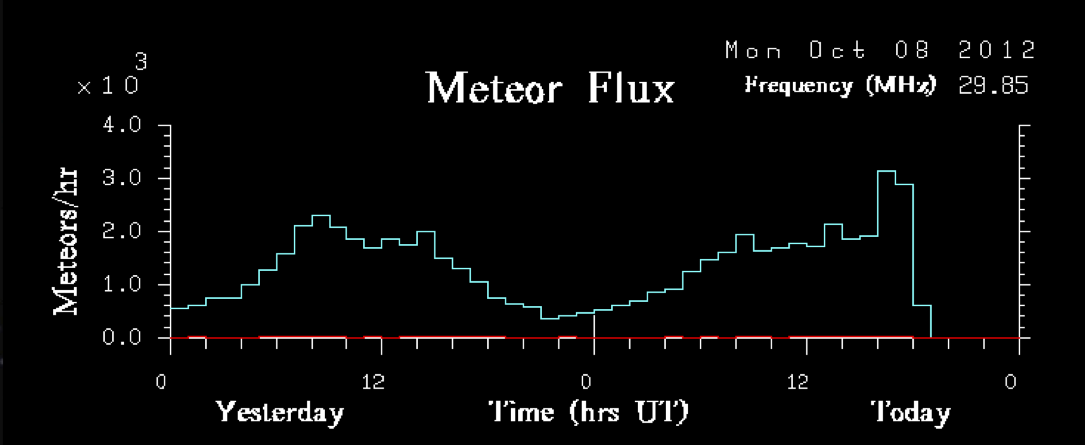
Space Weather says radar suggests a big show, already begun, with 1,000 meteoroids an hour:

DRACONID METEOR OUTBURST UNDERWAY: The CMOR radar in Canada is picking up a major outburst of Draconid meteors commencing at 16 UT on Oct. 8th. “Radar rates are at 1000 meteors per hour,” reports Bill Cooke of NASA’s Meteoroid Environment Office. “This is greater than last year’s outburst, and 5x the 2005 level.” Cooke encourages northern sky watchers, especially in Europe where night is falling, to be alert for Draconid activity. Because radars are sensitive to very small meteoroids, there is no guarantee that this radar outburst will translate into meteors visible to the human eye. On the other hand, a brilliant display could be in progress. The only way to know is to go outside and look. [CMOR radar data] [sky map] [Submit: reports or photos]
Listen: Tune into Space Weather Radio to hear live Draconid radar echoes.

Can you see these rocks as they burn up?  Or are they too small to make a visible “splash,” even though registering on radar?

Heck, some reports say it’s even more active than that; Sky and Telescope reports up to 2,200 meteoroids per hour.

How to tell?  Go outside and look up!

Draconids are most active in the early evening (other showers tend to be active after midnight).  Look toward the head of Draco the Dragon.  EarthSky.org offers a skymap to help out:

Draconid meteor shower, October 8, 2012 - map from EarthSky.org

Draconid meteor shower, October 8, 2012 – map from EarthSky.org

More:


Night skies at Yosemite, in time-lapse

September 6, 2012

Yosemite National Park, watching stars, with time-lapse photography.  The only way life gets better than this is to go there and film it yourself.  Yosemite Nature Notes 19.

Description from Nature Notes:

Yosemite’s vast acreage and remote location protect some of the darkest night skies in the country. Astronomers, photographers and city dwellers flock to the park to take advantage of this unique opportunity to view planets, stars, and galaxies.

Producer is Steven M. Bumgardner, and it features, inter alia, an interview with Shawn Reeder, whose time-lapse work I’ve highlighted before.

For classroom use, some topics and questions to pursue:

  • For geography, where is Yosemite N.P.?  Flying commercially, which airport is the best to get to the park?

    President Teddy Roosevelt and conservationist John Muir at Overhanging Rock, Glacier Point, Yosemite

    President Teddy Roosevelt and conservationist John Muir pose at Overhanging Rock at the top of Glacier Point, near which the men camped in a hollow and awoke to five inches of snow in 1903. National Park Service image

  • Map reading and orientation:  In the time-lapse sequences, you can frequently see lights streaking across the sky.  Those are commercial airliners — can you tell what airport they are headed to, or from?  Can you tell which ones are coming, which going?
  • Science:  What star formations do you see in these photographs that you can see from your house?  What star formations are not visible from your house?
  • Government:  Who signs the checks that pay the rangers pictured in the film?  For which agency do the work, in which branch of which government?
  • People in the film discuss light pollution from nearby cities.  Is there an agency in the federal government who has jurisdiction over light pollution?  How about an  agency in the state government?  What are the rules on light pollution for cities around Yosemite?
  • Can you identify the landmarks, the cliffs, rocks, mountains and rivers, portrayed in the film?  (Students might use a USGS topographical map, California state tourist promotion maps and websites, National Park Service databases, Google Earth, Google,  and a wide variety of other sources.
  • Who was president of the U.S. when Yosemite was set aside as a National Park, and what were the controversies surrounding it?
  • Who was John Muir?  Who was Frederick Law Olmsted?  What were their roles in the history of Yosemite?
  • Who lived in Yosemite, if anyone, before the Spanish missions were established in California?  When were the missions established?  How did the U.S. gain possession of the Yosemite Valley?

Photos from just another day at Denali . . .

August 15, 2012


Interior Dept photo, America's Great Outdoors, Denali National Park and Preserve

Interior Department photo, America’s Great Outdoors, at Denali National Park and Preserve; photo caption from AGO said, “We’re not sure it’s possible to take a bad photo up there!”  Click for larger view.

More:

Update:  Interior tweeted another photo later today.

Denali Wildflower, U.S. Department of Interior

From the U.S. Department of Interior Tweet: This morning we gave you an amazing shot of #Denali. Would you believe this one is from the same place? Whether large or small, beauty in Denali is everywhere you look. #Alaska

Can someone identify the flower?


“Does it get better than this?” U.S. flag and Denali

August 10, 2012

Instagram from the Department of Interior, yesterday:

U.S. flag and Denali on an almost-clear day; Department of Interior photo, August 2012 - public domain

U.S. flag and Denali on an almost-clear day; Department of Interior photo, August 2012 – public domain

usinterior Tweeted, “Does it get any better than this?”

Denali, also known as Mt. McKinley, is the highest point in North America, 20,320 feet (6,194 m) above sea level.  Measured base to peak, it’s the tallest mountain on land on Earth — Everest and other Himilayan peaks rise from a very high plateau.  Denali is high enough that it makes its own weather.  Finding a day when the mountain is not almost completely obscured by clouds is rare, locals say.  Finding an almost-clear view, with blue sky in the background, is a cause for photographer excitement.

You’ll notice straight-line clouds in the sky — condensation trails from passenger jets.  I wonder how many flights bend a little to get a better view of the mountain for passengers?  Do big airlines even do that anymore?

Nice shot.  I could learn to like Instagram with more photos of this quality.

Better, it would be nice to be there, taking these shots.

More, including the controversy over the mountain’s name:


Yosemite time-lapse tour

July 25, 2012

From Project Yosemite, a series of cool time-lapses, from one of the coolest spots on Earth, Yosemite National Park.

Details on the film, and how to track down the artists and see more, from Project Yosemite’s Vimeo site:

A collaborative project by Sheldon Neill and Colin Delehanty. What started as an idea turned into an ongoing adventure to timelapse Yosemite in an extreme way.

We were complete strangers before it all started, but after we met on Vimeo our idea came into sight, and then began the challenge to make numerous trips to YNP where we would capture the beautiful landscape it offers for visitors every year.

We invite you to watch our video in hopes you’ll witness Yosemite like never before.

Project Yosemite

Yosemite HD

This video is a collaboration between Sheldon Neill and Colin Delehanty. All timelapses were shot on the Canon 5D Mark II with a variety of Canon L and Zeiss CP.2 Lenses.

Project Yosemite Website: projectyose.com
Facebook Page: facebook.com/projectyose
Contact info: info@projectyose.com

Thanks to Dynamic Perception for their motion controlled dolly and continued support!

Dynamic Perception Website: dynamicperception.com

Track: Outro
Album: Hurry Up, We’re Dreaming
Artist: M83
Site: ilovem83.com
Publishing: emimusicpub.com
Licensing: bankrobbermusic.com

This whole project has been an amazing experience. The two of us became friends through Vimeo and explored a shared interest in timelapsing Yosemite National Park over an extended period of time. We’d like to expand this idea to other locations and would appreciate any suggestions for a future project.

Project Yosemite was featured as a main story on Yosemite National Park’s Spring Newsletter.: yosemitepark.com/timelapse-sprnews-2012.aspx

To view this in 2K, visit: youtu.be/OwFbjJasW3E
Be sure to change the quality settings to ‘Original’.

Twitter:
twitter.com/#!/SheldonNeill
twitter.com/#!/delehanty

Facebook:
facebook.com/sheldon.neill
facebook.com/delehanty

Behind The Scenes: vimeo.com/35223326
By Dalton Runberg

Our hearts go out to the families of Markus Praxmarer who lost his life while climbing Half Dome on September 19th, 2011 and Ranger Ryan Hiller, who was crushed by a tree January 22nd 2012. They will be missed. (A photo of Ranger Ryan Hiller can be found to the right, above the statistics counter)

Generalized geologic map of the Yosemite area....

Generalized geologic map of the Yosemite area. (USGS image) (Photo credit: Wikipedia)

Yosemite National Park is spectacular, and much photographed than other great natural places of beauty.  How much does it benefit from being in California, closer to many people with good cameras and great photographic skills, to an extent that more distant, spectacular parks like Glacier N.P., Yellowstone N.P and Big Bend N.P. do not benefit? How does that affect management of the parks? How does that affect how people view their own local adventure areas?

Will Project Yosemite be back with more?

More:


“Who you calling a squirrel?”

July 22, 2012

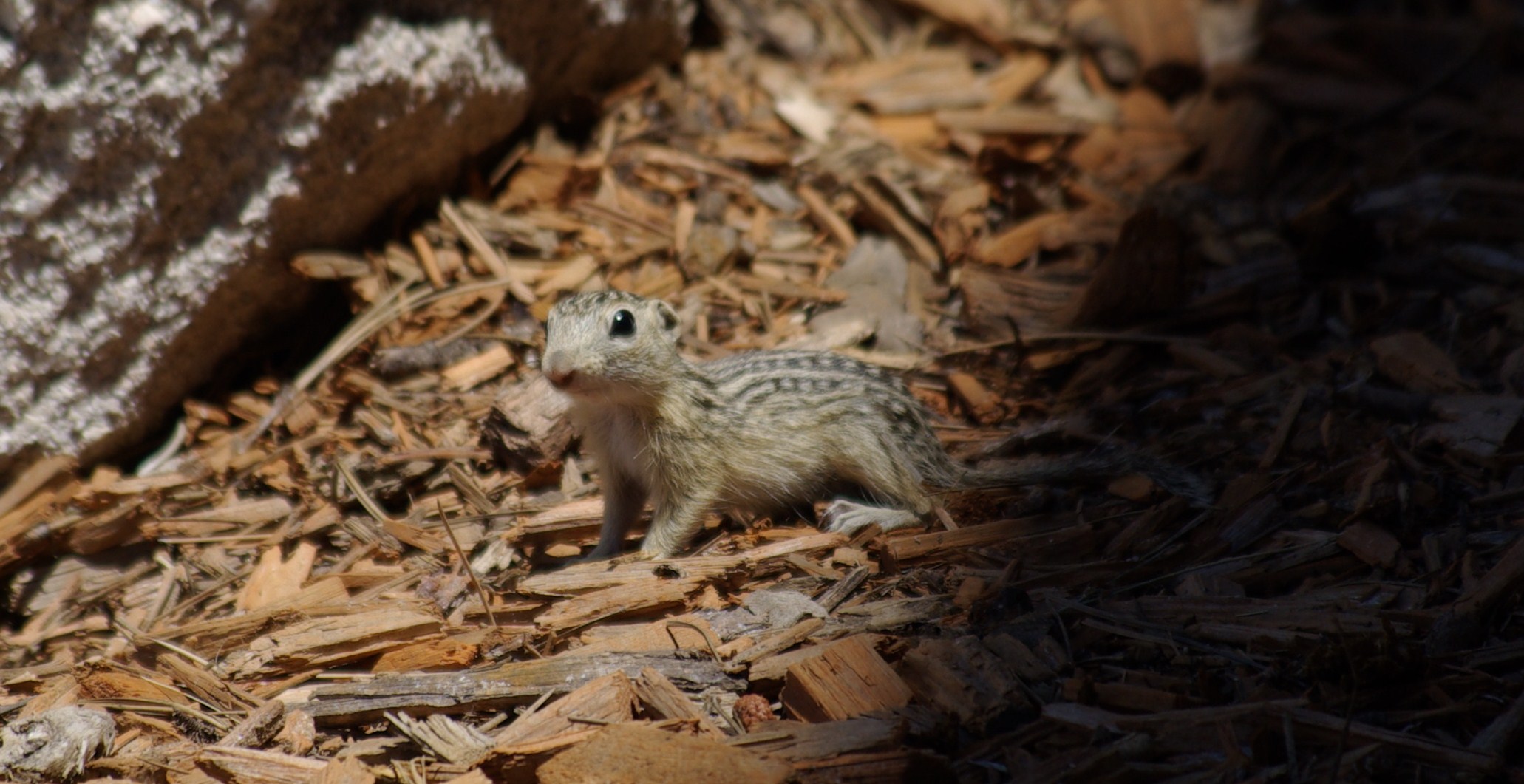
Ground squirrel at Camp Cris Dobbins, BSA:

13-lined ground squirrel, photo by Ed Darrell

13-lined ground squirrel, Ictidomys tridecemlineatus, photographed by Ed Darrell, at BSA Camp Cris Dobbins, Colorado


White-breasted nuthatch in action

July 21, 2012

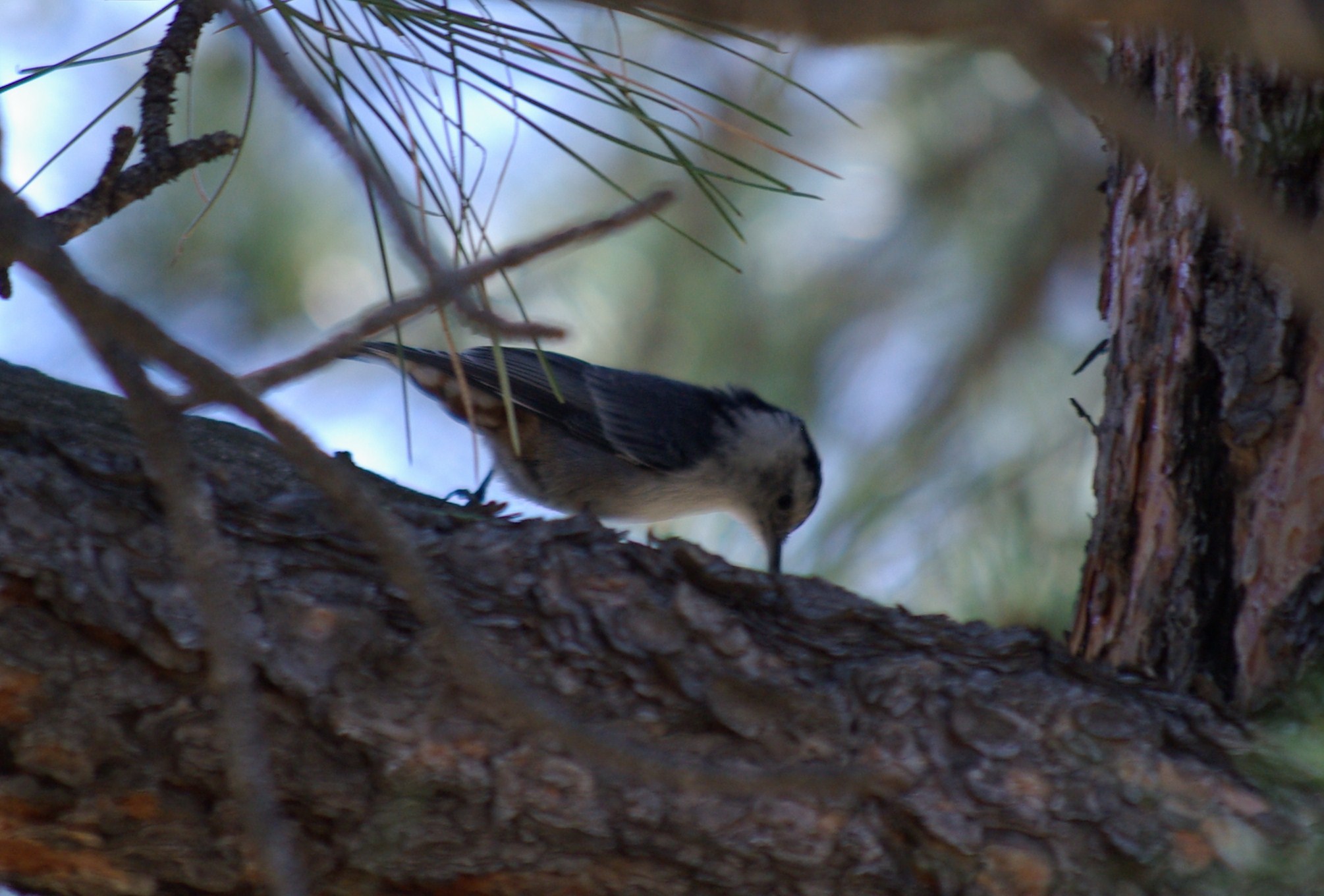
White-breasted nuthatch (Sitta carolinensis) (male?), cracking a nut on a pine limb, Peaceful Valley Scout Ranch, Colorado, July 2012:

White breasted nuthatch in action, Peaceful Valley Colorado, 2012 - photo by Ed Darrell - 061

White-breasted nuthatch (Sitta carolinensis)works over a seed, Colorado, 2012 – photo by Ed Darrell


Spring flowers in Dallas

July 1, 2012

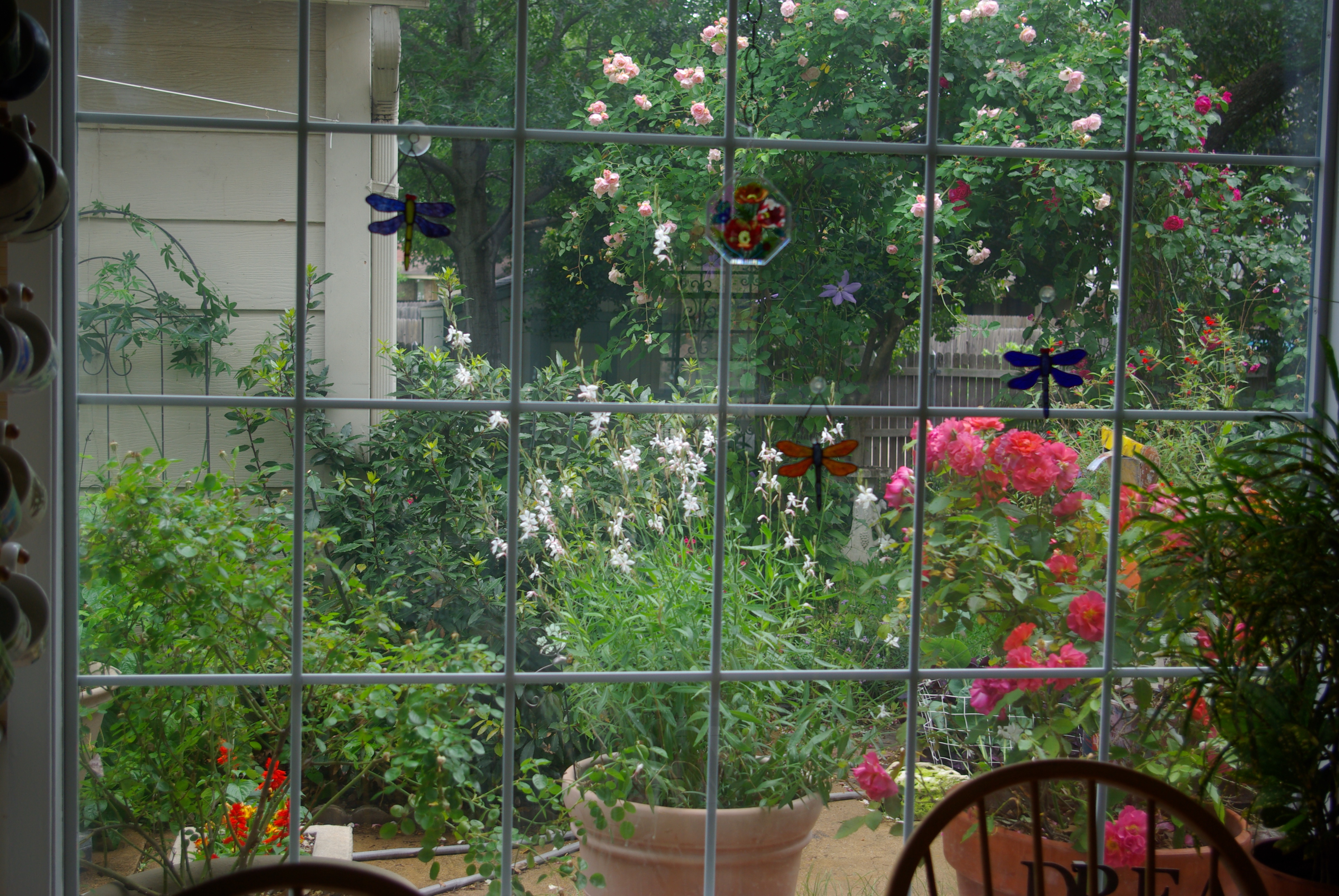
From our kitchen table, the view on April 15 of this year.

View from kitchen, April 15, 2012 - photo by Ed Darrell

Colors muted by shooting through glass, but you see the advantages of having a flower-loving gardener for a spouse. Kathryn’s garden provides delights in every not-frigid month, with many stunning moments like this one.

Coffee is always better with a sweet view.


Turk’s Cap, native Texas flower in 90 seconds

June 26, 2012

Short piece from Texas Parks & Wildlife:

Turk’s cap is a native Texas shrub that attracts hummingbirds, butterflies and moths. This easy-to-care for plant is named for the shape of its small blooms. To learn more about Texas native species and habitats, see http://www.tpwd.state.tx.us/huntwild/wild/wildlife_diversity/

Must admit I was unaware it’s a Texas native, though Kathryn has had it in all of our Texas gardens.  I love the blossoms.  I wish our local hummingbirds loved it as much as the photo in the video shows, but we have other plants they love and a feeder.  Butterflies like it, too.

Few other plants equal the intense red of the flowers.  Turk’s cap requires less water than many less spectacular, non-native plants.  Ours keep coming back year after year.  What more do you want in a good garden plant?

I wish my photos were so good as those used in the film.

More, and related material:


Dogwood Canyon amble for the blossoms

March 26, 2012

It was billed as a “hike” that might take 2.5 hours, but David Hurt, the grand benefactor of Dogwood Canyon Audubon Center, was the guide — at the two hour mark we had just ambled to the blossoming trees in their still-semi-secret location.  Amble, not a hike.

Great day to be outside.

The voyage is at least half the fun.

Dogwood Canyon's benefactor David Hurt - 03-25-2012 import 672

After more than a year of serious drought, some of North Texas experienced high rainfall in the past three months. Spring-fed streams and seeps on Cedar Hill and across the Escarpment flow well for the moment, lending hope to wild bird breeding.  On some entangled bank . . .

Poison ivy along the trail, Dogwood Canyon Audubon Center - 03-25-2012 import 697 - Photo by Ed Darrell, use permitted with attribution

Poison ivy along the trail. Keep away.

David Hurt demonstrates differences in oaks, 03-25-2012 import 694 - photo by Ed Darrell

Is it eastern red oak, or something else? How to tell?

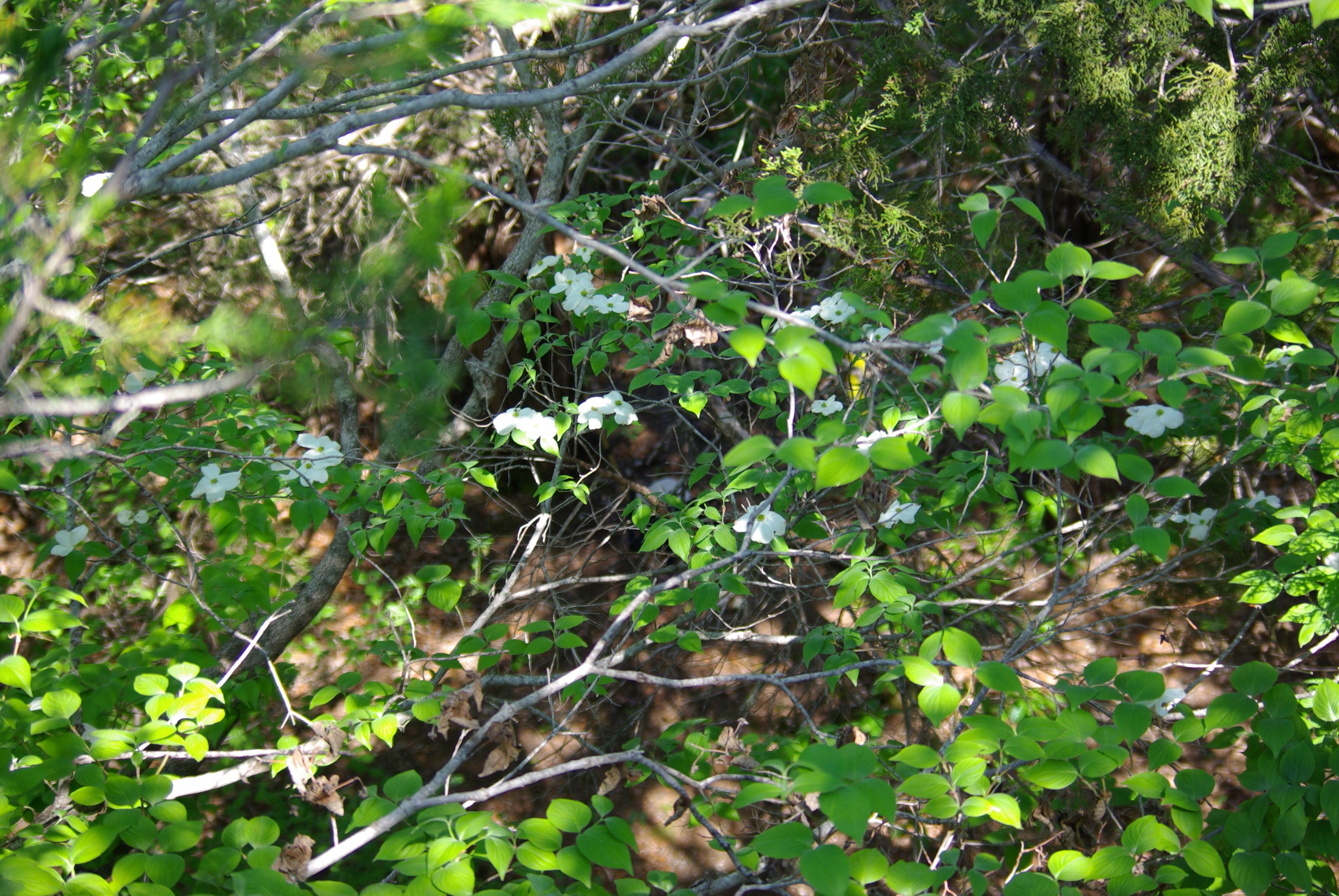
Dogwood blossom at Dogwood Canyon, Cedar Hill, Texas 03-25-2012 import 737 - Photo by Ed Darrell, use permitted with attribution

The dogwoods in bloom! An early spring, and lots of water, pushed the trees to leaf out before blossoming started — usually the blossoms come first. The drought last year probably hurts blossoming this year. Blossoms are not yet at their peak.

Dogwood blossoms, Dogwood Canyon Audubon Center 03-25-2012 import 744 - phot by Ed Darrell

Exquisite aroma and beauty from the dogwood blossoms – not the carpet of white we saw in a previous year. Still just the shock of finding these little beauties in Dallas County adds to their splendor. Dogwoods do well in East Texas, where it is wetter and the soil is acid. Here on the escarpment it is generally dry, hotter, and the soil is thin and alkaline. That the blossoms show up at all is a stunning oddity, a stroke of fortune emblematic of the unique place that is Dogwood Canyon.

Guided hikes — the only way to get to see the blossoms — are planned for Wednesday and Saturday this week.  Hikes are limited to 20 people, with two planned for Wednesday, and one for Saturday, March 31.  For reservations call Dogwood Canyon Audubon Center at (469) 526-1980.

Previously in Millard Fillmore’s Bathtub:


Greg Marley’s “Chanterelle Dreams, Amanita Nightmares” in the kitchen

December 29, 2011

Happy to see Mr. Marley has a video to accompany his book of last year, Chanterelle Dreams, Amanita Nightmares.  Marley hasn’t aged much in three decades; think it’s the ‘shrooms?

Vodpod videos no longer available.

Greg Marley’s “Chanterelle Dreams, Amanita Nigh…, posted with vodpod

From Chelsea Green TV. Chelsea Green publishes Marley’s work.

Greg Marley, Maine mycologist and author of "Chanterelle Dreams, Amanita Nightmares"

Greg Marley

Marley’s book was a finalist in the culinary history category for the 2011 book awards from the International Association of Culinary Professionals (IACP) , and won the 2011 Jane Grigson Award from IACP for distinguished scholarship and depth of research in cookbooks.  The award was named in honor of publisher and food author Jane Grigson, who herself published a volume on mushroom cookery.

From the Chelsea Green authors’ bios:

Greg Marley has a passion for mushrooms that dates to 1971, the year he left his native New Mexico and spent the summer in the verdant woods of central New York. Since then, he has become an avid student and teacher of mycology, as well as a mushroom identification consultant to the Northern New England Poison Control Center and owner of Mushrooms for Health, a company that provides education and products made with Maine medicinal mushrooms. Marley is the author of Mushrooms for Health: Medical Secrets of Northeastern Fungi. He lives and mushrooms in Rockland, Maine.

Greg and I met a couple of summers later, in “the verdant woods of central New York.”  We struck it off as two westerners in the usually wet East (though it was very dry that summer).  We worked together four summers, tramping the woods, canoeing the Adirondacks around Saranac Lake, singing (we were half of the barbershop quartet in a production of Meredith Willson’s “The Music Man” and joined around campfires on a hundred sparkling occasions), and sampling wild foods, in our work with the Louis August Jonas Foundation.

Nice to see a kid from the neighborhood doing good, and maybe well.


Bored in class? Do some math, for fun.

December 22, 2011

This is a good video that all math teachers ought to see (heck, I can figure out how to use it as a bell ringer in social studies, I think).

I had to mention it, just because of Michael Tobis’s wonderful headline at Planet 3.0:  “Bored in class?  Do some math instead.”

I confess to being caught doing math instead, in English, in history — and in art we often made mathematical games to create patterns.  From the stuff I see on walls in schools, that’s still popular.

Some time ago I ordered a poster from Max Temkin, the brilliant poster propagandist/artist.  It says that the universe is easy to understand if you speak its language, and that language is mathematics.  True.

Also true that in most of the disciplines that work into classes we call social studies, we do not have the ability to discern the cool patterns like Fibonacci numbers in pine cones, pineapples and sunflower blossoms.  People look for those pattersn in history anyway, and that poses a key problem to policy makers.  People want to see a pattern, expect to see a pattern, and historians cannot meet that expectation, other than quoting Santayana.

Maybe one of my students will be the one who discerns a key pattern.  It’ll be one of the slackers, if it happens.


Scenes from a beach: At the edge of the sea

December 20, 2011

Interesting little bauble in the Biloxi-Gulfport (Mississippi) Sun-Herald, I think from their columnist George Thatcher:

Cover of Rachel Carson's "The Edge of the Sea"

Good teacher resource for National Environmental Week, April 15-21, 2012

December 20 Scenes from the beach

“To stand at the edge of the sea,” wrote Rachel Carson, “… is to have knowledge of things that are as eternal, as any earthly life can be.”* The things that we see this morning–a cerulean sea and sky, the shorebirds, the sun still near the horizon — are identically the same objects that could be seen in Cambrian times, eons ago. There is a sense of the eternal in the objects viewed today. And I suppose there will be little change in a faraway eon that lies in some future age. — Diary, autumn 2011

* At the Edge of the Sea by Rachel Carson; Signet Books, New York (1955)

Read more here: http://www.sunherald.com/2011/12/19/3641733/december-20-scenes-from-the-beach.html#storylink=cpy

One should read Rachel Carson to get closer to the universe, not for political reasons, not necessarily for the science.  But being scientifically accurate, and being close to the pulse of the universe, Carson’s views will change your politics for the better if you really read and listen.