Here’s the photo of Obama the GOP hope Americans never see

May 17, 2013

It’s a prize-winning photograph by “Scout Tufankjian, an independent photographer whose portfolio includes a book of photographs from Obama’s first run for the White House.”

Scout Tufankjian's award-nominated photograph of Barack and Michelle Obama in East Davenport, Iowa, in 2012.

Barack and Michelle Obama in Booth No. 3 at Lagomarcino’s in the Village of East Davenport, Iowa, during the 2012 election campaign

Photographs sometimes reveal truths, and sometimes those truths are wonderful, and smile-making.

Bill Wundram’s column discusses the photo, in the Quad-City Times (it’s worth the click to read it).

THE QUIETUDE of the soda fountain booth was a marked difference from a rousing Obama appearance a half-hour earlier at a curb-to-curb outdoor rally.

After the speech, the Obamas adjourned to the cool of Lago’s. Tom had  prepared for them to be seated in Booth No. 3.

“The Obamas were shaking so many hands before coming into our soda shop that I had to make three different chocolate sundaes for them.” Tom says. “They kept melting.”

You can see all the photos in this Sony contest in a slide show, here.

More:


Birdbrains, in Canyonlands National Park

May 6, 2013

Bewick's Wrens nesting in skull of a bull, Canyonlands NP

From Canyonlands NP Facebook page: “View from the Maze: A pair of Bewick’s Wrens makes a nest in the brain cavity of an old bull’s skull. Where bovine ruminations once roamed a quick feathered flickering now prevails. If your skull ended up in a tree what species of bird would you like your brain cavity to host? (GC)”

Years ago in the Salt Lake Valley my sister Annette had a home on Wren Road.

One day she and a friend watched birds scurrying all over the property, plucking nesting materials.  “I wonder what kind of birds those are,” my sister said.

“Did you ever wonder why they named it ‘Wren Road?'” her friend replied.

If you want your bird watching friends to think you’re experienced at it, remember Bewick’s, as in “Bewick’s wren,”  is pronounced like the automobile, “Buick’s.”

More:


Waiting for Comet Godot

March 14, 2013

Comet Pan-STARRS?

I just can’t see it.

The past two evenings, when it was supposed to be visible, we couldn’t find it.  Maddeningly, others have great photos of the thing.

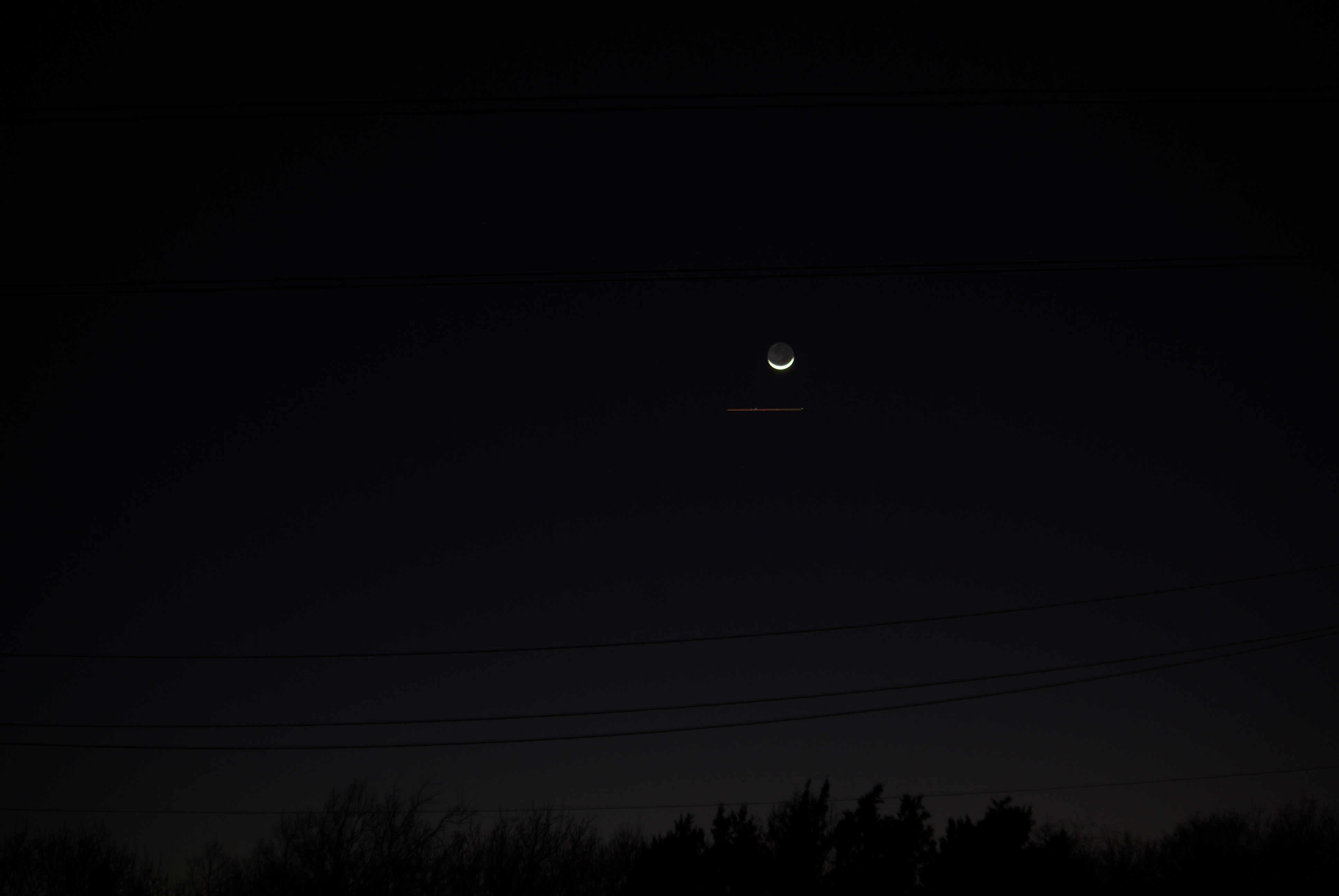
Here’s a photo of where it was supposed to be the evening of March 12.  Nice sliver of a Moon.

A view to the west over south Grand Prairie, Texas, showing the sliver of the new Moon, but a no-show Comet Pan-STARRS, March 12, 2013.  Photo by Ed, Kathryn and Peanut.

A view to the west over south Grand Prairie, Texas, showing the sliver of the new Moon, but a no-show Comet Pan-STARRS, March 12, 2013. Photo by Ed, Kathryn and Peanut.

We watched for over an hour, from just after the Sun’s winking out in a blaze of orange (Texas dust and DFW smog).  We were shooting without a tripod, and so it was difficult to capture just how thin was the line of the Moon for a long time.  It was not a clear crescent, with mountains of the Moon providing jagged lines that glistened like a crystal glass necklace.  Longer exposures revealed the comet to other observers in other places, but not to us.  Perched as we were right on the edge of the Austin Chalk Escarpment, we were joined by a dozen or so others who hoped to see the comet, or who were just putting their BMX bikes away.

A more detailed, and grainy, shot of the Moon (with no comet):

New Moon over Grand Prairie Texas, looking for Comet Pan-STARRS, photo by Ed Darrell

Eventually the Moon stated its presence, but still no Comet Pan-STARRS, on March 12, 2013. Looking west over Grand Prairie, Texas.  (Yeah, probably would have been a much better photo if not handheld.)

Here’s a photo of where it was supposed to be last night, the evening of March 13.

Moon over Grand Prairie, no comet, 3-13-2013

On March 13, Comet Pan -STARRS rode directly underneath the Moon; it’s invisible in this longer exposure, though you can see the streaking lights of a jetliner flying out of DFW International Airport under the Moon.

It’s like waiting for Godot.  Waiting for Comet Godot.

Quoting from SamuellBeckett.net:
ESTRAGON: 
People are bloody ignorant apes.  He rises painfully, goes limping to extreme left, halts, gazes into distance off with his hand screening his eyes, turns, goes to extreme right, gazes into distance. Vladimir watches him, then goes and picks up the boot, peers into it, drops it hastily.
VLADIMIR:  Pah!He spits. Estragon moves to center, halts with his back to auditorium.
ESTRAGON:  Charming spot. (He turns, advances to front, halts facing auditorium.)
Inspiring prospects. (He turns to Vladimir.)
Let’s go.
VLADIMIR:  We can’t.
ESTRAGON:  Why not?
VLADIMIR:  We’re waiting for Godot.
ESTRAGON:  (despairingly). Ah! (Pause.) You’re sure it was here?
VLADIMIR:  What?
ESTRAGON:  That we were to wait.
VLADIMIR:  He said by the tree. (They look at the tree.) Do you see any others?
ESTRAGON:  What is it?
VLADIMIR:  I don’t know. A willow.
ESTRAGON:  Where are the leaves?
VLADIMIR:

It must be dead.


More:

Brian Klimowski's photo of Comet Pan-STARRS, March 12, 2013

Other photographers found Comet Pan-STARRS. This photo comes via SpaceWeather.com. ” Brian Klimowski sends this picture from the countryside near Flagstaff, Arizona . . . ‘Beautiful show this evening!’ says Klimowski. ‘I took the photo from an altitude of about 9500 feet in the San Francisco Peaks near Flagstaff. A 1-second exposure with my Canon digital camera easily revealed the comet.'” Photo details: Canon 7D, 125 mm, 1s @ F/5.6. ISO 1250


Other side of the mountain: Timpanogos

February 26, 2013

East side of Timpanogos, by the Heber Valley Convention and Visitors Bureau:

Timpanogos from the east - replacement for photo that originally nested here. Utah.com image

Timpanogos from the east – replacement for photo that originally nested here. Utah.com image

Mt. Timpanogos, east side. Heber Valley CVB photo

Mt. Timpanogos, east side. Heber Valley CVB photo. Click image for larger view.

Tip of the old scrub brush to Susan Reeve Lewis.


Yosemite’s Horsetail Falls at its fiery best

February 26, 2013

Photo Tweeted from the National Park Service:

Bethany Gediman photo of Horsetail Falls, Yosemite NP, glowing orange

Horsetail Fall flows over the eastern edge of El Capitan in Yosemite Valley. It’s a small waterfall that many people don’t notice, but it has gained popularity as more and more people have noticed it can glow orange during sunset in mid to late February. The most popular place to see Horsetail Fall seemingly afire is El Capitan picnic area, west of Yosemite Lodge and east of El Capitan (see map below). The “firefall” effect generally happens during the second half of February. A clear sky is necessary for the waterfall to glow orange. Photo: Bethany Gediman, NPS

People living close to National Parks are lucky to do so; people who work in them luckier still, in the lifetime sweepstakes for seeing breathtaking sites.  NPS employee (Ranger?) Bethany Gediman caught this image of Horsetail Fall in Yosemite National Park.

Be sure to see the video of Yosemite Nature Notes No. 14, posted here earlier. It shows Horsetail at sunset in full glory.  Great photography.

How to get there:

Map to Horsetail Falls, Yosemite NP

Map of Yosemite National Park, showing Horsetail Falls and hiking trail to get to viewpoint in the photograph.

More:


Trombone time: Dave Finlayson and GoPro on the slide

February 6, 2013

Trombone players are nice guys, usually.  Something about the mellow tone, the difficulty of mastering a non-push-button (valve) instrument, and having to fill in the low parts where the egotistical trumpets can’t go.

My older brother Wes played trombone, and that sucked me in — the junior high band didn’t have any trombones, and some neighborhood fink ratted out that I had one in my closet.  My playing ended in college.  Younger son James played first chair in the Duncanville Wind Ensemble, a group that steps a lot of musicians right into pro slots; older son Kenny switched from trumpet to baritone in the same group (you can hear Kenny in that recording of the Wind Ensemble).  In Kathryn’s family, it’s almost required be a trombonist.  Uncle Darrell plays, still, in a symphony in Utah County, with various other uncles and cousins staffing bands from Ogden south to Provo in Utah.

So, of course, Dave Finlayson’s marriage of a short piece and a GoPro camera appealed to me right off:

You don’t recognize Dave Finlayson?

From GoPro’s site:

David Finlayson set out to make a GoPro video with his trombone and ended up with a surprise – a viral video with hits numbering over one million! Check out the extended cut David and GoPro produced — orchestra night, anyone? David is a trombonist with the New York Philharmonic – check out David’s channel for more videos at http://goo.gl/y1Hrj

More:


Odd juxtaposition of images — but it gives me some hope

January 29, 2013

A great photo from Pete Souza, the current White House photographer.  I’m hoping to track down I’ve tracked down even more details on this, because not all sources like to post all the credit information or other stuff a newspaper or blog should have . . .
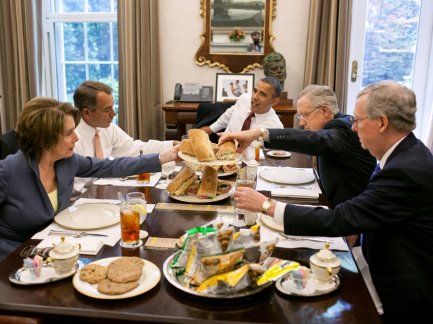
Pete Souza photo, lunch in the White House, Obama, Boehner, Pelosi, Reid, McConnell

Photo of a lunch in an anteroom of the President’s office, with President Obama, House Speaker John Boehner, House Minority Leader Nancy Pelosi, Senate Majority Leader Harry Reid, and Senate Minority Leader Mitch McConnell.

Consolidated News published the photo for its clients with this information:

United States President Barack Obama has lunch with members of the Congressional Leadership in the Oval Office Private Dining Room, May 16, 2012. The President served hoagies from Taylor Gourmet, which he purchased after a small business roundtable earlier in the day. Seated, clockwise from the President, are: U.S. Senate Majority Leader Harry Reid (Democrat of Nevada), U.S. Senate Republican Leader Mitch McConnell (Republican of Kentucky), U.S. House Minority Leader Nancy Pelosi (Democrat of California), and U.S. House Speaker John Boehner (Republican of Ohio)..Mandatory Credit: Pete Souza – White House via CNP

At least we know where to get sandwiches like that, now. (Here’s the photo in the White House Flickr set.)

Senate Majority Leader Mike Mansfield

Senate Majority Leader Mike Mansfield; oil on canvas by Aaron Shikler, 1978;  photo of painting from Wikipedia

Way back in the Early Holocene, when I first interned with the U.S. Senate, Majority Leader Mike Mansfield, D-Montana, held a close friendship with Sen. George Aiken, R-Vermont.  Many mornings they breakfasted together in the staff carry-out in the basement of the Capitol; their wives were friends, too.  One morning we got a question on some hot political issue at the Democratic Policy Committee (where I shared the best office I ever had in the third floor of the Capitol); I was dispatched to find Mansfield at breakfast and get an answer.  I found him dining with Aiken.

I forget the issue, but it was highly politically charged, something about policy on Vietnam.  Republicans and Democrats were much at war on the issue.  Mansfield read the note, and showed it to Aiken.  They discussed the issue while Mansfield penned an answer and handed it to me.  No big deal — two senators dealing with an important issue, talking it over.

When I joined Senate staff in a permanent position, life was much different among the senators.  The easy camradery between Mansfield and Aiken couldn’t be found anywhere.  That was in the late 1970s.  Partisanship was much sharper and nastier than I had seen earlier.  Vietnam was over, and that was probably a good thing.  The divisiveness I found would not have lent itself to any resolution of Vietnam.

At the RARE II conference at the University of Montana, in 1978, I heard a presentation from a staffer to Montana’s Sen. Paul Hatfield, if I recall correctly, a guy who had staffed for Sen. Lee Metcalf before.  He described the difficulties in getting serious legislation done on public lands issues.  As he described it, especially before the installation of air conditioning in the Capitol, the Senate would recess for the insufferable summer heat.  Senators, who had developed working relationships, if not friendships, would visit each other in their home states, for hunting and sight-seeing, among other things.  A Montana senator might show his colleague from Vermont how different the Rocky Mountains are from the Appalachians.  A Louisana senator might show his colleagues from western states how different is flood control on the Mississippi than on the Colorado or Sacramento, or Columbia.  By the time the Senate got back to business in the fall, legislation had been worked out, key alliances formed to get things done for various states, and though opposition was expressed to many projects, it was genuine difference of opinion expressed to friends.

That’s gone.  In 2013, it’s rare a Member of Congress can develop those kinds of relationships with other Members, especially with the fund-raising requirements for re-election.  Members travel back to their states and districts as many weekends as they can; they get to know their staff on each end, but they don’t know the other senators, or members of Congress.

President Warren G. Harding doesn’t have a reputation as a great president; but his poker parties were famous.  Lyndon Johnson didn’t play poker a lot (though I understand he did on occasion), but his presidency’s record in photographs show that he invited Members of Congress individually for afternoon meetings, often punctuated with a drink, always slathered in business and the potential for favors or arm-twisting.  Those sessions are legendary for the legislation they greased into law.

When I saw that photo at the top, I was put in mind of another famous image.
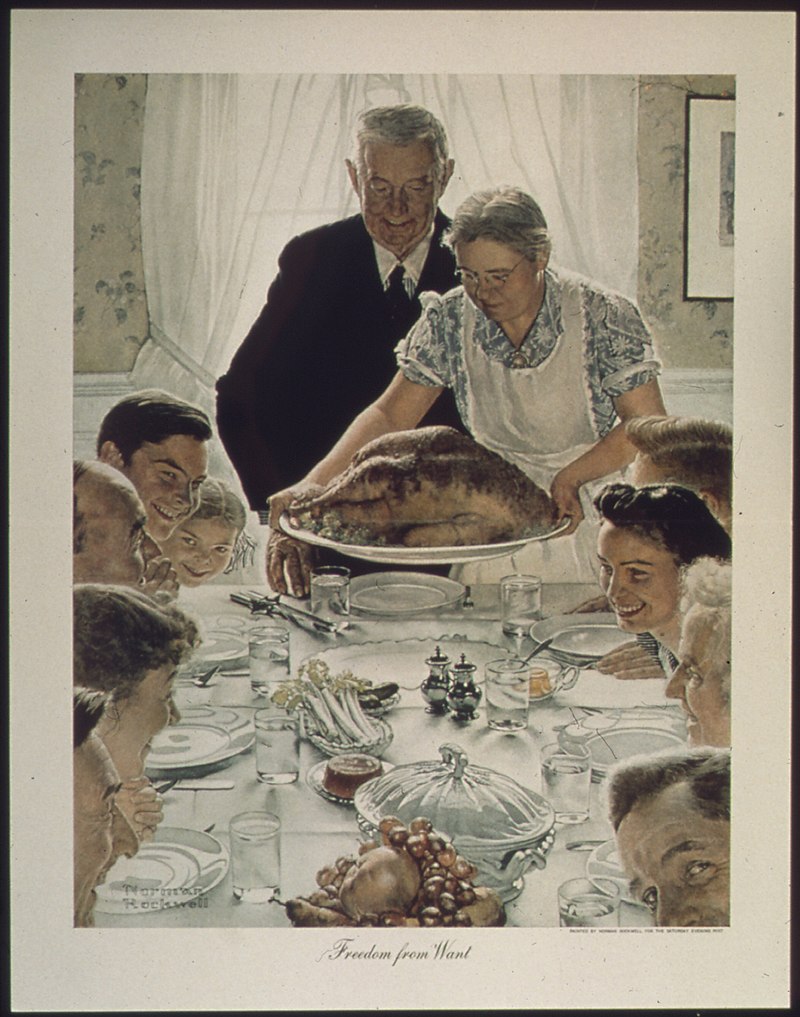
Norman Rockwell's Freedom from Want

Norman Rockwell’s painting, “Freedom from Want,” part of a quartet based on the Four Freedoms State of the Union Speech of Franklin Roosevelt, in January 1941.

Did Souza have that Rockwell painting in mind when he framed that shot?

Rockwell’s work was more than just iconic, really.  In the simple history, from Wikipedia:

The Four Freedoms or Four Essential Human Freedoms is a series of oil paintings produced in 1943 by the American artist Norman Rockwell. The paintings are approximately equal in dimension with measurements of 45.75 inches (116.2 cm) × 35.5 inches (90 cm).[1] The series, now in the Norman Rockwell Museum, was made for reproduction in The Saturday Evening Post over the course of four consecutive weeks in 1943 alongside essays by prominent thinkers of the day. Later they were the highlight of a touring exhibition sponsored by the Saturday Evening Post and the United States Department of the Treasury. The touring exhibition and accompanying sales drives raised over US$132 million in the sale of war bonds.[2]

The Four Freedoms theme was derived from the 1941 State of the Union Address by United States President Franklin Roosevelt delivered to the 77th United States Congress on January 6, 1941.[3] During the speech he identified four essential human rights (Freedom of Speech, Freedom of Worship, Freedom From Want and Freedom From Fear) that should be universally protected and should serve as a reminder of the American motivation for fighting in World War II.[4]

The theme was incorporated into the Atlantic Charter,[5] and it became part of the charter of the United Nations.[6] Roosevelt’s message was as follows: “In the future days which we seek to make secure, we look forward to a world founded upon four essential human freedoms.”[3][7]

Torpedo sandwiches from Taylor’s don’t exactly make a Thanksgiving dinner, but that’s not the point.  Rockwell portrayed an American family — at Thanksgiving, perhaps — sitting down to enjoy dinner together, breaking bread together as a Christian preacher might put it in a sermon.  President Johnson famously invited, “Come, let us reason together.”  Around Obama’s smaller-than-Rockwell’s table, the smiles are not so evident.  But I still see hope.

I see some hope for friendship, for the relationships that might move legislation, for the legislation that might move the nation.  God and Norman Rockwell know we could use it.

We can hope, can’t we?

More, perhaps related:


Light pollution-free area, near Little Snake River, Colorado

December 12, 2012

Take a look at this sunset shot:

Sunset near Little Snake River, Colorado - Photo by Shannon Diszmang

Sunset on BLM land near the Little Snake River, in northwest Colorado. Photo by Shannon Diszmang, via Royal Gorge National Recreation Area.

Note from America’s Great Outdoors blog:

Earlier this year, the Royal Gorge Recreation Area staff had a photo contest on their Facebook page and here is one of the great photos that was submitted. Here’s what photographer, Shannon Diszmang, had to say about it.

“This is BLM land in Northwest Colorado (Little Snake River district). I fell in love with this place. The red haze in this photo is the smoke coming from the wildfires on the west coast at the time. This is one of the lowest light pollution spots in our state which makes star gazing the absolute best.”

So, if you’re nearby, and you want a good place to look at the Geminid meteor shower tonight, odds are high there will be little light pollution here.  If there aren’t many clouds, you’re in luck.

More:

P.S.: The stunningly beautiful photo above is NOT the winner of the photo contest(!).  BLM wrote in a November press release:

CAÑON CITY, Colo. – Today the BLM Royal Gorge Field Office announced the winners of its BLM-sponsored photo contest.  The two winners were decided by the public via the RGFO’s Facebook page: one winner is based on the most “likes” and the other is based on the most “shares.” Only those “likes” and “shares” that originated from the Royal Gorge Facebook page were tallied towards a winner.

Chris Nelson’s photo was the most “liked” and is a scenic shot taken from Chaffee County Road 175 between Cañon City and Salida. Nelson’s photo received 64 “likes.”

The most “shared” photo was submitted by David Madone and portrayed several deer in an alfalfa field near Cañon City. Madone’s photo received 20 shares.

Both photos will be featured on the RGFO’s Facebook page throughout November and may be featured in future BLM Colorado publications and social media sites.

The photo contest began Oct. 2 and ended Nov. 4 with more than 60 photos submitted. All the photos that were entered into the contest may be viewed via the “Photo Contest” album on the RGFO’s Facebook page:  http://www.facebook.com/BLMRoyalGorge

Yeah, were I you, I’d go see what the winners looked like.


Before the fight: Ford and Reagan, October 31, 1974

December 5, 2012

Historian Michael Beschloss Tweeted out a wonderful photo:

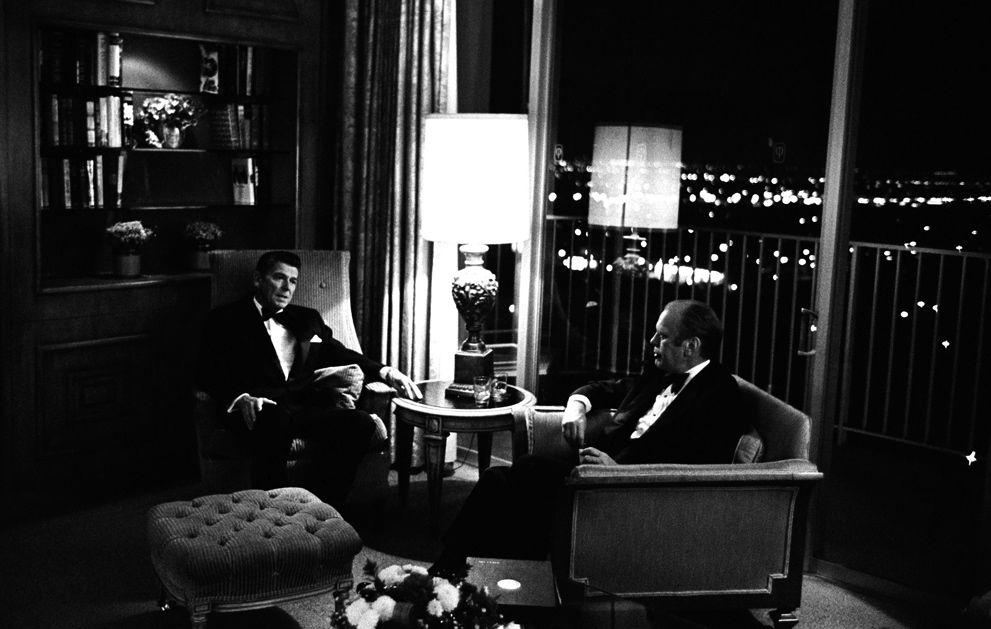
President Gerald Ford, former-Gov. Ronald Reagan, October 31, 1974, Century Plaza

October 31, 1974: President Gerald Ford, right, met with former-California Gov. Ronald Reagan, at the Century Plaza Hotel, Los Angeles. Photo courtesy Micheal Beschloss.

Who took the photo?  What was the event?  Beschloss asks on Twitter, why two drinks on Ford’s side of the table, and none on Reagan’s?

Looks like it’s a photo by David Hume Kennerly, the White House photographer in the Ford administration.  The photograph was taken with film, probably in black and white to save money and because it was the best way to get images for print media at the time.  Few newspapers ran color photos as a regular feature.  Electronic still photography at the time occurred in laboratories as tests.  As a pragmatic matter, media to store such photographs electronically were impractical — a large mainframe computer might have 256 kilobytes of memory for such storage, or enough for photo of poor resolution.

Kennerly’s site said this meeting came around a black-tie Republican fund-raiser in Los Angeles, at the then-swanky Century Plaza Hotel.

Vanity Fair’s David Friend called it “L.A. Noir” in a 2007 article on a book of photos by Kennerly:

Today, the image conveys a touch of Rat Pack swagger, an architectural elegance, and a hint of the California glamour that Reagan would eventually import to Washington. At the time, however, Kennerly, who had won a Pulitzer for his work in Vietnam, considered the picture too dark and brooding; he almost overlooked the frame on his contact sheet. But that darkness captured something of the spirit of the time: less than three months before, Watergate had forced Richard Nixon from office; inflation, unemployment, and gas prices were on the rise; and the U.S. was facing defeat in Vietnam.

The picture also caught the sometimes frosty relationship between the two leaders. Both Reagan and Ford, after all, would nix the 1980 “dream ticket” idea, floated by some Republican mandarins, to draft Ford as Reagan’s vice president. And Ford, during his unsuccessful 1976 campaign against Jimmy Carter, resented Reagan’s political infighting. “Truthfully,” Ford confessed to Kennerly years later, “I was upset when he challenged me [for the ’76 Republican nomination]. I thought it was unwise for a Republican to challenge a sitting Republican president. We had a pretty bitter contest. It was a head-to-head, knock-down, drag-out affair.”

“I study this picture now,” says Kennerly, “and it looks like a scene from The Godfather”—which had won the best-picture Oscar the year before.

Were I to guess, with a bit of education, I’d say both glasses belonged to Ford, one a cocktail, one water.  Reagan tended to avoid alcohol.

A great photograph, a tribute to the artistry and craftsmanship of Kennerly, especially with film; it also poses as a time capsule, freezing convention in GOP big-money fundraising, dress for men of influence and means, architecture, and so much more.

David Kennerly

Pulitzer Prize-winning war photographer, and White House photographer, David Hume Kennerly; TEDxBend image


Not before the deluge, not after it, but during the storm.  Nixon was three-months gone from the White House.  Vietnam’s peace agreement was a year-old, but it was seven months to the final invasion of South Vietnam by the communist North that would force the U.S. retreat, and “reunify” Vietnam under communist rule.  The Cold War still raged.  Iran was considered a U.S. puppet.  Mao Zedong still ruled in China.  Elvis Presley still ruled in Memphis.  AIDS was unknown.  Computers were accounting machines taking floors of entire buildings.  Portable telephones were expensive devices that hogged power and generally required at least an automobile to be attached to power the thing.

Barack Obama was 13.

It was a different time.

More:


Twain aboard ship – 1896 photo, 1897 etching

December 1, 2012

One of my favorite images of Mark Twain I found several years ago.  It’s a photograph of Twain, with a genuine smile of some contentment, seated in a deck chair on a ship, feet on the rail, gazing out to sea.

Correspondent J. A. Higginbotham tracked down the origin of the photograph through the Gutenberg Project, and found a nice etching from the photograph at twainquotes.com, with sleuthing by Barbara Schmidt, the curator of that site.

Here’s the photo, from the Gutenberg Project’s version of the 1898 American Publishing Company edition of Following the Equator:

Mark Twain, aboard ship, 1896; photo by Walter G. Chase of Boston

Mark Twain, aboard ship in 1896. Photo by Walter G. Chase, of Boston. This photo provided the frontispiece for the 1898 American Publishing Company edition of Following the Equator.

Who was Walter Chase?  So far as I have found, he was a Boston-based photographer.

Samuel L. Clemens, the man behind Mark Twain, undertook a world-wide speaking tour, to restore his fortune after bankruptcy, and to take his mind off the death of his daughter Susy, in August 1896.  At the same time, there was demand for newspaper columns and books on travel.  The resulting book, Following the Equator in the U.S., ended the series of travelogues Twain wrote.  Columns and the book covered his and his family’s adventures in 1896 and 1897; this photo must have originated in late 1896, in the early part of the tour.  We know from Chapter 1 that the land part of the trip, by train, “westward out of New York,” took 40 days.  Twain wrote that it took seven days to get to Hawaii.  We might be safe in saying the photograph shows him gazing at the Pacific.

Without knowing more, we might be tantalized by the prospect that Chase accompanied Twain on much of this tour, and took other photographs.  Twain wrote about games played among the travelers aboard ship, with notes indicating a key player was someone named “Chase.”  We have a photo of Twain posing for a sculptor in Vienna, from this trip. Somewhere, there may be a trunk of photographs . . .

According to Barbara Schmidt’s sleuthing, William Henry Warren Bicknell created the etching from the photograph, for the 1899 uniform edition of Following the Equator.  Bicknell was one of several illustrators used, including Boy Scout founder Daniel Beard.

Mark Twain in the Pacific, etching by W. H. W. Bicknell, from 1896 photograph by Walter G. Chase,

W. H. W. Bicknell’s etching from the 1896 Walter G. Chase photograph of Mark Twain, aboard a ship in the Pacific Ocean.

Schmidt uses a colored version of the etching on her website’s own frontispiece.  No doubt she describes it in more detail, but I have not found that description.

A color version of an etching of Mark Twain, based on Chase's 1896 photograph.  Image via twainquotes.com, Barbara Schmidt's site.

A color version of an etching of Mark Twain, based on Chase’s 1896 photograph. Image via twainquotes.com, Barbara Schmidt’s site.

A fitting way to end a day of commemorating Mark Twain’s birthday, to discover the origins of one of my favorite images of the man.

New question:  With the exception of the color image, each version includes Twain’s autograph, “Be good & you will be lonesome,” with his signature.  Was this an autograph done solely for the book, or was it an autograph to the publisher, editor, or photographer?

Tip of the old scrub brush to correspondent J. A. Higginbotham.

More:

Mark Twain

Mark Twain (Photo credit: Wikipedia) – Another, earlier image of Twain, origins to sleuth down!


Note to hikers in Provo Canyon: This is not Bigfoot

November 26, 2012

Not Bigfoot:

Bear on the Misty Falls Trail, Sequoia and Kings Canyon National Parks - photo by Spencer Darrell, rights reserved

Bear on the Misty Falls Trail, Sequoia and Kings Canyon National Parks – photo by Spencer Darrell, rights reserved

Assume that thing in the brush is a bear if it looks vaguely like a bear; if you’re filming, do so as you back up, and only through a very long telephoto lens (bears can sprint up to 30 mph; you want a 300-yard head start).   A bear can do more damage to you than Big Foot; don’t mess up the bear’s thing with tourists looking for cryptofauna.

Tip of the old scrub brush to Spencer Darrell, one of Our Men in California.

More:


Utah’s Mount Timpanogos, no PhotoShop needed

November 16, 2012

Here’s a good demonstration of why you don’t need PhotoShop, but a decent camera and a steady hand instead.

Utah's Mt. Timpanogos in snow, by Craig Clyde, 2012

Utah’s Mt. Timpanogos in snow, by Craig Clyde, 2012 (rights probably reserved).  Click for larger version.

Craig Clyde took this photo of Utah Valley‘s Mt. Timpanogos, probably from Saratoga Springs, on the west side of Utah Lake, after one of the first snows of 2012.  (This area had a few farm fields when I grew up there.)  It’s a great photo for several reasons.

It’s a formerly unusual view, there being so few people on the west side of the lake until recent development.  It pictures all of Timpanogos, with American Fork Canyon on the left, Mahogany Mountain, Big Baldy, and Provo Canyon on the right.  It’s an afternoon shot, you can tell from the angle of the sun (the mountain runs on a north-south axis), and the darkness on the lower mountains may be caused by the Sun’s setting behind the mountain range on the west side of  the lake.  Timpanogos in white, in the afternoon sunshine, is one of the greatest images of a mountain you’ll ever see.

Tip of the old scrub brush to Craig Clyde.  Mr. Clyde and I attended high school together — haven’t seen him in more than 30 years; not sure, but I don’t think he’s the same Craig Clyde in the movie business.

More:


Sometimes beauty is in the timing . . . Capitol Reef National Park

November 8, 2012

Long-time Scout friend Hal Rosen said he caught some good photos here, too — but none at this precise moment:

Temple of the Sun, Capitol Reef NP, photo by Mike Saemisch, October 29, 2012

Temple of the Sun, Capitol Reef NP, photo by Mike Saemisch, October 29, 2012

First you must get to Capitol Reef National Park, in Utah — one of Utah’s unfairly large number of five National Parks.  Then you take your “high-clearance vehicle” (not necessarily 4-wheel drive) out on the dirt roads in Cathedral Valley, and you hope for a crystal blue sky like this one.  Then you happen to get there just as the sun is right at the peak of the formation . . .

You had to be there.  Mike Saemisch was there just over a week ago, on October 29, 2012, and fortunately caught this photograph with the Sun as part of a sparkling spire on a sandstone formation known as the Temple of the Sun.

Digital photography changes the way one tours these places.  Fortunately.  Take the kids, and make sure they find it on a map so they can use your trip as fodder for their 9th grade geography class.

More:

  • A different angle, at a different time, by Scott Jarvie:  “A 3.5hr timelapse taken late on a cloudy night at the Temple of the Moon with the Temple of the Sun in the background. March 17, 2012.”

Wish we were there: Sequoia and Kings Canyon National Parks

November 6, 2012

You got the Tweet?

Miter Basin, Sequoia and Kings Canyon National Parks, California; photo by Kristin Glover, NPS (public domain)

Miter Basin, Sequoia and Kings Canyon National Parks, California; photo by Kristin Glover, NPS (public domain)

Photo from NPS employee Kristin Glover, at Miter Basin.

We should go see for ourselves, no?

If you go today, vote before you go.  This is one of the areas to be opened to energy exploration — oil and gas drilling or other mining — under Mitt Romney’s “energy plan” and the GOP National Platform.

More:


Jefferson Memorial from above

October 27, 2012

Must be rare to get such a reflection of the sky in a calm Tidal Basin pool; from the Department of Interior‘s Instagram:

Jefferson Memorial from the air, Department of Interior photo

From Interior’s Instagram: Last night we posted an aerial photo of the #Washington #Monument, which everyone seems to really enjoy. So we are keeping it going today with a #photo of the #Jefferson #Memorial. #NationalMall #DC

One commenter noted the photo almost makes it appear that the Jefferson Memorial is floating in the clouds.

There are more than 300 units in the National Parks System.  In the past two days we’ve had two spectacular photos from almost the same place, two memorials about a half-mile apart.  How many thousands of great photos are possible from all of these properties?  NPS’s job, caring for all of that stuff, is monumental.