25 new gems added to Library of Congress National Film Registry

December 28, 2011

Some you’ve loved forever, some you’ve never heard of (but now ought to seek out to view):  The Library of Congress announced 25 new films added to the National Film Registry, the list of great films we all ought to know about.

This year’s list covers 82 years of cinema, from 1912’s “The Cry of the Children” through 1992’s “El Mariachi” to 1994’s “Forrest Gump.”  It’s a very diverse list, from big Hollywood productions through animation, test films and even a series of home movies.

Here’s the list, followed by the press release; the list with descriptions of each film is below the fold.

Films Selected to the 2011 National Film Registry

  1. Allures (1961)
  2. Bambi (1942)
  3. The Big Heat (1953)
  4. A Computer Animated Hand (1972)
  5. Crisis: Behind A Presidential Commitment (1963)
  6. The Cry of the Children (1912)
  7. A Cure for Pokeritis (1912)
  8. El Mariachi (1992)
  9. Faces (1968)
  10. Fake Fruit Factory (1986)
  11. Forrest Gump (1994)
  12. Growing Up Female (1971)
  13. Hester Street (1975)
  14. I, an Actress (1977)
  15. The Iron Horse (1924)
  16. The Kid (1921)
  17. The Lost Weekend (1945)
  18. The Negro Soldier (1944)
  19. Nicholas Brothers Family Home Movies (1930s-40s)
  20. Norma Rae (1979)
  21. Porgy and Bess (1959)
  22. The Silence of the Lambs (1991)
  23. Stand and Deliver (1988)
  24. Twentieth Century (1934)
  25. War of the Worlds (1953)

The press release:

December 28, 2011

2011 National Film Registry More Than a Box of Chocolates

“Forrest Gump,” “Bambi,” “Stand and Deliver” Among Registry Picks

“My momma always said, ‘Life was like a box of chocolates. You never know what you’re gonna get.’” That line was immortalized by Tom Hanks in the award-winning movie “Forest Gump” in 1994. Librarian of Congress James H. Billington today selected that film and 24 others to be preserved as cultural, artistic and historical treasures in the National Film Registry of the Library of Congress.

Spanning the period 1912-1994, the films named to the registry include Hollywood classics, documentaries, animation, home movies, avant-garde shorts and experimental motion pictures. Representing the rich creative and cultural diversity of the American cinematic experience, the selections range from Walt Disney’s timeless classic “Bambi” and Billy Wilder’s “The Lost Weekend,” a landmark film about the devastating effects of alcoholism, to a real-life drama between a U.S. president and a governor over the desegregation of the University of Alabama. The selections also include home movies of the famous Nicholas Brothers dancing team and such avant-garde films as George Kuchar’s hilarious short “I, an Actress.” This year’s selections bring the number of films in the registry to 575.

Under the terms of the National Film Preservation Act, each year the Librarian of Congress names 25 films to the National Film Registry that are “culturally, historically or aesthetically” significant. “These films are selected because of their enduring significance to American culture,” said Billington. “Our film heritage must be protected because these cinematic treasures document our history and culture and reflect our hopes and dreams.”

Annual selections to the registry are finalized by the Librarian after reviewing hundreds of titles nominated by the public (this year 2,228 films were nominated) and conferring with Library film curators and the distinguished members of the National Film Preservation Board (NFPB). The public is urged to make nominations for next year’s registry at NFPB’s website (www. loc.gov/film).

In other news about the registry, “These Amazing Shadows,” a documentary about the National Film Registry, will air nationally on the award-winning PBS series “Independent Lens” on Thursday, Dec. 29, at 10 p.m (check local listings). Written and directed by Paul Mariano and Kurt Norton, this critically acclaimed documentary has also been released on DVD and Blu-ray and will be available through the Library of Congress Shop (www.loc.gov/shop/).

For each title named to the registry, the Library of Congress Packard Campus for Audio Visual Conservation works to ensure that the film is preserved for future generations, either through the Library’s massive motion-picture preservation program or through collaborative ventures with other archives, motion-picture studios and independent filmmakers. The Packard Campus is a state-of-the-art facility where the nation’s library acquires, preserves and provides access to the world’s largest and most comprehensive collection of films, television programs, radio broadcasts and sound recordings (www.loc.gov/avconservation/). 

The Packard Campus is home to more than six million collection items, including nearly three million sound recordings. It provides staff support for the Library of Congress National Film Preservation Board, the National Recording Preservation Board and the National Registries for film and recorded sound.

Founded in 1800, the Library of Congress is the nation’s oldest federal cultural institution. It seeks to spark imagination and creativity and to further human understanding and wisdom by providing access to knowledge through its magnificent collections, programs and exhibitions. Many of the Library’s rich resources can be accessed through its website at www.loc.gov and via interactive exhibitions on a personalized website at myLOC.gov.

Below the fold you’ll find a description of each film.

Read the rest of this entry »


Why you should be concerned about mercury pollution

December 28, 2011

Mercury poisoning marches through our culture with a 400-year-old trail, at least.  “Mad as a hatter” refers to the nerve damage hatmakers in Europe demonstrated, nerve damage we now know came from mercury poisoning.

In the 20th century annals of pollution control, the Minimata disaster stands as a monument to unintended grotesque consequences of pollution, of mercury poisoning.

A key Japanese documentary on the disaster is now available from Zakka Films on DVD, with English subtitles.

Anyone who scoffs at EPA’s four-decades of work to reduce mercury pollution should watch this film before bellyaching about damage to industry if we don’t allow industry to kill babies and kittens in blind, immoral pursuit of profit at public expense.

American Elephants, for example, is both shameless and reckless  in concocting lies about mercury pollution regulation (that site will not allow comments that do not sing in harmony with the pro-pollution campaign (I’d love for someone to prove me wrong)).  Almost every claim made at that post is false.  Mercury is not harmless; mercury from broken CFL bulbs cannot begin to compare to mercury in fish and other animals; mercury pollution is not minuscule (mercury warnings stand in all 48 contiguous states, warning against consumption of certain fish).  President Obama has never urged anything but support for the coal-fired power industry — although he has expressed concerns about pollution, as any sane human would.

Republicans have lost their moral compass, and that loss is demonstrated in the unholy campaign for pollution, the campaign against reducing mercury emissions.  It’s tragic.  Action will be required in November to stop the tragedy from spreading.  Will Americans respond as they should at the ballot boxes?

Can you watch “Minimata:  The Victims and Their World,” and not urge stronger controls on mercury emissions?  Can you support the murder of children and workers, for profit?


Heart of Atlanta Motel and civil rights

December 28, 2011

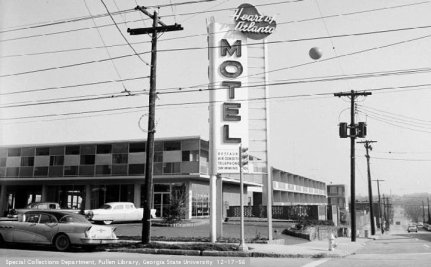
PG posted this photo in one of his collections at Chamblee54:

Heart of Atlanta Motel, 1956 - Special Collections and Archives,Georgia State University Library

Heart of Atlanta Motel, 1956 - Special Collections and Archives,Georgia State University Library

I wondered whether this is the motel in the case testing the 1964 Civil Rights Act — and sure enough, it is.  The case was decided, finally, by the U.S. Supreme Court in 1964, Heart of Atlanta Motel, Inc., v. United States, 379 U.S. 241 (1964) .

This important case represented an immediate challenge to the Civil Rights Act of 1964, the landmark piece of civil rights legislation which represented the first comprehensive act by Congress on civil rights and race relations since the Civil Rights Act of 1875. For much of the 100 years preceding 1964, race relations in the United States had been dominated by segregation, a system of racial separation which, while in name providing for “separate but equal” treatment of both white and black Americans, in truth perpetuated inferior accommodation, services, and treatment for black Americans.

During the mid-20th century, partly as a result of cases such as Powell v. Alabama, 287 U.S. 45 (1932); Smith v. Allwright, 321 U.S. 649 (1944); Shelley v. Kraemer, 334 U.S. 1 (1948); Sweatt v. Painter, 339 U.S. 629 (1950); McLaurin v. Oklahoma State Regents, 339 U.S. 637 (1950); NAACP v. Alabama, 357 U.S. 449 (1958); Boynton v. Virginia, 364 U.S. 454 (1960) and probably the most famous, Brown v. Board of Education of Topeka, 347 U.S. 483 (1954), the tide against segregation began to turn. However, segregation remained in full effect into the 1960s in parts of the southern United States, where the Heart of Atlanta Motel was located, despite these decisions.

The Atlanta Time Machine, a great collection of photos in the history of Atlanta and Georgia, has more photos, and this description of the site:

The Heart of Atlanta motel, located at 255 Courtland Street NE, was owned by Atlanta attorney Moreton Rolleston Jr.  Rolleston, a committed segregationist, refused to rent rooms at his hotel to black customers.  Upon passage of the Civil Rights Act of 1964, Rolleston immediately filed suit in federal court to assert that the law was the result of an overly broad interpretation of the U.S. Constitution’s commerce clause.  Rolleston represented himself in the case, HEART OF ATLANTA MOTEL, INC. v. UNITED STATES ET AL., which  went all the way to the United States Supreme Court.  Rolleston lost when the Supreme Court ruled that Congress was well within its powers to regulate interstate commerce in such a manner.  The Hilton Hotel now stands on the former site of the Heart of Atlanta Motel.

Texts in law school rarely have illustrations.  I know the motel mostly as a citation on pages of text, great grey oceans of somnambulent text.  This case is important in civil rights, though it is mentioned almost never in history texts.  What are these cases really about?  These photos offer us insight.

The Heart of Atlanta Motel aspired to greatness in the late 1950s and 1960s — evidenced by this publicity flyer photo from the Atlanta Time Machine; notice the flag flying for the motel’s Seahorse Lounge (Atlanta is landlocked):

Heart of Atlanta Motel publicity photo - Atlanta Time Machine

Heart of Atlanta Motel publicity photo - Atlanta Time Machine; not just a podunk "motor lodge," but a "resort motel." Click for larger image.

For the 1960s, this place offered great amenities, including two swimming pools and in-room breakfast service.

Flyer for the Heart of Atlanta Motel, circa 1960 - Atlanta Time Machine image

Flyer for the Heart of Atlanta Motel, circa 1960 - Atlanta Time Machine image

This photo is amusing — I can just imagine the difficulties of launching a motor boat of this size in one of the swimming pools, obviously for a publicity stunt.  The photo is dated February 27, 1960, in the Pullen Library Collection.

Boat in the pool at the Heart of Atlanta Motel, 1960 - Atlanta Time Machine image

Boat in the pool at the Heart of Atlanta Motel, 1960 - Atlanta Time Machine image

To compare how times have changed, you may want to look at this aerial photo of the area, including the Heart of Atlanta Hotel, and compare it with modern photos which show the Hilton Hotel that replaced the property.

Rolleston appears to have had a big ego.  As noted above, he represented himself in this case, and he argued it in the Supreme Court.  Here’s a picture from about that time, from the University of Missouri-Kansas City Law School “Famous Trials” site:

Moreton Rolleston, Jr., owner of the Heart of Atlanta Motel and the attorney who argued the case at the Supreme Court - UMKC Law School image

Moreton Rolleston, Jr., owner of the Heart of Atlanta Motel and the attorney who argued the case at the Supreme Court - UMKC Law School image; photo: Wayne Wilson/Leviton-Atlanta

You may decide for yourself whether this fits the old legal aphorism that a lawyer who represents himself in a case has a fool for a client.  The Oyez site at the University of Chicago provides access to the audio of the oral arguments.  Did Rolleston argue ably?  Rolleston argued against Archibald Cox, who went on to fame in the Watergate scandals.  This appears to have been Rolleston’s only appearance before the Supreme Court; it was Cox’s ninth appearance (he argued 20 cases before the Court in his career, several well known and notable ones).

Heart of Atlanta vs. United States was argued on October 5, 1964.  The opinion was issued on December 14, 1964, a 9-0 decision against Rolleston and segregation authored by Justice Tom C. Clark (one of Dallas’s earliest Eagle Scouts).

This was a fight Mr. Rolleston picked.  He was not cited nor indicted for violation of the Civil Rights Act, but instead asked for an injunction to prevent the law’s enforcement; according to the published decision,

Appellant, the owner of a large motel in Atlanta, Georgia, which restricts its clientele to white persons, three-fourths of whom are transient interstate travelers, sued for declaratory relief and to enjoin enforcement of the Civil Rights Act of 1964, contending that the prohibition of racial discrimination in places of public accommodation affecting commerce exceeded Congress’ powers under the Commerce Clause and violated other parts of the Constitution. A three-judge District Court upheld the constitutionality of Title II, §§ 201(a), (b)(1) and (c)(1), the provisions attacked, and, on appellees’ counterclaim, permanently enjoined appellant from refusing to accommodate Negro guests for racial reasons.

Oyez summarizes the case question:

Facts of the Case 

Title II of the Civil Rights Act of 1964 forbade racial discrimination by places of public accommodation if their operations affected commerce. The Heart of Atlanta Motel in Atlanta, Georgia, refused to accept Black Americans and was charged with violating Title II.

Question 

Did Congress, in passing Title II of the 1964 Civil Rights Act, exceed its Commerce Clause powers by depriving motels, such as the Heart of Atlanta, of the right to choose their own customers?

The decision turned on the commerce clause, and the reach of Congressional power to regulate interstate commerce.

Decision: 9 votes for U.S., 0 vote(s) against
Legal provision: Civil Rights Act of 1964, Title II

The Court held that the Commerce Clause allowed Congress to regulate local incidents of commerce, and that the Civil Right Act of 1964 passed constitutional muster. The Court noted that the applicability of Title II was “carefully limited to enterprises having a direct and substantial relation to the interstate flow of goods and people. . .” The Court thus concluded that places of public accommodation had no “right” to select guests as they saw fit, free from governmental regulation.

Good decision.

Heart of Atlanta Motel is gone.  The site is occupied by the Hilton Atlanta, today.


Annals of Global Warming: Planetary energy budget, for beginners, and climate engineering — from GAO

December 28, 2011

From the General Accountability Office, an arm of Congress, a report to the House Committee on Science, Space and Technology.

Aug 25, 2011
01:16

Global Average Energy Budget of the Earth’s Atmosphere

In eight steps, this animation depicts the path of sunlight that enters the planet’s atmosphere, illustrating how that radiation is reflected, absorbed, and emitted as heat energy.

In less than 90 seconds, an animated, graphic description of how and why global warming occurs.  You didn’t get it in 90 seconds?  Watch it again.  This video was made to accompany a GAO report on climate engineering. (Emphasis added, in red.)

Climate Engineering: Technical Status, Future Directions, and Potential Responses

GAO-11-71, Aug 25, 2011

[135-page report, in .pdf, here]

Summary:  Reports of rising global temperatures have raised questions about responses to climate change, including efforts to (1) reduce carbon dioxide (CO2) emissions, (2) adapt to climate change, and (3) design and develop climate engineering technologies for deliberate, large-scale intervention in Earth’s climate. Reporting earlier that the nation lacks a coordinated climate-change strategy that includes climate engineering, GAO now assesses climate engineering technologies, focusing on their technical status, future directions for research on them, and potential responses. To perform this technology assessment, GAO reviewed the peer-reviewed scientific literature and government reports, consulted experts with a wide variety of backgrounds and viewpoints, and surveyed 1,006 adults across the United States. Experts convened with the assistance of the National Academy of Sciences advised GAO, and several reviewed a draft of this report. GAO incorporated their technical and other comments in the final report as appropriate.

Climate engineering technologies do not now offer a viable response to global climate change. Experts advocating research to develop and evaluate the technologies believe that research on these technologies is urgently needed or would provide an insurance policy against worst case climate scenarios–but caution that the misuse of research could bring new risks. Government reports and the literature suggest that research progress will require not only technology studies but also efforts to improve climate models and data. The technologies being proposed have been categorized as carbon dioxide removal (CDR) and solar radiation management (SRM). CDR would reduce the atmospheric concentration of CO2, allowing more heat to escape and thus cooling the Earth. For example, proposed CDR technologies include enhancing the uptake of CO2 in oceans and forests and capturing CO2 from air chemically for storage underground. SRM technologies would place reflective material in space or in Earth’s atmosphere to scatter or reflect sunlight (for example, by injecting sulfate aerosols into the stratosphere to scatter incoming solar radiation or brightening clouds) or would increase the planet’s reflectivity (for example, by painting roofs and pavements in light colors). GAO found these technologies currently immature, many with potentially negative consequences. Some studies say, for example, that stratospheric aerosols might greatly reduce summer precipitation in places such as India and northern China. Many experts advocated research because of its potential benefits but also recognized its risks. For example, a country might unilaterally deploy a technology with a transboundary effect. Research advocates emphasized the need for risk management, envisioning a federal research effort that would (1) focus internationally on transparency and cooperation, given transboundary effects; (2) enable the public and national leaders to consider issues before they become crises; and (3) anticipate opportunities and risks. A small number of those we consulted opposed research; they anticipated major technology risks or limited future climate change. Based on GAO’s survey, a majority of U.S. adults are not familiar with climate engineering. When given information on the technologies, they tend to be open to research but concerned about safety.

Transcript of the video, describing each slide, below the fold.

Read the rest of this entry »


Great Beginnings Day, December 27: Darwin, Apollo

December 27, 2011

December 27 is one of those days — many of us are off work, but it’s after Boxing Day, and it’s not yet on to New Year’s Eve or Day. We should have celebrated, maybe.

We should celebrate December 27 as a day of portent: A good embarkation, and a good, safe end to a nation-encouraging trip to almost touch the Moon.

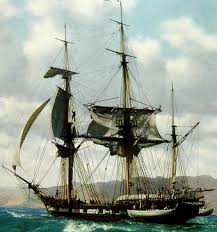
HMS Beagle, Darwin's ship

HMS Beagle, on a voyage of discovery

On December 27, 1831, Charles Darwin and H.M.S. Beagle set sail on an around-the-world voyage of discovery that would change all of science, and especially biology, forever.

December 27 1831
After a few delays, H.M.S. Beagle headed out from Plymouth with a crew of 73 under clear skies and a good wind. Darwin became sea-sick almost immediately.

Darwin never fully overcame his seasickness, but he fought it well enough to become the single greatest collector of specimens in history for the British Museum and British science, a distinction that won him election to science societies even before his return from the trip — and cemented his life in science, instead of in the church. Darwin’s discoveries would have revolutionized biology in any case. In analyzing what he had found, a few years later and with the aid of experts at the British Museum, Darwin realized he had disproved much of William Paley’s hypotheses about life and its diversity, and that another, more basic explanation was possible. This led to his discovery of evolution by natural and sexual selection.

Mini-sheet from the Royal Mail honoring Darwin's discoveries in the Galapagos Islands

Mini-sheet from the Royal Mail in 2009 honoring Darwin's discoveries in the Galapagos Islands

On December 27, 1968, Apollo 8 splashed down after a successful and heartening trip to orbit the Moon. The three crewmen, Commander Frank Borman, James A. Lovell, Jr., and William A. Anders, had orbited the Moon, a very important milestone in the methodological race to put humans on the Moon (which would be accomplished seven months later). 1968 was a terrible year for the U.S., with the North Korean capture of the U.S.S. Pueblo, assassinations of Rev. Martin Luther King, Jr., and Sen. Robert F. Kennedy during the presidential campaign, riots in dozens of American cities, nasty political conventions with riots at the Democratic Convention in Chicago, a contentious and bitter election making sore the nation’s divide over Vietnam policy, and other problems. On Christmas Eve, Borman, Lovell and Anders broadcast from orbit around the Moon, a triumphant and touching moment for the Apollo Program and Americans around the world. Their safe return on December 27 raised hopes for a better year in 1969.

Motherboard.tv has a great write up from Alex Pasternack:

In 1968, NASA engineers were scrambling to meet President Kennedy’s challenge to land a man on the moon by decade’s end. Because delays with the lunar module were threatening to slow the Apollo program, NASA chose to change mission plans and send the crew of Apollo 8 all the way to the moon without a lunar module.

Exactly 43 years ago, the three astronauts of Apollo 8 became the first humans to orbit another celestial object. As they came around the dark side of the Moon for the third time, Frank Borman, the commander, finally turned their capsule around. And then they saw the Earth.

Borman: Oh my God! Look at that picture over there! Here’s the Earth coming up. Wow, is that pretty.
Anders: Hey, don’t take that, it’s not scheduled.
Borman: (laughing) You got a color film, Jim?
Anders: Hand me that roll of color quick, will you…

One of the resulting photos taken by Anders on a Hasselblad camera became one of the world’s most iconic images.

As Bill Anders recalls it:

I just happened to have one with color film in it and a long lens. All I did was to keep snapping… It’s not a very good photo as photos go, but it’s a special one. It was the first statement of our planet Earth and it was particularly impressive because it’s contrasted against this startling horizon… After all the training and studying we’d done as pilots and engineers to get to the moon safely and get back, [and] as human beings to explore moon orbit, what we really discovered was the planet Earth.

Yeah, we missed toasting it on time in 2010. Plan to raise a glass today, December 27, 2011, to Great Beginnings Day for the human race. December 27 is a day we should remember, for these achievements.

Also on December 27:

  • 1927 – “Show Boat” with music by Jerome Kern and libretto by Oscar Hammerstein II, opened at the Ziegfeld Theater in New York City (AP)
  • 1932 – Radio City Music Hall opened for the first time, with a stage that, to me, looks like an old radio (AP)
  • 1945 – The World Bank was formed under the Bretton Woods Agreement of 1944, a key part of world finance structure following World War II
  • 1949 – Indonesia gained independence in a grant from Queen Juliana of the Netherlands; Netherlands had ruled Indonesia for three centuries

Adapted from a post from 2010.


A study in geography: The Red River of Texas – film from Texas Parks & Wildlife

December 26, 2011

Seven minutes on the Red River of the southern U.S., the fickle border of Texas and Oklahoma, the river of story and legend.  Good for a map study, good for the fun of it — how much do you really know about the Red River?

George Washington did not cross the Red River; George Washington may not have known the river even existed.  His loss.


Washington crossing the Delaware – a slightly different view

December 26, 2011

Past in the Present has this wonderful, terse post up:

It’s the most wonderful time of the year

Unless you’re a Hessian.

Passage of the Delaware, by Thomas Sully (1819). Now in the Boston Museum of Fine Arts.

Passage of the Delaware, by Thomas Sully (1819). Now in the Boston Museum of Fine Arts.

  1. Hessian?  Do my students know what he’s talking about?
  2. What is the other famous painting of this event?
  3. Considering how famous that other painting is, isn’t it almost tragic this one isn’t more famous?
  4. Considering #3, how many other great paintings of U.S. history sit in museums, or in government buildings, waiting to be discovered?  Maybe bloggers could help, by finding those paintings, photographing them, and posting the photographs.

More:


Have a good day, whatever you’re celebrating

December 25, 2011

Celebrating Christmas today?  In the middle of your Hanukkah observance?  Celebrating the birth of the world-wide web?

Whatever you’re doing today, have a good one.

(Did I miss your favorite observance for December 25, 2011?  Tell what I missed in comments.)


Cartoonist’s patent racism — disqualifier for New Jersey Hall of Fame?

December 24, 2011

What, exactly, are the requirements to be elected to the New Jersey Hall of Fame?

Thomas Nast is the great cartoonist whose pen launched crippling blows to the institutions of corrupt politicians including Tammany Hall’s Boss Tweed.  Nast generally gets the credit for inventing the symbols of the two major national parties, the donkey for the Democratic Party (or jackass, as in the first cartoon), and the elephant for the Republican Party, the party Nast favored.

Santa Claus’s commonly-accepted image owes a lot to Nast, who drew Santa Claus supporting the Union efforts in the Civil War.  Between 1855 and 1900, Nast supported the winning cause in at least seven presidential elections, illustrated the effects of America’s industrialization and rise as a world power, fought political corruption and campaigned for equal legal rights for immigrants and ex-slaves.

Thomas Nast's tribute to the Emancipation Proclamation in Harper's Weekly, 1863 - Ohio State University image

Thomas Nast’s tribute to the Emancipation Proclamation in Harper’s Weekly, 1863 – University of Michigan, Clements Library image; click image for a larger version

Lady Liberty?  Columbia?  An invention of Nast.  Nast’s image of Columbia was more than minor inspiration to the French friends of America who created the Statute of Liberty.  New Jersey is guarded, literally, with one of Nast’s creations.

Through it all, he clung to biases that, amplified by 1870s and 1880s politics, some people find less-than-acceptable today.  When Catholics raised money from Europe to establish schools in America so Catholic children would not undergo Protestant indoctrination, Nast sided with the public schools (and, perhaps, with the Protestants).  When immigrants, whose rights he defended, blindly turned the control of their votes over to corrupt political machines, he depicted those immigrants as louts, thugs and oafs.  On the issue of temperance, he sided with those who wanted to restrict alcoholic beverages, in opposition to German and Irish brewers and distillers.

Through it all, his pen brilliantly and clearly stated his positions, in images.  Nast’s work inspired Edgar Degas and Vincent van Gogh.

What should we make of the late-to-the-table complaints about Nast’s induction into the New Jersey Hall of Fame?  Opponents say Nast lampooned Catholics.  True.  Nast lampooned anyone whose policies he opposed.

Zeno presents a very good case that the opposition is wrong-headed, and ironic, coming from the voluble-and-usually obnoxious Bill Donohue of the Catholic League for Religious and Civil Rights (a self-proclaimed name that many people find inaccurate), a guy who might well be a target of Nast had Nast and Donohue occupied the same place in time.  (Though I quote Zeno at length here, go to his site to read the full piece.)

It was a theme to which the cartoonist returned whenever he wanted to inveigh against Romish influence (the Church was on record in opposition to the separation of church and state) or Irish immigration (Nast had decidedly nativist tendencies). Today we can look at Nast’s cartoons and see them as over the top. In high dudgeon, however, Bill Donohue cannot help but demonstrate once again his unerring instinct for avoiding le mot juste in favor of the words least apt:

[H]e demonized bishops by portraying them as crocodiles with miters for jaws; and he also depicted them as emerging from slime while prowling towards children.

Really, Bill? You had to go there? Silly man.

You just depicted Thomas Nast as a prophet.

Nast’s work provides us with a conundrum.  On one hand he ardently and fervently supported the Union against the Confederacy, especially with regard to emancipation of slaves.  On the other hand Nast ideologically opposed the Democratic Party — perhaps an easy thing to do in those days when the Democratic Party was on record supporting slavery — and portrayed anyone with Democratic links as a beast or thug.

Should Nast’s biases against Catholics and Irishmen who unthinkingly gave their poll power to Boss Tweed disqualify Nast from a spot in New Jersey’s Hall of Fame?

Here is a list of people elected to the New Jersey Hall of Fame over the past four years:

CLASS OF 2008

Buzz Aldrin
Clara Barton
Yogi Berra
Bill Bradley
Thomas Edison
Albert Einstein
Malcolm Forbes
Robert Wood Johnson II
Vince Lombardi
Toni Morrison
Norman Schwarzkopf
Frank Sinatra
Bruce Springsteen
Meryl Streep
Harriet Tubman

CLASS OF 2009

Bud Abbott & Lou Costello
F. Scott Fitzgerald
Althea Gibson
Jon Bon Jovi
Jerry Lewis
Guglielmo Marconi
Shaquille O’Neal
Phil Rizzuto
Paul Robeson
Carl Sagan
Walt Whitman
William Carlos Williams

Unsung Hero:
Captain Brian Brennan

CLASS OF 2010

Count Basie
Judy Blume
Justice William Brennan
Danny DeVito
Larry Doby
Michael Graves
Carl Lewis
Jack Nicholson
Alice Paul
Les Paul
Phillip Roth
Susan Sarandon
Wally Schirra
Frankie Valli
President Woodrow Wilson

Unsung Heroes:
Marc DiNardo & James D’heron

CLASS OF 2011

John Basilone
Tony Bennett
Governor Brendan Byrne
Mary Higgins Clark
Admiral William Halsey
Franco Harris
Leon Hess
Queen Latifah
Bucky Pizzarelli
Martha Stewart
Joe Theismann
John Travolta
Bruce Willis

Unsung Heroes:
9/11 Victims & First Responders

Generally a well-deserving group of heroes, don’t you think?

Careful students of history may blanche a bit at one name there, in consideration of the flap against Nast.  Woodrow Wilson had his own biases — he resegregated the White House as president.  He opposed civil rights for African Americans.  He invited the racist, pro-Ku Klux Klan movie, “Birth of a Nation,” into the White House and praised it for its accuracy and advocacy.

Wilson led the nation into World War I (after promising he would not), and he campaigned unsuccessfully for a peace treaty that might have prevented World War II, had he been listened to.  Wilson campaigned to create an international peace-keeping organization, the League of Nations, an agency doomed to failure because the U.S. Senate rejected Wilson’s every imprecation to ratify the treaty that ended the Great War and created the agency.

Can Bill Donohue actually make a case that the great cartoonist, Thomas Nast, does not belong in a pantheon that includes Frank Sinatra, Bruce Willis, John Travolta, and ex-con Martha Stewart?  Is Nast not at least as deserving as Woodrow Wilson, on the same grounds?

Nominations for the class of 2012 include Aaron Burr, the vice president candidate whose overweening ambition nearly derailed the nation’s Constitution in 1800, the man who shot Alexander Hamilton fatally, and a man who plotted the overthrow of the government of the U.S.

Nast is nominated in the “General” category.  The others nominated there are Alexander Calder, Alfred Stieglitz, Charles Addams, Doris Duke, Dorothy Parker, Dorothy Porter Wesley, Joyce Carol Oates, Milton Friedman, and Gov. Tom Kean.

Uh, Bill?  Did you see Milton Friedman there?  Yeah, he was a great economist and he made popular television and book explanations of economics (that Republicans eschew today, to the detriment of free markets and political freedom) — but should he be there considering his work for the Pinochet regime in Chile?  I mean, Bill, can we be consistent?  Chile is a chiefly Catholic nation, you know, and surely the murders of 10,000 Catholics should weigh in here, shouldn’t it?

(New Jersey’s ability to produce such a body of notables is, itself, notable.  Probably each of those people deserves commemoration in the New Jersey Hall of Fame.  Second place, two spots in the New Jersey Hall of Fame.)

Is this really what Catholics are reduced to, today — a pointless, silly campaign against commemorating a great cartoonist?  May we assume Donohue and the Catholic Church oppose Nast across the board, in Nast’s campaigns against corruption, his work against slavery and support for the Union, and his support of the rights for immigrants?

Perhaps Donohue should review the situation, like Fagin.

And you, Dear Reader, should go vote for Thomas Nast’s inclusion, warts and all.

More:


Does Jesus care if anyone says “Merry Christmas?”

December 23, 2011

I get e-mail from Sara Maxwell, alerting me to the blog post by Dave Hershey.

Ouch.

Let Dave tell it; first he used a Fox video, to show what he’s talking about:

(via Stuff Christian Culture Likes)

What would Jesus say if he came to your house and had coffee with you?

That is the question asked at around 1:10 into this video.  It is a decent question.  What would Jesus say?

*“I miss hearing you say Merry Christmas”

*”And if anyone wants to sue you and take your shirt, hand over your coat as well. If anyone forces you to go one mile, go with them two miles.Give to the one who asks you, and do not turn away from the one who wants to borrow from you.”

*”I  tell you, love your enemies and pray for those who persecute you”

*“Do not store up for yourselves treasures on earth, where moths and vermin destroy, and where thieves break in and steal. But store up for yourselves treasures in heaven, where moths and vermin do not destroy, and where thieves do not break in and steal. For where your treasure is, there your heart will be also.”

*“Whoever wants to be my disciple must deny themselves and take up their cross and follow me.”

*“The Spirit of the Lord is on me, because he has anointed me to proclaim good news to the poor. He has sent me to proclaim freedom for the prisoners and recovery of sight for the blind, to set the oppressed free, to proclaim the year of the Lord’s favor.” 

*“You still lack one thing. Sell everything you have and give to the poor, and you will have treasure in heaven. Then come, follow me.” 

*Isaiah was right when he prophesied about you:“‘These people honor me with their lips, but their hearts are far from me. They worship me in vain; their teachings are merely human rules.’ 

What would Jesus say to us?

Hint: all but the first choice are things Jesus actually did say to people (Matthew 5:41-42, 44; 6:19-21; 16:24; Luke 4:18-19; 18:21; Matthew 15:17-19).

When I read the gospels, I find Jesus’ words incredibly challenging.  What he calls people to do is uncomfortable, to say the least.  I am sure in the face of our insistence that people say “Merry Christmas” and our offense when people do not that he would challenge us Christians to sell our stuff or love our enemies or something we frankly would rather not do.

The ladies in the video say they are offended that people do not say Merry Christmas.  Offended?  By that?

Maybe we Christians should get offended by things that actually matter, things that are horrendous evils happening right now in the world, things like global poverty, human trafficking and modern-day slavery and so many others.

Maybe if instead of wasting money on billboards urging people to say “Merry Christmas” we used that money to help those who are really suffering, people would actually care to hear more about Jesus.

The prophet Amos also probably doesn’t care if you say “Merry Christmas”.  I’ll end with his powerful words (Amos 5):

21 “I hate, I despise your religious festivals; 
   your assemblies are a stench to me. 
22 Even though you bring me burnt offerings and grain offerings, 
   I will not accept them. 
Though you bring choice fellowship offerings, 
   I will have no regard for them. 
23 Away with the noise of your songs! 
   I will not listen to the music of your harps. 
24 But let justice roll on like a river, 
   righteousness like a never-failing stream!

Have a good Christmas/Hanukkah/Solstice/KWANZAA/Festivus, anyway.


Art from science: Protein folds

December 23, 2011

What is this?

Protein folding gif from Protein Art

From Protein Art

Nature and science produce some of the most beatiful stuff, especially in high-speed phtotography, or photo-micrographs, or shots from scanners of various kinds including especially Scanning Electron Microscopes (SEM).

I spent three years locked in a lab looking at photographs of Nuclepore filters that had captured dust, pollen, and air pollution in the desert southwest.  Magnified about 50,000 times, fly ash from coal-fired power plants become brilliant balls of glassy light; pollen from god-knows-what become intricate, Alhambra-worthy patterned stones, and dust becomes jagged expressionistic sculptures of someone greatly disturbed (but still artistically gifted).

Now we know that proteins fold up in specific ways.  Micrographic photos show wiggles of ribbon to you and me.

It’s inspiration to May K.

You and I see tangled ribbons:

May K's take on 2-nd PDZ Domain of Mint1  (Homo sapiens)

To May K the human protein 2-nd PDZ Domain of Mint1 becomes . . .

May K. sees:

May K's take on a human protein - a tango of cats (from 2-nd PDZ Domain of Mint1)

. . . a tango of cats.

Go see more for yourself.  Or here.

Sort of a Rorschach for well-balanced life scientists.  There are possibilities there.


Best editorial quote ever: “Yes, Virginia, there is a Santa Claus”

December 23, 2011

“Papa says, ‘If you see it in the Sun, it’s so.'”

Do we, you and I in 2011, stand as witnesses to the end of newspapers in America?

It’s been a grand history. Newspapering gave us great leaders like Benjamin Franklin. Newspapering gave us wars, like the Spanish-American War. Newspapering gave us Charlie Brown, Ann Landers, the Yellow Kid, Jim Murray, Red Smith, Thomas Nast (and Santa Claus), the Federalist Papers, and coupons to save money on laundry soap.

It’s been a curious history, too. An 1897 editorial vouching for Santa Claus rates as the most popular editorial of all time, according to the Newseum in Washington, D.C.

Francis Pharcellus Church, New York Sun writer who wrote

The man who saved Christmas, at least for Virginia O’Hanlon: Francis Pharcellus Church – Newseum image

In autumn, 1897, 8-year-old Virginia O’Hanlon of 115 West 59th Street in New York, wrote to the New York Sun with this simple question:

“Please tell me the truth; is there a Santa Claus?”

In the age of Yellow Journalism, the fiercely competitive Sun‘s editors turned the letter to Francis Pharcellus. He responded to little Virginia on September 21, 1897:

“Yes, Virginia, there is a Santa Claus.”

Church’s brother, William Conant Church, owned and published the newspaper. Both had followed their father into the news business. They co-founded The Army-Navy Journal in 1863, and went on to a series of journalistic collaborations. Francis was 58 years old when he answered Virginia’s letter. (He died at age 67, in 1906.)

The New York Sun held down the conservative corner in New York journalism at the time, versus the New York Times and the New York Herald-Tribune. But it also had an interesting history, to a blogger intrigued by hoaxes. In 1835 the paper published a series of six newspaper stories falsely attributed to Sir John Herschel, a well-known astronomer, claiming to describe a civilization on the Moon — the Great Moon Hoax. The discovery was credited to a new, very powerful telescope.

In 1844 the paper published a hoax written by Edgar Allen Poe, the Balloon Hoax. Under a pseudonym, Poe wrote that a gas balloon had crossed the Atlantic in three days.

The Sun also featured outstanding reporting. A 1947 and 1948 series about crime on the docks of New York City won a Pulitzer Prize for writer Malcolm Johnson. That series inspired Elia Kazan’s 1954 movie On the Waterfront starring Marlon Brando, Rod Steiger, Eva Marie Saint, Karl Malden and Lee J. Cobb.

The New York Sun ceased publication in 1950.

For all of its history, the Sun and the Churches are most remembered for that defense of belief in Santa Claus.
Virginia O’Hanlon grew up, graduated from Hunter College, got a masters at Columbia, and earned a Ph.D. from Fordham. She taught in the New York City Public School system, from which she retired in 1959. She died in 1971.

Birth of tradition

Columbia University was Church’s alma mater, as well as O’Hanlon’s. Her letter and his response get a reading each year at the Yule Log Ceremony at Columbia College, along with the poem “A Visit from St. Nicholas.” Animated, live-acting, and other television productions have been mounted in 1974, 1991, and 2009.


Is there a Santa Claus? Did Church write a credible defense? The text of the letter and answer, below the fold.

More:  

Read the rest of this entry »


Fossil walrus porn

December 23, 2011

Walrus baculum fossil, from Retrieverman

What is it? If you were a lady walrus a few million years ago, you wouldn't have to ask!

I can’t do it justice.  Go read about the photo at Retrieverman’s site.

My students hear it often:  Truth is stranger and often much more interesting than fiction.  It certainly applies in history, and it applies in science, too.


MITx launches — new model for post-secondary learning?

December 22, 2011

We get press releases in the e-mail:

MIT launches online learning initiative

MIT launches online learning initiative

MITx‘ will offer courses online and make online learning tools freely available.

December 19, 2011

Share

MIT today announced the launch of an online learning initiative internally called “MITx.” MITx will offer a portfolio of MIT courses through an online interactive learning platform that will:

  • organize and present course material to enable students to learn at their own pace
  • feature interactivity, online laboratories and student-to-student communication
  • allow for the individual assessment of any student’s work and allow students who demonstrate their mastery of subjects to earn a certificate of completion awarded by MITx
  • operate on an open-source, scalable software infrastructure in order to make it continuously improving and readily available to other educational institutions.

MIT expects that this learning platform will enhance the educational experience of its on-campus students, offering them online tools that supplement and enrich their classroom and laboratory experiences. MIT also expects that MITx will eventually host a virtual community of millions of learners around the world.

MIT will couple online learning with research on learning

MIT’s online learning initiative is led by MIT Provost L. Rafael Reif, and its development will be coupled with an MIT-wide research initiative on online teaching and learning under his leadership.

“Students worldwide are increasingly supplementing their classroom education with a variety of online tools,” Reif said. “Many members of the MIT faculty have been experimenting with integrating online tools into the campus education. We will facilitate those efforts, many of which will lead to novel learning technologies that offer the best possible online educational experience to non-residential learners. Both parts of this new initiative are extremely important to the future of high-quality, affordable, accessible education.”

Offering interactive MIT courses online to learners around the world builds upon MIT’s OpenCourseWare, a free online publication of nearly all of MIT’s undergraduate and graduate course materials. Now in its 10th year, OpenCourseWare includes nearly 2,100 MIT courses and has been used by more than 100 million people.

MIT President Susan Hockfield said, “MIT has long believed that anyone in the world with the motivation and ability to engage MIT coursework should have the opportunity to attain the best MIT-based educational experience that Internet technology enables. OpenCourseWare’s great success signals high demand for MIT’s course content and propels us to advance beyond making content available. MIT now aspires to develop new approaches to online teaching.”

OCW will continue to share course materials from across the MIT curriculum, free of charge.

MITx online learning tools to be freely available

MIT will make the MITx open learning software available free of cost, so that others — whether other universities or different educational institutions, such as K-12 school systems — can leverage the same software for their online education offerings.

“Creating an open learning infrastructure will enable other communities of developers to contribute to it, thereby making it self-sustaining,” said Anant Agarwal, an MIT professor of electrical engineering and computer science and director of MIT’s Computer Science and Artificial Intelligence Laboratory (CSAIL). “An open infrastructure will facilitate research on learning technologies and also enable learning content to be easily portable to other educational platforms that will develop. In this way the infrastructure will improve continuously as it is used and adapted.” Agarwal is leading the development of the open platform.

President Hockfield called this “a transformative initiative for MIT and for online learning worldwide. On our residential campus, the heart of MIT, students and faculty are already integrating on-campus and online learning, but the MITx initiative will greatly accelerate that effort. It will also bring new energy to our longstanding effort to educate millions of able learners across the United States and around the world. And in offering an open-source technological platform to other educational institutions everywhere, we hope that teachers and students the world over will together create learning opportunities that break barriers to education everywhere.”

Read frequently asked questions about MITx

Tip of the old scrub brush to James Darrell.


Bored in class? Do some math, for fun.

December 22, 2011

This is a good video that all math teachers ought to see (heck, I can figure out how to use it as a bell ringer in social studies, I think).

I had to mention it, just because of Michael Tobis’s wonderful headline at Planet 3.0:  “Bored in class?  Do some math instead.”

I confess to being caught doing math instead, in English, in history — and in art we often made mathematical games to create patterns.  From the stuff I see on walls in schools, that’s still popular.

Some time ago I ordered a poster from Max Temkin, the brilliant poster propagandist/artist.  It says that the universe is easy to understand if you speak its language, and that language is mathematics.  True.

Also true that in most of the disciplines that work into classes we call social studies, we do not have the ability to discern the cool patterns like Fibonacci numbers in pine cones, pineapples and sunflower blossoms.  People look for those pattersn in history anyway, and that poses a key problem to policy makers.  People want to see a pattern, expect to see a pattern, and historians cannot meet that expectation, other than quoting Santayana.

Maybe one of my students will be the one who discerns a key pattern.  It’ll be one of the slackers, if it happens.