Carnival of Evolution #38 — take THAT, creationism!

August 5, 2011

Larry Moran is much the overachiever, sort of the Hermoine Granger of evolution wizards scientists.

Carnival of Evolution logo

So, we shouldn’t be surprised that his hosting of the Carnival of Evolution #38 at his rollicking blog Sandwalk resulted in one of the longest, largest, most jam-packed blog carnivals ever.

Go see — unless you’re a creationist.  If you’re a creationist you’ll see so much that you’ll begin to doubt your faith in creationism and anti-science, and then you’re likely to confuse that with doubt of God, and you can’t stand such a faith trial.

Yeah, you, Don McLeroy.  And you, Granville Sewell.  More knowledge than you can hold in your head.

Which article in the Carnival of Evolution is your favorite, Dear Reader?

Tip of the old scrub brush to P. S. Myers at Pharyngula (soon moving . . .).


How to make a dinosaur: Start with a chicken . . .

July 25, 2011

Dinosaur hunter extraordinaire Jack Horner explained to an audience at TEDS that he always wanted a pet dinosaur . . .

(From a talk recorded March 4 2011.)

Jack Horner may look familiar to you.  Or you may not recognize him without the cowboy hat.  Horner is famous enough in dinosaurphile circles that a character who looked like Horner, down to the red shirt and cowboy hat, was included in the Jurassic Park movies.

This is, in loose form, real science.  It’s the sort of stuff that somehow gets squeezed out of science curricula in middle schools and high schools.  What student will not find it interesting to talk about why we can’t clone dinosaurs from mosquitoes trapped in amber, but how we can regress a chicken to bring out atavistic traits?

Such material may cause apoplexy among some cliques at the Texas State Board of Education — because this reinforces evolution ideas.  Horner says, “We can fix the chicken — because evolution works.”

Science teachers:  Can you find some way to shoehorn this stuff back into your classes?


Still no fireworks at Texas SBOE . . . yet

July 21, 2011

July 21, Austin — The board reconvened at 5:35.  An amendment to the approval of Tech System’s chemistry supplement was quickly passed.  Without any discussion, physics and IPC (“integrated physics and chemistry” — science for kids who will not be interested in science, and for teachers who can’t make them interested — but I digress), approved on raise-of-hand, quick votes — both in under three minutes total.

Biology! Staff notes there are some noted errors contested by publishers; the board again discusses what constitutes an error.  Craig begs for delay to tomorrow, since no one on TEA staff appears to have any biology expertise to rule on whether an error is an error.

Publisher in question is Holt McDougall — the #1 biology textbook publisher, for textbooks in high schools and junior colleges.  Holt asked for a hearing on the errors.  If I understand the discussion, the board is saying they’ll stick with the panel recommendations, since they are doing that for all other publishers. In short, the process is unclear to those who invented the process and those who are ruling on the product.  This would be a good essay from Richard Feynman, wouldn’t it?

Dollars to doughnuts, those members who now claim not to be able to figure out whether errors of biology are errors of biology, will be saying soon that they are competent to rule on key theories of science (evolution).

[Remember to see the immediately previous post, for links to Texas Freedom Network and Texas Observer blogs also covering this process live.]

Oy.  Twenty minutes of discussion on whether to ask a representative from Holt to explain why Holt thinks designated errors are not errors.  Board doesn’t know their own process — are errors noted by a vote of the review panel, or by a simple designation from any panelist without discussion.

Motion to hear from the publisher.  Mavis Knight wants to know why a motion is required, if the SBOE rules say the board can call a publisher any time.  (“And, Texas doesn’t execute innocent people, either.”) Garza discusses issue before the vote.  Debatable motion?  Yes.  “I don’t think we’re going to learn anything new from the publisher.”  (Who said that?)

Knight speaks in favor of hearing, to learn how the publisher got to their conclusion that the designated error is not an error.  Soto agrees.  Ratliff favors the motion, too — “to make sure that what we’re about to approve for the next decade is the best possible material” — and because the board doesn’t know whether the question from the panel represents a consensus or a wild hare.  Clayton — “is [the publisher] also a biologist, and can he address the issue?”  “I wonder if we’re wasting our time listening to a publisher instead of a biologist.”

[Lost some text — sorry]

6:06, motion to listen to publisher fails, 7-7.

Update, after adjournment:  Board voted to approve Holt-McDougall’s supplement on the condition that the publisher change things identified as errors by the review panel.  Board, by voting not to hear the publisher, failed to note that the “errors” are contested.  View of  biologists present is that the board is ordering Holt-McDougall to introduce errors.  Before final approval, can we get the board to come down on accurate science’s side?  This is the quiet erosion of good science I feared.

Board then pulled out three products for discussion, approving the others (biology, remember) on a hand vote.  Products pulled out are Adaptive Curriculum, Learning.com’s Adaptive Curriculum on their platform, and Technical Laboratory Systems’ SciTEX Biology.

Gail Lowe says the objection is the addition of Haeckel’s embryo drawings.  This is an old issue with Texas creationists.  They jumped on the Discovery Institute’s claim that Haeckel’s drawings show evolution, but where evolution doesn’t occur.  (Haeckel fudged drawings, biologists have known for years — but his fudged drawings haven’t been used to make his erroneous point in 50 years . . .).

Publisher steps up and shows photographs that they have agreed to substitute.

Somehow, the creationists fail to notice that what has happened is they are insisting on photographs that show evolution in stead of a drawing.  (Turns out the drawings are not Haeckel’s after all — just line drawings of embryoes).  Creationist Gail Lowe excitedly makes the motion to accept the product with photos instead of line drawings.  (Somewhere a Discovery Institute wizard is having a heart attack.)

Board proceeds to make similar motion for Learning.com’s version of Adaptive Curriculum’s stuff.

6:25 p.m.

Lowe complains of spelling, punctuation and subject-verb agreement issues on the slides for SciTEX Biology.  Motion to insist they be corrected before they make it to classroom.  Discussion . . . (discussion?  discussion?)

The science is right, but the spelling is wrong.  [To this old copy editor, this strikes me as bizarre.]  “In the future we need to appoint at least one member to each panel who is an expert in the English language.”  (missed which guy said that)

Motion to approve, with errors to be fixed, passes.

Item 8, biology supplements, as amended, is approved.

No fight.

Counsel says there must be a formal motion to reject the materials from the ID/Creationist guys.  Motion passes.

I’m a fireworks fan, but missing fireworks in this room is a good deal.

Board adjourned for the evening.  Votes on other issues, and final approval, tomorrow.


“Eat your peas, Gregor”

July 20, 2011

Gregor Mendel was born July 20 in 1822.

Google’s doodle honors the man now generally regarded as the “father of modern genetics.”  The Washington Post blogs note, “Rare is the monk who gets to be celebrated for passing down his genes.”

Oblivious to Mendel’s work and significance, and to much else in the world of knowledge, the Texas State Board of Education debates how to frustrate the teaching of evolution with hearings in Austin tomorrow, and a vote on supplementary materials to texts in biology on Friday, July 22.

Mendel would urge, pray for Texas and the children who will be saddled with the decision of the Texas SBOE.

Look up something about Mendel.  Maybe we could all learn something from him.

Google doodle - gregormendel11-hp

Google Doodle honoring Fr. Gregor Mendel, "father of modern genetics"


Friends of science and evolution: Testify next week in the Texas textbook process?

July 14, 2011

I get important e-mail from the Texas Freedom Network; they’re asking for help next week to fight creationism and other forms of buncombe popular in Texas:

Science and the SBOE: One Week to Go

Next week, the Texas State Board of Education will take a critical vote on science in our public schools. We need people like you to make sure the vote is in favor of sound, well-established science.

Up for board consideration are science instructional materials submitted by a number of publishers and vendors who want their product used in Texas classrooms. Even before the board meets, far-right groups have been hard at work trying to ensure materials approved by the board attack and diminish evolutionary science and include the junk science of “intelligent design”/creationism.

The attacks include one from a little-know firm out of New Mexico, International Databases, which submitted instructional materials rife with creationist propaganda.

It gets worse. Far-right SBOE members last month appointed creationists with questionable scientific credentials to teams tasked with reviewing the materials and making recommendations to the board.

And new board chair Barbara Cargill upped the stakes when in a speech just last week she framed the debate over science as a “spiritual battle.”

The board will hold just ONE public hearing on the science materials. Your participation is crucial.

It is critical that you act now by clicking here to express your interest in testifying before the board on July 21.

Please note: The deadline to sign up to testify is 5 p.m. Monday.

We must insist that the SBOE keep junk science – including “intelligent design”/creationism – out of our children’s classrooms. The board must approve only instructional materials that are accurate, that are in line with sound and well-established science, and that will prepare Texas children to succeed in college and the jobs of the 21st century.

Texas Freedom Network advances a mainstream agenda of religious freedom and individual liberties to counter the radical right. www.tfn.org | www.tfninsider.org | General: tfn@tfn.org
Tell a friend to subscribe to TFN News Clips, Alerts or Rapid Response Teams. Subscribers may choose the issue areas that interest them. To change your TFN subscription preferences – or to unsubscribe – click here.
Copyright 2010, Texas Freedom Network

Trying to carve out time here.  Can you help?

Hearings will be most interesting.  Support for the Texas State Board of Education actually comes, often, from the Texas Education Agency (TEA).  TEA this week laid off just under 200 workers, to deal with the 36% budget chopping done to the agency by the Texas Lege.  Word comes this week that curriculum directors at TEA were let go, including the director of science curriculum.

It’s rather like the first 20 weeks of World War II in the Pacific, with the aggressors advancing on almost all fronts against science.  When is our Battle of Midway?

Information, resources: 


December 27, Good Trip Day: Darwin and Apollo 8

December 28, 2010

December 27 is one of those days — many of us are off work, but it’s after Boxing Day, and it’s not yet on to New Year’s Eve or Day.  We should have celebrated, maybe.

We should celebrate it as a day of portent:  A good embarkation, and a good, safe end to a nation-encouraging trip to almost touch the Moon.

HMS Beagle, Darwin's ship

HMS Beagle, on a voyage of discovery

On December 27, 1831, Charles Darwin and H.M.S. Beagle set sail on an around-the-world voyage of discovery that would change all of science, and especially biology, forever.

December 27 1831
After a few delays, H.M.S. Beagle headed out from Plymouth with a crew of 73 under clear skies and a good wind. Darwin became sea-sick almost immediately.

Darwin never fully overcame his seasickness, but he fought it well enough to become the single greatest collector of specimens in history for the British Museum and British science, a distinction that won him election to science societies even before his return from the trip — and cemented his life in science, instead of in the church.  Darwin’s discoveries would have revolutionized biology in any case.  In analyzing what he had found, a few years later and with the aid of experts at the British Museum, Darwin realized he had disproved much of William Paley’s hypotheses about life and its diversity, and that another, more basic explanation was possible.  This led to his discovery of evolution by natural and sexual selection.

Mini-sheet from the Royal Mail honoring Darwin's discoveries in the Galapagos Islands

Mini-sheet from the Royal Mail in 2009 honoring Darwin's discoveries in the Galapagos Islands

On December 27, 1968, Apollo 8 splashed down after a successful and heartening trip to orbit the Moon.  The three crewmen, Commander Frank Borman, James A. Lovell, Jr., and William A. Anders, had orbited the Moon, a very important milestone in the methodological race to put humans on the Moon (which would be accomplished seven months later).  1968 was a terrible year for the U.S., with the North Korean capture of the U.S.S. Pueblo, assassinations of Rev. Martin Luther King, Jr., and Sen. Robert F. Kennedy during the presidential campaign, riots in dozens of American cities, nasty political conventions with riots at the Democratic Convention in Chicago, a contentious and bitter election making sore the nation’s divide over Vietnam policy, and other problems.  On Christmas Eve, Borman, Lovell and Anders broadcast from orbit around the Moon, a triumphant and touching moment for the Apollo Program and Americans around the world.   Their safe return on December 27 raised hopes for a better year in 1969.

Motherboard.tv has a great write up from Alex Pasternack:

In 1968, NASA engineers were scrambling to meet President Kennedy’s challenge to land a man on the moon by decade’s end. Because delays with the lunar module were threatening to slow the Apollo program, NASA chose to change mission plans and send the crew of Apollo 8 all the way to the moon without a lunar module.

Exactly 42 years ago, the three astronauts of Apollo 8 became the first humans to orbit another celestial object. As they came around the dark side for the third time, Frank Borman, the commander, finally turned their capsule around. And then they saw the Earth.

Borman: Oh my God! Look at that picture over there! Here’s the Earth coming up. Wow, is that pretty.
Anders: Hey, don’t take that, it’s not scheduled.
Borman: (laughing) You got a color film, Jim?
Anders: Hand me that roll of color quick, will you…

One of the resulting photos taken by Anders on a Hasselblad camera became one of the world’s most iconic images.

As Bill Anders recalls it:

I just happened to have one with color film in it and a long lens. All I did was to keep snapping… It’s not a very good photo as photos go, but it’s a special one. It was the first statement of our planet Earth and it was particularly impressive because it’s contrasted against this startling horizon… After all the training and studying we’d done as pilots and engineers to get to the moon safely and get back, [and] as human beings to explore moon orbit, what we really discovered was the planet Earth.

Yeah, we missed toasting it on time in 2010.  Plan to raise a glass on December 27, 2011, to Good Trip Day for the human race.  December 27 is a day we should remember, for these achievements.


Butterflies are free, to move about the country

October 24, 2010

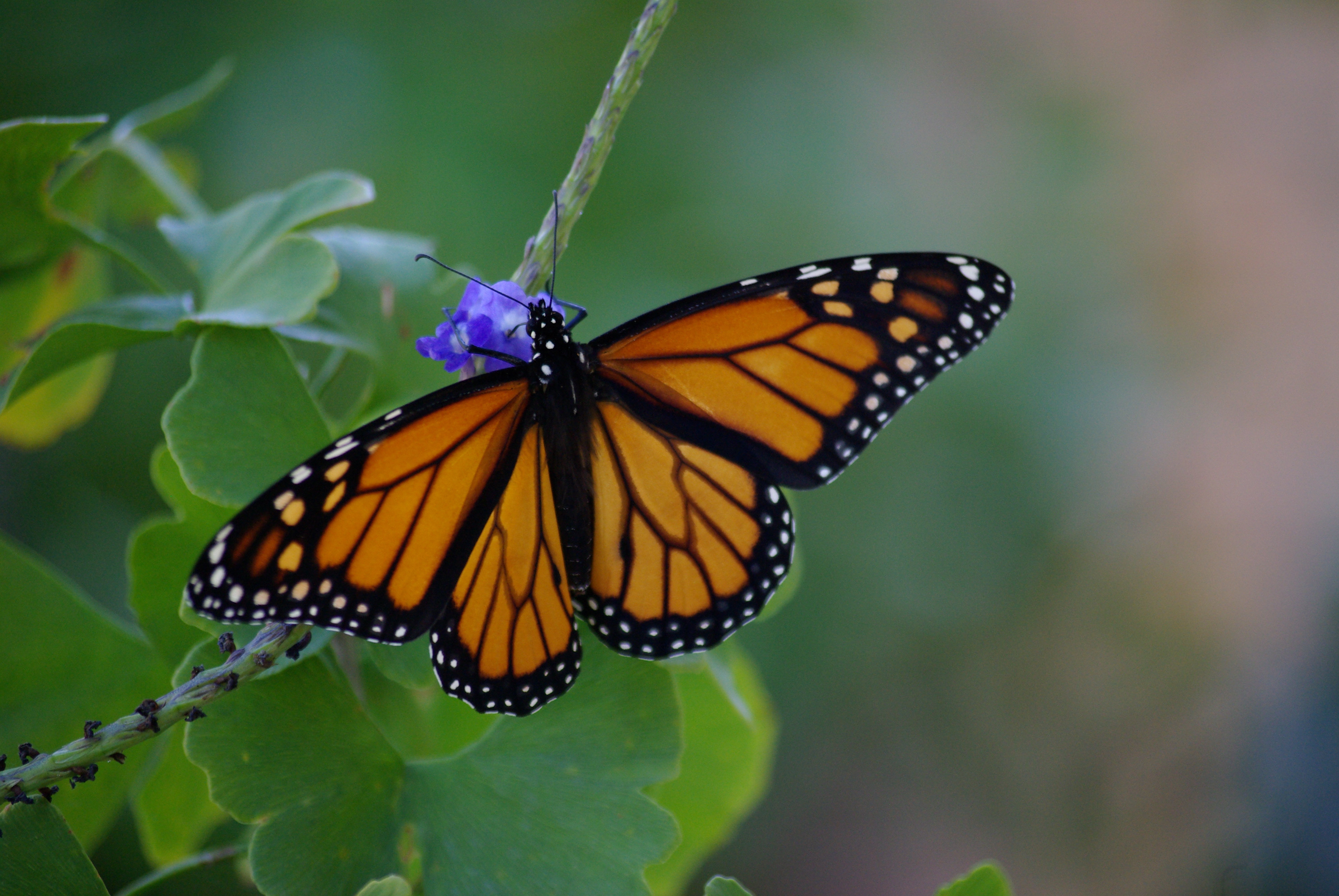
Great mysteries of science, history and spirit call to us:  How do the monarch butterflies do it?

Monarch butterflies (Danaus plexippus) fly north from their enclave in Mexico every spring, stopping to lay eggs on milkweed plants.  After a migration of several hundred miles, that first group that left Mexico dies off.  Their offspring hatch in a few days, devour the milkweed, make a chrysalis, metamorphose into butterflies, then fly farther north, where they repeat their parents’ behavior:  Lay some eggs, and die.  Within three generations, they’ve spread north into Canada.

Kathryn's butterfly plantings, October 2010 - photo by Ed Darrell

Inviting the monarchs in: You can see how Kathryn worked to attract butterflies. In this photo, you can see the butterfly weed (a milkweed), red Turk's cap, and blue ageratum especially for the monarchs.

Then the fourth generation does something so strange and wonderful people can’t stop talking about it:  They fly back to Mexico, to the same trees their great-great-great grandparents left.  There they sip some nectar, get some water, and spend a lot of time hanging in great globs, huddling over the winter, to start life for generations of monarch butterflies the next spring.

Sometimes in Texas in October, we can see clouds of monarch butterflies winging south.  If we’re lucky, they stop to visit our backyards and gardens, and we might provide some water and nectar to urge them homeward.  Kathryn, of course, plants the stuff the monarchs like, to help them, and to give us a chance to see them.

Monarch habitat in Mexico is under severe stress and threat.  Late storms and early freezes decimated monarch populations over the last decade [yes, that’s the proper use of “decimated;” look it up].  Human plantings are more critical to the monarch butterflies than ever before.

Two years ago Kathryn and I spent a September morning outside the library at Lawrence University, in Appleton, Wisconsin, watching monarchs sip nectar from local flowers for their journey.  Those same butterflies — we hope — passed through Texas a couple of weeks later.

Two weeks ago . . . well, see for yourself:

Monarch butterfly on blue porterweed, Dallas, TX October 2010 - photo by Ed Darrell IMGP5343

A monarch butterfly feeds on blue porterweed in Kathryn's garden, October 2010 - photo by Ed Darrell

Monarch butterfly on blue porterweed, Dallas, October 20101 - photo by Ed Darrell IMGP5347

. . . we're here with the camera, little guy, just open up those wings, please . . .

Monarch  butterfly on blue porterweed, Dallas, Texas October 2010 - photo by Ed Darrell IMGP5345

That's it! Beautiful! Have a safe trip, and come back next spring, will you?

Resources, more:

Conoclinium coelestinum


Literary mushrooms in Rockport, Maine

October 20, 2010

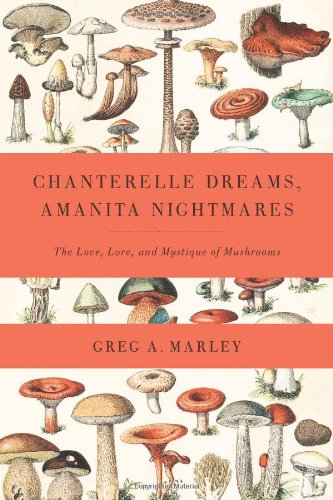
Greg Marley’s new book on mushrooms is out, and there is a launch party set for October 30, in Rockport, Maine.

Can you be there?

Greg’s book party:

Book Release Party and Mushroom Talk

Chanterelle Dreams, Amanita Nightmares, by Greg Marley
Cover of Chanterelle Dreams, Amanita Nightmares, by Greg Marley

Saturday, October 30 from 4-6:00 pm
at Farmers Fare on Route 90 in Rockport [Maine]
Light refreshments served and beverages available

Chanterelle Dreams, Amanita Nightmares: The Love, Lore and Mystique of Mushrooms

Welcome a new book by Greg Marley, celebrating the wonder and mystery of mushrooms. Enjoy a readable, captivating and informative collection of great mushroom stories. From world-class edibles (with recipes) to the most deadly, learn about the mushrooms in your neighborhood and how to invite them into your life, or even how to grow your own.


Hey, if you’re in the neighborhood, drop in.


How evolution makes bedbugs resistant to DDT

October 12, 2010

Our internet’s best expert in bedbugs, Bug Girl, recently featured another post relating how DDT drove evolution of bedbugs, so that bedbugs are no longer susceptible to DDT.  You should go read what Bug Girl said.

And you can view the video here, too; let’s spread the word, eh?

As Bug Girl describes it:

I discovered that bed bug evolution–specifically resistance to pesticides–was also the subject of the National Evolutionary Synthesis Center‘s podcast this month.  A FASCINATING interview with one of the grand old men of evolutionary genetics, James Crow.  He worked on DDT resistance back in the late 40s and 50s.

Watch, and increase your knowledge.


Want to teach evolution? Then be ready for THIS!

August 25, 2010

Threat to Bug Girl, Child of Satin

What would the police make of such a threat?

Bug Girl lifts the tent flap to show us just a little of what it’s like to be a teacher of evolution, including mysterious threats made on notes left under windshield wipers.

At least, I think it’s a threat.  (“If you teach evolution, I’ll make you giggle till you choke!”)

I figure that note came from the sort of person who would pray for this to happen to a good professor of biology.

(Do you think the note writer was trying to say something about the sheets upon which Bug Girl’s parents frolicked?)


University of Arizona’s “malaria-proof” mosquito

July 15, 2010

This could be good news:  A genetically-altered mosquito that doesn’t harbor the malaria parasite, and so cannot pass it along to humans it bites in its later life.

One more way to end the use and production of DDT.

Press release from the University of Arizona (one of my alma mater schools):

The first malaria-proof mosquito

Scientists at the University of Arizona have achieved a breakthrough in the fight against malaria: a mosquito that can no longer give the disease to humans

IMAGE: Michael Riehle, holding genetically altered mosquitoes, and his team work in a highly secure lab environment to prevent genetically altered mosquitoes from escaping.

Click here for more information.

For years, researchers worldwide have attempted to create genetically altered mosquitoes that cannot infect humans with malaria. Those efforts fell short because the mosquitoes still were capable of transmitting the disease-causing pathogen, only in lower numbers.

Now for the first time, University of Arizona entomologists have succeeded in genetically altering mosquitoes in a way that renders them completely immune to the parasite, a single-celled organism called Plasmodium. Someday researchers hope to replace wild mosquitoes with lab-bred populations unable to act as vectors, i.e. transmit the malaria-causing parasite.

“If you want to effectively stop the spreading of the malaria parasite, you need mosquitoes that are no less than 100 percent resistant to it. If a single parasite slips through and infects a human, the whole approach will be doomed to fail,” said Michael Riehle, who led the research effort, the results of which will be published July 15 in the journal Public Library of Science Pathogens. Riehle is a professor of entomology in the UA’s College of Agriculture and Life Sciences and is a member of the BIO5 Institute.

Riehle’s team used molecular biology techniques to design a piece of genetic information capable of inserting itself into a mosquito’s genome. This construct was then injected into the eggs of the mosquitoes. The emerging generation carries the altered genetic information and passes it on to future generations. For their experiments, the scientists used Anopheles stephensi, a mosquito species that is an important malaria vector throughout the Indian subcontinent.

The researchers targeted one of the many biochemical pathways inside the mosquito’s cells. Specifically, they engineered a piece of genetic code acting as a molecular switch in the complex control of metabolic functions inside the cell. The genetic construct acts like a switch that is always set to “on,” leading to the permanent activity of a signaling enzyme called Akt. Akt functions as a messenger molecule in several metabolic functions, including larval development, immune response and lifespan.

When Riehle and his co-workers studied the genetically modified mosquitoes after feeding them malaria-infested blood, they noticed that the Plasmodium parasites did not infect a single study animal.

IMAGE: Under UV light, this mosquito larva reveals a red fluorescent marker in its nervous system, causing eyes and nerves to glow. The marker’s presence tells the researchers in Riehle’s…

Click here for more information.

“We were surprised how well this works,” said Riehle. “We were just hoping to see some effect on the mosquitoes’ growth rate, lifespan or their susceptibility to the parasite, but it was great to see that our construct blocked the infection process completely.”

Of the estimated 250 million people who contract malaria each year, 1 million – mostly children – do not survive. Ninety percent of the number of fatalities, which Riehle suspects to be underreported, occur in Sub-Saharan Africa.

Each new malaria case starts with a bite from a vector – a mosquito belonging to the genus Anopheles. About 25 species of Anopheles are significant vectors of the disease.

Only the female Anopheles mosquitoes feed on blood, which they need to produce eggs. When they bite an infected human or animal, they ingest the malaria parasite.

Once the Plasmodium cells find themselves in the insect’s midgut, they spring into action. They leave the insect’s digestive tract by squeezing through the midgut lining. The vast majority of Plasmodium cells do not survive this journey and are eliminated by the mosquito’s immune cells. A tiny fraction of parasite cells, usually not more than a handful, make it and attach themselves on the outside of the midgut wall where they develop into brooding cells called oocysts.

Within 10-12 days, thousands of new Plasmodium cells, so-called sporozoites, sprout inside the oocyst. After hatching from the oocyst, the sporozoites make their way into the insect’s salivary glands where they lie in wait until the mosquito finds a victim for a blood meal. When the mosquito bites, some sporozoites are flushed into the victim’s bloodstream.

“The average mosquito transmits about 40 sporozoites when it bites,” said Riehle, “but it takes only one to infect a human and make a new malaria victim.”

Several species of Plasmodium exist in different parts of the world, all of which are microscopically small single-celled organisms that live in their hosts’ red blood cells. Each time the parasites undergo a round of multiplication, their host cells burst and release the progeny into the bloodstream, causing the painful bouts of fever that malaria is known and feared for.

Malaria killed more soldiers in the Civil War than the fighting, according to Riehle. In fact, malaria was prevalent in most parts of the U.S. until the late 1940s and early 1950, when DDT spraying campaigns wiped the vectors off the map. Today, a new case of malaria occurs in the U.S. only on rare occasions.

The severity of the disease depends very largely on the species of the Plasmodium parasite the patient happens to contract.

“Only two species of Plasmodium cause the dreaded relapses of the disease,” said Riehle. “One of them, Plasmodium vivax, can lie dormant in the liver for 10 to 15 years, but now drugs have become available that target the parasites in the liver as well as those in the blood cells.”

That said, there are no effective or approved malaria vaccines. A few vaccine candidates have gone to clinical trials but they were shown to either be ineffective or provide only short-term protection. If an effective vaccine were to be developed, distribution would be a major problem, Riehle said.

Researchers and health officials put higher hopes into eradication programs, which aim at the disease-transmitting mosquitoes rather than the pathogens that cause it.

“The question is ‘What can we do to turn a good vector into a bad vector?'” Riehle said.

“The eradication scenario requires three things: A gene that disrupts the development of the parasite inside the mosquito, a genetic technique to bring that gene into the mosquito genome and a mechanism that gives the modified mosquito an edge over the natural populations so they can displace them over time.”

“The third requirement is going to be the most difficult of the three to realize,” he added, which is why his team decided to tackle the other two first.

“It was known that the Akt enzyme is involved in the mosquito’s growth rate and immune response, among other things,” Riehle said. “So we went ahead with this genetic construct to see if we can ramp up Akt function and help the insects’ immune system fight off the malaria parasite.”

The second rationale behind this approach was to use Akt signaling to stunt the mosquitoes’ growth and cut down on its lifespan.

“In the wild, a mosquito lives for an average of two weeks,” Riehle explained. “Only the oldest mosquitoes are able to transmit the parasite. If we can reduce the lifespan of the mosquitoes, we can reduce the number of infections.”

His research team discovered that mosquitoes carrying two copies of the altered gene had lost their ability to act as malaria vectors altogether.

“In that group of mosquitoes, not a single Plasmodium oocyst managed to form.”

At this point, the modified mosquitoes exist in a highly secured lab environment with no chance of escape. Once researchers find a way to replace wild mosquito populations with lab-bred ones, breakthroughs like the one achieved by Riehle’s group could pave the way toward a world in which malaria is all but history.

###

This study was funded by the National Institutes of Health.

Reference: Corby-Harris et al. Activation of Akt Signaling Reduces the Prevalence and Intensity of Malaria Parasite Infection and Lifespan in Anopheles stephensi Mosquitoes. Public Library of Science (PLoS) Pathogens, July 2010 issue: www.plospathogens.org

How do you like them genetic engineering guys now?


Snail zombies in our garden!

July 6, 2010

It became really apparent during the rains last week.

Snails crawl up the walls and plants around our patio, and appear to wait to die there.  We’ve moved them back down to the soil, and they climb up again.

Kathryn remarked at the army of snails on the garage wall, beneath a bird feeder . . . that was the clue.

I don’t think ours do that eye-stalk thing.  Worse for the parasites, most of the birds ignore the snails.

Tip of the old scrub brush to Kate at The Urban Primate.

MacDowell’s book kept me out of church for at least a decade.

In the later pages he talks about how many copies of the Bible there are, and he says that’s an indication of how accurate it is, and that it’s the truth.  That’s like saying any document I create becomes  more truthful the higher the number of Xerox copies I make.

I figured that was one of the stupidest claims ever made.  Maybe it was the crowd I was in with, but the more devout Christians (except for the Mormons, but that’s a different tale) swooned over the claim.  I thought that any belief system that was so devoid of logic, and which required adherents to abandon all reason, was foolish.

About five years ago I picked it up again when one of our youth ministers asked me about it, and I skimmed through it again looking for any cogent, careful and compelling argument.  Of course, this was long after law school and due diligence work in the law . . . I thought it more foolish than I had found it years before.

I summed it up this way for the youth minister:  If there were evidence, we wouldn’t need faith.  We call it a faith proudly, and we discuss the mysteries.  It’s a tragedy that MacDowell has been divorced from that sweet part of Christian discovery and leap of faith.  Were there evidence enough for a verdict, we’d not need faith, and it would be impossible to be anything other than an agnostic who has found the evidence.

Your mileage may differ, but if so, you need a tune-up.

Ed Darrell
Dallas


Quote of the moment: Jonathan Weiner’s Pulitzer-winning explanation of mosquitoes developing immunity to DDT

April 30, 2010

When evolutionists study these worldwide resistance movements, they see four classes of adaptations arising, because an insect under attack has four possible routes to survival.

Jonathan Weiner, author of The Beak of the Finch

Jonathan Weiner, author of The Beak of the Finch, a story of evolution in our time

First, it can simply dodge. Strains of malarial mosquitoes in Africa used to fly into a hut, sting someone, and then land on the hut wall to digest their meals. In the 1950s and 1960s health workers began spraying hut walls with DDT. Unfortunately in every village there were always a few mosquitoes that would fly in through the window, bite, and fly right back out. Millions of mosquitoes died, but these few survived and multiplied. Within a short time almost all of the mosquitoes in the villages were hit-and-run mosquitoes.

Second, if an insect cannot dodge, it can evolve a way to keep the poison from getting under its cuticle. Some diamondback moths, if they land on a leaf that is tainted with pyrethroids, will fly off and leave their poisoned legs behind, an adaptive trick known as “legdrop.”

Third, if the insect can’t keep the poison out, it may evolve an antidote. A mosquito species called Culex pipiens can now survive massive doses of organophosphate insecticides. The mosquitoes actually digest the poison, using a suite of enzymes known as esterases. The genes that make these esterases are known as alleles B1 and B2. Many strains of Culex pipiens now carry as many as 250 copies of the B1 allele and 60 copies of the B2.

Because these genes are virtually identical, letter by letter, from continent to continent, it seems likely that they came from a single lucky mosquito. The mutant, the founder of this particular resistance movement, is thought to have lived in the 1960s, somewhere in Africa or Asia. The genes first appeared in Californian mosquitoes in 1984, in Italian mosquitoes in 1985, and in French mosquitoes in 1986.

Cover of Jonathan Weiner's book, The Beak of the Finch, a story of evolution in our time

Finally, if the insect can’t evolve an antidote,it can sometimes find an internal dodge. The poison has a target somewhere inside the insect’s body. The insect can shrink this target, or move it, or lose it. Of the four types of adaptations, the four survival strategies, this is the hardest for evolution to bring off — but [entomologist Martin] Taylor thinks this is how Heliothis [virescens, a cotton boll-eating moth] is evolving now.

“It always seems amazing to me that evolutionists pay so little attention to this kind of thing,” says Taylor. “And that cotton growers are having to deal with these pests in the very states whose legislatures are so hostile to the theory of evolution. Because it is evolution itself they are struggling against in their fields each season. These people are trying to ban the teaching of evolution while their own cotton crops are failing because of evolution. How can you be a creationist farmer any more?”

Jonathan Weiner, The Beak of the Finch, a story of evolution in our time, Alfred A. Knopf 1994, pp. 254-255. The book won the Pulitzer Prize for general non-fiction in 1995.


Caucasian wingnuts

April 7, 2010

I’m stealing this one completely from P. Z. Myers’ Pharyngula. It’s just too good.

The daffodils are lovely — I recall when they’d bloom just about Easter in Utah, and Washington, D.C.  Here in Dallas, our daffies depart before March 15, often not bothering to stick around until Easter.

But the real treat is the tree in the background.  It’s just another tree early in the spring, not yet leafed out.  But this one is special.

Pterocarya fraxifolia (tree in the background) - common name, "caucasian wingnut"

Caucasian Wingnut Tree (Pterocarya fraxinifolia ) and native daffodils in Warley place Nature reserve. © Copyright Glyn Baker and licensed for reuse under this Creative Commons Licence.

Pterocarya fraxinifolia (tree in the background) – common name, “caucasian wingnut” – in the Warley Place Nature Preserve, in Essex, England. Photo by Glyn Baker.

Its common name is “caucasian wingnut.”  You can’t make this stuff up. Reality is always much more entertaining than fiction.

Wikipedia’s entry is primed for comedy:

Species

There are six species of wingnut.

Another species from China, the Wheel Wingnut with similar foliage but an unusual circular wing right round the nut (instead of two wings at the sides), previously listed as Pterocarya paliurus, has now been transferred to a new genus, as Cyclocarya paliurus.

Uses

Wingnuts are very attractive, large and fast-growing trees, occasionally planted in parks and large gardens. The most common in general cultivation outside Asia is P. fraxinifolia, but the most attractive is probably P. rhoifolia. The hybrid P. x rehderiana, a cross between P. fraxinifolia and P. stenoptera, is even faster-growing and has occasionally been planted for timber production. The wood is of good quality, similar to walnut, though not quite so dense and strong.

Japanese wingnuts?  Chinese wingnuts?  Tonkin wingnuts (for all you Vietnam war historians out there)?

Wow.  Just wow.

More, if you care:


Quote of the moment: Charles Darwin and the tangled bank

March 20, 2010

A tangled bank, near Sandwalk, Darwin's walking path near his home at Downe House - image by GrrlScientist

A tangled bank, near Sandwalk, Darwin’s walking path near his home at Downe House – image by GrrlScientist

The final paragraph of Darwin’s On the Origin of Species By Means of Natural Selection:

It is interesting to contemplate a tangled bank, clothed with many plants of many kinds, with birds singing on the bushes, with various insects flitting about, and with worms crawling through the damp earth, and to reflect that these elaborately constructed forms, so different from each other, and dependent upon each other in so complex a manner, have all been produced by laws acting around us. These laws, taken in the largest sense, being Growth with reproduction; Inheritance which is almost implied by reproduction; Variability from the indirect and direct action of the conditions of life, and from use and disuse; a Ratio of Increase so high as to lead to a Struggle for Life, and as a consequence to Natural Selection, entailing Divergence of Character and the Extinction of less improved forms. Thus, from the war of nature, from famine and death, the most exalted object which we are capable of conceiving, namely, the production of the higher animals, directly follows. There is grandeur in this view of life, with its several powers, having been originally breathed by the Creator into a few forms or into one; and that, whilst this planet has gone circling on according to the fixed law of gravity, from so simple a beginning endless forms most beautiful and most wonderful have been, and are being evolved.

More: